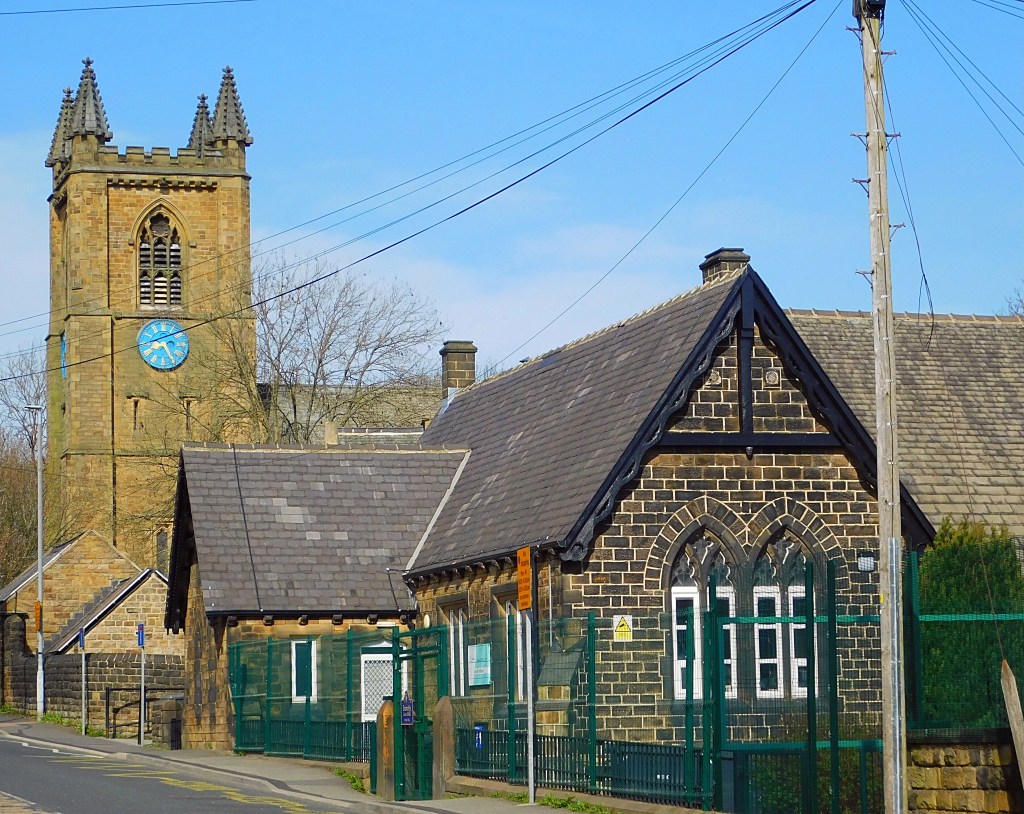
This is the latest update of the pages relating to my Batley St Mary’s one-place study, the details of which I announced here.
St Mary of the Angels, Batley
April saw the addition of eight new pages. Two other pages were updated.
The additions included five weekly newspaper pages for April 1916. I have accordingly updated the surname index to these During This Week newspaper pieces, so you can easily identify newspaper snippets relevant to your family.
More men who served and survived have been identified. I have updated that page accordingly. No new biographies for these men have been added this month. They will follow in due course.
I have written one biography for a War Memorial man: Lawrence Carney.
This month there are two new school log book pages. These are the ones for the Boys’ Department in 1914 and 1915.
Below is the full list of pages to date. I have annotated the *NEW* ones, plus the *UPDATED* pages, so you can easily pick these out. Click on the link and it will take you straight to the relevant page.
This is the latest update of the pages relating to my Batley St Mary’s one-place study, the details of which I announced here.
A selection of school log books – Photo by Jane Roberts
March saw the addition of seven new pages. Two other pages were updated.
Although March may therefore appear to have been quiet, I have been working away in the background on a new strand to the St Mary’s One-Place Study – the school. More of that later.
The additions included four weekly newspaper pages for March 1916. I have accordingly updated the surname index to these During This Week newspaper pieces, so you can easily identify newspaper snippets relevant to your family.
More men who served and survived have been identified. I have updated that page accordingly. No new biographies for these men have been added this month. They will follow in due course.
I have written one biography for a War Memorial man: Robert Randerson. A Batley rugby league player and St Mary’s school teacher, his first days at the school are also recorded in the brand new section to the study – the school log books.
These log books were kept regularly by the school – the infants, mixed and boys’ departments. They record the everyday routine of their running. Some of the entries may be mundane, register checking for example. But amidst these entries are some real gems – for example unusual incidents, disease outbreaks, school outings, and issues relating to individual school children or teachers. Interwoven through them is the religious context to St Mary of the Angels school, and how local and national events also impacted on it. They provide a snapshot of Catholic school life in a bygone time. Crucially for this study, these particular logs are not available online or in the archives.
This month there are two new pages relating specifically to these log books. The first is a general introduction. The second is the 1913 log book entries for the newly formed Boys’ Department. And it is on these pages Robert Randerson appears.
Below is the full list of pages to date. I have annotated the *NEW* ones, plus the *UPDATED* pages, so you can easily pick these out. Click on the link and it will take you straight to the relevant page.
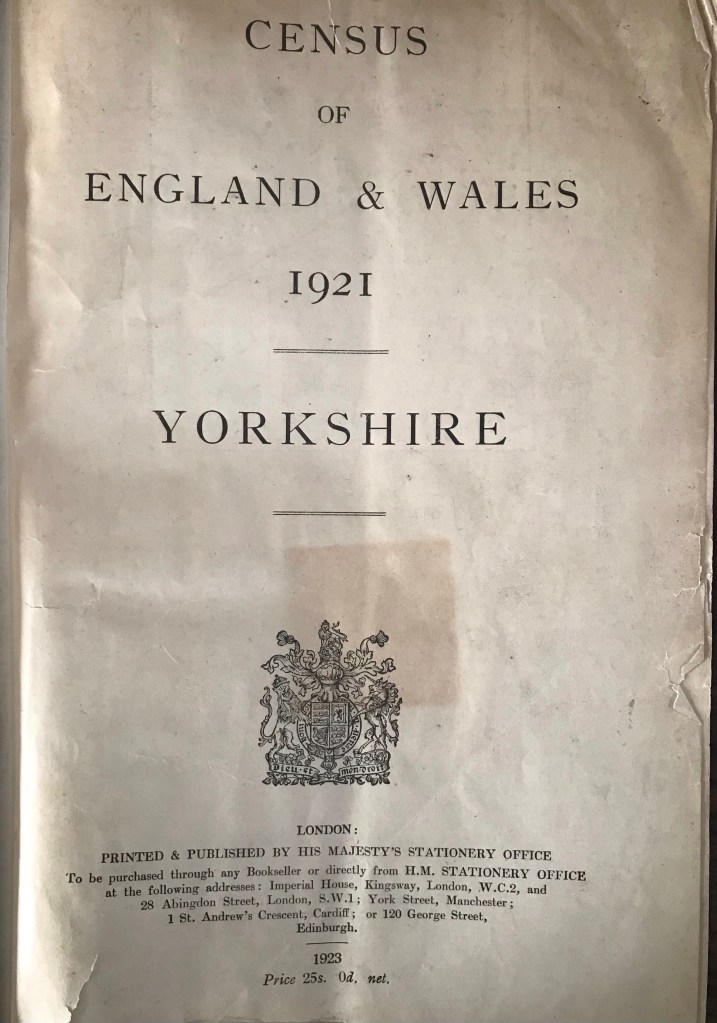
The dust is beginning to settle on the 1921 Census release, and I’ve had chance to familiarise myself with Findmypast’s online search, Here are some tips to help you get the best out of it.
1. Draw up your wish list and set your budget. I’m not entering into the debate over the cost of viewing the 1921 Census online, or the tie-in with Findmypast as sole provider for the immediate future. Only to say it is standard for these major record releases, and company’s have to recoup the massive digitisation costs involved. Filming, transcribing and indexing something on this scale does not come cheap. And there is opportunity to access the 1921 Census for free – at The National Archives (Kew), Manchester Central Library, and The National Library of Wales (Aberystwyth). But then you need to factor in transport costs, and possibly an overnight stay. Family history, like many other hobbies and interests, does cost.
What I will say is before you even start searching is draw up a wish list of those people you are most interested in, prioritise them, set your maximum budget and stick to it. Otherwise it is all too easy to get carried away.
I compiled my immediate wish list, for direct line ancestors alive in 1921, and stuck to it. It amounted to eight images. Any other records, including ones relating to my one-name study (there are 527 people named Aveyard in this census), and my Batley St Mary’s one-place study will have to wait until I can get to Manchester Central Library for free access, or until it all becomes part of the Findmypast subscription.
2. Play around with searches to familiarise yourself with the system. The second piece of advice I would give is don’t dive straight in. Play around with searches to get used to how the system works. That way you are going to get the best, and most accurate, results – and crucially minimise the risk of purchasing the wrong record.
3. Be aware of transcription errors. This release appears to be littered with them across the entire range of possible searches, and this will affect results. Try to keep an open mind when searching. Be flexible with searches, and alert to possible transcriptions errors.
For example, for one of my ancestors the Christian name Martin was incorrectly transcribed as Morton, perhaps signalling the transcriber as a fan of the Morton Farrier Genetic Genealogist book series! I did not automatically discount the entry. Based on other information I was able to identify it as a likely error and took the plunge. But it could, depending on the error scale, result in a negative search. And the pay-per-view angle may rule out speculative purchases.
There is a transcription error reporting mechanism if you purchase the transcript – as I said I’ve not done this, preferring to spend my money on the original image. If you have not purchased the transcript you can still report the error, but the method is via email to Findmypast, at transcriptsupport@findmypast.com. The link giving more details about this is here.
4. Make use of the Advance Search facilities. When you conduct a search you are given some basic information to enable you to determine if the result is the one for your family. For example, when searching for my great grandad Patrick Cassidy in Batley, the following clues are given.
Findmypast image
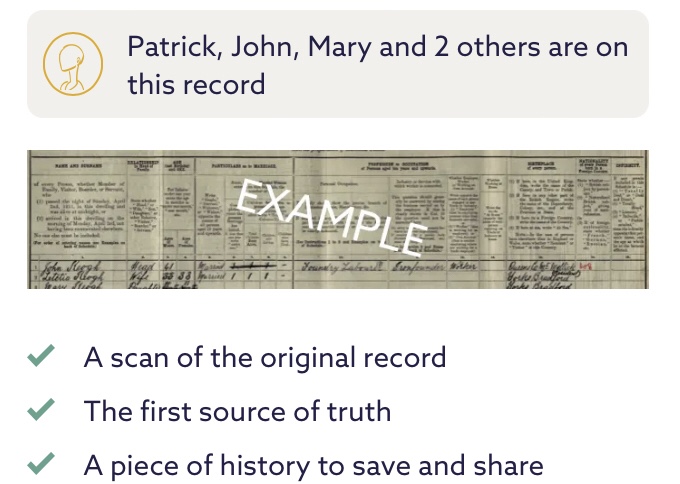
The hint says the record includes Patrick, John, Mary and two others. My problem with this was no John is linked to my great grandad’s family. And who are the two others? Can I confirm these names? Was this the correct family?
There is a simple way you can drill down this information to a more complete, granular level. Go to the Advanced Search. Leave the ‘Who’ boxes blank, and go down to the ‘Parish’ box and put in ‘Batley,’ and in other ‘Other Household Member” box type ‘Patrick Cassidy’. The results confirm the full names, birth year and birthplace of the other four members of the household, including Anne Cassidy, Mary Cassidy and Nelly Cassidy, plus Durham-born John Nixon. All this gave me confidence that I would be purchasing the correct record.
This is one example of an Advanced Search which worked well in this instance, though it may prove more challenging for common names. And some found Registration District worked better than Parish.
However, do not be put off. There are lots of other filters and options too. It is a case of playing with them to find the ones which help narrow the results suited to particular circumstances. And you can find lots of information simply through the free Advanced Search – and this may be sufficient to construct plans and spreadsheets for example for a one-place or one-name study.
One other thing to be aware of when searching on age is this census has a change. It gives it in years and months, with those under one month noted as such, rather than only years. This may affect searches, though it is always good practice to broaden age searches to give years +/- either side, as accuracy and ages in the census do not necessarily go hand-in-hand.
And, in a similar vein, do always keep at the back of your mind transcription errors and (in)accuracy of information provided by ancestors, which can skew results. Which leads onto Tip 5.
5. Be aware people may not be where expected, or tell the truth with the information they give. There’s always the possibility that people may not be with their family on census night. The timing of this census, 19 June, instead of early spring has added complications. People may have been on holiday.
There is also the issue of seasonal workers. My County Mayo-born grandpa, who by the mid-1920s was in Batley, looks to be over on a farm in Cheshire with two of his brothers in this census, working as a farm labourer. They are appropriately living in Irish Man’s Cottage! The men in this family did have a tendency to come over to England in the summer for seasonal farm labouring work, and this appears to be borne out in the 1921 Census. It may also be the case for others normally resident in Ireland but who came over to England seasonally to undertake work on farms. It is worth checking to see if they do feature.
And, as ever, be alert for those half-truths and downright misleading lies which always creep in and can affect your search.
Again it is a case of keeping an open mind – though the pay per view element of this release may curtail the ability to undertake speculative downloads. This is a luxury which may best be reserved for the free access locations at The National Archives (Kew), Manchester Central Library, and The National Library of Wales (Aberystwyth). But you can undertake the prepatory work from home using the free basic searches, short of any image purchase.
6. View the image, not the transcript. Linked to 3 (above), I would advise the image purchase option is always preferable to buying a transcript, even if it costs slightly more. The transcript may contain multiple errors which, unless you view the image, you will be oblivious to. Whereas if you view the image you can see exactly what the entry should say. And it may include details not referred to in the transcript. And there is always that added frisson of excitement of seeing the actual handwriting and signature of those completing the form.
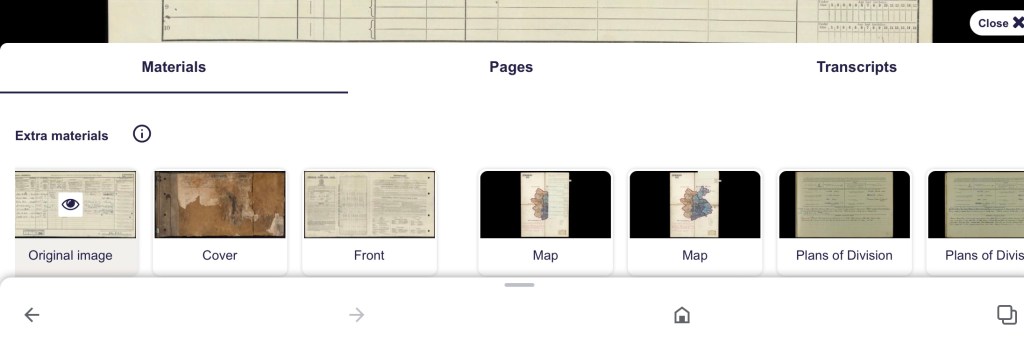
7. Make sure you click on the Extra Materials. Your purchase covers more documents than the original image. Don’t focus on this image at the expense of the ‘Extra Materials.’
‘Extra Materials’ available through purchasing the image – Findmypast
In these you will find the cover, which contains the RG15 Series Reference for the original household image, and Piece Number. Though I must admit my preferred method for obtaining the document reference is by downloading and saving the image (see 9, below), simply because the cover may be difficult to read and downloading/saving provides more accuracy by hopefully cutting out any enumerator error. Also be aware it is not a full reference number.
The ‘Front’ document contains that all-important address which is missing from the original household image. For more details about addresses see 8, below.
There are also maps which, besides pinpointing the area linked to the household, also have some useful background information – for example, population numbers, or details of any boundary changes.
The final files in these ‘Extra Materials’ are Plans of the Division. There may be more than one of these. The plans contain Enumeration District information, including boundaries and contents, basically the route the enumerator took. So, for example, for one set of my Hill ancestors, the Enumeration District where they lived comprised of:
Commencing at 1 Richmond Street taking all houses on left hand side to top odd nos. thence all houses in Vera Street, Crescent Street, Back Crescent Street all yards and Back Upton Street and down the left hand side of Upton Street to bottom even nos.
This is all vital information to pinpointing where the Hill family lived. This is particularly important if it is an area is unfamiliar to you, or if the streets have long-since gone. It will enable you to easily identify the area in old OS maps.
Note, once you have purchased an image it, along with the extra materials, are available to you each time you log on to Findmypast. So, if you missed them in your first eager foray into the census, you have not lost the opportunity.
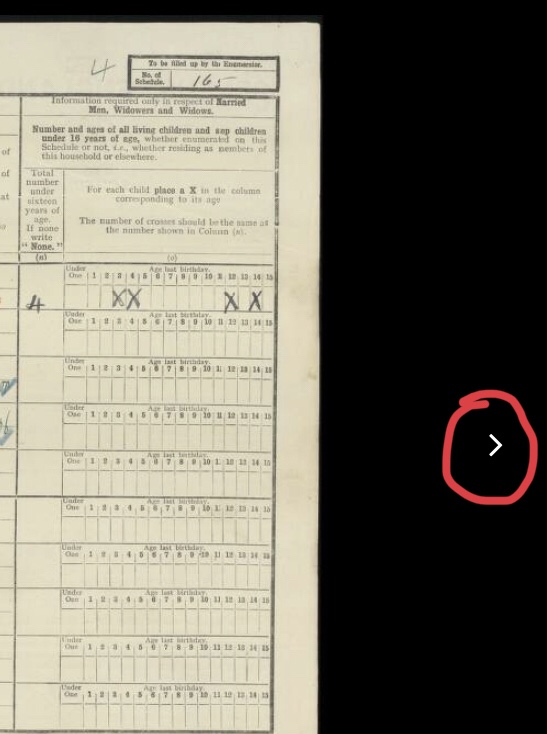
8. The address is not missing when viewing the image. Whilst it may not be immediately obvious, contrary to what some on social media believe, the address is there. There are two ways of accessing it. The ‘Extra Materials’ document suite includes one entitled ‘Front.’ This has the schedule which includes the address.
The same document can be accessed by clicking on the arrow to the right of the completed household schedule. Do be careful when using this method that you do not click too far as this will take you to the next household schedule and the option to buy it.
Clicking this arrow should take you to the address image – Findmypast
9. Download the images to save, including that all-important document reference. Always save the document images to ensure you always have access to them. The best way of doing this, and getting the clearest image, is by using the ‘download record’ facility. When saving this way the RG15 document reference and piece number is included in the file title. It is not the full reference number, but it is a start.
You can also get the document reference from the cover, which is in the extra materials.
It is good practice to note the document reference, and including it as part of the file title is ideal.
10. Take note of the employment information. The single most exciting information section in this census from my point of view is that on employment. Not only is there the occupation title, but for those working for an employer the name of that employer is provided, along with the place of work. This is fertile ground for further research to expand your knowledge of not only what your ancestor’s occupation was, but also where they worked, and investigation as to what business records survive – including any relating to employees.
For example, my husband’s 14-year-old grandma is described as a pottery paintress at Keeling and Co. Ltd, Dalehall, Staffs. I can now find out more about this pottery works.
My nana was a 16-year-old cloth weaver at J., T. & J. Taylor’s woollen manufacturers. West Yorkshire Archive Services has some company records which may be worth checking.
A whole series of my male ancestors worked in the coal mining industry. This census was taken during the coal miners’ strike. My ancestors do give their coal mining employment details, with the ominous words “Out of Work”. The names of their employers, and the specific coal mines, means I can now look at local papers to find out about the effect of industrial action generally locally, as well as how it affected specific coal mines. For me these include confirmation that my great grandfather did indeed work at Soothill Wood Colliery, Batley.
For my previous 1921 Census post, which looks at its background, includes some tips, has things to look out for, discusses why it is so important, & explains why I’m looking forward to it, click here.
Postscript: Finally a big thank you for the donations already received to keep this website going.
The website has always been free to use, but it does cost me money to operate. In the current difficult economic climate I am considering if I can continue to afford to keep running it as a free resource, especially as I have to balance the research time against work commitments.
If you have enjoyed reading the various pieces, and would like to make a donation towards keeping the website up and running in its current open access format, it would be very much appreciated.
Please click here to be taken to the PayPal donation link. By making a donation you will be helping to keep the website online and freely available for all.
This is the latest update of the pages relating to my Batley St Mary’s one-place study, the details of which I announced here.
St Mary of the Angels Church, Batley
In the past month I have added four weekly newspaper pages for December 1915. I have accordingly updated the surname index to these During This Week newspaper pieces, so you can easily identify newspaper snippets relevant to your family.
More men who served and survived have been identified. I have updated that page accordingly. No new biographies for these men have been added this month. They will follow in due course.
I have written one new biography for a War Memorial man, that of Thomas Finneran.
Finally for this month, I have added a new name to the page relating to biographies of men associated with St Mary’s who died but who are not remembered on the War Memorial.
Below is the full list of pages to date. I have annotated the *NEW* ones, plus the *UPDATED* pages, so you can easily pick these out. Click on the link and it will take you straight to the relevant page.
Forget the New Year countdown and the return of Big Ben’s bongs this year. Instead, like many other family historians, I’m counting the days down to 6 January 2022, the day which marks 1921 census release day. Its family clues and secrets have been hidden for over 100 years. But this is the day when they will finally be revealed.
But why are family and local historians so excited? What is its background? Why is it so important for family and local history? How can you access it?
I’ll try to answer those questions in this post.
Background: This was the census conducted in the immediate aftermath of the Great War, the Spanish flu pandemic and the introduction of voting rights for some women. It was a time of turmoil, upheaval and change.
The census was eventually taken on 19 June 1921, delayed for two months from its originally planned date of 24 April 1921, because of the state of emergency declared as a result of the coal miners’ strike.
Although care was taken to avoid holidays in the big industrial towns of the north, do be aware of the possibility the delay to the summer months may mean your family could be away from their expected residence.
What Information Will the Census Contain?
This census had the usual familiar mix of questions, but with some crucial omissions and additions from the 1911 Census. Questions included:
Name and Surname;
Relationship to the Head of Household;
Age – in years and (in a difference to previous censuses) completed months, with those under one month noted as such;
Sex;
Marriage or Orphanhood – For those 15 and over this means single, married, widowed or if the marriage has been dissolved. For children under under 15 this includes details about which parents are living/dead;
Birthplace and Nationality;
Personal Occupation (including attending school), Employment and Place of Work;
Married Men, Widowers and Widows also complete details about the number and ages of all living children and step children under 16 years of age, whether residing in the household or elsewhere.
The enumerator who collected the form was also responsible for recording the number of “living rooms” at the premises. And, for the first time, individuals in a household could also make separate confidential returns.
I’m disappointed that the so-called fertility question is missing from this census, with no information given about the number of completed years of marriage and the total number of children born within it, split between still living and dead. There question around blindness, deafness and dumbness has also gone.
But there are some big compensating questions. For example the changes to the questions around work will add a new family history component. This was introduced to find out about the travelling involved to get to a place of employment. The question around dissolved marriages is an interesting commentary about the recognition of increased availability of divorce. I am interested to see if any of my family is amongst the 16,682 people who declared themselves divorced on the returns. And, in light of the aftermath of the Great War and influenza pandemic, the recording of information for under 15s about whether both parents were alive or if either or both parents had died is a sad snapshot on the fragility of life.
If you want to familiarise yourself with the 1921 Census household form for England in advance of 6 January, you can download a copy here, courtesy of the ONS (Office for National Statistics) website.1
Why the Excitement with this Census Release? All new major record releases are exciting. But for many the 1921 Census will be particularly special. From the poignant moment of seeing family members in a census for the first or last time, to finding out the impact the War had on family and community structures; to discovering the employment and possibly employers of their ancestors in this period of industrial strife, to where they were – and who they were with – on census night. Then there’s societal changes at the start of the Roaring Twenties, like the increase of divorce, and changes in the work of women from previous censuses. And not forgetting the inevitable disentangling of truth from mistakes and pure fiction in the entries of our ancestors – no, they were not always honest on official documents!
On the more humorous side, will there be any quirky, or protest, entries this time? And what will be the most unusual or unexpected occupation or name?
All this information, even these errors, half-truths and lies, will shed new light on the lives and characters of our ancestors – the type of information we family historians are constantly seeking.
Crucially, it is an excitement not to be repeated for another 30 years, because the next census release will not be until 2051, with the 1951 Census.
For many, this will be the last chance to experience the anticipation and thrill surrounding a census release. The highs of finding that missing piece of the family history puzzle, to simply finding out a little more about the lives of your ancestors. To the lows of will the site crash with the volume of hits?
My Census Plans I have spent the Christmas period drawing up my family history census wish list.
I’m looking forward to the release on a personal family history level to find if my grandpa had made the move from Ireland to England at this point. If so, where was he living? And was he with family who had already made the move?
I also want to discover what various direct line ancestors and their families were doing. In particular, only three months before this census, my great grandfather died aged only 42. I want to see if there is any evidence of impact on his family. For example, were they still in the same home? Was the family still all together? Did my great grandmother have an occupation listed?
Also, being from a long line of coal mining ancestors, I want to see how many were still involved in the industry, especially given the census backdrop of a coal miners’ strike.
I have a wider interest in this census too, for my St Mary’s Batley One-Place Study. This focuses on the parish particularly in World War One, looking at not only those who served and died, but those who returned home, and the parish as a whole. I’m interested in seeing the impact both the war and the flu pandemic had on the parish population and family structures, with a particular interest in those families who had suffered war casualties. I’m also interested in any further Irish migration to the parish between 1911 and 1921. And I want to build up a bigger picture about employment in the parish. Batley was a significant textile town with the industry employing both men and women. The other major industry for the area was coal. Given this was the period of the coal miners’ strike, I want to see what impact this had on the census employment returns for the parishioners. Also, for returning military, was there a difference between their 1911 and 1921 employment? This, though, because of the scale, may be a longer-term plan based on a visit to one of the free access sites.
Note, the following section is now partially out-of date, with Findmypast’s wider release of the census for those with a relevant subscription.
How Can I View the 1921 Census? Now for the all-important administrative details about census access.
1. Who does this Census release cover? • This release covers 38 million people in England and Wales. Technically the full scope of it is England & Wales, the Channel Islands, the Isle of Man and the Armed Forces at sea or overseas (including in the nascent Irish Free State). 2. When can you access it? • The launch date is 00.01 GMT on 6 January 2022. 3. Where can you access it? • Online it will be available via commercial genealogy dataset provider Findmypast. They won the National Archives digitisation contract and have exclusivity for the 1921 census for up to three years. This will be the only online provider access during this period. • In-person access of the digital images is available at The National Archives, Kew. The census will also be available via Findmypast at the Manchester Central Library, and the National Library of Wales, Aberystwyth. • If you are still unsure, professional genealogists (including me) are undertaking census lookups. This may prove more efficient, accurate, cost-effective and ultimately less stressful. 4. How much does it cost? • You will be able to search the indexes on Findmypast for free. But a pay-per-view system will operate to actually view the transcripts and images. It costs £2.50 for every record transcript, and £3.50 for every original record image. • If you are a 12-month Pro subscriber there is a 10% discount. • Whether a transcription or image, purchasing the record of one individual will allow you to view the entire household’s census return in that purchased format. Unless that person was in an institution. 5. Can you access the 1921 Census for free? • Yes. It will be available to view digitally at The National Archives at Kew. It is also available to view free via Findmypast at Manchester Central Library and the National Library of Wales, Aberystwyth. 6. Which countries does the release cover? • The release applies to England and Wales. • Indexed images of the 1921 Scottish Census will be released on http://www.scotlandspeople.gov.uk and in the Scotlands People Centre, Edinburgh, in the latter half of 2022. • The 1921 Census was not taken in Ireland due to the Irish War of Independence. Censuses in Ireland and Northern Ireland were conducted in 1926.
Update: If you’re planning on going to Manchester Central Library to access the 1921 Census, the image below (posted on the Manchester and Lancashire Family History Society Facebook page) gives some important information. It’s essential pre-visit planning reading.
I’ll end this post with some snippets from Yorkshire to get you in the census mood.
The Sheffield Independent and Sheffield Daily Telegraph newspapers for 21 June 1921, reported on the case of three census wanderers. On census night, Sheffield police were tasked with searching highways and by-ways to round up those living outside. The three men, brought before the magistrates on 20 June and charged with lodging out, or wandering abroad without visible means of subsistence, included George H Jerram, of no fixed abode. He was found at 12.30am asleep in one of the Tinsley Park coke ovens with only 5d in his possession. He could not afford any lodgings.
Jerram remarked that “he was lodging out in France from August, 1914, to April, 1920,” and since coming out of the Army had only worked five weeks.”2
The Chairman discharged him, giving him the opportunity to fill out his census form.
I wonder if he will appear?
The Yorkshire Post of 21 June 1921 had a reporter going round an industrial quarter of Leeds with a census enumerator. Someone asked: “We have not put the dog on the paper. Will that be all right?”
I wonder if pets will feature though, something I wrote about in an earlier census piece. Please click here if you want to read this, and the other quirky entries which have appeared in previous censuses.
However, a dismal story of unemployment and overcrowding also emerged in this Yorkshire Post piece.
For example, an Irish woman and her brother (both single), their brother, sister-in-law, and seven children aged 3 to 19, living in four rooms, Three of the adults were out of work;
A coal-hawker and a son assisting him, both out of work, two errand boy sons out of work, and five children attending school, with only one son (aged 20) working;
An out-of-work boot riveter, his wife and six children, ranging from 23 years old downwards, living in three rooms.
Occupants were described as being terribly afraid they would be turned out of their squalid dwellings because of overcrowding. Authority could, and did, strike fear.
In Grimsby, forms revealed in one instance five families living in four rooms; in another seven families were in one house, with a further house consisting of eight families.
The Hull Daily Mail of 21 June 1921 reported on a census conundrum regarding a baby born after midnight but before 1am (British Summer Time), the equivalent of 11pm and midnight Greenwich mean time. Was the baby born too late for the census? No definite pronouncement was made, but the assumption was the system in operation at the time, British Summer Time, would govern such questions.
I wonder if anyone does have an example of a child recorded in this census who should technically not be?
And in an example of a potential missing entry, a correspondent’s letter appeared in the Halifax Daily Courier and Guardian of 25 June 1921. Essentially, a son completed the household form for his father (the head), himself, his sister, and his sister’s three children (two grandsons and a grand daughter of the household head). They all slept in the house on census night. However, when the enumerator collected the form, he said the grandchildren should not be recorded and crossed them out. The correspondent was concerned they would not now be counted.
Again, some of us may therefore have difficulty in finding people we know should be there. It may simply be down to a mis-transcription, or not adopting the correct research strategies. But it could also really be down to an omission, or deliberate dissembling to disguise identity. This is an example where a professional researcher may be able to help.
So get ready for 6 January, and the big day in the family history world. I hope you find what you’re looking for.
Postscript: Finally a big thank you for the donations already received to keep this website going.
The website has always been free to use, but it does cost me money to operate. In the current difficult economic climate I am considering if I can continue to afford to keep running it as a free resource, especially as I have to balance the research time against work commitments.
If you have enjoyed reading the various pieces, and would like to make a donation towards keeping the website up and running in its current open access format, it would be very much appreciated.
Please click here to be taken to the PayPal donation link. By making a donation you will be helping to keep the website online and freely available for all.
Thank you.
Footnotes: 1. For Wales and Monmouthshire, there was an extra question for each person (over three years) on whether they spoke English and Welsh, English only or Welsh only; and for Scotland (when that is released) watch out for the extra questions about whether each person (over three years) spoke Gaelic only and also whether they were entitled to benefits under the National Insurance (Health) Acts; 2. Sheffield Independent, 21 June 1921;
This is the latest update of the pages relating to my Batley St Mary’s one-place study, the details of which I announced here.
St Mary of the Angels Church, Batley
In the past month I have added four weekly newspaper pages for November 1915. I have accordingly updated the surname index to these During This Week newspaper pieces, so you can easily identify newspaper snippets relevant to your family.
More men who served and survived have been identified. I have updated that page accordingly. No new biographies have been added this month. These will follow in due course.
Finally for this month the biography for Second World War man Michael Flatley had been updated to include a colour photograph.
Below is the full list of pages to date. I have annotated the *NEW* ones, plus the *UPDATED* pages, so you can easily pick these out. Click on the link and it will take you straight to the relevant page.
Postscript: Finally a big thank you for the donations already received to keep this website going.
The website has always been free to use, but it does cost me money to operate. In the current difficult economic climate I am considering if I can continue to afford to keep running it as a free resource, especially as I have to balance the research time against work commitments.
If you have enjoyed reading the various pieces, and would like to make a donation towards keeping the website up and running in its current open access format, it would be very much appreciated.
Please click here to be taken to the PayPal donation link. By making a donation you will be helping to keep the website online and freely available for all.
This is the latest update of the pages relating to my Batley St Mary’s one-place study, the details of which I announced here.
St Mary of the Angels Church, Batley
In the past month I have added seven new pages. These include five weekly newspaper summary pages for October 1915. I have accordingly updated the surname index to these During This Week newspaper pieces, so you can easily identify newspaper snippets relevant to your family.
There is one new War Memorial biography, that of James Rush.
More men who served and survived have been identified. I have updated that page accordingly. No new biographies have been added this month. These will follow in due course. However, the biography of Thomas Donlan (senior) has been updated, with additional information.
The final new page for this month is an occupational one, that of a limelight operator.
Below is the full list of pages to date. I have annotated the *NEW* ones, plus the *UPDATED* pages, so you can easily pick these out. Click on the link and it will take you straight to the relevant page.
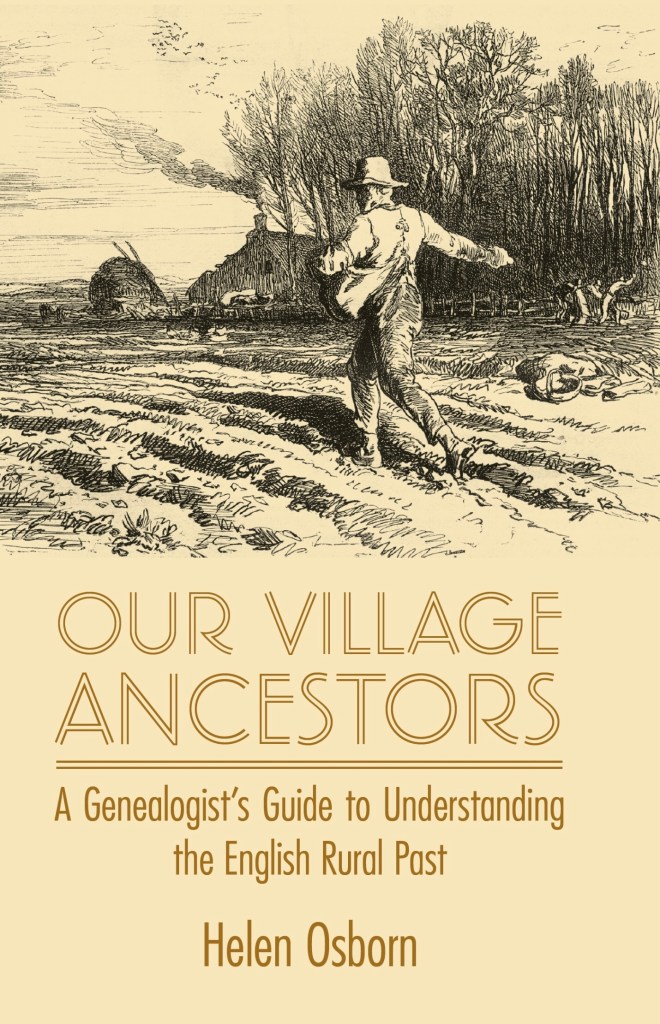
Helen Osborn’s Genealogy: Essential Research Methods is a key book for many family historians. Her latest book, Our Village Ancestors: A Genealogist’s Guide to Understanding England’s Rural Past, is certain to form another important element in the family history researcher’s toolkit.
Focussing on village life from the mid-sixteenth to the turn of the twentieth century, the book is aimed at those who want to fill in the details of the lives of their ancestors, and want to open up – and make best use of – the wealth of records out there to achieve this. Even those at an early stage of their family history journey will benefit from the information it contains.
Placing these records in their geographic and historic context is a theme which runs throughout the book, because as the book explains:
…in order to gather truly the evidence that we need to reconstruct families into genealogical trees, we should understand both the historical and local context as well as have a good understanding of the documents used.
Farming communities and countryside life is integral to the research of most family historians, with up until the nineteenth century the majority of people living a rural existence. As the book says:
Almost everybody with English roots will have an ancestor who lived in a village…
The book covers records applicable to a full range of village ancestors from the humble agricultural labourer to farmer ancestors, those in supporting village industries and crafts, right through to the more affluent landowners.
It contains eight chapters covering a multiplicity of these genealogical records, all of which combine to help build a picture of our village ancestors’ lives. The chapters are:
The Rural Past;
Parish and Family;
The Land and the Farmer;
The Church and the Tithe;
Supporting the Poor;
Work and School in the Countryside;
The Whole Community: Lists of Villagers and the Victorian Census; and
Leaving the Village.
There is also an appendix containing a handy list of dates of interest.
Each chapter introduces a series of key records, explaining the background to their creation, the information they contain, any particular issues or pitfalls associated with them, and how to interpret and locate them. This information is interspersed with examples of these records from across the country. Accompanying this information are fascinating facts, and tips, which aid family historians and provide food for thought in applying to research. There are also pointers as to how indirect evidence can be extracted from records, even when ancestors are not specifically mentioned. The individual chapters conclude with a Starting Points for the Researcher section which neatly summarises the records discussed in the preceding pages.
Through combining information from these sources, pictures of the lives of even quite ordinary ancestors can be built up. The book includes examples of such record-combining to reconstruct a person’s life, including a 19th century agricultural labourer and the harrowing story of the Eaves family.
The book is packed with information, and there are far too many records and information sources for me to mention. But they include parish registers and how to unpick information from them; manorial records; enclosure details; probate inventories; tithe maps and apportionments; glebe terriers; churchwardens’ accounts; vestry minutes; Quarter Sessions; various records relating to the old and new Poor Law; hearth tax; rate books; newspapers; and early censuses. Note, if you are looking for information about records created by Victorian national administrations, such as civil registration from 1837, these are not covered.
In addition to the records, I found the individual topics covered fascinating. From the social status of the farmer, the farm and its work, alongside wages and conditions, to tips on matching tithe maps with older records and using the early census to discover whole communities. And how many of us have ancestors who appear and disappear? The Leaving the Village chapter is full of strategies and tips for filling these gaps.
It is an immensely readable book (I completed it over a weekend). It is also one which will act as a reference, and refresher, to a series of genealogically valuable records for anyone researching their family history, running a one-place or one-name study, or with an interest in local history generally. And, although the focus is on village life, there is a cross-over in terms of many records to our more urban ancestors.
In conclusion, this is a worthy addition to any family historian’s bookshelf.
Our Village Ancestors: A Genealogist’s Guide to Understanding England’s Rural Past – Helen Osborn Publication date: 28 June 2021 Publisher: Robert Hale ISBN 9780719814167 Hardback £15.99
To mark the Spring Bank Holiday weekend in the UK, I decided to run a Twitter poll to find out what would be a family historian’s perfect way to spend it.
Essentially the premise was you have some free time….but, here’s the catch, only enough to do one family history thing. What will it be?
I did not specify things such as weather – my assumption being that it would be neutral, not gloriously warm or pouring with rain which might sway choices.
One other thing that may have impacted the voting is the peculiar circumstances in which we currently live. Yes, pandemic lockdown restrictions are easing – but some constraints on what we can do remain, including numbers around meeting family depending on venue.
Being a Twitter poll I was limited to four options. I chose:
Family history research;
Ancestral tourism – to include any out and about visits to places associated with ancestors, be it where they lived, or went to school and married, to burial place;
Family time/memory making; and
Organising your research (be it formally collating and logging search results, updating family trees, labelling photographs, etc.)
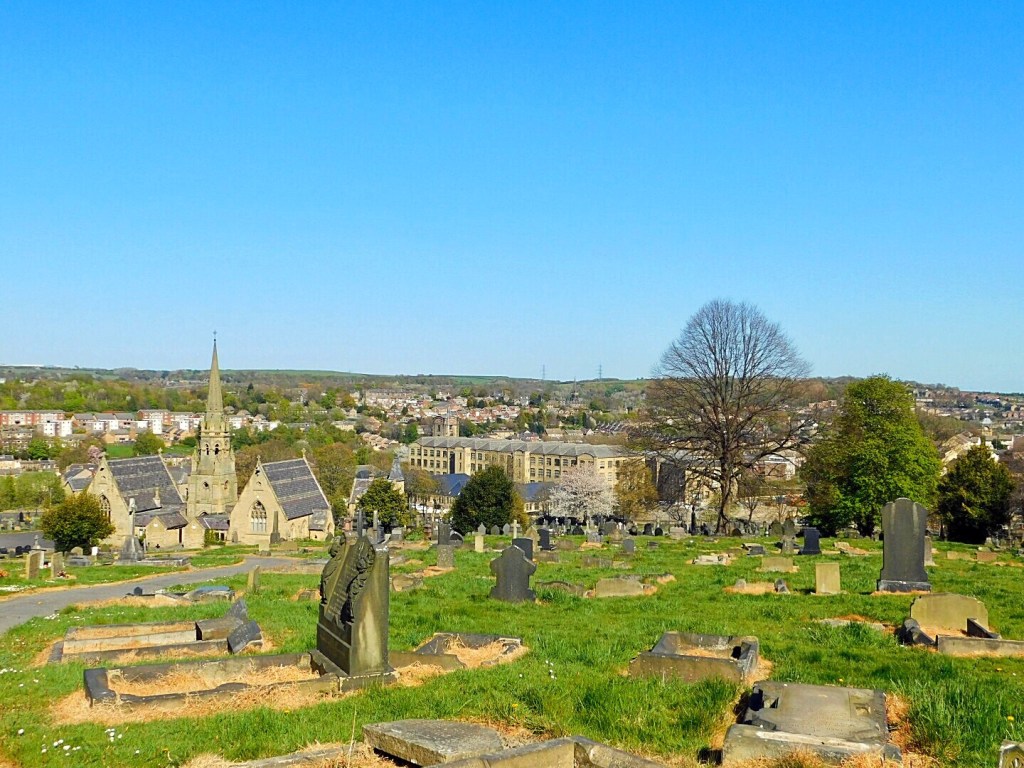
Batley Cemetery – Photo by Jane Roberts
This limitation was frustrating. I ruled archives out, it being a Bank Holiday. However, there were many other possible options I wanted to include: From having a distinct DNA choice like spending time on results analysis, to writing a family history book, biography or blog; from family history-related reading, to undertaking genealogy coursework; even preparing a family history talk, contributing to the work of a Family History Society, or participating in a collaborative crowd-sourcing project.
I would also have liked to get a feel for age ranges and experience of those who voted, as this might also impact on choices.
I realise that many family historians would want to do a combination of elements over the Bank Holiday, rather than focus on one thing. However, forcing one choice only meant that current priorities (and interests) were teased out.
The poll ran over 48 hours, ending at just before 9am GMT on Bank Holiday Monday. 112 people voted (a huge thank you), and it proved to be an interesting, and incredibly close-run, exercise. In fact, it went right down to the wire. Even in the final minutes there was nothing in it – a single vote either way would have swayed it.
The results were as follows:
It is apparent from this that people like results-based, or the more social and active family history, activities – the fun side of it. Perhaps even more so at holiday time. That’s no surprise. If you don’t enjoy it, why bother doing it?
And it is abundantly clear that the important background tasks such as methodical documentation, organising and collating research findings (and by extension planning) is regarded as more of a chore, an undertaking less suited to an entertaining Bank Holiday. Maybe that is an aspect that needs more attention – the importance of these mundane elements in contributing to more effective and better research.
The noteworthy take-away point though was the closeness of the result, with only the slimmest margin of votes separating the top three. Under normal everyday circumstances I would have expected research to be the runaway winner, rather than scraping over the line by a narrow squeak. The Bank Holiday element maybe key here – the desire, or need, to participate in more family-oriented activities. The backdrop of COVID may have made that even more of a priority.
And as for my perfect family history Bank Holiday weekend? I am in the camp where COVID coloured my choice.
The impact of the pandemic on family time made me reevaluate my priorities this Bank Holiday. With the exception of under a month last July, my area of Kirklees has been in some form of lockdown since March 2020. Even in that brief July 2020 window, number and location restrictions limited opportunities to get together. Meeting up with family has, in effect, been non-existent.
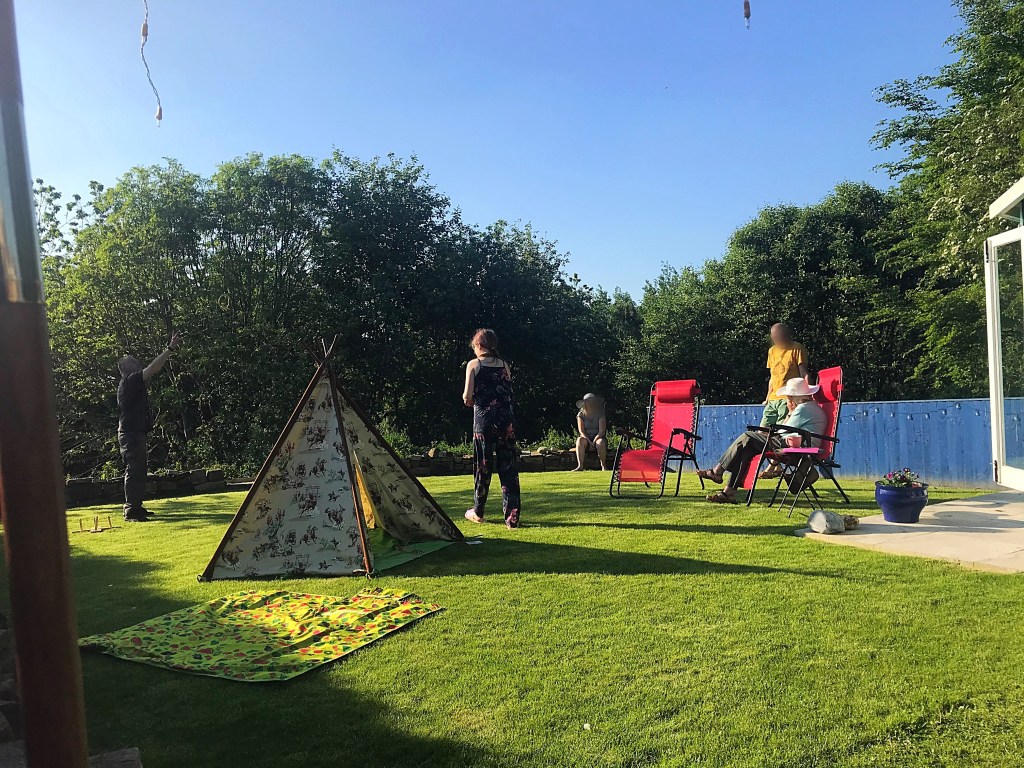
We had a family birthday this Bank Holiday weekend. To celebrate we had a small, socially distanced gathering in a garden to have a birthday tea and catch up generally. This was the first occasion we’ve been able to have any meaningful face-to-face quality time as a family since Christmas/New Year of 2019/2020. I will also be spending time with my daughter and 6-month-old grandson.
A socially distanced birthday – making memories
So for me family catch-up time and memory making trumped research, or any other family history activity, this Bank Holiday – and that time has been priceless.
Whatever your family history activity this Bank Holiday, hope it is an enjoyable one.
On the afternoon of Friday 7 May 1915, the Cunard liner the Lusitania was on the final leg of her crossing from New York to Liverpool. The morning fog had lifted, and it was now a fine, clear, calm day. At 2.10pm, around 14 miles off the Irish coast and the Old Head of Kinsale, she was struck by a torpedo fired by the German submarine U20. It took about 18 minutes for the ship to sink. Of the almost 2,000 on board, 1,198 men, women and children perished.1
It was a momentous international event, leading to anti-German riots across British cities and handing a huge wartime propaganda tool to the authorities. It was, in the initial aftermath, hoped by some that the USA would be drawn into the war. The circumstances surrounding the sinking is a huge topic in its own right which has merited many books, and one I am not covering in this post. Instead I am focussing on the local angle.
As a child I remember my grandma telling me about the Lusitania. She was only six years old when the ship went down. For her to recount her childhood memories around sixty years later shows the impact the sinking had on her.
What I failed to realise from my vague recollection of her tale of the ship was this event was not something that affected only the rich, famous and wealthy – the likes of American millionaire sportsman Alfred Gwynne Vanderbilt, American theatre producer Charles Frohman, world-famous Welsh tenor Gwynn Parry Jones, French-American stage and screen star Rita Jolivet, English-born playwright Charles Klein, and American artist and philanthropist Theodate Pope Riddle. Or even ‘ordinary’ crew and passengers from other areas of Britain.
It also had a massive local impact, with several of those on board having connections with the Batley, Dewsbury, Heckmondwike and Mirfield areas. Locally people would have known personally some of those on board, or at least known of them, making it an even bigger talking point in streets and homes across the area. That children were also involved would bring it to the attention of a younger audience. This, more so than anything, is why the sinking would have made a lasting imprint on my grandma’s mind.
This post covers a selection of local men, women and children caught up in the tragedy, people often overshadowed by the more famous on board.2 Some survived, one in particularly miraculous circumstances. Others though never made it home, including an entire family. Then there is the mystery man. Researchers to date have failed to uncover his origins. I believe he was a local man, and I include the progress I have made in identifying him.
Miss Olive North
Olive and her twin brother Roy Henderson North were born on 11 April 1889 in the Yorkshire village of Melbourne, near Pocklington.3 Their parents, James and Marion (née Barber) were schoolteachers whose work had taken them to Norfolk and Lincolnshire, as well as North Yorkshire.
By 1891 Marion, born in the Barnsley area, was living in Heckmondwike with her children Alice Lilian, George Garnett, Bernard Baines, Joseph Lambert, May and the twins. Another son, Frank Gordon, was with his maternal grandparents, also living in Heckmondwike. Even with this brood of seven youngsters at home in 1891, aged nine and under, Marion continued working as a teacher. It was no mean feat. James, who hailed from Heckmondwike, taught and lived elsewhere, in Skelton, North Yorkshire. This remained the arrangement up to and including the 1911 census, although at census-time in 1901 and 1911 some of the children are staying with him.
It was therefore not one of the town’s typical working class families that Olive grew up in.
At the time of the Lusitania sinking Marion North lived at Cambridge Street, off Cawley Lane, in Heckmondwike and taught at Battye Street Council School. Olive though had been away from the family home for some time, clearly having an adventuring spirit.
In the summer of 1913 the young milliner left her job. On 10 June, accompanied by her brother Frank, she departed from Liverpool on board the Megantic. The siblings sailed to Montreal, to visit their elder married sister, Alice, in Western Canada.4 Frank, a former soldier, was recalled on the outbreak of war. Olive, though, stayed on far longer than originally intended, finally leaving for New York in late April 1915 to sail back home 2nd class on the Lusitania. The ability to afford this standard of travel also serves to illustrate the social status of the North family.
Olive was aware of rumours that some disaster was going to befall the ship, writing home to that effect. But she added “if anything does happen to the boat I shall not be afraid to go into the unknown.”5 She also subsequently wrote:
When embarking on the “LUSITANIA” on May 1st 1915, some excitement was apparent, because of the rumour going around that the “LUSITANIA” would be sunk – and that this was to be her last voyage.6
Indeed, an Imperial German Embassy-placed advert had appeared in the New York Tribune on the morning of sailing, next to Cunard’s advertisement for the Lusitania’s departure, warning about the dangers of Atlantic voyages.
The rumours did prompt Olive to plan what action she would take in case of any incident, scoping out the best place to make for. She later attributed this foresight as the means of saving her life. Nevertheless, until the fateful day, she described the voyage as “pleasant and un-eventful” with “the wartime regulations of “Darkened ship” at night being the only different feature from a normal sailing.”7
On that 7 May afternoon, when the torpedo tore into the Lusitania, Olive and her party were just finishing lunch in the second class dining room. She described the impact as a terrible thud which seemed to be almost underneath their table. She also referred to a second explosion. One of the females in the party entreated Olive to stay with her in the state room so they could die together. But Olive told her “No, I am going to fight for my life”.8 This response must have given the woman renewed courage for she too was saved. In fact, one report states that all but two young men from the 11 passengers seated at Olive’s dining table survived.9
Olive described how the ship listed so badly it was difficult to climb the stair-ways. Furniture and crockery crashed to the floor in the dining room. Olive then realised she did not have her life-belt with her, so began to make her way to her cabin to collect it. On her way she met a ship’s steward who gallantly gave her his own life-belt, fixing it securely around her. It is not known if this selfless act cost the man his life.
Terrible scenes met Olive’s eyes when she finally reached the boat-deck, including the ghastly sight of a lifeboat full of people tipping into the sea as it could not be lowered properly. This prompted Olive to get out of the lifeboat she was in. People were swimming and floating in the sea below. Others were crushed to death on the boat deck. Some passengers jumped into the ocean clinging to chairs.
Olive remained standing there, and she remembered going down with the ship before finally losing consciousness on hitting the water. The next thing she recalled was fighting for breath as she surfaced, fortuitously finding herself near an upturned lifeboat to which she managed to cling. Hundreds of people were floating amongst the wreckage, clamouring for help. Many were jammed between pieces of wood. Olive’s heavy clothes kept her down in the water, which at first seemed warm.
After what seemed like ages she noticed a young red-haired man, possessing great strength, swimming in the water and dragging people towards a life raft for them to be hauled aboard by others. Some though were beyond his help, the ones wedged in the wreckage. But he managed to save Olive, along with over 20 others. At this point Olive began to feel the intense cold.
Another upturned nearby raft capsized totally, tossing its human cargo into the water. But the raft Olive was on was full, and could take on no more. They could only watch in horror as their former ship’s passengers disappeared beneath the waves.
Olive kept going and helped to row the raft she was on. It drifted for hours before they were finally picked up by the Steam Trawler, Brock. Here she was provided with dry men’s clothing (all that was available) and a cup of tea. One man climbing aboard became temporarily insane, believing the trawler was the Lusitania. The Brock finally reached Queenstown at about 10.30pm that night.
Olive’s mother heard about the fate of the Lusitania on Friday night. It was on Saturday morning that the North family received a telegram from Queenstown (today known as Cobh) with the terse, but emotive, words “Olive safe.” She arrived home in Heckmondwike on Monday night, haunted by her experience and thoughts of “the beautiful babies and the beautiful people” lost. She mournfully recalled that “the band was playing and the children were playing just before, and they are lost.”10
But Olive was amongst the fortunate ones. Other than the loss of all her onboard possessions, the emotional trauma, and bruising, she had survived.
In fact, she was well enough to travel down to Aldershot for the marriage of her twin brother Staff Sergeant Roy Henderson North ASC, which took place in the parish church on 12 May 1915. Olive was bridesmaid and witness to the marriage.11
In mid-August 1918 Olive married a man from her Heckmondwike home town, Percy Hanson. The marriage took place at Heckmondwike’s George Street Chapel. Percy was a Royal Naval Reserve wireless operator.12 Some accounts state that Olive met him whilst being rescued from the Lusitania by the Royal Navy cruiser the Juno, or have implied that Percy was on the Juno at the time. This is not true. The Juno did not take part in the rescue, being essentially ordered to remain in Queenstown for fear that the U-boat was still lurking and awaiting an opportunity to sink any RN rescue vessel that ventured out to help.13 Also, although Percy did serve on the Juno in 1914, at the time of the Lusitania sinking he was serving aboard the armed merchant cruiser Marmora.14 By a strange quirk of fate, and good fortune, he left the Marmora on 17 July 1918, weeks before his marriage. Days after his transfer, on 23 July 1918, the ship was sunk by a U-boat off the south coast of Ireland. Thus both Olive and her husband-to-be had cheated death at the hands of marauding German U-boats off Ireland.
Olive and Percy settled in Heckmondwike and were still living at Cawley Lane in 1939, with Percy working as a postmaster. The couple subsequently moved to Blackpool, and this was their residence at the time of Olive’s death on 4 July 1976.15
Mrs Florence Lockwood (née Robshaw) and children Clifford and Lily
Florence Robshaw (also known by the diminutive name of Florrie) was born on 13 June 1879 and baptised at St Philip’s parish church in Dewsbury in October 1880. Her parents were shoemaker William Robshaw and wife Mary Ann (née Auty).16 The family are recorded on the 1881 and 1891 censuses at Leeds Road, in the Soothill Upper area of Hanging Heaton, Dewsbury. As a child Florence attended the Eastborough Board School.
Florence Lockwood (née Robshaw)
Florence, a weaver, married cloth finisher Dick Lockwood at Batley parish church on 15 September 1900.17 The parish register entry incorrectly notes Dick’s father as Charles. Dick was in fact born in Batley on 8 September 1875, the son of cloth finisher George and Sarah Lockwood (née Illingworth).18
In 1901 the newly married couple lived at Warwick Cottages in the Warwick Road area of Batley. Florence still worked as a woollen weaver and Dick as a woollen cloth finisher. Dick’s employers included Messrs. Wormald and Walker’s Dewsbury mills.
By the time son Clifford was born on 6 March 1904, and baptised at Dewsbury Wesleyan Chapel on 28 March 1904, the couple had moved to Armitage Street in Ravensthorpe.19
In 1906 the Lockwood family took the huge decision to relocate to the USA. Florence’s uncle George Robshaw had emigrated there in the early 1880s, married, settled and raised a family, so it was not unchartered territory for them. Dick sailed on ahead of his wife and son. He is recorded departing Liverpool on 18 April 1906 on board the SS Friesland bound for Philadelphia, Pennsylvania.20 On the US immigration manifest Dick gave his occupation as a miner, and stated his destination was Alto[o]na, Pennsylvania.
The move was a success. Weeks later Florence and Clifford followed Dick out, sailing from Liverpool on board the White Star Line ship Teutonic on 11 July 1906. They arrived at Ellis New York on 18 July 1906. Florence gave her final destination as Frugality, Pennsylvania (around 14 miles away from Altoona), joining her husband. Perhaps Florence was displaying a little of that famous Yorkshire thrift and frugality of her own to get a cheaper infant fare. Clifford’s age on the passenger manifest is stated to be 11 months, rather than his correct age of over two years.21
By the time of the 1910 US Federal Census the Lockwoods were settled at Kearny Avenue, Kearny, in the Hudson District of New Jersey. Dick worked as a mill labourer. And the family had a new addition, two-year-old daughter Lily.
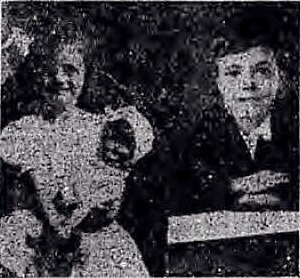
Lily and Clifford Lockwood
Florence, who had been socially active in Dewsbury as an enthusiastic worker for the Dewsbury Temperance Society, continued her community involvement in the USA. Some sources state she was the president of the New Jersey chapter of the Daughters of St. George, an organisation for women immigrants of British descent.22 She was certainly involved with the Kearny Star of Hope Lodge part of the organisation, holding the role of Financial Secretary for them in July 1912.23
In May 1911 Florence and her children made a summer visit home to family in England, sailing on the Arabic from New York to Liverpool. The catalyst for this homecoming appears to have been her mother’s possible ill-health and death.24 Her return journey to America was made on board the Campania, which docked at New York on 12 August 1911. She was accompanied on this return leg by her husband’s niece Beatrice Goodall (née Lockwood), Beatrice’s husband Willie, and their young son Leonard.25 The Goodall family had decided to make the move to the USA, with their destination being Kearny and their kinsfolk. I will return to the Goodalls later.
One poignant set of details we get from these sailing records are physical descriptions of the family. Florence was a tiny woman, standing a mere five foot tall. She had a dark complexion, black hair and brown eyes. The children took after her in colouring. Lily was too tiny to merit a height measurement. Clifford was three feet tall.
Two reasons were put forward for the fateful decision for Florence to make the 1915 wartime crossing to England with her children. US-based Robshaw relatives, with whom she spent the previous summer in Middletown, stated that her widowed father wanted her back home. These American Robshaws unsuccessfully tried to dissuade her from making the journey.26
However, this version of events was contradicted by her father, William. He believed the reason for her return was more to do with a shortage of work in America. As such Florence had decided to make the permanent journey back to England, with her husband due to follow a couple of months later once family affairs had been tied up overseas.
William wrote to Florence asking her to delay her journey because of the submarine threat, but she wrote back the week before the crossing to tell him she had booked her 3rd class passage, along with Clifford and Lily, on the Lusitania. Also returning would be her cousin Edith Robshaw, along with Dick’s niece Beatrice Goodall and her children.
Rather than having her frail, elderly father meet her at Liverpool, Florence informed him she would make her own way by train to Dewsbury, and would telegraph him details so he could meet her at Dewsbury railway station.
Florence never made it home. She, along with her two young children, and cousin Edith all perished. Her father learned of the ship’s fate from the calls of newspaper sellers, whilst waiting at home for the telegram from his daughter notifying him of her return train time.
One of the most disturbing set of images from the Lusitania tragedy are the photos of corpses recovered. These were used to try to identify the deceased. Body 69 is that of Lily Lockwood. Of all the local victims in this post she is the only one to be formally identified. She is buried in Common Grave B, at the Old Church Cemetery, Cobh, County Cork.
Dick Lockwood remained in America after his family’s deaths. In the 1915 New Jersey State Census he is living in Kearny, New Jersey, in the household of Florence’s uncle George Robshaw, working as a machinist. The 1920 US Federal Census expands on this, stating he was employed as a machinist in a steel works. He married Louise Ernestine Meyer in 1916 and went on to have a daughter, Ruth Victoria. He was widowed for a second time in February 1926.
One final postscript to the Lockwood story. Florence’s uncle,27 George Robshaw, submitted a compensation claim to the U.S.–German Mixed Claims Commission for the loss of Florence, Clifford and Lily. This commission adjudicated on losses arising from the sinking of the Lusitania. George made the claim rather than Dick, because he was an American citizen. His intention was to give any award to Dick. The claim was rejected because George personally suffered no damage which could be measured by pecuniary standards.28
The Goodall family – Willie and Beatrice (née Lockwood), and children Leonard and Jack
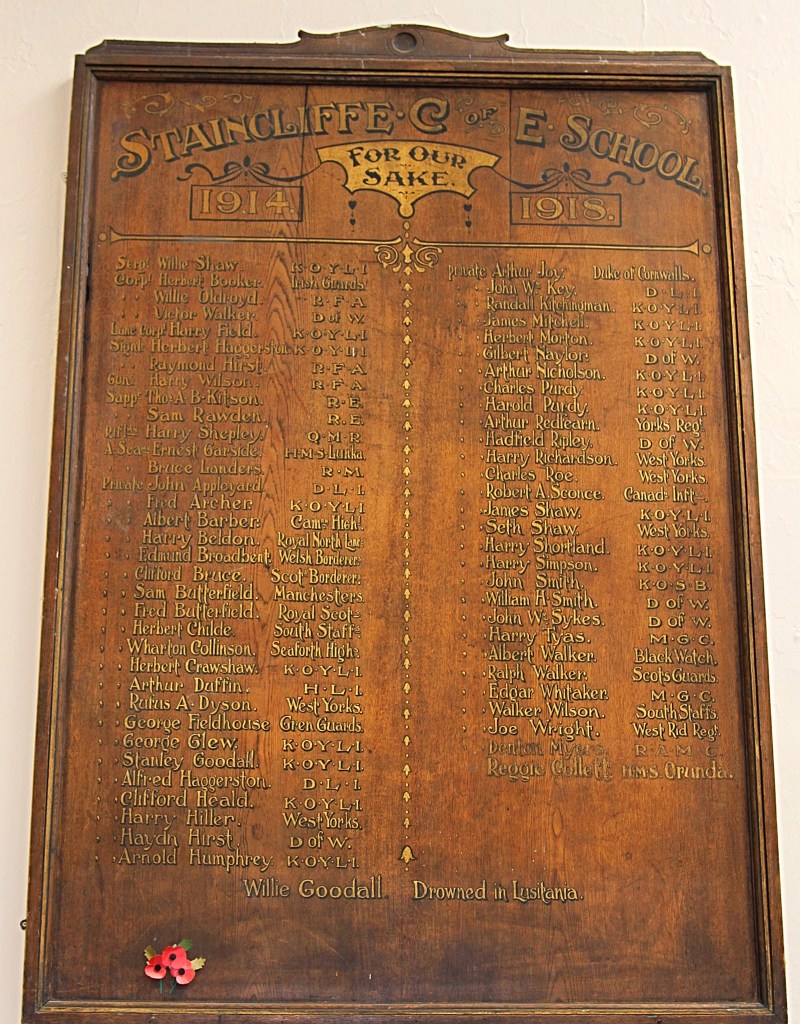
When names were being sought for inclusion on Batley’s town War Memorial in 1923, Willie Goodall’s mother put her son’s name forward. She explained he was Batley-born and went to America prior to the war. On his journey home with his wife and children he drowned in the Lusitania. The Borough Council rejected the claim. He is not on Batley War Memorial. However, his name does appear on Staincliffe Church of England School’s Roll of Honour.
Staincliffe School War Memorial, Including ‘Willie Goodall, Drowned in Lusitania’ – Photo by Peter Connor
In fact Willie Goodall was not even supposed to be sailing on the Lusitania that day. Only his wife, Beatrice, and children, Leonard and Jack, had initially booked passages. They were travelling back to England along with Beatrice’s Lockwood family relatives (see the section above).
Willie Goodall was born in Batley on 26 October 1881 and baptised at Staincliffe Wesleyan Methodist Chapel on 20 December that year.29 He was the second son of Staincliffe couple Fairfax and Emma Goodall (née Broadhead). In both the 1891 and 1901 censuses Willie, and his elder brother George Arthur, are not in the home of their parents and younger siblings at Tichbourne Street (1891) and Halifax Road (1901). They are recorded as living with their maternal grandparents, George and Elizabeth Broadhead, in the Staincliffe area of Batley, first at Bunkers Lane (1891), then (after George’s death) at Yard 5, 3 Halifax Road (1901). In the latter census Willie worked in the woollen textile industry as a woollen piecer.
By the time of his Batley All Saints marriage on 16 February 1907 he had progressed to follow his father’s textile career path, employed as a rag grinder. Companies he worked for included John Brooke and the Co-op’s Livingstone Mill, both based in Batley Carr. His wife, Beatrice, worked in the textile industry as a weaver, at the time of her marriage, also at the Co-operative Mills.30 Although some passenger sources record her as older than Willie, she was in fact his junior, her birth being registered in the September quarter of 1882.31 This is supported by census documents and the parish register marriage entry.
Willie’s bride, Batley-born Beatrice Lockwood, was the daughter of cloth finisher William Lockwood and his wife Adeline (née Haigh). William was the younger brother of Dick Lockwood, husband of Florence Robshaw. In fact, in the 1891 census the eight-year-old Beatrice Lockwood is living with her uncle Dick and her Lockwood grandparents at Cross Mount Street in Batley.
Later in 1907 the newly-wed Goodalls welcomed their first child into the world, a son named Leonard. Of a non-conformist religious persuasion, the family had their son duly baptised at Batley’s Taylor Street Chapel on 26 September that year.32
Mr and Mrs Goodall with eldest son Leonard
In April 1911 the young family are recorded living in the Staincliffe area of Batley, at 93, Halifax Road. Willie was still employed as a rag grinder, and Beatrice as a weaver. It was that year they took the plunge and moved to Kearny, New Jersey. As mentioned earlier, the family sailed from Liverpool to New York with Florence Lockwood and her children on board the Campania in August that year.
Once more the list of passengers for this voyage provides a physical description of the family. Willie stood at five feet two inches tall, with a dark complexion, brown hair and blue eyes. His wife was two inches taller with a fair complexion, blond hair and grey eyes. Leonard is incorrectly described as an infant, aged one year eleven months. No further details are provided for him.33 But once again is a Yorkshire family playing it crafty to sneak a cheaper fare for their child by knocking years off his age? Leonard was actually nearer to four years old.
The family settled in Kearny, New Jersey and this was where son Jack was born in 1914. However, life was tough, with Willie finding work hard to obtain. He switched jobs regularly, and the difficulty he had in securing satisfactory, lasting work is demonstrated by the range of unconnected industries these involved – from work in a cotton mill, to employment at a motor works and in a linoleum shop.
The employment situation further deteriorated after the outbreak of war, and this prompted the family decision to return home. However, only a week or so before the family planned to travel, Willie obtained what looked like a promising new post. He decided to stay on for two to three months longer to see how it went, leaving his wife and children to return to England on the Lusitania, in third class accommodation with her relatives.
This remained the belief of Willie’s family back home in England, even in the initial aftermath of the sinking. They did not realise Willie had changed his mind the day before the sailing, as the new job did not fulfil expectations. He made a last-minute decision to come home to England and surprise his parents. Grieving for the feared loss of Beatrice and the children, they now learned the crushing news of Willie’s fate in a remarkable way.
Early on in the voyage home, the Goodalls made friends with the Eddie and Annie Riley from Great Horton, Bradford. They were amongst the lucky ones, being saved along with their four-year-old twins Sutcliffe and Edith. Almost as remarkably, photos of the Riley family, taken in Queenstown in the days after their rescue, survive.
This image was originally posted to Flickr by National Library of Ireland on The Commons at https://flickr.com/photos/47290943@N03/29518574043. It was reviewed on 5 August 2020 by FlickreviewR 2 and was confirmed to be licensed under the terms of the No known copyright restrictions.
Once the Rileys got back to England, they voraciously read the newspaper accounts for any updates. These updates included one from the parents of Willie, stating he had remained in America whilst his family sailed home. Knowing this not to be true, the Rileys travelled to Staincliffe on the 15 September to break the news of Willie’s death to his parents in person.
When the Lusitania was torpedoed Willie was in the smoke-room and Leonard was running about playing on deck. Beatrice was also on deck, with baby Jack, talking to the Riley family. When the explosion occurred Beatrice ran off to seek her husband and eldest child, whilst the Rileys made for the lifeboats. They did not see the Goodalls again.
The Riley family, before returning to England, did make the grisly visit to the mortuary in Queenstown to see if they could recognise any members of the Staincliffe family, but failed to do so. Subsequently Cunard wrote to Willie’s parents stating, in what today seems like a remarkably insensitive manner:
We have now received some photographs of the unidentified bodies recovered and other photographs will be taken as the bodies are brought in, and will be sent here (Liverpool), and displayed for identification. We shall be very pleased to show you these photos, should you care to come to Liverpool….34
These are the sets of photos from which the body of Lily Lockwoood were identified. Unfortunately none of the Goodall family were recognised from them. They have no known graves.
Rev Herbert Linford Gwyer and wife Margaret Inglis Adams (née Cairns)
One of the most iconic incidents in the sinking involved newly-wed Margaret Inglis Adams Gwyer, and her husband the Rev. Herbert Linford Gwyer. The couple were on their way from Canada to Mirfield, for the Rev. Gwyer to resume his association with Yorkshire, taking up his appointment as curate at the parish church of the ancient Mirfield church of St Mary the Virgin.
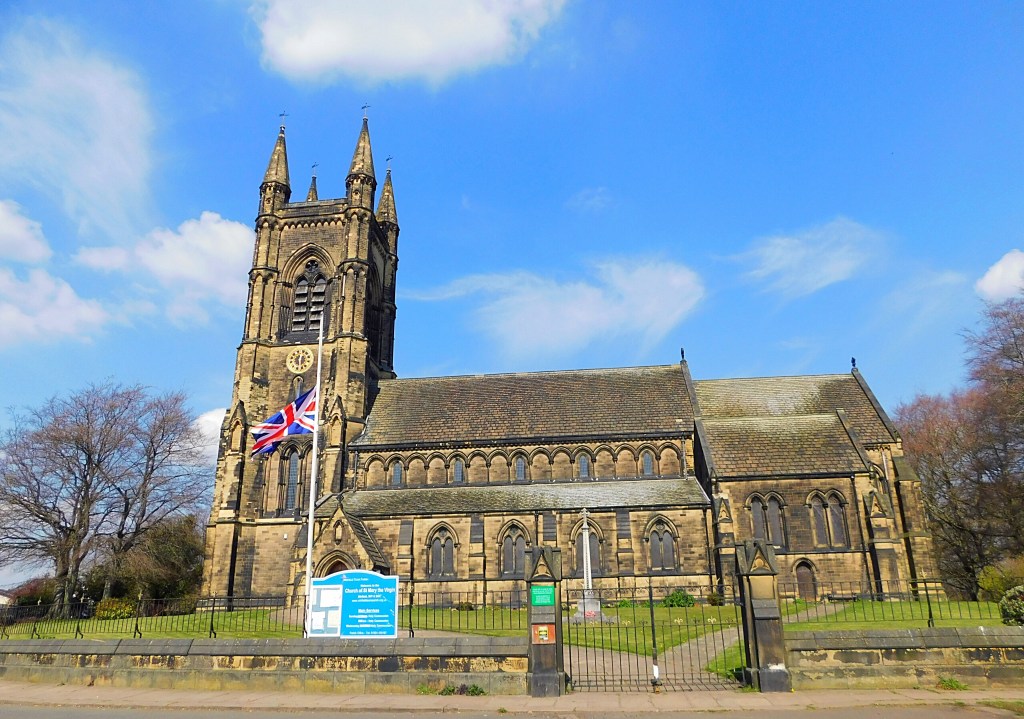
Mirfield St Mary the Virgin, the church to which the Rev. Herbert L. Gwyer was travelling on the Lusitania, after his appointment as curate there in 1915 – Photo by Jane Robert
Herbert Gwyer was born in London on 19 March 1883,35 the son of stockbroker36 John Edward Gwyer and wife Edith, née Linford. The family lived at Dorchester Place, Regents Park at the time of Herbert’s birth, and this was where his mother died the same day.37 Herbert’s baptism was swiftly arranged at St Paul’s, Lisson Grove on 20 March 1883.38
Educated at Uppingham public school, and Magdalene College Cambridge, Herbert was ordained a Deacon by the Bishop of Wakefield on 23 September 1906.39 His first appointment, as curate at All Hallows parish church, Kirkburton, lasted from 1906 to 1911.
Early in 1911 he left Yorkshire, to take up his new appointment as a missioner to the Railway Mission in Western Canada. In July 1914 he also took charge of the Empress Parish, on the west side of the Alberta/Saskatchewan border. Described as “indefatigable in his efforts for the betterment of the local society”40 it was through his endeavours that in the autumn of 1914 a new church edifice was erected.
Margaret Inglis Adams Cairns was born in Dunbar, Scotland on 1 July 1888.41 She was the daughter of local potato merchant William Cairns and his wife Alice. Latterly the family lived in the Warrender Park area of Edinburgh.
The Cairns family, comprising of William, and offspring Thomas, Margaret and Alice, left Glasgow on 2 April 1910 to settle in Canada. Son Norman followed them out later that year. The Cairns family became wealthy farmers with ranches in the Cochrane district, south of Calgary. Meanwhile Margaret made her home in the southern Saskatchewan town of Fort Qu’Appelle.42
It was whilst working in Canada the couple met. Herbert preached for the last time at St Mary’s Anglican Church, Empress, on 11 April 1915 and his resignation from the Railway Mission Society took effect from 12 April 1915. Three days later, in the Empress Church, he and Margaret married.43 They were to sail for England, and to Herbert’s new appointment in Mirfield, on 1 May 1915.
Like Olive North, the Gwyers travelled second class and were in the dining room when the torpedo struck. Writing to an Empress barrister later in May 1915, Herbert recounted the events of that day.
Unlike Olive, the Gwyers opted not to return to their cabin for lifebelts. But, in similarities to Olive’s account, Herbert told of the boat listing badly which prevented any safe lowering of the port side lifeboats – the one attempt he saw resulted in the craft being smashed against the liner’s side killing many. His other recollections were of crockery crashing; people rushing about on deck; and some jumping off the deck to the water below, which by now was full of wreckage and bodies.
Herbert and Margaret moved to the first class deck where the final lifeboat was being loaded. Margaret got one of the last places in it. Herbert remained a solitary figure on deck, many passengers having gone down to their cabins to retrieve valuables.
For a while Herbert stood quite alone waving and calling messages to his wife as the Lusitania went down. Then he made his bid for survival:
I shut my eyes and jumped, and by a merciful providence landed right into a boat in the water. Just then the Lusitania sank and her funnel came right over us. How we were not sucked down I cannot imagine. We all thought the end had come, and when I looked around Margaret was no longer in the boat.44 [From this written account by the clergyman it appears that, by some miracle, the Rev. Gwyer may have landed in the same boat as his wife.]
Herbert would never forget that awful moment. He went on to write:
It had been bad enough seeing her into the boat, but the sea was calm and I thought that with wreckage, etc., even if I wasn’t picked up I should be able to get on something till rescue came. The idea of being drowned never seemed near at all, but when she was washed overboard, I never thought I should see her again.45
Margaret’s ordeal now took on a whole new level of terror. As she was washed overboard, the rush of water sucked her down one of the Lusitania’s great funnels. As the tons of sea water poured on the furnaces below, enormous quantities of steam were generated. This forced a reaction, with jets of water, clouds of steam, oily black water and soot shooting forcefully back out of the funnel and into the sea. And in the midst of all this was an unrecognisable Margaret Gwyer, severely bruised, with injured ribs, clothes stripped away from her, and blackened with layers of soot and oil.
But, unbeknownst to her husband, she was alive, fished out of the water and saved. It was an extraordinary escape from death. And she was described as thoroughly cheerful despite her ordeal.
Herbert Gwyer met his wife again on a fishing boat. Initially, due to a combination of her dramatically changed appearance and his shock, he did not recognise her. But when he did, he could not begin to describe his sheer relief.
The Gwyers left Ireland and landed at Fishguard on Sunday morning, 9 May, with the waiting press eager to hear Margaret’s amazing escape – although many early newspaper reports described her as Herbert’s sister-in-law. They then travelled to Oxfordshire to recuperate with relatives before Herbert took up his appointment at Mirfield St Mary’s in July 1915. He remained in that post until late 1916. His last funeral is noted in the parish register in November of that year.
Rev Herbert Linford Gwyer
Between late 1916 and early 1919 Herbert served as a Temporary Chaplain to the Forces at the Royds Hall Huddersfield War Hospital. Margaret undertook V.A.D. work there. And then, with another of those strange coincidences life often throws, in March 1919 he was appointed Vicar of Christ Church, Staincliffe – the school of which houses the War Memorial inscribed with the name of Lusitania victim Willie Goodall.
Christ Church, Staincliffe, where Rev. Herbert L. Gwyer moved to in 1919, with Staincliffe Church of England School in the foreground, which contains the Memorial Plaque bearing Willie Goodall’s name – Photo by Jane Roberts
His subsequent religious appointments included Bishop of George in South Africa from February 1937. In 1952 he returned to England, becoming the Vicar of Amberley, in Sussex, serving there for five years before his retirement to Chichester in January 1957.
The experiences of Herbert Gwyer and his wife did not deter them from sailing. They appear on numerous passenger lists over the years. On 17 November 1960 the retired clergyman embarked on his final sea crossing. It was a last ironic twist of fate. Two days into the voyage from Southampton to South Africa, on board the Athlone Castle, his life ended, the primary cause being a cardiac arrest.46 45 years after the sinking of the Lusitania he did ultimately die at sea. Margaret survived him by almost 15 years, her death occurring on 16 April 1975.47
Arthur Taylor
The final Lusitania victim in this tale is mystery man Arthur Taylor. Numerous theories as to his identity have been put forward by researchers, but none are conclusive. And, so far, I have come across none who have reached my interpretation.
I believe the mysterious Arthur Taylor was a Thornhill Lees resident.
Official information about him is sparse. Other than his name, nationality (English), that he was travelling 3rd class, his occupation as a sand polisher and his last place of abode being Canada, there is little to go on. One newspaper lists him amongst those from Toronto feared lost, giving his address as Amsterdam Avenue.48
My lead came in the form of a newspaper snippet which reads:
There is unfortunately only too good a reason to believe that a Thornhill Lees young man, Arthur Taylor (30), of 17, Beatson Street, is one of the lost. Up till about three years ago, Taylor was a bottle-hand at the local works, but he then went out to Canada, and he has recently worked for a silver-plate company in Toronto. He is the youngest son of Mr. and Mrs. John Taylor, of Brewery Lane, and it was not known at the time of the disaster that he was coming home, though he had recently written to the effect that he would return shortly. On Monday his friends received a telegram from Toronto (but from whom is not known, presumably a friend of the young man), saying that he had sailed on the “Lusitania.” Inquiries were at once set afoot, and his name was found on a passenger list, but not in that of the survivors. On Thursday morning a letter was received from an official source at Liverpool that he was a survivor, but telegraphic communication with Queenstown, the same day, elicited the fact that this was incorrect. Mr. Arthur Taylor was amongst the third-class passengers. He has a wife and a little boy.49
Disentangling this mystery has not proved straightforward because of anomalies with the information provided in the report and with corroborating records.
However, based on my research, it appears the most likely candidate for the Lusitania’s victim is Arthur Taylor, son of Thornhill Lees-born glass bottle maker John Sykes Taylor and his wife Ann Elizabeth Kershaw.
The couple married at Thornhill Lees Holy Innocents church in 1876, but they did not stay local, eventually ending up in Shirehampton, which is located in the Bristol area of Gloucestershire. It was here their younger children were born, with Arthur being the youngest son. According to the baptism register of Shirehampton parish church, he was born on 27 November 1884.50
The move to the south west did not prove permanent, and the 1891 census found the family back in the Thornhill area. Their address in 1901 and 1911 was Chestnut Terrace, Thornhill Lees, and by this latter census John Sykes Taylor had switched from glass bottle making work to become a greengrocer and fruiterer.
Arthur though, followed his father’s old trade. In 1901 the 16-year-old worked as a glass bottle maker. This was almost inevitable given the area in which they lived, with the glass bottle works providing major local employment. The Kilner glassworks, producing bottles, jars and apothecary items, began at Thornhill Lees in 1842. By 1894 the firm employed as many as 400 hands (men, women and boys), and were making up to 300,000 bottles of all types per week.
20-year-old Arthur married Amy Booth on 28 October 1905 at the Thornhill church of St Michael and All Angels. She was the 21-year-old daughter of Sam and Clara Brook.51 Arthur and Amy’s son, John, was born on 19 April 1907, and baptised at the Thornhill Lees Holy Innocents church the following month.52
In the 1911 census the family abode was Thomas Street, Thornhill Lees, with Arthur (26) working as a glass blower and Amy as a cloth weaver in a woollen mill.
It was later that year when Arthur left home, unaccompanied by his wife and child, bound for America. He sailed from Liverpool on the RMS Baltic, and arrived at New York on 9 December 1911. The final destination given for the 27-year old bottle hand, whose last residence was Dewsbury, was Wallingford, Connecticut. This was to the farm of his uncle George Kershaw, the elder brother of Arthur’s mother.53
From the records we have a physical description of Arthur. Standing at five feet nine inches tall, with a medium complexion, brown hair and eyes, he was said to be in good health.54
The first anomaly in this record is place of birth, given as Newport, England – not Shirehampton. There is a village called Newport in Gloucestershire, which is around 19 miles north from Shirehampton – but it is a point to note.
Also, curiously, though married, he names his nearest relative in England as his father John, rather than his wife, Amy. The address given for John though is not Chestnut Terrace, but Brewery Lane, Thornhill Lees. This is the second anomaly. However the map below shows the proximity of the two locations.
Map showing the proximity of Chestnut Terrace to Brewery Lane, Ordnance Survey Maps – Six-inch England and Wales, 1842-1952, Yorkshire CCXLVII.NE Revised: 1905, Published: 1908 – National Library of Scotland, under the Creative Commons Attribution-NonCommercial-ShareAlike 4.0 International (CC-BY-NC-SA) licence
There is a further travel record for the now 29-year-old Arthur Taylor which adds more complications to the mix. This is in the form of a US Border Crossing card, when he left his new home in Toronto, Canada to travel to Buffalo, New York on 14 June 1913. By now he is working as a silver polisher, and again this record gives his birth place as Newport, England – not Shirehampton.55
The first discrepancy on the Border Crossing card was quickly resolved. He declared he had arrived in New York on the Baltic in December 1910, and had lived in Connecticut between 1910 and 1912. This would have meant he could not have been in England for the 1911 census. From migration records it was easy to show he simply got his dates mixed up by one year – his arrival was December 1911 as the passenger and crew lists I mentioned earlier show.
The next point of note is this record names his nearest relative as wife Emma, of 17 Beatson Street, Dewsbury. Whilst the address is a match for the 1915 newspaper report naming Arthur as a Lusitania victim, the name of his wife is incorrect – it should be Amy. However I have seen such name confusion between Amy and Emma in other genealogical records. And the 17 Beatson Street address does indeed link with Amy’s family. This is where her widowed mother Clara lived in 1911.
The final anomaly with the details on this card relate to physical description. There is a height discrepancy of a little over one inch. But, more glaringly, in this record his eyes are said to be blue, not brown. But once again this is not a unique error. For more details on an identical case see my post Don’t It Make My Brown Eyes Blue.
I have found no newspaper follow-up piece confirming Arthur’s fate. But, despite the anomalies, I believe the weight of evidence to date overwhelmingly points to Arthur Taylor of Thornhill Lees being a Lusitania casualty for the following reasons:
The newspaper report as a whole;
The occupational correlation – he worked in the silver plate industry according to the newspaper report, and is variously described as a silver polisher and sand polisher in other records from the period;
The Toronto abode;
The links between the man who emigrated in 1911 and the Thornhill Lees family; and
Crucially, despite exhaustive searches, there is no other candidate from the Thornhill/Thornhill Lees/Dewsbury area who would fit.
I may return to Arthur at a later date, if more evidence comes to light – including what became of his wife and child.
A British Government-produced replica of the medallion issued in Germany to mark the sinking of the Lusitania. The German manufactured medallion cited the incorrect date of sinking – 5 May 1915. The British used this error to infer the attack was premeditated, and the British reproduction of it became a fund-raising propaganda tool. (Click individual pictures to see full image) – Photographs by Jane Roberts
This small sample of 11 local Heavy Woollen District Lusitania connections give some idea of the impact of the ship’s sinking on communities up and down the country. It illustrates how the First World War touched the lives of people beyond those serving in the military. These people, too, became casualties as a direct result of the conflict. It seems fitting, therefore, that Staincliffe school remembered Willie Goodall as such.
Appeal for Help with Photographs: Sourcing copyright free photos of images for posts such as these is always problematic. I located several brilliant online images of those involved in this local history piece which I simply could not use. In the past I have been fortunate that, as a result of my research, families have subsequently shared photos and allowed me to publish them. If anyone does have any such photos I could add to this piece, I would be most grateful.
Postscript: Finally a big thank you for the donations already received to keep this website going.
The website has always been free to use, but it does cost me money to operate. In the current difficult economic climate I am considering if I can continue to afford to keep running it as a free resource, especially as I have to balance the research time against work commitments.
If you have enjoyed reading the various pieces, and would like to make a donation towards keeping the website up and running in its current open access format, it would be very much appreciated.
Please click here to be taken to the PayPal donation link. By making a donation you will be helping to keep the website online and freely available for all.
Thank you.
The searching, sourcing and referencing, including those equally important negative searches, for this post was huge. These references won’t be of interest to many readers. As such I’ve only included an abbreviated form below (and that is lengthy enough). If anyone does want more detailed references please contact me direct.
Notes: 1. Numbers range from 1,191 to 1,201. 1,198 was the number from the Cunard official lists; 2. I have not covered all of those with a local connection as the piece would be too long. Depending on interest I may do it at a later date; 3. 1939 Register and GRO Death Registration. As an aside, Roy is registered as Thomas in the GRO birth indexes; 4. UK Outwards Passenger Lists, The National Archives (TNA), Reference BT27 and the Dewsbury Reporter, 15 May 1915. Note the 1914 date given in the National Maritime Museum papers referred to at [6] is incorrect; 5. Dewsbury Reporter, 15 May 1915; 6. Various accounts of Olive North’s survival and rescue from the sinking or the RMS LUSITANIA, National Maritime Museum, Reference NRT/1; 7. Ibid; 8. Dewsbury Reporter, 15 May 1915; 9. Batley News, 15 May 1915; 10. Dewsbury Reporter, 15 May 1915; 11. Marriage Register of St Michael the Archangel parish church, Aldershot, Surrey History Centre, Reference 6927/1/21; 12. Leeds Mercury, 14 August 1918; 13. The catalogue description of the Olive North National Maritime Museum papers state she was returning to England aboard the Lusitania ostensibly to marry her fiancé Percy Hanson. The wedding was postponed until August 1918; 14. Percy Hanson, Registry of Shipping and Seamen: Royal Naval Reserve Ratings’ Records of Service, TNA, Reference BT 377/7/127199; 15. Olive North, England and Wales National Probate Calendar (Index of Wills and Administrations), Probate date 8 September 1976 16. Baptism Register, St Philip’s, Dewsbury, West Yorkshire Archives, Reference WDP9/439; 17. Marriage Register, Batley All Saints parish church, West Yorkshire Archives, Reference WDP37/34; 18. GRO birth registration December Quarter 1875, Dewsbury, 9b, Vol 618, mother’s maiden name Illingworth. Date of birth from U.S., World War I Draft Registration Cards, 1917-1918, New Jersey, Hudson County; 19. Dewsbury Wesleyan Chapel Baptism Register, West Yorkshire Archives, Reference WC21; 20. Passenger Lists of Vessels Arriving at Philadelphia, Pennsylvania, TNA, Washington D.C., Record Group Number 85, Series T840; 21. Passenger and Crew Lists of Vessels Arriving at New York, New York, 1897-1957, TNA, Washington D.C., Microfilm Serial: T715, 1897-1957; Line: 7; Page Number: 28; 22. Gare Maritime website, https://www.garemaritime.com/lusitania-part-12-gone-forever-dead-missing/; 23. The Paterson Morning Call, 1 July 1912; 24. Mary A Robshaw, GRO death indexes, Reference September Quarter 1911, Dewsbury, volume 9b, page 899; 25. Passenger and Crew Lists of Vessels Arriving at New York, New York, 1897-1957, TNA, Washington D.C., Microfilm Serial: T715, 1897-1957; Line: 18-23; Page Number: 167; 26. Middletown Daily Argus, 17 May 1915; 27. The Commission incorrectly states he was the brother of Florence; 28. Claim by the USA on behalf of George Robshaw, Docket No 2202, 7 January 1925, taken from Opinions in Individual Lusitania Claims and Other Cases: To May 27, 1925. Washington: G.P.O., 1925; 29. Staincliffe Wesleyan Methodist Chapel Baptism Register, West Yorkshire Archives, Reference C10/21/1; 30. Batley All Saints parish church Marriage Register, West Yorkshire Archives, Reference WDP37/36; and Batley News, 22 May 1915; 31. GRO birth registration September Quarter 1882, Dewsbury, 9b, Vol 586, mother’s maiden name Haigh; 32. England Births and Christenings, 1538-1975, FamilySearch, FHL Film Number 1657189; 33. Passenger and Crew Lists of Vessels Arriving at New York, New York, 1897-1957, TNA, Washington D.C., Microfilm Serial: T715, 1897-1957; Line: 21-23; Page Number: 167; 34. Dewsbury Reporter, 22 May 1915; 35. South African Biographical Index 1825-2005 (various dates); UK and Ireland Incoming Passenger List, arrival 2 April 1955, TNA, Reference BT26/1330; Sea Departure Card for his trip to the Cape in November 1960, TNA Reference BT27/1906Pt1/1/294 36. Subsequently he was secretary of the Provident Clerks Mutual Life Insurance Association, based at Moorgate, London; 37. Edith Gwyer, England and Wales National Probate Calendar (Index of Wills and Administrations), Probate date 10 October 1884 38. Baptism Register of St Paul’s, Lisson Grove, Westminster, accessed via Ancestry, misindexed as Groger, London Metropolitan Archives, no reference supplied 39. Sheffield Daily Telegraph, 24 September 1906 40. The Saskatoon Phoenix, 31 March 1915 41. Her GRO Death Registration gives 1 July 1888 as her date of birth, but some passenger lists state 5 July 1888. I have not obtained her birth certificate to confirm. However her Sea Departure Card for her trip to the Cape in November 1960 has the 1 July 1888 date, so this is likely to be the accurate one. TNA, Reference BT27/1906Pt1/1/565 42. The Saskatoon Phoenix, 31 March 1915; 43. Ibid; 44. The Saskatoon Phoenix, 14 June 1915; 45. Ibid; 46. Deaths at Sea, TNA Reference BT334/0114; 47. Margaret Inglis Adams Gwyer, England and Wales National Probate Calendar (Index of Wills and Administrations), Probate date 15 January 1976; 48. Toronto World, 10 May 1915; 49. Dewsbury Reporter, 15 May 1915; 50. Shirehampton parish church Baptism Register, Bristol Archives, Reference P/St MS/R/2/c; 51. St Michael and All Angels Thornhill Marriage Register, West Yorkshire Archives, ReferenceWDP14/1/3/12; 52. Holy Innocents Church, Thornhill Lees, Baptism Register, West Yorkshire Archives, Reference WDP169/1/1/2; 53. Passenger and Crew Lists of Vessels Arriving at New York, New York, 1897-1957, TNA, Washington D.C., Microfilm Serial: T715, 1897-1957; Line: 1; Page Number: 102; 54. Ibid; 55. Manifests of Alien Arrivals at Buffalo, Lewiston, Niagara Falls, and Rochester, New York, 1902-1954; TNA Washington DC, Record Group Number: 85; Series Number: M1480; Roll Number: 146
Other Sources (not the complete list): • 1861 to 1911 Censuses, England and Wales (various references); • 1891 and 1901 Censuses, Scotland; • 1910, 1920 and 1930 US Federal Census (various references); • 1915 New Jersey State Census; • 1939 Register (various references); • Amory, P. The Death of the Lusitania. Toronto?, 1917; • Batley News, 15 May 1915; • Crockford’s Clerical Directory, 1932; • Deaths at Sea Lists, (various); • Dewsbury Reporter, 15 and 22 May 1915; • England and Wales National Probate Calendar (Index of Wills and Administrations), (various); • Hoehling, A. A., and Mary Duprey Hoehling. The Last Voyage of the Lusitania. Lanham, MD: Madison Books, 1996; • Huddersfield Daily Examiner, 10 May 1915; • Imperial War Museum; • King, Greg, and Penny Wilson. Lusitania: Triumph, Tragedy, and the End of the Edwardian Age. New York: St. Martin’s Griffin, 2016; • Labour, Ministry of. Dictionary of Occupational Terms: Based on the Classification of Occupations Used in the Census of Population, 1921; London: His Majesty’s Stationery Office, 1927; • Larson, Erik. Dead Wake: the Last Crossing of the Lusitania. New York, NY: Random House Publishing Group, 2015; • Lusitania Online Website: http://www.lusitania.net/ • New Jersey, U.S., Death Index, New Jersey State Archives; • New Jersey Marriage Index, New Jersey State Archives; • Passenger Lists, (various); • Peeke, Mitch, Steven Jones, and Kevin Walsh-Johnson. The Lusitania Story: the Atrocity That Shocked the World. Barnsley, England: Pen & Sword, 2015; • Preston, Diana. Wilful Murder: the Sinking of the Lusitania. London: Doubleday, 2015; • The Berwick Advertiser, 14 May 1915; • The Berwickshire News, 18 May 1915; • The Daily Mirror, 10 May 1915; • The National Library of Scotland Maps; • Wikimedia Commons.