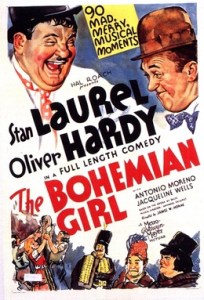
One thing that becomes apparent when looking into the theatrical shows put on by the various St. Mary of the Angels performing groups is the same shows crop up regularly. For example, in 1952 the schoolboys performed in The Bohemian Girl, a production I wrote about here, including an outline of the plot and characters. If you’re familiar with Laurel and Hardy, they did a film adaptation of it back in 1936.
In October 1946, six years before the schoolboys took on The Bohemian Girl, it was St. Mary’s Operatic Society’s second show of the year. It followed on from their March 1946 production of The Gondoliers (incidentally this Gilbert and Sullivan operetta was one of the Operatic Society’s shows in 1950, which I wrote about here.)
The Society’s version of The Bohemian Girl took place over four autumn nights between 13 and 20 October 1946, in the Parochial Hall before large and appreciative audiences. It was described as a marked success, with much of the credit for that given to the show’s producer, Anthony T. (Tom) Farrar.
“Tom” Farrar was a long-established and well-known personality in local amateur theatrical circles, who had principal parts with Batley Amateur Thespian Society between 1933-1939. Born in 1912, the son of Arthur Walker Farrar and wife Selina Jane, prior to the War he worked as a currier, employed by Messrs. Joseph Cadman and Son Ltd., a leather belting manufacturers based in Liversedge.

In the Second World War he joined with the RAF, where he reached the rank of Flight Lieutenant, and became Command Fire Officer for Northern Ireland. And with this military service came new opportunities to pursue his love of theatre, for he became the Liaison Officer for the Entertainments National Service Association (ENSA) in charge of all shows put on in Northern Ireland. A little more background here, ENSA was an organisation established in 1939 to provide entertainment for British Armed Forces personnel during the war.
He produced and played in many shows, including the RAF Gang shows (the RAF arm of the wartime entertainment units created specifically to boost the morale of their personnel stationed abroad), ran his own concert party “The Gremlins,” and came into contact with well-known Irish stage personalities, including F. J. McCormick of the Dublin Abbey Theatre Players who played the old man “Shell” in the 1947 film “Odd Man Out” starring James Mason.
It was also whilst serving with the RAF that he converted to Catholicism. In fact, in October 1947 following two years’ study at Campion House, the Jesuit College in Osterley, Middlesex, he went to the Collegia Beda in Rome to study for the Catholic priesthood, being ordained in the centre of Catholicism on Easter Sunday 1951.
It was during his time at Osterley that he produced The Bohemian Girl for St. Mary’s Amateur Operatic Society. Part of his remit for this show included devising and choreographing the various dances too.
Sunday 13 October 1946 marked the show’s opening night. Mary North initially played the lead female role of Arline, the Bohemian girl stolen 12 years earlier and brought up by gypsies. But this was for one night only, as indisposition ruled her out of the subsequent performances. Mary Judge stepped in at short notice for the three remaining shows, and did so in a very pleasing manner.
The story tunefully and gracefully unfolded, to the huge credit of all the cast from principals to chorus and dancers. It revealed the jealousy of the Gypsy Queen who found out that Arline and Thaddeus (a fugitive Pole) were in love. Rita Kelly, as the Gypsy Queen, delighted the audience with her clear soprano voice. She, and Michael O’Hara as Thaddeus, were requested to give several encores. The subsequent wicked planning of the Queen eventually led to her death, for in attempting to stab Arline, she was herself stabbed by Devilshoof (Chief of the Gypsies), admirably acted by Andrew Callaghan. The story ended with marriage of Arline and Thaddeus, and the happy reuniting of Arline and her father, Count Von Arnheim, played by Vincent Gallagher with great success and charm. Richard North as Florestein, and Donald Healy, Captain of the Guard, were also commended for their acting.
Others on stage included Messrs. J. Lynch, P. Carney, R. Munns, P. Sheridan, G. Cox, D. Healey, L. Carroll, J. Evans, J. Kelly (chorus of gentlemen). Mesdames K. Donegan, H. Moore, W. Colleran, A. Townsley, A. Bromley, K. Berry, M. Mara, M. Cairns, K. Gooder, M. Kilbride, K. Scally, N. Lynch, K. Blakeley, K. Sheridan, D. Levitt, A. Cunningham, J. Senior, M. Judge and J. Senior formed the chorus of ladies. The speciality dancers were Messrs. P. Carney, R. Munns, P. Sheridan, D. Healy, and Mesdames K. Sheridan, A. Cunningham, J. Senior and D. Levitt.
Amongst those involved behind the scenes, Mr. Cyril North was praised in his capacity as the show’s musical director and accompanist. Miss Margaret Lucy Scanlon, Associate of London College of Music (ALCM), ably acted once more as the conductor. The lighting effects provided by Mr. Thomas Brennan were described as being particularly good, showing to full advantage the colourful costumes of the actors, and the delightful scenery supplied by Dodsworth and Spencer, the renowned firm of scenic artists based in Bradford.
The stage manager was Harold Blakeley; Peter Sheridan was the property master. Wardrobe mistresses were Teresa Colleran and Hilda Cairns; the perruquiers (those in charge of wigs, hair-pieces, hair-styling etc.) came under the direction of Lucy Brennan; and Norah Colleran was the promoter.
The final performance took place on the evening of 20 October, with the shows proceeds being given to the New School Building fund.
Postscript:
I may not be able to thank you personally because of your contact detail confidentiality, but I do want to say how much I appreciate the donations received which have kept this website going over recent years. They really and truly have helped. Thank you.

The website has always been free to use, and if at all possible I want to continue this policy going forward. However, it does cost me money to operate – from undertaking the research and writing it up which can be around 20-30 hours a month, purchasing resources and documents, (last month I had some major outlays running into the hundreds of pounds), visiting archives, right down to website hosting costs, which given the number of photos I include pushes those costs up. In the current difficult economic climate I do have to consider if I can afford to continue running it.
If my website has helped with your family history research, or if you have simply enjoyed reading the various pieces and looking at these photos, please do consider making a donation towards keeping the website up and running in its current open access format. No matter how small it really does help and would be very much appreciated.
Please click here be taken to the PayPal donation link. By making a donation you will be helping to keep the website online, updated with new pieces, and freely available for all.
As a professionally qualified genealogist, if you would like me to undertake any family, local or house history research for you do please get in touch. More information can be found on my research services page.
Thank you.


