
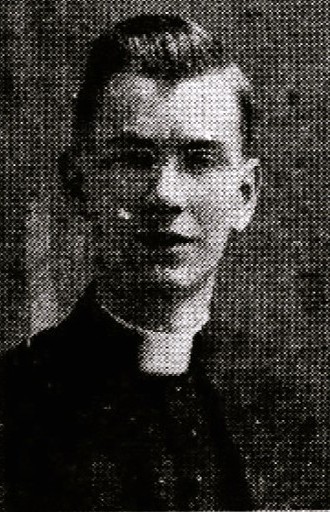
At the beginning of September 1948 it was announced that St. Mary’s senior curate Father Denis O’Mahoney (left) would be leaving to become the parish priest at the newly-formed parish of St. Anthony, Windhill, Shipley. From Golden Vale, Tipperary, he had arrived in Batley 13 years earlier as a newly-ordained priest.
Said by his parishioners to be a hard worker with a keen sense of humour, he played an active role in parish life. Upon his arrival at St. Mary’s he took charge of the Boys’ Brigade, an organisation subsequently disbanded as a result of the Second World War. He was also described as the main driving force behind most of the functions and activities held in the Parochial Hall.
Much of his spare time was devoted to sport and stage work at St. Mary’s. Batley St. Mary’s Amateur Operatic Society in particular had reason to be thankful for his energy and vitality, with his offers of advice and assistance for numerous productions.
Besides being its vice-president, along with junior curate Father Matthew Farrelly, Father O’Mahoney was also the Society’s Chairman of the Committee. Also on the Committee were Mr. Robert Munns, the Secretary; and Mr. Thomas Connor the Treasurer. Parish priest Rev. Peter McBride held the position of President. Other Committee members are detailed later in this piece.
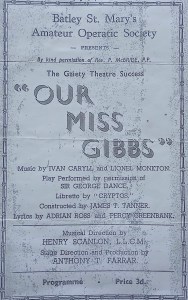
At around the time that Father O’Mahoney’s departure was announced, the Operatic Society was preparing for its first production of, what was classed, the winter season. The chosen show was the popular Our Miss Gibbs, with the cover of the programme shown on the right.
This Edwardian musical comedy, first performed on the London stage in 1909, centred around a beautiful Yorkshire girl, Miss Gibbs. Working as a sweet seller in a London store, she is plagued by the attentions of young male customers, who are making themselves sick buying all her sweets. She, though, is enamoured by a handsome young bank clerk who is in fact Earl in disguise, Lord Eynsford. Miss Gibbs’ cousin, Timothy, soon arrives to complicate the situation further by becoming embroiled with a petty criminal and inadvertently stealing the famous Ascot Gold Cup (which belongs to Lord Eynsford’s father). The story reaches its climax at the Franco-British Exhibition in White City where the characters gather for the marathon race.
The very stage-worthy St. Mary’s production was under the capable music direction of Mr. Henry Scanlon. Its expert stage director and producer was Mr. “Tom” Farrar, with newspapers proclaiming that St. Mary’s were fortunate to have him. The former leather currier was back in the parish on holiday from Italy, where he was studying for the priesthood. Born in Batley in 1912, the son of Arthur Walker and Jane Selina Farrar, he was brought up a Methodist, but converted to Catholicism whilst serving in the War. He was eventually ordained in 1951.
Marie Judge, in the title role of Miss Gibbs, was the brightest star of the show, with her strong singing and dancing its undoubted highlights.
The rest of the cast put in some hard, all-round work, and were described as a well-rehearsed team.
In summary, the cast was:
- The Hon. Hughie Pierrepoint (An Amateur Criminal) – Mr. James Prendergast.
- The Earl of St. Ives (Lord Eynsford’s Father) – Mr. James Harkin.
- Slithers (A Professional Crook) – Mr. Ken Cunningham.
- Mr. Toplady (Manager at Garrods) – Mr. Donald Healy.
- Lord Eysford (In love with Mary) – Mr. Robert Munns.
- Mr. Beavis (The Earl’s Family Solicitor) – Mr. Joseph Lynch.
- A Taxi Cabby – Mr. Denis Coleman.
- Mr. Amalfy (The Director-General of the White City) – Mr. Brian Moore.
- Timothy Gibbs (Mary’s Yorkshire cousin) – Mr. Leonard Moore.
- Lady Elizabeth Thanet (Engaged to Lord Eynsford) – Miss Kathleen Sheridan.
- Madam Jeanne (Modiste1 at Garrods) – Miss Kathleen Breheney.
- The Duchess of Minster (Lady Thanet’s Mother) – Miss Connie Sharpe.
- Mrs. Farquhar (An Impecunious Woman of Fashion) – Miss Dorothy Levitt.
- Nora (Colleen of Irish Village at White City) – Miss Mary Heaps.
- Sheilah (Colleen of Irish Village at White City) – Miss Rita Ingham.
- Kathleen (Colleen of Irish Village at White City) – Miss Mollie Mennell.
- Lady Connie (Lady Betty’s Bridesmaid) – Miss Helen Lynch.
- Lady Sybil (Lady Betty’s Bridesmaid) – Miss Pat Coleman.
- Lady Trixie (Lady Betty’s Bridesmaid) – Miss Edna Mullins.
- Lady Angela (Lady Betty’s Bridesmaid) – Miss Rita Collinson.
- Lady Muriel (Lady Betty’s Bridesmaid) – Miss Agnes Moran.
- Lady Gwen (Lady Betty’s Bridesmaid) – Miss Mary Neve.
- Lady Mary (Lady Betty’s Bridesmaid) – Miss Kathleen Levitt.
- Lady Eileen (Lady Betty’s Bridesmaid) – Miss Eileen Walker.
- Miss Gibbs (“Our Miss Gibbs”) – Miss Marie Judge.
- Speciality Dancers: Jose Senior and Denis Coleman.
- Ladies of the Chorus: Mesdames Rita Harkin, Helen Lynch, Mary Heaps, Elaine Gallagher, Mary Neve, Rita Kilroy, Mary Halloran, Lily Smith, Helen Lynch, Pat Coleman, Edna Mullins, Rita Collinson, Agnes Moran, Mary Neve, Kathleen Levitt, Eileen Walker, Mary Gallagher.2
- Gentlemen of the Chorus: Peter Scanlon, Barry Oram, James Lyons, Joseph Scally, Charles Shiel, Joseph Halloran, Colin Windle.
Fuller cast details, including who performed the various songs, are from the programme photographed below.
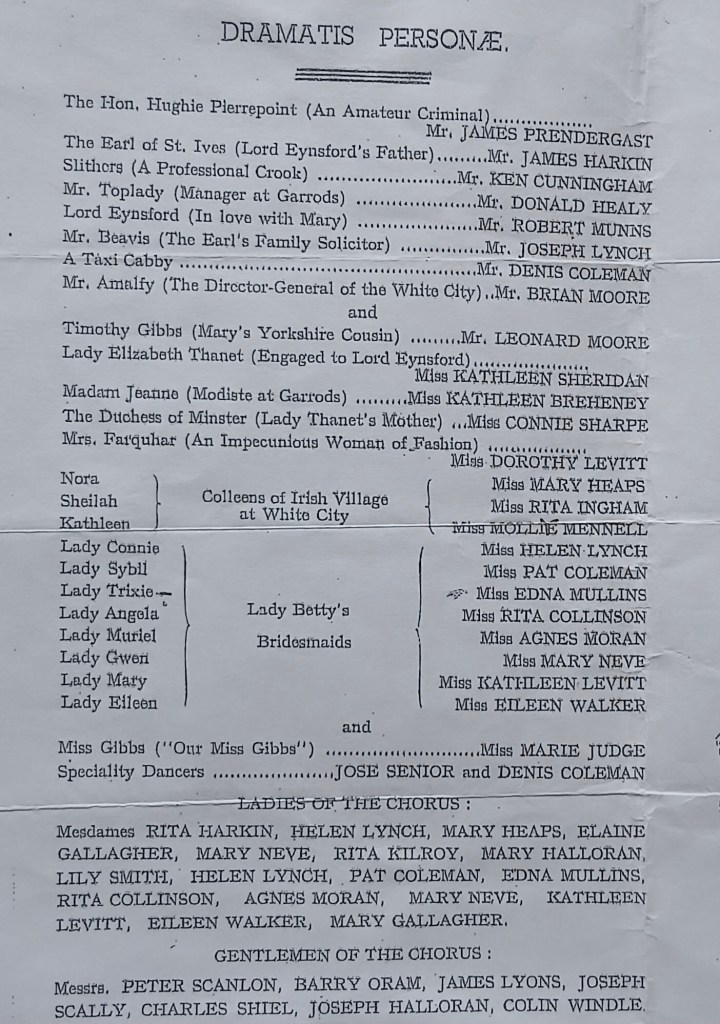
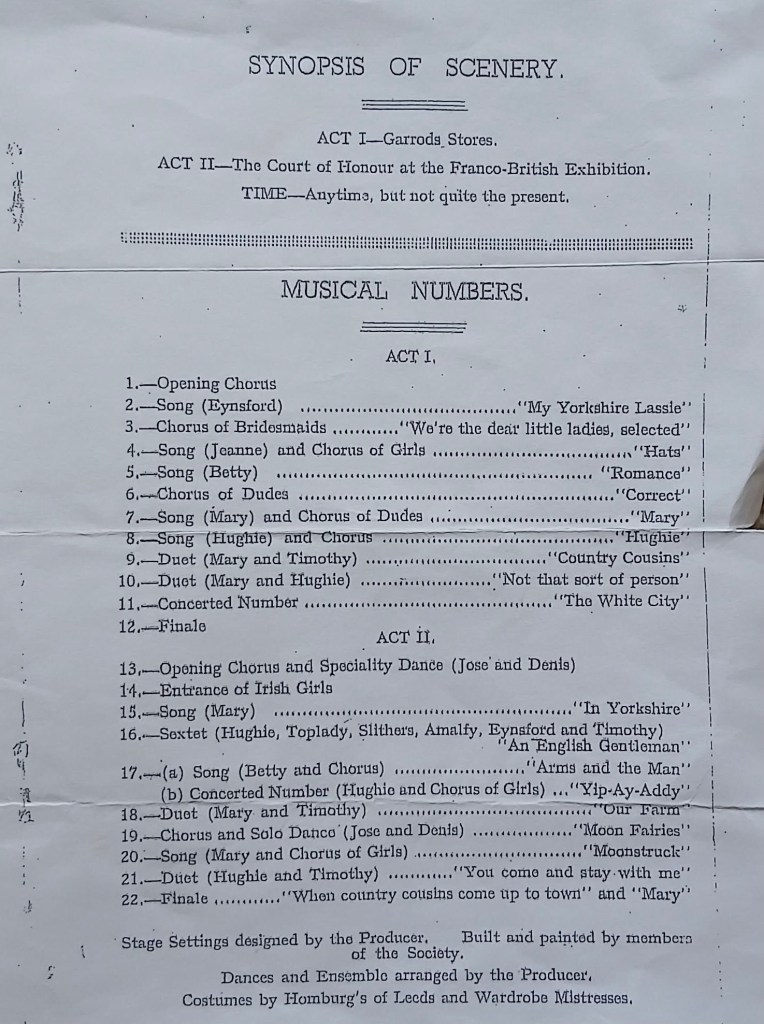
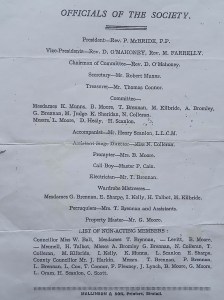
Other non-acting members were detailed on the bottom of the program, illustrated on the left. As can be seen many of these, along with the cast members, were also St. Mary’s Amateur Operatic Society Committee Members, and Society Officials.
They included the many invaluable behind the scenes people, vital to any show. For this production they were Miss N. Colleran (assistant stage director); Mrs. B. Moore (prompter); Master P. Cain (call boy); Mr T. Brennan (electrician); Mesdames G. Brennan, E. Sharpe, I. Kelly, H. Talbot and M. Kilbride (wardrobe mistresses); Mrs. T. Brennan and assistants (perruquiers)3, and Mr. G. Moore (property master.)
The final performance of Our Miss Gibbs took place on the evening of Sunday 12 September 1948, before the newly arrived St. Mary’s junior curate, Father Kevin O’Brien. More about him can be found in my write-up of another St. Mary’s production, this one in 1951 by the schoolboys performing Maritana.
With thanks to Maureen Hall for the production programme, the images of which are in this piece.
Postscript:
I may not be able to thank you personally because of your contact detail confidentiality, but I do want to say how much I appreciate the donations received to keep this website going. They really and truly do help. Thank you.

The website has always been free to use, and I want to continue this policy in the future. However, it does cost me money to operate – from undertaking the research and writing it up which can be around 20-30 hours a month, purchasing resources and documents, visiting archives, right down to website hosting costs (which given the number of photos I include does add up). In the current difficult economic climate I do have to consider if I can afford to continue running it as a free resource, especially given this reduces the amount of time I devote to client work.
If you have enjoyed reading the various pieces, and would like to make a donation towards keeping the website up and running in its current open access format, it would be very much appreciated.
Please click here be taken to the PayPal donation link. By making a donation you will be helping to keep the website online and freely available for all.
As a professionally qualified genealogist, if you would like me to undertake any family, local or house history research for you do please get in touch. More information can be found on my research services page.
Thank you.
Footnotes:
1. A fashionable dressmaker or milliner who designs, makes, and sells high-end women’s’ clothing and hats.
2. There does seem to be some duplication of names.
3. Wig-maker.


