
A youth-packed Batley St. Mary’s Amateur Operatic Society brightened a dull November in 1950, with their energy-filled production of Gilbert and Sullivan’s comedic operetta The Gondoliers.
A shortage of young men in the Society resulted in several schoolboys, and recent school-leavers, being drafted into bolster the cast for the company’s first production of the season.
It was an ambitious venture for such young shoulders, but the raw youths wholeheartedly threw themselves into the challenge, and their dynamism and enthusiasm more than made up for their lack of experience. In fact, some of the young players put on very promising performances, benefitting enormously from this early theatrical training opportunity.
First hitting the stage in 1889, The Gondoliers’ plot centres around ascertaining which of two newly-married Venetian gondoliers, “brothers” Marco and Giuseppe Palmieri, had just become the King of Barataria. One brother was actually born a prince, but brought up incognito from infancy by drunken gondolier Baptisto Palmieri, who mixed him up with his own son of the same age. Only Inez – the royal’s nurse from two decades ago – could identify which gondolier was the rightful heir…and she could not be located. To add further pressure, following the old king’s death there was unrest in Barataria, so Marco and Giuseppe travelled to the kingdom to reign jointly until the old lady could be found, interviewed, and the rightful king established. In another layer of confusion, the rightful king was wed in infancy to Casilda, the daughter of a Spanish Duke of Plaza-Tora – thus now making him an unintentional bigamist, and her his queen. If that was not confusing enough, in yet another twist the duke’s daughter was in love with her father’s servant, Luiz. It meant Casilda, and the gondoliers’ new brides Tessa and Gianetta, were all desperate to find out which brother would be declared the King. Chaos and hilarity ensued, but all ends well, with in a final revelation the rightful heir being identified as … Luiz.
The operetta arguably contains some of Gilbert and Sullivan’s loveliest melodies, with probably the most famous piece being Take a pair of sparkling eyes, sung by Marco.
Miss L. Scanlon produced the St. Mary’s show, and she shared the duties of conductor with Mr. C. North. Mr. Henry Scanlon was the musical director.
One major production drawback mentioned in press coverage was the minimalistic nature of musical accompaniment, the only instrument on show being a piano. However, one reviewer identified an unexpected positive from this, stating:
…this company side-stepped the usual monotonous drag of many local productions and maintained a pace in keeping with the opera, voices and music being reasonably balanced.1
The full cast details were as follows (with spellings in the main as reported at the time):
Various: C. Love (Don Alhambra del Bolero, the Grand Inquisitor of Spain); J. Kelly (the Duke of Plaza-Tora); Miss K. Munns (the Duchess of Plaza-Tora); R. Munns (Luiz); Marie Judge (Casilda); Miss K. Scally (Inez).
Venetian gondoliers: James Prendergast (Marco Palmieri); Leonard Moore (Giuseppe Palmieri); J. Breslin (Antonio); J. Mann (Francesco); G. Camponi (Giorgio); and F. Scanlon (Annibale).
Contadine (Italian peasant women): Miss J. Gooder (Tessa); Miss J. Senior (Vittoria); Miss K. Ashwell (Giulia); Miss M. Kelly (Fiametta); Mrs. R. Stubley (Gianetta).
Chorus of Gondoliers: D. Broady; P. Cane; D. Crayton; A. Grogan; Gerard Hill; Kevin Hill; Edward Jones; Peter Jones; P. Mann; G. Norgate; Barry Oram; B. Pollard; B. Senior; P. Senior; G. Walford; G. Wilson; V. Wilson.
Chorus of Contadine: M. Ashton; K. Brennan; E. Gallagher; J. Healy; D. Heaps; K. Lyons; M. Mennell; M. Messenger; K. Nettleton; S. Stenton; E. Talbot; M. Travis; S. Whelan; J. Woodhead.
Page boys: P. Lemon and Robert Travis.
Unfortunately, as you can see, their reported names were in the main limited to forename initials only – though I have already managed to expand on these details for some. Hopefully, the cast photograph below, (thank you John Norgate for sending me this image), will help to provide full names for others. If you can identify anyone, please let me know and I will add in their details. I have numbered the cast on the photograph, to hopefully make things easier.
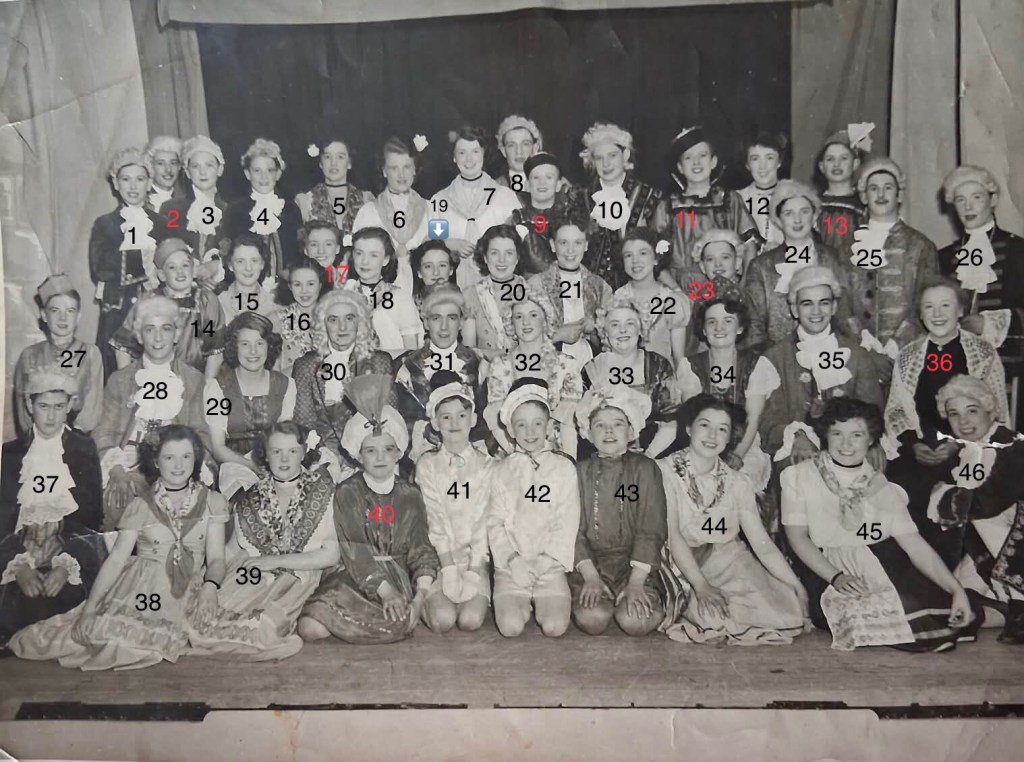
- Top Row – from left to right: 1, 2, 3, 4, 5, 6, 7, 8, 9, 10 Kevin Hill, 11, 12, 13,
- Second Row – from left to right: 14, 15, 16, 17, 18, 19, 20, 21, 22, 23, 24 Gerard Hill, 25 Jack Mann? 26,
- Third Row – from left to right: 27, 28, 29, 30, 31 Robert Munns, 32 Kathleen Munns, 33, 34, 35, 36
- Bottom Row – from left to right: 37 George Norgate, 38, 39 Kathleen Lyons 40, 41, 42 Peter Lemon, 43, 44 Josie Senior, 45 Margaret Senior, 46
The women were lauded as the undoubted stars of the show. Miss M. Kelly, as Fiametta, sang well in the opening chorus and the view was she deserved a bigger part. Reviewers praised Mrs. R. Stubley’s wonderfully clear voice and good control of movements in the role of Gianetta. Miss J. Gooder, as Tessa, earned plaudits as a comedienne. Marie Judge, as Casilda, displayed the dignity and stateliness befitting the daughter of a duke, and it was said few in local operatics could surpass her voice. Also deemed outstanding was K. Munns for her portrayal of Casilda’s mother, the duchess.
The star male performer, without any shadow of a doubt, was Master J. Breslin who “fairly rocked the hall”2 with his one and only solo, with no half-measure about his efforts, and no doubt as to the audibility of his voice.
The two principal gondoliers, the brothers Palmieri, played by James Prendergast (Marco) and Leonard Moore (Guiseppe) acted well together, but their voices lacked that extra volume and polish. C. Love portrayed the mournful Don Alhambra del Bolero well, but his voice was not always audible.
The full chorus celebratory dance and song number, Dance a Cachucha, was well done. Brimming over with energy, the chorus brought out the invigorating rhythm of the dance.
Reviews concluded that a good show could have been improved had the male voices been of the same standard as those of their female counterparts. However, taken on the whole, as a church amateur show, one could find little room to criticise.
Thank you for reading this piece. If you can fill in the gaps around names where I’ve only recorded initials, or identify anyone on the cast photograph, please do let me know.
And if anyone has any photographs related to other Batley St. Mary of the Angels shows, including programme photographs, please do send them to me as I’m writing about the various productions of the past. I’m also writing about the parish May Queen too, so photos relating to that event would be much appreciated. They can be sent either via Facebook or my contact details at the end of this post.
Footnotes:
1. Batley Reporter and Guardian, 25 November 1950.
2. Ibid.
3. 1911 Census entry for the Hunt family, Ref: RG14/27248/24.
4. Batley News, 26 December 1885.
5. US Passport Application, 29 October 1901,National Archives and Records Administration (NARA); Washington D.C.; NARA Series, Roll 587 01 Oct 1901-31 Oct 1901
Other Sources (not directly referenced):
• East Norfolk Operatic Society, The Gondoliers Synopsis – https://enosoc.co.uk/syngondoliers/.
• Gilbert and Sullivan Archive, The Gondoliers – https://gsarchive.net/gondoliers/html/.
• Newspapers (various).
• StageAgent, The Gondoliers – https://stageagent.com/shows/operetta/545/the-gondoliers.
• Wikipedia – The Gondoliers.
Postscript:

The website has always been free to use, and I want to continue this policy in the future. However, it does cost me money to operate – from undertaking the research and writing it up which can be around 20-30 hours a month, purchasing resources and documents, visiting archives, right down to website hosting costs (which given the number of photos I include does add up). In the current difficult economic climate I do have to consider if I can afford to continue running it as a free resource, especially given this reduces the amount of time I devote to client work.
If you have enjoyed reading the various pieces, and would like to make a donation towards keeping the website up and running in its current open access format, it would be very much appreciated.
Please click here be taken to the PayPal donation link. By making a donation you will be helping to keep the website online and freely available for all.
Thank you for the donations received to date too. They really are appreciated, and really do help.
Finally, as a professionally qualified genealogist and an accredited associate of the professional regulator body, the Association of Genealogists and Researchers in Archives (AGRA), I do undertake research commissions. If you would like me to undertake any family, local or house history research for you do please get in touch. More information can be found on my research services page.


