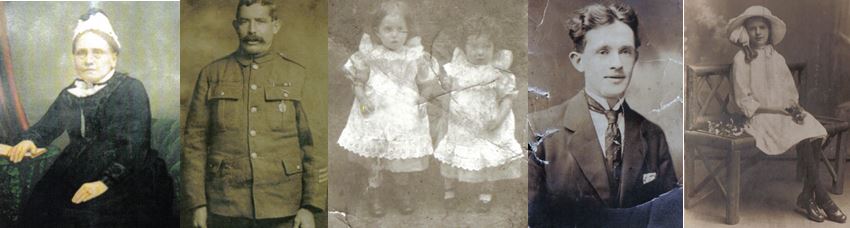
The girl chosen to be the Batley St. Mary of the Angels May Queen in 1936 was eight-year-old Patricia Josephine Houston. Born on 18 March 1928, she was the daughter of St. Mary’s school teacher Alfred Ernest Houston and his wife Mary Kate (formerly McGrath). The couple married in Ballinalee, County Longford in 1916 and came to Batley with their young family in the early 1920s. They lived at 6, Ealand Crescent on Batley’s Wilton Estate.
Prior to the big day, Patricia said she was delighted at the honour and was looking forward to wearing the Queen’s gown. Her main role was to perform the ceremony of the Crowning of Our Lady.
On Sunday evening, 03 May 1936, around 600 parishioners attended the service conducted by Father Peter McBride. He was assisted by his curate, Father Denis O’Mahoney. People gathered in the streets too, to catch a glimpse of the young Queen and the procession, which made its way from the schools into the church, the interior of which provided a colourful spectacle.
The procession was led by Acolytes1 and the cross bearer, along with the banner of St. Agnes, followed by members of the Guild of St. Agnes attired in white satin with red wreaths and red ribbons round their shoulders.
The ex-Queen, Miss Mary Hanson, was a pretty picture in an ivory satin gown and net veil surmounted by a delicately worked coronet. From her shoulders fell a beautifully embroidered train. She carried a sheaf of lilies.
Then followed the banner of Our Lady accompanied by the Children of Mary in white gowns and blue cloaks, their heads topped with white floral wreaths.
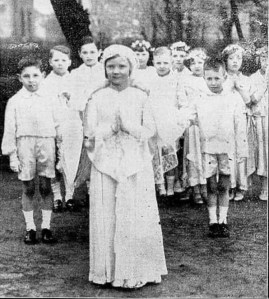
Twenty little boys, between the ages of five and seven, wore white satin suits, white gloves, blue sashes and patent shoes. Twenty little girls, all about four, accompanied the Queen, wearing white satin and carrying lilies.
The blonde-haired Queen (pictured on the left with some of her retinue), who walked to the Church with her hands clasped in prayer, presented a charming figure in her pearl satin gown, which had a central panel of starched Chantilly lace. Her pearl satin train, with pearl crystal adornments, was underlined with a pale blue satin beauté and net ruchings. Her Brussels net and Chantilly lace veil was secured by a tiara of diamanté and pearls.
This was only the first of the May Queen’s duties. All attention now eagerly turned towards the Whit-Tuesday procession, which would be the first since 1930 to process through the streets of Batley.
This major Whitsuntide event took place on Tuesday 02 June 1936, with over 1,000 Catholics, including 500 children, participating in the impressive procession. The participants snaked their way along Cemetery Road, Mayman Lane, Clerk Green, Wellington Street, Blakeridge Lane and back to St. Mary’s Church. Organised and marshalled by the Whitsuntide Walk Committee, of which Tom Durkin was Secretary, it took 15 minutes to pass any given point.
It was headed by cross bearer, Mr. Jack McHale, thurifer (the altar server who carried and swung the thurible in which burnt incense) Mr. John Lynch, and eight altar boys – Masters Joseph Hopkins, James Lynch, James Greenwood, John Rogers, Vincent Rowan, Thomas Senior, John Hannan and Joseph Gallagher.
Then followed the banner of St. Mary of the Angels, carried by Mr. Francis Maloney and Mr. Tom Holmes, with Misses Nora Skelly, Eileen Parkin, Margaret Wells and May McIntyre fulfilling the role of streamer bearers.
Fifty little girls in white satin gowns with ivory and silver floral wreaths walking with hands clasped in prayer were followed by boys from the infant school. The boys wore blue satin suits and lemon gloves. Then came other scholars wearing red sashes.
The banner of St. George was borne by Mr. Andrew Mullins and Mr. Andrew Cox. Bearers of some of the other banners were:
- Guardian Angel – Mr. J. Hopkins and Mr. J. Stenson.
- St. Joseph – Mr. J. Phillips and Mr. F. Stott.
- Our Lady of Good Counsel – Mr. Joe Phillips and Mr. Joseph Buckley.
- Faith of Our Fathers – Messrs. William Kilbride, Michael Grogan, Edward Ashwell, William Newsome and Alfred Hutton.
- Children of Mary – Mr. Edward Berry and Mr. James Carter
- St. Patrick – Messrs. Messrs. James Halloran, John Senior and John Mullins.
- The Pope – Messrs. John Brannan, Patrick Haley, Michael Lyons, James Gallagher, Edward Holmes, John T. Cairns, Michael Manning and Wilfred Walford.
The eight-year-old Queen, Miss Josephine Houston, was described as looking radiantly pretty in her regal robes, comprising of a satin gown and long, richly embroidered blue satin lined train, and a lace veil secured by a pearl crown. Her four train bearers were Masters Bernard Waite, Geoffrey Doyle, John Colleran and Gerald Durkin. Masters Kenneth Woodhead and Charles Sheil were ushers. Her little attendants, in white and blue, were Kathleen Gooder, Teresa Smith, Joan Senior, Joyce Brennan, Teresa Daley, Irene Morley, Agnes Cunningham, Winifred Rowe, Rita Kelly, Kathleen Naughton, Josephine Newsome, Sheila Rawson and Bridget Collins.
The ex-Queen, Miss Mary Hanson, walked in her mid-Victorian gown of white satin, net and lace. She was attended by Misses Eileen O’Hara, Mary Raynor, Kathleen Brennan, Joan Colleran, Maureen Gallagher, Kathleen Hanson, Kathleen Clough, Nora Colleran, Mary Greenwood, Mary Ann Lynch, Margaret Gallagher, Maureen Hughes, Margaret Munns, Kathleen McManus, Renee Kelly and Kathleen Bullock. John and Jack Senior were her train bearers.
Miss Kathleen Daley, as St. Agnes, wore a purple velvet gown and carried silver palms. Accompanying her was the Guild of St. Agnes banner, borne by Messrs. Henry Smith, Joe Buckley and P. Rowan. Misses Renie Sheridan, Winnie Sawyer, Nora Maguire and Hilda Gavaghan were in charge of the streamers. Also in her retinue were members of the Guild of St. Agnes, in white gowns trimmed with red ribbon. They comprised of Misses Kathleen Harkin, Hilda McCave, Agnes Morley, Nora Flatley. Teresa Kelly, Nora Ellis, Kathleen Halloran, Mary Brennan, Josephine Lynch, Margaret Cooney, Annie Carroll, Kitty Collins, Lily Hemingway, Winnie Rhodes, Mary Gallagher, Eileen Grimshaw, Bessie Riding, Mary Cafferty, Eileen Carney, Maureen Cox, Monica Rowan, Mary Cunningham, Kathleen O’Hara, Hilda McHale and Mary Molyneux.
Messrs. James Lyons, Joseph O’Hara, Cyril Firth and Thomas Birbeck carried the statue of Our Lady. Messrs. Frank Daley, Leo Daley, Fred Flexney and J. E. Whelan formed the statue’s guard of honour.
Bearers of the statue of Christ the King were Messrs. Leonard Brennan, Patrick Brennan, Leo Cox and James Harkin. Its guard of honour comprised of Messrs. Charles Sheil, John Sheil, Phillip Doyle and Michael [Mannin?]2
Children of Mary, in ivory and blue gowns, members of the Confraternity of the Sacred Heart, and gentlemen of the parish, completed the procession.
Former Batley St. Mary’s curate and Birstall St. Peter’s parish priest, the now parish priest in Halifax Dean Peter Russell, was spotted in the procession. Batley St. Mary’s curate Father Denis O’Mahoney, marched with the Boys’ Brigade, of which he had charge.
Birstall Old Band and Rothwell Prize Brass Band played popular marches and Irish airs, and the St. Joseph’s pipers band from Manchester presented an unusual spectacle.
The fickle British weather, the bain of so many outdoor events, provided an unwelcome talking point. An unfortunate shower, which began as the procession was on its return leg along Upper Commercial Street, spoilt some of the beautiful dresses which had been so carefully prepared by the mothers of the children. However they were all still able to enjoy the tea which followed in the schools.
Postscript:
I may not be able to thank you personally because of your contact detail confidentiality, but I do want to say how much I appreciate the donations received which have kept this website going over recent years. They really and truly have helped. Thank you.

The website has always been free to use, and if at all possible I want to continue this policy going forward. However, it does cost me money to operate – from undertaking the research and writing it up which can be around 20-30 hours a month, purchasing resources and documents, (last month I had some major outlays running into the hundreds of pounds), visiting archives, right down to website hosting costs, which given the number of photos I include pushes those costs up. In the current difficult economic climate I do have to consider if I can afford to continue running it.
If my website has helped with your family history research, or if you have simply enjoyed reading the various pieces and looking at these photos, please do consider making a donation towards keeping the website up and running in its current open access format. No matter how small it really does help and would be very much appreciated.
Please click 👉🏽 here 👈🏽 be taken to the PayPal donation link. By making a donation you will be helping to keep the website online, updated with new pieces, and freely available for all.
As a professionally qualified genealogist, if you would like me to undertake any family, local or house history research for you do please get in touch. More information can be found on my research services page.
Thank you.
Footnotes:
1. Most commonly, the term “acolyte” is used to describe adults who
serve at Mass.
2. The above names are replicated largely using the newspaper spellings, which may not necessarily be accurate.


