Tag Archives: genealogy

Belladonna and a Research Rabbit Hole: Avoiding Assumptions in Family History.

Whilst reading a newspaper from July 1915, my attention was caught by an attempted suicide in Dewsbury. It read:

GIRL DRINKS BELLADONNA.
Thornhill Lees Servant Upset By
Brother Being At The War.

Clara Stead (17), domestic servant, of Pontefract, was summoned for attempting to commit suicide by drinking a quantity of belladonna liniment at Dewsbury on the 15th inst.

Hetty Armitage, who employed the girl at the Perseverance Inn, Thornhill Lees, explained that on Thursday last week Stead was in the kitchen black-leading, but she went to a bathroom and afterwards accused called for witness and said, “Mrs. Armitage, do you know what I have done?” Later she added, “I have taken poison.” Asked where she had got it from, she replied, “From the bathroom,” and asked why she had done it she answered, “I don’t know.” Witness’ husband gave the girl milk and water, and she was afterwards taken to the Infirmary,

In answer to a question in Court, as to the reason for her act, Jones, [sic] who appeared greatly distressed, said, “I have a brother at the war.”

The Chairman: That ought not to have depressed you like that. You are young to do a thing like this.

The girl’s mother preferred to take her daughter back home and look after her.

The Chief Constable thereupon asked for the case to be withdrawn, and the Magistrates agreed.1

That was it. I had to find out more. Who was the girl? What became of her? Did her story have a happy ending? Who was her brother? What happened to him?

And so I disappeared down a research rabbit hole for the rest of the evening. The results reinforced once more that you should check multiple sources even for the same event; and never make assumptions when researching family history.

The first thing was to compare the Batley News report with that of the Dewsbury Reporter to see if that added anything.2 It did. The three main extras were:

  • Clara had worked at the pub since June;
  • Fred Armitage was the pub licensee; and
  • In a difference to the Batley News, Fred gave her hot water and salt, not milk and water.

Next I looked at the locality. Thornhill Lees is now a suburb of Dewsbury, lying around one mile south of the town centre between Savile Town and Thornhill. Back then it was a village. Near the river Calder, it had a station on the Yorkshire and Lancashire railway. Its chief employment industries were the collieries and glass bottle works. If you watched the Jeremy Clarkson episode of Who Do You Think You Are? you will have seen the Kilner Brothers glass bottle manufacturers. The Perseverance Inn, at Forge Lane, Thornhill Lees stood by the Calder and Hebble Navigation Canal. Ironically it had seen its fair share of inquests over the years on those successful in ending their lives, particularly by drowning in the waterway. Although the building still stands today, it is no longer a pub.

Map showing the location of the Perseverance Inn, Ordnance Survey Maps – 25-inch England and Wales, 1841-1952, Yorkshire CCXLVII.7 (Dewsbury) Revised: 1914 to 1915, Published: 1922 – National Library of Scotland, under the Creative Commons Attribution-NonCommercial-ShareAlike 4.0 International (CC-BY-NC-SA) licence

So who was Clara Stead? She was born on 2 December 1897 at Streethouse, near Pontefract, the daughter of William Stead and his wife Kezia (née Cooper). Her baptism took place on 23 December 1897 at Normanton All Saints, alongside that of her siblings William (born according to the baptism register on 16 July 1890, and was he really called William Stead as declared in the register? But more of that later);3 and Emma (born 16 September 1895).4 The couple’s other children were Minnie, born 14 January 1893;5 Colin, born on 13 December 1900;6 Richard, born 10 February 1903;7 and Lena, born in 1906. Note, other than Clara and William’s birth dates, I’ve not corroborated the remaining children’s births against any other sources.

The Stead family lived in the Streethouse part of Snydale-with-Streethouse, in both the 19018 and 19119 censuses. Pontefract lies around four miles to the north east of the village. Coal mining was the principal occupation, and Drighlington-born William was no exception, working as a hewer.

He married Kezia Cooper at Normanton parish church on 18 April 1892. At 26, she was four years William’s senior. The parish register entry records her as the daughter of Benjamin Cooper, and a widow – though this marital status is scored out.10 Unusually (but not impossible) the implication is her deceased husband was also named Cooper. But it is worth paying attention to such anomalies as the scoring out and name. The other thing to note about the marriage is it post-dates their son William’s birth by almost two years.

William’s birth certificate confirms this.11 He is registered as William Kirk. The certificate states he was born on 29 August 1890 at Ferry Fryston, although his birth was not registered until 5 November 1890 – way outside the 42-day limit. Also note this is some six weeks later than the birth date given in the baptism register. No father’s details are entered. But the certificate gives his mother’s name as Kezia Kirk, formerly Cooper. Like Kezia’s marriage to William Stead, this record has more question marks which need following up.

Kezia Cooper’s first marriage was the obvious next step. This was also at Normanton All Saints parish church on 2 January 1882, to John Kirk, a 21-year-old miner from Streethouse.12 The couple had three children – Jane Ann born on 15 October 1882 and who died on her second birthday; Maria born on 15 January 1886 and who died on the 23 January 1889; and another Jane Ann born on 21 July 1888 and who died less than one month later.

No death for John prior to Kezia’s second marriage to William Stead could be traced. The censuses indicated he was still alive, living with his father and step-mother at Streethouse in 1891 (and showing as married).13 Meanwhile in the same census, also in Streethouse, Kezia Kirk (married) and 8-month old William Kirk are living with her parents.14 Skip forward to 1901 and John Kirk is still alive and in Streethouse, but now married to Mary, and with daughter Mary Kirk and sons John Parkes and Charles Kirk.15 The marriage between John Kirk and Mary Parkes took place on 4 June 1892 at Holy Trinity church, Kimberley, Nottinghamshire.16

The assumption might be this marriage, and Kezia’s to William Stead a couple of months earlier, were bigamous. After all, as The National Archives guide states in this period “All divorce suits took place in London, thus restricting divorce to wealthier couples. Divorce did not really open up for all classes until the 1920s with the extension of legal aid and the provision of some local facilities.” 17 John Kirk was a coal miner living in a small Yorkshire village, as was Kezia’s father and new partner. None would seemingly fit the social status of those able to afford all the costs a divorce might entail.

However, Rebecca Probert whilst acknowledging that “the social profile of litigants remained definitely skewed towards the middle and upper classes” also points out that “there were plenty of examples of working-class petitioners” though “Those members of the working class who did petition for divorce tended to be drawn from the ranks of artisans rather than unskilled labourers.”18

The inference to be made from this is just because a couple may not fit the accepted social profile for divorcees in this period, do not rule it out. And so it proved for John and Kezia Kirk.

John filed a divorce petition on 19 March 1891, a little over two weeks before the 1891 census date. The decree nisi was granted on 11 August 1891, and the decree absolute formally ending the marriage was issued on 23 February 1892.19

The grounds for the uncontested divorce were Kezia’s adultery with William Stead. Kezia left John for William on 15 October 1889, and on 18 July 1890 gave birth to William’s child. Note this is yet another date of birth for William Kirk – we now have 16 July 1890, 18 July 1890 and 29 August 1890 depending on record. Normally, considering the relative value of these sources, the birth certificate would carry more weight. But this is not always the case. And may not be in this instance.

So why was Kezia’s real marital status not declared when she married William Stead? Under the 1857 Act, no Church of England clergyman could be compelled to solemnise the marriage of a person who had been divorced because of their adultery. However, any other clergyman entitled to officiate within the diocese could conduct the marriage.20 A church marriage was therefore permissible. However perhaps Kezia stated she was widowed, and also used her maiden name, to try to avoid any difficult questions or judgement. But her second marriage took place in the same church as her first, and the rarity divorce in this community, with hers being finalised only a couple of months earlier and fresh in minds, must have been the talk of the neighbourhood. Also the vicar conducting the ceremony was not one brought in from elsewhere. The fact widowed is scored out indicates there was some background knowledge or question mark. But it all goes to show the Stead family background was more complex than initial appearances.
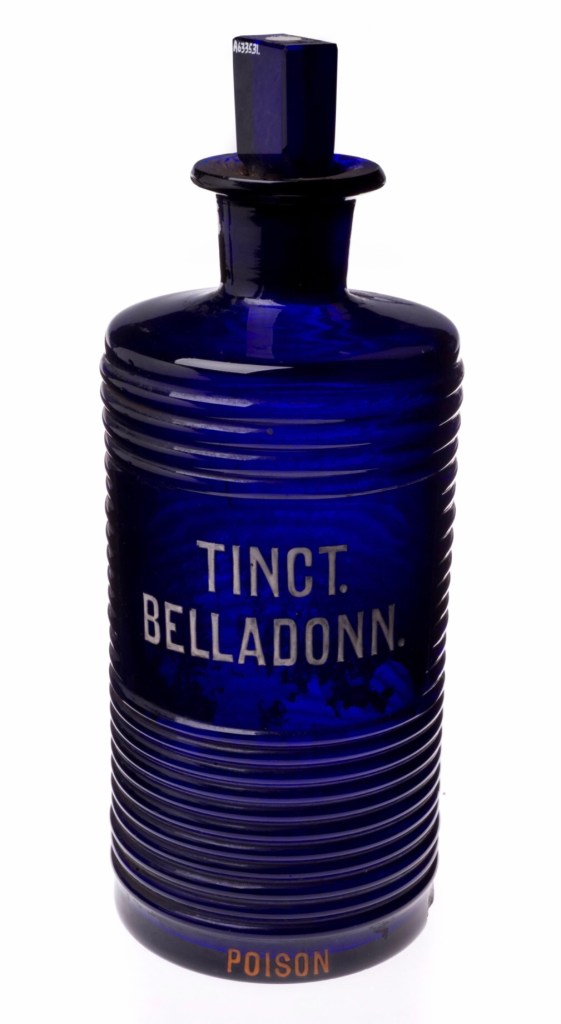
Glass bottle used for tincture of belladonna, England, 1880-. Credit: Science Museum, London. Attribution 4.0 International (CC BY 4.0)

Now back to Clara and her attempted suicide. What was it that she drank? Belladonna, known also as Deadly Nightshade, is, as its name suggests, a poisonous plant. However its roots and leaves have medicinal properties. Frequently advertised in the late 19th/early 20th century newspapers, it was a popular medicine-store cupboard standby. Its multiple uses included from insomnia relief, to as a diuretic and a muscle relaxant. It was also used as a pain reliever, with belladonna liniment recommended for such things as muscular aches, sprains, and rheumatic pains. Even chilblains and boils were treated with it. But it was also misused, with the newspapers full of poisoning cases and suicides. Then there were accidents, like a Birmingham family who mistakenly used it as a condiment in their stew. Or the Glasgow child who, imitating her sister drinking, took a swig out of a bottle containing belladonna liniment. Luckily Clara survived, unlike many others.

A huge positive about her court case is the compassionate attitude of the Chief Constable and the magistrates. On receiving assurances that Clara’s mother wanted to take her back home and care for her, they all agreed to drop the charges. Whilst this humane course of action is far from unique in this period, especially where there were promises not to do it again and where families were prepared to look after those charged, it could have been all too different. Lots of factors came into play, but I’ve looked at some other cases in the same period for girls of a similar age which had a range of far worse outcomes.

  • A 17-year-old domestic servant, who attempted to strangle herself on a footpath between Yeadon and Guisely in January 1915, was detained at an asylum;
  • In August 1915 the Vicar of Mapperley wrote suggesting to the court that a 15-year-old girl who jumped into a pond should be sent away, as it was not advisable to let her return home. The advice was taken and she was sent to a home for two years;
  • In June 1916 a 17-year-old Northampton girl was remanded to a workhouse for a week after throwing herself into the River Nene; and
  • Others were bound over, placed in the care of probation officers, or in the care of organisations such as the Salvation Army;

Did this tale have a happy ending? In part ‘yes’. Clara married a local coal miner in Pontefract Register Office on 6 March 1916. Her husband served for seven months with the Coldstream Guards in England towards the end of the war, and survived. The couple raised a family and Clara lived to a ripe old age.

But her fears for her brother, identified as William, turned out to be well-founded.

William Kirk married Heckmondwike girl Lily Victoria Andsley at Normanton All Saints on 16 December 1911.21 The couple had two girls, Dorothy born on 20 September 1912, and Edna born on 29 April 1914.22 William served with the 10th Battalion of the King’s Own Yorkshire Light Infantry (KOYLI) during the war, going overseas on 11 September 1915. This means at the point of Clara’s attempted suicide, her brother, though in the Army, was still in England.

William died on 9 July 1916 as a result of wounds suffered in the initial days of the Battle of the Somme. He is buried at Heilly Station Cemetery, Mreicourt-L’Abbe, France, a cemetery used by medical units from the 36th and 38th Casualty Clearing Station during this period. The additional information provided by the CWGC is that he was the husband of Lily Victoria Stead (formerly Kirk), of 43, Belmont St., Streethouse, Pontefract, Yorks.

I did a double take at her new surname of Stead. It did fleetingly cross my mind that she had adopted the surname of William’s family. However the implication by the use of ‘formerly’ was a remarriage. And this proved to be the case.

William Kirk’s pension card notes his widow married miner Samuel Stead on 9 March 1918.22 The marriage took place once more at Normanton All Saints.23

So ended my rabbit hole exploration.

However the real take away point from this is not Clara’s story. It is far more basic, and to do with research. It is primarily not to accept things at face value and not to make assumptions when investigating family history. Do not try to make facts fit your theories. Approach research with an open mind. Always dig deeper to locate as many sources as possible to corroborate findings. Weigh up and evaluate the relative merit of evidence sources. And make sure you have a wide range of evidence to support your conclusions.

In the case of Clara and her family:

  • There are discrepancies in the newspapers, including one huge typographical error when Clara in one section of one newspaper report is called Jones. Newspapers aren’t gospel;
  • Clara’s mother Kezia was not widowed when she married William Stead – she was divorced;
  • Working class people should not be ruled out from obtaining divorces in this period;
  • The treatment by courts of those who attempted suicide did vary;
  • Try to seek as many sources as possible to corroborate information – which can vary from record to record, for example something as straightforward as William Kirk’s birthdate;
  • Do not make assumptions on surnames. From the parish register entry for her second marriage, it might have appeared Kezia’s ‘deceased’ husband’s surname was Cooper; from the census and his baptism, William seemed to be called William Stead, when in fact he was officially William Kirk; and when William Kirk’s wife was listed as Lily Victoria Stead on the CWGC records, this was no connection whatsoever to the Stead surname of her deceased husband’s family, and a name he had possibly used. She had in fact remarried and her second husband was called Stead;
  • people do not change. They do not always tell the truth today, and neither did the past confer magical, unwavering truth-telling behaviours on our ancestors, even given the more deferential, religious society in which they lived. It may be some details and events they were genuinely hazy on. But for others they did deliberately lie. And this applies even on official documents; and
  • read all documents carefully and critically for the clues they offer, either by phraseology, omissions or anomalies.

Footnotes:
1. Batley News, 24 July 1915;
2. Dewsbury Reporter, 24 July 1915;
3. Baptism and birth date details from Normanton, All Saints, Baptism Register, West Yorkshire Archive Service, Reference Number: WDP151/1/2/5;
4. Ibid;
5. 1939 Register, Ref: RG101/3772E/004/17 Letter Code: KRDD;
6. Baptism 3 January 1901, Normanton, All Saints, Baptism Register, West Yorkshire Archive Service, Reference Number: WDP151/1/2/6;
7. 1939 Register, Ref: RG101/3641G/012/2 Letter Code: KMWM;
8. 1901 Census, Ref: RG13/4296/28/18;
9. 1911 Census, Ref: RG14/27482;
10. Normanton All Saints Marriage Register, West Yorkshire Archive Service, Reference Number: WDP151/1/3/6;
11. William Kirk Birth Registration, GRO Ref: Pontefract, December Quarter 1890, Volume 9C, Page 81;
12. Normanton All Saints Marriage Register, West Yorkshire Archive Service, Reference Number: WDP151/1/3/4
13. 1891 Census, Ref: RG12/4588/28/14
14. 1891 Census, Ref: RG12/3759/36/34
15. 1901 Census, Ref: RG13/4296/30/21
16. Nottinghamshire Family History Society Marriage Indexes
17. TNA Research Guide: Divorce – https://www.nationalarchives.gov.uk/help-with-your-research/research-guides/divorce/
18. Probert, Rebecca. Divorced, Bigamist, Bereaved?: the Family Historian’s Guide to Marital Breakdown, Separation, Widowhood, and Remarriage: from 1600 to the 1970s. Kenilworth England: Takeaway, 2015.
19. Divorce and Matrimonial Cause Files, Divorce Court File: 4262. Appellant: John Kirk. Respondent: Kezia Kirk. Co-respondent: William Stead. Type: Husband’s petition for divorce [hd]., 1891, Ref: J77/468/4262
20. Probert, Rebecca. Divorced, Bigamist, Bereaved?….
21. Normanton All Saints Marriage Register, West Yorkshire Archive Service, Reference Number: WDP151/1/3/9
22. Western Front Association; London, England; WWI Pension Record Cards and Ledgers; Reference: 114/0536/KIR-KIR
23. Normanton All Saints Marriage Register, West Yorkshire Archive Service, Reference Number: WDP151/1/3/10

Public or Private Family Tree?

This is a perennial question for many people researching their family history. Whether or not to have a public family tree available online. And it is a dilemma which can arise fairly early on in the research path. Sometimes though it is not even considered, and for some the consequences of a decision to go public emerge too late.

Image by Peggy und Marco Lachmann-Anke from Pixabay

Before I go any further I want to make it clear there’s no right or wrong answer. It really is a purely personal decision, one with which you need to be comfortable.

However, here are some considerations which I’m sharing to provoke a deeper examination of, and debate about, the implications. It’s not intended to be an exhaustive list, more a thought trigger. I’ve split them into pros and cons.

First the advantages of a public online tree.

  1. Connecting. It goes without saying, but a public online tree allows other researchers with the same family history interests to easily find and contact you. This enables you to connect with distant cousins, compare research, potentially plug gaps and share photos.
  2. Collaborating. Following on from this, once connections have been made this can lead to collaborative working on trees, pooling research, and the possibility to discuss findings and theories with someone who has a mutual family history connection.
  3. Learning. Linked to the above two, connecting and collaborating can lead to improving your family history research skills.
  4. Expanding. By having an online presence you may be able to expand your tree, pushing back lines and breaking down brick walls. All at a far quicker pace than solo research offers. Though a word of caution. Do not accept the research of others at face value. Always do your own work to check and verify.
  5. DNA. If you have undertaken a DNA test in order to further your family history research, a linked public tree is an important corollary to that test. I realise this may not always be possible. But if it is an option, there are clear advantages. A tree is one of the first things your DNA matches will look at to identify potential links. And it does encourage contacts. Ask yourself if, amongst a plethora of DNA matches, are you more likely to initially investigate and contact the treeless or those with trees? Personally, I find one of the most frustrating things about DNA testing is to see a possible match, but for that match to have no tree.
  6. Tree Purpose. Is your tree family history, pure and simple? Or is it something along the lines of a one-name or one-place study? The latter two may have a lesser emotional/personal attachment, and also a need for a far broader range of collaboration/connection networks than your own family tree.
  7. Family History Community Spirit. Having an online tree may fosters for you a feeling of really contributing and sharing to further the research of others.
  8. Legacy. You may be the only one in your family interested in family history. There may be no-one to bequeath the family history baton to, no subsequent generations willing to take on your work. You may be wondering how to ensure your research is preserved for the long-term. Putting it online is one option.
  9. Unexpected heirlooms. Recently a story made the news about the love letters written by a soldier, killed during the First World War Battle of the Somme, to his wife. They turned up in a sewing box donated to a charity shop. An appeal was put out, and within hours searches by members of the public on an ancestry site resulted in the tracing of family descendants, which will result in the letters being reunited. More details here. This is a rare, potential unexpected bonus of having a public tree.

Turning to the disadvantages of having your tree publicly available.

  1. Information control. Obvious really, but once your tree is out there publicly available to all, you have no control who can access it and how it is used. Be prepared for it being copied wholesale by multiple people without them even contacting you, and without them even referencing the person behind the original research. Is this something which would bother you? If it is, think of other options.
  2. Reduced Contacts. Linked to this, your tree’s proliferation may even reduce the chances of you being contacted. Unless yours is stand-out, it may be lost amongst a forest of other similar trees. Of course though this does not reduce your opportunities to contact others.
  3. Photos. This is a particularly sensitive subject. You may have ancestral photos linked to your tree. You may also have document images, such as civil registration certificates or probate records. Whilst you might be happy to have the basic tree information copied, you may find the copying of photographs in particular, and them popping up on scores of trees, a bridge too far. Several bridges if the photo is misattributed – great aunt Jane labelled as someone entirely different.
  4. Copyright. This is a topic in its own right, so I’m only putting some initial thoughts out there. Your own private tree for your personal use only is one thing. But where do you stand if you link photos, copyright document images etc to a public tree for all to see, copy and share? What about your own linked notes and analysis? And is that going to create a whole new set of potential issues?
  5. Errors. What if you include something in a public tree which you later wish to correct or amend? You may find the horse has already bolted, with your early research replicated across many other online trees.
  6. Privacy Concerns. Whilst living relatives should not be on a public tree, something to bear in mind is how traceable ultimately you (or your family’s) details potentially may be even if the living are unnamed. It might not be the first thing you think of when constructing a public online tree, and it may only be a very minimal risk, but you should be aware of the possibilities for abuse. As an aside, while online trees hosted by genealogy providers do anonymise the living, I’ve come across trees on personal websites where details of the living have been included.
  7. Etiquette. Essentially by openly sharing your tree you are entrusting your work to others. Do not assume all online will have the same courtesy standards regarding information sharing, use and acknowledging.

And finally, in the interest of openness, here’s how I handle the dilemma.

Well over a decade ago I did have a bad experience regarding someone copying my once online tree, including notes and other elements, and it didn’t sit right with me. However, I can see the benefits of information sharing to mutually further research. I now have a threefold tree strategy. This is:

  • A full tree which is on Family Historian and it is entirely private;
  • A private tree on a commercial website shared with a couple of trusted people – a very much pared down version of the Family Historian tree, minus any images or photographs. Only very basic information, with no source links or citations. I’ve not updated it for quite a while, but it is useful to consult when I’m out and about (family history events, archives visits etc.); and
  • An online publicly available skeleton tree, with basic direct line information only, linked to my DNA research. No photos. No documents. No comments. No analysis. It is there primarily for DNA purposes. That way I have a way of connecting with other DNA researchers. And I can then share selected relevant information, rather than my full tree.

I realise it does limit my opportunities for connection and collaboration because of its reduced public visibility. However, that hybrid approach is a decision I am most comfortable with. But it may not necessarily be the right one for you.

The bottom line is make sure you define your reasons for putting your tree online in advance of doing so. Ensure you know the full range of privacy settings on whatever online medium you decide to use for a family tree (if indeed you decide to go down that route). Think about what would work best for you and what you would be comfortable with. And go into it with your eyes wide open.


Postscript:
Finally a big thank you for the donations already received to keep this website going.

The website has always been free to use, but it does cost me money to operate. In the current difficult economic climate I am considering if I can continue to afford to keep running it as a free resource, especially as I have to balance the research time against work commitments.

If you have enjoyed reading the various pieces, and would like to make a donation towards keeping the website up and running in its current open access format, it would be very much appreciated.

Please click here to be taken to the PayPal donation link. By making a donation you will be helping to keep the website online and freely available for all.

Thank you.

Keeping Your Family History Research On Track

Do these scenarios sound familiar?

  • Halfway through a piece of research, do you realise you’ve done it before?
  • Do you get broken off from your research, or shelve it, then pick up the problem months later – but can’t recall what you’d done or where you’d got to?
  • Are you a scatter-gun researcher, flitting from one unplanned search to another, and at the end of a couple of hours you have no idea what records you’ve checked. Then go round in circles once more, repeating the same searches?

You’re not alone. But it means you’re wasting research time; you’re potentially overlooking key pieces of information; you are duplicating your efforts; and your research is unfocused. 

Which is where a research log comes in.

A log makes for efficient research, with no wasted time or duplicated effort. You can pick up a piece of research months later and know exactly what steps have previously been taken. It also means you can more easily identify gaps in your research.

In short a log keeps your research on track.

My seven key points for research logs are:

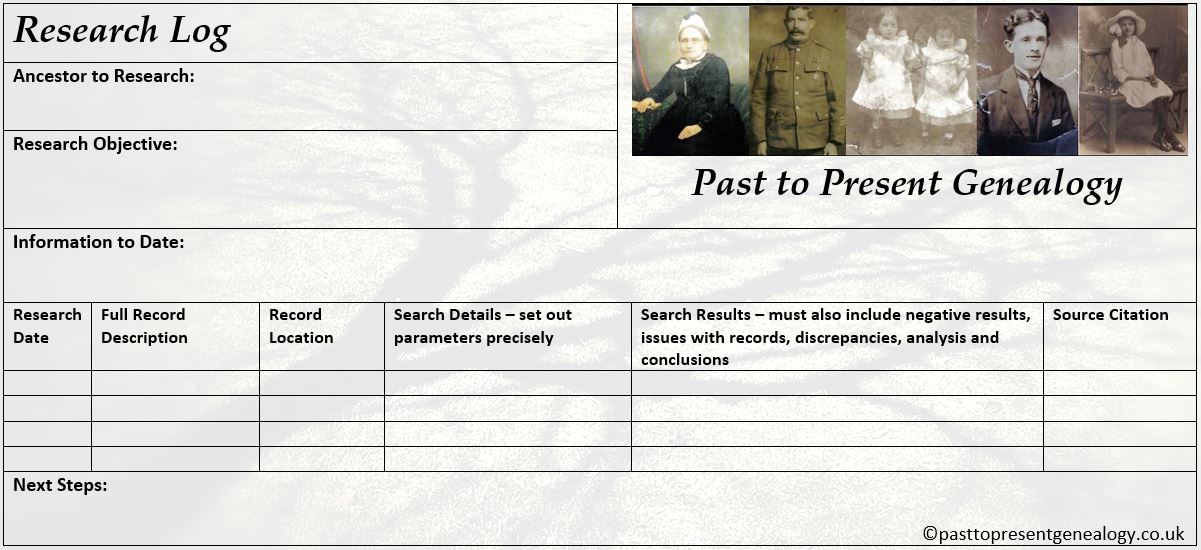
  1. Define the research objective: Set out clearly the problem, e.g. finding out the date of birth of an ancestor, or who their parents were. Include what you know through evidence, and any assumptions or conflicting information. This enables identification of issues, leading on to potential sources and search strategies
  1. Identify possible records and sources (e.g censuses, parish registers, probate records, books): These must be fully detailed including description, location(s) and type e.g. original documents, indexes, transcripts, digitised images etc.
  1. Date of the search: Archives add to their acquisitions. Records are continually being digitised and appearing online, and this includes updates to ones already online (think 1939 Register, or the GRO Indexes). So a search conducted 12 months ago may not have the same outcomes if conducted today. A date helps you decide if it’s worth repeating the search.
  1. Set out fully the search parameters: What spelling variants did you use? How many years either side of a specific date did you search? Which locations/parishes did you use? Did you rely on a data provider’s online search? Did you visually confirm results? Did you go through the record (and all the years) yourself? If a book, did you rely on the index or read the entire chapter or book? Some datasets (e.g. censuses) are on multiple websites – did you search just one? The same search on another website may have a different result. This enables you to see exactly what has been done and identify other possible areas of research.
  1. Record in detail the results – including negative ones: Fully record search results along with your analysis, conclusions and any discrepancies. This includes problems with the records, e.g. were there any gaps or record damage which might affect the result? Do ensure that the explanation is clear because it might be a while before you revisit it. And do include negative searches.
  1. Full source citations: Note where the original document can be found. Include full document reference, with page number. For website searches also include URL, description and date accessed. Give as much information as possible to enable you to find the document again. Do not assume it will always be online! 
  1. Next steps: Review your log. Identify follow-up searches. 

Your log could be electronic (do remember to back it up). Or it could be paper-based.

There are lots of pro-formas online. I have included my example above. Or perhaps you might prefer to design your own bespoke log.

And do not be put off by the thought of the time taken to keep a research log. It is minimal when compared with the time you will save in the long run from trying to remember exactly what you’ve done before, reducing the number of repeat searches and pinpointing what you have not tried.

Whatever method you use, online or paper-based, your research will benefit.

My 2020 Family History Review. And is it Really Worth Setting Any Goals for 2021?

Well 2020 did not go as planned. Massive understatement.

When the New Year dawned, little did I think the goals I set would be scuppered to such an extent. And if there was to be a hitch, a global pandemic would not have been top of my list of reasons. In fact, it would not have featured at all. But there you go.

2020 did begin well. Research for my new book got off to a great start. I gave a talk at Leeds library about World War One research based on the book I co-authored with my rugby league journalist husband. Other talks were lined up. I booked a couple of conference tickets, and the associated accommodation and transport.

And then March came, and with it lockdown. Everything went pear- shaped.

Archives visits and travel generally halted, along with it the prospect of any associated book research. Events and conferences were cancelled, one by one. As were the prospects of any further talks in these pre-Zoom days.

And unimaginably I lost any enthusiasm to review my family tree – apart from anything else getting through the trauma of daily life, where everything was so much more challenging and time-consuming, was an achievement. And these home-life challenges included a major water leak at the start of the year which necessitated a new kitchen and new bathroom – all work due to start in March. Lockdown came in as our bathroom was ripped out. Family history was the last thing on my mind.

The only thing that continued from my 2020 goals was blogging. In fact, this year saw an increase of around 50% in terms of those viewing my blog posts. Thank you. That was the one bright spot in my goals.

But things did pick up. In the place of conferences, I attended far more talks than I ever have before thanks to the wonders of Zoom. I also did a one-place studies course, and ended up starting one for Batley St Mary’s during World War One. Something entirely unexpected and unplanned at the start of 2020. But something I’m thoroughly enjoying.

As was becoming a grandma for the first time as 2020 drew to a close – I know, I’m way too young! It meant much of my free time this year was taken up with stitching a birth sampler ready for the big event.

Birth Sampler

In the light of all this I did think seriously about whether to set any goals for 2021, given the uncertainty we are still living under. But I do need something to aim for.

However, for 2021 my goals will be far more work-related, given how this has taken off.

And with work in mind, this was the major reason behind my decision to step down as editor of the Huddersfield and District Family History Society Journal. I loved doing it, and it is something I’m immensely proud of. But as work built up I increasingly found it squeezed the time I could devote to the Journal, particularly in the lead up to print deadline. My last Journal as editor goes out in January 2021.

And linked to this, my family history column in Down Your Way magazine also came to an end in 2020. The much-loved Yorkshire memories magazine was a casualty of the COVID-19 economic downturn. I must admit I really do miss writing a regular magazine feature, because it gave me another family history focus. But it has freed up even more research time.

As for my goals for 2021, they will be as follows:

  1. Pick up my book research, as and when I am able;
  2. Continue my blogging;
  3. Build up my St Mary’s Batley WW1 One-Place Study, details of which are at the top of my WordPress site;
  4. Focus on my research work for others. It’s a huge privilege to be entrusted with someone’s precious family or local history research, and I undertake it with the same dedication and thoroughness as I would my own; and
  5. Keep up to date with advancements in the field of genealogy as part of my continuing professional development programme. This will include undertaking a minimum of two formal courses, as well as a broad range of reading and practical work.

Finally a huge thank you for continuing to read my blog in these very trying times. As I said earlier this has truly been one of my year’s bright spots.

And as for the New Year, I hope that 2021 will be far kinder to us all than 2020 was.

Talk: Researching Your Great War Army Ancestors. (Includes details of my other 2020 talks)

Heads up about my forthcoming talk on 4 March at Leeds Central Library.

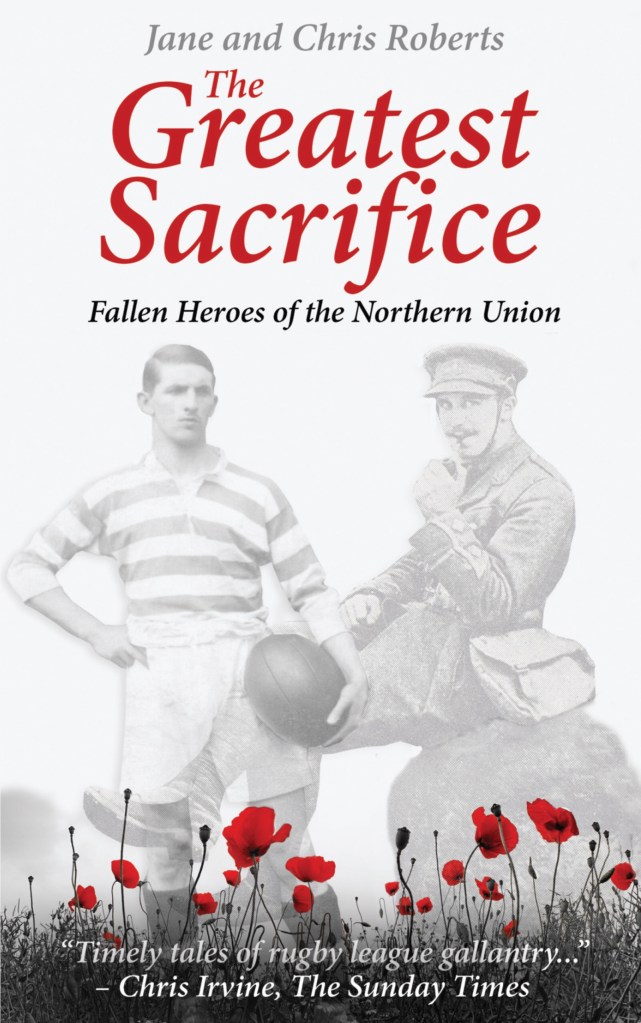
Based on my groundbreaking book The Greatest Sacrifice: Fallen Heroes of the Northern Union about rugby league players who died in World War 1, the talk investigates the stories behind some of the men. It will also be packed with tips for researching your own Great War Army ancestors.

The book, co-authored with Rugby League writer Chris Roberts, has received widespread acclaim, locally and nationally, in print and on radio. The reviews include:

The talk will take place in the Leodis Room, starting at 1pm. It will last for one hour, with opportunity to ask questions. Tickets are free and available through Ticket Source. You can also contact the library direct on 0113 378 5005.

This is one of a series of talks I give. The others scheduled for 2020 are:

  • Blogging for Family and Local History; and
  • The Home Front: the White Lee Explosion of 1914

For more details about these talks please contact me at: pasttopresentgenealogy@btinternet.com

That’s also the contact if you would like to buy a copy of the book. The price, including p&p within the U.K., is £14.99. It is also available direct from the publisher, Scratching Shed Publishing Ltd. It is also stocked at independent Leeds bookshop, Philip Howard Books. And it’s also available from the normal retail outlets.

Why Family History is Like A Box of Chocolates

It’s the end of January and I’m still eating my way through my Christmas chocolates. As I do so I can’t help but compare them with my family history research.

Each box and tin contains an overwhelming selection. One temptation is to dive in and, without any planning or forethought, work your way right through the entire box. That can be true of family history. A scattergun approach, jumping from one tempting ancestor to another. It’s great to start with, but ultimately it becomes less and less satisfying.

The other similarity is that often in that box or tin, some flavours and types are your favourites. You may be like me and go for them first (coconut is my personal weakness). The least tempting I leave till the end, and then I’m faced with nothing but a heap of orange creams which I must force myself to eat (it has to be done). Again, family history research can be the same. You have your favourite ancestors and these are the ones you go for first. You can’t get enough of them. Other ancestors, for whatever reason, don’t hold the same interest. These are the ones left for another day. And when you do pick them up, they’re not very satisfying.

On the same theme some chocolates are expensive. Others have more substance. Or they may have multiple layers and taste sensations. These could be your wealthy ancestors, or your ancestors with lots of associated records or the ones with really fascinating and varied lives.

My final comparison is that you can have too much of a good thing. It’s that end of January feeling when eating chocolates becomes a huge chore rather than a great pleasure. Personally I’m at the stage of not wanting to see another chocolate, but I feel I must plough on. And yes, hard as it is to believe, that can happen with research too. Family history morning, noon and night can leave you jaded by it all. That initial enthusiasm can wear off. So it’s good to have a break from it, even if only for a week or so. Then, like chocolates, you can return to it with renewed enthusiasm!

Actually, in hindsight, I may have eaten far too many chocolates this month. And done too much family history too (only joking). Which is why I’m having such fanciful thoughts. Normal service will be resumed in February.

Ten Things You Wish You’d Known Before Starting Your Family History

Many will be starting their family history research in the New Year. That’s the time of year I embarked on my quest many moons ago, when my brother bought me some books as a Christmas present.

The other day I got to thinking about the mistakes I made in those early days, and the advice I wish I’d been given at the outset. Here are 10 tips I wish my younger genie had been given.

A selection of my research record books (see Goal 6)
  1. Talk to relatives…but only if they want to. Don’t push it. Not all relatives will be comfortable with this, particularly if there are skeletons in the family history cupboard. If they do agree to talk, bear in mind the memory isn’t infallible. Names, dates and events may not be recalled with total accuracy. And there may be some air-brushing to glass over uncomfortable truths.
  2. Make a note of all the sources and references for your findings. That includes the document description, location and reference number. If it was accessed via an online search, note the website address, document dataset and search date. Basically anything and everything you will need to locate it again.
  3. Make a note of all searches – negative as well as positive. It avoids unnecessary repeat searches. Note the search date. This helps with online searches. You only need to repeat when the dataset is updated.
  4. Tempting as it is, avoid the scattergun approach. Plan your research strategy. If you plan, you focus. Don’t try do everything in one go. Concentrate on one person, issue, family at a time. Define the problem, and look at which records may help. Work through methodically.
  5. Don’t accept online family trees as gospel. It’s all too easy if you’re new to family history to accept the research of others without question. Do so at your peril – you could find yourself barking up the wrong tree. Do your own research.
  6. Record your findings as soon as possible. Don’t build up a backlog. I started with a card index system which I still continue. I also now record on a family history software programme. But it could also as easily be an ancestral notebook, or downloading forms such as those available on the FamilySearch Wiki. It’s whatever works for you. The key point is you do it, so your research is up to date. you can quickly evaluate it and spot the gaps.
  7. Don’t get hung up on spellings. Literacy levels and accents all impacted. Be open-minded. Some of my family surnames have upwards of 20 spelling variations. Even Christian names could vary.
  8. By the same token be aware that your ancestors were not necessarily consistent with facts. They may have not known their exact birthday. They may have wished to bend the truth. My great grandmother lied about her age to make it appear she was closer to the age of her husband. She and my great grandfather lied in the 1911 census about the number of years they had been married, to cover illegitimacy of children. Your ancestors were human. And humans don’t always tell the truth. So when searching, build up in parameters either side of dates. Question, question, question. And refer back constantly to previous findings,
  9. Join a family history society. Consider courses. Read to expand your knowledge. Ask if you’re not sure. And accept help. We’ve all been there. And genealogists are a friendly bunch.
  10. Finally be aware – family history research could end up taking over your life. You’re never finished.

I do hope these tips help you start your research on the right track!

A Personal Post: The End of an Era

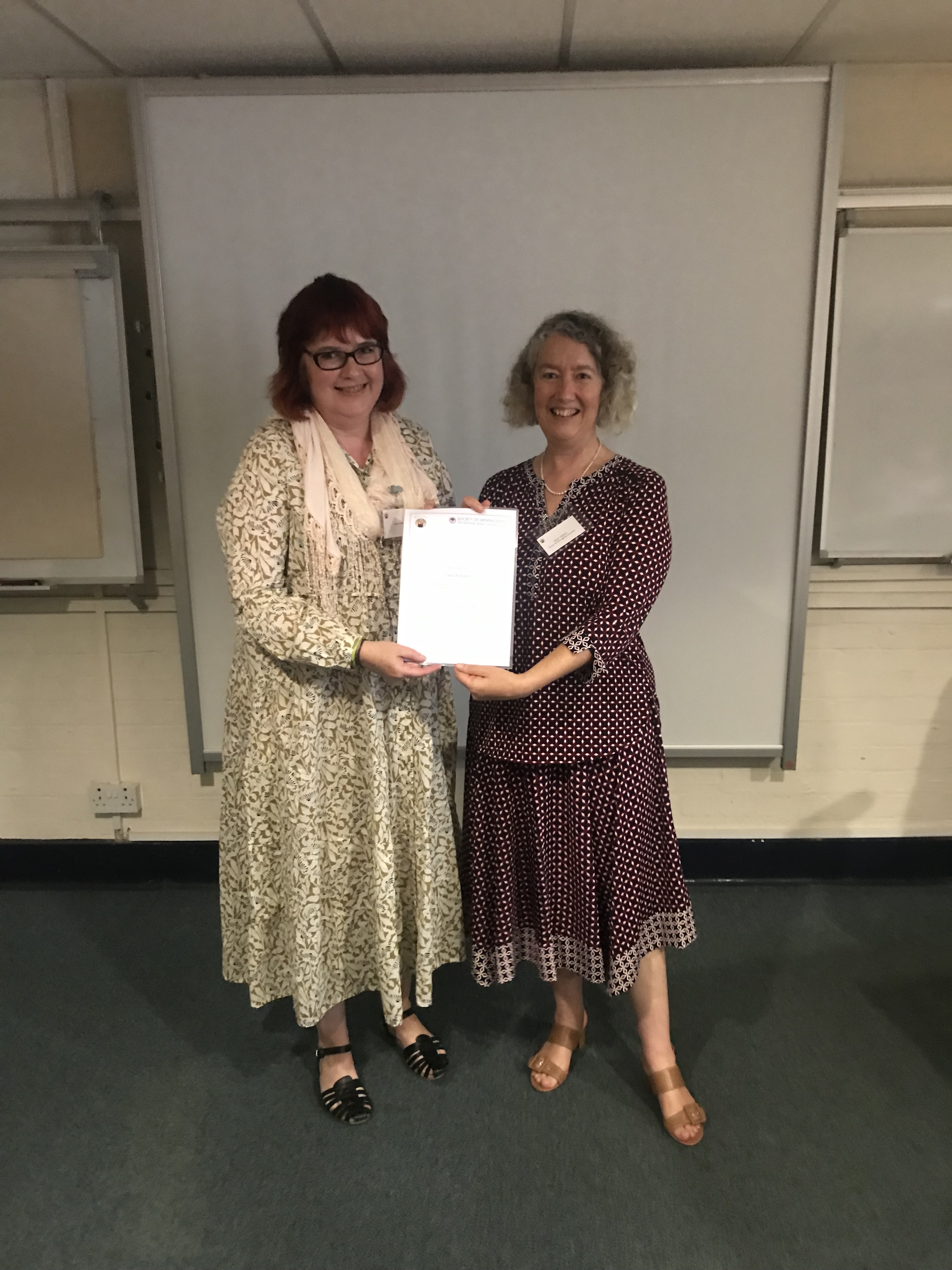
31 May 2019 marked the end of a huge chunk of my life over the past few years. I was at the Society of Genealogists in London for the award of my joint Pharos Tutors and Society of Genealogists Family History Skills and Strategies (Advanced) course certificate.

A bittersweet moment, it was the culmination of a couple of year’s hard work undertaking the various modules, the end of year one exam and a year two project. And even before that I had spent three years completing the Intermediate course.

Yes, submitting my final assignment last autumn and receiving my marks (a Distinction) just before Christmas were phases of the end. But the award ceremony was the moment which finally put a full stop on this period of formal learning

It was also wonderful meeting those who also undertook this learning journey, be it my fellow students or the ever-patient tutors who taught us along the way. I’ve learned so much through these courses and become a better genealogist as a result. They’ve also laid the foundations for my future continuing professional development.

But at the same time it was also a sad moment. Saying goodbye to everyone. Finally recognising that this phase of life was over and that the regular routine of formal learning had ended.

But has it?

Whilst the formal assessed courses are at an end, as part of keeping up-to-date with genealogical developments I will forge on with my personal programme of learning in order to continue to offer the best possible service to those who put their trust in me to research their precious family history.

My 1st One-Name Study Story: Edith Aveyard – Yorkshire Born And Bred

For me family history is more than a series of names and dates. I want to try paint a picture of my ancestors lives, their wider family network, the times in which they lived and the communities which shaped them. For many, records are the only way to build up this picture. For others their lives are still within living memory, either first hand or indirectly through others.

Edith Aveyard is my maternal great grandmother and the reason for my one-name study choice. I never met her, but through many hours talking to mum I do feel I have some sense of her character which goes beyond the records.

Born in East Ardsley in the West Riding of Yorkshire on 20 March 1879 she was one of the nine children of Wesleyan Methodist Abraham Aveyard and his wife Sarah Jane (née Broadhead). Her siblings included Peter (1873), Thomas Henry (1875), Bertha (1887), Amos Hartley (born 1881, died 1884), Paulina/Pauline (circa 1884), Eliza (1885), Caroline (1887) and John (1889). Abraham, a coal miner, spent several short spells between 1894 and 1908 in Wakefield Prison for debt.

Family census and various birth, baptism, death and burial records show that by March 1884 the family moved from East Ardsley to Morley. Sometime between May 1887 and March 1889 they shifted to Drighlington but by the mid-1890s they were back in Morley. All were coal-mining areas, so provided employment opportunities for Abraham and his eldest sons.

Edith married coal miner Jonathan Rhodes at Woodkirk Parish Church on 14 August 1897. They were both 18 years old. Edith did not sign her name in the register. Mum recalls that she could never write – yet she could read a horse-racing card well enough in the newspapers to enable her to put on a bet!

It was a marriage which did not meet with the approval of Jonathan’s parents, William Burnley Rhodes and Elizabeth. Mum has the impression they thought they were a ‘cut above’ Edith’s Aveyard family. Perhaps Edith’s father’s periods in jail were central to this belief. However, the marriage was one of necessity as Edith gave birth to a daughter, Alice, less than four months after the wedding.

The couple settled into married life and their home at Healey Croft Terrace, East Ardsley, near-neighbours of Edith’s brother Thomas Henry Aveyard. It was here the couple’s other children were born: Ethel (1899), Oliver (circa 1902), William Henry Bastow (circa 1903) and Pauline (1905).

But life was not without its difficulties. Jonathan was not a well man. A diabetic in the pre-insulin era, he was carrying out the physically demanding job of a coal hewer. And then tragedy hit. First youngest son William died at the Healey Croft Terrace home, on 4 June 1907, struck down by meningitis when only four-years-old. He was buried in the churchyard at East Ardsley St Michael’s two day’s later. Then, shortly after moving to Morley, the couple’s other son 8-year-old Oliver was killed on 8 October 1910 after being knocked down by a motor car on Britannia Road. It’s an incident which I wrote about here. He was buried alongside his brother on 11 October 1910.

By 1916 the family had left Morley and were living in Hanging Heaton. Daughter Alice married Willie Boynes in the Sunday school at Hanging Heaton on 16 April 1916. The school had been given a special licence to hold marriages by the Bishop of Wakefield.

The somewhat unusual venue was because the parish church of St Paul’s Church at Hanging Heaton was gutted by fire after a lightning strike in the early hours of 17 February 1916. Initially, given this was the midst of the Great War, the crowd watching the destruction of this landmark church, speculated that the cause was ‘German incendrianism.’

The Million Act church of St Paul’s, Hanging Heaton, was built originally between 1823-1825 as part of the church building programme sanctioned in the wake of Wellington’s 1815 victory over Napoleon at Waterloo. It was on a dominant hillside position, and the flames were visible for miles around. The High Street home of the Rhodes family was a matter of a few hundred metres away.

High Street, Hanging Heaton today. The old Number 67 where the family lived no longer exists. Photo by Jane Roberts

The fire was spotted at 4.10 am by Sam Pleasants. But, with only one telephone available in the vicinity of Hanging Heaton, summoning help was not straightforward. The Dewsbury Brigade received a call at 4.23am and, according to the Rev. W.E. Cleworth, they were working with the hose on the blaze before 5am (Batley News, 19 February 1916). The Dewsbury Reporter of the same date also stated:

Great praise was bestowed upon Dewsbury Fire Brigade for the very prompt manner in which they responded to the call and the general adaptability they displayed.

The Batley News report went onto say the Batley Brigade did not receive a request to assist until 5.15 am. This delay was criticised as being detrimental to efforts to save the church. The Leeds Mercury of 18 February in its report mentions the Dewsbury Brigade was speedily on the spot, but states Batley’s arrival was delayed for some time at the toll-bar gate at Grange Road. No mention of the problems being down to contacting them.

Later published accounts state that both the Batley and Dewsbury Fire Brigades were delayed in attending the conflagration. These too do not mention the lateness in getting the call through to Batley. Rather they say precisely because of the church’s steep hillside position, the horse-drawn engine from Batley could not access via the direct route up the hill. Instead it had to go via Grange Road where the Toll Keeper, when he eventually was roused from bed, argued about the toll for fire engines. The Dewsbury Brigade were held up because they could not enter the area without the permission of the delayed Batley Brigade. And when they were both finally in position, at the same time, initially they had no water.

Whatever happened with the Fire Brigades, the main point is the flames, fanned by a strong wind, took hold and the church was beyond saving. Its rebuilding was not authorised until 1920, and it was finally rededicated on 17 November 1923.

The vulnerability of the building to lightning strikes was highlighted just prior to the rededication. Building work completed, on Saturday 7 July 1923 it was once more struck by lightning. The top of one of the pinnacles was completely shattered, and a small fire broke out. Fortunately residents witnessed the event and acted swiftly. The blaze was quickly extinguished with buckets of water. This particular storm caused death and destruction across Yorkshire.

On a broader family history note, amongst the things salvaged from the 1916 inferno were the parish registers! One of the ‘rescuers’ of these precious documents was the verger, who also lived on High Street.

Interior of the destroyed Church of St Paul’s, Hanging Heaton

Despite the destruction, sightseers who flocked to view the ruins were allowed to enter the devastated building just over a week later. The Batley News of 26 February 1916 described:

…streams of humanity that flowed to the scene of the fire-wreckage was like unto the multitudes on the days of Lee Fair, [the country’s oldest chartered fair which dates from at least the early 12th century and is held at West Ardsley] a big football match or a big festival.

It is hard to imagine Edith and her family not being amongst these streams, given their proximity to the church. It was there nearest place of worship too, Edith clearly not adhering to her father’s Wesleyanism. She married in the Established Church, and her children were baptised in it.

In 1919 middle daughter Ethel married James Delaney, a Batley Catholic of Irish descent. Serving as a Gunner in the Royal Field Artillery, and latterly as a Sapper in the Royal Engineers, he was discharged from the Army in October 1918 no longer fit for service. He died in the East Lancashire Soldiers’ and Sailors’ Home at Park Lane, Kersal on 27 January 1928. One relative seems to think Ethel, who had nursed her husband, was so low in the aftermath of her husband’s death she could see no point in living. It was Edith who prevented her carrying through with her threat. I’ve found no evidence to back this up as yet. Perhaps I never will.

Once Ethel married, the only daughter remaining at home was Pauline. They were still in Hanging Heaton, but now at 20, Kirkgate. On 6 March 1921 she was by her father’s sickbed whilst her mother, Edith, briefly nipped out. It was whilst she was away that Jonathan died. His funeral took place at East Ardsley St Michael’s where he was laid to rest with his young sons on 9 March 1921.

Kirkgate, Hanging Heaton. Number 20 is now a modern house. These are the nearest old houses. Photo by Jane Roberts

Edith re-married on 25 February 1922. He husband was 38-year-old motor driver William Henry Ellis, a bachelor. Mum knew him as uncle a Bill. St Paul’s Hanging Heaton was not yet rebuilt, so the wedding took place in the Church Hall which had replaced the Sunday School as the building licensed to conduct services.

The Rebuilt Church of St Paul’s, Hanging Heaton. Photo by Jane Roberts

By 1939 bus driver Bill and Edith had moved to Upper Camroyd Street in the centre of Dewsbury. The location suited her perfectly. A stone’s throw from the huge market, and with access to a full array of shops, it was also near the pub where she could pop across to get a pitcher of beer to take home. Subsequently Edith moved a couple of streets away from Upper Camroyd Street to one of a pair of cottages in Battye Street.

It was the same town in which married daughter Pauline now lived with husband John, so mum has plenty memories about her broad Yorkshire-speaking grandma.

A diminutive woman, mum remembers her as being ‘a bit to a tartar‘ who would stand no nonsense from her grandchildren. She recalls a couple of examples. Her grandma had a horsehair settee. Mum, as a child in her short skirt, remembers sitting on it and the fibres pricking into her legs. Despite the discomfort she would sit rigid, as no way would her grandma allow any fidgeting. On another occasion Edith came to look after her grandchildren whilst Pauline and husband John were away. The children were not allowed to open any drawers in their own house!

Yet she was always more lenient with mum’s eldest brother, Jack. And when one of mum’s sisters married, she offered to partition her bedroom down the middle with a curtain so she could live there with her new husband. The offer was declined.

Mum’s other memories include when she first started work. Her job straight from school was at Luke Howgate’s in Dewsbury. The firm still exists today. It manufactures for the funeral trade and mum worked on simple soft furnishings for coffin interiors. She would pop in from work for a Friday fish and chips lunch with her grandma and uncle Bill. Edith was thrilled with her granddaughter’s new job and would ask endless questions about it, whilst imparting her considerable knowledge of the funeral trade. She spoke from personal experience. Besides informally helping bring babies into the world, she also was called upon to lay out the dead in the neighbourhood. She even had her own personal laying out drawer ready for her own death – and her grandchildren were not allowed to open this either!

Edith Aveyard

Uncle Bill died in 1956. Edith died at Staincliffe hospital on 24 October 1957 as a result of cerebral arterio sclerosis and old age. She was buried alongside her first husband, Jonathan, and sons William and Oliver in the unmarked East Ardsley grave.

Her Battye Street home as long since gone. The cottages were demolished. On the very spot where they stood is the Chapel of Rest for George Brooke’s, Funeral Directors. It somehow seems fitting.

Sources:

  • GRO Birth, Marriage & Death certificates – various;
  • Yorkshire Baptisms, Marriages & Burials via Ancestry.com Church of England Parish Register Collection. Original data at West Yorkshire Archives;
  • Abraham Aveyard, HMP Wakefield Records, via Ancestry.com. West Yorkshire, England, Prison Records, 1801-1914 [database on-line]. Original data at West Yorkshire Prison Records. Reference C118: Wakefield Prison. West Yorkshire Archive Service, Wakefield, England;
  • Censuses 1881 to 1911 accessed via Ancestry.co.uk and FindMyPast;
  • 1939 Register accessed via Ancestry.co.uk and FindMyPast;
  • Newspapers as indicated;
  • Pauline Hill’s recollections – conversations with Jane Roberts, February 2019;
  • St Paul’s Hanging Heaton website: http://www.stpaulch.co.uk/;
  • OS Maps – National Library of Scotland;
  • East Ardsley St Michael’s MI booklet – Morley Family History Group;
  • James Delaney, WO 363 War Office Soldiers’ Documents, First World War ‘Burnt’ Documents accessed via FindMyPast. Originals at The National Archives, Reference WO 363/D972.

Transcription Tuesday 2019 – Your Chance to Give Something Back to Family History

A date for your diary: 5 February 2019 is Transcription Tuesday.

This annual event, launched by Who Do You Think You Are? Magazine in 2017, promises to be the biggest yet and it’s your chance to be part of it.

As Sarah Williams, the magazine’s editor, says:

The internet has transformed family history but the documents that are going online need to be transcribed or indexed to make them searchable, and for many projects the only way that is going to happen is with the help of volunteers……We hope to see hundreds, if not thousands, of volunteers from across the world join together and give something back to family history.

Three projects, covering three distinct record sets, form this year’s event:

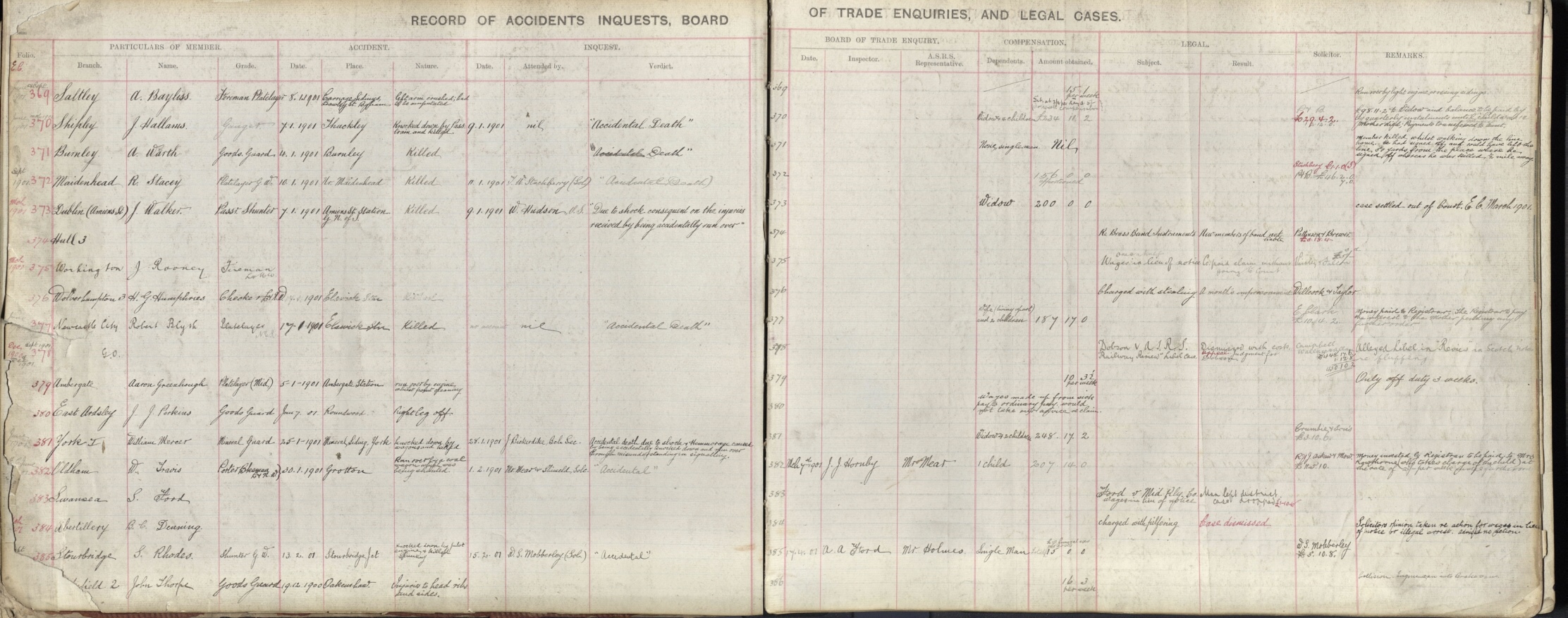
  • Transcribing a book covering railway worker accidents between 1901-1907 in just 24 hours. This Amalgamated Society of Railway Servants volume, the forerunner of the National Union of Rail, Maritime and Transport Workers (RMT), records accidents and legal cases involving its members. It is a strand of the Railway Work, Life and Death project, and is being carried out in conjunction with the University of Portsmouth, the Modern Records Centre based at the University of Warwick and the National Railway Museum (NRM). The tome will make a potential 2,150 railway worker records widely available.

Sample page from the railway accidents book that volunteers will transcribe on Transcription Tuesday 2019 CREDIT: Modern Records Centre

  • Warwickshire witness statements from the county’s quarter sessions. This is a part of Warwickshire County Record Office’s Warwickshire Bytes project encouraging volunteer participation in indexing records held by the archive; and
  • A range of parish registers in association with FamilySearch.

There are so many reasons to take part in Transcription Tuesday. It is your moment to be part of something big; it is an opportunity to give something back to the wider family history community; it is a chance to make more accessible to families the lives of thousands of ancestors; it could help you improve one of the core skills of a family historians – reading and transcribing original documents; and you never know, if you have a railway ancestor, Warwickshire roots or the parish records relate to your ancestral homelands you may be lucky enough to find yourself uncovering part of your family history!

To find out more about the day, the projects and how to get involved visit: http://www.whodoyouthinkyouaremagazine.com/transcriptiontuesday

And please spread the word to help make this year’s Transcription Tuesday the biggest so far.