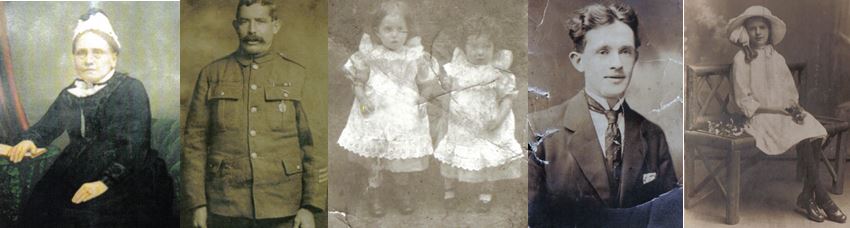
This is the latest update of the pages relating to my Batley St Mary’s one-place study, the details of which I announced here.
Thomas Donlan – one of the new biographies in April
In the past month I have added seven new pages. These include four weekly newspaper summary pages. I have also produced a surname index to these During This Week newspaper pieces, so you can easily identify newspaper snippets relevant to your family.
There are also two War Memorial biographies – those of Thomas Donlan and Thomas McNamara.
Another man linked to the parish who is not on the War Memorial but who died has also been identified, and that page has been updated to reflect this man’s name. I will be writing biographies for all these men as the study progresses. I have amended the section covering Burials, Cemeteries, Headstones and MIs to include this additional soldier.
Finally more men who served and survived have been identified. I have accordingly updated that page. The biographies of these will follow in due course.
Below is the full list of pages to date. I have annotated the *NEW* ones, plus the *UPDATED* page, so you can easily pick these out. Click on the link and it will take you straight to the relevant page.
The White Lee explosion at Henry Ellison’s chemical factory on Hollinbank Lane, Heckmondwike, which killed 10 men on 2 December 1914, does not tell the entire story of the chequered history of these works. Even before this catastrophic event it was the scene of multiple fires. Additionally there was a series of bizarre, and unassociated, deaths involving men who worked there between 1870 and 1885. All occurred during the tenure of the previous owners of the works, the Heaton family. And the Heatons themselves were not untouched.
James Heaton, who started the family’s involvement with chemical manufacturing, was originally a spinner by trade. From Little Gomersal, he married Jane Popplewell at Birstall St Peter’s on 28 December 1834. The newly married Heatons subsequently moved to Leicester to raise their family. Children included Joseph (born 1836), George (born circa 1838), Martha (born in 1839, and died in 1840), Mary (born in 1840), John (born 1841), Susannah (birth registered in 1841), and Jane (born 1847, and died in 1848).
I have not pinned down precisely the family’s move back up north, but it is likely to have taken place in the mid to late 1850s. Certainly, by the time of the 1861 census, the Heaton’s were in the Dale Lane area of Heckmondwike, with James and his three sons described as manufacturing chemists – a total shift away from James’ lambs wool spinning days.
Other clues around timing of the manufacturing chemist move come in Ordnance Survey maps and Directories. The 1854 Ordnance Survey map of the area (surveyed 1847-1851) does not feature the chemical works. Neither is the Heaton Chemical Works mentioned in White’s 1858 Directory of Leeds, Halifax, Huddersfield etc. However one set of inquest notes indicate that one of the Heaton brothers, Joseph, had been involved in chemistry since around 1854. The accuracy of this statement though is uncertain – the same notes give the incorrect month and year of death for James.1
The newness of the concern is also indicated in newspapers, which also provide further details of the type of processes Messrs. James Heaton and Sons undertook. Besides chemical manufacturing, they were also involved in oil extraction by means of the pressing process, and grease production.2 A newspaper report from March 1863, describing a fire at the premises, states how a newly erected, and uninsured, shed used for the purposes of extracting oil etc was destroyed, damage estimated at £200. The adjoining shed, where several tons of oil and other flammable spirits were stored, was saved due to the assistance of neighbours.3 In addition to offices, warehouses and storage facilities, from newspaper reports over the years the extensive buildings included a rag storage area, a blacksmiths and a coopers.
A later map showing the location of the Chemical Works – Ordnance Survey Maps – Six-inch England and Wales, 1841-1952, Yorkshire CCXXXII.SW (includes Cleckheaton, Gomersal, Heckmondwike), Surveyed: 1889 to 1892, Published: 1894 – National Library of Scotland, under the Creative Commons Attribution-NonCommercial-ShareAlike 4.0 International (CC-BY-NC-SA) licence
The family had fingers in pies other than the White Lee chemical and oil refining concern. They owned a farm, and had a growing property portfolio. In July 1874 they bought the old-established copperas and prussiate works in Roberttown, producing black dye and sulphuric acid. One member of the family even had a ship named after him: In 1882 an iron screw steamer, intended for the Indian and Atlantic trades, was launched up in Tyneside. The steamer, christened by Mary Heaton (wife of middle brother George), was named the George Heaton.
The Heatons, though, were not immune to local controversy. A Healey resident, writing to the local paper in 1879, accused the Heaton chemical works of being a public nuisance, responsible for “constantly bringing the most noxious gases and vilest smells into our homes; our sitting rooms and bedrooms, too, being frequently filled with them.”4
Then there were the Local Board and Town Council water meter disputes, planning controversies, and accusations of providing cottages unfit for habitation.
On a personal level, court cases included the ill-treatment of a horse (John), and the assault on a letter carrier in 1874 (Joseph). In this incident Joseph refused to hand over 2d to Heckmondwike Post Master employee Frank Richmond. Joseph then pushed the mail deliverer against a wall and pulled his ears because he felt the youth had behaved in a “saucy and taunting manner.”5 Joseph escaped punishment because the assault was deemed of a trivial character.
The letter incident occurred days after another fire at the Heaton Chemical Works, and perhaps the stress Joseph was under affected his reaction that day. The previous year, in June 1873, a fire broke out in the uninsured works, but was quickly subdued with minimal damage. The fire which broke out on 2 February 1874, at about 5.30pm, was far more serious. Believed to have been caused by oil overflowing from one of the tanks, it took several local fire brigades until 10pm to extinguish the blaze, by which time it had caused damage estimated £20,000.6 Fortunately by now the Heaton’s business was partly insured, although it did mean they suffered losses of around £10,000.7 However the consequences were felt far beyond this date. Messrs. Heaton became embroiled in a dispute about charges for the fire brigade services that night. Legal proceedings followed to recover these costs.
The dispute rumbled on, and failure to settle payment from previous fires was the reason why all local fire brigades refused to attend yet another blaze at the works. Believed to have been caused by the ignition of overheated grease, this fire broke out in the early hours of 28 August 1879. One brigade did set off, but turned back round when they found out the location of the fire. It was left to local people to confine the conflagration to the originating building, extinguish the blaze and save the rest of the extensive works which were filled with combustible chemicals. Again only partly insured, damage was estimated at between £1,000 to £1,500.8
The above-mentioned controversies took place after the death of James Heaton on 27 April 1867, when sons Joseph, George and John took over the running of the business. John was the brother best described as the business’s superintending manager; Joseph and George travelled, and mainly did outside works, though Joseph was also the brother who conducted chemical experiments. And it was on their watch that the random sequence of deaths involving those connected to the chemical works occurred. Two were fire related, and both these incidents directly touched the Heaton family.
The first death occurred in 1870. 20-year-old carter George Miller had only worked at Heatons for three weeks when he met his death. Born in Kirkby Overblow in 1849, he was the son of farm labourer David Miller and his wife Ann. David died in 1862 and Ann, after being widowed for a second time, moved with her children to the Birstall area.9 George however lodged elsewhere. Ann, crucially for the turn of events, described her son as sober and very steady.
On 9 March 1870 George, along with Lister Kaye, another carter employed by the Heatons, took some charcoal to Heckmondwike then went to Ravens Wharf to collect two loads of sand. On the way back, at around 5.50pm they stopped off at the Prospect Beerhouse, Dewsbury Moor, where they stayed for about 1½ hours drinking ale with several other men before making their way back to the chemical works. Lister Kaye described George as “verylively”10 – the implication being he had perhaps drunk a little too much.
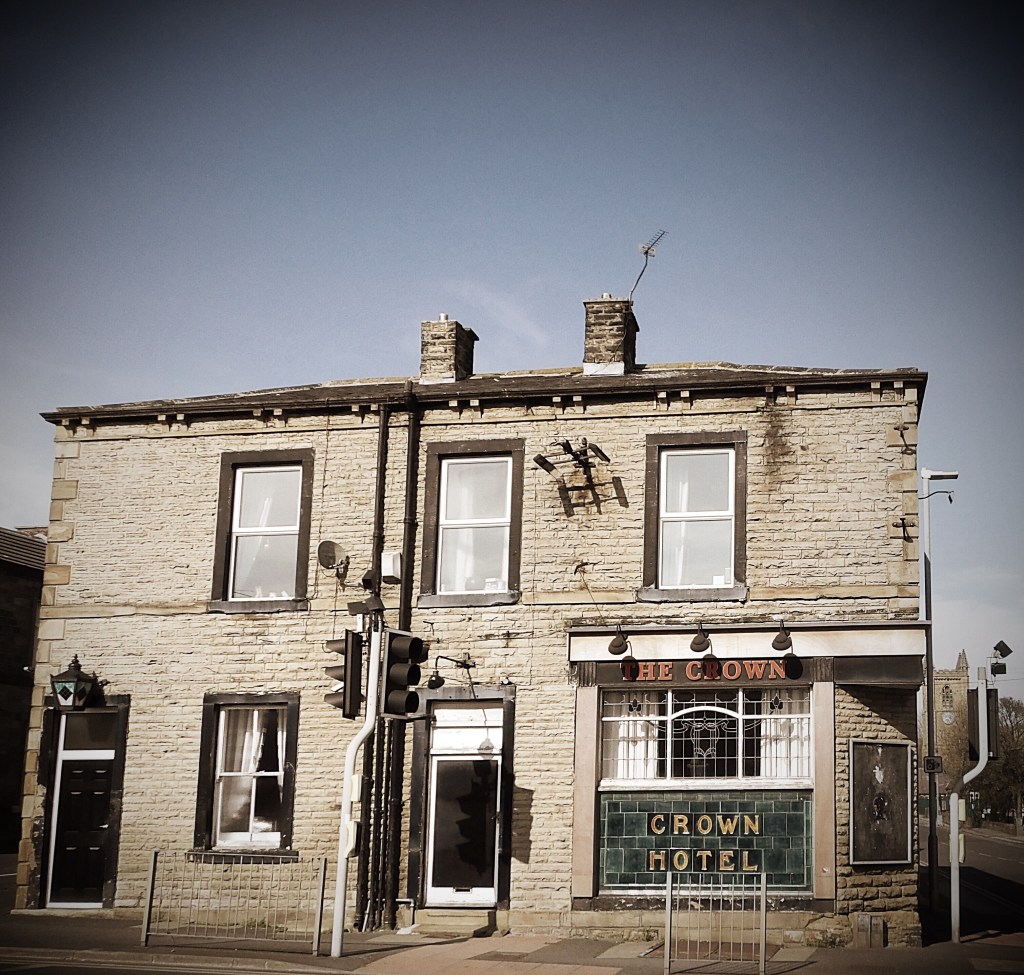
At about 8.10pm, Catherine Droghan was walking up Staincliffe Hall Road. Almost at the top she saw George, walking unsteadily with his horse and cart loaded with sand.11 He spoke thickly to Catherine as if he had been drinking, then sat on the cart shafts until he reached the top of the hill. At this point he jumped down to pick up the reins of the horse which were trailing on the ground. As he tried to get back onto the shafts he fell to the ground on his face, and the cart wheel ran over him. His final words before he was carried to the Crown Hotel were “Oh dear let me lie still.”12 He died 20 minutes later.
The Crown Hotel with Christ Church, Staincliffe (baptism place of some of the Heaton children) and Staincliffe Hall Road to the right – Photo by Jane Roberts
The inquest on 11 March 1870, incidentally also held at the Crown Hotel, ruled he had been accidentally run over. Perhaps it was a case of a new boy not used to drinking trying to fit in with the men. But it appears this stop off at the Prospect Beerhouse cost him his life.
The next employee’s death was of an entirely different nature. This was 21-year-old Thomas Dawson, who worked as a book-keeper at the Heaton chemical works. It was around a two-mile walk away from his home in Gomersal, where he lived with his mill engine operator father John, mother Ann, and younger brother William.
Thomas was born in Gildersome and, before his move to Gomersal, he spent his early years in Batley and Birstall, where he was a member of the Birstall Wesleyan Society. A hard working and studious young man, the fact he was learning French as an adult in this period supports his scholarly nature.
Described by his mother as “well and hearty,”13 he was working up until Saturday 1 November 1873. That day he complained of a pain in his head, and despite a visit from the doctor who diagnosed a mild attack of low fever, he did not improve.
At around 5am on the morning of 5 November his mother went to his room and found his bed empty. Downstairs, the house door was unlocked. The alarm was raised and search parties sent out.
Later that afternoon Nelson Oldroyd saw a walking stick floating in one of the Gomersal mill dams of Messrs. Thomas Burnley and Sons, the employers of Thomas’ father. The dam was within 50 yards of what had been the Dawson family home around three weeks earlier. Nelson then saw Thomas’ body lying face down in the 37 inch deep water. He called for help and the body was retrieved.
The inquest, held at the White Horse Inn in Gomersal, (a place mentioned in connection with John Heaton later on in this piece), reached a verdict that Thomas had drowned himself when of unsound mind.
The third death occurred on Monday, 17 May 1880. The victim was 20-year-old blacksmith’s striker James Flanagan.
James was the son of Irish farmer Andrew Flanagan. He lodged with his cousin Catherine, and her husband Michael Fallon, at Carr Street, Heckmondwike. He had been employed by Heaton and Sons for around 18 months, working alongside Staincliffe blacksmith Paul Perkin.
That Monday morning, at around 6am, James left home for work. A couple of hours later he was helping Perkin with the removal of a one-ton seak press. This was a type of press used to extract oil. Joseph Heaton arrived on the scene and took over the supervision of proceedings.
The machine was put on an 18 inch high horse-drawn cart, called a bogey. It proved a difficult operation, due to the slippery surface, the downward incline, and the fact there was only limited room for the horses to work. Various permutations were tried, one horse, then two, then back to one, with more men called to help push, then sent away again. Eventually it was left to Joseph Heaton to take the horse, with Paul Perkin on one side of the bogey and James on the other. According to Perkin, Joseph told the pair to try to keep in front of the bogey, but for some reason James continued alongside the back wheel.
Initially the bogey moved slowly and steadily. As they neared the crane Joseph Heaton pulled the horse to one side to avoid some casks. He then stopped. At this point the press began to wobble, before it, and the bogey, overturned. There was a scream.
Joseph ran towards James who was on the ground, pinned down by the press. Men were quickly summoned to prize the press off James, who was then placed on a trap sent for by Joseph, and taken to the old Batley Cottage Hospital where he was admitted at about 9.40am. This was the original cottage hospital which opened at Hillfield House, Knowles Hill, in August 1878, prior to the opening of the purpose-build Carlinghow Hill hospital on 27 March 1883.
A map showing the location of the old Batley Cottage Hospital which was in operation between 1878 and 1883 – Ordnance Survey Maps – 25 inch England and Wales, 1841-1952, Yorkshire CCXXXII.11 (Batley; Morley), Surveyed: 1889 to 1892, Published: 1894 – National Library of Scotland, under the Creative Commons Attribution-NonCommercial-ShareAlike 4.0 International (CC-BY-NC-SA) licence
James remained conscious almost to the end, but in great pain. He died just before noon. The inquest, which was held in the hospital on 19 May 1880, reached a verdict of “accidentally crushed.” James is buried in Heckmondwike cemetery.
The next fatality occurred six months later in very peculiar circumstances, and this time it was Joseph Heaton. Joseph was the brother who conducted most of the firm’s chemical experiments, to establish their properties for grease extraction. He had been involved in chemistry for around 26 years.14
At 11am on 22 November 1880, Joseph was in the inner office busy conducting some experiments with bisulphide of carbon. Used as a solvent, this was a toxic, volatile and highly flammable liquid. The fumes could act as an irritant and an anaesthetic. It was a liquid though that Joseph was accustomed to working with. However this Monday morning things went dramatically wrong.
At around 11.15am, somehow the liquid ignited and the copper vessel containing it dropped to the floor. Eliza Coleman, who was at the sewing machine in the inner office, became aware of a commotion and saw Joseph blowing on a small flame in the pan on the floor. Joseph would have been fully aware of the danger a fire posed – after all, the chemical works had suffered significant damage and financial losses before. He attempted to pick up the copper container but dropped it, burning his hand.
At this point Eliza, fearing a fire was inevitable, broke the office window and climbed out. Luckily in the process she avoided inhaling any fumes.
Joseph made another attempt to get the blazing pan out of the building. This time he successfully reached the office yard, where other workers quickly extinguished the flames. The office itself incurred minimal damage, but Joseph had inhaled the fumes.
Joseph took some castor oil before lunch, and remained at work that day. His brother John said he seemed perfectly composed and rational when he left him just before 4pm. However, when his other brother, George, enquired after him that afternoon he told him “I feel it on my stomach and I have burnt my hand in carrying it out when on fire.”15
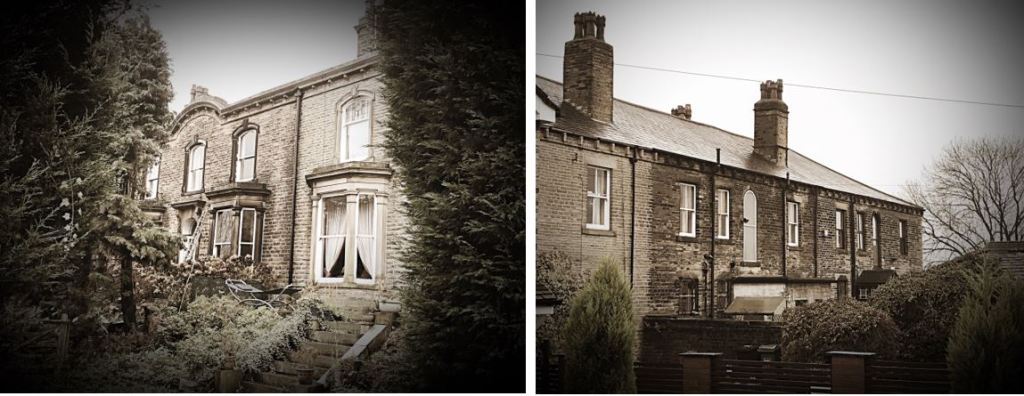
Joseph returned to his Hollinbank Terrace home as usual that evening. John, who lived next door but one, on hearing George’s account, went round to see how Joseph was and found him in bed conscious, but breathing very heavily. Charles Eyre Counsellor, a Heckmondwike surgeon and apothecary, arrived just after 1am and prescribed some remedies. John left at around 2.20am, but called back at just gone 7am, around the same time as Counsellor returned. By now Joseph was unconscious. Joseph died at around 8.30am that Tuesday morning, 23 November 1880.
The inquest was held at the Junction Inn, Heckmondwike, with the jury viewing Joseph’s body at his Hollinbank Terrace home. Their verdict was Jospeh died from inhaling bisulphide of carbon.
The copyright on this image is owned by Betty Longbottom and is licensed for reuse under the Creative Commons Attribution-ShareAlike 2.0 license.
Joseph left a widow, Ann (née Oliver) who he had married on 15 June 1871 at Barnby Dun, near Doncaster. The couple had two young daughters, Frances Jane, born in 1872, and Annie Elizabeth, born in 1874. Joseph was buried in Heckmondwike Cemetery on 26 November 1885.
The fifth death took place five years later in horrific circumstances. This time John Heaton was the victim.
John married Elizabeth Swalwell on 31 March 1870 at St Mary’s parish church, Scarborough. Children followed regularly, including Lizzie Maud (born in 1871), Bertha (born in 1872), Laura (born 1873), May (born 1874), Walter Leonard (born and died in 1875, age 3 weeks), Isabel (born 1876) and Jane Harriet (born in 1879, and died age 6 months in 1880).
On 14 August 1876 he was fortunate to escape serious injury. Returning from the White Horse Inn in Gomersal (the inquest location for former employee Thomas Dawson a shade under three years earlier) that Monday evening, the dog cart in which he travelled lurched violently as it turned into Muffitt Lane, throwing him out of the carriage seat and into the wall of a house. The driverless horse and trap safely made its way back to White Lee, whilst John lay unconscious. He did make a full recovery, but it was a narrow escape. In November 1885 his luck ran out.
At around 7pm on Saturday 7 November 1885 a huge fire broke out in the refining and oil press parts of the Heaton Brothers works. Fuelled by the combustible materials – the estimate was between 200 to 300 tons of oil went up that night – flames illuminated the skyline for miles around. Thousands of people from Heckmondwike and Batley congregated to witness the scene of destruction. Fire brigades from the Crystal and Union Mills (Messrs Kelley and Sons, Heckmondwike), the Liverpool, London and Globe Insurance Society, Birstall, Spen Valley Millowners and Staincliffe Mills all converged on the scene. When the flames were finally extinguished damage was estimated to be between £10,000 to £15,000.16
George Heaton was in Scarborough at the time, so was well out of the way. Only an hour or so before the fire broke out John had gone to Leeds for an evening out. His wife though sent a wire through to his destination and he returned home as quickly as possible by train and then cab from Batley railway station. It was a fateful decision. One only wonders how much his wife regretted her contacting him as events played out.
John dashed to the works to join in with the firefighting efforts. Despite having a sup of gin, he was described as excited, rather than the worse for liquor. With flames in the refining part now abating, the press area became the focus of these efforts. John formed the head of the chain along which buckets of water were passed, and it was he who took responsibility for throwing the water to douse the flames. He stood near a disused tank, the top of which was level with the floor – yet this was never considered dangerous. Ordinarily the tank contained cold water, but the fire caused pans of oil to boil over, and 18 inches of this boiling liquid now formed a layer on the water. By this stage John had thrown between 30-40 buckets of water. In the process of throwing yet another he slipped on a piece of zinc roofing and fell sideways into the tank. Quickly men pulled him out, but he was covered in hot oil with the majority of the scalds being to his arms, legs and face.
Despite his injuries John managed to walk back to his Hollinbank Terrace home. Dr Lee attended him, but John died in his home at about 3pm on Sunday 8 November. He was 44 years old, the same age as his brother Joseph was when he died.
The houses where all three Heaton brothers lived and died – Photo by Jane Roberts
Another inquest, another hostelry – this time the Cricketers’ Arms Hotel, Heckmondwike. The jury returned a verdict of “accidentally scalded.”
John was interred in Heckmondwike Cemetery on 9 November 1885. His wife, Elizabeth, was in the early months of pregnancy. She gave birth to a daughter, Georgina, on 28 May 1886. On 18 September that year the family were back in Heckmondwike Cemetery once more – this time for Georgina’s burial.
The surviving Heaton brother, George, did not carry on with the family business. In 1887 the chemical and oil refining works, along with other ventures including the farm, the Copperas Works in Roberttown, and several properties, were all put up for sale.17 In the 1891 census he is described as a retired manufacturing chemist. In his retirement George split his time between Heckmondwike and Scarborough.
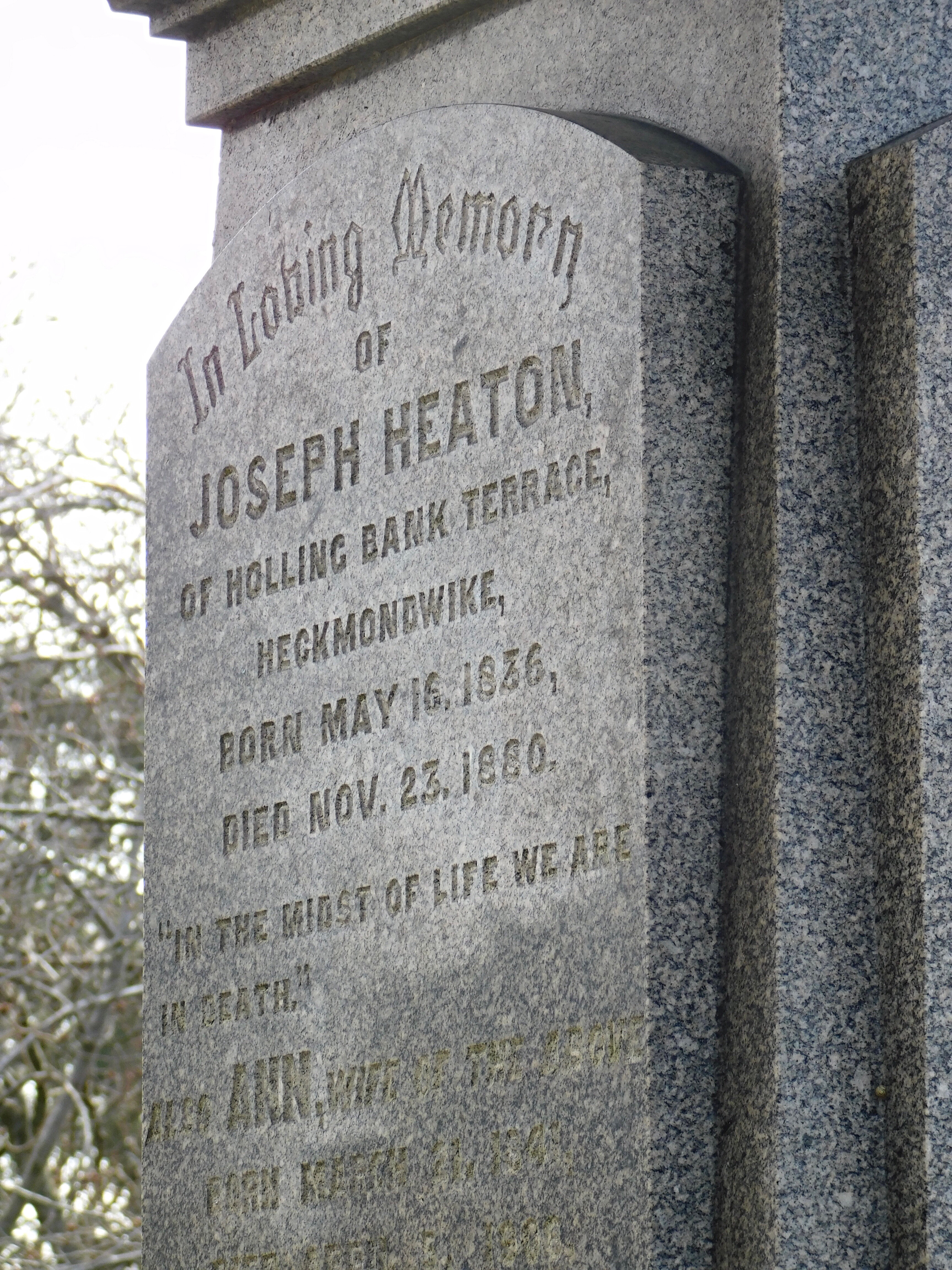
The Heaton headstone in Heckmondwike cemetery, pictured in detail below, gives clues to one of George’s major interests – Freemasonry. Both he and his brother Joseph, right up until their deaths, were members of the Amphibious Lodge in Heckmondwike. In 1896 George became Grand Master of the Lodge.
George died suddenly on 22 January 1898. He left a widow Mary (née Akeroyd) who he married at St Paul’s in Huddersfield on 25 November 1868. The couple’s two sons predeceased George. James William died, age 8, on 24 June 1878; Albert Edward died on 13 July 1879 just short of his fourth birthday. Both were buried in Heckmondwike cemetery and are commemorated on the family headstone.
George’s obituary appeared in The Freemason. It read:
Obituary. BRO. GEORGE HEATON.
Bro. George Heaton, of Hollinbank-terrace, Heckmondwike, died somewhat suddenly on Saturday morning, the 22nd instant. He was 60 years of age, and was formerly in business as a manufacturing chemist and oil extractor. Bro. Heaton, who leaves a widow but no family, was formerly a member of the Board of Health,18 and for a while took an active interest in the Chamber of Commerce.19 It was in connection with Freemasonry, however, that he was best known. He joined the Amphibious Lodge, No. 258, Heckmondwike a quarter of a century ago, and has been a munificent patron of Masonic Charities. A few years ago he contributed 1200 guineas to the Royal Masonic Benevolent Institution, and quite recently he gave 1300 guineas to the Royal Masonic Institution for Girls. He was a P[ast] M[aster] of his lodge, and had also held a prominent position in the Provincial Grand Lodge of West Yorkshire. Although his death was unexpected, he has not enjoyed good health for some time.20
Shortly after his death an oil portrait of George was completed. Commissioned during his lifetime, he was depicted in full regalia with decorations and seals of office as Provincial Grand Deacon of West Yorkshire. The full sized figure, measuring 7 feet 6 inches by 5 feet 6 inches, was hung in the Heckmondwike Masonic Hall. If this portrait still exists, and if there is an image of it, I would love to know. It would be great to include it as part of this blog.
Not including that final catastrophic 1914 explosion, the above sequence of events with numerous fires at the chemical works, and four of the five deaths being work-related but all in entirely different ways, shows the dangers our ancestors faced in days before health and safety. And this sequence was nothing out of the ordinary, as the newspaper accounts of accidents across factories, mills, mines and other workplaces in this period testify. Perhaps what is noteworthy about the Heaton Chemical Works story is the fact that it cost two of the three brothers their lives. Perhaps George made the correct decision in quitting when he did.
I will leave you with one final series of images for the Heaton family: the two family headstones with their inscriptions for James and his sons Joseph, George and John. These lie in the shadow of the now derelict Twin Chapels in Heckmondwike cemetery.
The Heckmondwike cemetery headstone inscriptions for James Heaton and sons Joseph, George and John. The two headstones are in the final photograph, with Joseph’s being the one with the cross, behind the main Heaton headstone – Photos by Jane Roberts
Postscript: I may not be able to thank you personally because of your contact detail confidentiality, but I do want to say how much I appreciate the donations already received to keep this website going. They really and truly do help. Thank you.
The website has always been free to use, and I want to continue this policy in the future. However, it does cost me money to operate – from undertaking the research to website hosting costs. In the current difficult economic climate I do have to regularly consider if I can afford to continue running it as a free resource.
If you have enjoyed reading the various pieces, and would like to make a donation towards keeping the website up and running in its current open access format, it would be very much appreciated.
Please click 👉🏽 here 👈🏽be taken to the PayPal donation link. By making a donation you will be helping to keep the website online and freely available for all.
Thank you.
As a professionally qualified genealogist, if you would like me to undertake any family, local or house history research for you do please get in touch. More information can be found on my research services page.
Notes: 1. Inquest notes, West Riding Coroner’s Notebook, West Yorkshire Archives, Ref: C493/K/2/1/86; 2.It is unclear if grease is a separate substance, or if it is a local word for oil; 3. Leeds Mercury, 9 March 1863; 4. Batley Reporter and Guardian, 15 February 1879; 5. Batley Reporter and Guardian, 21 February 1874; 6. Batley Reporter and Guardian, 7 February 1874; 7. Using the MeasuringWorth website at https://www.measuringworth.com/index.php, this equates to a real price today of £935,300; 8. £1,500 is equates to a real price today of £153,600 using the above MeasuringWorth website; 9. Sources from the time give her name as Ann Gill, widow from Birstall. After David Miller’s death, Ann remarried in April 1866 at Weeton. Her husband was Samuel Gill. He died in 1868. In 1871 Ann is living with Edward Gill at Hightown, described as his wife. They actually married in August 1873 at St Peter’s, Birstall; 10. Inquest notes, West Yorkshire Archives, Ref: C493/K/2/1/36; 11. It’s not clear from the reports, but given George was coming from Dewsbury Moor it is likely he was approaching the Butcher’s Arms crossroads from the Dewsbury Gate Road side, directly opposite Staincliffe Hall Road; 12. Inquest notes, West Riding Coroner’s Notebook, West Yorkshire Archives, Ref: C493/K/2/1/36; 13. Inquest notes, West Riding Coroner’s Notebook, West Yorkshire Archives, Ref: C493/K/2/1/53; 14. Inquest notes, West Riding Coroner’s Notebook, West Yorkshire Archives, Ref: C493/K/2/1/86; 15. Ibid; 16.Using the top-end estimate of £15,000, this equates to an eye-watering real price today of £1,632,000 using the above MeasuringWorth website; 17. Yorkshire Post and Leeds Intelligencer, 1 and 5 February 1887; 18. Heckmondwike, where he served one term of three years; 19. Again in Heckmondwike; 20. The Freemason, 28 January 1898.
Other Sources: • 1841 – 1891 Censuses; • Baptism Registers – Birstall St Peter’s, Leicester All Saints and Staincliffe Christ Church; • Directories; • Freemasonry Membership Registers; • GRO Indexes; • Heckmondwike Cemetery Burial Registers; • Marriage Registers – Barnby Dun Parish Church, Birstall St Peter’s, Huddersfield St Pauls and Scarborough St Mary’s; • National Library of Scotland Maps; • National Probate Calendar; • Newspapers, various dates – including Batley News, Batley Reporter and Guardian, Bradford Observer, Dewsbury Reporter, Huddersfield Chronicle, Huddersfield Daily Examiner, Leeds Mercury, Leeds Times, Wakefield Free Press, and Yorkshire Post and Leeds Intelligencer; • West Riding Coroner’s Notebook; • Wikimedia Commons;
This is the latest update of the pages relating to my Batley St Mary’s one-place study, the details of which I announced here.
Moses Stubley
During the past month I have added eight new pages. These include four weekly newspaper summaries. There are also three War Memorial biographies – those of Michael Flynn, Thomas Foley D.C.M., and Moses Stubley.
I have also updated Austin Nolan’s biography with some new information about a childhood scrape he got into with two other of the St Mary’s lads.
Finally I have identified several more men who served and survived, and have accordingly updated that page. The eighth page is a biography of one man in that category, Thomas Donlan. The biographies of the others will follow in due course.
Below is the full list of pages to date. I have annotated the *NEW* ones, plus the *UPDATED* page, so you can easily pick these out. Click on the link and it will take you straight to the relevant page.
St Mary of the Angels Church, Photo by Jane Roberts
This is the latest update of the pages relating to my Batley St Mary’s one-place study, the details of which I announced here.
During the past month I have added eight pages. These include seven weekly newspaper summaries. There is also one biography, that of William Frederick Townsend. This was one of several name and name variants used by this mystery Royal Naval Volunteer Reserve man with theatre connections, who is buried beneath a CWGC headstone in Batley cemetery.
I have also identified more men who served and survived, and have accordingly updated that page.
Below is the full list of pages to date. I have annotated the *NEW* ones, plus the *UPDATED* page, so you can easily pick these out.
St Mary of the Angels Church, Photo by Jane Roberts
This is the latest update of the pages relating to my Batley St Mary’s one-place study, the details of which I announced here.
During the last few week I have added seven pages. These include six weekly newspaper summaries. There is also one biography, that of Patrick Naifsey, which encompasses apparitions, miracles, evictions, Kipling and an Irish Great War poet, as well as the County Mayo/Batley connection.
I have also identified more men who served and survived, and have accordingly updated that page.
Below is the full list of pages to date. I have annotated the *NEW* ones, plus the *UPDATED* page, so you can easily pick these out.
St Mary of the Angels, Batley – Photo by Jane Roberts
Although you may think my blog posts appear to have been thin on the ground of late, the pages relating to my one-place study, as announced here, have more than made up for it. Since its official launch on 15 October 2020 there have been 22 additions.
These are the pages to date. I have indicated the 22 additions.
As a lifelong Healey, Batley resident, a treasured piece of the village’s history which I own is a commemorative mug. It is linked to Healey’s peace celebrations, which marked the end of the Great War.
Healey Peace Celebrations Commemorative Beaker
Given it is the Remembrance period, it seems a fitting time to share the history behind the commemorative mug, or beaker as it was termed at the time.
If you have Healey, or Batley, links you may recognise some of the names or the streets mentioned in the Healey Peace Festival story. I certainly do. Many of the surnames were familiar ones to me growing up in the area over half a century later. And the procession passed along the streets of my childhood and youth, and by my current home.
First of all to set the scene. Even before the signing of the Treaty of Versailles on 28 June 1919, the Treaty which was to officially end the war with Germany, the country was gearing up to celebrate. The government was keen that any local festivities should be put on hold for a collective celebration of peace by the entire country. Their initial plans were for national celebrations over four days at the beginning of August, to coincide with the summer Bank Holiday on 4 August. But this was reduced to one day of simultaneous celebrations across the Empire on 19 July, with King George V proclaiming the day would be a Bank Holiday and Public Holiday throughout the United Kingdom.
But even though 19 July 1919 was the official national ‘Peace Day’ this did not put a stop to the extension of local celebrations, in line with initial plans, over the August Bank Holiday weekend.
And this was the case in Healey, Batley, which held its Peace Festival on Saturday 2 August 1919
The Batley News of 9 August 1919 reported Healey’s celebrations as follows. Note spelling and punctuation is as per the article, and some of the print is not legible:
HEALEY’S PEACE FESTIVAL Brilliant and Entertaining Spectacle. Glorious Feast for the Children. Fancy Costumes and Sports Results.
There was an atmosphere of joy in Healey on Saturday, when the little village threw itself heart and soul into Peace rejoicing. The streets were gaily decorated with flags and bunting, and several of the residents had transformed the appearance of their houses into that of fairy dwellings. Flags were flying from the windows, and the fronts of the houses were a mass of red, white and blue.
When the procession assembled in White Lee Road at two o’clock the weather was somewhat undecided, and it looked, indeed, as if the workers’ splendid efforts were going to be spoiled. Luckily, however, there were only one or two showers, and everything passed on beautifully. By 2.30 the procession was organised, and proceeded along White Lee Road, Healey Lane, Deighton Lane, Trafalgar Street, West Park Road, Healey Lane, to Mr. A. Oldroyd’s field (kindly lent for the occasion), where the children sang the National Anthem and “O God, our Help in ages past,” under the conductorship of Mr. J. H. Wagner.
Mr. W. T. Exley (President) walked at the head of a picturesque procession, and he was accompanied by a little girl dressed as Red Riding Hood, and a boy dressed as Boy Blue. Decorated bicycles and tricycles followed, some gaily attired in patriotic colours, and others covered with charming flowers, A [?]der in khaki was heartily applauded. He had built his machine to represent a tank, and with the guns projecting from the framework, the machine looked very warlike.
There was a blaze of colour amongst the boys and girls, who represented various Allied nations, including Japan, India, Spain and China. Several boys and girls were also attired in Scotch costumes. Britannia followed, and behind her was a decorated wagon containing young children. A novel and interesting group of children with dolls’ perambulators presented a pretty appearance. The little carriages were tastefully adorned with flowers and ribands. One of the turnouts was decorated as a Red Cross carrier.
Humorous characters followed, and after them came boys and girls in historical dresses, including courtiers, etc. John Bull was a striking figure, and succeeding a motor wagon load of children who seemed to enjoy the fun, was Liversedge Parish Church Boys’ Brigade drum and fife band, who were followed by pierrots and humorous characters, conspicuous amongst whom was an impersonator of Charlie Chaplin. One member of the procession represented the Kaiser. A competitor who caused much merriment wore a fireman’s hat and coat and a Scotch kilt, with khaki puttees. A woman dressed in red, white and blue material, and wheeling two rag dolls in a carriage, also raised roars of merriment.
The Prize-Winners.
Prizes were awarded for the three best competitors in all the classes, and the following were the awards:- Decorated bicycle or tricycle, for boys under 16. – 1, Albert Oldfield; 2, Fred Wadsworth; 3, Jos. Preston. Best dressed Allied girl, under 16. – 1, Dorothy Tattersfield; 2, Grace Auty; 3, Kathleen Blackburn. Best dressed Allied boy, under 16. – 1, Walter Senior; 2, Wm. J. Newsome; 3, Harold Tattersfield. Best child’s doll turnout, girls under 11. – 1, Kathleen Armitage; 2, F. M. Walker; 3, Florence Senior. Basket of flowers. – 1, Floris Robinson; 2, Esther Blackburn; 3, Kathleen Raine. Best dressed humorous boy under 16. – 1, Harold Boocock; 2, Herbert Auty; 3, James A. Illingworth. Best dressed historical boy under 16. – 1, Lawrence Smith; 2, Clifford Newsome; 3, Willie Sykes. Best dressed novel boy, under 16. – 1, Wilfred Bald[w]in; 2, Ernest Riley; 3, G. Tattersfield. Best dressed humorous girl under 16. – 1, Ivy Bailey. [No other names]. Best dressed historical girl under 16. – 1, Madge Barber; 2, Edna Bruce; 3, Barbara Tattersfield. Best dressed novel girl under 16. – 1, May King; 2, Lilian Trott; 3, May Swallow. Best dressed humorous gentleman. – 1, Mrs. Illingworth; [yes, it does say Mrs.] 2, Smith Senior; 3, Percy Riley. Best dressed humorous ladies. 1, Mr. Illingworth; [yes, it does say Mr.] 2, Mrs. Swallow; 3, Mary Fisher.
The judges, Messrs. J. F. Whitaker, A. Jowett and F. W. Gaunt, had a very difficult task to perform in selecting the winners owing to the keen competition, and both winners and losers merited high praise. The prizes in each class were of the value of 10s., 5s. And 2s. 6d.
After the judging, tea was provided in a large marquee for boys and girls under 16 who had taken part in the procession. Children who were unable to attend owing to sickness or employment will receive due consideration if their cases have been notified to the officials.
Interesting Sports.
In the evening sports, including flat races, sack races, skipping and three-legged races, were held, and suitable prizes given.
The winners were:-
60 Yards Flat Race, girls under 9. – 1 Olive Gibson, 2 Elsie Barber, 3 [?]y Sykes. 60 Yards Flat Race, boys under 9. – 1 Geo. Atkinson, 2 Fred Wadsworth, 3 Frank Pyatt. 80 Yards Flat Race, girls under 12. – 1 Alice Sykes, 2 Edna Bruce, 3 Elsie Lee. 80 Yards Flat Race, boys under 12. – 1 John Rhodes, 2 Laurence Blackburn, 3 Ronald Kershaw. Wheelbarrow Race, boys over 12. – 1 W. Parker and C. Preston, 2 [Blank] Flowers and Frank Scott, 3 [Blank] Gibson and J. Robinson. Potato Race, girls under 12. – 1 Gerty Parker, 2 Dorothy Wilkinson, 3 Elsie Lee. Three-legged Race, boys under 12. – 1 J. Rhodes and N. Scott, 2 Horace Greenald and R. Wharton, 3 Lawrence Blackburn and [Blank] Boocock. 80 Yards Skipping Race, girls under 12. – 1 Edna Bruce, 2 Elsie Lee, 3 Alice Sykes. 60 Yards Sack Race, boys under 12. – 1 Ralph Ward, 2 W. Baldwin, 3 John Rhodes. 100 Yards Flat Race, boys over 12. – 1 Geo. Tattersfield, 2 Clifford Preston, 3 M. Gibson. 100 Yards Skipping Race, girls over 12. – 1 Marion Barker, 2 Ivy Bailey, 3 Dorothy Tattersfield. 60 Yards Sack Race, boys over 12. – 1 Willie Parker, 2 Clifford Preston, 3 M. Gibson. 100 Yards Flat Race, girls over 12. – 1 Lilian Sykes, 2 Louise Robinson, 3 Marion Barker. Three-legged race, girls over 12. – 1 Muriel Pyatt and Lilian Trott, 2 Dorothy Sykes and Annie Autie, 3 May King and Rene Redfearn.
The children hugely enjoyed Professor Candler’s famous punch-and-judy show. There was also dancing round the Maypole by a number of children. Batley Old Band played for dancing. To complete an excellent day’s enjoyment there was a grand firework display after ten o’clock.
A beaker souvenir will be presented to each child under 16 resident in Healey, at an early date.
Hard-Working Officials.
The following are the officers of the committee, who worked hard for the success of the proceedings, along with others:- Messers. W. T. Exley (president), C. P. Tattersfield and J. A. Oldroyd (joint treasurers), and E. Bruce and H. G. Auty (joint secretaries). The officials on Saturday were: Chief marshall, Mr J. A. Blackburn; assistant marshall, Mr. Saml. Brearley; band, Mr. J. H. Wagner; decorated cycles, Mr. P. Ward; Allied girls (Mr. J. A. Blackburn (D.L); Allied boys, Mr. A. Newsome; child’s turnout, Mr. W. Whiteley; flower girls, Mr. Pinder; decorated wagon, Mr. F. Jowett; humorous boys, Mr. G. H. Wilson; historical boys, Mr. H. Haley; novel boys, Mr. G. Naylor; humorous girls, Mr. Colbeck, B. Barber; historical girls, Mr. H. Sykes; novel girls, Mr. A. Gaunt; motor waggon (children), Mr. F. Jowett; drum and Fife band, Messrs. Parkinson and W. T. Stone; adult gentlemen, Mr. J. Stone; adult ladies, Mr. C. H. Preston; stewards, Messrs. J. A. Tattersfield and J. W. Haigh; competitors’ stewards, Messrs. Battye, Pinder and Preston; bell men, Messrs. Cordingley and Bennett; prize stewards, Rev. Geo. Trippett and Mr. A, Oldroyd; handicappers, Messrs. E. Robinson and C. Buckley; starter, Mr. J. A. Blackburn (D.L.).
I must admit reading the article gave me an immense sense of pride in the Healey of my childhood. It even reminded me of the Queen’s Silver Jubilee Celebrations in 1977 at the now gone Harrison’s Social Club and fields on Healey Lane. Us children were given commemorative mugs then. Sadly I’m not sure what happened to mine.
But it is one of these antique 1919 Peace beakers that I have, presented to one of the Healey under 16s over a century ago. I’m not sure who owned it originally. But I will treasure it. And it will be handed on to future generations with Healey village links.
If you regularly read my blog, you may have noticed I’ve been quiet on the posting front of late. There is a reason for it.
My blog does regularly contain stories relating to the Batley Irish community in the late 19th and early 20th century. Well, in future I’ve decided to consolidate this research and these stories into a formal one-place study. I’ve decided to chose St Mary’s War Memorial as the focus. It’s in the parish I most associate with my family – in effect since the parish’s inception. I see the study as a way to examine the life and times of the Catholic community in which my ancestors lived.
St Mary of the Angels Catholic Church, Batley – Photo by Jane Roberts
The study though will not be totally devoted to the Great War. I see the War Memorial as a way to investigate the history of a community not normally the focus of history – even within my home town. And the study will not be centred around those who normally feature in books – the civic leaders, the mill and mine owners. It will primarily be looking at ordinary, working-class people living in extraordinary times – both in terms of wider national and international events, as well as against the backdrop of the rapid expansion of the town.
Yes, it will look at the part played in the Great War by this Catholic community. But that is only one strand. In addition to biographies of the men, I will be researching their wider families. I will be mapping where they lived, investigating their occupations, and looking at the wider parish history and community – including that all-important migration from Ireland. In the process of my research I hope to identify those from the parish who served and survived, and weave their stories into the study. And I will be conducting a wide range of data analysis to build up a picture of the Catholic community in Batley.
If you look at the top of my website (possibly in the Menu section, depending on how you are viewing) you will see there is a tab entitled St Mary of the Angels Catholic Church War Memorial, Batley – One-Place Study. Click on that and you will find a number of sub-pages relating to the study. It is still early days and there is much work to be done. But so far there are the following pieces under these various sub-pages:
The downside is because they are not classed as blog posts (although that’s in effect what they are) they will not feature in the blog section of my website, so you will not automatically see them in chronological posting order at the front end of my website. To read them you need to click on the one-place study page.
The good news is that I will regularly write a blog post signposting this new material (along the lines of this one). I will also index the posts as usual, under the Blog Index page (again, for this, see the top menu of my website).
And I will be continuing to blog regularly on other topics as usual. So really the one-place study is bonus material.
Posted onDecember 23, 2019|Comments Off on Hidden History of Batley: A Festive Fireworks Fatality
Festive fireworks on days other than bonfire night are not a modern phenomenon. And if you thought events to promote Batley and boost town trade, such as Batley Festival and Batley Vintage Day, were a 21st century invention, think again.
In the late 19th century, backed by an ambitious and forward-thinking Council, local tradesmen regularly promoted events to draw visitors into town. But the 1886 annual event is memorable for its tragic consequences, ones which would cast a shadow over the town for years to come.
On the 23 and 24 December 1886, the latest town promotional event was in full flow. The shops were decorated, two local brass bands paraded the streets and Commercial Street was partly illuminated by the marvellous innovation of electric lights. The culmination of the two days of festivities, drawing everything to a sensational close, was to be a grand firework display, scheduled for 8pm in the market place on Christmas Eve.
An established family firm of pyrotechnists from Dalton, Huddersfield, were engaged to provide this visual delight. Joseph Womersley Potter had been in the firework business for 15 years. His son Charles Henry Potter, assisted by another son Thomas and a third man, Joseph Pinder, were responsible for Batley’s entertainment. It promised to be an unmissable display, packed with rockets, mortars and spinning wheels.
The blaze of glory to round everything off, and send all home happy, was a volley of around 40 rockets ascending into the night sky, centred around triumphal arch with the motto ‘The Town and Trade of Batley.’ At the back and front of the rocket display stood two mortars which, when ignited by the sparks from the rockets, would each fire towards the heavens a massive shell, exploding to provide a final meteoric shower of lights. This was to be the unforgettable climax of the evening. Unforgettable, as it turned out, for the wrong reasons.
The rain of the day cleared, heralding a clear, crisp winter’s evening, with frost quickly hardening the ground. There was no moonlight, but thousands of stars twinkled in the night sky. A crowd numbering several thousand assembled to watch the spectacle. The focal point was the area around the firework display. A special enclosure was made to encircle this area, on ground between the Hanover Street Congregational Church and the Market and Town Halls. But such was the crush of eager spectators that barriers were pulled down, and some intrepid folk even climbed over railings and entered the Congregational Church grounds to get a better view.
Extract of Six-inch OS Map: CCXXXII.SE. Surveyed: 1888 to 1892. Published: 1895 – National Library of Scotland – Adapted
Among the crowds congregated by the now-demolished Market Hall were six local lads, whose emotions within minutes would switch from curiosity, laughter, and eyes-wide-open wonderment to unimaginable horror.
They included two youngsters from Wards Hill: 9-year-old Schofield Senior, the son of Hannah Senior; and John William Tatham, age 10, the son of County Mayo-born couple Michael and Margaret Tatham [1].
Two of the other boys lived at Woodwell: George Bates, age 14, was son of Mary Jackson and her coal mining husband Henry; and 10-year-old Robert Cassidy, the son of John and Emma, was the brother of Thomas Patrick Cassidy, the man destined to become Batley’s famous rat-catcher.
14-year-old Charles Henry Pinder, the son of coal miner Andrew Pinder, lived at Woodkirk. His mother Hannah Jane had died over six years earlier.
The sixth lad, 13-year-old Liversedge-born Frank Fearnley Sykes, lived at Spring Gardens with his mother, Ellen, and siblings. These included his younger brother Herbert. His father, a leather currier named George, died only the previous month. As a result, Frank quit school to help his mother earn money by delivering the bread and tea cakes which she baked. He left home at about 8pm that evening, bound for the market place, no doubt looking forward to an evening with his friends and a temporary diversion from everyday life.
At just before 9pm, Charles Henry Potter lit the rockets for the grand finale. Thousands of pairs of eyes turned heavenwards to watch the dazzling spectacle. However, in a matter of seconds, a few of the more eagle-eyed in the crowd spotted things had not gone to plan. One of the mortar shells, instead of rising into the air, fired out horizontally, spiralling towards the crowd near the Market Hall, sparks emitting in all directions. Hoards rushed backwards in panic. John Bruce of Clay Fold in the Clark Green area of town, was one of the lucky ones. Standing in the area by the Market Hall, the missile passed to the left of him.
Batley Market Hall (my own collection) – origin unknown
Then the screams and cries of pain rang out in the clear night air, centred around several boys now lying on the ground. Frank Fearnley Sykes clutched at John Bruce pleading “O master, will you take me home?” Bruce asked him “Whose bairn are you lad?” Before fainting, Frank managed to say “I’m George Sykes’s, of Spring Gardens.”
West Riding Police Constable George Edward Horner was in the crowd. He assisted several of the injured boys, four being conveyed to their homes on stretchers for treatment. He then went up to the relatively recently opened Batley Cottage Hospital, on Carlinghow Hill, where the two most seriously injured boys were taken.
By far the worse of these was Frank Fearnley Sykes. In extreme shock, and complaining of only sickness but no pain, he had suffered several burns including severe ones to the inner and upper parts of his thighs. And beneath the sheets of his hospital bed, his shattered, gunpowder-blackened legs were a mangled mess of tissue. Nothing could be done.
Dr Robert Dex Keighley (a former Mayor of Batley) stayed with him till around 11 o’clock on Christmas Eve, until Frank finally slipped from life. After he had left home only three hours earlier, a strong, healthy lad, his mother never saw him alive again.
In an odd aside, it was noted a policeman brought home one of Frank’s badly damaged boots later that night, and a girl fetched the other one to Ellen the following morning. Was this as much a commentary on the value of boots in this period, as a show of compassion and thoughtfulness towards a grieving mother? Boots were not disposable commodities. They were expensive, and essential for work and school. I’ve seen a local school log book in this period full of entries about children unable to attend school in winter due to a lack of boots. They were handed down, repaired time upon time, and passed on after death.
And, in addition to the overwhelming sense of grief, death could drive a family into desperate poverty. In the space of a month, Ellen had lost her husband and son. Besides the loss of income resulting from the death of two main breadwinners, the cost of the actual funeral could be financially crippling. And this was a period of high mortality. So Ellen, like many other families, had taken out life insurance for her son to provide for a decent burial if the unimaginable should happen. Her 44-year-old husband was buried in Batley cemetery on 27 November 1886 and her 13-year-old son was buried in the same plot on 28 December 1886.
The inquest opened on Monday 27 December 1886, at the Wilton Arms and Bridge Hotel. No longer a pub, it still exists as a burger joint – ironically named Frankie’s. Because Frank’s death was a result of a gunpowder accident, a Home Office Inspector of Explosives needed to attend. The Christmas period delayed Royal Artillery Major J.P. Cundill’s appearance and, after hearing from Dr Keighley and Frank’s mother, the inquest was adjourned. It resumed on 31 December, and shifted to the more imposing surroundings of the Town Hall.
Batley Town Hall (my own collection) – origin unknown
The jury reached a verdict that Frank was accidentally injured by fireworks. They expressed the opinion that Charles Henry Potter had not used sufficient care in regard to the mortar. They also said that the fence around the enclosure had not offered sufficient protection to the public. The Jury Foreman, Councillor Isaac Barker, did not make any recommendations for future years as the jury hoped that this would be the last display of fireworks in Batley for some time.
So what happened to the other injured boys?
Of those treated in hospital, Schofield Senior’s right leg was shattered from the knee downwards. On Christmas Day, in a critical condition, the limb was amputated. Thankfully, he did pull through. He earned his living as a tailor, went on to have a family and died in Huddersfield in January 1956.
George Bates was initially taken home suffering burns to his head, face and left leg, but then it was found he needed hospital treatment. He recovered, went on to work as a coal miner and married Sarah Ann Almond at Batley Parish Church in 1895. By 1911 the couple had six surviving children.
John William Tatham was one of the boys treated at home. His injuries were burns to his face and lower limbs.
Robert Cassidy also suffered burns to his head, arms, body and legs. He married Mary Jane Speight in Hunslet in 1907. He emigrated to Australia in 1910 and died in Queensland in February 1954.
Charles Henry Pinder suffered burns to his arms, head and face. He emigrated to Philadelphia, Pennsylvania, where he became a naturalised American citizen, was employed as a mill worker, married and raised a family. He died in May 1950.
And Frank Fearnley Sykes’ name lived on. His brother Herbert named his son, born on 17 February 1907, after him.
Sources: These include various newspapers, the Coroner’s Notebook, censuses, GRO indexes, as well as parish, cemetery, migration, citizenship and burial records. The OS Map is reproduced with the permission of the National Library of Scotland under a Creative Commons licence. https://maps.nls.uk/index.html
Notes: [1] There are various spellings of this surname, depending on report. [2] Plot M223
Comments Off on Hidden History of Batley: A Festive Fireworks Fatality
Just before 2pm on Wednesday 2 December 1914, a tremendous explosion occurred. It centred on the Hollinbank Lane area of Heckmondwike. The ferocity was so great it was felt 50 miles away. A yellow mist and smoke enveloped the area, and an awful stench permeated everywhere. It was the early months of the War and people feared a Zeppelin attack, or some form of enemy sabotage. Madame Personne, a refugee who had escaped war-torn Belgium, now living in the comparative safety of a White Lee cottage, fainted from shock.
Close to the epicentre of the blast, homes and workplaces suffered major damage: roofs and doors were blown off, crockery smashed, furniture was damaged, wooden partitions in buildings were torn down, gas street lamp lanterns broke and, within a three-mile radius, thousands of glass panes shattered. Many homes were rendered uninhabitable. The scene represented a war zone, more familiar in Belgium and France.
Arthur Barber described the damage to his home:
Our houses were wrecked, all the windows being out and the roofs broken through, and much damage done inside also….The kitchen door was blown straight off, and the pantry blown down, and the staircase was riven off the walls. The cellars are practically tumbling in. All the hen-pens were blown in pieces. And where all the hens are we don’t know it is impossible to sleep there, and we are staying with relatives.
Collections were raised to help those whose homes were destroyed. The thousands of sightseers who visited in the aftermath helped swell the coffers.
Whole swathes of Heckmondwike, Cleckheaton, Healey and Batley were affected, with stories coming in from across the area. A tram car travelling between Batley and Heckmondwike temporarily lifted off its tracks. A man was thrown out of his sick-bed. Some workers at Messrs. J & F Popplewell’s rag works on Hollinbank Lane were forced to leap for safety from the top window of the mill, as the roof tumbled in. Scores of windows in Belle Vue Street, Healey were blown out. The pupils at Healey school were showered with glass as the windows shattered. As a result, several children were injured, with one boy, John William Stone, requiring treatment in Batley Hospital. The school was forced to close temporarily for repairs. Even Batley hospital did not escape damage, with an operating theatre window breaking during an operation.
Shoddy manufacturer Joseph Fox was particularly involved. Driving his car in the Healey area, it lifted off the ground with the strength of the blast. He witnessed the plate glass window of Healey Co-op stores fall out (known today as Healey Mini Market).
Healey Mini Market today, the former Healey Branch of the Batley Co-op – Photo by Jane Roberts
Fox was one of those involved in ferrying the scores of injured for treatment. And, returning to his Hollinbank Terrace home, he discovered his house was one of those buildings to have taken the brunt of the explosion’s impact. His wife’s maid May Thompson was in Batley Hospital with an eye injury caused by flying glass. The house, one of three in a terrace built originally for the Heaton brothers, still stands – now on Dale Lane.
The Houses on Hollinbank Terrace (now Dale Road) which bore the brunt of the 1914 blast – Photo by Jane Roberts
But all this was overshadowed by the total devastation and carnage at the seat of the explosion, the Henry Ellison-operated White Lee chemical works. Situated on high ground off Hollinbank Lane, the firm moved in as tenants of the former Heaton family-owned chemical factory in 1900. Ellison’s were an established chemical manufacturer. They quickly obtained a Government licence to make picric acid, a major component of lyddite used for the manufacture of shells, in their newly acquired White Lee premises. They undertook this work for a couple of years until the end of the Boer War in 1902, when demand for the product slumped. They briefly re-opened the factory in 1905 during the Russo-Japanese War, selling the picric acid to brokers. After this, demand tailed off once more and the works closed until August 1914.
Extract of Six-inch OS Maps: CCXXXII.SW and SE, revised 1905, published 1908 – National Library of Scotland – Adapted
The outbreak of the First World War proved a game-changer, with the Government’s need for picric acid for shell manufacture rocketing again. It was now a race to get the works ready to resume full-scale production, with buildings tarred inside and out, wooden floors covered with linoleum, and separating brick walls and rudimentary sprinkler systems in place. In total, the works comprised of five buildings in which the wet processes of picric acid manufacture were carried out. Four other buildings were used for drying, sifting/grinding, packing and storing the chemical.
Picric acid was regarded as safe in its pure state, but if it came into other substances, such as metals, it could form sensitive picrates which were dangerous. For this reason, production licences were required. Regulations limited the quantity of picric acid in any one area, ensured it was not confined and precautions had to be taken to ensure no foreign bodies were introduced to the production process. In order to avoid any ignition risk, no matches could be taken into the most dangerous areas, such as the sifting and grinding shed – so pockets were checked and sewn up before entry. Additionally, protective rubber overshoes had to be worn in these areas to prevent possible contamination by stones and nails. Commonly worn hobnail boots could be a particular issue, as they could cause sparks and, theoretically, the nails could be loosened by acid present on site. These objects could then contaminate the acid production, and potentially enter the grinding machines. The overshoes placed outside the doors to these areas, in theory, minimised the risk.
With all these precautions in place fire, not explosion, was believed to be the most immediate danger. If the fire was quickly put out to prevent the acid overheating, an explosion would be avoided.
On 2 November 1914 production recommenced at Ellison’s White Lee Works. On 19 November a government inspection found everything in good order, with only a few minor points identified due to the long period of building disuse. These were quickly rectified.
Labour was in short supply due to men enlisting, but picric acid production was not regarded as a skilled job. The company recruited a good, young analytical chemist from Cleckheaton, 22-year-old Bradford Grammar School and Leeds University educated Fred Wright. He had previously worked at the Barugh Benzol Works near Barnsley and, more recently, at the Benzol Works at Low Moor. However he had no previous experience with picric acid. He started work at White Lee only two weeks before the explosion.
Ellison’s also brought in a well-regarded employee from the Low Moor Chemical Works to act as foreman. 37-year-old James Nicholas had considerable experience of picric acid manufacturing.
The rest of the workers were recently recruited unskilled labourers, some starting on the day of the explosion. Because of the shortage of labour, these men worked across a number of areas of the production process, as required.
On 2 December, when the explosion occurred, 11 employees were on site. There were also several workmen engaged in construction, as the facilities were being extended to cope with the demands of the war. Unfortunately, these men were also caught up in the tragedy.
The afternoon shift started and production work was proceeding as usual. Wright and Nicholas worked in the packing shed, whilst three men were employed in the sifting and grinding room. At just before 2pm a massive blast occurred, centred on the sifting and grinding areas.
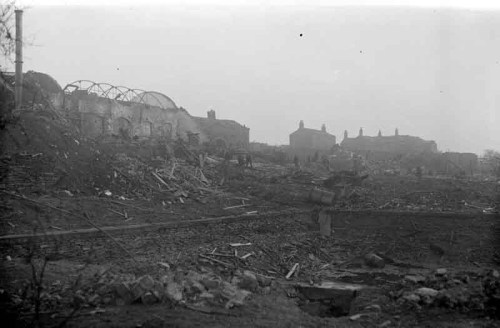
Buildings crumbled, a huge flash of flame soared into the sky, followed by dense clouds of yellow smoke. All that remained of the sifting and grinding shed area was a deep hole where the structure once stood. Peripheral works buildings were severely damaged, with any walls still standing being dangerously cracked. Surrounding fields were littered with masonry, smashed timber, pieces of machinery and roofing. Body parts were found for days afterwards. Containers holding liquid acid split, the corrosive liquid tracking down the hillside, which all added to the horrific scene.
Aftermath of the White Lee Explosion – Copyright of Kirklees Image Archive who granted permission for use in this blog post. Website http://www.kirkleesimages.org.uk/
One eyewitness, Leeds man James William Bellhouse working with a colleague on the roof of Robert Bruce’s William Royd cotton mill, stated:
The explosion made a tremendous row and blew us off the building. I saw a mass of flame, and the sky seemed to be lit up by a blazing red. A lot of debris were flying all up and around….
Bellhouse and his workmate were unharmed.
Some others had equally lucky escapes. A couple of men employed in the grinding area had not returned to work there for the afternoon shift. They had struggled to cope with the dust, despite covering their noses and mouths, and frequently opening the door. They survived.
Former Batley rugby league player Jim Gath of Wilton Street, Batley was on site to undertake work on the boiler. Minutes before the blast he decided to leave the boiler house to do some outside work. He had just climbed scaffolding when the explosion occurred. Covered by debris, only by sheer strength did he extricate himself, injuring his arm in the process. He remembered walking, then crawling, then nothing until he awoke in Dewsbury hospital.
William Sykes of Healey Street, Batley was working in the boiler house, which was demolished. According to reports at the time, concussed and dyed yellow by the fumes, he escaped too. However, this was not the whole story, and it did not end happily. Subsequent reports indicated he also sustained injuries to his legs and eyes. His health deteriorated and he died in July 1915. Coincidentally, his daughter Elizabeth, working in the nearby Robert Bruce-owned mill, suffered a compound fracture of her right arm.
The blast killed nine men outright. Another died in Dewsbury hospital later that day. The men were as follows.
Percy Ashton, born on 26 October 1892 was the son of Willie and Elizabeth Ashton (née Barker) of Tidswell Street, Heckmondwike. He was a joiner working on construction of the new buildings. A popular member of Dewsbury AFC, he was buried in Heckmondwike cemetery.
Heckmondwike Cemetery, Percy Ashton’s Headstone – Photo by Jane Roberts
Arthur Cooper, was born in Leeds on 19 February 1863. He married Martha Ann Wheelhouse in Leeds in 1885. A boot finisher for most of his working life, by 1893 he and his family were living in Lobley Street, Heckmondwike. He now had employment in the boot department at Heckmondwike Co-op. Sometime after the 1911 census he switched work to become a mason’s labourer for his neighbours, the Firth brothers. Initially amongst the missing, his body was found under rubble two days after the blast.
Albert Laycock Firth was a 51-year-old living at Lobley Street in Heckmondwike. He and his brothers Nimrod and Ralph were the stone masons erecting the new drying building. Ralph nipped back to their own Work’s yard prior to the blast, and heard the explosion. He identified his brother. Albert left a widow Elizabeth (née Briggs) who he married in 1893. The couple had three children in the 1911 census – Aked, James Albert and George.
Nimrod Firth the brother of Albert was 34 years of age. He also lived at Lobley Street. The son of James Firth and his wife Sarah Laycock, Nimrod married Lucy Wright in April 1913. He was identified through keys in his pocket. His funeral, along with that of his brother, took place at Heckmondwike Upper Independent Chapel.
James Nicholas was the works foreman. The 37-year-old was born in Herefordshire, but the family eventually settled in Cleckheaton. The 1901 census shows him employed as a picric acid labourer, so by 1914 he’d had at least 13 years experience of working with the chemical. Later that year he married Edith Emma Strickland. The couple went on to have four children – Harold Cookson, Eric, Edith Gladys and Laura. His brother John formally identified him. He was buried in Cleckheaton.
Clifford Thornton, a joiner from Boundary Street, Liversedge, only started building work at Ellison’s on the day of the explosion. Like Percy Ashton he was employed by Messrs. R Senior and Sons. A 25-year-old single man, he was the only living child of John Marsden Thornton and his wife Betty (née Cordingley). He survived the blast, but died as a result of his injuries at 4.05pm in Dewsbury Infirmary. An active member of Heckmondwike Upper Independent Chapel and Sunday School, this was where his funeral took place.
Heckmondwike Upper Independent Chapel – Photo by Jane Roberts
Fred Wright, worked as the establishment’s analytical chemist. From Cleckheaton, he was the 22-year-old son of Walter Henry Wright and his wife Elizabeth Savoury. Walter Wright was well known in local musical circles, being the organist at Providence Place Chapel, Cleckheaton and a former conductor of Cleckheaton Philharmonic Society. His son was so badly mutilated he was identified by the contents of his pockets (including a gold watch, purse, and visiting card) and a distinguishing mark. Fred was buried in Whitcliffe cemetery.
The three men working in the grinding room were William Berry, George Terry and James Alfred Morton (some sources mistakenly name him as John Edward Morton). Only identified amongst the dead from various items of clothing discovered in the days after the explosion, the partial human remains found which possibly belonged to them were buried in a single coffin in Heckmondwike cemetery. Father O’Connor, the parish priest at Heckmondwike Catholic Church (now the Holy Spirit Parish) conducted the service for Morton. Father O’Connor later became the inspiration for G.K. Chesterton’s fictional detective Father Brown.
William Berry transferred from Ellison’s Cleckheaton works two months prior to the blast. A labourer, he supervised the drying shed activities. 36 years of age, his widow Clara identified his overcoat. There was also his return railway ticket to Low Moor where he lived. Born in Halifax, he married Clara Hargreaves at All Saints, Salterhebble in July 1910. The couple had two children, Annie (b. 1911) and Arthur (b. 1913).
James Alfred Morton (38) was separated from his wife May, and living at Staincliffe. The son of Cornelius and Bridget Morton, he was a miner by trade. However, in recent years he worked as a casual labourer, most recently for a gardener in Batley Carr. He only started at the chemical works on Tuesday. His brother, Joseph, could only identify scraps of his clothing – parts of his trousers, shirt, coat and red, white and blue striped tie.
George Terry (22) of White Lee only started at Ellison’s on the Monday, previously working as a rag grinder in Batley. Initially his father wrongly identified one of the original bodies as his son, so badly mutilated was it. He was led away in a distressed state, only for others to realise the mistake. Days later, small strips of waistcoat and corduroy trousers belonging to George were identified by his widow Lilian. They had been married less than six months. She had left him at the gates of his work after lunch at 1.25pm on her way to visit her mother, and heard the explosion.
Commemorative Postcard from my Collection (note there is no image of James Alfred Morton who is wrongly named)
The official Home Office inquiry headed by Major Cooper-Key, Chief Inspector of Explosives, reported in January 1915. Although Cooper-Key found the wearing of protective overshoes was not strictly adhered to in the designated danger areas, crucially it was enforced in the sifting and grinding shed where the explosion occurred. He went on to conclude that Ellison’s complied with all the necessary regulations for picric acid manufacture, and could not be held responsible. Sabotage was also effectively ruled out.
He attributed the disaster to two factors. The ignition occurred in the sifting and grinding room, probably due to the accidental presence of a nail, stone or similar hard foreign body entering the grinding mill. Under normal circumstances this would have resulted in a spark and fire which would have been extinguished before the picric acid had chance to heat to explosion point. But the shed was extremely dusty, a situation exacerbated by the strong wind that day which constantly fanned the particles as the door opened and closed to try to let fresh air in. The initial ignition resulted in the explosion of this carbonaceous dust.
Although the White Lee explosion led to a review of picric acid manufacturing guidelines, it did not mark the end of accidents resulting from its manufacture during the war.
And the ten men who died on the day of the explosion, as well as William Sykes who died seven months later, are yet more local casualties of the First World War.
A plaque has been laid by the Spen Valley Civic Society to commemorate the event and those affected.
White Lee Disaster Plaque – Photo by Jane Roberts
Postscript: I may not be able to thank you personally because of your contact detail confidentiality, but I do want to say how much I appreciate the donations already received to keep this website going. They really and truly do help. Thank you.
The website has always been free to use, and I want to continue this policy in the future. However, it does cost me money to operate – from undertaking the research to website hosting costs. In the current difficult economic climate I do have to regularly consider if I can afford to continue running it as a free resource.
If you have enjoyed reading the various pieces, and would like to make a donation towards keeping the website up and running in its current open access format, it would be very much appreciated.
Please click 👉🏽 here 👈🏽 be taken to the PayPal donation link. By making a donation you will be helping to keep the website online and freely available for all.
Thank you.
As a professionally qualified genealogist, if you would like me to undertake any family, local or house history research for you do please get in touch. More information can be found on my research services page.
Sources:
Multiple sources were used, including newspaper reports, the official accident report, censuses, civil registration indexes and parish registers.
Special thanks to Kirklees Image Archive for permission to reproduce their image of the aftermath of the explosion. http://www.kirkleesimages.org.uk/ This is a fabulous local pictorial archive. The images are subject to copyright restrictions.