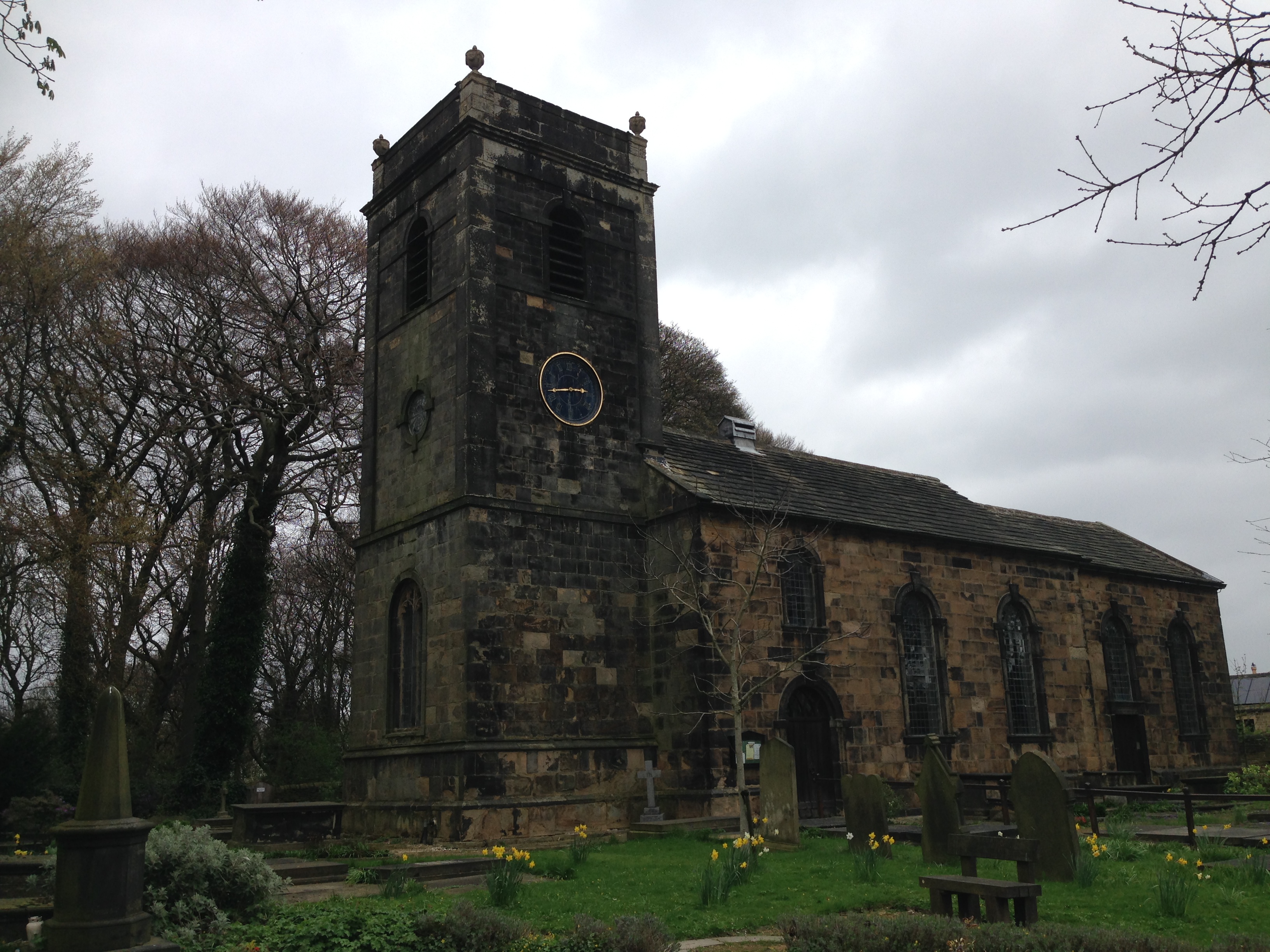
Category Archives: Batley

Festive Adverts and Shopping in Batley: A 1915 Christmas – Part 1: “The Home Beautiful”

In the run up to Christmas I’m writing a series of seasonal blog posts with a family and local history theme. In the opening three posts I look at shopping in Batley in 1915, as described in the local press.

Adverts and shopping articles were a feature in all local newspapers up and down the country in the weeks leading to Christmas. 

These kinds of newspaper pieces and adverts – giving shop descriptions, detailed location information, and the wares on sale – provide a picture of the area in which ancestors lived, add colour to research and complement the information from other sources such as Directories and maps. They also provide a unique insight into the period for a family historian. And it is all the more useful if your ancestor worked in one of the featured shops!

Although the shops I describe are based in my home-town, the type of retail outlet and products sold would be seen in most towns in the country in this period.

By way of context, Batley and the surrounding Heavy Woollen District had prospered in the early part of the war. Its fabrics were much in demand by the military and business boomed. So, even if prices in shops were higher, the employment opportunities, wages and bonuses paid to mill workers went some way to offset this. Also, notably in these early war years, many shops made a virtue of not including wartime additions to the cost of stock bought in at old prices. So the implication given by the press was Batley residents were still relatively well-placed to put on a good show at Christmas.

Batley folk were exhorted to celebrate Christmas 1915 with cheerfulness and a generous spirit. It was claimed this would contribute to national optimism.  So, as families suffered the anxiety of separation and news of dead and injured servicemen reached home, shops were decked out in patriotic emblems, usually centred on the Union Jack or flags of Allies, and these Christmas adverts began to fill the newspapers.

The first ones appeared in the “Batley News” towards the end of November 1915, and by the beginning of December they increased to a steady flow. So a much later start than today’s Christmas retail push.

As for items designed to make a 1915 Christmas celebration, unsurprisingly alongside those traditional food and household goods, many products had a military theme or were directly aimed at our “gallant lads” and “plucky nurses”.

Like today, updating the house for Christmas played a part in preparations, the season being described as an ideal time to adorn the home with new goods.  Mr Preston Jenkinson’s shop, located by the Batley Tram Terminus, was hailed as probably the largest vendor or linoleum and flooring products for miles around. Products included linoleum, oil-cloth, rugs, fringe, mackintoshes and bedsteads. Its plain pricing, courteous staff, range of stock and the fact that “the huge store is one of those rare places where the stranger may have a really good look round before being pressed to buy” were virtues for those “bent on buying well for Christmas”.

Jenkinson 2

Hanover Street’s Messrs W North and Sons was another store for those with an eye for “The Home Beautiful” to frequent. This shop also sold oil-cloth, linoleum, dainty rugs and the “latest creations of carpet factories”. Beyond this they stocked enamelled curbs and hearths and inlaid furniture, “the choicest products of the cabinet-maker”.

Messrs Brett and North’s furnishing emporium on Bradford Road had “everything calculated to make home life bright and beautiful”. Its products ranged from pictures, mirrors, ornaments, cutlery and electro-ware to rugs, suites, desks, cabinets and easy chairs. “The metal artwork, vases, dinner and tea-set’s, exquisite designs in chairs, bedroom suites etc afford a pretty display”.

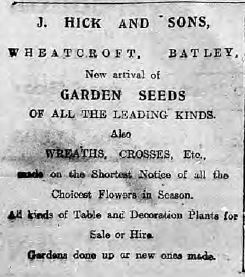
Flowers also played a part in the festivities. Messrs J Hick and Sons at Wheatcroft was described as “a joy to the eye and a refresher to the soul” whose flowers could “be bought and transferred to the home, to give radiance and fragrance throughout the holidays”. Besides flowers, seasonal evergreens such as mistletoe and holly decorated homes. And, as a time to remember departed loved ones, shops promoted wreaths and crosses to lay at last resting places. Ironic given the number of families who would never know final resting places as the war progressed.

Hick advert

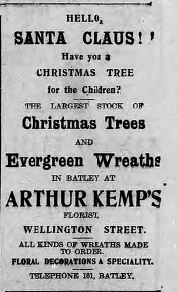
Mr Arthur Kemp’s greenhouses and gardens in Wellington Street, facing the baths, was a Batley institution. Residents were urged to walk around the greenhouses to select tea-table and school party blooms; Christmas decorations for home, church and grave; bridal wreaths and buttonholes for the winter wedding; and the central piece at Christmas – the tree.

Kemps trees  11 Dec 1915

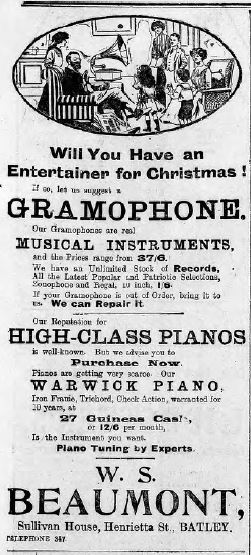
Music was important in Christmas celebrations and family gatherings. Mr W S Beaumont’s Henrietta Street music store stocked gramophones and thousands of records so “no home need to be without mirth and music at the festive season” with “such seasonable strains as ‘The Hallelujah Chorus,’ and good old carols like ‘Good King Wenceslas,’ followed by sprightly jigs and reels, or by patriotic spirit-raisers like ‘Britannia’ and the ‘Marseillaise”.

Beaumont Batley advert

Player-pianos and rolls were available, promoted as a way to play music without undertaking years of study. And for those already proficient pianos, violins and wind instruments were on sale. The shop had repair facilities and Mr Beaumont would consider weekly payment in approved cases. Santa Claus could supply children’s bugles and drums from the shop too!

Beaumont Batley 27 Nov 1915

In my next post I will cover Christmas toys and gifts, including those aimed at soldiers and sailors on active service abroad or in training at home. It can be found at: https://pasttopresentgenealogy.wordpress.com/2015/11/25/festive-adverts-and-shopping-in-batley-a-1915-christmas-part-2-gifts-galore-for-man-woman-and-child
Sources:
“Batley News” – various November-December editions.

WW1 Remembrance in Verse: “In Memoriam” and “Roll of Honour” Newspaper Columns

This is the last of my three blog posts in this period of Remembrance. It focuses on the WW1 period.

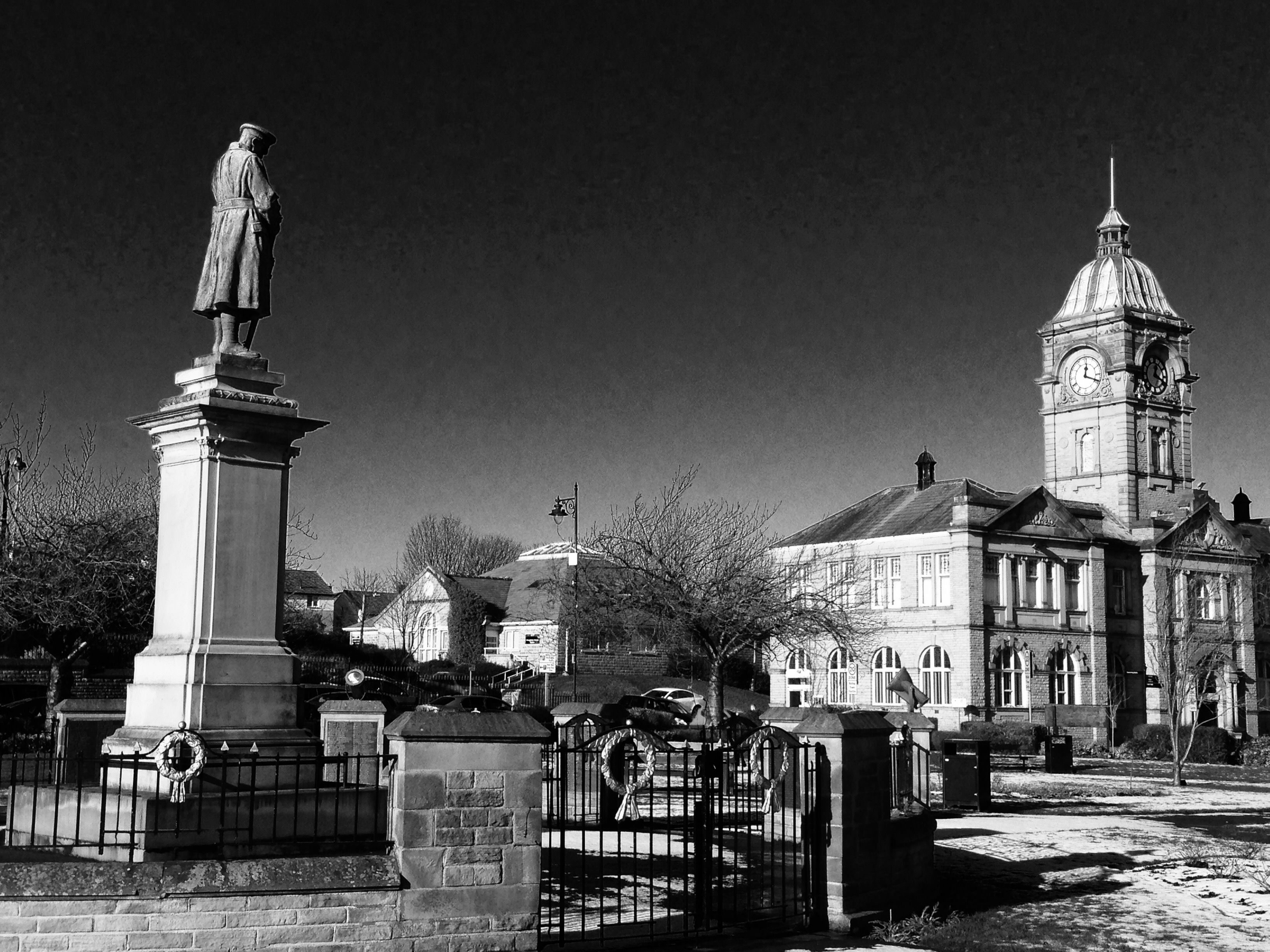
Batley War Memorial

Batley War Memorial

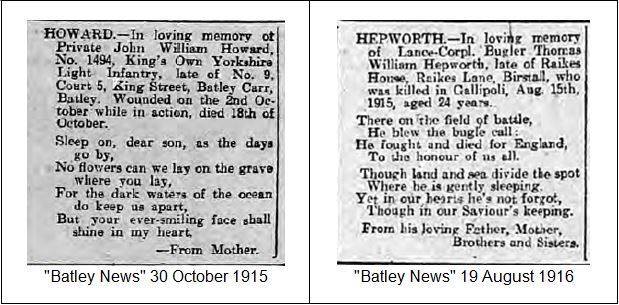
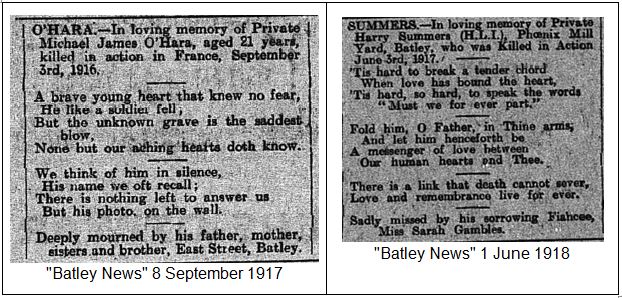
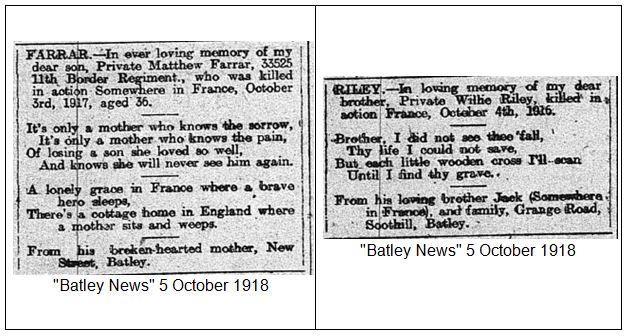
As the Great War progressed and the anniversaries of the Fallen came and went, the local newspaper “In Memoriam” and, later, dedicated “Roll of Honour” columns were increasingly filled with moving tributes to lost husbands, sons, fathers, brothers and fiancées. Although less frequent in late 1915 and throughout 1916, this phenomenon became particularly notable from 1917 onwards and endured in the years beyond the end of the conflict.

Many were recurrent standard verses, or variations on standard themes: grief; absence; young lives cut short; a mother’s pain; religious sentiments; Remembrance; doing one’s duty; sacrifice; wooden crosses; graves overseas far from home, or no known grave; not being present in their loved one’s dying moments; occasionally the difficulty of seeing others return; and even reproach for those who caused the war.

Although not war poetry, they are powerful representations of family grief and loss which echo across the ages.

My mother’s brother died in Aden whilst on National Service in 1955. These family tributes from another era are the ones which, in all my St Mary’s War Memorial research, left the greatest impression on her, resonating with her emotions 60 years later.

These “In Memoriam” and “Roll of Honour” notices provide an accessible window into this aspect of the War, the emotions of those left behind. They are also a continuing legacy for family historians. They can provide service details, place and even circumstances of death, names and addresses of family members (including married sisters) and details of fiancées all of which can aid research.

Here is a selection from the local Batley newspapers[1].

Remembrance 1

Remembrance 2

Remembrance 3

Remembrance 4

Remembrance 5

Remembrance 6

Remembrance 7

Remembrance 8

Sources:

  • Batley News – various dates
  • Batley War Memorial photo by Jane Roberts

[1] These are not confined to those servicemen on the St Mary’s War Memorial

Remembered by Families in Batley Cemetery; Remembered by the CWGC Elsewhere

This is the first of my posts in the run up to Remembrance Sunday.

The work of the Commonwealth War Graves Commission (CWGC) is familiar to many. They care for cemeteries and memorials in 23,000 locations across 154 countries, ensuring the 1.7 million people from Commonwealth forces who lost their lives as a result of the two world wars are never forgotten.

Batley cemetery contains CWGC 66 burials. Predominantly these plots have standard CWGC headstones, but there are also some Private Memorials where families chose to erect their own headstone on a war grave. All are listed on the CWGC website.[1]

Unsurprisingly some families who had loved ones commemorated elsewhere by the CWGC, chose also to include their names on family headstones in home cemeteries. This is not exclusively confined to those military personnel with no known graves.  These are not classed as war graves. The service person is not buried there. So they are entirely distinct from CWGC recognised Private Memorials.

These inscriptions would provide a focal point close to home for families of service personnel with no known grave, or buried far from home. They are a visible sign of love, acknowledgement and family remembrance.

These headstones can prove invaluable for researchers in terms of family and service details. But, as they are not war graves, they are not recorded by the CWGC. So it is a case of seeking them out.

Here are four I spotted in Batley cemetery.

Able Seaman Farrar Hill, killed on 31 January 1918[2] when his submarine, HMS E/50,  was lost in the North Sea. It is believed to have struck a mine near the South Dogger Light Vessel.  He is commemorated on the Plymouth Naval Memorial. But he is remembered on the Hill family headstone.

Farrar Hill - family headstone

Farrar Hill – family headstone

Pte Robert Hirst, 6th Bn King’s Own Yorkshire Light Infantry. He was killed in action on 24 September 1915 and has no known grave. His name appears on The Ypres (Menin Gate) Memorial. His family have included his name on a relatively new headstone in Batley cemetery.

Robert Hirst's relatively new headstone

Robert Hirst’s relatively new headstone

Rifleman Edward Leonard, 1st/8th Bn West Yorkshire Regiment, killed in action on 2 July 1916 and commemorated on the Thiepval Memorial. His sister Annie, a munitions worker at the Barnbow factory at Garforth, Leeds, died on 21 July 1916 from picric acid poisoning – the same day as the Leonard family received news Edward was missing. His and Annie’s name appear on the headstone.

Headstone - Edward Leonard

The Leonard family headstone

Pte Albert Smith of the 2nd/5th Bn Duke of Wellington’s (West Riding) Regiment died of wounds on 27 May 1918. He is buried in Bagneux British Cemetery, Gezaincourt, France but he is also included on his family headstone.

The Smith family headstone - including Albert Smith

The Smith family headstone – including Albert Smith

So, even for those service men and women commemorated on CWGC memorials and in cemeteries elsewhere, do not discount information provided on family headstones closer to home.

The Royal British Legion launched its 2015 Poppy Appeal on 22 October. This is their link: http://www.britishlegion.org.uk/

Sources:


[1] http://www.cwgc.org/
[2] Some sources indicate the submarine was lost “on or around 1 February 1918”, but 31 January is the CWGC date

Pro Patria, Pro Rege, Pro Familia: WW1 Centenary Visit

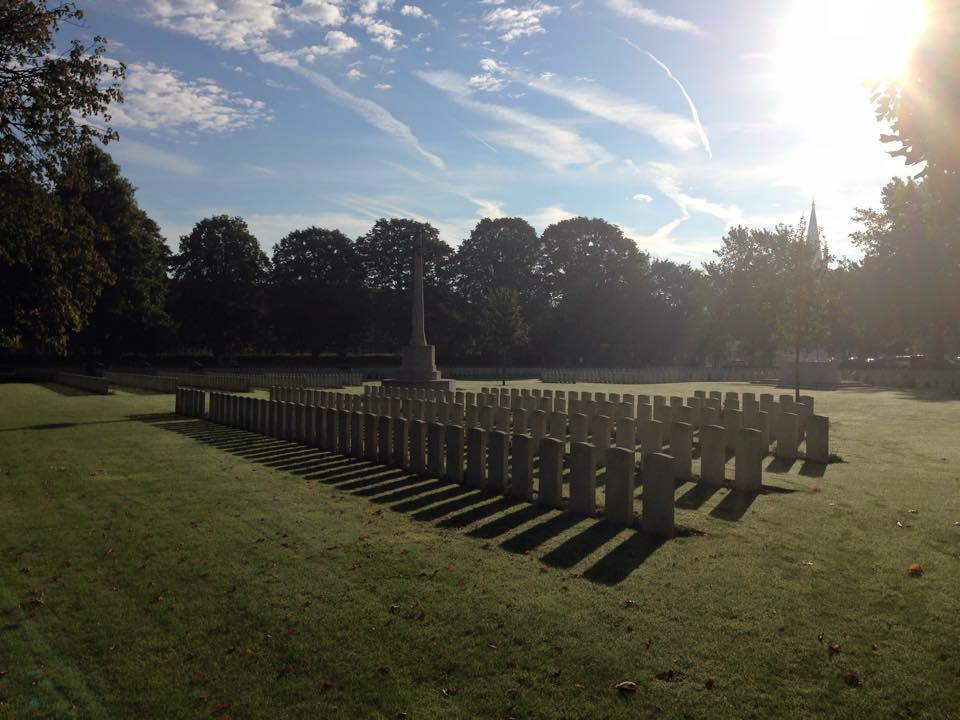
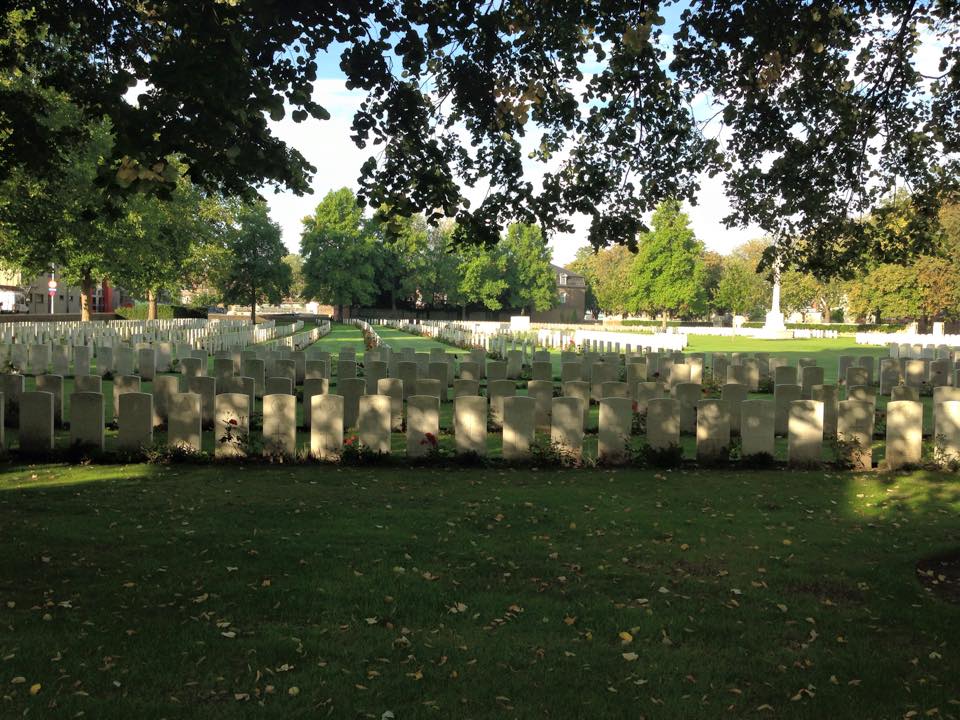
Last weekend I returned to Ypres. A visit I felt compelled to make. 19 September marked the centenary of the death of my great grand uncle, Jesse Hill.[1] So it seemed appropriate to visit his grave in Ypres Reservoir Cemetery.

Ypres Reservoir Cemetery

Ypres Reservoir Cemetery

It was a weekend full of coincidences. And an unforgettable one. The events of 100 years ago still resonate emotionally with many today.

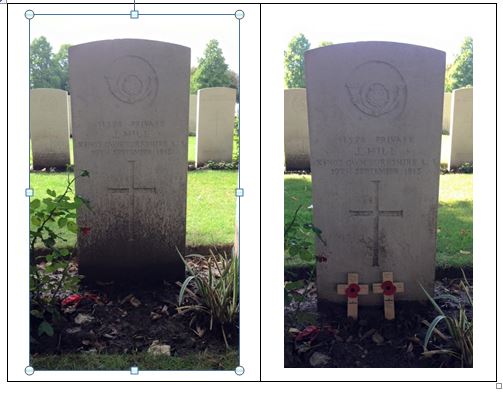
I visited Jesse’s grave on Friday evening, the eve of the anniversary. The headstone is beneath trees and as a result every time I’ve visited it’s rather mud-splattered. Friday was no different. However when I returned first thing on Saturday morning, the anniversary of his death, the headstone had been cleaned!

There was only one other person in the cemetery at 9.30 that morning – and it was someone I know from home! He was visiting the graves of Dewsbury men from 6th Battalion King’s Own Yorkshire Light Infantry (KOYLI), comrades of Jesse, who died at around the same time. So a huge coincidence that we’d both travelled 350 miles and turned up in that cemetery at the exact same time.

Ypres Reservoir Cemetery

Ypres Reservoir Cemetery

Before I left I placed a poppy cross, brought all the way from Batley, on Jesse’s grave.

From Unit War Diary maps, I’d located the area occupied by the 6th KOYLI the morning Jesse died. So on Saturday afternoon I walked around Railway Wood and what was the vicinity of the ‘H’ Sector trenches. Walking the ground brought home the frighteningly close proximity of the British Front Line to the German trenches in a way maps cannot. And it made the concept of “friendly fire” incidents far more understandable.

RE Grave, Railway Wood

RE Grave, Railway Wood

On that walk my husband found two pieces of shrapnel. It’s not unusual, but then again in all my many visits it’s only happened to us on two previous occasions – so it did feel incredible that this find occurred on the 100th anniversary and in that very location.

On Sunday morning I returned to Ypres Reservoir Cemetery. Unbelievably a second poppy cross lay on Jesse’s grave. A look I the visitor register confirmed that another Hill descendent also had the urge to pay an anniversary visit Jesse’s grave.

Jesse Hill's headstone

Jesse Hill’s headstone

Later that morning I attended a Rededication Service at Birr Cross Roads cemetery. Thanks to the patience, perseverance and unstinting efforts of Australian volunteer researchers, three soldiers’ headstones previously carrying the “unknown” epitaph now have identities; and the families of these three Australian soldiers, Pte Huntsman, Pte Eacott and Pte Neilson, now have named graves to visit. It speaks volumes of the emotional pull of the events so long ago that families of all three soldiers travelled halfway across the world to be at the service. It was a privilege to be there too.

Birr Cross Roads Rededication Service

Birr Cross Roads Rededication Service

Other visits that day included Tyne Cot Cemetery and Memorial. The sheer size of the cemetery even after many visits is difficult to take in with 11,956 First World War servicemen buried or commemorated here, of which in excess of 8,000 are unidentified. The list of almost 35,000 names on the memorial is equally staggering.

Tyne Cot Cemetery and Memorial

Tyne Cot Cemetery and Memorial

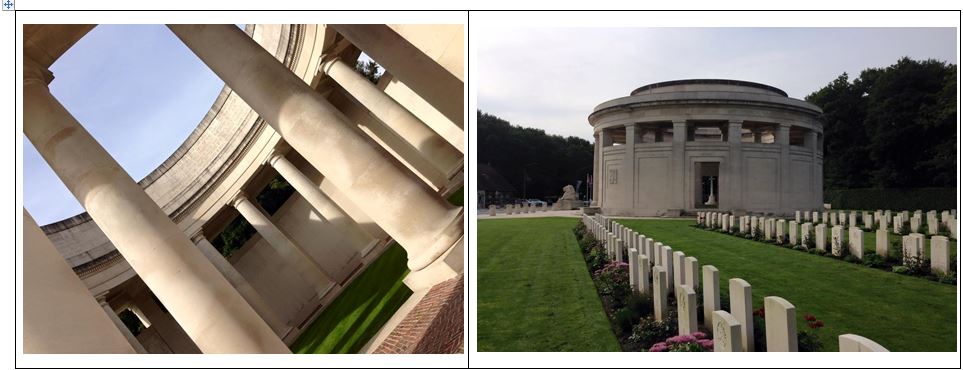
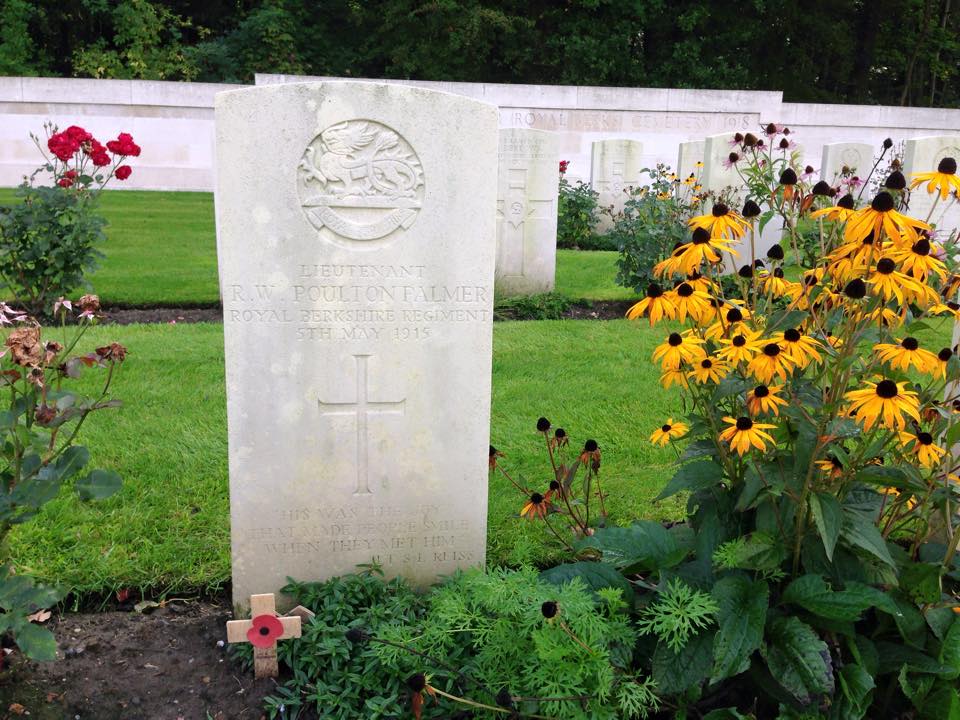
I returned home on Monday. On the way back to Calais I stopped off at the first CWGC site I ever visited: the majestic, lion-flanked Ploegsteert Memorial. Although I’m a Rugby League fan, as it’s the Rugby Union World Cup it seemed appropriate to pop across the road to call by the grave of England Rugby Union captain Ronald Poulton Palmer at Hyde Park Corner (Royal Berks) Cemetery.

Ploegsteert Memorial

Ploegsteert Memorial


Ronald Poulton Palmer's Grave

Ronald Poulton Palmer’s Grave

Final stop was Lijssenthoek Military Cemetery. I wanted to visit the graves of three men whose lives I researched and who have connections to my home Parish of Batley St Mary’s: John Collins, Henry Groa(r)k and Patrick Lyons. The cemetery has an excellent visitor centre with information about the soldiers buried there. I’ve supplied information about the St Mary’s men, and there is a webpage if others wish to do the same.[2] There is also a wall containing some of their images. The first one I noticed was remarkably familiar – the photo of Patrick Lyons. It seemed a fitting end to my latest visit to Belgium.

Lijssenthoek Visitor Centre

Lijssenthoek Visitor Centre

[1] See blog post https://t.co/JcKGrZVh7t

[2] http://www.lijssenthoek.be/en/page/160/visitor-centre.html

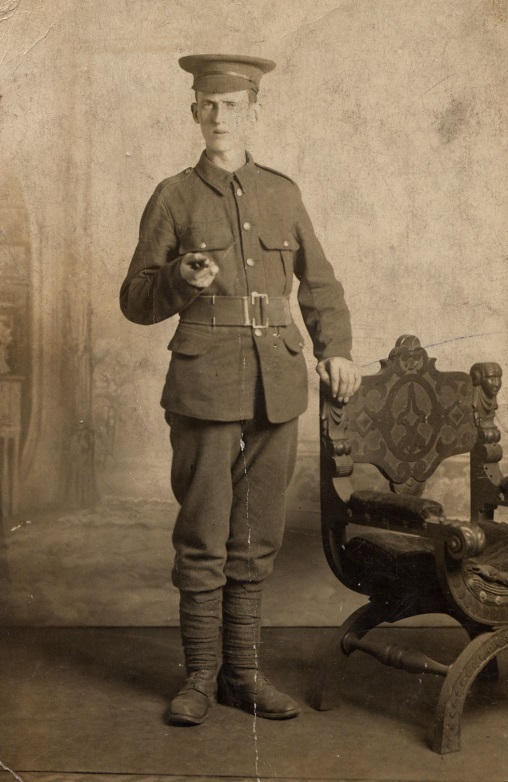
Pte Jesse Hill, 6th (Service) Battalion, The King’s Own (Yorkshire Light Infantry): 13 November 1895 to 19 September 1915. Never Forgotten

I’m hoping to travel to Ypres Reservoir Cemetery again soon. I’ve been several times over the past few years. But this will be a particularly poignant visit. It will mark 100 years since the death of my great grandad’s youngest brother Jesse Hill, killed in action in WW1.

Jesse was the son of Joseph Hill and his second wife Mary Ann Simpson. He was born on 13 November 1895 at Rouse Mill Lane, Soothill and grew up in the family’s home on Spurr Street, just across the road from Batley railway station and all the grand cloth selling houses which lined Station Road.

An extremely popular boy, he attended Mill Lane Council School where he was a prominent member of both the school cricket and football team.

After leaving school he joined the finishing department at Messrs Wrigley and Parker’s Greenhill Mills minutes down the road from his home. This was one of the many mills upon which Batley’s fortunes were built upon.

Whilst Jesse was in the early stages of his working life older brother Charlie enlisted in the Army. Jesse therefore had direct contact with a serving soldier and first-hand accounts of military life.

When war was declared on 4 August 1914 the persuasiveness of the recruiting sergeant’s triple-pronged seduction techniques of a general appeal to patriotism, the more specific exhortation of defence of your country and women-folk from the barbaric Germans and the desperate desire to avoid accusations of shirking duty and the accompanying dreaded white feather of cowardice kindled a response in Jesse.

Swept along with a tide of emotion and the fear of missing out on adventure because, after all, it would be over quickly, Jesse was one of those young men who in their thousands gathered in the Dewsbury recruiting office and recruiting offices the length and breadth of the Kingdom to take the King’s Shilling. Jesse even added a year to his age in order to ensure he would be accepted. And with a cursory medical and a few swift pen strokes on 7 August 1914 Jesse was in the Army for the duration, duly assigned to the newly formed 6th (Service) Battalion, The King’s Own (Yorkshire Light Infantry), (KOYLI).

Pte Jesse Hill, 11598, 6th Bn The King's Own (Yorkshire Light Infantry) Pte Jesse Hill, 11578, 6th Bn The King’s Own (Yorkshire Light Infantry)

From Pontefract the Battalion moved initially to Woking and then in November 1914 to Witley Camp, Surrey one of the many temporary army training camps flung up in those early months of the war. In February 1915 they moved to Aldershot for their final preparations prior to deployment overseas.

It was whilst at Aldershot and with embarkation for France and the Front Line looming that Jesse wrote his will. He used the standard Army Form designed specifically for the purpose. The harsh reality that he may never return may have struck home by filling in this one basic form. His will, dated 17 March 1915, was witnessed by two Birstall men, Thomas Kelly and John W Learoyd. He named his now married half-sister Nellie Armstrong, daughter of Mary Ann Simpson, as Executor.

The will stated that in the event of his death and following discharge of debts and funeral expenses, everything was to go to his sister Martha, a testimony to the closeness of Jesse and his youngest sister.

On 20 May 1915 an advance party from the Battalion were sent from Aldershot to Southampton in preparation for departure to France. On 21 May 1915 the main body of men split into two groups and, accompanied by music played by the band of the 8th Devon Regiment, marched to the railway station at Aldershot ready for departure to Folkestone. By 11pm that night they arrived in Folkestone where they embarked on a cross channel steamer and, after a calm crossing, arrived in Boulogne in the early hours of 22 May. From there they marched the two miles to Ostrohove Camp where they remained for just one night before moving up the line and into Belgium by the end of the month.

Belgium was the sector which was the focus of sustained fighting at this point of the war. Only a month earlier the first gas attack on the Western Front, perpetrated by the Germans, took place initiating the 2nd Battle of Ypres. 2nd Ypres ended on 25 May pushing the Allies back, compressing the Salient and bringing the Front Line closer to Allied held Ypres. Reinforcements were urgently needed, and it was to this “hot spot” that the 6th KOYLI and Jesse Hill were sent.

This is where they remained for the next few months, undergoing the rotational routine of trench warfare. Typically most men spent five days in the frontline, five in reserve, five back at the frontline and finally five in reserve. However, this was not fixed because, if circumstances demanded it, they could spend anything between four and eight days in the frontline trenches. While some men were in the front fire trenches, others would occupy the support lines, ready to provide reinforcement when hard-pressed in an attack or a raid. Finally the battalion was removed from the frontline trenches and taken to the rear areas, a process known as relief and carried out at the dead of night via the communication trenches. But even when in reserve trenches they were kept busy and still at risk, undertaking sentry duty and providing digging, wiring and ration parties.

This became Jesse’s daily routine in the areas around Ypres, Vlamertinghe, Hooge, Sanctuary Wood areas, frequently negotiating the Menin Road and Hellfire Corner to get from Ypres to the frontline trenches.

During these months he had a couple of narrow escapes. On one occasion he and four others were buried by shell wreckage; on another time a “motor char-a-banc” in which he was travelling overturned and Jesse sustained what were described as comparatively slight injuries.

On the evening of 15 September 1915 it was the 6th KOYLI’s turn to have another spell in the trenches leaving Ypres through the Menin Gate, up the Menin Road and into the frontline. It appears that Jesse was in “A” Company in H16, H17, S17, H16A and H15A trenches.

The Area Around the The area around the 1915 “H” Sector Trenches, taken on one of my earlier visits to Belgium

It was all fairly standard stuff. During the relief, always a dangerous time, the Battalion lost a Machine Gun Sergeant and four men just after arrival in H14 to a large shell. On the 16 September 1915 the diary notes continuous shelling from their own guns behind the lines, as they were trying an experimental shell. The German reply was not vigorous. All in all the 16 September was a fairly quiet night, with 60 more men coming up from base as the Battalion had been allocated far too much work and were having to carry their own rations. 17 September followed a similar pattern. Shelling increased from both sides on 18 September and six men from “B” Company were killed as a result, but overall once again the night was described as “peaceful comparatively”.

Friday 19 September dawned with heavy bombardment from the Allied guns at 4.50am. These rounds fell short of the German Lines and gradually became shorter and shorter until they were raining rapidly on the British held trenches, mainly around H18 and H19. However, because the telephone was out and the Forward Observation Officer had been killed, the Officer Commanding in the trenches could not report back to the guns. Shells were now hitting H18, H17A, the bombing post at H18A and H19 and casualties sustained – both dead and wounded.

19 September is the day that official records, both CWGC and his Army Death Certificate, state Jesse died. If so, he was killed by this so-called friendly fire.

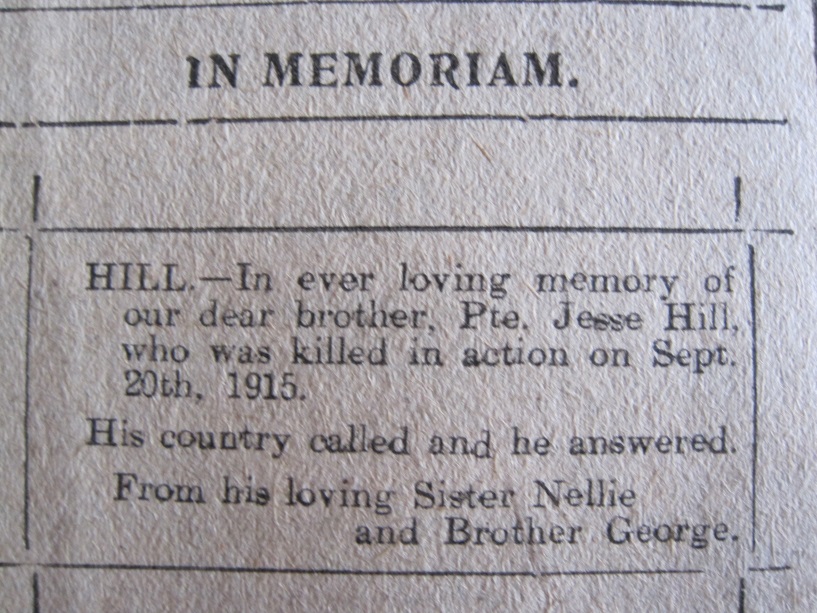
However, there is a small question mark. On the first anniversary of his death in September 1916 an “In Memoriam” notice appeared in the local newspapers. This indicates that the family believed his death occurred on 20 September.

In Memoriam Notice from In Memoriam Notice from “The Dewsbury District News” of 30 September 1916

The Unit War Diary for 20 September notes that at 4.55am High Explosives from Hill 60 landed at Charing Cross killing six men.

Pte Healey wrote to Jesse’s family and the details appeared in the local papers in mid-October. The newspaper article puts it bluntly as follows: 

“A companion named Private Healey wrote to the relatives a few days ago informing them that Private Hill met his death suddenly, both legs and part of his body being blown off, and an official intimation confirms the sad news”.

So, although official records state Jesse’s death took place on 19 September, it may conceivably have been 20 September.

CWGC records show that after the war Jesse’s body was recovered in June 1919. The trench map reference appears to relate to the Ypres area.  I initially believed he may have been buried in what was known Ypres Reservoir Middle Cemetery, (also called “Prison Cemetery No.2” and “Middle Prison Cemetery”), which was located near the prison and reservoir. It was used in August and September 1915, and rarely afterwards. It contained the graves of 107 soldiers from the United Kingdom, 41 of which were from the 6th KOYLI.  However a further analysis of CWGC records appears to discount this theory. After the War the graves from Middle Prison Cemetery, other small burial grounds around Ypres and graves from the Salient battlefields were brought together in one cemetery, Ypres Reservoir. This is Jesse’s final resting place.

Jesse Hill's Headstone - Ypres Reservoir Cemetery Jesse Hill’s Headstone – Ypres Reservoir Cemetery

Jesse was awarded the awarded the 1914-15 Star, Victory Medal and British War Medal. He is remembered on the Batley War Memorial and the Soothill Upper War Memorial at St Paul’s, Hanging Heaton.  The UK, Army Registers of Soldiers’ Effects show following his death that the Army owed his sister, Martha, as next of kin, £1 13s 3d and a £3 10s war gratuity.  

Jesse Hill Batley War Memorial Batley War Memorial Inscription – Jesse’s name, along wit the name of his nephew Percy

Sources:

  • Ancestry.co.uk – British Army WWI Medal Rolls Index Cards, 1914-1920 Army Registers of Soldiers’ Effects, 1901-1929: http://home.ancestry.co.uk/
  • “Batley News” – 9 October 1915
  • Birth Certificate
  • CWGC: http://www.cwgc.org/
  • Death Certificate
  • “Dewsbury District News” – 16 October 1915 and 30 September 1916
  • FindMyPast – Census information, Soldiers Died in the Great War: http://www.cwgc.org/
  • Gov.UK Website – Find a Soldier’s Will: https://www.gov.uk/probate-search
  • The National Archives – Unit War Diary, 43 Infantry Brigade: 6 Battalion King’s Own Yorkshire Light Infantry. WO 95/1906/1: http://www.nationalarchives.gov.uk/
  • “War Register and Records of War Service 1914-1920 Urban District of Soothill Upper” – Rev W E Cleworth MA
  • Photos of Jesse Hill, “H” sector trenches, headstone and Batley War  Memorial inscription – my own

Copyright

© Jane Roberts and PastToPresentGenealogy, 2015. Unauthorized use and/or duplication of this material without express and written permission from this blog’s author and/or owner is strictly prohibited. Excerpts and links may be used, provided that full and clear credit is given to Jane Roberts and PastToPresentGenealogy with appropriate and specific direction to the original content.

The Mysterious Wartime Disappearance of Sweethearts in Bridlington & the Batley Cemetery Link

An intriguing inscription on a Batley cemetery headstone led me to discover the story behind Lottie Oddy and her fiancé James Purdy.

Born in around 1892 Charlotte Emma Oddy, known as Lottie, was the daughter of butcher George Henry Oddy and his wife Emma (neé Popplewell). They lived at Staincliffe Road, Dewsbury. Lottie worked as a sewing machinist making blouses at Carrbrooke Manufacturing Co. She left her employers during the war to take over the book keeping and clerical duties at Oddy and Fox rag merchants based at Common Road, Staincliffe. This change was caused by the absence of her brother, Spedding. A partner in the firm, he was away serving in as a despatch rider in the Royal Tank Corps.

Lottie’s fiancé, James Purdy was born on 13 August 1890. He was one of four sons of Batley Carr residents Walter and Susanna Purdy (nee Raspin). James’ father worked as a foreman rag grinder at Messers Thomas Purdy and Sons, a mungo and shoddy manufacturer located on Bradford Road, Batley Carr. Initially James also worked in the rag and shoddy warehouse but he found manual labour a struggle due to his delicate health. He therefore established his own rag merchants business in around 1913 which, according to newspapers, was flourishing. His delicate health meant he was exempt from military service, although this was due for review in January 1919.

The sweethearts were from the nonconformist tradition. James was connected with the Batley Carr Primitive Methodist Chapel; Lottie with the Staincliffe Wesleyan Church. Described as a devoted couple, they had known each other for a number of years and, according to some newspapers, had been engaged for about five or six.[1]

On 7 September 1918 they joined Lottie’s widowed mother[2] and her sister, Gertie, for a two week holiday to Bridlington. The Oddy family were frequent visitors to the town, holidaying in the resort for several years.

On the afternoon of Friday 13 September Lottie and James went out for a walk but promised to join Gertie and some friends later that afternoon on the sea front. They failed to turn up. There then followed a frantic search involving police from Bridlington and Batley Carr, the harbour master, boatmen and friends and family of the couple, including James’ father who travelled to Bridlington to assist.

Their mysterious disappearance was covered nationwide. They had no known worries; their engagement had family approval; they did not boat, and indeed investigations had found no craft missing; their baggage remained in their Horsforth Avenue apartments; and they normally stayed around the area of the sea front, occasionally walking towards Flamborough. An accident was always recognised as a distinct possibility. Fears of a landslide due to the recent wet weather formed one suggested line of investigation. But even this direction had proved fruitless. They had in effect vanished without trace from a busy seaside town.

The hope remained that they would turn up alive and well, although James’ father did say that he felt as though his son was calling to him for help.

Police issued their descriptions. 5’2” Lottie was brown-haired, blue-eyed, fresh complexioned and of robust appearance. When she left her apartment she wore a gold and brown woollen sports coat, grey mixture frieze skirt, white blouse, black stockings, black shoes, black felt hat and a raincoat. She carried a black moiré bag and had a diamond ring. She also left the apartments with a book.

James stood at 5’1”[3]. Of medium build, he had a slight stoop, a pale complexion and was clean-shaven with rich brown hair. He wore a grey suit, black tie with a gold pin in it, brown mackintosh, light cap and black boots. He had a gold signet ring on his left hand.

No sign of the couple could be found and their disappearance remained a mystery until Saturday 21 September. First thing that morning a retired farmer, Arthur Mason, took a stroll along the South Sands. It was a route he walked regularly. Over recent days he had noticed a cliff fall. The day before his latest walk the sea had been rough with a higher tide than in previous days, reaching right up to the cliffs. Mr Mason noticed it had washed away part of the clay from the fall, exposing a man’s blood-covered head and shoulders. He immediately notified the authorities. Soldiers and police extracted the couple’s bodies from the clay in which they were entombed.

The inquest later that day concluded Lottie and James had been sitting beneath the cliff on James’ coat, when 10-12 tons of overhanging clay broke free and fell on them. James apparently heard something and was in the process of getting up in an effort to protect his fiancée. He had his hand outstretched towards Lottie. She had been sitting on the coat reading her book. Her right hand reached out towards James, and beside her left hand was the open book. This was Alice and Claude Askew’s “The Tocsin: A Romance of the Great War”.[4]

This stretch of beach had been the scene of a previous accident in September 1904, when a Bridlington Grammar School junior master and pupil died as the result of a cliff fall whilst out fossil hunting[5]. A noticeboard erected warning people about the danger of sitting under the cliffs had been washed away several years ago and never replaced.

The Coroner, Mr Herbert Brown, recorded a verdict of accidental death due to a fall of the cliff. This caused the suffocation of Lottie and James. He said he would call the authorities about the necessity of erecting warning signs.

Lottie Oddy's Batley cemetery headstone -

Lottie Oddy’s Batley cemetery headstone – “who met her death by the fall of the cliffs at Bridlington”

James’ funeral took place on 24 September and Lottie’s the following day. They are buried in family graves in separate areas of Batley cemetery.

Ironically at the beginning of October 1918 the papers reported yet another Bridlington cliff tragedy, with the death of 22 year old Bradford woman Ethel Keal. She fell over the cliffs at Sewerby.

Sources:

  • Ancestry.co.uk: Baptism and Marriage Records (West Yorkshire Non-Conformist records) http://home.ancestry.co.uk/
  • Batley Cemetery Burial Register
  • Batley News 21 and 28 September 1918
  • Batley Reporter and Guardian 20 and 27 September 1918
  • FindMyPast: BMD and Census record, plus newspapers ( Hull Daily Mail 16 September 1918, 21 September 1918, 23 September 1918, Yorkshire Evening Post 20 September 1918, Yorkshire Post and Leeds Intelligencer 23 September 1918, Driffield Times 28 September 1918), http://www.findmypast.co.uk/

[1] One report indicates an eight year engagement.
[2] Lottie’s father, George, died in 1916.
[3] Again newspapers varied, some stating 5’3”
[4] Alice and Claude Askew were extremely popular husband and wife authors. Associated with the Serbian Campaign, the couple drowned in October 1917 when the boat they were sailing in from Italy to Corfu sank following German submarine torpedo attack.
[5] Mr A Graham Allen and Jack Broomhead. Another pupil, Joseph Baker, escaped.

Copyright

© Jane Roberts and PastToPresentGenealogy, 2015. Unauthorized use and/or duplication of this material without express and written permission from this blog’s author and/or owner is strictly prohibited. Excerpts and links may be used, provided that full and clear credit is given to Jane Roberts and PastToPresentGenealogy with appropriate and specific direction to the original content.

Parish Registers: Brick Wall Breakers and Mystery Creators

I can immerse myself for hours in Parish Registers, tracking my ancestors and their communities. They can often lead to research breakthroughs. Conversely they can result in further knotty puzzles. Other than the normal but frustrating non-appearance in a register, or the ones containing multiple difficult to untangle options, here is a brief selection from my family tree.

Brick wall

Brick Wall Breakers
1) The baptism on 7 March 1779 at All Saints, Batley for Benjamin Rynder. This is the brother of my 5x great grandmother, Sarah, and his entry is in a Dade style register. So not only does it provide his birth date, his parent’s names and residence and father’s occupation, it also provides his grandparent’s names. It makes tracing the family back a whole lot easier. It also helps with linking to similarly Dade-style recorded siblings and cousins. Sarah’s baptism in 1777 does not contain this level of detail. Maternal Line

2)  All Hallows Kirkburton Burial Register gave a cause of death for my 4x great grandfather George’s sister, Esther Hallas. The entry on 13 July 1817 states a cause of death: “Killed by Lightning”. This entry led to further research breakthroughs feeding into Esther’s story, my first blog post.[1] Maternal Line

3) Robert Hudson, the brother of my 4x great grandfather David. His St Michael’s East Ardsley burial entry of 1 November 1831 gives a cause of death “Hung himself in the Coal Pit Cabin”. In following this up I unearthed a rather unsavoury tale which I will return to in the autumn. Maternal Line

4) The burial of George Hallas, my 4x great grandfather, solved the mystery of his father. I had, until this point, a number of possible options. George died aged 69. Nevertheless his burial entry on 12 May 1864 in the Mirfield St Mary’s burial register provided his father’s name, Amos. This information enabled me to go back two further generations. Maternal Line

5) This could easily have fallen into the “Mystery Creator” category. According to his birth certificate John Callaghan, my grandfather, was born on 16 June 1895. However, the transcript of the County Mayo Kilmovee baptism[2] register states his baptism took place on 30 May 1895 in Glan Chapel. One possible explanation is the family could not get to Castlebar to register the birth within the prescribed time-limits, so were creative with his date of birth to avoid a fine. He used to claim he had two birthdays – so this corroborates the tale. Maternal Line

Mystery Creators
6) My great grandmother’s first daughter was born in 1893 out of wedlock. The Parish Register of St Mary of the Angels, Batley has a bizarre entry which indicates otherwise. According to this daughter’s baptismal entry my great grandmother was married to Charles Regan. I have traced no record of this “phantom” marriage, or of Charles Regan. My great grandmother’s eventual Registry Office 1897 marriage certificate indicates she was a spinster. So was Charles her daughter’s real father? Paternal Line (I have anonymised this as it is comparatively recent).

7) The mystifying John Loftus. Another one from Ireland, this time from the County Mayo Kilbeagh Parish baptisms. The entry clearly indicates the baptism on 3 October 1869 of a son, John (Joannes), to John Loftus and Ann Barrett. John and Ann are my 2x great grandparents. I have been unable to trace a birth certificate for their son John. What I have discovered is the birth certificate for a daughter, Ellen, born on 30 September 1869. So have I a missing child of John Loftus and Ann Barrett, or is entry a red herring? Paternal Line

8) Sushanna Hill, my 4x great grandfather’s sister has a perplexing baptism entry in the wonderful Dade-style Sherburn in Elmet Parish Register. Usually Dade Registers are an absolute genealogical god-send. This one has led to a brick wall. Sushanna is the first-born child of Francis and Sarah Hill, so the Dade entry provides a wealth of family history information. The entry for Sushanna reads:

“1st Daughter of Francis of Sherburn, taylor. Son of Francis of Sherburn, wheel carpenter by Esther his wife, daughter of John Simpson of Brayton, yeoman. Mother – Sarah, daughter of Philip Gibson of Little Fenton, farmer, by Sushanna his wife daughter of [blank]. Born Monday 29th August 1785 and baptised the same day”.

I cannot find concrete evidence to support Francis’ parentage as recorded in the entry. As a result I have been unable to trace this line any further back. I have a suspicion that it is a false lead. I think I do know Francis’ parentage. This is one of the nuts I am hoping genealogical DNA tests will ultimately crack. Paternal Line

9) William Hill’s baptism at St Mary’s, Whitkirk on 14 July 1816 is another strange one. William is the brother of my 3x great grandfather. Joseph. According to the Parish Register he is the illegitimate son of Grace Pennington. No mention of “Hill” in the entry whatsoever. In fact Grace Pennington married Francis Hill by licence in that Parish in September 1811. There is however a footnote at the bottom of the page as follows:

“It was discovered when this child was brought to church September 1st having been privately baptized July 14th that this was an erroneous entry, Grace Pennington being lawfully married, and that the entry should have been William son of Francis & Grace Hill, Halton, Butcher. Signed this second of September 1816”

Signatories were the vicar and “Francis Hill, the father of the said child”. I would love to know the story behind this error and its subsequent discovery.[3] Paternal Line

10) My 4x great grandmother Zilla(h)[4] Rhodes, baptised at All Saints, Batley on 29 September 1780. The Dade Register does not help as she is described as a bastard. Neither are there any details provided of her mother Sarah’s parentage. From further entries in the register it appears Sarah went onto have another illegitimate daughter, Mary, in 1784. There are also possibly a further two illegitimate daughters in the 1790s. In turn Zillah had three, possibly four, illegitimate children. So far I have been unable to trace any further details, including through using Poor Law or Bastardy records, because of the paucity of surviving material. But to have so many illegitimate children does seem a tad unusual. Maternal line

Confused

Image from Pixabay.com

There are many other examples, but this is my starter for ten. 

Sources:

  • All Hallows, Kirkburton – Burials
  • All Saints, Batley – Baptisms
  • All Saints, Sherburn in Elmet – Baptisms
  • National Library of Ireland Catholic Parish Registers – Kilbeagh Parish baptisms, Microfilm 04224 / 17 http://registers.nli.ie/
  • Pixabay.com: https://pixabay.com/
  • St Mary of the Angels, Batley – Baptisms
  • St Mary’s, Mirfield – Burials
  • St Mary’s, Whitkirk – Baptisms
  • St Michael’s, East Ardsley – Burials
  • Transcript of the Kilmovee Baptisms from the former East Mayo.org website

[1] See my first blog post, “Death by Lightning”
[2] This is too late a date for the National Library of Ireland Parish Registers website. Some time ago there was a fantastic East Mayo website which had transcripts of the parish registers. Sadly this has long since gone. But it can be found using the Internet Archive Wayback Machine
[3] William and Francis feature in my blog post entitled “Attempted Murder in Halton? The Perverse Joy of Old Newspapers”
[4] Syllah in the baptism entry

Copyright

© Jane Roberts and PastToPresentGenealogy, 2015. Unauthorized use and/or duplication of this material without express and written permission from this blog’s author and/or owner is strictly prohibited. Excerpts and links may be used, provided that full and clear credit is given to Jane Roberts and PastToPresentGenealogy with appropriate and specific direction to the original content.

Batley Rugby League Club’s WW1 History-Maker

Some debate occurred in the Yorkshire press in March 1915 as to who was the first Northern Union player in Yorkshire and beyond to obtain a commission in The Great War.

The “Huddersfield Daily Examiner[1]” and “Yorkshire Evening Post[2]” declared that in Yorkshire the accolade fell to Wakefield Trinity’s William Lindsay Beattie who was appointed temporary 2nd Lieutenant in the Border Regiment on 15 March 1915.[3] He lost his life on 27 January 1917. Lancashire-based Wigan’s Gwyn Thomas was reputed to be the first commissioned Northern Union player. However, I believe this event occurred towards the end of 1914. Thomas survived the war and joined Huddersfield in 1919.

Both papers overlooked Batley winger, Robert Randerson.

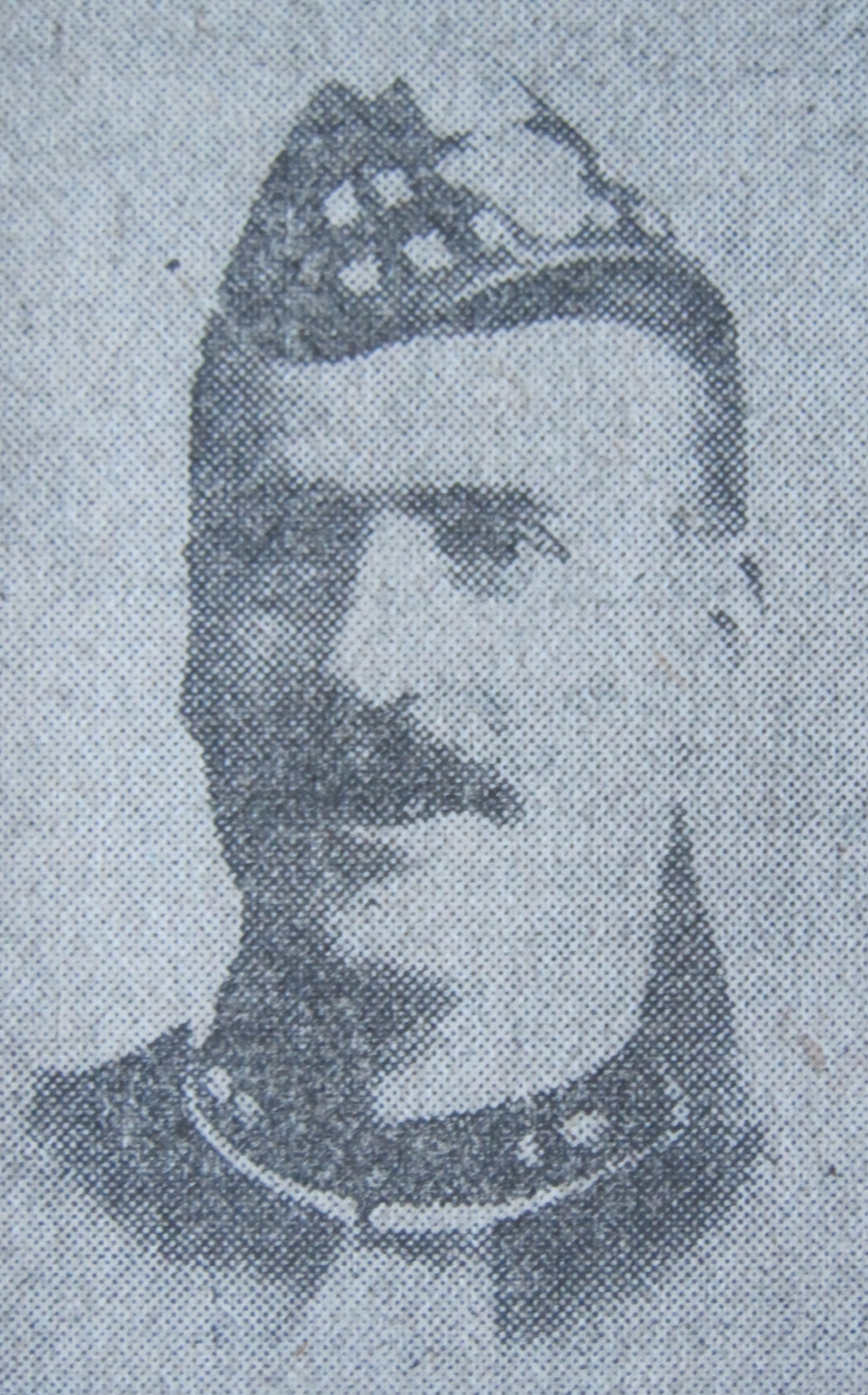
Robert Randerson Robert Randerson

Robert, (or Bob as he was known according to the local press), joined the Leeds University Officer’s Training Corps (OTC) shortly after Britain’s entry into the War. “The London Gazette” of 25 August 1914 lists Robert as amongst those OTC cadets and ex-cadets appointed as temporary 2nd Lieutenants.[4] Promotion quickly followed. In January 1915[5]“The London Gazette” announced his appointment to temporary Lieutenant with effect from 10 December 1914. Only months later, on 15 May 1915, he became a temporary Captain as notified in a June edition of the same official journal.[6]

Letters of correction to the papers followed; and the Batley Club itself was adamant the honour belonged to its player. In its Annual Meeting of May 1915 it pronounced:

“Randerson…..was the first N.U. player to receive a commission. This honour has been claimed by others but it belongs to Lieut. Randerson and the Batley Club”[7]

Within weeks of this discussion, on 7 August 1915, Robert was to lose his life in the “Yorkshire Landings” at Gallipoli.[8]

Robert was born in York in late 1890, the son of Robert and Annie Randerson (neé Wilkinson). His siblings included Annie (1886), Benjamin (1889), William (1892), John Wilkinson (1897) and George (1899).

The family were comfortably off with Robert senior earning his living as a master corn miller then as a grocer and corn merchant. By 1901 the family lived on Haxby Road, York and remained here at the time of Robert’s death.

They were an old Catholic family with strong religious convictions and connections. After training at Ushaw, Robert’s uncle Benjamin served as a priest initially briefly at St Patrick’s, Leeds, then St Charles Borromeo, Hull and lastly, until his death in 1897, at St Hilda’s, Whitby. In the 1911 census Robert’s sister, Annie, was a nun residing at St Wilfrid’s Priory, Arundel. She was employed as a head mistress at the town’s St Phillip’s Infants’ School.[9] His younger brother, John, was a boarder at the Franciscan College at Cowley, Oxfordshire.

The 1911 census shows Robert, a former pupil at Archbishop Holgate’s Grammar School in York, following his sister Annie’s educational career path. A student at St Mary’s College, Hammersmith, the objective of this establishment was to train Catholic men to serve as teachers in Catholic schools throughout the country. Robert demonstrated his sporting ability whilst studying here. In an inter-College sports contest he broke all previous records for the 100 yard flat race, covering the ground in a shade over 10 seconds.

Robert came to Batley in around 1913 as an assistant master at St Mary’s school. He soon became involved in the wider Parish community, holding the role of choirmaster at St Mary’s church.

But he became known beyond the town’s Catholic population when he started playing rugby for Batley. Initially in the reserves, he made his first team debut in a cup-tie at Halifax on 14 March 1914. His career was limited by the outbreak of war, but in this short time he made five appearances for the Batley first team scoring four tries.

At the declaration of war Robert’s strong sense of duty kicked in. He was the first Batley player to enlist and was quoted as saying:

“I am not a fighting man; I don’t like to fight, but I ought to go and fight at a time like this”.

He served with the 6th (Service) Battalion, Alexandra, Princess of Wales’s Own (Yorkshire Regiment), one of Kitchener’s New Army battalions. His enlistment necessitated a re-arrangement of the St Mary’s Boys Department school timetable, an event noted in the school log book.

It was whilst serving with the Yorkshire Regiment based at Belton Park, Grantham, that he made his final appearance for Batley against Keighley on 10 October 1914. He told the club secretary Kershaw Newton that it would be his last game with the Gallant Youths until peace was signed as, with his exhaustive training programme of marching, drilling, lectures and special studies as an officer on top of his ordinary duties, he was “about played out by the weekend”.

Additionally, with his officer responsibilities, he could not afford to risk a rugby playing injury.

“….I have 60 men under me and am responsible for them, and will have to lead them in war. To make them and myself efficient requires all my time and energy, and I do not think it would be right to risk laying myself up with an injury….”

Poignantly he wrote:

“…..I will come and hope to see many of my old friends round the railings as a sort of good-bye until we get the serious business through and when honour and justice are satisfied I trust to have many a jolly game on the hill”.[10]

Robert scored one try in Batley’s 19-0 victory. But, ironically given his concerns about injury before the game, he suffered the misfortune of a kick to the head. This blow confined him to a darkened room for a few days on returning to Belton Park.

At the beginning of July 1915 Robert and his Battalion left Liverpool bound ultimately for the Dardanelles. Initially landing at Mudros they moved onto the island staging post of Imbros to acclimatise and practice night landings and attacks. On the evening of the 6 August they left Imbros and at around 11pm that night they finally disembarked on the Gallipoli peninsular, south east of Nibrunesi Point on B Beach. The aim was to take Lala Baba, a low hill between the southern side of Suvla Bay and the Salt Lake.

Map of Suvla Bay and ANZAC Cove from Gallipoli Diary, Vol. 2 by Sir Ian Hamilton - Edward Arnold, London - From Wikimedia Commons Map of Suvla Bay and ANZAC Cove from Gallipoli Diary, Vol. 2 by Sir Ian Hamilton – Edward Arnold, London, 1920 or before – From Wikimedia Commons

As the men moved off from the sea shore they were immediately engulfed by the darkness of the night, it being impossible to see a body of troops at a few yards distance.

Lala Baba was eventually taken, but the Unit War Diary records a heavy price paid with 16 officers and about 250 other rank casualties (killed and wounded) in the fighting during those first hours of the night of 6/7 August 1915. This was out of a total of 25 officers and 750 other ranks that set off from Imbros only a short time earlier.

Robert was amongst those officers killed. He died on 7 August 1915 within hours of landing. According to a fellow officer he met an instantaneous death as a result of a gunshot wound to the head. In a letter to Robert’s father he wrote:

“We made our landing of the evening of the 6th August below the Salt Lake. The 6th York’s covered the landing of the rest of the Brigade. At about 10a.m we disembarked from the barge with little opposition and started up the peninsular to take a hill called Talla Baba, and there we lost a lot of men. I got there just before 12 midnight. Some of our men had gone over and some were held up by the Turks entrenched on top and there were several of our officers wounded and killed there, I was told your son had been killed there and the sergeant who told me said that he had been shot through the head, so his death seems to have been instantaneous”.[11]

The first news of Robert’s demise reached Batley around the 12 August when Mrs Power, with whom he had apartments in Norfolk Street before the war, received a brief note from his father informing her that he had been killed in the Dardanelles.

Local tributes poured in for him, newspapers referring to him as “Gentleman Bob”.“The Batley Reporter and Guardian” praised his “manly character and sterling qualities” concluding he “was a true sportsman and a most popular player on the field and a perfect gentleman in private life”.[12]  

The Batley News eulogised his virtues saying:

“A pattern of good conduct on the football field, handsome appearance, of excellent physique, and a splendid teacher, his demise removes from the Heavy Woollen District one whose manifold example commends itself to the rising generation”. [13]

The members of the Batley Education Committee were equally fulsome with their tributes to Robert in their meeting at the end of September 1915. They expressed sympathy with his family and appreciation for his work in the town. Alderman H North said that:

“Captain Randerson was a typical gentleman; an ideal leader of boys and a man appreciated by his scholars and school managers. …… His death had removed from Batley a most capable servant of the education committee….. The town was poorer by his demise”. 

His death was also noted in Catholic newspaper “The Tablet”[14]

Robert Randerson, remembered on Batley St Mary's War Memorial Robert Randerson, remembered on Batley St Mary’s War Memorial

I will leave the final word on Robert from the school in which he worked. Almost exactly one year to the day from the St Mary’s log book entry about timetable changes forced by Robert’s enlistment, the same log book has an entry on 16 August 1915 announcing that school re-opened after the midsummer holiday. It went on to say in a restrained, understated way:

“News received that Captain Randerson, Assistant Master from this school, was killed in action at the Dardanelles on August 7th”. 

Sources:

  • Batley News
  • Batley Reporter and Guardian
  • Commonwealth War Graves Commission
  • FindMyPast – newspapers, census records and Teacher’s Registration Council Registers: http://www.findmypast.co.uk/
  • School Log Book – Batley St Mary’s
  • “St Mary of the Angels War Memorial” – Jane Roberts
  • “The Gazette” website: https://www.thegazette.co.uk/
  • “The Tablet” archive: http://archive.thetablet.co.uk/
  • The National Archives Catalogue Reference: WO/95/4299: Unit War Diary – 32 Infantry Brigade, 6th Battalion Yorkshire Regiment 1 July 1915-31 December 1915
  • Wikimedia Commons – Map of Suvla Bay and ANZAC Cove from Gallipoli Diary, Vol. 2 by Sir Ian Hamilton – Edward Arnold, London, 1920 or before

[1]“Huddersfield Daily Examiner”, 25 March 1915
[2]“Yorkshire Evening Post”, 27 March 1915
[3]“The London Gazette”, Publication date: 19 March 1915, Issue: 29106, Page: 2745
[4]“The London Gazette”, 25 August 1914, Issue 28879, Page 6697
[5] “The London Gazette”, 15 January 1915, Supplement 29043 Page 594
[6] “The London Gazette”, 11 June 1915, Supplement 29192 Page 5736
[7]“Batley News”, 22 May 1915
[8]http://www.cwgc.org/media/50615/suvla_version_7.pdf
[9] The Teacher’s Registration Council Registers show she was headmistress at St Phillips between 1910-1916
[10]“Batley News”, 10 October 1914
[11]“Batley Reporter and Guardian”, 1 October 1915
[12]“Batley Reporter and Guardian”, 13 August 1915
[13]“Batley News”, 21 August 1915
[14]“The Tablet” Et Cietera, 28 August 1915 http://archive.thetablet.co.uk/article/28th-august-1915/23/et-cietera and Catholic Roll of Honour, 1 January 1916 http://archive.thetablet.co.uk/article/1st-january-1916/13/the-catholic-roll-of-honour

Copyright

© Jane Roberts and PastToPresentGenealogy, 2015. Unauthorized use and/or duplication of this material without express and written permission from this blog’s author and/or owner is strictly prohibited. Excerpts and links may be used, provided that full and clear credit is given to Jane Roberts and PastToPresentGenealogy with appropriate and specific direction to the original content.

Bigamy in Batley? 

This is the curious tale of Stephen Burnett, the brother of my 3x great grandmother, and his wife Abigail Hirst.

Stephen was the son of Robert Burnett and his wife Ann Jackson. The Burnetts moved frequently in the early days of their marriage, probably as a result of Robert’s trade. He was a tinner/brazier.  Many young tinsmiths took to the road as pedlars or tinkers in an effort to save enough money to open a shop in town. Stephen’s baptism is recorded in the Flockton Register for St Michael and All Angels Church, Thornhill on 5 June 1796.[1]  The family eventually settled in Drighlington, where Robert opened his business.

Stephen did not follow the family trade.  By the time he married Abigail Hirst on 24 December 1815 at All Saints, Batley Parish Church, following banns[2], he worked as a miner. Abigail was the daughter of John and Susannah Hirst[3]. All Saints Church, Batley 2

During this period, Batley was not the normal location for marriages for Drighlington folk.  The town fell within the remit of Birstall Parish, and the normal venue for such occasions was St Peter’s Church in Birstall.

However, within a short time of their marriage, there appears to have followed a strange turn of events. On 14 November 1816, with Abigail pregnant, it seems that Stephen travelled to Leeds to enlist as a Private in the Army, joining the 51st Foot Regiment[4], the forerunner of the King’s Own Yorkshire Light Infantry.  Claiming to be 17 years of age he enlisted for life[5].

In the meantime Abigail, now living in Adwalton, gave birth to a son, Thomas, on 5 April 1817. The baptism took place at St Peter’s Birstall on 1 June[6]. Oddly, Stephen’s profession is described as a collier, no mention of the Army.

Stephen may have been in Yorkshire in January 1821 because a Stephen Burnett acted as a witness at the marriage of John Burnett at St Peter’s Birstall.  John was another of the children of Robert and Ann Burnett. The only question mark is that Robert’s father was also called Stephen, and to date I have not traced his death.

However, whatever the circumstances, Stephen was clearly estranged from his wife.  On 30 May 1825 in Batley Parish Church, the same location as her earlier nuptials, Abigail undertook what in effect appears to be a bigamous marriage to William Gallaway[7]. There is no marital status indicated for either party in the Parish Register.

It is a distinct possibility that Abigail was pregnant and this forced the issue. It appears she and William may have had a son, Joseph, born in Adwalton in around 1825. No baptism has been traced to confirm the parentage of Joseph. But he features in the 1841 and 1851 censuses with the family[8].

In this period there was a seven years’ absence defence for bigamy.  If a spouse had not been heard of for seven years and there was no indication as to whether they were still alive, in such circumstances the abandoned partner was free to re-marry.  A variation of this was if the spouse had been absent and overseas for seven years.[9]  If the spouse subsequently reappeared, the second marriage, although not bigamous, would be declared void.

However, if it was Stephen that visited home only four years earlier in 1821 this would cast serious doubt about the application of the seven year rule. An appearance at a family wedding would hardly go unnoticed. Neither could the overseas absence claim apply as, although Stephen enlisted in 1816, his Regiment was home-based until spring 1821.

Within months of Abigail’s “marriage” to William events took an unanticipated twist. In November 1825, after eight years’ Army service, Stephen was discharged to pension. He was suffering from an illness described as “organic disease of the thorax”, which he contracted in Falmouth in 1818. This was now serious enough to render him unfit for further military service.

His discharge papers describe his conduct as good. They state he was born in Flockton. They describe him as 5’6” tall, with brown hair, grey eyes and fair complexion. They also give his trade, a collier. It appears he immediately returned home to Drighlington, where he was again a witness at a family wedding – this time for his sister Mary in December that year.[10]

One cannot begin to imagine the consternation caused to William and Abigail when news of Stephen’s return reached them. Now at the very least their “marriage” would be declared void; at its worse the ignominy of a trial and the threat of transportation if convicted hovered over them if the truth came to light.

They were spared the ordeal.  An ill man, shortly after his return Stephen died aged 30.  His burial took place at St Paul’s, Drighlington on 4 July 1826[11].

This still left William and Abigail in a tricky situation. Now a widow she was free to marry and this is the course of action she took to legitimise her union with William. Swiftly after Stephen’s death, Abigail and William married at a different parish church, that of St James, Tong, on 1 October 1826[12]. The entry in the register now states Abigail is a widow.  And was it an accident or deliberate that William’s surname had subtly changed to Galloway?

Tong Parish Church

Tong Parish Church

To conclude the strange tale of Stephen and Abigail, their son Thomas survived to adulthood. In the 1841 census he is living in Tong with Abigail’s parents. He married Betty Webster on 6 March 1843 and the register entry names his father as Stephen Burnett, miner[13]. Thomas’ address at the time of his marriage is given as Farnley.  After initially living in Tong, Farnley appears to be where Abigail and William settled sometime between 1839 and 1841[14]. In addition to Joseph the couple had at least six other children. The youngest child was named “Hirst,” a reference to Abigail’s maiden name[15].

There are a number of question marks over the theory behind the story. These include the baptismal entry for Stephen and Abigail’s son Thomas, and the possible reappearance of Stephen in 1821 for John’s wedding. Another apparent discrepancy is Stephen’s signature. Stephen could sign his name. Because of this we have four samples signatures taken from marriage registers and his Army papers.

The entries in the various parish registers are fairly consistent. The signature on his Discharge Papers is not identical, being just his initial rather than full Christian name. But the rest of the signature is not out of step.

So is the Stephen Burnett in the Army the Drighlington Stephen Burnett? I suspect it is, as the mystery which surrounds Abigail and William Galloway’s two marriages coupled with the timing of Stephen’s Army discharge and death seem to point to something being amiss.

Sources:

  • Ancestry.co.uk: Parish Register of St Michael’s, Thornhill
  • Ancestry.co.uk: Parish Register of St Peter’s, Birstall
  • National Army Museum – History of the 51st Regiment of Foot http://www.nam.ac.uk/research/famous-units/51st-2nd-yorkshire-west-riding-or-kings-own-light-infantry-regiment
  • Find My Past: WO97 Royal Hospital Chelsea: Soldiers Service Documents
  • Ancestry.co.uk: Parish Register of Batley All Saints
  • Find My Past: 1841 and 1851 Census
  • Anestry.co.uk: Parish Register of St Peter’s, Leeds
  • Ancestry.co.uk: Parish Register of St James’, Tong
  • Ancestry.co.uk: Parish Register of Leeds St Peter’s Parish Church
  • Find My Past GRO BMD Records – Baptisms
  • “Marriage Law for Genealogists: the definitive guide” – Rebecca Probert
  • “Divorced, Bigamist, Bereaved?” – Rebecca Probert

[1] Thornhill St Michael’s Parish – Flockton Register
[2] Note the marriage was by banns and not by licence. So even if the parties were underage at the time of their marriage, it would not have subsequently be declared invalid
[3] Her baptism is recorded in the Parish Register of St Peter’s Birstall on 7 October 1798. At the time her parents lived in Drighlington, although there is sometimes some overlap in records between Drighlington and the neighbouring village of Adwalton. The 1851 census records Abigail as being born in Adwalton.[4] http://www.nam.ac.uk/research/famous-units/51st-2nd-yorkshire-west-riding-or-kings-own-light-infantry-regiment
[5] Find My Past, British Army Service Records: WO97 Chelsea Pensioners British  Army Service Records 1760-1913, Box 645, Box Record 95 – Discharge papers
[6] St Peter’s Parish Church Birstall Parish Register – Baptisms. Ancestry.co.uk transcript indicates 17 June for baptismal date, but this appears to be an error
[7] Batley All Saints Parish Register – Marriages, under the name Abigal Burnet
[8] This is supposition. In the 1841 census, when no family relationships were given, Joseph is recorded in the Farnley home of William and Abigail, age 16.  In the 1851 he is described as “son”. But that could equally refer to being the son of just William as it could to being the son of both William and Abigail.
[9] “Marriage Law for Genealogists” and “Divorce, Bigamist, Bereaved?” – Rebecca Probert
[10] Mary Burnett is my 3x Great Grandmother. Her marriage to William Clough is recorded in the St Peter’s Parish Church Birstall Parish Register – Marriages[11] St Paul’s Church, Drighlington – Burials
[12] St James’ Parish Church, Tong Parish Register – Marriages. The place did have family associations, as by the time of the 1841 census, Abigail’s parents lived here.
[13] Leeds St Peter’s Parish Church Parish Register – Marriages
[14] Given the birth places of their children according to the 1851 census, and the fact that by 1841 they were living in Farnley
[15] Hurst according to the 1851 census, but Hirst in the GRO entry and 1841 census,

The Battle of Bellewaarde, 16 June 1915: A Batley woman’s efforts to discover her Royal Scots Fusilier husband’s fate

This blog posting is the story of two people: Michael Rourke and his wife Margaret Duffy. Michael died during World War 1.  The story is as much about him as it is about his wife and the extraordinary efforts she made to discover his fate.

Both were parishioners of Batley St Mary’s RC Church, ordinary working class Yorkshire folk, with the County Mayo background typical of the parish.  Margaret did not have the money and contacts of some who found themselves in similar desperate positions during the war.  But she had persistence, ingenuity and determination.  Her story is the story of many other families up and down the country trying to find out what had happened to missing husbands, fathers and sons.

Michael and Margaret do not have any link to my family. This work is based on research I did for my charity booklet about the men named on the Batley St Mary’s War Memorial.

Michael was born in West Town, Dewsbury in 1877. He was the eldest child of Irish-born parents, Patrick and Bridget Groark (neé Mullany) who married in 1876.

At this point it is worth mentioning the complexity of certain Irish surnames which, even in the late 19th/early 20th century, continued to have various versions.  Groark was one of these, and the family can be found using a number of variants including Groark, Rourke and even Groak. I have referred to Michael as “Rourke” throughout, as this was then name he used when enlisting in the Army in the 1890s, and indeed the family seemed to use this version initially.  But by around 1900, at the time of the birth of their youngest child Agnes, the family were transitioning from Rourke to Groark, and this version became the commonly used one as the 20th century progressed.

Michael was one of ten children. His siblings included Mary Ann (1879), James (born in 1881 but who died the following year), Maggie (1883), Lizzie (1887), James (1889), Henry (1892), Francis (1894), Nellie (1896) and Agnes (1900).

Initially the family lived in the Dewsbury RC parish of St Paulinus.  In 1881 they resided on Ingham Road, Dewsbury with Patrick described as a cart driver.   By 1889, as is shown in the baptism for their second son bearing the name James, the family had moved to neighbouring Batley.  James was their first child to be baptised in St Mary’s parish.

In 1891 they were recorded as living at North Street, Cross Bank, one of many streets of houses in the vicinity of St Mary’s church; then in Wooller Houses, in nearby Carlinghow in 1901.  By 1911 they were back in North Street.  During this period Patrick worked in agriculture as a farm labourer, and the 1911 census gave more detail specifying that he was a cowman.  Bridget worked in the woollen industry in 1881 as a weaver and in the following census as a rag sorter.

13-year-old Michael is recorded in the 1891 census as working as a coal miner.  In April 1897 he enlisted in the Militia with the 3rd Battalion, The King’s Own (Yorkshire Light Infantry).  As mentioned earlier his attestation papers were under the name “Rourke” and indicate that he was employed as a hurrier at Critchley’s colliery. It is in this name that all his military records can be found.

“Hurrier” was the Yorkshire term for the person who moved the coal tubs from the coal face where it had been hewed to the shaft at the pit bottom. They might be known as a waggoner in some parts of the country, a drawer in Lancashire, a putter in Northumberland or a haulage-man in Scotland.  Hurriers in this period were usually youths as this was one of the early stages in a normal career progression pattern through underground pit roles.

The same attestation papers also provide a physical description. Michael was 5’3” and 104lbs, fresh complexioned with light grey eyes and dark hair.  However within a week of signing up, he purchased his discharge for £1.

In July 1897, still employed by Critchley’s  but this time as a collier, he changed his mind and re-enlisted  in the Militia serving once more with the 3rd KOYLI for just over 12 months before transferring to the Regular Army with the Royal Scots Fusiliers in July 1898.  His Regular Army attestation papers describe him as 5’3¾” and 111lbs, fresh complexioned with light grey eyes and brown hair.  He had a small, round scar over the outer end of his right brow and a scar on the back of his right middle finger.

However a pattern was emerging as, yet again, Michael had a change of heart and in November 1898 was discharged on payment of £10, half of which was refunded in May 1899. He returned once more to work for his former employer at Critchley’s colliery.

The reason for the refund is not mentioned. But the probable cause is because, true to his previous form, Michael had once again signed Militia attestation papers in January 1899 with the 3rd KOYLI and by April 1899 was back with the Royal Scots Fusiliers[1]. The 1901 census shows him at home with his family, but his occupation is a soldier.

I have not tracked Michael’s life in the next 10 years, but according to newspaper reports he did serve in South Africa in the 2nd Boer War.

By 1911, Michael had returned home to Batley. Weeks prior to the 1911 census Michael’s mother Bridget died.  She was buried in Batley Cemetery at the beginning of March.  Michael was now once more out of the Army and living with his family.   He had changed career totally and now worked in the woollen industry as a mill hand willier[2].  This was his occupation immediately before the war at Messers Chas Robinson and Company’s mill.

On 7 June 1913 Michael married at St Mary of the Angels Church. His bride was Margaret Haley (neé Duffy), a widow with three children.

Margaret was born on 11 December 1876, the daughter of County Mayo-born coal miner Patrick Duffy and his wife Mary (neé Regan). The Duffy’s have two other younger daughters recorded in censuses – Mary and Catherine.  A fourth daughter, Bridget, died infancy. The family lived in Birstall[3] with Margaret, when reaching working age, being employed in the local woollen industry as a weaver.

Margaret married general labourer John William Haley in late 1899 and the couple settled in Whitwood, Castleford.  The marriage was short for John died in 1903, age 34. At the time Margaret had two children, Thomas (1900) and Patrick (1902). She was also heavily pregnant.  She returned home to Birstall and her family.  Daughter Margaret Kathleen was born in late 1903. By 1911 Margaret and her three children were residing with her widowed father in the town, but she moved to Batley after her marriage.

According to the baptismal register at St Mary’s, Michael and Margaret’s only child, a son named Michael, was born on 11 April 1914. The family lived at North Street, Cross Bank and this was the family address when war was declared.

Michael and his three brothers all joined the Army.  Michael was immediately called up as a National Reservist, going out to France with the 1st Battalion, The Royal Scots Fusiliers in early September 1914[4]. James enlisted with the York and Lancaster Regiment; whilst Henry and Francis served with The King’s Own (Yorkshire Light Infantry).

Michael Rourke

Pte Michael Rourke, 6093, 1st Bn Royal Scots Fusiliers

In early November 1914 Margaret received an official communication from the Infantry Record Office at Hamilton informing her that her husband had been admitted to hospital at Port-le-Grand, suffering from bronchitis.  She had not received a letter from him since the middle of October and was naturally very anxious about his condition, although the communiqué did give her  some small measure of reassurance that any news about his health would be immediately passed on to her.  Shortly afterwards, that same month, he was invalided home with rheumatism.  After a spell in England he returned to the Front for a second time.

In May 1915 a letter from him was published in the “Batley News”.  He said he was well and the weather very hot.  He also mentioned that the men got a bath and change of clothing when out of the trenches.  He also enclosed a copy of an address to his Battalion by his Brigade Commander, highly complementing them on their part in an action in which Michael participated.  This read:

“In order to cover the right flank of troops on our left, your battalion was ordered to take up a very bad and exposed position on a forward slope and sure enough on the morning after you were exposed to a very heavy shell fire, followed by an infantry attack by vastly superior numbers.  The Germans came pouring through, and it soon became obvious that your position was untenable, and we were ordered to take up a position further back. 

The Colonel, gallant soldier that he was, decided, and rightly to hold his ground, and the Royal Scots Fusiliers fought, and fought until the Germans absolutely surrounded and swarmed into the trenches.  I think it was perfectly splendid.  Mind you, it was not a case of “hands up” or any nonsense of that sort.  It was a fight to a finish.  What more do you want?  Why, even a German General came to the Colonel afterwards and congratulated him and said he could not understand how his men had held out so long.  You may well be proud to belong to such a regiment, and, I am proud to have you in my brigade. 

General Sir Smith Dorrien also praised the RSF for their fine work after Neuve Chappelle.  He visited them in billets and addressed them in terms of high praise.  “None but the best troops could do the work, and so I sent you, and you have done it”

 Michael’s last letter home was dated 14 June 1915.  By early July his family were becoming increasingly uneasy as to his wellbeing, but there was still no definite information.  The first disquieting news had arrived from a fellow-Batley soldier in late June. Pte C King of the 1st Northumberland Fusiliers wrote to Margaret on 21 June as follows:

“Mick and I were together on June 15th and promised that if anything happened to either of us on the 16th we would write to his home.  I hope you will not take this too seriously but live in hope; I went round his regiment and could not find any Mick.  Some of his pals told me he was wounded”.

Writing to Mr. A Baines of Upton Street, Cross Bank, Batley on 30 June Pte King wrote further about the fate of his friend:

“I am very sorry for Mrs Rourke.  His regiment was in the charge with us on the day I will never forget – the 16th of June.  I saw for myself that he was amongst the missing, but there is hope yet.  It was a bloody sight but a grand charge.  We had a lot of casualties and they lay all over.  My deepest sympathy goes to Mrs Rourke, for I am very much afraid that poor Mick is gone.  The Germans shelled us for 27½ hours after we made the charge and the men were blown to bits; it was hell”.

There then followed months of uncertainty interspersed with inconclusive, sometimes conflicting, information, as Margaret desperately tried to find any information as to what had become of Michael.

Around the same time as she received news from Pte King, she also received information that her husband had been wounded and taken into a Chelsea Hospital.  She asked the Record Office for information but they told her that her husband’s name had not yet appeared on any casualty list, and no report had been received that he had been admitted to any hospital.

But Margaret did not give up this line of inquiry; instead, using her church contacts, she followed it up by contacting Father F Kerr McClement of St Mary’s, Cadogan Street, Chelsea[5] to see if he could be of assistance.  Unfortunately he was unable to provide any positive news, writing to her:

“I am sorry you have had so much anxiety as to your husband and I have done my best to find his whereabouts.  He is not in St Mark’s College, Chelsea (which is generally known as Chelsea Hospital) nor in St Georges Hyde Park Corner, Victoria, Tite Street, or in any of the private hospitals visited by us”.  

On Saturday 17 July, Mrs Rourke finally received a communication from the War Office stating that they were sorry to inform her that her husband had been missing since the 16 June. At the time he was serving with the 1st Battalion’s “A” Company.

Margaret’s next recorded steps were to contact two organisations with expertise in tracing the whereabouts of missing soldiers – the British Red Cross and Order of St John Inquiry Department for Wounded and Missing Men.  The former organisation responded with the following news:

“Pte Pilgrim, of this regiment (the Royal Scots Fusiliers), who is now in No 2 Canadian General Hospital, Le Treport, tells us that there are two men named Rourke in his regiment.  The man whom he knows something about is a slim man, slightly built dark, with a moustache, about 38 years of age.  This man was wounded at Hooge on June 16th, and could not be brought in, as the Germans had retaken trenches which they had lost.  We do not know if this refers to the man for whom you are inquiring; perhaps from the description you could tell us if it is so.  But you must remember that it is not at all certain from this report what happened to Pte Rourke.  We hope to obtain more information which will make the matter clearer.”

The description given matched Michael’s. The records of the International Committee of the Red Cross do show that Margaret made enquiries about Michael, but sadly only the card noting this and Margaret’s address exist.

As more and more news filtered through, it appeared that Michael had taken part in an attack at Hooge where the Allies captured four lines of German trenches.  The Germans counter-attacked re-capturing the last two trenches.  Michael lay wounded in the third line of trenches, but so severe was the action that when the retreat came and the Germans re-captured that line, his comrades were unable to take their wounded colleagues back with them.

Margaret still did not give up, continuing to write to authorities in an attempt to establish any firm news of her husband’s fate, clinging to the hope that if not lying injured in an Allied hospital, perhaps he was being held as a prisoner of war.  With this in mind her next step was to write to the King of Spain.

Spain was a neutral country and King Alfonso XIII contributed a great deal to improving the treatment of prisoners throughout the conflict.  At his own expense he maintained a staff of 40 who helped him serve as an intermediary between prisoners and their families, using the Spanish diplomatic network in his endeavours.  In response to her plea for assistance she received the following reply:

“Palacio Real de Madrid,
October 30 1915

Madam, – I am ordered by His Majesty the King, my august sovereign, to answer your letter petitioning His Majesty to cause enquiries to be made in Berlin with regard to Mr Michael Rourke, you husband.  Although His Majesty’s Embassy in Berlin is charged only with the interests of France and Russia, His Majesty being desirous nevertheless of demonstrating his interests in British subjects, has graciously acceded to your request, and has commanded the Spanish Ambassador in Berlin to communicate with Great Britain’s representative there – the United States Ambassador – in order that in conjunction with the latter the necessary investigations may be made.  His Majesty earnestly hopes that these enquiries may be the means of procuring satisfactory information for you – E de Swire”.

Satisfactory information sadly was not forthcoming and Margaret continued in her quest.

Many other women were also tirelessly pursuing word about their missing menfolk, with advertisements for information appearing in newspapers.  It was in one of the Sunday papers that Margaret saw an advert from Elizabeth Morton from Chesterfield seeking news about her husband Lance Corpl Thomas Morton, 1st Royal Scots Fusiliers, reported missing on 16 June 1915 at Hooge.   Noting that this soldier was in the same Battalion as her husband and had been missing since the same date, Margaret wrote to Mrs Morton expressing sympathy with her and pointing out that she was in the same predicament.

Mrs Morton had received a response to her advert from a Pte Harry Thomson of the 1st Royal Scots Fusiliers, who was in a military hospital in Newcastle on Tyne.  He communicated the news of her husband’s death.  Mrs Morton passed Pte Thomson’s address to Margaret in the hope that he would be able to shed some light as to the fate of Michael.  Margaret wrote to him and received the following response:

“I am sorry to tell you that your husband, Pte Michael Rourke, was killed on the 16th June 1915.  He was slightly wounded with myself and Lance Corporal Morton.  I wanted him to go back to the dressing station and get looked after there, but he would not hear of it.  He wanted to go on and have it out with the Germans as he called it.  We went on together for about 20 yards when he fell with a bullet through the head.  He never spoke after it.  We managed to get him and some more of our men back later on and bury them behind our firing line.  I am sorry to have to tell you the sad news Mrs. Rourke, but it is best to know the truth.  The regiment lost very heavily that morning. The Royal Scots Fusiliers did their work very well.  I am glad to say that I am keeping a little better.  This is the second time I have been wounded.  I hope you are keeping well, yourself and all your family.  Anything also that you want to know about “Mick”, as we used to call him, I shall be pleased to tell you if I can.  I must close now as the doctor is on the rounds”.

Margaret forwarded the letter onto the War Office.  Towards the end of May 1916, eleven months after initially being posted missing, she received a letter in reply which confirmed that her husband was dead.  The letter read:

“Madame, with reference enquiry concerning Pte Rourke 1st Royal Scots Fusiliers I am directed to inform you that no further news having been received relative to this soldier, who has been missing since the 16th June 1915, the Army Council have been regretfully constrained to conclude that he is dead and that his death took place on the 16th June 1915 or since.  I am to express the sympathy of the Army Council with the relatives of the deceased:-your obedient servant C.F. Waitherton[6]”.

Michael died in what was known as the Battle of Bellewaarde. His body was never identified.  According to the website[7] dedicated to remembering the Battle, more than 1,000 men lost their lives within a 12 hour period on 16 June 1915, in an area of approximately ½ mile square.

Menin Gate Inscription

Menin Gate Inscription

Michael is commemorated on the Ypres (Menin Gate) memorial, alongside the names of more than 54,000 other officers and men whose graves are not known. These include Lance Corporal Thomas Morton, husband of Elizabeth, with whom Margaret had corresponded during her search.

Of Michael’s other brothers only the youngest, Francis, survived the war.

From cemetery and BMD records it appears Margaret never remarried. There is a burial in Batley Cemetery in April 1957 for Margaret Groark, aged 80.

The Menin Gate

The Menin Gate

Sources:

Copyright

© Jane Roberts and PastToPresentGenealogy, 2015. Unauthorized use and/or duplication of this material without express and written permission from this blog’s author and/or owner is strictly prohibited. Excerpts and links may be used, provided that full and clear credit is given to Jane Roberts and PastToPresentGenealogy with appropriate and specific direction to the original content.

[1] I have traced six sets of attestation papers for Michael.
[2] A wilier/willeyer was someone who fed the willeying machine  which was used to break down the rag and wool, thus separating and cleaning the fibres
[3] Birstall adjoins Batley. Up until 1905 when St Patrick’s parish was established in its own right, Birstall fell within the Catholic parish of St Mary’s, Batley.
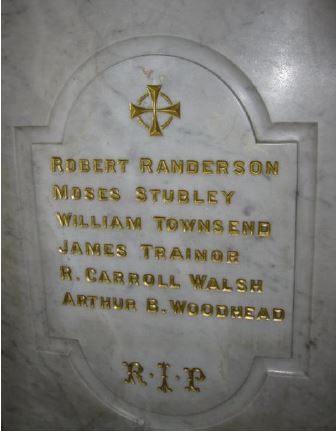
[4] Service Number 6093
[5] One of the oldest Roman Catholic parishes in central London
[6]  This featured in two newspapers, the “Batley Reporter and Guardian” and the “Batley News”. The latter indicates the letter was signed C F Watherston.
[7] http://www.bellewaarde1915.co.uk/ Website includes extracts of the 1st Battalion Royal Scots Fusiliers Unit War Diary.