This is the latest update of the pages relating to my Batley St Mary’s one-place study, the details of which I announced here.
July saw the addition of seven new posts, bringing the total number of posts to 164. Three others were updated.
The additions included five weekly newspaper pages for July 1916. I have accordingly updated the surname index to these During This Week newspaper pieces, so you can easily identify newspaper snippets relevant to your family.
I have written a new biography for a War Memorial man – that of Edward Barber.
More men who served and survived have been identified. I have updated that page accordingly. No new biographies for these men have been added this month. They will follow in due course.
Finally for this month there is one new school log book. This is for the Boys’ Department in 1919.
Below is the full list of pages to date. I have annotated the *NEW* ones, plus the *UPDATED* pages, so you can easily pick these out. Click on the link and it will take you straight to the relevant page.
This is the latest update of the pages relating to my Batley St Mary’s one-place study, the details of which I announced here.
June saw the addition of eight new posts, meaning the site has passed the 150 mark. In fact, this month’s additions brings the total number of posts to 157. Two others were updated.
The additions included four weekly newspaper pages for June 1916. I have accordingly updated the surname index to these During This Week newspaper pieces, so you can easily identify newspaper snippets relevant to your family.
I have written a new biography for a War Memorial man – that of Richard Carroll Walsh.
More men who served and survived have been identified. I have updated that page accordingly. No new biographies for these men have been added this month. They will follow in due course.
There is also a new occupational post. This describes the job of a lamp cleaner. It is perhaps an overlooked coal mining occupation, but turned out to have a fascinating history, critical to improving mine safety.
Finally for this month there are two new school log books. These are for the Boys’ Department in 1917 and 1918. The latter is particularly relevant to today’s Covid-hit world, covering the first and second waves of the Spanish Flu pandemic. School closures are commonplace in 1918 as Batley succumbed to the virus.
Below is the full list of pages to date. I have annotated the *NEW* ones, plus the *UPDATED* pages, so you can easily pick these out. Click on the link and it will take you straight to the relevant page.
This is the latest update of the pages relating to my Batley St Mary’s one-place study, the details of which I announced here.
Headstone of William Smith in Batley Cemetery, Photo by Jane Roberts
May saw the addition of eight new pages. Two other pages were updated.
The additions included four weekly newspaper pages for May 1916. I have accordingly updated the surname index to these During This Week newspaper pieces, so you can easily identify newspaper snippets relevant to your family.
More men who served and survived have been identified. I have updated that page accordingly. There is one new biography here this month, that of Patrick Cassidy
I have written one biography for a parishioner killed during the Second World War – William Smith.
There is also a new occupational post which links to William Smith, about the role of a piecer/piecener.
Finally for this month there is one new school log book. This is for the Boys’ Department in 1916.
Below is the full list of pages to date. I have annotated the *NEW* ones, plus the *UPDATED* pages, so you can easily pick these out. Click on the link and it will take you straight to the relevant page.
This is the latest update of the pages relating to my Batley St Mary’s one-place study, the details of which I announced here.
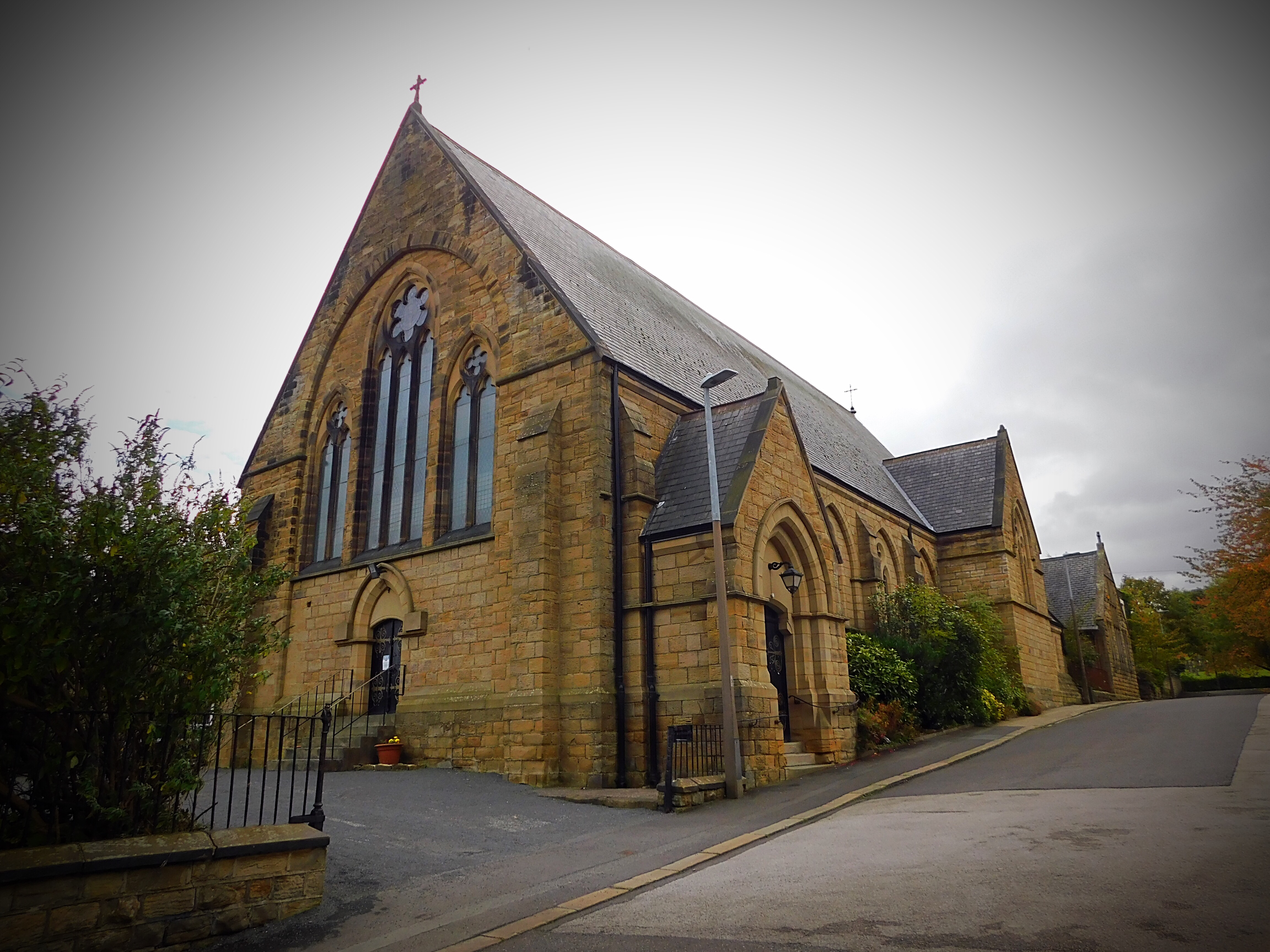
St Mary of the Angels, Batley
April saw the addition of eight new pages. Two other pages were updated.
The additions included five weekly newspaper pages for April 1916. I have accordingly updated the surname index to these During This Week newspaper pieces, so you can easily identify newspaper snippets relevant to your family.
More men who served and survived have been identified. I have updated that page accordingly. No new biographies for these men have been added this month. They will follow in due course.
I have written one biography for a War Memorial man: Lawrence Carney.
This month there are two new school log book pages. These are the ones for the Boys’ Department in 1914 and 1915.
Below is the full list of pages to date. I have annotated the *NEW* ones, plus the *UPDATED* pages, so you can easily pick these out. Click on the link and it will take you straight to the relevant page.
This is the latest update of the pages relating to my Batley St Mary’s one-place study, the details of which I announced here.
A selection of school log books – Photo by Jane Roberts
March saw the addition of seven new pages. Two other pages were updated.
Although March may therefore appear to have been quiet, I have been working away in the background on a new strand to the St Mary’s One-Place Study – the school. More of that later.
The additions included four weekly newspaper pages for March 1916. I have accordingly updated the surname index to these During This Week newspaper pieces, so you can easily identify newspaper snippets relevant to your family.
More men who served and survived have been identified. I have updated that page accordingly. No new biographies for these men have been added this month. They will follow in due course.
I have written one biography for a War Memorial man: Robert Randerson. A Batley rugby league player and St Mary’s school teacher, his first days at the school are also recorded in the brand new section to the study – the school log books.
These log books were kept regularly by the school – the infants, mixed and boys’ departments. They record the everyday routine of their running. Some of the entries may be mundane, register checking for example. But amidst these entries are some real gems – for example unusual incidents, disease outbreaks, school outings, and issues relating to individual school children or teachers. Interwoven through them is the religious context to St Mary of the Angels school, and how local and national events also impacted on it. They provide a snapshot of Catholic school life in a bygone time. Crucially for this study, these particular logs are not available online or in the archives.
This month there are two new pages relating specifically to these log books. The first is a general introduction. The second is the 1913 log book entries for the newly formed Boys’ Department. And it is on these pages Robert Randerson appears.
Below is the full list of pages to date. I have annotated the *NEW* ones, plus the *UPDATED* pages, so you can easily pick these out. Click on the link and it will take you straight to the relevant page.
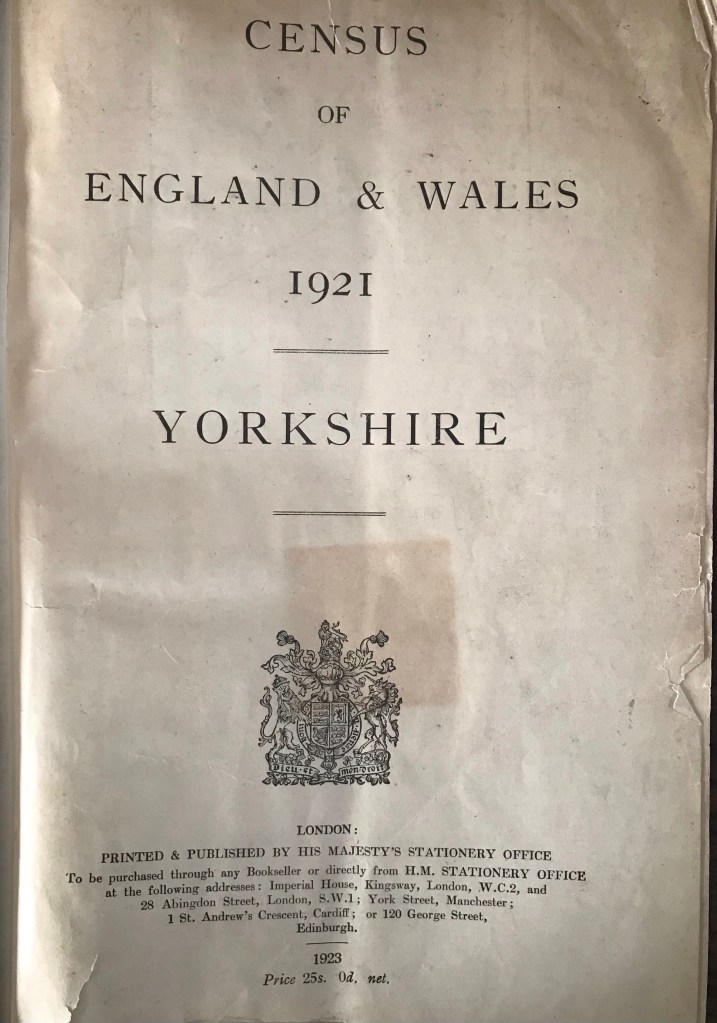
Forget the New Year countdown and the return of Big Ben’s bongs this year. Instead, like many other family historians, I’m counting the days down to 6 January 2022, the day which marks 1921 census release day. Its family clues and secrets have been hidden for over 100 years. But this is the day when they will finally be revealed.
But why are family and local historians so excited? What is its background? Why is it so important for family and local history? How can you access it?
I’ll try to answer those questions in this post.
Background: This was the census conducted in the immediate aftermath of the Great War, the Spanish flu pandemic and the introduction of voting rights for some women. It was a time of turmoil, upheaval and change.
The census was eventually taken on 19 June 1921, delayed for two months from its originally planned date of 24 April 1921, because of the state of emergency declared as a result of the coal miners’ strike.
Although care was taken to avoid holidays in the big industrial towns of the north, do be aware of the possibility the delay to the summer months may mean your family could be away from their expected residence.
What Information Will the Census Contain?
This census had the usual familiar mix of questions, but with some crucial omissions and additions from the 1911 Census. Questions included:
Name and Surname;
Relationship to the Head of Household;
Age – in years and (in a difference to previous censuses) completed months, with those under one month noted as such;
Sex;
Marriage or Orphanhood – For those 15 and over this means single, married, widowed or if the marriage has been dissolved. For children under under 15 this includes details about which parents are living/dead;
Birthplace and Nationality;
Personal Occupation (including attending school), Employment and Place of Work;
Married Men, Widowers and Widows also complete details about the number and ages of all living children and step children under 16 years of age, whether residing in the household or elsewhere.
The enumerator who collected the form was also responsible for recording the number of “living rooms” at the premises. And, for the first time, individuals in a household could also make separate confidential returns.
I’m disappointed that the so-called fertility question is missing from this census, with no information given about the number of completed years of marriage and the total number of children born within it, split between still living and dead. There question around blindness, deafness and dumbness has also gone.
But there are some big compensating questions. For example the changes to the questions around work will add a new family history component. This was introduced to find out about the travelling involved to get to a place of employment. The question around dissolved marriages is an interesting commentary about the recognition of increased availability of divorce. I am interested to see if any of my family is amongst the 16,682 people who declared themselves divorced on the returns. And, in light of the aftermath of the Great War and influenza pandemic, the recording of information for under 15s about whether both parents were alive or if either or both parents had died is a sad snapshot on the fragility of life.
If you want to familiarise yourself with the 1921 Census household form for England in advance of 6 January, you can download a copy here, courtesy of the ONS (Office for National Statistics) website.1
Why the Excitement with this Census Release? All new major record releases are exciting. But for many the 1921 Census will be particularly special. From the poignant moment of seeing family members in a census for the first or last time, to finding out the impact the War had on family and community structures; to discovering the employment and possibly employers of their ancestors in this period of industrial strife, to where they were – and who they were with – on census night. Then there’s societal changes at the start of the Roaring Twenties, like the increase of divorce, and changes in the work of women from previous censuses. And not forgetting the inevitable disentangling of truth from mistakes and pure fiction in the entries of our ancestors – no, they were not always honest on official documents!
On the more humorous side, will there be any quirky, or protest, entries this time? And what will be the most unusual or unexpected occupation or name?
All this information, even these errors, half-truths and lies, will shed new light on the lives and characters of our ancestors – the type of information we family historians are constantly seeking.
Crucially, it is an excitement not to be repeated for another 30 years, because the next census release will not be until 2051, with the 1951 Census.
For many, this will be the last chance to experience the anticipation and thrill surrounding a census release. The highs of finding that missing piece of the family history puzzle, to simply finding out a little more about the lives of your ancestors. To the lows of will the site crash with the volume of hits?
My Census Plans I have spent the Christmas period drawing up my family history census wish list.
I’m looking forward to the release on a personal family history level to find if my grandpa had made the move from Ireland to England at this point. If so, where was he living? And was he with family who had already made the move?
I also want to discover what various direct line ancestors and their families were doing. In particular, only three months before this census, my great grandfather died aged only 42. I want to see if there is any evidence of impact on his family. For example, were they still in the same home? Was the family still all together? Did my great grandmother have an occupation listed?
Also, being from a long line of coal mining ancestors, I want to see how many were still involved in the industry, especially given the census backdrop of a coal miners’ strike.
I have a wider interest in this census too, for my St Mary’s Batley One-Place Study. This focuses on the parish particularly in World War One, looking at not only those who served and died, but those who returned home, and the parish as a whole. I’m interested in seeing the impact both the war and the flu pandemic had on the parish population and family structures, with a particular interest in those families who had suffered war casualties. I’m also interested in any further Irish migration to the parish between 1911 and 1921. And I want to build up a bigger picture about employment in the parish. Batley was a significant textile town with the industry employing both men and women. The other major industry for the area was coal. Given this was the period of the coal miners’ strike, I want to see what impact this had on the census employment returns for the parishioners. Also, for returning military, was there a difference between their 1911 and 1921 employment? This, though, because of the scale, may be a longer-term plan based on a visit to one of the free access sites.
Note, the following section is now partially out-of date, with Findmypast’s wider release of the census for those with a relevant subscription.
How Can I View the 1921 Census? Now for the all-important administrative details about census access.
1. Who does this Census release cover? • This release covers 38 million people in England and Wales. Technically the full scope of it is England & Wales, the Channel Islands, the Isle of Man and the Armed Forces at sea or overseas (including in the nascent Irish Free State). 2. When can you access it? • The launch date is 00.01 GMT on 6 January 2022. 3. Where can you access it? • Online it will be available via commercial genealogy dataset provider Findmypast. They won the National Archives digitisation contract and have exclusivity for the 1921 census for up to three years. This will be the only online provider access during this period. • In-person access of the digital images is available at The National Archives, Kew. The census will also be available via Findmypast at the Manchester Central Library, and the National Library of Wales, Aberystwyth. • If you are still unsure, professional genealogists (including me) are undertaking census lookups. This may prove more efficient, accurate, cost-effective and ultimately less stressful. 4. How much does it cost? • You will be able to search the indexes on Findmypast for free. But a pay-per-view system will operate to actually view the transcripts and images. It costs £2.50 for every record transcript, and £3.50 for every original record image. • If you are a 12-month Pro subscriber there is a 10% discount. • Whether a transcription or image, purchasing the record of one individual will allow you to view the entire household’s census return in that purchased format. Unless that person was in an institution. 5. Can you access the 1921 Census for free? • Yes. It will be available to view digitally at The National Archives at Kew. It is also available to view free via Findmypast at Manchester Central Library and the National Library of Wales, Aberystwyth. 6. Which countries does the release cover? • The release applies to England and Wales. • Indexed images of the 1921 Scottish Census will be released on http://www.scotlandspeople.gov.uk and in the Scotlands People Centre, Edinburgh, in the latter half of 2022. • The 1921 Census was not taken in Ireland due to the Irish War of Independence. Censuses in Ireland and Northern Ireland were conducted in 1926.
Update: If you’re planning on going to Manchester Central Library to access the 1921 Census, the image below (posted on the Manchester and Lancashire Family History Society Facebook page) gives some important information. It’s essential pre-visit planning reading.
I’ll end this post with some snippets from Yorkshire to get you in the census mood.
The Sheffield Independent and Sheffield Daily Telegraph newspapers for 21 June 1921, reported on the case of three census wanderers. On census night, Sheffield police were tasked with searching highways and by-ways to round up those living outside. The three men, brought before the magistrates on 20 June and charged with lodging out, or wandering abroad without visible means of subsistence, included George H Jerram, of no fixed abode. He was found at 12.30am asleep in one of the Tinsley Park coke ovens with only 5d in his possession. He could not afford any lodgings.
Jerram remarked that “he was lodging out in France from August, 1914, to April, 1920,” and since coming out of the Army had only worked five weeks.”2
The Chairman discharged him, giving him the opportunity to fill out his census form.
I wonder if he will appear?
The Yorkshire Post of 21 June 1921 had a reporter going round an industrial quarter of Leeds with a census enumerator. Someone asked: “We have not put the dog on the paper. Will that be all right?”
I wonder if pets will feature though, something I wrote about in an earlier census piece. Please click here if you want to read this, and the other quirky entries which have appeared in previous censuses.
However, a dismal story of unemployment and overcrowding also emerged in this Yorkshire Post piece.
For example, an Irish woman and her brother (both single), their brother, sister-in-law, and seven children aged 3 to 19, living in four rooms, Three of the adults were out of work;
A coal-hawker and a son assisting him, both out of work, two errand boy sons out of work, and five children attending school, with only one son (aged 20) working;
An out-of-work boot riveter, his wife and six children, ranging from 23 years old downwards, living in three rooms.
Occupants were described as being terribly afraid they would be turned out of their squalid dwellings because of overcrowding. Authority could, and did, strike fear.
In Grimsby, forms revealed in one instance five families living in four rooms; in another seven families were in one house, with a further house consisting of eight families.
The Hull Daily Mail of 21 June 1921 reported on a census conundrum regarding a baby born after midnight but before 1am (British Summer Time), the equivalent of 11pm and midnight Greenwich mean time. Was the baby born too late for the census? No definite pronouncement was made, but the assumption was the system in operation at the time, British Summer Time, would govern such questions.
I wonder if anyone does have an example of a child recorded in this census who should technically not be?
And in an example of a potential missing entry, a correspondent’s letter appeared in the Halifax Daily Courier and Guardian of 25 June 1921. Essentially, a son completed the household form for his father (the head), himself, his sister, and his sister’s three children (two grandsons and a grand daughter of the household head). They all slept in the house on census night. However, when the enumerator collected the form, he said the grandchildren should not be recorded and crossed them out. The correspondent was concerned they would not now be counted.
Again, some of us may therefore have difficulty in finding people we know should be there. It may simply be down to a mis-transcription, or not adopting the correct research strategies. But it could also really be down to an omission, or deliberate dissembling to disguise identity. This is an example where a professional researcher may be able to help.
So get ready for 6 January, and the big day in the family history world. I hope you find what you’re looking for.
Postscript: Finally a big thank you for the donations already received to keep this website going.
The website has always been free to use, but it does cost me money to operate. In the current difficult economic climate I am considering if I can continue to afford to keep running it as a free resource, especially as I have to balance the research time against work commitments.
If you have enjoyed reading the various pieces, and would like to make a donation towards keeping the website up and running in its current open access format, it would be very much appreciated.
Please click here to be taken to the PayPal donation link. By making a donation you will be helping to keep the website online and freely available for all.
Thank you.
Footnotes: 1. For Wales and Monmouthshire, there was an extra question for each person (over three years) on whether they spoke English and Welsh, English only or Welsh only; and for Scotland (when that is released) watch out for the extra questions about whether each person (over three years) spoke Gaelic only and also whether they were entitled to benefits under the National Insurance (Health) Acts; 2. Sheffield Independent, 21 June 1921;
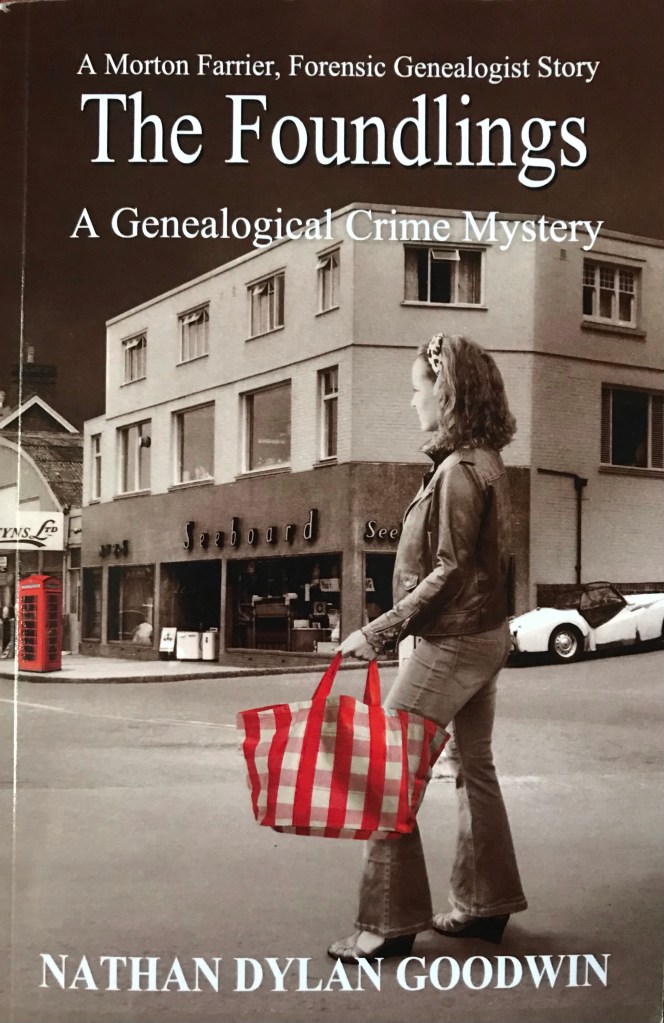
The Foundlings is the ninth novel in the Morton Farrier Forensic Genealogist series of books by Nathan Dylan Goodwin. And I promise no spoilers in this review. Suffice it to say if you read the book you’re in for a treat!
Once more genealogist Morton Farrier’s latest investigation is a fast-paced enjoyable read with plenty of plot twists and turns along the way, keeping you guessing right to the end. Farrier’s own family history is woven into the case, which proves all the more emotionally challenging for him because it is close to home.
It’s a case in which Farrier combines traditional family history research with DNA and genetic genealogy in order to find out the parentage of three women abandoned as babies. There’s real creative skill in how the author draws together all the various strands in this multi-layered story, with shades of darkness, to build to a credible ending. And for me it’s a sign of a good book when I’m compelled to flick back through the pages once I’ve finished, to re-read those “Aha” moments whose significance I’d not realised in my first run through.
As a family historian I really appreciate this series of books because I love following Farrier’s research processes. I can relate to the various records used, both online and in archives. And I do try to guess what steps he will take. This tale introduced an ethical dimension too. That being said, you certainly do not need to be a genealogist to become immersed in the story. If you like a satisfying mystery or crime novel, especially with some history thrown in too, The Foundlings – and the previous Forensic Genealogist books – will be right up your street.
I must confess I’m already an avid fan of the Morton Farrier Forensic Genealogist series of books, so his character was not new to me. I had just finished reading The Spyglass File. It meant The Foundlings was a few jumps ahead from where I’d got to in the series. And yes, I can confirm it can be read as a stand-alone novel, though I did quickly skip the few references to his previous case so as not to give away any clues to that story. I can also confirm it is up there with the previous books in the series, which goes from strength to strength.
In summary, if you’re in to family history, crime mysteries or historical thrillers I can highly recommend this book, along with all the others I’ve read in the series.
If you’ve not read any of the previous books in the Forensic Genealogist series and want to start at the beginning to sequentially see how the character’s back story evolves, here’s the full list:
The Asylum – A Morton Farrier short story;
Hiding the Past;
The Lost Ancestor;
The Orange Lilies – A Morton Farrier novella;
The America Ground;
The Spyglass File;
The Missing Man – A Morton Farrier novella;
The Suffragette’s Secret – A Morton Farrier short story;
The Wicked Trade;
The Sterling Affair;
The Foundlings.
Finally, here’s the all-important purchase information for The Foundlings. I read the paperback version, ISBN-13: 979-8481041421, price £8.99. There is also a kindle edition. Full purchase details forthis, and all the previous books in the series, can be found on Nathan Dylan Goodwin’s website.
Footnote: I was given a copy of this book by the author to preview. But if I hadn’t received a copy I would have certainly bought it – as I have all the earlier ones
Halfway through a piece of research, do you realise you’ve done it before?
Do you get broken off from your research, or shelve it, then pick up the problem months later – but can’t recall what you’d done or where you’d got to?
Are you a scatter-gun researcher, flitting from one unplanned search to another, and at the end of a couple of hours you have no idea what records you’ve checked. Then go round in circles once more, repeating the same searches?
You’re not alone. But it means you’re wasting research time; you’re potentially overlooking key pieces of information; you are duplicating your efforts; and your research is unfocused.
Which is where a research log comes in.
A log makes for efficient research, with no wasted time or duplicated effort. You can pick up a piece of research months later and know exactly what steps have previously been taken. It also means you can more easily identify gaps in your research.
In short a log keeps your research on track.
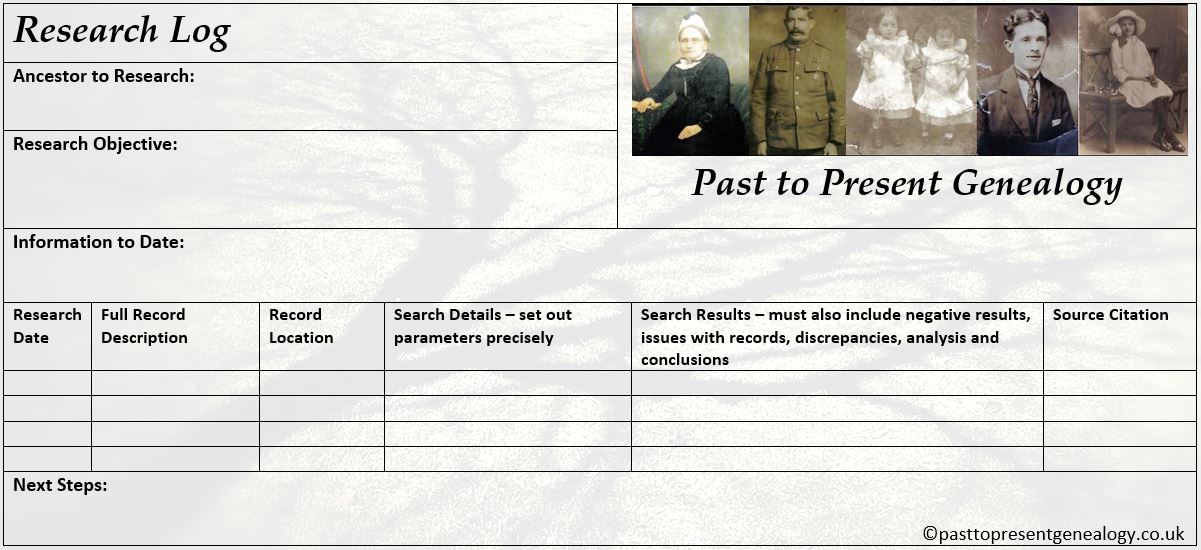
My seven key points for research logs are:
Define the research objective: Set out clearly the problem, e.g. finding out the date of birth of an ancestor, or who their parents were. Include what you know through evidence, and any assumptions or conflicting information. This enables identification of issues, leading on to potential sources and search strategies
Identify possible records and sources (e.g censuses, parish registers, probate records, books): These must be fully detailed including description, location(s) and type e.g. original documents, indexes, transcripts, digitised images etc.
Date of the search: Archives add to their acquisitions. Records are continually being digitised and appearing online, and this includes updates to ones already online (think 1939 Register, or the GRO Indexes). So a search conducted 12 months ago may not have the same outcomes if conducted today. A date helps you decide if it’s worth repeating the search.
Set out fully the search parameters: What spelling variants did you use? How many years either side of a specific date did you search? Which locations/parishes did you use? Did you rely on a data provider’s online search? Did you visually confirm results? Did you go through the record (and all the years) yourself? If a book, did you rely on the index or read the entire chapter or book? Some datasets (e.g. censuses) are on multiple websites – did you search just one? The same search on another website may have a different result. This enables you to see exactly what has been done and identify other possible areas of research.
Record in detail the results – including negative ones: Fully record search results along with your analysis, conclusions and any discrepancies. This includes problems with the records, e.g. were there any gaps or record damage which might affect the result? Do ensure that the explanation is clear because it might be a while before you revisit it. And do include negative searches.
Full source citations: Note where the original document can be found. Include full document reference, with page number. For website searches also include URL, description and date accessed. Give as much information as possible to enable you to find the document again. Do not assume it will always be online!
Next steps: Review your log. Identify follow-up searches.
Your log could be electronic (do remember to back it up). Or it could be paper-based.
There are lots of pro-formas online. I have included my example above. Or perhaps you might prefer to design your own bespoke log.
And do not be put off by the thought of the time taken to keep a research log. It is minimal when compared with the time you will save in the long run from trying to remember exactly what you’ve done before, reducing the number of repeat searches and pinpointing what you have not tried.
Whatever method you use, online or paper-based, your research will benefit.
Many will be starting their family history research in the New Year. That’s the time of year I embarked on my quest many moons ago, when my brother bought me some books as a Christmas present.
The other day I got to thinking about the mistakes I made in those early days, and the advice I wish I’d been given at the outset. Here are 10 tips I wish my younger genie had been given.
A selection of my research record books (see Goal 6)
Talk to relatives…but only if they want to. Don’t push it. Not all relatives will be comfortable with this, particularly if there are skeletons in the family history cupboard. If they do agree to talk, bear in mind the memory isn’t infallible. Names, dates and events may not be recalled with total accuracy. And there may be some air-brushing to glass over uncomfortable truths.
Make a note of all the sources and references for your findings. That includes the document description, location and reference number. If it was accessed via an online search, note the website address, document dataset and search date. Basically anything and everything you will need to locate it again.
Make a note of all searches – negative as well as positive. It avoids unnecessary repeat searches. Note the search date. This helps with online searches. You only need to repeat when the dataset is updated.
Tempting as it is, avoid the scattergun approach. Plan your research strategy. If you plan, you focus. Don’t try do everything in one go. Concentrate on one person, issue, family at a time. Define the problem, and look at which records may help. Work through methodically.
Don’t accept online family trees as gospel. It’s all too easy if you’re new to family history to accept the research of others without question. Do so at your peril – you could find yourself barking up the wrong tree. Do your own research.
Record your findings as soon as possible. Don’t build up a backlog. I started with a card index system which I still continue. I also now record on a family history software programme. But it could also as easily be an ancestral notebook, or downloading forms such as those available on the FamilySearch Wiki. It’s whatever works for you. The key point is you do it, so your research is up to date. you can quickly evaluate it and spot the gaps.
Don’t get hung up on spellings. Literacy levels and accents all impacted. Be open-minded. Some of my family surnames have upwards of 20 spelling variations. Even Christian names could vary.
By the same token be aware that your ancestors were not necessarily consistent with facts. They may have not known their exact birthday. They may have wished to bend the truth. My great grandmother lied about her age to make it appear she was closer to the age of her husband. She and my great grandfather lied in the 1911 census about the number of years they had been married, to cover illegitimacy of children. Your ancestors were human. And humans don’t always tell the truth. So when searching, build up in parameters either side of dates. Question, question, question. And refer back constantly to previous findings,
Join a family history society. Consider courses. Read to expand your knowledge. Ask if you’re not sure. And accept help. We’ve all been there. And genealogists are a friendly bunch.
Finally be aware – family history research could end up taking over your life. You’re never finished.
I do hope these tips help you start your research on the right track!
I make no apologies for posting this advice. If it helps just one person it’s worth repeating it.
Here goes:
Do not rely on
index searches and/or transcriptions – look at actual documents or digitised images of them;
Whenever possible use more
than one genealogical dataset provider for any searches; and
When searching be flexible
with spellings, dates, ages etc.
This was brought home to me yet again recently whilst doing my Aveyard One-Name Study.
Extracting
all occurrences of the name from the 1851 census in England and Wales I used
both Ancestry and Findmypast. Searching purely on Aveyard, and not including my
variant surname searches, the totals were:
Ancestry: 206; and
Findmypast: 183.
Both
providers had results not found by the other one.
I also
looked at Haveyard. Ancestry had five results and Findmypast six.
I went through each result individually, checking against the original census images. Some proved not to be Aveyard entries at all. Even individual information within correct entries had discrepancies when checked against the image – ages, occupations, names and relationships incorrect for instance. And there was no correlation with the errors between the providers. As for the quality of images, that too varied. For some Findmypast was far superior; for others Ancestry proved more legible. And some were difficult on both.
In the end I came up with 211 genuine Aveyard/Haveyard entries. This total is purely coincidental in matching the Ancestry total. My 211 included some not found by either provider in the Aveyard/Haveyard searches, but based on my knowledge of names I knew should be there. And this total does not include the Halfyard spelling sometimes used.
To put it simply if I had used one provider for my search and not checked the images I would have replicated errors and had missing entries.
Even my 211 may be a hostage to fortune as I delve more into my Aveyard and wider ancestry, become more familiar with names which should feature based on results from other record sets, and look at broader wildcard searches.
I use this census search as an example. The same principles apply equally for any searches. Only today, finding someone in a 1939 Register search via Findmypast proved impossible. Switch to Ancestry and it was the first “hit.”
Also just because you cannot find an expected result does not mean it isn’t there. It could be simply mis-transcribed, the document could be damaged or pages may have been skipped in the digitisation process. So check the original document, especially if you are relying on one provider for your search. In fact I’d say always go through the document.
In recent weeks I’ve found burials which didn’t come up with a normal search; ships passengers missed off the search indexes; incorrect dates even down to the wrong year; and even a 1912 birth entry on the General Register Office (GRO) website which had the mother’s maiden name totally mangled. I went ahead and ordered the certificate, trusting my instincts (combined with reasoned searching and elimination). It proved the right call. The name was mis-transcribed on the main index, because the document itself had legibility issues and the name was highly unusual.
Another GRO example recently was using Findmypast marriage indexes for 1904. The page number was transcribed as 133 and their marriage finder hint came up with two suggested grooms. Looking at the image, the page number was actually 123. Using FreeBMD, a search on District, Date, Page and Volume sorted it and the correct groom was identified. Needless to say it wasn’t either of the two suggested via the Findmypast search.
The moral of the story is do not rely on indexes, transcriptions and the search algorithms of online genealogy sites; use more than one provider as it is less likely the same transcription error will be repeated on all; always check the image if at all possible; be flexible with your spellings, do not rely on what you think is the established one; and don’t accept negative search results without question.
So from one “old” genealogist, maybe by following these general principles you will have more chance of “meeting” your ancestors whilst you are alive, than in any afterlife!