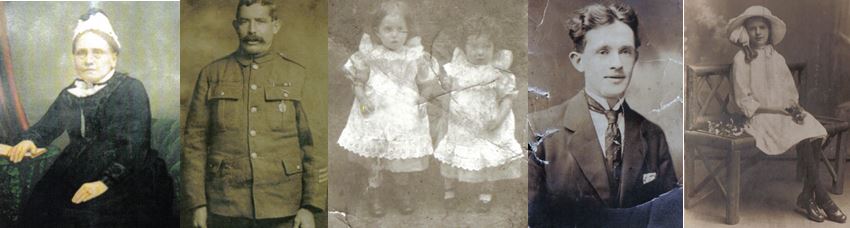
This is my regular look back at the posts added to the Batley St Mary of the Angels One-Place Study during the previous month. If you want to know the background, and what is involved in a one-place study, click here. Otherwise read on, to discover a wealth of parish, parishioner and wider local Batley history.
Six new posts were added to the Batley St Mary’s one-place study during October 2023, bringing the total number of study posts to 279. Two other posts were updated. This latest monthly update contains the list of all the posts to date, including links to them, with the new and updated posts signposted.
These additions included four weekly newspaper pages for October 1917. I have accordingly updated the surname index to these During This Week newspaper pieces, so you can easily identify newspaper snippets relevant to your family.
There was one new War Memorial biography added added this month, for Michael Cunningham.
More men who served and survived the First World War have been identified and are included in that section, though no new biographies were added here this month. They will follow in due course.
The other post relates to the Batley cemetery burials of several priests and nuns who served in the parish. This can be found in the Miscellany of Information section.
Below is the full list of pages to date. I have annotated the *NEW* and *UPDATED* ones, so you can easily pick these out. Click on the link and it will take you straight to the relevant page.
Finally, if you do have any information about, or photos of, parishioners from the period of the First World War please do get in touch. It does not have to be War Memorial men. It could be those who served and survived, or indeed any other men, women and children from the parish.
I would also be interested in information about, and photos of, those parishioners who were killed in World War Two, or others from the parish who undertook any war service and survived. This can be as broad as serving in the military, or work in munitions factories, the Land Army, even taking in refugees. This is an area I’m looking to develop in the future.
Postscript: I want to say a big thank you for the donations already received to keep this website going. They really do help.
The website has always been free to use, and I want to continue this policy in the future. However, it does cost me money to operate – from undertaking the research to website hosting costs. In the current difficult economic climate I do have to regularly consider if I can afford to continue running it as a free resource.
If you have enjoyed reading the various pieces, and would like to make a donation towards keeping the website up and running in its current open access format, it would be very much appreciated.
Please click 👉🏻here👈🏻 to be taken to the PayPal donation link. By making a donation you will be helping to keep the website online and freely available for all.
This is my regular look back at the posts added to the Batley St Mary of the Angels One-Place Study during the previous month. If you want to know the background, and what is involved in a one-place study, click here. Otherwise read on, to discover a wealth of parish, parishioner and wider local Batley history.
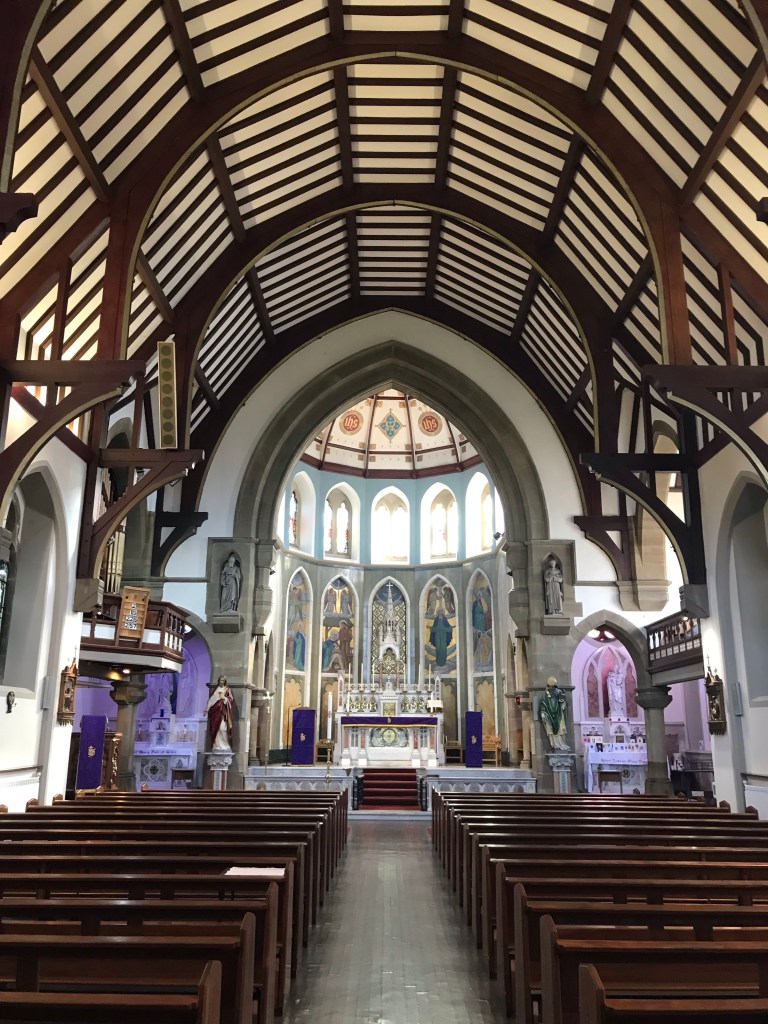
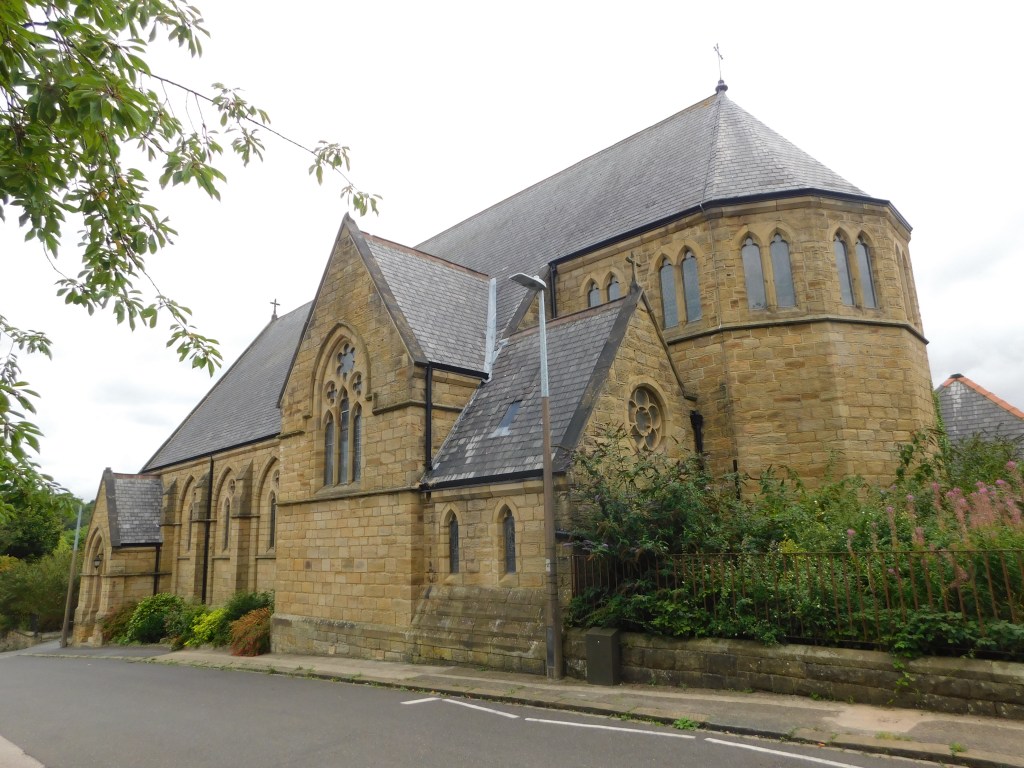
St Mary of the Angels, Batley – Photo by Jane Roberts
Eight new posts were added to the Batley St Mary’s one-place study during September 2023, including a crucial one about the arrival of the Irish in Batley, the early history of the parish and the building of the church. It means there are now 273 posts in the study. Two other posts were updated. This latest monthly update contains the list of all the posts to date, including links to them, with the new and updated posts signposted.
These additions included five weekly newspaper pages for September 1917. I have accordingly updated the surname index to these During This Week newspaper pieces, so you can easily identify newspaper snippets relevant to your family.
There was one new War Memorial biography added added this month, for William Colbeck.
More men who served and survived the First World War have been identified and are included in that section, though no new biographies were added here this month. They will follow in due course.
The two other posts relate to the arrival of the Irish, the early history of the parish and the building of the church. They can be found in the Miscellany of Information section.
Below is the full list of pages to date. I have annotated the *NEW* and *UPDATED* ones, so you can easily pick these out. Click on the link and it will take you straight to the relevant page.
Finally, if you do have any information about, or photos of, parishioners from the period of the First World War please do get in touch. It does not have to be War Memorial men. It could be those who served and survived, or indeed any other men, women and children from the parish.
I would also be interested in information about, and photos of, those parishioners who were killed in World War Two, or others from the parish who undertook any war service and survived. This can be as broad as serving in the military, or work in munitions factories, the Land Army, even taking in refugees. This is an area I’m looking to develop in the future.
Postscript: I want to say a big thank you for the donations already received to keep this website going. They really do help.
The website has always been free to use, and I want to continue this policy in the future. However, it does cost me money to operate – from undertaking the research to website hosting costs. In the current difficult economic climate I do have to regularly consider if I can afford to continue running it as a free resource.
If you have enjoyed reading the various pieces, and would like to make a donation towards keeping the website up and running in its current open access format, it would be very much appreciated.
Please click 👉🏻here👈🏻 to be taken to the PayPal donation link. By making a donation you will be helping to keep the website online and freely available for all.
Even though it was a difficult month personally with the death of my mother, more posts were added to the Batley St Mary of the Angels One-Place Study during August.
If you are new to to this one-place study and want to know what it is all about, click here. Otherwise read on, to discover a wealth of parish, parishioner and wider local Batley history.
Six new posts were added to the Batley St Mary’s one-place study during August. Although it is not as many as I planned, it does bring the total to 265. Two other posts were updated. This latest study update contains the list of all the posts to date, including links to them, with the new and updated posts signposted.
These additions included four weekly newspaper pages for August 1917. I have accordingly updated the surname index to these During This Week newspaper pieces, so you can easily identify newspaper snippets relevant to your family.
There was one new War Memorial biography added added this month, for Lawrence Judge.
More men who served and survived the First World War have been identified and are included in that section, though no new biographies were added here this month. They will follow in due course.
The final addition this month was about a Batley Irish secret society, and the discovery of an arms cache.
Below is the full list of pages to date. I have annotated the *NEW* and *UPDATED* ones, so you can easily pick these out. Click on the link and it will take you straight to the relevant page.
Finally, if you do have any information about, or photos of, parishioners from the period of the First World War please do get in touch. It does not have to be War Memorial men. It could be those who served and survived, or indeed any other men, women and children from the parish.
I would also be interested in information about, and photos of, those parishioners who were killed in World War Two, or others from the parish who undertook any war service and survived. This can be as broad as serving in the military, or work in munitions factories, the Land Army, even taking in refugees. This is an area I’m looking to develop in the future.
Postscript: I want to say a big thank you for the donations already received to keep this website going. They really do help.
The website has always been free to use, and I want to continue this policy in the future. However, it does cost me money to operate – from undertaking the research to website hosting costs. In the current difficult economic climate I do have to regularly consider if I can afford to continue running it as a free resource.
If you have enjoyed reading the various pieces, and would like to make a donation towards keeping the website up and running in its current open access format, it would be very much appreciated.
Please click 👉🏻here👈🏻 to be taken to the PayPal donation link. By making a donation you will be helping to keep the website online and freely available for all.
If you are new to to this one-place study and want to know what it is all about, click here. Otherwise read on, to discover a wealth of Batley St Mary of the Angels parish, parishioner and wider local Batley history.
Six new posts were added to the Batley St Mary’s one-place study in July 2023. This brings the total to 259. Two other posts were updated. This latest study update contains the list of all the posts to date, including links to them, with the new and updated posts signposted.
These additions included four weekly newspaper pages for July 1917. I have accordingly updated the surname index to these During This Week newspaper pieces, so you can easily identify newspaper snippets relevant to your family.
More men who served and survived the First World War have been identified and are included in that section, though no new biographies were added here this month. They will follow in due course.
There was one new school log book added in June, covering the Mixed Department in 1917.
The final addition this month was a tale of graveyard desecration, the perpetrators being St Mary’s schoolboys.
Below is the full list of pages to date. I have annotated the *NEW* and *UPDATED* ones, so you can easily pick these out. Click on the link and it will take you straight to the relevant page.
Finally, if you do have any information about, or photos of, parishioners from the period of the First World War please do get in touch. It does not have to be War Memorial men. It could be those who served and survived, or indeed any other men, women and children from the parish.
I would also be interested in information about, and photos of, those parishioners who were killed in World War Two, or others from the parish who undertook any war service and survived. This can be as broad as serving in the military, or work in munitions factories, the Land Army, even taking in refugees. This is an area I’m looking to develop in the future.
Postscript: I want to say a big thank you for the donations already received to keep this website going. They really do help.
The website has always been free to use, and I want to continue this policy in the future. However, it does cost me money to operate – from undertaking the research to website hosting costs. In the current difficult economic climate I do have to regularly consider if I can afford to continue running it as a free resource.
If you have enjoyed reading the various pieces, and would like to make a donation towards keeping the website up and running in its current open access format, it would be very much appreciated.
Please click 👉🏻here👈🏻 to be taken to the PayPal donation link. By making a donation you will be helping to keep the website online and freely available for all.
June 2023 was another milestone month for the Batley St Mary’s one-place study. This month the study notched up its 250th post. This latest update contains the list of all the posts to date, including links to them.
If you are new to to this one-place study and want to know what it is all about, click here. Otherwise read on to discover all the other posts, new and old, containing a wealth of parish, parishioner and wider local Batley history.
During June eight posts were in added, bringing the total number for the study to 253. Four others were updated.
These additions included five weekly newspaper pages for June 1917. One of these marked the study’s 250th post. I have accordingly updated the surname index to these During This Week newspaper pieces, so you can easily identify newspaper snippets relevant to your family.
Patrick Lyons was added to the First World War Memorial biographies. Michael Lydon’s was updated.
Dozens more men who served and survived the First World War have been identified and are included in that section, though no new biographies were added here this month. They will follow in due course.
There was one new school log book added in June, covering the Mixed Department in 1916.
The final addition this month was to the section on Electoral Registers. It covers Batley’s North Ward, Polling Districts A and B.
Below is the full list of pages to date. I have annotated the *NEW* and *UPDATED* ones, so you can easily pick these out. Click on the link and it will take you straight to the relevant page.
Finally for this month, if you do have any information about, or photos of, parishioners from the period of the First World War please do get in touch. It does not have to be War Memorial men. It could be those who served and survived, or indeed any other men, women and children from the parish.
I would also be interested in information about, and photos of, those parishioners who were killed in World War Two, or others from the parish who undertook any war service and survived. This can be as broad as serving in the military, or work in munitions factories, the Land Army, even taking in refugees. This is an area I’m looking to develop in the future.
Postscript: I want to say a big thank you for the donations already received to keep this website going. They really do help.
The website has always been free to use, and I want to continue this policy in the future. However, it does cost me money to operate – from undertaking the research to website hosting costs. In the current difficult economic climate I do have to regularly consider if I can afford to continue running it as a free resource.
If you have enjoyed reading the various pieces, and would like to make a donation towards keeping the website up and running in its current open access format, it would be very much appreciated.
Please click 👉🏻here👈🏻 to be taken to the PayPal donation link. By making a donation you will be helping to keep the website online and freely available for all.
This is the latest Batley St Mary’s one-place study update, looking at the posts added during May 2023. This update also contains links to all the posts in the study to date.
If you are new to to this one-place study and want to know what it is all about, click here. Otherwise read on to discover all the other posts, new and old, containing a wealth of parish, parishioner and wider local Batley history.
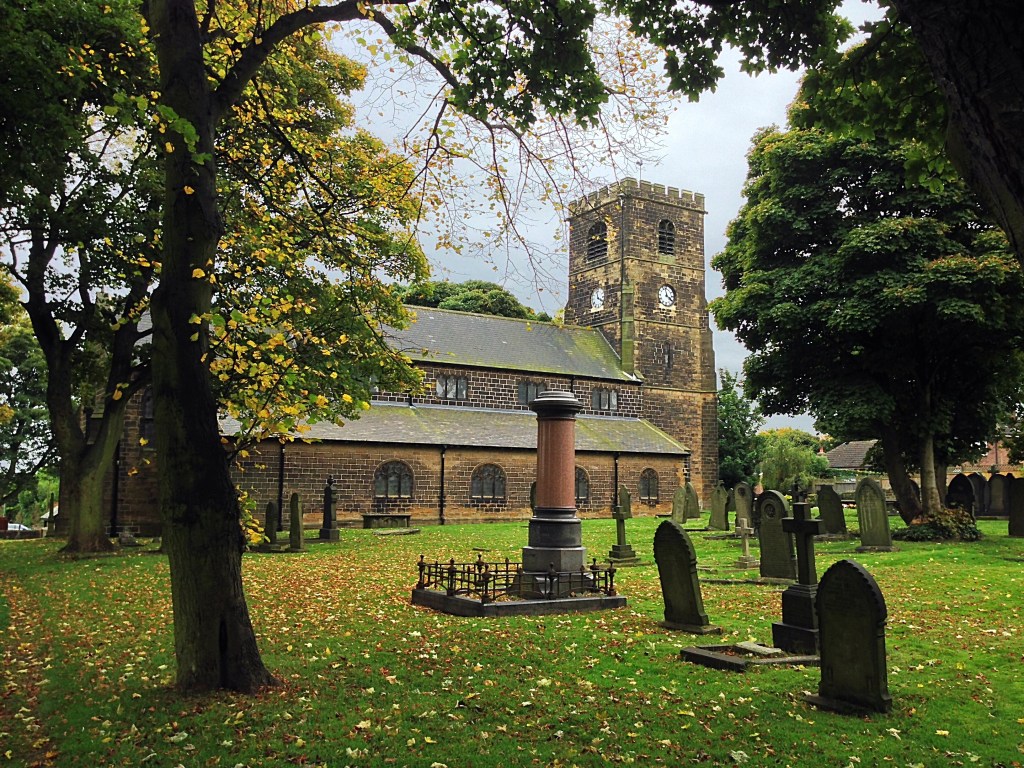
St Mary’s Church as seen from Batley Cemetery – photo by Jane Roberts
During May nine posts were in added, bringing the total number for the study to 245. Two others were updated.
These additions included four weekly newspaper pages for May 1917. I have accordingly updated the surname index to these During This Week newspaper pieces, so you can easily identify newspaper snippets relevant to your family.
Two new Great War Memorial biographies were added, Matthew Farrar and Willie Barber.
More men who served and survived the First World War have been identified and are included in that section, though no new biographies were added here this month. They will follow in due course.
Thomas Egan’s biography was added to those men from the parish who died in World War Two.
The final additions this month are two new school log books, covering the Mixed Department in 1914 and 1915.
Below is the full list of pages to date. I have annotated the *NEW* and *UPDATED* ones, so you can easily pick these out. Click on the link and it will take you straight to the relevant page.
Finally for this month, if you do have any information about, or photos of, parishioners from the period of the First World War please do get in touch. It does not have to be War Memorial men. It could be those who served and survived, or indeed any other men, women and children from the parish.
I would also be interested in information about, and photos of, those parishioners who were killed in World War Two, or others from the parish who undertook any war service and survived. This can be as broad as serving in the military, or work in munitions factories, the Land Army, even taking in refugees. This is an area I’m looking to develop in the future.
Postscript: I want to say a big thank you for the donations already received to keep this website going. They really do help.
The website has always been free to use, and I want to continue this policy in the future. However, it does cost me money to operate – from undertaking the research to website hosting costs. In the current difficult economic climate I do have to regularly consider if I can afford to continue running it as a free resource.
If you have enjoyed reading the various pieces, and would like to make a donation towards keeping the website up and running in its current open access format, it would be very much appreciated.
Please click 👉🏻here👈🏻 to be taken to the PayPal donation link. By making a donation you will be helping to keep the website online and freely available for all.
This is the latest Batley St Mary’s one-place study update, looking at the posts added in March 2023. The update also contains links to all the posts in the study to date.
If you are new to to this one-place study and want to know what it is all about, click here. Otherwise read on to discover all the other posts, new and old, containing a wealth of parish, parishioner and wider local Batley history.
St Mary’s Church – photo by Jane Roberts
March 2023 has been a busy month. It saw the addition of 10 new posts, bringing the total number for the study to 228. Seven others were updated.
The additions included five weekly newspaper pages for March 1917. I have accordingly updated the surname index to these During This Week newspaper pieces, so you can easily identify newspaper snippets relevant to your family.
This month there is one new Memorial biography, James Groark. More men who served and survived have been identified and are included in that section, though no new biographies were added here this month. They will follow in due course. And thanks to information received, a new man associated with the parish who lost his life in the War has been identified, Martin Flatley. He has therefore been added to the section covering Men Associated with St Mary’s Who Died but Who Are Not on the War Memorial. I very much appreciate it when people contact me with information about St Mary’s parishioners to include in this one-place study.
A new occupation post has been added this month – a colliery bye-worker (and other variants by which the job was known).
Following on from this, a new post has been added to the Miscellany of Information section, dealing with a coal mining accident with tragic consequences which involved four parishioners. With thanks to Joanne Harrison for allowing me to use a family photo for this piece.
If anyone does have any photos which could be included in this one-place study, they would be gratefully received.
The last couple of additions this month are two new school log books have been added for the Infants’ school, covering 1919 and 1920.
Below is the full list of pages to date. I have annotated the *NEW* and *UPDATED* ones, so you can easily pick these out. Click on the link and it will take you straight to the relevant page.
Finally for this month, if you do have any information about, or photos of, parishioners from the period of the First World War, including any men who served (be it those who died or those who survived), or any parishioners who died in World War Two, it is always gratefully received.
Postscript: Finally a big thank you for the donations already received to keep this website going. They really do help.
The website has always been free to use, but it does cost me money to operate. In the current difficult economic climate I do have to consider if I can continue to afford to keep running it as a free resource.
If you have enjoyed reading the various pieces, and would like to make a donation towards keeping the website up and running in its current open access format, it would be very much appreciated.
Please click 👉🏻here👈🏻 to be taken to the PayPal donation link. By making a donation you will be helping to keep the website online and freely available for all.
This is the latest Batley St Mary’s one-place study update, looking at the posts added in January 2023. The update also contains links to all the posts in the study to date.
If you are new to to this one-place study and want to know what it is all about, click here. Otherwise read on to discover all the other posts, new and old, containing a wealth of parish, parishioner and wider local Batley history.
St Mary’s Church – photo by Jane Roberts
January 2023 saw the addition of nine new posts, bringing the total number for the study to 212. Three other pages were updated. Two other categories, looking at statistics for Batley and the parish of St Mary’s, were renamed.
The additions included four weekly newspaper pages for January 1917. I have accordingly updated the surname index to these During This Week newspaper pieces, so you can easily identify newspaper snippets relevant to your family.
January saw the addition of two new Memorial biographies, those for Arthur William Bayldon Woodhead and Martin Gallagher,
More men who served and survived have been identified and that page includes these new names. However, no new biographies were added here this month. They will follow in due course.
And this month there is an unusual tale in the Miscellany of Information section – a post about a bizarre crime which took place in Batley cemetery under cover of black-out darkness in 1942.
As for the renamed categories, Batley Descriptions now becomes Batley Statistics and Descriptions – Population, Health, Mortality, Fertility etc. It will cover general information about Batley. This will provide an overview of the town where St Mary of the Angels is located and therefore some more context to the lives of the parishioners. Two new posts have been added here. One looks at the population of Batley between 1801 and 1939. The other looks at Batley in the 1921 census, with all the changes wrought by the war.
The other renamed category is Population, Health, Mortality and Fertility, which has been renamed Batley St Mary’s Population, Health, Mortality and Fertility Information and Comparisons. This will look at population and health issues at a parish rather than town level, and may draw on information from the town section to enable comparisons.
Below is the full list of pages to date. I have annotated the *NEW* and *UPDATED* ones, so you can easily pick these out. Click on the link and it will take you straight to the relevant page.
Postscript: Finally a big thank you for the donations already received to keep this website going. They really do help.
The website has always been free to use, but it does cost me money to operate. In the current difficult economic climate I am considering if I can continue to afford to keep running it as a free resource, especially as I have to balance the research time against work commitments.
If you have enjoyed reading the various pieces, and would like to make a donation towards keeping the website up and running in its current open access format, it would be very much appreciated.
Please click here to be taken to the PayPal donation link. By making a donation you will be helping to keep the website online and freely available for all.
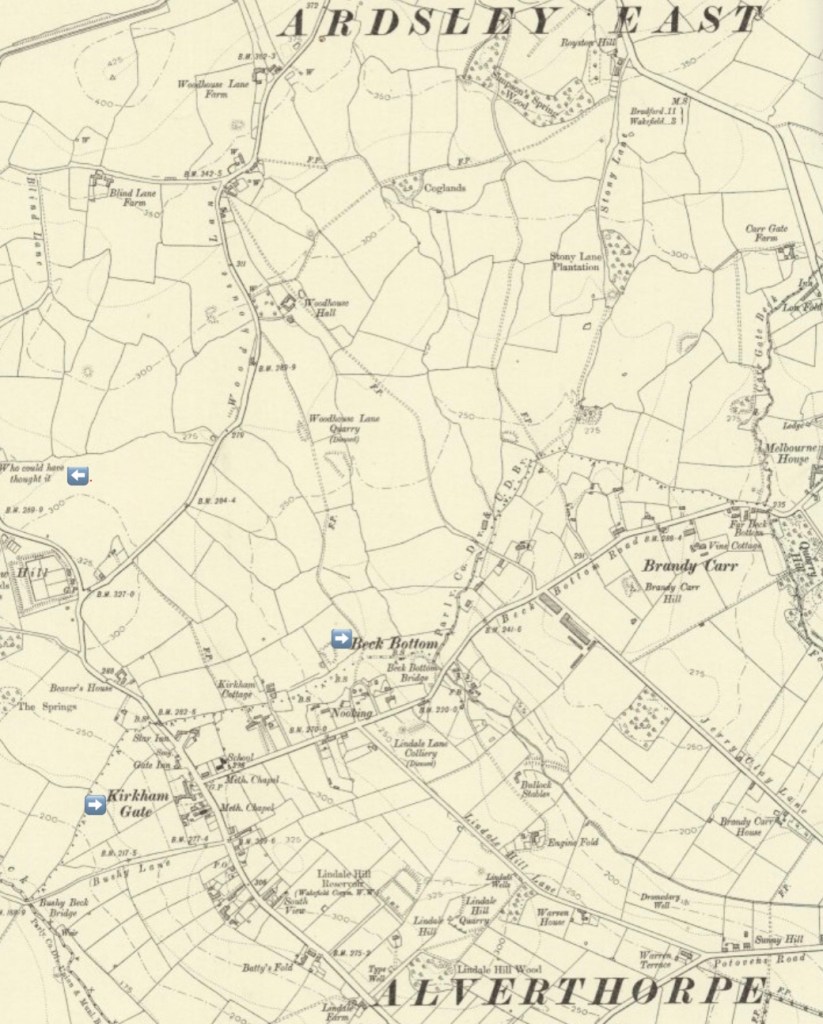
Whilst looking at a 19th century map of the West and East Ardsley areas, the place name Who could have thought it captured my imagination. Although I don’t live too far away from the area, this was the first time I had encountered it.
That was it. Instead of focusing on a course about agricultural labourers (the reason I’d been studying the map in the first place) I now set about trying to find out more about the origins of this unusual location name. Amazingly this led me down a rabbit hole which was connected to my own family history.
Map showing the proximity of Chestnut Terrace to Brewery Lane, Ordnance Survey Maps – Six-inch England and Wales, 1842-1952, Yorkshire 233 Surveyed: 1848 to 1851, Published: 1854 – National Library of Scotland, under the Creative Commons Attribution-NonCommercial-ShareAlike 4.0 International (CC-BY-NC-SA) licence
Some sources state that Who Could Have Thought It was named after a tragic accident in 1809, in which ten East Ardsley miners were killed.1 The location was a small cluster of miners’ cottages at Spring Bottom, which, as a result of the tragedy, became known locally as Who Could Have Thought It. The name appears on O.S. maps until circa 1930, after which it becomes Haigh Hall Terrace.
As a result of this information my interest was piqued further. I have direct maternal line ancestors who were miners in and around East Ardsley in this period. These include my 4x great grandfathers David Hudson, born in circa 1795, and George Broadhead, baptised in East Ardsley in 1803.
Now it was time to find out about this accident.
The York Herald and County Advertiser reported on it as follows:
We have to record a most melancholy accident which happened on Friday week, in two of the pits belonging to Mess. Lee, Watson and Co., situate at East Ardsley, near Wakefield. Ten men and four boys, colliers, employed in the said pits, were instantly drowned by the bursting, it is supposed, of the tunnel of some old pits, lying near and not now in use. —The water, which is not less than ten or eleven yards deep in each pit, is drawing off as quick as possible, but it is thought the bodies will not be got out before Tuesday. —Several of the unfortunate sufferers have left wives and families; thus in a moment bereft of their only earthly protectors and friends. Three young lads, who were at the mouth of one of the pits, on hearing the running water, swarmed up the rope, and alarming, by their cries, the men at the top, were fortunately extricated from their perilous situation. An inquest will be held on the bodies of the sufferers as soon as they can be got out. It since appears that only six men were drowned – four having escaped, but through what means we have not learned.2
The escape of these four additional men reduced the death toll to ten. An article in the Morning Post provide more details about their rescue. It also provided the names of the dead:
DREADFUL ACCIDENT
In the melancholy catalogue of misfortunes, so frequently occurring in Coal Mines, few have produced a deeper impression on the public, or been more dreadfully fatal in their consequences, than that which happened in the pits of Messrs. Lee, Watson, and Co, at East Ardsley, near Wakefield on Friday the 30th ult. The workmen at the time the accident happened, were driving through a throw, as it is technically called, when coming in contact with some exhausted pits, the water rushed through an aperture with irresistible impetuosity, and almost instantly inundated the pit where the people were at work. Three lads, fortunately in a situation to take the bucket, were drawn up without injury, but eleven men and three boys were shut up in the subterraneous abode, and for three days and nights consigned, in the imagination of their families and friends, to the mansions of the dead. Every exertion was made to drain the pit in hope that some lives might be saved; two engines were set to work for that purpose, and the Colliers from the works of Messrs. Branding, Smithson, Fenton, Wood, and Walker, were unremitting in their endeavours to rescue, if Providence had so ordered it, some, at least, of their unfortunate fellow workmen from the jaws of death.
On Monday, voices were heard to ascend from the pits; imagine the anxiety of wives, mothers, fathers, and children, all standing at the mouth of the abyss – anxious to catch a sound – and intensely anxious in that sound to recognise the well-known voice for some near and dear relative.
The moment had arrived when the hopes of some were to be elevated into reality, and the fond expectation of others to be sunk to dispair [sic]. Two men and two boys, John Hudson, Robert Kendrew, William Broad, and Joseph Goodyear, were drawn up alive and in health, though they had remained for three days and nights without rest or sustenance, except a little bread, which Kendrew happened to have in his pocket, and which, with unexampled generosity, he divided among his half famished companions, supplying his own wants with a quid of tobacco.3 The following are the names and families of the ten unfortunate sufferers:—
Aaron Haigh, a boy; George Gothard, an unmarried man; Samuel Bower, an unmarried man; John Haigh, has left a wife pregnant; Thomas Brook, one child and a wife pregnant; Thomas Broad, a wife and two children; William Broad, a wife and three children; Thomas Marshall, a wife and five children; Thomas Hartley, a wife and six children; and Jonathan Gothard, a wife and nine children.4
According to another report John and Aaron Haigh were brothers. They were alive for some time after the flooding. Eventually they made a bid to get out, but were drowned in the attempt. The remaining eight corpses were dragged out of the pit once the water subsided. Their lifeless bodies were presented to their heart-broken relatives.5
By now I was well and truly hooked. A Hudson featured amongst the saved, as did a Broad. Two further Broads were amongst the dead, including a Thomas Broad.
The cogs in the family history part of my brain were kicking into overdrive as a result of the Broad angle. My earlier research into the Broadhead family had revealed they sometimes used the surname Broad. My 4x great grandfather, George Broadhead, married in 1826 under the name Broad, and this was the recording of his surname in one census (1841). Some (but not all) of his children were baptised as Broad too. And George’s 1803 baptism entry (under Broadhead) names his father as miner Thomas. Other than that, I had no more information about Thomas. To be fair it is a branch I’ve not looked at for a few years. Could this mining accident be a breakthrough?.
A couple of more general points struck me from the newspaper coverage. Firstly the community involvement, with miners from other local pits helping in the rescue and recovery attempt.
Secondly, there is an incredible amount of detail for a newspaper report of the time into a mining accident in a Yorkshire village: Even down to the victims’ names, marital status and number of children. Reports in this period can be very sketchy on such details.
That the events in East Ardsley captured the public imagination is evident. It is not hard to see why. Apart from the tragedy, it had elements of raw human emotion, bravery and acts of pure selflessness, with the events having a central hero in Robert Kendrew.
Such was the impact of the East Ardsley pit disaster, and the survival over days of the four miners, in 1818 the Reverend James Plumptre, the Vicar of Great Grandsen, Huntingdonshire, wrote a play based on them. Entitled Kendrew: or, The Coal Mine, it focuses on the struggle for survival of Robert Kendrew, John Hudson, William Broad and Joseph Goodyear. The play is still available to read, with its religious overtones, its whitewashing of the realities of pit work, its romanticised depiction of a female miner and the weaving in of a love story.6
Back to reality, I decided to check parish registers for the burial of the men. So far I have located information for eight.
Four of the burials took place on 4 July 1809 at Woodkirk St Mary’s parish church. The register has the helpful annotation that they drowned in a pit on 1 July (note this is the day after the accident).7
William Hartley, from East Ardsley, Collier;
Thomas Brook, of Hague Moor, Collier;
John Hague of Hague Moor, Collier; and
Aaron, son of Aaron Hague of Westerton, Collier.
St Michael’s Church, East Ardsley – Photo by Jane Roberts
The burials of a further four of the victims are recorded, minus any explanatory notes, in the parish register of St Michael’s, East Ardsley.8
4 July 1809 – Sam[ue]l, son of Jonathan Bower, Labourer, Wakefield Parish;
4 July 1809 – Tho[ma]s Marshall, Miner;
5 July 1809 – Thomas Broadhead, Miner; and
5 July 1809 – William Broadhead, Miner.
My heart skipped a beat. Here Thomas’ surname is recorded as Broadhead, not Broad. Disappointingly there were no further clues in the register entry. An age would have been a bonus. The Bishop’s Transcript (BT) unfortunately added nothing further. Although on this occasion the BT was no help, they are always worth checking. The only hint as to age, therefore, came from the newspaper which indicated he had a wife and two children.
It was now time to hit the parish registers in earnest. In addition to East Ardsley, this included checking its surrounding parishes in this period: Dewsbury, Woodkirk, Rothwell and Wakefield. Searches included both Broadhead and Broad. As a result I now have page upon page of Broadhead research and family notes!
For consistency, in the following write-up of this research, I will use the surname Broadhead rather than Broad. However, I will indicate when the Broad version was used in records.
I focused on not only Thomas, but William Broadhead too, in case there was a family connection between them. The newspapers had mentioned the Haighs were brothers, nothing about the relationship between the Broadheads. But perhaps they were cousins?
The newspaper indicated William had three children and Thomas two. I first set about trying to identify these children to see if there was a possibility this Thomas was the father of my 1803 baptised 4x great grandfather.
Sod’s law. William was a doddle, Thomas was not.
William Broadhead was baptised at East Ardsley parish church on 13 June 1784, the son of coal miner William Broadhead.9 Siblings included David, Nanny and James. No sibling named Thomas has been found. William married Mary Claiton, also at East Ardsley, on 25 December 1805.10 Their children, all baptised in the same church, were:
Hannah, baptised 27 July 1806;11
Jane, baptised on 16 December 1807;12 and
Elizabeth, baptised on 24 June 1809, less than a week before her father’s death.13
In all the baptism entries William is listed either as a miner or coal miner. Elizabeth died in 1810.14 The other two girls survived, with Hannah marrying John Wainwright in 1823,15 and Jane marrying John Bedford in 1825.16
Over to Thomas, then. I checked for any Broadhead East Ardsley baptisms between 1773 and 1823, with a father named Thomas. The post-1809 dates were deliberate, to see if there was a Thomas in the parish after the accident.
There were eight baptisms in total, all occurring between 1797 and 1810. Four could be discounted as they related to children of a clothier from Wakefield parish. Another, linked to a labourer from Wakefield parish, was similarly ruled out. That left three, as follows:
George, baptised 13 March 1803, son of Tho[ma]s, miner [my 4x great grandad];17
John, baptised 11 February 1805, son of Tho[ma]s, miner.18 He died in 1818;19 and
Ellin, baptised 20 August 1809, daughter of Tho[ma]s and Hannah, miner.20
The obvious issue here is the number of children – three as opposed to the two cited in the newspaper. The other issue is Ellin’s baptism took place after the 30 June 1809 accident, and there is no reference in her baptism entry to her father being dead. The only difference in the BT was name, Ellioner, so no help there. I checked the baptism entry for John Haigh’s child for comparison purposes. The newspaper reports mentioned his wife was pregnant at the time of his death – no such mention for Thomas Broadhead’s wife. Unfortunately for my purposes the Haigh baptism took place in Woodkirk parish so the phraseology for the entry in this parish cannot be directly compared with that of East Ardsley. In the Woodkirk register, whilst John is named as the baby’s father, the entry clearly indicates he is deceased.21
The anomaly may simply be a newspaper oversight: Thomas did have two children when he died – George and John. But had his wife so very recently given birth to a third that it had been missed in reporting? Although saying that, William’s third child had only recently been born and she was included. The more likely scenario, however, assuming the likely interval between birth and baptism was weeks (though accepting this was not always the case), and with the 20 August baptism date, was Hannah being pregnant at the time of Thomas’ death, and this being overlooked in press reporting. Though the discrepancy is worth noting as an end that does not neatly tie, this latter scenario seems not improbable.
There is one final document to build the case for Thomas being my 5x great grandfather, and this is a probate document from the Exchequer Court of York. On the 12 August 1809 Administration of the goods of Thomas Broadhead, late of East Ardsley who died intestate, was granted to his widow Hannah Broadhead.22 The death can refer to none other than the miner who lost his life in the pit. This document is confirmation of the name of the widow of this miner.
As it stands I believe the balance of evidence is overwhelming now pointing to the 1809 death being George’s father, and my 5x great grandfather, Thomas Broadhead. There is simply no other candidate.
I wanted to find out what happened to Ellin, as much as anything for any further clues this might offer. Besides parish registers, other sources used here included censuses to corroborate age and birthplace, and GRO indexes.
Ellen Broad (note the surname) married Jonathan Hanson at Dewsbury All Saints parish church on 16 September 1827.23 The witnesses offer no further family information. The interchange between the Broad and Broadhead surnames is demonstrated by the registration of those children born after the introduction civil registration. Two have Broadhead as mother’s maiden name, and one has Broad.24
I now returned to Thomas and Hannah. When did they marry?
There were two candidates for the marriage, neither in East Ardsley:
Wakefield All Saints, 16 January 1792, Thomas Broadhead and Hannah Batty, both of this parish, with a William Broadhead as a witness;25
Rothwell Holy Trinity, 19 April 1802, Thomas Broadhead and Hannah Lumb, both of this parish, with a John Broadhead as witness.26
The first was eliminated. This couple appeared to be having children baptised in Wakefield parish from 1792 to 1807. And the baptism of one child, Charlotte, in 1804 provided the confirmation, naming Hannah as the daughter of David Battye.27 Interestingly one baptism for this family, from 1799, mentions an abode of Beck Bottom. only a hop, skip and jump over the East Ardsley parish boundary. And in 1817 David Broadhead, (brother of William who died in the accident), along with his wife Hannah and six children were removed from East Ardsley to Alverthorpe with Thornes.28 There does appear to be a particular location focus emerging for these Broadheads, around the southern East Ardsley parish boundary with the Alverthorpe area of Wakefield parish at the time.
Map showing location of Who Could Have Thought It, Beck Bottom and Kirkham Gate. The latter two fall under Alverthorpe Township. The East Ardsley parish boundary runs just to the north of Kirkham Gate and Beck Bottom, and covers Who Could Have Thought It. To give some idea of distance, Beck Bottom is under a mile away from Kirkham Gate.
This left the 1802 Rothwell marriage of Thomas to Hannah Lumb. Broadhead was not a common name in this parish. A Thomas cannot be traced in it before the marriage. There are no children of the couple baptised there subsequently. Another Broadhead marriage took place there in 1806, that of a William Broadhead to Charlotte Wainwright.29 Despite this also saying the couple were both of this parish, William was actually from Woodkirk parish, this is where the couple lived after their marriage and it was the baptism parish of their children. On this basis I have concluded the 1802 Rothwell marriage of Thomas Broadhead and Hannah Lumb is the correct one.
As for when Thomas Broadhead was born, this is still a work in progress. The most obvious baptism is one at East Ardsley on 29 October 1780, for Thomas son of miner John Broadead.30 But I cannot be definitive as there are other options in Wakefield and Woodkirk (the most likely other parishes) which I need to work through. Checking baptisms between 1740-1790 produced this list of candidates:
Wakefield, 26 October 1741 – Tho[ma]s, son of Dan Broadhead;
Wakefield, 16 February 1741[42] – Tho[ma]s, son of Adam Broadhead, Potovans;
Wakefield, 1 September 1755 – Tho[ma]s, son of Sarah Broadhead, base begot by John Beaumont, Thornhill;
Wakefield, 18 November 1769 – Tho[ma]s, son of Samuel Broadhead;
Wakefield, 26 December 1770 – Tho[ma]s, son of Jonathan Broadhead;
Woodkirk, 9 February 1772 (note this parish is still using old style dating and it is 1771 in the Register) – Thomas, son of James Broadhead, Beggarington, collier;
Wakefield, 24 February 1775 – Tho[ma]s, son of Joshua Broadhead;
Wakefield, 24 August 1778 – Tho[ma]s, son of Widow Broadhead;
East Ardsley, 29 October 1780 – Tho[ma]s, son of John Broadhead, miner;
Unfortunately, because of the scant information in parish registers of this period, it may prove impossible to reconcile them all with marriages and burials. I may be left with more than one candidate. I may have to see what alternative sources exist, and even that might be insufficient.
And in further frustration I have yet to establish what, if any, connection there was between the 1809 mining casualties Thomas and William Broadhead. The only lead I have is very tenuous. Witnesses at the 1823 East Ardsley marriage of William’s daughter Hannah to John Wainwright include what looks like two separate George Broadhead signatories. Having these handwriting examples for comparison purposes have not helped yet. Unfortunately, when my 4x great grandfather George Broadhead married Rachel Speight, at Woodkirk on 18 June 1826, he made his mark.31 This was a period when he was styling himself Broad, not Broadhead which constitutes yet another smokescreen. I have known people who did switch between marks and signing their name, but to date I have no signature for my 4x great grandfather with which to compare. In another complication neither of the other two George Broadheads I know who were around in this period signed their names when they married, so I cannot definitively eliminate them either. 32
Parish Register signatures: 1823 marriage at East Ardsley of Hannah Broadhead with a George Broadhead as witness; and my 4x great grandfather George Broad[head]’s mark in the Woodkirk parish register at the time of his marriage in 1826.
Finally, it looks highly probable that the boy named William Broad[head] named amongst the rescued, was baptised at East Ardsley on 25 December 1794, son of miner John Broadhead.33 I did initially wonder if he could be a younger brother of Thomas, especially if the 1780 East Ardsley baptism is the correct one. But further analysis showed this William’s parents were John Broadhead who married Mary Marshall at East Ardsley on 18 November 1793.34 Furthermore John and Mary are alive in the 1841 census, with John’s age being 70 (possibly rounded down in accordance with that census).35 His burial at East Ardsley on 23 July 1848, age 77, provides yet further confirmation this man cannot be the father of Thomas who married in 1802.36 But could he be a brother? More work needed there.
All this mixed bag of results goes to illustrate that family history is not simple. It takes time, and at the end of it there may not be a conclusive answer. I believe the evidence has stacked up in favour that Thomas Broadhead, who died in the 1809 mining accident, being my 5x great grandfather. Also that Hannah Lumb is my 5x great grandmother. If this is the case, I also have two siblings for my 4x great grandfather, in John and Ellen. But beyond that I have not found Thomas’ baptism. The most probable is the 1780 East Ardsley one, son of John. But I cannot categorically state that and add it to my family tree.
I also need to find out what became of Thomas’ widow, my 5x great grandmother Hannah Lumb, after his death.
It’s a typical case of answer one family history question and end up with a whole bunch more.
More work remains. In the list of priorities I need to:
Visit Morley Library (original) or West Yorkshire Archives (microfilm) to see if anything further can be found in the East Ardsley township and Churchwarden records about the Broadhead family, in particular after the death of Thomas;
Try to confirm Thomas’ baptism. Whilst the 1780 is a possible, I need to do more in investigation around the other Thomas Broadhead baptisms. Ultimately it may come down to attempting to reconstruct the Broadhead families in the East Ardsley, Woodkirk and Wakefield parishes, which is where the main linkages appear to be. And this will involve going through parish registers page by page. It is a painstaking and time-consuming task. And after all that I may still have no perfect answer; and
It is also then a case of seeking out any other sources which may help for the parishes of interest, beyond the East Ardsley ones mentioned above. Things like wider parish poor law records including removal orders, settlement certificates, bastardy bonds…if they survive!
And then there’s trying to trace Hannah Broadhead (formerly Lumb) in records – knowing in advance there are a number of Hannah Broadheads in the area.
If there are any developments coming out of this work I will provide an update.
The ‘Who Could Have Thought It’ area in May 2021 – Photo by Jane Roberts
In conclusion, this has been a glorious rabbit hole to explore. At a minimum I now know more about the turn of the 19th century East Ardsley community of my ancestors. Above all I believe I have made a family tree breakthrough and identified a set of 5x great grandparents. I also have information about my 5x great grandfather’s death, and added to my mining family history in the process.
Who would have thought a course on agricultural labourers, a map and a place called Who Could Have Thought It would lead to that?
Postscript: I am still unclear how the pit accident could lead to this peculiar place name, unless it was some reference to the survival of the four miners. Also the place name is not unique. I have since discovered another Who Could Have Thought it to the north-east of Thornton, Bradford on the 1847-1850 surveyed six-inch ordnance survey map, published in 1852. Who knows how many more there are?
Finally a big thank you for the donations already received to keep this website going.
The website has always been free to use, but it does cost me money to operate. In the current difficult economic climate I am considering if I can continue to afford to keep running it as a free resource, especially as I have to balance the research time against work commitments.
If you have enjoyed reading the various pieces, and would like to make a donation towards keeping the website up and running in its current open access format, it would be very much appreciated.
Please click here to be taken to the PayPal donation link. By making a donation you will be helping to keep the website online and freely available for all.
Thank you.
Footnotes: 1. Loyal “Who Could Have Thought It” Lodge No. 416 of the Grand United Order of Oddfellows (Huddersfield Unity), Huddersfield Exposed, https://huddersfield.exposed/wiki/; 2. York Herald and County Advertiser, 8 July 1809; 3. Chewing tobacco; 4. Morning Post, 11 July 1809; 5. Statesman, 11 July 1809; 6. Plumptre, James. Original Dramas … With Prefaces and Notes. MS. Notes and Corrections by the Author. Cambridge: J. Hodson, 1818. Available via Google Books; 7. Woodkirk St Mary’s parish register, West Yorkshire Archive Service, Reference: WDP108/1/1/4; 8. St Michael’s East Ardsley parish register, West Yorkshire Archive Service, Reference: WDP16/1/2; 9. St Michael’s East Ardsley parish register, West Yorkshire Archive Service, Reference:WDP16/1/1; 10. St Michael’s East Ardsley parish register, West Yorkshire Archive Service, Reference: WDP16/1/8. Register records she was the daughter of Mary, a widow; 11. St Michael’s East Ardsley parish register, West Yorkshire Archive Service, Reference: WDP16/1/2; 12. Ibid; 13. Ibid; 14. St Michael’s East Ardsley parish register, West Yorkshire Archive Service, Reference: WDP16/1/2; 15. St Michael’s East Ardsley parish register, West Yorkshire Archive Service, Reference: WDP16/1/8; 16. St Michael’s East Ardsley parish register, West Yorkshire Archive Service, Reference: WDP16/1/9; 17. St Michael’s East Ardsley parish register, West Yorkshire Archive Service, Reference: WDP16/1/2; 18. Ibid; 19. St Michael’s East Ardsley burial register, West Yorkshire Archive Service, Reference WDP16/1/16 20. St Michael’s East Ardsley parish register, West Yorkshire Archive Service, Reference: WDP16/1/2; 21. St Mary’s Woodkirk parish register, baptism of Rachel Haigh, 20 August 1809, West Yorkshire Archive Service, Reference: WDP108/1/1/4; 22. Thomas Broadhead, Administration, East Ardsley, AUG 1809, Exchequer Court of York, Borthwick Institute 23. All Saints Dewsbury marriage register, West Yorkshire Archive Service, Reference: WDP9/21; 24. Dewsbury registered Emma (1837) and John (1840) have Broadhead; Martha Ann, registered in Halifax in 1845, has Broad; 25. All Saints Wakefield parish register, West Yorkshire Archive Service, Reference: WDP3/3/5; 26. Rothwell Holy Trinity parish register, West Yorkshire Archive Service, Reference: RDP91/3/3; 27. Charlotte Broadhead baptism 30 December 1804, Wakefield St John the Baptist parish register, West Yorkshire Archive Service, Reference: WDP45/1/1/1; 28. West Riding Quarter Sessions, Leeds Sessions 16 October 1817, West Yorkshire Archive Service, Reference: QS10/4; 29. William Broadhead marriage 8 September 1806, Rothwell Holy Trinity parish register, West Yorkshire Archive Service, Reference: RDP91/3/3; 30. St Michael’s East Ardsley parish register, West Yorkshire Archive Service, Reference: WDP16/1/1; 31. St Mary’s Woodkirk marriage register, West Yorkshire Archive Service, Reference: WDP108/1/3/3; 32. George Broadhead who married Mary Hartley at Wakefield All Saints on 26 August 1822, son of William and Mary and baptised at Wakefield on 20 April 1801; and George Broadhead who married Elizabeth Broadhead at Woodkirk on 18 November 1828, likely the son of John, baptised at East Ardsley on 24 May 1807; 33. St Michael’s East Ardsley parish register, West Yorkshire Archive Service, Reference: WDP16/1/2; 34. St Michael’s East Ardsley parish register, West Yorkshire Archive Service, Reference: WDP16/1/8; 35. 1841 England and Wales census, The National Archives, Reference HO107/1267/1/13/23; 36. St Michael’s East Ardsley burial register, West Yorkshire Archive Service, Reference: WDP16/1/16.
The White Lee explosion at Henry Ellison’s chemical factory on Hollinbank Lane, Heckmondwike, which killed 10 men on 2 December 1914, does not tell the entire story of the chequered history of these works. Even before this catastrophic event it was the scene of multiple fires. Additionally there was a series of bizarre, and unassociated, deaths involving men who worked there between 1870 and 1885. All occurred during the tenure of the previous owners of the works, the Heaton family. And the Heatons themselves were not untouched.
James Heaton, who started the family’s involvement with chemical manufacturing, was originally a spinner by trade. From Little Gomersal, he married Jane Popplewell at Birstall St Peter’s on 28 December 1834. The newly married Heatons subsequently moved to Leicester to raise their family. Children included Joseph (born 1836), George (born circa 1838), Martha (born in 1839, and died in 1840), Mary (born in 1840), John (born 1841), Susannah (birth registered in 1841), and Jane (born 1847, and died in 1848).
I have not pinned down precisely the family’s move back up north, but it is likely to have taken place in the mid to late 1850s. Certainly, by the time of the 1861 census, the Heaton’s were in the Dale Lane area of Heckmondwike, with James and his three sons described as manufacturing chemists – a total shift away from James’ lambs wool spinning days.
Other clues around timing of the manufacturing chemist move come in Ordnance Survey maps and Directories. The 1854 Ordnance Survey map of the area (surveyed 1847-1851) does not feature the chemical works. Neither is the Heaton Chemical Works mentioned in White’s 1858 Directory of Leeds, Halifax, Huddersfield etc. However one set of inquest notes indicate that one of the Heaton brothers, Joseph, had been involved in chemistry since around 1854. The accuracy of this statement though is uncertain – the same notes give the incorrect month and year of death for James.1
The newness of the concern is also indicated in newspapers, which also provide further details of the type of processes Messrs. James Heaton and Sons undertook. Besides chemical manufacturing, they were also involved in oil extraction by means of the pressing process, and grease production.2 A newspaper report from March 1863, describing a fire at the premises, states how a newly erected, and uninsured, shed used for the purposes of extracting oil etc was destroyed, damage estimated at £200. The adjoining shed, where several tons of oil and other flammable spirits were stored, was saved due to the assistance of neighbours.3 In addition to offices, warehouses and storage facilities, from newspaper reports over the years the extensive buildings included a rag storage area, a blacksmiths and a coopers.
A later map showing the location of the Chemical Works – Ordnance Survey Maps – Six-inch England and Wales, 1841-1952, Yorkshire CCXXXII.SW (includes Cleckheaton, Gomersal, Heckmondwike), Surveyed: 1889 to 1892, Published: 1894 – National Library of Scotland, under the Creative Commons Attribution-NonCommercial-ShareAlike 4.0 International (CC-BY-NC-SA) licence
The family had fingers in pies other than the White Lee chemical and oil refining concern. They owned a farm, and had a growing property portfolio. In July 1874 they bought the old-established copperas and prussiate works in Roberttown, producing black dye and sulphuric acid. One member of the family even had a ship named after him: In 1882 an iron screw steamer, intended for the Indian and Atlantic trades, was launched up in Tyneside. The steamer, christened by Mary Heaton (wife of middle brother George), was named the George Heaton.
The Heatons, though, were not immune to local controversy. A Healey resident, writing to the local paper in 1879, accused the Heaton chemical works of being a public nuisance, responsible for “constantly bringing the most noxious gases and vilest smells into our homes; our sitting rooms and bedrooms, too, being frequently filled with them.”4
Then there were the Local Board and Town Council water meter disputes, planning controversies, and accusations of providing cottages unfit for habitation.
On a personal level, court cases included the ill-treatment of a horse (John), and the assault on a letter carrier in 1874 (Joseph). In this incident Joseph refused to hand over 2d to Heckmondwike Post Master employee Frank Richmond. Joseph then pushed the mail deliverer against a wall and pulled his ears because he felt the youth had behaved in a “saucy and taunting manner.”5 Joseph escaped punishment because the assault was deemed of a trivial character.
The letter incident occurred days after another fire at the Heaton Chemical Works, and perhaps the stress Joseph was under affected his reaction that day. The previous year, in June 1873, a fire broke out in the uninsured works, but was quickly subdued with minimal damage. The fire which broke out on 2 February 1874, at about 5.30pm, was far more serious. Believed to have been caused by oil overflowing from one of the tanks, it took several local fire brigades until 10pm to extinguish the blaze, by which time it had caused damage estimated £20,000.6 Fortunately by now the Heaton’s business was partly insured, although it did mean they suffered losses of around £10,000.7 However the consequences were felt far beyond this date. Messrs. Heaton became embroiled in a dispute about charges for the fire brigade services that night. Legal proceedings followed to recover these costs.
The dispute rumbled on, and failure to settle payment from previous fires was the reason why all local fire brigades refused to attend yet another blaze at the works. Believed to have been caused by the ignition of overheated grease, this fire broke out in the early hours of 28 August 1879. One brigade did set off, but turned back round when they found out the location of the fire. It was left to local people to confine the conflagration to the originating building, extinguish the blaze and save the rest of the extensive works which were filled with combustible chemicals. Again only partly insured, damage was estimated at between £1,000 to £1,500.8
The above-mentioned controversies took place after the death of James Heaton on 27 April 1867, when sons Joseph, George and John took over the running of the business. John was the brother best described as the business’s superintending manager; Joseph and George travelled, and mainly did outside works, though Joseph was also the brother who conducted chemical experiments. And it was on their watch that the random sequence of deaths involving those connected to the chemical works occurred. Two were fire related, and both these incidents directly touched the Heaton family.
The first death occurred in 1870. 20-year-old carter George Miller had only worked at Heatons for three weeks when he met his death. Born in Kirkby Overblow in 1849, he was the son of farm labourer David Miller and his wife Ann. David died in 1862 and Ann, after being widowed for a second time, moved with her children to the Birstall area.9 George however lodged elsewhere. Ann, crucially for the turn of events, described her son as sober and very steady.
On 9 March 1870 George, along with Lister Kaye, another carter employed by the Heatons, took some charcoal to Heckmondwike then went to Ravens Wharf to collect two loads of sand. On the way back, at around 5.50pm they stopped off at the Prospect Beerhouse, Dewsbury Moor, where they stayed for about 1½ hours drinking ale with several other men before making their way back to the chemical works. Lister Kaye described George as “verylively”10 – the implication being he had perhaps drunk a little too much.
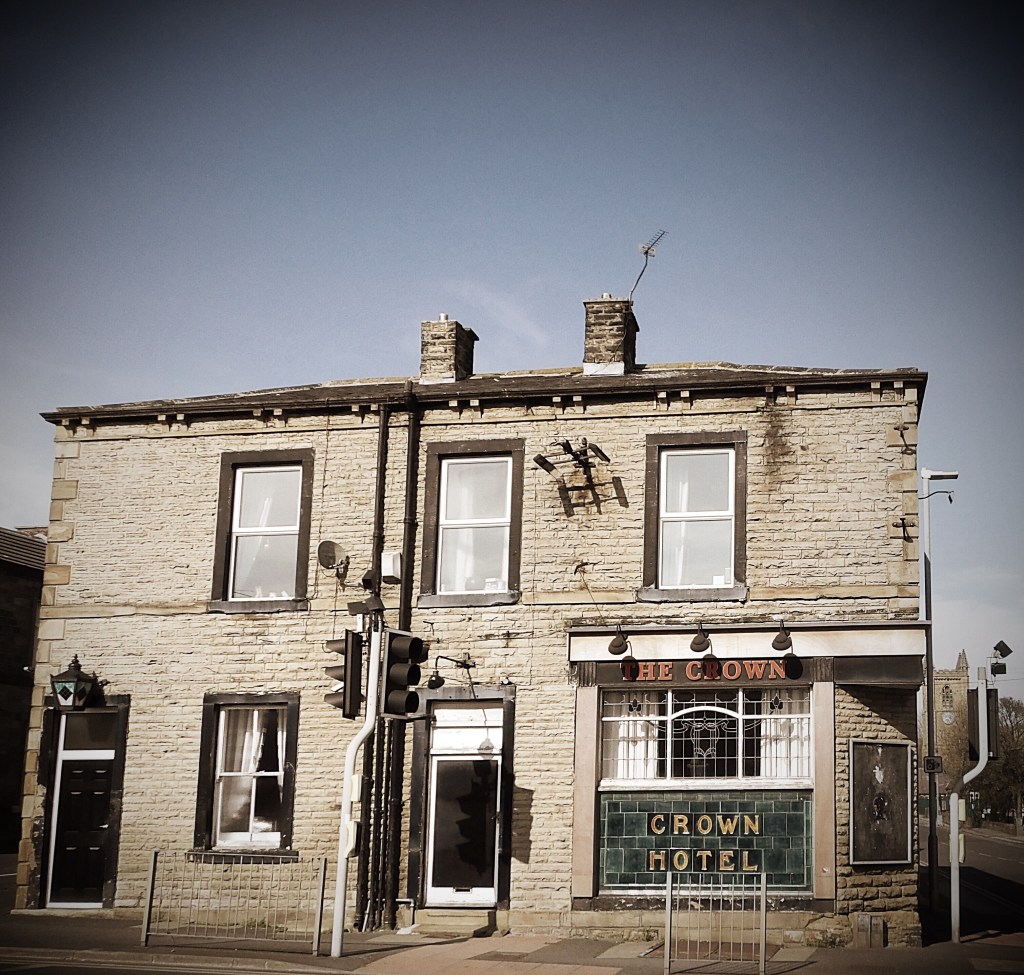
At about 8.10pm, Catherine Droghan was walking up Staincliffe Hall Road. Almost at the top she saw George, walking unsteadily with his horse and cart loaded with sand.11 He spoke thickly to Catherine as if he had been drinking, then sat on the cart shafts until he reached the top of the hill. At this point he jumped down to pick up the reins of the horse which were trailing on the ground. As he tried to get back onto the shafts he fell to the ground on his face, and the cart wheel ran over him. His final words before he was carried to the Crown Hotel were “Oh dear let me lie still.”12 He died 20 minutes later.
The Crown Hotel with Christ Church, Staincliffe (baptism place of some of the Heaton children) and Staincliffe Hall Road to the right – Photo by Jane Roberts
The inquest on 11 March 1870, incidentally also held at the Crown Hotel, ruled he had been accidentally run over. Perhaps it was a case of a new boy not used to drinking trying to fit in with the men. But it appears this stop off at the Prospect Beerhouse cost him his life.
The next employee’s death was of an entirely different nature. This was 21-year-old Thomas Dawson, who worked as a book-keeper at the Heaton chemical works. It was around a two-mile walk away from his home in Gomersal, where he lived with his mill engine operator father John, mother Ann, and younger brother William.
Thomas was born in Gildersome and, before his move to Gomersal, he spent his early years in Batley and Birstall, where he was a member of the Birstall Wesleyan Society. A hard working and studious young man, the fact he was learning French as an adult in this period supports his scholarly nature.
Described by his mother as “well and hearty,”13 he was working up until Saturday 1 November 1873. That day he complained of a pain in his head, and despite a visit from the doctor who diagnosed a mild attack of low fever, he did not improve.
At around 5am on the morning of 5 November his mother went to his room and found his bed empty. Downstairs, the house door was unlocked. The alarm was raised and search parties sent out.
Later that afternoon Nelson Oldroyd saw a walking stick floating in one of the Gomersal mill dams of Messrs. Thomas Burnley and Sons, the employers of Thomas’ father. The dam was within 50 yards of what had been the Dawson family home around three weeks earlier. Nelson then saw Thomas’ body lying face down in the 37 inch deep water. He called for help and the body was retrieved.
The inquest, held at the White Horse Inn in Gomersal, (a place mentioned in connection with John Heaton later on in this piece), reached a verdict that Thomas had drowned himself when of unsound mind.
The third death occurred on Monday, 17 May 1880. The victim was 20-year-old blacksmith’s striker James Flanagan.
James was the son of Irish farmer Andrew Flanagan. He lodged with his cousin Catherine, and her husband Michael Fallon, at Carr Street, Heckmondwike. He had been employed by Heaton and Sons for around 18 months, working alongside Staincliffe blacksmith Paul Perkin.
That Monday morning, at around 6am, James left home for work. A couple of hours later he was helping Perkin with the removal of a one-ton seak press. This was a type of press used to extract oil. Joseph Heaton arrived on the scene and took over the supervision of proceedings.
The machine was put on an 18 inch high horse-drawn cart, called a bogey. It proved a difficult operation, due to the slippery surface, the downward incline, and the fact there was only limited room for the horses to work. Various permutations were tried, one horse, then two, then back to one, with more men called to help push, then sent away again. Eventually it was left to Joseph Heaton to take the horse, with Paul Perkin on one side of the bogey and James on the other. According to Perkin, Joseph told the pair to try to keep in front of the bogey, but for some reason James continued alongside the back wheel.
Initially the bogey moved slowly and steadily. As they neared the crane Joseph Heaton pulled the horse to one side to avoid some casks. He then stopped. At this point the press began to wobble, before it, and the bogey, overturned. There was a scream.
Joseph ran towards James who was on the ground, pinned down by the press. Men were quickly summoned to prize the press off James, who was then placed on a trap sent for by Joseph, and taken to the old Batley Cottage Hospital where he was admitted at about 9.40am. This was the original cottage hospital which opened at Hillfield House, Knowles Hill, in August 1878, prior to the opening of the purpose-build Carlinghow Hill hospital on 27 March 1883.
A map showing the location of the old Batley Cottage Hospital which was in operation between 1878 and 1883 – Ordnance Survey Maps – 25 inch England and Wales, 1841-1952, Yorkshire CCXXXII.11 (Batley; Morley), Surveyed: 1889 to 1892, Published: 1894 – National Library of Scotland, under the Creative Commons Attribution-NonCommercial-ShareAlike 4.0 International (CC-BY-NC-SA) licence
James remained conscious almost to the end, but in great pain. He died just before noon. The inquest, which was held in the hospital on 19 May 1880, reached a verdict of “accidentally crushed.” James is buried in Heckmondwike cemetery.
The next fatality occurred six months later in very peculiar circumstances, and this time it was Joseph Heaton. Joseph was the brother who conducted most of the firm’s chemical experiments, to establish their properties for grease extraction. He had been involved in chemistry for around 26 years.14
At 11am on 22 November 1880, Joseph was in the inner office busy conducting some experiments with bisulphide of carbon. Used as a solvent, this was a toxic, volatile and highly flammable liquid. The fumes could act as an irritant and an anaesthetic. It was a liquid though that Joseph was accustomed to working with. However this Monday morning things went dramatically wrong.
At around 11.15am, somehow the liquid ignited and the copper vessel containing it dropped to the floor. Eliza Coleman, who was at the sewing machine in the inner office, became aware of a commotion and saw Joseph blowing on a small flame in the pan on the floor. Joseph would have been fully aware of the danger a fire posed – after all, the chemical works had suffered significant damage and financial losses before. He attempted to pick up the copper container but dropped it, burning his hand.
At this point Eliza, fearing a fire was inevitable, broke the office window and climbed out. Luckily in the process she avoided inhaling any fumes.
Joseph made another attempt to get the blazing pan out of the building. This time he successfully reached the office yard, where other workers quickly extinguished the flames. The office itself incurred minimal damage, but Joseph had inhaled the fumes.
Joseph took some castor oil before lunch, and remained at work that day. His brother John said he seemed perfectly composed and rational when he left him just before 4pm. However, when his other brother, George, enquired after him that afternoon he told him “I feel it on my stomach and I have burnt my hand in carrying it out when on fire.”15
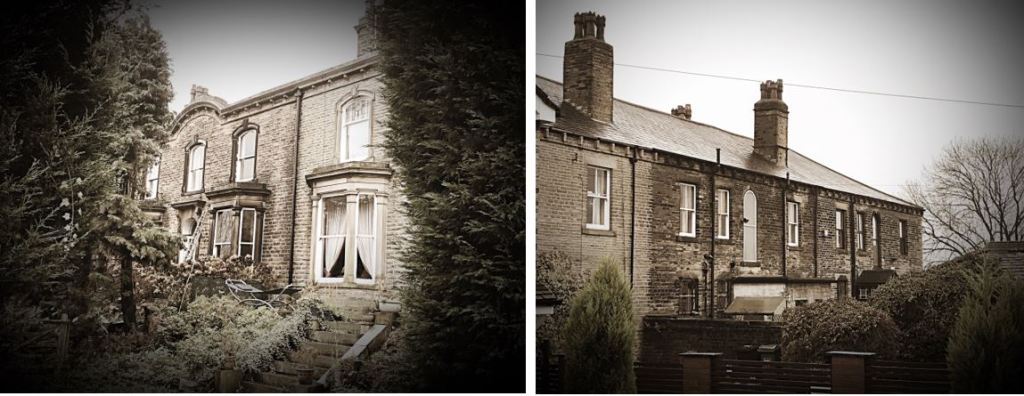
Joseph returned to his Hollinbank Terrace home as usual that evening. John, who lived next door but one, on hearing George’s account, went round to see how Joseph was and found him in bed conscious, but breathing very heavily. Charles Eyre Counsellor, a Heckmondwike surgeon and apothecary, arrived just after 1am and prescribed some remedies. John left at around 2.20am, but called back at just gone 7am, around the same time as Counsellor returned. By now Joseph was unconscious. Joseph died at around 8.30am that Tuesday morning, 23 November 1880.
The inquest was held at the Junction Inn, Heckmondwike, with the jury viewing Joseph’s body at his Hollinbank Terrace home. Their verdict was Jospeh died from inhaling bisulphide of carbon.
The copyright on this image is owned by Betty Longbottom and is licensed for reuse under the Creative Commons Attribution-ShareAlike 2.0 license.
Joseph left a widow, Ann (née Oliver) who he had married on 15 June 1871 at Barnby Dun, near Doncaster. The couple had two young daughters, Frances Jane, born in 1872, and Annie Elizabeth, born in 1874. Joseph was buried in Heckmondwike Cemetery on 26 November 1885.
The fifth death took place five years later in horrific circumstances. This time John Heaton was the victim.
John married Elizabeth Swalwell on 31 March 1870 at St Mary’s parish church, Scarborough. Children followed regularly, including Lizzie Maud (born in 1871), Bertha (born in 1872), Laura (born 1873), May (born 1874), Walter Leonard (born and died in 1875, age 3 weeks), Isabel (born 1876) and Jane Harriet (born in 1879, and died age 6 months in 1880).
On 14 August 1876 he was fortunate to escape serious injury. Returning from the White Horse Inn in Gomersal (the inquest location for former employee Thomas Dawson a shade under three years earlier) that Monday evening, the dog cart in which he travelled lurched violently as it turned into Muffitt Lane, throwing him out of the carriage seat and into the wall of a house. The driverless horse and trap safely made its way back to White Lee, whilst John lay unconscious. He did make a full recovery, but it was a narrow escape. In November 1885 his luck ran out.
At around 7pm on Saturday 7 November 1885 a huge fire broke out in the refining and oil press parts of the Heaton Brothers works. Fuelled by the combustible materials – the estimate was between 200 to 300 tons of oil went up that night – flames illuminated the skyline for miles around. Thousands of people from Heckmondwike and Batley congregated to witness the scene of destruction. Fire brigades from the Crystal and Union Mills (Messrs Kelley and Sons, Heckmondwike), the Liverpool, London and Globe Insurance Society, Birstall, Spen Valley Millowners and Staincliffe Mills all converged on the scene. When the flames were finally extinguished damage was estimated to be between £10,000 to £15,000.16
George Heaton was in Scarborough at the time, so was well out of the way. Only an hour or so before the fire broke out John had gone to Leeds for an evening out. His wife though sent a wire through to his destination and he returned home as quickly as possible by train and then cab from Batley railway station. It was a fateful decision. One only wonders how much his wife regretted her contacting him as events played out.
John dashed to the works to join in with the firefighting efforts. Despite having a sup of gin, he was described as excited, rather than the worse for liquor. With flames in the refining part now abating, the press area became the focus of these efforts. John formed the head of the chain along which buckets of water were passed, and it was he who took responsibility for throwing the water to douse the flames. He stood near a disused tank, the top of which was level with the floor – yet this was never considered dangerous. Ordinarily the tank contained cold water, but the fire caused pans of oil to boil over, and 18 inches of this boiling liquid now formed a layer on the water. By this stage John had thrown between 30-40 buckets of water. In the process of throwing yet another he slipped on a piece of zinc roofing and fell sideways into the tank. Quickly men pulled him out, but he was covered in hot oil with the majority of the scalds being to his arms, legs and face.
Despite his injuries John managed to walk back to his Hollinbank Terrace home. Dr Lee attended him, but John died in his home at about 3pm on Sunday 8 November. He was 44 years old, the same age as his brother Joseph was when he died.
The houses where all three Heaton brothers lived and died – Photo by Jane Roberts
Another inquest, another hostelry – this time the Cricketers’ Arms Hotel, Heckmondwike. The jury returned a verdict of “accidentally scalded.”
John was interred in Heckmondwike Cemetery on 9 November 1885. His wife, Elizabeth, was in the early months of pregnancy. She gave birth to a daughter, Georgina, on 28 May 1886. On 18 September that year the family were back in Heckmondwike Cemetery once more – this time for Georgina’s burial.
The surviving Heaton brother, George, did not carry on with the family business. In 1887 the chemical and oil refining works, along with other ventures including the farm, the Copperas Works in Roberttown, and several properties, were all put up for sale.17 In the 1891 census he is described as a retired manufacturing chemist. In his retirement George split his time between Heckmondwike and Scarborough.
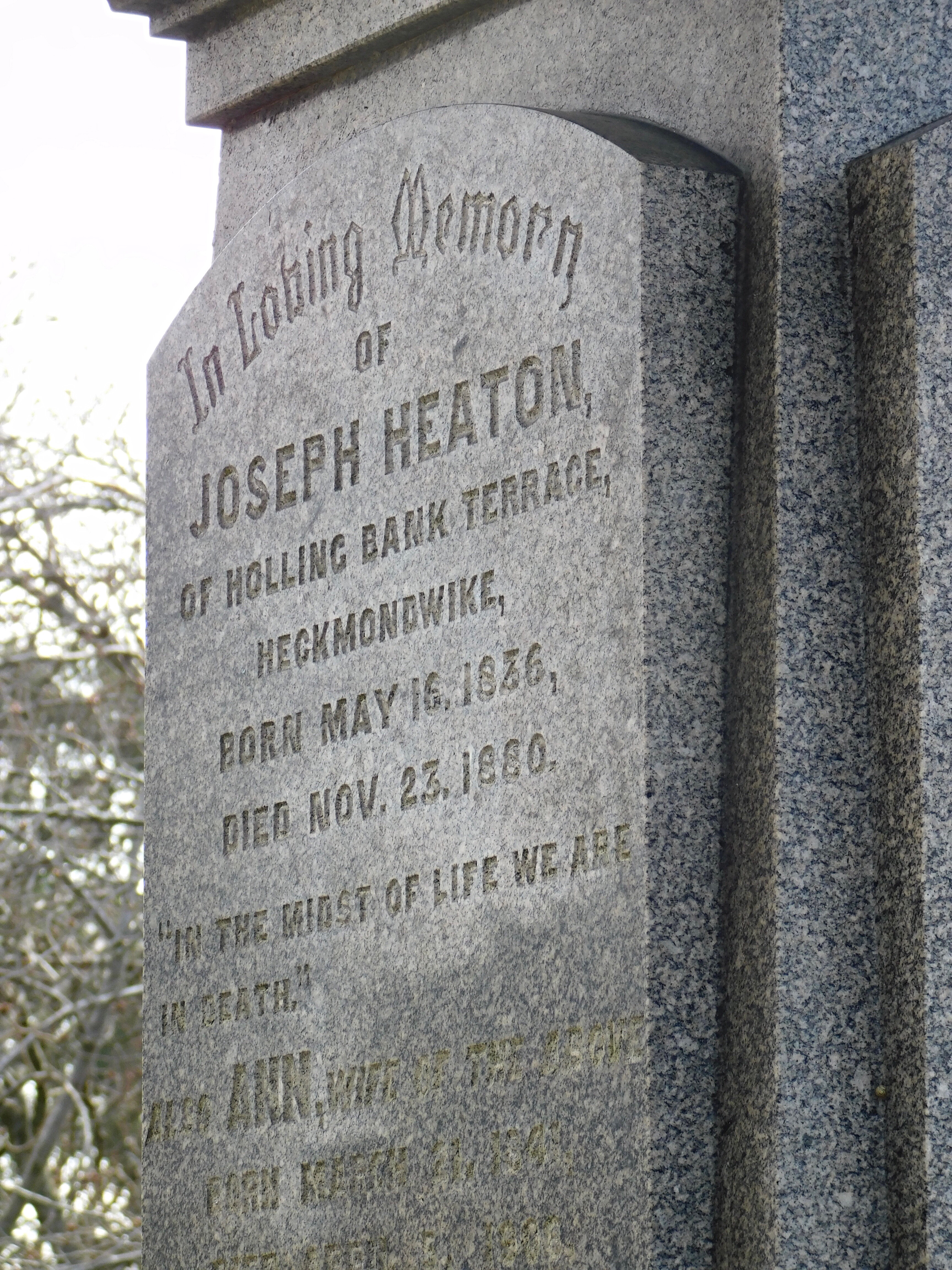
The Heaton headstone in Heckmondwike cemetery, pictured in detail below, gives clues to one of George’s major interests – Freemasonry. Both he and his brother Joseph, right up until their deaths, were members of the Amphibious Lodge in Heckmondwike. In 1896 George became Grand Master of the Lodge.
George died suddenly on 22 January 1898. He left a widow Mary (née Akeroyd) who he married at St Paul’s in Huddersfield on 25 November 1868. The couple’s two sons predeceased George. James William died, age 8, on 24 June 1878; Albert Edward died on 13 July 1879 just short of his fourth birthday. Both were buried in Heckmondwike cemetery and are commemorated on the family headstone.
George’s obituary appeared in The Freemason. It read:
Obituary. BRO. GEORGE HEATON.
Bro. George Heaton, of Hollinbank-terrace, Heckmondwike, died somewhat suddenly on Saturday morning, the 22nd instant. He was 60 years of age, and was formerly in business as a manufacturing chemist and oil extractor. Bro. Heaton, who leaves a widow but no family, was formerly a member of the Board of Health,18 and for a while took an active interest in the Chamber of Commerce.19 It was in connection with Freemasonry, however, that he was best known. He joined the Amphibious Lodge, No. 258, Heckmondwike a quarter of a century ago, and has been a munificent patron of Masonic Charities. A few years ago he contributed 1200 guineas to the Royal Masonic Benevolent Institution, and quite recently he gave 1300 guineas to the Royal Masonic Institution for Girls. He was a P[ast] M[aster] of his lodge, and had also held a prominent position in the Provincial Grand Lodge of West Yorkshire. Although his death was unexpected, he has not enjoyed good health for some time.20
Shortly after his death an oil portrait of George was completed. Commissioned during his lifetime, he was depicted in full regalia with decorations and seals of office as Provincial Grand Deacon of West Yorkshire. The full sized figure, measuring 7 feet 6 inches by 5 feet 6 inches, was hung in the Heckmondwike Masonic Hall. If this portrait still exists, and if there is an image of it, I would love to know. It would be great to include it as part of this blog.
Not including that final catastrophic 1914 explosion, the above sequence of events with numerous fires at the chemical works, and four of the five deaths being work-related but all in entirely different ways, shows the dangers our ancestors faced in days before health and safety. And this sequence was nothing out of the ordinary, as the newspaper accounts of accidents across factories, mills, mines and other workplaces in this period testify. Perhaps what is noteworthy about the Heaton Chemical Works story is the fact that it cost two of the three brothers their lives. Perhaps George made the correct decision in quitting when he did.
I will leave you with one final series of images for the Heaton family: the two family headstones with their inscriptions for James and his sons Joseph, George and John. These lie in the shadow of the now derelict Twin Chapels in Heckmondwike cemetery.
The Heckmondwike cemetery headstone inscriptions for James Heaton and sons Joseph, George and John. The two headstones are in the final photograph, with Joseph’s being the one with the cross, behind the main Heaton headstone – Photos by Jane Roberts
Postscript: I may not be able to thank you personally because of your contact detail confidentiality, but I do want to say how much I appreciate the donations already received to keep this website going. They really and truly do help. Thank you.
The website has always been free to use, and I want to continue this policy in the future. However, it does cost me money to operate – from undertaking the research to website hosting costs. In the current difficult economic climate I do have to regularly consider if I can afford to continue running it as a free resource.
If you have enjoyed reading the various pieces, and would like to make a donation towards keeping the website up and running in its current open access format, it would be very much appreciated.
Please click 👉🏽 here 👈🏽be taken to the PayPal donation link. By making a donation you will be helping to keep the website online and freely available for all.
Thank you.
As a professionally qualified genealogist, if you would like me to undertake any family, local or house history research for you do please get in touch. More information can be found on my research services page.
Notes: 1. Inquest notes, West Riding Coroner’s Notebook, West Yorkshire Archives, Ref: C493/K/2/1/86; 2.It is unclear if grease is a separate substance, or if it is a local word for oil; 3. Leeds Mercury, 9 March 1863; 4. Batley Reporter and Guardian, 15 February 1879; 5. Batley Reporter and Guardian, 21 February 1874; 6. Batley Reporter and Guardian, 7 February 1874; 7. Using the MeasuringWorth website at https://www.measuringworth.com/index.php, this equates to a real price today of £935,300; 8. £1,500 is equates to a real price today of £153,600 using the above MeasuringWorth website; 9. Sources from the time give her name as Ann Gill, widow from Birstall. After David Miller’s death, Ann remarried in April 1866 at Weeton. Her husband was Samuel Gill. He died in 1868. In 1871 Ann is living with Edward Gill at Hightown, described as his wife. They actually married in August 1873 at St Peter’s, Birstall; 10. Inquest notes, West Yorkshire Archives, Ref: C493/K/2/1/36; 11. It’s not clear from the reports, but given George was coming from Dewsbury Moor it is likely he was approaching the Butcher’s Arms crossroads from the Dewsbury Gate Road side, directly opposite Staincliffe Hall Road; 12. Inquest notes, West Riding Coroner’s Notebook, West Yorkshire Archives, Ref: C493/K/2/1/36; 13. Inquest notes, West Riding Coroner’s Notebook, West Yorkshire Archives, Ref: C493/K/2/1/53; 14. Inquest notes, West Riding Coroner’s Notebook, West Yorkshire Archives, Ref: C493/K/2/1/86; 15. Ibid; 16.Using the top-end estimate of £15,000, this equates to an eye-watering real price today of £1,632,000 using the above MeasuringWorth website; 17. Yorkshire Post and Leeds Intelligencer, 1 and 5 February 1887; 18. Heckmondwike, where he served one term of three years; 19. Again in Heckmondwike; 20. The Freemason, 28 January 1898.
Other Sources: • 1841 – 1891 Censuses; • Baptism Registers – Birstall St Peter’s, Leicester All Saints and Staincliffe Christ Church; • Directories; • Freemasonry Membership Registers; • GRO Indexes; • Heckmondwike Cemetery Burial Registers; • Marriage Registers – Barnby Dun Parish Church, Birstall St Peter’s, Huddersfield St Pauls and Scarborough St Mary’s; • National Library of Scotland Maps; • National Probate Calendar; • Newspapers, various dates – including Batley News, Batley Reporter and Guardian, Bradford Observer, Dewsbury Reporter, Huddersfield Chronicle, Huddersfield Daily Examiner, Leeds Mercury, Leeds Times, Wakefield Free Press, and Yorkshire Post and Leeds Intelligencer; • West Riding Coroner’s Notebook; • Wikimedia Commons;