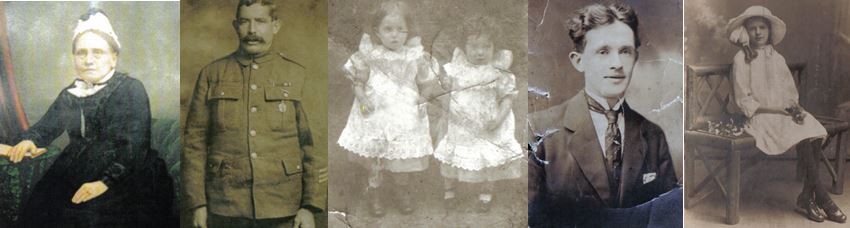
Yesterday is History: You ARE Family History

Often when researching family history one major component is missing. You.

As the saying goes ‘Yesterday is History.’ It’s something us family historians often overlook, we’re so focused on earlier generations.

So time to take a pause from all the research and write up your own life story. It is a legacy for future generations of family history researchers – your history, your recollections, and in your words. Your chance to say it as you remember, with all those unique snippets of information, stamped with your personality.Years ago I bought dad a memory journal to complete. He never did. It’s a thing a bitterly regret he never got round to doing. It would have been a precious legacy to all his descendants for ever more, now he’s no longer around to ask. It would have been a much-cherished connection to him and his life through his written words. As it is, I’m the family history recorder, so now his life is viewed through my memories, my prism. One step removed.

And for those with no direct-line descendants this might be even more important.

This is your opportunity to ensure a lasting footprint in your family’s history.

There are so many ways to do it. It’s not like in previous eras where education, cost and social status dictated, and restricted, opportunity.

There is the family history journal method which in theory is the easiest option with all its pre-printed prompts. But you could also write down your life story. There is no need to over-complicate it and create some massive opus, unless you really want to. Family Tree magazine set a challenge recently to write your family history in only 1,000 words. Those 1,000 words could prove of more value than money left in a will, no matter how rough and ready you may feel it is. That’s not the point. It’s the fact it’s down there for posterity.

There’s even the option to do a recording, so not only your words but your voice preserved for ever more (hopefully).

And when you do put pen to paper, finger to keyboard, or voice to recorder, make sure the finished product is passed on to your family or the wider family history community. It could be by ensuring relatives have copies in your lifetime. It could be a formal bequest via your will. But whatever and however: Just do it.

The Family History Show 2019 – A Family History Get Together in York

The Family History Show at York is one of my family history year’s highlights, and 2019 did not disappoint.

A one-day event held at York Racecourse, it is billed as The Largest Family History Show in the North of England. With around 60 exhibitors, the stands are close together creating a bustling market-place experience, so there’s a real atmosphere of camaraderie amongst the exhibitors which rubs off on those visiting.

View from the Mezzanine – Photo by Jane Roberts

Sometimes bigger national events in exhibition centres can seem a tad remote and ‘commercialised.’ In contrast York conveys a really friendly, relaxed and welcoming feel. It’s great for show novices because it’s not overwhelming, but for regulars it’s like returning to a much-loved home.

Whilst Ancestry, Findmypast and the big DNA kit push was absent, to be honest it didn’t matter. There was so much else to focus on with a wide representation from the family history world. These included purveyors of postcards, maps, magazines and books to providers of genealogical supplies and courses alongside archives and museums. TheGenealogist, FamilySearch, Society of Genealogists, Ministry of Defence Records Section and the Family History Federation were amongst the bigger organisations. And it was fantastic to see such a range of Family History Societies from across the north of England and beyond.

I’ve attached the list of attendees below.

List of Attendees at The Family History Show York, 2019 – Photo by Jane Roberts

There was also an Ask the Experts area, plus seven talks in the two lecture theatres rounding off with an Expert Panel. Inspired by watching BBC’s A House Through Time I attended Gill Blanchard’s Tracing Your House History talk and came away with lots of tips and ideas to trace my house history … if I ever have the time! Time may be even more of a premium for me, especially as I ended up joining the Family and Community Historical Research Society (FACHRS). I’m full of enthusiasm to get involved.

Family and Community Historical Research Society (FACHRS) Stand – Photo by Jane Roberts

After a busy few hours on my feet it was a relief to have a sit down. There is a cafe area for those all-important refreshment breaks, but this year we brought sandwiches and ate them in fresh air and glorious sunshine overlooking the finishing straight. And what a view it was!

My Lunchtime View – Photo by Jane Roberts

Then it was back to it, and finding out what’s new. Morley Family History Group covers the area synonymous with the surname Aveyard, the subject of my One-Name Study. And they are in the process of producing a raft of new and updated parish register indexes and Memorial Inscription booklets.

Another stop-off must for me was the Ministry of Defence Records Section. They had some fascinating original documents on view including a 1914-1916 Wellington Barracks Footguards Attestation Register and some Air Ministry files about missing WW2 airmen. It was a wonderful opportunity to touch history, reading the lists of names knowing these were all real people who more than a century ago signed on to serve King and Country. It was especially sobering viewing noting how many were annotated with Killed in Action, Died of Wounds or discharged because they were no longer fit for service. One name which stood out for me was Albert Gun[n] who attested in Dewsbury and was Killed in Action.

Some of the Documents on Display at The MoD Records Stand – Photo by Jane Roberts

They also had a prototype online application system for service records which you could test and provide comments on. I understand it is hoped to have more news on this at RootsTech London.

I loved catching up with many familiar faces. And the show would not have been complete without popping over to say hello to the Huddersfield & District Family History Society team of volunteers who, at the end of a busy day, were still on their feet. I must declare an interest here as I edit their quarterly Journal.

The Huddersfield & District Family History Group Volunteers – Photo by Jane Roberts

I did fear with three big national family history shows scheduled for 2019, one of which took place only a couple of weeks earlier, that York would find itself squeezed out. With competing family and budget demands, to get to London and Birmingham from the north of the country for a show is a big commitment both in terms of travel time and cost, particularly if an overnight stay is factored in. The same pressures apply to exhibitors, with many relying on volunteers. York, for this part of the world, is far more accessible.

This accessibility factor, combined with the breadth of relevant exhibitors attending and talks geared towards the audience, thankfully meant my fears did not become a reality. The morning in particular seemed busier than ever.

The Family History Show 2019, York – Photo by Jane Roberts

And the years of experience behind the running of the show meant the organisation was excellent at all points – from booking tickets (excellent value at £8 for two if pre-booked), to directions to the racecourse with its ample free car parking, plus regular free shuttle buses from the railway station for those on public transport. Once at the venue things continued to run smoothly including a fast-track entry lane for those who had pre-booked, two private rooms for the free talks (so no noise seep) with these being large enough to accommodate all who wished to attend, and a floor plan to navigate your way around the exhibitors.

It proved a thoroughly enjoyable day and 20 June 2020, the date of the next Family History Show in York, is already firmly pencilled in my diary.

The Shocking Death of George Aveyard

Family history at its most basic boils down to births, marriages and deaths. Sometimes it is easy to become immune to the true meaning of the parade of dates marking the start and end of life. There are, after all, so many in a family tree. Occasionally, though, one event does stop you still in your tracks. For me the death of George Aveyard is one such event.

George was the two-year-old son of Daniel and Sophia Aveyard. In the context of my Aveyard One-Name Study, Daniel’s parents were George Aveyard (1780-1854) and his second wife Hannah Asquith. The family originated in the West Ardsley area, but somewhere between March 1832 and June 1841, they moved to Gildersome Street, an area south of the centre of modern-day Gildersome.  

Daniel was the second youngest of George’s 18 children, baptised on 4 August 1830 at St Mary’s, Woodkirk [1]. Evidence strongly suggests George and Hannah were my 4x great grandparents.

Daniel, a coal miner, married Sophia Brook at All Saints Dewsbury Parish Church on 23 August 1852 [2]. Sophia was born on 1 June 1832 and baptised one month later at Woodkirk parish church, her parents being William and Amelia Brook [3].

All Saints, Dewsbury Parish Church – Photo by Jane Roberts

Daniel and Sophia’s marriage resulted in 12 children [4]. So far, I have identified 10 of them – whilst Aveyard is an uncommon name there was more than one Aveyard/Brook marriage in the relevant period. I suspect I have identified at least one of the remaining children, but more work is required (short of purchasing the relevant birth certificates).

The so far identified children are Simeon [5] (birth registered in 1853); George [6] (birth registered in 1855); Sarah Elizabeth [7] (birth registered in 1861); Brook [8] (birth registered in 1863); twins Joseph and Mary [9], whose diminutive name appears to have been Polly [10] – yes, that is a known short form of Mary, (births registered in 1865); Ada [11] (birth registered in 1868). She was buried on 25 April 1869 at St Peter’s Birstall under the name of Adah Aveyard and her father was named as Daniel [12]; Herbert [13] (birth registered in 1870); Richard Newman [14] (birth registered in 1871); and Rachel [15] (birth registered in 1872). She was buried on 21 July 1872 at St Peter’s Birstall with her father named as Dan[ie]l [16].

The events in this post took place in Gildersome Street on 13 August 1858, with the inquest taking place before Coroner Thomas Taylor the following day at the King’s Arms Inn, Gildersome. Whilst many inquest records do not survive for this period, with newspapers being the main information source, we are fortunate that the HM Coroner of Wakefield records at West Yorkshire Archives (Wakefield) includes the notebooks of Thomas Taylor [17] for the period 1852-1900. They include the notes for the inquest of George Aveyard.

A little over two years old, George was able to talk and had been used to walking alone for about six months. Sarah Aveyard (née Stables) the wife of one of Daniel’s older brothers, Thomas, gave an account at the inquest, testifying there were “...always plenty of children playing about” [18] in Gildersome Street where the families lived. 

It was clear that even though a toddler, George was amongst them. Her young nephew had been to her house on morning of his death, leaving at around 11 o’clock heading down the road. So, his aunt clearly had no concerns that he was out and about without his mother.

You can envisage the scene: traditionally based around weaving and cloth manufacture but now becoming a mining village, this was a close-knit community with groups of impoverished, grubby children, the streets their playground, freely popping in and out of houses, many of them occupied by relatives. A place where everyone knew everyone. In this period Gildersome Street really was an Aveyard enclave.

At around 11.45 am George arrived home. His mother, Sophia, gave him a piece of bread and content he once more wandered back outside. At around noon she noticed he was missing. This was out of character, as according to Sophia’s evidence at the inquest “I have not lost him before.” [19]. She sent out her eldest child Simeon to seek him. At this point she believed him to be perfectly safe at his grandmother’s home about 80 yards away. This is most likely to be his paternal grandmother, Hannah Aveyard. 

It was dinner time and Sophia was starting to feel anxious. Another neighbour, widow Elizabeth Buckley, overheard her asking one of her daughters if she had seen George. This would have been just gone one o’clock. Elizabeth in fact had seen George two or three times that morning. 

Now events took on a dark, stuff of nightmares turn. Alice Aveyard, described as “going in [sic] 11 years” [20], daughter of Thomas and Sarah, and therefore cousin of little George, was the one who made the horrific discovery. I imagine it would haunt her until her dying days, a scene no adult, let alone a child, could never unsee.  

According to her inquest evidence:

“…I went yesterday afternoon to George Buttery’s privy adjoining the Wakefield and Bradford Road. The door was wide open. On looking thro’ the hole in the seat I saw a bare knee in the soil and I imm[ediat]ely gave an alarm.” [21]

In the 1851 census, Thomas and Sarah Aveyard’s household details were adjacent to the entry for the family of George Buttery. In other words they were close neighbours.

So what was a privy? Well, I’ll start by saying a privy was a far cry from the flushing, sanitary toilets of today. Improvements had, in fact, commenced with the landmark 1848 Public Health Act which decreed:

“That it shall not be lawful newly to erect any House, or to rebuild any House pulled down to or below the Floor commonly called the Ground Floor, without a sufficient Watercloset or Privy and an Ashpit furnished with proper Doors and Coverings.” [22]. 

There were also provisions for the newly created Local Boards of Health to issue notices where any houses had insufficient provision:

 “..whether built before or after the Time when the act is applied to the District in which it is situate…” [23] 

But this is a bit of gloss which belies the true unsanitary, conditions. In the period a privy was essentially nothing more than a small wooden, sometimes brick, building which could be shared by several families. The implication, however, in the inquest notes is that the Gildersome Street houses by 1858 did not have massive communal privies shared by scores of people. Alice’s evidence is that this one belonged to one household, that of George Buttery.  Sarah Aveyard in her evidence stated:

“The privy does not belong to Daniel Aveyard’s house.” [24]

Number of families aside, the very basic interior design was a wooden board with a hole cut into it. In fact, there could be more than one hole, and these not necessarily divided into separate cubicles. 

Excreta (liquid and faeces) would drop through this hole and the waste would drain and collect into cesspits. These were generally porous for the liquid matter to drain away, though this did not always happen. And when it did operate correctly, the question is where did it seep to and what contamination did it cause? The (hopefully but not always) dry waste would build up and eventually be shovelled out by night soil men. And yes, it was a job carried out under the cover of darkness.  The waste would then be sold on for manure.

So, the soil referred to in Alice’s evidence was actually a euphemism for human excreta.  

Even if not serving a large number of houses, the stench surrounding these privies would be unimaginable at any time of year, never mind August and the height of summer. And it was in this hell hole that a child was trapped.

Alice went to tell her mother she had seen a child’s leg in the privy. It was about quarter past one in the afternoon. Sarah returned with her daughter to the appalling scene, saw the knee and screamed. This attracted the attention of some local women, including Elizabeth Buckley. 

The women removed George’s body, which was lodged head first in the soil (think about the true meaning of the word soil in this context). Elizabeth testified that when they extracted him, he was dead, his eyes were partly open, there was no froth about his nose and, she observed when she washed his body, that he had no signs of injury. She also stated the the privy seat was not broken and in good order.

In other words this appeared to rule out any foul play, which view the inquest jury duly took. Its verdict was that George had “accidentally suffocated.” It is a verdict which does not even begin to capture the hideous circumstances surrounding this young child’s death.

Back in 1858, with its alarmingly high childhood mortality rates, a child’s death was not the unexpected event it is today in 21st century England. But a child’s death in such a ghastly accident was utterly shocking. Perhaps this was the reason Daniel, Sophia and their family had left Gildersome Street by the time of the 1861 census, and had moved to Boggart Lane in the Howden Clough area of Batley, near Still House Farm, which stands today [26]. They wanted to escape the scene of such personal family trauma?

Such was the hideous nature of George’s death, the inquest was widely reported in local newspapers, as typified by the 21 August 1858 edition of the Pontefract Advertiser [26] which recorded:

SHOCKING DEATH OF A LITTLE BOY – An inquest was held on Saturday, at the King’s Arms Inn, Gildersome before T. Taylor, Esq., on the body of George Aveyard, aged two years, son of Daniel Aveyard, coal miner. On Friday last, about noon, deceased went out of his father’s house, and no more was seen of him until one and two in the afternoon, when he was discovered in the soil of an adjoining privy. When extricated he was found to be quite dead….”

It is a death which over 160 years later, and amidst so many other deaths recorded in the course of my family history research, I cannot forget and one that does not cease to sicken.

As for location, the buildings of Gildersome Street have long been erased from maps. Ironically the present-day area is one which I frequently visit. It lies among the network of busy roads and the industrial estate areas, all within minutes walking distance from where West Yorkshire Archives (Leeds) now stands.

Notes

  • [1] Baptism of Daniel Aveyard, St Mary’s Woodkirk Baptism Register. Accessed viaWest Yorkshire, England, Church of England Births and Baptisms, 1813-1910 [database on-line]. Originals at West Yorkshire Archive Service; Wakefield, Yorkshire, England; Yorkshire Parish Records; New Reference Number: WDP108/1/2/1
  • [2] Baptism of Sophia Brook, St Mary’s Woodkirk Baptism Register. Accessed viaWest Yorkshire, England, Church of England Births and Baptisms, 1813-1910 [database on-line]. Originals at West Yorkshire Archive Service; Wakefield, Yorkshire, England; Yorkshire Parish Records; New Reference Number: WDP108/1/2/2
  • [3] Marriage of Daniel Aveyard and Sophia Brook, All Saints Dewsbury Parish Church. Marriage Register Accessed via Ancestry.com. West Yorkshire, England, Church of England Marriages and Banns, 1813-1935 [database on-line]. Originals at West Yorkshire Archive Service; Leeds, Yorkshire, England; Yorkshire Parish Records; Reference Number: WDP9/28
  • [4] 1911 Census, Aveyard family entry. Although Sophia is now a widow her Particulars as to Marriage details have been completed. Accessed via Findmypast. Originals at The National Archives, Kew. Reference RG14PN27255
  • [5] Birth Registration of Simeon Aveyard, March Quarter 1853, Hunslet Registration District, Volume 9B, Page 219, Mother’s Maiden Name Brook. Accessed via the General Register Office Website Birth Indexes.
  • [6] Birth Registration of George Aveyard, December Quarter 1855, Hunslet Registration District, Volume 9B, Page 184, Mother’s Maiden Name Brook. Accessed via the General Register Office Website Birth Indexes.
  • [7] Birth Registration of Sarah Elizabeth Aveyard, June Quarter 1861, Dewsbury Registration District, Volume 9B, Page 475, Mother’s Maiden Name Brooke. Accessed via the General Register Office Website Birth Indexes.
  • [8] Birth Registration of Brook Aveyard, December Quarter 1863, Dewsbury Registration District, Volume 9B, Page 502, Mother’s Maiden Name Brook. Accessed via the General Register Office Website Birth Indexes.
  • [9] Birth Registration of Mary and Joseph Aveyard, March Quarter 1865, Dewsbury Registration District, Volume 9B, Page 550, Mother’s Maiden Name Brook. Accessed via the General Register Office Website Birth Indexes.
  • [10] 1891 Census, Aveyard family entry. Accessed via Findmypast. Originals at The National Archives, Kew. Reference RG12/3722/12/17
  • [11] Birth Registration of Ada Aveyard, June Quarter 1868, Dewsbury Registration District, Volume 9B, Page 575, Mother’s Maiden Name Brooke. Accessed via the General Register Office Website Birth Indexes.
  • [12] Burial of infant named Adah Aveyard, 29 April 1869 at St Peter’s, Birstall. Accessed via Ancestry.com. West Yorkshire, England, Church of England Deaths and Burials, 1813-1985 [database on-line]. Originals at West Yorkshire Archive Service; Wakefield, Yorkshire, England; New Reference Number: WDP5/1/4/3
  • [13] Birth Registration of Herbert Aveyard, March Quarter 1870, Dewsbury Registration District, Volume 9B, Page 578, Mother’s Maiden Name Brook. Accessed via the General Register Office Website Birth Indexes.
  • [14] Birth Registration of Richard Newman Aveyard, March Quarter 1871, Dewsbury Registration District, Volume 9B, Page 604, Mother’s Maiden Name Brook. Accessed via the General Register Office Website Birth Indexes.
  • [15] Birth Registration of Rachel Aveyard, March Quarter 1872, Dewsbury Registration District, Volume 9B, Page 603, Mother’s Maiden Name Brook. Accessed via the General Register Office Website Birth Indexes.
  • [16] Burial of infant named Rachel Aveyard, 21 July 1872 at St Peter’s, Birstall. Accessed via Ancestry.com. West Yorkshire, England, Church of England Deaths and Burials, 1813-1985 [database on-line]. Originals at West Yorkshire Archive Service; Wakefield, Yorkshire, England; New Reference Number: WDP5/1/4/4
  • [17] Taylor was the coroner for the Honour of Pontefract from 1852-1900, deputy county coroner 1855, 1861-1864, and county coroner 1864-1900.
  • [18] Coroner’s notes at the inquest into the death of George Aveyard, 14 August 1858 Originals at West Yorkshire Archives, Thomas Taylor, West Yorkshire Coroner’s Notebooks June to November 1858, Reference C493/K/2/1/9
  • [19] Ibid
  • [20] Ibid
  • [21] Ibid
  • [22] Public Health Act 1848 (11 & 12 Vict. c.63), An Act for promoting the Public Health – 31st August 1848. Accessed via Legislation.gov.uk website, delivered by The National Archives http://www.legislation.gov.uk/ukpga/Vict/11-12/63/contents/enacted
  • [23] Ibid
  • [24] Coroner’s notes at the inquest into the death of George Aveyard, 14 August 1858 – Ibid
  • [25] Example of a dry toilet for illustrative purposes. This one is from a railway station in Vrbčany in the Czech Republic. Source Wikimedia Commons https://commons.wikimedia.org/wiki/File:Suchy_zachod_zastavka_Vrbcany_detail.jpg, Attributed to Ludek [CC BY-SA 3.0 (http://creativecommons.org/licenses/by-sa/3.0/)%5D
  • [26] 1861 Census, Aveyard family entry. Accessed via Findmypast. Originals at The National Archives, Kew. Reference RG09/3401/107/24
  • [27] Identical reports featured in The Leeds Mercury of 17 August 1858 and The Leeds Intelligencer of 21 August 1858

Pioneers of the FIFA Women’s World Cup: The First Football Internationals

The Women’s Football World Cup is now well underway. With England v Scotland attracting a peak of 6.1 million BBC TV viewers, becoming the UK’s most watched women’s football match of all time, it’s a far cry from the sport’s early days.

The first women’s international match took place on Saturday 7 May 1881 between Scotland and England at Hibernian Road, Easter Park in front of about 2,000. According to some reports the teams had only trained for about a fortnight for this game, the first in a series of rather chaotic, public exhibition matches to be played in both countries. 

The England team, including (according to some press reports) women from London [1], which took the field comprised of May Goodwin (goal); Mabel Bradbury, Maude Hopewell, Maude Starling, Ada Everstone, Geraldine Ventner, Mabel Vance, Eva Davenport, Minnie Hopewell, Kate Mellor and Nellie Sherwood. The Scotland team, from Glasgow and the surrounding area, was Ethel Hay (goal); Bella Oswald, Georgina Wright, Rose Raynham, Isa Stevenson, Emma Wright, Louise/Louisa Cole, Lily St Clair, Maude Riverford,[2] Carrie Baliol and Minnie Brymner. Some spellings vary depending on newspaper.

It is possible some of the names were stage names to disguise real identities. Interestingly two ‘actors,’ 18-year-old Louisa Cole (born in Greenock, Renfrewshire) and 19-year-old English-born Carrie H Baliol, were lodging in the home of Margaret Henderson in Campbeltown, Argyllshire [3]. Both these names featured amongst the Scotland forwards. Their presence adds to this game owing as much to theatre and entertainment as a sporting contest.

The game took place against the backdrop of the early years of the suffrage movement and advancement of women’s rights. In fact, the games were part of the pushing back of the long-established boundaries confining and defining women and their place in society. Indeed, a piece in The Jedburgh Gazette described it as ‘women’s rights with a vengeance.’ [4]

To put in some kind of context, it was only in 1870 that any money which a married woman earned could be treated as her own property and not her husband’s, with the introduction of the 1870 Married Women’s Property Act. And it was not until after the Internationals, in 1882, that the right was extended to allow married women to have complete personal control over all of their property. 

The attitudes towards women and ideas around their expected behaviours were instrumental to most of the reporting.  The game was variously described as a ‘most disappointing spectacle…football is not a game for women,’ [5] ‘an athletic novelty’ [6] and ‘a general feeling was apparent…to make fun of the match.’ [7] although the players were described as being ‘of excellent physique in most cases’ [8]. It was claimed ‘before the match was concluded more than half the spectators had gone. The general feeling seemed to be that the whole affair was a most unfeminine exhibition…’ [9]. 

An inordinate amount of attention was paid to the players’ attire and hair, with some retaining

 …such feminine ornaments as frilling, bracelets, &c., but others, with arms bare to the shoulder, entered into the game with all the enthusiasm of boys. [10]

The kit was essentially similar to their male counterparts. Scotland sported blue jerseys, a badge with two Union Jacks, a crimson waist sash, knickerbockers and blue and white hose. The English team’s jersey was crimson, with a blue sash and a lion rampant badge. They had white knickerbockers and crimson and white hose. Both teams wore crimson and white woollen cowls and high-laced boots. 

1890’s Illustration of a Women’s Football Match

Scotland ran out 3-0 victors. The Fife Herald typified the waspish type of reporting. Their take on the women was: 

They were slow in all their movements except, perhaps, when they were within a few feet of the goal, when their tongues were in full swing…

Although they did grudgingly conclude:

Misses Maude Hopewell and Bella Oswald as backs, and several of the forwards played well. [11]

They went on to quote the Glasgow News saying:

Football is not a game for women and the spectacle of a score of girls careering about the field in knickerbockers is not to be defended on any ground of public utility.

The teams struggled to get a venue for the next game, it being eventually played on 16 May 1881 at the Shawfield Ground, Rutherglen Bridge, Glasgow.  It resulted in what was termed as a scandalous exhibition, disgraceful scenes and a display of ruffianism from ‘Glasgow Roughs’ with fighting and a pitch invasion. 

Around 400 paid to watch the game but others burst the gates despite police efforts to prevent them. This swelled the crowd to what some newspapers estimated to be as many as 5,000.  Mainly men, they hooted, hissed and laughed at the women and ‘after 55 minutes of play of the most amateurish description’ [12] a contingent cut the ropes and stormed the pitch.

A police baton charge was required to rescue the players, some who were badly treated by the mob. With difficulty the women managed to get to their horse-drawn omnibus, one (or two, depending on newspaper report) fainting in the process. The four grey horses pulling the omnibus galloped away, with the accompanying jeers and hisses from the mob ringing in the women’s ears.

A further attempt to play a game at Kilmarnock was halted by the intervention of magistrates. The Ayr Advertiser’s take on this read:

The “LADY” FOOTBALL PLAYERS – Kilmarnock was saved the scandal of a visit from the “Lady Football players” on Tuesday night, by the intervention of the magistrates whose representations caused the club who had granted the use of their field to cancel the engagement. The managers of the female teams being advised of this decision by telegraph, they did not put in an appearance. And the disgraceful exhibition was accordingly prevented. [13]

The teams now moved over the border to England. They played their next game in front of a crowd of about 4,000 at the Olympic Club, Blackburn on the afternoon of Saturday, 21 May 1881. 

I can find no details of the team sheets but curiously a couple of reports stated ‘The players hail from Glasgow’ [14]

This is backed up by a report in the Athletic News of 25 May which stated:

The fair performers were unmercifully chaffed by the spectators but as the remarks were passed in the coarsest Lancashire, and the girls are as Scotch as they can find in Glasgow, the talk did not hurt them much for want of being understood. [15]

Both teams had second half goals disallowed, but a few minutes before the game ended the ‘English representatives’ scrambled the ball over to finish 1-0 winners.

The ad hoc nature of the matches is illustrated by the report of what appears to be the next game which took place on 3 June:

The female football players not being able to find a ground in Manchester, wandered to Liverpool, and on Friday last they managed to bring off a match at a running ground in the outskirts of the city. The following report of what the “ladies” are pleased to call “football” has been sent in to me for publication:- On Friday evening the lady football players gave an exhibition of their powers to the Liverpool public at Stanley Athletic Grounds. The young ladies appeared on the field at 7.30 p.m., and were loudly cheered by the spectators. The Scotch captain won the toss and selected to play with the wind. The match, from the players point of view, was very good. About 15 minutes from the start the English secured the first goal through a piece of good dribbling on the part of Miss Eva Davenport. Thereafter the Scotch pressed their opponents very hard, Miss Louisa Cole making several fine runs but failed to score before half-time was called. On ends being changed, the Scotch scored their first goal, Miss Louisa Cole doing the needful just before time was called. For the English Miss May Goodwin at goal stopped several dangerous shots. Misses Geraldine Vintner, Eva Davenport, and Minnie Hopewell as forwards dribbled well and made some splendid runs. For the Scotch, Miss Georgia Wright at back played a good defensive game. Misses Louisa Cole and Maud Rimeford, as forwards, played a good combined game. Altogether the match was a great success although the attendance was not so large as might have been expected to witness such a novelty. [16]

The team appeared to be based in Manchester. From there on 13 June they travelled by rail to Windhill, Bradford to play another game. The Leeds Times reported:

They are not a prepossessing band of females, and generally are composed of young girls, a few of them being between twenty and thirty years of age. A large number of people witnessed the game, which was well played. The competitors were frequently and uproariously cheered by spectators. The match ended in a victory for Scotland by three goals to two. [17] 

They did eventually get to play in Manchester, but once more confusion reigned. The Athletic News of 22 June 1881 reported that the team had arrived in Manchester a month ago but initially had not found a ground to play on. They finally arranged to play on the field of Salford FC but this fell through when their cashier absconded with the money needed for the ground rent. It was then announced they would play at Cheetham Football Club’s Tetlow Fold, and a 3,000- strong crowd turned up for the game on 20 June.

The report continued:

Unfortunately, there was some other hitch in the proceedings, and the game did not come off, but I am informed that all the difficulties have been cleared away, and that these matches would duly be played last evening [21 June] and to-night (Wednesday). [18]

Cheetham FC were at pains to distance themselves from the event. They even advertised to this effect in an open letter dated 21 June from Edwin Smales, the Club Secretary, which was published in the Manchester Courier. [19]

The game on 21 June proved another debacle. The Huddersfield Chronicle of 23 June carried a full report about the ‘Scene at a Football Match’:

The players attired in a costume which is neither graceful nor very becoming, were driven to the ground in a wagonette, and, as was to be expected, were followed by a crowd largely composed of youths eager to avail themselves of the opportunity presented for a little boisterous amusement…Very few persons paid for admission to the grounds, but a great multitude assembled in the road and struggled for a sight of what was going on within the enclosure, whilst an equally large number gathered in the higher ground on the other side of the field for a similar purpose. A number of police constables were present to maintain order and prevent anyone entering without paying, and for about an hour, whilst the so-called match was being played they succeeded. There were frequent attempts, however, to elude the constables. At length a great rush was made by those occupying the higher land, and the football ground was speedily taken possession by the mob. Apprehending a repetition of the rough treatment they have met with in other parts of the country, the women no sooner heard the clamour which accompanied the rush than they also took to their heels and ran to where their wagonette was standing. This they reached before the crowd could overtake them, and amid the jeers of the multitude and much disorder they were immediately driven away. [20]

So, another abandoned match. But the ladies did not give in. These pioneers of the women’s game returned to Liverpool. There, as advertised in the Liverpool Mercury of 25 June 1881, the International Lady Football Players played two more games on the 25 and 27 June at the Cattle Market Inn Athletic Ground, Stanley. Admission was 1s. 

Liverpool Mercury – 25 June 1881

In yet another curious newspaper report, reference was made to the disappointingly small attendance:

Owing, probably, to the disappointment caused a few weeks ago by their failure to keep an engagement to play at the same grounds… [21]

The report went on to discuss the women’s ‘modest and picturesque’ costume, and half-time refreshments of oranges. Scotland won the game 2-1.

The second game on 27 June was better attended:

The play was very spirited, and at times the feeling of nationality was strongly manifested by the onlookers, the efforts of the players on both sides being encouraged and rewarded by cheers. [22]

Scotland proved the stronger side, winning 2-0. The report made mention of a further match to be played that night, 28 June. Indeed, the newspaper even carried an advert for the game. I’ve not found any report of the result yet.

Liverpool Echo – 28 June 1881

This typified the chaos surrounding these first so-called internationals with cancelled and abandoned games, uncertainty about identities (and nationalities) of those playing or even scorers, and all this taking place in the face of the prevailing attitude about the role of women in society. The fact that these ‘anonymous’ women managed to play any games at all under such difficult and downright hostile circumstances is a testament to their strength of character.

What a total contrast to the FIFA Women’s World Cup of 2019, with its media coverage, worldwide interest, and Panini sticker albums all contributing to the profiles of the players, making them household names and sporting role models to future generations of female footballers. 

Notes:

  • [1] Edinburgh Evening News, 9 May 1881
  • [2] For example Riverford is sometimes Rimeford or Riweford
  • [3] 1881 Scotland Census, accessed via Ancestry, Reference – Parish: Campbeltown; ED: 16; Page: 13; Line: 6; Roll: cssct1881_150
  • [4] The Jedburgh Gazette, 14 May 1881
  • [5] The Dundee Courier and Argus, 10 May 1881
  • [6] Buxton Herald, 11 May 1881
  • [7] The Edinburgh Evening News, 9 May 1881
  • [8] Ibid
  • [9] Nottinghamshire Guardian, 13 May 1881
  • [10] The Ayr Advertiser, 12 May 1881
  • [11] The Fife Herald, 12 May 1881
  • [12] Glasgow Herald 17 May 1881
  • [13] The Ayr Advertiser 19 May 1881
  • [14] Birmingham Daily Mail and Edinburgh Evening News 23 May 1881
  • [15] Athletic News, 25 May 1881
  • [16] Athletic News, 8 June 1881
  • [17] The Leeds Times, 18 June 1881
  • [18] Athletic News, 22 June 1881
  • [19] The Manchester Courier, And Lancashire General Advertiser, 22 June 1881
  • [20] The Huddersfield Chronicle, 23 June 1881
  • [21] The Manchester Evening News, 27 June 1881
  • [22] The Liverpool Mercury 28 June 1881

The Fair Weather Genealogist – Summer Research Tips

Summer tends to be the time of year when family history research takes a back seat. Who wants to be stuck in front of a computer screen or closeted away in some dusty archive or local library when the days are long and the sun is shining brightly?

The meteorological summer is defined as June, July and August. Here are my five seasonal tips to continue with your family history research whilst making the most of those three long, hot summer months (we can but dream!)

  • Do a bit of ancestral tourism, visiting locations associated with your family history. It could be a street in which your ancestors lived, the school they attended, the church where they married, the cemetery in which they are buried, or even popping into the pub, if it still exists, where a family-associated inquest was held.
  • For me family history extends beyond names and dates. I love finding about the everyday lives of my ancestors, their occupations, leisure activities, transport methods, living conditions, and the health struggles they faced. I also want to try put their lives into the context of local and national history. Summertime provides ample opportunity to find out more, especially on those cooler summer days. It could be a visit to a museum such as the Thackray Medical Museum, the trio of Ripon Museums covering the workhouse, courthouse and police station/prison, Bradford Police Museum, the National Coal Mining Museum, the National Railway Museum in York, Ryedale Folk Museum or Beamish (the Living History Museum of the North). I’ve concentrated on some northern examples here, but there are so many possibilities to choose from up and down the country. It’s definitely worth checking out ones near where you are holidaying, as it’s something which could be incorporated in to a family vacation or a day trip.
  • Outdoor events are another option especially when the sun is cracking the flags, from 1940s weekends to Civil War events with living history camps. These require more seeking out, but they are well worth the effort.
  • Experience the transport methods of your ancestors. Journey back in time accompanied by the evocative smells and sounds of a real steam train, stopping off at stations liveried in colours and signs of a bygone era. In Yorkshire there are plenty to choose from and they’re fantastic for families too. There’s Middleton Railway in Leeds, the world’s oldest working railway; the Keighley and Worth Valley Railway, of Railway children fame and taking in historic Haworth with its Brontë associations; the Embsay and Bolton Abbey steam railway in the beautiful Yorkshire countryside; and the North Yorkshire Moors Historical Railway Trust operating between Pickering and Whitby, taking in Heartbeat country. Volunteer-run, these railways offer far more than the wonderful train rides, with offerings including themed events, tours and even hands-on experiences.

Haworth Station in the Keighley & Worth Valley Railway – Photo by Jane Roberts

  • And if you really are struggling to drag yourself away from the beach or the pool this summer holiday season, why not pack some genealogy crime and mystery fiction into those suitcases? That way you can get your genealogy fix through plotting the next research steps of a fictional genealogist and trying to crack the case whilst getting some well-earned rest and relaxation. Four authors of this genre to look out for are Nathan Dylan Goodwin with his Morton Farrier forensic genealogist book series; M. K. Jones who writes about genealogy detectives Maze Investigations; M. J. Lee and his former police detective turned genealogical investigator Jayne Sinclair; and Steve Robinson’s series of books based around American international genealogist Jefferson Tayte.

Whatever you end up doing this summer, I hope it’s a good one.

A Personal Post: The End of an Era

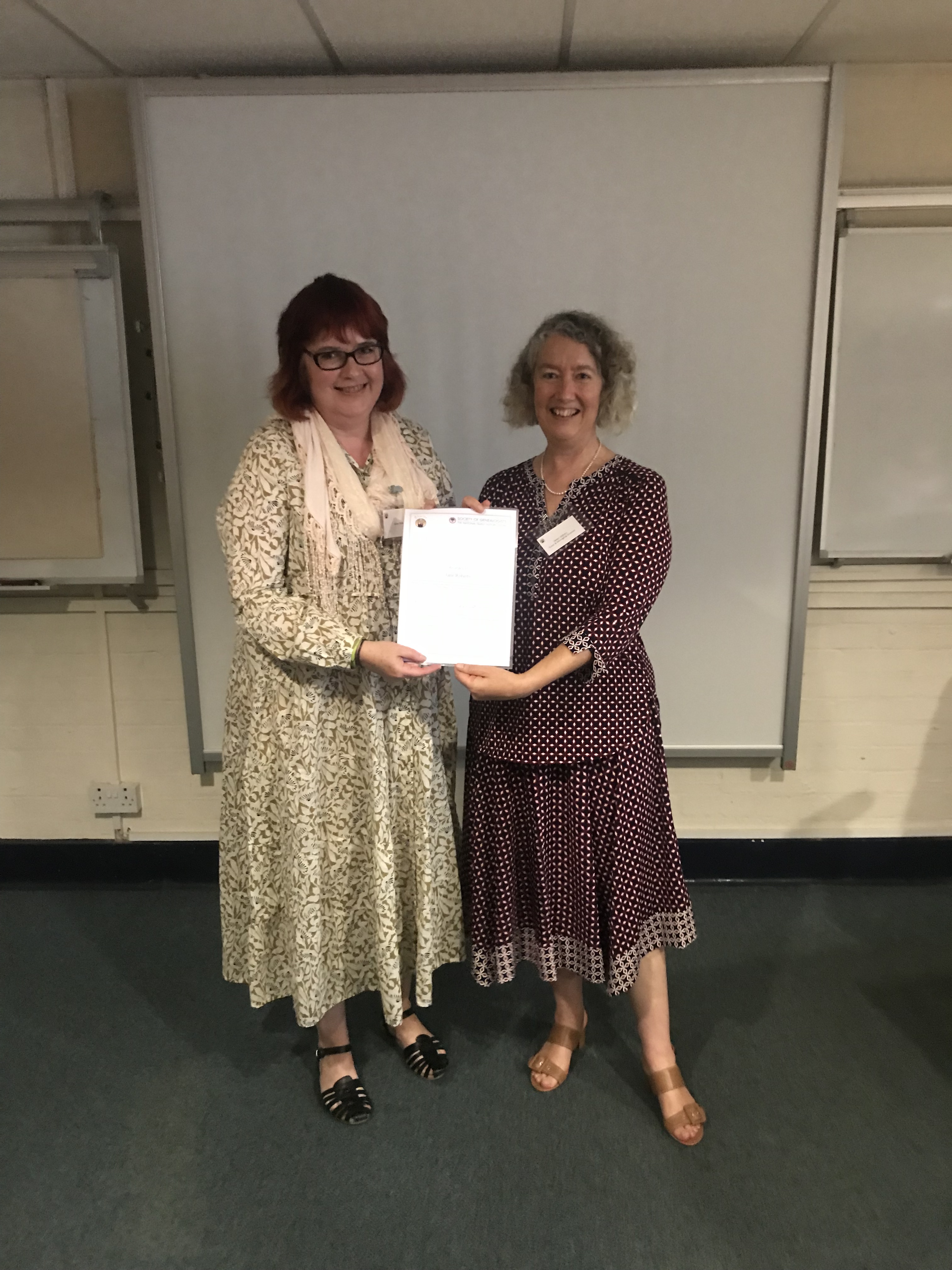
31 May 2019 marked the end of a huge chunk of my life over the past few years. I was at the Society of Genealogists in London for the award of my joint Pharos Tutors and Society of Genealogists Family History Skills and Strategies (Advanced) course certificate.

A bittersweet moment, it was the culmination of a couple of year’s hard work undertaking the various modules, the end of year one exam and a year two project. And even before that I had spent three years completing the Intermediate course.

Yes, submitting my final assignment last autumn and receiving my marks (a Distinction) just before Christmas were phases of the end. But the award ceremony was the moment which finally put a full stop on this period of formal learning

It was also wonderful meeting those who also undertook this learning journey, be it my fellow students or the ever-patient tutors who taught us along the way. I’ve learned so much through these courses and become a better genealogist as a result. They’ve also laid the foundations for my future continuing professional development.

But at the same time it was also a sad moment. Saying goodbye to everyone. Finally recognising that this phase of life was over and that the regular routine of formal learning had ended.

But has it?

Whilst the formal assessed courses are at an end, as part of keeping up-to-date with genealogical developments I will forge on with my personal programme of learning in order to continue to offer the best possible service to those who put their trust in me to research their precious family history.

Gone Fishing – Newton-by-the-Sea Past and Present

My recent holiday in Northumberland proved yet again that I can never totally switch off from research. I stayed in a Grade II Listed former fisherman’s cottage in the picturesque coastal village of Low Newton-by-the-Sea (historically known as Newton Seahouses). The cottage in which I stayed, according to Historic England, dates from the 18th century but was remodelled in the mid-19th century [1]. It is one of the whitewashed cottages which border three sides of the village green, owned by the National Trust [2]. The buildings on one side include the historic Ship Inn, parts of which are thought to date back to the 16th-17th century. The fourth side of the square leads directly to the beach and rocks of Newton, or St Mary’s, Haven.

It is a wonderfully relaxing location and the connection with the past is palpable. I felt compelled to delve into the history of the village and as a result discovered that the 19th century incarnation was a far cry from today’s holiday destination. It was a village very much shaped by the sea, and life for its inhabitants was decidedly tough.

Shipwrecks and death at sea were an occupational hazard, both for sailors transporting goods up and down the coast or across the North Sea to the continent, as well as for the locally-based fishermen. The predominant catches of these local fishermen were of turbot, lobster and herrings.

One early incident, reported in the local papers, occurred on 21 June 1833 [3]. William Cuthbertson’s sons William (age 22) and Robert, along with Ralph Archbold (age 19), the son or William Archbold, set off in a boat from Newton Sea Houses to Dunstanburgh Castle to gather sink stones for the brat nets [4].

Dunstanburgh Castle and the Cottages at Low Newton-by-the-Sea – Photo by Jane Roberts

On the return journey a heavy squall caught the sail and capsized the boat which sunk immediately due to the weight of the stones. Robert, who could swim a little, grabbed two of the oars and kept afloat until saved by some fishermen. The other two young men drowned, their bodies found the following day. Their burials on 24 June 1833 are recorded in the parish register of Holy Trinity, Embleton.

Back to the 21st century and hopefully those present-day holidaymakers savouring a thirst-quenching pint of one of the Ship Inn’s microbrewery offerings, or enjoying a delicious locally-sourced meal in the pub (turbot was on the menu for our visit) will not be put off by some of the 19th century activities which took place there. It was a convenient place to hold inquests, including for those whose bodies washed ashore. Some were foreign seafarers.

The Ship Inn – Photo by Jane Roberts

One such Ship Inn inquest took place before George Watson, coroner for North Northumberland, on Wednesday 26 February 1879. The body of 40-year-old Trieste seaman Francesco Carbone was discovered by labourer Thomas Anderson on rocks at Newton that Monday. He was one of the sailors on board the 542 tons Italian barque Stefano Padre, which foundered on the rocks just off Newton-by-the-Sea [5].

The barque, accompanied by a tug, set off from Aberdeen to North Shields in ballast [6] on Saturday 23 February. That night the sea started to get rough, and in the early hours of the following morning the barque struck the rocks. Although the tug managed to get a heaving rope to the vessel, it was unable to pull it free and abandoned the rescue attempt.

An attempt was made to launch the ship’s boat by those on the stricken craft. This ended in failure with most being forced to return to the Stefano Padre, whilst the four men on the front ended up in the sea. One of these did manage to cling on to the ship’s boat. When waves threw it clean on the rocks men from the Volunteer Life Company, comprised of coastguard and fishermen of Newton, managed to drag him to safety.

It was dangerous work with the men continually being washed off their feet. Not only was there the immediate danger of working in treacherous conditions, but the effects of the cold and exposure to the elements in undertaking what could be prolonged rescue efforts wreaked havoc on health. One of the coastguard men, Joseph Whiles, was completely drenched and blinded by the surf. He only reluctantly left the rescue scene after being advised to do so by Dr Magill.

Coastguards Cottages – Photo by Jane Roberts

Repeated attempts were made by the Coastguard to employ rockets to get a line to the barque and eventually this was successful, resulting in the rescue of the captain and six men.

The inquest jury returned a verdict of ‘accidentally drowned’ on Stefano Carbone. The courageous manner in which the coastguard and fishermen of Newton had endeavoured to save the lives of the crew in the face of great personal danger was acknowledged. William Pringle, a fish-curer who represented the fishermen at the inquest, and Mr Williams, the chief coastguard, were asked to inform those involved. The latter stated:

…a better class of men could not be found than those he had under his charge…

William Pringle was subsequently presented with an illuminated testimonial in vellum by the Board of Trade [7].

It seems the Ship Inn did not always sport this name. Though by time of the 1899 publication of the OS six-inch map of the area it was clearly marked as the Ship Inn [8], an earlier edition which was surveyed in 1860 and published in 1866 [9], shows its name as Smack Inn. And curiously, some newspapers reporting a Newton-by-the-Sea inquest in 1861 stated it took place in the Keelboat Inn. This was into the death of 59-year old Claas Foelders from Emden, Captain of the Hanoverian schooner Hortensia.

In stormy weather, heavy seas and thick rain the schooner, which was bound for Newcastle from Hamburg, lost its way in the darkness and struck the North Steel Rocks off Boulmer at around 8pm on the evening of Wednesday 27 March 1861. It being low tide the crew of the Boulmer lifeboat were able to walk out to the Hortensia, boarding at about 8.30pm. However, Foelders, who was described as tipsy, refused to leave. His crew of four also remained – some reports indicated that Foelders forced them to stay. With the tide on the turn, the lifeboat crew left the vessel and returned to shore at 10.30pm. By this time the captain was ‘dead drunk’. The sea quickly rose, the ship was driven further onto the rocks and began filling with water.

Now, in tricky conditions, the lifeboat was forced to launch. Despite all entreaties from his crew and the lifeboatmen, the captain once more obstinately refused to leave the Hortensia, holding on to the rails. With the situation becoming increasingly perilous the lifeboat returned to shore at 12.30 am, this time with the four crew members. The ship broke up entirely in the early hours of the morning of 28 March.

Later that morning, whilst out fishing about two miles off shore, Newton-by-the-Sea fisherman William Carss, and his two sons James and William, found the body of the captain floating head upwards dressed in drawers, stockings and a jacket. 

The inquest, held before the Coroner J. J. Hardy, on 30 March, returned a verdict that Foelders was found drowned. As mentioned some reports state it took place in Mr Jos Blair’s Keelboat Inn, Newton-by-the-Sea [10] and [11]. Others state it was the home of Newton-by-the-Sea innkeeper Mr James Blair [12] and [13].

Looking for alternative local inns, there was the Joiner’s Arms in Newton village (High Newton). Also, according to another OS map [14] there was one other public house in the vicinity, the Fisherman’s Arms. This is now a National Trust holiday cottage called Risemoor. The 1858 Kelly’s Post Office Directory of Northumberland and Durham does not help, its only listing being George Geggie’s Joiner’s Arms. However, the 1861 census was taken only days after the inquest on 7 April, so I checked this out.

There is no Joseph Blair in Newton-by-the-Sea (both the village itself of High Newton and Low Newton/Newton Seahouses). However, at ‘Newton Sea Houses Pub[lic] Ho[use].’ is ‘Fish[erman] and Inn Keeper’ James Blair, wife Hannah and five-year-old son James [15]. This seems to place him right in the square, where the Ship Inn is located. So it appears this was the inn in which the inquest of Claas Foelders took place. Perhaps the newspapers mistakenly called it the Keelboat Inn, or perhaps this briefly was its name. More work is needed to research this, probably more for archives than online, to enable a firm conclusion.

By 1871 [16] James and Hannah had moved in to Newton village itself (High Newton), and his sole occupation was fisherman. Skip forward to 1881 [17] and still in High Newton James now reverted to the dual occupation of fisherman and publican. But tragedy struck on 1 December 1883 when he too was claimed by the sea. He and John Patterson put out to Dunstanburgh haul in their lobster nets. A heavy wave hit their boat washing James and an oar overboard and knocking John over. With only one oar John could not control the boat and his attempts to reach James failed. John lost consciousness but fortunately his boat drifted to shore and he was found. James’ body was not discovered until 18 December on rocks near Dunstanburgh. His inquest the following day, ironically held at the Joiners Arms with which he knew well, returned a verdict of ‘accidentally drowned’ [18]. His son James took over the running of this pub, and is shown here with his family and widowed mother Hannah in the 1891 census [19].

Back to Low Newton, there is a gem of a description of it from a survey conducted by the Alnwick Rural Sanitary Authority which featured in the Alnwick Mercury of 18 October 1873. It paints a wonderful picture of life there in the latter half of the 19th century. It is such an evocative piece I’ve reproduced it in full.

NEWTON SEA HOUSES
This busy little fishing village lies close to the sea in the centre of “St. Mary’s,” or the rocky “Newton Haven.” It consists of fishermen’s cottages, a public house, and stable, forming three sides of a square (the fourth side being open to the haven), a couple of fish curing houses, and a fish curer’s – Mr Pringle’s – old and very damp house, together with coastguardsmen’s houses planted on the hill high above the village. The period of my inspection happened to be just when the herring fishing was coming to a close, and I had good opportunity of observing the peculiar requirements of the inhabitants in their houses and of noting where they were deficient or good. It appears that every fisher has three men to keep, called “Yarmouth men.” With the exception of the houses which are new, all of them consist of one room and a loft formed out of the high tiled roofs. The sleeping accommodation in these in the fishing season is, as one says, “Ourselves and three men have to pig in there,” and another “have to have a bed or two in the garret for the people to lie in that we have.” The interiors are made the most the space admits of, but they nearly all resemble the forecastle on board ship, they are so low, so crowded, so deficient in light, so like cabins and berths, and every sanitary contrivance. They look, indeed, like buildings made out of the materials of wrecks. “The couples [20] of this house is nothing particler, one of them’s broke.” “This is all the comfort poor people have; many nights I have to rise to put dishes to keep the rain coming in.” “It was a kind o’ blockit up, but it’s in very bad repair.” “Little or no back places, not a drain about the place.” “Our coals are piled up at the back of our beds.” “Only one privy for the whole of us, and that at the back door of the public house.” Such is the condition of the houses where there is an addition in the hot season of “three Yarmouth men.” At the present time the dark windowless lofts are being crowded with masts and sails (one for want of room was poked through the tiles), creel nets, covered with fish scales, festoons of bladders highly coloured in stripes and looking like Egyptian necklaces, tarpaulins, blocks, ropes, lanterns, and “all things useable at sea”, for, say the fishermen, “our fishing work gear takes a large garret.” In these cases, however, “the couples being nothing particular,” it is surprising how the things get packed over their heads, and a wonder that the whole loft does not come down upon them with a crash. A much better state of things appears, however, in the provision of these seafarers at the three new houses mentioned. Every careful thought has been bestowed in their erection, especially as to the provision of a large well lighted loft, where “the three Yarmouth men” and “all things useable at sea” can be alternately lodged; but here, alas! there is a deficiency of coal and washing-up places. In one of “these nice new houses” I saw one poor woman “possing”[21] in the pantry to keep, as she said, “the other places rid”; and in another they had secured a bargain of a winter’s supply of coals, and in the absence of a coal house have actually been obliged to pack them from floor to ceiling in the pantry. The central large and open place in front of the three-side square of houses is the common refuse heap, unwalled, and dependent upon the paternal care of Mr Dixon, the farmer tenant, to remove and keep it low. The owner of this property, Mr Mather, has a good opportunity to make this a model little fishing village, by rebuilding the older houses in the manner of the new. He should not, however, forget the provision of coal and washing-up places, and the usual sanitary conveniences. The well-to-do tenants would or should gladly pay a fair per centage on the outlay for the boon of good dwellings suitable to their occupation which they one and all sigh for. The coast guard houses are like all government buildings models of order. Smart with white and black wash, everything taut and in trim, they possess every sanitary contrivance, including the earth closet and commode. Water for all these places has to be brought a considerable distance from an arched cavern below some basalted rocks, which will require the care of your authority. [22] 

The Living Room and View, Unrecognisable from the 19th Century Description of the Cottages – Photo by Jane Roberts

The water supply was a persistent problem; and the village green where visitors now spread out picnic blankets, soak up the sun and smell the tang of the sea was far from a fragrant outside space back in 1873. And the situation had not improved by the start of the following decade as a damning report to the Rural Sanitary Authority on 28 January 1882 by the Alnwick Medical Officer illustrated. It stated:

….a mild case of small pox had appeared at Newton-by-the-Sea, contracted probably from the girl’s father who had just returned from a neighbourhood where the disease existed. Also that a rapidly fatal case of diphtheria had since occurred to a member of the same family in the same house. The house is very unfavourably situated in regard to a large midden ashpit occupying the centre of the village, which is built to form three sides of a square, the end towards the sea being open. The pit is capable of holding about sixty loads, and large accumulations are allowed to take place from which noxious effluvia arises. It was recommended to be paved at [the] bottom and the contents removed weekly [23].

The Square, Low Newton-by-The-Sea – Photo by Jane Roberts

The Low Newton of today would be unrecognisable to those late 19th century inhabitants. So, as you sit by the green sipping your beer, soaking up the atmosphere and admiring sea view and the picturesque cottages (you may even be holidaying in one), remember it was not always thus. And do spare a thought for those men, women and children who lived, worked and died here in centuries past.

Notes:

  • [1] Historic England – Nos 1 and 2 and Garage adjacent to Ship Inn, Newton Seahouses Square: https://historicengland.org.uk/listing/the-list/list-entry/1041750
  • [2] Report No. 0058/6-09, Historic Environment Survey for the National Trust Properties on the Northumberland Coast, Newton – July 2009: https://www.aenvironment.co.uk/downloads/historic-landscape-characterisation/newton-coast-management-plan.pdf
  • [3] Newcastle Courant – 6 July 1833 and Durham County Advertiser – 12 July 1833.
  • [4] Brat-Nets was the name given in Northumberland for fixed drift-nets which hung in slack folds in order to entangle and strangle turbot. Brat was the local name for turbot
  • [5] Alnwick Mercury – 1 March 1879, Newcastle Courant – 28 February 1879, Shields Daily News – 28 February 1879 and Shields Daily Gazette – 2 December 1904
  • [6] Having no cargo, but carrying ballast for stability
  • [7] The Berwick Advertiser – 5 November 1880
  • [8] OS Six-Inch Map, Northumberland XXII.SE, Revised 1896, Published 1899
  • [9] OS Six-Inch Map, Northumberland XXII, Surveyed 1860, Published 1866
  • [10] Newcastle Journal – 3 April 1861
  • [11] Morpeth Herald – 6 April 1861
  • [12] Newcastle Daily Chronicle – 2 April 1861
  • [13] Newcastle Courant – 5 April 1861
  • [14] OS Six-Inch Map, Northumberland XXVII, Surveyed 1861, Published 1867
  • [15] 1861 Census England & Wales, Newton-by-the-Sea, RG09/13881/60/13
  • [16] 1871 Census England & Wales, Newton-by-the-Sea, RG10/5176/56/3
  • [17] 1881 Census England & Wales, Newton-by-the-Sea, RG11/5125/60/7
  • [18] Alnwick Mercury – 8 and 22 December 1883
  • [19] 1891 Census England & Wales, Newton-by-the-Sea, RG12/4265/127/4
  • [20] Rafters (pair of)
  • [21] A northern term for washing clothes by agitating them with a long pole or rod. Pounding of washing.
  • [22] Alnwick Mercury – 18 October 1873
  • [23] Alnwick Mercury – 4 February 1882

Additional Sources:

  • Aflalo, F. G. The Sea-Fishing Industry of England and Wales: A Popular Account of the Sea Fisheries and Fishing Ports of Those Countries. London, 1904.
  • Post Office Directory of Northumberland and Durham: With Map Engraved Expressly for the Work, and Corrected to the Time of Publication. London: Kelly and, 1858.

I did find some 19th century images but due to copyright doubts I’ve not reproduced them.

Family History Search Tips

I make no apologies for posting this advice. If it helps just one person it’s worth repeating it.

Here goes:

  • Do not rely on index searches and/or transcriptions – look at actual documents or digitised images of them;
  • Whenever possible use more than one genealogical dataset provider for any searches; and
  • When searching be flexible with spellings, dates, ages etc.

This was brought home to me yet again recently whilst doing my Aveyard One-Name Study.

Extracting all occurrences of the name from the 1851 census in England and Wales I used both Ancestry and Findmypast. Searching purely on Aveyard, and not including my variant surname searches, the totals were:

  • Ancestry: 206; and
  • Findmypast: 183.

Both providers had results not found by the other one.

I also looked at Haveyard. Ancestry had five results and Findmypast six.

I went through each result individually, checking against the original census images. Some proved not to be Aveyard entries at all. Even individual information within correct entries had discrepancies when checked against the image – ages, occupations, names and relationships incorrect for instance. And there was no correlation with the errors between the providers. As for the quality of images, that too varied. For some Findmypast was far superior; for others Ancestry proved more legible. And some were difficult on both.

In the end I came up with 211 genuine Aveyard/Haveyard entries. This total is purely coincidental in matching the Ancestry total. My 211 included some not found by either provider in the Aveyard/Haveyard searches, but based on my knowledge of names I knew should be there. And this total does not include the Halfyard spelling sometimes used.

To put it simply if I had used one provider for my search and not checked the images I would have replicated errors and had missing entries.

Even my 211 may be a hostage to fortune as I delve more into my Aveyard and wider ancestry, become more familiar with names which should feature based on results from other record sets, and look at broader wildcard searches.

I use this census search as an example. The same principles apply equally for any searches. Only today, finding someone in a 1939 Register search via Findmypast proved impossible. Switch to Ancestry and it was the first “hit.”

Also just because you cannot find an expected result does not mean it isn’t there. It could be simply mis-transcribed, the document could be damaged or pages may have been skipped in the digitisation process. So check the original document, especially if you are relying on one provider for your search. In fact I’d say always go through the document.

In recent weeks I’ve found burials which didn’t come up with a normal search; ships passengers missed off the search indexes; incorrect dates even down to the wrong year; and even a 1912 birth entry on the General Register Office (GRO) website which had the mother’s maiden name totally mangled. I went ahead and ordered the certificate, trusting my instincts (combined with reasoned searching and elimination). It proved the right call. The name was mis-transcribed on the main index, because the document itself had legibility issues and the name was highly unusual.

Another GRO example recently was using Findmypast marriage indexes for 1904. The page number was transcribed as 133 and their marriage finder hint came up with two suggested grooms. Looking at the image, the page number was actually 123. Using FreeBMD, a search on District, Date, Page and Volume sorted it and the correct groom was identified. Needless to say it wasn’t either of the two suggested via the Findmypast search.

The moral of the story is do not rely on indexes, transcriptions and the search algorithms of online genealogy sites; use more than one provider as it is less likely the same transcription error will be repeated on all; always check the image if at all possible; be flexible with your spellings, do not rely on what you think is the established one; and don’t accept negative search results without question.

So from one “old” genealogist, maybe by following these general principles you will have more chance of “meeting” your ancestors whilst you are alive, than in any afterlife!

From Gildersome to Gorton (Other Locations Available): An Analysis of the Aveyard Families in the 1851 Census

It might not be everyone’s idea of a pleasant way to while away the hours, but I’ve had tremendous fun analysing the various Aveyard families in the 1851 census of England and Wales. I will eventually get onto constructing family trees as I link more building blocks of information. But for now I concentrated on focusing on the Aveyards as a group looking at their ages, birth and address locations, occupations and even Christian names.

I’ve loved playing with various chart formats to depict the information. Perhaps I really do need to get out more! However I hope those with Aveyard ancestry connections will enjoy seeing the bigger picture and working out where their particular branch fits. And at the outset I should caution this is a work in progress – I do envisage revisions to the data as I grow more familiar with the Aveyards!

I undertook 1851 census surname searches using both Ancestry and Findmypast, genealogical dataset provides, to try to minimise any omissions through transcription errors. This is a big risk if relying on one genealogical data provider. These searches included both the Aveyard surname and an infrequently used alternative spelling of Haveyard. For ease I will use Aveyard generally, unless I’m specifically referring to an individual who uses the Haveyard spelling.

I then checked the image, again to minimise any transcription errors. If the image proved problematical with Findmypast I checked the Ancestry image and vice versa.

Going through each entry personally in this way also gave me a far better ‘feel‘ for the Aveyard families. Yes, it’s time consuming. But I think it’s worth it.

In total there were 211 occurrences of the Aveyard surname, split between 105 males and 105 females. One entry, for a Gorton (Lancashire) Aveyard, was so badly damaged it was impossible to determine age, relationship or gender. Therefore any analysis of these specific factors (unless indicated) is based on an overall Aveyard total of 210.

The youngest Aveyard, Ellen (of Gildersome), was newborn. The eldest one, Benjamin (born in Gorton and living in Mancester), was 75.  There were only six Aveyards in their 70’s, so less than three per cent. The average age, based on the 210 entries with legible ages, was 24.72.

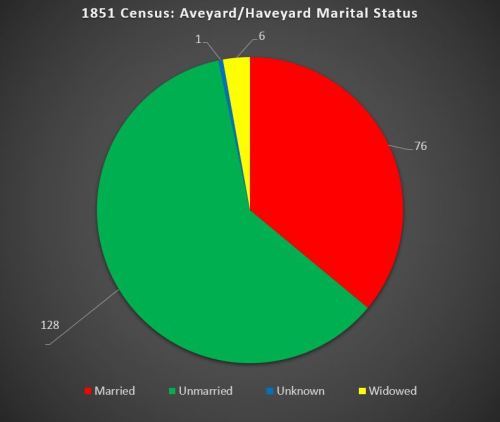
The marital status of the Aveyards is depicted in Chart 1, below.

Chart 1:

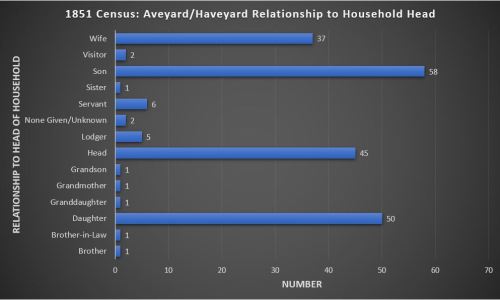
45 Aveyards were heads of the household. The precise split of relationship to the head of household of the 211 Aveyards is given in Chart 2, below.

Chart 2:

I next looked at Christian names. William (17 occurrences), George (16) and Thomas/Tom (11) were the top three male names. For females bearing the Aveyard name, including those by virtue of marriage, Mary (16) and Sarah (13) were those in double digits. The full breakdown of male names is in Chart 3, and females in Chart 4.

Chart 3:

Chart 4:

Next I looked at birth and address counties and, within these counties, the precise address and birth location. For part of this piece of analysis I excluded married and widowed females, on the basis these were highly unlikely to be born as an Aveyard. The results were startling. There is an overwhelming northern England geographical concentration of Aveyards, with Yorkshire being the main location.

Chart 5 shows the birth county of all Aveyard surname bearers – it shows 83.41 per cent of all Aveyards in the 1851 census were Yorkshire-born; 10.90 per cent were born in Lancashire; and 3.31 were Cheshire-born. Five others were born in either Durham, Lincolnshire or Middlesex.

Chart 5:

Chart 6 (below) excludes married and widowed females (and the unknown gender entry). This leaves 169 male or unmarried female Aveyards. Removing this cohort further narrows down the counties to only four. The Yorkshire concentration increases, with 86.39 per cent born in this county. Of the others 10.05 per cent are Lancashire-born, 2.36 Cheshire and 1.18 per cent Middlesex

Chart 6:

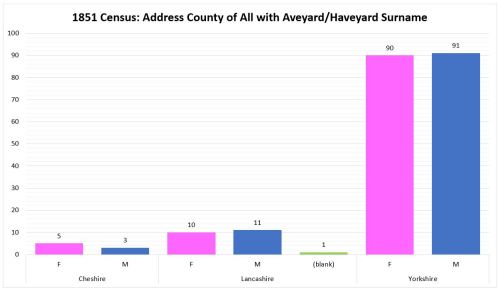
When looking at the address counties of the Aveyards we are down to the triumvirate of Yorkshire, Lancashire and Cheshire as depicted in Charts 7 and 8.

Chart 7:

Chart 8:

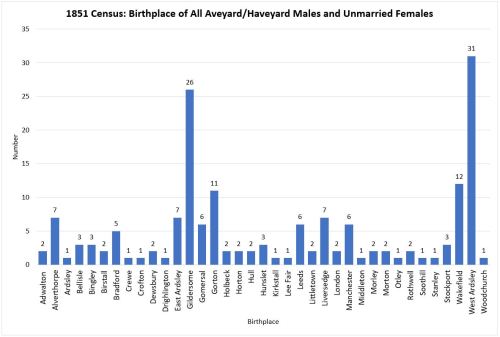
My final couple of charts relating to birth and address locations of Aveyards once more excludes married and widowed females and the one Aveyard of unknown gender, so again is based on 169 people.

Chart 9 focusing on birthplace shows 15.38 per cent are born in Gildersome and 18.34 per cent in West Ardsley, both in Yorkshire. West Ardsley also covers Lee Fair and Woodchurch, so including the two who give these birthplace locations increases the West Ardsley percentage to 19.52. One gives a birthplace of Ardsley. As this could equally be East Ardsley I have not included it in the West Ardsley calculations.

Chart 9:

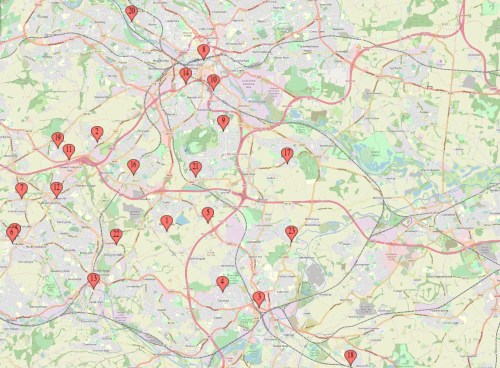
Many of the other Yorkshire birthplaces are within close proximity to West Ardsley. The closest 22 are depicted in the map below, with West Ardsley at (1).

Map of Yorkshire Birthplaces near to West Ardsley

KEY: 1 = West Ardsley; 2 = Gildersome; 3 = Wakefield; 4 = Alverthorpe; 5 = East Ardsley; 6 = Liversedge; 7 = Gomersal; 8 = Leeds; 9 = Belle Isle (Bellisle); 10 = Hunslet; 11 = Adwalton; 12 = Birstall; 13 = Dewsbury; 14 = Holbeck; 15 = Littletown; 16 = Morley; 17 = Rothwell; 18 = Crofton; 19 = Drighlington; 20 = Kirkstall; 21 = Middleton (Leeds); 22 = Soothill; 23 = Stanley.

As the crow flies looking at points north, south, east and west to West Ardsley: Kirkstall is 11.42 miles; Crofton is 11.59 miles; Liversedge is 8.81; and to Rothwell is 7.72 miles.

In Lancashire Gorton is the most popular birthplace, with 11 Aveyards (6.5 per cent) giving this as their birth location. It is the fourth most popular behind Yorkshire’s West Ardsley, Gildersome and Wakefield.

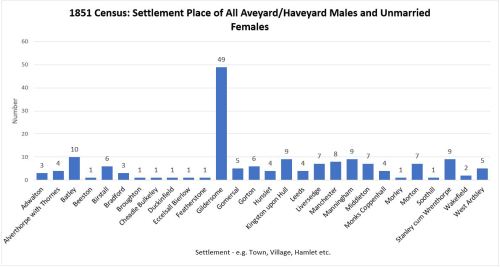
Chart 10 depicts addresses. 49 (28.99 per cent) have a Gildersome address. In comparison only five live in West Ardsley, showing a migration away from what was their largest birth location.

Chart 10:

The corresponding map showing the closet locations to top address spot Gildersome (1) are depicted on the map below.

Map of Yorkshire Settlement Places Closest to Gildersome

KEY: 1 = Gildersome; 2 = Batley; 3 = Stanley cum Wrenthorpe; 4 = Liversedge; 5 = Middleton (Leeds); 6 = Birstall; 7 = Gomersal; 8 = West Ardsley; 9 = Alverthorpe with Thornes; 10 = Hunslet; 11 = Leeds; 12 = Adwalton; 13 = Wakefield; 14 = Beeston; 15 = Morley; 16 = Soothill.

My final piece of analysis depicted in the bar charts at Charts 11 to 13 looks at occupations of males and females aged eight and upwards, and all children up to and including 16 years of age.

The stand-out occupation of the male Aveyards is coal miner with 21 giving this as an occupation. A further 11 had coal-related occupations, including one engine tenter working in a colliery. In other words 38.55 per cent of all male Aveyards age eight and upwards were employed in the coal industry. All of these boys and men lived in Yorkshire, 19 of them in Gildersome. There were only 24 males age eight and upwards in a Gildersome. Over in Lancashire the nine Aveyards in this age bracket had no real common occupational grouping: two errand boys, a hatter, a retired hatter plus a leather cutter, french polisher, herald knitter, mechanic and annuitant. In Cheshire there was a hat maker and mechanic. All three of those with a hat making link were Gorton-born.

Chart 11:

Looking at females in the age eight and above category 42, equivalent to 51.85 per cent, had no occupation listed. Of the others many had domestic and service work and over 18.5 per cent had a cloth manufacturing role.

Chart 12:

The final chart (Chart 13) looks at eight to 16-year-olds. Of the 86 in this age group:

  • 35 had no details given:
  • 21 were at school;
  • a further three were described as splitting their time between mill and school. These were the only eight and nine-year-olds described as having a job;
  • in addition to these three split-timers, a further eight were in the cloth industry; and
  • seven (including two ten-year-olds0 worked in the coal mining industry.

Chart 13:

So where do my direct-line Aveyards fit in? In 1851 my 4x Great Grandparents George and Hannah Aveyard were alive as were my 3x Great Grandparents Peter and Caroline Aveyard (married in 1846). Caroline was born in Gildersome, the others in West Ardsley. George (71) was a labourer and Peter (25) a coal miner. I do know from other records George had been a coal miner When younger. Neither wife had a listed occupation. George and Hannah (63) lived in Gildersome and Peter and Caroline in Adwalton. Note as married women neither Hannah (63) or Caroline (24) appear in the birthplace or settlement place tables. Based on this I’d say they were typical of the Aveyards as a whole.

I did wonder about publishing this post as I may subsequently identify some Aveyards overlooked in my first sweep of the 1851 census. For instance I have a feeling at least one Yorkshire branch of the family may have used the name Halfyard in the census. This may add around 20+ more names. I reckon there are five in Lancashire and around seven in Cheshire. All this needs verifying. Also the ages given may subsequently prove incorrect when I eventually start cross-matching with civil registration and parish register information. In the end I decided to go for it. I can always update this research if I do discover other Aveyards. And as for the age details, I will for the purposes of census analysis stick with what they gave. So, as I said earlier, view this as a work in progress and watch this space for further updates.

Sources:

A Batley Murder: “I Have Done it For Love”

On 31 December 1895 Tom Morley received a final letter at his Batley home from his brother Pat. Written from Armley jail on the eve of Pat’s death it read:

My dear Tom, I am very sorry to part with ye, but I hope I will meet ye in heaven, I will soon be in a better place withe [sic] the help of God I am preparing to go home to-morrow at nine o’clock, and I am leaving ye all my kind love. Let ye all pray for me this night and let ye pray for poor Lizzie that is gone before me. Dear Tom, I was no disgrace to you this 20 years in England untill [sic] now. Tom, it is my foolishness that left me here. It is hard work to rite [sic] this letter. Tom, I must conclude, and I am bidding ye all a long farewell. God be with you for ever. [1]

Pat Morley’s last night on earth was fairly restful. In the morning he ate a light breakfast, and was joined from 7am until 8.50am by Father Hassing, the Catholic prison chaplain. Prayers were said until James Billington, the government hangman, came for him.

Arms strapped to his side Morley was led to the chalk-marked drop point by a number of warders. Father Hassing, in the procession, recited the service for the dead in Latin. On reaching the spot, his ankles were strapped together, his face covered with a white cap, Major Knox the Prison Governor gave the signal and Morley dropped 7′ 6″ to his death.

One hour later he was cut down, placed in a black-painted coffin and the perfunctory inquest held confirming the death sentence had been duly carried out. Two more formalities ensued. The Declaration of the Sheriff and Others read:

We, the undersigned, hereby declare that Judgment of Death was this Day executed on Patrick Morley in Her Majesty’s Prison of Leeds in our Presence.
Dated this 31st day of December 1895 E Gray Under Sheriff of Yorkshire. James Knox, Governor of the said Prison. Anthony J Hassing Chaplain of the said Prison. [2]

The Certificate of the Armley Prison Surgeon (at this time the word Surgeon was also used to refer to a doctor, rather than having our 21st century understanding), Berkeley Moynihan stated he had examined the body of Patrick Morley and death was confirmed. Later Berkeley Moynihan was elevated to the peerage as the 1st Baron Moynihan. More recent readers may be more familiar with the 4th Baron Colin Moynihan, a British Olympic coxswain and a former Conservative sports minister, who was the grandson of the Armley prison doctor.

Old Gate Armley Gaol (edited Black & White) – Wikimedia Commons, Creative Commons License 3.0 (Share Alike)

It was all a far cry from Pat’s early life on a farm near Charlestown, County Mayo. In this countryside surrounds he was brought up with his three brothers and two sisters. But, as was the case with so many Irish, their homelands became but distant memories. By the 1890s one brother lived in Liverpool, another in Ripon and a third, Thomas, in Batley along with a sister, Bridget. Their father, however, remained in Ireland.

Standing at 5′ 7″ [3] Patrick was a thin, spare man, with sharp cast features and a somewhat ruddy appearance. Some went so far as to describe him as having an intellectual type of face. His most noteworthy features were his deep, brooding eyes – although Lucy Cooper, one of the witnesses giving evidence in front of the Magistrates in Batley Town Hall on 30 September, said to much laughter “Nay, he’s nowt in my line to look at.”

In England Pat was said:

…to have been possessed of a good bit of pride, and, being able to command good wages, he has, to quote the words of one of his relatives, “not gone into the tap-rooms but into the best rooms, amongst the gents.” [4]

He met Elizabeth Stratton whilst working in Harrogate. She ran a lodging house in which he stayed. Born in Halifax in 1853 (so slightly older than the 35 years indicated at the time of her death), she was the daughter of John and Elizabeth Stratton (née Penny). She and her siblings, William, Mary, Joseph and James, grew up in Bradford with their father’s jobs including a labourer in a stone quarry and an earthenware dealer. Her parents died in late 1880 and, after initially working as a glass and China shopkeeper in Bradford, she moved to Harrogate. Described as a respectable, educated woman she was often seen in that town dressed in black, wearing a veil.

According to the same relative of Pat’s:

…seeing he had some good clothes and was a decent fellow who didn’t mix with the roughs, she married him. [5]

Their wedding took place in Harrogate at Christmas-time in 1893.

Within months though marital problems emerged. Although regarded as a quiet, steady, inoffensive man, it seemed Pat liked a drink. This caused him to became jealous of the lodgers. According to Tom “He was not a right drunkard but he spent his money in drink.” [6]

One jealous alcohol-fuelled incident saw Pat hitting a resident on the head with a poker.

When Lizzie arranged to remove her furniture from the house and leave, Pat barricaded himself inside and refused the removal men entry. She relented and returned to him, but as a result of his behaviour lodgers shunned Diamond Place, frightened away by the antics of the proprietor’s new husband.

The couple eventually left Harrogate, initially moving to Hunslet Lane, Leeds. It was here in July 1894 that Pat was bound over to keep the peace for 12 months after threatening his wife. A loaded revolver was found in his possession and taken from him – his brother Tom subsequently claimed in a statement to have thrown it into a river.

The couple came to Batley shortly afterwards (his brother reckoned about September 1894), living at Beaconsfield Villa. Here Pat worked for Batley Corporation as a labourer whilst Lizzie was employed as a power loom weaver at Sheard’s mill.

In July 1895, just before the expiration of his previous sentence, Pat appeared once again before the police court. It was a familiar charge: once more he’d made threats against his wife.

This time he was fined 40s and costs and bound over to keep the peace for six months.

He went to Harrogate to cool off and whilst he was away Lizzie, fearing for her safety, left the marital home. In early September she took lodgings at 1 Hirst Place, off Purlwell Lane, in the cottage belonging to Ellen Nutton and her married daughter Lucy Cooper.

Pat returned to Batley on 14 September for Batley Feast and immediately sought out his wife. In the following days he was a frequent visitor to Hirst Place, pleading with Lizzie to return to him. She refused, afraid he would harm her telling him “You know Pat, I daren’t live with you. You know you have threatened me so often.” [7]. At other times she said she would if he would “mend” and “if he would give over drinking.” [8]

After one rejection he briefly left Batley on 16 September and spent time in Harrogate then Ripon, where he purchased another bulldog-type revolver. He returned to Batley on 18 September and resumed his visits to Hirst Place, trying to persuade his estranged wife to come back. In one statement he said:

I kept begging her to change her mind, because I knew if she did not change her mind she would have to die for it… [9]

His final visit to Lizzie took place on Sunday 22 September. He arrived at around 1.15pm, whilst Lizzie was preparing dinner. Both Ellen and Lucy were in the room. He asked if she had been to church that morning, but she said not as she’d been too late.

Approaching 2pm, as Lizzie was snipping some parsley, he got up from his chair and moved towards her asking if she would lend him a shilling. It being Batley Feast time she too was short of money, having taken time off work to go to the jollities on the Saturday, Monday and Tuesday. As a consequence she had not finished the piece of cloth she was weaving (as a weaver she was paid by the piece).

Pat was now within an arms length of her. Saying “Get out Lizzie” he reached for his breast pocket, drew out the revolver and shot her once in the right temple. She fell to the ground at the feet of Ellen Nutton. She never spoke again.

British Bulldog Revolver – Wikimedia Commons, Creative Commons License CCO 1.0

In his police statement later that afternoon he claimed if she had given him the shilling he would have gone away.

Pat then put the gun to his mouth and, with trembling hands, pulled the trigger once more. Despite the revolver firing, for some inexplicable reason it missed him. The bullet was subsequently found to have hit the wall behind him.

By now Lucy was shouting the alarm and banging on the window. Fred Ashton, a young miner who lived at 8 Hirst Place and who had heard the crack of two shots, came to see what was going on. He apprehended Pat on the doorstep of the cottage and led him back inside. Pat calmly handed the revolver to Fred.

The police and the Batley police surgeon were quickly summoned. PC William Robinson, who lived only 120 yards away, was the first Batley policeman on the scene. He was the constable who dealt with the domestic dispute only two months earlier.

Police surgeon Herbert Keighley was unable to save Lizzie who died at around 2.30pm. As she lay dying Pat muttered “I am sorry. I hope her soul is in heaven” and “I have done it for love.” [10]

Ellen, described as a matronly-looking woman, claimed at his trial in December that she felt if he had held out for just a couple more days Lizzie would have returned to him. Her evidence, as outlined in the Judge’s notes in that final December trial, appeared to indicate he and Lizzie had “slept together” during his Hirst Place visits. The Judge wrote the word “cohabiting” in the margins. [11] Whether this is true, what is not in doubt is during those few days after Pat’s return to Batley in September 1895 they spent several hours together, both at Hirst Place and around Batley visiting friends – for example Bridget Cafferty’s home on Spa Street.

Lizzie Morley’s inquest took place before Coroner Thomas Taylor in the late afternoon of 23 September. It was held at the New Inn, a public house on nearby Purlwell Lane.

Her funeral followed on Wednesday 25 September, officiated by Rev. Father Charles Gordon of St Mary of the Angels R.C. Church.

A large crowd gathered at Hirst Place ready to accompany her body to the cemetery, doubtless eager to hear the latest gossip about the tragedy. Work colleagues carried the flower-covered polished pitch pine coffin with brass furnishings from the house to the hearse. The procession, headed by around a dozen weavers from her workplace, then wound its way through those gathered along the Purlwell Lane, Clerk Green and Cemetery Road route.

Chief mourners were Lizzie’s brother Joseph and his wife, her aunt and uncle James and Louisa Naylor (her mother’s sister), sister-in-law Emily Stratton and cousin Elizabeth Penny. Some reports estimated around two thousand witnessed the ceremony.

In the meantime Pat appeared before Batley Magistrates on 23 and 30 September. On both occasions large crowds gathered outside the Town Hall with townsfolk hoping to catch a glimpse of the prisoner as he was brought to court.

Interior of Batley Town Hall – Photo by Chris Roberts (edited by Jane Roberts)

The first hearing held in the small Committee Room meant only limited public access.

At the second hearing even bigger crowds gathered outside the building two hours before proceedings commenced. Even after the doors opened people continued to arrive, and the crowd swelled to such an extent during the course of the hearing that traffic was obstructed. At the end of this hearing Pat was formally charged with the wilful murder of his wife and committed to trial at the next Leeds Assizes.

His brother Tom was a frequent visitor to his brother in Wakefield Gaol, where Pat remained in good spirits and had not despaired of being saved from the gallows. Tom wrote to a number of Pat’s former employers to get character references for him. Responses included one from Major Gorman of Smeaton Manor, Northallerton and Mr R Routledge of Hick House, Northallerton. The latter reply was typical:

I am very much grieved to hear of the dreadful act your brother has committed. I cannot imagine but that he was either really drunk or insane at the time he did it. When working for me he was always so cheerful and pleasant. I am afraid that anything I can say would avail him very little…If you are not able to employ counsel the judge will, no doubt, order someone to defend him… [12]

Another ploy was to try to prove Pat was mentally unstable. When the case came before Mr Justice William Grantham at the Assizes held at Leeds Town Hall on 9 December, evidence was produced to this effect. It included a family history of insanity. Pat’s brother Tom said “he had not been right in his head these ten years” and his condition worsened after his marriage. Tom went on to say they had an aunt similarly afflicted. Their brother Michael had “not been square in the head” since birth; neither was their cousin Mary who emigrated to America. Bridget Rowan, their sister, who lived at Woodwell, Batley gave similar evidence as to Pat’s mental state. She mentioned her brother had stayed with her in the three nights prior to the death of Lizzie. Whilst here his state of mind deteriorated to the point that he was incessantly talking to himself. [13]

Justice Grantham by “Spy” (Leslie Ward) Published in Vanity Fair 15 March 1890 – Wikimedia Commons, Public Domain Image (Author Died in 1922)

The Judge sought the opinion of Berkeley Moynihan (spelled Barclay by the Judge), Armley Gaol surgeon, who rebuffed this. In his opinion he had ordinary control of his actions and was quite responsible for them. The Judge’s notations of the doctor’s evidence included:

He seemed to have ordinary memory and was quite like an ordinary individual. [14]

The jury was also unconvinced. After listening to evidence from a parade of other witnesses including Ellen Nutton, Lucy Cooper, Fred Ashton, Dr Herbert Keighley, Batley policemen PC William Robinson, Sergeant Smith Machell and PC William Craven, as well as Leeds City policemen involved in the 1894 Leeds domestic dispute, they found the prisoner guilty.

Pat now gave a long, disjointed statement in a strong Irish accent as follows:

I have your riverence, [sic] your lordship – I am here. No docther [sic] in Leeds to [sic] examine me. I am in a weak state of mind. Your riverence [sic] I hope you will give me a fair chance. I was more fit for the asylum at the time. I was away three weeks. She sold my home. I went away to Harrogate. I was drunk during the time. I had been sober for twelve months. I loved my wife. I did not want to shoot her. No, I was not the man. I told the doctor at Wakefield all the time I was there. I said my head was rising off me. I told the doctor in Armley Gaol that my head was bad, and it has been bad for a number of years, as my friends know. I hope you will give me a chance. I did not intend to shoot my wife. I only had this revolver to frighten her. She would not go back to live with me. I did not think the revolver would go off at the time. The revolver went. I thought I hadn’t it ready for going. I had no more mind to shoot her if I had to drop dead before ye gentleman. I am the wrongest. I am the innocentest man, though I did it. I have the best character of any man in the world. She sold my home. I went to Harrogate to take the waters. I was not drinking then. Gentlemen – your Lord, it is only a little revolver. I only did it to frighten her. [15]

The Judge, unmoved, donned his black cap, and passed a sentence of death. A woman in the gallery sobbed once, and Patrick Morley, staring blankly ahead, was hustled out of the court.

However, some did raise questions about the verdict, blaming the unprepared, inexperienced defence counsel. A piece in The Leeds Times of 14 December 1895 said Pat had:

…the appearance of mental derangement, of at least feebleness and abnormal stupidity, and I think there may be more in the statement of his having two near relations in Ireland insane than was disclosed…Patrick Morley may be an idiot or a brute or a combination of both, but he ought not be hanged if he is in a mental state that weakens his responsibility. I trust that full inquiry will be made into his history and into his condition of mind.

The Judge had no such concerns. His notes mention his belief that the prisoner displayed shrewdness. They also indicate one of the first questions Pat asked his Council was if he should pretend to be insane and what was the best way to do this. However, the Judge did request a post-trial medical report. Dated 17 December 1895, Henry Clarke – the doctor who had seen him regularly during his two-month sojourn at Wakefield Prison – stated that on his arrival there on 24 September there was no evidence of delusions or hallucinations. It was only on 1 October that he appeared dull, stupid and slow in answering questions. The following day he denied ever seeing the doctor previously, claimed he had never been married and could not answer even the simplest of questions. The doctor gave special instructions for his visits with family and friends to be monitored. In these he repeatedly spoke about his wife with regard to her ring and some property and suggested to his brother that he should get evidence as to some relative who had been in an asylum. Dr Clarke concluded:

In my opinion he was sane and responsible for his actions. I regarded his conduct under examination during the latter part of his stay here as assumed. [16]

The decision remained unchanged. Pat Morley, now in Armley Gaol, philosophically awaited his fate, the date for his hanging set for 31 December 1895. His penultimate letter to his brother Tom read:

My dear Brother, Sorry I am to write you this lonesome letter in my present state, and in the position in which I am placed as you perhaps have heard that I am to die in the last day of the year; and let ye all pray for me. I have the priest coming to see me every day. Dear Tom, if only I had taken your advice I should not be placed in the position I am. Poor Tom, you always advised me for the best, and I didn’t take it, but I thought, Tom, I would not come to this end. Dear brother Tom, I will tell you the truth now, I will. Poor Lizzie is now dead and in Heaven I hope, and the Lord have mercy on her soul, and I am here, as he know, waiting to die; I will tell you Lizzie has been the cause of all this. I am going to die for her now, Tom, and Lizzie has brought it all on me and to herself. I never intended to take her life. Dear Tom, I am very sorry for poor Lizzie. Let ye all pray for Lizzie, Tom. I did not think last Christmas I should be here this Christmas. Tom, if I had taken your advice I would not be here. My dear brother, I must now conclude with my kind love to you, Mary and family. May God bless you all, and let ye all pray for me, as ye know I shall soon be in another world, where there is no end, but everlasting life. Tom and Mary, I am bidding you all a long farewell. I am sending my kind love to Maggy and all the children, and I am leaving my blessing to all the friends and neighbours. Tom, don’t forget poor Pat. Good-bye, good-bye, good-bye. xxxxxxxxxx [17]

A few lines to his sister read:

You always told me to be kind to Lizzie, and I was good and kind to her, but she was bad to me and to herself. She was all the time trying to provoke me. I could tell you a lot of things she did to me, but I will tell you no more. All ye pray for Lizzie. [18]

And so the final day of 1895 dawned, with the chorus of sparrows chirruping from the eaves of houses near to Armley Gaol. It was unusually mild. It was the day 38-year-old Patrick Morley became the last man to be executed for a Batley murder.

Footnotes:

  1. Yorkshire Evening Post – 4 January 189
  2. Leeds Assizes, Patrick Morley, December 1895. Originals at TNA, Reference HO 144/266/A5749
  3. According to the Batley police statements used at the trial and held at The National Archives (TNA). Interestingly his HMP Wakefield records state 5′ 4½”
  4. Leeds Times – 12 October 1895
  5. Ibid
  6. Leeds Assizes, Patrick Morley, December 1895. Judge’s Notes of evidence of Thomas Morley, 9 December 1895. Originals at TNA, Reference HO 144/266/A57496
  7. Huddersfield Daily Examiner, Inquest evidence of Ellen Nutton – 24 September 1895
  8. Leeds Assizes, Patrick Morley, December 1895. Judge’s Notes of evidence of Ellen Nutton, 9 December 1895. Originals at TNA, Reference HO 144/266/A57496
  9. Leeds Assizes, Patrick Morley, December 1895. Patrick Morley’s statement to Sergt Machell and PC Craven at Batley Police Station, 22 September 1895. Originals at TNA, Reference HO 144/266/A57496
  10. Leeds Assizes, Patrick Morley, December 1895. Various witness depositions and in Judge’s Notes. Originals at TNA, Reference HO 144/266/A57496
  11. Leeds Assizes, Patrick Morley, December 1895. Judge’s Notes of evidence of Ellen Nutton, 9 December 1895. Originals at TNA, Reference HO 144/266/A57496
  12. Leeds Times – 26 October 1895
  13. Leeds Assizes, Patrick Morley, December 1895. Judge’s Notes of evidence of Thomas Morley and Bridget Rowan, 9 December 1895. Originals at TNA, Reference HO 144/266/A57496
  14. Leeds Assizes, Patrick Morley, December 1895. Judge’s Notes of evidence of Berkeley Moynihan, 9 December 1895. Originals at TNA, Reference HO 144/266/A57496
  15. Leeds Times – 14 December 1895
  16. Leeds Assizes, Patrick Morley, December 1895. Report of Henry Clarke, Medical Officer, Wakefield Prison, 17 December 1895. Originals at TNA, Reference HO 144/266/A57496
  17. Leeds Mercury – 4 January 1896
  18. Ibid

Sources:

  • West Yorkshire Prison Records, Wakefield Prison. Accessed via Ancestry.co.uk. Originals at West Yorkshire Archive Service, Wakefield, England, Reference C118/151
  • Leeds Assizes, Patrick Morley, December 1895. Originals at TNA, Reference HO 144/266/A57496
  • Bradford Daily Telegraph, 24 September 1895
  • Huddersfield Chronicle, 10 and 14 December 1895
  • Huddersfield Daily Examiner, 24 and 26 September 1895
  • Leeds Mercury, 10 and 28 December 1895,
  • Leeds Times, 28 September 1895, 5, 12 and 26 October 1895, 14 and 21 December 1895, 4 January 1896
  • Lincolnshire Chronicle, 27 September 1895
  • Yorkshire Evening Post, 4 January 1896
  • Yorkshire Herald, 1 October 1895
  • GRO Indexes
  • 1861 to 1911 Censuses