Category Archives: Remembrance

We Will Remember Them: Contemporary Parish War Register Books

War Memorials can be found in churches, towns and villages the length and breadth of the country, inscribed with the names of those who paid the ultimate sacrifice. Years later researching those named can prove problematical, as all that exists on the Memorial is a name.  I know this only too well from my Batley St Mary’s research!

However some Parishes and Districts went a step further and, in addition to these Memorials, they produced registers and books containing more details about their war dead.

This Christmas my parents bought me a limited edition reproduction of one such book, the Upper District of Soothill War Register and Records of War Service 1914 to 1920.  Soothill War Book

The original was compiled by the Rev W.E. Cleworth, Vicar of St Paul’s, Hanging Heaton. Printed by E.F. Roberts in Batley, it was based on a War Service Register kept by the Vicar from the start of the war. The Soothill Upper War Memorial Committee subsequently assisted. When the war ended 1,000 Record Forms were printed, information inserted from the Manuscript Register and then these were distributed to households in the area for correction and additions. Over 900 were returned and these were used in the production of the book, which was truly a parish effort. Copies of the original book are held at St Paul’s Hanging Heaton and Batley library.

It is particularly noteworthy that this book contains the names of not only those who gave their lives in the course of the conflict; it includes information about all those from the District who served. So a wonderful record of those who came home and are all too often overlooked.

It contains addresses, Units, age when war service commenced, places served, promotions, distinctions and other points of interest about the service careers of those featured.

Details of the limited edition reproduction organised by Margaret Watson, including more about the original, can be found in October 2014 editions Batley & Birstall News. However I understand the reprint has now sold out. The book includes a number of men linked to my family tree, including Jesse Hill, so I am so pleased to now own a copy. And I am indebted to Margaret and all those who worked on putting the reprint together.

On a recent visit to Lavenham, Suffolk I popped into the local Parish Church of St Peter and Paul to look at their War Memorial. To my surprise and joy beneath their Memorial they too had a book.

Lavenham Church

Lavenham Parish Church – Jane Roberts
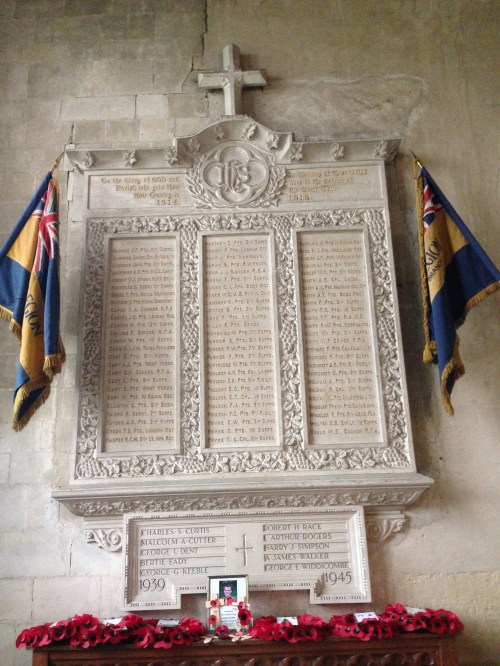
This one commemorated those who died in both World Wars. A handwritten Book of Remembrance dating from 1922, it was compiled with the specific intention that those who died would have more than their names remembered.

Lavenham War Memorial

Lavenham War Memorial – Jane Roberts

There appeared to be a page devoted to each man, giving name, age and address alongside service details and even extracts from letters informing families of their loss. A wonderful lasting legacy for generations to come.  Lavenham book of remembrance

These books are particularly poignant because of their “of the time” nature. I wonder how many more are out there? And how many are being reprinted to ensure these men’s memories are perpetuated?
WW1 Remembrance in Verse: “In Memoriam” and “Roll of Honour” Newspaper Columns

This is the last of my three blog posts in this period of Remembrance. It focuses on the WW1 period.

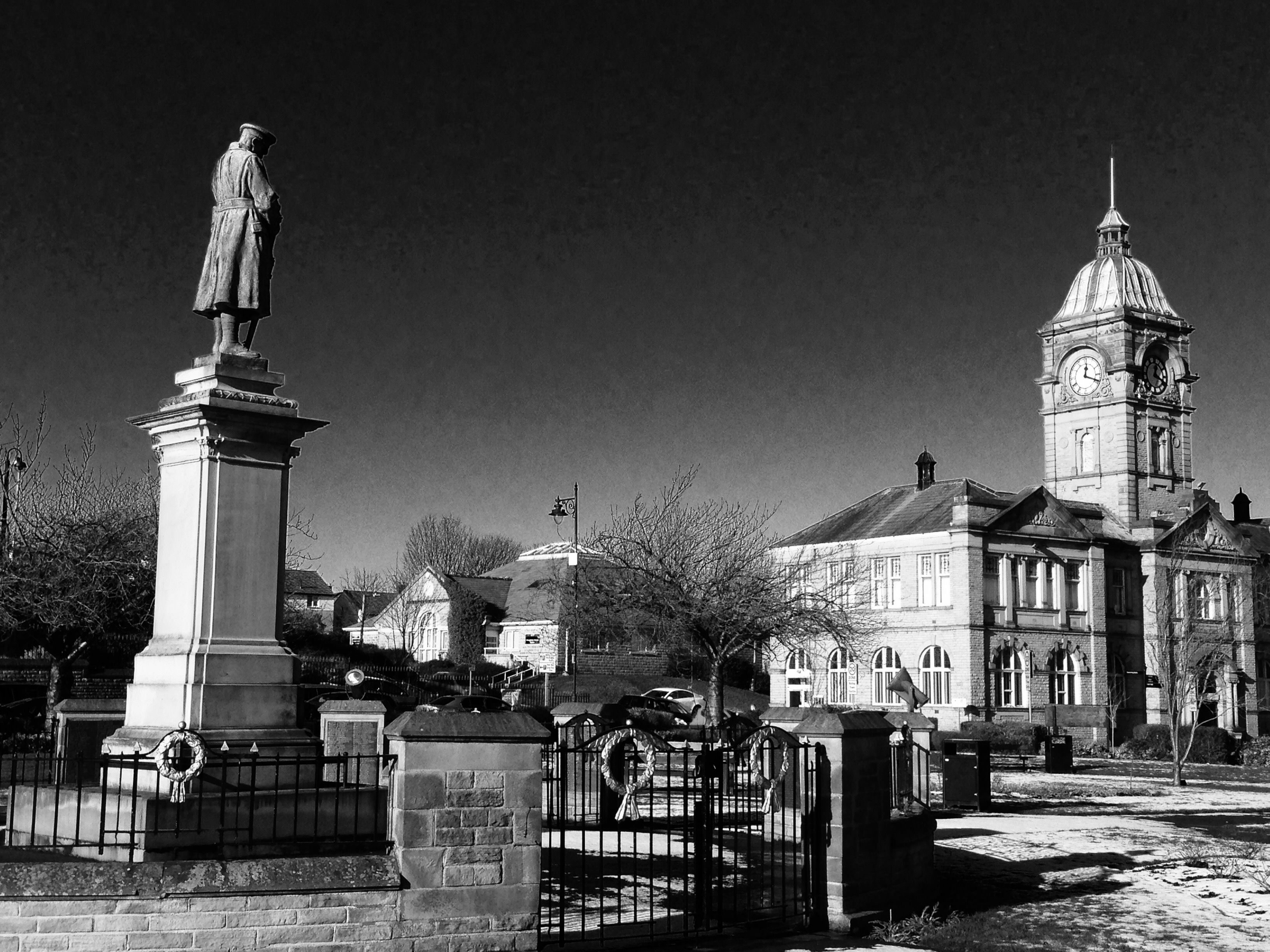
Batley War Memorial

Batley War Memorial

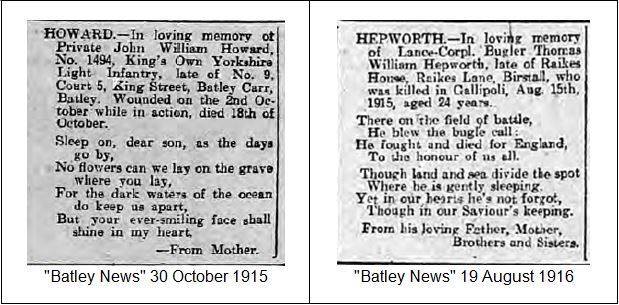
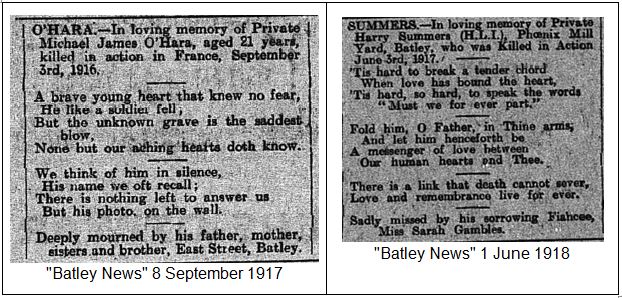
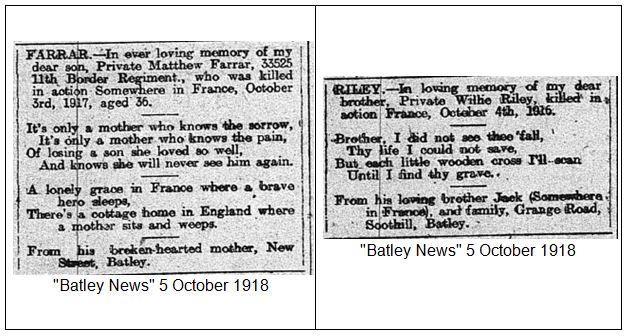
As the Great War progressed and the anniversaries of the Fallen came and went, the local newspaper “In Memoriam” and, later, dedicated “Roll of Honour” columns were increasingly filled with moving tributes to lost husbands, sons, fathers, brothers and fiancées. Although less frequent in late 1915 and throughout 1916, this phenomenon became particularly notable from 1917 onwards and endured in the years beyond the end of the conflict.

Many were recurrent standard verses, or variations on standard themes: grief; absence; young lives cut short; a mother’s pain; religious sentiments; Remembrance; doing one’s duty; sacrifice; wooden crosses; graves overseas far from home, or no known grave; not being present in their loved one’s dying moments; occasionally the difficulty of seeing others return; and even reproach for those who caused the war.

Although not war poetry, they are powerful representations of family grief and loss which echo across the ages.

My mother’s brother died in Aden whilst on National Service in 1955. These family tributes from another era are the ones which, in all my St Mary’s War Memorial research, left the greatest impression on her, resonating with her emotions 60 years later.

These “In Memoriam” and “Roll of Honour” notices provide an accessible window into this aspect of the War, the emotions of those left behind. They are also a continuing legacy for family historians. They can provide service details, place and even circumstances of death, names and addresses of family members (including married sisters) and details of fiancées all of which can aid research.

Here is a selection from the local Batley newspapers[1].

Remembrance 1

Remembrance 2

Remembrance 3

Remembrance 4

Remembrance 5

Remembrance 6

Remembrance 7

Remembrance 8

Sources:

  • Batley News – various dates
  • Batley War Memorial photo by Jane Roberts

[1] These are not confined to those servicemen on the St Mary’s War Memorial

Remembered by Families in Batley Cemetery; Remembered by the CWGC Elsewhere

This is the first of my posts in the run up to Remembrance Sunday.

The work of the Commonwealth War Graves Commission (CWGC) is familiar to many. They care for cemeteries and memorials in 23,000 locations across 154 countries, ensuring the 1.7 million people from Commonwealth forces who lost their lives as a result of the two world wars are never forgotten.

Batley cemetery contains CWGC 66 burials. Predominantly these plots have standard CWGC headstones, but there are also some Private Memorials where families chose to erect their own headstone on a war grave. All are listed on the CWGC website.[1]

Unsurprisingly some families who had loved ones commemorated elsewhere by the CWGC, chose also to include their names on family headstones in home cemeteries. This is not exclusively confined to those military personnel with no known graves.  These are not classed as war graves. The service person is not buried there. So they are entirely distinct from CWGC recognised Private Memorials.

These inscriptions would provide a focal point close to home for families of service personnel with no known grave, or buried far from home. They are a visible sign of love, acknowledgement and family remembrance.

These headstones can prove invaluable for researchers in terms of family and service details. But, as they are not war graves, they are not recorded by the CWGC. So it is a case of seeking them out.

Here are four I spotted in Batley cemetery.

Able Seaman Farrar Hill, killed on 31 January 1918[2] when his submarine, HMS E/50,  was lost in the North Sea. It is believed to have struck a mine near the South Dogger Light Vessel.  He is commemorated on the Plymouth Naval Memorial. But he is remembered on the Hill family headstone.

Farrar Hill - family headstone

Farrar Hill – family headstone

Pte Robert Hirst, 6th Bn King’s Own Yorkshire Light Infantry. He was killed in action on 24 September 1915 and has no known grave. His name appears on The Ypres (Menin Gate) Memorial. His family have included his name on a relatively new headstone in Batley cemetery.

Robert Hirst's relatively new headstone

Robert Hirst’s relatively new headstone

Rifleman Edward Leonard, 1st/8th Bn West Yorkshire Regiment, killed in action on 2 July 1916 and commemorated on the Thiepval Memorial. His sister Annie, a munitions worker at the Barnbow factory at Garforth, Leeds, died on 21 July 1916 from picric acid poisoning – the same day as the Leonard family received news Edward was missing. His and Annie’s name appear on the headstone.

Headstone - Edward Leonard

The Leonard family headstone

Pte Albert Smith of the 2nd/5th Bn Duke of Wellington’s (West Riding) Regiment died of wounds on 27 May 1918. He is buried in Bagneux British Cemetery, Gezaincourt, France but he is also included on his family headstone.

The Smith family headstone - including Albert Smith

The Smith family headstone – including Albert Smith

So, even for those service men and women commemorated on CWGC memorials and in cemeteries elsewhere, do not discount information provided on family headstones closer to home.

The Royal British Legion launched its 2015 Poppy Appeal on 22 October. This is their link: http://www.britishlegion.org.uk/

Sources:


[1] http://www.cwgc.org/
[2] Some sources indicate the submarine was lost “on or around 1 February 1918”, but 31 January is the CWGC date