Category Archives: Catholic

Batley Privy Riots and the Death of a Policeman

Searching for my ancestors in the Batley library newspapers, I ended up totally side-tracked reading about the goings-on in the town’s New Street area. Some incidents involved distantly connected relations. But the real value was the insight it gave into the community in which my ancestors lived, over a narrow timeframe. I looked at the two years from Christmas 1875. Whilst I didn’t read every paper, the ones I skimmed gave a flavour.

The 1875 Christmas festivities in New Street, an Irish immigrant area, resulted in court appearances for a number of its residents. The first involved Ann Gavan, a married woman (so far no link with my Gavans), accompanied by the headline in the “Batley Reporter” of 1 January 1876 “The Way Christmas is Kept in New Street”. On 27 December she appeared at Batley Borough Court, convicted of being drunk and riotous on Christmas Day.

She attracted police attention on Christmas Eve. Seeing a crowd gathered around her house, Police Sergeant Gamwell looked through the window. He saw her lying heavily drunk on the floor, surrounded by a crowd of boys. Her husband was also drunk. In fact they were seldom sober. By 3am Christmas Day the pair were cursing and swearing, attracting a large crowd. At this point Police Constable Shewan apprehended Ann. He couldn’t manage her husband too.

But this wasn’t an isolated New Street incident. Appearing in Batley Borough Court on the same day were an assortment of individuals. Christmas Day saw John King, described as an old man – although what constituted old then may not be the case by today’s standards, hauled off to the police station. Again the charge was one of drunk and riotous behaviour. He also assaulted the arresting office, Police Constable Beecroft. On 26 December Patrick Jordan and Patrick Moran’s drunken fight resulted in a drunk and riotous conviction for the pair. Their escapade tied up five or six police officers most of the evening. And Michael McManus was similarly convicted, for the 17th time.

That wasn’t the end of the parade of individuals before Batley Borough Court for events that Christmas in New Street. The following week’s edition of the “Batley Reporter” contained a string of obscene language cases: Mary Foley used obscene language towards several policemen on 26 December; Ellen Tarpey was convicted of using obscene language toward Mary Gavan (a potential family connection here) on 27 December; the case against John Hannan (another family link) was dismissed. He faced a charge of using obscene language towards Ann McCormick on 28 December. And finally yet another case involving Ann McCormick as victim, this time at the receiving end from John McManus on 27 December. The Mayor wished the bench could fine her too, as he considered her equally to blame in the incident.

The idea that this was a one-off string of cases occasioned by Christmas doesn’t hold water. True the police office was nearby, so the area fell under particular scrutiny. But no other area of Batley had such a high proportion of cases. In fact the Mayor “….commented strongly on the number of cases of obscene language brought before the Bench especially from that locality; and said if it was not for the cases from that district the magistrates would have little to do”.

And going through the papers there are more cases, not confined to holidays. The one incident that stuck out for me did involve distant relatives: John Hannan, of the murderous poker assault episode on his father-in-law, and his wife, Margaret. The newspaper heading reads “Dealing Gently With New Street Rioters”.

The incident started at 3.45pm on Sunday 15 October 1876, lasted two or three hours, and involved several residents. It was sparked by the disputed use of a privy in the yard of Patrick Gannon. Hannan and another man broke open its door. They claimed they had a right to be in the toilet. It appears Gannon and nearby neighbour Mary McManus, with whom the Hannans now lodged, shared the same landlord. The landlord authorised Mary’s use of the privy.

687px-Toilet_in_the_Beamish_Museum_01 (2)

Outside Toilet at Beamish – Wikimedia Commons by Immanuel Giel

Gannon claimed that as he challenged the “intruders”, Hannan struck him. At this point Gannon fetched the police.

Normally in these circumstances the police would not attend. They would issue an assault summons. On this occasion Police Constable Friendly Hague went with Gannon to New Street, an action subsequently criticised. He defended it by saying Gannon was afraid to go home. Perhaps the fact Hannan was well-known to the police had an influence.

It was claimed Hannan re-commenced his attack on Gannon. Police Constable Webber, upon seeing the crowd gathered in New Street, went to see what was happening. He assisted Police Constable Hague in apprehending Hannan, who resisted. In the ensuing melee Bridget Gannon, wife of Patrick, came out with a poker. At this point Hannan was on the floor, black in the face from being throttled by Police Constable Hague.

Margaret Hannan now joined in to rescue her husband. She too was armed with a poker, striking both Gannon and Police Constable Hague about the head, shoulders and back with it, saying “I’ll not let the b___ take him”. She was led away by Mary McManus.

Michael Gallagher also joined the affray, kicking Police Constable Hague whilst on the floor, saying “We’ll kill the b___ if you like”. Hannan incited Gallagher further by crying “Go into him”, so Gallagher obliged, aiming another kick.

The upshot of this Court appearance before the Mayor, Alderman J.T.Marriott: Hannan was cleared of assaulting Gannon. He was also cleared of damaging Police Constable Hague’s trousers, as the Mayor said the policeman should not have rushed in as he did. He was, however, convicted of the assault on Hague; as was Gallagher; Margaret was convicted of assaulting both the policeman and Gannon.

Whist on the surface this seems a series of humorous incidents, it highlights the problems faced by these early Victorian police in executing their duty. It was also a precursor to an event with far more serious consequences: the death of a policeman in the town on 9 December 1877. Inevitably New Street featured in the events.

William Peet [1] was born in January 1853, the son of agricultural labourer Thomas Peet and his wife Sarah. His baptism took place on 1 May 1853 in the parish of Wolvey in Warwickshire, close to the border with Leicestershire. The family are recorded here prior to William’s birth in the 1851 census, with daughters Sarah Ann (6), Elizabeth (2) and Jane (2 months).

By the time of the 1861 census the Peets had moved north to Broomhill near Barnsley. In addition to William and his parents, the family included Jane (10), Joseph (6) and infant son Thomas.

William’s father died sometime prior to the 1871 census. This census shows William as the oldest child residing in his mother Sarah’s home. Not yet 50 and described as an annuitant, she had five other sons at home, three under the age of 10. These were Joseph (16), Thomas (10), Fred (8), John (7) and Harry (4). William’s wage from his job as a mason’s labourer must have been a welcome support.

In September 1874 William married 19 year old Mary Downs at Wombwell parish church. The register entry describes his occupation as a miner. Two daughters followed, Lily (1875) and Sarah Ann (1877).

It was shortly after Sarah Ann’s birth that William undertook a significant change of career. 1856 saw the creation of the West Riding Constabulary, an organisation which William joined on 17 September 1877. The Examination Book shows he measured 5”8¼”, had light hair, light blue eyes and a fair complexion. He described his trade as a labourer, his previous employment being at Barnsley’s Lundhill colliery. He was attached to the Division responsible for policing in Batley on 23 October 1877.

It was at around the time of a sequence of serious incidents between Batley’s Irish community and the police. In one incident, originating in New Street at the end of November 1877, Police Constable Beecroft suffered such a serious assault it rendered him unfit for work weeks later. This was the situation facing the new policeman. A situation which cost him his life on Sunday 9 December 1877.

The remarks column of his Examination Book reads:

“Killed in a street row at Batley by a number of drunken Irishmen (between 11pm and midnight). He and PC 278 Herring were quelling the disturbance when 7 or 8 Irishmen turned round and began to beat, stone and kick them in a most unmerciful manner, one of them striking a fatal blow on the head with a heavy walking stick taken from PC Herring”.

From around 9pm on 8 December PC Peet and PC Robert Herring patrolled the Batley area around New Street, Wellington Street, Hick Lane and Union Street. At just gone 11pm they heard a disturbance on Cobden Street and witnessed a crowd of around 60 men and women. A number of them, William Flynn (27 year old shoemaker), Patrick Phillips (labourer, age 25 ), John Ryan (labourer, 24) and Michael O’Neill (labourer) had been to a jig at Patrick McGowan’s “Prince of Wales” beerhouse in Cobden Street. New Street’s Ann McCormick, a rag picker and a familiar name in my research of the area, (there was a mother and daughter of this name and I suspect this was the daughter whereas the one involved in the Christmas 1875 incidents was the mother), also attended the dance. Now, after closing time, many of the revellers became involved in a street dispute.

Some men had their coats off, including Flynn, O’Neill and Phillips, and were threatening to strike men from the Staincliffe area and neighbouring town of Heckmondwike, including Patrick Hunt. When PCs Peet and Herring arrived Ann McCormick, screaming and crying, claimed she had been struck by one of the Batley men, pointing in the direction of Flynn and O’Neill. Apparently it was the latter. There is the possibility she was trying to obtain payback for a prevented marriage.
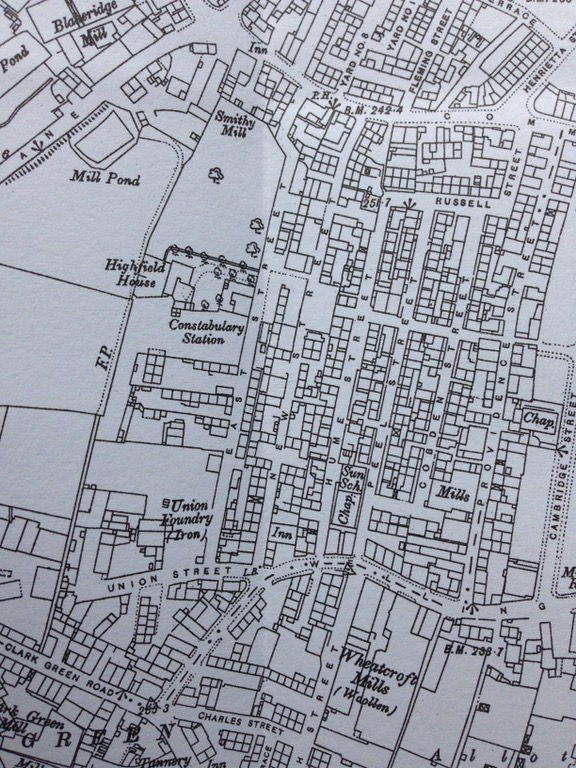
1892 map showing the area events took place

The police tried to diffuse the situation, attempting to get the crowd to disperse. At this point the Staincliffe and Heckmondwike men made their escape. Flynn and his mates progressed down Peel Street, swearing and cursing but then, reaching Wellington Street, refused to move.

Challenged by Herring about their dispersal delay, one of the men knocked the policeman down stealing his wooden stick. He then charged at PC Peet striking him about the head with the stolen weapon, knocking him to the ground and taking his truncheon.

There was some confusion as to the identity of this assailant. PC Herring remained adamant throughout the judicial process it was Flynn; but it was a dark night with little lamplight, and evidence from others was confusing with some indicating O’Neill. Some giving evidence claimed not to have seen blows struck, others only fist blows. Doubt was also cast on Herring’s identification because he had only been working in the Batley area for a few weeks. And new witnesses crawled out of the woodwork disputing events. For example Mary Foley appeared at the Assizes claiming she witnessed the row but hadn’t appeared before the magistrates earlier in proceedings because she “had a queer husband, a large family, and did not want to be mixed up with the police”.

Whilst Peet was down, Flynn, O’Neill and Ryan aimed kicks at him. They then turned on PC Herring.

This provided an opportunity for PC Peet to regain his feet and assist his colleague. The pair managed to grab hold of Flynn. Other men in the crowd began to pelt the police with stones and loose setts which had been left in he street by council workmen carrying out repairs. John McManus, a 25 year old collier, was identified as the man who threw the setts. Phillips as a stone-thrower. Peet was hit on the back of the arm or shoulder. The stone-throwing enabled Flynn to escape into a house in New Street, the police giving chase.

No other officer heard PC Herring’s whistle-blowing calls for help and the crowd refused to assist, so he remained watching the house whilst PC Peet brought police reinforcements. The extra police arrived but upon entering the house they found Flynn had vanished.


The police now went about tracing and arresting those involved. These included Flynn (apprehended in his bed at his Ward’s Hill home 1.30am. His wife woke him and he struck her saying “You b*****”, and to Robert Webber, one of the arresting policemen “It’s thy b***** phizog is it?”). Others rounded up were McManus, Ryan, Martin Devanagh and Patrick and James Phillips. Patrick Phillips, according to some reports, lodged in John Hannan’s house, but the Clark Green[2] location does raise questions as to whether it is “my” man. One person though evaded capture – O’Neill.

Whilst this was going on, at just before 1am in the morning Peet complained of feeling ill and returned to his Purlwell Lane home in the Mount Pleasant area of town. It was a house which he and his family shared with the Herring family. During the early hours he became increasingly unwell, lapsing into a coma. Police surgeon James Cameron was called at around 6am and Peet died just before 8am.

Cameron undertook a post-mortem, assisted by Dr William Bayldon. It revealed Peet had suffered a skull fracture and haemorrhage, causing his death. Peet’s body was taken back to his home near Barnsley for burial.

The two-part inquest in front of Thomas Taylor, district coroner, was held on the 11 and 18 December at the New Inn at Clark Green in Batley. A verdict of murder by Flynn was reached.

The men next appeared before the Magistrates, and a large crowd, at Batley Town Hall on 20 December. The case against Devanagh was dropped as the evidence against him was not sufficiently strong. Herring couldn’t swear to his presence and he, naturally, denied having been there.

At the end of the hearing James Phillips was also discharged. Although said to be at the row, he wasn’t seen doing anything termed fatal.

That left Flynn, Ryan, McManus and Patrick Phillips committed to trial at the Yorkshire Winter Assizes on a wilful murder charge: Flynn as the man who inflicted the fatal blow, the others for aiding and abetting. Some discussion did take place about extending this serious charge  wider than Flynn, but the balance of opinion swayed in favour of it. They concluded it was not necessary that all persons should inflict the fatal blow. If those present aided and abetted, they were all equally guilty of wilful murder.

The proceedings in Batley were not without occasional humour, a kind of “us and them” scenario reminiscent of Sir Jeremiah Harman’s Springsteen, Gascoigne and Oasis comments. These included an exchange in Batley Borough Court  about the meaning of “jig“, with Mr Airton from the West Riding Police providing the explanation.
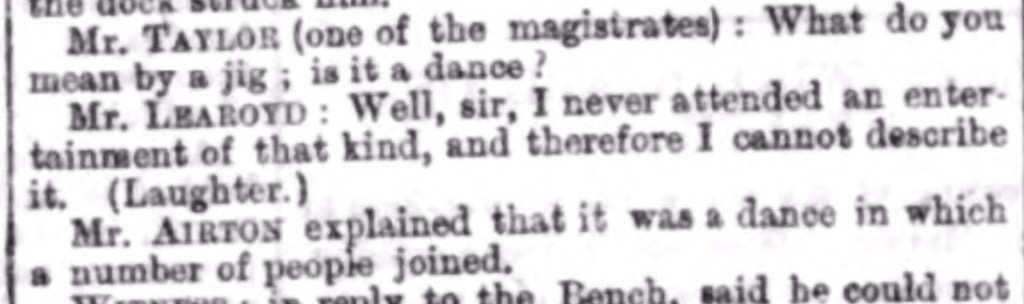
“Dewsbury Reporter” 22 December 1877 – A Jig Explained

At the inquest  Ellen Chappell, a witness, illustrates wonderfully why we have variations in ancestral surname spellings.

Surname Confusion – “Huddersfield Chronicle” 19 December 1877

The Assizes took place at Leeds Town Hall the following month. One of the first decisions made by the Grand Jury was a downgrading of the charges against Ryan, McManus and Phillips as there did not appear to be any common purpose between Flynn and the others to attack Peet. They now faced a charge of assaulting a policeman in the execution of his duty. Only Flynn faced the charge of wilful murder.

His trial took place on 18 January 1878. To an outbreak of applause in the court the jury returned a “not guilty” verdict. This on the basis of uncertainty as to who stuck the fatal blow – they could not definitely say it was Flynn. He was detained to face an assault charge with the others, the following day.

This was the final trial of the Assizes. Because Flynn had been acquitted of Peet’s murder, no evidence was offered for the assault and he was discharged. Guilty verdicts were reached against the other three men, who each received six month sentences.

Mary Peet and her children returned to her hometown of Wombwell, near Barnsley. The Police Committee granted her a £65 gratuity. A subscription fund was also established for her. She married coalminer Den(n)is Bretton in 1879, having a number of other children during her second marriage, including a son named William.

Besides a man loosing his life, the death of PC Peet highlighted racial tension in Batley, between the Irish and local communities. A series of local newspaper letters and articles are testimony to this. One letter illustrating the fact, which attracted much attention, appeared in the “Dewsbury Reporter” of 15 December 1877. It was written from “A Batley Lad”. It harked back to the leniency shown to those New Street privy rioters amongst others. It read:

“The murder of a constable, often predicted, in Batley, has at last taken place, and perhaps the Irish now will be a trifle more quiet. They have felled many a policeman during the last two years, and when brought up, especially when Mr J.T. Marriott was Mayor and Ex-Mayor, have been let off, as your paper recorded from time to time, with most inadequate punishment. The Irish in this quarter are a very low lot, and rows and fights have taken place every weekend, but instead of the magistracy supporting the representatives of the law they have leaned to the other, and not virtuous side.

I think it is time that we had our own borough police, for if we had I think we should not allow them to be knocked about by the Irish roughshod as the poor county constables have been.

Perhaps the Irish after this murder will remember Patrick Reid”.[3]

Rev. Canon Gordon, the priest at St Mary of the Angels RC Church, referred to the incident in his sermon on Sunday 16 December 1877. He stated the Irishmen involved in the disturbance and murder never entered Church, and were Catholics in name only. He went on to say the event was a disgrace to all true Irishmen and Catholics. The incident confirmed his previously expressed opinion that a murder would be committed in Batley as a result of the excessive drinking which prevailed in the Irish classes. He concluded by expressing the hope that God would severely punish the guilty as a lesson to future generations.

This was the community in which my Irish ancestors lived and were part of. Its history forms a critical backdrop in shaping their everyday lives.

I’ve named only a fraction of those involved in the various stages of the trial for the murder of William Peet. If anyone believes their ancestor is involved I’m happy to check my notes.

Footnotes:
[1] Sometimes referred to as Peete
[2] Modern spelling is Clerk Green
[3] Patrick Reid was an Irish hawker executed in York on 8 January 1848 for the triple murder in Mirfield of James and Ann Wraith and their servant Caroline Ellis

Sources:

  • Ancestry.co.uk – Warwickshire Anglican Registers for the Parish of Wolvey; West Riding Constabulary Examination Books; Wakefield Charities Coroners Notebooks, 1852-1909; Criminal Registers, 1791-1892 (HO 27);
  • “Batley Reporter” newspaper
  • Census: 1851-1881
  • FindMyPast – Doncaster Archives Yorkshire Marriages; newspapers including “Dewsbury Reporter”, “Huddersfield Chronicle”, “Leeds Mercury”, “Yorkshire Post and Leeds Intelligencer”,
  • GRO Indexes
  • Wikimedia Commons for photograph of outside toilet, by Immanuel Giel – Own work, Public Domain, https://commons.wikimedia.org/w/index.php?curid=1110467

Obsolete Mayo Family History Website: Wayback Machine to the Rescue

In a couple of my blog posts (My County Mayo Family and The National Library of Ireland Catholic Parish Registers Website and Parish Registers: Brick Wall Breakers and Mystery Creators) I’ve referred to one of my much loved, and missed, websites. It was a County Mayo baptism and marriage transcript site, EastMayo.org, launched in 2005. Mainly using LDS films, it’s aim was to provide a free facility to researchers of family history in East Mayo. It concentrated on “that area of County Mayo encompassed by the Roscommon border and the towns of Charlestown, Boholo, Swinford, Kiltimagh, Knock, Claremorris and Ballindine”.  

 The transcripts included:

  • Aghamore 1864-1883 and Knock 1869-1905 Baptisms; 
  • Aghamore Marriages 1864-1882; 
  • Claremorris Civil Registrations 1872-1875; 
  • Claremorris Marriages 1806-1890 and Baptisms 1835-1912; 
  • Kilconduff Marriages 1846-1878; 
  • Kilmovee Baptisms 1854-1910 and 1881-1913; 
  • Kilmovee Marriages; 
  • Kilmovee Marriages Out of Parish; 
  • Knock Marriages 1883-1943 

With generations of my family from the Catholic Parish of Kilmovee, this site was a Godsend. I was disappointed when it disappeared. Although in 2015 the National Library of Ireland launched its free Catholic Parish Register website plugging some of the gap, the EastMayo.org had a broader date range for its limited number of Parishes.   

And there were some extras such as the fabulous “Kilmovee Marriages Out of Parish” transcriptions. Basically, if someone married out of Parish, the priest in the Parish the marriage took place contacted the priest in the person’s baptismal Parish informing them. 

I’ve seen something similar in the Batley St Mary’s registers. These contained such letters slipped between the pages. Indeed in this Parish, the priests went so far as to annotate the person’s baptismal entry with their subsequent marriage details, whether the marriage took place in or out of Parish.  

The Kilmovee transcripts covered marriages in the first part of the 20th Century, with marriages taking place within Ireland and beyond. Although only a snapshot of around 30 years, the Batley marriages of my grandpa (John Callaghan) and his brother (Martin Callaghan) are captured in them. 

An example of the global range of these marriages is seen in the initial transcriptions. They included former Kilmovee parishioners marrying as far afield as Glasgow, Batley, Orange – New York, Stockport, Congleton, Manchester, Doncaster, Accrington, Huddersfield, Charlestown, St Helens, Jersey City – USA and Silver Falls, Canada.  

Information on these Out of Parish marriages varied, but could contain: 

  • spouse; 
  • baptismal date (a bit of creativity here – most of the dates given seem to be approximate); 
  • parental details, with sometimes the mother’s maiden name; 
  • date and place of marriage (church and location);
  • witnesses; 
  • officiating priest; 
  • age; and  
  • if the person is widowed. 

The information provided linked your ancestor to a Parish. It also enabled you to track back further, for example by looking at the baptism transcripts.  

Yes, there were acknowledged transcription difficulties, but it was a wonderful resource.  

An updated EastMayo.org site domain name still exists with links to Irish-related websites, though it is not the original site with all that wonderfully name-rich information. But all is not lost. The original, as it stood between 2006-2011, can still be accessed via the Internet Archive Wayback Machine. 

And I’ll end with another really useful County Mayo website, which can be found here. Besides current day information, including where to stay and things to do, there is information about the area’s history, geography and culture generally as well as that of individual towns and villages. There is also a message board which may be helpful for those with Mayo roots.

Batley Rugby League Club’s WW1 History-Maker

Some debate occurred in the Yorkshire press in March 1915 as to who was the first Northern Union player in Yorkshire and beyond to obtain a commission in The Great War.

The “Huddersfield Daily Examiner[1]” and “Yorkshire Evening Post[2]” declared that in Yorkshire the accolade fell to Wakefield Trinity’s William Lindsay Beattie who was appointed temporary 2nd Lieutenant in the Border Regiment on 15 March 1915.[3] He lost his life on 27 January 1917. Lancashire-based Wigan’s Gwyn Thomas was reputed to be the first commissioned Northern Union player. However, I believe this event occurred towards the end of 1914. Thomas survived the war and joined Huddersfield in 1919.

Both papers overlooked Batley winger, Robert Randerson.

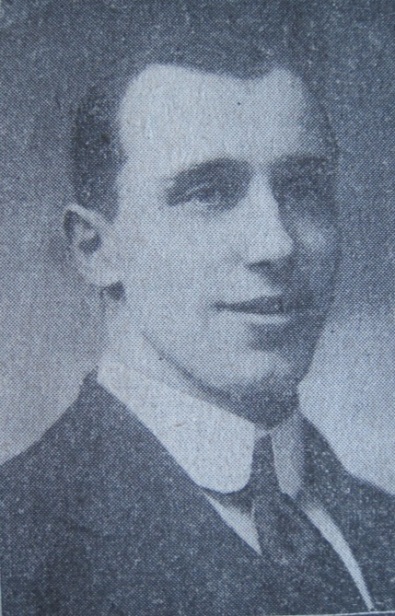
Robert Randerson Robert Randerson

Robert, (or Bob as he was known according to the local press), joined the Leeds University Officer’s Training Corps (OTC) shortly after Britain’s entry into the War. “The London Gazette” of 25 August 1914 lists Robert as amongst those OTC cadets and ex-cadets appointed as temporary 2nd Lieutenants.[4] Promotion quickly followed. In January 1915[5]“The London Gazette” announced his appointment to temporary Lieutenant with effect from 10 December 1914. Only months later, on 15 May 1915, he became a temporary Captain as notified in a June edition of the same official journal.[6]

Letters of correction to the papers followed; and the Batley Club itself was adamant the honour belonged to its player. In its Annual Meeting of May 1915 it pronounced:

“Randerson…..was the first N.U. player to receive a commission. This honour has been claimed by others but it belongs to Lieut. Randerson and the Batley Club”[7]

Within weeks of this discussion, on 7 August 1915, Robert was to lose his life in the “Yorkshire Landings” at Gallipoli.[8]

Robert was born in York in late 1890, the son of Robert and Annie Randerson (neé Wilkinson). His siblings included Annie (1886), Benjamin (1889), William (1892), John Wilkinson (1897) and George (1899).

The family were comfortably off with Robert senior earning his living as a master corn miller then as a grocer and corn merchant. By 1901 the family lived on Haxby Road, York and remained here at the time of Robert’s death.

They were an old Catholic family with strong religious convictions and connections. After training at Ushaw, Robert’s uncle Benjamin served as a priest initially briefly at St Patrick’s, Leeds, then St Charles Borromeo, Hull and lastly, until his death in 1897, at St Hilda’s, Whitby. In the 1911 census Robert’s sister, Annie, was a nun residing at St Wilfrid’s Priory, Arundel. She was employed as a head mistress at the town’s St Phillip’s Infants’ School.[9] His younger brother, John, was a boarder at the Franciscan College at Cowley, Oxfordshire.

The 1911 census shows Robert, a former pupil at Archbishop Holgate’s Grammar School in York, following his sister Annie’s educational career path. A student at St Mary’s College, Hammersmith, the objective of this establishment was to train Catholic men to serve as teachers in Catholic schools throughout the country. Robert demonstrated his sporting ability whilst studying here. In an inter-College sports contest he broke all previous records for the 100 yard flat race, covering the ground in a shade over 10 seconds.

Robert came to Batley in around 1913 as an assistant master at St Mary’s school. He soon became involved in the wider Parish community, holding the role of choirmaster at St Mary’s church.

But he became known beyond the town’s Catholic population when he started playing rugby for Batley. Initially in the reserves, he made his first team debut in a cup-tie at Halifax on 14 March 1914. His career was limited by the outbreak of war, but in this short time he made five appearances for the Batley first team scoring four tries.

At the declaration of war Robert’s strong sense of duty kicked in. He was the first Batley player to enlist and was quoted as saying:

“I am not a fighting man; I don’t like to fight, but I ought to go and fight at a time like this”.

He served with the 6th (Service) Battalion, Alexandra, Princess of Wales’s Own (Yorkshire Regiment), one of Kitchener’s New Army battalions. His enlistment necessitated a re-arrangement of the St Mary’s Boys Department school timetable, an event noted in the school log book.

It was whilst serving with the Yorkshire Regiment based at Belton Park, Grantham, that he made his final appearance for Batley against Keighley on 10 October 1914. He told the club secretary Kershaw Newton that it would be his last game with the Gallant Youths until peace was signed as, with his exhaustive training programme of marching, drilling, lectures and special studies as an officer on top of his ordinary duties, he was “about played out by the weekend”.

Additionally, with his officer responsibilities, he could not afford to risk a rugby playing injury.

“….I have 60 men under me and am responsible for them, and will have to lead them in war. To make them and myself efficient requires all my time and energy, and I do not think it would be right to risk laying myself up with an injury….”

Poignantly he wrote:

“…..I will come and hope to see many of my old friends round the railings as a sort of good-bye until we get the serious business through and when honour and justice are satisfied I trust to have many a jolly game on the hill”.[10]

Robert scored one try in Batley’s 19-0 victory. But, ironically given his concerns about injury before the game, he suffered the misfortune of a kick to the head. This blow confined him to a darkened room for a few days on returning to Belton Park.

At the beginning of July 1915 Robert and his Battalion left Liverpool bound ultimately for the Dardanelles. Initially landing at Mudros they moved onto the island staging post of Imbros to acclimatise and practice night landings and attacks. On the evening of the 6 August they left Imbros and at around 11pm that night they finally disembarked on the Gallipoli peninsular, south east of Nibrunesi Point on B Beach. The aim was to take Lala Baba, a low hill between the southern side of Suvla Bay and the Salt Lake.

Map of Suvla Bay and ANZAC Cove from Gallipoli Diary, Vol. 2 by Sir Ian Hamilton - Edward Arnold, London - From Wikimedia Commons Map of Suvla Bay and ANZAC Cove from Gallipoli Diary, Vol. 2 by Sir Ian Hamilton – Edward Arnold, London, 1920 or before – From Wikimedia Commons

As the men moved off from the sea shore they were immediately engulfed by the darkness of the night, it being impossible to see a body of troops at a few yards distance.

Lala Baba was eventually taken, but the Unit War Diary records a heavy price paid with 16 officers and about 250 other rank casualties (killed and wounded) in the fighting during those first hours of the night of 6/7 August 1915. This was out of a total of 25 officers and 750 other ranks that set off from Imbros only a short time earlier.

Robert was amongst those officers killed. He died on 7 August 1915 within hours of landing. According to a fellow officer he met an instantaneous death as a result of a gunshot wound to the head. In a letter to Robert’s father he wrote:

“We made our landing of the evening of the 6th August below the Salt Lake. The 6th York’s covered the landing of the rest of the Brigade. At about 10a.m we disembarked from the barge with little opposition and started up the peninsular to take a hill called Talla Baba, and there we lost a lot of men. I got there just before 12 midnight. Some of our men had gone over and some were held up by the Turks entrenched on top and there were several of our officers wounded and killed there, I was told your son had been killed there and the sergeant who told me said that he had been shot through the head, so his death seems to have been instantaneous”.[11]

The first news of Robert’s demise reached Batley around the 12 August when Mrs Power, with whom he had apartments in Norfolk Street before the war, received a brief note from his father informing her that he had been killed in the Dardanelles.

Local tributes poured in for him, newspapers referring to him as “Gentleman Bob”.“The Batley Reporter and Guardian” praised his “manly character and sterling qualities” concluding he “was a true sportsman and a most popular player on the field and a perfect gentleman in private life”.[12]  

The Batley News eulogised his virtues saying:

“A pattern of good conduct on the football field, handsome appearance, of excellent physique, and a splendid teacher, his demise removes from the Heavy Woollen District one whose manifold example commends itself to the rising generation”. [13]

The members of the Batley Education Committee were equally fulsome with their tributes to Robert in their meeting at the end of September 1915. They expressed sympathy with his family and appreciation for his work in the town. Alderman H North said that:

“Captain Randerson was a typical gentleman; an ideal leader of boys and a man appreciated by his scholars and school managers. …… His death had removed from Batley a most capable servant of the education committee….. The town was poorer by his demise”. 

His death was also noted in Catholic newspaper “The Tablet”[14]

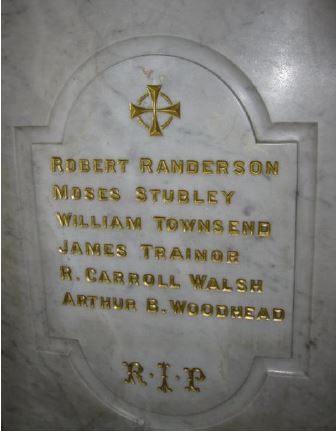
Robert Randerson, remembered on Batley St Mary's War Memorial Robert Randerson, remembered on Batley St Mary’s War Memorial

I will leave the final word on Robert from the school in which he worked. Almost exactly one year to the day from the St Mary’s log book entry about timetable changes forced by Robert’s enlistment, the same log book has an entry on 16 August 1915 announcing that school re-opened after the midsummer holiday. It went on to say in a restrained, understated way:

“News received that Captain Randerson, Assistant Master from this school, was killed in action at the Dardanelles on August 7th”. 

Sources:

  • Batley News
  • Batley Reporter and Guardian
  • Commonwealth War Graves Commission
  • FindMyPast – newspapers, census records and Teacher’s Registration Council Registers: http://www.findmypast.co.uk/
  • School Log Book – Batley St Mary’s
  • “St Mary of the Angels War Memorial” – Jane Roberts
  • “The Gazette” website: https://www.thegazette.co.uk/
  • “The Tablet” archive: http://archive.thetablet.co.uk/
  • The National Archives Catalogue Reference: WO/95/4299: Unit War Diary – 32 Infantry Brigade, 6th Battalion Yorkshire Regiment 1 July 1915-31 December 1915
  • Wikimedia Commons – Map of Suvla Bay and ANZAC Cove from Gallipoli Diary, Vol. 2 by Sir Ian Hamilton – Edward Arnold, London, 1920 or before

[1]“Huddersfield Daily Examiner”, 25 March 1915
[2]“Yorkshire Evening Post”, 27 March 1915
[3]“The London Gazette”, Publication date: 19 March 1915, Issue: 29106, Page: 2745
[4]“The London Gazette”, 25 August 1914, Issue 28879, Page 6697
[5] “The London Gazette”, 15 January 1915, Supplement 29043 Page 594
[6] “The London Gazette”, 11 June 1915, Supplement 29192 Page 5736
[7]“Batley News”, 22 May 1915
[8]http://www.cwgc.org/media/50615/suvla_version_7.pdf
[9] The Teacher’s Registration Council Registers show she was headmistress at St Phillips between 1910-1916
[10]“Batley News”, 10 October 1914
[11]“Batley Reporter and Guardian”, 1 October 1915
[12]“Batley Reporter and Guardian”, 13 August 1915
[13]“Batley News”, 21 August 1915
[14]“The Tablet” Et Cietera, 28 August 1915 http://archive.thetablet.co.uk/article/28th-august-1915/23/et-cietera and Catholic Roll of Honour, 1 January 1916 http://archive.thetablet.co.uk/article/1st-january-1916/13/the-catholic-roll-of-honour

Copyright

© Jane Roberts and PastToPresentGenealogy, 2015. Unauthorized use and/or duplication of this material without express and written permission from this blog’s author and/or owner is strictly prohibited. Excerpts and links may be used, provided that full and clear credit is given to Jane Roberts and PastToPresentGenealogy with appropriate and specific direction to the original content.

My County Mayo Family and the National Library of Ireland Catholic Parish Registers Website

8 July saw the launch of the National Library of Ireland’s (NLI) Catholic Parish Registers website[1].  As with any new launch patience was important in the early hours.  Heavy traffic did slow the system down initially. However, I eventually managed to connect with the website that evening.

I have now spent a few very satisfying hours looking for the records for my County Mayo ancestors.  These are my early thoughts.

  • Obvious really, but you do need to have an idea where your ancestors were from, and from there the Catholic parish. This does not necessarily correspond to the Civil Parish. It also pays to be aware of adjacent parishes and also any parish boundary changes. The NLI Parish Registers website provides a helpful link[2] to help identify the appropriate parish and there are other websites and books[3] which perform similar functions.  In cases where you are unsure of the location of your ancestors Griffiths Valuation and surname distribution patterns[4] may provide clues. But if like me you have ancestors called Murphy, the use of these can be limited. Fortunately I know the area of East Mayo from which most of my ancestors hailed although a couple are proving elusive.
  • There are limitations in terms of date coverage. The registers start from the 1740s/50s in some areas of Ireland and generally end in around 1880, although there are some exceptions to this cut-off point. Registers in County Mayo tend to start later. The County Mayo parishes I am interested in illustrate this. Kilbeagh baptisms range from 1855-1881, marriages 1845-1866 and a different marriage set on a separate film for 1855-1881; Kilmovee has 1854-1881 and 1855-1881 (not the same entries) baptisms, with marriages 1824-1848 and 1854-1880; Knock baptisms range from 1868-1881 and marriages from 1875-1881. So not a great deal of coverage in terms of years to follow a family generationally, and the baptisms and marriages timeframes do not correspond exactly. Relating this to one branch of my family, my grandpa, John Callaghan, was born in 1895 in Carrowbeg near Kilkelly, County Mayo. His parents Michael Callaghan and Mary Murphy were married in 1883 and his eldest sibling was born in 1884. None of these events fall within the dates of the Kilmovee registers. I can follow his mother’s family (she was born in around 1856), from Sonvolaun, in the Kilmovee registers. But his father was born in around 1848 and possibly came from Shanveghera Townland (Knock), for which there is no coverage for the relevant period. So the registers have been of limited help here[5].
  • There are 56 parishes across Ireland which are not covered – fortunately this does not affect the parishes of my ancestors which all feature to some extent, although maybe perhaps not for the years I would want. Ballycroy in County Mayo is an example where there is no coverage.
  • The registers cover mainly baptisms and marriages. So if you are seeking burials you are probably going to be out of luck. This is the case for all the known Catholic parishes of my ancestors. In my quick scan of County Mayo I only found Kilfian, Killasser and Kilmoremoy (which also falls into Sligo) had burials.
  • Christian names are in Latin. Can be a bit daunting at first but there are websites which help with this.[6]
  • The names in the registers are not searchable by keyword. So it is old-fashioned page by page trawl through the scanned microfilmed document, although you can narrow the date parameters if necessary. To be honest I love looking through the complete register. It gives me more of a feel for the community in which my ancestors lived. I also have an indication as to surname spelling variations. It also means I am not reliant on someone else and their possible omissions and errors in transcribing or indexing. You can fast track the process if you have Ancestry[7] access using their “Ireland, Selection of Catholic Baptisms 1742-1881”,   “Ireland, Selection of Catholic Marriages and Banns 1742-1884” and “Ireland, Selection of Catholic Parish Deaths 1756-1881”. Be warned though the Latin name issue can create problems if you do use this method. A search for my paternal great grandfather Patrick Cassidy under is Anglicised name does not come up on this Ancestry search. But he can be found under “Patritius Cassidy.” So consider wildcard searches. 
    National Library of Ireland, Catholic Parish of Kilbeagh Baptisms 1 Jan 1855-16 Jan 1881, Microfilm 04224 / 17 - 5 April 1868 Patrick Cassidy baptism

    National Library of Ireland, Catholic Parish of Kilbeagh Baptisms 1 Jan 1855-16 Jan 1881, Microfilm 04224 / 17 – 5 April 1868 Patrick Cassidy baptism

  • I love the fact that for baptisms mother’s maiden names and sponsors (godparents) are included in the registers. These can provide further family connection pointers.
  • One of the Kilbeagh Marriage Registers[8] provided an “impedimenta” column providing additional information such as degrees of relationship, so again useful follow up clues.
  • Finally it does help to know the history behind the records to explain why things are the way they are. In this respect I find “Irish Church Records” edited by James G Ryan a useful, clear-written reference.

Yes, in common with other similar projects there are some pages where writing is faint and difficult to read. One page I looked at in Kilbeagh[9] had what looked like a leaf, but was probably a giant ink-splodge, obliterating part of the page.  Not great if that is the page you are interested in.

But I am overjoyed that such a fantastic, free genealogy resource is now available for those with Irish Catholic ancestry. And the site is one to which I shall return frequently as I try to find out more about my County Mayo roots, including my pre-famine Gavan and Knavesy (and its numerous variants)[10] ancestors, for whom I have still to identify origins.

Finally, to date the identified County Mayo surnames relevant to my direct-line ancestry are:

  • Cassidy
  • Loftus
  • Barrett
  • Maye
  • Callaghan
  • Murphy
  • Horaho
  • Gavan
  • Knavesy

Sources:

National Library of Ireland Catholic Parish Registers: http://www.nli.ie/en/parish-register.aspx and http://registers.nli.ie/

[1]http://registers.nli.ie/
[2] http://www.swilson.info/ – love the soundex search
[3] The Irish Times website http://www.irishtimes.com/ancestor/placenames/   and “Tracing your Irish Ancestors” – John Grenham
[4] See the Irish Times website surname distribution feature http://www.irishtimes.com/ancestor/surname/
[5] Some time ago there was a fantastic East Mayo website which had transcripts of the parish registers from parishes within the area, including the later Kilmovee baptisms and marriages. This has long since gone. But it was a great help with my early Kilmovee searches. Thank goodness for the Internet Archive Wayback Machine!
[6] I use http://www.from-ireland.net/irish-names/latin-names-in-english/ and http://comp.uark.edu/~mreynold/recint7.htm   and http://homepages.rootsweb.ancestry.com/~oel/latingivennames.html For a general guide to Latin words in Irish Catholic Parish Registers I use http://www.irish-genealogy-toolkit.com/latin-irish-parish-registers.html
[7] http://home.ancestry.co.uk/
[8] Kilbeagh Marriages Microfilm 04224 / 16
[9] Kilbeagh Marriages March 1859 Microfilm 04224 / 15
[10] Includes Knafesy, Kneafsey, Kneafsy, Nacey, Nasey, Neacy, Neafsey and Neasy to name but a few