Category Archives: Ancestry

A Curate’s Egg of Family History 2016 New Year’s Resolutions

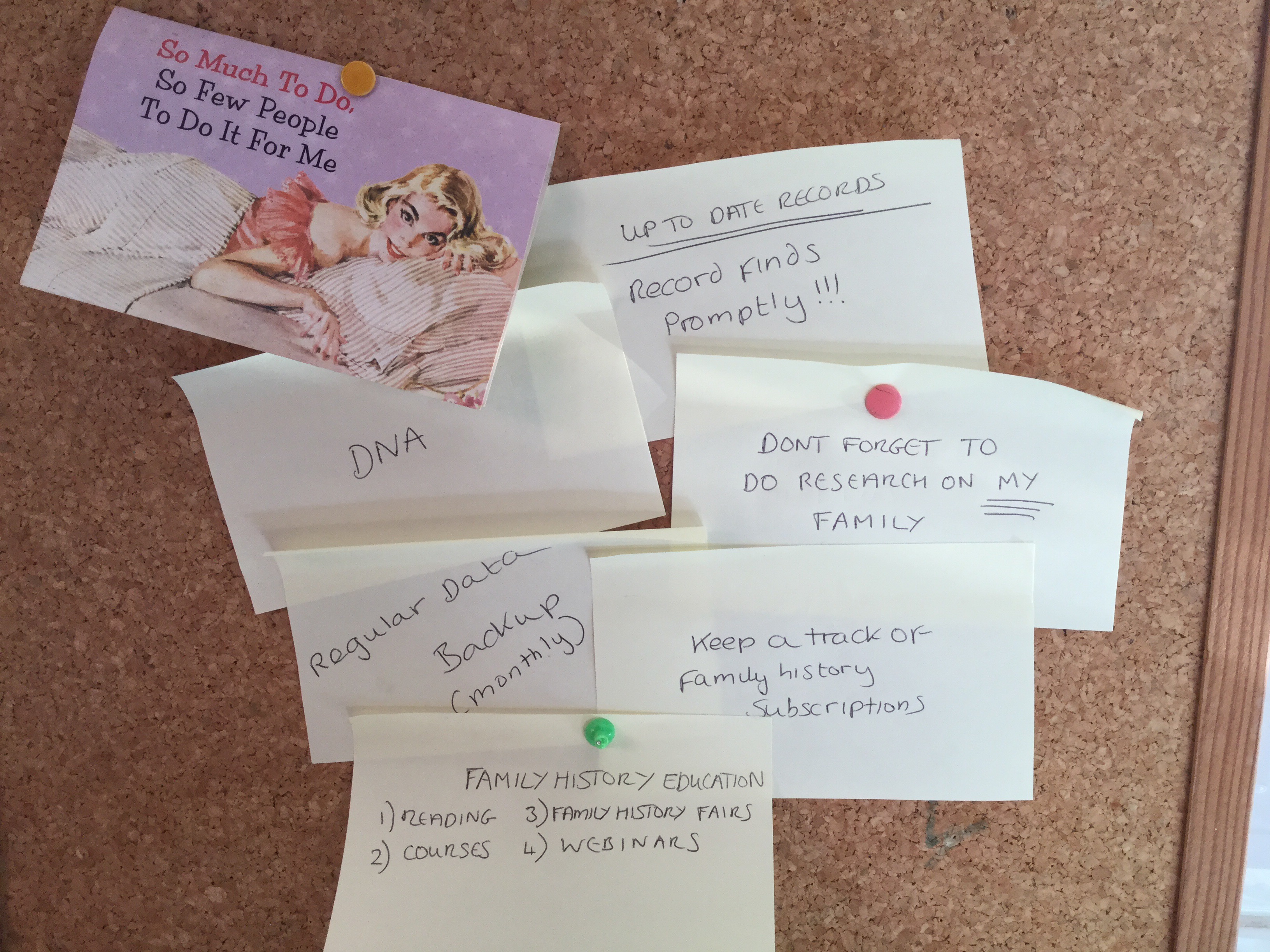
As I review my 2016 New Year’s Resolutions, I’m left thinking they turned into a bit of mixed bag. Some were fully achieved; others partly; and one, to be brutally honest, was an abject fail.  Regular Data Back-Ups:
 This started out brightly. But by October, when I bought my new laptop, they came to an abrupt halt. I still haven’t got to grips with the newest frustration in my life. I have a technology phobia. I loved my old laptop mainly because I was used to it. The thought of having to confront the multitude of tasks that accompany a new machine – such as adapting to Windows 10, loading my Family Historian and other packages or setting up my printer – fills me with dread. And as my old laptop is on its last legs I daren’t use that either. So it’s been a period of avoidance. And now, this holiday season, I’m going to have to be brave and take the plunge with this new family addition. This includes transferring all the muddle of work I’ve fudged together, on a multitude of other devices in this technological wasteland of time, to my nemesis – and backing it all up.  Although as I write this (on my iPad) I still can’t bring myself to face the trauma.

Record Keeping: I did catch up with cataloging all my outstanding records, and then I kept up with record keeping……for a few months. But by the end of the year I lapsed once more.The computer issues proved one (major) factor in this. The other element is the whole host of new online records, which overwhelmed me. I was like a kid in a sweet shop with the online launch of Irish GRO birth, marriage and death entries, quickly followed by the new online England and Wales GRO index. The final straw was the GRO PDF trial. I now have masses of certificates to add to my latest record keeping backlog. 

Get a Grip of Subscriptions: 
A success. All are listed. I am monitoring usage and I am cutting back, albeit reluctantly, on my lesser used ones.  

Keep Informed about Latest Family History Developments: Another one which went well. I attended two family history fairs. I did do the reading I committed to – but not on the bus. The lure of dozing proved too much here. I undertook several webinars. I completed my Pharos Tutors Family History Skills and Strategies (Intermediate) modules. I’ve now embarked on the Advanced course. So I can tick this box 

Get Back to my own Family History Research:
 A mixed picture here. I did fit in personal research – just not the research I planned. I made no progress with my husband’s tree. Neither did I start mum’s family history book. Other pieces of research took precedence. I crammed in a series of visits to West Yorkshire Archives (Wakefield) before its relocation closure, and the results here led to new family history diversions. As did my visit to Tyne and Wear Archives. Not to mention the raft of new data releases. I also took on new, unanticipated ventures. These included starting a One-Name Study, choosing my great grandmother’s very Yorkshire surname: Aveyard. I also launched my Healey Great War Project

DNA: I hold my hands up. This proved an almost total failure. Other than periodically scanning my matches and sending the odd email, I’ve made very little progress. I have responded to the emails I received. Sadly, not all of mine have met with the same response rate. But it’s not been an unmitigated disaster. I’m in touch with some wonderful, newly-discovered distant cousins – it’s now a case of working out the exact links!  

So there are a couple of key lessons for me. The first is to stay focused on the goals I set throughout the year. The second is to be mindful of my technology issues, and try to address them. Hopefully evaluating my 2016 Resolutions will help me when turning my mind to my 2017 wish-list! I’ve already decided to put DNA on the back-burner though. 

A Short Life Remembered: Resurrecting the GRO Dead

This is another in my “Short Lives Remembered” series. In these posts I focus on often-forgotten children in family trees. Those who died all too young. The ones who never had chance to marry, have children and descendants to cherish their memory. The ones who, but for family history researchers, would be forever forgotten. This story is a direct result of the new search facilities available with the General Register Office (GRO) indexes. 

I wrote about the new searchable indexes of births and deaths and the extra flexibility they provided here. As it is a new compilation it differs from other indexes because, where possible, the GRO have provided the mother’s maiden name right back to July 1837, as opposed to the September quarter of 1911. For deaths, an age is included if it is on, or is legible on, the original entry. Again this is back to their 1837 inception, as opposed to the March quarter of 1866 on other indexes.

Armed with these new search options, I am in the process of going through my family tree. For some there are obvious child-bearing gap years to focus on. The 1911 census is even more explicit in that it gives the number of children born in a marriage to a couple and provides the number surviving/dead. So the search offers a new tool to identify some of the hitherto unknown dead children if other methods have failed. More speculatively I’m going through my direct line ancestors to see if there are any other missed babies. Tedious with the two-year search parameter and having to specify the gender when searching. But rewarding nevertheless.

This is the story of my first search. 

I decided to investigate my 2x great grandparents Joseph and Kezia Hill (née Clough). Joseph and Kezia married on 22 April 1869 at Tong Parish Church. Coal miner Joseph was only just 20 and Kezia 18. They both lived on Whitehall Road, Drighlington. Childhood sweethearts I assumed. In February 1871 son Albert was born, followed by John Herbert (Jack) in December 1872. Another boy, Harry, was born in around early 1874. Finally daughter Martha arrived  towards the end of September 1876. Kezia died the following year. So I had a very narrow search window for this family.  

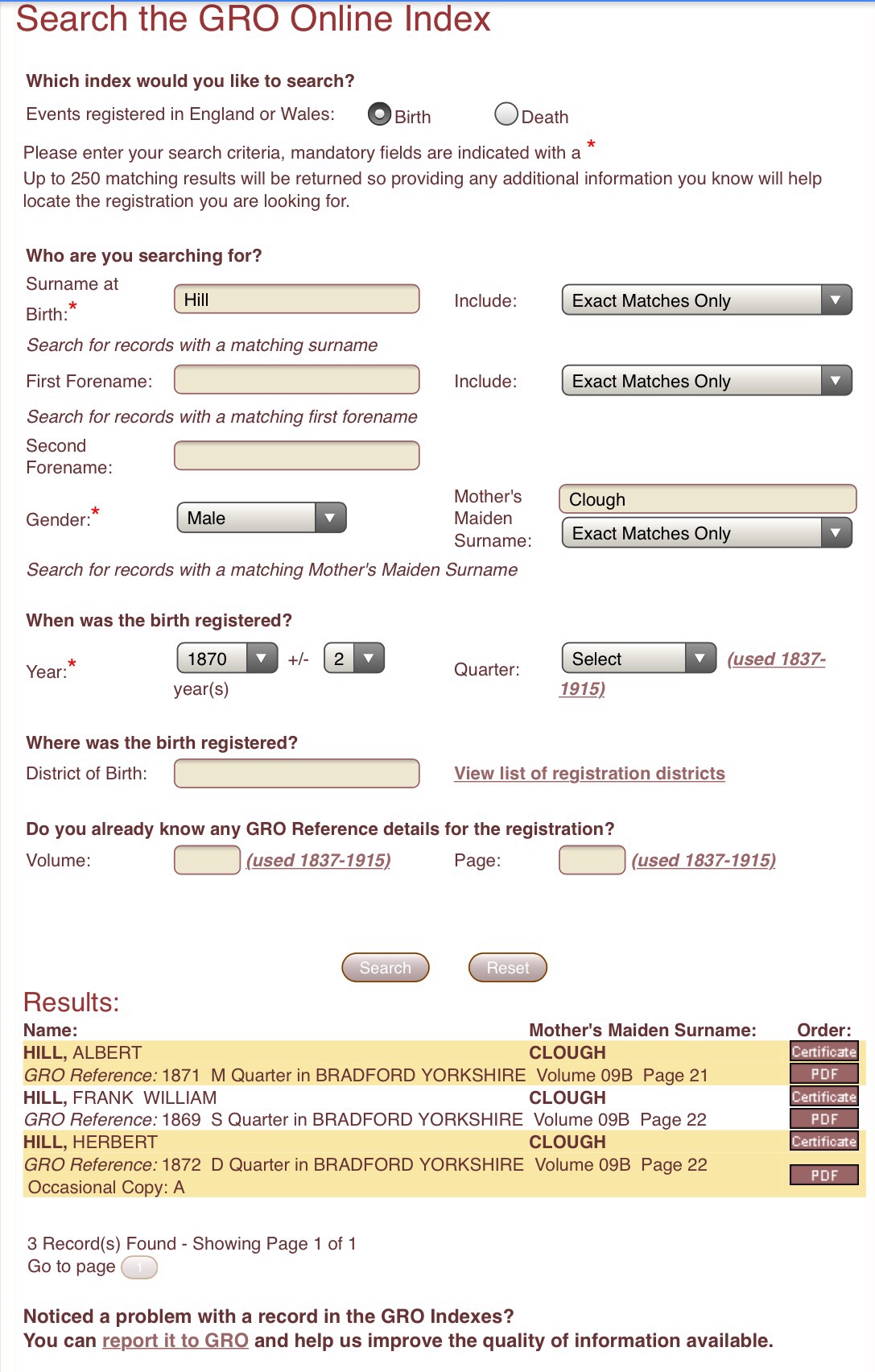
I didn’t expect much, given they’d had four children in their seven years of marriage. However the very first search produced a possible. I used 1870 +/- 2 years, males, with the surname Hill and mother’s maiden name Clough, and no phonetically similar/similar sounding variation options. It produced three hits. These are in the screenshot below. 

Albert is there, as is a boy named Herbert. This is John Herbert. As I explained in my previous post, this is one of the quirks of the new search. Joseph and Kezia originally registered their son under the name Herbert, but changed their minds, went back and amended his name to John Herbert. The new indexes fail to pick up certified name changes. 

There is a third boy on this list though: Frank William, whose birth was registered in the September 1869 quarter. It looked promising. The Registration District corresponded – Bradford, Yorkshire. The names were family ones – Joseph’s grandfather was called Francis; his uncle and eldest brother were named William. But it wasn’t proof positive.

In the 1871 census Joseph and Kezia with infant son Albert. No Frank. Was he living elsewhere at the time of the census, or had he died, another census “in-betweener“. 

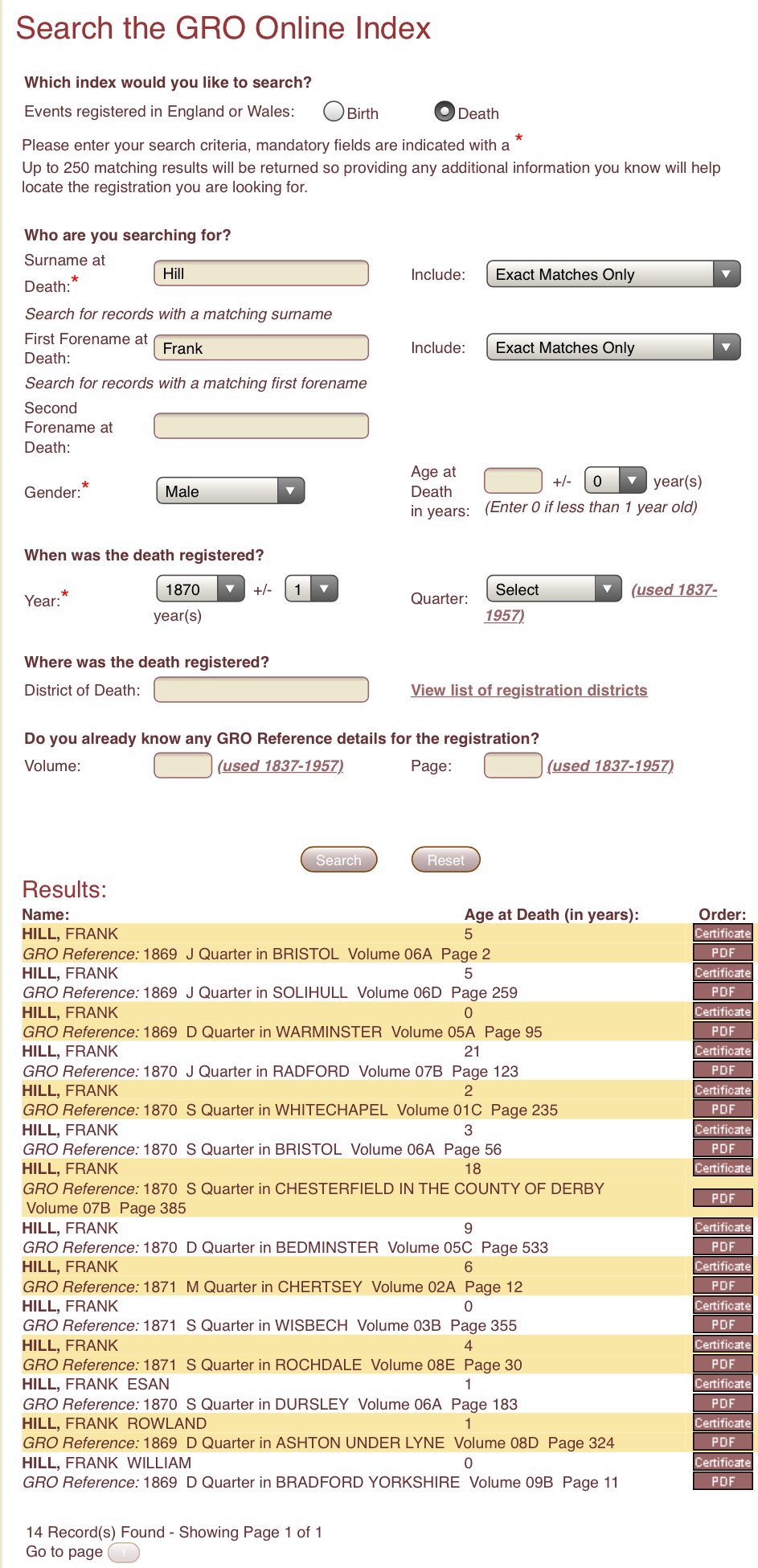
A search on the death indexes for Frank Hill with a +/- 1 year parameter resulted in 14 hits. The bottom entry looked spot on. It shows the death registration of Frank William Hill in Bradford, Yorkshire in the December quarter of 1869 – age 0.  The convention is to record the age as 0 for infants under 12 months. However, be aware that despite the rhetoric, this isn’t a hard and fast rule with these new indexes –  there are errors. I have instances were a child of two months at death is recorded as two years.  

I decided to play it safe though and went for the birth certificate initially. I ordered it on 9 November via the trial PDF system. By 11 November it arrived, five days ahead of schedule. However I couldn’t open it. The only one of my orders I had an issue with, and it would be this one. Despite this glitch, I am feeling very positive about the new PDF system. No it’s not perfect, but it is another (cheaper) ordering option, where you don’t need a fancy all bells and whistles certified copy. It’s a straightforward process, especially for those birth and death events searchable on the new indexes. And the indexes themselves have helped me progress my family history in a way not possible with the alternative ones.

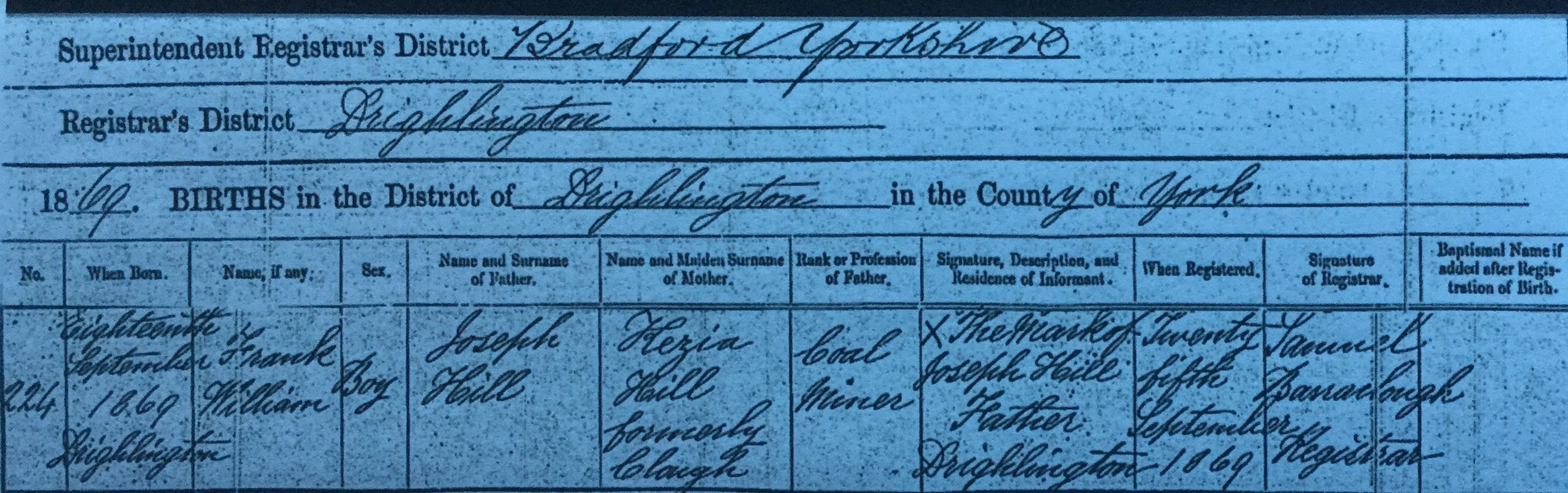
Anyway, back to Frank’s certificate. I was on tenterhooks. So near but yet so far. Then Steve Jackson stepped in, who runs the Atcherley One-Name Study. He sorted it in no time, and bingo. Frank William was indeed Joseph and Kezia’s first child. 

This put a whole new spin on my family tree. For a start my great grandad was now relegated to third child. But, more importantly, Frank was born in Drighlington on 18 September 1869. This was coming up to five months after his parents married. He may therefore have been the very reason for their marriage. But sadly his life proved far shorter than those five months of his parents married life to date.   

PDF Copy Birth Certificate of Frank William Hill

Joseph registered his son’s birth, making his mark. He alternated between signing and making his mark on various birth and death registrations, so it is difficult to make literacy assumptions on the basis of a one-off registration. However the sad task of registering the baby’s death fell to Sabina Hill. I suspect she is Joseph’s sister as she’s the only Sabina Hill in the family tree at this point. However I do have a slight niggle with this theory: she was only 14 years old in 1869. She too made her mark.

Frank never thrived. He must have been a constant cause of concern for his young parents. He is described on the death certificate as having anaemia since birth. He lived only three weeks, giving up his struggle in Drighlington on 9 October 1869. 

His certificate also states, besides anaemia, he suffered convulsions for a few hours before his death. Convulsions was not an uncommon death certificate death cause for young children and infants in this era. Babies and infants who develop a fever as a result of an infection may fit because of their high body temperature. With the medical limitations of the period, in these circumstances the outward manifestation rather than the underlying cause was recorded.

So ended Frank’s short, but significant, life. Significant insofar as it was probably the initial impetus behind Joseph and Kezia’s marriage. And, as a result, generations later their family lives on. Including me.

I’ve not found a baptism for Frank. There won’t necessarily be one. And to date I’ve not found a parish register burial entry for him. But it’s early days, given its only a week ago since I learned of his existence thanks to the new GRO indexes. However the discovery of his brief life has added a new dimension to Joseph and Kezia’s life together. And sadly it’s another tragic one. Maybe next year I will write about them.

Others who feature in this series of “Short Lives Remembered” posts are:

Sources:

GRO Picture Credit: 

Extract from GRO birth register entry for Frank William Hill: Image © Crown Copyright and posted in compliance with General Register Office copyright guidance.

WDYTYA? Live 2017 Preparations: Tickets on Sale 

It’s not even Christmas 2016, but one of my presents will be here early. After my 2016 visit to WDYTYA? Live in Birmingham, where I felt one day was far too short a visit for me, I determined that in 2017 I would spend longer at the exhibition. Tickets are now on sale with an “early bird” discount.

WDYTYA? Live 2016 – photo by Jane Roberts

So now it’s time for me to plan my visit. I’m going for a two-day option. So next to check out hotels. And based on my previous experiences I will pre-book my workshops. I’m getting old so need a seat!

General Register Office (GRO) Index – New & Free

Another free resource for family historians. The GRO (England & Wales) have made available online a searchable index of births and deaths, via their website. All you need to do is have a registered GRO online certificate ordering account.

 This new index covers registered births from 1837-1915 and deaths from 1837-1957. 

The plan was to limit the index to births over 100 years old and deaths over 50. However the GRO state that completing digitisation “would require significant investment and there are no current plans to resume this work but we continue to monitor the scope for future opportunities to complete the digitisation of all birth, death and marriage records.” So, I suspect in this climate of government austerity, the completion of the death digitisation, the year-by-year roll out, and the digitisation of marriages won’t happen anytime soon. However they will update the index if there are errors and omissions, and they do have an error report form for these to be submitted to them.

The GRO have a FAQ section on the website. This includes a guide about searching the indexes. So I won’t cover that aspect in this post. There is also a useful guide here.

So what does this GRO online index add to the indexes already out their via FreeBMD and subscription sites like FindMyPast

Well for a start this is a brand new index and not a copy of an existing third party one from the microfiche indexes. Anyone doing family history will be familiar with the scenario – a search on two websites will not necessarily yield exactly the same results. So this provides an extra check with which to by-pass errors and find that illusive record.

Crucially, as the GRO point out, this new index contains “additional data fields to those which are already available and this will assist family historians to identify the correct record.” Other indexes, because they are taken from the microfiche indexes, only include age at death from the March quarter of 1866 onwards; and for births the mother’s maiden name only features from the September quarter of 1911. This index is different. Because it is a new compilation, where possible the GRO have provided the mother’s maiden name right back to 1837; similarly an age for deaths is also included if it is on, or is legible on, the original entry. The convention for recording the age as 0 for infants under 12 months is continued though. 

As a result of this extra information I think I have narrowed the 1860s death of my 3x great grandfather to two possible certificates: Not the several of previous searches. At £9.25 a certificate this could make all the difference to me taking a gamble and ordering. Similarly the availability of the mother’s maiden name on the earlier birth entries enables pinpointing the correct entry far more straightforward. It also is a useful tool to discover hitherto unknown children of a marriage during the 1837-1911 period.

Also whereas other indexes record middle names as initials for many years, the new GRO index gives them in full. In my post about names in World War 1 I didn’t include middle names as these were not identifiable in the FreeBMD indexes for that period. The use of initials on FreeBMD is explained here

However it is now possible to do a middle name search to a limited extent on the new GRO index irrespective of period, as the screenshot below illustrates. I did a search for a middle name of “Joffre” for 1914 +/- 2 years. With other indexes this isn’t possible, they just show the middle name by initial for these years, in this example “J”. 

Although it’s not a solution to calculating a total number as you can’t search without a surname, this facility might aid the correct pinpointing of an entry. 

GRO index screenshot showing 1914 +/- 2 year search for boys with surname “Smith” and middle name “Joffre”


Limitations so far for me are the:

  • two year search parameters, which can drag out the search process if you’re working on a longer window of uncertainty (for example an inter-census death), especially when you have to do a male and female search;
  • having to use the mandatory gender field when conducting a search is a tad frustrating. I keep forgetting to switch;
  • the 250 results limitation may be problematical for larger one-name-studies; and
  • not having a county-wide search functionality. It’s either everything, a volume number, which does not equate exactly to all the districts within a county (thanks to gwinowan for the tip) or a specific registration district.

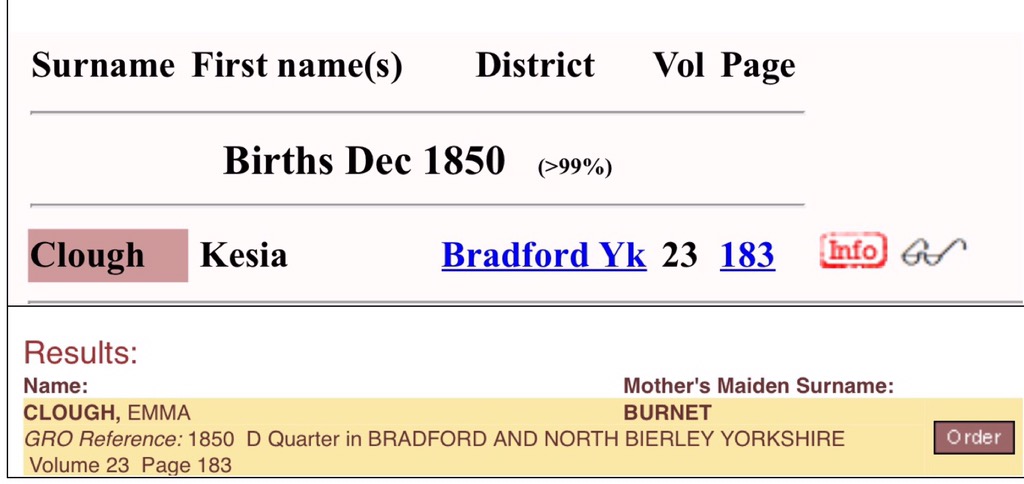
And finally one anomaly. In my post about tricky names I indicated how my 3x great grandparents changed their minds about the name they registered my 2x great grandmother under. She was originally registered as Emma Clough but, as was permissible, they subsequently amended her name to Kesia (she was known as Kezia(h), so even more spelling variants). This is shown on the original birth certificate and GRO copy. When searching on the microfiche indexes she is found under Kesia Clough. In the new GRO ones she’s down as Emma. The same applies to my great grandfather – originally registered as Herbert Hill, but amended to John Herbert. Found under John Herbert in other indexes, but Herbert in the new GRO one.

Top entry from FreeBMD showing my 2x great grandmother’s correct (amended) name; bottom entry from the new GRO indexes showing the name she was originally registered under

So be aware, the new GRO index will show the name the baby was originally registered under. This may cause confusion, especially for one-namers.

Overall though, despite its clumsiness and limitations in some ways, I’m really happy with the additional options it provides. So a thumbs up from me.

Update 1: Just read on the “Who Do You Think You Are?” Magazine FB page that, following on from these indexes, the GRO will trial the purchase of uncertified PDFs of birth certificates from 1837-1934 and death certificates from 1837-1957 at a cost of £6 each. This from 9 November 2016 lasting for three weeks, or until 45,000 PDFs have been purchased.

Update 2: GRO have launched the £6 PDF trial starting from 9 November. This from their website:

From 9 November, we are trialling emailing PDF copies of registration records. Records will not be immediately viewable, but emailed as a PDF.

The pilot is in 3 phases, starting with our digitised records:

  • Births: 1837 – 1934 and 2007 on
  • Deaths: 1837 – 1957 and 2007 on
  • Marriages: 2011 on
  • Civil Partnerships: 2005 on

Phase 1 closes on 30 Nov, or when 45,000 PDFs have been ordered, whichever is sooner. Details of phase 2 (3 hour PDF service) and phase 3 (records not digitised) will be announced here shortly.

Full details are in here in the GRO’s “Most Customers Want to Know” page.

I’ve ordered a couple of PDF certificates under the new system, which is all very straightforward to use. In fact it’s more user-friendly for those indexed entries, as you can place your order direct from the search result and all the relevant information (including name, District, Quarter, Volume & Page) is automatically entered. Delivery for these Phase 1 PDF’s is to a slightly longer timeframe. My expected email delivery is 16 November. I’m just hoping the 45,000 limit isn’t reached before they arrive, as if I’ve correctly identified a birth for an hitherto unknown baby of my 2x great grandparents, I also want to get the death certificate. 

Update 3: Phase 1 ended on 30 November. I ended up ordering 19 PDFs  in total. Six have arrived, although I do have an issue with one. It arrived in an unopenable Winmail.dat format on 11 November. The GRO finally re-sent it as a PDF on 2 December. I ordered the final 13 towards the end of the trial and delivery, due to the volume of orders, is not anticipated until early December.  

Update 4: Pilot phase 2, for a within three hour delivery service for PDF copies of all birth, death, marriage and civil partnership records has ended now. However the £45 price tag was beyond my purse strings. 

Phase 3 is now up and running, with a close date of 4pm on 12 April 2017, or 40,000 PDFs, whichever is the soonest. It covers PDF copies of those civil registration entries that are not held by GRO in a digital format, in other words those not included in the earlier Phase 1 £6 trial. The exact dates are:

  • Births: 1935-2006
  • Deaths: 1958-2006
  • Marriages: 1837-2010

These PDFs will cost £8. I may be tempted here, though it is only a £1.25 saving on the postal service – so not a massive saving.

A New Chapter in My Family History

This is a personal update. 

On 1 November I began my three month notice period at work. My 30 year civil service career officially ends on 31 January 2017. I am ready for a change. When the opportunity arose and the Department of Health announced it was shedding a third of staff launching its voluntary exit scheme in the early autumn, my list of reasons for leaving far outweighed the ones for staying. True civil service policy analysis principles there. Weighing up the pluses and minuses to come to a balanced and considered opinion.

A New Family History Chapter – photo by Jane Roberts

But I do have mixed feelings. It’s a huge step after so many years. On the whole I have enjoyed my time with the civil service, to be fair some jobs far more than others. I’ve made some fantastic, lifelong friends. I’ve gained a raft of skills which will be of incredible value going forward. Above all moving from a job with a regular monthly salary into the unknown feels very scary.

But it’s an opportunity I relish. It’s a chance to have more time to concentrate on family history. A chance do the things I enjoy. A chance to do something for me. A chance to share over a decade of family research knowledge and experience. And a chance to put those skills I’ve learned to practice in a new direction. Skills, values and principles which include: 

  • planning;
  • researching;
  • analysis;
  • summarising; 
  • reporting;
  • seeing the bigger picture;
  • bringing together multiple data sources to provide a coherent picture;
  • writing;
  • time management;
  • independent thinking and working, yet also being able to work as part of team;
  • project management; 
  • meeting deadlines;
  • following a set remit;
  • confidentiality;
  • honesty & integrity;
  • computer programme knowledge; and
  • providing value for money.

So going forward I will have more time to work on my own family tree and my one-name-study. I will also be able to attend more family history events. I aim to do more continuing professional development. And I will be able to take on more client work. In the coming months I will provide more details.

Another Family History Website Bites the Dust

A sad day for those with coal mining ancestors and interests. Whilst doing some research into my many ancestors working in this industry, I attempted to access one of my favourite occupational websites, “The Coal Mining History Resource Centre” (CMHRC).

However it appears to have vanished.

Ian Winstanley compiled the information for the website. But I believe Raleys Solicitors, an old-established Barnsley law firm specialising in miners’ compensation claims, ran it. They went into administration in March 2016. Whereas client work appears to have transferred to Ison Harrison Solicitors, the website seems to have been a casualty.

Ancestry.co.uk have Ian Winstanley’s “Coal Mining Accidents and Death Index 1700-1950“, which was on the site. But CMHRC was far more than this wonderful database. Described as the UK’s largest and most comprehensive website concerning the history of coal-mining, its resources included maps, the 1842 Royal Commission reports, poems, a glossary of mining terms and a photo gallery. Unlike Ancestry, it was a free website. And to be honest I much preferred its search facility.

I would hope the loss of CMHRC is temporary and it can soon be restored in all its former glory. But in the meantime there is a bit of a work round.

In my post about an obsolete County Mayo website, I described how the Internet Archive Wayback Machine could be useful in accessing defunct websites. You can partly access CMHRC via this mechanism, but be warned you do lose much of the original site functionality.

Screenshot of CMHRC via the Wayback Machine

If searching via the Internet Archive Wayback Machine, the URL to use for CMHRC is:  http://www.cmhrc.co.uk

Make sure you search for 2016 captures and earlier. It is far from perfect but it might help.

There are also the following useful sites:

Feel free to add more to the list.

Some suggestions that I’ve since received (thanks Judy & Fergus):

Grim Times for an 18th Century Coal Mining Family 

The most common occupation in my family tree is “coal miner”. Unsurprising given my paternal and maternal West Riding roots. As a result I’ve spent quite a bit of time researching the history of coal mining: the social and political aspects as well as the general occupation and its development through time.

This research could form the basis of many posts. The aspect I’m focusing on this time is the perilous nature of the work. “Poldark” brought this to mind. Different type of mining, but the death of Francis highlighted the dangers of underground work in the late 18th century and made me think once again about my coal mining forefathers. However grim I think my job is, I only have to think about my ancestors, men, women and children, who worked down the coal mine to realise how lucky I am. 

Even in more recent times coal mining was a hazardous, unhealthy occupation. But in terms of my 18th and 19th century family history, these were days before today’s stringent health and safety regulations. Indeed in the early days of my ancestors the working was totally unregulated. 

The cramped, damp conditions and physical exertion led to chronic muscular-skeletal problems and back pain as well as rheumatism and inflammation of the joints. Many suffered from loss of appetite, stomach pains, nausea, vomiting and liver troubles. Most colliers became asthmatic by the time they reached 30, and many had tuberculosis. And all this would have led to days off sick without income to support the family. 

Then there were the accidents. No-one knows how many deaths there were in the first half of the 19th century, let alone earlier. An unreliable estimate in 1834-5 of the number of lives lost in coal mines in the previous 25 years gave the number of deaths in the West Riding as 346 and the evidence is the high proportion were children. According to the appendices of the Mines Inspectors Report’s 1850-1914 some 70,700 miners died or sustained injures in the mines of Great Britain from 1850 to 1908. However even this is not reliable, because the number of non-fatal accidents taking place between 1850-1881 is unknown. It was no-ones job to collect the information. 

It is true that miners themselves took risks, failing to set timber supports, propping air doors open and working with candles when it was dangerous to do so even after the invention of the Davy lamp. But colliery officials and managers also cut corners and costs leading to dangerous conditions, for example failing to replace candles with lamps, not supplying sufficient timbers, not ensuring adequate ventilation, using defective colliery shafts which were not bricked or boarded and contained no guide rods, as well as drawing uncaged corves (the small tubs/baskets for carrying hewn coal from the pit face) direct from the pits which resulted in falls of coal and people down the shaft. It was not until 1872 that every mine manager was required to hold a certificate of competence. 

Whilst explosions exacted a heavy toll and made headlines, it was the individual deaths and injuries sustained over weeks, months and years by falls of coal and roof which were responsible for most accidents, fatal or otherwise. 

One of the earliest mining ancestors I’ve traced is my 6x great grandfather Joseph Womack, born in around 1738. And his is the earliest family mining fatality. 

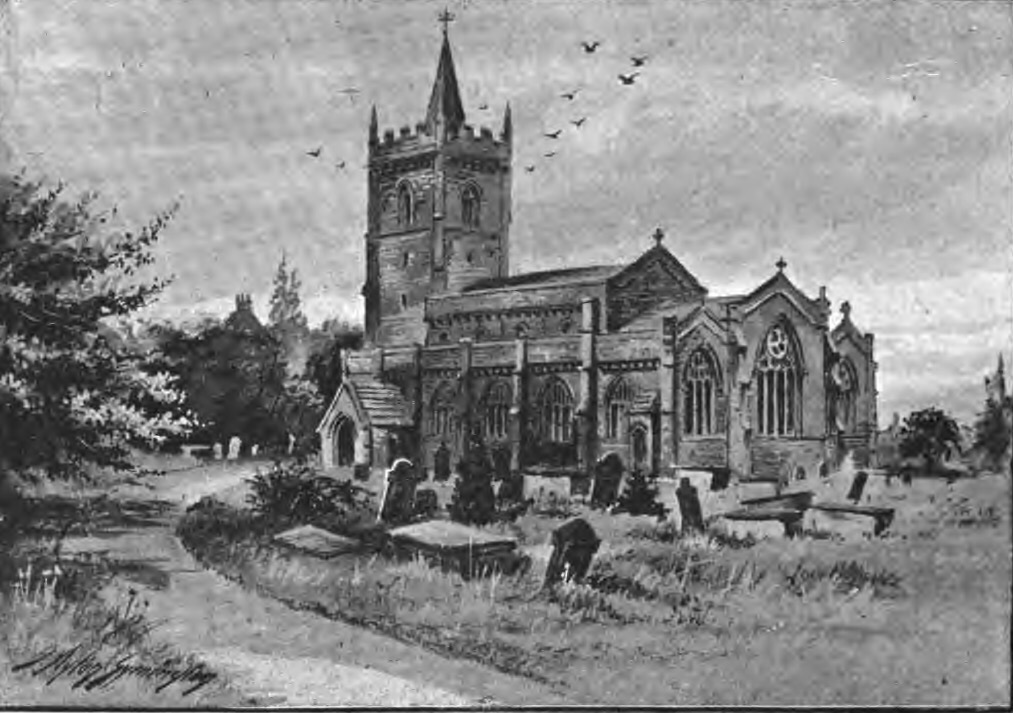
Joseph married Grace Hartley on 11 February 1760 in the parish church of St Mary’s Whitkirk. It is the oldest medieval church in Leeds and a church probably existed on the site at the time of the Domesday Book. The name “Whitkirk” or “Whitechurch” is first recorded in the 12th Century in a charter of Henry de Lacey, founder of Kirkstall Abbey, confirming the land of Newsam, Colton and the “Witechurche” to the Knights Templars. The present building dates from 1448-9 but underwent substantial restoration in 1856. So it is essentially the building in which my 6x great grandparents married. 

Whitkirk Parish Church

The man known as the father of civil engineering, John Smeaton, is buried just behind the main altar. Perhaps Smeaton’s most famous work is the 3rd Eddystone Lighthouse, completed in 1759 just the year before Joseph and Grace’s marriage. His other works included the Forth & Clyde Canal, Ramsgate Harbour, Perth Bridge, over 60 mills and more than 10 steam engines. 

Joseph signed the register in a wonderfully neat hand. It’s always a thrill when I see the signatures of my ancestors. And especially those who worked in manual jobs not associated with literacy.  

The marriage entry indicated Joseph and Grace were both residents of the parish. The location was pinpointed to Halton with the baptism of their first child, Joseph, on 22 October 1760. This location was confirmed in each of their subsequent children’s baptismal entries. Halton was about three miles east of Leeds in Temple Newsam township with Whitkirk parish. 

Another son, Richard, was baptised on 27 June 1762 followed by their first daughter Mary, my 5x great grandmother, on 12 February 1765. Four other Womack children’s baptisms are subsequently recorded – William on 21 January 1770; Henry on 24 September 1772; Thomas on 6 August 1775; and Grace on 14 February 1779. This final baptism is more detailed, giving Grace’s date of birth as 31 December 1778 and stating that her father, Joseph, worked as a collier. 

The Womacks, Joseph and his sons, were a coal mining family working at the local Seacroft colliery. Joseph and his eldest sons Joseph and Richard were there one day in May 1781 when tragedy struck in the form of an explosion. The events reached papers nationally as well as locally. The coverage is typified by this paragraph in the “Leeds Intelligencer” of Tuesday 22 May 1781. According to the newspaper the explosion took place on a Thursday, which would make it 17 May. However this may be inaccurate. I will return to this later. Typically for the time no names are given. 

In the era before the 1815 invention of the Davy Lamp, candles were the only form of light in the mine. But the risk of explosions with naked flames from these candles igniting methane gas was high, even in well ventilated pits. Firedamp was the name given to an inflammable gas, whose chief component was methane. This was released from the seam and roof during working. And on this fateful May day the Womack father and sons were caught in its ignition. 
We turn to the Whitkirk burial register for the details of how this newspaper snippet linked to the Womacks. The register gives the following burial details on 18 May 1781: 

Joseph Womack collier slain by the firedamp at Seacroft also his son Richard Womack who was slain at the same time. The father was aged 43 the son 19 years”  

Slightly later era, but illustration of a pit top after an explosion

Joseph (junior) was one of those hurt in the incident. This is shown by an entry in the same register, dated 2 June 1781: sadly another burial. It is Joseph’s. He lingered for several days before succumbing to his injuries, described as “bruises”. The entry states that his injuries were the result of the same incident in which his father and brother were killed.

Besides being emotionally devastating for the family, with the death of two members on the same day and a third receiving injuries in the same incident leading to his protracted death two weeks later, it would have been economically crippling. The three main breadwinners wiped out in a single stroke. Grace was left to bring up several children – the eldest 16 years old, the youngest just two. 

Less than two years after the death of his father and brothers Thomas died, aged eight, as a result of a fever. This is a notoriously vague catch-all description for the period indicating, yet again, that in these times the precise source of illnesses were often not known but which clearly suggests some kind of infection. There are no other clues or hints. Checking the burial register for the period around Thomas’ death reveals nothing, for example an epidemic or outbreak of common illnesses in the area. He was buried on 25 April 1783 in the parish. 

Surprisingly the family do not appear in the list of recipients receiving parish dole money. Neither are they mentioned in the parish churchwardens and overseers accounts or vestry minutes, but there is very little poor law related material in these specific Whitkirk documents. It is very possible that they were supported by the parish via this mechanism, but these records have not survived, or else I’ve not yet discovered them in my visit to the Leeds branch of West Yorkshire Archives.  

But the two information sources, newspaper and parish register, give an indication of the devastating effect a pit explosion could have on a family at a time when fathers, brothers and sons (and prior to the 1842 Mines Act women plus girls and boys under 10) worked side by side underground. 

A sad footnote to this post concerns the anonymity of those killed. In addition to Joseph senior and Richard, there were two others who lost their lives in the immediate aftermath of the explosion, as reported in the “Leeds Intelligencer” 0f 22 May. Given the date of the article, Joseph junior couldn’t have been one. Their names didn’t appear in any reports I found. I do wonder who they were though, these people who worked and died with my ancestors.

There is nothing to indicate any other Whitkirk burials of the period applied to these victims. Parishes adjoining Whitkirk were Leeds, Swillington, Rothwell and Barwick in Elmet.  Leeds St Peter’s parish church provides a cause of death for all burial entries for the period. Sadly I drew a blank in this search. Likewise for Swillington St Mary’s and Holy Trinity at Rothwell. However, Barwick in Elmet All Saints register records the burial on 17 May 1781 of 33 year old Christopher Dickinson from Lowmoor. He died on 16 May 1781, “kild in Seacroft coalpitts“. So was this the same incident? If so it indicates the inaccuracy of the newspaper date which implied a 17 May accident date. 

Providing the newspaper got the numbers right, the other individual remains a mystery. The only possibility so far is a cryptic and inconclusive 17 May 1781 entry in the nearby parish of Garforth St Mary’s “Thos son of Mathew Limbord colier aged 23 years” No cause of death. And really it’s not clear if it was Thomas or his father who worked as a collier.

The “UK Coal Mining Accidents and Death Index 1700-1950” doesn’t offer a solution either. This was on the now obsolete “Coal Mining History and Resource Centre” website, which I wrote about in my previous post. As indicated in that post, the index is now available on Ancestry.co.uk – but this accident is not recorded. I may never know who the fourth person was. And it makes me think how many other mining deaths are similarly lost.

 Sources:

  • St Mary’s Whitkirk Parish Register and records 
  • Leeds Intelligencer” 
  • National Coal Mining Museum: http://www.ncm.org.uk
  • The North of England Mining Institute of Mining and Mechanical Engineers: http://www.mininginstitute.org.uk
  • The Durham Mining Museum: http://www.dmm.org.uk
  • Voices from the Dark – Women and Children in Yorkshire Coal Mines” – Fiona Lake and Rosemary Preece 
  • “Working Conditions in Collieries around Huddersfield 1800-1870” – Alan Brooke 
  • My Ancestor was a Coalminer” – David Tonks 
  • British Coalminers in the 19th Century” – John Benson 
  • The Yorkshire Miners: A History – Volume I” – Frank Machin 
  • The history of the Yorkshire Miners 1881-1918” – Carolyn Baylies 
  • Tracing your Coalmining Ancestors” – Brian A Elliott 
“Ley Lines” of the Somme: an amazing Somme 100 experience

Do you believe in fate? Of hidden forces drawing people together? I do after my latest Great War pilgrimage.

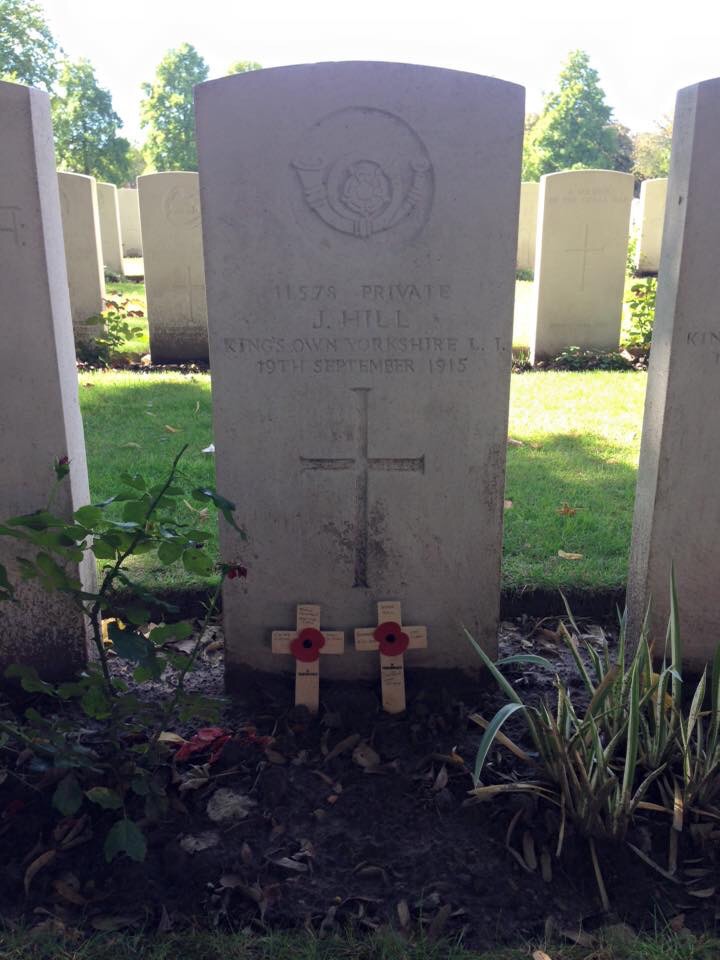
I recently went over to Belgium and France and timed the visit to coincide with two of my Hill family death anniversaries. Jesse Hill, who died on 19 September 1915 and is buried at Ypres Reservoir; and Percy Hill who died, according to soldiers’ effects records, at 2/1 South Midland Casualty Clearing Station on 30 September 1916. Percy is buried at Warloy-Baillon Community Cemetery Extension, just to the west of Albert.

Last year when visiting Jesse, on the centenary of his death, I narrowly missed meeting a relative for the first time. Two poppy crosses and the visitors book showed we’d paid our respects at Jesse’s grave within hours of each other. That was coincidence enough, but nothing in comparison to what happened this year.

Two Poppy Crosses by Jane Roberts

Chris (my husband) and I spent a few days in Ypres before driving to Avesnes Le Sec, near Cambrai, to stay with an “old” school friend for the weekend (sorry about the “old” Anne, but it applies to me too). We finished the final leg of our visit on the Somme, initially at the wonderful “No 56” b&b then at the “Royal Picardie” hotel in Albert for the last two nights. The only reason we transferred to Albert was because the b&b only had availability for three nights.

The early evening of 28 September we finished another long day of walking by stopping off at the beautiful Authuile Military Cemetery, in the village of Authuille (note the spelling difference). 

I love this tranquil cemetery with its feeling of peace and calm, and its eye-pleasingly curving layout of headstones sloping down to the river Ancre. An odd thing to say, but it’s probably my favourite cemetery. It is also the final resting place of Pte Willie Barber of the 1/4th King’s Own Yorkshire Light Infantry (KOYLI) one of the parishioners at Batley St Mary’s who I spent so much time researching.

Authuile Military Cemetery – by Jane Roberts

As we wandered down to the bottom slopes of the cemetery I noticed another visitor. This was unusual, as it was getting on and the cemetery isn’t one people normally beat a path to the door of. By the time we got to the top she had gone.

I sort of wondered if she was here to see Willie, one of those flights of fancy about impossible coincidences. I’m always a bit over-focussed on the St Mary’s men I researched. But there was nothing in the visitors book to indicate why she’d been there. That was the end of that, or so I thought. A chance to find out lost.

The following day we checked into our Albert hotel. Whilst in town sitting outside a café drinking coffee we saw the lady again. But again never spoke.

And then on 30 September, the anniversary of Percy’s death, we went down to our first breakfast in the hotel and she was there with her mum.  This time we did speak. She was over for the centenary of her great grandfather’s death, that very day. The same day as Percy Hill. 30 September.

We talked a bit more, and amazingly discovered both Percy and her ancestor, Jonathan Pearson, were in the same battalion, 1/4th KOYLI. Both died of wounds and both received their injuries during the same period of duty in the trenches near Ulster Tower in mid-September. She had followed Jonathan’s footsteps for those few final frontline days and was on her way across to Boulogne to his grave on his death anniversary, before returning home to the south of England that evening.

She had photos of Jonathan. I had some of Percy, including group photos with some of his pals. And amazingly on one of these photos was a man who looked remarkably like Jonathan. Same colouring, same features including distinctive nose and cut of hair.

We couldn’t believe it. 100 years to the exact day of their deaths we were in a hotel in Albert staring at a picture of what appears to be both men together. It was is if some unseen force had been pulling us together for the past couple of days, starting at Authuile Military Cemetery where fellow 1/4th KOYLI soldier Willie Barber is buried, finally uniting us on the centenary of their death. An incredible, earth-stopping realisation. And if the b&b had been available for the final two days of my visit I wouldn’t have even been in the Albert hotel. A week later and I still can’t believe it.

We parted promising to pass on Jonathan and Percy’s regards at their respective final resting places, around some 90 miles apart.

And so onto Warloy-Baillon. We stopped at Ulster Tower en route and found the poppy cross Jonathan’s family had laid in the area of the KOYLI trenches of mid September 1916. We saw the Pope’s Nose, the German salient with a decaying relic of a observation post/gun emplacement, which was the focus of their trench raids in that period.

We were at Percy Hill’s grave for 1.15pm, the minute is death is recorded. And there, at around 2pm, we met with David Short and his wife Pauline, the relative I so narrowly missed meeting just over a year ago at Jesse Hill’s grave. And in a final piece of symmetry David is from the north east of England, not Yorkshire, the same area from which Jonathan hailed.

Fabulous News For Those With Irish Ancestry

A really short blog post, but I can scarcely contain my excitement. I wanted to share my joy as soon as possible. And what fabulous news it is for those with Irish ancestry. 

The Irish Genealogy website has released the Irish General Register Office (GRO) images of births of over 100 years ago, marriages of over 75 years ago and deaths of over 50 years ago.

These aren’t just indexes, they are the actual GRO images. So mother and father details for births; cause of death information; location information; names of fathers for marriages; occupations; dates. In other words exactly what you’d get on a certificate.

And what’s even better – they’re absolutely free. So no more €4 postal applications for photocopies of Irish certificates me. And no more wasted money on speculative applications either.  

I am ecstatic. This was beyond my wildest dreams when I first heard a whisper about the launch a few days ago. 

A quick look and they’re not complete yet, but already I’m filling in some gaps. And, as they’ve been uploaded ahead of the scheduled 8 September 2016 launch date, I’ve not ruled a further tranche. 

So guess which website I’ll be on over the next few days, ploughing through my outstanding list of civil records: https://www.irishgenealogy.ie/en/

Sources:  

Which Type of Family Historian Are You?

After several years immersed in family history research, along the way I’ve also observed my fellow researchers, and I include myself here. As a result I’ve identified several breeds within this species. Some are clearly pedigrees displaying one single personality trait. Others are more of the Heinz 57 variety, displaying a cross section of characteristics to varying degrees, depending on their inherited DNA.

Which Type of Family Historian Are You?

The categories I’ve identified are by no means exhaustive. I have listed them below, along with their core characteristics.

The Gatherer: This grouping is more concerned about how far back they can go and how many individuals their tree can hold, rather than in-depth individual stories of ancestors. It’s a contest, a badge of honour. Who can get back the furthest. Who can collect the most. What their tree lacks for in substance, they more than make up for with the thousands of names and dates populating the multiple branches. So many names it makes it difficult to distinguish the wood from the trees.  

The Gatherer

The Treehopper: These individuals hop from one public tree to another culling data. The Treehopper doesn’t evaluate this data to see if it is indeed their family. And they are oblivious to errors such as children born before parents and centuries old Methusalahs. Their philosophy is “it’s on the internet so it must be true“. 

There is much cross-fertilisation amongst the Treehopper populace, so the errors become self-perpetuating. 

The Plunderer: These folk are similar to the Treehopper breed in that they cherry pick data from others. But they are far more discerning. And they are not averse to passing the research off as their own. 

The Fortune Seeker: This bounty-hunting bunch are only interested in proving their connection to rich and famous. The richer and more famous the better. Their ace would be to have a link to royalty. A dinner-table topic to dine out on forever, whilst polishing their collective tiaras. 

The Fortune Seeker

The Carnivore: This sub-species is only interested in their meaty, gory ancestors. They wallow in the deepest, darkest entrails of their family history. Ordinary lives are not worth spending time researching. These individuals thrive on the blood-lust of murderers, criminals, victims, bigamists, incest intrigues, gruesome deaths, disasters and tragedies. The grislier the better, in order to feed their passion. 

The Nurturer: Always putting others before themselves, these kindly souls spend so much time helping others in their family history quest, that their own research is sadly neglected. They make occasional efforts to tend and grow their own tree, only to succumb once more to the cries of help from others. 

Whilst they do love assisting the more juvenile researchers in their midst, their plaintive moans of despair at their lack of personal tree-time can occasionally be heard echoing in archive corridors.

The Wanderer: These are the free spirits of the family history world. Or perhaps that should read the most easily distracted? They set off on one path, but part way through their research something more interesting attracts their attention and they change direction. They then spend hours wandering down this new road, before realising they’ve been diverted. Not to worry though. They’ll get to their destination eventually, but with lots of exciting adventures along the way. 

The Wanderer

The Aestivator: This is the spring/summer version of hibernation. During the, hopefully, good weather of these seasons aestivators concentrate on other hobbies and activities. The weather is too nice to be stuck indoors, at home or in archives, researching. The only trees they tend during this period are the ones in their gardens. The only nod towards family history research may be the occasional ancestral cemetery or location visit. Essentially they have entered a phase of genealogical torpor.

They emerge from their aestivation with renewed energy and enthusiasm, ready to conduct their desk-based research during the cold, dark, wet months of late autumn/winter. 

The Night Predator: These researchers burn the midnight oil. The daylight hours are eaten up by family and work demands. Once the children are safely tucked up in bed, partners craftily diverted and work consigned till tomorrow, the Night Predators’ family history papers come out and their computers are fired up. Time looses all track. One more minute becomes one more hour. Bed is but a distant port of call. The clock chimes an inconvenient 1am. Dawn brings its own dawning realisation, “I sleep to research more effectively.” Sleep, therefore, is an unwelcome, but essential, research interruption. And so eventually the Night Predator drags them-self wearily to bed, mind whirring on finds and strategies, counting ancestors not sheep.  

The Night Predator

The Protector: This group are the guardians of their family’s history. They unearth all aspects: good, bad and indifferent. They critically analyse and evaluate their research, recording it for posterity. They delve into all aspects, and historically and locally contextualise the lives of direct line and collateral ancestors. They collect, preserve, share, treasure and protect their finds to ensure no lives are forgotten. They engender a sense of family continuity.  

However be warned, their sheer single-minded obsession and enthusiasm may occasionally be too much for living family members. They have been known to bury their heads in their hands or flee for cover at the prospect of more quizzing or yet another tale from the Protector.

The Scavenger: These phenomena pull disparate facts swiftly together in a haphazard manner with no regard for considered research or truth. If someone has the same name, well that first match they encounter must be “The One“. No matter they may be from a totally unrelated parish, sometimes hundreds of miles away, there are multiple alternatives, or there are other irregularities. 

Time, history, geography, facts and other options are minor inconveniences, swiftly ignored or dismissed. The Scavenger relies on gut instinct at best. At worst they ram the wrong shaped piece in their family history puzzle and move on.

The Specimen Collector: This category has a sole focus on direct line ancestors only, so four grandparents, eight great grandparents, 16 2x great grandparents and so on. They can really put these ancestors under their genealogical microscope or magnifying glass to probe and delve into their lives in minute detail, without the overwhelming distraction of collateral ancestors. The downside is this researcher may miss breaking down a brick wall which may come from looking at these collateral lines.

The Specimen Collector

The Hunter: These individuals love the thrill of the ancestral chase. Nothing is more satisfying than a visit to the archives or a day spent surfing family history websites. 

Their homes are filled with hastily jotted notes on the back of discarded envelopes and scattered pieces of paper. They have multiple notebooks on the go at any one time, because they misplace the one they’re working on so swiftly grab another. Finds will be properly recorded another day …..maybe. For the time being it’s all retained in the head. Occasionally an overwhelming urge to put things in order overcomes these people. But it’s a temporary blip and instinctive habits are quickly resumed. For them it’s a case of nature over nurture. 

The Hunter

The Grazer: A solid type, who munches steadily and evenly paced through their family history feast. Day by day, piece by piece. Neither obsessively or frenetically. It is a lifetime’s work, no need to rush. It’s there to be savoured, mulled over and enjoyed.

Which one(s) am I? Well that’s for me to know and you to wonder. But all theses different elements and people combine to create the wonderful discipline, interest, hobby, livelihood and obsession that is family history.  

PS – This post is prompted by a bit of end of school holiday giddiness. Any other suggestions are most welcome. 

Sources: