This blog posting is the story of two people: Michael Rourke and his wife Margaret Duffy. Michael died during World War 1. The story is as much about him as it is about his wife and the extraordinary efforts she made to discover his fate.
Both were parishioners of Batley St Mary’s RC Church, ordinary working class Yorkshire folk, with the County Mayo background typical of the parish. Margaret did not have the money and contacts of some who found themselves in similar desperate positions during the war. But she had persistence, ingenuity and determination. Her story is the story of many other families up and down the country trying to find out what had happened to missing husbands, fathers and sons.
Michael and Margaret do not have any link to my family. This work is based on research I did for my charity booklet about the men named on the Batley St Mary’s War Memorial.
Michael was born in West Town, Dewsbury in 1877. He was the eldest child of Irish-born parents, Patrick and Bridget Groark (neé Mullany) who married in 1876.
At this point it is worth mentioning the complexity of certain Irish surnames which, even in the late 19th/early 20th century, continued to have various versions. Groark was one of these, and the family can be found using a number of variants including Groark, Rourke and even Groak. I have referred to Michael as “Rourke” throughout, as this was then name he used when enlisting in the Army in the 1890s, and indeed the family seemed to use this version initially. But by around 1900, at the time of the birth of their youngest child Agnes, the family were transitioning from Rourke to Groark, and this version became the commonly used one as the 20th century progressed.
Michael was one of ten children. His siblings included Mary Ann (1879), James (born in 1881 but who died the following year), Maggie (1883), Lizzie (1887), James (1889), Henry (1892), Francis (1894), Nellie (1896) and Agnes (1900).
Initially the family lived in the Dewsbury RC parish of St Paulinus. In 1881 they resided on Ingham Road, Dewsbury with Patrick described as a cart driver. By 1889, as is shown in the baptism for their second son bearing the name James, the family had moved to neighbouring Batley. James was their first child to be baptised in St Mary’s parish.
In 1891 they were recorded as living at North Street, Cross Bank, one of many streets of houses in the vicinity of St Mary’s church; then in Wooller Houses, in nearby Carlinghow in 1901. By 1911 they were back in North Street. During this period Patrick worked in agriculture as a farm labourer, and the 1911 census gave more detail specifying that he was a cowman. Bridget worked in the woollen industry in 1881 as a weaver and in the following census as a rag sorter.
13-year-old Michael is recorded in the 1891 census as working as a coal miner. In April 1897 he enlisted in the Militia with the 3rd Battalion, The King’s Own (Yorkshire Light Infantry). As mentioned earlier his attestation papers were under the name “Rourke” and indicate that he was employed as a hurrier at Critchley’s colliery. It is in this name that all his military records can be found.
“Hurrier” was the Yorkshire term for the person who moved the coal tubs from the coal face where it had been hewed to the shaft at the pit bottom. They might be known as a waggoner in some parts of the country, a drawer in Lancashire, a putter in Northumberland or a haulage-man in Scotland. Hurriers in this period were usually youths as this was one of the early stages in a normal career progression pattern through underground pit roles.
The same attestation papers also provide a physical description. Michael was 5’3” and 104lbs, fresh complexioned with light grey eyes and dark hair. However within a week of signing up, he purchased his discharge for £1.
In July 1897, still employed by Critchley’s but this time as a collier, he changed his mind and re-enlisted in the Militia serving once more with the 3rd KOYLI for just over 12 months before transferring to the Regular Army with the Royal Scots Fusiliers in July 1898. His Regular Army attestation papers describe him as 5’3¾” and 111lbs, fresh complexioned with light grey eyes and brown hair. He had a small, round scar over the outer end of his right brow and a scar on the back of his right middle finger.
However a pattern was emerging as, yet again, Michael had a change of heart and in November 1898 was discharged on payment of £10, half of which was refunded in May 1899. He returned once more to work for his former employer at Critchley’s colliery.
The reason for the refund is not mentioned. But the probable cause is because, true to his previous form, Michael had once again signed Militia attestation papers in January 1899 with the 3rd KOYLI and by April 1899 was back with the Royal Scots Fusiliers[1]. The 1901 census shows him at home with his family, but his occupation is a soldier.
I have not tracked Michael’s life in the next 10 years, but according to newspaper reports he did serve in South Africa in the 2nd Boer War.
By 1911, Michael had returned home to Batley. Weeks prior to the 1911 census Michael’s mother Bridget died. She was buried in Batley Cemetery at the beginning of March. Michael was now once more out of the Army and living with his family. He had changed career totally and now worked in the woollen industry as a mill hand willier[2]. This was his occupation immediately before the war at Messers Chas Robinson and Company’s mill.
On 7 June 1913 Michael married at St Mary of the Angels Church. His bride was Margaret Haley (neé Duffy), a widow with three children.
Margaret was born on 11 December 1876, the daughter of County Mayo-born coal miner Patrick Duffy and his wife Mary (neé Regan). The Duffy’s have two other younger daughters recorded in censuses – Mary and Catherine. A fourth daughter, Bridget, died infancy. The family lived in Birstall[3] with Margaret, when reaching working age, being employed in the local woollen industry as a weaver.
Margaret married general labourer John William Haley in late 1899 and the couple settled in Whitwood, Castleford. The marriage was short for John died in 1903, age 34. At the time Margaret had two children, Thomas (1900) and Patrick (1902). She was also heavily pregnant. She returned home to Birstall and her family. Daughter Margaret Kathleen was born in late 1903. By 1911 Margaret and her three children were residing with her widowed father in the town, but she moved to Batley after her marriage.
According to the baptismal register at St Mary’s, Michael and Margaret’s only child, a son named Michael, was born on 11 April 1914. The family lived at North Street, Cross Bank and this was the family address when war was declared.
Michael and his three brothers all joined the Army. Michael was immediately called up as a National Reservist, going out to France with the 1st Battalion, The Royal Scots Fusiliers in early September 1914[4]. James enlisted with the York and Lancaster Regiment; whilst Henry and Francis served with The King’s Own (Yorkshire Light Infantry).

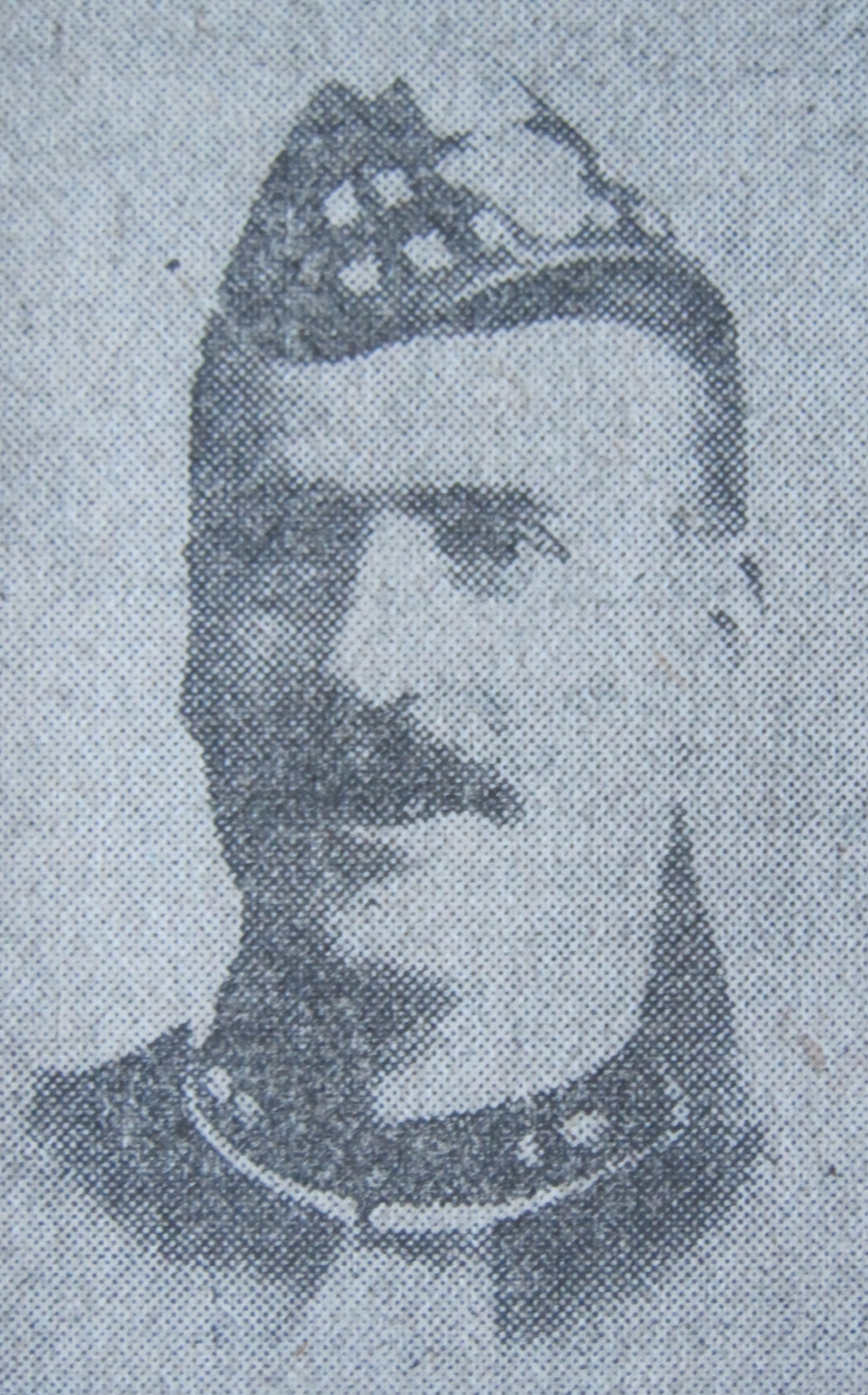
Pte Michael Rourke, 6093, 1st Bn Royal Scots Fusiliers
In early November 1914 Margaret received an official communication from the Infantry Record Office at Hamilton informing her that her husband had been admitted to hospital at Port-le-Grand, suffering from bronchitis. She had not received a letter from him since the middle of October and was naturally very anxious about his condition, although the communiqué did give her some small measure of reassurance that any news about his health would be immediately passed on to her. Shortly afterwards, that same month, he was invalided home with rheumatism. After a spell in England he returned to the Front for a second time.
In May 1915 a letter from him was published in the “Batley News”. He said he was well and the weather very hot. He also mentioned that the men got a bath and change of clothing when out of the trenches. He also enclosed a copy of an address to his Battalion by his Brigade Commander, highly complementing them on their part in an action in which Michael participated. This read:
“In order to cover the right flank of troops on our left, your battalion was ordered to take up a very bad and exposed position on a forward slope and sure enough on the morning after you were exposed to a very heavy shell fire, followed by an infantry attack by vastly superior numbers. The Germans came pouring through, and it soon became obvious that your position was untenable, and we were ordered to take up a position further back.
The Colonel, gallant soldier that he was, decided, and rightly to hold his ground, and the Royal Scots Fusiliers fought, and fought until the Germans absolutely surrounded and swarmed into the trenches. I think it was perfectly splendid. Mind you, it was not a case of “hands up” or any nonsense of that sort. It was a fight to a finish. What more do you want? Why, even a German General came to the Colonel afterwards and congratulated him and said he could not understand how his men had held out so long. You may well be proud to belong to such a regiment, and, I am proud to have you in my brigade.
General Sir Smith Dorrien also praised the RSF for their fine work after Neuve Chappelle. He visited them in billets and addressed them in terms of high praise. “None but the best troops could do the work, and so I sent you, and you have done it”
Michael’s last letter home was dated 14 June 1915. By early July his family were becoming increasingly uneasy as to his wellbeing, but there was still no definite information. The first disquieting news had arrived from a fellow-Batley soldier in late June. Pte C King of the 1st Northumberland Fusiliers wrote to Margaret on 21 June as follows:
“Mick and I were together on June 15th and promised that if anything happened to either of us on the 16th we would write to his home. I hope you will not take this too seriously but live in hope; I went round his regiment and could not find any Mick. Some of his pals told me he was wounded”.
Writing to Mr. A Baines of Upton Street, Cross Bank, Batley on 30 June Pte King wrote further about the fate of his friend:
“I am very sorry for Mrs Rourke. His regiment was in the charge with us on the day I will never forget – the 16th of June. I saw for myself that he was amongst the missing, but there is hope yet. It was a bloody sight but a grand charge. We had a lot of casualties and they lay all over. My deepest sympathy goes to Mrs Rourke, for I am very much afraid that poor Mick is gone. The Germans shelled us for 27½ hours after we made the charge and the men were blown to bits; it was hell”.
There then followed months of uncertainty interspersed with inconclusive, sometimes conflicting, information, as Margaret desperately tried to find any information as to what had become of Michael.
Around the same time as she received news from Pte King, she also received information that her husband had been wounded and taken into a Chelsea Hospital. She asked the Record Office for information but they told her that her husband’s name had not yet appeared on any casualty list, and no report had been received that he had been admitted to any hospital.
But Margaret did not give up this line of inquiry; instead, using her church contacts, she followed it up by contacting Father F Kerr McClement of St Mary’s, Cadogan Street, Chelsea[5] to see if he could be of assistance. Unfortunately he was unable to provide any positive news, writing to her:
“I am sorry you have had so much anxiety as to your husband and I have done my best to find his whereabouts. He is not in St Mark’s College, Chelsea (which is generally known as Chelsea Hospital) nor in St Georges Hyde Park Corner, Victoria, Tite Street, or in any of the private hospitals visited by us”.
On Saturday 17 July, Mrs Rourke finally received a communication from the War Office stating that they were sorry to inform her that her husband had been missing since the 16 June. At the time he was serving with the 1st Battalion’s “A” Company.
Margaret’s next recorded steps were to contact two organisations with expertise in tracing the whereabouts of missing soldiers – the British Red Cross and Order of St John Inquiry Department for Wounded and Missing Men. The former organisation responded with the following news:
“Pte Pilgrim, of this regiment (the Royal Scots Fusiliers), who is now in No 2 Canadian General Hospital, Le Treport, tells us that there are two men named Rourke in his regiment. The man whom he knows something about is a slim man, slightly built dark, with a moustache, about 38 years of age. This man was wounded at Hooge on June 16th, and could not be brought in, as the Germans had retaken trenches which they had lost. We do not know if this refers to the man for whom you are inquiring; perhaps from the description you could tell us if it is so. But you must remember that it is not at all certain from this report what happened to Pte Rourke. We hope to obtain more information which will make the matter clearer.”
The description given matched Michael’s. The records of the International Committee of the Red Cross do show that Margaret made enquiries about Michael, but sadly only the card noting this and Margaret’s address exist.
As more and more news filtered through, it appeared that Michael had taken part in an attack at Hooge where the Allies captured four lines of German trenches. The Germans counter-attacked re-capturing the last two trenches. Michael lay wounded in the third line of trenches, but so severe was the action that when the retreat came and the Germans re-captured that line, his comrades were unable to take their wounded colleagues back with them.
Margaret still did not give up, continuing to write to authorities in an attempt to establish any firm news of her husband’s fate, clinging to the hope that if not lying injured in an Allied hospital, perhaps he was being held as a prisoner of war. With this in mind her next step was to write to the King of Spain.
Spain was a neutral country and King Alfonso XIII contributed a great deal to improving the treatment of prisoners throughout the conflict. At his own expense he maintained a staff of 40 who helped him serve as an intermediary between prisoners and their families, using the Spanish diplomatic network in his endeavours. In response to her plea for assistance she received the following reply:
“Palacio Real de Madrid,
October 30 1915
Madam, – I am ordered by His Majesty the King, my august sovereign, to answer your letter petitioning His Majesty to cause enquiries to be made in Berlin with regard to Mr Michael Rourke, you husband. Although His Majesty’s Embassy in Berlin is charged only with the interests of France and Russia, His Majesty being desirous nevertheless of demonstrating his interests in British subjects, has graciously acceded to your request, and has commanded the Spanish Ambassador in Berlin to communicate with Great Britain’s representative there – the United States Ambassador – in order that in conjunction with the latter the necessary investigations may be made. His Majesty earnestly hopes that these enquiries may be the means of procuring satisfactory information for you – E de Swire”.
Satisfactory information sadly was not forthcoming and Margaret continued in her quest.
Many other women were also tirelessly pursuing word about their missing menfolk, with advertisements for information appearing in newspapers. It was in one of the Sunday papers that Margaret saw an advert from Elizabeth Morton from Chesterfield seeking news about her husband Lance Corpl Thomas Morton, 1st Royal Scots Fusiliers, reported missing on 16 June 1915 at Hooge. Noting that this soldier was in the same Battalion as her husband and had been missing since the same date, Margaret wrote to Mrs Morton expressing sympathy with her and pointing out that she was in the same predicament.
Mrs Morton had received a response to her advert from a Pte Harry Thomson of the 1st Royal Scots Fusiliers, who was in a military hospital in Newcastle on Tyne. He communicated the news of her husband’s death. Mrs Morton passed Pte Thomson’s address to Margaret in the hope that he would be able to shed some light as to the fate of Michael. Margaret wrote to him and received the following response:
“I am sorry to tell you that your husband, Pte Michael Rourke, was killed on the 16th June 1915. He was slightly wounded with myself and Lance Corporal Morton. I wanted him to go back to the dressing station and get looked after there, but he would not hear of it. He wanted to go on and have it out with the Germans as he called it. We went on together for about 20 yards when he fell with a bullet through the head. He never spoke after it. We managed to get him and some more of our men back later on and bury them behind our firing line. I am sorry to have to tell you the sad news Mrs. Rourke, but it is best to know the truth. The regiment lost very heavily that morning. The Royal Scots Fusiliers did their work very well. I am glad to say that I am keeping a little better. This is the second time I have been wounded. I hope you are keeping well, yourself and all your family. Anything also that you want to know about “Mick”, as we used to call him, I shall be pleased to tell you if I can. I must close now as the doctor is on the rounds”.
Margaret forwarded the letter onto the War Office. Towards the end of May 1916, eleven months after initially being posted missing, she received a letter in reply which confirmed that her husband was dead. The letter read:
“Madame, with reference enquiry concerning Pte Rourke 1st Royal Scots Fusiliers I am directed to inform you that no further news having been received relative to this soldier, who has been missing since the 16th June 1915, the Army Council have been regretfully constrained to conclude that he is dead and that his death took place on the 16th June 1915 or since. I am to express the sympathy of the Army Council with the relatives of the deceased:-your obedient servant C.F. Waitherton[6]”.
Michael died in what was known as the Battle of Bellewaarde. His body was never identified. According to the website[7] dedicated to remembering the Battle, more than 1,000 men lost their lives within a 12 hour period on 16 June 1915, in an area of approximately ½ mile square.

Menin Gate Inscription
Michael is commemorated on the Ypres (Menin Gate) memorial, alongside the names of more than 54,000 other officers and men whose graves are not known. These include Lance Corporal Thomas Morton, husband of Elizabeth, with whom Margaret had corresponded during her search.
Of Michael’s other brothers only the youngest, Francis, survived the war.
From cemetery and BMD records it appears Margaret never remarried. There is a burial in Batley Cemetery in April 1957 for Margaret Groark, aged 80.

The Menin Gate
Copyright
© Jane Roberts and PastToPresentGenealogy, 2015. Unauthorized use and/or duplication of this material without express and written permission from this blog’s author and/or owner is strictly prohibited. Excerpts and links may be used, provided that full and clear credit is given to Jane Roberts and PastToPresentGenealogy with appropriate and specific direction to the original content.
[1] I have traced six sets of attestation papers for Michael.
[2] A wilier/willeyer was someone who fed the willeying machine which was used to break down the rag and wool, thus separating and cleaning the fibres
[3] Birstall adjoins Batley. Up until 1905 when St Patrick’s parish was established in its own right, Birstall fell within the Catholic parish of St Mary’s, Batley.
[4] Service Number 6093
[5] One of the oldest Roman Catholic parishes in central London
[6] This featured in two newspapers, the “Batley Reporter and Guardian” and the “Batley News”. The latter indicates the letter was signed C F Watherston.
[7] http://www.bellewaarde1915.co.uk/ Website includes extracts of the 1st Battalion Royal Scots Fusiliers Unit War Diary.





![12 May 1910: Proclamation of the Accession of George V, Stone read from the portable bandstand in Granville Square. The portable band stand seen here was the first of its kind and was manufactured by Haynes and Sons, wheelwrights, of Station Road, Stone, and was purchased by Stone Urban District Council. See Copyright footnote at [6]](https://pasttopresentgenealogy.co.uk/wp-content/uploads/2015/06/haynes-bandstand.jpg)


