Following several years of painstaking research, Kevin McQuinn and Val Mitchell, assisted by others, have produced the ultimate reference guide to the Mayors of Batley.
It is the only book to cover all 72 men and women who served as Mayor on the Borough of Batley Town Council from its incorporation in 1869 through to the 1974, when Batley’s governance was taken over by the newly created Kirklees Metropolitan Borough Council.
The book truly has been a labour of love, and the passion of the authors for their subject really does shine through. Running to 152 pages, the A4 wire-bound booklet has a chapter devoted to each Mayor. Besides providing their biographical details, it covers the key civic challenges they faced, and developments for Batley, during their tenure as Mayor.
It means the booklet goes far beyond the lives of these individual men and women. When combined with other chapters describing the history of Batley before incorporation, and key developments introduced in the first 50 years after Batley became a Borough, it gives a unique perspective of the history of the town as seen through the prism of the decisions of the Borough Council.
It demonstrates the civic pride which drove the Borough Council to strive for better infrastructure, housing and public buildings for the town’s residents to improve their lives. It illustrates the rivalry between Batley and Dewsbury, competitiveness which again led to tangible improvements to the town and the lives of its people. It shows how at times of war the townsfolk united in a common purpose, contributing to the war effort. Above all, it shows how much power the Mayors and Borough Council wielded to focus on the things that really mattered to residents at a local level. It really is a window on the lives and times of our Batley ancestors.
Fully illustrated, it is a book to dip in and out of, and will be one to which I will refer for years to come.
Priced at £12.00, plus post and packing, any profit made will be given to Kirkwood Hospice (so, if you can afford to pay more for your copy that would be most welcome). Ordered copies will also be available for collection at Batley Library.
If you are looking for gift ideas for someone interested in Batley’s local history, you can’t go wrong with this. You can even arrange for a personally dedicated copy to make it extra special. Neither will it break the bank, and you’ll be helping Kirkwood hospice too.
To order a copy, please contact either Kevin McQuinn or Val Mitchell on the designated book ordering email at: bhg.mayors@gmail.com
Full disclosure: I normally receive a free copy of a book in return for a honest review. In this case I have had no hesitation in buying my own copy, as I believe this is an invaluable booklet for a Batley local historian, more so given some of the Mayors were Catholics and therefore link to my Batley St. Mary of the Angels One-Place Study. In addition the money being raised from sales is going to a hospice which has provided care for my family, and which relies on the generosity of the community to continue providing its vital services.
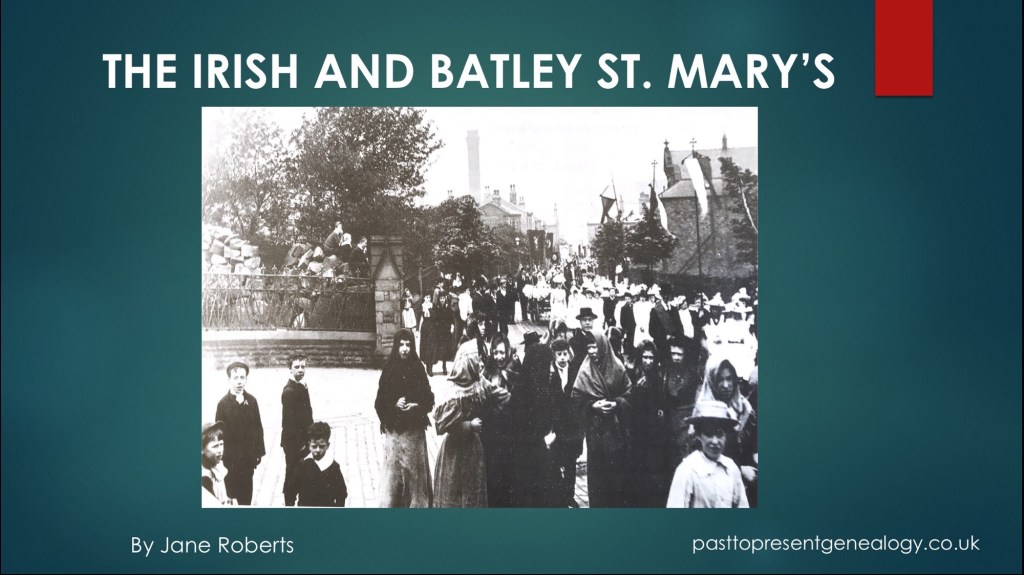
November 2025 was a busy month for the Batley St. Mary of the Angels One-Place Study. Four new posts were added, bringing the total number to 419. I also gave two talks about the early history of the Irish in Batley and the parish – one via Zoom to the Society of One-Place Studies; the other in-person to Batley History Group. If you missed them, I will be repeating the Irish and St. Mary’s talk next year with bookings already made for it, along with my other talks.
To start off with, I wrote a light-hearted piece about Buffalo Bill and A Right Royal Celebration for Batley’s Schoolchildren, a celebration in which the children of St Mary of the Angels participated. I describe, and include a photograph, of the special commemorative medal presented to all the schoolchildren, so that if you have one in your family you can identify it and know more about its history.
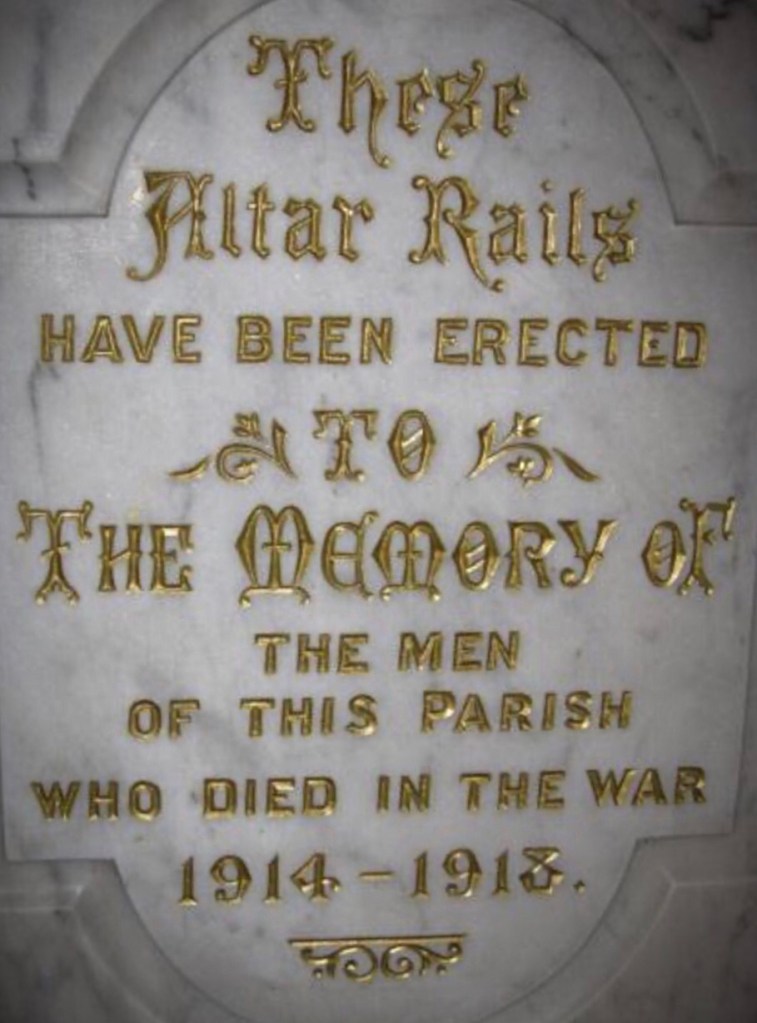
In a change of tone, with November being the month of Remembrance, one of the new posts was about James Edwards, one of the parishioners commemorated on the parish’s World War One War Memorial.
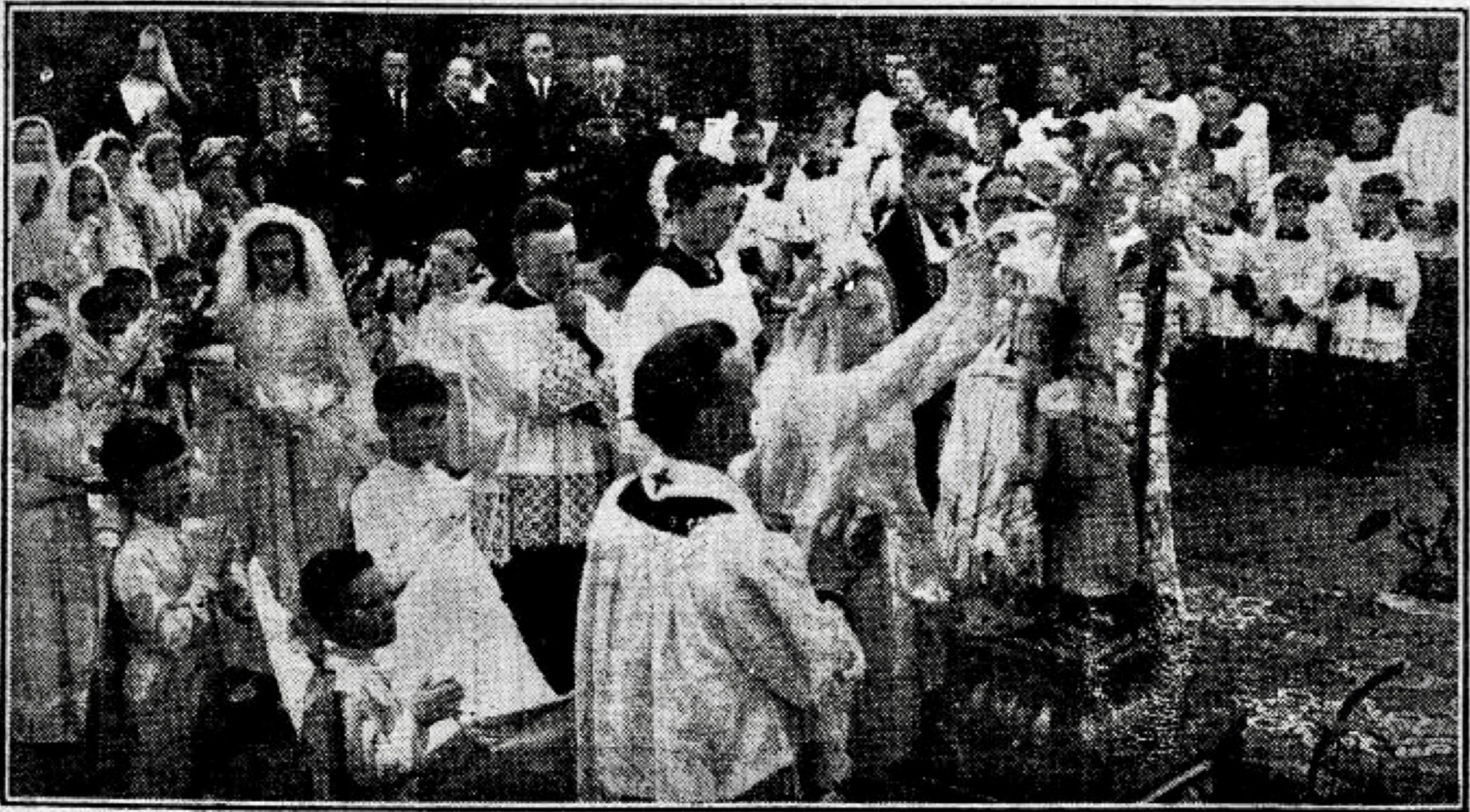
In the May Queen section I have added a piece about the 1952 ceremony when Patricia Anne Cain was the May Queen (as shown in the photograph to the left). It includes names of many others involved in the procession that day, which was a historic one in terms of its format that year.
The final post for the month was the parish history snippets piece for November 2025. These snippets cover a variety of events and people from the parish from years gone by, and can be found in the Bulletin for Batley St Mary of the Angels and Birstall St Patrick section. Even if you have seen them on the Bulletin, it is worth checking them here as some have links to more detailed pieces I have written.
Below is the full list of pages to date. I have annotated the *NEW* posts, so you can easily pick these out. Click on the link and it will take you straight to the relevant page.
If you want to know the background, and what is involved in a one-place study, click here. Otherwise read on, to discover a wealth of parish, parishioner and wider local Batley history.
Postscript: I may not be able to thank you personally because of your contact detail confidentiality, but I do want to say how much I appreciate the donations already received to keep this website going. They really and truly do help. Thank you.
The website has always been free to use, and I want to continue this policy in the future. However, it does cost me money to operate – from undertaking the research to website hosting costs. In the current difficult economic climate I do have to regularly consider if I can afford to continue running it as a free resource.
If you have enjoyed reading the various pieces, and would like to make a donation towards keeping the website up and running in its current open access format, it would be very much appreciated.
Please click 👉🏻here👈🏻 be taken to the PayPal donation link. By making a donation you will be helping to keep the website online and freely available for all.
Thank you.
As a professionally qualified genealogist, if you would like me to undertake any family, local or house history research for you do please get in touch. More information can be found on my research services page.
Finally, if you do have any information about, or photos of, parishioners from the period of the First World War please do get in touch. It does not have to be War Memorial men. It could be those who served and survived, or indeed any other men, women and children from the parish.
I would also be interested in information about, and photos of, those parishioners who were killed in World War Two, or others from the parish who undertook any war service and survived. This can be as broad as serving in the military, or work in munitions factories, the Land Army, even taking in refugees. This is an area I’m looking to develop in the future.
As of Monday 17 November 2025, the price or ordering your family history probate documents via the government’s Find A Will service will increase from £1.50 to £16.00. That’s an eye-watering rise of almost 1000%.
The notice for this increase was published on 10 November in The Gazette, meaning for many it has been a mad rush to get those last minute orders in.
The rationale for this price rise, as stated in the Ministry of Justice’s (MOJ) Explanatory Memorandum, reads:
The estimated cost to His Majesty’s Courts and Tribunal Service (HMCTS) for providing single copies of documents under the Find A Will service equates to £16 per copy. The £1.50 fee therefore significantly under-recovers its cost, despite fees being set with the intention of full cost recovery. This statutory instrument will therefore increase the fee for users to obtain copies of documents within the Principal Registry of the Family Division, district registries and any sub-registries attached, which includes the “Find A Will” service and individual users requesting extra copies of probate grants from £1.50 to £16, to align more closely with costs and ensure that HMCTS can continue to deliver its services effectively.
The £1.50 charge was introduced in 2019, with prior to that the cost being £10, so a review was overdue. But I would love to know how they determined upon a flat rate £16 figure.
It means for many the cost of these documents for family and local history will be now prohibitively expensive, limiting future research. For example, at £16 each, there is no way would I be able to afford ordering all the World War One soldiers’ wills that I have for my Batley St. Mary of the Angels one-place study.
I’ve spent this past week ordering probate documents for clients to beat the rise. It included an order for 12 wills which cost £18. As of 17 November to place that same order will be £196.
Today I finally got round to reviewing my one-place study soldiers’ wills, confirming I’d already got them all.
I also reviewed my direct line ancestors, and placed an order for the six I identified as missing. Four came back instantly via an automated service, having already been digitised. This is akin to the service for World War One soldiers wills.
To my mind this begs the question why did the MOJ not introduce a graded pricing structure for probate records, similar to that in place for General Register Office (GRO) civil registration orders? The GRO’s automated Digital Image service has a lower cost of £3, with PDFs costing £8, and the more labour-intensive full certificates coming in at £12.50.
This seems a much fairer system than the flat rate fee, a system which might avoid pricing out family and local history researchers. For as the fee structure stands, there will be a dramatic cliff-edge drop off for probate orders going forward.
Postscript: The MoJ does still have a £1.50 bulk access option aimed at some (unspecified) organisations who access every copy of a grant of probate or will issued in England and Wales. By extension this means individual family and local history researchers are being overcharged for their documents, essentially subsidising these organisations. Hardly a fair system!
Because of work commitments, during October 2025 only one new post was added to the Batley St Mary of the Angels One-Place Study, bringing the total number of posts to 415.
This new post was the parish history snippets piece for October 2025. These snippets cover a variety of events and people from the parish from years gone by, and can be found in the Bulletin for Batley St Mary of the Angels and Birstall St Patrick section. Even if you have seen them on the Bulletin, it is worth checking them here as some have links to more detailed pieces I have written.
One of the reason for the lack of additions this month is because in November and December I’m giving a series of talks to various organisations. These include an online talk on 11 November 2025 to the Society of One-Place Studies about the early history of the Irish in Batley, and the parish of Batley St Mary of the Angels up until around the 1880s. This is restricted to members of the Society. However, on Monday 24 November I will be giving more or less the same talk at the Batley History Group meeting in Batley Town Hall. This starts with refreshments at 7pm, with the talk commencing at 7.30pm. It is open to both members (£2) and non-members (£4). So, perhaps I will see some of you there. More details about this, and Batley History Group’s other meetings in 2025/26 can be found here.
James Harkin, Batley’s 1st Catholic Mayor
I also have a special thank you this month for someone who has sent me a lovely letter and some photos of James Harkin, Batley’s first Catholic mayor – one of which is included in this piece. I don’t have her contact details to thank her personally, so hopefully she will read my thank you here.
Below is the full list of pages to date. I have annotated the *NEW* posts, so you can easily pick these out. Click on the link and it will take you straight to the relevant page.
If you want to know the background, and what is involved in a one-place study, click here. Otherwise read on, to discover a wealth of parish, parishioner and wider local Batley history.
Postscript: I may not be able to thank you personally because of your contact detail confidentiality, but I do want to say how much I appreciate the donations already received to keep this website going. They really and truly do help. Thank you.
The website has always been free to use, and I want to continue this policy in the future. However, it does cost me money to operate – from undertaking the research to website hosting costs. In the current difficult economic climate I do have to regularly consider if I can afford to continue running it as a free resource.
If you have enjoyed reading the various pieces, and would like to make a donation towards keeping the website up and running in its current open access format, it would be very much appreciated.
Please click 👉🏻here👈🏻 be taken to the PayPal donation link. By making a donation you will be helping to keep the website online and freely available for all.
Thank you.
As a professionally qualified genealogist, if you would like me to undertake any family, local or house history research for you do please get in touch. More information can be found on my research services page.
Finally, if you do have any information about, or photos of, parishioners from the period of the First World War please do get in touch. It does not have to be War Memorial men. It could be those who served and survived, or indeed any other men, women and children from the parish.
I would also be interested in information about, and photos of, those parishioners who were killed in World War Two, or others from the parish who undertook any war service and survived. This can be as broad as serving in the military, or work in munitions factories, the Land Army, even taking in refugees. This is an area I’m looking to develop in the future.
May 2025 marked a milestone for the Batley St Mary of the Angels One-Place Study, with it hitting 400 posts during the first week of the month. By the end of May 2025 five posts had been added across a range of topics, bringing the total number of posts in the study to 404.
Below is the complete list of all the St Mary’s posts published up to the end of May 2025, including links to them, with those new and updated posts signposted so you can easily locate them.
If you want to know the background, and what is involved in a one-place study, click here. Otherwise read on, to discover a wealth of parish, parishioner and wider local Batley history.
That milestone 400th post was a description of the parish of St Mary of the Angels in 1950, a post which for some will bring back memories. This is in the Miscellany of Information section.
With May 2025 marking the 80th anniversary of VE Day, I added a new World War Two biography, that of Bernard Stenchion. His death, in June 1945, illustrates that although Victory in Europe was celebrated on 8 May 1945, for some this was not the end of the War, while for many other parishioners the war had already irrevocably changed their lives.
The 1950 May Queen Catherine Heaps (L), with Moya Hill, the 1949 May Queen (R)
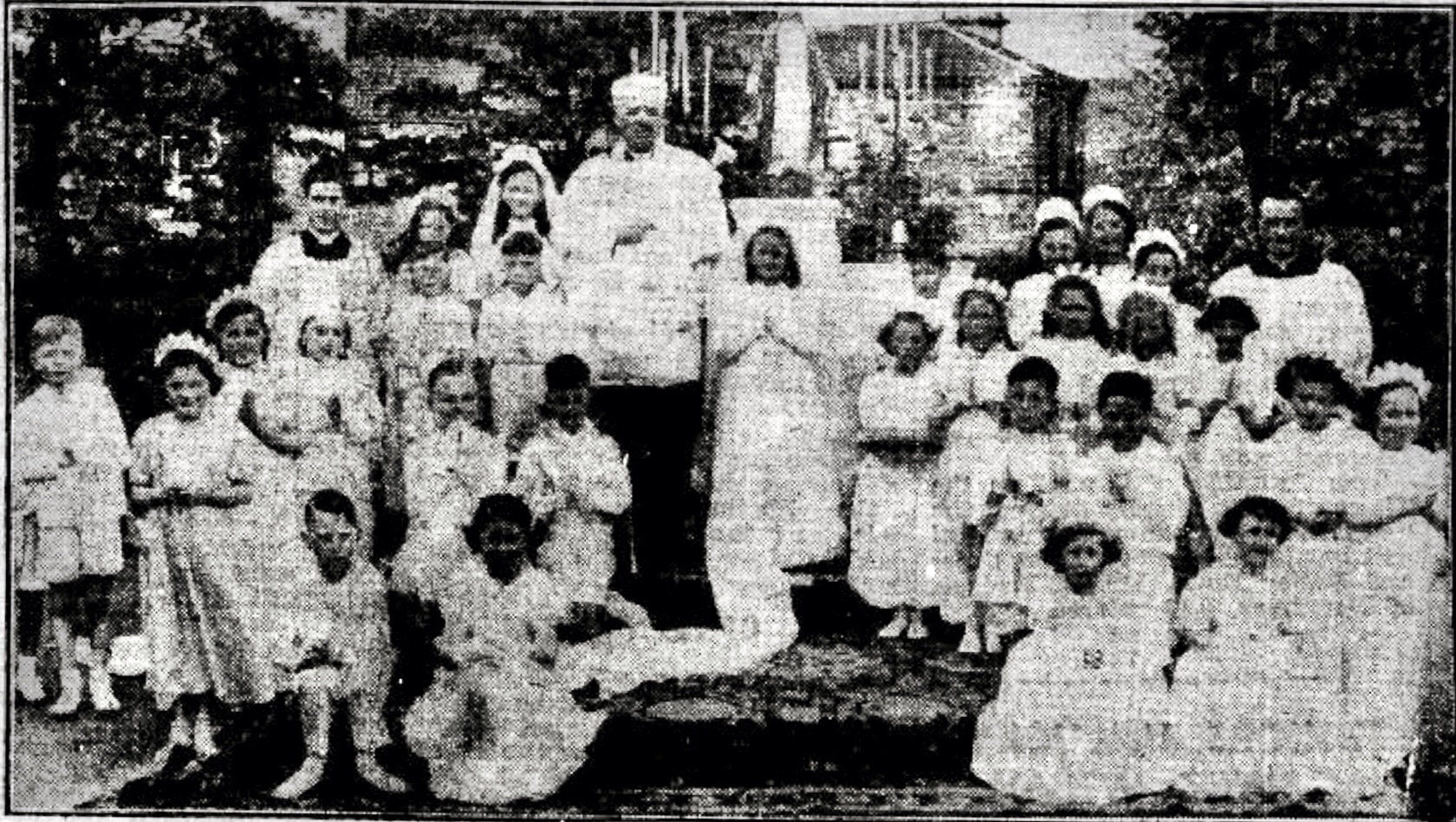
It also seems appropriate that in May two new May Queen pieces were added – about the 1923 May Queen Katherine Phillips, and the 1950 May Queen Catherine Heaps.
The fifth new post this month was the parish history snippets pieces from the May 2025 bulletins, and this can be found in the Bulletin for Batley St Mary of the Angels and Birstall St Patrick section.
Below is the full list of pages to date. I have annotated the *NEW* and *UPDATED* ones, so you can easily pick these out. Click on the link and it will take you straight to the relevant page.
Finally this month, I wanted to let you know that I will be giving at the Batley History Group meeting on 23 June 2025 all about the early history of the Irish in Batley and the parish of St Mary’s up to the 1880s. If you want to attend that meeting, it is in the Council Chamber of Batley Town Hall, with refreshments served from 7pm and the talk starting at 7.30pm. All are welcome, and the cost is £2 for members and £4 for non-members. It would be great to see people there.
Postscript: I may not be able to thank you personally because of your contact detail confidentiality, but I do want to say how much I appreciate the donations already received to keep this website going. They really and truly do help. Thank you.
The website has always been free to use, and I want to continue this policy in the future. However, it does cost me money to operate – from undertaking the research to website hosting costs. In the current difficult economic climate I do have to regularly consider if I can afford to continue running it as a free resource.
If you have enjoyed reading the various pieces, and would like to make a donation towards keeping the website up and running in its current open access format, it would be very much appreciated.
Please click 👉🏻here👈🏻 to be taken to the PayPal donation link. By making a donation you will be helping to keep the website online and freely available for all.
Thank you.
As a professionally qualified genealogist, if you would like me to undertake any family, local or house history research for you do please get in touch. More information can be found on my research services page.
Finally, if you do have any information about, or photos of, parishioners from the period of the First World War please do get in touch. It does not have to be War Memorial men. It could be those who served and survived, or indeed any other men, women and children from the parish.
I would also be interested in information about, and photos of, those parishioners who were killed in World War Two, or others from the parish who undertook any war service and survived. This can be as broad as serving in the military, or work in munitions factories, the Land Army, even taking in refugees. This is an area I’m looking to develop in the future.
April was a particularly busy month for the Batley St Mary of the Angels One-Place Study. It included the addition of a new subject heading, along with eight new posts, bringing the total number of posts to 399. One other post was updated.
Below is the complete list of all the St Mary’s posts published up to the end of April 2025, including links to them, with those new and updated posts signposted so you can easily locate them.
The May Queens of 1931 and 1932
If you want to know the background, and what is involved in a one-place study, click here. Otherwise read on, to discover a wealth of parish, parishioner and wider local Batley history.
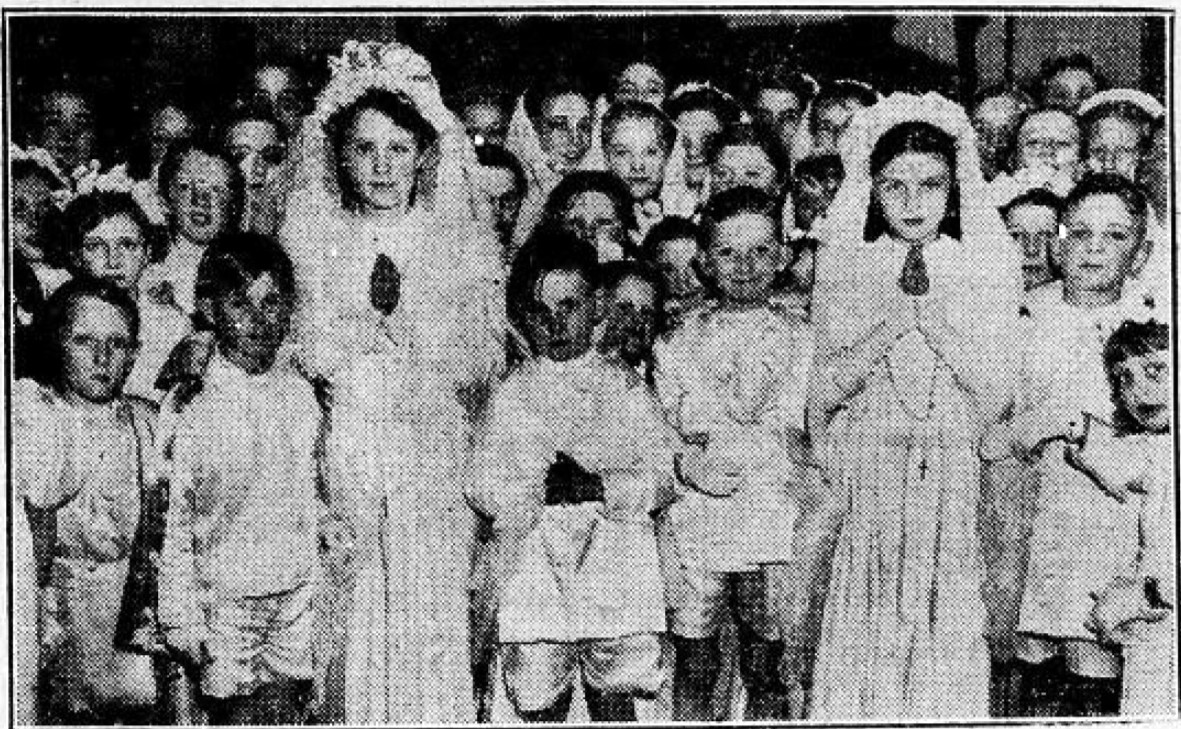
The new section added in April was one about the May Queens of the parish. I am trying to identify as many of them as possible, with a piece dedicated to each year. To date seven years have been added to this section, 1922, 1931-1933, 1939-1941.
The final addition this month is in the Bulletin for Batley St Mary of the Angels and Birstall St Patrick section. It is the piece covering the parish history snippets included in the parish bulletins during April 2025.
I have also added a further update to the World War Two introduction page.
Below is the full list of pages to date. I have annotated the *NEW* and *UPDATED* ones, so you can easily pick these out. Click on the link and it will take you straight to the relevant page.
Postscript: I may not be able to thank you personally because of your contact detail confidentiality, but I do want to say how much I appreciate the donations already received to keep this website going. They really and truly do help. Thank you.
The website has always been free to use, and I want to continue this policy in the future. However, it does cost me money to operate – from undertaking the research to website hosting costs. In the current difficult economic climate I do have to regularly consider if I can afford to continue running it as a free resource.
If you have enjoyed reading the various pieces, and would like to make a donation towards keeping the website up and running in its current open access format, it would be very much appreciated.
Please click 👉🏻here👈🏻 to be taken to the PayPal donation link. By making a donation you will be helping to keep the website online and freely available for all.
Thank you.
As a professionally qualified genealogist, if you would like me to undertake any family, local or house history research for you do please get in touch. More information can be found on my research services page.
Finally, if you do have any information about, or photos of, parishioners from the period of the First World War please do get in touch. It does not have to be War Memorial men. It could be those who served and survived, or indeed any other men, women and children from the parish.
I would also be interested in information about, and photos of, those parishioners who were killed in World War Two, or others from the parish who undertook any war service and survived. This can be as broad as serving in the military, or work in munitions factories, the Land Army, even taking in refugees. This is an area I’m looking to develop in the future.
A little after 7.30pm on 7 May 1945, a radio newsflash announced to the people of Britain that Germany had formally surrendered, and the following day would be Victory in Europe (V.E.) Day. It marked the end of almost six years of war across the continent.
The news, which was met with wild jubilation, was not unexpected. With the writing on the wall, Hitler committed suicide on 30 April, and his successor, Grand Admiral Karl Dönitz, immediately commenced negotiations with the Allies. Things moved rapidly, with Dönitz’s mind concentrated in a bid to save as much of eastern Germany as possible from the advancing Russian Red Army.
On 4 May 1945 British Army Field Marshall Bernard Montgomery accepted the unconditional surrender of German forces in the Netherlands, north-west Germany and Denmark. On 7 May, Supreme Allied Commander General Eisenhower (who later became the 34th US President) accepted the surrender of all German forces, with this coming into effect the following day.
In Batley, preparations for V.E. Day celebrations were well underway, and this even before the government’s 1 May communication to local authorities about the form they should take. A host of townspeople were already on standby, ready to spring into action at a moment’s notice once the eagerly anticipated announcement came. These preparations were as varied as church bell-ringers and the members of Batley Old Band at the ready, whilst other townsfolk stood primed for the immediate erection of platforms in Batley market place. There were plans for religious services, preparations for a bonfire, and arrangements for the floodlighting of public buildings – so that tradition is not a modern phenomenon.
Batley’s schools already had holiday contingencies drawn up – for example, if the announcement came during the afternoon school session or during the evening, they would shut for the two following days. When the announcement did come, because of the timing, St. Mary of the Angels RC schools were shut not only on 8 and 9 May, but also 10 May, it being the Ascension Day holiday. In effect, this meant many St. Mary’s pupils also failed to return for re-opening on Friday, 11 May – with the weekend added on, they spun it out to a six-day break!
Even bakers and confectioners had contingency arrangements. With closures dependent on the announcement timing, they urged customers to carry at least one day’s bread in stock, with the suggestion being if the declaration came on Monday, Tuesday or Wednesday, these shops would remain open for two hours only to sell goods already made, before shutting for the holiday.
Batley Council’s preparations were so meticulous that a message from the Mayor, Councillor F. W. H. Auty, was published on Friday, 5 May. In it he outlined arrangements for the Victory Parade for the Sunday afternoon following whenever V.E. Day was, and exhorting people to attend their churches and chapels on what was designated countrywide as being ‘Thanksgiving Sunday.’
Once the 7 May evening announcement came, the people of Batley were ready. As V.E. Day morning dawned, the rain failed to dampen the spirits of joy, relief and thankfulness. As if by magic, flags, banners, bunting and garlands appeared on houses, factories, buildings and shops across the town. Unlike today, nighttime outdoor electric fairy lights on private houses were a novelty, so one house provided a real talking point for having outside electric lights forming the “V” for victory sign. The War Memorial, Town Hall, and Parish Church Tower were floodlit, and a revolving lantern was placed in the library clock tower.
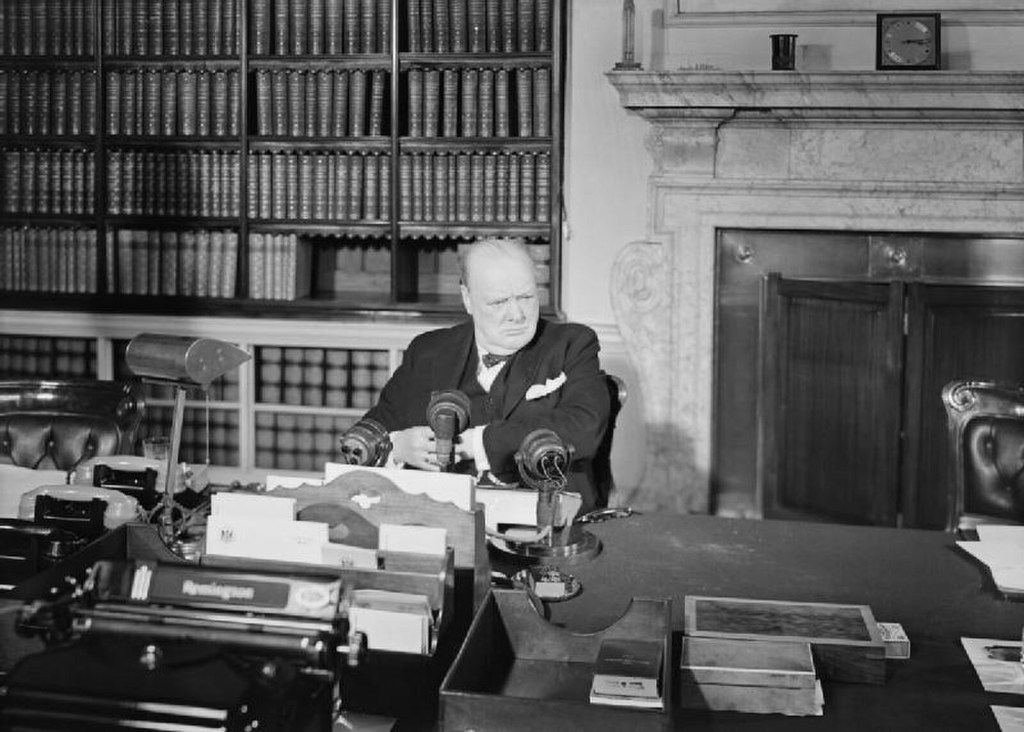
Despite the rain persisting into V.E. Day afternoon, Batley Old Band and the Boy Scouts’ Band played at intervals in the Market Place where, at 3pm, Churchill’s momentous radio broadcast to the nation was transmitted, as it was in wireless-owning households across town. Churchill’s broadcast can be heard in full here.
Winston Churchill makes his VE Day broadcast to the British people from the Cabinet Office in Whitehall, 8 May 1945 – Wikimedia Commons Public Domain Image.
Immediately afterwards, the church bells rang out and, as if sensing the mood, the rain turned to a drizzle before clearing, and by early evening the sun broke through.
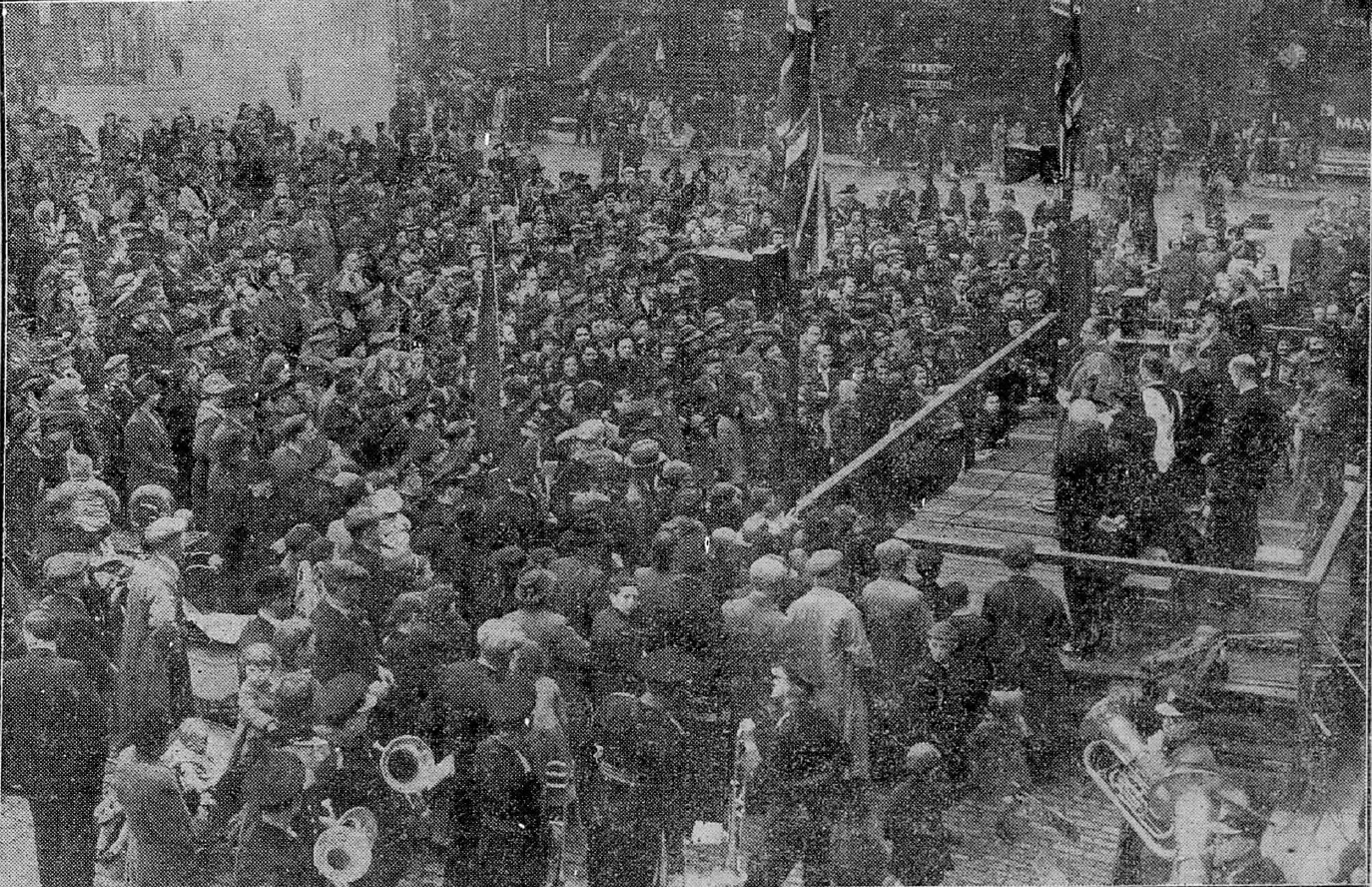
At 7pm the Vicar of Batley (Rev. E. C. Hamer), and Mayor’s Chaplain, (Rev. W. J. Bremner), conducted a service in the packed market place. The Mayor, in his address, expressed his heartfelt thanks to the citizens of Batley for their cheerfulness and steadfastness over the past five years. He also recalled an incident at Waterloo Station following the Dunkirk evacuation, when one of the ‘boys’ told him “Don’t be downhearted for we shall go back because He is with us.” It is a reminder of the central part faith played in the lives of many in this period.
Batley Market Place on V.E. Day Evening
Another reminder of that religious core was the many Church services held across town. These followed the Market Place service, and continued in the days afterwards. They added a reflective note to the thanksgiving, remembering the losses and the suffering which many would endure long after the cessation of hostilities.
The largest of these services was at Batley Parish Church, with a collection there going towards the Church of England’s efforts to raise one million pounds for the churches of Europe – fundraising being interwoven with many events. Other services took place at the Zion Methodist Church, St Luke’s, Staincliffe Baptist Church (which was also opened for private prayer), Staincliffe Christ Church, Batley Road Methodist Church, St Andrew’s at Purlwell (a church which suffered bomb damage in the 1940 Batley air raid), and Carlinghow St John’s. A United Service of Thanksgiving and Dedication was held at Hanging Heaton Parish Church, in conjunction with the Ebenezer Methodist Chapel. Their collection for the Committee for Christian Reconstruction in Europe raised over £14, which equates to over £760 at today’s values.
Continuing the seamless coordination of V.E. Day events, at 9pm King George VI made a radio broadcast from Buckingham Palace, which can be listened to here.
Following this, thousands made their way to Mount Pleasant. Here, at 10pm, the civic-organised bonfire was lit, accompanied by fireworks exploding into the night sky, whilst Red Cross workers, collecting for the Prisoners of War fund, wheeled around an effigy of Hitler. At one point, as the flames leapt skywards, timber crackled, crowds applauded, and the pungent scent of smoke filled the air, there was a fear that the breeze-carried burning embers would set the whole football field alight.
All around, the skyline was illuminated by other celebratory bonfires. From the birds-eye vantage of Caulms Wood Quarry the victory lights view was particularly memorable. The Mount Pleasant bonfire lit up the sky with a warm red glow. Other bonfires in Batley could be seen dotted around streets and open spaces. Towards Earlsheaton the glow from many other bonfires was visible. Between Batley and Dewsbury hundreds of lights shone out from house windows finally divested of their black-out curtains. The bright white glow of pre-war standard electric street lights could once more be seen over Dewsbury. Staincliffe General Infirmary presented a beautiful floodlit scent. A searchlight over to the west repeatedly circled the sky. And above it all, fireworks streaked heavenwards.
Back in Batley, the Fleming Street bonfire raised 10s., (over £27 real price today, no mean feat for a working class street after five years of hardship), which went towards the Batley Red Cross Hospital supplies. The bonfire in Hanging Heaton school yard also included an area for music and old-time dancing, with church organist Mr. W. Hall providing a radiogram (a radio/gramophone combination).
Hitler effigies were a theme, with the one at Oaks Road, made by Roland Whitty, John Harrison, Peter Virr, and Donald Trott, raising 30s. for the Red Cross. The sale of hot peas added another £1 to funds. A Birstall housing estate’s bonfire had a particularly symbolic – and sinister – bonfire topper, a black and yellow SS unit pennant, sent home by a Birstall soldier who took it in the battle of the Rhine.
It is hard to imagine, but for many children, with wartime blackout restrictions, the V.E. Day celebrations would be their first ever experience of the magic of bonfires and fireworks. Though for one Batley St. Mary of the Angels teenager, 14-year-old Margaret Donegan, it was a memorable occasion for all the wrong reasons. Her night ended with an ambulance trip to Batley Hospital, and stitches in her knee.
Whilst no babies were born in Batley Maternity Home on V.E. Day, George and Eleanor Shadbolt, of Back Taylor Street, welcomed their daughter – Dorothy Victory.
The holiday spirit continued on a sunny 9 May, designated V.E Day Plus One, with the combined Batley and Birstall Old Bands entertaining the crowds in Wilton (Batley) Park during the afternoon and evening. People played bowls and tennis, while ice-cream eating, Union Jack flag-waving children bedecked in red, white and blue messed around, boating, bathing and playing.
Elsewhere across Batley, in the afternoon there were Victory street parties and evening bonfires and dances. A Victory ball was held at Batley’s Ambulance Rooms, with members of the Forces admitted free. The Stardusters Band played at a crowded ball at the Co-operative Hall. St Luke’s held a social.
For one St. Mary of the Angels parishioner, 19-year-old Peggy Munns, V.E. Day Plus One had a special significance – it was her wedding day. Her Lancastrian fiancé, Signalman Robert Billington Walmsley, was on ballot leave from the British Liberation Army. Given away by her father Joseph Munns, she wore a white embroidered dress, with a white-feathered headdress and veil, and carried a bouquet of tulips and roses. After a reception at Wilton Park’s Lakeside Cafe, the couple left for their honeymoon in Blackpool.
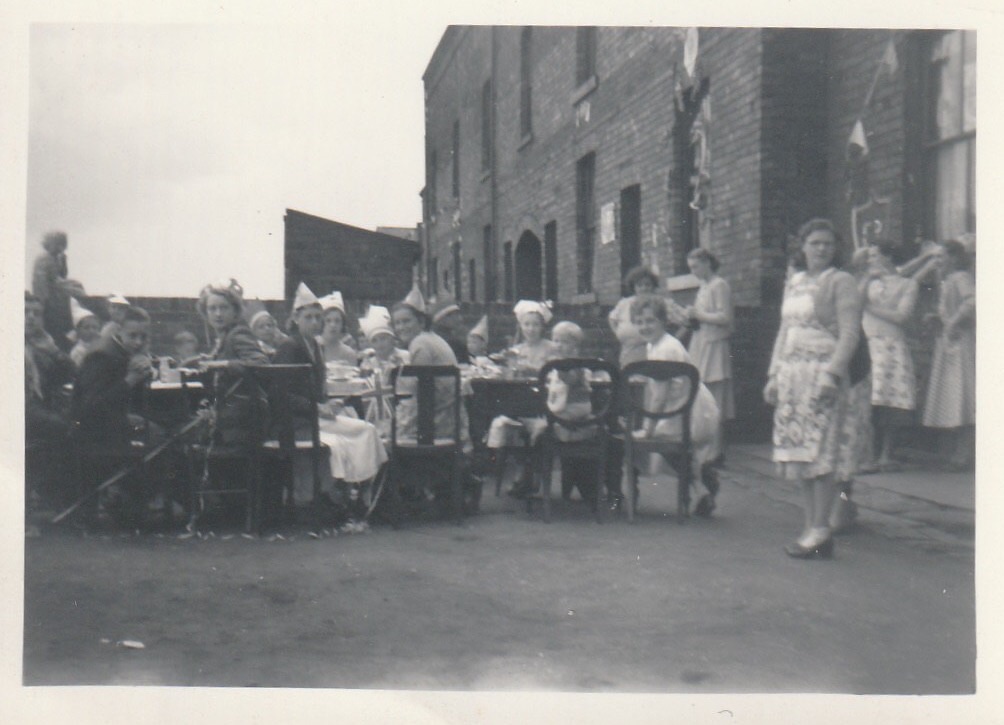
Despite mixed weather, the weekend of 12/13 May marked another round of celebrations. Fortunately, the Saturday morning rain cleared for the many Victory parties and bonfires held across the streets of Batley. They were varied in size and form, but in all cases children were at the heart and, despite rationing, neighbours came together pooling food. Here are just a few:
A Borough Road party, attended by around 70 children, where a piano was brought out for community singing. A decorated table was set up in the road, with residents filling it with party food, including trifle, cakes and pastries.
At Beaumont Street, Mount Pleasant, 32 children were entertained. There, a gramophone (old style record player) provided music, and each child received a sixpence.
Also at Mount Pleasant, each child on Colbecks Yard was given a bar of chocolate. Surplus party food was sold in aid of the Red Cross.
At Whitaker Square, 36 children enjoyed their street party; at Yard 1 (Wellington Street), the number of children was 10.
Warwick Mount’s Victory party organised by Mrs. Crowther and Mrs. Perry catered for 26 adults and 14 children. Neighbours shared provisions, to put on tea and supper. Children received sweets, oranges and 2s., which equates to £5.45 today. Babies were given 3s. In the evening there was a bonfire, with yet another Hitler effigy. A gramophone was brought out to accompany the dancing. Then they had another party and beetle drive on Sunday.
Mrs. A. Padgett provided a radiogram for the Yard 1, Norfolk Street party for around 25 people. A firework display followed tea.
Mrs. H. Marriott and Miss A. Walker organised the party covering the Copley and Loxley Streets area of Carlinghow. Here, over 40 children were entertained. Neighbours provided food, with adults eating after the children. There were games, and musical entertainment came in the form of both a piano and gramophone.
A bunting and flag-decorated Trafalgar Street was the venue for the Healey district party, organised by married couple Ernest and Ellen Scott of number 30. Around 60 children played games, and were given ice-cream, oranges and sweets. In the evening a bonfire was lit, whilst George Powell played the piano and Geoffrey Mitchell the accordion for dancing and community singing. The Red Cross benefited to the tune of 30s, raised via a competition and collection.
The residents of Clutton Street, West Street and Lady Anne Road organised a party for around 38 children living there. Tea was followed by ice-cream. Entertainments included a treasure hunt, singing by Bill Brannan, singing and dancing by Misses Patricia Gledhill and Vera Plumb, and a performance by illusionist Mrs. Joe Sheard. After a pie and pea supper, each child was presented with 1s. 6d. Later, Messrs. Abe North, A. Law and Jack Taylor played ‘delightful music’ on their cornets, and the grown-ups sang with them until midnight.
The Victoria Street party – with thanks to Gerry Hudson for the photos
Other parties included one at Taylor Street on Tuesday. An effigy of Hitler was utilised as a novel way to raise the money to fund it. After the children’s tea, this effigy was burned on a bonfire. Here, the children received oranges and ice-cream. Also on Tuesday, the neighbours of Royd Street, Hanging Heaton, treated the children there to a supper and a bonfire.
I have been asked if extra rations were allowed for these parties. From what I’ve read, rations of extra sugar, and fat etc. were not allowed for these street parties, unless the party was organised by the Red Cross or similar. Some did query it because extra sugar and fat could be obtained for a wedding. But because VE Day was a nationwide celebration, there was a genuine fear that if restrictions were lifted there would be not enough food for all the events. The only exception appears to be that that the Board of Trade confirmed people could purchase red, white and blue bunting without using their coupons. And on the morning of 8 May 1945, Prime Minister Churchill received assurances from the Ministry of Food that there were sufficient beer supplies in London!
And on Saturday 12 May, there was another military wedding for Father McBride to officiate over at a St. Mary of the Angels. The bride was Mary Phillips of the Auxiliary Territorial Service, the women’s branch of the Army established to undertake non-combatant roles, thus freeing up men for those. The 25-year-old daughter of James and Margaret Phillips, she married Pte. Johnnie Keelan, of the Royal Army Ordnance Corps, who came from Glasgow. She wore a turquoise two-piece trimmed with gold. Her accessories were brown, and she carried a spray of pink carnations and white heather. Like newly-weds Peggy and Robert Walmsley days earlier, this couple also had their reception at the Lakeside cafe, followed by a Blackpool honeymoon.
The main final acts marking Victory in Europe took place on Sunday 13 May, ‘Thanksgiving Sunday’. Churches and chapels up and down the country held special services to give thanks for Britain’s deliverance from danger. These services were followed by Victory parades.
Under threatening skies, the Batley parade participants assembled at 2.30pm in the Old Foundry Yard (in the Branch Road/St. James Street area), processing to the Market Place via Bradford Road, Hick Lane and Commercial Street. The mix of participants illustrated how many organisations, both military and Home Front, had been involved in the war effort. Those participating included repatriated prisoners of war, members of the military, the Home Guard, the British Legion (Batley and Birstall Branches), Toc H (Batley Branch), K.O.Y.L.I (Batley Branch Regimental Association), Police and Specials (Batley and Birstall), the National Fire Service, Ambulance and Nursing Divisions, Ambulance Cadets, the Volunteer Stretcher Bearer Company, Salvation Army, Army Cadet Force, Air Training Corps, Girls Training Corps, Church Lads’ Brigade, the Boy Scouts, Report Centre Staff, Air Raid Wardens, Rescue Decontamination and Repair, Messenger Service, Casualty Services, Fire Guards, The Mortuary Service, Food Decontamination Service, Mayoress’s Comforts Committee, Women’s Voluntary Service, the Central Hospital Supply Service, Prisoners of War Relatives’ Association, and other members of the public who had contributed to the war effort.
Thanksgiving Parade at Batley Market Place, 13 May 1945
Once in the Market Place, the Mayor addressed the assembled throng, praising the unity of the people in the face of the critical days of 1940 following the Dunkirk evacuation and Battle of Britain. He urged that peace should not be once more thrown away as it was in 1918, and once the celebrations were over, people should “work for the benefit of those who fought for freedom and have won the right to be free.” His speech included a moment’s silence to remember those who had given their lives.
This address was followed by a short service conducted by the Mayor’s Chaplain, Rev. Bremner.
The event concluded with the singing of the National Anthem. The minute the last note was sung, the heaven’s opened with such intensity, drenching the majority as they scattered for shelter. It marked the official end of the celebrations in Batley.
As celebratory as V.E. Day in Batley was, it should not be forgotten that for many families and individuals across town the day was difficult, a reminder of loved ones who would never return home, of lives, minds and bodies scarred forever. And the War itself was not at an end, with the Far East war still raging as Japan fought on. VJ Day, 15 August 1945, and the end of World War II, was still three months away.
Finally, if you do have any memories or photographs of Batley’s V.E. Day celebrations, please do let me know. It would be great to add them here as part of Batley’s history of that day.
For more about the impact of World War II on Batley please read my post about the night the Luftwaffe bombed Batley and Dewsbury, which can be found by clicking here.
For more details about the areas in Batley hit that night, and the air raid warden reports click here.
For damage to specific houses in various streets across Batley during that 12/13 December 1940 air raid see:
For Part 1 – Street names commencing A to B click here.
Please also read the section of my Batley St Mary’s One-Place Study about parishioners serving in the military who died in the conflict, the introduction of which can be found here.
Postscript: I may not be able to thank you personally because of your contact detail confidentiality, but I do want to say how much I appreciate the donations already received to keep this website going. They really and truly do help. Thank you.
The website has always been free to use, and I want to continue this policy in the future. However, it does cost me money to operate – from undertaking the research to website hosting costs. In the current difficult economic climate I do have to regularly consider if I can afford to continue running it as a free resource.
If you have enjoyed reading the various pieces, and would like to make a donation towards keeping the website up and running in its current open access format, it would be very much appreciated.
Please click 👉🏻here👈🏻 to be taken to the PayPal donation link. By making a donation you will be helping to keep the website online and freely available for all.
Thank you.
As a professionally qualified genealogist, if you would like me to undertake any family, local or house history research for you do please get in touch. More information can be found on my research services page.
Multiple sources were used to compile the above account, from local papers to family history records – there are far too many to list.
What family historian isn’t a bibliophile? I’m no exception to the rule, living by the principal “A house isn’t a home without at least one bookcase for every room”.
I love exploring a multitude of family and local history topics, so it was a pleasure to be introduced to a new subject – the baronial system in Scotland, as covered by David Dobson in his book Scottish Baronial Families, 1250-1750. Published by the Genealogical Publishing Company, this paperback runs to 199 pages.
It opens with a brief summary of the feudal governance system introduced and used by Scottish monarchs, at the heart of which was the administrative unit of a barony. Headed by a baron, who in effect was a crown vassal, it was a system which operated until 1747 when the British government curtailed their powers with the Heritable Jurisdiction Act, their response to Jacobite rising of 1745-46. With Baronial responsibilities extending to the tax collection, supplying of men for military purposes, as well as jurisdiction over civil and criminal matters, and the baron’s principal seat of authority being the caput, in terms of English equivalent a baron was something akin to a Lord of the Manor.
The introductory section also explains the difference between barons and the noble rank of baronet, the latter created in 1611 by King James VI1 as a way of fundraising, along with promoting the Plantation (organised colonisation) of Ulster, and settlement in Nova Scotia. These are also featured in the book.
Next there is a simple one-page bibliography, which acts as a very basic proxy for specific source citations.
Before getting into the meat of the publication, there are seven images. Whilst they are captioned, I would have found it helpful to also have an accompanying page number to link them to the specific section in the book.
We then come to the main body of the book. Drawing mainly on the Register of the Great Seal of Scotland, this is an alphabetical listing of the Scottish Baronial families – covering in total around 1,000 Scottish baronies and baronetcies. And whilst the listings are dominated by men, there are also a smattering of female holders. The listings detail the families, plus when, where, and by who, they were granted their baronies/baronetcies. Some have additional information. The pieces range from a couple of sentences, to – in some cases – upwards of a page for those families with multiple grants, or where there is extra details.
The book concludes with a select listing of Scots-Irish baronetcies established in Ireland and in the New World.
It is a book to dip into for reference, rather than one to read from cover to cover, and it acts as a concise introduction to the subject. Personally, as part of this reference material, I would also have found a place name index useful, in order to link locations to baronies. But there’s no doubt this is an impressive starting point and companion book for researchers and local historians investigating these families.
The book was published in 2024, ISBN 9780806359748. For ease I’ve attached the purchase links for both Amazon and Genealogical.com
Full disclosure: I received a free copy of the book from Genealogical.com in return for a honest review. I have expressed my truthful opinion in the above review.
Footnotes: 1.King James I of England, although it was not until 1707 that new baronets were established under the United Kingdom.
The number of posts in the Batley St Mary of the Angels One-Place Study creeps ever-closer to the 400 mark. The three new posts added in February 2025 brings it up to 386. One of those posts is a result of my February visit to the Leeds Diocesan Archives, and hopefully in the coming months more pieces will follow on from my finds that day. Two other posts were updated.
Below is the complete list of all the St Mary’s posts published up to the end of February 2025, including links to them, with those new and updated posts signposted so you can easily locate them.
If you want to know the background, and what is involved in a one-place study, click here. Otherwise read on, to discover a wealth of parish, parishioner and wider local Batley history.
Batley St Mary of the Angels
The first piece arising from my Diocesan Archives visit is a description of the parish boundaries given by Fr, Lea in 1918. It is interesting because of the changes which have taken place in the intervening period, with streets appearing, and other landmarks vanishing.
The second piece is about the deaths of the husband and wife Smallpox Hospital caretakers within days of each over the Christmas/New Year period of 1921/22. Again there is additional interest here for people who might remember the old Smallpox Hospital, and the separate Infectious Diseases Hospital which later became Oakwell Geriatric Hospital.
The final addition is in the Bulletin for Batley St Mary of the Angels and Birstall St Patrick section. It is the piece covering the parish history snippets included in the parish bulletins during February 2025. There are some additional links here to fuller pieces I’ve written about some of these snippets.
As for the two updated pieces, one details more parishioners who served in, and survived, the First World War. The other is an update to A St Mary’s Parishioner in the Holy Land, which covers a physical attack he sustained whilst there.
Below is the full list of pages to date. I have annotated the *NEW* and *UPDATED* ones, so you can easily pick these out. Click on the link and it will take you straight to the relevant page.
Postscript: I may not be able to thank you personally because of your contact detail confidentiality, but I do want to say how much I appreciate the donations already received to keep this website going. They really and truly do help. Thank you.
The website has always been free to use, and I want to continue this policy in the future. However, it does cost me money to operate – from undertaking the research to website hosting costs. In the current difficult economic climate I do have to regularly consider if I can afford to continue running it as a free resource.
If you have enjoyed reading the various pieces, and would like to make a donation towards keeping the website up and running in its current open access format, it would be very much appreciated.
Please click 👉🏻here👈🏻 to be taken to the PayPal donation link. By making a donation you will be helping to keep the website online and freely available for all.
Thank you.
As a professionally qualified genealogist, if you would like me to undertake any family, local or house history research for you do please get in touch. More information can be found on my research services page.
Finally, if you do have any information about, or photos of, parishioners from the period of the First World War please do get in touch. It does not have to be War Memorial men. It could be those who served and survived, or indeed any other men, women and children from the parish.
I would also be interested in information about, and photos of, those parishioners who were killed in World War Two, or others from the parish who undertook any war service and survived. This can be as broad as serving in the military, or work in munitions factories, the Land Army, even taking in refugees. This is an area I’m looking to develop in the future.
At the beginning of October 1918, whilst lying paralysed and almost speechless in the Leeds Workhouse Infirmary, septuagenarian Ferdinand Hanson1 made international headlines.
This admittance to hospital brought a sensational, and very public, end to Ferdinand’s 30-year-old secret – it revealed the Hamburg-born widower, who claimed to be a Danish national, was actually a woman.
The secret began to unravel in early September 1918 on his customary weekly shopping trip to buy coffee from a shop on Boar Lane, Leeds. Returning home via Briggate, Ferdinand collapsed, suffering a stroke. Two women managed to get him back to his Leeds lodging house at Lilac Grove, just off Skinner Lane.
There, sitting by the fireside, Ferdinand’s condition worsened – but he stubbornly refused to let his landlady help get him into more comfortable clothing. He deteriorated so much that in the end she called the doctor, who advised admittance to hospital. Despite Ferdinand’s vehement protests, an ambulance was called.
Ferdinand Hanson pictured in the 1890s
Once in Beckett Street Infirmary, the reasons for Ferdinand’s protests became clear – undressed, it was discovered he was a woman. The Infirmary recorded their new patient under the name of Dora Hanson.
Ferdinand’s landlady of seven years, widow Carrie Green, collapsed in shock when told her male lodger was actually a woman. She could not conceive that the person with whom she shared her home for so long was anything other than a man. Perhaps there was also the dawning realisation that she may have been scammed out of hundreds of pounds.
She had implicitly believed the back-story Ferdinand told her about his life. So much so that when the authorities investigated Ferdinand during the war and concluded he was German, not Danish, she managed to keep him out of an internment camp by promising to “look after the old man”.
Carrie described Ferdinand as exceedingly polite, never failing to raise his hat to the women in the neighbourhood. Short in stature, with a pale, rather finely-featured face, and with white, close-cropped hair, Ferdinand seemed well-educated, being fluent in seven languages. He gave the impression that a previous employer of 20 years was the White Star Line, for whom he acted as an onboard interpreter.
Ferdinand’s one vice was being a heavy smoker, using really strong and noxious smelling tobacco in his clay pipe. He even smoked in bed. Initially, Carrie objected, concerned he might inadvertently set the house alight, but her lodger assured her “it is all right; I have always been very careful”. After the sex revelation, some theorised this excessive smoking was adopted as a means to reinforce Ferdinand’s masculinity – although, to be fair, many women did smoke pipes.
Ferdinand also claimed to have travelled extensively in the United States as an expert photographer, working in several cities – including Philadelphia, Washington and New York. It was in the latter he said he married, his wife working as a milliner in that city.
He asserted it was the death of his wife which prompted his return to Europe, with him settling in Yorkshire where he obtained work in various photographic shops as a photographer-canvasser. This was an advertising role, promoting the studio employing him. Initially he lived in Dewsbury, working for a photographer there. After his move to Leeds, he worked in a Grand Arcade photographers shop, though he had been unemployed in the years leading up to his seizure.
Ferdinand Hanson took up lodgings with Carrie Green in around 1911, having previously boarded for around 12-14 years with Batley Carr-born Martha Whitaker. The suggestion was he first stayed with Martha when she ran digs in Dewsbury. By 1901 she and her husband William ran a boarding house on Wade Lane, Leeds. Martha then moved to Portland Crescent in Leeds, where she continued as a boarding house keeper after her husband’s death. Unfortunately, Ferdinand is not recorded in the 1901 and 1911 censuses with Martha, either at Wade Lane or Portland Crescent. A canvasser’s job did involve travelling though.
It was Martha who recommended Ferdinand to Carrie, as a “quiet, respectable, well-behaved gentleman”. Martha was dead by autumn 1918 when Ferdinand’s secret came to light. It was left to Carrie Green and Martha’s adopted daughter, the now married Dorothy Emms,2 to wrack their brains for any missed clues.
Dorothy, who was only a child when Ferdinand stayed with them, remembered his lack of friends, and his frequent solo rambles through the streets of Leeds. He also used to receive regular letters from abroad which Dorothy believed contained money. These letters stopped by the time Ferdinand lodged with Carrie, who could only think of one letter ever arriving for him.
Though Ferdinand was adept at needlework, Carrie believed the explanation given to her – being married to a milliner, he used to help his wife trim hats. According to Carrie, Ferdinand was very domestically inclined, washing all his own clothes, helping out around the house, and he even rather liked peeling potatoes! She interpreted this as Ferdinand being anxious to lighten her load.
Ferdinand Hanson in the 1910s
There was only one possible clue that all might not be as seemed, with Dorothy recalling occasional comments about the remarkable whiteness and softness of Mr. Hanson’s skin.
There was, however, a much darker side to this tale. Because Ferdinand never paid Carrie as much as a solitary sixpence in the entire seven years he stayed with her. In fact, she even lent him money to buy clothes. In effect, Ferdinand conned her, under the pretext of having a wealthy sister living in Hamburg who had willed all her possessions to him. He told Carrie, as he had no other relations in the world, he would share his entire inheritance with her. Carrie believed him. It was an expensive error of judgement. She calculated the scam left her £300 out of pocket. It also destroyed her trust in people.
Some speculated that work was the reason Ferdinand lived as a man for 30 years – it helped secure photography jobs. But despite attempts to find out the motive directly from the horses mouth, it was a secret which Ferdinand took to the grave.
Never recovering from that life-changing stroke, almost two years later 74-year-old Ferdinand Hanson died in the Leeds Workhouse Infirmary. And although the hospital did give Ferdinand a female name on admission, Ferdinand was the name under which the death was registered, and the name recorded in the Harehills Cemetery burial register when the enigmatic Ferdinand Hanson was laid to rest on 25 May 1920.
Postscript: I may not be able to thank you personally because of your contact detail confidentiality, but I do want to say how much I appreciate the donations already received to keep this website going. They really and truly do help. Thank you.
The website has always been free to use, and I want to continue this policy in the future. However, it does cost me money to operate – from undertaking the research to website hosting costs. In the current difficult economic climate I do have to regularly consider if I can afford to continue running it as a free resource.
If you have enjoyed reading the various pieces, and would like to make a donation towards keeping the website up and running in its current open access format, it would be very much appreciated.
Please click 👉🏻here👈🏻 to be taken to the PayPal donation link. By making a donation you will be helping to keep the website online and freely available for all.
Thank you.
As a professionally qualified genealogist, if you would like me to undertake any family, local or house history research for you do please get in touch.
Footnotes: 1. Hansen was another surname spelling variant. I have used Hanson in this piece as this was the name used for death registration. 2. Dorothy Whitaker was born in Scotland in 1895. Although she is recorded as Whitaker in the 1901 and 1911 censuses, her birth surname was Novello.
Other Sources: • Censuses England and Wales, various dates. • Harehills Cemetery Burial Register. • GRO Indexes. • Newspapers – Various.