Cards on the table – I love the Morton Farrier Forensic Genealogist series. And this latest instalment was right up there with the best.
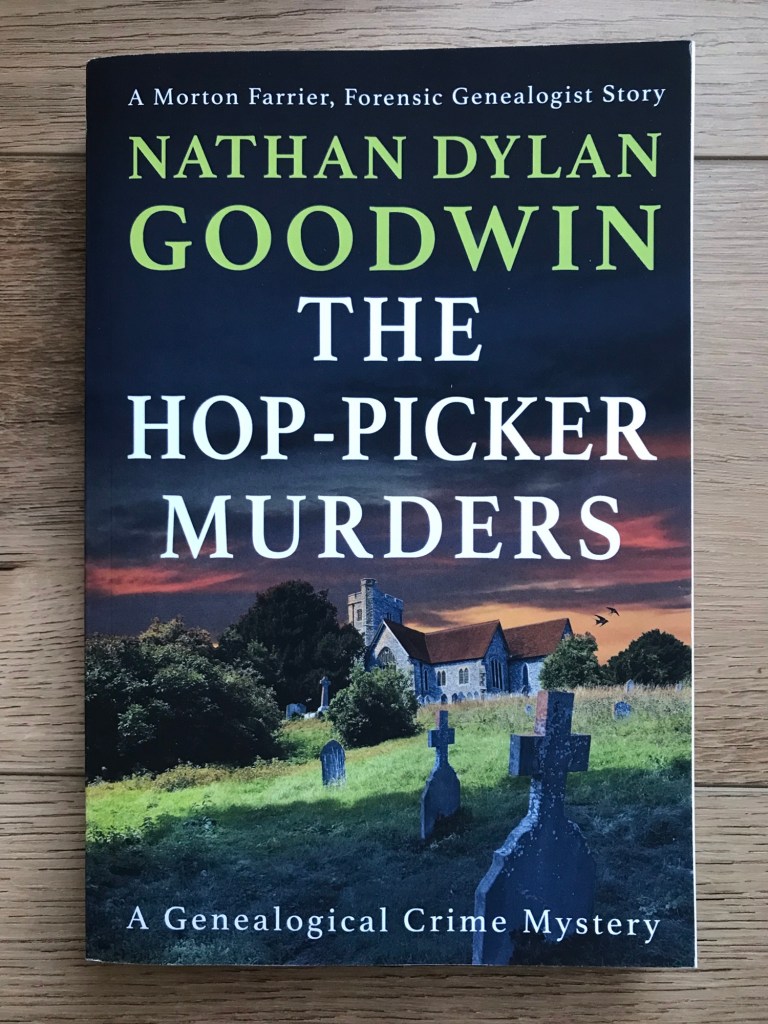
My copy of The Hop-Picker Murders
It is classic Morton Farrier fare. A fast-paced crime fiction mystery, which right from the opening pages packs a punch. It intertwines the progress of Morton’s latest genealogy investigation with events of a bygone era – in this case the lives of East End seasonal hop-pickers working in Kent in the immediate aftermath of World War One, and a young woman’s quest to clear her missing brother’s name and find out what happened to him.
Nathan Dylan Goodwin skilfully weaves the multiple strands of past and present, with the latest developments in the hero’s own complicated family history backstory, and some professional twists along the way too. The characterisation of heroine Nellie means the reader is naturally and sympathetically drawn into her pursuit of truth and answers. The peppering of the story with various genealogical records and sources adds a further dimension for those involved in family history research, from the hobbyist through to the professional – though you do not need to be a family historian to appreciate this well-crafted crime fiction novel. The author’s meticulous research of seasonal hop-picking in this era gives it that all-important feel of historical authenticity.
The book was a joy to read, one of those I was truly sorry to reach the end of. The positive though is there’s clearly scope for more Morton Farrier adventures to come.
Now all I need is some of those weird and wonderful scone recipes to set me up for these future Forensic Genealogist exploits.
The book can be read as a stand alone novel, though as someone who has read all the previous books I’ve found knowing a little about Morton Farrier’s life up to this point does help contextually.
If you’ve not read any of the previous books in the Forensic Genealogist series and want to start at the beginning to sequentially see how the character’s backstory evolves, here’s the full list:
The Asylum – short prequel to the series.
Hiding the Past.
The Lost Ancestor.
The Orange Lilies.
The America Ground.
The Spyglass File.
The Missing Man.
The Suffragette’s Secret – Novella.
The Wicked Trade.
The Sterling Affair.
The Foundlings.
The Deserter’s Tale.
The Hop-Picker Murders.
Finally, here’s the all-important purchase information for The Hop-Picker Murders. I read the paperback version, ISBN-13: 979-8298809924, which is due out in Spring 2026, with the audiobook version also due around then. The kindle and hardback edition (£18.99 RRP) are already available.
Full purchase details forthese, and all the previous books in the series, can be found on Nathan Dylan Goodwin’s website. There’s also additional historical background information about hop-picking, and one of the real-life hop-pickers who features in the book.
Full disclosure: I received a free paperback copy of this book in return for a honest review. I have expressed my truthful opinion in this review.
A quick heads up for an online talk I will be giving via the Society of Genealogists on 25 April 2026. Don’t switch off at this point if you’re not a member – it is open to anyone.
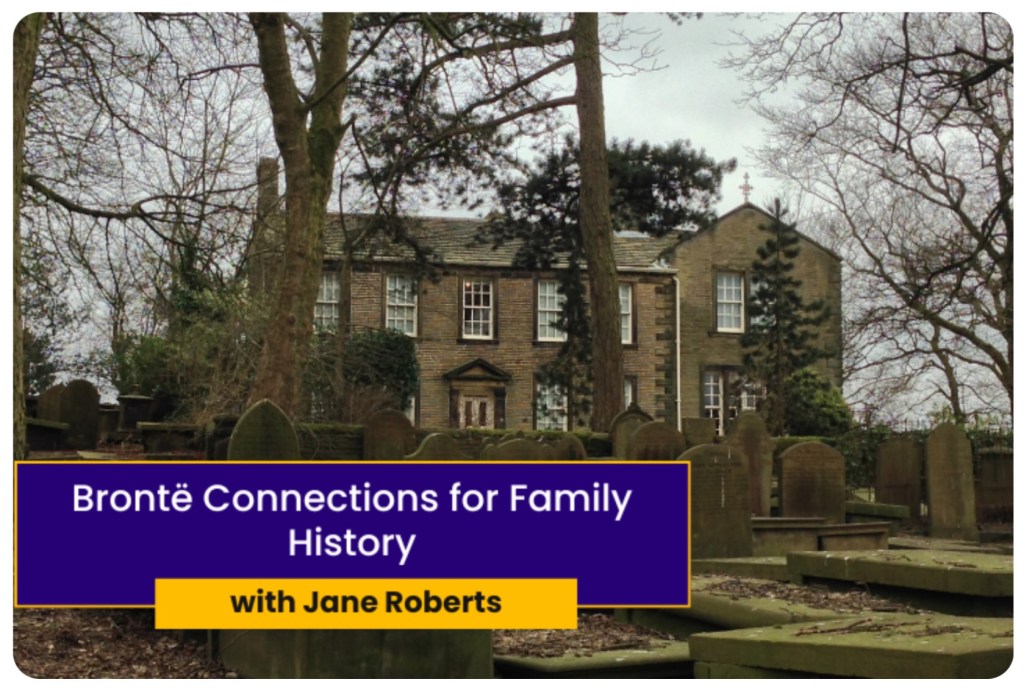
If you follow this blog, or any of my online social media accounts, you will know I live in an area packed with Brontë history, and I’m a frequent visitor to Haworth and other Brontë linked sites.
Well, I’m delighted that I’ve been asked to give an online talk all about exploring Brontë Connections for Family History.
Here’s the blurb about it, to give you some idea of what I’ll be covering:
The latest film adaptation of Emily Brontë’s dark, Gothic literary classic, Wuthering Heights, has triggered a fresh wave of Brontë-mania. A new generation of tourists are descending on the village of Haworth, keen to find out more about these world-famous sisters, and wanting to carve out their own slice of Brontë magic. But family historians can also channel into the Brontë family’s lives and literature, seeking their own Brontë connections and research inspiration. Jane’s talk will give you some ideas of how, and where to look.
I’d love to see you there, as I’m immensely proud of where I come from, my area’s Brontë links, all things Brontë, and I might even let you in on my quest to find my links to this amazing literary family!
You never know, as a result you may have ideas and inspiration to see how your family history might be connected.
February has been a particularly busy month for the Batley St. Mary of the Angels One-Place Study, with five new posts. This brings the total number of posts up to 427. Three more were updated.
Peter Gavaghan
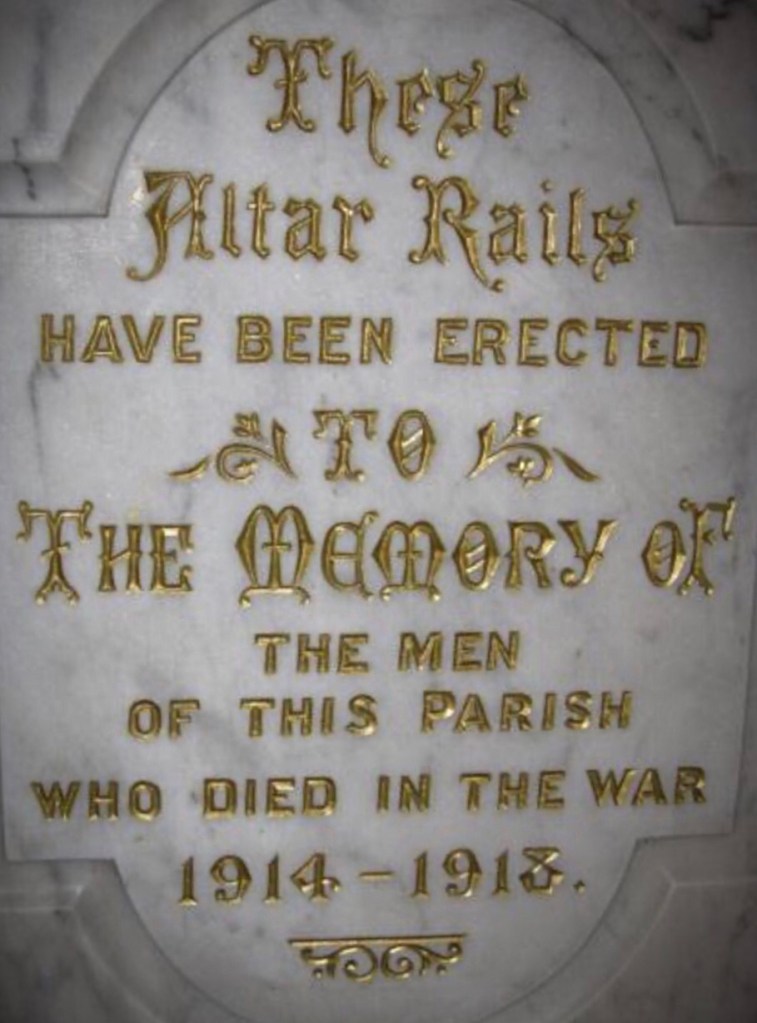
This month’s additions and updates included one new War Memorial biography, that of the first Peter Gavaghan to be killed in the war (his cousin also named Peter died later on, and his biography was added some time ago). Both men’s biographies can now be found in The Biographies: War Memorial Men section.
Several more men who served and survived were identified, and this page has been updated. Their biographies will follow in due course.
Someone from the parish who died but is not on the church War Memorial has been identified, Michael Howley. I have added his biography to the section covering Men Associated with St. Mary’s Who Died but Who Are Not on the Memorial, and that overall page has been accordingly updated too. I have also updated the War Memorial Chronology of Deaths page, to include him.
There are two new posts in the Miscellany of Information section. One deals with the horrific, but all too common, circumstances surrounding the death of a child in the 19th century. The other concerns three pigs, a headstone and a long-lived parishioner.
There is also the parish history snippets piece for February 2026. These snippets cover a variety of events and people from the parish from years gone by, and can be found in the Bulletin for Batley St Mary of the Angels and Birstall St Patrick section. One is an amazing piece connected to The Beatles and a circus! Even if you have seen them on the Bulletin, it is worth checking them here as some have links to more detailed pieces I have written.
Below is the full list of pages to date. Simply click on the link and it will take you straight to the relevant page. I have annotated the *NEW* and “UPDATED” posts, so you can easily pick them out.
If you want to know the background, and what is involved in a one-place study, click here. Otherwise read on, to discover a wealth of parish, parishioner and wider local Batley history.
Postscript: I may not be able to thank you personally because of your contact detail confidentiality, but I do want to say how much I appreciate the donations already received to keep this website going. They really and truly do help. Thank you.
The website has always been free to use, and I want to continue this policy in the future. However, it does cost me money to operate – from undertaking the research to website hosting costs. In the current difficult economic climate I do have to regularly consider if I can afford to continue running it as a free resource.
If you have enjoyed reading the various pieces, and would like to make a donation towards keeping the website up and running in its current open access format, it would be very much appreciated.
Please click 👉🏽 here 👈🏽 be taken to the PayPal donation link. By making a donation you will be helping to keep the website online and freely available for all.
Thank you.
As a professionally qualified genealogist, if you would like me to undertake any family, local or house history research for you do please get in touch. More information can be found on my research services page.
Finally, if you do have any information about, or photos of, parishioners from the period of the First World War please do get in touch. It does not have to be War Memorial men. It could be those who served and survived, or indeed any other men, women and children from the parish.
I would also be interested in information about, and photos of, those parishioners who were killed in World War Two, or others from the parish who undertook any war service and survived. This can be as broad as serving in the military, or work in munitions factories, the Land Army, even taking in refugees. This is an area I’m looking to develop in the future.
If you are looking for a family or local history speaker during 2026 and 2027, here are the details of my current and upcoming talks:
Charles the Pigeon and a Yorkshire Spy.
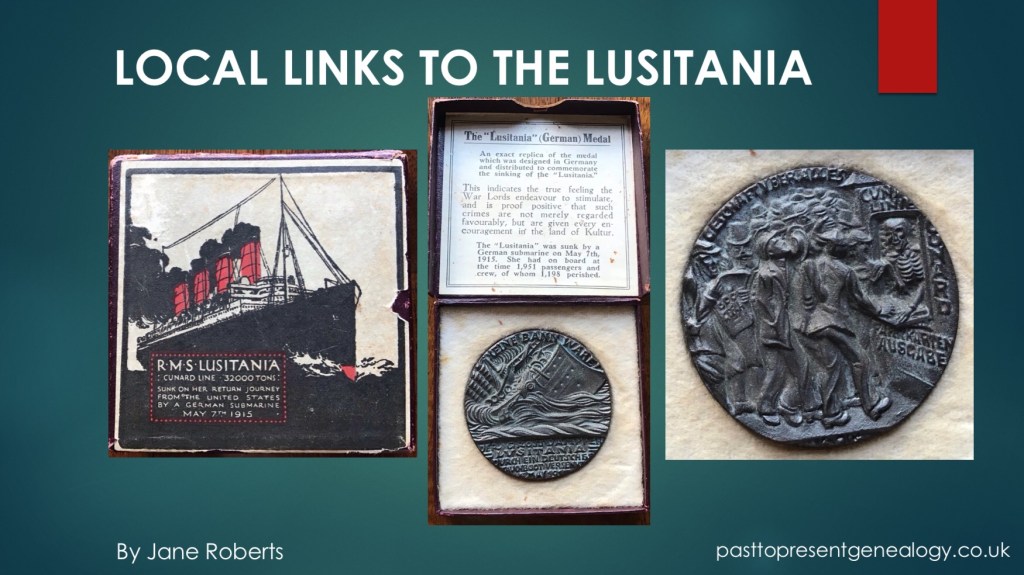
Local Links to the Lusitania.
A Site with a Deadly History – The White Lee Explosion of 1914. UPDATED FOR 2026 – available from September 2026.
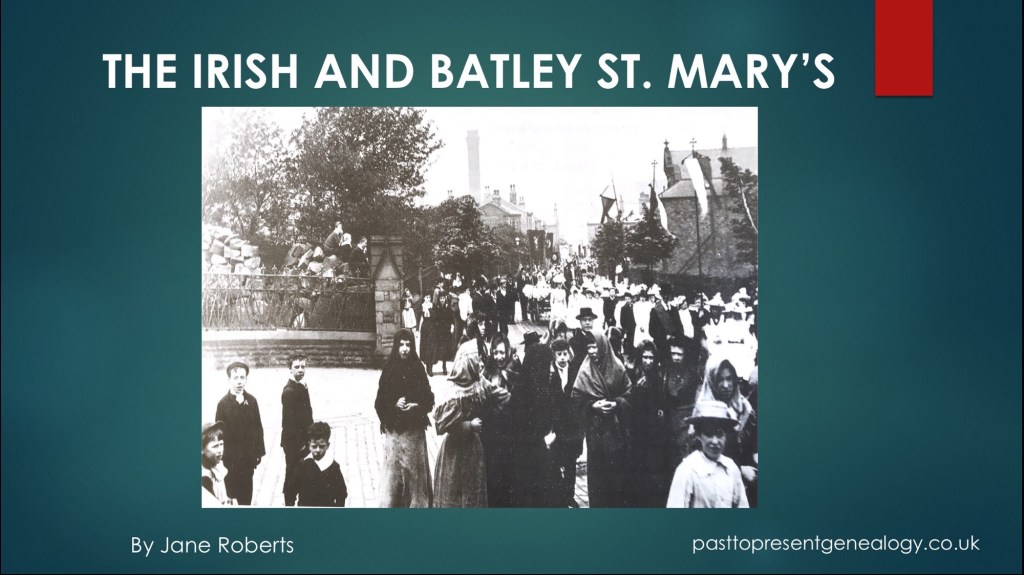
The Early History of the Irish and Batley St. Mary of the Angels. This is the first of three talks about my one-place study.
The Batley St. Mary of the Angels War Memorial – the Sacrifice of a Yorkshire Catholic Parish in the First World War. NEW FOR 2026 – available from October 2026, this is my second one-place study talk.
The People of the Parish – Parishioner’s Tales from my Batley St. Mary of the Angels One-Place Study. NEW FOR 2026 – available from August 2026, this is my third one-place study themed talk.
Tips for Researching Your Great War Ancestors/First World War Rugby League Players.
How to Research Your Family Tree.
Census Sense and Census Oddities. NEW FOR 2026 – available from November 2026.
From Body Snatched to Brush-Makers and Child-Stealing Chimney Sweeps. Tales from my Family History. NEW FOR 2027 – available from March 2027.
In terms of regions covered, the first three talks have a distinctly Yorkshire flavour. My three St. Mary’s one-place study based talks look at various aspects of my Batley study, intertwining the Irish and Yorkshire character of the parish. The seventh talk is tailored around rugby league players killed in the First World War from your locality. The eighth talk is about family tree research in England and Wales generally, and can be geared around research tips for Yorkshire ancestors. The ninth talk focuses in detail on one specific family history record set, the census of England and Wales. The tenth talk will be predominantly Yorkshire-based, but covers other areas in the north of England too.
All the talks run to 45 minutes, with time for questions afterwards. However if you require a shorter or longer talk, these generally can be accommodated depending on topic.
More details about each talk are below. But if you need more information, including around costs and to enquire about making a booking, please contact me at: pasttopresentgenealogy@btinternet.com
Charles the Pigeon and a Yorkshire Spy.
Charles the Pigeon and a Yorkshire Spy is the story of an unsung Yorkshire hero, living behind enemy lines and carrying out works of espionage and sabotage during World War One. His adopted pigeon Charles played an important part in these wartime exploits. Their daring deeds are more like a boy’s adventure story than real life. But this is a true tale of wartime courage, and one which deserves wider telling.
Local Links to the Lusitania focuses on people with Yorkshire connections on board the Cunard liner, torpedoed and sunk off the Irish coast on 7 May 1915. The sinking did not affect only the rich and famous. Many ordinary Yorkshire people, including from the Heavy Woollen District and areas more generally around the former West Riding, were involved. This talk provides context to the sinking and explores some of their stories.
There is a possibility this talk can be tailored to your local area.
A Site with a Deadly History – The White Lee Explosion of 1914.
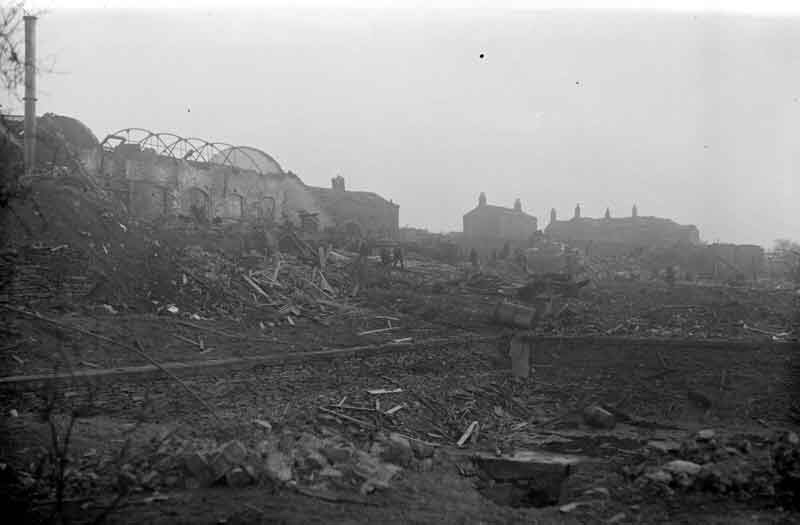
The Home Front: the White Lee Explosion of 1914 is a talk based around the events of December 1914 when a devastating explosion, caused during the manufacture of picric acid for the war effort, took place at White Lee. It resulted in deaths and injuries, as well as damage across a vast area of Batley, Heckmondwike and the Spen Valley. It is an event often overlooked because of later explosions in Yorkshire at Low Moor and Barnbow. This talk aims to provide more information about this Heavy Woollen District incident, the forerunner to the later explosions. The talk will explore the unlucky history of the site, as well as the events on the day and the aftermath.
The Early History of the Irish and Batley St. Mary of the Angels.
This is the first of my one-place study talks, and it covers the history of the Irish in Batley and the Catholic parish of Batley St. Mary of the Angels until circa the 1880s. It investigates what a one-place study is, why I embarked on one, why I chose this particular study, as well as my findings – including the Irish migration angle, how they were received locally, the building of the church, all with a focus on ordinary parishioners.
The Batley St. Mary of the Angels War Memorial – the Sacrifice of a Yorkshire Catholic Parish in the First World War.
The second of my Batley St. Mary of the Angels talks is about the War Memorial which provided the catalyst for my one-place study. The Memorial commemorates 72 parishioners who paid the ultimate sacrifice in the First World War, and my talk will give some overall context to their backgrounds, the branches of the military and the regiments in which they served, as well as picking out some of the individual stories.
The People of the Parish – Parishioner’s Tales from my Batley St. Mary of the Angels One-Place Study.
My third Batley St. Mary of the Angels one-place study talk looks at some of the ordinary people from the parish across the decades who have some surprising, if not extraordinary, life tales. They illustrate the amazing richness of working-class local history which a one-place study can unearth – stories which often undeservedly get overlooked, with the focus history inevitably tends to place on the more illustrious middle-class townsfolk.
Tips for Researching Your Great War Ancestors/First World War Rugby League Players.
Based on my groundbreaking book The Greatest Sacrifice: Fallen Heroes of the Northern Union about rugby league players who died in World War One, the talk investigates the stories behind some of the men. It is also packed with tips for researching your own Great War Army ancestors. For local history groups, I can drop the family history research tips aspect, and base the talk solely about the players.
This talk will help those embarking on their family history journey, but it will also provide useful reminders and advice for those who have already started out on their ancestral adventure. In this talk I will guide you through building your family tree. I will cover the basics to help you start your research on the right track, give you lots of tips, help you avoid those all-important pitfalls, and provide ideas for taking your research further. If required, I can slant this talk towards Yorkshire ancestral research.
The census talk focuses in detail on this one specific family history record set. It covers background details about this essential building block for family history research in England and Wales, includes some all important search tips, and has some hidden (and sometimes humorous) gems from the entries.
The Batley St. Mary of the Angels One-Place Study ended 2025 on a total of 421 posts, with two new posts being published in December.
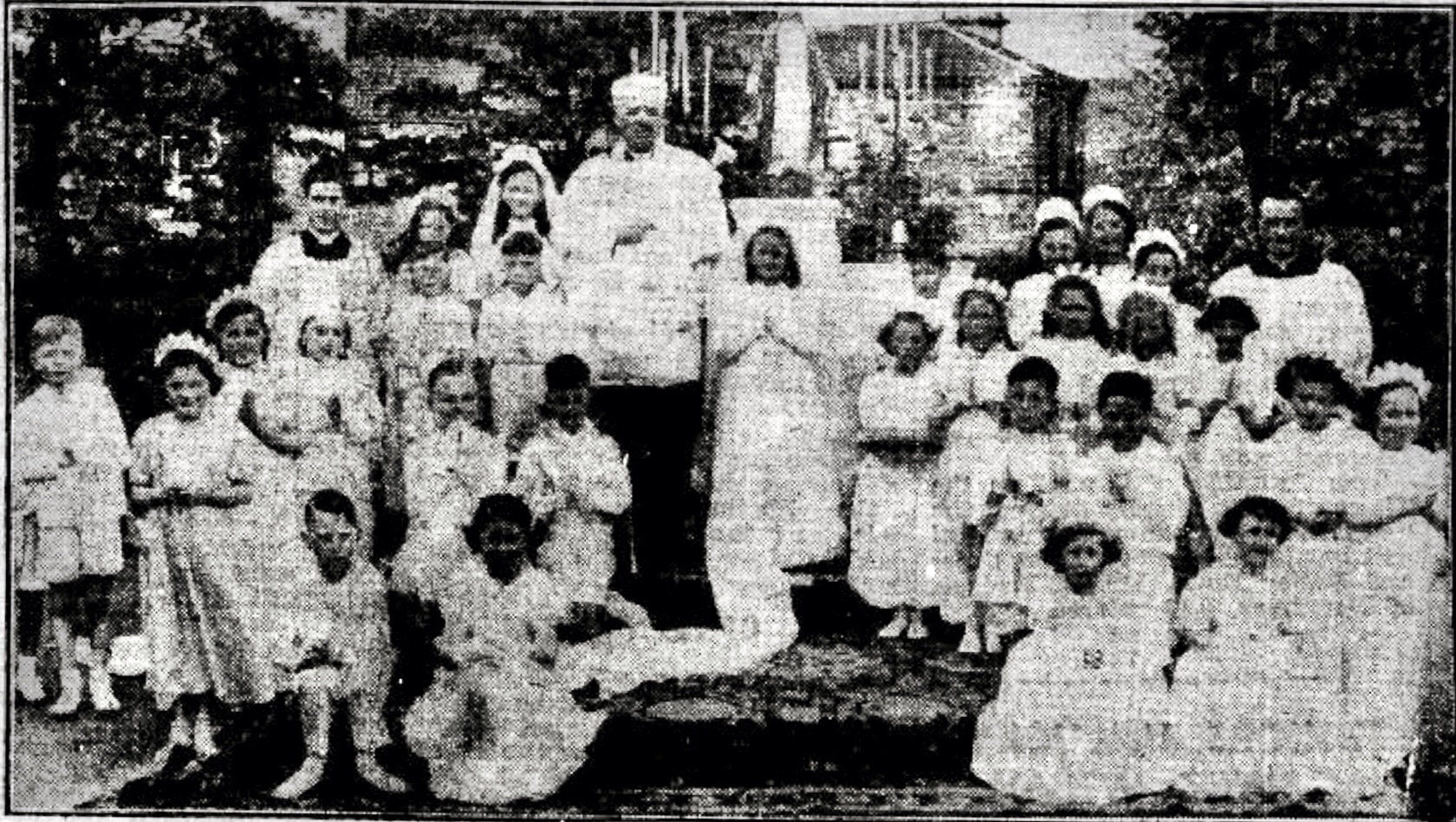
The first post of the month was all about the 1953 May Queen ceremony (photograph on the left), which was added to the May Queen section. Mary O’Connor took the starring role, but the piece includes names of many others involved in the procession that day.
The final post of 2025 was the parish history snippets piece for December. These snippets cover a variety of events and people from the parish from years gone by, and can be found in the Bulletin for Batley St Mary of the Angels and Birstall St Patrick section. Even if you have seen them on the Bulletin, it is worth checking them here as some have links to more detailed pieces I have written.
Below is the full list of pages to date. I have annotated the *NEW* posts, so you can easily pick these out. Click on the link and it will take you straight to the relevant page.
If you want to know the background, and what is involved in a one-place study, click here. Otherwise read on, to discover a wealth of parish, parishioner and wider local Batley history.
Finally, I’d like to end with a thank you for reading my Batley St. Mary of the Angels one-place study posts in 2025. Your support, additional information, photographs and many lovely comments throughout the year have all really been appreciated. I look forward to what 2026 will bring to this parish history collection. Hopefully the first of these will be published next week.
Postscript: I may not be able to thank you personally because of your contact detail confidentiality, but I do want to say how much I appreciate the donations already received to keep this website going. They really and truly do help. Thank you.
The website has always been free to use, and I want to continue this policy in the future. However, it does cost me money to operate – from undertaking the research to website hosting costs. In the current difficult economic climate I do have to regularly consider if I can afford to continue running it as a free resource.
If you have enjoyed reading the various pieces, and would like to make a donation towards keeping the website up and running in its current open access format, it would be very much appreciated.
Please click 👉🏽here👈🏽be taken to the PayPal donation link. By making a donation you will be helping to keep the website online and freely available for all.
Thank you.
As a professionally qualified genealogist, if you would like me to undertake any family, local or house history research for you do please get in touch. More information can be found on my research services page.
Finally, if you do have any information about, or photos of, parishioners from the period of the First World War please do get in touch. It does not have to be War Memorial men. It could be those who served and survived, or indeed any other men, women and children from the parish.
I would also be interested in information about, and photos of, those parishioners who were killed in World War Two, or others from the parish who undertook any war service and survived. This can be as broad as serving in the military, or work in munitions factories, the Land Army, even taking in refugees. This is an area I’m looking to develop in the future.
November 2025 was a busy month for the Batley St. Mary of the Angels One-Place Study. Four new posts were added, bringing the total number to 419. I also gave two talks about the early history of the Irish in Batley and the parish – one via Zoom to the Society of One-Place Studies; the other in-person to Batley History Group. If you missed them, I will be repeating the Irish and St. Mary’s talk next year with bookings already made for it, along with my other talks.
To start off with, I wrote a light-hearted piece about Buffalo Bill and A Right Royal Celebration for Batley’s Schoolchildren, a celebration in which the children of St Mary of the Angels participated. I describe, and include a photograph, of the special commemorative medal presented to all the schoolchildren, so that if you have one in your family you can identify it and know more about its history.
In a change of tone, with November being the month of Remembrance, one of the new posts was about James Edwards, one of the parishioners commemorated on the parish’s World War One War Memorial.
In the May Queen section I have added a piece about the 1952 ceremony when Patricia Anne Cain was the May Queen (as shown in the photograph to the left). It includes names of many others involved in the procession that day, which was a historic one in terms of its format that year.
The final post for the month was the parish history snippets piece for November 2025. These snippets cover a variety of events and people from the parish from years gone by, and can be found in the Bulletin for Batley St Mary of the Angels and Birstall St Patrick section. Even if you have seen them on the Bulletin, it is worth checking them here as some have links to more detailed pieces I have written.
Below is the full list of pages to date. I have annotated the *NEW* posts, so you can easily pick these out. Click on the link and it will take you straight to the relevant page.
If you want to know the background, and what is involved in a one-place study, click here. Otherwise read on, to discover a wealth of parish, parishioner and wider local Batley history.
Postscript: I may not be able to thank you personally because of your contact detail confidentiality, but I do want to say how much I appreciate the donations already received to keep this website going. They really and truly do help. Thank you.
The website has always been free to use, and I want to continue this policy in the future. However, it does cost me money to operate – from undertaking the research to website hosting costs. In the current difficult economic climate I do have to regularly consider if I can afford to continue running it as a free resource.
If you have enjoyed reading the various pieces, and would like to make a donation towards keeping the website up and running in its current open access format, it would be very much appreciated.
Please click 👉🏻here👈🏻 be taken to the PayPal donation link. By making a donation you will be helping to keep the website online and freely available for all.
Thank you.
As a professionally qualified genealogist, if you would like me to undertake any family, local or house history research for you do please get in touch. More information can be found on my research services page.
Finally, if you do have any information about, or photos of, parishioners from the period of the First World War please do get in touch. It does not have to be War Memorial men. It could be those who served and survived, or indeed any other men, women and children from the parish.
I would also be interested in information about, and photos of, those parishioners who were killed in World War Two, or others from the parish who undertook any war service and survived. This can be as broad as serving in the military, or work in munitions factories, the Land Army, even taking in refugees. This is an area I’m looking to develop in the future.
As of Monday 17 November 2025, the price or ordering your family history probate documents via the government’s Find A Will service will increase from £1.50 to £16.00. That’s an eye-watering rise of almost 1000%.
The notice for this increase was published on 10 November in The Gazette, meaning for many it has been a mad rush to get those last minute orders in.
The rationale for this price rise, as stated in the Ministry of Justice’s (MOJ) Explanatory Memorandum, reads:
The estimated cost to His Majesty’s Courts and Tribunal Service (HMCTS) for providing single copies of documents under the Find A Will service equates to £16 per copy. The £1.50 fee therefore significantly under-recovers its cost, despite fees being set with the intention of full cost recovery. This statutory instrument will therefore increase the fee for users to obtain copies of documents within the Principal Registry of the Family Division, district registries and any sub-registries attached, which includes the “Find A Will” service and individual users requesting extra copies of probate grants from £1.50 to £16, to align more closely with costs and ensure that HMCTS can continue to deliver its services effectively.
The £1.50 charge was introduced in 2019, with prior to that the cost being £10, so a review was overdue. But I would love to know how they determined upon a flat rate £16 figure.
It means for many the cost of these documents for family and local history will be now prohibitively expensive, limiting future research. For example, at £16 each, there is no way would I be able to afford ordering all the World War One soldiers’ wills that I have for my Batley St. Mary of the Angels one-place study.
I’ve spent this past week ordering probate documents for clients to beat the rise. It included an order for 12 wills which cost £18. As of 17 November to place that same order will be £196.
Today I finally got round to reviewing my one-place study soldiers’ wills, confirming I’d already got them all.
I also reviewed my direct line ancestors, and placed an order for the six I identified as missing. Four came back instantly via an automated service, having already been digitised. This is akin to the service for World War One soldiers wills.
To my mind this begs the question why did the MOJ not introduce a graded pricing structure for probate records, similar to that in place for General Register Office (GRO) civil registration orders? The GRO’s automated Digital Image service has a lower cost of £3, with PDFs costing £8, and the more labour-intensive full certificates coming in at £12.50.
This seems a much fairer system than the flat rate fee, a system which might avoid pricing out family and local history researchers. For as the fee structure stands, there will be a dramatic cliff-edge drop off for probate orders going forward.
Postscript: The MoJ does still have a £1.50 bulk access option aimed at some (unspecified) organisations who access every copy of a grant of probate or will issued in England and Wales. By extension this means individual family and local history researchers are being overcharged for their documents, essentially subsidising these organisations. Hardly a fair system!
Because of work commitments, during October 2025 only one new post was added to the Batley St Mary of the Angels One-Place Study, bringing the total number of posts to 415.
This new post was the parish history snippets piece for October 2025. These snippets cover a variety of events and people from the parish from years gone by, and can be found in the Bulletin for Batley St Mary of the Angels and Birstall St Patrick section. Even if you have seen them on the Bulletin, it is worth checking them here as some have links to more detailed pieces I have written.
One of the reason for the lack of additions this month is because in November and December I’m giving a series of talks to various organisations. These include an online talk on 11 November 2025 to the Society of One-Place Studies about the early history of the Irish in Batley, and the parish of Batley St Mary of the Angels up until around the 1880s. This is restricted to members of the Society. However, on Monday 24 November I will be giving more or less the same talk at the Batley History Group meeting in Batley Town Hall. This starts with refreshments at 7pm, with the talk commencing at 7.30pm. It is open to both members (£2) and non-members (£4). So, perhaps I will see some of you there. More details about this, and Batley History Group’s other meetings in 2025/26 can be found here.
James Harkin, Batley’s 1st Catholic Mayor
I also have a special thank you this month for someone who has sent me a lovely letter and some photos of James Harkin, Batley’s first Catholic mayor – one of which is included in this piece. I don’t have her contact details to thank her personally, so hopefully she will read my thank you here.
Below is the full list of pages to date. I have annotated the *NEW* posts, so you can easily pick these out. Click on the link and it will take you straight to the relevant page.
If you want to know the background, and what is involved in a one-place study, click here. Otherwise read on, to discover a wealth of parish, parishioner and wider local Batley history.
Postscript: I may not be able to thank you personally because of your contact detail confidentiality, but I do want to say how much I appreciate the donations already received to keep this website going. They really and truly do help. Thank you.
The website has always been free to use, and I want to continue this policy in the future. However, it does cost me money to operate – from undertaking the research to website hosting costs. In the current difficult economic climate I do have to regularly consider if I can afford to continue running it as a free resource.
If you have enjoyed reading the various pieces, and would like to make a donation towards keeping the website up and running in its current open access format, it would be very much appreciated.
Please click 👉🏻here👈🏻 be taken to the PayPal donation link. By making a donation you will be helping to keep the website online and freely available for all.
Thank you.
As a professionally qualified genealogist, if you would like me to undertake any family, local or house history research for you do please get in touch. More information can be found on my research services page.
Finally, if you do have any information about, or photos of, parishioners from the period of the First World War please do get in touch. It does not have to be War Memorial men. It could be those who served and survived, or indeed any other men, women and children from the parish.
I would also be interested in information about, and photos of, those parishioners who were killed in World War Two, or others from the parish who undertook any war service and survived. This can be as broad as serving in the military, or work in munitions factories, the Land Army, even taking in refugees. This is an area I’m looking to develop in the future.
Written by professional genealogist Cheri Hudson Passey, and drawing on her experience in carrying out work for the U.S. Army Past Conflict Repatriations Branch (for UK researchers this equates to the MOD’s War Detectives from the Joint Casualty and Compassionate Centre Commemorations team), the stated aim of this book is to help genealogists of all levels to trace and connect with descendants of ancestors. These connections might lead to more information, documents, family memorabilia, photographs and photo identification, to enrich research and add colour to your family history.
The slimness of the book, running to 56 pages, is indicative that it is a basic overview. After the preface and methodology, the chapters are as follows:
Building a Solid Foundation.
Looking for Clues in Records.
Researching Online.
Researching on Location.
People Finders and Social Media.
Reaching Out to Family.
A Word About DNA.
Working Through a Soldier Repatriation Case: Steps for Finding Living Family.
There is also a concluding section and, to round off, a couple of pages listing tools and resources – although there are some website address errors here.
Together they provide a step-by-step guide to finding relatives down both ancestral and collateral lines, using modern tools to track them down.
Some of the steps are obvious, like ensuring your family tree is accurate and complete. The value of research plans to keep on track is discussed, as well as the need to follow the Genealogical Proof Standard (GPS), concepts which may be new to non-professionals.
Building mini trees is suggested as a research tool, and the book includes several screenshots on how to export GEDCOM files with which to work from. These, along with other images, are greyscale rather than colour.
Various sources are highlighted as useful for providing clues, building a body of evidence and resolving conflicting information. Search tips are given for finding living family members, including through using online trees. Tools such as reverse image searches are covered. I was pleased to see recognition that everything is not online. And I particularly enjoyed the chapter which pulled everything together in working through a soldier repatriation case.
From my UK and Ireland research perspective, the fact that it is written by a U.S. researcher means it is naturally geared towards research in that country. This is particularly obvious in the sections dealing with locating newspapers, and people finding sources. It is explicitly acknowledged in the section about national public records. That being said, there are general tips to be gleaned from those researching beyond the U.S., especially for the less experienced researcher.
Arguably the most crucial chapter is the one about reaching out to family. It was good to see advice given about handling these tricky initial contacts. This includes being aware of the fear factor behind unsolicited contacts in this world of scammers, along with the need to respect privacy and reach out with respect and sensitivity to living connections, upholding the ethics of handling information about living, and obtaining informed consent around any information shared.
However, one important topic I would have liked to have seen covered in a little more detail was the potential ethical dilemmas posed by this aspect of family history research, very much like DNA tests, the risks of which are dealt with in the book.
Contacting distant living relatives can potentially lead to unforeseen and unintended consequences, especially if that family history is challenging and sensitive, and it might have been useful to have consideration of this aspect. This is a particular issue when the person being contacted has no obvious family history interest, and is not on a family history platform, so is unaware to the possibility of such contacts.
As I have mentioned, the book is only a brief introduction to the subject of identifying and tracking down living relatives, and ethical dilemmas are a meaty subject. But a cautionary, if not a deeper exploration of this angle, would have been helpful.
That aside, when these contacts work out the mutual benefits can be huge, and this book is a useful addition to my genealogy library as a handy and concise aide-mémoire to this type of research.
The book was published in 2025, ISBN 9780806321516. For ease I’ve attached the purchase links for both Amazon and Genealogical.com
Full disclosure: I received a free copy of the book from Genealogical.com. I was not asked for a review in return, but I thought it would be useful to post one to introduce this book to others who may not be aware of it. In doing so I have expressed my honest opinion.
May 2025 marked a milestone for the Batley St Mary of the Angels One-Place Study, with it hitting 400 posts during the first week of the month. By the end of May 2025 five posts had been added across a range of topics, bringing the total number of posts in the study to 404.
Below is the complete list of all the St Mary’s posts published up to the end of May 2025, including links to them, with those new and updated posts signposted so you can easily locate them.
If you want to know the background, and what is involved in a one-place study, click here. Otherwise read on, to discover a wealth of parish, parishioner and wider local Batley history.
That milestone 400th post was a description of the parish of St Mary of the Angels in 1950, a post which for some will bring back memories. This is in the Miscellany of Information section.
With May 2025 marking the 80th anniversary of VE Day, I added a new World War Two biography, that of Bernard Stenchion. His death, in June 1945, illustrates that although Victory in Europe was celebrated on 8 May 1945, for some this was not the end of the War, while for many other parishioners the war had already irrevocably changed their lives.
The 1950 May Queen Catherine Heaps (L), with Moya Hill, the 1949 May Queen (R)
It also seems appropriate that in May two new May Queen pieces were added – about the 1923 May Queen Katherine Phillips, and the 1950 May Queen Catherine Heaps.
The fifth new post this month was the parish history snippets pieces from the May 2025 bulletins, and this can be found in the Bulletin for Batley St Mary of the Angels and Birstall St Patrick section.
Below is the full list of pages to date. I have annotated the *NEW* and *UPDATED* ones, so you can easily pick these out. Click on the link and it will take you straight to the relevant page.
Finally this month, I wanted to let you know that I will be giving at the Batley History Group meeting on 23 June 2025 all about the early history of the Irish in Batley and the parish of St Mary’s up to the 1880s. If you want to attend that meeting, it is in the Council Chamber of Batley Town Hall, with refreshments served from 7pm and the talk starting at 7.30pm. All are welcome, and the cost is £2 for members and £4 for non-members. It would be great to see people there.
Postscript: I may not be able to thank you personally because of your contact detail confidentiality, but I do want to say how much I appreciate the donations already received to keep this website going. They really and truly do help. Thank you.
The website has always been free to use, and I want to continue this policy in the future. However, it does cost me money to operate – from undertaking the research to website hosting costs. In the current difficult economic climate I do have to regularly consider if I can afford to continue running it as a free resource.
If you have enjoyed reading the various pieces, and would like to make a donation towards keeping the website up and running in its current open access format, it would be very much appreciated.
Please click 👉🏻here👈🏻 to be taken to the PayPal donation link. By making a donation you will be helping to keep the website online and freely available for all.
Thank you.
As a professionally qualified genealogist, if you would like me to undertake any family, local or house history research for you do please get in touch. More information can be found on my research services page.
Finally, if you do have any information about, or photos of, parishioners from the period of the First World War please do get in touch. It does not have to be War Memorial men. It could be those who served and survived, or indeed any other men, women and children from the parish.
I would also be interested in information about, and photos of, those parishioners who were killed in World War Two, or others from the parish who undertook any war service and survived. This can be as broad as serving in the military, or work in munitions factories, the Land Army, even taking in refugees. This is an area I’m looking to develop in the future.










 Past To Present Genealogy