Category Archives: Genealogy

How the Western Front Association WW1 Pension Ledgers May Have Solved Another Family History Mystery

Last weekend I finally gave in and subscribed to Fold3 taking advantage of their cyber week special and buying annual premium membership at a 40% discount of $47.95. The deciding factor was the need to view their exclusive record set:- the Western Front Association (WFA) collection of Pension Record Cards and Ledgers.

Dependents of each serving British soldier, sailor, airman and nurse who was killed in the Great War were entitled to a pension. So were those service personnel wounded or otherwise incapacitated. For those who died the next of kin and pension amounts are detailed in the cards and ledgers. For those who survived they provide details of injury (wounds, illness), plus regimental details (unit, regimental number) and home address. The latter are particularly important for researchers, as those who survived are often more difficult to find information about, especially with common names.

My interest was driven by the need to find out more about my great uncle Michael Callaghan, brother of my grandpa John. The son of Michael Callaghan and his wife Mary (née Murphy) of Carabeg in County Mayo, his birth date was registered in the Swinford District as 17 January 1890.

It’s a date I take with the usual large pinch of salt. His baptism at Glan Chapel, according to transcripts, took place on 1 January 1890, pre-dating his birth and indicative that he was born in late 1889 – Irish catholic baptisms taking place shortly after birth. This is a common theme with my Callaghan ancestors – their official birth dates often postdate their baptisms. It was easier, and more important, to be received into the church. By the time they got round to official registration, dates were fudged to avoid late registration fines.

Mum said she thought Michael served with the Irish Guards during World War One and had received a severe facial injury. She cannot recall ever seeing him, and believed he lived in Leeds. She said she’d been told he was tall, with very dark hair like his mother and, in his youth, had been very good-looking.

That’s as much as I had to go on.

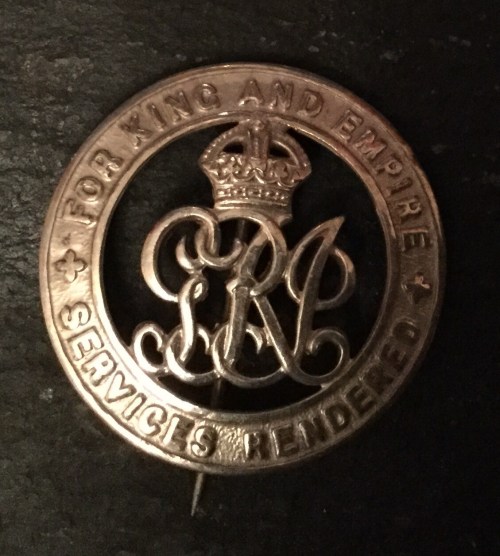
A few years ago, the possible I’d come up with, based on the assumption his injury resulted in his military discharge, was a Private Michael Callaghan of the Irish Guards, service number 11415. According to the Silver War Badge Rolls he enlisted on 31 July 1916 and was discharged on 29 July 1918, age 29, no longer physically fit for war service as a result of wounds. His Badge Number was B71936. Checking with Michael’s Medal Index Card it also showed he had served as a Private in the Labour Corps, Service Number 702152. But this entirely speculative search proved nothing, so I parked the information in my research file.

Silver War Badge – Photo by Jane Roberts

The Pension Record Cards and Ledgers on Fold3 offered a new avenue to explore. Still being uploaded, when I checked on 6 December 2018 there were four records relating to the Silver War Badge Pte Michael Callaghan. They confirmed his injury as a gunshot wound to his face, and the degree of disablement which was attributed to his war service ranged between 40 to 60 per cent. He was awarded a life pension. Interestingly two different birth years were given – 1889 and 1890. The records indicated he was unmarried. Mum seems to think he did marry and had two sons, but she isn’t entirely sure and has no names.

They also gave three addresses – none though in Leeds. The earliest record had an address of Carpenters Arms, West Woodside, Lincoln but also indicated a permanent address of 18 Bound[a]ry Street, Bury. By 1924 the address was recorded as 55 Union Street, Hemsworth, Wakefield. These latter two addresses were of particular interest. My Michael Callaghan had brothers with links to both Bury and Wakefield.

Checking the 1911 census, a 47-year-old widow named Catherine Walsh lived at 18 Boundary Street, Bury. Also in the household were her four surviving Bury-born children Martin, Mary, Annie and John, whose ages ranged from 17-24. There were also two nephews listed – 30-year-old Barney Roan and 25-year-old Thomas Callagn, both miners. They, along with Catherine, were born in County Mayo (recorded as Maho in the census).

This 1911 census entry is a perfect illustration of not relying on indexes: both Ancestry and TheGenealogist record Thomas’ surname as Roan in their index, whilst FindMyPast’s version is Collagen.

Thomas piqued my interest – Michael’s brother Thomas settled in Bury. The surname wasn’t too far out – I’ve seen many a mangled version of Callaghan. His date of birth was 19 November 1884 giving an age of 26 at the time of the census – so not too far out either.

Catherine’s address was also 18 Boundary Street in the 1901 census, when her husband John Walsh was alive. Checking the GRO birth indexes for the registration of Martin, Mary, Annie and John revealed Catherine’s maiden name as Bones or Boans.

I next turned to the Lancashire OnLine Parish Clerk. The marriage of John Walsh (Latin form Joannem used in the parish register), son of Joannis Walsh, and Catherine (Catharinam is the Latin register version) Bones, daughter of Andreae, took place at St Joseph’s Catholic Church, Bury on 29 November 1884.

This was perplexing – so far my Callaghan line doesn’t link to either Bones or Walsh. So was Thomas, described as Catherine’s nephew in the 1911 census, really my grandpa John’s eldest brother?

I decided to look for the baptisms of John and Catherine’s children, again using the Lancashire OnLine Parish Clerk. And it is here Catholic registers come into their own. Anna (Latin form of the name) Walsh, daughter of Joannis Walsh and Catherinae, formerly Bones, was born on 26 August 1888 and baptised at St Joseph’s on 16 September 1888. And the priest helpfully annotated the entry, stating Anna married Thos. Callaghan at St Joseph’s on 15 June 1912.

Unfortunately, this marriage has not been transcribed on the Parish Clerk site. However, the baptism of two of the children of Thomas and Annie are there, including Mary (or Maria as recorded) born on 14 April 1914. The priest’s note that she married Gulielmo J. Dunne on 24 May 1947 was enough. My mum attended this wedding – Mary was her cousin. Bingo! The same family.

One final corroboration was the 1939 Register entry for Thomas and Annie Callaghan. The birth dates of 19 November 1884 and 26 August 1888 matched. Mary’s married name of Dunne has also been added – the Register was a living document used subsequently by the NHS as it’s Central Register.

So now I have a link for Pte Michael Callaghan back to my Callaghan family in Bury via the 18 Boundary Street address on the pension entries. And it appears I have now evidence of my great uncle’s Great War military service and injury, corroborating what mum heard as a child. I’ve still a fair way to go – I would like to learn more about his war service. I also want to know if he did marry and have a family. I also want to find out when he died. But I have now made a start as a result of the Pension Cards and Ledgers.

More information about the cards can be found on the WFA website in a series of articles including ‘The Western Front Association’s Pension Record Card and Ledger Archive,’ ‘Great War Pension Record Cards and Ledgers: deeper understanding‘ and ‘Pension Record Cards and Ledgers: some examples of dependents’ cards.’

20 DECEMBER 2018 UPDATE

If you are a member of the Western Front Association you can now access these records using your membership login and without having to subscribe to Ancestry/Fold3. Here’s the relevant information. As of this month about 37% of the total archive has been digitised, so it’s worth checking back as more are rolled out in 2019.

Sources:

  • Birth Registration for Michael Callaghan, 17 January 1890, Swinford via https://www.irishgenealogy.ie/en/irish-records-what-is-available/civil-records
  • Michael Callaghan Silver War Badge Number B71936, via Ancestry.co.uk, Originals held by The National Archives, War Office and Air Ministry: Service Medal and Award Rolls, First World War, Ref WO329 Piece Number 3087,
  • Medal Index Card for Pte Michael Callaghan, 11415, Irish Guards via Ancestry.co.uk
  • Pte Michael Callaghan, 11415, Irish Guards Pension Cards and Ledgers via Fold3, originals held by the WFA
  • 18 Boundary Street, Bury Household in the 1911 Census via FindMyPast, The Genealogist and Ancestry.co.uk, The National Archives, Ref RG14/23489
  • Catherine Walsh, Bury, 1901 Census via FindMyPast, The National Archives, Ref RG13/3638/38/35
  • Lancashire OnLine Parish Clerk website https://www.lan-opc.org.uk/
  • Thomas and Annie Callaghan, 1939 Register via FindMyPast, The National Archives, Ref RG101/4319E/017/8
  • Western Front Association, webpages indicated via hyperlinks in main body

Triplets and Two Sets of Twins – Combining Newspapers and Parish Registers

In 1834 Susan Gibson (née Rylah) made the news across England. The Leeds Times of 20 October 1834 typified reporting when it wrote:

RARE NEWS FOR MALTHUS!! – A woman named Susan Gibson, of Earlsheaton, was brought to bed of three children on Wednesday last, who with mother are all doing well – she has born twins twice before.

The children, Joseph, Rachel and Leah, arrived in the world on 17 September 1834. Their father was clothier Thomas Gibson. Soothill was the family abode given in the parish register, though Susan (sometimes referred to as Susy or Susannah) was born in Earlsheaton and the family did eventually move there.

The infant newsmakers were baptised at All Saints Dewsbury Parish Church on 12 October 1834, along with December 1831-born sister, Elizabeth. This was the same church in which their parents married on 22 July 1821.

‘Triplets, shown in the uterus: illustration showing the position of the foetuses in a plural position. Colour lithograph, 1850/1910?’ . Credit: Wellcome Collection. CC BY

The headline’s Malthus referred to the influential, but controversial, English economist Thomas Malthus. His population growth theories centred round the argument that increases in population would diminish the ability of the world to feed itself and there would be insufficient land for crops. Citing Malthus was a recurring theme in reporting unusual birth stories during this period.

Interestingly, at the same time as the press reported the birth of the Gibson trio, they were also reporting the birth of Bridlington’s Thompson triplets. Abraham, Isaac and Jacob were the sons of Bridlington Quay stone mason Robert Thompson and his wife Ann. They were described as being ‘all well and likely to live’. The Bridlington St Mary (Priory) parish register recorded the baptism of Robert Thompson’s ‘thrine sons‘ on 22 September 1834, all under the same entry (No 649) in the baptism register, rather than under their own individual entries.

Neither set of triplets added to the population pressure though. Despite the hopeful press outlook at the time of their birth they all failed to thrive. The Thompson trio lingered longest. Jacob was buried on 16 November 1834; Abraham 22 January 1835; and finally Isaac on 17 March 1835.

The demise of the Gibson babies was far swifter. Less than three weeks after their baptism all were dead. A 12-day period in late October/early November 1834 saw a series of Gibson funerals at the parish church. Rachael (as her name was recorded in the burial register) was buried first, on 26 October. Before the month was out Leah died too, her burial taking place on 31 October. The final triplet, Joseph, was interred on 6 November.

As it is pre-July 1837, there is no civil registration. We’re relying on parish registers, and it is not possible from these entries to identify the earlier sets of twins born to Susan. Birth dates are an exception in the baptism register. It’s usually just a baptism date which is given. And, as indicated when the triplets were baptised alongside their almost three-year-old sister, the family were not always prompt in initiating their offspring into the church. It appears some of the Gibson children died before baptism. But burials are inconclusive too. These give father’s name – but there are three clothiers named Thomas Gibson in the Soothill area to muddy the burial entries. And some of the entries simply indicate S.B.C. (abbreviation for stillborn child) or an unbaptized [sic] child with the name of a parent (father, unless illegitimate). So without the newspaper reports we may never have known about Susan’s tendency towards multiple births.

The census provides no clues. In 1841 the family lived at Town Green, Soothill and in addition to Thomas and Susan the household includes Sarah (20), Martha (15), Elizabeth (9), Jane (5), William (3) and Ann (1) – but bear in mind the age of those over 15 was supposed to be rounded down to the nearest multiple of five, and relationship details are absent in this census. However it is clear there are no common ages.

Similarly the 1851 census has no indication of multiple births either. In terms of the couple’s children, Jane (15), William (incorrectly entered as 18 – he was born in 1837) and Ellen (9) are recorded. However, it appears from the GRO Birth Indexes that Ellen was a twin too. Her birth is registered in the same quarter at Dewsbury as an Eliza Gibson, mother’s maiden name Rylah.

Eliza Gibson’s burial is recorded on 21 February 1842 at Dewsbury All Saints, father Thomas.

And Susan Gibson comes nowhere near earning the accolade of most prolific mother ever. That dubious honour goes to the wife of a Russian peasant, as detailed by Guinness World Records:

The greatest officially recorded number of children born to one mother is 69, to the wife of Feodor Vassilyev (b. 1707–c.1782), a peasant from Shuya, Russia. In 27 confinements she gave birth to 16 pairs of twins, seven sets of triplets and four sets of quadruplets

Sources:

  • Leeds Times. 20 October 1834 via FindMyPast
  • John Bull. 13 October 1834 via FindMyPast
  • Dewsbury All Saints Baptism Register. West Yorkshire Archive Service, Reference WDP9/11, via Ancestry.co.uk
  • Dewsbury All Saints Burial Register. West Yorkshire Archive Service, Reference WDP9/50, via Ancestry.co.uk
  • Ibid, Reference WDP9/51
  • Dewsbury All Saints Marriage Register. West Yorkshire Archive Service, Reference WDP9/21, via Ancestry.co.uk
  • Bridlington St Mary (Priory), Parish Register of Baptisms 1830-1847. East Riding Archives and Local Studies Service, Reference PE153/11
  • Bridlington St Mary (Priory), Parish Register of Baptisms 1813-1838. East Riding Archives and Local Studies Service, Reference PE153/38
  • 1841 Census. TNA, Reference HO107/1268/14/7/7, via Ancestry.co.uk
  • 1851 Census. TNA. Reference HO107/2325/133/11, via Ancestry.co.uk
  • GRO Birth Indexes, William Gibson. December Quarter 1837, Dewsbury, Vol 22, Page 52 via the General Register Office website, https://www.gro.gov.uk/gro/content/certificates/
  • GRO Birth Indexes, Ellen and Eliza Gibson. March Quarter 1842, Dewsbury, Vol 22, Page 55 via the General Register Office Website, https://www.gro.gov.uk/gro/content/certificates/
  • Most Prolific Mother Ever. Guinness World Records. http://www.guinnessworldrecords.com/world-records/most-prolific-mother-ever

All websites accessed 26 September 2018

The Family History Show – York 2018

As part of my 2018 New Year’s Resolutions I set myself a pleasant task to attend a variety of Family History events. The Family History Show at York Racecourse was high on my ‘must-do‘ list, as it’s around three years since my last visit. It did not disappoint.

Organised by Discover Your Ancestors Magazine and sponsored by S&N Genealogy Supplies and The Genealogist.co.uk, it has dropped “Yorkshire” from its title of years gone by. This is a reflection that, although having a distinct Yorkshire flavour, those present represent a far wider geographical spread than “God’s Own County“.

Family history societies from as far afield as Shropshire, Clwyd, Cumbria and Aberdeen were there alongside a broad cross-section of those from Yorkshire. I took the opportunity to renew my lapsed Morley Family History Group membership, as well as chatting with those on the Huddersfield & District Family History Society, Bradford Family History Society and Northumberland and Durham Family History Society stands to name but a few.

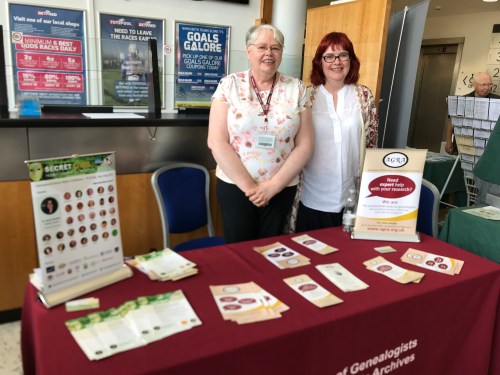
But the show goes way beyond the traditional family history societies, and includes archives, genealogy education providers, family history product suppliers, as well as book and map sellers. There are also professional organisations such as The Register of Qualified Genealogists and the Association of Genealogists and Researchers in Archives (AGRA) the latter of which I am an Associate and, as a result, I did a stint on their stand.

In this Armistice Centenary Anniversary year military exhibitors were understandably highly visible, including researchers, the Imperial War Museum (Lives of the First World War) and York Army Museum. To my delight representatives from the Green Howards Museum were there promoting their Ribbon of Remembrance Project. It was fabulous to see their exhibits, including original 1911 Militia and Volunteer registers which left me wondering what became of those named. On the other hand my husband, in trying on a 1908 German Pickelhaube, demonstrated the increased head sizes a century on. This is something I experienced in a previous job a couple of decades ago with bearskins – the frames of previous eras needed stretching to fit the heads of late 20th century guardsmen.

But the highlight of my Green Howards visit was talking about one of my Rugby League men and discovering a new photograph of him which the Museum have given me permission to use in my forthcoming book.

The MoD were there too. At the final Who Do You Think You Are? Live last year there was the hint of an imminent announcement about post-1921 Army records, with my hope this might mean digitisation in some form. I asked today and apparently this is facing obstacles which have slowed down progress, with legal issues (presumably Data Protection) playing a part. So we could be waiting a few more years yet before news on this front.

The show also featured some free talks, which I didn’t get the chance to go to because I was far too busy catching up with people. For me the opportunity to chat to folk who share my passion for family history is a now central part of attending these events.

One notable family history absentee given the current sales pitch was DNA. If it was being promoted I failed to spot it. A full list of exhibitors is here.

As per my 2015 visit findings, the show wasn’t on the huge scale of my first visit many years ago when the stands spread over several floors, including big hitters such as Ancestry and FindMyPast, and you were cheek to jowl with eager attendees. Perhaps that’s a sign of the changing times of family history research whereby the false assumption is that everything is online and there’s no value in anything beyond your keyboard, which means attendance at fairs has correspondingly declined.

However it did mean today’s offering was far more relaxed. It meant you really had the opportunity to have unpressurised conversations and find out as much as possible from exhibitors, learn what is out there and get involved in the genealogy community generally. And in my stint on a stand I certainly appreciated being able to devote full attention to those seeking information. But don’t get me wrong, there was still a steady stream of people.

I did make purchases too, including an inevitable book. No longer content with genealogical facts, I opted for a bit of family history fiction – of which any of us bitten by this bug will have frustrating experience of. But this time mine was in the form of a Nathan Dylan GoodwinForensic Genealogist” series book – so an escape from research. Now to find time to read it!

The Changing Landscape of Family History

I’m feeling a little lost. This is the time of year when my thoughts would be turning towards planning my ‘Who Do You Think You Are? Live’ adventure. But, as was announced last year, this is a show that won’t go on. Yes, the writing may have been on the wall with the massed ranks of so-called chuggers, aka charity muggers, in evidence last year. Stand space was expensive making it difficult for genuine family history organisations to have a presence. Even The National Archives gave it a miss. Is this a sign the popular interest in family history research has plateaued and is perhaps on the decline?

And, dare I say it, maybe the TV show ‘Who Do You Think You Are?’ has struggled occasionally with who it thinks it is in recent series. Yes, there are some gems of episodes. But it doesn’t seem to hold the same thrall of its early days. The BBC have also seemed happy to tinker with scheduling, to the detriment of viewing continuity, possibly an indication of where it now stands in their pecking order. No longer a flagship viewing offering? But is that in part because the format needs a shake-up?

Also has the series encouraged the belief family history is quick and easy? The big Internet and associated ‘it’s all a mouse-click away.com’ con, which in turn fostered the ‘fast-food family historian’ in us all to some extent. That attitude led to some of the more informative talks at last year’s ‘Live’ show, such as ones about genealogical proof, being a step too far for some of the audience. It’s too much like hard work, all this checking, corroborating and building a body of evidence.

I personally feel the absence of a national show has left a huge void in the British family history calendar of events. But maybe that’s because I’m a tad family history research obsessed. I’m going to miss its social aspect, the chance to see what’s out there beyond my own family history interests, the informative talks to improve my skill set, not to mention the opportunity to grab a book bargain or subscription discount. I’m seeking out alternatives, from the ‘Secret Lives’ conference to local and regional events and talks. One source to find out what’s on is GENEVA, an online calendar of GENealogical EVents and Activities.

On the same era-ending theme, earlier this month the final edition of ‘Your Family History’ magazine plopped on my doormat. Or should I say I dashed to the newsagent to buy my final copy, as my subscription expired the previous month and no reminder to renew was sent? For 15 years, initially under the title of ‘Your Family Tree’, it has provided information, advice and tips for the family history community from beginner to the more advanced. But time has been called on the publication. Reasons cited for its demise included rising costs and competition from the Internet. This competition presumably extends to digital media, blogs, podcasts and the like. But again I’m left wondering if the appetite for family history research has levelled out.

The family history landscape is changing. In reality it has always been a constant evolution. But the Internet is the real game-changer in recent years, considerably speeding up the process.

I started my family history journey probably just after the launch of ‘Your Family Tree’ (as it was called then). Back then it was old fashioned painstaking research methods. None of this ‘everything only a mouse click away’ belief, too often implicitly peddled by T.V. programmes and family history subscription sites now. Online subscription-based genealogy database services were in their infancy. IGI and FreeBMD were my high-tech, online ports of call. Microfiche and microfilm readers, Family History Societies and visits to local libraries and archives provided my gateway.

I well remember the days of going to my local library and scrolling through the census. Ditto for parish registers. I’d even plan holidays to visit archives in family associated locations in order to fit in a few hours research. This for basic record sets like the census or parish registers, things we take so much for granted today. Hard to imagine, but it wasn’t online and neither did it come automatically with a helpful searchable index. If you were lucky the local Family History Society might have compiled an index booklet. Or maybe an antiquarian publication had reproduced them. But, as the Family History Society exhorted, you still needed to check the original document.

But in the main you were ‘indexless’, and it was the long job of scrolling through filmed copies of the census, or going through the parish register microfiche by microfiche noting down all occurrences of family surnames. And maybe repeating the process, as research turned up a new surname to track in the same parish….several times over. But that way, you did get to familiarise yourself with the records, the community in which your ancestors lived and the writing!

It’s hard to imagine that this was how we did family history only a few years ago. Today, subscription genealogy services are in constant competition to get the next big dataset online. This is today’s gateway to family history. Yes, it is brilliant there is so much out there to tempt people into the wonderful world of family history. It’s making family history more accessible. And it can save masses of time in travelling up and down the country on archives visits. But in the race to get it all online, clear source referencing along with precise coverage dates, seems to have been dismissed. For instance the unwary may assume Ancestry’s West Yorkshire Parish Register collection includes all parishes. It doesn’t. But finding out what is there, and the years covered, is not an easy task. And transcribing errors may in turn lead to false negative results.

In a way it’s become too big, too unwieldy and the race to ‘chuck stuff online’ has meant it’s been too organisationally chaotic. For many there’s that initial flurry of interest, but it all tails off. And make no wonder people give up. It can be like plaiting fog. Especially when you don’t fully understand what’s there in the first place. I’ve heard people admit to it. They start off enthused but then they soon find it all too overwhelming and lose track (and interest) in what they’re doing.

In a way, the Internet may have curiously decreased knowledge too. There doesn’t seem to be the same willingness to trawl through a parish register, the Quarter Sessions or a Borough Court register to check for yourself. It’s too much like hard work. Yet there are times when this is necessary. For many it now needs to be the quick click, instant gratification of an online search and move on without evaluating whether it’s right or wrong. And hey presto I’ve got a tree going back to 1066!

A corollary is because so few are prepared to put in this painstaking work, the amount of time it takes is not appreciated. For so many there’s no interest in finding out about the variety of records, what they can and can’t do, what pitfalls there are, and what alternative sources exist to plug gaps. Which is why the demise of knowledge-bringing magazines such as ‘Your Family History’ is such a loss.

I’m forever seeking out information and knowledge to develop my family history skills: be it reading, both online and traditional books and magazines, as well as attending talks, webinars, podcasts and formal learning courses. I’m currently signed up to a series of Guild of One Name Studies monthly webinar. There are so many sources of learning out there if you look. And by doing them and improving your knowledge, you’ll be amazed how much you learn which in turn will lead to more accurate family trees, and hopefully breakthroughs. But that’s the point: you have to know the limitations of online sources and actively seek out knowledge beyond the confines of your computer. And by seeking out this wider knowledge you become more acutely aware of the computer pros and cons.

And yet there still seems to be only a passing realisation that not everything is on the internet. There is so much more in archives waiting to be explored. Much of it will never make it onto these online providers such as Ancestry, FindMyPast or The Genealogist because it is not commercially viable. Who for instance would be interested in churchwarden accounts, Vestry minutes, charity records, manorial documents and the like for some obscure location? But often these documents may help prove a link.

Bottom line, these companies are only interested in what makes money. After the 1921 census, what will they use to generate income and fresh interest? Perhaps this goes some way to explaining why price structures are amended; why Ancestry is putting its more recently acquired UK military datasets not on Ancestry.co.uk but on sister-company Fold3, in order to get another subscription stream; and why there is such a push on DNA testing as an alternative cash-cow. I’m not against DNA testing per se. It has a place. It is another tool. But there is perception peddled that it’s a quick root to a fully formed family tree, with no research required.

By the same token cash-strapped Councils, looking to make savings, are cutting back archives opening hours, or even closing them, because so much is online. Read the same for local libraries. It’s an easy excuse for them to use in order to reduce costs. And so it’s all online becomes a self-perpetuating myth.

Which is why I think David Olusoga’s recent BBC2 series ‘A House Through Time’ was such a refreshing change. Not only was it interesting, engaging and informative, it was a new way to introduce people to family history. It didn’t propagate the ‘it’s all online’ impression. And it wasn’t afraid to admit some people were difficult to trace and the trail went cold. Hopefully it has reached out to, and inspired, a new set of family historians, those seekers and keepers of documented, accurate ancestral truth, memories and knowledge.

The Accidental Blogger – My 2017 Review

My 2017 blogging year didn’t go quite as planned. Two posts a month was what I promised. And with 33 for the year I ever so slightly overachieved. So unplanned in a positive way. This number was down significantly on my 2016 total of 60+ posts, but deliberately so. I continue to enjoy researching and writing. I also find the process helps me to focus on, and review, my personal family history research. But keeping volume up, alongside quality and interest, is a tricky balance. Hopefully I achieved that balance in 2017.

I accidentally stumbled into this blogging lark. My blog started in April 2015. In those first nine months it had a tad over 2,900 views. In 2016 it grew to 12,163. So how does 2017 compare?

The Headlines: Despite the reduced output my blog did not suffer. It had 20,649 views. I feel slightly giddy and ever so grateful that folk actually looked at my random stories and thoughts about family and local history. In 2015 I averaged roughly about 322 views per month. In 2016 this grew to over 1,000 per month. Roll forward to 2017, and it achieved over 1,700 per month.

My Best Day: 28 July 2017 had an amazing 662 views. For hard-core bloggers that’s not many, but I feel hugely privileged so many people took the time out to engage. Sunday is now my most popular day, with 22% of views. And, once more, the golden hour is 8pm.

How Did They Find You? Facebook was the primary referrer with over 5,000 clicks leading to my site. Search Engines accounted for almost 4,000.

Where Did They Come From? The global reach of WordPress continues to astonish, with views from around 80 countries. Unsurprisingly, as I’m based in England, over 13,000 were from the UK. Almost 4,000 reached me from the USA. But I had views as far afield as Rwanda, Fiji, Venezuela, Albania and Lebanon (one from each of those countries). So if you’re reading this a huge thank you!

I also loved reading the comments I’ve received indirectly via Facebook and Twitter, or directly on my blog site. Some of these have resulted in new direct family history connections with distant cousins. Others have been from descendants of those named in my research. Again, thank you for getting in touch.

Top Five Posts of 2017: Other than general home page/archives and my ‘about‘ page, these were:

  • Access to Archives – What Price and at What Cost? This was my reaction to the news that Northamptonshire Archives proposed introducing charges to visit, alongside a reduced number of free access hours. The fact this post received over 1,500 views is testimony to the concern felt throughout the academic and family history communities about this development. The proposal was thankfully shelved. But it shows the ongoing issues we face with access to archives at a time when Councils are facing difficult choices about their priorities in a climate of tight funding.
  • Buried Alive: A Yorkshire Cemetery Sensation had almost 1,000 views, with its multiple stories of people ‘rising from the dead’. It included a particularly macabre tale from Leeds, with a gravedigger seemingly ignoring knocking from a coffin. It goes to show that the Victorian fear and obsession with premature internment still holds a fascination today.
  • General Register Office (GRO) Index – New & Free was actually posted in 2016. But in 2017 it had a resurgence, with its close to 800 views more than doubling its 2016 tally. This post was about a new free source for searching the GRO birth and death indexes (note not marriages) for certain years, one which gives additional search options. It also covered the initial £6 PDF certificate trials. There is currently an extended pilot running for these £6 PDFs, which I blogged about here.
  • Living DNA: I’m Not Who I Thought I Was dealt with my latest shocking DNA results. I’m 100% from Great Britain and Ireland. No drama there. But imagine the horror this Yorkshire lass felt to discover she has genetic material from the dark side of the Pennines. I did try to kid myself that it couldn’t possibly be Lancashire blood. But a discovery last month via traditional family history research seems to confirm the accuracy of LivingDNA’s results. It points to a 5x great grandmother from Colne. How could my mum inflict this on me?
  • A Dirty Tale from a Yorkshire Town had just shy of 600 views. The 1852 inquiry into sanitation in Batley proved to be a fascinating peek into the lives of our ancestors, their struggles to obtain drinking water, the issues of sanitation in an increasingly urbanised area, the problems with disposing of the dead and the knock on health effects, with frequent epidemics. All illustrated with examples from the town. Despite the grim and dry(?) subject, the post clearly whet the appetite for this type of local context to family history.

So a real mix of posts ranging from topical family history issues, to DNA and general history and local history tales. This snapshot really sums up what my blog is about. A bit of my family history, interspersed with general genealogical topical updates, and a smattering of local history posts about the lives and times of my ancestors and the communities in which they lived.

The Ones that Got Away: These are a few of my favourite posts which didn’t make the top five:

  • Death by Dentition looked at teething as a cause of infant death in the 19th century. This research was promoted by the discovery of my 3x great grandmother’s youngest daughter’s death in 1870.
  • Batman – My Family History Super Hero uncovered the extraordinary persistence of my aged Irish great grandad in trying, and lying, to enlist to serve in the Great War not once, not twice but three times. I discovered his final attempt in 1918 was to join the newly formed RAF. So he, not his grandson (my dad) was the first to serve in that branch of the military.
  • In my commitment to the role of libraries in the community, I shared my thoughts on their importance in A Library is Not a Luxury but One of the Necessities of Life.
  • I also wrote about a couple of murders with local connections. One remains unsolved. Cold Case: The Huddersfield Tub Murder involved a woman of ‘ill-repute‘ whose tragic life and abusive relationships ultimately resulted in her death. The other, Mother-in-Law Murderer, was a tale of poisoning which resulted in the hanging of a Batley woman in 1794.
  • Finally, if you want to discover a claim to Brontë fame, check out Finding Your Brontë links.

What Does 2018 Promise? Well, as in 2017, I aim to do two posts a month. I’ve lots of ideas for these, including some in-depth research pieces. In this centenary year of the Armistice, some will definitely have a Great War theme. Others will have a more general family or local history context. And, of course, there will be the occasional topical offering when something big hits the genealogy news. Hopefully these topics remain relevant and interesting, but any other suggestions would be welcome.

The big question, as ever for me, is time. 2018 promises to be a busy year personally and professionally. This may impact on my blogging output, as I do need to focus on my family history client research work, the final year of my assessed genealogy course and my book. I’ll have to see how it pans out.

But whatever my blogging year holds, thank you for reading, engaging and supporting.

Wishing you a happy, peaceful 2018 filled with family history fun!

2018 Family History New Year’s Resolutions (Otherwise Known as Rewarding Challenges)

Well it’s that time of year again. In my penultimate post of last year I assessed how my 2017 New Year’s Resolutions went. In my final post of the year I set out some general family history related suggestions for 2018 for those seeking ideas. So now to look forward and set my own goals for the New Year.

I’m sticking to just five ‘challenges‘ once more. They are a balance of personal, professional and wider family history objectives. And they do, in part, link to some of the suggestions I posted yesterday.

Work on my Aveyard One-Name Study (ONS): Yes, that hardy perennial which had very stunted growth in 2017. I will spend more time on it in 2018, says I through gritted teeth. It’s not that I don’t like doing the work, it’s just I never get time. And because it’s a relaxed, gentle-paced kind of hobby, it’s the one which is easier to knock on the head when other areas of life and work pick up speed. So in an effort to kick-start it, I may in part combine it in part with Resolution Number Two.

Complete my Pharos Tutors Family History Skills and Strategies (Advanced) Course: I’m now into Year Two of the eight module course. This year I have my final three modules and assignments. I also must undertake a pre-19th century Project. I’m currently finalising my research proposal, and I’m hoping to frame it in such a way to fulfil some personal family history research, or link it to my ONS. Either way the course will provide me with an excuse to do some of my own research for a change, whilst at the same time being part of my Continuing Professional Development.

Finish my Book Research: This was a ‘bolt from the blue‘ piece of work which hit me in 2017. Alongside my husband I have wandered into a publishing contract. The book is due out later in 2018 and my research is well underway. I aim to complete the bulk of the remaining research by early March. I’ve already set aside January to focus on it, in between my Pharos Medieval Genealogy module. After that, it’s just dotting ‘i’s’ and crossing ‘t’s’ for me. Luckily for me the writing part is down to the other half.

Personal Research: Some ancestors are sent to test us. One of my trials is my 4x great grandfather Abraham Marshall. He’s an hiding-in-plain view type of chap. One of those ancestors I put aside as I couldn’t find an obvious family for him. In theory he should be straightforward. I just need to put in some effort, something I’ve never found time to do. It may involve an element of family reconstitution and lateral thinking. So 2018 is the year in which I will put in that effort and marshal my Marshalls, so to speak. We’ll see how it goes.

Attend a mixture of Conferences, Lectures, Family and Local History Fairs and Talks: The demise of ‘Who Do You Think You Are? Live’ leaves a major gap in the genealogy calendar. But there is so much more out there. It is an opportunity to connect with other events, including those organised by that backbone of grassroots genealogy, the Family History Society. I’m going to commit to attending a minimum of six events over the course of 2018. I’ve already signed up for a major genealogy event, the Secret Lives conference. Organised by the Association of Genealogists and Researchers in Archives (AGRA), The Guild of One Name Studies, the Halsted Trust and the Society of Genealogists, it runs over three days in late summer. But I will also mix it up with smaller scale local events and talks. Family history can so often be a solitary interest, where you find yourself either tucked away in a local archive or at home behind the computer screen. Often, in pursuing our family history goals, we overlook the value of connecting with others who share our passion. And in doing so we overlook the value of our local Family History Societies. So I’m making 2018 my year of championing the work of local history groups and Family History Societies. Starting with the Huddersfield and District Family History Society January sale: Parish Register index booklets for £1, CDs at £5 and census CDs £5 too, plus p&p. That’s my kind of sale!

So just five New Year’s Resolutions for 2018. But I’m pretty relaxed about them as, from the experiences of this year, life can throw the unexpected at you. What you want to achieve evolves and changes as the year progresses. Some new opportunity may mean a shift in priorities. And family history is meant to be fun, not some rigid tick-box exercise.

Whatever your family history aims and hopes are for 2018, I wish you have a rewarding and interesting New Year. But above all I’m wishing you peace, health and happiness, because that’s what really counts.

Word Tree by Jane Roberts using http://www.wordclouds.com

My Top 12 Family History Suggestions for the New Year

As the year closes, here are 12 Family History suggestions for you to consider in 2018. 12 as in one per month. Or maybe because I simply couldn’t whittle them down to 10. You can judge!img_4905

  1. Review your research. Often research is ‘completed‘ and then shelved for years or possibly for ever, even if there are gaps. It does pay though to periodically revisit your research. What might have seemed a dead-end 12 months ago, may no longer be the case. A new record set, an additional piece of information gleaned through researching another family member, or even your own improved research techniques – all these can mean a brick wall is ready to come crashing down.
  2. Join a Family History Society. These organisations are the bedrock of family history up and down the country. They offer a wealth of help, advice and local knowledge. They also provide opportunities to meet with others sharing the same passion for, what can be, a solitary pursuit.
  3. Visit an archive. Contrary to what may appear to be the case, not everything is online. Far from it. And even what is there is not perfect. The indexing may leave something to be desired. Or the source citation may be so unclear as to mislead. One of the simple pleasures of family history research for me is physically connecting with original source material. To hold a document from a bygone era, possibly centuries old, and realise you’re touching something created by people long since gone. All the more special if, within that document you discover your ancestor’s name.
  4. On the same lines, check out your local library. They may have lots of free resources to help you with your family history research. From local newspapers on microfilm, to electoral registers, donated research, council minutes, medical officer of health annual reports, school yearbooks and magazines. The may have censuses, and microfilm or microfiche copies of parish registers. Many have free computer access to Ancestry or FindMyPast. So get down to your local library. You may be pleasantly surprised what’s there.
  5. Talk to relatives. They are living connections with the past, often too easily ignored whilst you pursue your paper trail. My dad died this year. Even though I did quiz him about the past, it’s only now he’s gone that I realise there’s so much more I wished I’d asked him. A few years ago I gave dad a book to fill in about his life. He never did it. So talk to your relatives whilst you have the chance.
  6. Do a family history course or webinar. Anything really to improve your skills. It doesn’t need to cost much. There are lots of free tutorials. Check out The National Archives events – they do some really good free online webinars. FindMyPast also do them. Your local Family History Society may run courses too. But ultimately your research techniques, and results, will benefit from it.
  7. If you do a DNA test, and if you are able to, please Please PLEASE include a tree. Even if it’s only a skeleton tree with a few direct line ancestors. There are so many treeless DNA testers, and it’s so frustrating trying to work out what the connection is between you and them. Yes there are ways and techniques to try to work round this. But it’s so long-winded and speculative. It’s far easier if at the outset there are some family names to work with. So if you received a DNA test this Christmas, besides the initial excitement of spitting or swabbing, do take a bit of time to upload a tree. By doing so you may get more potential DNA matches contacting you too.
  8. Check out #AncestryHour on Twitter. Tuesday’s at 7pm-8pm (GMT). Lots of fast-paced, fun, friendly family history chat, tips and plenty of opportunity to ask questions. More details are here. Starts again on 9 January 2018.
  9. If you do have a public tree on Ancestry, review it to make sure it’s accurate. And if you’re new to family history and looking at these public trees don’t take them as gospel. Do your own research and checking. So many of these things are blindly copied perpetuating the myth that 95 year old 3x great auntie Ann gave birth to twins!
  10. A bit long term, and on a less cheery note: what will happen to all your painstakingly researched family history once you’re gone? Will it end up in the bin? Start thinking now about how it will be preserved. Is there someone in the family to pass the baton on to? If not, is there another option?
  11. Photographs. A dying art in this digital age. I can’t remember the last time I put a family photo in an album, never mind label the names. They’re all on my phone, FaceBook, or when I get round to it, on my computer. So perhaps devote some time to putting a few key family photos (with names) in an album for future generations. Perhaps I’m showing my age and technophobe side here?
  12. Make 2018 the year when you better organise your family history research. Note sources in full. Note negative searches. Note dates searches were conducted. Write up research, and file it, at the time you do the work – not six months later when you’ve not a clue what paper is where, let alone what your scribbled note says and anyway it’s now all too overwhelming to sort out.montage

Whatever you do with your family history quest in 2018, enjoy it! I’ll publish my own New Year’s Resolutions tomorrow.

The Camera Doesn’t Lie – But the Caption Might. A Lesson in Family History Evidence

This post is dedicated to my dad who died in August 2017, after an almost three year battle with cancer. It is prompted by a photograph which appeared recently on a local Facebook page.

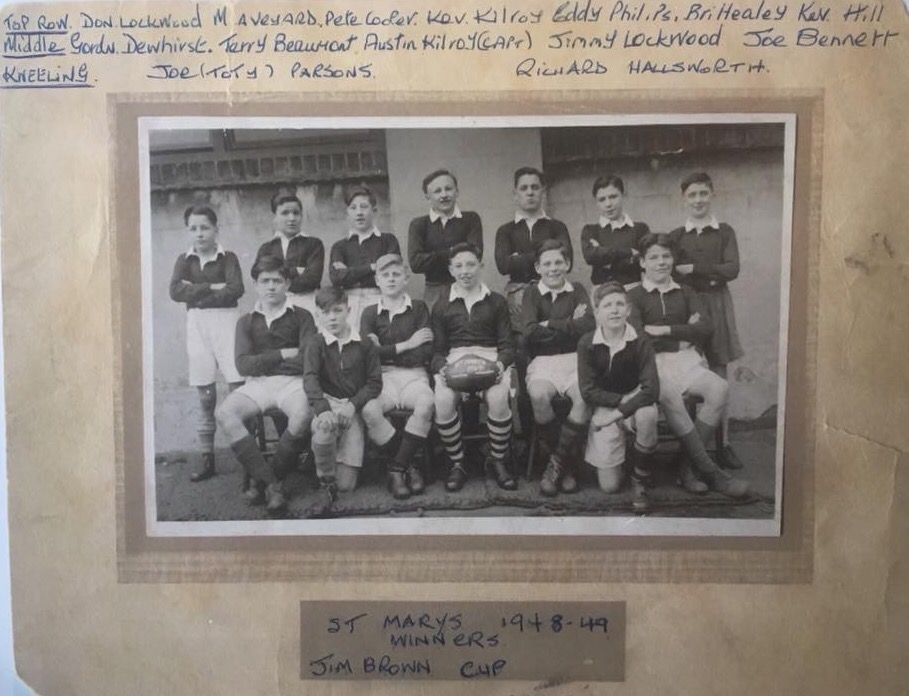
This is the photo which inspired me to write this post. It is a St Mary’s Batley school Rugby League team photo. Apparently under 15s.

St Mary’s 1948-49 Rugby League Cup Winning Team – Photo reproduced with permission of Mark Oliver Lockwood

The top right boy is identified as ‘Kev Hill’. My dad. My heart wanted it to be so, but my head said otherwise. It looked more like dad’s marginally older brother, Gerard. Plus dad would have only been about 12 at the time.

I knew dad was a good rugby player, a winger. He was quick, really quick. I know when dad served in the RAF, he played Rugby Union on the wing for them: back in the 1950s Rugby League wasn’t an accepted military sport. Rugby League though was his true game. It was in the family. His uncle, Thomas Brannan, played for Batley. His cousin, Brian Briggs, played for Huddersfield, St Helens and Wakefield. He also represented Yorkshire, England and Great Britain.

One of my earliest memories is dad taking me to Mount Pleasant on a Sunday afternoon to watch Batley play. We’d usually be accompanied by his brother Gerard, and my cousin Claire. It is from those early days watching the game with dad, either live or on TV, that I developed my love of Rugby League.

One of the conversations I had in dad’s last months was how he believed his playing days wouldn’t have been halted temporarily if his own dad hadn’t died when he was three. Dad suffered a bad led injury and, for a time, his naturally protective mum stopped him playing in the lead up to a cup final whilst at school. His mum eventually relented, but it was too late. It meant he missed the cup-winning final. A big deal for him, which almost 70 years later he talked about. It meant he wasn’t on the team photo which was on display in Batley Nash. Maybe it was the team photo in the year or so after the one above.

Anyway, back to this 1948/49 photo. Seeing it knocked me for six. It was the type of photo I’d share and discuss with dad. He’d go through those photographed, identifying them from his school days. But this was the first time ever he’d been labelled on a picture. And I couldn’t ask him about it.

Dad’s younger sister and brother are alive though. And they confirmed my belief. The photo is incorrectly labelled. It’s not dad. It is his older brother Gerard, who died a few years ago. I’d noticed uncle Gerard’s shorts contravened kit rules. My uncle also pointed out that Gerard wasn’t wearing rugby boots, something I hadn’t noticed. It turns out uncle Gerard was late for the team photo. So the family knew the history behind it.

Maybe if this photo had surfaced years later when those who knew dad and his brother were long gone, descendants would’ve accepted the name labelling as correct. Who is to say that the family history photos we have today haven’t been similarly mistakenly named? As with any other family history source it pays to evaluate that source and ask questions. In this case:

  • When was the labelling done – was it years later?
  • If names do appear, who did it? The person, another family member who knew them or someone totally unrelated?
  • Is it a family group photo, for example a wedding shot, which features many family members? This might make it easier to put names to individuals. Or is it a class photo, with no other family members on?
  • Does the period look right, in terms of clothes, style and type of photograph, studio name and location etc?
  • If there are dates indicated on the shot, do they fit in with what is known?
  • Does it match the family member’s appearance in other photos (if they exist)?
  • Do other sources corroborate it?

So the moral of this story, in life as much as in family history, is question and challenge. Back up with other evidence to build up a body of proof. Don’t go on just one single piece of ‘evidence‘ and don’t go with your heart – use your head.

Dad – Father’s Day 2014, with the Family History Book I wrote for his present

Family History Alert: Launch of New General Register Office (GRO) Extended PDF Pilot for Certificates

Good news for those family historians wanting to potentially cut down on cost and delivery time for those all-important English and Welsh birth and death certificates. Almost 12 months since the launch of the last PDF trial, which I wrote about here, the GRO have launched a new extended PDF pilot, similar to 2016’s Phase 1 trial. GRO TrialThe results from that proved inconclusive in assessing impact on other GRO and Local Registration services. The GRO have therefore announced that, as from 12 October 2017, they will be running a PDF pilot which will run for a minimum of  three months – so not the mad dash three week/45,000 limit of last year’s Phase 1 trial. This longer run will better enable the GRO to make a considered evaluation of the pilot. [Note this time period has now been extended to a minimum of nine months. See the update at the end of this post].

The more relaxed timeframe will also have benefits for us family historians  – giving us more time to evaluate our tree for gaps, and make repeat orders depending on what the certificates reveal once they arrive. The GRO say the PDFs should be received within five working days of ordering, providing the order is placed before 4pm.

Like last year the cost of a PDF certificate is £6. And, akin to the 2016 Phase 1 trial, it is limited to 1837-1916 birth certificates and 1837-1957 death certificates. This equates to those already digitised certificates under the GRO’s old DoVE (Digitisation of Vital Events) project. The DoVE project was never completed, hence the pilot limitations. So bad luck if you’ve been hanging on for a marriage certificate, or a post-1916 birth or post-1957 death certificate.

The GRO are unable to answer at this stage whether the service will become permanent or whether there will be an extension to more products (eg marriages).

That said, it is still a welcome announcement for those who want a birth or death certificate for family history purposes. Note the PDFs cannot be used for official purposes – e.g. passport applications.

The link to the GRO site is here. More details about the pilot can be found here.

I will be spending the weekend assessing any civil registration gaps in my tree.

Update: In mid-January 2018 the GRO updated their website information on this latest trial. The length of the pilot has been extended to run for a minimum of 9 months, from the original 12 October 2017 start date.

Update 25 December 2018: The cost of these PDF copies of register entries will rise from £6 to £7 on 16 February 2019. Certificates will increase from £9.25 to £11

Lost in France (Or Belgium)? Not Me, Thanks to a Friendly LinesMan. 

I’m back from my latest visit to the Somme and Ypres area. In 11 days I notched up in excess of 100 miles walking the battlefields. And, thanks to a fantastic piece of kit which I used for the first time this visit, I reckon on this trip few of those miles were as a result of getting lost and retracing steps. 

Let me introduce my new guide: it’s called a LinesMan. WW1 Trench Maps put together in one handy package by Great War Digital.

This miracle-worker actually belongs to my husband. It was his Christmas present. But due to surgery a few weeks ago, he wasn’t up to miles of walking. I was. Hence I laid claim to it – and I’m now loath to let it go.  

On Sunken Lane with my LinesMan2Go – Photo by Chris Roberts

I love walking the battlefields. In my opinion it’s the only way to get an appreciation of the distances and lie of the land facing those involved in the Great War. Normally I’m armed with walking guidebooks: Paul Reed’s ‘Walking the Somme’ and his old edition of ‘Walking the Salient‘; plus ‘A Visitor’s Guide: The First Day of the Somme: Gommecourt to Maricourt‘, and Battle Lines Ypres: Nieuwpoort to Ploegsteert‘ by Jon Cooksey and Jerry Murland. Brilliant though they are, occasionally the instructions are too ambiguous for me, which leads me up the battlefield equivalent of the garden path – the mis-communication trench.

For example, instructions such as “Continue through the woods…Approximately halfway along you will notice a track running off to your left at right angles. This was the junctionof Bunhill Row with the Strand” could be problematical if the route is unfamiliar. How can I be expected to know what is halfway on a path I’ve never trodden? Cue my LinesMan maps. I have the LinesMan2Go version, which is a Samsung Galaxy tablet preloaded with over original 800 geo-referenced digital images of British 1:10,000 scale trench maps of the Western Front in Belgium and France. The GPS shows exactly where I am via a red onscreen tracker circle, and the map pinpoints where the Bunhill Row/Strand junction is.  I can see exactly where I am in relation to the junction, a real navigation aid. 

An illustration of this is the photo below on the Butte de Warlencourt walk from Paul Reed’s 2nd edition of ‘Walking the Somme‘. Proof I made it.

LinesMan in Action on Butte de Warlencourt walk – Photo by Jane Roberts

On other occasions its beauty is in its ability to confirm you have taken the correct overgrown track and are heading in the right direction – a welcome reassurance when you’ve been walking for ages in what seems like the middle of nowhere!

The option to track my route via the LinesMan, in conjunction with the guide book, gives an even greater understanding of the terrain. The maps cover different dates, so one area has several maps enabling you to see any changes over time as well as linking to modern times. The LinesMan is therefore a perfect partner to the books. No need now to take multiple bulky trench maps on my visits, and even worse find I’ve left the relevant one at home.

More than that though, the LinesMan is invaluable from a family history point of view. It has enabled me to track the final days of my ancestor Jesse Hill. He served with the 6th King’s Own Yorkshire Light Infantry (KOYLI) and was killed in action on 19 September 1915, near Ypres. The Unit War Diary includes a map of ‘H‘ Sector dated 27 July 1915, and it is in trenches in this Sector the battalion were based at the time of Jesse’s death. 

‘H’ Sector trenches, 26 July 1915 – 6th KOYLI Unit War Diary

Comparing this Unit War Diary map with the Bellewaarde Ridge & Hooge walk in Cooksey & Murland, then tracking my route via my LinesMan maps enabled me to confirm earlier research, and pinpoint with confidence the area in which he died. 

Snapshot from Linesman Map 10-28 Part 5-160416 Hooge Showing Railway Wood Area

Walking the actual trench locations wasn’t possible – a field full of turnips put paid to that  (at least that’s what they looked to be given my pathetic agricultural skills, *ancestors spinning in their graves*). But it was enough for me just to know I’d definitely nailed it. It also confirmed the fact that my previous visits, without aid of the LinesMan2Go, had put me in roughly the right area.  It’s good to have that final piece of confirmation though.

‘H’ Sector area, 20 September 2017 – Photo by Jane Roberts

But it also has other uses. Map references, for example those CWGC ones indicating where bodies were found prior to being brought into concentration cemeteries, take on a new relevance with my LinesMan. I also liked the facility to map routes out as I walked them, so I could review my footsteps at the end of my walk. And flicking through the range of maps for a particular location across different dates show the changes (or not) which took place during the course of the war.

I do need to get more practice using my LinesMan (yes, I’ve claimed it) in order to familiarise myself with all its features and get the best out of it. Initial issues for me, which more practice should resolve include improving my speed in manipulating the various maps; I also found it extremely touch sensitive, so found myself inadvertently flicking maps – but again more use should remedy this. More problematical issues, which are beyond my control, relate to weather: too sunny and screen glare becomes an issue; too wet, and at times rain proved torrential, is even worse – I didn’t dare use my precious tablet.

As I mentioned I (sorry, Chris) have the LinesMan2Go version: a tablet with all the maps pre-loaded. That’s because I was a tad worried at my ability to transfer the maps to iPhone, iPad or Android device. For me the primary reason for the kit was to enhance my battlefield visits. But I would like to view the maps on my computer, beyond what is available via the National Library of Scotland maps. So for that reason perhaps I should have been braver and trusted my technological skills.

For more details about the Great War Digital’s LinesMan products, including how to purchase them, click here

Finally, my review of this product is totally independent. I used the LinesMan2Go for the first time this visit, and was so impressed by it I wanted to share my experience.