Tag Archives: Home Front

St Mary of the Angels, Batley: One-Place Study Update – 1 to 31 July 2022 Additions

This is the latest update of the pages relating to my Batley St Mary’s one-place study, the details of which I announced here.

July saw the addition of seven new posts, bringing the total number of posts to 164. Three others were updated.

The additions included five weekly newspaper pages for July 1916. I have accordingly updated the surname index to these During This Week newspaper pieces, so you can easily identify newspaper snippets relevant to your family.

I have written a new biography for a War Memorial man – that of Edward Barber.

More men who served and survived have been identified. I have updated that page accordingly. No new biographies for these men have been added this month. They will follow in due course. 

Finally for this month there is one new school log book. This is for the Boys’ Department in 1919.

Below is the full list of pages to date. I have annotated the *NEW* ones, plus the *UPDATED* pages, so you can easily pick these out. Click on the link and it will take you straight to the relevant page.


1. About my St Mary of the Angels Catholic Church War Memorial One-Place Study;

Batley Descriptions – Directories etc.
2. 1914: Borough of Batley – Town Information from the Annual Report of the Medical Officer of Health.

Biographies: Men Associated with St Mary’s Who Died but Who Are Not on the Memorial 
3. Reginald Roberts 
4. William Frederick Townsend

Biographies: The War Memorial Men
5. Edward Barber *NEW*
6. Herbert Booth
7. Edmund Battye
8. Dominick (aka George) Brannan
9. Michael Brannan
10. John Brooks
11. Lawrence Carney
12. Martin Carney
13. Thomas Curley
14. Peter Doherty
15. Thomas Donlan
16. Thomas Finneran
17. Michael Flynn
18. Thomas Foley D.C.M.
19. Thomas Gavaghan
20. Michael Groark (also known as Rourke)
21. James Griffin
22. Michael Horan
William McManus – See William Townsend below
23. Thomas McNamara
24. Patrick Naifsey
25. Austin Nolan
26. Robert Randerson
27. James Rush
28. Moses Stubley
29. William Townsend, also known as McManus
30. Richard Carroll Walsh

Biographies: Those who Served and Survived (this includes a list of those identified to date and who will later have dedicated biographical pages) *UPDATED*
31. Patrick Cassidy
32. James Delaney
33. Thomas Donlan (senior)
34. Michael Rush

Burials, Cemeteries, Headstones and MIs
35. Cemetery and Memorial Details
36. War Memorial Chronology of Deaths

During This Week
37. During This Week Newspaper Index *UPDATED*
38. 1914, 8 August – Batley News
39. 1914, 15 August – Batley News
40. 1914, 22 August – Batley News
41. 1914, 29 August – Batley News
42. 1914, 5 September – Batley News
43. 1914, 12 September – Batley News
44. 1914, 19 September – Batley News
45. 1914, 26 September – Batley News
46. 1914, 3 October – Batley News
47. 1914, 10 October – Batley News
48. 1914, 17 October – Batley News
49. 1914, 24 October – Batley News
50. 1914, 31 October – Batley News
51. 1914, 7 November – Batley News
52. 1914, 14 November – Batley News
53. 1914, 21 November – Batley News
54. 1914, 28 November – Batley News
55. 1914, 5 December – Batley News
56. 1914, 12 December – Batley News
57. 1914, 19 December – Batley News
58. 1914, 24 December – Batley News
59. 1915, 2 January – Batley News
60. 1915, 9 January – Batley News
61. 1915, 16 January – Batley News
62. 1915, 23 January – Batley News
63. 1915, 30 January – Batley News
64. 1915, 6 February – Batley News
65. 1915, 13 February – Batley News
66. 1915, 20 February – Batley News
67. 1915, 27 February – Batley News
68. 1915, 6 March – Batley News
69. 1915, 13 March – Batley News
70. 1915, 20 March – Batley News
71. 1915, 27 March – Batley News
72. 1915, 3 April – Batley News
73. 1915, 10 April – Batley News
74. 1915, 17 April – Batley News
75. 1915, 24 April – Batley News
76. 1915, 1 May – Batley News
77. 1915, 8 May – Batley News
78. 1915, 15 May – Batley News
79. 1915, 22 May – Batley News
80. 1915, 29 May – Batley News
81. 1915, 5 June – Batley News
82. 1915, 12 June – Batley News
83. 1915, 19 June – Batley News
84. 1915, 26 June – Batley News
85. 1915, 3 July – Batley News
86. 1915, 10 July – Batley News
87. 1915, 17 July – Batley News
88. 1915, 24 July – Batley News
89. 1915, 31 July – Batley News
90. 1915, 7 August – Batley News
91. 1915, 14 August – Batley News
92. 1915, 21 August – Batley News
93. 1915, 28 August – Batley News
94. 1915, 4 September – Batley News
95. 1915, 11 September – Batley News
96. 1915, 18 September – Batley News
97. 1915, 25 September – Batley News
98. 1915, 2 October – Batley News
99. 1915, 9 October – Batley News
100. 1915, 16 October – Batley News
101. 1915, 23 October – Batley News
102. 1915, 30 October – Batley News
103. 1915, 6 November – Batley News
104. 1915, 13 November – Batley News
105. 1915, 20 November – Batley News
106. 1915, 27 November – Batley News
107. 1915, 4 December – Batley News
108. 1915, 11 December – Batley News
109. 1915, 18 December – Batley News
110. 1915, 23 December – Batley News
111. 1916, 1 January – Batley News
112. 1916, 8 January – Batley News
113. 1916, 15 January – Batley News
114. 1916, 22 January – Batley News
115. 1916, 29 January – Batley News
116. 1916, 5 February – Batley News
117. 1916, 12 February – Batley News
118. 1916, 19 February – Batley News
119. 1916, 26 February – Batley News
120. 1916, 4 March – Batley News
121. 1916, 11 March – Batley News
122. 1916, 18 March – Batley News
123. 1916, 25 March – Batley News
124. 1916, 1 April – Batley News
125. 1916, 8 April – Batley News
126. 1916, 15 April – Batley News
127. 1916, 22 April – Batley News
128. 1916, 29 April – Batley News
129. 1916, 6 May – Batley News
130. 1916, 13 May – Batley News
131. 1916, 20 May – Batley News
132. 1916, 27 May – Batley News
133. 1916, 3 June – Batley News
134. 1916, 10 June – Batley News
135. 1916, 17 June – Batley News
136. 1916, 24 June – Batley News
137. 1916, 1 July – Batley News *NEW*
138. 1916, 8 July – Batley News *NEW*
139. 1916, 15 July – Batley News *NEW*
140. 1916, 22 July – Batley News *NEW*
141. 1916, 29 July – Batley News *NEW*

Miscellany of Information
142. The Controversial Role Played by St Mary’s Schoolchildren in the 1907 Batley Pageant
143. The Great War: A Brief Overview of What Led Britain into the War
144. Willie and Edward Barber – Poems
145. A St Mary’s School Sensation

Occupations and Employment Information
146. Occupations: Confidential Clerk
147. Occupations: Lamp Cleaner
148. Occupations: Limelight Operator
149. Occupations: Office Boy/Girl
150. Occupations: Piecer/Piecener
151. Occupations: Rag Grinder
152. Occupations: Willeyer

The Families
153. A Death in the Church

School Log Books
154. Boys’ School – Log Book, 1913
155. Boys’ School – Log Book, 1914
156. Boys’ School – Log Book, 1915
157. Boys’ School – Log Book, 1916
158. Boys’ School – Log Book, 1917
159. Boys’ School – Log Book, 1918
160. Boys’ School – Log Book, 1919 *NEW*

Population, Health, Mortality and Fertility
161. 1914: The Health of Batley School Children Generally, with a Particular Focus on St Mary’s School Children

World War Two
162. World War Two Chronology of Deaths
163. Michael Flatley
164. William Smith *UPDATED*

World War 2 Air Raid Damage in Batley: Part 4 – K to N

In my post Batley’s First Air Raid – The Night of 12/13 December 1940, I wrote about the areas of Batley hit.

Since then I have pinpointed many of the affected buildings, houses and addresses, including a general summary of the damage inflicted on each property.

This is the fourth post which covers these addresses and the damage details, so you can identify if your current home was part of this event in our local history; or if a home associated with your family history was affected. This post covers street names beginning with the letters K through to N.

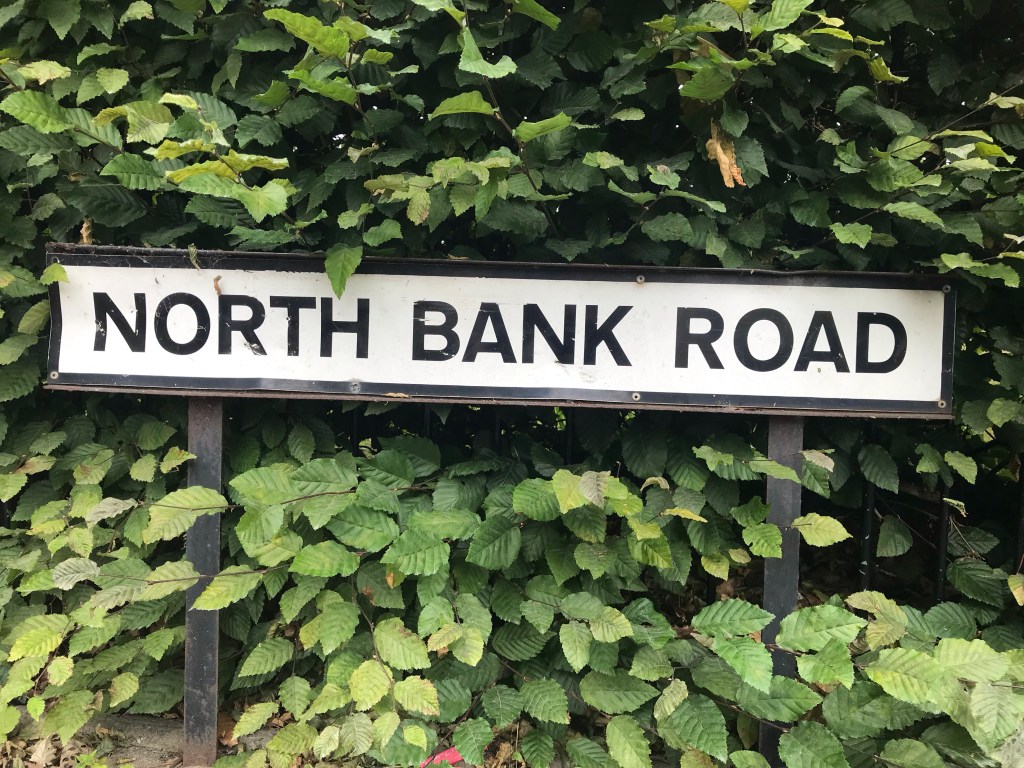
North Bank Road, Batley – Photo by Jane Roberts

One note of caution, although many house numbers remain unchanged from that period, some may have undergone re-numbering in the intervening years. The numbers in the table below are as they were during the war, not as they are today. Other houses have long since gone.

Also, though hundreds of addresses are listed, I am aware from my earlier research that this is not the full record of houses affected – there are areas of Batley hit that night which are missing from the list.

Some final points to be aware of. I have detailed the information exactly as it was written, so the damage inventory columns are not consistent. For example ceiling damage sometimes comes under ‘contents’, at others under the ‘generally’ heading. 

It is also clear this is not the complete story of damage inflicted. I am aware some buildings did suffer substantially more than is listed for them in the space-limited columns – for example the gable end at a house on North Bank Road needing rebuilding as a result of the air raid, but the inventory gives no indication of the extent of the damage to this house.

And, to my mind, the list of contents ruined does appear suspiciously light. Again has space played a part? For example it is hard to believe that crockery and furniture in the majority of houses was undamaged given the structural damage listed. An exception to this features in this post – a house on North Bank Road has furniture and crockery breakages reported. However these contents were not listed in the space provided but were an add on insertion at the top of the page. It is therefore likely that individual household forms were completed initially and the information then collated and condensed on one form covering all addresses, meaning layers of detail being missed in this overall summary.

North Bank Road – Photo by Jane Roberts

Anyway, good luck with locating your home. Don’t forget to scroll across the table to get the full details – there are columns detailing the property description, address, and an indication of the extent of damage (i.e. roof, walls, floors, contents and general damage). And do check my website as I continue to add more posts listing affected houses.

Description1AddressRoofWallsFloorsContentsGenerally
2 Kent StreetWindows
4 Kent StreetWindows
6 Kent StreetWindows
8 Kent StreetWindows
10 Kent StreetCeilingWindows
12 Kent StreetCeilingWindows
14 Kent StreetMany SlatesDoorWindow
16 Kent StreetWindows
18 Kent StreetWindow
20 Kent StreetCeilingWindow
22 Kent StreetCeilingWindow
24 Kent StreetCeilingWindows
26 Kent StreetWindows
28 Kent StreetCeilingWindows
30 Kent StreetLetter Box Windows
32 Kent StreetCeilingWindows
34 Kent StreetWindows
36 Kent StreetWindows
2 Knowles RoadWindow
19 Knowles RoadWindow
33 Knowles RoadWindow
35 Knowles RoadWindow
Council SchoolMill LaneWindow
23 Mount AvenueWindow
25 Mount AvenueWindow
32 New StreetWindow
2 Norfolk StreetWindows
3 Norfolk StreetMany SlatesLockWindows
4 Norfolk StreetWindows
5 Norfolk StreetWindows
6 Norfolk StreetWindows
8 Norfolk StreetWindows
9 Norfolk StreetWindows
10 Norfolk StreetWindows
11 Norfolk StreetWindows
12 Norfolk StreetWindows
14 Norfolk StreetWindows
15 Norfolk StreetWindows
17 Norfolk StreetWindows
22 Norfolk StreetWindows
37 Norfolk StreetWindows
66 Norfolk StreetWindows
68 Norfolk StreetWindows
7 North Bank RoadWindows
23 North Bank RoadWindows
27 North Bank RoadWindows
29 North Bank RoadWindows
31 North Bank RoadWindows
33 North Bank RoadWindows
121 North Bank RoadLock: Windows
123 North Bank RoadWindows
125 North Bank RoadSlates (WC)LockWindows & Frame
127 North Bank RoadSlates (WC)Dinner Service, Tea Service, Dressing-TableWindows & Frames
129 North Bank RoadMany SlatesCeilings Windows & Frames
131 North Bank RoadMany SlatesCeilings: LocksWindows & Frames: Door
133 North Bank RoadWindows & Door
135 North Bank RoadWindows
137 North Bank RoadWindows
139 North Bank RoadNot Known2
141 North Bank RoadMany SlatesCeilingsWindows & Frames: Lock
143 North Bank RoadNot Known2
145 North Bank RoadNot Known2
147 North Bank RoadMany SlatesPlasterCeilingsFireplace: Door: Windows
149 North Bank RoadNot Known2
151 North Bank RoadCeilingsWindows & Frames: Door
153 North Bank RoadCeilingsWindows
155 North Bank RoadCeilingWindows & Frames
157 North Bank RoadPlasterCeilingsCellar Brickwork: Window Frame
159 North Bank RoadLocksWindows
161 North Bank RoadWindows
163 North Bank RoadWindows
165 North Bank RoadWindows & Frame
167 North Bank RoadWindows
169 North Bank RoadWindows
171 North Bank RoadWindows
173 North Bank RoadWindows
175 North Bank RoadFireplaceWindows & Frame
69 North StreetWindow
Data extracted from West Yorkshire Archive Services Ref KMT1/Box42/TB227 – This is only a portion of the information contained. I have not included owners, occupiers, rateable value etc.

For Part 1 – A to B see here.
For Part 2 – C to F see here.
For Part 3 – G to J see here.
For Part 5 – O to P see here.
For Part 6 – Q to T see here.
For Part 7 – U to Z see here.


Postscript:
Finally a big thank you for the donations already received to keep this website going. 

The website has always been free to use, but it does cost me money to operate. In the current difficult economic climate I am considering if I can continue to afford to keep running it as a free resource, especially as I have to balance the research time against work commitments. 

If you have enjoyed reading the various pieces, and would like to make a donation towards keeping the website up and running in its current open access format, it would be very much appreciated. 

Please click here to be taken to the PayPal donation link. By making a donation you will be helping to keep the website online and freely available for all. 

Thank you.


Footnotes:
1. In this section of the list the ‘Description’ column is largely blank. The implication is these are houses, not business premises.
2. These buildings were on a different form where the only column relating to damage was “Indiction of Extent of Damage to Contents”. Other buildings on this form suffered complete destruction. It seems to be a form reserved for those buildings which suffered serious damage.

World War 2 Air Raid Damage in Batley: Part 3 – G to J

In my post Batley’s First Air Raid – The Night of 12/13 December 1940, I wrote about the areas of Batley hit.

Since then I have pinpointed many of the affected buildings, houses and addresses, including a general summary of the damage inflicted on each property.

This is the third post with these details so you can identify if your home was part of this event in our local history; or if a home associated with your family history was affected. It covers street names starting with the letters G through to J.

One of the streets covered in this post

One note of caution, although many house numbers remain unchanged from that period, some may have undergone re-numbering in the intervening years. The numbers in the table below are as they were during the war, not as they are today. Other houses have long gone.

Also, though hundreds of addresses are listed, I am aware from my earlier research that this is not the complete inventory – there are areas of Batley hit that night which are missing from the list.

Some final points to be aware of. I have detailed the information exactly as it was written, so the damage inventory columns are not consistent. For example ceiling damage sometimes comes under ‘contents’, at others under the ‘generally’ heading. 

It is also clear this is not the complete story of damage inflicted. I am aware some buildings did suffer substantially more than is listed for them in the space-limited columns – for example gable ends needing rebuilding as a result of the air raid.

Some final points to be aware of. I have detailed the information exactly as it was written, so the damage inventory columns are not consistent. For example ceiling damage sometimes comes under ‘contents’, at others under the ‘generally’ heading. 

It is also clear this is not the complete story of damage inflicted. I am aware some buildings did suffer substantially more than is listed for them in the space-limited columns – for example gable ends needing rebuilding as a result of the air raid. 

And, to my mind, the list of contents ruined does appear suspiciously light. For example it is hard to believe that crockery and furniture in the majority of houses was undamaged given the structural damage listed. Again has space played a part? There are exceptions – in one detailed entry for an address in another post, although the contents were not listed in the space provided, they were an add-on insertion at the top of the page. It is hard to believe that contents in the majority of entries for other houses suffered no similar damage. I believe it is likely that individual household forms were completed initially and the information then collated and condensed on one form covering all addresses, meaning layers of detail being missed in this overall summary.

Anyway, good luck with locating your home. Don’t forget to scroll across the table to get the full details – there are columns detailing the property description, address, and an indication of the extent of damage (i.e. roof, walls, floors, contents and general damage). And do check my website as I continue to add more posts listing affected houses.

Description1AddressRoofWallsFloorsContentsGenerally
1 Garden StreetWindow
2 Garden StreetWindow
3 Garden StreetWindow
6 Garden StreetWindow
8 Garden StreetWindow
3 George StreetWindow
13 George StreetWindow
19 George StreetWindow
13 Gladwin StreetWindow
Gospel HallMuchPlasterCeilingsWindows
Grammar SchoolSewer: Boundary Wall, Windows
2 Great Wood StreetSlightCeilingsW.C Pot: Windows
4 Great Wood StreetSlightCeilingsWindows
6 Great Wood StreetSlightCeilingsWindows
8 Great Wood StreetSlightCeilingsPartition: Windows
8 Healey LaneSlightWindow
22 Healey Lane Window
39 Healey Lane Window
47 Healey Lane OrnamentWindow
49 Healey Lane Window
50A Healey LaneWindows
55 Healey Lane Window
61 Healey Lane Window
73 Healey Lane Window
75 Healey Lane Window
77 Healey Lane Window
79 Healey Lane Window
100 Healey Lane PlasterWindows
102 Healey Lane Windows
118A Healey Lane Window
120 Healey Lane Many Slates CeilingsWindows
122 Healey Lane Windows
126 Healey Lane Many Slates Windows
128 Healey Lane Many Slates
130 Healey Lane Chimney Flashing Window
132 Healey Lane Many Slates Window
134 Healey Lane Many Slates CeilingWindows
138 Healey Lane Many Slates CeilingsWindows
142 Healey Lane Window
144 Healey Lane Many Slates CeilingWindow
146 Healey Lane SlightWindow
148 Healey Lane SlightWindows
154 Healey Lane Windows
160 Healey Lane Many SlatesWardrobeWindow
199 Healey Lane Window
Fried Fish Shop219 Healey Lane Window
Braeside, 46 Healey Lane
HouseWestfield, Healey Lane Many SlatesWindows
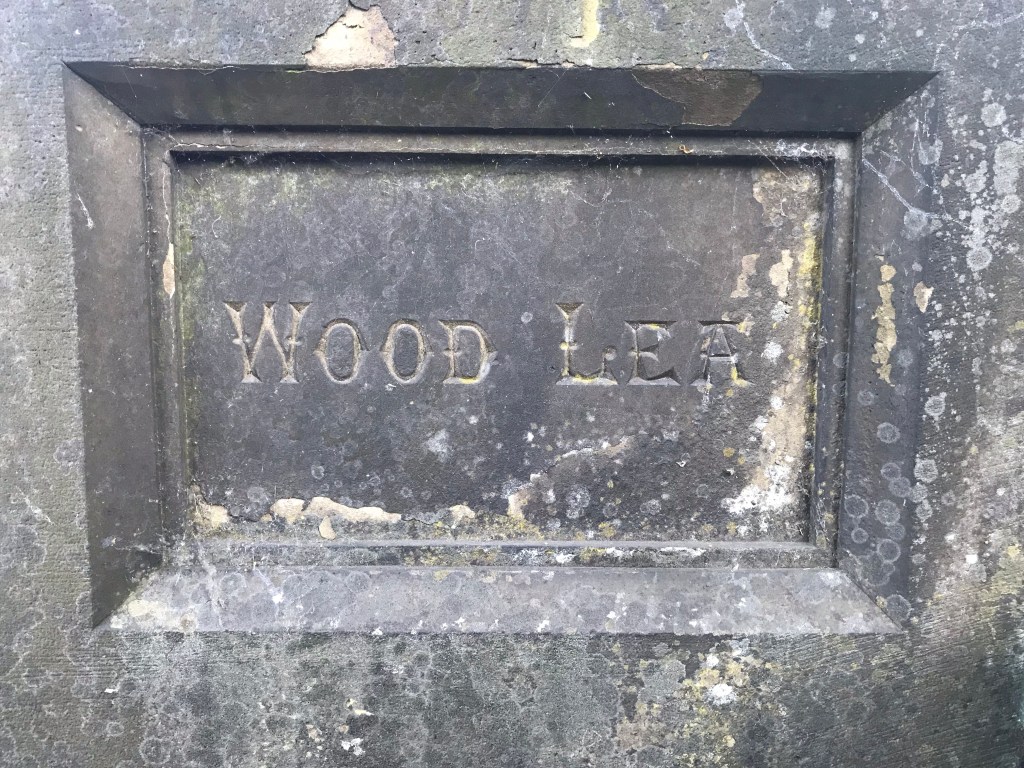
Wood Lea, 42 Healey Lane Windows
Senior Boys’ SchoolHealey Lane Slates
2 Highcliffe RoadWindows & Frame
4 Highcliffe RoadWindows
12 Highcliffe RoadWindows
16 Highcliffe RoadCeilings
18 Highcliffe RoadCeilings
22 Highcliffe RoadWindows
26 Highcliffe RoadWindows
36 Highcliffe RoadCeilingWindows & Frame
38 Highcliffe RoadCeilingWindows
40 Highcliffe RoadCeilingWindows
1 Holyoak AvenueMany Slates
2 Holyoak AvenueMany SlatesCeilingsSteps Windows
3 Holyoak AvenueMany SlatesCeilingsWindows
4 Holyoak AvenueMany SlatesWindows
5 Holyoak AvenueMany SlatesCeilingsWindows & Eaves Gutters
6 Holyoak AvenueMany SlatesWindows
7 Holyoak AvenueMany SlatesWindows
8 Holyoak AvenueMany SlatesWindows
9 Holyoak AvenueMany SlatesCeilingsEaves Gutter & Windows
10 Holyoak AvenueMany SlatesWindows
11 Holyoak AvenueMany SlatesCeilingsDoor & Windows
12 Holyoak AvenueMany SlatesWindows
13 Holyoak AvenueMany SlatesCeilingsDoor, Eaves & Windows
14 Holyoak AvenueMany SlatesWindows
15 Holyoak AvenueMany SlatesCeilingsDoor & Windows
16 Holyoak AvenueMany SlatesWindows
10 Jacob StreetWindow
12 Jacob StreetWindow
Data extracted from West Yorkshire Archive Services Ref KMT1/Box42/TB227 – This is only a portion of the information contained. I have not included owners, occupiers, rateable value etc. 

For Part 1 – A to B see here.
For Part 2 – C to F see here.
For Part 4 – K to N see here.
For Part 5 – O to P see here.
For Part 6 – Q to T see here.
For Part 7 – U to Z see here.


Postscript:
Finally a big thank you for the donations already received to keep this website going. 

The website has always been free to use, but it does cost me money to operate. In the current difficult economic climate I am considering if I can continue to afford to keep running it as a free resource, especially as I have to balance the research time against work commitments. 

If you have enjoyed reading the various pieces, and would like to make a donation towards keeping the website up and running in its current open access format, it would be very much appreciated. 

Please click here to be taken to the PayPal donation link. By making a donation you will be helping to keep the website online and freely available for all. 

Thank you.


Footnotes:
1. In this section of the list the ‘Description’ column is largely blank. The implication is these are houses, not business premises.

World War 2 Air Raid Damage in Batley: Part 2 – C to F

In my post Batley’s First Air Raid – The Night of 12/13 December 1940, I wrote about the areas of Batley hit.

Since then I have pinpointed many of the affected buildings, houses and addresses, including a general summary of the damage inflicted on each property.

This is the second post with these details so you can identify if your home was part of this event in our local history; or if a home associated with your family history was affected. It covers street names from C to F.

One note of caution, although many house numbers remain unchanged from that period, some may have undergone re-numbering in the intervening years (e.g. potentially Deighton Lane, looking at the current numbering/house names and cross-matching to the house names/numbers on the air raid damage list, and also looking at OS maps for the period).1 The numbers here are as they were during the war, not as they are today. Other houses have long gone.

Also, though hundreds of addresses are listed, I am aware from my earlier research that this is not the complete inventory – there are areas of Batley hit that night which are missing from the list.

Some final points to be aware of. I have detailed the information exactly as it was written, so the damage inventory columns are not consistent. For example ceiling damage sometimes comes under ‘contents’, at others under the ‘generally’ heading.

It is also clear this is not the complete story of damage inflicted. I am aware some buildings did suffer substantially more than is listed for them in the space-limited columns – for example gable ends needing rebuilding as a result of the air raid.

And, to my mind, the list of contents ruined does appear suspiciously light. For example it is hard to believe that crockery and furniture in the majority of houses was undamaged given the structural damage listed. Again has space played a part? There are exceptions – in one detailed entry for an address in another post, although the contents were not listed in the space provided, they were an add-on insertion at the top of the page. It is hard to believe that contents in the majority of entries for other houses suffered no similar damage. I believe it is likely that individual household forms were completed initially and the information then collated and condensed on one form covering all addresses, meaning layers of detail being missed in this overall summary.

Anyway, good luck with locating your home. Don’t forget to scroll across the table to get the full details – there are columns detailing the property description, address, and an indication of the extent of damage (i.e. roof, walls, floors, contents and general damage). And do check my website as I continue to add more posts listing affected houses.

DescriptionAddressRoofWallsFloorsContentsGenerally
Caledonia Road, J E Etherington LtdNot known2
HouseOak Cottage, Caledonia RoadMany slates
Public BathsCambridge StreetMany slates
House22 Carlinghow LaneWindow
House8 Cedar GroveWindow
House35 Chaster StreetWindow
House41 Chaster StreetWindow
House45 Chaster StreetWindow
House98 Chaster StreetWindows
House100 Chaster StreetWindows
House102 Chaster StreetWindows
House104 Chaster StreetWindows
House106 Chaster StreetWindow
House108 Chaster StreetWindows
House110 Chaster StreetWindows
House14 Clarence StreetMany slatesCeiling
House27 Cobden StreetWindow
House2 Colbeck Avenue3 slates offWindows
House3 Colbeck Avenue3 slates offWindow
House4 Colbeck Avenue12 slates offPlasterWiringWindow
House5 Colbeck Avenue2 slates offWindow
House6 Colbeck Avenue3 slates offCeilings & Windows
House7 Colbeck AvenueWindows
House9 Colbeck Avenue1 Ceiling & Windows
House11 Colbeck AvenueSlightChimney pot & Windows
House12 Colbeck AvenueWindows
House1 Colbeck TerraceSlight1 Ceiling & Windows
House 2 Colbeck TerraceWindows
House3 Colbeck TerraceSlight
House4 Colbeck TerraceLight BowlWindows
House5 Colbeck TerraceSlightWindows
House6 Colbeck TerraceWindows
House7 Colbeck TerraceSlightWindows
House8 Colbeck TerraceWindows
House9 Colbeck TerraceSlightDoor LockWindows
House10 Colbeck TerraceWindows
House11 Colbeck TerraceSlight
House12 Colbeck TerraceWindows
Shop25 Commercial StreetWindow
Electricity ShowroomsCommercial Street60?
House94 CommonsideWindow
House33 Crescent StreetWindow
House8 Cross Bank RoadWindow
House62 Cross Bank RoadWindow
House45 Cross Park StreetMany slatesBurntCeilingWindow
House18 Dark LaneWindow
House20 Dark LaneWindow
House22 Dark LaneWindow
House25 Dark LaneWindows
House45 Dark Lane CeilingsWindows
House55 Dark Lane Windows
House2 Deighton LaneSlightWindows
House4 Deighton LaneCeiling
House6 Deighton LaneCeiling & Window
House8 Deighton LaneCeiling & Windows
House10 Deighton LaneDoor LockWindows
House12 Deighton LaneWindow
House14 Deighton LaneWindow
House16 Deighton House, Deighton LaneSlightCeiling
House18 Deighton LaneWindow
House25 Deighton LaneMany slates1 Ceiling
House28 Deighton LaneSlightHouse & Greenhouse Windows
House29 Deighton LaneMany SlatesWindows
House31 Deighton LaneMany SlatesWindows
House36 Deighton LaneMany SlatesWindow
House38 Deighton LaneMany SlatesWindow
House42 Deighton LaneMany SlatesCeiling
House44 Deighton LaneMany SlatesCeilings & Windows
House45 Deighton LaneMany SlatesWindows
House46 Deighton LaneWindows & Garage
House47 Deighton LaneMany TilesWindows
House51 Holmleigh, Deighton LaneWindow & Garage Roof
House49 Deighton LaneMany Tiles
House53 Deighton LaneWindow
House55 Deighton LaneMany SlatesWindow, Greenhouse & Garage
House57 Deighton LaneMany SlatesHouse & Greenhouse Windows
House56 Fairholme, Deighton LaneMany SlatesWindows
House58 Deighton LaneMany SlatesWindows
House59 Deighton LaneCurtainsWindows & Window Frame
House60 Deighton LaneMany SlatesWindows & Eaves Gutter
House61 Deighton LaneWindow
House63 Deighton LaneWindow
House2 Denison StreetMuch Damage – Tenant Away – Entry Impossible Windows
House4 Denison StreetPlasterCeilingsLock: Windows & Frame
House6 Denison StreetPlasterCellar Wall: Windows
House8 Denison StreetMany SlatesPlasterCeilingWindows & Frames: Locks
House10 Denison StreetMany SlatesPlasterCeilingsWindows & Frames: Lock
House12 Denison StreetWindows
House14 Denison StreetMany SlatesCeilingWindows: Lock
House16 Denison StreetLock: Windows
House18 Denison StreetMany SlatesPlasterCeilingsWindows & Frames: Lock
House20 Denison StreetPlasterCeilingWindows & Frames: Lock
House22 Denison StreetPlasterCeilingsWindows & Frames
House24 Denison StreetMany SlatesPlasterWindows & Frames: Lock
House29 Denison StreetSlightPlasterCeilingsDoors, Windows & Frames
House31 Denison StreetSlightPlasterCeilingsDoors, Windows & Frames
House33 Denison StreetSlightPlasterCeilingsDoors, Windows & Frames
House35 Denison StreetSlates: PurlinsPlasterCeilingsDoors, Windows & Frames
House37 Denison StreetSlightPlasterCeilingsDoors, Windows & Frames
House39 Denison StreetSlightPlasterCeilingsDoors, Windows & Frames
House40 Denison StreetFlashingCeilings: CurtainsWindows & Frames: Doors
House41 Denison StreetPlasterCeilingsWindows
House42 Denison StreetFlashingCeilingsLocks: Fireplace: Windows
House43 Denison StreetCeilingsWindows
House44 Denison StreetMany Slates etcPlasterCeilingsDoors: Windows
House45 Denison StreetCeilingsWindows & Frames: Lock
House46 Denison StreetMany Slates etcCeilingPlinth: Windows & Frame. Doors
House47 Denison StreetCeilingsWindows
House48 Denison StreetCeilingFireplace: Locks: Windows
House49 Denison StreetMany SlatesPlasterCeilingsLock: Windows
House50 Denison StreetCeilingsWindows
House51 Denison StreetCeilingsWindows & Frame
House52 Denison StreetCeilingLock & Windows
House53 Denison StreetCeilingsPassage Wall: Windows
House54 Denison StreetMany SlatesCeilingLocks & Windows
House55 Denison StreetMany SlatesCeilingsWindows
House56 Denison StreetCeilingsLocks & Windows
House57 Denison StreetCeilingsDoor: Windows & Frames
House58 Denison StreetWindows
House59 Denison StreetPlasterPassage Wall: Windows
House60 Denison StreetWindow
House61 Denison StreetCeilingLock: Windows
House62 Denison StreetMany SlatesLocks & Window
House63 Denison StreetCeilingsWindows
House64 Denison StreetDoor & Windows
House65 Denison StreetMany SlatesPlasterWindows
House66 Denison StreetCeilingWindows
House67 Denison StreetPlasterCeilingWindows
House69 Denison StreetPlasterCeilingsLocks & Windows
House71 Denison StreetWindows
House73 Denison StreetMany SlatesCeilingWindows
House75 Denison StreetMany SlatesCeilingWindow
House77 Denison StreetMany SlatesWindow
House79 Denison StreetWindow
House & Shop81 Denison StreetShop & House Windows
31 Field LaneWindow
Garage (Paint Shop)Field LaneSlates
Council SchoolField Lane Window
Data extracted from West Yorkshire Archive Services Ref KMT1/Box42/TB227This is only a portion of the information contained. I have not included owners, occupiers, rateable value etc.

For Part 1 – A to B see here.
For Part 3 – G to J see here.
For Part 4 – K to N see here.
For Part 5 – O to P see here.
For Part 6 – Q to T see here.
For Part 7 – U to Z see here.


Postscript:
Finally a big thank you for the donations already received to keep this website going. 

The website has always been free to use, but it does cost me money to operate. In the current difficult economic climate I am considering if I can continue to afford to keep running it as a free resource, especially as I have to balance the research time against work commitments. 

If you have enjoyed reading the various pieces, and would like to make a donation towards keeping the website up and running in its current open access format, it would be very much appreciated. 

Please click here to be taken to the PayPal donation link. By making a donation you will be helping to keep the website online and freely available for all. 

Thank you.


Footnotes:
1. In these cases more detailed house history research is required.
2. This building was on a different form where the only column relating to damage was “Indiction of Extent of Damage to Contents”. Other buildings on this form suffered complete destruction. It seems to be a form reserved for those buildings which suffered serious damage. In an earlier post about Batley’s First Air Raid it is noted that a two-storey Rag Warehouse off Bridge Street belonging to J. E. Etherington Ltd had a stock of wool destroyed. Bridge Street backs onto Caledonia Road, so the entry on this form may refer to that building.

World War 2 Air Raid Damage in Batley: Part 1 – A to B

In my post Batley’s First Air Raid – The Night of 12/13 December 1940, I wrote about the areas of Batley hit. Since then I have been able to pinpoint many of the affected buildings, houses and addresses. This includes a general summary of the damage inflicted on each specific property.

This is the first post in which I provide details of the addresses and damage so you can identify if your home was part of this event in our local history; or if a home associated with your family history was affected.

View of Batley towards St Andrew’s Church – one of the bomb-damaged areas – Photo by Jane Roberts

One note of caution, although many house numbers remain unchanged from that period, some may have undergone re-numbering in the intervening years. The numbers here are as they were during the war, not as they are today. Other houses have long gone.

Also, though hundreds of addresses are listed, I am aware from my earlier research that this is not the complete inventory – there are areas of Batley hit that night which are missing.

Some final points to be aware of. I have detailed the information exactly as it was written, so the damage inventory columns are not consistent. For example ceiling damage sometimes comes under ‘contents’, at others under the ‘generally’ heading. 

It is also clear this is not the complete story of damage inflicted. I am aware some buildings did suffer substantially more than is listed for them in the space-limited columns – for example gable ends needing rebuilding as a result of the air raid. 

And, to my mind, the list of contents ruined does appear suspiciously light. For example it is hard to believe that crockery and furniture in the majority of houses was undamaged given the structural damage listed. Again has space played a part? There are exceptions – in one detailed entry for an address in another post, although the contents were not listed in the space provided, they were an add-on insertion at the top of the page. It is hard to believe that contents in the majority of entries for other houses suffered no similar damage. I believe it is likely that individual household forms were completed initially and the information then collated and condensed on one form covering all addresses, meaning layers of detail being missed in this overall summary.

Anyway, good luck with locating your home. Don’t forget to scroll across the table to get the full details – there are columns detailing the property description, address, and an indication of the extent of damage (i.e. roof, walls, floors, contents and general damage). And do keep coming back to my website to check as I continue to add more posts listing affected houses.

DescriptionAddressRoofWallsFloorsContentsGenerally
House57 Albion StreetWindow
House58 Albion StreetWindow
House62 Albion StreetWindow
Sunday SchoolSt Andrew’s SchoolExtensiveWindows
ChurchSt Andrew’s Church Extensive Windows
House32 Back Brearley StreetWindow
House20 Back Coalpit StreetWindow
House22 Back Coalpit StreetRoof1Window
House24 Back Coalpit StreetRoof1Windows
House26 Back Coalpit StreetRoof1Windows
House28 Back Coalpit StreetRoof1Windows
House30 Back Coalpit StreetRoof1Windows
House32 Back Coalpit SteetRoof1Windows
House34 Back Coalpit StreetRoof1Windows
House26 Back Crescent StreetWindow
House30 Back Crescent StreetWindow
House34 Back Crescent StreetWindow
House2 Yd 2 Back Taylor StreetWindows
House5 Yd 2 Back Taylor StreetWindows
House1 Bank StreetCeilingsLock: Windows & frame
House2 Bank Street SlightPlasterCeilingsDoors, Windows & Frames
House4 Bank Street SlightPlasterCeilingsDoors, Windows & Frames
House6 Bank Street SlightPlasterCeilingsDoors, Windows & Frames
House8 Bank Street SlightPlasterCeilingsDoors, Windows & Frames
House10 Bank Street SlightPlasterCeilingsDoors, Windows & Frames
House12 Bank Street SlightPlasterCeilingsDoors, Windows & Frames
House1 Beaumont StWindows
House3 Beaumont StWindows
House4 Beaumont StWindows
House5 Beaumont StCeilingWindows
House6 Beaumont StMany Slates
House7 Beaumont StWindow
House8 Beaumont StWindows
House9 Beaumont StCeilingWindows
House10 Beaumont StWindows
House12 Beaumont StLock
House14 Beaumont StWindows
House16 Beaumont StPlasterCeilingWindows
House17 Beaumont StWindows
House18 Beaumont StChimney PotWindows
House19 Beaumont StMany SlatesCeilingWindows
House20 Beaumont StWindows
House21 Beaumont St[Ro?] Chimney PotDoor: Windows
House22 Beaumont StWindows
House23 Beaumont StWindows
House24 Beaumont StCeilingWindows
House25 Beaumont StCeilingsWindows
House26 Beaumont StWindows
House27 Beaumont StLock: Windows
House28 Beaumont StCeiling
House29 Beaumont StWindow
House31 Beaumont StLockWindows
House32 Beaumont StWindows
House33 Beaumont StLocksWindows
House34/38 Beaumont StWindows & Frame
House35 Beaumont StWindows
House 36 Beaumont StWindows
House37 Beaumont StMany SlatesWindows
House 39 Beaumont StWindows
House 40 Beaumont StWindow Frames
House41 Beaumont StCeilingsWindows
House & Shop42 Beaumont StShop & House Windows
House 43 Beaumont StWindows
House44 Beaumont StCeilingsWindows & Frames
House45 Beaumont StCeilingsLocks: fireplace: Windows
House46 Beaumont StCeilingWindows & Frame
House47 Beaumont StCeilings, door, lead piping Fireplace: Windows & frame
House48 Beaumont StCeilingWindows
House49 Beaumont StCeilingsFireplace: locks: fall-pipe, windows
House50 Beaumont StWindows
House51 Beaumont StCeilings Windows & frame: fall-pipe. Door
House52 Beaumont StWindows
House53 Beaumont StCeilingWindows
House54 Beaumont StCeilingsWindows
House56 Beaumont StCeilingWindows
House58 Beaumont StPlasterCeiling Locks: Windows
House60 Beaumont StCeilingLock: Windows
House62 Beaumont StCeilingsWindows & frame. Door.
House64 Beaumont StCeilingLock: Windows
House66 Beaumont StCeilingWindows
House68 Beaumont StWindows & frames
House70 Beaumont StCeilingWindows & Frame
House72 Beaumont StCeilingsWindows
House74 Beaumont StMany SlatesCeilingWindows
House76 Beaumont StChimney PotsCeilingDoor & windows
House78 Beaumont StMuch Damage – Tenant away – entry impossibleWindows
House80 Beaumont StWindows
House82 Beaumont StCeilingWindows
House1 Belvedere Road Tenant away – entry impossible – slight damageWindows
House3 Belvedere Road Windows & frame
House4 Belvedere Road Windows
House8 Belvedere Road Windows
House10 Belvedere Road Windows
House14 Belvedere Road CeilingWindows
House15 Belvedere Road Windows
House16 Belvedere Road Wash-basinWindows
House18 Belvedere Road Window
House20 Belvedere Road Window
House22 Belvedere Road Door-lock
House40 Belvedere Road Window
House42 Belvedere Road Window
House20 Blakeridge LaneWindow
House35 Bonaccord Square, P’well LanePlasterCeilingWindow
House35A Bonaccord Square, P’well LaneCeiling
House1 Bonaccord Terrace Great Wood StMany SlatesWindows & frame: Lock
House3 Bonaccord Terrace Great Wood StMany SlatesDrains: Lock: Windows
House5 Bonaccord Terrace Great Wood StLock: Windows & Frame
House7 Bonaccord Terrace Great Wood StWindows & frames: Lock
HouseBoys’ Grammar School House2
ShopBradford RoadWindow
ClubBritish Legion Club, Bradford RoadWindows
House[Bradford Road?]2
Shop52 Bradford RoadWindow
Shop56 Bradford RoadWindow
Shop60 Bradford RoadWindow
House & Shop187 Bradford RoadWindows
House & Shop191 Bradford RoadWindow
Shop215 Bradford RoadWindows
WorkshopBradford RoadWindows
ShopBradford RoadWindows
National Prov BankBradford RoadSlates, joists & flashing
LaundryBradford RoadWindows
WarehousePerseverance Mills, Bradford RoadTop storey gutted
MillAnchor MillsExtensive Several Bales of ragsWindows
House4 Brearley PlaceCeilingWindows & frames
House6 Brearley PlaceWindows & frames
House8 Brearley PlaceWindows & frames
House10 Brearley PlaceCeiling & lockWindow frame & windows
House12 Brearley PlaceMany SlatesWindow frame & windows
House14 Brearley PlaceCeiling Window frame & windows
House16 Brearley PlaceCeilingWindows
House18 Brearley PlaceCeilingWindows
House20 Brearley PlaceCeilingsWindows
House22 Brearley PlaceCeilingsWindows & frame
House24 Brearley PlaceCeilings Windows & frame
House26 Brearley PlaceCeilingsDoor: lock: Windows
House28 Brearley PlaceCeilingsWindows & frame
House30 Brearley PlaceCeilingsWindows & frame
House32 Brearley PlaceCeilingsWindows & frame
House34 Brearley PlaceCeilingsWindows & frame
House 36 Brearley PlaceCeilingsWindows & frame
House2 Yd 1 Brearley StreetWindow
House3 Yd 1 Brearley StWindows
House4 Yd 1 Brearley StWindows
House5 Yd 1 Brearley StWindows
House5 Brearley StreetWindow
House13 Brearley StreetWindow
House23 Brearley StreetWindows
House33 Brearley StreetWindow
Sunday School }Methodist }ChapelWindows
Chapel}Brownhill
House4 Brownhill Terrace, Warwick Road Window
House5 Brownhill Terrace, Warwick Road Window & lock
House7 Brownhill Terrace, Warwick Road Ceiling Window
House62 Brownhill Terrace, Warwick Road Window
House64 Brownhill Terrace, Warwick Road Window
House76 Brownhill Terrace, Warwick Road PlasterCeilingsWindows
House1 Brown’s PlaceWindow
House12 Brown’s PlaceWindow
32 Brown’s Place3Windows
House17 Brown’s Terrace, Purlwell Lane Window
House23 Brown’s Terrace, Purlwell Lane Windows
House25 Brown’s Terrace, Purlwell Lane Windows
House27 Brown’s Terrace, Purlwell Lane Windows
House29 Brown’s Terrace, Purlwell Lane Windows
House31 Brown’s Terrace, Purlwell Lane Windows
Data extracted from West Yorkshire Archive Service Ref KMT1/Box42/TB227

For Part 2 – C to F click here.
For Part 3 – G to J see here.
For Part 4 – K to N see here.
For Part 5 – O to P see here.
For Part 6 – Q to T see here.
For Part 7 – U to Z see here.


Postscript:
Finally a big thank you for the donations already received to keep this website going. 

The website has always been free to use, but it does cost me money to operate. In the current difficult economic climate I am considering if I can continue to afford to keep running it as a free resource, especially as I have to balance the research time against work commitments. 

If you have enjoyed reading the various pieces, and would like to make a donation towards keeping the website up and running in its current open access format, it would be very much appreciated. 

Please click here to be taken to the PayPal donation link. By making a donation you will be helping to keep the website online and freely available for all. 

Thank you.


Footnotes:
1. Roofs to wash-houses damaged – slates.
2. No damage listed.
3. Cross matching with 1939 Register I suspect this should be Brown Street.

Family and Local History Talks in 2022 and 2023

After a break of a couple of years I’m now back with a new series of family and local history talks.

These are:

  • Local Links to the Lusitania;
  • Tips for Researching your Great War Ancestors;
  • My Batley St Mary’s in World War One One-Place Study;
  • The Home Front: the White Lee Explosion of 1914.

Local Links to the Lusitania focuses on people with Yorkshire connections on board the Cunard liner, torpedoed and sunk off the Irish coast on 7 May 1915. The sinking did not affect only the rich and famous. Many Yorkshire people were involved. This talk explores some of their stories.

There is a possibility this talk can be tailored to your local area.


Based on my groundbreaking book The Greatest Sacrifice: Fallen Heroes of the Northern Union about rugby league players who died in World War One, the talk investigates the stories behind some of the men. It is also packed with tips for researching your own Great War Army ancestors.


My Batley St Mary’s in World War One One-Place Study is based on my ongoing study of the Catholic parish of St Mary of the Angels, particularly during the First World War. It investigates what a one-place study is, why I embarked on one, why I chose this particular focus, as well as my findings.


The Home Front: the White Lee Explosion of 1914 is a talk based around the events of December 1914 when a devastating explosion, caused during the manufacture of picric acid for the war effort, took place at White Lee. It resulted in deaths and injuries, as well as damage across a vast area of Batley, Heckmondwike and the Spen Valley. It is an event often overlooked because of later explosions in Yorkshire at Low Moor and Barnbow. This talk aims to provide more information about this Heavy Woollen District incident, the forerunner to the later explosions. The talk will explore the unlucky history of the site as well as the events on the day and the aftermath. 


For more details about these talks, including booking one, please contact me at: pasttopresentgenealogy@btinternet.com

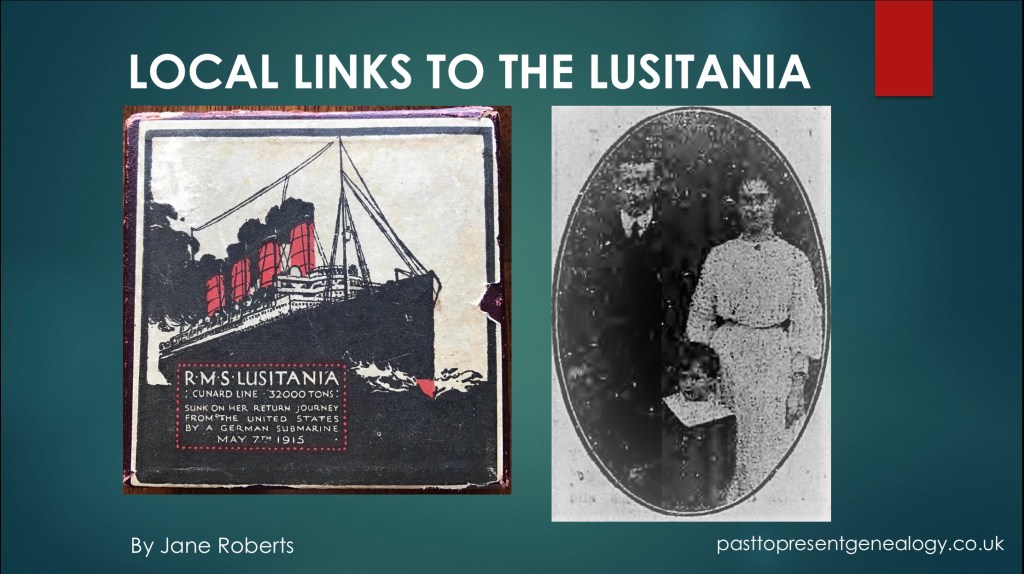
Lusitania Talk – 10 May 2022

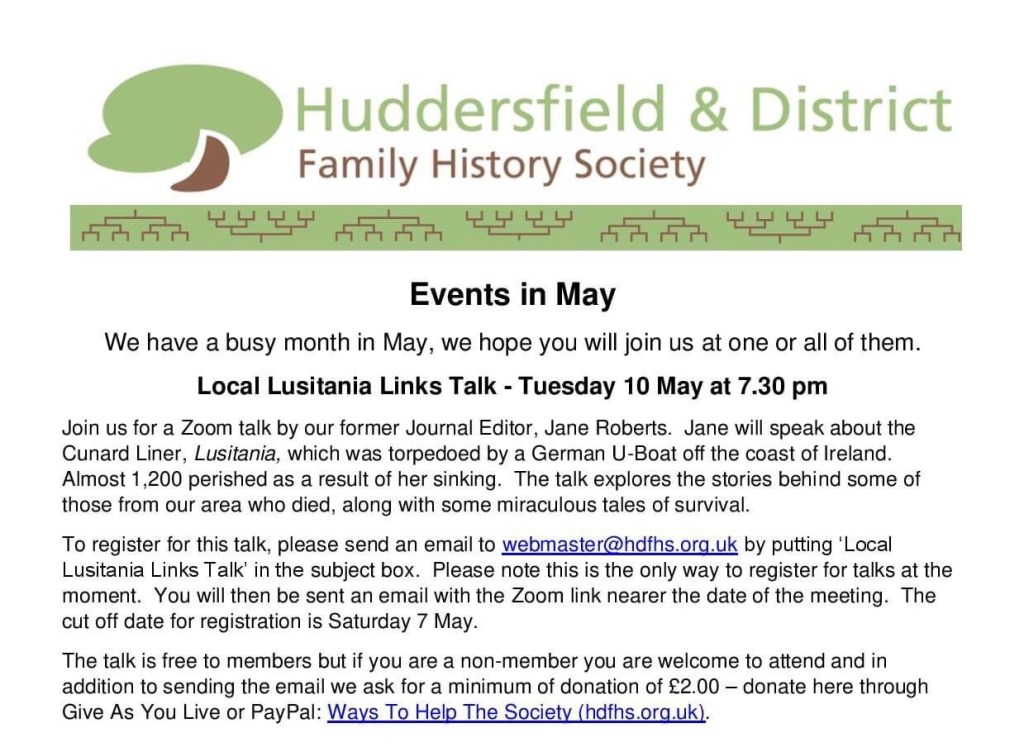
A heads up that I will be giving a talk via Zoom at 7.30 p.m. on 10 May 2022 about the Lusitania sinking of 7 May 1915.

Lusitania Medal Box – Photo by Jane Roberts

Huddersfield and District Family History Society are hosting the talk and more details are in the advert below. Essentially it is free for Society members, and a minimum £2 donation for non-members. Registering is by sending an email with ‘Local Lusitania Links’ in the subject box to webmaster@hdfhs.org.uk

As well as background details, I will be exploring some of the local links from around the family history society area to illustrate why the sinking had such a huge impact on our community.

It should be a fascinating talk packed with information and some amazing tales of loss and survival.

St Mary of the Angels, Batley: One-Place Study Update – 1 to 31 March 2022 Additions

This is the latest update of the pages relating to my Batley St Mary’s one-place study, the details of which I announced here.

A selection of school log books – Photo by Jane Roberts

March saw the addition of seven new pages. Two other pages were updated.

Although March may therefore appear to have been quiet, I have been working away in the background on a new strand to the St Mary’s One-Place Study – the school. More of that later.

The additions included four weekly newspaper pages for March 1916. I have accordingly updated the surname index to these During This Week newspaper pieces, so you can easily identify newspaper snippets relevant to your family.

More men who served and survived have been identified. I have updated that page accordingly. No new biographies for these men have been added this month. They will follow in due course.

I have written one biography for a War Memorial man: Robert Randerson. A Batley rugby league player and St Mary’s school teacher, his first days at the school are also recorded in the brand new section to the study – the school log books.

These log books were kept regularly by the school – the infants, mixed and boys’ departments. They record the everyday routine of their running. Some of the entries may be mundane, register checking for example. But amidst these entries are some real gems – for example unusual incidents, disease outbreaks, school outings, and issues relating to individual school children or teachers. Interwoven through them is the religious context to St Mary of the Angels school, and how local and national events also impacted on it. They provide a snapshot of Catholic school life in a bygone time. Crucially for this study, these particular logs are not available online or in the archives.

This month there are two new pages relating specifically to these log books. The first is a general introduction. The second is the 1913 log book entries for the newly formed Boys’ Department. And it is on these pages Robert Randerson appears.

Below is the full list of pages to date. I have annotated the *NEW* ones, plus the *UPDATED* pages, so you can easily pick these out. Click on the link and it will take you straight to the relevant page.


1. About my St Mary of the Angels Catholic Church War Memorial One-Place Study;

Batley Descriptions – Directories etc.
2. 1914: Borough of Batley – Town Information from the Annual Report of the Medical Officer of Health.

Biographies: Men Associated with St Mary’s Who Died but Who Are Not on the Memorial
3. Reginald Roberts
4. William Frederick Townsend

Biographies: The War Memorial Men
5. Herbert Booth
6. Edmund Battye
7. Dominick (aka George) Brannan
8. Michael Brannan
9. John Brooks
10. Martin Carney
11. Thomas Curley
12. Peter Doherty
13. Thomas Donlan
14. Thomas Finneran
15. Michael Flynn
16. Thomas Foley D.C.M.
17. Thomas Gavaghan
18. Michael Groark (also known as Rourke)
19. James Griffin
20. Michael Horan
William McManus – See William Townsend below
21. Thomas McNamara
22. Patrick Naifsey
23. Austin Nolan
24. Robert Randerson *NEW*
25. James Rush
26. Moses Stubley
27. William Townsend, also known as McManus

Biographies: Those who Served and Survived (this includes a list of those identified to date and who will later have dedicated biographical pages) *UPDATED*
28. James Delaney
29. Thomas Donlan (senior)
30. Michael Rush

Burials, Cemeteries, Headstones and MIs
31. Cemetery and Memorial Details
32. War Memorial Chronology of Deaths

During This Week
33. During This Week Newspaper Index *UPDATED*
34. 1914, 8 August – Batley News
35. 1914, 15 August – Batley News
36. 1914, 22 August – Batley News
37. 1914, 29 August – Batley News
38. 1914, 5 September – Batley News
39. 1914, 12 September – Batley News
40. 1914, 19 September – Batley News
41. 1914, 26 September – Batley News
42. 1914, 3 October – Batley News
43. 1914, 10 October – Batley News
44. 1914, 17 October – Batley News
45. 1914, 24 October – Batley News
46. 1914, 31 October – Batley News
47. 1914, 7 November – Batley News
48. 1914, 14 November – Batley News
49. 1914, 21 November – Batley News
50. 1914, 28 November – Batley News
51. 1914, 5 December – Batley News
52. 1914, 12 December – Batley News
53. 1914, 19 December – Batley News
54. 1914, 24 December – Batley News
55. 1915, 2 January – Batley News
56. 1915, 9 January – Batley News
57. 1915, 16 January – Batley News
58. 1915, 23 January – Batley News
59. 1915, 30 January – Batley News
60. 1915, 6 February – Batley News
61. 1915, 13 February – Batley News
62. 1915, 20 February – Batley News
63. 1915, 27 February – Batley News
64. 1915, 6 March – Batley News
65. 1915, 13 March – Batley News
66. 1915, 20 March – Batley News
67. 1915, 27 March – Batley News
68. 1915, 3 April – Batley News
69. 1915, 10 April – Batley News
70. 1915, 17 April – Batley News
71. 1915, 24 April – Batley News
72. 1915, 1 May – Batley News
73. 1915, 8 May – Batley News
74. 1915, 15 May – Batley News
75. 1915, 22 May – Batley News
76. 1915, 29 May – Batley News
77. 1915, 5 June – Batley News
78. 1915, 12 June – Batley News
79. 1915, 19 June – Batley News
80. 1915, 26 June – Batley News
81. 1915, 3 July – Batley News
82. 1915, 10 July – Batley News
83. 1915, 17 July – Batley News
84. 1915, 24 July – Batley News
85. 1915, 31 July – Batley News
86. 1915, 7 August – Batley News
87. 1915, 14 August – Batley News
88. 1915, 21 August – Batley News
89. 1915, 28 August – Batley News
90. 1915, 4 September – Batley News
91. 1915, 11 September – Batley News
92. 1915, 18 September – Batley News
93. 1915, 25 September – Batley News
94. 1915, 2 October – Batley News
95. 1915, 9 October – Batley News
96. 1915, 16 October – Batley News
97. 1915, 23 October – Batley News
98. 1915, 30 October – Batley News
99. 1915, 6 November – Batley News
100. 1915, 13 November – Batley News
101. 1915, 20 November – Batley News
102. 1915, 27 November – Batley News
103. 1915, 4 December – Batley News
104. 1915, 11 December – Batley News
105. 1915, 18 December – Batley News
106. 1915, 23 December – Batley News
107. 1916, 1 January – Batley News
108. 1916, 8 January – Batley News
109. 1916, 15 January – Batley News
110. 1916, 22 January – Batley News
111. 1916, 29 January – Batley News
112. 1916, 5 February – Batley News
113. 1916, 12 February – Batley News
114. 1916, 19 February – Batley News
115. 1916, 26 February – Batley News
116. 1916, 4 March – Batley News *NEW*
117. 1916, 11 March – Batley News *NEW*
118. 1916, 18 March – Batley News *NEW*
119. 1916, 25 March – Batley News *NEW*

Miscellany of Information
120. The Controversial Role Played by St Mary’s Schoolchildren in the 1907 Batley Pageant
121. The Great War: A Brief Overview of What Led Britain into the War
122. Willie and Edward Barber – Poems
123. A St Mary’s School Sensation

Occupations and Employment Information
124. Occupations: Confidential Clerk
125. Occupations: Limelight Operator
126. Occupations: Office Boy/Girl
127. Occupations: Rag Grinder
128. Occupations: Willeyer

The Families
129. A Death in the Church

School Log Books *NEW*
130. Boys’ School – Log Book, 1913 *NEW*

Population, Health, Mortality and Fertility
131. 1914: The Health of Batley School Children Generally, with a Particular Focus on St Mary’s School Children

World War Two
132. World War Two Chronology of Deaths
133. Michael Flatley

St Mary of the Angels, Batley: One-Place Study Update – 1 to 28 February 2021 Additions

William McManus

This is the latest update of the pages relating to my Batley St Mary’s one-place study, the details of which I announced here.

During the past month I have added seven pages. These include four weekly newspaper summaries. There are also two biographies, those of Edmund Battye and William McManus/Townsend. And in the miscellany section is a story about an alleged sensational incident regarding a pupil and the acting head teacher of St Mary’s school.

I have also identified several more men who served and survived, and have accordingly updated that page. I have also updated Patrick Naifsey’s biography, after establishing the family connection which would have drawn him to settle in the Batley area.

Below is the full list of pages to date. I have annotated the *NEW* ones, plus the *UPDATED* page, so you can easily pick these out.

1. About my St Mary of the Angels Catholic Church War Memorial One-Place Study;

Batley Descriptions – Directories etc.
2. 1914: Borough of Batley – Town Information from the Annual Report of the Medical Officer of Health.

Biographies: Men Associated with St Mary’s Who Died but Who are Not on the Memorial
3. Reginald Roberts
4. William Frederick Townsend

Biographies: The War Memorial Men
5. Austin Nolan
6. Edmund Battye *NEW*
7. Michael Brannan
8. Michael Horan
9. Patrick Naifsey *UPDATED* (to include new family and service record information)
10. Thomas Curley
11. William Townsend, also known as McManus *NEW*

Biographies: Those who Served and Survived (this includes a list of those identified to date and who will later have dedicated biographical pages) *UPDATED*
12. James Delaney

Burials, Cemeteries, Headstones and MIs
13. Cemetery and Memorial Details
14. War Memorial Chronology of Deaths

During This Week
15. 1914, 8 August – Batley News
16. 1914, 15 August – Batley News
17. 1914, 22 August – Batley News
18. 1914, 29 August – Batley News
19. 1914, 5 September – Batley News
20. 1914, 12 September – Batley News
21. 1914, 19 September – Batley News
22. 1914, 26 September – Batley News
23. 1914, 3 October – Batley News
24. 1914, 10 October – Batley News
25. 1914, 17 October – Batley News
26. 1914, 24 October – Batley News
27. 1914, 31 October – Batley News
28. 1914, 7 November – Batley News
29. 1914, 14 November – Batley News
30. 1914, 21 November – Batley News
31. 1914, 28 November – Batley News
32. 1914, 5 December – Batley News
33. 1914, 12 December – Batley News
34. 1914, 19 December – Batley News
35. 1914, 24 December – Batley News
36. 1915, 2 January – Batley News
37. 1915, 9 January – Batley News
38. 1915, 16 January – Batley News
39. 1915, 23 January – Batley News
40. 1915, 30 January – Batley News
41. 1915, 6 February – Batley News *NEW*
42. 1915, 13 February – Batley News *NEW*
43. 1915, 20 February – Batley News *NEW*
44. 1915, 27 February – Batley News *NEW*

Miscellany of Information
45. The Controversial Role Played by St Mary’s Schoolchildren in the 1907 Batley Pageant
46. The Great War: A Brief Overview of What Led Britain into the War
47. Willie and Edward Barber – Poems
48. A St Mary’s School Sensation *NEW*

The Night the Luftwaffe Bombed Batley and Dewsbury

12 December 1940 had been a cold winter’s day. As darkness drew in, families across the Heavy Woollen District prepared to hunker down for their second wartime Christmas.

Money was tight – no change there for most. So no sacks full of Christmas presents for the children. Again no change for many. But people were making the best of it, continuing peacetime Christmas traditions. Like the Hartley family in Savile Town, making a Christmas cake with a neighbour that evening – a reminder of the ordinariness of preparations of past Christmases [1].

But this was far from a normal Christmas. The strangeness of separation from loved ones in this so-called season of goodwill, bundled up with anxiety for the safety of those absentees, bound lots of families together. Mrs Hill in Batley faced a difficult Christmas – her first as a young widow with four children under the age of six. Over in Dewsbury, the Callaghan family were getting ready to spend Christmas with their latest family addition, a seventh child born earlier that year. Their eldest, 15-year-old Jack, typical of many teenage lads, was caught up with the excitement of pretending to shoot German planes out of the Yorkshire skies from his open bedroom window, accompanied by his own ack-ack-ack sound effects. His Air Raid Protection (ARP) Warden father quickly dragged him away, ensuring the window was firmly shut and blacked out. Within four years Jack would be serving with the Royal Navy craft in the D-Day landings.

At around 7.30pm the blood-chilling wail of the air raid sirens sounded across the Batley and Dewsbury districts, ending that evening’s attempts to recreate the normal of Christmases past. This was their new wartime normal. The anti-aircraft guns, based in Caulms Wood and what is now hole number 2 of Hanging Heaton Golf Club, began firing.

View over Batley from Hanging Heaton going towards the golf course, site of the anti-aircraft Guns – Photo by Jane Roberts

Perhaps there was an air of calm as people made their way to various air raid shelters. After all, they’d experienced this before, and the alarms always proved thankfully false.

Various organisations had these bomb shelters – for example St Mary’s RC school’s log book notes shortly after the war declaration that air raid shelters were built. One was under construction at Batley hospital in March 1940 – I know because it cost my grandad his life. Some sheltered in the strongest part of their house – cellars, sculleries, or simply under kitchen tables.

Others had purpose-built Anderson shelters in their gardens, erected right from the early days of the war. My dad remembers his dad building one, which would’ve been in the very first months after war broke out. Many families kept theirs post-war, converted to garden storage. They were a common site for many a year after the war.

This Mortimer Street, Batley, Anderson shelter existed well into the 1980s – Photo by Pauline Hill

Communal shelters existed with wooden slatted seats inside, like the soil-covered brick built one at Staincliffe. There was also a communal shelter at Leeds Road, Dewsbury. The tunnel at the bottom of Primrose Hill, close to Lady Ann Road, was another example. Vera May recalls sheltering there as a child during the 12 December 1940 raid. Men who worked at Taylor’s mill were also there, and Vera remembers: ‘They were great with us children, singing with us so we would not be afraid[2]. For, unlike most nights, this was no false alarm. The Luftwaffe this time were not passing over Batley and Dewsbury on their way to/from bombing another unfortunate town or city. Tonight it was for real, the turn of the heart of the Heavy Woollen district with its rail lines and mills manufacturing cloth for the military to face Hitler’s wrath.

Following the failure of the Battle of Britain, the Luftwaffe were now targeting Britain’s industrial and military centres. Sheffield was the focus for Operation Crucible, with bombing during the nights of the 12 and 15 December 1940. The targets of the raids were the multiple steel and iron works, collieries, and coke ovens along the Don Valley. One theory is that the bombing of Batley and Dewsbury was a mis-targeting from this attack, rather than these two towns being the specific objectives. Whatever, the results were disastrous for many of the townsfolk.

The night sky over Batley and Dewsbury lit up with parachute flares and tracer fire, as baskets of incendiary bombs and parachute mines rained down. Houses shook, window frames rattled, glass shattered, masonry and roof slates tumbled to the ground, water spurted out from fractured taps and pipes, and plaster fell from ceilings. As the bombs hurtled earthwards they made terrifying whistling and screaming sounds. Those sheltering braced themselves for the next ‘hit’, hunched over with hands protecting heads, then after each blast ensuring all others in the shelter were still OK.

It was not a constant bombardment. In the quieter periods, when the drone of the planes died away, people emerged troglodyte-like from their places of safety to check the damage, try extinguish any lights, and bale water onto house fires. Then they darted back in at the launch of the next attack wave.

Geoffrey Whitehead, an eight-year-old Batley schoolboy, vividly recalls that terrifying night. His grandparents, Charles and Harriet Whitehead, ran the off-licence at 1 Bunkers Lane. They also lived ‘over the shop’, along with Geoffrey and his parents. When the sirens sounded, Geoffrey’s father, Austin, set off towards Mayman Lane for his voluntary Auxiliary Fire Service (AFS) work. Normally the rest of the family would go to the brick-built communal shelter at the bottom of Common Road. But the planes were upon them too quickly. With bombs already raining down, there was simply not time to risk walking the short distance to Common Road. Instead the family made their way down to the beer cellar and sheltered under the table there. The cellar roof was reinforced with plaster-covered wooden planks. So great were the shock-waves from the bombs, in particular one huge blast, that white plaster flecks came away from the ceiling [3].

As time passed, the air became ever more thick with smoke and dust, flames engulfed buildings, while the stench of sulphur from the high explosive bombs weighed heavy. Throughout it all, the Civil Defence Services, stretched to the limit, worked valiantly. They were assisted by brave and alert householders who had buckets of sand and water at the ready. These AFS personnel (Austin Whitehead possibly amongst them), soldiers, police and ARP Wardens checked on sheltering householders, went into homes to extinguish fires left in grates, smothered incendiary bombs with sand, operated stirrup pumps to douse flames, entered burning buildings to ensure no-one was inside, retrieved valuables and carried furniture from homes impossible to save. Delayed action fuse bombs and unexploded devices posed further threats to the rescuers. Yet they carried on regardless in the face of unimaginable danger.

Numerous incidents were reported across Batley. Joe Shepley, a fruiterer and ARP Warden, and David Woodcock were injured by flying splinters. One housewife caught an incendiary bomb in a bucket of water as it ripped through her ceiling – fortunately little damage was done. The home of Albert Stevenson and his bride of three weeks, Edith (née Thewlis), had a similarly lucky escape when soldiers quickly extinguished an incendiary bomb which landed in their bedroom. Private Rutter risked his life by entering a blazing building in which he thought someone was trapped. Luckily no-one was inside, but the soldier had the presence of mind to bring out furniture. Soldiers saved a laundry from flames, as well as the Well Lane mineral water works, despite knowing there was an unexploded bomb near the latter.

In the same area of Well Lane, Superintendent Horace Horne, an ambulance driver, had been instructing a class of ambulance cadets when the first bombs fell. They assisted in the operations to save the St John Ambulance headquarters and a storage building opposite, removing to safety the ambulances and most of the first aid stores.

Others reported the AFS and ARP personnel ‘carrying an adult invalid from a dilapidated house’ and ‘searching beneath a mass of overhanging slates and splintered rafters for someone who might be trapped in debris[4].

A cinema was hit, but again escaped relatively unscathed. Bombs landed in fields – I wonder if this was the one which my dad remembers landing in Carter’s field? My uncle can also remember a massive depression at the bottom of Healey Lane which he believed was a result of bomb damage. Was it from this raid?

And the major blast which shook the cellar in which Geoffrey Whitehead sheltered, was the result of a huge bomb which landed in fields near what is now Manor Way. He visited the crater site the following day and recalls the hole being so huge you could fit a double decker bus in it. He also remembers collecting shrapnel from it, now long since lost [5].

The Purlwell area of Batley was particularly badly affected. St Andrew’s church was the first in the Wakefield Diocese to be damaged by air raids. In the immediate aftermath repair costs were put at £1,000. The £400 East Window was pitted with splinters. One wall was so unsafe, with the organ visible through a gaping crack in the masonry, that rebuilding was thought necessary. The only door not blown out was the stout, oak entrance door.

St Andrew’s Church, Purlwell, Batley – Photo by Jane Roberts

Houses round and about the church suffered significant bomb and blast damage. It was in this locality that Batley’s first air-raid fatality lost his life. Private Herbert Courtney Channon of the Royal Army Service Corps was in Purlwell Hall Road when he was struck in the neck by shrapnel and killed instantly. Some say he was decapitated. His friends, standing either side of him, had lucky escapes being flung to the ground by the blast. Private Channon’s body was returned to his family for burial in Chard, Somerset later that month [6].

Even with the departure of the German raiders in the early hours of the 13 December, the danger did not pass. As the all-clear rang out at around 1am, amidst air thick with smoke and fumes, the rubble of smouldering buildings, the danger of unstable masonry and the risk posed by unexploded and delayed action bombs, the civil defence volunteers and demolition squads continued to work. The presence of ‘live’ devices meant the temporary evacuation of many houses, swelling the ranks of those bombed out of their homes.

Around 400 Batley residents slept that night in a school refuge centre. They were given meals in two Sunday schools. Most of the displaced were thankfully able to return to their homes by the following nightfall. One Batley man whose house suffered bomb appreciatively stated:

Kindly folk spontaneously brought food for us, invited us to their houses for meals. Tradesman offered us anything we needed, and young ladies served hot tea to us during the salvage. [7]

According to the official statistics compiled from Intelligence Reports into enemy activity on British domestic soil, that night Batley suffered five casualties comprising one killed and four injured. In fact two people in the town died as a result of the German raid. In addition to soldier Herbert Courtney Channon, local mill hand Percy Ingham also lost his life.

Percy was born in Birstall on 24 April 1894, the son of Harry and Sarah Ann Ingham. He married Annie Phillips on 7 February 1920 at St Mary of the Angels RC Church in Batley.

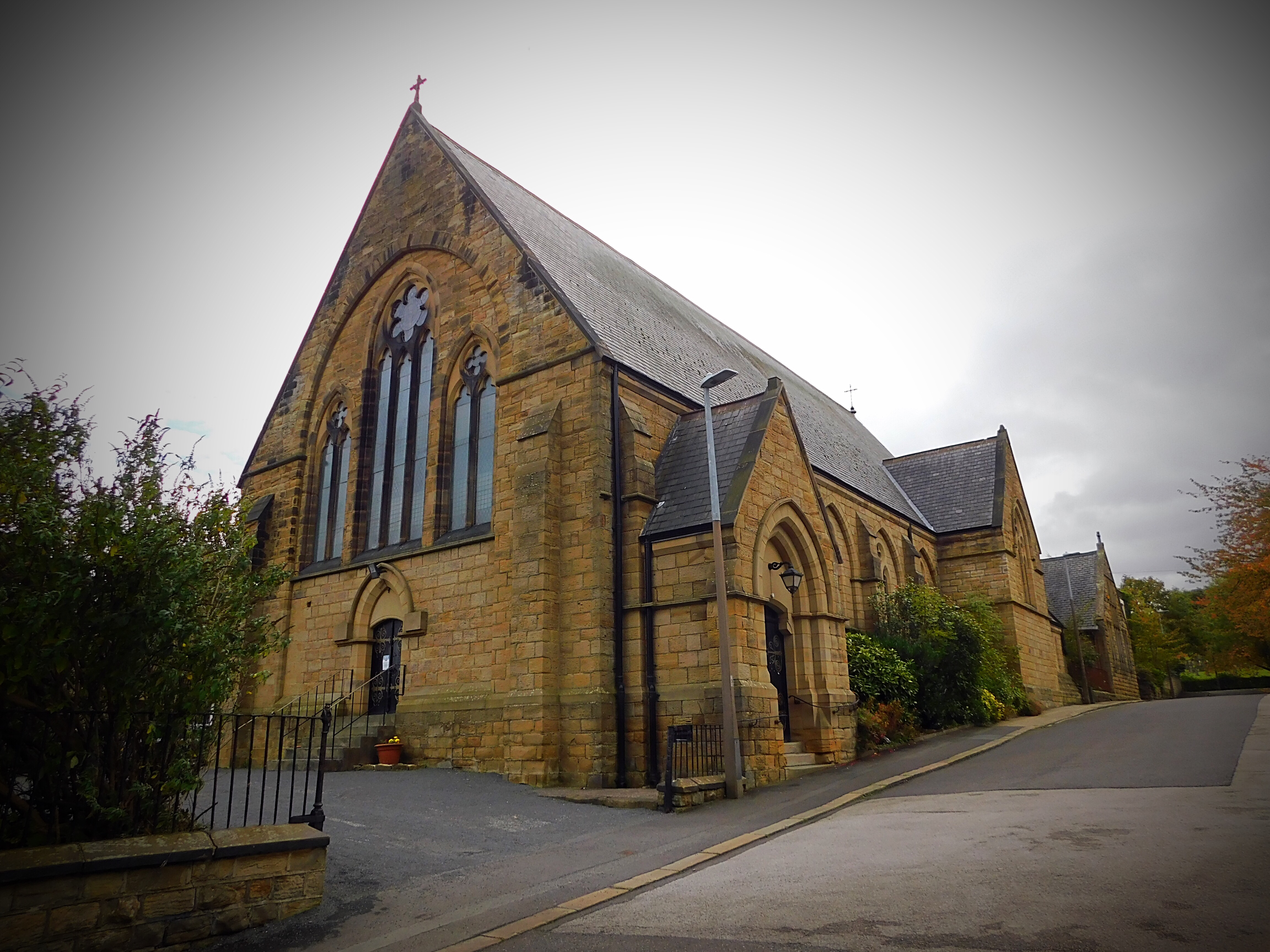
St Mary of the Angels, Batley – Photo by Jane Roberts

On the night of the raid, Percy sustained injuries at his home at 61 Purlwell Hall Road, the same street where Private Channon was cut down. Percy was taken to Staincliffe hospital where, despite all efforts, he died on 16 December 1940. Part of the old hospital buildings (previously Dewsbury Union Workhouse and the workhouse infirmary, as well as a military hospital in the First World War) exist today.

Staincliffe Hospital, now known as Dewsbury District Hospital and part of the Mid Yorkshire Hospitals NHS Trust – Photo by Jane Roberts

Percy’s funeral, conducted by Catholic priest John J Burns, took place on 20 December 1940. He is interred in Batley cemetery and his resting place is marked with a headstone. He is also commemorated in the roll of World War Two civilian dead held at Westminster Abbey, and on the Commonwealth War Grave’s Commission (CWGC) database.

Batley Cemetery, Headstone of Percy Ingham – Photo by Jane Roberts

Neighbouring Dewsbury also suffered in the 12 December raid, with five people losing their lives.

Brenda Hartley, her mother Hilda and neighbour Nellie Naylor, abandoned their Christmas cake baking at 13 North View, Savile Town. Initially they went into their cellar, but as Nellie’s husband, Harry, was due home they made a hair-raising dash to the cellar in the Naylor house next door but one. It was a decision which saved their lives. Harry arrived 15 minutes later. Shortly afterwards a bomb landed on the house they had vacated only a short time ago.

Initially unconscious, the group soon came round to find they were now buried alive. Their terrifying ordeal lasted several hours. Brenda’s mother sustained severe injuries, unable to move under the debris. There was a fear at one point that Hilda would drown, when water used to put out the fires above seeped steadily into the cellar. Harry, thankfully, managed to alert the firemen before it was too late. Rescuers eventually managed to dig a hole the size of an oven door into the cellar, through which a plank was inserted. Then, one by one, those entombed were pulled out to safety. However, the family at 14 North View were not so lucky as Brenda’s father, Dennis, soon learned.

Dennis cycled home immediately after hearing about the Savile Town bombing. He had been working the night shift at Newsome’s mill in Batley Carr. He did not know if his wife and daughter had survived. When he finally got through the cordon protecting devastated North View from the general public, he had a heart-stopping moment when:

…the A.R.P. Men told him they had just found two bodies. They had walked over them thinking they were pillows, but they turned out to be Mrs Scott and her daughter Enid who lived next door to us. Mr Scott was working at his shop, he was a cobbler in Thornhill Lees… [8]

Mary Ann Scott (née Platts) was originally from Carlinghow, Batley. Born in 1879 [9], her 61st birthday was only days away. She married boot and shoe repairer Harry Scott at Carlinghow St John’s on 16 April 1906 [10]. Before her marriage she worked as a weaver at Carlinghow mills (at that stage owned by Brooke Wilford & Co.,) and was a prominent member of the Carlinghow church, teaching in its Sunday school. After her marriage the family settled at 14 North View, and this was their home when Enid, their only child, was born on 7 August 1908. Enid attended Savile Town St Mary’s School, and Wheelwright Girls’ Grammar School. Her working life was spent in office and company secretary roles in Ossett. She also was a volunteer at the Dewsbury ARP Report Centre.

Harry was working at his boot repairing business at Brewery Lane, Thornhill Lees, when the attack occurred. That saved his life. On Tuesday 17 December, after a double funeral service at Carlinghow St John’s, it was Harry’s sad duty to walk behind the coffins of his wife and daughter as they were carried to Batley cemetery for interment. No headstone marks their final resting place. But, like Percy Ingham, their names live on in the Westminster Abbey roll of honour and on the CWGC database.

That day marked three more burials – this time all in Dewsbury cemetery. All three men were members of the Dewsbury Home Guard and were employed in Messrs. Crawshaw and Warburton’s Shaw Cross Colliery. The men were in the colliery offices at the former Ridings colliery on Wakefield Road [11], which was wrecked by a parachute mine. A row of terrace houses on Wakefield Road (Sunny Bank, numbers 72 to 82) were also destroyed in the attack. Fortunately the residents there had taken to the communal shelter and all survived. But the Home Guard men were not so fortunate.

Extract of Six-inch OS Map: Yorkshire CCXLVII.NE; Revised 1938; Published 1948. Shows Dewsbury and location of bombed Crawshaw and Warburton Colliery Offices and North View, Savile Town

Section Leader Sidney Burridge, of 351 Victoria Terrace, Leeds Road, Dewsbury, was a 46-year-old married man. Employed as a colliery deputy at Shaw Cross colliery, it was the same type of job undertaken by his father. Born on 5 July 1894, the son of James Hartley Burridge and wife Jane Elizabeth, he was baptised at St Philip’s church, Dewsbury [12]. It started his lifelong association with the church. It was here, on 8 September 1914, that he married Sophia Squires [13]. And it was the vicar at St Philip’s who conducted his funeral service, with a Union Jack-draped coffin and a Home Guard escort signifying his Local Defence Volunteer role. Outside work, Sidney was a member of Eastborough Working Men’s Club and Dewsbury Rugby League Football Club, both associations represented at his funeral. He left a widow and two children.

The Headstone of Sidney Burridge, Dewsbury Cemetery – Photo by Jane Roberts

Section Commander Ernest Lodge was another of the Home Guard fatalities. He sold house coals and briquettes for Messrs. Crawshaw and Warbuton. Born on 15 November 1893, he was the son of weaver Harry Lodge of Lepton and his wife Elizabeth [14]. Ernest’s mother died around three years later, and on 29 September 1900 Harry re-married at Dewsbury, St Mark’s [15]. His new wife was Sarah Elizabeth Oddy.

Ernest married widow Alice Wilson (formerly Chatwood) at Moorlands Wesleyan Chapel, Dewsbury on 20 July 1929 [16]. The couple both sang with their choir and, at the time of Ernest’s death, lived at 12, Thirlmere Road, Dewsbury.

He too was accorded a funeral with the honour of a Union Jack-covered coffin. Members of the Home Guard lined the path to his grave, which Dewsbury cemetery staff had bordered with evergreen.

The Headstone of Ernest Lodge, Dewsbury Cemetery – Photo by Jane Roberts

Section Commander Wilfred King was the third Home Guard casualty that night. Born on 31 May 1905 at Commonside, Hanging Heaton, he was the son of George and Martha Ann King. A coal hewer at the Shaw Cross pit, he lived with his parents at 457, Leeds Road, Dewsbury.

In a particularly cruel twist of fate, his 28-year-old bride-to-be Mary Glover, of Thornton Street, instead of preparing for her wedding scheduled for later that week, now found herself attending her fiancé’s funeral. She addressed her floral tribute ‘from his broken-hearted and sorrowing sweetheart’. Wilfred’s funeral service was held at the Boothroyd Lane Providence Independent, prior to interment at Dewsbury Cemetery.

The Headstone of Wilfred King, Dewsbury Cemetery – Photo by Jane Roberts

But that did not mark the extent of local deaths in the bombing raid of the night of 12/13 December 1940. As I mentioned at the outset, the main focus of the bombing that night was the city of Sheffield with its vital steel and iron works. Arthur Brewer, a long-time resident of Ravensthorpe, was in Sheffield that night.

Arthur was born in Birstall on 30 July 1907. The son of Earl and Mary Brewer, he was baptised at the Mount Zion Chapel at White Lee on 1 September 1907 [17]. Some time after 1911 the family moved to Ravensthorpe, and after leaving school Arthur began a career as a musician, specialising in the drums.

He played regularly at the Town Hall in Mirfield and Dewsbury’s Majestic cinema. He then joined the renowned Paul Zaharoff in London, famed for his international band. Subsequently Arthur went on tour playing in numerous city hotels, including a 16-week stint in Jersey.

In 1935 Arthur married Mary Goddard. For the 18 months prior to his death Arthur was based in Sheffield playing with a band in hotels across the city. In down-times he supplemented his income with lorry driving. Initially Mary stayed with him: she is registered there in the 1939 register. But later she moved to the comparative safety of Dewsbury, and was living with her in-laws at Thornhill Street, in Savile Town. Also with her was her and Arthur’s two children, the youngest only three month’s old at the time of raid. Perhaps it was the birth of the baby which prompted the move.

It is a cruel irony that both Savile Town and Sheffield were simultaneously under a Luftwaffe siege: The security of both Mary and Arthur was at stake that December night.

At about 11.20pm Arthur was in the Marples Hotel in Sheffield with fellow-band member Donovan Russell. The seven-storey Marples Hotel and pub on Fitzalan Square had operated under several names since the 1870’s, initially starting out as the Wine and Spirit Commercial Hotel, and latterly the London Mart. But it was still known as The Marples. And it’s name was to be forever etched in history for the events of that night.

At 11.44pm, as over 70 people sheltered in its cellar, it took a direct hit from a 500lb German bomb. Arthur was believed to be amongst those sheltering. Donovan Russell had a lucky escape – he left Arthur there just 20 minutes before the bomb struck. The entire building collapsed.

It was not until 10am the following day that rescue attempts began, initial assessments being survival was impossible. Amazingly seven people were rescued. But that was all. It is estimated around seventy people died in the building, the biggest single loss of life during the Sheffield Blitz. Arthur was amongst that number. If there was any consolation, death was believed to be instantaneous.

Over the following weeks the site was cleared. 64 bodies were eventually recovered, and partial remains of a further six or seven people. Only 14 were visually identified. Personnal belongings were used in the process of formal identification for most of the others.

As of mid-January the only item belonging to Arthur which Mary recovered were the lenses of his glasses. When probate was granted on 12 March 1942, the entry confirmed identification of his body at the hotel. The entry read:

BREWER Arthur of 34 Thornhill-street Savile Town Dewsbury Yorkshire who is believed to have been killed through war operations on 12 December 1940 and whose dead body was found at Marples Hotel Fitzalan-square Sheffield Administration Wakefield 12 March to March Brewer widow.
Effects £161 5s [18]

I’ve planned this local history tale for some time. I wanted to publish it to coincide with the 75th anniversary of VE Day. Unfortunately, because of the current battle the world faces against the invisible coronavirus enemy, my research was prematurely curtailed. However, I wanted to go ahead with publication as a tribute to our ancestors of 80 years ago. Once some kind of research normality resumes I hope to update this post.

Finally, the Bombing Britain website, which draws together intelligence reports of enemy action on British domestic soil, records only this one direct air raid on Dewsbury. Batley had two recorded air raids. The evening of 12 December into the early hours of 13 December, and one on the night of 15/16 December 1940. This latter raid had no recorded casualties. If anyone does have any memories of these events, or life on the Home Front in Batley and Dewsbury generally, please do contact me.

ADDITIONAL INFORMATION
It appears the Bombing Britain site covering enemy action over British soil may under-report the bombs which landed over the Batley and Dewsbury area. West Yorkshire Archives produced an ARP Bomb Map for the night of 14/15 March 1941. It can be found at here and includes an unexploded bomb almost opposite what is now Healey Community Centre.


Postscript:
Finally a big thank you for the donations already received to keep this website going. 

The website has always been free to use, but it does cost me money to operate. In the current difficult economic climate I am considering if I can continue to afford to keep running it as a free resource, especially as I have to balance the research time against work commitments. 

If you have enjoyed reading the various pieces, and would like to make a donation towards keeping the website up and running in its current open access format, it would be very much appreciated. 

Please click here to be taken to the PayPal donation link. By making a donation you will be helping to keep the website online and freely available for all. 

Thank you.


Notes:
[1] WW2 People’s War archive of wartime memories, bbc.co.uk/ww2peopleswar, Brenda Hartley, now Haley, Reference A2843750;
[2] Vera May – Batley History Group Facebook Page, Jane Roberts post 19 April 2020;
[3] Geoffrey Whitehead, retired Batley Boy’s High School deputy headmaster, in conversation with Jane Roberts dated 27 April 2020;
[4] Batley News, 21 December 1940;
[5] Geoffrey Whitehead, Ibid;
[6] Exeter and Plymouth Gazette, 27 December 1940;
[7] Batley News, 21 December 1940;
[8] WW2 People’s War archive of wartime memories, bbc.co.uk/ww2peopleswar, Brenda Hartley, now Haley, Reference A2843750;
[9] Birstall St Peter’s baptism register, born on 23 December 1879 and baptised on 25 January 1880, accessed via Ancestry.co.uk West Yorkshire Church of England births and baptisms 1813-1910, original record at West Yorkshire Archive Services, Reference WDP5/1/2/9;
[10] Carlinghow St John’s marriage register, accessed via Ancestry.co.uk West Yorkshire Church of England Marriages and Banns, 1813-1935, original record at West Yorkshire Archive Services, Reference WDP132/1/2/2;
[11] England & Wales National Probate Calendar, Sidney Burridge, Probate Date 27 November 1941 gives the place of death. Accessed via Ancestry.co.uk;
[12] St Philip’s, Dewsbury, baptism register, accessed via Ancestry.co.uk West Yorkshire Church of England births and baptisms 1813-1910, original record at West Yorkshire Archive Services, Reference WDP9/439;
[13] St Philip’s, Dewsbury, marriage register, accessed via Ancestry.co.uk West Yorkshire Church of England Marriages and Banns, 1813-1935, original record at West Yorkshire Archive Services, Reference WDP9/443;
[14] Baptism of Earnest [sic] Lodge, Huddersfield Northumberland Street Methodist Circuit, accessed via Ancestry.co.uk West Yorkshire, Non-Conformist Records, 1646-1985, original record at West Yorkshire Archives Service, Reference KC295/3;
[15] St Mark’s, Dewsbury, marriage register, accessed via Ancestry.co.uk West Yorkshire Church of England Marriages and Banns, 1813-1935, original record at West Yorkshire Archive Services, Reference WDP228/1/2/2;
[16] Marriage register of Moorlands Wesleyan Chapel, Boothroyd Lane, Dewsbury, accessed via Ancestry.co.uk West Yorkshire, Non-Conformist Records, 1646-1985, original record at West Yorkshire Archives Service, Reference C111/207;
[17] Mount Zion, White Lee, Baptism register, accessed via Ancestry.co.uk West Yorkshire, Non-Conformist Records, 1646-1985, original record at West Yorkshire Archives Service, Reference C10/15/1/1/1;
[18] England & Wales National Probate Calendar, Arthur Brewer, Probate Date 12 March 1942; Accessed via Ancestry.co.uk

Sources:
1939 Register, accessed via Findmypast and Ancestry.co.uk;
Batley Cemetery Burial Records;
• Batley News, 14 and 21 December 1940 and 18 January 1941
;
• BBC WW2 People’s War
, bbc.co.uk/ww2peopleswar ;
• Bombing Britain website, TNA file series HO203, intelligence reports of enemy action on British domestic soil http://www.warstateandsociety.com/Bombing-Britain ;
• Chariots of Wrath, Sam Whitworth, published 2016
;
• Commonwealth War Graves Commission website, https://www.cwgc.org/
;
• England and Wales Censuses 1881-1911 (various);
Exeter and Plymouth Gazette, 27 December 1940;
Farnham Maltings website, The Marples Tragedy (Sheffield Blitzm 1940), https://farnhammaltings.com/newsmarples-tragedy/ ;
Hanging Heaton Golf Club website, https://www.hhgc.org/about-hhgc/
National Probate Calendar, Herbert Courtney Channon, Sidney Burridge, Arthur Brewer, Enid Scott, Ernest Lodge;
• OS Map is reproduced with the permission of the National Library of Scotland under a Creative Commons licence. https://maps.nls.uk/index.html
Parish Registers – various;
Sheffield History website, The Marples, https://www.sheffieldhistory.co.uk/forums/topic/98-the-marples/ ;
• The Chris Hobbs website, Marples Hotel, https://www.chrishobbs.com/marples1940.htm ;
• The History of Batley 1800 – 1974, Malcolm H Haigh, published 1985;
Sheffield Libraries blogspot, Sheffield Blitz: lost eyewitness account from Marples Hotel survivor comes to light in archives, http://shefflibraries.blogspot.com/2017/07/sheffield-blitz-lost-eyewitness-account.html ;
Western Times, 27 December 1940;
WW2 People’s War archive of wartime memories, bbc.co.uk/ww2peopleswar, Brenda Hartley, now Haley, Reference A2843750; Edward Lomax (Dewsbury), Reference A2875782; Ronald Tolson Schofield (Dewsbury), Reference A2843886; and Derrick Sharp (Batley), Reference A2339291;

UPDATE:
This has generated many memories and comments. There are the fantastic ones which have been posted in the WordPress comments section for this post below.
In addition there have been lots posted elsewhere on social media and I have gathered them together here.
• Brian Howgate on Facebook page Batley Photos Old and New wrote: My grandparents lived exactly opposite St Andrews Church in purlwell Hall Road. There house got serverly damaged when the bomb dropped on the church.
• On the same site Lesley Dyer wrote: My grandfather not only worked during the day but was also did his bit as a warden who had to go out and watch out for any incendries dropping which started fires and had to put them out before the German bomber’s came over, it went on for weeks, until one night another warden had told my grandfather that St. Andrews had been hit taking its roof, as a man stood in a shop doorway and the blast/shock wave blew him back into the shop, luckily he survived, the church roof & windows had gone altogether, along with homes in the area had also been damaged too.
• Also on that page Kevin Mcguire wrote: Our next door neighbour had a[n] Anderson shelter which he kept all his gardening gear they did not look that safe to me as a kid there were air aid shelters every where great for exploring and playing Japs and commanders with wooden guns.
• Again on the Batley Photos site Joan Chappell recalled: As a child I went to St. Andrews church. We were told that the reason it had chairs and not pews like most other churches was because it was bombed during the war.
• Also on Batley Photos Jack Dane wrote: ….when we lived on Purwell Crescent I have always had this memory of my mother leaving me outside our gate crying because it was pitch black she ran back into the house to fetch something she had forgotten when we were on our way to our neighbours air raid shelter, the date of the bombing puts me at 3 year old which seems about right if it was that particular night.
On the Shoddy Matters Facebook Page Christine Lawton wrote: My husband is named after Wilfred king he was a friend of there family.
• On the same page Ian Sewell said: I remember the bunkers up Caulms Wood with the huge stones.
• Also on Shoddy Matters David Wilby wrote: ….growing up [I] remember seeing where the bomb had dropped, up by the farm on Staincliffe hall road, near the top of Deighton Lane.
• And in another Shoddy Matters post Chrissie Chapman wrote: I have lived up Carters fields all my life and was told that the house I own had the gable wall blown down due to a bomb from the war. The wall was rebuilt and I now think, after reading this, it must have been from the bombs that fell on Carters Field . We often played, as children, in the air raid shelter that was on waste land next to the Parochial Hall.
• Linked to Chrissie’s post, on Dewsbury Pictures Old and New Facebook page David Riley said: My aunt Dorie’s gable end was blown up by the bomb in Carters Field had to move into my mum and dads in Northbank Rd near Mullins farm. David also said they lived in the last block of four [houses] facing Healey, Northbank fields by the top of the football pitch. Looking at the 1939 Register, the address for Doris Boden was 173 North Bank Road, Batley.
• Also on the Dewsbury page John Riley wrote: My auntie who lived down Robin Lane, used to find large lumps of shrapnel in the garden which she said came off the exploding AA shells fired from Caulms Wood.
• On Twitter Ghulam Nabi wrote: I attended Birkdale High School in 1974 and top half which was formerly the Girls Grammar school had air raid shelters all around the grounds.. Some of the lads found them and used to skip lessons by hiding in there. As an aside, the Girls Grammar School was Wheelwright, the former school of one of the air raid victims, Enid Scott.