Tag Archives: Birstall

St Mary of the Angels, Batley: One-Place Study Update – 1 to 30 November 2025 Additions

November 2025 was a busy month for the Batley St. Mary of the Angels One-Place Study. Four new posts were added, bringing the total number to 419. I also gave two talks about the early history of the Irish in Batley and the parish – one via Zoom to the Society of One-Place Studies; the other in-person to Batley History Group. If you missed them, I will be repeating the Irish and St. Mary’s talk next year with bookings already made for it, along with my other talks.

To start off with, I wrote a light-hearted piece about Buffalo Bill and A Right Royal Celebration for Batley’s Schoolchildren, a celebration in which the children of St Mary of the Angels participated. I describe, and include a photograph, of the special commemorative medal presented to all the schoolchildren, so that if you have one in your family you can identify it and know more about its history.

In a change of tone, with November being the month of Remembrance, one of the new posts was about James Edwards, one of the parishioners commemorated on the parish’s World War One War Memorial.
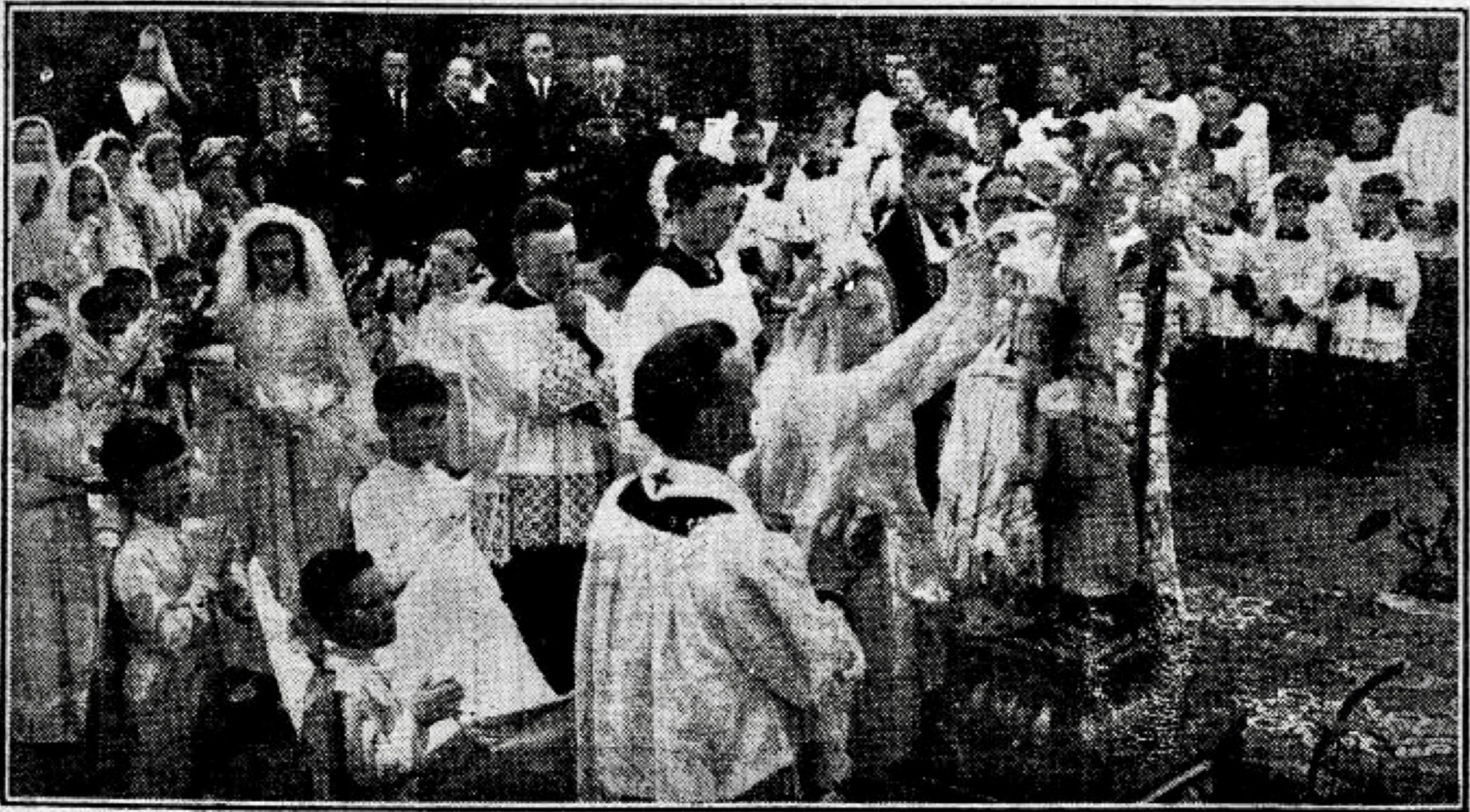
In the May Queen section I have added a piece about the 1952 ceremony when Patricia Anne Cain was the May Queen (as shown in the photograph to the left). It includes names of many others involved in the procession that day, which was a historic one in terms of its format that year.

The final post for the month was the parish history snippets piece for November 2025. These snippets cover a variety of events and people from the parish from years gone by, and can be found in the Bulletin for Batley St Mary of the Angels and Birstall St Patrick section. Even if you have seen them on the Bulletin, it is worth checking them here as some have links to more detailed pieces I have written.

Below is the full list of pages to date. I have annotated the *NEW* posts, so you can easily pick these out. Click on the link and it will take you straight to the relevant page.

If you want to know the background, and what is involved in a one-place study, click here. Otherwise read on, to discover a wealth of parish, parishioner and wider local Batley history. 


Postscript:
I may not be able to thank you personally because of your contact detail confidentiality, but I do want to say how much I appreciate the donations already received to keep this website going. They really and truly do help. Thank you.

The website has always been free to use, and I want to continue this policy in the future. However, it does cost me money to operate – from undertaking the research to website hosting costs. In the current difficult economic climate I do have to regularly consider if I can afford to continue running it as a free resource. 

If you have enjoyed reading the various pieces, and would like to make a donation towards keeping the website up and running in its current open access format, it would be very much appreciated. 

Please click 👉🏻here👈🏻 be taken to the PayPal donation link. By making a donation you will be helping to keep the website online and freely available for all. 

Thank you.

As a professionally qualified genealogist, if you would like me to undertake any family, local or house history research for you do please get in touch. More information can be found on my research services page.


Finally, if you do have any information about, or photos of, parishioners from the period of the First World War please do get in touch. It does not have to be War Memorial men. It could be those who served and survived, or indeed any other men, women and children from the parish. 

I would also be interested in information about, and photos of, those parishioners who were killed in World War Two, or others from the parish who undertook any war service and survived. This can be as broad as serving in the military, or work in munitions factories, the Land Army, even taking in refugees. This is an area I’m looking to develop in the future.

I can be contacted at: pasttopresentgenealogy@btinternet.com


1. About my St Mary of the Angels Catholic Church War Memorial One-Place Study;

Batley’s Public Buildings and Institutions
2. Batley Hospital: The First 50 Years – 1878 to 1928 
3. The Early History of Batley’s Public Baths 

Batley St Mary’s Population, Health, Mortality and Fertility Information and Comparisons
4.  1914: The Health of Batley School Children Generally, with a Particular Focus on St Mary’s School Children

Batley Statistics and Descriptions – Population, Health, Mortality, Fertility etc.
5. 1914: Borough of Batley – Town Information from the Annual Report of the Medical Officer of Health.
6. Batley and the 1921 Census 
7. Batley Population Statistics 1801-1939

Biographies: Men Associated with St Mary’s Who Died but Who Are Not on the Memorial 
8. Thomas Gannon 
9. Reginald Roberts 
10. William Frederick Townsend

Biographies: The War Memorial Men
11. Edward Barber 
12. William Barber (Memorial name spelling) 
13. Herbert Booth 
14. Edmund Battye
15. Dominick (aka George) Brannan 
16. Michael Brannan 
17. John Brooks 
18. Michael Cafferty 
19. Patrick Cafferty 
20. John William Callaghan 
21. Lawrence Carney 
22. Martin Carney 
23. Thomas William Chappell 
24. William Colbeck
25.  Michael Cunningham 
26. Thomas Curley
27. Peter Doherty 
28. Thomas Dolan 
29. Thomas Donlan 
30. James Edwards *NEW*
31. John W. Enright 
32. Mathew Farrer 
33. Thomas Finneran 
34. Michael Flynn 
35. Thomas Foley D.C.M. 
36. Martin Gallagher 
37. James Garner
38. Harold Gaunt 
39. James Gavaghan 
40. Peter Gavaghan 
41. Thomas Gavaghan 
42. Henry Groark 
43. James Groark 
44. Michael Groark (also known as Rourke) 
45. James Griffin 
46. William Hargreaves 
47. Michael Hopkins 
48. Patrick Hopkins
49. Michael Horan
50. James Hughes 
51. Lawrence Judge 
52. John Leech 
53. Michael Lydon
54. John Thomas Lynch 
55. Patrick Lyons 
William McManus – See William Townsend below
56. Thomas McNamara 
57. Clement Manning 
58. Patrick Naifsey 
59. Austin Nolan 
60. Robert Randerson 
61. James Rush 
62. Moses Stubley 
63. William Townsend, also known as McManus
64. James Trainor 
65. Richard Carroll Walsh
66. Arthur William Bayldon Woodhead

Biographies: Those who Served and Survived (this includes a list of those identified to date and who will later have dedicated biographical pages)
67. Patrick Cassidy 
68. James Delaney
69. Thomas Donlan (senior) 
70. Thomas Gannon 
71. Michael Rush 

Burials, Cemeteries, Headstones and MIs
72. Cemetery and Memorial Details 
73. War Memorial Chronology of Deaths .

During This Week
74. During This Week Newspaper Index 
75. 1914, 8 August – Batley News 
76. 1914, 15 August – Batley News 
77. 1914, 22 August – Batley News 
78. 1914, 29 August – Batley News 
79. 1914, 5 September – Batley News 
80. 1914, 12 September – Batley News 
81. 1914, 19 September – Batley News 
82. 1914, 26 September – Batley News 
83. 1914, 3 October – Batley News 
84. 1914, 10 October – Batley News 
85. 1914, 17 October – Batley News 
86. 1914, 24 October – Batley News 
87. 1914, 31 October – Batley News 
88. 1914, 7 November – Batley News 
89. 1914, 14 November – Batley News 
90. 1914, 21 November – Batley News 
91. 1914, 28 November – Batley News
92. 1914, 5 December – Batley News 
93. 1914, 12 December – Batley News 
94. 1914, 19 December – Batley News 
95. 1914, 24 December – Batley News 
96. 1915, 2 January – Batley News 
97. 1915, 9 January – Batley News 
98. 1915, 16 January – Batley News 
99. 1915, 23 January – Batley News 
100. 1915, 30 January – Batley News 
101. 1915, 6 February – Batley News 
101. 1915, 13 February – Batley News 
103. 1915, 20 February – Batley News 
104. 1915, 27 February – Batley News 
105. 1915, 6 March – Batley News 
106. 1915, 13 March – Batley News 
107. 1915, 20 March – Batley News 
108. 1915, 27 March – Batley News 
109. 1915, 3 April – Batley News 
110. 1915, 10 April – Batley News 
111. 1915, 17 April – Batley News 
112. 1915, 24 April – Batley News 
113. 1915, 1 May – Batley News 
114. 1915, 8 May – Batley News 
115. 1915, 15 May – Batley News 
116. 1915, 22 May – Batley News 
117. 1915, 29 May – Batley News 
118. 1915, 5 June – Batley News 
119. 1915, 12 June – Batley News 
120. 1915, 19 June – Batley News 
121. 1915, 26 June – Batley News 
122. 1915, 3 July – Batley News 
123. 1915, 10 July – Batley News 
124. 1915, 17 July – Batley News 
125. 1915, 24 July – Batley News 
126. 1915, 31 July – Batley News 
127. 1915, 7 August – Batley News 
128. 1915, 14 August – Batley News 
129. 1915, 21 August – Batley News 
130. 1915, 28 August – Batley News 
131. 1915, 4 September – Batley News 
132. 1915, 11 September – Batley News 
133. 1915, 18 September – Batley News 
134. 1915, 25 September – Batley News 
135. 1915, 2 October – Batley News 
136. 1915, 9 October – Batley News 
137. 1915, 16 October – Batley News 
138. 1915, 23 October – Batley News 
139. 1915, 30 October – Batley News 
140. 1915, 6 November – Batley News 
141. 1915, 13 November – Batley News 
142. 1915, 20 November – Batley News 
143. 1915, 27 November – Batley News 
144. 1915, 4 December – Batley News 
145. 1915, 11 December – Batley News
146. 1915, 18 December – Batley News 
147. 1915, 23 December – Batley News 
148. 1916, 1 January – Batley News 
149. 1916, 8 January – Batley News 
150. 1916, 15 January – Batley News 
151. 1916, 22 January – Batley News 
152. 1916, 29 January – Batley News 
153. 1916, 5 February – Batley News 
154. 1916, 12 February – Batley News 
155. 1916, 19 February – Batley News 
156. 1916, 26 February – Batley News 
157. 1916, 4 March – Batley News 
158. 1916, 11 March – Batley News 
159. 1916, 18 March – Batley News 
160. 1916, 25 March – Batley News 
161. 1916, 1 April – Batley News 
162. 1916, 8 April – Batley News 
163. 1916, 15 April – Batley News 
164. 1916, 22 April – Batley News 
165. 1916, 29 April – Batley News 
166. 1916, 6 May – Batley News 
167. 1916, 13 May – Batley News
168. 1916, 20 May – Batley News 
169. 1916, 27 May – Batley News
170. 1916, 3 June – Batley News 
171. 1916, 10 June – Batley News 
172. 1916, 17 June – Batley News 
173. 1916, 24 June – Batley News 
174. 1916, 1 July – Batley News 
175. 1916, 8 July – Batley News 
176. 1916, 15 July – Batley News 
177. 1916, 22 July – Batley News 
178. 1916, 29 July – Batley News 
179. 1916, 5 August – Batley News
180. 1916, 12 August – Batley News
181. 1916, 19 August – Batley News 
182. 1916, 26 August – Batley News
183. 1916, 2 September – Batley News 
184. 1916, 9 September – Batley News
185. 1916, 16 September – Batley News 
188. 1916, 23 September – Batley News 
187. 1916, 30 September – Batley News 
188. 1916, 7 October – Batley News
189. 1916, 14 October – Batley News 
190. 1916, 21 October – Batley News
191. 1916, 28 October – Batley News 
192. 1916, 4 November – Batley News
193. 1916, 11 November – Batley News
197. 1916, 18 November – Batley News
195. 1916, 25 November – Batley News 
196. 1916, 2 December – Batley News 
197. 1916, 9 December – Batley News 
198. 1916, 16 December – Batley News 
199. 1916, 23 December – Batley News 
200. 1916, 30 December – Batley News 
201. 1917, 6 January – Batley News 
202. 1917, 13 January – Batley News 
203. 1917, 20 January – Batley News 
204. 1917, 27 January – Batley News
204. 1917, 3 February – Batley News 
206. 1917, 10 February – Batley News 
207. 1917, 17 February – Batley News 
208. 1917, 24 February – Batley News 
209. 1917, 3 March – Batley News
210. 1917, 10 March – Batley News 
211. 1917, 17 March – Batley News 
212. 1917, 24 March – Batley News 
213. 1917, 31 March – Batley News
214. 1917, 7 April – Batley News 
215. 1917, 14 April – Batley News 
216. 1917, 21 April – Batley News 
217. 1917, 28 April – Batley News 
218. 1917, 5 May – Batley News 
219. 1917, 12 May – Batley News 
220. 1917, 19 May – Batley News 
221. 1917, 26 May – Batley News 
222. 1917, 2 June – Batley New
223. 1917, 9 June – Batley News
224. 1917, 16 June – Batley News
225. 1917, 23 June – Batley News
226. 1917, 30 June – Batley News
227. 1917, 7 July – Batley News
228. 1917, 14 July – Batley News 
229. 1917, 21 July – Batley News 
230. 1917, 28 July – Batley News 
231. 1917, 4 August – Batley News 
232. 1917, 11 August – Batley News 
233. 1917, 18 August – Batley News 
234. 1917, 25 August – Batley News 
235. 1917, 1 September – Batley News 
236. 1917, 8 September – Batley News 
237. 1917, 15 September – Batley News 
238. 1917, 22 September – Batley News 
239. 1917, 29 September– Batley News 
240.  1917, 6 October – Batley News 
241. 1917, 13 October – Batley News
242. 1917, 20 October – Batley News
243. 1917, 27 October – Batley News 
244. 1917, 3 November – Batley News
245. 1917, 10 November – Batley News
246. 1917, 17 November – Batley News 
247. 1917, 24 November – Batley News 
248. 1917, 1 December – Batley News 
249. 1917, 8 December – Batley News 
250. 1917, 15 December – Batley News 
251. 1917, 22 December – Batley News 
252. 1917, 29 December – Batley News 
253. 1918, 5 January – Dewsbury District News 
254. 1918, 12 January – Dewsbury District News 
255. 1918, 19 January – Batley News 
256. 1918, 26 January – Batley News
257. 1918, 2 February – Batley News 
258. 1918, 9 February – Batley News 
259. 1918, 16 February – Batley News 
260. 1918, 23 February – Batley News 
261. 1918, 2 March – Batley News 
262 1918, 9 March – Batley News 
263. 1918, 16 March – Batley News 
264. 1918, 23 March – Batley News 
265. 1918, 30 March – Batley News 
266. 1918, 6 April – Batley News 
267. 1918, 13 April – Batley News 
268. 1918, 20 April – Batley News 
269. 1918, 27 April – Batley News 
270. 1918, 4 May – Batley News
271. 1918, 11 May – Batley News 
272. 1918, 18 May – Batley News 
273. 1918, 25 May – Batley News 
274. 1918, 1 June – Batley News 
275. 1918, 8 June – Batley News 
276. 1918, 15 June – Batley News 
277. 1918, 22 June – Batley News
278. 1918, 29 June – Batley News 
279. 1918, 6 July – Batley News 
280. 1918, 13 July – Batley News 
281. 1918, 20 July – Batley News
282. 1918, 27 July – Batley News
283. 1918, 3 August – Batley News 
284. 1918, 10 August – Batley News 
285. 1918, 17 August – Batley News 
286. 1918, 24 August – Batley News 
287. 1918, 31 August – Batley News 
288. 1918, 7 September – Batley News 
289. 1918, 14 September – Batley News 
290. 1918, 21 September – Batley News 
291. 1918, 28 September – Batley News 
292. 1918, 5 October – Batley News 
293. 1918, 12 October – Batley News 
294. 1918, 19 October – Batley News 
295. 1918, 26 October – Batley News 
296. 1918, 2 November – Batley News 
297. 1918, 9 November – Batley News 
298. 1918, 16 November – Batley News 
299. 1918, 23 November – Batley News 
300. 1918, 30 November – Batley News 
301. 1918, 7 December – Batley News 
302. 1918, 14 December – Batley News 
303. 1918, 21 December – Batley News 
304. 1918, 28 December – Batley News 

Electoral Registers 1918-1921 
305. 1918 Batley Electoral Register, North Ward, Polling Districts A and B – Naval and Military Voters

Guest Contributions
306. Memories of Skelsey Row – by Brian Foley 

Maps and Photographs
307. A Description of the Parish Boundaries 
308. Aerial View of St Mary’s Church and the Surrounding Streets 
309. Batley St Mary’s – Map Published in 1894 
310. Batley St Mary’s – Map Published in 1907 
311. Batley St Mary’s – Map Published in 1922 
312. Batley St Mary’s – Map Published in 1933 

Miscellany of Information
313. A Bitter-Sweet Remarriage 
314. A Colliery Accident with Tragic Consequences
315. A Description of the Parish of St Mary of the Angels in 1950 
316. A Grave Disturbance in Batley 
317. A Part of St Mary of the Angels in Batley Cemetery 
318. A “Peace” of Batley History
319. An Appeal to Ireland to Build a Catholic Church in Batley 
320. A Potted Early History of the Irish in Batley, the Building of St Mary of the Angels Church, and the Parish Priest’s Fatal Accident 
321. A St Mary’s Parishioner in the Holy Land 
322. A St Mary’s School Sensation
323. A St Mary’s School Trip Souvenir 
324. Batley’s Secret Irish Society and the Ammunition Seizure 
325. Batley St Mary’s First Torchlight Procession 
326. Batley St Mary’s Second Torchlight Procession 
327. Buffalo Bill and A Right Royal Celebration for Batley’s Schoolchildren *NEW*
328. “Daddy’s Death and then Triplets” 
329. Heritage Impact Assessment: St Mary’s Catholic Primary School and Convent, Batley 
330. Hot-Cross Buns and the Yorkshire Tea-Cake Dilemma. Plus A Suggested Meal Planner for Batley Families in 1917 
331. Into the Valley of Death – One of the Six Hundred
332. “I’ve Done it for Love” – A Batley Murder 
333. St Mary of the Angels Catholic Church – 1929 Consecration Service
334. The Consequences of a Refusal to Work in 1918
335. The Controversial Role Played by St Mary’s Schoolchildren in the 1907 Batley Pageant
336. The Deaths of the Smallpox Hospital Caretakers 
337. The Debate Over Grave-Diggers’ Holidays 
338. The Earliest Published Account of Batley St Mary’s Church and Schools 
339. The Great War: A Brief Overview of What Led Britain into the War 
340. The Unholy row between St Mary’s Church and the Batley and Birstall Irish Clubs 
341. Thomas Ate My Rat 
342. William Berry – A Beautiful Voice Stilled 
343. Willie and Edward Barber – Poems

Occupations and Employment Information
344. Occupations: Colliery Byeworker/Byeworkman/Byworker/Bye-Worker/By-Worker 
345. Occupations: Confidential Clerk 
346. Occupations: Lamp Cleaner 
347. Occupations: Limelight Operator 
348. Occupations: Mason’s Labourer 
349. Occupations: Office Boy/Girl 
350. Occupations: Piecer/Piecener 
351. Occupations: Rag Grinder 
352. Occupations: Willeyer

School Log Books 
353. Boys’ School – Log Book, 1913 
354. Boys’ School – Log Book, 1914 
355. Boys’ School – Log Book, 1915 
356. Boys’ School – Log Book, 1916 
357. Boys’ School – Log Book, 1917 
358. Boys’ School – Log Book, 1918 
359. Boys’ School – Log Book, 1919 
360. Boys’ School – Log Book, 1920 
361. Infant School – Log Book, 1913 
362. Infant School – Log Book, 1914
363. Infant School – Log Book, 1915
364. Infant School – Log Book, 1916 
365. Infant School – Log Book, 1917
366. Infant School – Log Book, 1918 
367. Infant School – Log Book, 1919 
368. Infant School – Log Book, 1920 
369. Mixed Department – Log Book, 1913 
370. Mixed Department – Log Book, 1914 
371. Mixed Department – Log Book, 1915 
372. Mixed Department – Log Book, 1916 
373. Mixed Department – Log Book, 1917
374. Mixed Department – Log Book, 1918 
375. Mixed Department – Log Book, 1919
376. Mixed Department- Log Book 1920

The Bulletin of St Mary of the Angels and Birstall St Patrick – Parish History Section 
377. March 2024 Bulletin History Pieces 
378. April 2024 Bulletin History Pieces
379. May 2024 Bulletin History Pieces 
380. June 2024 Bulletin History Pieces 
381. July 2024 Bulletin History Pieces
382. August 2024 Bulletin History Pieces 
383. September 2024 Bulletin History Pieces 
384. October 2024 Bulletin History Pieces 
385. November 2024 Bulletin History Pieces 
386. December 2024 Bulletin History Pieces 
387. January 2024 Bulletin History Pieces 
388. February 2025 Bulletin History Pieces 
389. March 2025 Bulletin History Pieces 
390. April 2025 Bulletin History Pieces 
391. May 2025 Bulletin History Pieces 
392. June 2025 Bulletin History Pieces 
393. July 2025 Bulletin History Pieces 
394. August 2025 Bulletin History Pieces 
395. September 2025 Bulletin History Pieces 
396. October 2025 Bulletin History Pieces 
397. November 2025 Bulletin History Pieces *NEW*

The Families
398. A Death in the Church
399. St Mary’s Schoolboys Wreak Havoc in a Batley Graveyard

The May Queens of Batley St Mary of the Angels 
400. 1922 May Queen: Phyllis Doyle 
401. 1923 May Queen: Katherine Phillips 
402. 1925 May Queen: Agnes Judge 
403. 1929 May Queen: Mary Collins 
404. 1931 May Queen Ceremony: Theresa Judge 
405. 1932 May Queen Ceremony: Agnes Kilgallon 
406. 1933 May Queen Ceremony: Winnie Colleran 
407. 1939 May Queen Ceremony: Kathleen Gooder 
408. 1940 May Queen Ceremony: Sheila Rowan 
409. 1941 May Queen Ceremony 
410. 1950 May Queen Ceremony: Catherine Heaps
411. 1951 May Queen Ceremony: Mary Harkin 
412. 1952 May Queen Ceremony: Patricia Anne Cain *NEW*

World War Two 
413. World War Two Chronology of Deaths 
414. Thomas Egan
415. Michael Flatley
416. Frank Higgins 
417. Edward Lynch 
418. William Smith
419. Bernard Stenchion 

Oakwell Hall Tales

Grade I Listed Oakwell Hall is a glorious Elizabethan-built former Manor House in the heart of West Yorkshire. Located in a 110-acre country park in Birstall, the building stands relatively unchanged since the 17th century. For this reason it is often used as a setting for period dramas ranging from Gunpowder and Gentleman Jack to Anne Boleyn and Wuthering Heights.

It has a fascinating, and sometimes quite macabre history, too. It includes outrageously scheming owners, an eccentric huntsman, English Civil War and Brontë links, capped off by the sudden deaths of the two men responsible for preventing its removal to America. And of course no self-respecting Elizabethan hall would be complete without a resident ghost.

In this blog post I’ll introduce you to some of these characters and tales.

Oakwell Hall

In medieval times Oakwell was a small farming community, with its own fields grouped around the settlement. It is unimaginatively named Oakwell, because the surrounding oak woodland contained a well. Sources indicate a timber framed house stood there in 1310, with this then being replaced by a larger timber framed building. There is also evidence of a moat.

The Batt family is the one most associated with Oakwell Hall, with the manor being purchased from the Piggott family in the mid-1560s by Halifax-born Henry Batt. He was a well-connected and ruthlessly ambitious Elizabethan business man. Linked to the Waterhouse family of Shibden Hall through his marriage to Margaret Waterhouse, he also acted as a receiver of rents for another powerful local landowning family, the Saviles of Thornhill.

Through this network of connections, Henry amassed enough wealth to purchase not only Oakwell, but Heaton and Heckmondwike Manors too.1 But in clawing his way to the gentry classes, he was not averse to the occasional dastardly deeds to boost his income and influence.

Variously described as ‘unprincipled and avaracious’, ‘a sacrilegious vagabond’, and nicknamed ‘the dilapidator’, he stands charged with many underhand activities.

One particularly sordid, and complicated, crime he stands accused of is the Machiavellian role he played in a plot to seize the infant heiress of a Liversedge landholding family, the Rayners, following the sudden death of her father William in August 1550. He was puppet-master in the plot, playing off the two-month-old’s great-uncle Marmaduke Rayner against Sir John Neville of Liversedge Hall, in their respective schemes to make her their ward, and to gain control of the Rayner lands and wealth. He took bribes from both parties, and directed their actions. In the midst of it all, William Rayner’s widow lost her husband, child and home.

He is also reputed to have taken advantage of the religious turmoil of the time to steal the great bell from Birstall parish church, melting it down to benefit his coffers.

Another accusation levelled against him was tearing down the vicarage in Birstall churchyard, and making off with the stones.

He is also supposed to have appropriated for his own purposes a sum of money designated to provide schooling for poor children of Birstall. Perhaps the £5 annual support his great grandson John Batt was listed as giving in the 1640s for a free school in Birstall was partial reparation for this. It is a strong possibility for, after Henry’s death, an inquisition at Elland found him guilty of the crime and his heirs ordered to make amends by way of a fine and an annual endowment.

Henry’s son John Batt had an equally sordid reputation, described as a ‘base fellow’ because of his scurrilous deeds. In a tale of ‘like father, like son’ he stands accused of the destruction of a cottage in order to use the stones. Or was it more a case of the father and son tales being conflated? Because other sources claim it was John who continued where his father left off, blackening his name for ever, by shamelessly taking the hauled-down vicarage stones to build a house on his own land. Perhaps it was these stones which were partly used in the building of Oakwell Hall, erected for John Batt in 1583. That year is etched on the date stone, along with the initials JB. The building is said to incorporate some of the earlier wooden structure.

I will not describe Oakwell Hall as this is well-documented elsewhere, including by Historic England here, and the West Yorkshire Archive Service here. Substantial remodelling did take place even in the early years, but by the late 17th century this work petered out.


Oakwell Hall, main door by Stephen Craven with the initials and date inscribed. Perhaps a latter addition, as a much-eroded date appears to be originally inscribed in the stone beneath
Creative Commons Attribution-Share Alike 2.0 Generic

Following the death of John Batt in July 1607, the hall passed to his son Robert.2 A rector at Newton Tony in Wiltshire, he was an absentee Lord of the Manor, leasing out the hall to his Waterhouse relatives. He died in February 1617, leaving a young family. His eldest son and heir John was still a minor, being baptised at Newton Tony in 1606. He only took up his inheritance in 1631, age 25.

Arguably, under his tenure the hall reached its zenith. More remodelling of the hall took place, with the star of the show being an elaborate new ceiling in the Great Hall – a masterpiece sadly destroyed when a chimney came down in a storm in 1883.

The flamboyant new Lord of the Manor mingled easily with the gentry, the Batts now their equals rather than the new kids on the upper-class block.

But these were tumultuous times and, with the country descending into Civil War, John Batt tied his flag firmly to the Royalist mast, serving as a Captain in the regiment of his friend Sir William Savile of Thornhill Hall. The latest Batt Lord of the Manor was also accused of unprincipled behaviour. In 1642, he presented King Charles I with £100, which was said to be part of the wealth stolen by his great-grandfather Henry. John Batt’s allegiance to the cause of Charles I would ultimately come at a bigger price.

On 30 June 1643, the Civil War literally crossed the threshold of Oakwell Hall. That day, a mile away at Adwalton Moor, 4,000 Parliamentarians headed by Lord Fairfax and his son Sir Thomas Fairfax, clashed in a three-hour battle with a 10,000-strong Royalist force headed by the Earl of Newcastle. Suffering 500 casualties, the bloodied and defeated Parliamentarians fled the battlefield, passing down Warrens Lane (now Warren Lane), adjacent to Oakwell Hall, earning it the gruesome nickname ‘Bloody Lane’.

Knowing it to be a Royalist household, some Parliamentarian soldiers burst through the doors seeking revenge on Captain John Batt. Some reports of this event say an unnamed royalist soldier in the house evaded capture by secreting himself in a hidden cupboard in the gallery. Others claim John Batt was there, but escaped up a chimney. Others say he was absent. Whatever the circumstances, he was not caught. However, his terrified wife was at home. Having recently given birth, she was confined in the Hall with her nurse. The nurse’s fear was so great she fled to Pontefract with the baby, remaining there until safety was assured. For a while it was, with the victory at the Battle of Adwalton Moor securing the north for the Royalists for the remainder of 1643.

But the Royalists’ luck did not hold. In August 1644, John Batt had no choice but to render allegiance to Lord Fairfax, the Parliamentarian General of the North. With the Parliamentarians victorious, he was forced to pay a heavy financial penalty for his support of King Charles I. The gloriously named Committee for the Compounding With Delinquents imposed on him a fine of £364, a tenth of the value of his estate. The family never financially recovered.

John Batt, along with three of his sons, set sail for America in an attempt to recoup some of the family losses. It proved a failure. According to Dugdale’s Visitation to Yorkshire, John’s eldest son died whilst sailing home from Virginia. From the same source it appears John Batt perished in 1652.

His son William succeeded him at Oakwell Hall, but died in 1673, reportedly heavily in debt.

We now come to arguably the longest-known resident of Oakwell Hall, William’s son Captain William Batt. Baptised at Birstall St Peter’s on 11 January 1659, he is the famous Oakwell Hall ghost. No lesser person than Elizabeth Gaskell wrote about him in The Life of Charlotte Brontë, describing him as the ‘reprobate proprietor’. She said:

Captain Batt was believed to be far away; his family was at Oakwell; when in the dusk, one winter evening, he came stalking along the lane, and through the hall, and up the stairs, into his own room, where he vanished. He had been killed in a duel in London that very same afternoon of December 9th, 1684.3

The lane Elizabeth Gaskell refers to is Battle of Adwalton Moor’s ‘Bloody Lane’, or Warrens Lane, and she asserted the walk was haunted by the ghost of Captain Batt. Note though that the route of this lane is not the same today, as the building of the railway line in 1900 resulted in it being diverted, as is illustrated in the two Ordnance Survey (OS) maps, below.

On the evening of 9 December 1684, his family, including widowed mother Elizabeth, were sitting by the fireside when William made his dramatic entrance. He never uttered a word to them as he walked through the Great Hall, past them, up the staircase, along the gallery, and to a chamber at the far end where he vanished. But they all recognised him. The only evidence he left of his presence was a bloody footprint in the bed chamber from where he vanished. The room in question is now known as the Painted Chamber. The macabre twist came when they realised what had happened to him that very day.

Snippets of the events were recorded by a local roving nonconformist minister and gossipy diarist, the Rev. Oliver Heywood. In his famous vellum book, which contained a register of various baptism, marriage and burial events, he noted in the burials section:

398 Mr Bat: in sport. 16844

Another publication of the Rev. Heywood’s varied documents has a further notation of the burial containing more details. No year is indicated but the entry is clearly referring to the death of William Batt:

Mr. Bat of Okewell a young man slain by Mr. Gream at Barne near London buried at Burstall Dec. 305

Other sources indicate the duel was the result of a debt, possibly related to gambling. Some say he had been in the Black Swan Inn, Holborn, that day, where he had borrowed money.

His body was brought home from London and his burial is recorded in the parish register of Birstall St Peter’s, taking place on 30 December 1684 – matching what was indicated in the Rev. Heywood’s notes.

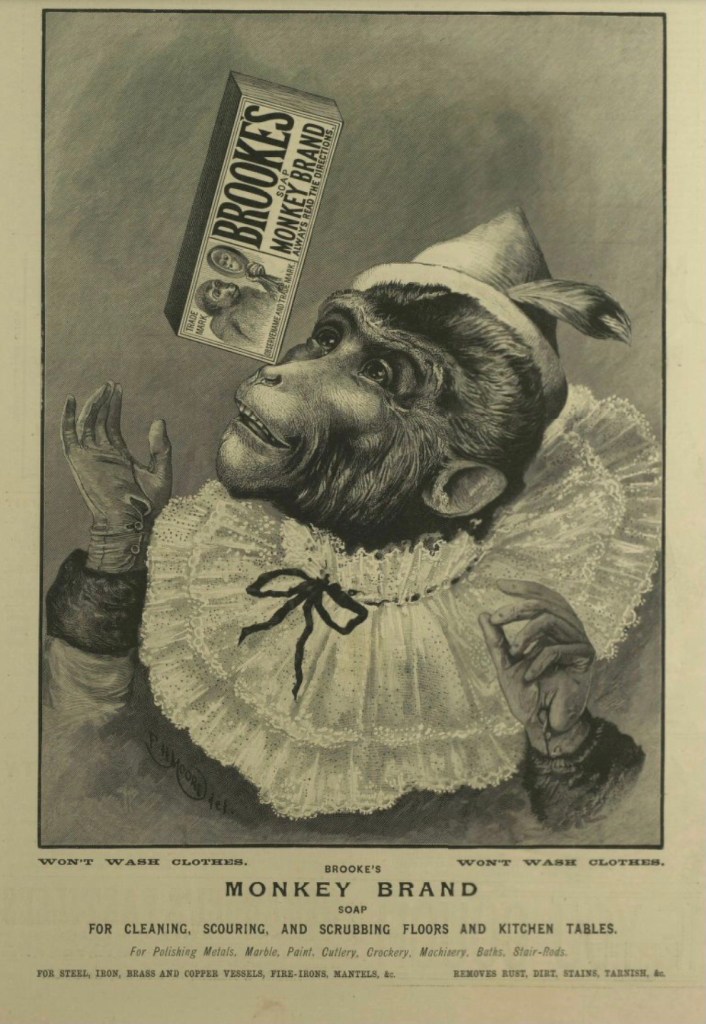
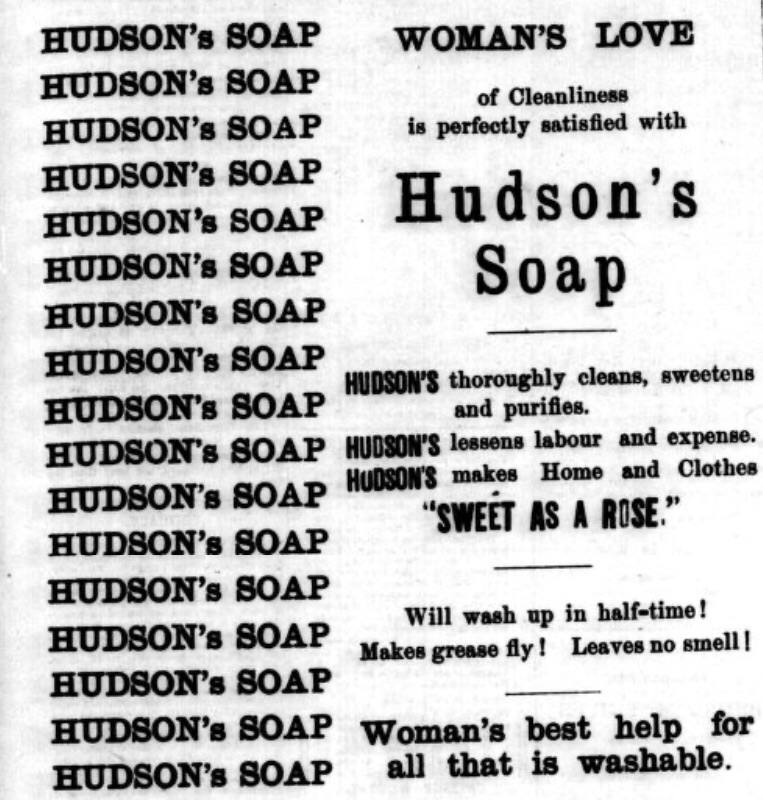
In Victorian times, antiquarians, Brontë aficionados, and newspaper journalists seeking headline-making copy, visited the Hall and were regaled with the tale of the ghost of William Batt and his bloody footprint. It is said for decades after his death it was impossible to remove the stain, until a concoction of Hudson’s Soap or Brooke’s Monkey Brand did the trick.

Or did it? For even in the late 19th century the housekeeper was telling visitors it could still be seen…though she wouldn’t show it to them saying it was hidden underneath the carpet! And 20th century reports continued to circulate attesting to its existence, explaining it appeared and disappeared. One wag in the 1880s did say the footprint had nothing to do with Captain Batt and was more likely to be as a result of soldiers entering the Hall in the aftermath of the Battle of Adwalton Moor. Most Haunted filmed there in 2015 and said evidence of ghostly activity was present.

The last man to own the Hall with the Batt surname was John Batt, son of the William Batt who died in 1673. John died childless in 1707. The Hall was divided and went to distant relatives. In 1747 the bulk of the estate, including the Hall, was sold to solicitor Benjamin Fearnley.

Keen on blood sports, he perhaps is best remembered for the gravestone and epitaph he prepared for his huntsman Amos Street, well before the man’s death on 3 August 1777. Amos was buried in Birstall churchyard and the inscription, with its sting in the tale for the reader, went:

This is to the memory of Old Amos,
Who was when alive for hunting famous,
But now his chases are all o’er,
And here he’s earth’s of years four score,
Upon this stone he’s often sat,
And tryed to read his epitaph,
And thou who does so at this moment,
Shall ere long somewhere ly dormant.6

Birstall St Peter’s Churchyard – Photo by Jane Roberts

Fearnley borrowed heavily to purchase Oakwell Hall, and when he died his family were forced to sell it in 1789. From then on it was owned by a series of absentee landlords who rented it out. This, plus the financial difficulties of the last Batt owners, meant no substantial changes were made to Oakwell Hall from the mid-17th century, which is why it is such a wonderfully preserved example of a manor house from that period.

And it is in this absentee landlord phase that the event occurred which triggered the reason why the building is internationally famous today.

In the 19th century a series of tenants ran boarding schools for boys and girls. In the 1841 census, Hannah Cockhill and her daughters ran a girls’ school from the Hall. The Nussey family and the Cockhills were related, and Charlotte Brontë visited the school with her great friend Ellen. It clearly made a huge impression on her. In 1849 her second novel ‘Shirley’ was published. The novel’s Fieldhead, ancestral home of the eponymous orphaned heiress Shirley Keeldar, was based on Oakwell Hall. Charlotte described it in detail in the novel. One passage read:

If Fieldhead had few other merits as a building, it might at least be termed picturesque. Its regular architecture, and gray and mossy colouring communicated by time, gave it a just claim to this epithet. The old latticed windows, the stone porch, the walls, the roof, the chimney-stacks, were rich in crayon touches and sepia lights and shades. The trees behind were fine, bold, and spreading; the cedar on the lawn in front was grand; and the granite urns on the garden wall, the fretted arch of the gateway, were, for an artist, as the very desire of the eye.7

And elsewhere:

This was neither a grand nor a comfortable house; within as without it was antique, rambling, and incommodious.8

Elizabeth Gaskell in The Life of Charlotte Brontë, said of the Hall:

It stands in a rough-looking pasture-field, about a quarter of a mile from the high road. It is but that distance from the busy whirr of the steam-engines employed in the woollen mills of Birstall; and if you walk to it from Birstall Station about meal-time, you encounter strings of mill-hands, blue with woollen dye and cranching in hungry haste over the cinder-paths bordering the high road. Turning off from this to the right, you ascend through an old pasture-field, and enter a short by-road, called the “Bloody Lane” ….From the “Bloody Lane,” overshadowed by trees, you come into the rough-looking field in which Oakwell Hall is situated. It is known in the neighbourhood to be the place described as “Field Head,” Shirley’s residence. The enclosure in front, half court, half garden; the panelled hall, with the gallery opening into the bed-chambers running round; the barbarous peach-coloured drawing-room; the bright look-out through the garden-door upon the grassy lawns and terraces behind, where the soft-hued pigeons still love to coo and strut in the sun, — are all described in “Shirley.”9

Oakwell Hall, with the original Warrens (or Bloody) Lane to the left as you look. The lane was re-routed with the building of a railway line, in 1900. It was also re-named Warren Lane – Photo by Jane Roberts

The appearance of Oakwell Hall in a Brontë novel has subsequently acted as a magnet for Brontë aficionados worldwide.

Skip forward to the mid-1920’s for my final tale in my quick canter through the history of Oakwell Hall. Owned at this stage by absentee landlords Ray and Fitzroy Estates, rumours abounded that at best the interiors were about to be stripped by antiques dealers; or at worst the entire hall was on the verge of being dismantled, bricks, wooden interior panels the lot, and sold to covetous Americans, who would transport to the United States to be rebuilt there.

This resulted in a huge outcry and the launch of a public appeal to raise the money necessary to purchase Oakwell Hall to ensure it was saved for the nation. By September 1927, donations – much contributed from admirers of the Brontë sisters – amounted to around £800.10 But this well short of the £3,000 required to purchase it, even given the owners’ intimation that they would contribute £500 to the public subscription fund if the Hall was bought.

But £3,000 was the tip of the financial iceberg. Additional money would be required to put the building into a good state of repair, and then maintain it going forward. The campaign organisers were beginning to despair the money would be raised, especially given the difficult economic conditions.

But in September 1927, two Harrogate resident philanthropists, both leading figures in the wool trade, came to the rescue. Batley-born Sir Henry Norman Rae (better known as Sir Norman Rae), who was a former pupil at Batley Grammar School, and at one time Liberal MP for Shipley, joined forces with his friend, Halifax-born John Earl Sharman. They would be prepared to buy the Hall and save this important historical building with its famous literary links for the nation. Over the next few months a deal was thrashed out.

The deal saving the Hall from American relic seekers was announced on 3 January 1928, with the contract to be signed the following day. In an offer estimated to be worth between £4,000 to £5,000, Sir Norman Rae and John Sharman would purchase the Hall, put it into a proper state of repair, lay out the grounds, and provide suitable period furnishings for the interior, then hand it over to Birstall Urban District Council. In return, Birstall Urban District Council would act as custodians for the Hall which was to be maintained as a typical Yorkshire Manor House with domestic furniture illustrative of the 17th, 18th and 19th centuries; allow reasonable public access; and see that the buildings and grounds were kept in good order going forward. The donations received to save the Hall was diverted to form part of the ongoing maintenance fund.

Some of the more unusual conditions attached to the deal included the forbidding of the sale or consumption of alcohol on the premises. Neither was private occupation of the Hall to be allowed, except by a caretaker. And, very wisely, the terms included a clause which stated the property could not be sold or mortgaged without permission from the Court.

But before 1928 ended, John Sharman and Sir Norman Rae would both be dead, in a matter of weeks of each other. In a strange coincidence, both had embarked on new romantic relationships.

On 8 November, at Marylebone Register Office, John Sharman married for a second time. His new bride was Miss Ada Burrows. Less than three weeks later, on 26 November 1928, he died honeymooning in Bournemouth.

Although not in the best of health and suffering from angina, Sir Norman Rae died suddenly on 31 December 1928. His death occurred whilst having tea at Westfield House (many older residents of Batley will remember it as the PDSA building on Healey Lane), the Batley home of his fiancée Elsie Taylor. The couple had only recently become engaged, his first wife having died in 1927. Elsie Taylor was a Batley Councillor, and the daughter of Joshua Taylor, one of the founding brothers of the renowned Batley textile firm of J., T., and J. Taylor. In 1932 she went on to become Batley’s first female Mayor.

Batley Council subsequently took over the running of Oakwell Hall. Now it is under the stewardship of Kirklees Council, who have the responsibility for preserving this unique piece of Yorkshire history for future generations.

I’ll conclude with the reason Sir Norman Rae put forward for stepping in to save the Hall. He asserted that the West Riding had not many such assets, and unless those that remained were cared for, the time would soon come when there was little or nothing worth preserving. Oh, that Kirklees Council, today’s custodians of many local Listed buildings, would take heed in respect not only Oakwell Hall but also their other Listed buildings in and around the Batley and Birstall area.


Postscript:
I want to say a big thank you for the donations already received to keep this website going. They really do help.

The website has always been free to use, and I want to continue this policy in the future. However, it does cost me money to operate – from undertaking the research to website hosting costs. In the current difficult economic climate I do have to regularly consider if I can afford to continue running it as a free resource. 

If you have enjoyed reading the various pieces, and would like to make a donation towards keeping the website up and running in its current open access format, it would be very much appreciated. 

Please click 👉🏻here👈🏻 to be taken to the PayPal donation link. By making a donation you will be helping to keep the website online and freely available for all. 

Thank you.


Footnotes:
1. Some sources say Heckmondwike and Gomersal Manors.
2. I have based the Batt family tree on a number of sources including parish registers, probate records and Clay, J. W., Dugdale’s Visitation of Yorkshire, With Additions, Exeter: William Pollard & Co., 1893.
3. Gaskell, Elizabeth Cleghorn. The life of charlotte bronte:: … by E. C. Gaskell. Appleton, 1857. 
4. Heywood, Oliver, and J. Horsfall Turner. The Rev. Oliver Heywood, B.A., 1630-1702, His AUTOBIOGRAPHY, Diaries, Anecdote and Event Books: Illustrating the General and Family History of Yorkshire and Lancashire. 2. Vol. 2. Brighouse England: A.B. Bayes, 1882.
5. Heywood, Oliver, Thomas Dickenson, and J. Horsfall Turner. The Nonconformist REGISTER, Of Baptisms, Marriages, and Deaths: 1644-1702, 1702-1752, Generally Known as the Northowram Or Coley Register, but Comprehending Numerous Notices of Puritans And Anti-Puritans in Yorkshire, Lancashire, Cheshire, London, &c., with Lists OF Popish RECUSANTS, QUAKERS, & C. Brighouse: J.S. Jowett, printer ‘News Office’, 1881.
5. Batley Reporter and Guardian, 08 July 1876.
7. Brontë, Charlotte. Shirley (Penguin Classics). Penguin, 2011. 
8. Ibid.
9. Gaskell, Elizabeth Cleghorn. The life of charlotte bronte:: … by E. C. Gaskell. Appleton, 1857. 
10. Amounts vary from £600 to £1,000 depending on source. £800 is the figure quoted The Batley News, 5 January 1929, when Sir Norman Rae died. However the same paper on 7 January 1928 said the fund stood at £704 0s 4d. when the Hall was saved on 3 January 1928


Other Sources:
I have used a raft of sources in compiling this blog post. Some of the information in these multiple sources is conflicting, with hard evidence lost in the mists of time. I’ve tried to make sense of the information and weave it into a coherent narrative, but in doing so I have had to rely heavily on the validity of the stories told about the dastardly deeds of the Batts. In addition to the sources in the Footnotes, I have listed the some of the others used below. 

• Batley Reporter and Guardian, 01 May 1890, 10 October 1890, 30 July 1897, 21 February 1902, 21 June 1907 
• Censuses, Various.
• Clay, John William. Yorkshire Royalist Composition Papers of the Proceedings of the Committee for the Compounding With Delinquents During the Commonwealth Volume II. Yorkshire Archaeological Society, 1895
Country Life, 18 January 1990
• English Heritage Battlefield Report: Adwalton Moor 1643 https://historicengland.org.uk/content/docs/listing/battlefields/adwalton-moor/
Haigh, Malcolm H. The History of Batley 1800-1974, 1978.
•  Haigh, Malcolm. Batley Pride: More town tales. Batley: Malcolm H. Haigh, 2005. 
•  Halifax Evening Courier, 27 November 1928.
•  Huddersfield Daily Examiner, 4 January 1928.
• Kirklees Council. “Oakwell Hall.” Oakwell Hall | Kirklees Council. Accessed August 11, 2024. https://www.kirklees.gov.uk/beta/museums-and-galleries/oakwell-hall.aspx
•  Leeds Mercury, 28 September 1927, 15 October 1927, 04 January 1928.
•  Oakwell’s Colourful Past Revealed https://www.bbc.co.uk/bradford/content/articles/2009/04/06/oakwell_hall_2009_feature.shtml
• Parish Registers, Various.
•  Peel, Frank. Spen valley: Its past and present. Heckmondwike West Yorkshire: Senior and Co, 1893. 
•  Scatcherd, Norrison, The history of Morley, in the West Riding of Yorkshire; including a particular account of its old chapel. Morley: 1874.
The Brighouse News, 27 July 1895
The Battlefields Trust https://www.battlefieldstrust.com/resource-centre/civil-war/battleview.asp?BattleFieldId=4.
Yorkshire Post, 04 January 1928, 9 November 1928.

Fantastical Legends, Fables and Mythology from the Batley and Dewsbury Areas: Featuring the Countess of Sussex and the Killer Lion

As the nights draw in, and Halloween approaches, there are some intriguing folklore tales – indeed some very reminiscent of traditional childhood fairy tales – from the Batley and Dewsbury areas. Some are well-known; others less so. Here are a selection.


A well-known local legend is that of the ghost of Captain Batt at Oakwell Hall. No lesser person than Elizabeth Gaskell wrote about it in The Life of Charlotte Brontë.

She said of the Hall:

It stands in a rough-looking pasture-field, about a quarter of a mile from the high road. It is but that distance from the busy whirr of the steam-engines employed in the woollen mills of Birstall; and if you walk to it from Birstall Station about meal-time, you encounter strings of mill-hands, blue with woollen dye and cranching in hungry haste over the cinder-paths bordering the high road. Turning off from this to the right, you ascend through an old pasture-field, and enter a short by-road, called the “Bloody Lane” – a walk haunted by the ghost of a certain Captain Batt, the reprobate proprietor of an old hall close by, in the days of the Stuarts. From the “Bloody Lane,” overshadowed by trees, you come into the rough-looking field in which Oakwell Hall is situated. It is known in the neighbourhood to be the place described as “Field Head,” Shirley’s residence. The enclosure in front, half court, half garden; the panelled hall, with the gallery opening into the bed-chambers running round; the barbarous peach-coloured drawing-room; the bright look-out through the garden-door upon the grassy lawns and terraces behind, where the soft-hued pigeons still love to coo and strut in the sun, — are all described in “Shirley.”

Gaskell’s book goes on to describe the appearance of a bloody footprint in a bedchamber of Oakwell Hall. She reveals the story behind it, and its connection with the lane by which the Hall is approached.

Captain Batt was believed to be far away; his family was at Oakwell; when in the dusk, one winter evening, he came stalking along the lane, and through the hall, and up the stairs, into his own room, where he vanished. He had been killed in a duel in London that very same afternoon of December 9th, 1684.1

Oakwell Hall, with the original Warrens (or Bloody) Lane to the left as you look. The lane was re-routed with the building of a railway line, in 1900. It was also re-named Warren Lane – Photo by Jane Roberts

William Batt’s burial is recorded in the parish register of Birstall St Peter’s on 30 December 1684.2

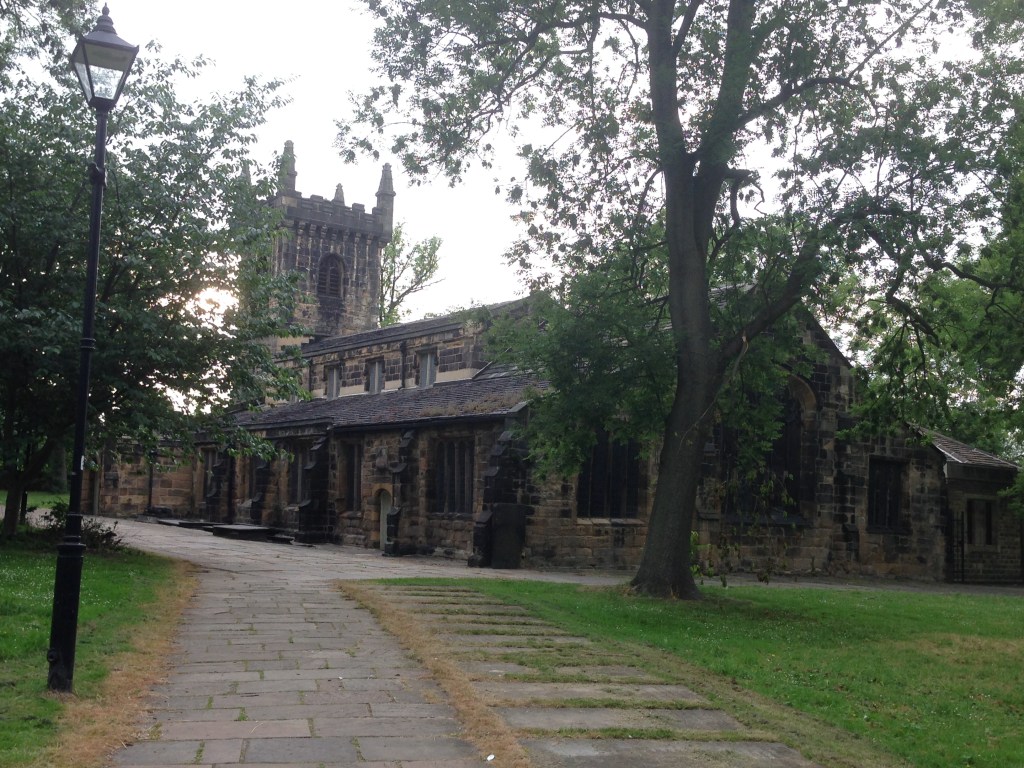
Birstall St Peter’s Churchyard – Photo by Jane Roberts

A local roving non-conformist minister and gossipy diarist, the Rev. Oliver Heywood, gives more snippets of information about William Batt’s death. In his vellum book, which contained a register of various baptism, marriage and burial events, he noted in the burials section:

398 Mr Bat: in sport. 16843

Another publication of the Rev. Heywood’s varied documents has a further notation of the burial containing more details. No year is indicated but the entry is clearly referring to the death of William Batt:

Mr. Bat of Okewell a young man slain by Mr. Gream at Barne(t) near London buried at Burstall Dec. 304

Other sources indicate the duel was the result of a debt, possibly related to gambling.

And, although William Batt’s ghost has associations with ‘Bloody Lane,’ this footpath does not owe its name to him. ‘Bloody Lane,’ or Warrens Lane (now Warren Lane) to give it its proper name, earned its gruesome nickname as a result of the English Civil War Battle of Adwalton Moor of 30 June 1643. This was the likely route the defeated, fleeing Parliamentarian troops took to leave the battlefield.

Who knows whether the tale of William Batt’s spirit returning home is true? But it is as tale which has been passed down through the generations, and it is one still told today to Oakwell Hall visitors.


The 1662 publication Mirabilis Annus Secondus; or, the Second Year of Prodigies describes signs and apparitions seen in the Heavens (sky), Earth (land) and Waters in the months from April 1661 to June 1662. The section dealing with strange land-based sensations includes the following phenomenon from Batley from May 1662:

…at a Town called Batley in Yorkshire, about four miles from Wakefield, in the Ground of one Michael Dawson, about the Carr belonging to that Town, a man climbing up into an Oak-tree to cut boughs, perceived his clothes to be very much stained with Blood; and upon search, he found the under-side of the Oak-leaves to be all bloody, not only in that Tree, but in another also not far from it. Several of the Leaves of the said Trees were afterwards sent abroad to divers persons in the Country, who had a desire to see them, and the Blood was dried upon them, and they seemed as if they had been coloured and dyed therewith. This is a very certain truth, and attested by many eye-witnesses.5

The blood-like substance was possibly to be the result of a disease to the tree. But it caused a sensation back in 1662.


The next peculiar mythology centres around Batley Parish Church. It is described as follows:

On the eastern end of the outside of Batley Church, under the shade of the great eastern window, there is a not common tombstone; insomuch as on its centre there is a small brass plate, in size about eight inches by six, which once had upon it an inscription but can now only boast of a few unintelligible letters. The centre of this brass plate is worn hollow by a strange process. A tradition is current that any one who will put his hands upon this plate, and at the same time look up at the great coloured window – dedicated people say to the memory of a drunken woman – for five minutes he will not be able to take his hands off again. The appearance of the plate testifies to the popularity as well as the untruthfulness of this popular fit.6

Batley Parish Church – Photo by Jane Roberts

Unfortunately these old tombstones were cleared from the churchyard, and it is therefore no longer possible to identify the one attracting the attention of adventurous 19th century Batley townsfolk. I wonder if anyone knows who it belonged to?


Mystical stories would not be complete without a haunted house. And, according to turn of the twentieth century accounts, one existed at Dewsbury. Located on Wakefield Road, some of the building dated to the time of Cromwell. It was part of the estate of a Manor House, the gardens and grounds of which stretched towards the Old Bank. It was an area thick with vegetation, with beauty spots in the Hollin[g]royd and Caulms Woods areas. A subterranean passage connected the two houses. Sections of this tunnel were in existence as late as the latter part of the nineteenth century.

The Haunted House, Thornhill

According to legend, after the death of one particularly wicked (and unnamed) Lord of the Manor, he was unable to rest in peace. His midnight rambles terrified the local inhabitants, who were driven in fear to consult a local priest. This brave priest managed to communicate with the Lord’s troubled and troublesome spirit. The spirit agreed to retire and never return while Hollin[g]royd Wood grew green.7 I wonder if he is back now the wood is no more?

Ordnance Survey Map showing Hollin[g]royd Wood and Wakefield Road – Six-inch England and Wales, 1842-1952, Yorkshire Sheet 247, Surveyed: 1850 to 1851, Published: 1855 – National Library of Scotland, under the Creative Commons Attribution-NonCommercial-ShareAlike 4.0 International (CC-BY-NC-SA) licence

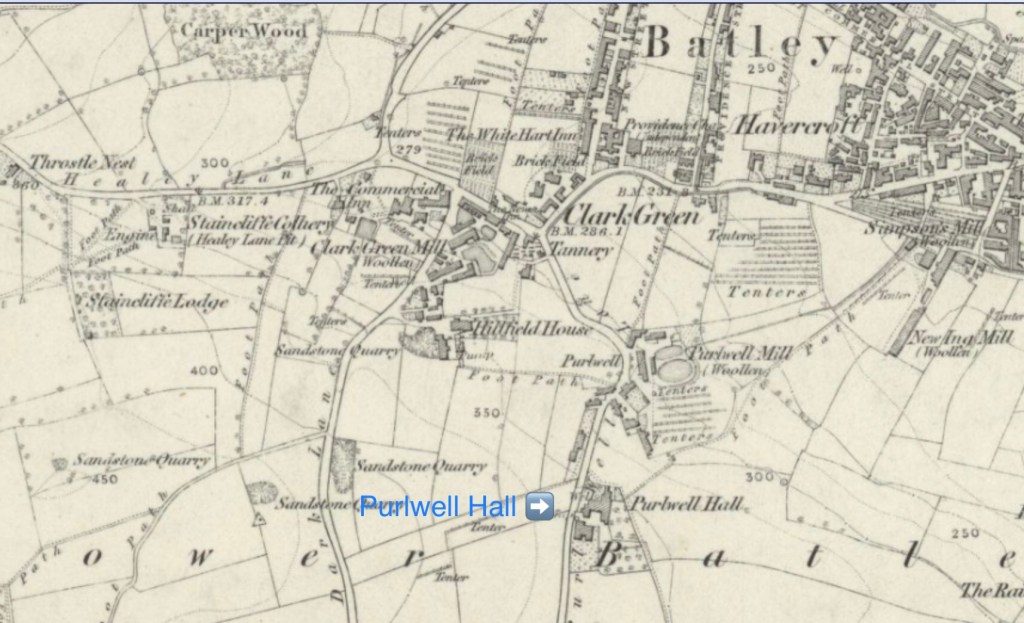
Purlwell Hall, which stood in the Mount Pleasant area of Batley, was also the subject of a romantic legend. The events, which are vaguely referred to as taking part in the mid-eighteenth century, centred around a young lady. Some versions say she was an orphan noted for her beauty, goodness and intellect, who lived with her aunt and uncle at the Hall.8 Others say she was the fairest and sweetest of three daughters of the household.9

Purlwell Hall in Olden Times

Two men vied for her hand in marriage. One was honest but poor. The other a rich, handsome Captain. Unsurprisingly for those who follow fairy tales, the young lady fell in love with the poor suitor. But, as happens in these stories, her family rejected her choice. As a result they kept her locked away in the library – a small, square room in the hall. Here she was to stay until she changed her mind. But her love for the poor, honest man did not waver. He was ever in her thoughts as she gazed longingly out of the window, towards the hills to the south, clearly visible in the smokeless sky – this was obviously before Batley became famous as a mill town, full of chimneys belching out smoke!

Ordnance Survey Map showing Purlwell Hall – Six-inch England and Wales, 1842-1952, Yorkshire Sheet 232, Surveyed: 1847 to 1851, Published: 1854 – National Library of Scotland, under the Creative Commons Attribution-NonCommercial-ShareAlike 4.0 International (CC-BY-NC-SA) licence

The heart-broken girl whiled away the time in her prison etching a verse in the pane of one of the windows, with the diamond from a ring. Some say the ring belonged to her mother. Other more romantic accounts say it was from a ring given to her by her forbidden love. If so, he was not quite as poor as the tale makes out.

There are a number versions of this verse, one of which read:

Come, gentle Muse, wont to divert
Corroding cares from anxious heart;
Adjust me now to bear the smart
Of a relenting angry heart.
What though no being I have on earth,
Though near the place that gave me birth,
And kindred less regard to pay
Than thy acquaintance of to-day;
Know what the best of men declare,
That they on earth but strangers are,
No matter it a few years hence
How fortunate did to thee dispense,
If – in a palace though hast dwelt
Or – in a cell of penury felt –
Ruled as a Prince – served as a slave,
Six feet of earth is all thou’lt have.
Hence give my thoughts a nobler theme
Since all the world is but a dream
Of short endurance.10

Although there are no clues as to the period of time this lovesick damsel was incarcerated, given the length of the verse she etched it was clearly not a mere matter of days.

But, as in all good fairy tales, there was a happy ending. The captain tired of his hopeless pursuit of a fair lady who would never love him. Her parents (or adopted parents depending on the version), realising how much in love she was with the humble and honest suitor, relented; and Miss Taylor (as one version calls her) finally became the wife of her true love.

Is this based on true events? Who knows. However, what does seem beyond doubt, is the engraving on the window pane. This is as testified to by independent witnesses in the latter part of the 19th century when the Hall underwent renovations.


The next legend concerns Dewsbury Minster’s famous Christmas Eve Devil’s Knell. The tenor bell rings out in funereal manner once for every year since the birth of Christ to the present year, with the last toll falling on the stroke of midnight. The tolling is said to keep the parish safe from devilish pranks for the coming year.

Dewsbury Minster Church of All Saints – Photo by Jane Roberts

There are various dates given for the commencement of this custom. Some say the 13th century, others the 14th or 16th. It appears, if these earlier dates were the case, the custom did lapse, for the ringing is recorded as definitely taking place from 1828.

One folk-lore journal, published in 1888, mentions this Christmas Eve bell-ringing at Dewsbury.11 It outlines the custom to toll the bells that night, stating this was an acknowledgment that the devil died when Jesus was born.

Elsewhere in the journal a curious tradition from Soothill is mentioned. It says that an unnamed master of an iron-foundry, in a fit of passion, threw a boy into one of his furnaces. The sentence passed on him was that he should build a yard all round an unspecified local church, and provide a bell for the steeple. The writer, who asks for more information about this incident, does not connect it, or bell, with Dewsbury Minster’s Devil’s Knell. Perhaps the omission is deliberate, in an attempt to tease out the truth. Because questions were being raised by some of the origins attributed to the Christmas Eve bell ringing.

These other stories linked with the origins of Dewsbury’s Devil’s Knell stated the tenor bell at Dewsbury Minster, Black Tom, was an expiatory gift from Sir Thomas de Soothill for the murder of a boy, whom he threw into the forge dam. Thomas de Soothill, who died in 1535, was a member of the Saville family and known locally as Black Tom, hence the name of the bell.12 There is therefore a clear similarity with the Soothill iron-foundry incident mentioned in the 1888 journal.

Christmas 1986 Folklore Stamp

Yet another version states the tradition began in 1434. A local knight, or Lord of the Manor depending on this version, flew into a rage after hearing a servant boy had failed to attend Church and threw him into a pond, where he drowned. As his deathbed penance, the knight donated the bell to Dewsbury Minster Church of All Saints, requesting it be tolled every Christmas Eve.13

An 1880 edition of the Dewsbury Reporter cast doubt on the Black Tom origins story.14 Essentially, they say there were no mention of any bells currently in the church, which were recast in 1875, existing in the Minster prior to 1725. They also asked for evidence of this murder incident, along with the timeline for Thomas de Soothill’s life, and the location of the supposed forge.

Whatever its beginnings, the Christmas Eve Devil’s Knell is tolled to this day. Here’s a link to a video by the bell-ringers at the Minster tolling the Christmas Eve Devil’s Knell, with their version of its origins


The final fantastical tale also involves a branch of the Savile family. This time the ones whose residences included Howley Hall. It is supposedly (though not conclusively) centred around Anne Villiers, daughter of the Earl of Anglesey, or Anne Sussex as she was subsequently known. She became the second wife of Sir Thomas Savile (1590-1659), whose titles, at this stage, included Viscount of Castlebar and Baron Savile of Pomfret. Anne and Thomas married at St Mary’s, Sunbury on Thames on 20 January 1641[2].15 He was made the 1st Earl of Sussex (in the third creation of this title) on 25 May 1644.

Howley Hall, as it was in its heyday, and the 19th century ruins

Lady Anne’s Well, which is reputedly named after the aforementioned Countess of Sussex, lay on the south-east side of Howley ruins, near to Soothill Wood where several springs flowed to furnish the well.

Ordnance Survey Map showing Howley Hall and Lady Ann[e]’s Well – Six-inch England and Wales, 1842-1952, Yorkshire Sheet 232, Surveyed: 1847 to 1851, Published: 1854 – National Library of Scotland, under the Creative Commons Attribution-NonCommercial-ShareAlike 4.0 International (CC-BY-NC-SA) licence

Lady Anne, so rumour has it, liked to bathe in the waters of the well. The legend is that one day, whilst in the process of immersing herself in these cleansing waters, she was caught and devoured by a wild animal or animals – some go as far as to say it was a lion.16

The spot where her mangled remains were discovered became holy ground. The pure waters of the well were subsequently said to possess supernatural properties, and changed colours, with this miracle occurring annually at 6 o’clock on Palm Sunday morning. Hundreds of people converged on this site at the specified day and hour, brandishing twigs and switches to represent palms. By the mid-19th century the well bore an obliterated inscription, and had an iron basin, or ladle, attached to the stonework with a chain.

Even Elizabeth Gaskell in The Life of Charlotte Brontë covered the legend, but in her version it was another type of wild creature responsible for the killing. In her book, published in 1857, writing about Howley Hall, which now belonged to Lord Cardigan, she said:

Near to it is Lady Anne’s well; “Lady Anne,” according to tradition, having been worried and eaten by wolves as she sat at the well, to which the indigo-dyed factory people from Birstall and Batley woollen mills yet repair on Palm Sunday, when the waters possess remarkable medicinal efficacy; and it is still believed that they assume a strange variety of colours at six o’clock in the morning on that day.17

The supposed incident was even the subject of verses in later years, including:

‘Twas such a place, sequestered glade,
Where Lady Anne was lifeless laid;
While bathing there, as people say,
A lion seized her for his prey:
Her cor[p]se was made the wild beast’s food,
He ate her flesh, and drank her blood;
And now the spot is holy ground,
Where Lady Anne’s remains were found,
Hard by a well which bears her name,
A lasting tribute to her fame;
There youths and maidens often go
Their sympathetic love to show,
And mourn her fate, unhappy maid,
Who perished in the Sylvan shade.
Palm Sunday is the annual day
When lads and lasses wend their way
To this sad spot, there gather palms,
As employs of the fair one’s charms;
Homeward again they do return,
And water take in can or urn,
Which they suppose contains a charm
That will preserve them from all harm.18

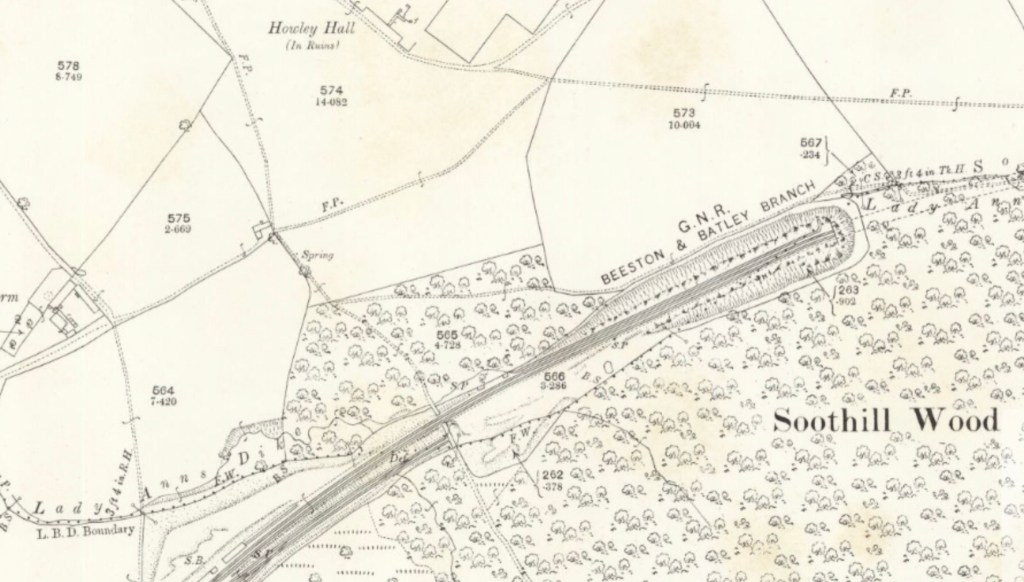
In the late 1880s the area around the well was destroyed when the wood was bisected by the Great Northern Railway Line covering Dewsbury, Batley and onto Leeds via Beeston. This Beeston and Batley branch of the line opened in August 1890, and included a 732-yard long tunnel located near to the well, though the spring still existed for the use of residents living in nearby cottages. Yet the legend lived on.

Ordnance Survey Map showing Howley Hall Ruins and the Beeston/Batley Branch of the Great Northern Railway now running through Soothill Wood destroying Lady Anne’s Well – 25-inch England and Wales, 1841-1952, Yorkshire CCXXXII.12, Surveyed: 1889 to 1892, Published: 1894 – National Library of Scotland, under the Creative Commons Attribution-NonCommercial-ShareAlike 4.0 International (CC-BY-NC-SA) licence

If true, you would expect this extraordinary event to be widely publicised, especially given it involved a member of the aristocracy. It is not. And, as with many other of these tales, it is decidedly vague with facts.

More than that, there are other fatal flaws to this lion-eating (or should that be a pack of wolves) tale. Not least is the one concerning the reputed victim of these voracious beasts. According to Cockayne’s Complete Peerage, Anne Villiers outlived her husband, Sir Thomas Savile. He died in circa 1659 (his will was proved on 8 October 1659). By the time Anne died in around 1670, she was the wife of Richard Pelson. Their daughter, Anne, went on to become the wife of James Tuchet, 5th Earl of Castlehaven. Furthermore, according to Cockayne, the former Anne Villiers died at St Giles’ in the Fields, London – some 200 miles away from any wild animals at the well.19 He certainly makes no reference to her being killed in a tragic accident involving wild animals.

There is also the issue around the type of creature responsible for the supposed mauling. Although there were reports of wolves living wild in Scotland up until the 18th century, it is generally accepted that wolves were extinct in England by the 15th century. As for wild lions, well the wealthy were known to keep them as part of menageries, including at nearby Nostell Priory. But as for an escaped killer lion prowling Soothill Woods in the 17th century, that seems the stuff of fantasy.

However, suppose it is not the 1st Earl of Sussex’s wife being referred to? The reports I’ve read either refer to Lady Anne or Lady Anne Sussex. Could it possibly therefore be the subsequent Countess of Sussex? James Savile, the son of Thomas Savile by Anne Villiers (the 1st Countess Sussex), who succeeded his father to the earldom, married Anne Wake. According to Cockayne’s Complete Peerage, after his death in 1671, when the earldom became extinct, she went on to marry Fairfax Overton. Looking at Marriage Bonds and Allegations, this marriage took place in around April 1674.20 According to Cockayne she died in 1680 – and again there is no mention of a dramatic death associated with her. There is also the same issue with the existence of wild animals.

There are other theories too about the well’s miraculous powers. These include rumours that the waters of the well had reputed holy properties even before this supposed incident, with inhabitants of the area visiting it from possibly as far back as pre-Norman times. Some sources point out that it was quite common for wells of pure water in solitary locations throughout the country in the early years of Christianity to be attributed with these holy and healing properties. As a result they became places of pilgrimage, visited and decorated on Holy Days like Ascension Day or, in this instance, Palm Sunday.

Due to the holy nature of the area, it is theorised that in the immediate neighbourhood a small chapel (Fieldkirk) existed in pre-Norman times, before the church in Batley was erected. There is even speculation about an annual Fair, Fieldkirk Fair, taking place either in the churchyard of this small chapel, or adjoining it. Norrison Scatcherd in his 1870s history of Morley mentions villagers returning from the annual Palm Sunday assemblage as saying they had been to Fieldcock Fair – which he quite reasonably suggests is a corruption of this old Fieldkirk Fair.21

This early Christian link, then, may have been the origins of the miraculous colour-changing well, not any killer animals devouring a bathing countess – the latter probably being invented to add spice to attract the Victorian generation. Nevertheless it is an interesting local legend.


As I said in the introduction, this is only a selection of folklore tales and mysterious happenings associated with the area. Many have a common thread: unspecified, or uncertain, dates; discrepancies about the names of central characters, most of whom are local gentry or aristocracy; there is even confused information, for example lions or wolves, orphan or daughter, iron foundry master or knight, ponds or forge furnaces.

But all these tales are part of the area’s history and would have been familiar to our ancestors living here, which is why they are worth preserving.

If you have any similar strange local anecdotes and legends associated with the Batley and Dewsbury areas do let me know.


With thanks to fellow AGRA Associate Joe Saunders who tipped me off about the mystery of the bloody oak leaves tale.


Postscript:
Finally a big thank you for the donations already received to keep this website going. 

The website has always been free to use, but it does cost me money to operate. In the current difficult economic climate I am considering if I can continue to afford to keep running it as a free resource, especially as I have to balance the research time against work commitments. 

If you have enjoyed reading the various pieces, and would like to make a donation towards keeping the website up and running in its current open access format, it would be very much appreciated. 

Please click here to be taken to the PayPal donation link. By making a donation you will be helping to keep the website online and freely available for all. 

Thank you.


Footnotes:
1. Gaskell, Elizabeth Cleghorn. The Life of CHARLOTTE Bronte, Author Of “Jane Eyre”, “Shirley”, “Villette”, Etc. Smith, Elder & Co, 1857;
2. Birstall St Peter’s parish Register, West Yorkshire Archive Service, Reference: WDP5/1/1/1;
3. Heywood, Oliver, and J. Horsfall Turner. The Rev. Oliver Heywood, B.A., 1630-1702, His AUTOBIOGRAPHY, Diaries, Anecdote and Event Books: Illustrating the General and Family History of Yorkshire and Lancashire. 2. Vol. 2. Brighouse England: A.B. Bayes, 1882;
4. Heywood, Oliver, Thomas Dickenson, and J. Horsfall Turner. The Nonconformist REGISTER, Of Baptisms, Marriages, and Deaths: 1644-1702, 1702-1752, Generally Known as the Northowram Or Coley Register, but Comprehending Numerous Notices of Puritans And Anti-Puritans in Yorkshire, Lancashire, Cheshire, London, &c., with Lists OF Popish RECUSANTS, QUAKERS, & C. Brighouse: J.S. Jowett, printer ‘News Office’, 1881;
5. Mirabilis Annus SECUNDUS, Or, the Second Year of Prodigies: Being a True and Impartial Collection of Many Strange Signes AND Apparitions, Which Have This Last Year Been Seen in the Heavens, and in the Earth, and in the Waters: Together with Many Remarkable Accidents and Judgements BEFALLING Divers Persons, According to the Most Exact Information That Could Be Procured from the Best Hands, and Now Published as a Warning to All MEN Speedily to Repent, and to Prepare to Meet the Lord, Who Gives Us These Signs of His Coming, 1662;
6.Yorkshire Folk-Lore Journal: With Notes Comical and Dialetic .. Bingley: Printed for the editor by T. Harrison, 1888;
7. Batley News, 24 May 1902;
8. Yorkshire Folk-Lore Journal: With Notes Comical and Dialetic .. Bingley: Printed for the editor by T. Harrison, 1888;
9. Batley Reporter and Guardian, 29 March 1901;
10. Ibid;
11. Yorkshire Folk-Lore Journal: With Notes Comical and Dialetic .. Bingley: Printed for the editor by T. Harrison, 1888;
12. Greenwood’s History, as quoted in the Dewsbury Reporter, 31 January 1880;
13. Yorkshire Post, 23 December 2015;
14. Dewsbury Reporter, 31 January 1880;
15. Parish Register, St Mary’s, Sunbury on Thames, London Metropolitan Archives, Ref: DRO/007/A/01/001;
16. Batley Reporter and Guardian, 3 July 1880;
17. Gaskell, Elizabeth Cleghorn. The Life of CHARLOTTE Bronte, Author Of “Jane Eyre”, “Shirley”, “Villette”, Etc. Smith, Elder & Co, 1857;
18. Dewsbury Chronicle and West Riding Advertiser, 9 July 1887
19. Cokayne, George E., ed. The Complete Peerage of England, Scotland, Ireland, Great Britain and the United Kingdom: EXTANT, Extinct or Dormant. By G.E.C. 7. Vol. 7. London: George Bell & Sons, 1896;
20. Fairfax Overton and Ann Conntesse Marriage Allegation, Parish – St Giles in the Field, London Metropolitan Archives, Ref: Ms 10091/28
21. Scatcherd, Norrison Cavendish. The History OF MORLEY, in the West Riding Of Yorkshire: Including a Particular Account of Its Old Chapel. Morley: S. Stead, 1874.

Other Sources:
• Baker, Margaret. Discovering Christmas Customs and Folklore: A Guide to Seasonal Rites. Princes Risborough, Bucks, UK: Shire Publications, 1992;
The Batley News and Birstall Guardian, 22 August 1885;
Batley Reporter and Guardian, 2 August 1890;
Dewsbury Chronicle and West Riding Advertiser, 10 July 1886;
• Green, Martin, and Martin Green. Curious Customs And Festivals: A Guide to Local Customs and Festivals throughout England and Wales. Newbury: Countryside Books, 2001;
The History of Wolves in the UK, https://wolves.live/the-history-of-wolves-in-the-uk/;

The Britannia Mills Tragedy – ‘Lord Help Me!’

It was 6pm on the evening of Thursday 20 October 1892. It had been an unsettled, breezy day with the constant threat of rain. As darkness descended, the signal was given for work to cease at Britannia Mills. Looms gradually abated, day-shift weavers turned off their lights, and those women not working overtime tied their handkerchiefs round their heads in preparation to leave the building and venture out into the chill, autumnal night.

Extract of OS Six-inch map, Yorkshire CCXXXII.NE, Surveyed 1888-1892, Published 1894

The building on Geldard Road in Birstall, known locally as ‘Slopers’ Mill, was a five-storey structure. The lower two floors were occupied by Messrs. Charles Robinson and Company, Carlinghow woollen manufacturers. The upper storeys were tenanted by Leeds woollen manufacturers Messrs. Hartley Brothers. The top floor contained around 30 looms, with about two thirds operating that Thursday.

Britannia Mills photographed after the July 1905 fire – source unknown

The distance from the ground to the fifth floor was around 30-35 yards [1]. Whilst a long, winding staircase could be used, after a tough day’s work tired workers from the upper floors often preferred to use the mill hoist, commonly used to carry goods between floors. This hoist, located in the centre of the building, controlled a contraption which workers referred to as a cage. Essentially an open-sided box with a wooden roof and floor, it was supported by an iron rope, and worked by pulleys and gearing suspended from girders: in effect a primitive lift system.

For younger workers the journey in this cage no doubt was tremendous fun, adding a frisson of excitement at the end of their arduous workday.

It was set in motion by pulling one of the two guide ropes at the side. One of these ropes acted as a brake. There was no one person designated to operate the hoist. It was started and reversed by the person nearest the ropes, something which might have particularly appealed to teenage boys. Youngsters did not see any danger with it. In fact 15-year-old Hilda North, who had worked in the Hartley portion of the mill for around a week, told her father on the second day there she only got one foot on the hoist when it descended. And it was not unheard of for agile workers to jump into the cage as it passed the lower floors.

The hoist was so popular with the workers that around five weavers from the top floor regularly knocked off at 5.55pm in order to beat the rush, and avoid the inevitable overcrowding. Because overcrowding was commonplace. Reports state many as 20 workers crammed into it on occasions. They rushed to it at the end of their shift, like children racing to leave school. In fact many were only teenagers.

James Gray, the engineman at the mill for eight years and whose responsibilities included looking after the engine powering the mill machinery, had been unaware of any mechanical issues with the hoist in that time. However, it was not his responsibility to oversee and maintain it. And he couldn’t remember any official inspection or maintenance of it by an external official either. The only incident he recalled was around five or six years earlier, when too many people in it caused it to land with a bump.

As a result of that incident the maximum capacity was limited to eight, and pulling on the ropes whilst was in motion was prohibited. The penalty for contravening these instructions ranged from a severe 1s fine to instant dismissal – although it seems these punishments were never meted out. There was a warning note at the hoist entrance, a legacy of the earlier incident, put up by the previous mill owners.

Wording on the Hoist Warning Notice

Although prominent, it was perhaps too high for some even if they could read [2]. Neither were new starters routinely informed about the restrictions; nor did it appear to be discussed generally, not even by those aware that the regulations were regularly being breached.

John Howitt, a warp dresser working at Hartleys for a fortnight, only used the hoist if it did not exceed maximum capacity even if it meant waiting. But he admitted he never thought to warn younger workers ignoring the rules [3]. And 15-year-old Mary Alice Mann, a recently employed weaver at Hartleys stated “I saw other people go down in the hoist, and I went with them.[4] No thought did she give to numbers.

That Thursday evening was no different. Eager workers, keen to quickly return home, rushed and pushed to make their way towards the exit. A crowd on the top floor jostled and jockeyed for position in the cage, with cries of “Let us get in.” Perhaps some on the lower floors had stolen a march, already in the cage before it reached the upper storey, similar to the tricks we use today at busy lifts: that was one rumour circulating later. According to at least one report one lad, Edwin Day, jumped in as it made its descent. In all, it appears around 16 people were now crammed in. It may have even been as many as 18, for collating names from various newspaper reports the occupants included:

  • Fred Beevers, Carlinghow. Born in July 1875, the son of Andrew and Sarah Ann Beevers, in 1891 the family lived on Coal Pit Lane with Fred working as a cloth presser;
  • Elizabeth Birbeck, 38-year-old wife of Turner Birbeck. They lived at Lambsfield Place, Geldard Road, Birstall. She only started work that week as weaver at Hartleys. Other information shows she was born on 7 May 1853, the daughter of John and Hannah Gooder, and she married Turner on 25 October 1873 at St Peter’s Church in Birstall;
  • Edwin Blakey Day, age 14. He was a piecer and the son of postman Ernest Day of Union Street, Birstall [5]. He had worked six months for Robinsons, but was due to start work the following week at Carr Mill;
  • Edith Crossley [6], weaver, wife of James Crossley of Geldard Road. Other sources show she was born in Holmfirth on 8 February 1861, the daughter of Hugh and Mary Ramsden, and married James Booth Crossley on 23 July 1881 at St Saviour’s, Brownhill;
  • Jane Donnelly, Richmond Street, Batley. Looking at other sources it seems likely she was the Dublin-born wife of Richard Donnelly, maiden name Egan. Her age was 30 in the 1891 census and she worked as a woollen machine feeder;
  • Ann Frankland, wife of collier James Frankland, of Britannia Cottages, Geldard Road. Further investigation shows she was born on 18 March 1869 and was the sister of Elizabeth Birbeck. She married James on 1 February 1890 at Batley All Saints;
  • Gooder, sister of Mrs Birbeck. No Christian name is given in the reports, which only mention she is a girl. Although possible this may be the recently married Ann Frankland, it is equally possible this is another of the Gooder sisters. Weight is added to this because in some of the casualty lists both Ann Frankland and ‘a girl named Gooder’ appear. But there is nothing conclusive;
  • Hannah Mary Grayson, Birstall. Putting together other sources she is likely to be the daughter of Solomon and Mary Grayson (and its many surname variants) who was born on 26 November 1863. In the 1891 census she is living with her widowed mother at Cross Street in Birstall [7], and working as a wool cloth weaver. She married George Easby at St Peter’s, Birstall on 8 January 1897;
  • Walter Jones, age 13, piecer, son of tripe dresser Edward Jones and wife Sarah Ann of Low Lane, Birstall. He was born on 12 March 1879;
  • Joshua Kellett, age 15, piecer, son of John and Mary Kellett of White Lee Road, Batley;
  • Nellie Lee, Skelsey Row, Batley;
  • Mary Alice Mann, 15, daughter of Mark and Elizabeth Mann. She was born on 5 November 1876 and lived with her family at Geldard Road, Birstall. She had been employed as a weaver for one week in the Hartley-run portion of the mill;
  • Kate McGuire, a young woman living in Batley. Although unverified, this might have been the 23-year-old niece of Michael McGuire living at Parker Buildings, Whittaker Street in the 1891 census;
  • Henry Mitchell, the son of Annie Mitchell, of Geldard Road, Birstall. Not employed at the mill, he had been there to drop tea off for another worker. The newspaper reports put his age at 9 or 10. My research points he was likely to be 9-year-old Harry Mitchell born on 17 October 1883, the son of Annie and William Mitchell. In 1891 he was living at Geldard Road with his mother and his maternal grandmother Mary Ann Ramsden. He was the nephew of Edith Crossley;
  • Sarah Moon, age 53, weaver and wife of tobacco pipe maker Charles Moon. They lived at Boar Terrace, Geldard Road, Birstall. Sarah and widower Charles married at Tong St James on 9 May 1880 – it was her second marriage too. Sarah was born in Cleckheaton on 24 December 1839, the daughter of James and Sarah Haigh. She married her first husband William Firth in Halifax on 7 October 1860, but was widowed with two young sons, in early 1865. Sarah only started work at Hartley’s on the afternoon of 18 October, in place of Annie Williams who was ill;
  • Hilda North, the daughter of George and his Irish-born wife Ellen North. Born on 11 February 1877, her family home was 22 Carlinghow Lane. When the accident occurred she had worked as a weaver for only one week in the Hartley portion of Britannia Mills. Well-liked by all who knew her, Hilda and her family were long associated with St Mary’s RC Church in Batley. In fact some newspapers claimed Hilda was a member of the church choir, though this was disputed in a subsequent report [8].
  • A boy named Ramsden. There are no further details. It is possible that this might be a confusion with Henry Mitchell (above); and
  • Ada Rymer, age 17 [9]. Born on 31 May 1875, she was the daughter of Thomas and Eliza Rymer. In 1891 the family address was Riding Street, White Lee, Batley;

Elizabeth Birbeck, holding one of the guide ropes, gave the signal and the cage began its descent. It quickly became apparent that things were not right: the cage was travelling faster than usual. Someone called out “Steady it!” Fred Beevers pulled one of the guide ropes which temporarily righted things. However, before it reached the halfway point, it hurtled out of control down the shaft. Shouting “Pull the rope! Pull the rope!” Elizabeth Birbeck grabbed the left hand side, whilst Fred Beevers took hold of the right. The pair desperately battled to steady the cage. Someone else screamed, and Edith Crossley cried out “Let’s jump up,” in a vain attempt to slow the cage’s descent. But in the words of Mary Alice Mann it “banged reight to t’bottom.” As the cage struck the floor Elizabeth Birbeck exclaimed “Lord, help me!” These were her final recorded words.

Some of the occupants were thrown out of the cage which, with the force of the impact, rebounded around three feet into the air. It smashed to the floor for a second time, and this ripped down the hoist’s gears and support girders. Weighing about a ton, these crashed on top of the cage.

The Hoist Gear and Accident Aftermath

The tremendous noise alerted those elsewhere in the mill, and workers rushed to the disaster site. James Gray immediately stopped the engine. Shocked and injured cage occupants emerged coughing and stunned from the dust-shrouded scene. The air gradually cleared, revealing the horrific sight of the crushed and splintered cage. Some mill workers were trapped under the wreckage.

Blocks were hastily assembled and the debris lifted off the badly mangled bodies, with Edwin Day first to be released. Those prominent in the rescue included John Leach, Joseph Wright, John Howitt and W. Lockwood.

News of the accident spread quickly beyond the mill. Crowds gathered at the gates, anxious to hear news of their loved ones. Wider in Birstall, and neighbouring areas, small knots of people gathered to speculate about events. Hushed voices and murmurs, rising to excited and expectant tones as they craned their necks to see the comings and goings at the mill. The local police rushed to the scene, pushing past the throng of people. Birstall doctors, Bridgeman and Field, were quickly summoned to tend to the injured.

By around 6.15pm news of fatalities reached those outside. The arrival of Ambrosine Fox (née Renshaw) must have been a signal, even before the names of the dead seeped out more generally. Married to miner Abraham Fox, the family lived at Chapel Lane in Birstall. Although Ambrosine has no occupation listed in the 1891 census, it seems she was one of the local go-to women for laying out the dead. Maybe she also helped bring local children into the world too, as these two tasks often went hand in hand.

Within the mill boundaries those who perished were taken to the burling shed. Here, illuminated by lamplight, Ambrosine Fox carried out the grim task of carefully laying out their bodies. This traditionally involved undressing and washing them, plugging the various orifices, possibly placing coins on their eyes and something (commonly a bandage) under their chins to keep the eyes and mouth closed. The body would be then dressed in its burial clothes, with bandages or ribbons tied around the body to hold it straight and ready for the coffin.

Four fatalities resulted from the accident, and they suffered horrific injuries caused by the falling debris. Those killed were:

  • Elizabeth Birbeck, the most badly injured. Although her face was unmarked, her body incurred severe crush trauma;
  • Edwin Blakey Day suffered mainly head injuries, but also a broken right leg;
  • Hilda North broke her right leg in two places, her left arm was severed at the elbow, her neck was put out and her head split open; and
  • Sarah Moon had a partially severed right leg, chest crush injuries and a fractured skull.

In terms of the injured, Edith Crossley suffered from shock; Ann Frankland had a broken foot; Walter Jones injured his left knee; Joshua Kellett sustained a broken left arm; Mary Alice Mann escaped with only a black eye; Henry Mitchell bruised his left thigh; and Ada Rymer had severe shock. Fortunately none had life-threatening injuries, and all were taken back to their homes to recuperate. It appears all others in the cage had no injuries of note. The belief was if the hoist gears and girders had remained intact, all inside the cage would have survived. It was the fact they came down which proved fatal.

Families were left mourning their loved ones. They also had the ordeal of the inquest, which opened at Birstall’s Coach and Six Inn within 24 hours of the accident. The current building is a 1950s replacement of the earlier structure. The inquest swiftness was down to the need to keep the bodies fresh. No conclusion was reached at this initial hearing, as a report on the condition of the hoist was deemed necessary. But at least funeral arrangements could now be made.

Later that day, Friday 21 October, Reverend Charles Gordon, the parish priest of St Mary’s, Batley, visited the distressed family of Hilda North to try offer some comfort, but presumably to also discuss these funeral arrangements. As was the custom (and for practical reasons with the majority of bodies still being kept at home between death and burial) funerals quickly followed death. So, on the afternoon of Sunday 23 October, less than 72 hours after the accident, all four interments took place.

A triple ceremony, for Edwin Day, Elizabeth Birbeck and Sarah Moon, was held at St Peter’s, Birstall. The coffins set off from their respective homes, and in a praiseworthy feat of co-ordination by Birstall undertakers Messrs. J Akeroyd and Sons, the processions met up as they journeyed to the church, timed to reach there at 4pm. In the procession were many of those in the hoist when the accident occurred. Crowds lined the route, tears staining the cheeks of bystanders. The numbers led one report to claim that:

…the multitude of people in the town on Sunday…was never exceeded at any time in the annals of the town on an occasion of that description… [10]

St Peter’s Parish Church, Birstall – Photograph by Jane Roberts

As the cortège approached the church, a muffled peal rang out from the church belfry. The three coffins were gently removed from the three hearses in absolute silence and carried into the crowded church for a service. Not all those present could fit in the building, forcing many more to assemble outside. The coffins were then borne to their final resting places in the churchyard, as the solemn, muffled peal of the bell pierced the silence. The sun shone brilliantly throughout, but a bitingly cold wind swept the graveside. There:

The children wailed continuously, the women were loud in their lamentations, and men were completely broken down…[11]

Once the service ended the trio of coffins were covered with earth. Mourners dispersed, offering words of sympathy to the bereaved families as they left. As darkness fell over the now-empty churchyard, the many wreaths laying on the three burial mounds stood silent witness to the tragic events.

That same afternoon Hilda North was committed to rest in Batley cemetery, in a similarly impressive service conducted by the Reverend Charles Gordon. Once more the approach to her final resting place was lined with a huge throng of people. The cemetery too brimmed with mourners, with a vast number of wreaths placed on her grave.

Batley Cemetery, Hilda North’s Damaged Headstone – Photograph by Jane Roberts

The adjourned inquest resumed at the Coach and Six on 28 October, with a report from Bradford engineer John Waugh into the state of the hoist. After establishing this did not contribute to the accident, the jury reached a verdict that:

…the deceased were killed by the falling of the cage of the hoist and the subsequent fall of the gear and supports of the said hoist, by the crowding into the cage of a greater number of persons than it was calculated to carry, and by the improper use of the gear ropes by some of the persons in the cage, that the overcrowding of the cage was in contravention of a warning which was conspicuously pasted up on the door of the hoist chamber…[12]

Britannia Mills in 2020 – Photograph by Jane Roberts

Finally, for those familiar with Birstall and wondering why Britannia Mills today does not bear any resemblance to the five-storey building of 1892, the answer is the all-too familiar fate which befell many mills: fire. In July 1905, when under the ownership of Batley mayor George Hirst and primarily occupied by the Extract Wool and Merino Company which he chaired, a fire took hold and ravaged the building. The reconstruction resulted in the smaller structure we are familiar with today. But as you pass, do pause and think. Over a century ago four local people lost their lives here, simply by going to work. Two of them would, by today’s standards, be still of school age. How times have (thankfully) changed.


Postscript:
Finally a big thank you for the donations already received to keep this website going. 

The website has always been free to use, but it does cost me money to operate. In the current difficult economic climate I am considering if I can continue to afford to keep running it as a free resource, especially as I have to balance the research time against work commitments. 

If you have enjoyed reading the various pieces, and would like to make a donation towards keeping the website up and running in its current open access format, it would be very much appreciated. 

Please click here to be taken to the PayPal donation link. By making a donation you will be helping to keep the website online and freely available for all. 

Thank you.


Notes:
[1] Some reports say almost 40 yards. 1 yard = 3 feet. I suspect these reports may be an exaggeration, because an official report quoted in the Batley Reporter and Guardian of 29 October 1892 into the state of the hoist mentions the distance from the hoist girders to the floor was 67 feet;
[2] 6 feet off the ground according to Mary Alice Mann;
[3] Batley Reporter and Guardian, 22 October 1892;
[4] Batley News, 28 October 1892;
[5] Some reports say Low Lane. They also incorrectly give his father’s name as Edward;
[6] Some reports incorrectly state Eva;
[7] In the 1891 census she is recorded as Hannah May Grayson, and her mother is Mary Medcalf, TNA Reference RG12/3722/70/17. Her birth in the Dewsbury Registration District in the December quarter of 1863 is under Gration;
[8] Batley News, 28 October 1892;
[9] Newspaper reports give her age as 18;
[10] Batley Reporter and Guardian, 29 October 1892;
[11] Ibid;
[12] Yorkshire Evening Post, 28 October 1892.

Sources:
• 1861-1901 England and Wales censuses;
• Batley All Saints church marriage register;
• Batley Cemetery burial register;
• Batley News – 21 and 28 October 1892, and 21 July 1905;Batley News
– 21 and 28 October 1892, and 21 July 1905;
• Batley Reporter & Guardian
– 22 and 29 October 1892, and 21 July 1905;
• Birstall St Peter’s church parish registers (baptisms, marriages and burials);
• Funeral Practices, British Customs: https://www.encyclopedia.com/medicine/encyclopedias-almanacs-transcripts-and-maps/funeral-practices-british-customs
• Leeds Mercury – 24 October 1892;
Leeds Times – 22 October 1892;
• OS Map is reproduced with the permission of the National Library of Scotland under a Creative Commons licence. https://maps.nls.uk/index.html
• Tong St James parish register (marriages);
Yorkshire Evening Post – 21, 24 and 28 October 1892;

An Aveyard Mining Death

In my last Aveyard post I wrote about the horrific death in August 1858 of toddler George Aveyard, the son of Daniel and Sophia Aveyard. In it I mentioned his older brother Simeon, who was sent to seek his missing young brother. At the time Gildersome-born Simeon, whose birth was registered in the March Quarter of 1853 [1], was only four.  

In a tragic twist of fate Simeon’s life was also cut far too short through an accident in 1873, when only 20 years old. In another cruel parallel, his death also resulted in an inquest before Thomas Taylor, the very same Coroner who headed George’s inquest over 15 years earlier.

The Aveyard family moved to Howden Clough shortly after George’s death. A coal mining family, Simeon followed that traditional occupation. It is here his history is  abruptly halted.

At about 5.30am on 3 September 1873 he and his father Daniel set off to work at Messrs. Haigh and Greaves Howden Clough Colliery Company’s Middleton Main Pit.  Long since gone, it was in the Pheasant Drive, Geldard Road and Nab Lane area of present day Birstall. 

Simeon worked there for several years, but for the past couple he’d achieved the pinnacle status of hewer. He worked his own bank around seven yards wide, with a yard-thick seam of coal. The roof was considered generally good, consisting of 9-12-inch-thick clod [2] or black bind [3]. 

However, Simeon had told his father there had been some slips in his place the previous day. As a consequence, Daniel, a seasoned miner, strongly cautioned his son to keep his wood up to the coal face to support it. 

Admit it. How many sons ignore their father’s advice? Youth is always right? It’s an age-old dilemma. In this case the carefree invincibility of youth proved wrong, with fatal results. 

John Woffenden, the pit Deputy, had known Simeon from his infancy. Doing his round of the pit he arrived at Simeon’s bank at around 7.20am. He could hear groaning and he found the young man doubled over with his head between his knees and two pieces of clod on his back. These had fallen between two wooden props which had lids [4] whilst he was apparently cutting down coal close to the face. Several other props were lying around ready to be put up when required. Despite his father’s warnings it appears Simeon had failed to ensure the area was adequately shored up.

After attempting to make him more comfortable Woffenden fetched two other men. Between them they freed Simeon, but his spinal injuries were so severe he could not straighten himself and was unable to move his legs. He also sustained several cuts to his head. Despite his injuries he was fully conscious. 

It was around 8am when Daniel learned of the accident, meeting the men bringing his son to the pit bottom.  Simeon was carried home where Robert Rayner, a Gomersal General Practitioner/Surgeon, [5] attended him. Rayner was familiar with mining injuries and his name crops up in connection with ones received at Howden Clough colliery.

However, Simeon failed to recover, gradually wasting away over the next few days. As his life ebbed away, he admitted to his father that the sole blame for the accident was his. He died between 2-3 o’clock in the afternoon of 15 September. 

The inquest, held the following day at Gomersal’s White Horse Hotel, reached the verdict that Simeon had been accidentally crushed [6].

Birstall St Peter’s Graveyard – Photo by Jane Roberts

Simeon’s body was interred in St Peter’s churchyard, Birstall on 17 September 1873 [7].

Notes:

[1] GRO Birth Registration of Simeon Aveyard, accessed via the GRO website, GRO Reference March Quarter 1853, Hunslet, Vol 9B, Page 219.
[2] Indurated clay.
[3] Indurated argillaceous shale or clay, very commonly forming the roof of a coal seam and frequently containing clay ironstone. 
[4] A short piece of timber about two feet long placed on top of a prop to support the roof.
[5] 1871 & 1881 Censuses accessed via Fimdmypast, Original at TNA, Reference: RG10/4588/27/11 and RG11/4551/31/10
[6] West Yorkshire Coroner’s Notebook, Thomas Taylor’s Notes of Inquest of Simeon Aveyard, 16 September 1873, Accessed via Ancestry.co.uk, Original at West Yorkshire Archive Service, Reference Number: WDP5/1/4/4
[7] Burial of Simeon Aveyard, St Peter’s Birstall Burial Register, accessed via Ancestry.co.uk, Original West Yorkshire Archive Service – Reference Number: WDP5/1/4/4

Other Sources:

  • Bradford Observer, 17 September 1873
  • Dewsbury Reporter, 20 September 1873
  • GRESLEY, WILLIAM STUKELEY. GLOSSARY OF TERMS USED IN COAL MINING. London, New York, E & F.N. Spon 1883.
  • Healey Hero Website http://www.healeyhero.co.uk/
  • Leeds Times, 20 September 1873
  • National Library of Scotland, Maps https://maps.nls.uk/

WW1 Remembrance in Verse: “In Memoriam” and “Roll of Honour” Newspaper Columns

This is the last of my three blog posts in this period of Remembrance. It focuses on the WW1 period.

Batley War Memorial

Batley War Memorial

As the Great War progressed and the anniversaries of the Fallen came and went, the local newspaper “In Memoriam” and, later, dedicated “Roll of Honour” columns were increasingly filled with moving tributes to lost husbands, sons, fathers, brothers and fiancées. Although less frequent in late 1915 and throughout 1916, this phenomenon became particularly notable from 1917 onwards and endured in the years beyond the end of the conflict.

Many were recurrent standard verses, or variations on standard themes: grief; absence; young lives cut short; a mother’s pain; religious sentiments; Remembrance; doing one’s duty; sacrifice; wooden crosses; graves overseas far from home, or no known grave; not being present in their loved one’s dying moments; occasionally the difficulty of seeing others return; and even reproach for those who caused the war.

Although not war poetry, they are powerful representations of family grief and loss which echo across the ages.

My mother’s brother died in Aden whilst on National Service in 1955. These family tributes from another era are the ones which, in all my St Mary’s War Memorial research, left the greatest impression on her, resonating with her emotions 60 years later.

These “In Memoriam” and “Roll of Honour” notices provide an accessible window into this aspect of the War, the emotions of those left behind. They are also a continuing legacy for family historians. They can provide service details, place and even circumstances of death, names and addresses of family members (including married sisters) and details of fiancées all of which can aid research.

Here is a selection from the local Batley newspapers[1].

Remembrance 1

Remembrance 2

Remembrance 3

Remembrance 4

Remembrance 5

Remembrance 6

Remembrance 7

Remembrance 8

Sources:

  • Batley News – various dates
  • Batley War Memorial photo by Jane Roberts

[1] These are not confined to those servicemen on the St Mary’s War Memorial

The Battle of Bellewaarde, 16 June 1915: A Batley woman’s efforts to discover her Royal Scots Fusilier husband’s fate

This blog posting is the story of two people: Michael Rourke and his wife Margaret Duffy. Michael died during World War 1.  The story is as much about him as it is about his wife and the extraordinary efforts she made to discover his fate.

Both were parishioners of Batley St Mary’s RC Church, ordinary working class Yorkshire folk, with the County Mayo background typical of the parish.  Margaret did not have the money and contacts of some who found themselves in similar desperate positions during the war.  But she had persistence, ingenuity and determination.  Her story is the story of many other families up and down the country trying to find out what had happened to missing husbands, fathers and sons.

Michael and Margaret do not have any link to my family. This work is based on research I did for my charity booklet about the men named on the Batley St Mary’s War Memorial.

Michael was born in West Town, Dewsbury in 1877. He was the eldest child of Irish-born parents, Patrick and Bridget Groark (neé Mullany) who married in 1876.

At this point it is worth mentioning the complexity of certain Irish surnames which, even in the late 19th/early 20th century, continued to have various versions.  Groark was one of these, and the family can be found using a number of variants including Groark, Rourke and even Groak. I have referred to Michael as “Rourke” throughout, as this was then name he used when enlisting in the Army in the 1890s, and indeed the family seemed to use this version initially.  But by around 1900, at the time of the birth of their youngest child Agnes, the family were transitioning from Rourke to Groark, and this version became the commonly used one as the 20th century progressed.

Michael was one of ten children. His siblings included Mary Ann (1879), James (born in 1881 but who died the following year), Maggie (1883), Lizzie (1887), James (1889), Henry (1892), Francis (1894), Nellie (1896) and Agnes (1900).

Initially the family lived in the Dewsbury RC parish of St Paulinus.  In 1881 they resided on Ingham Road, Dewsbury with Patrick described as a cart driver.   By 1889, as is shown in the baptism for their second son bearing the name James, the family had moved to neighbouring Batley.  James was their first child to be baptised in St Mary’s parish.

In 1891 they were recorded as living at North Street, Cross Bank, one of many streets of houses in the vicinity of St Mary’s church; then in Wooller Houses, in nearby Carlinghow in 1901.  By 1911 they were back in North Street.  During this period Patrick worked in agriculture as a farm labourer, and the 1911 census gave more detail specifying that he was a cowman.  Bridget worked in the woollen industry in 1881 as a weaver and in the following census as a rag sorter.

13-year-old Michael is recorded in the 1891 census as working as a coal miner.  In April 1897 he enlisted in the Militia with the 3rd Battalion, The King’s Own (Yorkshire Light Infantry).  As mentioned earlier his attestation papers were under the name “Rourke” and indicate that he was employed as a hurrier at Critchley’s colliery. It is in this name that all his military records can be found.

“Hurrier” was the Yorkshire term for the person who moved the coal tubs from the coal face where it had been hewed to the shaft at the pit bottom. They might be known as a waggoner in some parts of the country, a drawer in Lancashire, a putter in Northumberland or a haulage-man in Scotland.  Hurriers in this period were usually youths as this was one of the early stages in a normal career progression pattern through underground pit roles.

The same attestation papers also provide a physical description. Michael was 5’3” and 104lbs, fresh complexioned with light grey eyes and dark hair.  However within a week of signing up, he purchased his discharge for £1.

In July 1897, still employed by Critchley’s  but this time as a collier, he changed his mind and re-enlisted  in the Militia serving once more with the 3rd KOYLI for just over 12 months before transferring to the Regular Army with the Royal Scots Fusiliers in July 1898.  His Regular Army attestation papers describe him as 5’3¾” and 111lbs, fresh complexioned with light grey eyes and brown hair.  He had a small, round scar over the outer end of his right brow and a scar on the back of his right middle finger.

However a pattern was emerging as, yet again, Michael had a change of heart and in November 1898 was discharged on payment of £10, half of which was refunded in May 1899. He returned once more to work for his former employer at Critchley’s colliery.

The reason for the refund is not mentioned. But the probable cause is because, true to his previous form, Michael had once again signed Militia attestation papers in January 1899 with the 3rd KOYLI and by April 1899 was back with the Royal Scots Fusiliers[1]. The 1901 census shows him at home with his family, but his occupation is a soldier.

I have not tracked Michael’s life in the next 10 years, but according to newspaper reports he did serve in South Africa in the 2nd Boer War.

By 1911, Michael had returned home to Batley. Weeks prior to the 1911 census Michael’s mother Bridget died.  She was buried in Batley Cemetery at the beginning of March.  Michael was now once more out of the Army and living with his family.   He had changed career totally and now worked in the woollen industry as a mill hand willier[2].  This was his occupation immediately before the war at Messers Chas Robinson and Company’s mill.

On 7 June 1913 Michael married at St Mary of the Angels Church. His bride was Margaret Haley (neé Duffy), a widow with three children.

Margaret was born on 11 December 1876, the daughter of County Mayo-born coal miner Patrick Duffy and his wife Mary (neé Regan). The Duffy’s have two other younger daughters recorded in censuses – Mary and Catherine.  A fourth daughter, Bridget, died infancy. The family lived in Birstall[3] with Margaret, when reaching working age, being employed in the local woollen industry as a weaver.

Margaret married general labourer John William Haley in late 1899 and the couple settled in Whitwood, Castleford.  The marriage was short for John died in 1903, age 34. At the time Margaret had two children, Thomas (1900) and Patrick (1902). She was also heavily pregnant.  She returned home to Birstall and her family.  Daughter Margaret Kathleen was born in late 1903. By 1911 Margaret and her three children were residing with her widowed father in the town, but she moved to Batley after her marriage.

According to the baptismal register at St Mary’s, Michael and Margaret’s only child, a son named Michael, was born on 11 April 1914. The family lived at North Street, Cross Bank and this was the family address when war was declared.

Michael and his three brothers all joined the Army.  Michael was immediately called up as a National Reservist, going out to France with the 1st Battalion, The Royal Scots Fusiliers in early September 1914[4]. James enlisted with the York and Lancaster Regiment; whilst Henry and Francis served with The King’s Own (Yorkshire Light Infantry).

Michael Rourke

Pte Michael Rourke, 6093, 1st Bn Royal Scots Fusiliers

In early November 1914 Margaret received an official communication from the Infantry Record Office at Hamilton informing her that her husband had been admitted to hospital at Port-le-Grand, suffering from bronchitis.  She had not received a letter from him since the middle of October and was naturally very anxious about his condition, although the communiqué did give her  some small measure of reassurance that any news about his health would be immediately passed on to her.  Shortly afterwards, that same month, he was invalided home with rheumatism.  After a spell in England he returned to the Front for a second time.

In May 1915 a letter from him was published in the “Batley News”.  He said he was well and the weather very hot.  He also mentioned that the men got a bath and change of clothing when out of the trenches.  He also enclosed a copy of an address to his Battalion by his Brigade Commander, highly complementing them on their part in an action in which Michael participated.  This read:

“In order to cover the right flank of troops on our left, your battalion was ordered to take up a very bad and exposed position on a forward slope and sure enough on the morning after you were exposed to a very heavy shell fire, followed by an infantry attack by vastly superior numbers.  The Germans came pouring through, and it soon became obvious that your position was untenable, and we were ordered to take up a position further back. 

The Colonel, gallant soldier that he was, decided, and rightly to hold his ground, and the Royal Scots Fusiliers fought, and fought until the Germans absolutely surrounded and swarmed into the trenches.  I think it was perfectly splendid.  Mind you, it was not a case of “hands up” or any nonsense of that sort.  It was a fight to a finish.  What more do you want?  Why, even a German General came to the Colonel afterwards and congratulated him and said he could not understand how his men had held out so long.  You may well be proud to belong to such a regiment, and, I am proud to have you in my brigade. 

General Sir Smith Dorrien also praised the RSF for their fine work after Neuve Chappelle.  He visited them in billets and addressed them in terms of high praise.  “None but the best troops could do the work, and so I sent you, and you have done it”

 Michael’s last letter home was dated 14 June 1915.  By early July his family were becoming increasingly uneasy as to his wellbeing, but there was still no definite information.  The first disquieting news had arrived from a fellow-Batley soldier in late June. Pte C King of the 1st Northumberland Fusiliers wrote to Margaret on 21 June as follows:

“Mick and I were together on June 15th and promised that if anything happened to either of us on the 16th we would write to his home.  I hope you will not take this too seriously but live in hope; I went round his regiment and could not find any Mick.  Some of his pals told me he was wounded”.

Writing to Mr. A Baines of Upton Street, Cross Bank, Batley on 30 June Pte King wrote further about the fate of his friend:

“I am very sorry for Mrs Rourke.  His regiment was in the charge with us on the day I will never forget – the 16th of June.  I saw for myself that he was amongst the missing, but there is hope yet.  It was a bloody sight but a grand charge.  We had a lot of casualties and they lay all over.  My deepest sympathy goes to Mrs Rourke, for I am very much afraid that poor Mick is gone.  The Germans shelled us for 27½ hours after we made the charge and the men were blown to bits; it was hell”.

There then followed months of uncertainty interspersed with inconclusive, sometimes conflicting, information, as Margaret desperately tried to find any information as to what had become of Michael.

Around the same time as she received news from Pte King, she also received information that her husband had been wounded and taken into a Chelsea Hospital.  She asked the Record Office for information but they told her that her husband’s name had not yet appeared on any casualty list, and no report had been received that he had been admitted to any hospital.

But Margaret did not give up this line of inquiry; instead, using her church contacts, she followed it up by contacting Father F Kerr McClement of St Mary’s, Cadogan Street, Chelsea[5] to see if he could be of assistance.  Unfortunately he was unable to provide any positive news, writing to her:

“I am sorry you have had so much anxiety as to your husband and I have done my best to find his whereabouts.  He is not in St Mark’s College, Chelsea (which is generally known as Chelsea Hospital) nor in St Georges Hyde Park Corner, Victoria, Tite Street, or in any of the private hospitals visited by us”.  

On Saturday 17 July, Mrs Rourke finally received a communication from the War Office stating that they were sorry to inform her that her husband had been missing since the 16 June. At the time he was serving with the 1st Battalion’s “A” Company.

Margaret’s next recorded steps were to contact two organisations with expertise in tracing the whereabouts of missing soldiers – the British Red Cross and Order of St John Inquiry Department for Wounded and Missing Men.  The former organisation responded with the following news:

“Pte Pilgrim, of this regiment (the Royal Scots Fusiliers), who is now in No 2 Canadian General Hospital, Le Treport, tells us that there are two men named Rourke in his regiment.  The man whom he knows something about is a slim man, slightly built dark, with a moustache, about 38 years of age.  This man was wounded at Hooge on June 16th, and could not be brought in, as the Germans had retaken trenches which they had lost.  We do not know if this refers to the man for whom you are inquiring; perhaps from the description you could tell us if it is so.  But you must remember that it is not at all certain from this report what happened to Pte Rourke.  We hope to obtain more information which will make the matter clearer.”

The description given matched Michael’s. The records of the International Committee of the Red Cross do show that Margaret made enquiries about Michael, but sadly only the card noting this and Margaret’s address exist.

As more and more news filtered through, it appeared that Michael had taken part in an attack at Hooge where the Allies captured four lines of German trenches.  The Germans counter-attacked re-capturing the last two trenches.  Michael lay wounded in the third line of trenches, but so severe was the action that when the retreat came and the Germans re-captured that line, his comrades were unable to take their wounded colleagues back with them.

Margaret still did not give up, continuing to write to authorities in an attempt to establish any firm news of her husband’s fate, clinging to the hope that if not lying injured in an Allied hospital, perhaps he was being held as a prisoner of war.  With this in mind her next step was to write to the King of Spain.

Spain was a neutral country and King Alfonso XIII contributed a great deal to improving the treatment of prisoners throughout the conflict.  At his own expense he maintained a staff of 40 who helped him serve as an intermediary between prisoners and their families, using the Spanish diplomatic network in his endeavours.  In response to her plea for assistance she received the following reply:

“Palacio Real de Madrid,
October 30 1915

Madam, – I am ordered by His Majesty the King, my august sovereign, to answer your letter petitioning His Majesty to cause enquiries to be made in Berlin with regard to Mr Michael Rourke, you husband.  Although His Majesty’s Embassy in Berlin is charged only with the interests of France and Russia, His Majesty being desirous nevertheless of demonstrating his interests in British subjects, has graciously acceded to your request, and has commanded the Spanish Ambassador in Berlin to communicate with Great Britain’s representative there – the United States Ambassador – in order that in conjunction with the latter the necessary investigations may be made.  His Majesty earnestly hopes that these enquiries may be the means of procuring satisfactory information for you – E de Swire”.

Satisfactory information sadly was not forthcoming and Margaret continued in her quest.

Many other women were also tirelessly pursuing word about their missing menfolk, with advertisements for information appearing in newspapers.  It was in one of the Sunday papers that Margaret saw an advert from Elizabeth Morton from Chesterfield seeking news about her husband Lance Corpl Thomas Morton, 1st Royal Scots Fusiliers, reported missing on 16 June 1915 at Hooge.   Noting that this soldier was in the same Battalion as her husband and had been missing since the same date, Margaret wrote to Mrs Morton expressing sympathy with her and pointing out that she was in the same predicament.

Mrs Morton had received a response to her advert from a Pte Harry Thomson of the 1st Royal Scots Fusiliers, who was in a military hospital in Newcastle on Tyne.  He communicated the news of her husband’s death.  Mrs Morton passed Pte Thomson’s address to Margaret in the hope that he would be able to shed some light as to the fate of Michael.  Margaret wrote to him and received the following response:

“I am sorry to tell you that your husband, Pte Michael Rourke, was killed on the 16th June 1915.  He was slightly wounded with myself and Lance Corporal Morton.  I wanted him to go back to the dressing station and get looked after there, but he would not hear of it.  He wanted to go on and have it out with the Germans as he called it.  We went on together for about 20 yards when he fell with a bullet through the head.  He never spoke after it.  We managed to get him and some more of our men back later on and bury them behind our firing line.  I am sorry to have to tell you the sad news Mrs. Rourke, but it is best to know the truth.  The regiment lost very heavily that morning. The Royal Scots Fusiliers did their work very well.  I am glad to say that I am keeping a little better.  This is the second time I have been wounded.  I hope you are keeping well, yourself and all your family.  Anything also that you want to know about “Mick”, as we used to call him, I shall be pleased to tell you if I can.  I must close now as the doctor is on the rounds”.

Margaret forwarded the letter onto the War Office.  Towards the end of May 1916, eleven months after initially being posted missing, she received a letter in reply which confirmed that her husband was dead.  The letter read:

“Madame, with reference enquiry concerning Pte Rourke 1st Royal Scots Fusiliers I am directed to inform you that no further news having been received relative to this soldier, who has been missing since the 16th June 1915, the Army Council have been regretfully constrained to conclude that he is dead and that his death took place on the 16th June 1915 or since.  I am to express the sympathy of the Army Council with the relatives of the deceased:-your obedient servant C.F. Waitherton[6].

Michael died in what was known as the Battle of Bellewaarde. His body was never identified.  According to the website[7] dedicated to remembering the Battle, more than 1,000 men lost their lives within a 12 hour period on 16 June 1915, in an area of approximately ½ mile square.

Menin Gate Inscription

Menin Gate Inscription

Michael is commemorated on the Ypres (Menin Gate) memorial, alongside the names of more than 54,000 other officers and men whose graves are not known. These include Lance Corporal Thomas Morton, husband of Elizabeth, with whom Margaret had corresponded during her search.

Of Michael’s other brothers only the youngest, Francis, survived the war.

From cemetery and BMD records it appears Margaret never remarried. There is a burial in Batley Cemetery in April 1957 for Margaret Groark, aged 80.

The Menin Gate

The Menin Gate

Sources:

Copyright

© Jane Roberts and PastToPresentGenealogy, 2015. Unauthorized use and/or duplication of this material without express and written permission from this blog’s author and/or owner is strictly prohibited. Excerpts and links may be used, provided that full and clear credit is given to Jane Roberts and PastToPresentGenealogy with appropriate and specific direction to the original content.

[1] I have traced six sets of attestation papers for Michael.
[2] A wilier/willeyer was someone who fed the willeying machine  which was used to break down the rag and wool, thus separating and cleaning the fibres
[3] Birstall adjoins Batley. Up until 1905 when St Patrick’s parish was established in its own right, Birstall fell within the Catholic parish of St Mary’s, Batley.
[4] Service Number 6093
[5] One of the oldest Roman Catholic parishes in central London
[6]  This featured in two newspapers, the “Batley Reporter and Guardian” and the “Batley News”. The latter indicates the letter was signed C F Watherston.
[7] http://www.bellewaarde1915.co.uk/ Website includes extracts of the 1st Battalion Royal Scots Fusiliers Unit War Diary.