Cards on the table – I love the Morton Farrier Forensic Genealogist series. And this latest instalment was right up there with the best.
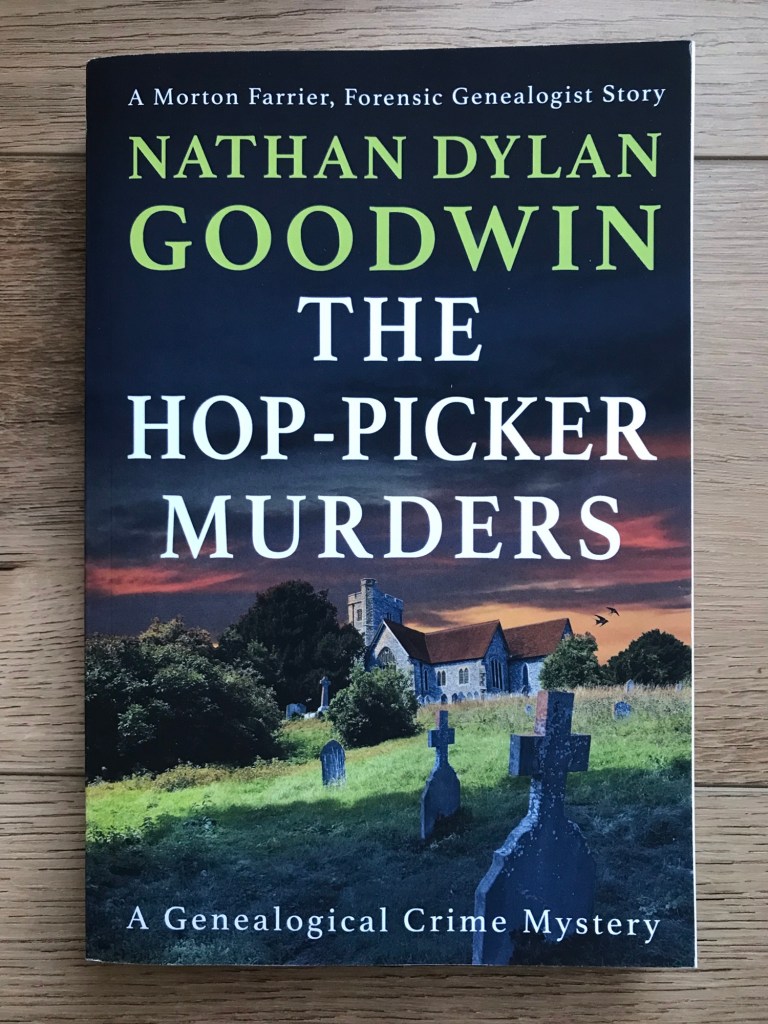
My copy of The Hop-Picker Murders
It is classic Morton Farrier fare. A fast-paced crime fiction mystery, which right from the opening pages packs a punch. It intertwines the progress of Morton’s latest genealogy investigation with events of a bygone era – in this case the lives of East End seasonal hop-pickers working in Kent in the immediate aftermath of World War One, and a young woman’s quest to clear her missing brother’s name and find out what happened to him.
Nathan Dylan Goodwin skilfully weaves the multiple strands of past and present, with the latest developments in the hero’s own complicated family history backstory, and some professional twists along the way too. The characterisation of heroine Nellie means the reader is naturally and sympathetically drawn into her pursuit of truth and answers. The peppering of the story with various genealogical records and sources adds a further dimension for those involved in family history research, from the hobbyist through to the professional – though you do not need to be a family historian to appreciate this well-crafted crime fiction novel. The author’s meticulous research of seasonal hop-picking in this era gives it that all-important feel of historical authenticity.
The book was a joy to read, one of those I was truly sorry to reach the end of. The positive though is there’s clearly scope for more Morton Farrier adventures to come.
Now all I need is some of those weird and wonderful scone recipes to set me up for these future Forensic Genealogist exploits.
The book can be read as a stand alone novel, though as someone who has read all the previous books I’ve found knowing a little about Morton Farrier’s life up to this point does help contextually.
If you’ve not read any of the previous books in the Forensic Genealogist series and want to start at the beginning to sequentially see how the character’s backstory evolves, here’s the full list:
The Asylum – short prequel to the series.
Hiding the Past.
The Lost Ancestor.
The Orange Lilies.
The America Ground.
The Spyglass File.
The Missing Man.
The Suffragette’s Secret – Novella.
The Wicked Trade.
The Sterling Affair.
The Foundlings.
The Deserter’s Tale.
The Hop-Picker Murders.
Finally, here’s the all-important purchase information for The Hop-Picker Murders. I read the paperback version, ISBN-13: 979-8298809924, which is due out in Spring 2026, with the audiobook version also due around then. The kindle and hardback edition (£18.99 RRP) are already available.
Full purchase details forthese, and all the previous books in the series, can be found on Nathan Dylan Goodwin’s website. There’s also additional historical background information about hop-picking, and one of the real-life hop-pickers who features in the book.
Full disclosure: I received a free paperback copy of this book in return for a honest review. I have expressed my truthful opinion in this review.
A quick heads up for an online talk I will be giving via the Society of Genealogists on 25 April 2026. Don’t switch off at this point if you’re not a member – it is open to anyone.
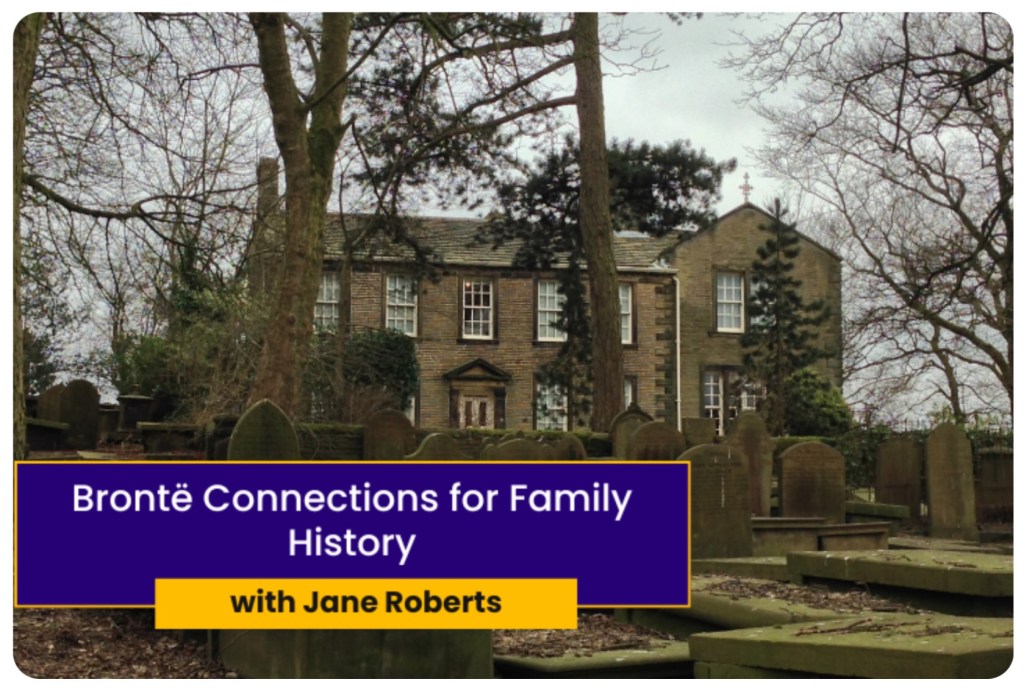
If you follow this blog, or any of my online social media accounts, you will know I live in an area packed with Brontë history, and I’m a frequent visitor to Haworth and other Brontë linked sites.
Well, I’m delighted that I’ve been asked to give an online talk all about exploring Brontë Connections for Family History.
Here’s the blurb about it, to give you some idea of what I’ll be covering:
The latest film adaptation of Emily Brontë’s dark, Gothic literary classic, Wuthering Heights, has triggered a fresh wave of Brontë-mania. A new generation of tourists are descending on the village of Haworth, keen to find out more about these world-famous sisters, and wanting to carve out their own slice of Brontë magic. But family historians can also channel into the Brontë family’s lives and literature, seeking their own Brontë connections and research inspiration. Jane’s talk will give you some ideas of how, and where to look.
I’d love to see you there, as I’m immensely proud of where I come from, my area’s Brontë links, all things Brontë, and I might even let you in on my quest to find my links to this amazing literary family!
You never know, as a result you may have ideas and inspiration to see how your family history might be connected.
February has been a particularly busy month for the Batley St. Mary of the Angels One-Place Study, with five new posts. This brings the total number of posts up to 427. Three more were updated.
Peter Gavaghan
This month’s additions and updates included one new War Memorial biography, that of the first Peter Gavaghan to be killed in the war (his cousin also named Peter died later on, and his biography was added some time ago). Both men’s biographies can now be found in The Biographies: War Memorial Men section.
Several more men who served and survived were identified, and this page has been updated. Their biographies will follow in due course.
Someone from the parish who died but is not on the church War Memorial has been identified, Michael Howley. I have added his biography to the section covering Men Associated with St. Mary’s Who Died but Who Are Not on the Memorial, and that overall page has been accordingly updated too. I have also updated the War Memorial Chronology of Deaths page, to include him.
There are two new posts in the Miscellany of Information section. One deals with the horrific, but all too common, circumstances surrounding the death of a child in the 19th century. The other concerns three pigs, a headstone and a long-lived parishioner.
There is also the parish history snippets piece for February 2026. These snippets cover a variety of events and people from the parish from years gone by, and can be found in the Bulletin for Batley St Mary of the Angels and Birstall St Patrick section. One is an amazing piece connected to The Beatles and a circus! Even if you have seen them on the Bulletin, it is worth checking them here as some have links to more detailed pieces I have written.
Below is the full list of pages to date. Simply click on the link and it will take you straight to the relevant page. I have annotated the *NEW* and “UPDATED” posts, so you can easily pick them out.
If you want to know the background, and what is involved in a one-place study, click here. Otherwise read on, to discover a wealth of parish, parishioner and wider local Batley history.
Postscript: I may not be able to thank you personally because of your contact detail confidentiality, but I do want to say how much I appreciate the donations already received to keep this website going. They really and truly do help. Thank you.
The website has always been free to use, and I want to continue this policy in the future. However, it does cost me money to operate – from undertaking the research to website hosting costs. In the current difficult economic climate I do have to regularly consider if I can afford to continue running it as a free resource.
If you have enjoyed reading the various pieces, and would like to make a donation towards keeping the website up and running in its current open access format, it would be very much appreciated.
Please click 👉🏽 here 👈🏽 be taken to the PayPal donation link. By making a donation you will be helping to keep the website online and freely available for all.
Thank you.
As a professionally qualified genealogist, if you would like me to undertake any family, local or house history research for you do please get in touch. More information can be found on my research services page.
Finally, if you do have any information about, or photos of, parishioners from the period of the First World War please do get in touch. It does not have to be War Memorial men. It could be those who served and survived, or indeed any other men, women and children from the parish.
I would also be interested in information about, and photos of, those parishioners who were killed in World War Two, or others from the parish who undertook any war service and survived. This can be as broad as serving in the military, or work in munitions factories, the Land Army, even taking in refugees. This is an area I’m looking to develop in the future.
The Batley St. Mary of the Angels One-Place Study ended 2025 on a total of 421 posts, with two new posts being published in December.
The first post of the month was all about the 1953 May Queen ceremony (photograph on the left), which was added to the May Queen section. Mary O’Connor took the starring role, but the piece includes names of many others involved in the procession that day.
The final post of 2025 was the parish history snippets piece for December. These snippets cover a variety of events and people from the parish from years gone by, and can be found in the Bulletin for Batley St Mary of the Angels and Birstall St Patrick section. Even if you have seen them on the Bulletin, it is worth checking them here as some have links to more detailed pieces I have written.
Below is the full list of pages to date. I have annotated the *NEW* posts, so you can easily pick these out. Click on the link and it will take you straight to the relevant page.
If you want to know the background, and what is involved in a one-place study, click here. Otherwise read on, to discover a wealth of parish, parishioner and wider local Batley history.
Finally, I’d like to end with a thank you for reading my Batley St. Mary of the Angels one-place study posts in 2025. Your support, additional information, photographs and many lovely comments throughout the year have all really been appreciated. I look forward to what 2026 will bring to this parish history collection. Hopefully the first of these will be published next week.
Postscript: I may not be able to thank you personally because of your contact detail confidentiality, but I do want to say how much I appreciate the donations already received to keep this website going. They really and truly do help. Thank you.
The website has always been free to use, and I want to continue this policy in the future. However, it does cost me money to operate – from undertaking the research to website hosting costs. In the current difficult economic climate I do have to regularly consider if I can afford to continue running it as a free resource.
If you have enjoyed reading the various pieces, and would like to make a donation towards keeping the website up and running in its current open access format, it would be very much appreciated.
Please click 👉🏽here👈🏽be taken to the PayPal donation link. By making a donation you will be helping to keep the website online and freely available for all.
Thank you.
As a professionally qualified genealogist, if you would like me to undertake any family, local or house history research for you do please get in touch. More information can be found on my research services page.
Finally, if you do have any information about, or photos of, parishioners from the period of the First World War please do get in touch. It does not have to be War Memorial men. It could be those who served and survived, or indeed any other men, women and children from the parish.
I would also be interested in information about, and photos of, those parishioners who were killed in World War Two, or others from the parish who undertook any war service and survived. This can be as broad as serving in the military, or work in munitions factories, the Land Army, even taking in refugees. This is an area I’m looking to develop in the future.
November 2025 was a busy month for the Batley St. Mary of the Angels One-Place Study. Four new posts were added, bringing the total number to 419. I also gave two talks about the early history of the Irish in Batley and the parish – one via Zoom to the Society of One-Place Studies; the other in-person to Batley History Group. If you missed them, I will be repeating the Irish and St. Mary’s talk next year with bookings already made for it, along with my other talks.
To start off with, I wrote a light-hearted piece about Buffalo Bill and A Right Royal Celebration for Batley’s Schoolchildren, a celebration in which the children of St Mary of the Angels participated. I describe, and include a photograph, of the special commemorative medal presented to all the schoolchildren, so that if you have one in your family you can identify it and know more about its history.
In a change of tone, with November being the month of Remembrance, one of the new posts was about James Edwards, one of the parishioners commemorated on the parish’s World War One War Memorial.
In the May Queen section I have added a piece about the 1952 ceremony when Patricia Anne Cain was the May Queen (as shown in the photograph to the left). It includes names of many others involved in the procession that day, which was a historic one in terms of its format that year.
The final post for the month was the parish history snippets piece for November 2025. These snippets cover a variety of events and people from the parish from years gone by, and can be found in the Bulletin for Batley St Mary of the Angels and Birstall St Patrick section. Even if you have seen them on the Bulletin, it is worth checking them here as some have links to more detailed pieces I have written.
Below is the full list of pages to date. I have annotated the *NEW* posts, so you can easily pick these out. Click on the link and it will take you straight to the relevant page.
If you want to know the background, and what is involved in a one-place study, click here. Otherwise read on, to discover a wealth of parish, parishioner and wider local Batley history.
Postscript: I may not be able to thank you personally because of your contact detail confidentiality, but I do want to say how much I appreciate the donations already received to keep this website going. They really and truly do help. Thank you.
The website has always been free to use, and I want to continue this policy in the future. However, it does cost me money to operate – from undertaking the research to website hosting costs. In the current difficult economic climate I do have to regularly consider if I can afford to continue running it as a free resource.
If you have enjoyed reading the various pieces, and would like to make a donation towards keeping the website up and running in its current open access format, it would be very much appreciated.
Please click 👉🏻here👈🏻 be taken to the PayPal donation link. By making a donation you will be helping to keep the website online and freely available for all.
Thank you.
As a professionally qualified genealogist, if you would like me to undertake any family, local or house history research for you do please get in touch. More information can be found on my research services page.
Finally, if you do have any information about, or photos of, parishioners from the period of the First World War please do get in touch. It does not have to be War Memorial men. It could be those who served and survived, or indeed any other men, women and children from the parish.
I would also be interested in information about, and photos of, those parishioners who were killed in World War Two, or others from the parish who undertook any war service and survived. This can be as broad as serving in the military, or work in munitions factories, the Land Army, even taking in refugees. This is an area I’m looking to develop in the future.
May 2025 marked a milestone for the Batley St Mary of the Angels One-Place Study, with it hitting 400 posts during the first week of the month. By the end of May 2025 five posts had been added across a range of topics, bringing the total number of posts in the study to 404.
Below is the complete list of all the St Mary’s posts published up to the end of May 2025, including links to them, with those new and updated posts signposted so you can easily locate them.
If you want to know the background, and what is involved in a one-place study, click here. Otherwise read on, to discover a wealth of parish, parishioner and wider local Batley history.
That milestone 400th post was a description of the parish of St Mary of the Angels in 1950, a post which for some will bring back memories. This is in the Miscellany of Information section.
With May 2025 marking the 80th anniversary of VE Day, I added a new World War Two biography, that of Bernard Stenchion. His death, in June 1945, illustrates that although Victory in Europe was celebrated on 8 May 1945, for some this was not the end of the War, while for many other parishioners the war had already irrevocably changed their lives.
The 1950 May Queen Catherine Heaps (L), with Moya Hill, the 1949 May Queen (R)
It also seems appropriate that in May two new May Queen pieces were added – about the 1923 May Queen Katherine Phillips, and the 1950 May Queen Catherine Heaps.
The fifth new post this month was the parish history snippets pieces from the May 2025 bulletins, and this can be found in the Bulletin for Batley St Mary of the Angels and Birstall St Patrick section.
Below is the full list of pages to date. I have annotated the *NEW* and *UPDATED* ones, so you can easily pick these out. Click on the link and it will take you straight to the relevant page.
Finally this month, I wanted to let you know that I will be giving at the Batley History Group meeting on 23 June 2025 all about the early history of the Irish in Batley and the parish of St Mary’s up to the 1880s. If you want to attend that meeting, it is in the Council Chamber of Batley Town Hall, with refreshments served from 7pm and the talk starting at 7.30pm. All are welcome, and the cost is £2 for members and £4 for non-members. It would be great to see people there.
Postscript: I may not be able to thank you personally because of your contact detail confidentiality, but I do want to say how much I appreciate the donations already received to keep this website going. They really and truly do help. Thank you.
The website has always been free to use, and I want to continue this policy in the future. However, it does cost me money to operate – from undertaking the research to website hosting costs. In the current difficult economic climate I do have to regularly consider if I can afford to continue running it as a free resource.
If you have enjoyed reading the various pieces, and would like to make a donation towards keeping the website up and running in its current open access format, it would be very much appreciated.
Please click 👉🏻here👈🏻 to be taken to the PayPal donation link. By making a donation you will be helping to keep the website online and freely available for all.
Thank you.
As a professionally qualified genealogist, if you would like me to undertake any family, local or house history research for you do please get in touch. More information can be found on my research services page.
Finally, if you do have any information about, or photos of, parishioners from the period of the First World War please do get in touch. It does not have to be War Memorial men. It could be those who served and survived, or indeed any other men, women and children from the parish.
I would also be interested in information about, and photos of, those parishioners who were killed in World War Two, or others from the parish who undertook any war service and survived. This can be as broad as serving in the military, or work in munitions factories, the Land Army, even taking in refugees. This is an area I’m looking to develop in the future.
April was a particularly busy month for the Batley St Mary of the Angels One-Place Study. It included the addition of a new subject heading, along with eight new posts, bringing the total number of posts to 399. One other post was updated.
Below is the complete list of all the St Mary’s posts published up to the end of April 2025, including links to them, with those new and updated posts signposted so you can easily locate them.
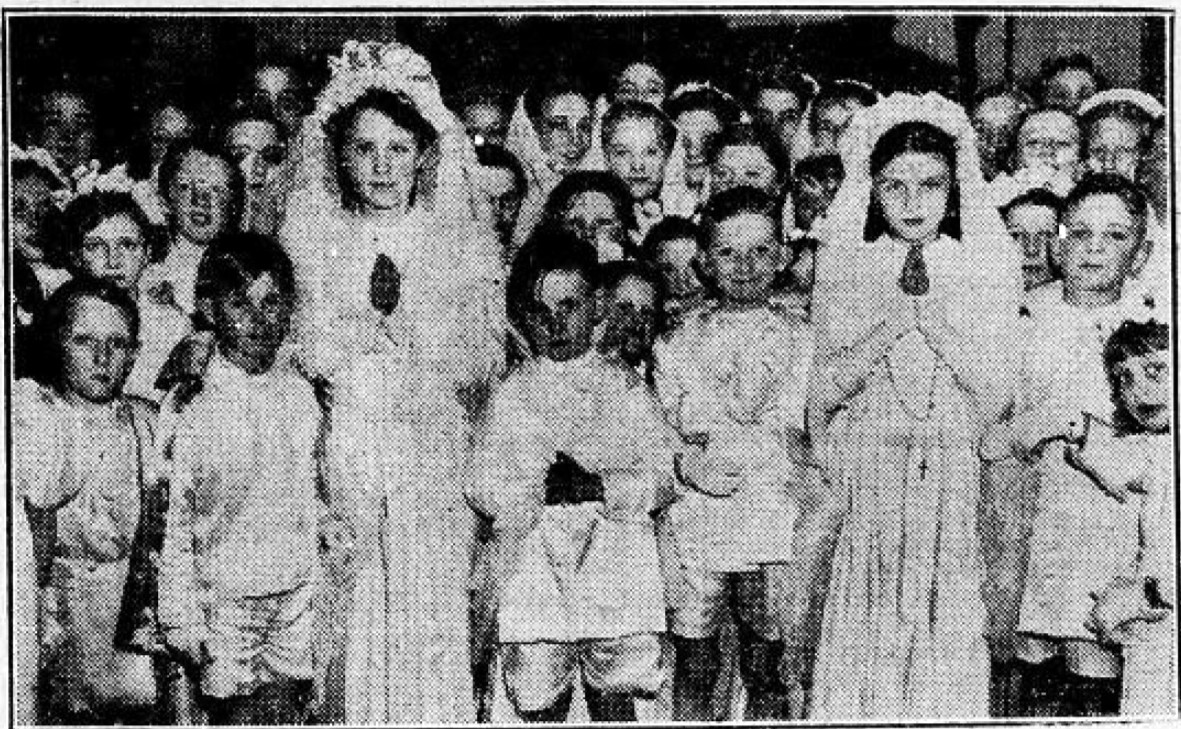
The May Queens of 1931 and 1932
If you want to know the background, and what is involved in a one-place study, click here. Otherwise read on, to discover a wealth of parish, parishioner and wider local Batley history.
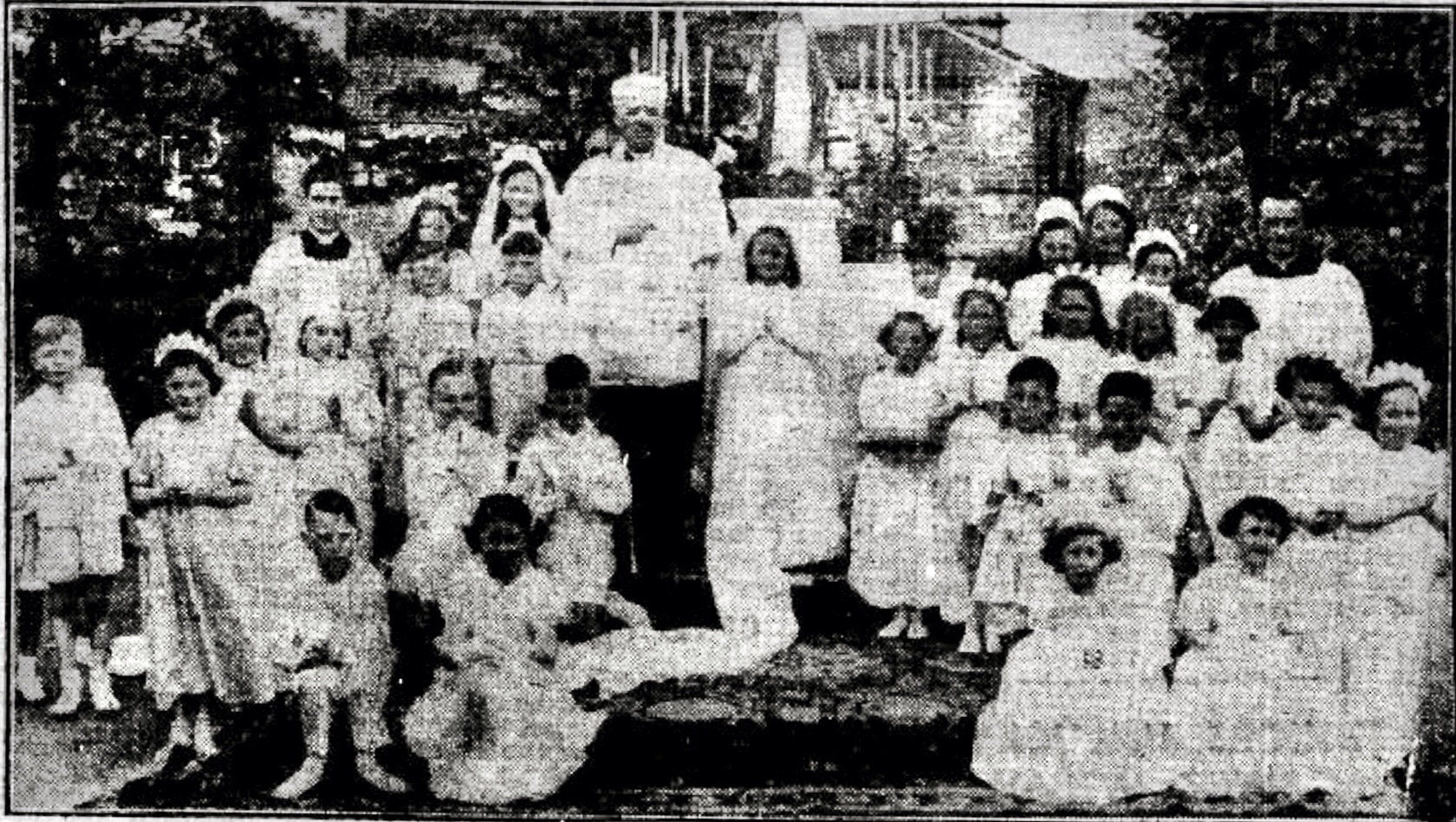
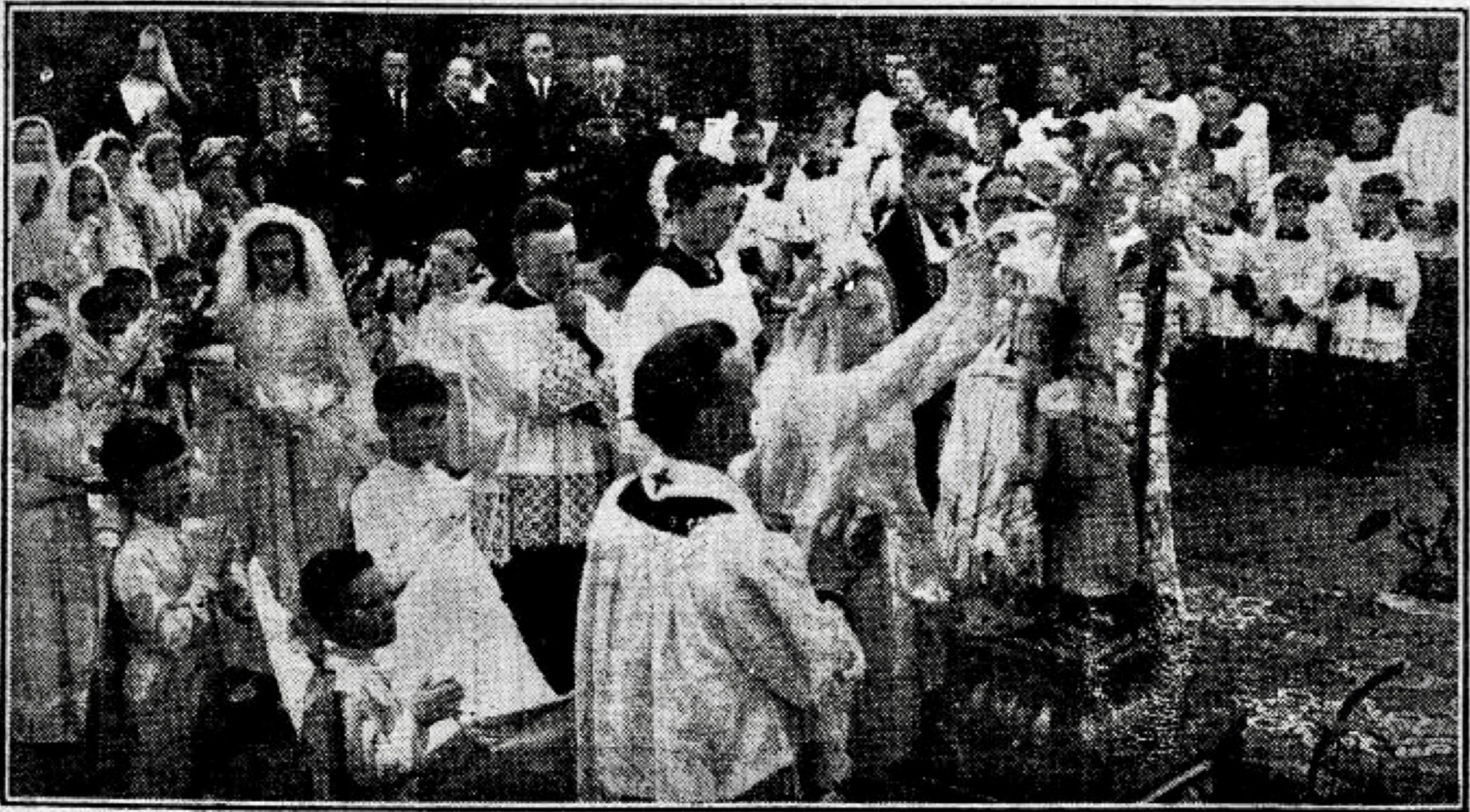
The new section added in April was one about the May Queens of the parish. I am trying to identify as many of them as possible, with a piece dedicated to each year. To date seven years have been added to this section, 1922, 1931-1933, 1939-1941.
The final addition this month is in the Bulletin for Batley St Mary of the Angels and Birstall St Patrick section. It is the piece covering the parish history snippets included in the parish bulletins during April 2025.
I have also added a further update to the World War Two introduction page.
Below is the full list of pages to date. I have annotated the *NEW* and *UPDATED* ones, so you can easily pick these out. Click on the link and it will take you straight to the relevant page.
Postscript: I may not be able to thank you personally because of your contact detail confidentiality, but I do want to say how much I appreciate the donations already received to keep this website going. They really and truly do help. Thank you.
The website has always been free to use, and I want to continue this policy in the future. However, it does cost me money to operate – from undertaking the research to website hosting costs. In the current difficult economic climate I do have to regularly consider if I can afford to continue running it as a free resource.
If you have enjoyed reading the various pieces, and would like to make a donation towards keeping the website up and running in its current open access format, it would be very much appreciated.
Please click 👉🏻here👈🏻 to be taken to the PayPal donation link. By making a donation you will be helping to keep the website online and freely available for all.
Thank you.
As a professionally qualified genealogist, if you would like me to undertake any family, local or house history research for you do please get in touch. More information can be found on my research services page.
Finally, if you do have any information about, or photos of, parishioners from the period of the First World War please do get in touch. It does not have to be War Memorial men. It could be those who served and survived, or indeed any other men, women and children from the parish.
I would also be interested in information about, and photos of, those parishioners who were killed in World War Two, or others from the parish who undertook any war service and survived. This can be as broad as serving in the military, or work in munitions factories, the Land Army, even taking in refugees. This is an area I’m looking to develop in the future.
What family historian isn’t a bibliophile? I’m no exception to the rule, living by the principal “A house isn’t a home without at least one bookcase for every room”.
I love exploring a multitude of family and local history topics, so it was a pleasure to be introduced to a new subject – the baronial system in Scotland, as covered by David Dobson in his book Scottish Baronial Families, 1250-1750. Published by the Genealogical Publishing Company, this paperback runs to 199 pages.
It opens with a brief summary of the feudal governance system introduced and used by Scottish monarchs, at the heart of which was the administrative unit of a barony. Headed by a baron, who in effect was a crown vassal, it was a system which operated until 1747 when the British government curtailed their powers with the Heritable Jurisdiction Act, their response to Jacobite rising of 1745-46. With Baronial responsibilities extending to the tax collection, supplying of men for military purposes, as well as jurisdiction over civil and criminal matters, and the baron’s principal seat of authority being the caput, in terms of English equivalent a baron was something akin to a Lord of the Manor.
The introductory section also explains the difference between barons and the noble rank of baronet, the latter created in 1611 by King James VI1 as a way of fundraising, along with promoting the Plantation (organised colonisation) of Ulster, and settlement in Nova Scotia. These are also featured in the book.
Next there is a simple one-page bibliography, which acts as a very basic proxy for specific source citations.
Before getting into the meat of the publication, there are seven images. Whilst they are captioned, I would have found it helpful to also have an accompanying page number to link them to the specific section in the book.
We then come to the main body of the book. Drawing mainly on the Register of the Great Seal of Scotland, this is an alphabetical listing of the Scottish Baronial families – covering in total around 1,000 Scottish baronies and baronetcies. And whilst the listings are dominated by men, there are also a smattering of female holders. The listings detail the families, plus when, where, and by who, they were granted their baronies/baronetcies. Some have additional information. The pieces range from a couple of sentences, to – in some cases – upwards of a page for those families with multiple grants, or where there is extra details.
The book concludes with a select listing of Scots-Irish baronetcies established in Ireland and in the New World.
It is a book to dip into for reference, rather than one to read from cover to cover, and it acts as a concise introduction to the subject. Personally, as part of this reference material, I would also have found a place name index useful, in order to link locations to baronies. But there’s no doubt this is an impressive starting point and companion book for researchers and local historians investigating these families.
The book was published in 2024, ISBN 9780806359748. For ease I’ve attached the purchase links for both Amazon and Genealogical.com
Full disclosure: I received a free copy of the book from Genealogical.com in return for a honest review. I have expressed my truthful opinion in the above review.
Footnotes: 1.King James I of England, although it was not until 1707 that new baronets were established under the United Kingdom.
The number of posts in the Batley St Mary of the Angels One-Place Study creeps ever-closer to the 400 mark. The three new posts added in February 2025 brings it up to 386. One of those posts is a result of my February visit to the Leeds Diocesan Archives, and hopefully in the coming months more pieces will follow on from my finds that day. Two other posts were updated.
Below is the complete list of all the St Mary’s posts published up to the end of February 2025, including links to them, with those new and updated posts signposted so you can easily locate them.
If you want to know the background, and what is involved in a one-place study, click here. Otherwise read on, to discover a wealth of parish, parishioner and wider local Batley history.
Batley St Mary of the Angels
The first piece arising from my Diocesan Archives visit is a description of the parish boundaries given by Fr, Lea in 1918. It is interesting because of the changes which have taken place in the intervening period, with streets appearing, and other landmarks vanishing.
The second piece is about the deaths of the husband and wife Smallpox Hospital caretakers within days of each over the Christmas/New Year period of 1921/22. Again there is additional interest here for people who might remember the old Smallpox Hospital, and the separate Infectious Diseases Hospital which later became Oakwell Geriatric Hospital.
The final addition is in the Bulletin for Batley St Mary of the Angels and Birstall St Patrick section. It is the piece covering the parish history snippets included in the parish bulletins during February 2025. There are some additional links here to fuller pieces I’ve written about some of these snippets.
As for the two updated pieces, one details more parishioners who served in, and survived, the First World War. The other is an update to A St Mary’s Parishioner in the Holy Land, which covers a physical attack he sustained whilst there.
Below is the full list of pages to date. I have annotated the *NEW* and *UPDATED* ones, so you can easily pick these out. Click on the link and it will take you straight to the relevant page.
Postscript: I may not be able to thank you personally because of your contact detail confidentiality, but I do want to say how much I appreciate the donations already received to keep this website going. They really and truly do help. Thank you.
The website has always been free to use, and I want to continue this policy in the future. However, it does cost me money to operate – from undertaking the research to website hosting costs. In the current difficult economic climate I do have to regularly consider if I can afford to continue running it as a free resource.
If you have enjoyed reading the various pieces, and would like to make a donation towards keeping the website up and running in its current open access format, it would be very much appreciated.
Please click 👉🏻here👈🏻 to be taken to the PayPal donation link. By making a donation you will be helping to keep the website online and freely available for all.
Thank you.
As a professionally qualified genealogist, if you would like me to undertake any family, local or house history research for you do please get in touch. More information can be found on my research services page.
Finally, if you do have any information about, or photos of, parishioners from the period of the First World War please do get in touch. It does not have to be War Memorial men. It could be those who served and survived, or indeed any other men, women and children from the parish.
I would also be interested in information about, and photos of, those parishioners who were killed in World War Two, or others from the parish who undertook any war service and survived. This can be as broad as serving in the military, or work in munitions factories, the Land Army, even taking in refugees. This is an area I’m looking to develop in the future.
2025 got off to a great start for the Batley St Mary of the Angels One-Place Study, with the addition of five posts which cover a varied mix of the history of the parish and its people. It brings the total number of posts to 383. One other post was updated.
Below is the complete list of all the St Mary’s posts published up to the end of January 2025, including links to them, with those new and updated posts signposted so you can easily locate them.
If you want to know the background, and what is involved in a one-place study, click here. Otherwise read on, to discover a wealth of parish, parishioner and wider local Batley history.
Batley St Mary of the Angels
Two new War Memorial biographies were added, those of Harold Gaunt and Thomas Dolan. The former covers a lesser known aspect of military service. The latter includes some cherished photos, used with the family’s permission. I also identified more parishioners who served in, and survived, the First World War. That list has been updated.
The Bulletin for Batley St Mary of the Angels and Birstall St Patrick section, has one addition. This is the piece covering the parish history snippets which were included in the parish bulletins during January 2025 – one of which may be rather surprising but reflects commonly held initial world attitudes to someone who turned out to be a monster.
It also links to the one of the two new posts in the Miscellany of Information section. One is about a former parishioner who played an unexpected and significant role, bringing him into contact with people across the world. The other post is a topic I never thought would be covered in the St Mary’s One-Place Study. Given this month, on the 27 January, we commemorated World Holocaust Day and the 80th anniversary of the liberation of Auschwitz-Birkenau, the largest Nazi concentration camp complex, it serves as a timely and important reminder.
Below is the full list of pages to date. I have annotated the *NEW* and *UPDATED* ones, so you can easily pick these out. Click on the link and it will take you straight to the relevant page.
Postscript: I may not be able to thank you personally because of your contact detail confidentiality, but I do want to say how much I appreciate the donations already received to keep this website going. They really and truly do help. Thank you.
The website has always been free to use, and I want to continue this policy in the future. However, it does cost me money to operate – from undertaking the research to website hosting costs. In the current difficult economic climate I do have to regularly consider if I can afford to continue running it as a free resource.
If you have enjoyed reading the various pieces, and would like to make a donation towards keeping the website up and running in its current open access format, it would be very much appreciated.
Please click 👉🏻here👈🏻 to be taken to the PayPal donation link. By making a donation you will be helping to keep the website online and freely available for all.
Thank you.
As a professionally qualified genealogist, if you would like me to undertake any family, local or house history research for you do please get in touch. More information can be found on my research services page.
Finally, if you do have any information about, or photos of, parishioners from the period of the First World War please do get in touch. It does not have to be War Memorial men. It could be those who served and survived, or indeed any other men, women and children from the parish.
I would also be interested in information about, and photos of, those parishioners who were killed in World War Two, or others from the parish who undertook any war service and survived. This can be as broad as serving in the military, or work in munitions factories, the Land Army, even taking in refugees. This is an area I’m looking to develop in the future.



 Past To Present Genealogy