This is the latest update of the pages relating to my Batley St Mary’s one-place study, the details of which I announced here.
A selection of school log books – Photo by Jane Roberts
March saw the addition of seven new pages. Two other pages were updated.
Although March may therefore appear to have been quiet, I have been working away in the background on a new strand to the St Mary’s One-Place Study – the school. More of that later.
The additions included four weekly newspaper pages for March 1916. I have accordingly updated the surname index to these During This Week newspaper pieces, so you can easily identify newspaper snippets relevant to your family.
More men who served and survived have been identified. I have updated that page accordingly. No new biographies for these men have been added this month. They will follow in due course.
I have written one biography for a War Memorial man: Robert Randerson. A Batley rugby league player and St Mary’s school teacher, his first days at the school are also recorded in the brand new section to the study – the school log books.
These log books were kept regularly by the school – the infants, mixed and boys’ departments. They record the everyday routine of their running. Some of the entries may be mundane, register checking for example. But amidst these entries are some real gems – for example unusual incidents, disease outbreaks, school outings, and issues relating to individual school children or teachers. Interwoven through them is the religious context to St Mary of the Angels school, and how local and national events also impacted on it. They provide a snapshot of Catholic school life in a bygone time. Crucially for this study, these particular logs are not available online or in the archives.
This month there are two new pages relating specifically to these log books. The first is a general introduction. The second is the 1913 log book entries for the newly formed Boys’ Department. And it is on these pages Robert Randerson appears.
Below is the full list of pages to date. I have annotated the *NEW* ones, plus the *UPDATED* pages, so you can easily pick these out. Click on the link and it will take you straight to the relevant page.
This is the latest update of the pages relating to my Batley St Mary’s one-place study, the details of which I announced here.
Sam Sykes – One of the Newspaper additions this month
It has been a busy month. In total eight new pages were added. Eight others were updated.
I focused on occupations during February, with three new work descriptions added – those of confidential clerk, office boy/girl and willeyer.
I have added four weekly newspaper pages for February 1916. I have accordingly updated the surname index to these During This Week newspaper pieces, so you can easily identify newspaper snippets relevant to your family.
More men who served and survived have been identified. I have updated that page accordingly. No new biographies for these men have been added this month. They will follow in due course.
I have also written one biography for a War Memorial men: Dominick Brannan, also known as Dominic or George Brennan. I have updated five others (Michael Brannan, Michael Flynn, Thomas Foley, Patrick Naifsey, Austin Nolan). Also updated is Reginald Roberts, who was linked to the parish but not on the Memorial.
Below is the full list of pages to date. I have annotated the *NEW* ones, plus the *UPDATED* pages, so you can easily pick these out. Click on the link and it will take you straight to the relevant page.
This is the latest update of the pages relating to my Batley St Mary’s one-place study, the details of which I announced here.
St Mary of the Angels Church, Batley
In the past month I have added five weekly newspaper pages for January 1916. I have accordingly updated the surname index to these During This Week newspaper pieces, so you can easily identify newspaper snippets relevant to your family.
More men who served and survived have been identified. I have updated that page accordingly. No new biographies for these men have been added this month. They will follow in due course.
I have also written two new biographies for a War Memorial men: those of Peter Doherty and Thomas Gavaghan.
Below is the full list of pages to date. I have annotated the *NEW* ones, plus the *UPDATED* pages, so you can easily pick these out. Click on the link and it will take you straight to the relevant page.
This is the latest update of the pages relating to my Batley St Mary’s one-place study, the details of which I announced here.
St Mary of the Angels Church, Batley
In the past month I have added eight new pages, including a major news announcement for September. This is the extension of the study to include those from the parish who died in the Second World War.
Although the church has no War Memorial commemorating parishioners who died in World War Two, with the help of Batley’s Roll of Honour I am seeking to identify them and publish mini-biographies as part of this one-place study. These new pages include the background to the Second World War element of the study; a list of those identified to date; and the first of these biographies, Michael Flatley.
Turning to World War One, there are four weekly newspaper summary pages for September 1915. I have accordingly updated the surname index to these During This Week newspaper pieces, so you can easily identify newspaper snippets relevant to your family.
The biography of Thomas McNamara has been updated, with additional information.
More men who served and survived have been identified. I have updated that page accordingly. This month I have published a biography for one of these men, Michael Rush. He survived both the 2nd Boer War and the First World War. The biographies of other men in this section will follow in due course.
Below is the full list of pages to date. I have annotated the *NEW* ones, plus the *UPDATED* pages, so you can easily pick these out. Click on the link and it will take you straight to the relevant page.
A cemetery can tell you so much about a town’s past. It is a physical representation of the lives of many of its inhabitants – years, decades and even centuries after they departed its soil. Headstones provide a snapshot of their lives. The uniform layout of burial registers record the passing of the rich, the less well-off and the impoverished. And combined, their lives and deaths chart the history and development of a town over time.
Batley cemetery, and its register, is no exception. The first burial recorded in the register’s consecrated (Church of England) portion of the cemetery is on 19 January 1867 for nine-week-old William Henry Stockwell; in the unconsecrated section it is 25-year-old Mary Fox, on 10 November 1866. She, therefore, is the first registered burial in the cemetery. In this post I will focus on one grave in the consecrated section.
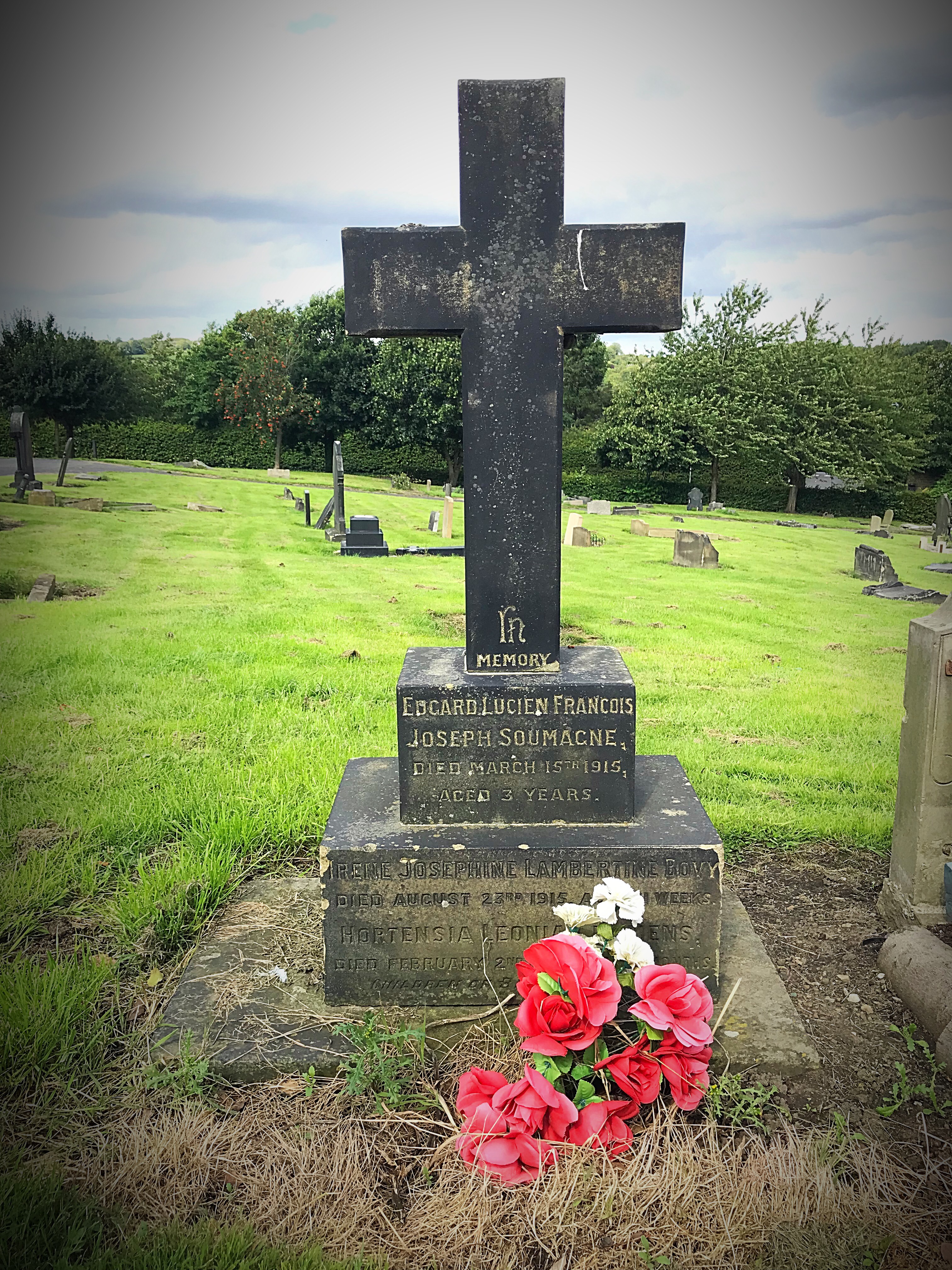
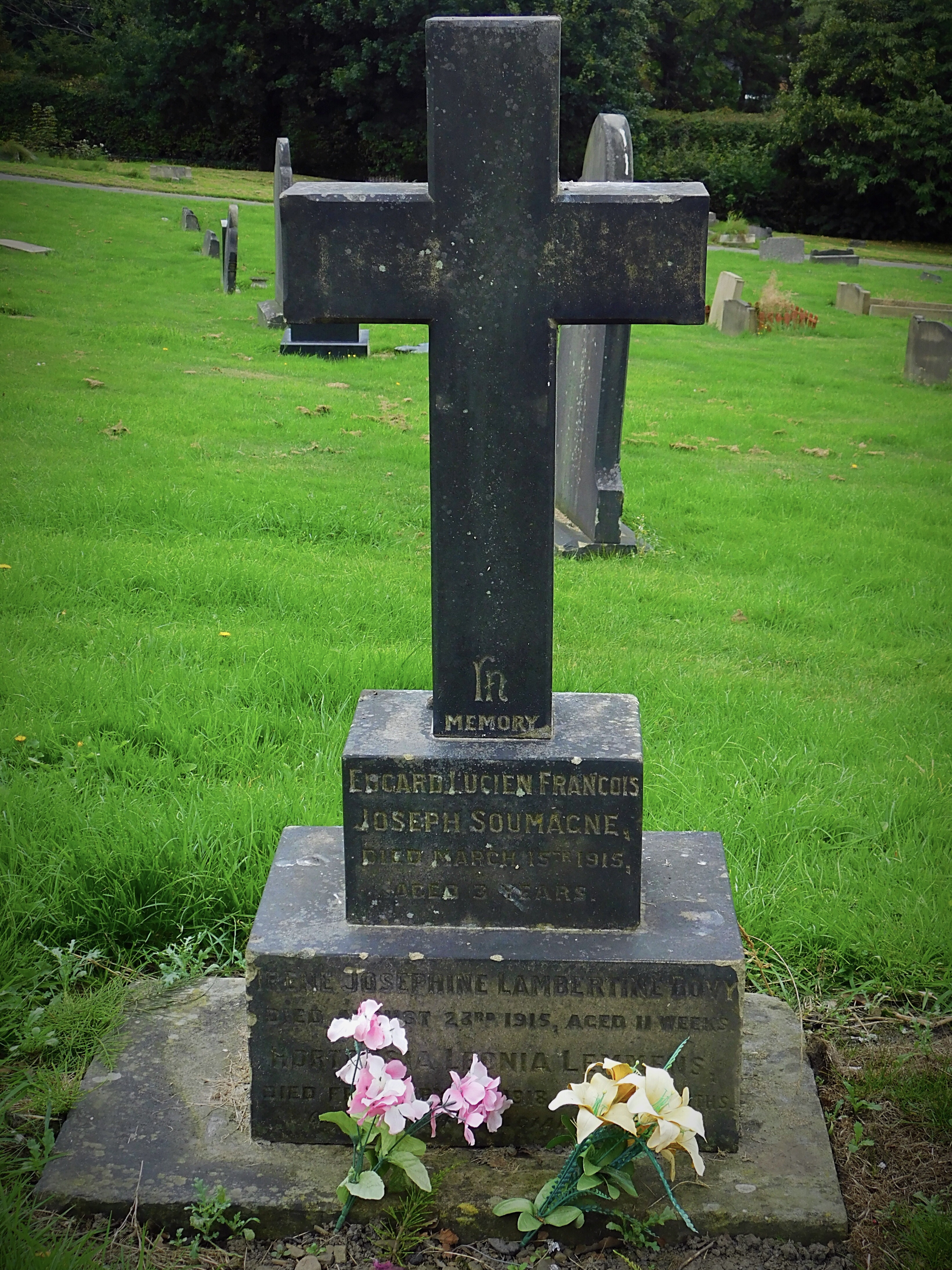
This grave has a headstone. It marks the loss of three young lives. The children are all from different families. One was buried in accordance with the rites of the Church of England. The other two were Catholic burials. All have unusual names for the area. Particularly striking is how, over a century after the occupants of the grave were buried, artificial flowers are still being placed at the foot of the cross.
So how did these three children come to be buried in Batley cemetery?
Flowers at the foot of children’s grave – one photo taken in August 2019, the other in August 2021 – Photos by Jane Roberts
Their story starts in August 1914, the outbreak of the Great War and the German invasion of Belgium. These children were refugees, either driven directly from their home by war, or born in this country subsequently to parents forced to flee Belgium. Many came to Great Britain, and towns countrywide welcomed them. By the end of 1914 an estimated 110,000 Belgian refugees were in the country.1
The first Belgium refugees officially arrived in Batley on 17 October. A mixture of single people and family groups, they numbered 25 in total.2 They were accommodated at Shaftesbury House, Upper Batley. This was the residence of the late Alderman J. J. Parker, an ex-Mayor of the Borough. It was fitted out and furnished free of charge by Batley residents. The refugees were also provided with free medical care, and Batley Corporation waived any rates on the property.
In those first months Batley people showed an intense interest in the new arrivals, and the newspapers contained regular updates about the town’s Belgian guests. There were even set visiting days, so locals could turn up to show sympathy and solidarity with them. The generosity of the Batley public continued, with monetary donations and increasing offers of accommodation resulting in the ability to house even more Belgian refugees.
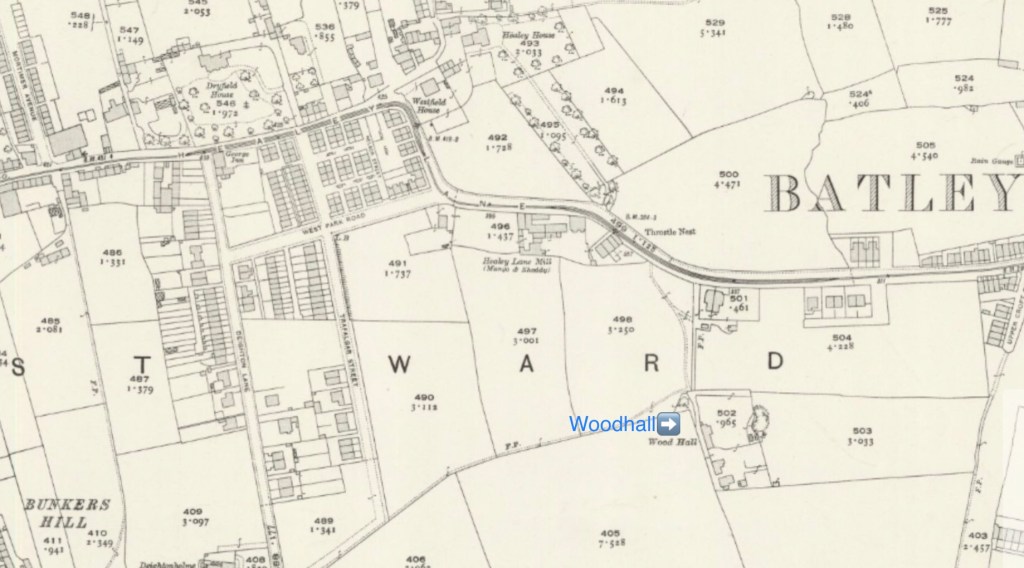
Eighteen more arrived on 21 November. Nine went to Woodhall, in a house provided by Henry Jessop. The others were housed in properties on Byron Street, Kelvin Grove and Primrose Hill. The continuing swell of housing offers meant that by February 1915 almost 70 Belgian refugees were based in Batley.3
Their new homes were supplied by a variety of locals. These included Staff Nurse Alice Musto, who offered up her home on the Warwick Road corner of Taylor Street whilst she was away serving with the Territorial Nursing Force.4 As experience built up, it was found that these separate family houses were best for homing the refugees. Though the larger multi-occupancy group houses still had an important role in that they helped the newly-arrived, providing company and support for them until they became familiar with the area, people and language.
Support facilities for the displaced foreigners grew. A special class for Belgian children was established at St Paulinus RC School in Dewsbury. Attended by 15 scholars, their Belgian teacher was Miss Callens, who herself had arrived in the country only recently. The Tramway Company provided free travel for those children living a distance from school. Meals were provided free by members of the St Paulinus congregation.5
English language classes were provided for adults. Entertainment was also laid on. Christmas parties and gifts were supplied. The area even had Catholic priests who themselves were refugees from Belgium. They were attached to the local churches to minister to the refugee flock. These included Father Julien Kestelyn at Birstall St Patrick’s, subsequently posted to St Mary’s; and Father Paul van de Pitte, initially at St Joseph’s, Batley Carr.
In regards to religious observance, one amusing incident occurred soon after the refugees’ arrival. An offer from a Batley resident to take a family group to church was enthusiastically accepted. The lady, not a Catholic, ascertained the times of Sunday mass at St Mary’s, based on the assumption that all from Belgium were Catholic. She even accompanied them to church, neglecting her own religious observances that day. Except it transpired after mass that the Belgian family were actually Protestants! It turned out the initial batch of Woodhall refugees were non-Catholics. So a girl living there had provision made for her to attend Staincliffe Church school.
Batley townsfolk continued to make regular contributions to the Belgian Relief Fund. For example, by June 1915 St Mary’s RC Church had made 17 separate donations to the fund following church collections.6
Tensions did exist though, for instance around the cost of maintaining these refugees. In January 1915, whilst dismissing public murmurings about them being treated too well, it was agreed that care was needed not to spoil them. By the beginning of October 1915, when the mutual decision was made that the refugees were to feed and clothe themselves wherever the man’s work permitted it, the town’s Belgian Refugees Fund donations stood at £914 5s.7 In simple purchasing power terms that equates to £74,900 at today’s values.8 Support remained though. For example, housing, coal and lighting would continue to be provided free of charge.
On 14 December 1914 a particularly unsavoury incident occurred. At 6.15am 19-year-old Woodhall resident Jean Joseph Soumagne was attacked going to work at J Blackburn and Co’s mill. Whilst making his way down the footpath to Healey Lane, a man sprang from behind a wall, stabbed him in the cheek and right thigh, then threw him down in the mud, before making his escape under cover of darkness. There is no mention of Joseph being targeted because of his nationality, but the implication is there, especially because nothing was taken.9 Jean Joseph subsequently applied to join the Belgian Army.10
And it was the youngest Soumagne child who was the first young refugee to be buried in the grave in Batley cemetery, in a plot purchased by the local Belgian Relief Committee. Forty-year-old Antwerp nickel-plater Lucien Soumagne, his 43-year-old wife Marie, and children Jean Joseph (19), Lucien (16) and Edgard Lucien (3) were amongst the original nine Woodhall residents who arrived at the house in November 1914.11 Mr and Mrs Soumagne had prominent roles within the Batley Belgian community, liaising with authorities and seemingly acting as spokespersons in particular for the Woodhall refugees. The family were non-Catholics, which may partly explain why this burial plot was purchased in the Consecrated Church of England portion of Batley cemetery.
Edgard died on 15 March 1915 as a result of diphtheria. Thankfully rare in this country now due to childhood vaccination, this highly-infectious, primarily respiratory-spread disease was a killer back in 1915. The sore throat, high temperature, headache and nausea rapidly led to difficulty in breathing and swallowing. It could also damage the heart, kidneys and liver, and affect the skin. The disease reached epidemic proportions in Batley in 1915. Ninety six cases were notified that year, the highest proportion since 1893. A particularly bad outbreak occurred in the last quarter of 1915, centred around youngsters over 14 who had left school. Almost all of these were in the Cobden Street area of town, and connected with Irish Roman Catholics. Because of its infectious nature, 87 of the year’s 96 sufferers were admitted to hospital.12 It was here, at the Oakwell Isolation Hospital, that Edgard died – just one of 18 diphtheria deaths in Batley that year.
He was interred in Batley cemetery on 18 March, in a service conducted amidst fleeting snow, by the Batley Parish Church curate, Rev. J. S. Walker. In addition to his parents, brothers, and local people closely involved with the refugees, his paternal aunt – herself a refugee – travelled up from Bedfordshire.
The next child to be laid to rest in this plot was an 11-week-old baby girl, Irene Josephine Lambertine Bovy. Her birth was registered in the Kings Norton district of Birmingham, the daughter of Mr and Mrs Phillipe D. J. Bovy. The family only arrived in Batley the month prior to Irene’s death, to live with relatives at Woodhall, which now included Catholics amongst its residents. She passed away on the morning of 23 September 1915. Like Edgard, she too died in hospital as a result of another childhood killer disease, whooping cough. All 16 deaths recorded in 1915 in Batley Borough for this disease related to children under the age of five.13 Again this is another disease today successfully combatted by childhood vaccination. Irene’s burial took place on 25 September, conducted by Catholic priest Paul van de Pitte.
The final child buried here is the six-month old daughter of Belgian soldier Leon Lemmens. Hortensia Leoni Lemmens’ birth was registered in Dewsbury in 1917. Latterly she and her mother had been staying at Rock Farm, Upper Batley, with another family of Belgian refugees. Prior to that they had been supported at Osborne Terrace (see first map) by members of Batley Conservative Club, who continued this support in paying for the child’s burial expenses. Hortensia died on the 2 February 1918, and her funeral – conducted by Batley St Mary’s Catholic priest Father Shea – took place on the 5 February.
The headstone which marks the grave notes they are the children of Belgian refugees. It reads:
IN MEMORY EDGARD LUCIEN FRANCOIS JOSEPH SOUMAGNE, DIED MARCH 15TH 1915, AGED 3 YEARS. IRENE JOSEPHINE LAMBERTINE BOVY, DIED AUGUST 23RD 1915, AGED 11 WEEKS. HORTENSIA LEONI LEMMENS DIED FEBRUARY 2ND 1918, AGED 6 MONTHS. CHILDREN OF BELGIAN REFUGEES
Close-up of the inscription – Photo by Jane Roberts
And, curiously, even a century after their deaths, someone is remembering their loss by regularly placing the artificial flowers on their grave.
Footnotes: 1. Batley News, 2 January 1915; 2. Batley News, 24 October 1914; 3. Batley News, 6 February 1915; 4. Batley News, 30 January 1915; 5. Batley News, 28 November 1915; 6. Batley News, 12 June 1915; 7. Batley News, 2 October 1915; 8. Measuring Worth website, https://www.measuringworth.com/index.php; 9. Batley News, 19 December 1915; 10. Batley News, 16 January 1915; 11. Batley News, 28 November 1915; 12. Pearce, G H. Borough of Batley Annual Report of the Medical Officer of Health For the Year 1915. JS Newsome, Batley, 1916; and 13. Ibid.
Other Sources: • Batley Cemetery Burial Registers; • Batley News, 5 December 1914, 9 January 1915, 20 March 1915, 25 September 1915, 9 October 1915, and 9 February 1918; • GRO Indexes; and • National Library of Scotland website
This is the latest update of the pages relating to my Batley St Mary’s one-place study, the details of which I announced here.
In the past month I have added seven new pages. These include four weekly newspaper summary pages. I have accordingly updated the surname index to these During This Week newspaper pieces, so you can easily identify newspaper snippets relevant to your family.
There is one new War Memorial biography – that of John Brooks. I have also updated the biography of Herbert Booth to include a new photograph of a Batley street, dating from around 1910.
I’ve also written the first post in the occupations and employment category, describing the job of a rag grinder.
Patent Rag Grinding Machine, The History and Antiquities of Morley, in the West Riding of the County of York, 1876 – out of copyright
And there is the first post in the families section, entitled A Death in the Church.
Finally for this month, more men who served and survived have been identified. I have also updated that page. The biographies of these men will follow in due course.
Below is the full list of pages to date. I have annotated the *NEW* ones, plus the *UPDATED* pages, so you can easily pick these out. Click on the link and it will take you straight to the relevant page.
This is the latest update of the pages relating to my Batley St Mary’s one-place study, the details of which I announced here.
St Mary of the Angels Church – Photo by Jane Roberts
In the past month I have added six new pages. These include five weekly newspaper summary pages. I have accordingly updated the surname index to these During This Week newspaper pieces, so you can easily identify newspaper snippets relevant to your family.
There is one new War Memorial biography – that of Herbert Booth.
Finally for this month, more men who served and survived have been identified. I have also updated that page. The biographies of these men will follow in due course.
Below is the full list of pages to date. I have annotated the *NEW* ones, plus the *UPDATED* page, so you can easily pick these out. Click on the link and it will take you straight to the relevant page.
This is the latest update of the pages relating to my Batley St Mary’s one-place study, the details of which I announced here.
St Mary of the Angels Church – Photo by Jane Roberts
In the past month I have added seven new pages. These include four weekly newspaper summary pages. I have accordingly updated the surname index to these During This Week newspaper pieces, so you can easily identify newspaper snippets relevant to your family.
There are also two new War Memorial biographies – those of Martin Carney and Michael Groark (also known as Rourke).
In addition, more men who served and survived have been identified. I have also updated that page. The biographies of these men will follow in due course.
Finally, for June’s additions, there is a brand new post about the health of Batley school children in 1914, with a focus on those at St Mary’s. This will be the first in a series looking a population, health, fertility and mortality.
Below is the full list of pages to date. I have annotated the *NEW* ones, plus the *UPDATED* page, so you can easily pick these out. Click on the link and it will take you straight to the relevant page.
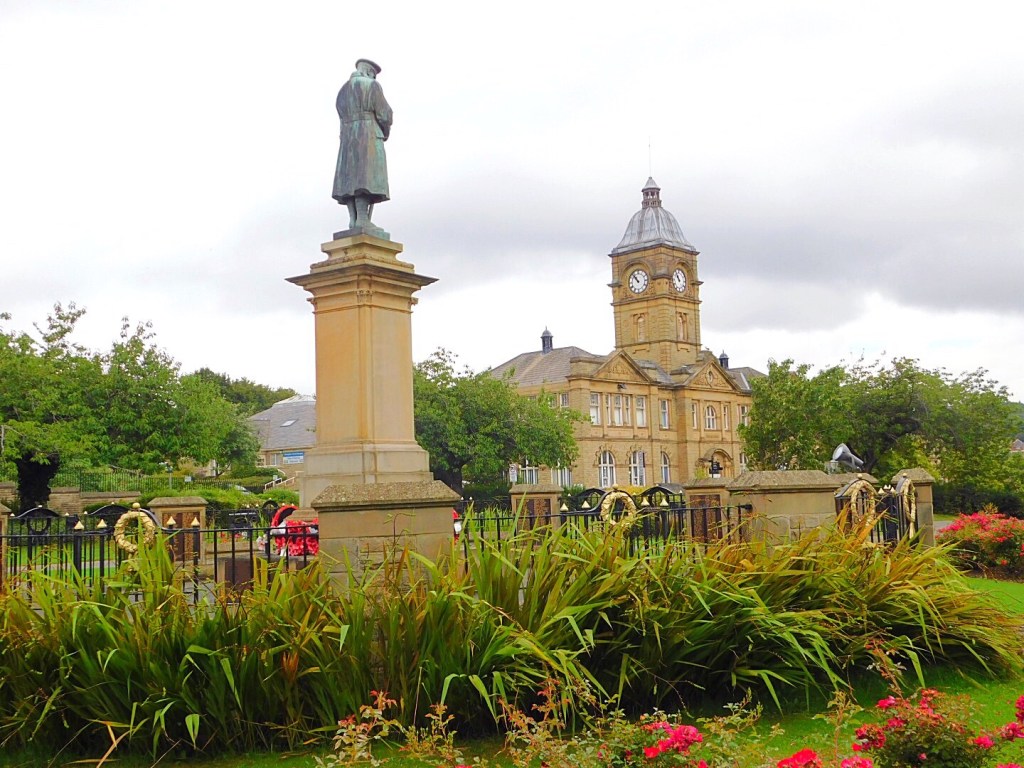
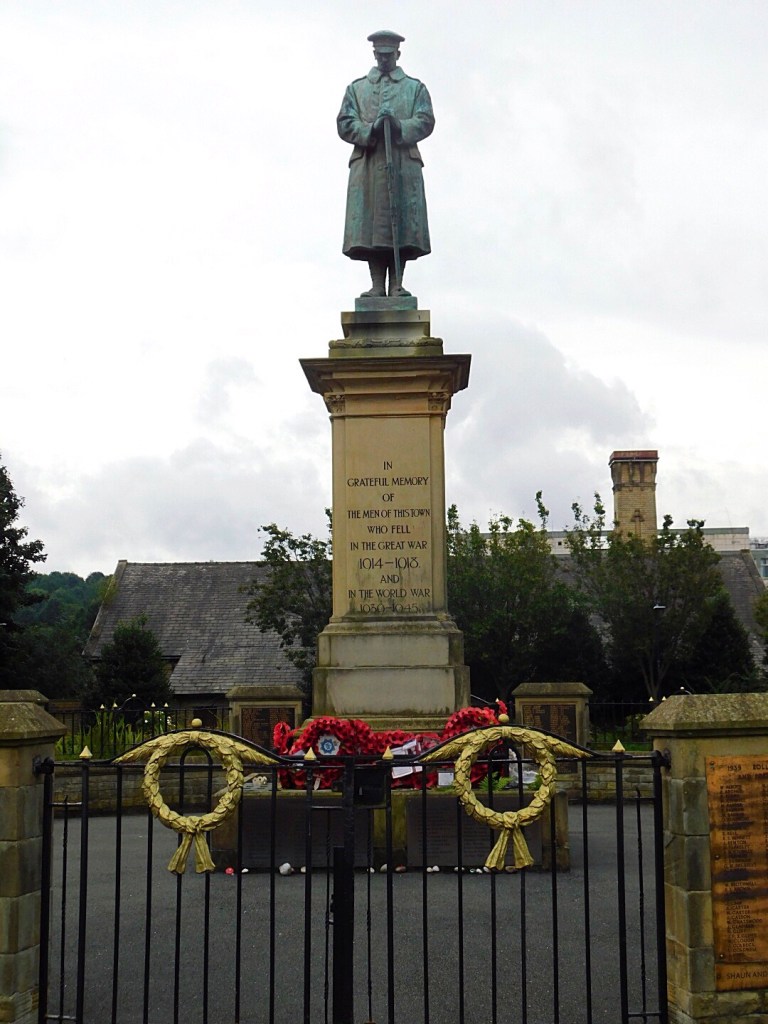
It is one of Batley’s most iconic sites. The soldier in the Memorial Gardens looking down solemnly over the names of Batley’s Fallen. But the design, and location, of the town’s War Memorial could have been totally different. And, it may come as a surprise, the town commemorated its Great War Fallen with far more than this Memorial. Here’s the story about the debates which went on in Batley about a suitable form of remembrance.
The Batley War Memorial Figure – Photo by Jane Roberts
The Great War officially ended on 28 June 1919 with the signing of the Treaty of Versailles. It was over a year later, on 9 August 1920, when Batley Borough’s General Purposes Committee resolved that “a representative Committee be appointed to consider and report to a public meeting on the question of the provision of some suitable War Memorial for this Borough.”
The War Memorial Committee was initially made up of the Mayor, Aldermen and Councillors, who were able to add others as deemed appropriate. In addition to these Borough worthies, those involved in the War Memorial Committee, and its offshoots, eventually comprised of representatives from each of the following organisations:
Borough Magistrates;
Co-opted Members of the Library Committee;
Co-opted Members of the Education Committee;
Co-opted Members of the Technical School Committee;
Chamber of Commerce;
Chamber of Trade;
Committee of the Batley & District Hospital;
Batley Workingmen’s Club;
Soothill Workingmen’s Club:
Batley Co-operative Society Ltd.;
Batley Paxton Society;
Temperance Society, Batley;
Trades & Friendly Club, Batley;
Carlinghow Workingmen’s Club;
Liberal Club, Batley;
Liberal Club, Staincliffe;
Conservative Club, Batley;
United Irish League Club, Batley;
St John Ambulance Association, Batley Division;
Batley Cricket, Athletic and Football. Club;
Independent Labour Party, Batley Branch;
Primrose League, Batley;
Women’s Liberal Association, Batley;
Co-operative Women’s Guild, Batley;
Teachers Association, Batley Branch;
Independent Labour Party Women’s Branch;
P.M.E. Batley (Hanover Street Church);
British Women’s Temperance Association (BWTA), Batley Branch;
BWTA Staincliffe Branch;
BWTA Hanging Heaton Branch;
Batley Old Band;
Batley Nursing Service;
Batley Ex-Servicemen’s Social Club; and
Batley Branch British Legion.
At the War Memorial Committee Meeting on 11 October 1920, three resolutions were passed:
That they should recommend to a public meeting that a suitable monument be erected in the Borough as one way in which to perpetuate the memory of those from Batley who fell in the War;
That it should also be recommended that a portion of any War Memorial Fund should be go towards the extension of Batley & District Hospital. Alongside this, that a Sub-Committee be appointed to consider and report upon the amount of pensions being paid to widows and other dependents of the men from the Borough who fell in the Great War; and
That subscribers to any arising War Memorial Fund should be allowed to earmark their subscriptions to any one or more of the selected schemes.
Batley War Memorial in Winter – Photo by Jane Roberts
The pension aspect was considered further in January 1922. In this meeting the War Memorial Sub-Committee decided in view of the increased amount of State pensions payable to War widows and War dependents, and the decrease in the cost of living, the Batley war Memorial Scheme should be confined to raising subscriptions to erect a suitable monument. The main Committee accepted this recommendation and, as a result, the establishment of a larger benevolent fund was deferred. Essentially this meant it was scrapped.
The War Memorial Committee then appointed another Sub-Committee to prepare and consider plans for the erection of the War Memorial.
On 20 February 1922 this War Memorial Sub-Committee discussed the siting of the Memorial. One suggestion was part of Batley Parish Church Yard. However it was felt a new Memorial inappropriate for an old church yard. The two remaining options were the park, adjoining Bradford Road; or the Market Place, because of its accessibility. Objections to the latter were raised on the grounds that the market would be too crowded. As an alternative, another portion of the Market Estate was proposed – the open ground at the top of the Market Hill. The Committee voted on the two options, and overwhelming decision was Market Hill. The Borough Surveyor had the task of preparing a rough layout in time for the next meeting.
The Sub-Committee reconvened on 6 March 1922 for further discussions, based on the layout drawn up by the Borough Surveyor. Some did not like the proximity of the Memorial to the police station. Others still argued for a more central market position. But the top of the Market Hill won the day, with the lay-out approved to put forward for main committee sign-off.
The Borough Engineer was asked to obtain sketch models for the Monument and a walled enclosure on the Market Hill site, with the design of the Monument left to the discretion of the artists. A cost of £1,500 was set as part of the design specifications.
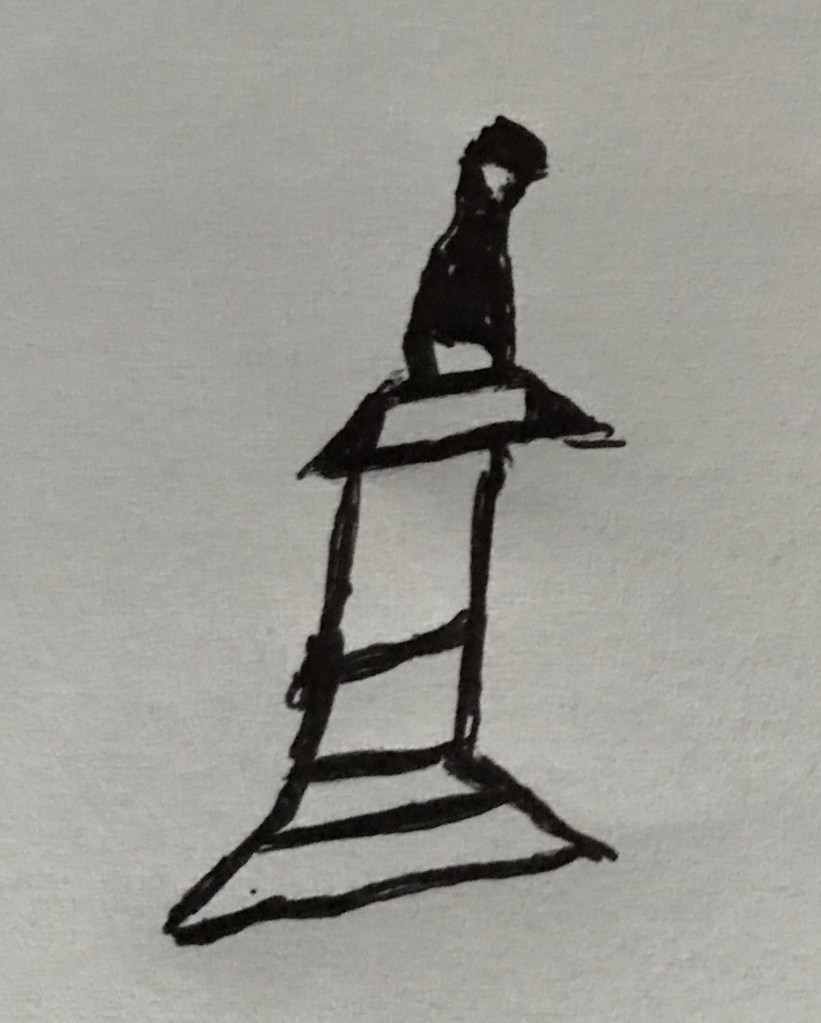
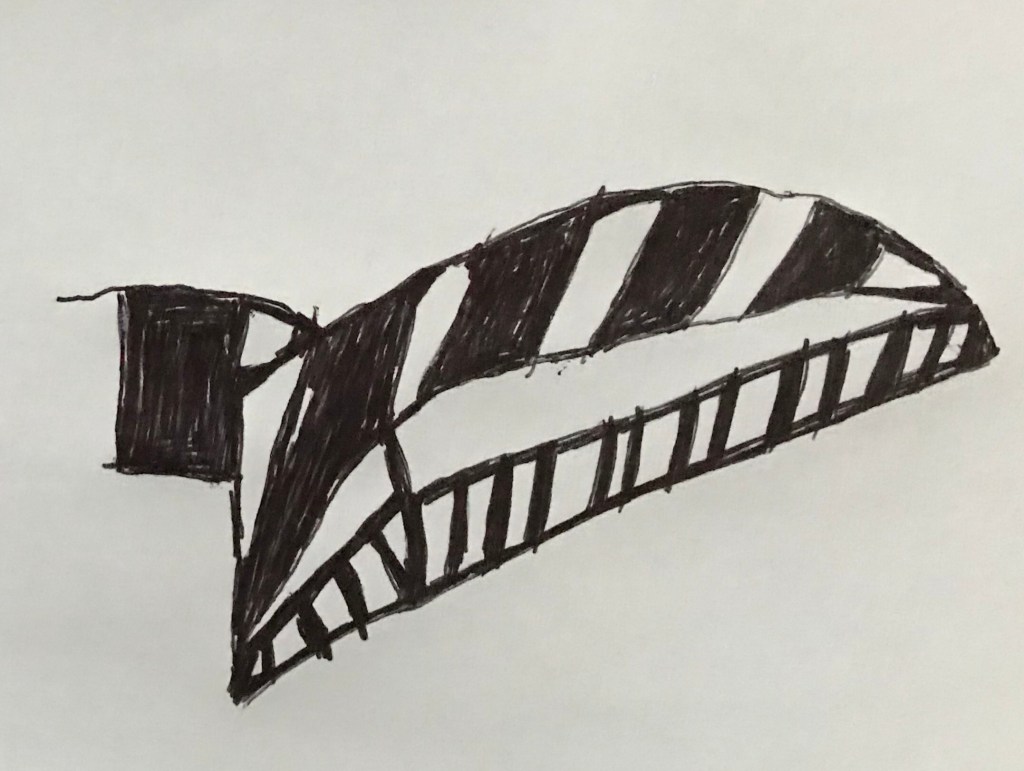
The Borough Engineer brought 16 submitted designs to the 15 May 1922 meeting. Two designs were selected – one by Messrs. Wright and Sons Limited of Bradford; and the other by Messrs. R.L Bolton and Son of Cheltenham. The Committee also wanted a third design in the form of another Cross, so the decision was taken to ask Messrs. Kelly of Bradford and Messrs. Scott of Dewsbury to resubmit designs so one of these crosses could also be considered. The rough minutes of the meeting contained rudimentary doodles of the designs. I have reproduced these below. Yes, my sketches are bad. But in my defence they are very good replicas of those in the draft minutes!
Copies of the War Memorial Sub-Committee Memorial Doodles (and I’m still not convinced the bottom one was a design or absent-minded doodling) – by Jane Roberts
Now thoughts turned to names on the Memorial. The Town Clerk was asked to compile a nucleus list consisting of name, rank and unit. This could then be circulated amongst churches, clubs etc, and checked with information from official bodies like the War Pensions Department and Post Office. Once this nucleus list was established, it would be publicly available for consultation in the Town Hall and library, and advertised in the local papers.
June 1922 came and went. The War Memorial Sub-Committee failed to reach a design decision. More designs had come in. More were sought. And the Town Clerk and Borough Surveyor were instructed to obtain photographs of monuments already erected in other towns.
These photographs were presented on the 30 August 1922 War Memorial Sub-Committee meeting. Finally two designs were settled on. As in May it was the design by Bradford’s Messrs Wright and Sons Ltd, at a cost of £2,000. This was a figure on a pedestal. However, the Sub-Committee decided to ask this firm to submit an alternative design for the figure. The second design selected was by Mr L.T. Moore of London. This was a tall pillar on a plinth surmounted by a Cross. Lions were depicted on the sketch, and the Sub-Committee wanted an amended design without the lions.
The Memorial site and designs now went before the full War Memorial Committee on 8 September 1922. They overwhelmingly concurred that the Market Estate site was preferable to the park, 20 votes to 4, with one abstention. But the designs attracted more debate.
The Borough Surveyor outlined the design of Messrs Wright and Sons Ltd. In a pose symbolic of attendance at a funeral, a bronze soldier stood on a Bolton Wood Stone pedestal. But some were dissatisfied with a soldier. Alternate suggestions bandied about included a Winged Figure for Victory. Another suggestion was for a Sailor, a Soldier and an Airman; and taking this combined services theme a step further, a single symbolic figure representing all three services was mooted. But the line was held. This bronze soldier was the design decided upon by the Sub-Committee, and it was this design which the full Committee had to consider.
Mr L. T. Moore‘s design was similarly debated by the Committee. Rather than lions surrounding the cross, could it not be the figure from the first design, came the suggestion? It was confirmed that the Sub-Committee agreed that the lions be removed. The War Memorial Committee choice here was therefore the cross with or without figures.
Finally it came to a vote. With 23 in favour against nil, and two abstentions, Messers Wright & Sons Ltd Soldier design was the one chosen at Sub-Committee stage for Batley’s War Memorial.
The next step was the approval of these decisions by the General Purposes Committee of the Town Council (28 September 1922), and sign-off by the Town Council itself (5 October). Both passed as stood – the Market Hill area of the Market Estate, and Messers Wright & Sons Ltd were confirmed. Preparations were now taken to enclose and lay out a portion of the Market Estate for the Monument, and to inform the people of Batley.
The town’s meeting took place on 30 November 1922. Even here there was a last-ditch unsuccessful attempt to force a reconsideration of the the Market Estate location for the Memorial. But the plans were finally signed off here, with only three dissentients.
The town’s meeting also saw the newly-elected Mayor, Councillor Hamilton Crothers, formally launch the Mayor’s Fund-Raising Appeal to pay for the Memorial. At the meeting it was announced that an initial £750 had been donated equally by Messrs G. & J. Stubley, Messrs J., T. & J. Taylor Ltd, and Mrs Adeline Stubley. By 1 August 1923 the Mayor’s Appeal stood at £2,248 7s and 6d, with donations coming in from across the town, way in excess of the amount needed.
Batley War Memorial in Summer – Photo by Jane Roberts
In parallel to the fund-raising appeal, collecting the names of the Fallen moved onto the next phase. In February 1923 forms were issued to householders in the Borough asking for the particulars of any relative who was killed or whose death was certified as due to wounds received, or disease contracted in the War. In addition to this house-to-house canvass, names were obtained through the War Pensions Department, Clubs, Institutes, Religious bodies etc. Information poured in, on officially distributive pro formas, in various books placed in the municipal buildings, and by post. Multiple clubs, organisations and churches also submitted names. All this information was used to produce lists, with numerous corrections and iterations leading to multiple versions and refinements. A format of the list was also published in order to receive further names, or any corrections (including spellings). This was an enormous task, in a time when information had to be cross-checked, compared, collated, sorted and organised manually – then typewritten.
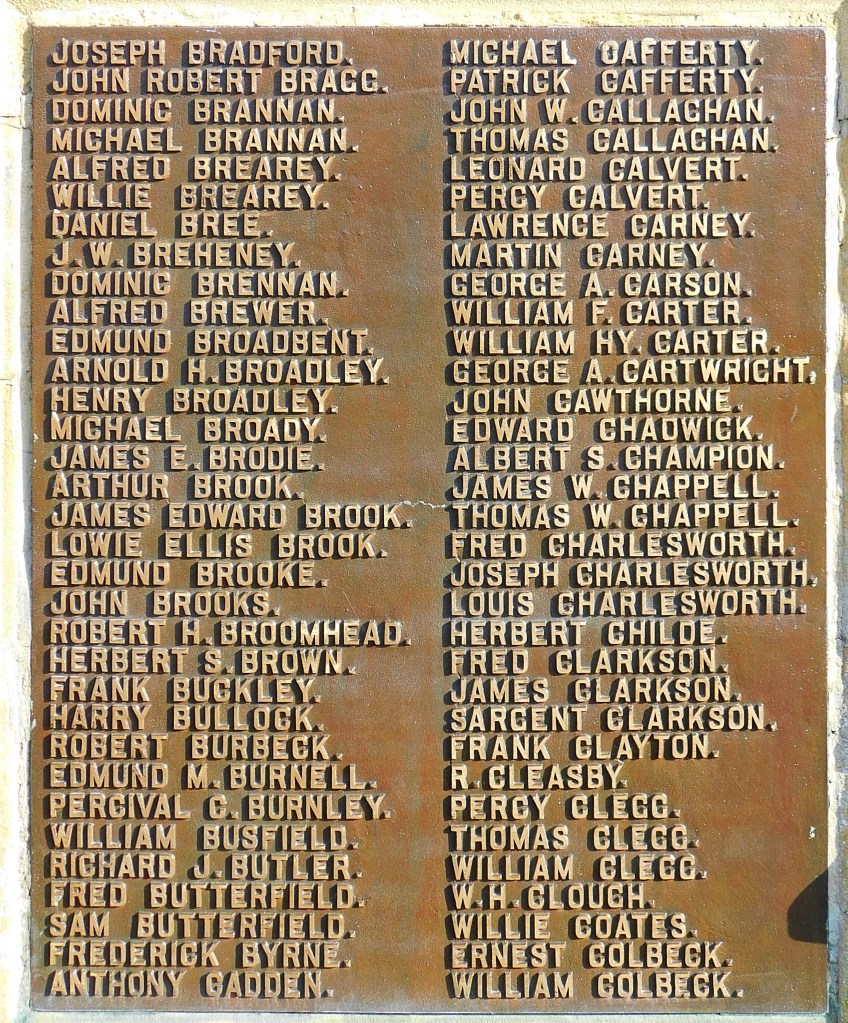
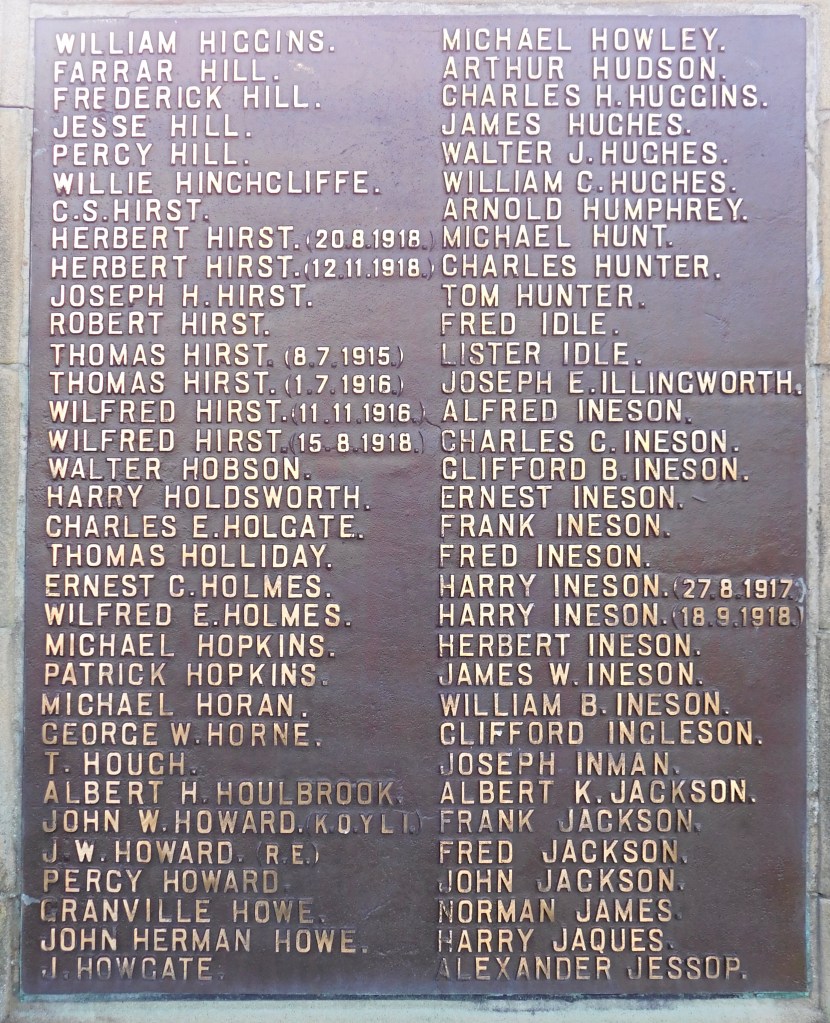
By August 1923 a satisfactory draft list showing rank, name, regiment and date of death was produced. This list – 782 names in total – was forwarded to the chosen contractor, Messrs Wright and Sons Ltd of Bradford, for them to prepare the twelve bronze tablets for the Memorial. These tablets would include the men’s Christian and surnames, organised in alphabetical surname order.
Three of the War Memorial Name Tablets – Photo by Jane Roberts
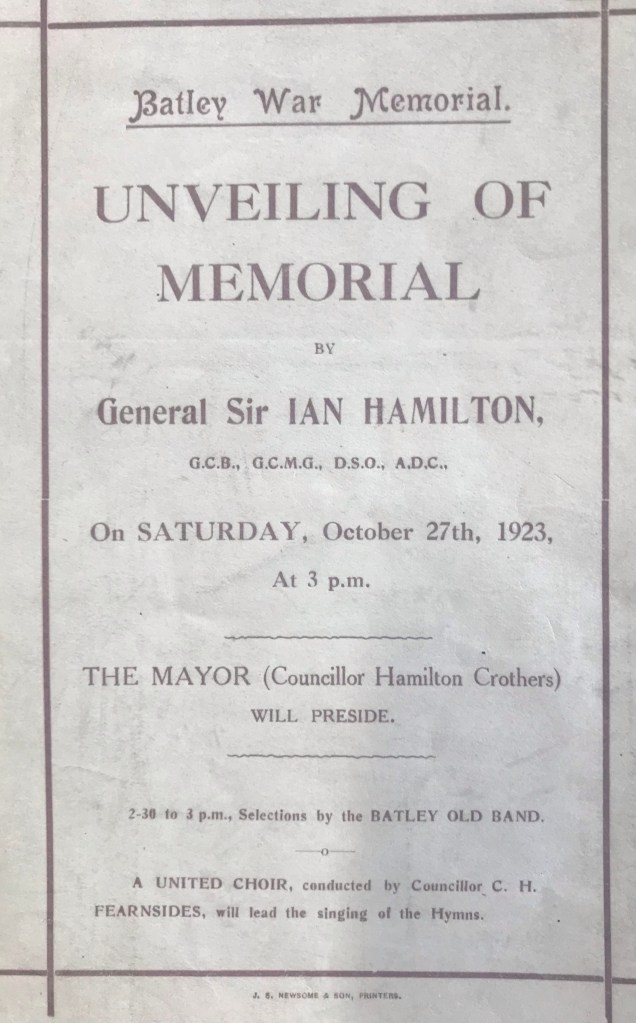
On 6 September 1923 the Sub-Committee responsible for the unveiling of the War Memorial met formally for the first time. They had not long to make arrangements for the event, which they set for 27 October 1923. In terms of who would perform the unveiling, the Sub-Committee tasked the Mayor with approaching either Field Marshal Earl Haig, Admiral Earl Beatty, General Ian Hamilton or General Harrington, G.O.C. Northern Command
General Sir Ian Hamilton, commander at Gallipoli, had retired from the Army in 1920. But he subsequently took a keen interest in the work of the British Legion, and he was in great demand as a speaker for veteran organisations. Despite the very short notice he agreed to perform the unveiling of Batley’s War Memorial.
And yet, even at this late stage, there had been no decision as to the War Memorial inscription. Those discussions continued during September. By early October the sculptors finally received confirmation that the inscription would be:
In grateful memory of the men of this town who fell in the Great War 1914- 1918.
Batley War Memorial Inscription – Photo by Jane Roberts
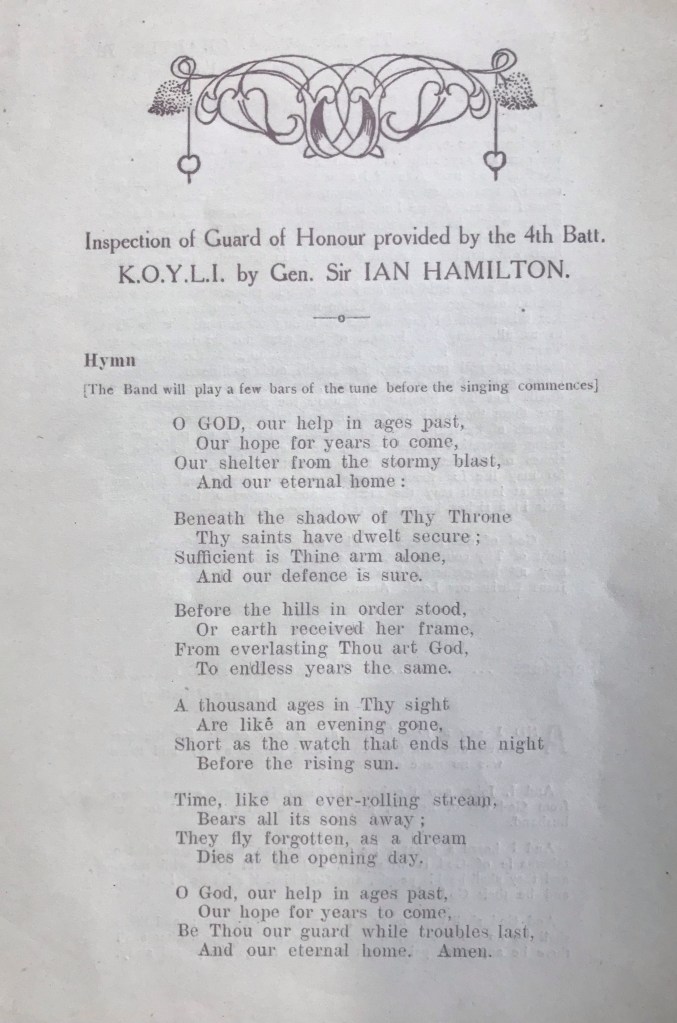
The War Memorial unveiling ceremony commenced at 3pm on 27 October 1923. General Hamilton, in his short address, said it was not enough to raise a memorial to the nearly 800 dead. The people must take their part to prevent the world entering upon another period of war, and to save their children from suffering as they themselves had suffered. The inscription on the War Memorial today, shows General Hamilton’s hope did not come to pass.
The images below are from the official programme for the ceremony.
At the wreath-laying ceremony which followed the unveiling, nearly one hundred relatives of the fallen men laid flowers at the foot of the Memorial.
Batley finally had its War Memorial.
Unveiling of Batley War Memorial
So what of the other proposals for the Mayor’s War Memorial Fund? As explained earlier, there were originally three:
The now fulfilled erection of a monument;
The augmenting of the pensions received by widows and other dependents of men from the Borough who fell – an aim which was quickly dropped; and
Contributing to the Batley Hospital Extension scheme.
From 1924 onwards the move was made to ensure that the surplus of the Mayor’s Appeal Fund be devoted to the urgently needed hospital extension “in such a manner as to help perpetuate the memory of those who fell in the Great War.”
In fact, the Mayor’s War Memorial Appeal Fund had been so well-supported by the folk of Batley that £750 was duly handed to the Board of Batley Hospital on 30 April 1926. And there was still a surplus available. Around £100 of this was earmarked for a suitable Memorial Plaque for the hospital to commemorate the gift from the War Memorial Fund. It was mooted that this could possibly be in the new entrance hall of the hospital, but the final decision as to location would be for the Hospital Board. This £136 surplus was still under discussion in 1934.
In 1935 it was resolved at last. A Memorial plaque would definitely be erected. Two choices for wording were considered. The final decision was:
To assist in perpetuating the memory of the men of Batley who fell in the Great War 1914-1918 whose names are recorded on the town’s War Memorial the sum of £862 was given from the War Memorial Fund towards the cost of the extension of this Hospital begun 1924, completed 1928.
There was one other tangible form of remembrance. In 1925 the War Memorial Committee decided to seek tenders for a Memorial Tablet Frame containing the names of Batley’s Fallen. Despite these tenders being commissioned and received in 1925, nothing happened for almost another ten years. Finally in 1935 another set of tenders were requested. The specification decided upon was for two English Oak Mural Tablets, encasing behind glass parchment scrolls containing the names of the 782 fallen. These were to be displayed inside Batley Library. The 1935 tender request was quite specific that this was to be English Oak. Perhaps this was a throwback to 1925 when one of the aborted tenders, from Harry Senior, cabinet maker of Daisy Hill, Dewsbury, showing an astounding lack of awareness, stated his quote was for frames of PRIME QUALITY AUSTRIAN OAK ! (And yes, his quote did have this phrase in capital letters).
Messrs. Osborn Hoyle Ltd, Engravers, Die Sinkers and Stamp Makers of 17 Bond Street, Dewsbury finally won the tender, at a cost of £14 4s for the frames, and £7 10s for the 12 parchment scrolls and glass. There was also an additional cost of supplying and fixing 108 bronze letters on the oak frames, amounting to £4 1s 1d. This work was all complete by August 1935. This firm also won the contract for the Hospital Memorial plaque.
The Oak Memorial Tablets are now in Batley Town Hall.
Oak Memorial Tablets in Batley Town Hall – photos by Jane Roberts
But does anyone recall seeing the bronze Memorial Plaque in Batley Hospital, or know what became of it since the hospital’s closure? It did briefly resurface back in 2014, but I’ve not found out what happened after that. I’ve not noticed it in Batley Town Hall, but since researching the War Memorial history I’ve been unable to go down to check. It may be it is still in storage somewhere. I really do hope it can go on display once more at some point. After all, it is part of our town’s history, and it is a tribute to our ancestors’ efforts to commemorate our town’s Great War Fallen in perpetuity.
Batley Hospital Plaque, on Display at Dewsbury Town Hall in around 2014/15 – Photo donated and permission granted to use in this blog
Finally, this Remembrance Sunday will not be like others because of the pandemic restrictions. If you have not been able to buy your usual poppy locally this year, and do feel able to donate to the Royal British Legion, here is the link to the Poppy Appeal 2020.
Batley War Memorial in Autumn – Photo by Jane Roberts
Postscript: Finally a big thank you for the donations already received to keep this website going.
The website has always been free to use, but it does cost me money to operate. In the current difficult economic climate I am considering if I can continue to afford to keep running it as a free resource, especially as I have to balance the research time against work commitments.
If you have enjoyed reading the various pieces, and would like to make a donation towards keeping the website up and running in its current open access format, it would be very much appreciated.
Please click here to be taken to the PayPal donation link. By making a donation you will be helping to keep the website online and freely available for all.
Thank you.
Footnotes: • I am gradually uploading mini-biographies for the St Mary of the Angels Catholic Church parishioners on the One-Place Study section of my website. The list of St Mary’s War Memorial men is here, with links to the biographies. • For more information about those on the War Memorial see Batley’s Roll of Honour;
As a lifelong Healey, Batley resident, a treasured piece of the village’s history which I own is a commemorative mug. It is linked to Healey’s peace celebrations, which marked the end of the Great War.
Healey Peace Celebrations Commemorative Beaker
Given it is the Remembrance period, it seems a fitting time to share the history behind the commemorative mug, or beaker as it was termed at the time.
If you have Healey, or Batley, links you may recognise some of the names or the streets mentioned in the Healey Peace Festival story. I certainly do. Many of the surnames were familiar ones to me growing up in the area over half a century later. And the procession passed along the streets of my childhood and youth, and by my current home.
First of all to set the scene. Even before the signing of the Treaty of Versailles on 28 June 1919, the Treaty which was to officially end the war with Germany, the country was gearing up to celebrate. The government was keen that any local festivities should be put on hold for a collective celebration of peace by the entire country. Their initial plans were for national celebrations over four days at the beginning of August, to coincide with the summer Bank Holiday on 4 August. But this was reduced to one day of simultaneous celebrations across the Empire on 19 July, with King George V proclaiming the day would be a Bank Holiday and Public Holiday throughout the United Kingdom.
But even though 19 July 1919 was the official national ‘Peace Day’ this did not put a stop to the extension of local celebrations, in line with initial plans, over the August Bank Holiday weekend.
And this was the case in Healey, Batley, which held its Peace Festival on Saturday 2 August 1919
The Batley News of 9 August 1919 reported Healey’s celebrations as follows. Note spelling and punctuation is as per the article, and some of the print is not legible:
HEALEY’S PEACE FESTIVAL Brilliant and Entertaining Spectacle. Glorious Feast for the Children. Fancy Costumes and Sports Results.
There was an atmosphere of joy in Healey on Saturday, when the little village threw itself heart and soul into Peace rejoicing. The streets were gaily decorated with flags and bunting, and several of the residents had transformed the appearance of their houses into that of fairy dwellings. Flags were flying from the windows, and the fronts of the houses were a mass of red, white and blue.
When the procession assembled in White Lee Road at two o’clock the weather was somewhat undecided, and it looked, indeed, as if the workers’ splendid efforts were going to be spoiled. Luckily, however, there were only one or two showers, and everything passed on beautifully. By 2.30 the procession was organised, and proceeded along White Lee Road, Healey Lane, Deighton Lane, Trafalgar Street, West Park Road, Healey Lane, to Mr. A. Oldroyd’s field (kindly lent for the occasion), where the children sang the National Anthem and “O God, our Help in ages past,” under the conductorship of Mr. J. H. Wagner.
Mr. W. T. Exley (President) walked at the head of a picturesque procession, and he was accompanied by a little girl dressed as Red Riding Hood, and a boy dressed as Boy Blue. Decorated bicycles and tricycles followed, some gaily attired in patriotic colours, and others covered with charming flowers, A [?]der in khaki was heartily applauded. He had built his machine to represent a tank, and with the guns projecting from the framework, the machine looked very warlike.
There was a blaze of colour amongst the boys and girls, who represented various Allied nations, including Japan, India, Spain and China. Several boys and girls were also attired in Scotch costumes. Britannia followed, and behind her was a decorated wagon containing young children. A novel and interesting group of children with dolls’ perambulators presented a pretty appearance. The little carriages were tastefully adorned with flowers and ribands. One of the turnouts was decorated as a Red Cross carrier.
Humorous characters followed, and after them came boys and girls in historical dresses, including courtiers, etc. John Bull was a striking figure, and succeeding a motor wagon load of children who seemed to enjoy the fun, was Liversedge Parish Church Boys’ Brigade drum and fife band, who were followed by pierrots and humorous characters, conspicuous amongst whom was an impersonator of Charlie Chaplin. One member of the procession represented the Kaiser. A competitor who caused much merriment wore a fireman’s hat and coat and a Scotch kilt, with khaki puttees. A woman dressed in red, white and blue material, and wheeling two rag dolls in a carriage, also raised roars of merriment.
The Prize-Winners.
Prizes were awarded for the three best competitors in all the classes, and the following were the awards:- Decorated bicycle or tricycle, for boys under 16. – 1, Albert Oldfield; 2, Fred Wadsworth; 3, Jos. Preston. Best dressed Allied girl, under 16. – 1, Dorothy Tattersfield; 2, Grace Auty; 3, Kathleen Blackburn. Best dressed Allied boy, under 16. – 1, Walter Senior; 2, Wm. J. Newsome; 3, Harold Tattersfield. Best child’s doll turnout, girls under 11. – 1, Kathleen Armitage; 2, F. M. Walker; 3, Florence Senior. Basket of flowers. – 1, Floris Robinson; 2, Esther Blackburn; 3, Kathleen Raine. Best dressed humorous boy under 16. – 1, Harold Boocock; 2, Herbert Auty; 3, James A. Illingworth. Best dressed historical boy under 16. – 1, Lawrence Smith; 2, Clifford Newsome; 3, Willie Sykes. Best dressed novel boy, under 16. – 1, Wilfred Bald[w]in; 2, Ernest Riley; 3, G. Tattersfield. Best dressed humorous girl under 16. – 1, Ivy Bailey. [No other names]. Best dressed historical girl under 16. – 1, Madge Barber; 2, Edna Bruce; 3, Barbara Tattersfield. Best dressed novel girl under 16. – 1, May King; 2, Lilian Trott; 3, May Swallow. Best dressed humorous gentleman. – 1, Mrs. Illingworth; [yes, it does say Mrs.] 2, Smith Senior; 3, Percy Riley. Best dressed humorous ladies. 1, Mr. Illingworth; [yes, it does say Mr.] 2, Mrs. Swallow; 3, Mary Fisher.
The judges, Messrs. J. F. Whitaker, A. Jowett and F. W. Gaunt, had a very difficult task to perform in selecting the winners owing to the keen competition, and both winners and losers merited high praise. The prizes in each class were of the value of 10s., 5s. And 2s. 6d.
After the judging, tea was provided in a large marquee for boys and girls under 16 who had taken part in the procession. Children who were unable to attend owing to sickness or employment will receive due consideration if their cases have been notified to the officials.
Interesting Sports.
In the evening sports, including flat races, sack races, skipping and three-legged races, were held, and suitable prizes given.
The winners were:-
60 Yards Flat Race, girls under 9. – 1 Olive Gibson, 2 Elsie Barber, 3 [?]y Sykes. 60 Yards Flat Race, boys under 9. – 1 Geo. Atkinson, 2 Fred Wadsworth, 3 Frank Pyatt. 80 Yards Flat Race, girls under 12. – 1 Alice Sykes, 2 Edna Bruce, 3 Elsie Lee. 80 Yards Flat Race, boys under 12. – 1 John Rhodes, 2 Laurence Blackburn, 3 Ronald Kershaw. Wheelbarrow Race, boys over 12. – 1 W. Parker and C. Preston, 2 [Blank] Flowers and Frank Scott, 3 [Blank] Gibson and J. Robinson. Potato Race, girls under 12. – 1 Gerty Parker, 2 Dorothy Wilkinson, 3 Elsie Lee. Three-legged Race, boys under 12. – 1 J. Rhodes and N. Scott, 2 Horace Greenald and R. Wharton, 3 Lawrence Blackburn and [Blank] Boocock. 80 Yards Skipping Race, girls under 12. – 1 Edna Bruce, 2 Elsie Lee, 3 Alice Sykes. 60 Yards Sack Race, boys under 12. – 1 Ralph Ward, 2 W. Baldwin, 3 John Rhodes. 100 Yards Flat Race, boys over 12. – 1 Geo. Tattersfield, 2 Clifford Preston, 3 M. Gibson. 100 Yards Skipping Race, girls over 12. – 1 Marion Barker, 2 Ivy Bailey, 3 Dorothy Tattersfield. 60 Yards Sack Race, boys over 12. – 1 Willie Parker, 2 Clifford Preston, 3 M. Gibson. 100 Yards Flat Race, girls over 12. – 1 Lilian Sykes, 2 Louise Robinson, 3 Marion Barker. Three-legged race, girls over 12. – 1 Muriel Pyatt and Lilian Trott, 2 Dorothy Sykes and Annie Autie, 3 May King and Rene Redfearn.
The children hugely enjoyed Professor Candler’s famous punch-and-judy show. There was also dancing round the Maypole by a number of children. Batley Old Band played for dancing. To complete an excellent day’s enjoyment there was a grand firework display after ten o’clock.
A beaker souvenir will be presented to each child under 16 resident in Healey, at an early date.
Hard-Working Officials.
The following are the officers of the committee, who worked hard for the success of the proceedings, along with others:- Messers. W. T. Exley (president), C. P. Tattersfield and J. A. Oldroyd (joint treasurers), and E. Bruce and H. G. Auty (joint secretaries). The officials on Saturday were: Chief marshall, Mr J. A. Blackburn; assistant marshall, Mr. Saml. Brearley; band, Mr. J. H. Wagner; decorated cycles, Mr. P. Ward; Allied girls (Mr. J. A. Blackburn (D.L); Allied boys, Mr. A. Newsome; child’s turnout, Mr. W. Whiteley; flower girls, Mr. Pinder; decorated wagon, Mr. F. Jowett; humorous boys, Mr. G. H. Wilson; historical boys, Mr. H. Haley; novel boys, Mr. G. Naylor; humorous girls, Mr. Colbeck, B. Barber; historical girls, Mr. H. Sykes; novel girls, Mr. A. Gaunt; motor waggon (children), Mr. F. Jowett; drum and Fife band, Messrs. Parkinson and W. T. Stone; adult gentlemen, Mr. J. Stone; adult ladies, Mr. C. H. Preston; stewards, Messrs. J. A. Tattersfield and J. W. Haigh; competitors’ stewards, Messrs. Battye, Pinder and Preston; bell men, Messrs. Cordingley and Bennett; prize stewards, Rev. Geo. Trippett and Mr. A, Oldroyd; handicappers, Messrs. E. Robinson and C. Buckley; starter, Mr. J. A. Blackburn (D.L.).
I must admit reading the article gave me an immense sense of pride in the Healey of my childhood. It even reminded me of the Queen’s Silver Jubilee Celebrations in 1977 at the now gone Harrison’s Social Club and fields on Healey Lane. Us children were given commemorative mugs then. Sadly I’m not sure what happened to mine.
But it is one of these antique 1919 Peace beakers that I have, presented to one of the Healey under 16s over a century ago. I’m not sure who owned it originally. But I will treasure it. And it will be handed on to future generations with Healey village links.










 Past To Present Genealogy