Tag Archives: family history

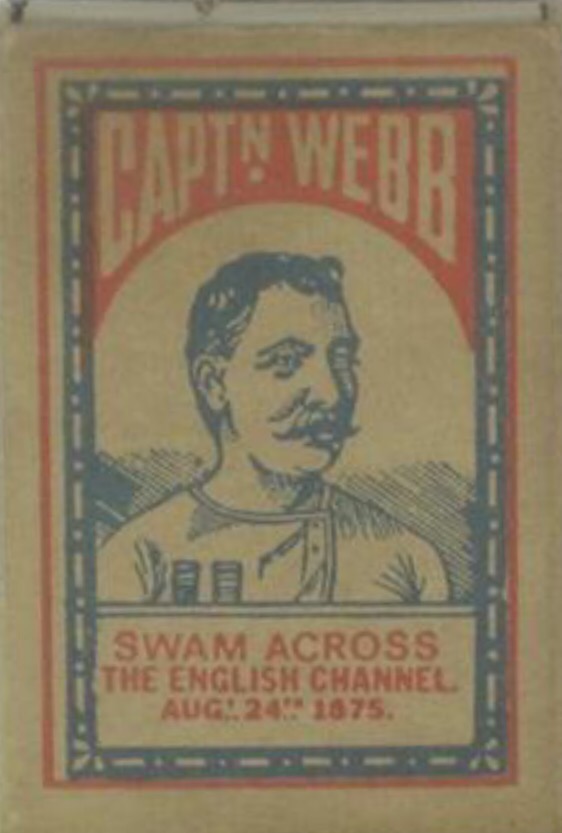
Shropshire, Staffordshire, Shrouds & Shoes: Striking a Light on the Captain Webb Connection

In Shropshire, Staffordshire, Shrouds & Shoes I said I’d start to piece together my husband’s family tree. The project was inspired by my mother-in-law. She was very enthusiastic about it and retained that enthusiasm throughout. But sadly, as her health deteriorated, I found it wiser to quietly drop my research. I found she was becoming so involved she could no longer distinguish between past and present, fact and false memory. An example was frantic phone calls and threats to summon the police in the middle of the night because she had time-travelled. She was convinced she was back in the 1950s. It turned out she’d dug out some old newspapers before going to bed, woke up in the early hours, started reading them then saw the date.   

Things reached crisis point at the beginning of December when she was admitted to hospital on a long-term basis. In hindsight her detention has been a blessing as we now have a definitive diagnosis, Alzheimer’s, and she is finally able to access the correct treatment. 

She is now is out of hospital, the illness has truly taken hold, and she is no longer has her own home. In the process of clearing it we discovered more family papers which I will go through in due course, once things have settled down.  
But initially they have solved one mystery: the Captain Webb connection. He of the English Channel swimming fame. Even as far back as the early 1990s my husband had insisted they were related. He wasn’t sure how. 

My preliminary research yielded no obvious link. There was a common surname. My husband’s great great grandmother was Mary Webb. She was born in Adbaston/Flashbrook area of Staffordshire in around 1830. She married Joseph Haynes at Aston in Edgmond, Shropshire, on 10 February 1859. Joseph founded a wheelwrights business in Stone, Staffordshire. But I could see no link. However, my mother-in-law’s papers seemed to indicate Mary Webb was the supposed connection.  

In her possession was a “Nostalgia Notebook” article from the “Staffordshire Newsletter” dated 28 October 2004. It states that Joseph’s wife “Mary was believed to be the sister of Captain Webb…..”  

Captain Matthew Webb was the son of surgeon Matthew Webb and his wife Sarah Cartwright Garbitt. They married in 1845. Matthew was a bachelor, aged around 32, at the time of his marriage. Their second son, Matthew of the swimming fame, was born in Dawley, Shropshire in around 1848. He was baptised in Dawley Parish Church on 9 March 1848 and the entry is annotated with the words “Swam the English Channel August 25 1875”. 

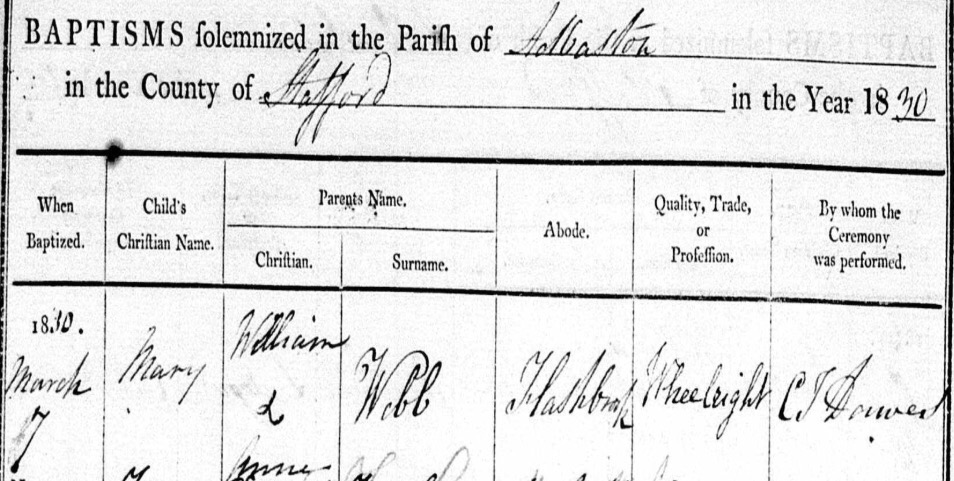
In contrast Mary Webb’s baptism took place on 7 March 1830 at Adbaston Parish Church, Staffordshire. She was the daughter of William Webb, a wheelwright, and his wife Ann.  

Baptism entry for Mary Webb

 Her father’s name is confirmed on her marriage certificate. It is also detailed in various newspaper marriage announcement columns, including the “Wolverhampton Chronicle and Staffordshire Advertiser” of 16 February 1859. This goes on to say for 12 years she had been a valuable and faithful servant for William Sillitoe Esq., The Bridge, Newport. The 1851 census shows her as a house servant in this household. 

“Wolverhampton Chronicle & Staffordshire Advertiser” marriage announcement for Joseph Haynes & Mary Webb

 
I’m not ruling out a Webb connection further back. But if the link was supposed to be as stated, that my husband’s great great grandmother was the sister of Matthew Webb, it is false. As a result, my husband’s claim to family history fame seems to be on very dodgy ground with the flickering match flames rapidly extinguishing. And the Webb family have one bunch fewer kinsfolk.    
So be prepared when you start out looking into your family tree – you may end up disappointed and learning things you’d rather be oblivious to! 

Sources

  • Find My Past – newspapers, censuses & Shropshire & Staffordshire Parish Registers
  • Staffordshire Newsletter” – 28 October 2004

Obsolete Mayo Family History Website: Wayback Machine to the Rescue

In a couple of my blog posts (My County Mayo Family and The National Library of Ireland Catholic Parish Registers Website and Parish Registers: Brick Wall Breakers and Mystery Creators) I’ve referred to one of my much loved, and missed, websites. It was a County Mayo baptism and marriage transcript site, EastMayo.org, launched in 2005. Mainly using LDS films, it’s aim was to provide a free facility to researchers of family history in East Mayo. It concentrated on “that area of County Mayo encompassed by the Roscommon border and the towns of Charlestown, Boholo, Swinford, Kiltimagh, Knock, Claremorris and Ballindine”.  

 The transcripts included:

  • Aghamore 1864-1883 and Knock 1869-1905 Baptisms; 
  • Aghamore Marriages 1864-1882; 
  • Claremorris Civil Registrations 1872-1875; 
  • Claremorris Marriages 1806-1890 and Baptisms 1835-1912; 
  • Kilconduff Marriages 1846-1878; 
  • Kilmovee Baptisms 1854-1910 and 1881-1913; 
  • Kilmovee Marriages; 
  • Kilmovee Marriages Out of Parish; 
  • Knock Marriages 1883-1943 

With generations of my family from the Catholic Parish of Kilmovee, this site was a Godsend. I was disappointed when it disappeared. Although in 2015 the National Library of Ireland launched its free Catholic Parish Register website plugging some of the gap, the EastMayo.org had a broader date range for its limited number of Parishes.   

And there were some extras such as the fabulous “Kilmovee Marriages Out of Parish” transcriptions. Basically, if someone married out of Parish, the priest in the Parish the marriage took place contacted the priest in the person’s baptismal Parish informing them. 

I’ve seen something similar in the Batley St Mary’s registers. These contained such letters slipped between the pages. Indeed in this Parish, the priests went so far as to annotate the person’s baptismal entry with their subsequent marriage details, whether the marriage took place in or out of Parish.  

The Kilmovee transcripts covered marriages in the first part of the 20th Century, with marriages taking place within Ireland and beyond. Although only a snapshot of around 30 years, the Batley marriages of my grandpa (John Callaghan) and his brother (Martin Callaghan) are captured in them. 

An example of the global range of these marriages is seen in the initial transcriptions. They included former Kilmovee parishioners marrying as far afield as Glasgow, Batley, Orange – New York, Stockport, Congleton, Manchester, Doncaster, Accrington, Huddersfield, Charlestown, St Helens, Jersey City – USA and Silver Falls, Canada.  

Information on these Out of Parish marriages varied, but could contain: 

  • spouse; 
  • baptismal date (a bit of creativity here – most of the dates given seem to be approximate); 
  • parental details, with sometimes the mother’s maiden name; 
  • date and place of marriage (church and location);
  • witnesses; 
  • officiating priest; 
  • age; and  
  • if the person is widowed. 

The information provided linked your ancestor to a Parish. It also enabled you to track back further, for example by looking at the baptism transcripts.  

Yes, there were acknowledged transcription difficulties, but it was a wonderful resource.  

An updated EastMayo.org site domain name still exists with links to Irish-related websites, though it is not the original site with all that wonderfully name-rich information. But all is not lost. The original, as it stood between 2006-2011, can still be accessed via the Internet Archive Wayback Machine. 

And I’ll end with another really useful County Mayo website, which can be found here. Besides current day information, including where to stay and things to do, there is information about the area’s history, geography and culture generally as well as that of individual towns and villages. There is also a message board which may be helpful for those with Mayo roots.

Education, Education, Education: My Family History Learning 

My blogging output may decrease over the next few weeks as I’ve scheduled some time for learning.

On 23 January I started my latest Pharos Tutors online genealogy course, “Searching for Wills and Administrations in England and Wales”.  I’ve completed several Pharos courses and find this online learning method works well for me, fitting around work and family commitments. This will be my final module in their Family History Skills & Strategies (Intermediate) with Certificate programme. The explanation about how these certificate courses work is here.    
I’ve also booked three (free) National Archives webinars scheduled for March. These are:

I participated in their 1939 Register webinar at the end of 2015. It was really informative and the technology was easy to grasp worked well, prompting me to book more. So I’m converted to this form of learning. This, and previous webinars, can be found online. Their programme of events is here.

And to complete my latest foray into the world of family history education I’ve enrolled on a  FutureLearn course, “Genealogy: Researching your Family Tree”. This again is an online course, running for six weeks with a time commitment of around four hours per week. The course is a University of Strathclyde one, so I have high hopes.

The course description is to:

……. help you develop an understanding of the basic genealogy techniques and how to communicate your family history. We will consider how to effectively find and analyse sources and explore the potential of DNA testing as applied to genealogy. We’ll help you add historical context to your family history and discuss how to record and communicate research findings in a clear fashion”.

I’m particularly interested in the DNA angle. Hopefully it will stimulate me to return to my stalled genetic genealogy journey, referred to in three blog posts from last year:

This will be my first FutureLearn course, so I’m quite interested to find out how it works and if the learning style suits me as they have a number of other courses I’d be very interested in.

So the “keeping informed” element of my genealogy New Year’s Resolutions  is progressing nicely.

I Left it too Late: Batley’s Greenhill Mills Destroyed

Thank goodness no-one died, but even so I am feeling quite emotional about this. On 14 January a massive fire ripped through Greenhill Mills, Grange Road, Batley razing it to the ground.  

Apart for the sadness for those who will have lost their jobs, it was a place very much associated with an ancestor, Jesse Hill, who died in WW1: the ancestor I have spent most time researching. 

That connection has now gone, wiped out in a matter of hours. 

The firm Jesse Hill worked for, Wrigley & Parker, went into liquidation in the late 1920’s and the mill was sold. But it was still the same building. 

The mill was only down the road from me. I kept meaning to photograph it but I never got round to it. And I never made the effort to see inside, walk on the wood floors, touch the stonework. I know that sounds odd, perhaps it’s a family historian thing. 

Unlike many other places connected with my family history, because it was on my doorstop I didn’t have to make a special trip. It was there, I’d do it one day, no rush. A Victorian structure, still being used. It wasn’t like it would disappear overnight…..or so I thought.  

Following the inferno of 14 January, that’s exactly what happened.   

Not sparing the time to take that handful of photographs to record Jesse Hill’s workplace is something I now very much regret. As is never seeing the interior. It’s example of how we take for granted our local and family history.  

So a lesson learned the hard way. Don’t put off the chance to visit a family history connected location; don’t put off talking to family to record memories. Because one day you’ll wake up and realise that chance has gone. 

This is the only photo I took – too late.  

The remains of Greenhill Mills

 
Neither does Jesse Hill’s Spurr Street home exist. 

Spurr Street, Batley

Top Ten Genealogy/Family History Books by a Self-Confessed Bookworm

Tsundoku” – the Japanese word for buying books and letting them pile up unread. Yes I’m guilty of that. But I also have piles of read books because I don’t have enough bookshelf space, despite buying yet another one last year to accommodate my burgeoning genealogy and WW1 book collection. I return to these books time and time again for pleasure and my research (interchangeable, because I get enjoyment from research).   

Part of my Book Collection

 Trying to narrow it down to my top ten go-to books has been a really difficult decision because it depends on which aspect of research I’m concentrating. Some such as the handy little Gibson Guides covering topics from Militia Lists, to Hearth Tax and Probate Jurisdictions are invaluable but very specific. I wanted a broader range of topics in my selection.

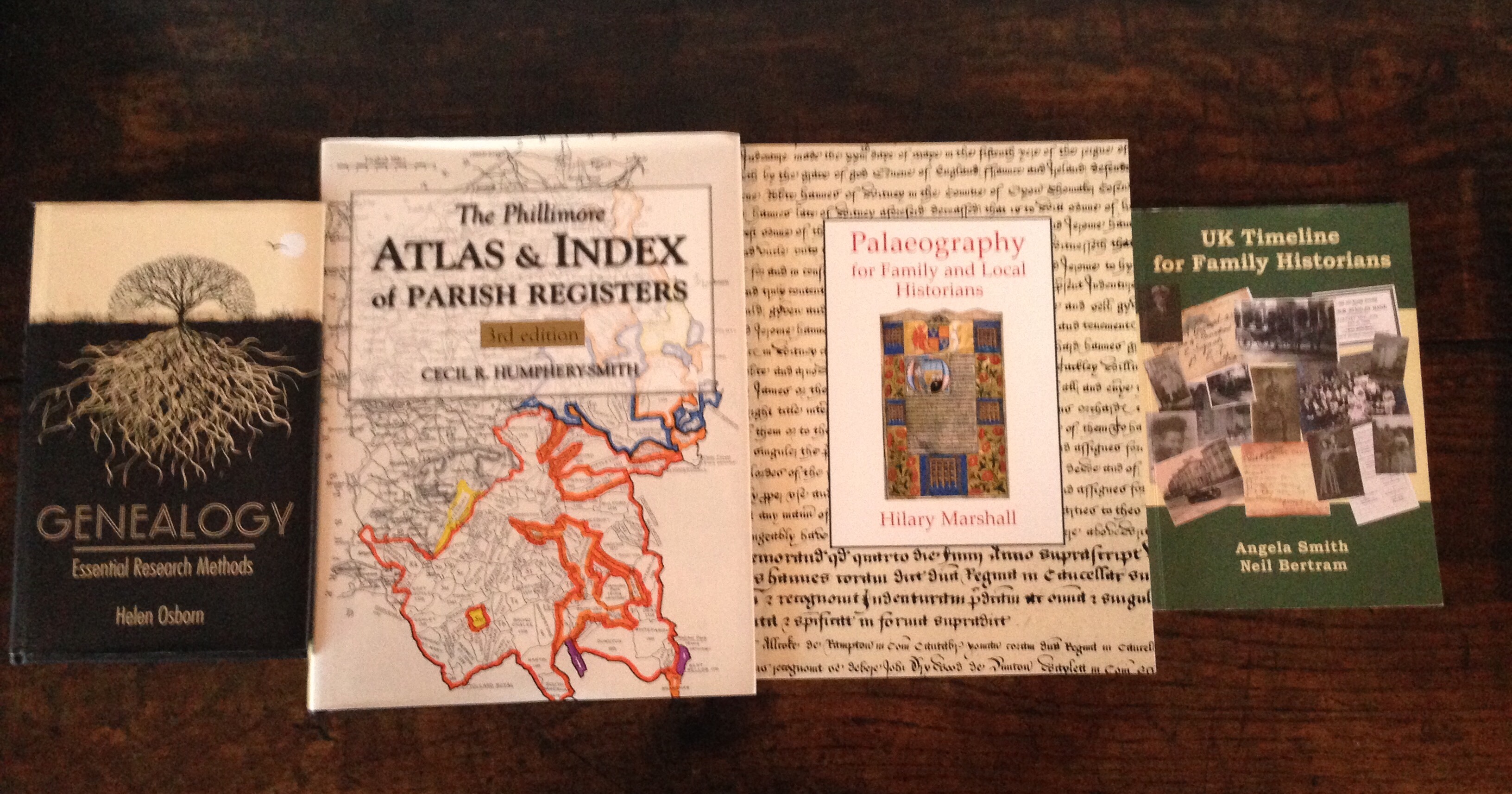
So in the end I’ve gone for a mixture of general reference and more specialised books, including some tailored to my own family history interests. Here they are, in no particular order: 

  • Ancestral Trails: The Complete Guide to British Genealogy and Family History” – Mark Herber. Exactly as described in the title. It’s my definitive reference book, written in a easy-to-read style and jam-packed with information. A book I couldn’t do without.
  • The Dictionary of Genealogy” – Terrick V H FitzHugh. An alphabetical glossary of terms. A quick reference source to dip into.
  • Tracing your Ancestors in the National Archives: The Website and Beyond” – Amanda Bevan. An in-depth guide which clearly set outs and explains The National Archives series of records. It is indeed “the biggest and best guide to The National Archives”  
  • The Phillimore Atlas and Index of Parish Registers” – edited by Cecil R Humphrey-Smith. Although this might not be for everyone because the information is available on the Internet, I find it invaluable having everything about pre-1832 parishes at county-level in one place, juxtaposed with the topographical county map. There is a comprehensive index of the parishes complete with dates of registers. The Ecclesiastical and Peculiar Jurisdictions are also included. It covers England, Scotland and Wales. Though for those with poor eyesight, a magnifying glass to see the maps in detail is advisable!
  • UK Timeline for Family Historians” – Angela Smith & Neil Bertram. Provides a timeline for family historians setting genealogical events and resources into a wider historical context. It’s not exhaustive but it is a really useful quick, basic reference book.
  • Genealogy – Essential Research Methods” – Helen Osborn. This is a different type of book. It is a detailed, well laid out reference for problem-solving research strategies to help break down brick walls. Some excellent advice on research methodology.
  • Palaeography for Family and Local Historians” – Hilary Marshall. I think it is essential to have a book about palaeography, abbreviations and Latin to help with deciphering old handwriting and language. I have a number all of which I use to varying degrees, so it was difficult to chose one. But in the end I went for this comprehensive book. It has the standard characteristics of letters, abbreviations and a Latin vocabulary. But it also includes copies of original documents accompanied by the transcript, translation, a description and any notable features of the script. So everything in one book.  
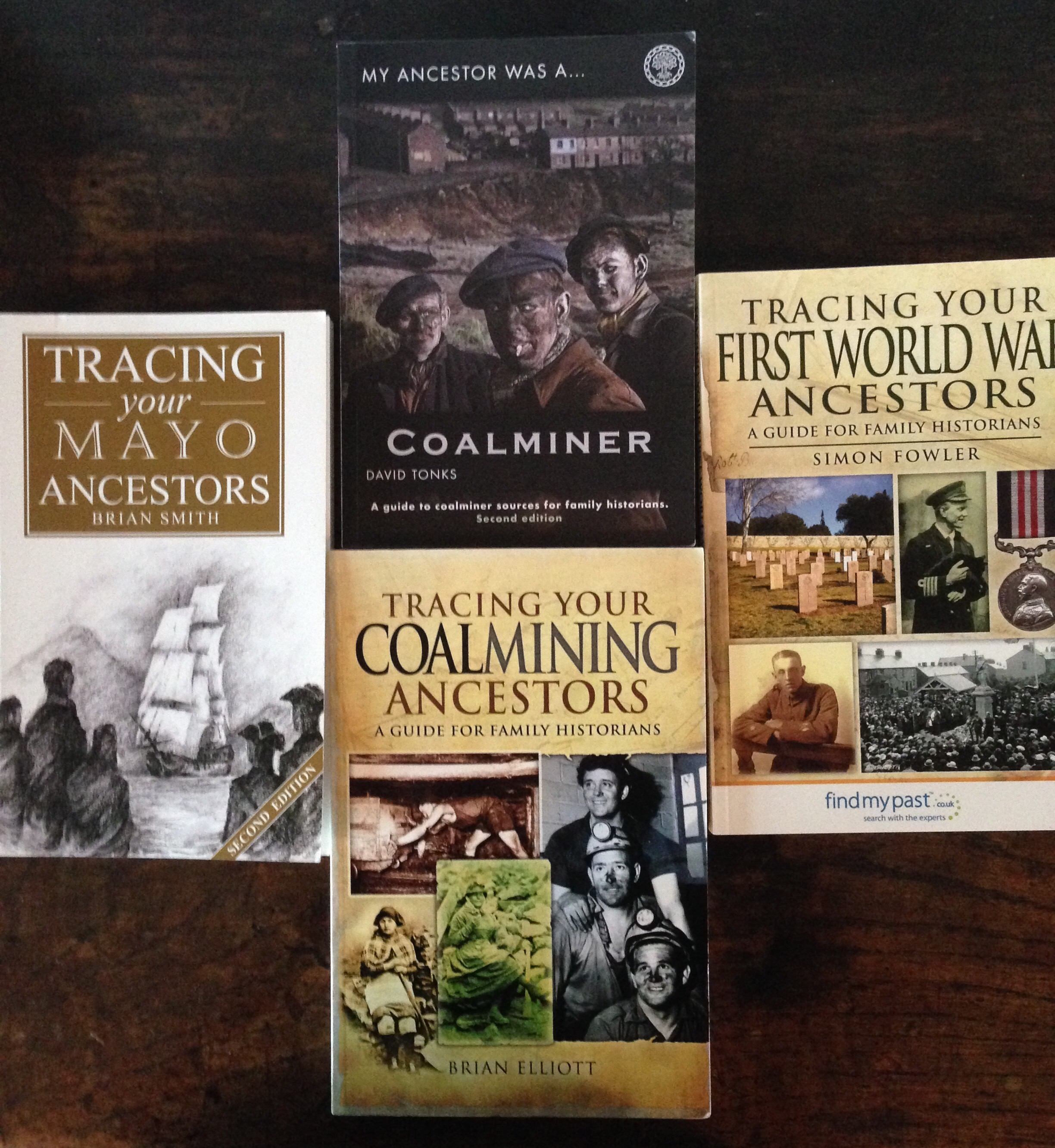
  • Tracing your Mayo Ancestors” – Brian Smith. I have a significant contingent of Irish ancestors. I agonised about which Irish ancestry book to include in my list. I was torn between this and John Grenham’s “Tracing Your Irish Ancestors” covering the whole of the country. But as, so far, all my ancestors are from County Mayo I went for a book focusing purely on the records for this County. There are other County books in this series of Flyleaf Press publications.
  • My Ancestor was a Coalminer: A Guide to Coalminer Sources for Family Historians”  – David Tonks. I love the SoG “My Ancestor was A…..” series of books, alongside Pen & Sword’s “Tracing Your Ancestor” series. My ancestors were predominantly coalminers, so for me a coal-mining family history research book is essential. I’ve included this one for the comprehensive pointer to various coal-mining sources. But I could have equally chosen Pen & Sword’s very informative and generally more detailed “Tracing Your Coalmining Ancestors: A Guide for Family Historians” by Brian Elliott (I’ve cheated though and  included this book in my final picture). However the deciding factor was my final choice, another Pen & Sword publication.
  • Tracing Your First World War Ancestors” – Simon Fowler. First World War ancestry is another one of my particular interests, having researched the 76 men on my local church War Memorial, St Mary of the Angels RC Church, Batley. I have a number of books about military research. But this is a good basic introduction covering the full range of those involved in the conflict, including women and civilians at war.  

To keep a track of my books I keep a A-Z by author index of them all. I make sure I take to any family history fairs and events so, in theory, I won’t duplicate purchases; and even if I can’t immediately spot a book on my over-crowded bookshelves, I know it’s there somewhere!

If you have tips for essential family history books please feel free to share them. It’s great to hear about key books, whether you are beginner to family history research or more experienced.

January Sale: Huddersfield & District Family History Society Publications

A proper January sale for me. Not clothes or household goods. But Parish Register index booklets.

Many of my ancestors are from the area of West Yorkshire covered by the Huddersfield & District Family History Society (FHS). So naturally this is one of the societies I’m a member of. This month they are reducing the price of their Register Transcription booklets to £1.00 and CDs to £5.00. Here is their Publication Page link.

img_0310

A Selection of my HDFHS Index Booklets

Although the Ancestry West Riding Parish Register collection is wonderful, and nothing can beat a visit to the local Archives, I must admit to a strong attachment to these index booklets and the hard work of all the FHS transcribers they represent. So in part this post is a shout out for all the fantastic work they do.

Yes, I do check my ancestral finds against the Registers for the rare, but inevitable, transcription error. And I do enjoy  looking through the Registers. But I still love the physical comfort and solidity of a book(let), not to mention the eye-relief especially when browsing generally.

And despite the big push by genealogy companies and the impression they sometimes give, not everything is available on the Internet…including some of the Parishes covered by these indexes.

I’m fortunate to live in the same area of many of my ancestors, so I can easily visit West Yorkshire Archives, local studies libraries and the excellent local libraries, including the one in my hometown of Batley. Others do not have this luxury. These indexes are excellent finding aids and another gateway to the Registers, providing a complementary, alternative source of information.

So whilst my husband was out at work on New Year’s Day, I spent part of it perusing the several hundred booklets produced by the FHS, checking against my list of previous purchases, and placing my (large) order.

My Bizarre Christmas-Associated Family Name: AKA There’s more to Family History than DNA

In “Shrapnel and Shelletta[1] I wrote about war-associated baby names. This is a more seasonal post about a particular Christmas-associated family name.

When naming a baby at Christmas-time, which names conjure up this magical time of year? Which can be considered as festive and beautiful as this special period? Holly, Ivy, Joy, Noel/le, Merry, Nick or Rudolph might spring to mind. Perhaps Caspar, Gabriel, Emmanuel, Balthasar and Gloria? Or maybe the Holy Family names of Jesus, Mary and Joseph?

In contrast, which name would make you recoil with shock and horror? Which name would you think “No way! How inappropriate! What on earth are they thinking of?”

Probably near the top of the list would be the one associated with my family tree.  For on 24 December 1826 at Kirkheaton’s St John the Baptist Parish Church (oh, the irony of date and church name)[2] the baptism of Herod Jennings took place.

Saint-Sulpice-de-Favières_vitrail1_837 Herod

Magi before Herod the Great, Wikimedia Creative Commons License, G Freihalter

Herod was born on 3 November 1826, one of five children of coal miner George Jennings and his wife Sarah Ellis. They married in October 1818 at St Mary’s, Mirfield and by the time of Herod’s baptism had settled in Hopton, a hamlet in that township, midway between Mirfield and Kirkheaton.

Herod’s siblings included the equally wonderfully named Israel (baptised 20 June 1824) and Lot (born 8 March 1830), so some fabulous biblical associations there too. The other family names of James (baptised 24 September 1820) and Ann (baptised 20 October 1822, buried 7 July 1823) seem disappointingly ordinary in comparison.

Sarah died in 1832, age 36 leaving George to bring up his four surviving children. James married Sarah Pickles on 25 December 1839, another example of Christmastime events in this branch of the Jennings family![3]So, by the time of the 1841 census, it was just George and his two sons, Israel and Herod, along with a female servant Jemima Gibson living in the Upper Moor, Hopton household. Youngest child Lot was along the road at Jack Royd, with the Peace family. This may have been a permanent arrangement given the family situation.

By the time of this census young Herod already worked down the mine, a job which ultimately would possibly contribute to his death.

On 7 October 1850 he married Ann Hallas at St Mary’s, Mirfield. Both Herod and Ann lived at Woods Row, Hopton. Ann was slightly older than Herod, being born in 1824. By the time of their wedding, she was already the unmarried mother of two. Her son, Henry, was born in 1843; and my 2x great grandmother Elizabeth’s birth occurred in November 1850, 11 months prior to Ann’s marriage to Herod.

This then is my family connection to Herod: His marriage to my 3x great grandmother. And it is one of the mysteries I still hope the DNA testing of mum and me will solve. Was Herod the father of Elizabeth? She was certainly brought up to think so, with all the censuses prior to her marriage recording her surname as Jennings, whereas her brother Henry went under his correct Hallas surname. And when registering the birth of her son Jonathan, there is a slip when Elizabeth starts entering her maiden name as “Jen”. This is subsequently scored through and correctly written as “Hallas”.

It appears Henry too was minded to look upon Herod as his father-figure. At his baptism at St Peter’s, Hartshead in June 1857 he appears in the register as Henry Jennings, not Hallas. When he married Hannah Hainsworth at Leeds All Saints on 24 December 1866, his marriage certificate records his father’s name as “Herod Hallas”. And in 1870 he named his eldest son Herod. Although by no means a common name, a glance at the GRO indexes shows it did appear occasionally, along with its alternative forms of Herodius and the feminine Herodia. The fact Henry gave his son this unusual name seems to indicate a measure of affection for the man who brought him up. Finally, at the time of the 1871 census Herod, son William and nephew Charles were boarding in the Leeds home of Henry.

So, whether or not there is a DNA link, he is still a major figure in my family tree. And for me this brings home the fact that there is more to family, and family history research, than DNA links alone!

Herod and Ann had nine other children: Ellen (born April 1851), Louisa (born January 1853), Harriet (born November 1854), Mary (born May 1858), William (born 1860), Eliza (born April 1862), Rose (born 1864), Violet (born 1866) and James (born 1871).

The family moved frequently, presumably due to Herod’s work as a coal miner. They are recorded at various locations in the area, many within walking distance of where I live. These included Mirfield, Battyeford, Hopton, Hartshead, Roberttown, White Lee and Batley.

Outside of work Herod had a keen interest in quoits, arranging and taking part in park challenge games especially around local Feast times. This game was particularly popular with miners and mining communities in Victorian times, with the metal rings being made of waste metal from mine forges. Challenge matches were also a way to raise funds, for example for sick and injured miners.

Herod died age 52, at Cross Bank, Batley as a result of asthma and bronchitis, which presumably owed something to his mining occupation. Working in cramped, filthy, air-polluted, damp, sometimes wet conditions from an early age, this was a hazardous and unhealthy occupation. The conditions and physical exertion led to chronic muscular-skeletal problems and back pain as well as rheumatism and joint inflammation. Most colliers had lung associated problems, with many becoming asthmatic whilst still relatively young. So Herod’s cause of death, from a lung-related illness, is unsurprising.

Ironically Herod’s date of death occurred on 5 January 1878, a day we associate with the Christmas period, falling before 12th night. And in the Western Christian tradition the 6 January is the Epiphany, marking the visit of the Magi to the infant Jesus in Bethlehem. This brings us once more to the King Herod connection, at Herod Jennings’ death as well as his baptism.

This is what Matthew’s gospel says about those events at the first Christmas:

Then Herod summoned the wise men to see him privately. He asked them the exact date on which the star had appeared, and sent them to Bethlehem. ‘Go find out all about the child,’ he said ‘and when you have found him, let me know, so that I too may go and do him homage.’  Having listened to what the king had to say, they set out. And there in front of them was the star they had seen rising; it went forward and halted over the place where the child was. The sight of the star filled them with delight, and going into the house they saw the child with his mother Mary, and falling to their knees they did him homage. Then, opening their treasures, they offered him gifts of gold and frankincense and myrrh. But they were warned in a dream not to go back to Herod, and returned to their own country by a different way. 

After they had left, the Angel of the Lord appeared to Joseph in a dream and said, ‘Get up, take the child and his mother with you, and escape into Egypt, and stay there until I tell you, because Herod intends to search for the child and do away with him.’ So Joseph got up and, taking the child and his mother with him, left that night for Egypt, where he stayed until the death of Herod……Herod was furious when he realised he had been outwitted by the wise men, and in Bethlehem and its surrounding district he had all the male children killed who were two years old or under, reckoning by the date he had been careful to ask the wise men”.[4]

Herod was buried in Batley Cemetery on 7 January 1878.

I have a great deal of affection for Herod, whether or not there is a direct family blood-tie. The fact he took on one, possibly two children when he married Ann; and they in turn acknowledged him as a father, which speaks volumes for him. I can relate to the location links. And I can totally sympathise with his asthma suffering.

This is my final family history blog post of 2015, and an apt one given the time of year. Thanks ever so much for reading them. As someone new to blogging your support, encouragement and feedback has meant so much over the past eight months.

Merry Christmas everyone – wishing you all peace, health and happiness for 2016!

Sources:

[1] Shrapnel and Shelletta: Baby Names and their Links to War, Remembrance and Commemoration | PastToPresentGenealogy https://pasttopresentgenealogy.wordpress.com/2015/11/04/shrapnel-and-shelletta-baby-names-and-their-links-to-war-remembrance-and-commemoration/
[2] Herod the Great was responsible for trying to elicit the three wise men to reveal the  whereabouts of Jesus and, when this failed, subsequently ordering the killing of all infant boys under the age two and under, the so-called “Massacre of the Innocents”. His son, Herod Antipas, had John the Baptist killed.
[3] It was not uncommon for working-class people to have wedding ceremonies on Christmas Day. It was, after all, a holiday so they had time off work.
[4] The Jerusalem Bible, Popular Edition 1974 – Matthew 2: 7-17
Christmas Party Tips and Etiquette: 1915

In late November 1915 a local newspaper helpfully provided a “humorous” series of 1915 Christmas “don’ts” to help its readers avoid any seasonal social faux-pas.

Christmas Donts 1

These were as follows:

  • Don’t arrive half an hour too soon and jocularly explain that you’ve come to avoid the crush;
  • Don’t entertain the company with a humorous description of the old gentleman you saw coming up the street. He may arrive later;
  • Don’t always catch the same girl when playing blind man’s buff. People may suspect that you can see;
  • Don’t attempt to do conjuring tricks unless you have tried them before;
  • Don’t say “I thought so” when you are informed the mince pies are homemade – it’s ambiguous;
  • Don’t say that the plum pudding is “just like mothers”. It might be considered a poor compliment;
  • Don’t say “That yarn of yours always makes me laugh” when your host introduces his annual joke. It sounds like another way of saying “Chestnuts”;
  • Don’t sing more than half-a-dozen songs in succession because – well, it’s bad for the voice;
  • Don’t, when asked to take a glass of port wine, sip it, and then inquire whether it’s port or sherry. You may be misunderstood; and
  • Don’t, when conversing harp on the “ripping time” you had at Brown’s the other night. It savours of odious comparisons.

Christmas Donts 2

I’m not sure how many of these handy hints would apply to the party season a century on – perhaps they still should! Although an idealistic and possibly tongue in cheek portrayal of life, they do evoke some of the gentility, values and manners of a Christmas 100 years ago. They also provide a contrast to the War raging on the continent. 

For me these contemporaneous snippets, with their wonderful phraseology and language, help make family history more than just finding a trail of names and dates. They give a flavour of the times in which my ancestors lived. And you never know, the tips might prove handy this year!

Christmas Donts 3

Source:

  • “Batley News” – 27 November 1915

Festive Adverts and Shopping in Batley: A 1915 Christmas – Part 3: Food for Man and Beast

In the final part of my seasonal shopping blog I look at Batley’s food and drink shops, as featured in the local press during the weeks leading to Christmas 1915. These shops catered for festive meals in households across Batley. But many also provided a taste of home for those serving overseas.

Mr Geo. Brown, a popular Branch Avenue caterer and confectioner was one such business. He supplied amazing quantities of chocolates, biscuits, fancy cakes and larger currant cakes to men in khaki and navy blue.  Of his cakes, going to soldiers, the Batley News eulogised “and won’t they welcome the toothsome and nourishing comestibles that they are so fond of in peace times”! He also sold boxes, crackers, stockings and a variety of decorative tins and jars filled with sweets, chocolates and toys. And what would Christmas be without its Christmas cake? I find Brown’s 8 December Xmas show opening date a notable difference to Christmas shopping today, when festive goods start appearing on the shelves months earlier.

Brown confectioner 18 Dec 1915

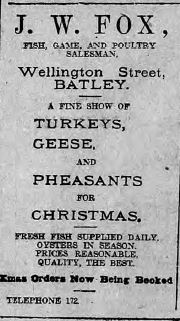
Meat shops were plentiful. Mr John Fox’s establishment at 39, Wellington Street had an array of Norfolk turkeys, Yorkshire geese, pheasants, game, rabbit and poultry. His products included oysters, fish, potted meats, even apples and oranges. His shop was described as “like a picture of Christmas as it should be”.

Fox

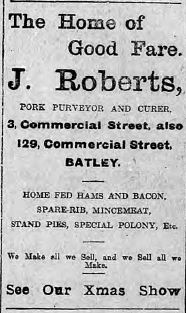
Jesse Roberts’ pork butchers was located almost at the Hick Lane corner of Commercial Street. His polony, a tasty delicacy, was relished both at home and abroad with hundredweights of it sent to those serving King and Country. The newspaper said patriotically “it has come as a real reminder of the tea-table at home, for many of the local KOYLIs on war service”.  The demand for that Christmas staple, the stand pie, from those serving overseas caused a shortage at Mr Roberts’ depot in mid-December. His shop also sold bacon, mincemeat and even tomato sauce!

Roberts

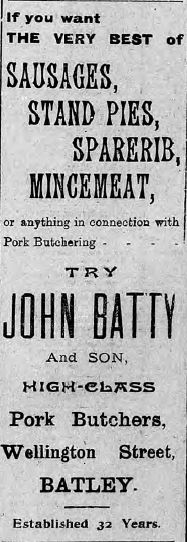
Another pork butcher was Mr John Batty. His spotlessly clean shop was located at 52, Wellington Street. He too sold bacon, cooked hams and those stand pies so sought after by soldiers and sailors and those keeping the home fires burning. Potted meats, sausages, polonies, tongue and mincemeat also helped “give the Christmas bill of fare a most acceptable variety”.

Batty

Alfred Milnes owned butchers shops at Town Street, Batley Carr and Mill Lane, Hanging Heaton. He also had a Saturday Dewsbury market stall. A veteran judge of beef and one of the district’s most popular butchers, he was the beef go-to man.  Prime mutton was another of his fortes and his beef sausages were noted as “amongst the most reliable commodities of their kind”.

Milnes

Mr J C Ridsdale, provision dealer, wine and spirit merchant, dispatched large quantities of figs, raisins, plum puddings and biscuits from his Market Place store to soldiers and sailors.  Whilst admitting that the price of some products, such as raisins, were dearer than in previous years their superb quality repaid the price. Prize cheese and smoked Wiltshire bacon also featured amongst his wares. As did table delicacies ranging from jellies and biscuits to bottled fruits and sweets; from muscatel, almonds and mincemeat to champagne and cigars. And his shop was the only local agency for Gilbey’s wines and spirits.

Ridsdale's 18 Dec 1915

On the subject of drinks and cigars, Mrs Chadwick’s Crown Hotel on Commercial Street boasted a fine stock with sherry cask matured spirits and whiskies including brands from some of the world’s most famous distilleries. Buyers though we’re reminded of the curtailed hours due to the new Liquor Control Order.

Crown Hotel

Sam Wilson’s establishments, one at the Market Place corner of Upper Commercial Street and the other near the Tram Terminus at the Bradford and Station Road junction, provided another sign of the times. A popular local tobacconist, “every local worshipper of the Lady Nicotine” knew his shops. He stocked a wide price range and flavour of cigarettes, boxes of cigars and blends of tobacco. He also had a wonderful array of pipes, “a rare stock of beauties, just right for using or giving when the Christmas spirit is greatly developed in men”.

Wilson cigars 18 Dec 1915

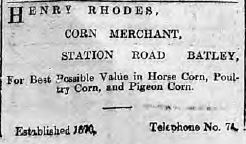
And finally not to be forgotten at Christmas was the horse. This was still a society heavily reliant on horse power, both on the land and in terms of transporting goods locally. Henry Rhodes, corn merchant, located at Station Road was “excellently situated for supplying the quadrupeds with as good a Christmas dinner as anyone could wish”.

Henry Rhodes

I hope this series of posts has given a flavour of a 1915 Christmas. Although a century ago it is still recognisable as the Christmas we celebrate today. And although these shops have long since disappeared, forced out by supermarkets such as Tesco’s,  I can relate the locations to my ancestors lives and picture them doing their Christmas shopping in the multiplicity of individual retailers lining the thriving town’s teeming streets.

My two earlier post can be found at:

Part 1: https://pasttopresentgenealogy.wordpress.com/2015/11/19/festive-adverts-and-shopping-in-batley-a-1915-christmas-part-1-the-home-beautiful

Part 2: https://pasttopresentgenealogy.wordpress.com/2015/11/25/festive-adverts-and-shopping-in-batley-a-1915-christmas-part-2-gifts-galore-for-man-woman-and-child

Festive Adverts and Shopping in Batley: A 1915 Christmas – Part 2: Gifts Galore for Man, Woman and Child

In Part 2 of my blog about Christmas shopping in Batley in 1915 I focus on gift-giving. Although the shadow of war cast a cloud it could not, as the papers put it, “eclipse the public’s desire to remember the season of goodwill”.

The war had made a mark though, in terms of presents given. Children’s toys took on a distinctive, militaristic theme. And the postal system and Army Transport were inundated with food and presents for soldiers, sailors and nurses serving overseas or training on home shores: Cakes and plum puddings to revive memories of home; grocers reporting a run on goods men in the trenches could relish; butchers supplying hundredweights of comestibles; clothing retailers, ironmongers, tin-ware merchants and jewellers selling practical goods aimed at those serving King and Country. Batley folk had a wealth of local shops to satisfy these needs.

The town centre had a good selection of jewellers.  The universally popular product stocked by all, aimed especially at those serving in the Armed Forces, were Radiolite wrist watches with luminous dials, readable in the dark. These were also promoted as useful in the dark for people at home.

Joe Fox, whose clock was a much-loved time-teller for shoppers on Commercial Street, was one retailer of these wrist-watchers. He also had a good number of other clocks which, the paper remarked, were not easy to obtain nowadays.

Joe T Fox Batley 11 Dec 1915

Commercial Street’s Messrs Gerald Brooke, Ltd also retailed these “luminous levers”. Diamond and gem rings glittered in the window of this shop, described as “ranking high amongst jewellers and silversmiths in the West Riding”, making a display worthy of their big reputation. Upholding its good name, Brooke’s sold clocks, alberts, signet rings, canteens of cutlery, silver and plated goods such as cake-stands, and dessert dishes and other goods “at prices that cannot be repeated”.

Brooke

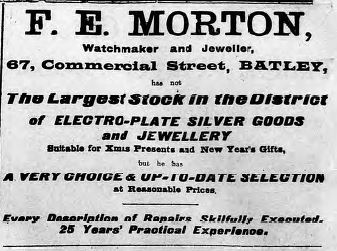
Mr F E Morton was a third Commercial Street jeweller who boasted the sale of luminous watches, a number which had already been sent to soldiers. Silverware marked the other outstanding feature of his shop, with a beautiful home-enhancing collection of vases, bon-bon dishes, cruets, cake, fruit and jam stands. If that wasn’t enough to entice the discerning Christmas shopper, there was also, of course, the alluring range of mantelpiece and wall clocks, watches, rings, bangles and pendants.

Morton

The town’s choice in shoe and clothing shops was equally impressive.  Salter and Salter’s heavily stocked Commercial Street shop’s advertising ploy was “The best is cheapest” when buying winter boots, shoes and slippers. Leather was becoming more difficult to purchase so the public were urged to spend their money to the best advantage and see Salter and Salter’s plainly-marked goods.

Messrs George Jessop and Son, clothiers, hosiers, boot and shoe dealers was one of those stores making a virtue of selling stock bought in at old prices without wartime additions. The famous firm used this tactic to encourage people to buy quickly as “much of the stuff cannot be replaced” at these current quoted prices. They stocked fashionable dark grey overcoats with silk velvet collars. They also held a good supply of blue nap and real indigo blue serge which some tailors could not buy for “love nor money”. They had a display of Scouts outfits in one window. Seasonable presents for those at home included ties, hats, hosiery, snow-shoes and galoshes. Cardigan jackets were suggested for soldiers and sailors.

Jessops

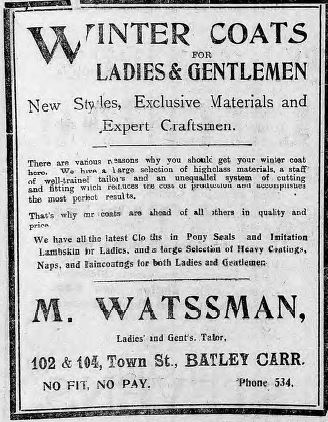
Mr M Watssman of Town Street, Batley Carr also held a stock of cloth bought at old prices. Supplying a choice of new materials and up-to-date patterns cut to a perfect fit, his motto was “no fit, no pay”. He also had a special ladies department with sealskins and raincoats.

Watssman

Well-known in Dewsbury and Wakefield, Messrs J Pickles and Son, hosiers and outfitters, opened their Batley branch in time for Christmas 1915. Located at 18-20 Commercial Street this was an establishment where “gentlemen can have their every wish gratified in the latest design of ties, shirts and socks”. Soliciting trade from those with military loved ones, they claimed one local officer made repeat sock orders, proof of his satisfaction with them during active service.  They stocked fashionable soft hats and the latest ties with open ends. Raincoats were made to order, so the customer could have his particular ideas catered for. And their vast quantities of underwear, gloves and scarves made the purchase of a sensible Christmas gift easy.

Pickles 2.JPG

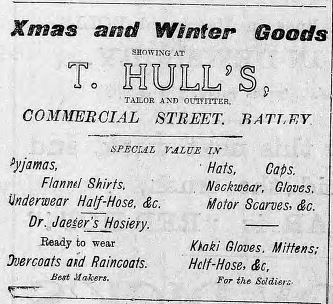
Mr Thos. Hull, old-established Batley outfitter and draper, located in Exchange Buildings, Commercial Street, had been remodelled and boasted new fitting rooms. One wonders if this was a response to new local competition in the form of the Pickles’ shop. Managed for more than 20 years by Mr W Bainbridge, the shop sold hats, suits and “superb” raincoats. The latest fashion in knitted silk ties in bright, mixed colours featured here. Scarves were touted as a suitable Christmas gift. But the real big selling point was khaki mittens of a quality far superior to anything Mr Bainbridge had handled.  With over 240 pairs sold for soldiers, these mittens were popular with warriors who found them so useful. Khaki colours also appeared in the shop’s handkerchiefs, socks and shirts.

Hull's clothes 18 Dec 1915

But the ladies of Batley did not miss out. Miss Kendall’s store at 11, Commercial Street was described as “a revelation and a joy for ladies” and “a shopful of ladies’ delights”.  It stocked exquisite, beautifully made Maltese lace, embroidered frocks and handkerchiefs, perfume, pinafores and dainty blouses in the latest fashion, as well as  a supply of gloves noted as one of the best and biggest in the district. They also stocked “a delightful array of cushions, table centres, and other articles that go to make home life truly bright and agreeable”.

Kendall 27 Nov 1915

Miss Hazzlewood was Batley’s blouse specialist. The “Batley News” enthused that “some of the dainty creations now on view will make charming gifts for the fair sex at Christmas”. The on-site staff, in this domain for ladies, also manufactured large quantities of underclothing. But men were not overlooked by Miss Hazzlewood who, in conjunction with Batley Ladies’ Sewing Guild, cut over 1,000 shirts for soldiers and other garments “for the fighting boys”. 

Hazzlewood

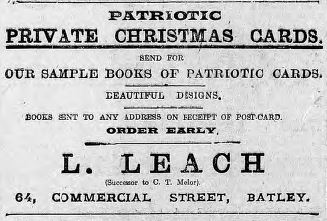
Toy shops abounded too. Mr Lionel Leach had taken over the 68 Commercial Street business previously known as C T Mellor’s, selling handbags, cards and books. His leather goods included wallets, purses, writing and jewel cases.  Fountain pens, photo frames and antimony ware made ideal gifts too. Books catering for children and adults and toys and games were in particularly brisk demand. Christmas cards featured khaki, Union Jacks and other patriotic war-themed embellishments.

Leach Christmas Cards 4 Dec 1915

Leach's 18 Dec 1915

Military toys, electrical goods, cycles and motors were found in the shops of Mr Herbert Hainsworth, on Branch Avenue and Well Lane in Batley and 42, Northgate, Dewsbury. Air-guns, some firing 1,000 shots without the need to re-charge, trained the eye to accuracy. A toy machine gun with wooden “shells”, emitting sounds mimicking the “bark” and “crack” of the weapon, was described as “wonderfully reminiscent of its big brother at the Front”. Then there was the new Sandy Handy, a mechanical toy which filled and emptied buckets of sand.

Hainsworths

Hainsworth’s shop also catered for adults. For fighting men they recommended their pocket lamps, leather vests and motorcycle clothing. Their motor and cycle departments held countless accessories which made useful presents, such as capes, gloves, tools and lamps. They sold bicycles. And motor cycles by Triumph, P and M, BSA, Sunbeam, Lloyds and Wolf were available, including new lightweight models for 1916.  They also served the business customer through their light delivery van and commercial motor trade arm.

Mr Thos Wood (late Mr E H Tate’s) was one of the Heavy Woollen District’s foremost ironmongers. The toy shop element of the business was located in Well Lane, with its forts, guns, cannons and building sets. His Commercial Street shop window proved a seasonal delight, reflective of the times. One window portrayed in detail a Red Cross Hospital. They also had a miniature Charlie Chaplin! Christmas novelties for the soldier in the family included a bullet-proof shield which doubled as a mirror and periscope. Cigarette lighters made a nice Christmas gift. And the visitor was urged not to miss the trench stores containing “wonderfully simple little things that Tommy Atkins values immensely”.

Wood

But the shop which delighted the children of Batley, Santa’s very own Toyland, was Misses Western’s Commercial Street shop. The “Batley News” proclaimed “it may be aptly called the Batley Home of Santa Claus. He fills his pack and reindeer sledge there”. This year the toys had a largely military theme with soldiers, forts, guns, battleships, miniature tents, cooking stoves, aeroplanes and Scouts outfits. In addition to boys mechanical toys manufactured in England or France, girls could choose from dolls made in Britain, France or Japan. Meccano sets were aimed at both sexes. Adults too were catered for with brushes, combs, oak trays and basket-ware.

Westerns

So in this selection there are many gifts familiar to today’s Christmas shoppers; and many which typify the war-torn times of 1915.

In Part 3 I will look at Christmas food and drink vendors.

Part 1 can be found at https://pasttopresentgenealogy.wordpress.com/2015/11/19/festive-adverts-and-shopping-in-batley-a-1915-christmas-part-1-the-home-beautiful

Sources:

“Batley News” – various November-December editions.