Tag Archives: family history

Belladonna and a Research Rabbit Hole: Avoiding Assumptions in Family History.

Whilst reading a newspaper from July 1915, my attention was caught by an attempted suicide in Dewsbury. It read:

GIRL DRINKS BELLADONNA.
Thornhill Lees Servant Upset By
Brother Being At The War.

Clara Stead (17), domestic servant, of Pontefract, was summoned for attempting to commit suicide by drinking a quantity of belladonna liniment at Dewsbury on the 15th inst.

Hetty Armitage, who employed the girl at the Perseverance Inn, Thornhill Lees, explained that on Thursday last week Stead was in the kitchen black-leading, but she went to a bathroom and afterwards accused called for witness and said, “Mrs. Armitage, do you know what I have done?” Later she added, “I have taken poison.” Asked where she had got it from, she replied, “From the bathroom,” and asked why she had done it she answered, “I don’t know.” Witness’ husband gave the girl milk and water, and she was afterwards taken to the Infirmary,

In answer to a question in Court, as to the reason for her act, Jones, [sic] who appeared greatly distressed, said, “I have a brother at the war.”

The Chairman: That ought not to have depressed you like that. You are young to do a thing like this.

The girl’s mother preferred to take her daughter back home and look after her.

The Chief Constable thereupon asked for the case to be withdrawn, and the Magistrates agreed.1

That was it. I had to find out more. Who was the girl? What became of her? Did her story have a happy ending? Who was her brother? What happened to him?

And so I disappeared down a research rabbit hole for the rest of the evening. The results reinforced once more that you should check multiple sources even for the same event; and never make assumptions when researching family history.

The first thing was to compare the Batley News report with that of the Dewsbury Reporter to see if that added anything.2 It did. The three main extras were:

  • Clara had worked at the pub since June;
  • Fred Armitage was the pub licensee; and
  • In a difference to the Batley News, Fred gave her hot water and salt, not milk and water.

Next I looked at the locality. Thornhill Lees is now a suburb of Dewsbury, lying around one mile south of the town centre between Savile Town and Thornhill. Back then it was a village. Near the river Calder, it had a station on the Yorkshire and Lancashire railway. Its chief employment industries were the collieries and glass bottle works. If you watched the Jeremy Clarkson episode of Who Do You Think You Are? you will have seen the Kilner Brothers glass bottle manufacturers. The Perseverance Inn, at Forge Lane, Thornhill Lees stood by the Calder and Hebble Navigation Canal. Ironically it had seen its fair share of inquests over the years on those successful in ending their lives, particularly by drowning in the waterway. Although the building still stands today, it is no longer a pub.

Map showing the location of the Perseverance Inn, Ordnance Survey Maps – 25-inch England and Wales, 1841-1952, Yorkshire CCXLVII.7 (Dewsbury) Revised: 1914 to 1915, Published: 1922 – National Library of Scotland, under the Creative Commons Attribution-NonCommercial-ShareAlike 4.0 International (CC-BY-NC-SA) licence

So who was Clara Stead? She was born on 2 December 1897 at Streethouse, near Pontefract, the daughter of William Stead and his wife Kezia (née Cooper). Her baptism took place on 23 December 1897 at Normanton All Saints, alongside that of her siblings William (born according to the baptism register on 16 July 1890, and was he really called William Stead as declared in the register? But more of that later);3 and Emma (born 16 September 1895).4 The couple’s other children were Minnie, born 14 January 1893;5 Colin, born on 13 December 1900;6 Richard, born 10 February 1903;7 and Lena, born in 1906. Note, other than Clara and William’s birth dates, I’ve not corroborated the remaining children’s births against any other sources.

The Stead family lived in the Streethouse part of Snydale-with-Streethouse, in both the 19018 and 19119 censuses. Pontefract lies around four miles to the north east of the village. Coal mining was the principal occupation, and Drighlington-born William was no exception, working as a hewer.

He married Kezia Cooper at Normanton parish church on 18 April 1892. At 26, she was four years William’s senior. The parish register entry records her as the daughter of Benjamin Cooper, and a widow – though this marital status is scored out.10 Unusually (but not impossible) the implication is her deceased husband was also named Cooper. But it is worth paying attention to such anomalies as the scoring out and name. The other thing to note about the marriage is it post-dates their son William’s birth by almost two years.

William’s birth certificate confirms this.11 He is registered as William Kirk. The certificate states he was born on 29 August 1890 at Ferry Fryston, although his birth was not registered until 5 November 1890 – way outside the 42-day limit. Also note this is some six weeks later than the birth date given in the baptism register. No father’s details are entered. But the certificate gives his mother’s name as Kezia Kirk, formerly Cooper. Like Kezia’s marriage to William Stead, this record has more question marks which need following up.

Kezia Cooper’s first marriage was the obvious next step. This was also at Normanton All Saints parish church on 2 January 1882, to John Kirk, a 21-year-old miner from Streethouse.12 The couple had three children – Jane Ann born on 15 October 1882 and who died on her second birthday; Maria born on 15 January 1886 and who died on the 23 January 1889; and another Jane Ann born on 21 July 1888 and who died less than one month later.

No death for John prior to Kezia’s second marriage to William Stead could be traced. The censuses indicated he was still alive, living with his father and step-mother at Streethouse in 1891 (and showing as married).13 Meanwhile in the same census, also in Streethouse, Kezia Kirk (married) and 8-month old William Kirk are living with her parents.14 Skip forward to 1901 and John Kirk is still alive and in Streethouse, but now married to Mary, and with daughter Mary Kirk and sons John Parkes and Charles Kirk.15 The marriage between John Kirk and Mary Parkes took place on 4 June 1892 at Holy Trinity church, Kimberley, Nottinghamshire.16

The assumption might be this marriage, and Kezia’s to William Stead a couple of months earlier, were bigamous. After all, as The National Archives guide states in this period “All divorce suits took place in London, thus restricting divorce to wealthier couples. Divorce did not really open up for all classes until the 1920s with the extension of legal aid and the provision of some local facilities.” 17 John Kirk was a coal miner living in a small Yorkshire village, as was Kezia’s father and new partner. None would seemingly fit the social status of those able to afford all the costs a divorce might entail.

However, Rebecca Probert whilst acknowledging that “the social profile of litigants remained definitely skewed towards the middle and upper classes” also points out that “there were plenty of examples of working-class petitioners” though “Those members of the working class who did petition for divorce tended to be drawn from the ranks of artisans rather than unskilled labourers.18

The inference to be made from this is just because a couple may not fit the accepted social profile for divorcees in this period, do not rule it out. And so it proved for John and Kezia Kirk.

John filed a divorce petition on 19 March 1891, a little over two weeks before the 1891 census date. The decree nisi was granted on 11 August 1891, and the decree absolute formally ending the marriage was issued on 23 February 1892.19

The grounds for the uncontested divorce were Kezia’s adultery with William Stead. Kezia left John for William on 15 October 1889, and on 18 July 1890 gave birth to William’s child. Note this is yet another date of birth for William Kirk – we now have 16 July 1890, 18 July 1890 and 29 August 1890 depending on record. Normally, considering the relative value of these sources, the birth certificate would carry more weight. But this is not always the case. And may not be in this instance.

So why was Kezia’s real marital status not declared when she married William Stead? Under the 1857 Act, no Church of England clergyman could be compelled to solemnise the marriage of a person who had been divorced because of their adultery. However, any other clergyman entitled to officiate within the diocese could conduct the marriage.20 A church marriage was therefore permissible. However perhaps Kezia stated she was widowed, and also used her maiden name, to try to avoid any difficult questions or judgement. But her second marriage took place in the same church as her first, and the rarity divorce in this community, with hers being finalised only a couple of months earlier and fresh in minds, must have been the talk of the neighbourhood. Also the vicar conducting the ceremony was not one brought in from elsewhere. The fact widowed is scored out indicates there was some background knowledge or question mark. But it all goes to show the Stead family background was more complex than initial appearances.
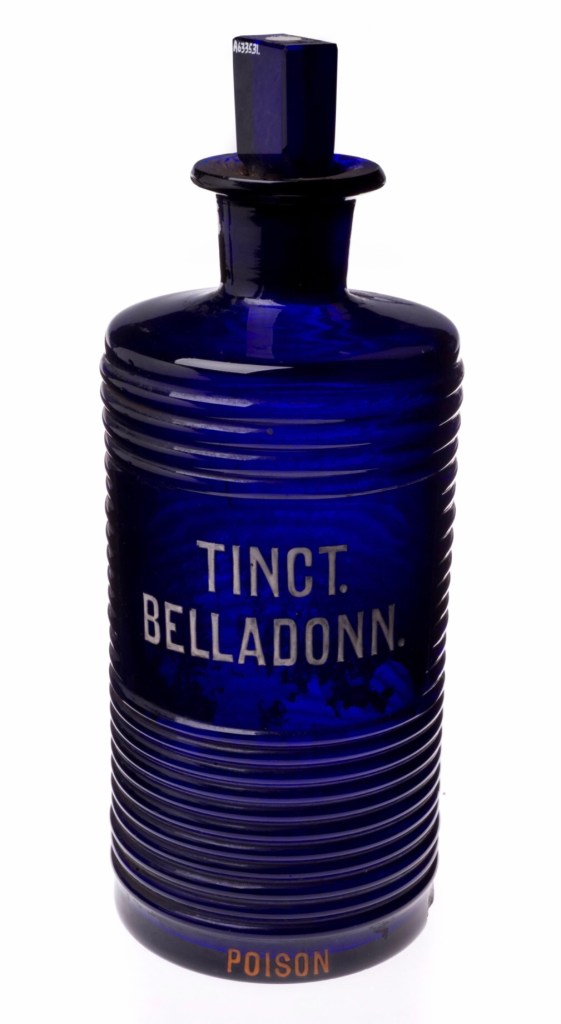
Glass bottle used for tincture of belladonna, England, 1880-. Credit: Science Museum, London. Attribution 4.0 International (CC BY 4.0)

Now back to Clara and her attempted suicide. What was it that she drank? Belladonna, known also as Deadly Nightshade, is, as its name suggests, a poisonous plant. However its roots and leaves have medicinal properties. Frequently advertised in the late 19th/early 20th century newspapers, it was a popular medicine-store cupboard standby. Its multiple uses included from insomnia relief, to as a diuretic and a muscle relaxant. It was also used as a pain reliever, with belladonna liniment recommended for such things as muscular aches, sprains, and rheumatic pains. Even chilblains and boils were treated with it. But it was also misused, with the newspapers full of poisoning cases and suicides. Then there were accidents, like a Birmingham family who mistakenly used it as a condiment in their stew. Or the Glasgow child who, imitating her sister drinking, took a swig out of a bottle containing belladonna liniment. Luckily Clara survived, unlike many others.

A huge positive about her court case is the compassionate attitude of the Chief Constable and the magistrates. On receiving assurances that Clara’s mother wanted to take her back home and care for her, they all agreed to drop the charges. Whilst this humane course of action is far from unique in this period, especially where there were promises not to do it again and where families were prepared to look after those charged, it could have been all too different. Lots of factors came into play, but I’ve looked at some other cases in the same period for girls of a similar age which had a range of far worse outcomes.

  • A 17-year-old domestic servant, who attempted to strangle herself on a footpath between Yeadon and Guisely in January 1915, was detained at an asylum;
  • In August 1915 the Vicar of Mapperley wrote suggesting to the court that a 15-year-old girl who jumped into a pond should be sent away, as it was not advisable to let her return home. The advice was taken and she was sent to a home for two years;
  • In June 1916 a 17-year-old Northampton girl was remanded to a workhouse for a week after throwing herself into the River Nene; and
  • Others were bound over, placed in the care of probation officers, or in the care of organisations such as the Salvation Army;

Did this tale have a happy ending? In part ‘yes’. Clara married a local coal miner in Pontefract Register Office on 6 March 1916. Her husband served for seven months with the Coldstream Guards in England towards the end of the war, and survived. The couple raised a family and Clara lived to a ripe old age.

But her fears for her brother, identified as William, turned out to be well-founded.

William Kirk married Heckmondwike girl Lily Victoria Andsley at Normanton All Saints on 16 December 1911.21 The couple had two girls, Dorothy born on 20 September 1912, and Edna born on 29 April 1914.22 William served with the 10th Battalion of the King’s Own Yorkshire Light Infantry (KOYLI) during the war, going overseas on 11 September 1915. This means at the point of Clara’s attempted suicide, her brother, though in the Army, was still in England.

William died on 9 July 1916 as a result of wounds suffered in the initial days of the Battle of the Somme. He is buried at Heilly Station Cemetery, Mreicourt-L’Abbe, France, a cemetery used by medical units from the 36th and 38th Casualty Clearing Station during this period. The additional information provided by the CWGC is that he was the husband of Lily Victoria Stead (formerly Kirk), of 43, Belmont St., Streethouse, Pontefract, Yorks.

I did a double take at her new surname of Stead. It did fleetingly cross my mind that she had adopted the surname of William’s family. However the implication by the use of ‘formerly’ was a remarriage. And this proved to be the case.

William Kirk’s pension card notes his widow married miner Samuel Stead on 9 March 1918.22 The marriage took place once more at Normanton All Saints.23

So ended my rabbit hole exploration.

However the real take away point from this is not Clara’s story. It is far more basic, and to do with research. It is primarily not to accept things at face value and not to make assumptions when investigating family history. Do not try to make facts fit your theories. Approach research with an open mind. Always dig deeper to locate as many sources as possible to corroborate findings. Weigh up and evaluate the relative merit of evidence sources. And make sure you have a wide range of evidence to support your conclusions.

In the case of Clara and her family:

  • There are discrepancies in the newspapers, including one huge typographical error when Clara in one section of one newspaper report is called Jones. Newspapers aren’t gospel;
  • Clara’s mother Kezia was not widowed when she married William Stead – she was divorced;
  • Working class people should not be ruled out from obtaining divorces in this period;
  • The treatment by courts of those who attempted suicide did vary;
  • Try to seek as many sources as possible to corroborate information – which can vary from record to record, for example something as straightforward as William Kirk’s birthdate;
  • Do not make assumptions on surnames. From the parish register entry for her second marriage, it might have appeared Kezia’s ‘deceased’ husband’s surname was Cooper; from the census and his baptism, William seemed to be called William Stead, when in fact he was officially William Kirk; and when William Kirk’s wife was listed as Lily Victoria Stead on the CWGC records, this was no connection whatsoever to the Stead surname of her deceased husband’s family, and a name he had possibly used. She had in fact remarried and her second husband was called Stead;
  • people do not change. They do not always tell the truth today, and neither did the past confer magical, unwavering truth-telling behaviours on our ancestors, even given the more deferential, religious society in which they lived. It may be some details and events they were genuinely hazy on. But for others they did deliberately lie. And this applies even on official documents; and
  • read all documents carefully and critically for the clues they offer, either by phraseology, omissions or anomalies.

Footnotes:
1. Batley News, 24 July 1915;
2. Dewsbury Reporter, 24 July 1915;
3. Baptism and birth date details from Normanton, All Saints, Baptism Register, West Yorkshire Archive Service, Reference Number: WDP151/1/2/5;
4. Ibid;
5. 1939 Register, Ref: RG101/3772E/004/17 Letter Code: KRDD;
6. Baptism 3 January 1901, Normanton, All Saints, Baptism Register, West Yorkshire Archive Service, Reference Number: WDP151/1/2/6;
7. 1939 Register, Ref: RG101/3641G/012/2 Letter Code: KMWM;
8. 1901 Census, Ref: RG13/4296/28/18;
9. 1911 Census, Ref: RG14/27482;
10. Normanton All Saints Marriage Register, West Yorkshire Archive Service, Reference Number: WDP151/1/3/6;
11. William Kirk Birth Registration, GRO Ref: Pontefract, December Quarter 1890, Volume 9C, Page 81;
12. Normanton All Saints Marriage Register, West Yorkshire Archive Service, Reference Number: WDP151/1/3/4
13. 1891 Census, Ref: RG12/4588/28/14
14. 1891 Census, Ref: RG12/3759/36/34
15. 1901 Census, Ref: RG13/4296/30/21
16. Nottinghamshire Family History Society Marriage Indexes
17. TNA Research Guide: Divorce – https://www.nationalarchives.gov.uk/help-with-your-research/research-guides/divorce/
18. Probert, Rebecca. Divorced, Bigamist, Bereaved?: the Family Historian’s Guide to Marital Breakdown, Separation, Widowhood, and Remarriage: from 1600 to the 1970s. Kenilworth England: Takeaway, 2015.
19. Divorce and Matrimonial Cause Files, Divorce Court File: 4262. Appellant: John Kirk. Respondent: Kezia Kirk. Co-respondent: William Stead. Type: Husband’s petition for divorce [hd]., 1891, Ref: J77/468/4262
20. Probert, Rebecca. Divorced, Bigamist, Bereaved?….
21. Normanton All Saints Marriage Register, West Yorkshire Archive Service, Reference Number: WDP151/1/3/9
22. Western Front Association; London, England; WWI Pension Record Cards and Ledgers; Reference: 114/0536/KIR-KIR
23. Normanton All Saints Marriage Register, West Yorkshire Archive Service, Reference Number: WDP151/1/3/10
St Mary of the Angels, Batley: One-Place Study Update – 1 to 31 March 2021 Additions

This is the latest update of the pages relating to my Batley St Mary’s one-place study, the details of which I announced here.

Moses Stubley

During the past month I have added eight new pages. These include four weekly newspaper summaries. There are also three War Memorial biographies – those of Michael Flynn, Thomas Foley D.C.M., and Moses Stubley.

I have also updated Austin Nolan’s biography with some new information about a childhood scrape he got into with two other of the St Mary’s lads.

Finally I have identified several more men who served and survived, and have accordingly updated that page. The eighth page is a biography of one man in that category, Thomas Donlan. The biographies of the others will follow in due course.

Below is the full list of pages to date. I have annotated the *NEW* ones, plus the *UPDATED* page, so you can easily pick these out. Click on the link and it will take you straight to the relevant page.

1. About my St Mary of the Angels Catholic Church War Memorial One-Place Study;

Batley Descriptions – Directories etc.
2. 1914: Borough of Batley – Town Information from the Annual Report of the Medical Officer of Health.

Biographies: Men Associated with St Mary’s Who Died but Who are Not on the Memorial
3. Reginald Roberts
4. William Frederick Townsend

Biographies: The War Memorial Men
5. Edmund Battye
6. Michael Brannan
7. Thomas Curley
8. Michael Flynn *NEW*
9. Thomas Foley D.C.M. *NEW*
10. Michael Horan
William McManus – See William Townsend below
11. Patrick Naifsey
12. Austin Nolan *UPDATED* – Previously unseen information from childhood.
13. Moses Stubley *NEW*
14. William Townsend, also known as McManus

Biographies: Those who Served and Survived (this includes a list of those identified to date and who will later have dedicated biographical pages) *UPDATED*
15. James Delaney
16. Thomas Donlan *NEW*

Burials, Cemeteries, Headstones and MIs
17. Cemetery and Memorial Details
18. War Memorial Chronology of Deaths

During This Week
19. 1914, 8 August – Batley News
20. 1914, 15 August – Batley News
21. 1914, 22 August – Batley News
22. 1914, 29 August – Batley News
23. 1914, 5 September – Batley News
24. 1914, 12 September – Batley News
25. 1914, 19 September – Batley News
26. 1914, 26 September – Batley News
27. 1914, 3 October – Batley News
28. 1914, 10 October – Batley News
29. 1914, 17 October – Batley News
30. 1914, 24 October – Batley News
31. 1914, 31 October – Batley News
32. 1914, 7 November – Batley News
33. 1914, 14 November – Batley News
34. 1914, 21 November – Batley News
35. 1914, 28 November – Batley News
36. 1914, 5 December – Batley News
37. 1914, 12 December – Batley News
38. 1914, 19 December – Batley News
39. 1914, 24 December – Batley News
40. 1915, 2 January – Batley News
41. 1915, 9 January – Batley News
42. 1915, 16 January – Batley News
43. 1915, 23 January – Batley News
44. 1915, 30 January – Batley News
45. 1915, 6 February – Batley News
46. 1915, 13 February – Batley News
47. 1915, 20 February – Batley News
48. 1915, 27 February – Batley News
49. 1915, 6 March – Batley News *NEW*
50. 1915, 13 March – Batley News *NEW*
51. 1915, 20 March – Batley News *NEW*
52. 1915, 27 March – Batley News *NEW*

Miscellany of Information
53. The Controversial Role Played by St Mary’s Schoolchildren in the 1907 Batley Pageant
54. The Great War: A Brief Overview of What Led Britain into the War
55. Willie and Edward Barber – Poems
56. A St Mary’s School Sensation

A Very British Obsession: The Weather (and Some Ideas for Sources to Use for Family History Research)

Like many other Brits, I can be ever so slightly obsessed with the weather. In fact a Bristol Airport commissioned poll back in 2018 suggested the average British person spends the equivalent of four and a half months of their life talking about the weather. Nearly 50 per cent of those 2,000 adults surveyed said chatting about temperature, sunshine or rain is their go-to subject when making small talk.

Winter Landscape, George Morland – Wikimedia Commons, Public Domain Image

But unlike many of my nationality, I go way beyond the current forecast. I even seek out historical information. There’s a particular reason for my historical weather curiosity though – it adds context, colour and background to my family history research.

My historical weather digging is varied. There are the mundane, everyday issues, like finding out what it was like on various ancestral wedding days. Or whether a significant local weather event provide a talking point in the communities of my ancestors. For example the 1916 lightning strike which destroyed St Paul’s Church, Hanging Heaton (no fatalities, including parish registers, thankfully).

But weather could be extraordinary, and a genuine matter of life and death. An increase in mortality rates in the parish register? Was it the result of a particular illness outbreak like smallpox or measles? Or perhaps harsh winter weather was the primary driver?

And on a more basic everyday level, in the agriculturally-dominated society of bygone years, the changing seasons and weather patterns dictated the rhythm and structure of the lives of our ancestors. Any untoward variation from the expected cycle could have a critical impact. An unusual weather event could mean the difference between a bumper harvest, available work and plentiful food; or delayed sowing, a badly reduced – or even ruined – crop, limited employment, squeezed food supplies, high prices and hunger. It could extend beyond food crops. Livestock might perish and their fodder be in short supply. Weather could therefore have a devastating impact. Drought and crop failure could change the course of lives, potentially even driving migration.

So where to find this information? Here are a few ideas to get you started.


Newspapers are an obvious source. But think beyond their weather forecasts and weather event reports. Even something as simple as a football or rugby match report, a mundane summer fete article, or the circumstances of an accident, may refer to the weather conditions. It’s a case of thinking outside the box even in an obvious source.


When thinking of weather today, the Met Office might be your go-to source. They also retain historic station data, with monthly data made available online for a selection of these long-running historic stations. The series typically range from 50 to more than 100 years in length. The 37 stations cover the length and breadth of Britain, including Armagh, Durham, Bradford, Lowestoft, Southampton, Stornaway Airport and Valley. The relevant website link can be found here.


There are several other weather-related websites. One outstanding example is Martin Rowley’s Booty Meteorological Website. This brought together historical information about the weather in Britain using multiple sources. The site no longer exists. But fear not. It has been archived, via the UK Web Archive, and is still accessible here.

There is a time-slice menu starting at 4000-100 BC and going up to 2000-2049, although the last entry is for 2012 (the site’s last update being February 2013). The information is colour key coded denoting the type of event/year, be it hot or cold, wet or dry, or stormy. There is also a companion historical menu too, which enables you to put climatological events into a historical context.

Examples of the type of entry include:

1768 (February)
Snow-melt & rain event overtopped banks (of the River Aire) in Leeds (W. Yorkshire)….I think we can assume that snowfall during January around and above Leeds (across the Pennine headwaters of the Aire) must have been considerable. [The year 1768 is the second-wettest year in the EWP series].1

And:

1859 (October)
THE “ROYAL CHARTER” STORM
.

The gale of 25th / 26th October 1859, which wrecked the fully rigged ship “Royal Charter” on the coast of Anglesey, drowning about 500 people (and loss of gold bullion), led to the introduction of gale warnings (in 1861) by means of hoisting of signals around the British & Irish coastlines (‘hoist North Cones’!). The ship was only one of over 200 vessels wrecked between the 21st October and 2nd November, with the loss of around 800 lives – most of these losses occurred in the ‘Royal Charter Storm’.

The Website of Pascale Bonenfant has a page on British Weather from 1700 to 1849, drawing on Martin Rowley’s information. So if you are struggling to access the Booty Meteorological Website you can see an extracted portion of it here.


The Tempest Database of Extreme Weather in the UK is a project funded by the Arts and Humanities Research Council. Spanning five centuries, this contains historical accounts of weather drawn from archival materials including diaries, letters, church records, school log-books, newspaper cuttings and photographs. The research was focused on five case-study regions – Central England, Southwest England, East Anglia, Wales and Northwest Scotland, though entries do relate to places across the UK (check out the “other” locations in the place/location selector box). Even if your location is not covered, the sources do give some good ideas for ones to check out in your area of interest.

The search is flexible. Options include by case study region, place, date, document type, repository etc. Specific weather events can be searched – and this is extremely wide-ranging from the expected snow, flood, gale and heatwave events, to rainbows, comets and earthquakes. So not only do you get the famous Youlgreave weather of 1615 with its terrible and long-lasting snows, including the memorable sentence “Uppon May day in the Morning, instead of fetching in flowers, the youths brought in flakes of snow which lay about a foot deep upon the Moors and Moutaunes…” you also get the notes of the Rector of Thorpe Malsor, Northamptonshire, on the earthquake in the early hours of 6 October 1863.

Results give those all-important source reference numbers so you can check original entires rather than relying on transcripts. And the results can even be mapped.

The website can be found here.


My final suggestion is the humble parish register, but you could easily extend this to wider parish records. As seen in the Tempest Database of Extreme Weather, parish records were one of the primary sources it drew upon when gathering information.

Several people sent me some wonderful examples when I asked on Twitter, (I’ve included the link so you can read the full range).

Amongst them is a particularly memorable line summing up the bitter cold at Whittington, Shropshire in February 1776, as submitted by One-Namer and One-Placer Steve Jackson. The entry describes how “The wings of small Birds were so frozen that they fell to the ground.

Three more from Yorkshire and one from Derbyshire show some further examples of the type of entry. I’ve illustrated the first with some follow-up research.

My ancestor Esther Hallas was buried on 13 July 1817. The parish register of Kirkburton All Hallows notes she was killed by lightning. There are no other details. But that entry led to a newspaper report with more details. The Leeds Mercury of Saturday, 19 July 1817 had the following snippet:

Yesterday se’nnight, a fatal accident took place at High Burton, near Huddersfield, during the thunder-storm on that day: The lightning struck the chimney of a house belonging to Mr Fitton, and having partially destroyed it, proceeded down the chimney, into the kitchen, and in its passage through which a servant girl was struck, and killed on the spot; the face of the clock was melted, and several panes in the window broken. Two men were also hurt by the lightning, but not dangerously

In another example, the Almondbury parish has an original entry in Latin, and alongside it a loose later English translation. Essentially it reads along the lines of:

In this year, 1614, so great a fall of snow as was not known in the memory of any living, far exceeding that in 1540 in magnitude and duration, in which many travellers as well as inhabitants of Saddleworth perished.

The entry is dated 28 January 1614/15. Investigating further, this fits in with the timing of the Youlgreave extreme weather entries of early 1615. A check of the Booty Meteorological Website shows the “Great Snow” of the winter and early spring of 1614/15 affected various parts of the country.

In another snow event, North Yorkshire County Council Record Office sent in this entry from the parish register of Thornton in Lonsdale:

March 16th 1719 is memorable for a prodigious quantity of snow falling… the storm went so high that door neighbours could not visit one another without difficulty of danger…

The final example is from Janet Braund Few, with a 1 February 1715/16 entry from Chapel-en-le-Frith, Derbyshire. This shows the further potential consequences of bad weather:

On that day there was an extreme wind. It blew the weathercock off the steeple and brake it in pieces, and a great Ash down in the Church- yard; with vast great loss to most people in their houses, some being blown downe.


This is by no means an exhaustive list of historical weather sources for family history. But hopefully these six examples give you some ideas to aid your research, providing context, colour and background to it.

Notes:
1. England and Wales Precipitation series (Met Office / Hadley Centre)

St Mary of the Angels, Batley: One-Place Study Update – 2 to 31 January 2021 Additions

St Mary of the Angels Church, Photo by Jane Roberts

This is the latest update of the pages relating to my Batley St Mary’s one-place study, the details of which I announced here

During the past month I have added eight pages. These include seven weekly newspaper summaries. There is also one biography, that of William Frederick Townsend. This was one of several name and name variants used by this mystery Royal Naval Volunteer Reserve man with theatre connections, who is buried beneath a CWGC headstone in Batley cemetery.

I have also identified more men who served and survived, and have accordingly updated that page.

Below is the full list of pages to date. I have annotated the *NEW* ones, plus the *UPDATED* page, so you can easily pick these out.

1. About my St Mary of the Angels Catholic Church War Memorial One-Place Study;

Batley Descriptions – Directories etc.
2. 1914: Borough of Batley – Town Information from the Annual Report of the Medical Officer of Health.

Biographies: Men Associated with St Mary’s Who Died but Who are Not on the Memorial
3. Reginald Roberts
4. William Frederick Townsend *NEW*

Biographies: The War Memorial Men
5. Austin Nolan
6. Michael Brannan
7. Michael Horan
8. Patrick Naifsey
9. Thomas Curley

Biographies: Those who Served and Survived (this includes a list of those identified to date and who will later have dedicated biographical pages) *UPDATED*
10. James Delaney

Burials, Cemeteries, Headstones and MIs
11. Cemetery and Memorial Details
12. War Memorial Chronology of Deaths

During This Week
13. 1914, 8 August – Batley News
14. 1914, 15 August – Batley News
15. 1914, 22 August – Batley News
16. 1914, 29 August – Batley News
17. 1914, 5 September – Batley News
18. 1914, 12 September – Batley News
19. 1914, 19 September – Batley News
20. 1914, 26 September – Batley News
21. 1914, 3 October – Batley News *NEW*
22. 1914, 10 October – Batley News *NEW*
23. 1914, 17 October – Batley News
24. 1914, 24 October – Batley News
25. 1914, 31 October – Batley News
26. 1914, 7 November – Batley News
27. 1914, 14 November – Batley News
28. 1914, 21 November – Batley News
29. 1914, 28 November – Batley News
30. 1914, 5 December – Batley News
31. 1914, 12 December – Batley News
32. 1914, 19 December – Batley News
33. 1914, 24 December – Batley News
34. 1915, 2 January – Batley News *NEW*
35. 1915, 9 January – Batley News *NEW*
36. 1915, 16 January – Batley News *NEW*
37. 1915, 23 January – Batley News *NEW*
38. 1915, 30 January – Batley News *NEW*

Miscellany of Information
39. The Controversial Role Played by St Mary’s Schoolchildren in the 1907 Batley Pageant
40. The Great War: A Brief Overview of What Led Britain into the War
41. Willie and Edward Barber – Poems

Public or Private Family Tree?

This is a perennial question for many people researching their family history. Whether or not to have a public family tree available online. And it is a dilemma which can arise fairly early on in the research path. Sometimes though it is not even considered, and for some the consequences of a decision to go public emerge too late.

Image by Peggy und Marco Lachmann-Anke from Pixabay

Before I go any further I want to make it clear there’s no right or wrong answer. It really is a purely personal decision, one with which you need to be comfortable.

However, here are some considerations which I’m sharing to provoke a deeper examination of, and debate about, the implications. It’s not intended to be an exhaustive list, more a thought trigger. I’ve split them into pros and cons.

First the advantages of a public online tree.

  1. Connecting. It goes without saying, but a public online tree allows other researchers with the same family history interests to easily find and contact you. This enables you to connect with distant cousins, compare research, potentially plug gaps and share photos.
  2. Collaborating. Following on from this, once connections have been made this can lead to collaborative working on trees, pooling research, and the possibility to discuss findings and theories with someone who has a mutual family history connection.
  3. Learning. Linked to the above two, connecting and collaborating can lead to improving your family history research skills.
  4. Expanding. By having an online presence you may be able to expand your tree, pushing back lines and breaking down brick walls. All at a far quicker pace than solo research offers. Though a word of caution. Do not accept the research of others at face value. Always do your own work to check and verify.
  5. DNA. If you have undertaken a DNA test in order to further your family history research, a linked public tree is an important corollary to that test. I realise this may not always be possible. But if it is an option, there are clear advantages. A tree is one of the first things your DNA matches will look at to identify potential links. And it does encourage contacts. Ask yourself if, amongst a plethora of DNA matches, are you more likely to initially investigate and contact the treeless or those with trees? Personally, I find one of the most frustrating things about DNA testing is to see a possible match, but for that match to have no tree.
  6. Tree Purpose. Is your tree family history, pure and simple? Or is it something along the lines of a one-name or one-place study? The latter two may have a lesser emotional/personal attachment, and also a need for a far broader range of collaboration/connection networks than your own family tree.
  7. Family History Community Spirit. Having an online tree may fosters for you a feeling of really contributing and sharing to further the research of others.
  8. Legacy. You may be the only one in your family interested in family history. There may be no-one to bequeath the family history baton to, no subsequent generations willing to take on your work. You may be wondering how to ensure your research is preserved for the long-term. Putting it online is one option.
  9. Unexpected heirlooms. Recently a story made the news about the love letters written by a soldier, killed during the First World War Battle of the Somme, to his wife. They turned up in a sewing box donated to a charity shop. An appeal was put out, and within hours searches by members of the public on an ancestry site resulted in the tracing of family descendants, which will result in the letters being reunited. More details here. This is a rare, potential unexpected bonus of having a public tree.

Turning to the disadvantages of having your tree publicly available.

  1. Information control. Obvious really, but once your tree is out there publicly available to all, you have no control who can access it and how it is used. Be prepared for it being copied wholesale by multiple people without them even contacting you, and without them even referencing the person behind the original research. Is this something which would bother you? If it is, think of other options.
  2. Reduced Contacts. Linked to this, your tree’s proliferation may even reduce the chances of you being contacted. Unless yours is stand-out, it may be lost amongst a forest of other similar trees. Of course though this does not reduce your opportunities to contact others.
  3. Photos. This is a particularly sensitive subject. You may have ancestral photos linked to your tree. You may also have document images, such as civil registration certificates or probate records. Whilst you might be happy to have the basic tree information copied, you may find the copying of photographs in particular, and them popping up on scores of trees, a bridge too far. Several bridges if the photo is misattributed – great aunt Jane labelled as someone entirely different.
  4. Copyright. This is a topic in its own right, so I’m only putting some initial thoughts out there. Your own private tree for your personal use only is one thing. But where do you stand if you link photos, copyright document images etc to a public tree for all to see, copy and share? What about your own linked notes and analysis? And is that going to create a whole new set of potential issues?
  5. Errors. What if you include something in a public tree which you later wish to correct or amend? You may find the horse has already bolted, with your early research replicated across many other online trees.
  6. Privacy Concerns. Whilst living relatives should not be on a public tree, something to bear in mind is how traceable ultimately you (or your family’s) details potentially may be even if the living are unnamed. It might not be the first thing you think of when constructing a public online tree, and it may only be a very minimal risk, but you should be aware of the possibilities for abuse. As an aside, while online trees hosted by genealogy providers do anonymise the living, I’ve come across trees on personal websites where details of the living have been included.
  7. Etiquette. Essentially by openly sharing your tree you are entrusting your work to others. Do not assume all online will have the same courtesy standards regarding information sharing, use and acknowledging.

And finally, in the interest of openness, here’s how I handle the dilemma.

Well over a decade ago I did have a bad experience regarding someone copying my once online tree, including notes and other elements, and it didn’t sit right with me. However, I can see the benefits of information sharing to mutually further research. I now have a threefold tree strategy. This is:

  • A full tree which is on Family Historian and it is entirely private;
  • A private tree on a commercial website shared with a couple of trusted people – a very much pared down version of the Family Historian tree, minus any images or photographs. Only very basic information, with no source links or citations. I’ve not updated it for quite a while, but it is useful to consult when I’m out and about (family history events, archives visits etc.); and
  • An online publicly available skeleton tree, with basic direct line information only, linked to my DNA research. No photos. No documents. No comments. No analysis. It is there primarily for DNA purposes. That way I have a way of connecting with other DNA researchers. And I can then share selected relevant information, rather than my full tree.

I realise it does limit my opportunities for connection and collaboration because of its reduced public visibility. However, that hybrid approach is a decision I am most comfortable with. But it may not necessarily be the right one for you.

The bottom line is make sure you define your reasons for putting your tree online in advance of doing so. Ensure you know the full range of privacy settings on whatever online medium you decide to use for a family tree (if indeed you decide to go down that route). Think about what would work best for you and what you would be comfortable with. And go into it with your eyes wide open.


Postscript:
Finally a big thank you for the donations already received to keep this website going.

The website has always been free to use, but it does cost me money to operate. In the current difficult economic climate I am considering if I can continue to afford to keep running it as a free resource, especially as I have to balance the research time against work commitments.

If you have enjoyed reading the various pieces, and would like to make a donation towards keeping the website up and running in its current open access format, it would be very much appreciated.

Please click here to be taken to the PayPal donation link. By making a donation you will be helping to keep the website online and freely available for all.

Thank you.

Keeping Your Family History Research On Track

Do these scenarios sound familiar?

  • Halfway through a piece of research, do you realise you’ve done it before?
  • Do you get broken off from your research, or shelve it, then pick up the problem months later – but can’t recall what you’d done or where you’d got to?
  • Are you a scatter-gun researcher, flitting from one unplanned search to another, and at the end of a couple of hours you have no idea what records you’ve checked. Then go round in circles once more, repeating the same searches?

You’re not alone. But it means you’re wasting research time; you’re potentially overlooking key pieces of information; you are duplicating your efforts; and your research is unfocused. 

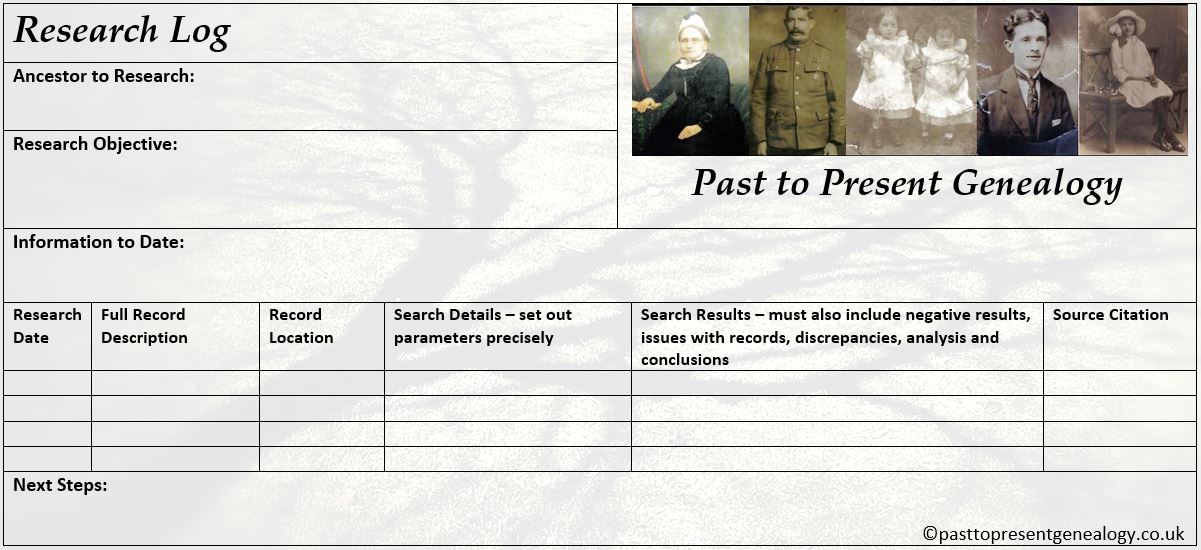
Which is where a research log comes in.

A log makes for efficient research, with no wasted time or duplicated effort. You can pick up a piece of research months later and know exactly what steps have previously been taken. It also means you can more easily identify gaps in your research.

In short a log keeps your research on track.

My seven key points for research logs are:

  1. Define the research objective: Set out clearly the problem, e.g. finding out the date of birth of an ancestor, or who their parents were. Include what you know through evidence, and any assumptions or conflicting information. This enables identification of issues, leading on to potential sources and search strategies
  1. Identify possible records and sources (e.g censuses, parish registers, probate records, books): These must be fully detailed including description, location(s) and type e.g. original documents, indexes, transcripts, digitised images etc.
  1. Date of the search: Archives add to their acquisitions. Records are continually being digitised and appearing online, and this includes updates to ones already online (think 1939 Register, or the GRO Indexes). So a search conducted 12 months ago may not have the same outcomes if conducted today. A date helps you decide if it’s worth repeating the search.
  1. Set out fully the search parameters: What spelling variants did you use? How many years either side of a specific date did you search? Which locations/parishes did you use? Did you rely on a data provider’s online search? Did you visually confirm results? Did you go through the record (and all the years) yourself? If a book, did you rely on the index or read the entire chapter or book? Some datasets (e.g. censuses) are on multiple websites – did you search just one? The same search on another website may have a different result. This enables you to see exactly what has been done and identify other possible areas of research.
  1. Record in detail the results – including negative ones: Fully record search results along with your analysis, conclusions and any discrepancies. This includes problems with the records, e.g. were there any gaps or record damage which might affect the result? Do ensure that the explanation is clear because it might be a while before you revisit it. And do include negative searches.
  1. Full source citations: Note where the original document can be found. Include full document reference, with page number. For website searches also include URL, description and date accessed. Give as much information as possible to enable you to find the document again. Do not assume it will always be online! 
  1. Next steps: Review your log. Identify follow-up searches. 

Your log could be electronic (do remember to back it up). Or it could be paper-based.

There are lots of pro-formas online. I have included my example above. Or perhaps you might prefer to design your own bespoke log.

And do not be put off by the thought of the time taken to keep a research log. It is minimal when compared with the time you will save in the long run from trying to remember exactly what you’ve done before, reducing the number of repeat searches and pinpointing what you have not tried.

Whatever method you use, online or paper-based, your research will benefit.

St Mary of the Angels, Batley: One-Place Study Update – 6 December 2020 to 1 January 2021 Additions

St Mary of the Angels Church, Photo by Jane Roberts

This is the latest update of the pages relating to my Batley St Mary’s one-place study, the details of which I announced here.

During the last few week I have added seven pages. These include six weekly newspaper summaries. There is also one biography, that of Patrick Naifsey, which encompasses apparitions, miracles, evictions, Kipling and an Irish Great War poet, as well as the County Mayo/Batley connection.

I have also identified more men who served and survived, and have accordingly updated that page.

Below is the full list of pages to date. I have annotated the *NEW* ones, plus the *UPDATED* page, so you can easily pick these out.

1. About my St Mary of the Angels Catholic Church War Memorial One-Place Study;

Batley Descriptions – Directories etc.
2. 1914: Borough of Batley – Town Information from the Annual Report of the Medical Officer of Health.

Biographies: Men Associated with St Mary’s Who Died but Who are Not on the Memorial
3. Reginald Roberts

Biographies: The War Memorial Men
4. Austin Nolan
5. Michael Brannan
6. Michael Horan
7. Patrick Naifsey *NEW*
8. Thomas Curley

Biographies: Those who Served and Survived (this includes a list of those identified to date and who will later have dedicated biographical pages) *UPDATED*
9. James Delaney

Burials, Cemeteries, Headstones and MIs
10. Cemetery and Memorial Details
11. War Memorial Chronology of Deaths

During This Week
12. 1914, 8 August – Batley News
13. 1914, 15 August – Batley News
14. 1914, 22 August – Batley News
15. 1914, 29 August – Batley News
16. 1914, 5 September – Batley News
17. 1914, 12 September – Batley News
18. 1914, 19 September – Batley News *NEW*
19. 1914, 26 September – Batley News *NEW*
20. 1914, 17 October – Batley News
21. 1914, 24 October – Batley News
22. 1914, 31 October – Batley News
23. 1914, 7 November – Batley News
24. 1914, 14 November – Batley News
25. 1914, 21 November – Batley News
26. 1914, 28 November – Batley News
27. 1914, 5 December – Batley News *NEW*
28. 1914, 12 December – Batley News *NEW*
29. 1914, 19 December – Batley News *NEW*
30. 1914, 24 December – Batley News *NEW*

Miscellany of Information
31. The Controversial Role Played by St Mary’s Schoolchildren in the 1907 Batley Pageant
32. The Great War: A Brief Overview of What Led Britain into the War
33. Willie and Edward Barber – Poems

My 2020 Family History Review. And is it Really Worth Setting Any Goals for 2021?

Well 2020 did not go as planned. Massive understatement.

When the New Year dawned, little did I think the goals I set would be scuppered to such an extent. And if there was to be a hitch, a global pandemic would not have been top of my list of reasons. In fact, it would not have featured at all. But there you go.

2020 did begin well. Research for my new book got off to a great start. I gave a talk at Leeds library about World War One research based on the book I co-authored with my rugby league journalist husband. Other talks were lined up. I booked a couple of conference tickets, and the associated accommodation and transport.

And then March came, and with it lockdown. Everything went pear- shaped.

Archives visits and travel generally halted, along with it the prospect of any associated book research. Events and conferences were cancelled, one by one. As were the prospects of any further talks in these pre-Zoom days.

And unimaginably I lost any enthusiasm to review my family tree – apart from anything else getting through the trauma of daily life, where everything was so much more challenging and time-consuming, was an achievement. And these home-life challenges included a major water leak at the start of the year which necessitated a new kitchen and new bathroom – all work due to start in March. Lockdown came in as our bathroom was ripped out. Family history was the last thing on my mind.

The only thing that continued from my 2020 goals was blogging. In fact, this year saw an increase of around 50% in terms of those viewing my blog posts. Thank you. That was the one bright spot in my goals.

But things did pick up. In the place of conferences, I attended far more talks than I ever have before thanks to the wonders of Zoom. I also did a one-place studies course, and ended up starting one for Batley St Mary’s during World War One. Something entirely unexpected and unplanned at the start of 2020. But something I’m thoroughly enjoying.

As was becoming a grandma for the first time as 2020 drew to a close – I know, I’m way too young! It meant much of my free time this year was taken up with stitching a birth sampler ready for the big event.

Birth Sampler

In the light of all this I did think seriously about whether to set any goals for 2021, given the uncertainty we are still living under. But I do need something to aim for.

However, for 2021 my goals will be far more work-related, given how this has taken off.

And with work in mind, this was the major reason behind my decision to step down as editor of the Huddersfield and District Family History Society Journal. I loved doing it, and it is something I’m immensely proud of. But as work built up I increasingly found it squeezed the time I could devote to the Journal, particularly in the lead up to print deadline. My last Journal as editor goes out in January 2021.

And linked to this, my family history column in Down Your Way magazine also came to an end in 2020. The much-loved Yorkshire memories magazine was a casualty of the COVID-19 economic downturn. I must admit I really do miss writing a regular magazine feature, because it gave me another family history focus. But it has freed up even more research time.

As for my goals for 2021, they will be as follows:

  1. Pick up my book research, as and when I am able;
  2. Continue my blogging;
  3. Build up my St Mary’s Batley WW1 One-Place Study, details of which are at the top of my WordPress site;
  4. Focus on my research work for others. It’s a huge privilege to be entrusted with someone’s precious family or local history research, and I undertake it with the same dedication and thoroughness as I would my own; and
  5. Keep up to date with advancements in the field of genealogy as part of my continuing professional development programme. This will include undertaking a minimum of two formal courses, as well as a broad range of reading and practical work.

Finally a huge thank you for continuing to read my blog in these very trying times. As I said earlier this has truly been one of my year’s bright spots.

And as for the New Year, I hope that 2021 will be far kinder to us all than 2020 was.

Announcing a New Family and Local History Venture

If you regularly read my blog, you may have noticed I’ve been quiet on the posting front of late. There is a reason for it.

My blog does regularly contain stories relating to the Batley Irish community in the late 19th and early 20th century. Well, in future I’ve decided to consolidate this research and these stories into a formal one-place study. I’ve decided to chose St Mary’s War Memorial as the focus. It’s in the parish I most associate with my family – in effect since the parish’s inception. I see the study as a way to examine the life and times of the Catholic community in which my ancestors lived.

St Mary of the Angels Catholic Church, Batley – Photo by Jane Roberts

The study though will not be totally devoted to the Great War. I see the War Memorial as a way to investigate the history of a community not normally the focus of history – even within my home town. And the study will not be centred around those who normally feature in books – the civic leaders, the mill and mine owners. It will primarily be looking at ordinary, working-class people living in extraordinary times – both in terms of wider national and international events, as well as against the backdrop of the rapid expansion of the town.

Yes, it will look at the part played in the Great War by this Catholic community. But that is only one strand. In addition to biographies of the men, I will be researching their wider families. I will be mapping where they lived, investigating their occupations, and looking at the wider parish history and community – including that all-important migration from Ireland. In the process of my research I hope to identify those from the parish who served and survived, and weave their stories into the study. And I will be conducting a wide range of data analysis to build up a picture of the Catholic community in Batley.

If you look at the top of my website (possibly in the Menu section, depending on how you are viewing) you will see there is a tab entitled St Mary of the Angels Catholic Church War Memorial, Batley – One-Place Study. Click on that and you will find a number of sub-pages relating to the study. It is still early days and there is much work to be done. But so far there are the following pieces under these various sub-pages:

I will be adding more in the coming months.

The downside is because they are not classed as blog posts (although that’s in effect what they are) they will not feature in the blog section of my website, so you will not automatically see them in chronological posting order at the front end of my website. To read them you need to click on the one-place study page.

The good news is that I will regularly write a blog post signposting this new material (along the lines of this one). I will also index the posts as usual, under the Blog Index page (again, for this, see the top menu of my website).

And I will be continuing to blog regularly on other topics as usual. So really the one-place study is bonus material.

“Alas Too Idle Yet Writing a Book” – Census Gems

If you think reading the census is dull, think again. It can reveal some unexpected gems. I thought I’d share a few I’ve viewed over the years – ones I’ve found, and some located by others. I hope you enjoy them as much as I do.

As March is designated Women’s History Month I’m starting out with some 1911 census entries. The suffrage movement advocated boycotting this census. Some women deliberately absented themselves on census night, 2 April. Other census forms have information and notations which indicate they are clearly linked to people actively involved, or sympathising, with the suffrage movement.

Suffragist, and a founder member of the Women’s Freedom League, Dr Octavia Lewin of 25 Wimpole Street, Marylebone wrote ‘No vote. No census. I absolutely refuse to give any information’. She does then go on to list her impressive array of qualifications, ending with ‘assistant physician, London Homeopathic Hospital’. That, though, was the limit of the household information she supplied, with the Registrar annotating the form to the effect that the rest of information was estimated. [1]

Over in Ingatestone, Essex, Dorothea Rock, of the Women’s Social and Political Union (WSPU), was similarly forthright with her protest. She wrote:

I, Dorothea Rock, in the absence of the male occupier, refuse to fill up this Census paper as, in the eyes of the Law, women do not count, neither shall they be counted. [2]

Louisa Garrett Anderson, daughter of Elizabeth, a qualified surgeon and another prominent WSPU member, withheld any household information for her Harley Street home. Yet again the details, including for four anonymous people, were estimated. [3]

Other ‘No vote. No census’ protestors included Dorothy Bowker (WSPU). Lodging at Marylebone she wrote across her return:

I am Dumb politically. Blind to the census. Deaf to enumerators. Being classed with criminals lunatics and paupers I prefer to give no further particulars. [4]

The enumerator and registrar added further comments to the effect that Dorothy had returned temporarily to her lodgings to remove her luggage, then left.

Also in Marylebone, the occupational entry for Georgiana Alexandra Mott, a pioneer of education for women, simply read ‘Desires a parliamentary Vote’ [5]. This sentiment was shared by another Marylebone resident, Ann Halliburton, who wrote ‘I desire the vote’. [6]

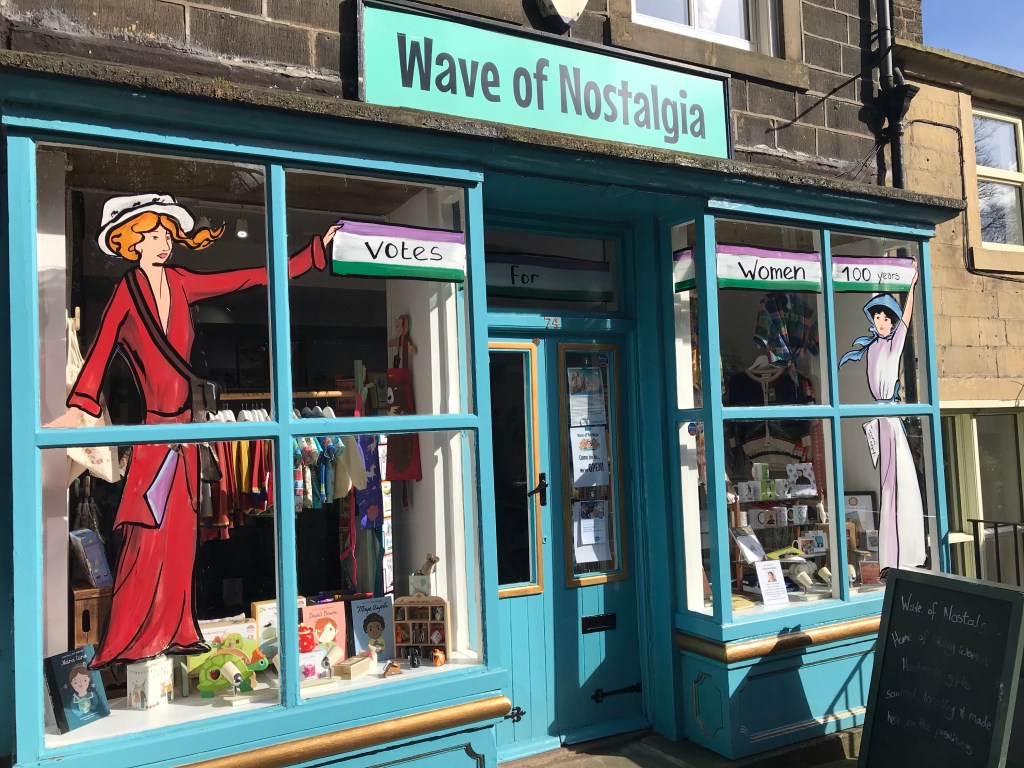
Haworth Shop Window – Photo by Jane Roberts

But the protest extended beyond Marylebone. The occupation given by 41-year-old married woman Ada Twells of South Kyme, Lincolnshire was ‘At present agitating for votes for Women’ [7]. The occupation of fish merchants’ wife Clara Annie Braithwaite of Cleethorpes was ‘Suffragette’ [8]. Clara Callander, 60, living at Wavertree went one further. Besides the occupation of suffragette, she gave her employer as UWSPU and under the infirmity column she put ‘disability to vote’ [9]. In similar vein Christine S Bremner, a visitor at the Morgan-Browne household in Wimbledon, refused to giver her age or birthplace, but gave her occupation as ‘Suffragette’ and infirmity ‘unenfranchised’ [10].

Another suffragette with an infirmity was 23-year-old Marion Louise Kitchin, daughter of Doncaster-born veterinary surgeon James Edward Kitchin. The family lived at Woodford Green in 1911, and this is a information-packed return. His wife Elizabeth’s occupation is ‘Lady’. His 16-year-old son, William Norman, is a ‘gentleman at large’. Marion is a suffragette ‘looking for a job’, with ‘absent mindedness’ recorded as her infirmity. Sister Kathleen is afflicted with ‘unpunctuality’. Son Geoffrey was ‘argumentative’, I guess that’s teenagers for you. But not quite the infirmity information being sought! [11]

Then there’s the Folkestone household of Mrs Smart. She, and three anonymous occupants, were listed as suffragettes. There’s a supplementary note that Mrs Smart ‘refused to fill up a schedule and the others refused information for the reason that they state women have no vote’ [12].

Other indications of suffrage sympathies included the use of slave as an occupation. Examples here include 52-year-old widow Lucy Gilbert of Bermondsey [13]. Variations on this theme included ‘Domestic Slave’, which was used amongst others by 48-year-old married woman Elizabeth Bond of Cherry Hinton, Cambridgeshire [14]. ‘Family Slave’ also pops up, including Eleanor Snowden (35), a married woman from Harewood near Leeds [15].

As seen from the above, women campaigning for the vote deliberately withheld their names. But the censuses are full of unknown men and women, occasionally with extra information such as Italian man, German woman. One example which Jane Hough found in the 1901 census at Little Weldon, Northamptonshire, listed Poacher 1, 2 and 3, with an indication that the particulars could not be ascertained [16].

My favourite personal find though is from the 1871 census at Kirthwaite, Dent, where included in the Thompson household is a man ‘supposed out of work’ on the tramp. If you have a 40-year-old Stockport-born ancestor you can’t trace in this census, could it be this individual, described as ‘a man with a big nose’? [17].

Man With a Big Nose – Source Pixabay

Occupations provide a rich seam of hilarity to mine. How about William Neale in Shottesbrook, Berkshire whose occupation, as described in 1881, was ‘None (to idle)’ [18]? And perhaps an indication in 1851 Barnstone, Nottinghamshire, of the esteem in which Mary Carlisle held her daughter-in-law Maria: ‘too idle for anything’ [19]. Skip forward to 1881, where George Huyton, a visitor to Parr, St Helens, was described as ‘too lazy to work’ [20].

But the prize for idleness must surely go to Matilda Sharpe, ‘81 tomorrow’. The sister of the head of a household in Islington, in 1911 she completed the form signing herself off as ‘Deputy Head’. Something many an under-valued author can appreciate, she described her occupation as ‘Alas too Idle yet writing a Book’. Then she duly put her creative skills to good use, ensuring an enduring written legacy. She described the Rev. Rose as having his ‘Heart in his Work. Alas Over-Worked’. His wife, Mrs Rose, was a ‘lovely Self Devoting Wife’. Caroline Chipperfield earned high praise as a ‘Cook – & a very Nice One’. Whilst Alice Percy had similar plaudits, being a ‘House Maid – all we could Wish’ [21].

In particular, some of the census entries relating to children are priceless. As you read them you can sympathise with the mixed emotions of desperation, frustration, love and humour felt by their parents.

The 1851 census entry for Edith, under two months, the daughter of Edward and Elizabeth Higgin in Liverpoool read ‘(Occupation) Suckling & Sleeping’ [22].

In the same census, over in Bradford, Hannah, the four-month-old daughter of Robert and Hannah Kennedy was ‘constantly crying at home’ [23].

Another early example appeared in the 1881 census when West Derby (near Liverpool) barrister George Zavier Segar described his wife’s occupation as ‘Looking after me and the Family’. His three-year-old daughter Mary G was occupied ‘Eating Sleeping Talking’; whilst her one-year-old brother Robert S included the additional string to his bow of ‘getting into mischief’ [24].

Across in Chadderton, in the same census, James Lever’s infirmity was being ‘without money’. Perhaps his two-year-old daughter Mary’s occupation caused this financial hardship, because her occupation is described as ‘crying for halfpennys’ [25].

Whilst in 1881 Atherstone, Adelaide Forbes, two-year-old daughter of Stuart Forbes was ‘Eating, Drinking, Sleeping etc’. He recognised his wife Isabel’s role of ‘Keeping House & nursing children’. And sister-in-law Grace Churchill was worthily described as ‘Feeding the Hungry & Clothing the Naked’ [26].

Crying Child – Darwin: The expression of the emotions in man and animals – Wellcome Library. Attribution 4.0 International (CC BY 4.0) – https://wellcomecollection.org/works/wqfqzcmg

There are scores of 1911 census examples featuring children. I’ve listed some of these below:

  • Elsie Irene Axtell, age nine months, the daughter of Archibald and Ada Axtell from Bristol was described as ‘Eating Drinking Sleeping’ [27].
  • Florence Brown, nine months, of Limehouse, London, daughter of Frederick and Florence was occupied ‘Crying’, with the indication that she undertook this job ‘at home’. The family also included ‘Perfect’ for all members in the Infirmity column [28].
  • The youngest two members of the Herrington family in West Rounton, North Yorkshire, had occupations befitting their ages. Alfred, three, was occupied ‘Crying Eating & Sleeping’; and sister Mary, under one month, worked at ‘Crying Sucking & Sleeping’ [29].
  • Across in Scarborough, Robert and Elizabeth Knaggs wrote of their three-year-old daughter, Marjorie, ‘Play mostly Crying occasionally’ [30].
  • Edna Lee, age three, living with her grandparents and parents in Bradford was described as ‘Eating Drinking Playing’ with ‘Sleeping’ added later in brackets [31]. Was this by an enumerator with a sense of humour?
  • The occupation of Stanley William Pawley, one-year-old son of William and Flora Pawley of Fakenham was occupied ‘Crying & Breaking Feeding Bottles’ [32].
  • Harold Urquhart Roberts, age one, living at Farnborough was ‘Eating Drinking & Shouting’ in the ‘Baby’ industry or service [33].
  • In Willesden, Gerald Stollery, three, was engaged in ‘mostly destroying toys’, whereas sister Eileen, one, had the sole job of ‘crying’ [34].

It is, however, sobering to consider not all these children survived to adulthood. But they live on, and stand out, through their wonderful census descriptions.

I’ll end the example of children in the censuses section with an 1871 entry. This is yet another classic, on a par with idle book-writer Matilda Sharpe who inspired this post. This one is for the Parsons family living in Basford, Nottinghamshire. Susannah Parsons, wife of William, was described as ‘Her husband’s devoted nurse’; granddaughter Florence, nine, whose condition was ‘Tall & thin’ rather than single was ‘a student of rudimentary accomplish[men]t’. Sussannnah H, eight, was ‘a still younger student of above’; grandson William, one, ‘very fat’, had his rank, profession or occupation column proudly annotated ‘His rank is most upright for he can walk and is very independent’; six-year-old granddaughter Emily G, ‘very thin’, was engaged in ‘innocent mischief’; and not forgetting Caroline Jones, a ‘most excellent serv[an]t as nurse’ [35].

The elderly could also have unusual occupational annotations. Samantha Willis highlighted a 1911 entry from Hastings linked to her family. Household head Arthur Edward Callis, ‘Waiter. Boots. Chamber Maid. God knows what’ wrote of his 90-year-old mother-in-law Jane Sargent ‘Does nothing sleeps’ [36]. Maybe this is simply an accurate reflection of the impact of advanced years, or ill health, rather than any form of sarcasm.

And do watch out for other unsolicited snippets of information. For example in Bognor in 1911 George Henry Harrington, 37, has no work. The explanation is given: ‘Had neurasthenia several years now. Because very deaf at 34…’ [37].

There’s also a 26-year-old unmarried naval officer, Thomas Wallace Young, a visitor in 1911 Harting, Sussex. The dashing image is, well, dashed when his afflictions are listed: bald and toothless [38].

And John Underwood of Hastings wasn’t wrong in describing his affliction as ‘bad temper’ in 1911. He was sufficiently annoyed to identify all his family’s individual afflictions starting with his wife, occupied in cooking and washing, but the possessor of a ‘long tongue’. His children were quarrelsome, stubborn, greedy, vain and noisy [39].

Finally Britain is often labelled a nation of animal lovers. We often think of our pets as family members. And thankfully some census entries supporting this have sneaked through too.

In 1911 Heanor, church worker Frances Catherine Stone, 46, listed her two other household members: Timothy the Cat, age seven; and Jack the Dog, eight [40].

A dog smoking a pipe, with ‘Pears’ inscribed on his collar. Chromolithograph after E. Landseer (1907) – Wellcome Library – https://wellcomecollection.org/works/acw6wkuv

Meanwhile, in Doncaster that year, the Cooke household hosted a rather unusual boarder. Single, age one, his name was Jim the Cat. And naturally enough his occupation was ‘mouse catcher’ [41].

Cheshire Cat, from Lewis Carroll’s Alice in Wonderland (1865-1866) drawn by John Tenniel (1820-1914) – Wikimedia Commons, Public Domain image

And the 1911 census Rigby household in Birkenhead have a tom cat named Tobit C[r]ackitt. His age is obscured (the enumerator is unamused by the family’s sense of humour), but you can still read that he’s married with 16 children, all living. He works as a ‘Mouse Catcher Soloist Thief’. Nationality is ‘Cheshire Cat’ and he does sadly have an infirmity: He is speechless. William Rigby, the household head, perhaps thinks too much information is being sought and writes:

All the Above Mentioned Have Breakfast Dinner Tea & Supper. Eat Standard Bread Drink Sterilized milk. Sleep with the Windows open. Wash our feet once a week. “Etc” God Save the King. R.S.V.P. Rest in Peace [42].

The enumerator has crossed this piece of insubordination out too.

But I’ll leave journalist James Ange Little with the last word though. It could well be that he too was getting a dig in at the perceived intrusiveness of the census questions, but his final entry is pure census gold. He wrote:

Incidentally, we have an Airedale Terrier. I do not know whether particulars are required, but in case you want them here they are….

He then went on to give details for Keighley-born Roger, age five. Information generally about his marriage were unknown, other than his children probably numbered something over 100. He worked as a watchdog on his own account. The industry/service was ‘looking after house’ and this was undertaken ‘at home & outside’ [43].

As you can see from the above, most examples are from the 1911 census simply because of the survival of the original householder schedules, as opposed to the sanitised enumerator books from the earlier censuses. But, as I’ve identified, there are stray examples which slipped through from earlier censuses too.

If you can add to the list of quirky England and Wales census examples do feel free to add a comment, or email me. If you could provide the census reference too, that would be appreciated. I’ll update this post to reflect any received.

Update 1 – 10 March 2020: After Siblings and Niblings informed me in the comments section about a relationship status of paramour in the 1911 census, I investigated further. And yes, there are lots of other examples. One I located in 1891 Stepney had a household head, Arthur Newstead, a 24-year-old widower. The household also included Charlotte Linch (married) whose relationship status was ‘paramour’. Not only that, there was a five-year-old girl, ‘paramour’s child’; a baby whose relationship was ‘putative daughter’ and a 27-year-old man whose connection to the head was ‘paramour’s brother’ [44].

And I am still seeking out the quirky. One particularly astonishing one is from Chesterfield in 1851. Thomas Cooke, a 61-year-old married man is the head of the household. Also listed is his wife, Jane, age 44. There are four other members. These comprise Harriett Cooke, 30-year-old unmarried niece, described in the occupation column as ‘concubine of her uncle!’ But that’s not all. There are three children ranging from six years old to two months and in the occupation column they are described thus:

Son of do. [concubine]……………)
Dau[ghte]r of do. [concubine]..) by her uncle!!!
Son of do. [concubine]……………) [45]

And yes, the exclamation marks were inserted by a shocked enumerator. Perhaps it equated to an exclamation for Harriett and each of her three children?

References:

  • [1] 1911 Census of England and Wales, TNA Reference RG14/525
  • [2] Ibid, Reference RG14/10034
  • [3] Ibid, Reference RG14/518
  • [4] Ibid, Reference RG14/548
  • [5] Ibid, Reference RG14/551
  • [6] Ibid
  • [7] Ibid, Reference RG14/19604
  • [8] Ibid, Reference RG14/19987
  • [9] Ibid, Reference RG14/22674
  • [10] Ibid, Reference RG14/3463
  • [11] Ibid, Reference RG14/9755
  • [12] Ibid, Reference RG14/4634
  • [13] Ibid, Reference RG14/1898
  • [14] Ibid, Reference RG14/9081
  • [15] Ibid, Reference RG14/25953
  • [16] 1901 Census of England and Wales, TNA Reference RG13/1450/115/26
  • [17] 1871 Census of England and Wales, TNA Reference RG10/4250/47/5
  • [18] 1881 Census of England and Wales, TNA Reference RG11/1315/65/7
  • [19] 1851 Census of England and Wales, TNA Reference HO107/2139/28516
  • [20] 1881 Census of England and Wales, TNA Reference RG11/3738/75/51
  • [21] 1911 Census of England and Wales, TNA Reference RG14/984
  • [22] 1851 Census of England and Wales, TNA Reference HO107/2182/323/26
  • [23] Ibid, Reference HO107/2307/72/18
  • [24] 1881 Census of England and Wales, TNA Reference RG11/3713/113/4
  • [25] Ibid, Reference RG11/4085/52/14
  • [26] Ibid, Reference RG11/3058/78/19
  • [27] 1911 Census of England and Wales, TNA Reference RG14/14919
  • [28] Ibid, Reference RG14/1555
  • [29] Ibid, Reference RG14/29357
  • [30] Ibid, Reference RG14/28955
  • [31] Ibid, Reference RG14/26788
  • [32] Ibid, Reference RG14/11555
  • [33] Ibid, Reference RG14/6251
  • [34] Ibid, Reference RG14/7004
  • [35] 1871 Census of England and Wales, TNA Reference RG10/3488/14/22
  • [36] 1911 Census of England and Wales, TNA Reference RG14/4748
  • [37] Ibid, Reference RG14/5376
  • [38] Ibid, Reference RG14/5440
  • [39] Ibid, Reference RG14/4741
  • [40] Ibid, Reference RG14/20398
  • [41] Ibid, Reference RG14/28198
  • [42] Ibid, Reference RG14/21991
  • [43] Ibid, Reference RG14/2457
  • [44] 1891 Census of England and Wales, TNA Reference RG12/292/153/27
  • [45] 1851 Census of England and Wales, TNA Reference, TNA Reference HO107/2147/273/16