Category Archives: Yorkshire

A Workplace With a Deadly History

The White Lee explosion at Henry Ellison’s chemical factory on Hollinbank Lane, Heckmondwike, which killed 10 men on 2 December 1914, does not tell the entire story of the chequered history of these works. Even before this catastrophic event it was the scene of multiple fires. Additionally there was a series of bizarre, and unassociated, deaths involving men who worked there between 1870 and 1885. All occurred during the tenure of the previous owners of the works, the Heaton family. And the Heatons themselves were not untouched.


James Heaton, who started the family’s involvement with chemical manufacturing, was originally a spinner by trade. From Little Gomersal, he married Jane Popplewell at Birstall St Peter’s on 28 December 1834. The newly married Heatons subsequently moved to Leicester to raise their family. Children included Joseph (born 1836), George (born circa 1838), Martha (born in 1839, and died in 1840), Mary (born in 1840), John (born 1841), Susannah (birth registered in 1841), and Jane (born 1847, and died in 1848).

I have not pinned down precisely the family’s move back up north, but it is likely to have taken place in the mid to late 1850s. Certainly, by the time of the 1861 census, the Heaton’s were in the Dale Lane area of Heckmondwike, with James and his three sons described as manufacturing chemists – a total shift away from James’ lambs wool spinning days.

Other clues around timing of the manufacturing chemist move come in Ordnance Survey maps and Directories. The 1854 Ordnance Survey map of the area (surveyed 1847-1851) does not feature the chemical works. Neither is the Heaton Chemical Works mentioned in White’s 1858 Directory of Leeds, Halifax, Huddersfield etc. However one set of inquest notes indicate that one of the Heaton brothers, Joseph, had been involved in chemistry since around 1854. The accuracy of this statement though is uncertain – the same notes give the incorrect month and year of death for James.1

The newness of the concern is also indicated in newspapers, which also provide further details of the type of processes Messrs. James Heaton and Sons undertook. Besides chemical manufacturing, they were also involved in oil extraction by means of the pressing process, and grease production.2 A newspaper report from March 1863, describing a fire at the premises, states how a newly erected, and uninsured, shed used for the purposes of extracting oil etc was destroyed, damage estimated at £200. The adjoining shed, where several tons of oil and other flammable spirits were stored, was saved due to the assistance of neighbours.3 In addition to offices, warehouses and storage facilities, from newspaper reports over the years the extensive buildings included a rag storage area, a blacksmiths and a coopers.

A later map showing the location of the Chemical Works – Ordnance Survey Maps – Six-inch England and Wales, 1841-1952, Yorkshire CCXXXII.SW (includes Cleckheaton, Gomersal, Heckmondwike), Surveyed: 1889 to 1892, Published: 1894 – National Library of Scotland, under the Creative Commons Attribution-NonCommercial-ShareAlike 4.0 International (CC-BY-NC-SA) licence

The family had fingers in pies other than the White Lee chemical and oil refining concern. They owned a farm, and had a growing property portfolio. In July 1874 they bought the old-established copperas and prussiate works in Roberttown, producing black dye and sulphuric acid. One member of the family even had a ship named after him: In 1882 an iron screw steamer, intended for the Indian and Atlantic trades, was launched up in Tyneside. The steamer, christened by Mary Heaton (wife of middle brother George), was named the George Heaton.


The Heatons, though, were not immune to local controversy. A Healey resident, writing to the local paper in 1879, accused the Heaton chemical works of being a public nuisance, responsible for “constantly bringing the most noxious gases and vilest smells into our homes; our sitting rooms and bedrooms, too, being frequently filled with them.4

Then there were the Local Board and Town Council water meter disputes, planning controversies, and accusations of providing cottages unfit for habitation.

On a personal level, court cases included the ill-treatment of a horse (John), and the assault on a letter carrier in 1874 (Joseph). In this incident Joseph refused to hand over 2d to Heckmondwike Post Master employee Frank Richmond. Joseph then pushed the mail deliverer against a wall and pulled his ears because he felt the youth had behaved in a “saucy and taunting manner.5 Joseph escaped punishment because the assault was deemed of a trivial character.

The letter incident occurred days after another fire at the Heaton Chemical Works, and perhaps the stress Joseph was under affected his reaction that day. The previous year, in June 1873, a fire broke out in the uninsured works, but was quickly subdued with minimal damage. The fire which broke out on 2 February 1874, at about 5.30pm, was far more serious. Believed to have been caused by oil overflowing from one of the tanks, it took several local fire brigades until 10pm to extinguish the blaze, by which time it had caused damage estimated £20,000.6 Fortunately by now the Heaton’s business was partly insured, although it did mean they suffered losses of around £10,000.7 However the consequences were felt far beyond this date. Messrs. Heaton became embroiled in a dispute about charges for the fire brigade services that night. Legal proceedings followed to recover these costs.

The dispute rumbled on, and failure to settle payment from previous fires was the reason why all local fire brigades refused to attend yet another blaze at the works. Believed to have been caused by the ignition of overheated grease, this fire broke out in the early hours of 28 August 1879. One brigade did set off, but turned back round when they found out the location of the fire. It was left to local people to confine the conflagration to the originating building, extinguish the blaze and save the rest of the extensive works which were filled with combustible chemicals. Again only partly insured, damage was estimated at between £1,000 to £1,500.8


The above-mentioned controversies took place after the death of James Heaton on 27 April 1867, when sons Joseph, George and John took over the running of the business. John was the brother best described as the business’s superintending manager; Joseph and George travelled, and mainly did outside works, though Joseph was also the brother who conducted chemical experiments. And it was on their watch that the random sequence of deaths involving those connected to the chemical works occurred. Two were fire related, and both these incidents directly touched the Heaton family.


The first death occurred in 1870. 20-year-old carter George Miller had only worked at Heatons for three weeks when he met his death. Born in Kirkby Overblow in 1849, he was the son of farm labourer David Miller and his wife Ann. David died in 1862 and Ann, after being widowed for a second time, moved with her children to the Birstall area.9 George however lodged elsewhere. Ann, crucially for the turn of events, described her son as sober and very steady.

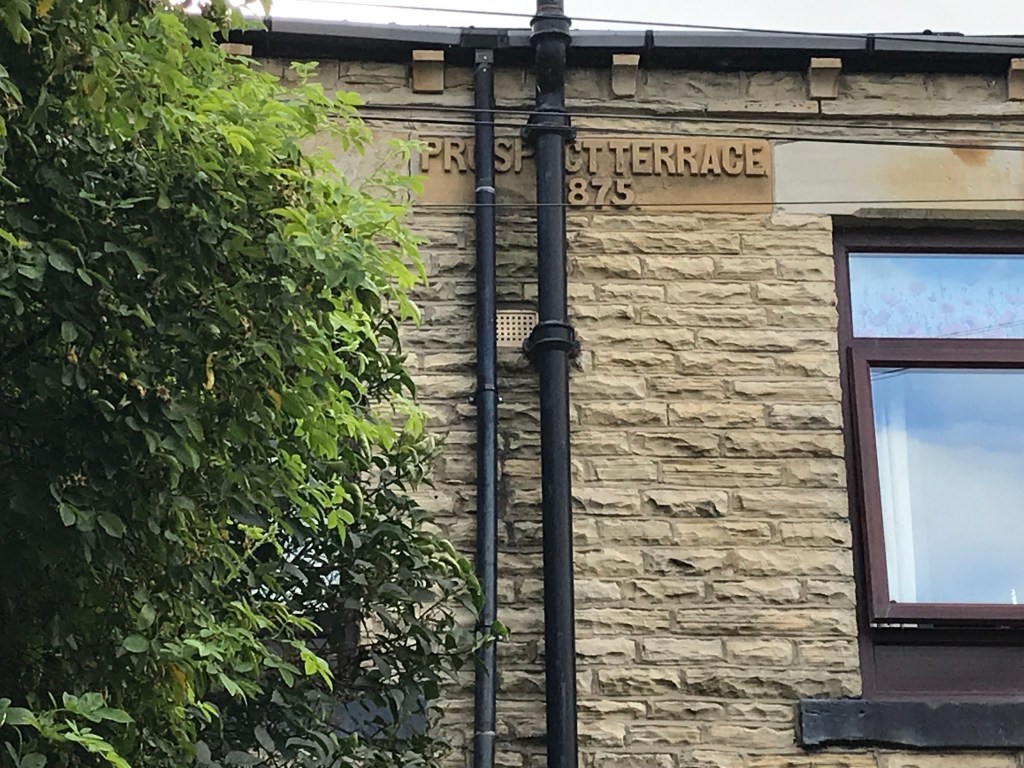
On 9 March 1870 George, along with Lister Kaye, another carter employed by the Heatons, took some charcoal to Heckmondwike then went to Ravens Wharf to collect two loads of sand. On the way back, at around 5.50pm they stopped off at the Prospect Beerhouse, Dewsbury Moor, where they stayed for about 1½ hours drinking ale with several other men before making their way back to the chemical works. Lister Kaye described George as “very lively10 – the implication being he had perhaps drunk a little too much.

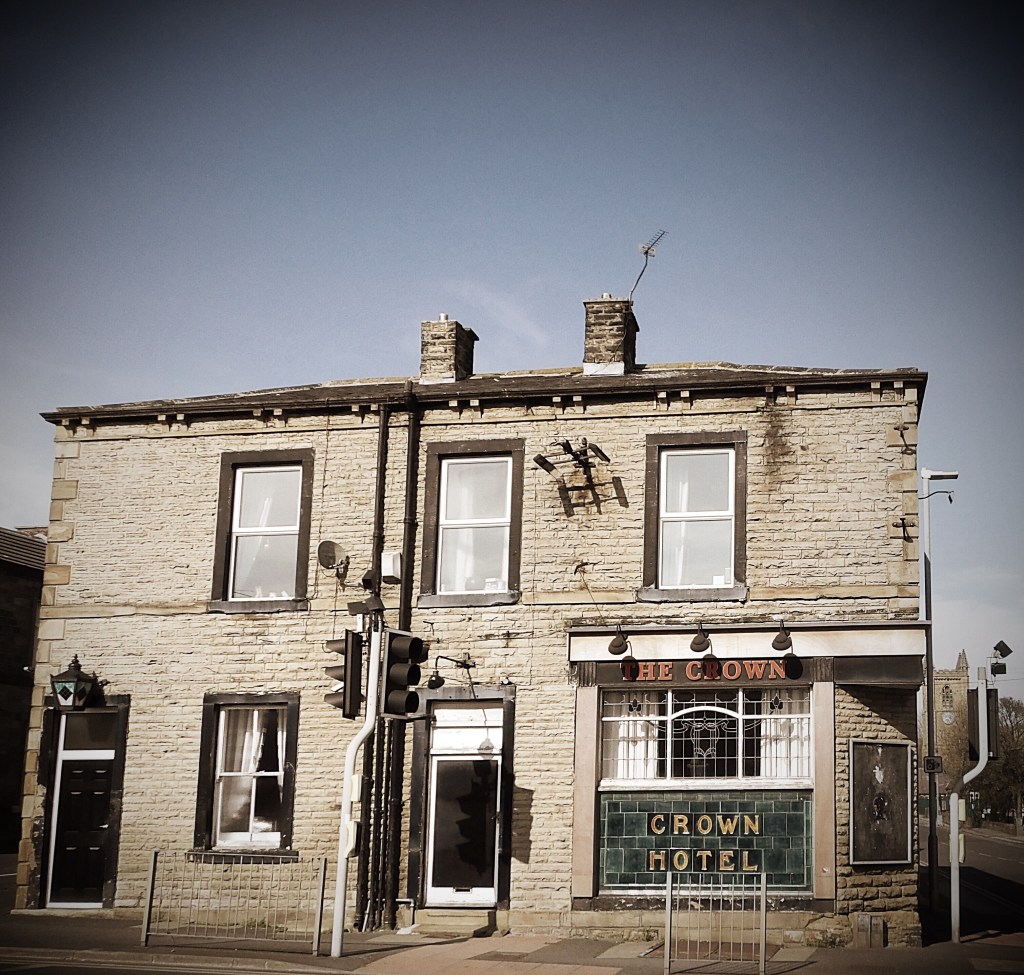
At about 8.10pm, Catherine Droghan was walking up Staincliffe Hall Road. Almost at the top she saw George, walking unsteadily with his horse and cart loaded with sand.11 He spoke thickly to Catherine as if he had been drinking, then sat on the cart shafts until he reached the top of the hill. At this point he jumped down to pick up the reins of the horse which were trailing on the ground. As he tried to get back onto the shafts he fell to the ground on his face, and the cart wheel ran over him. His final words before he was carried to the Crown Hotel were “Oh dear let me lie still.12 He died 20 minutes later.

The Crown Hotel with Christ Church, Staincliffe (baptism place of some of the Heaton children) and Staincliffe Hall Road to the right – Photo by Jane Roberts

The inquest on 11 March 1870, incidentally also held at the Crown Hotel, ruled he had been accidentally run over. Perhaps it was a case of a new boy not used to drinking trying to fit in with the men. But it appears this stop off at the Prospect Beerhouse cost him his life.


The next employee’s death was of an entirely different nature. This was 21-year-old Thomas Dawson, who worked as a book-keeper at the Heaton chemical works. It was around a two-mile walk away from his home in Gomersal, where he lived with his mill engine operator father John, mother Ann, and younger brother William.

Thomas was born in Gildersome and, before his move to Gomersal, he spent his early years in Batley and Birstall, where he was a member of the Birstall Wesleyan Society. A hard working and studious young man, the fact he was learning French as an adult in this period supports his scholarly nature.

Described by his mother as “well and hearty,”13 he was working up until Saturday 1 November 1873. That day he complained of a pain in his head, and despite a visit from the doctor who diagnosed a mild attack of low fever, he did not improve.

At around 5am on the morning of 5 November his mother went to his room and found his bed empty. Downstairs, the house door was unlocked. The alarm was raised and search parties sent out.

Later that afternoon Nelson Oldroyd saw a walking stick floating in one of the Gomersal mill dams of Messrs. Thomas Burnley and Sons, the employers of Thomas’ father. The dam was within 50 yards of what had been the Dawson family home around three weeks earlier. Nelson then saw Thomas’ body lying face down in the 37 inch deep water. He called for help and the body was retrieved.

The inquest, held at the White Horse Inn in Gomersal, (a place mentioned in connection with John Heaton later on in this piece), reached a verdict that Thomas had drowned himself when of unsound mind.


The third death occurred on Monday, 17 May 1880. The victim was 20-year-old blacksmith’s striker James Flanagan.

James was the son of Irish farmer Andrew Flanagan. He lodged with his cousin Catherine, and her husband Michael Fallon, at Carr Street, Heckmondwike. He had been employed by Heaton and Sons for around 18 months, working alongside Staincliffe blacksmith Paul Perkin.

That Monday morning, at around 6am, James left home for work. A couple of hours later he was helping Perkin with the removal of a one-ton seak press. This was a type of press used to extract oil. Joseph Heaton arrived on the scene and took over the supervision of proceedings.

The machine was put on an 18 inch high horse-drawn cart, called a bogey. It proved a difficult operation, due to the slippery surface, the downward incline, and the fact there was only limited room for the horses to work. Various permutations were tried, one horse, then two, then back to one, with more men called to help push, then sent away again. Eventually it was left to Joseph Heaton to take the horse, with Paul Perkin on one side of the bogey and James on the other. According to Perkin, Joseph told the pair to try to keep in front of the bogey, but for some reason James continued alongside the back wheel.

Initially the bogey moved slowly and steadily. As they neared the crane Joseph Heaton pulled the horse to one side to avoid some casks. He then stopped. At this point the press began to wobble, before it, and the bogey, overturned. There was a scream.

Joseph ran towards James who was on the ground, pinned down by the press. Men were quickly summoned to prize the press off James, who was then placed on a trap sent for by Joseph, and taken to the old Batley Cottage Hospital where he was admitted at about 9.40am. This was the original cottage hospital which opened at Hillfield House, Knowles Hill, in August 1878, prior to the opening of the purpose-build Carlinghow Hill hospital on 27 March 1883.

A map showing the location of the old Batley Cottage Hospital which was in operation between 1878 and 1883 – Ordnance Survey Maps – 25 inch England and Wales, 1841-1952, Yorkshire CCXXXII.11 (Batley; Morley), Surveyed: 1889 to 1892, Published: 1894 – National Library of Scotland, under the Creative Commons Attribution-NonCommercial-ShareAlike 4.0 International (CC-BY-NC-SA) licence

James remained conscious almost to the end, but in great pain. He died just before noon. The inquest, which was held in the hospital on 19 May 1880, reached a verdict of “accidentally crushed.” James is buried in Heckmondwike cemetery.


The next fatality occurred six months later in very peculiar circumstances, and this time it was Joseph Heaton. Joseph was the brother who conducted most of the firm’s chemical experiments, to establish their properties for grease extraction. He had been involved in chemistry for around 26 years.14

At 11am on 22 November 1880, Joseph was in the inner office busy conducting some experiments with bisulphide of carbon. Used as a solvent, this was a toxic, volatile and highly flammable liquid. The fumes could act as an irritant and an anaesthetic. It was a liquid though that Joseph was accustomed to working with. However this Monday morning things went dramatically wrong.

At around 11.15am, somehow the liquid ignited and the copper vessel containing it dropped to the floor. Eliza Coleman, who was at the sewing machine in the inner office, became aware of a commotion and saw Joseph blowing on a small flame in the pan on the floor. Joseph would have been fully aware of the danger a fire posed – after all, the chemical works had suffered significant damage and financial losses before. He attempted to pick up the copper container but dropped it, burning his hand.

At this point Eliza, fearing a fire was inevitable, broke the office window and climbed out. Luckily in the process she avoided inhaling any fumes.

Joseph made another attempt to get the blazing pan out of the building. This time he successfully reached the office yard, where other workers quickly extinguished the flames. The office itself incurred minimal damage, but Joseph had inhaled the fumes.

Joseph took some castor oil before lunch, and remained at work that day. His brother John said he seemed perfectly composed and rational when he left him just before 4pm. However, when his other brother, George, enquired after him that afternoon he told him “I feel it on my stomach and I have burnt my hand in carrying it out when on fire.15

Joseph returned to his Hollinbank Terrace home as usual that evening. John, who lived next door but one, on hearing George’s account, went round to see how Joseph was and found him in bed conscious, but breathing very heavily. Charles Eyre Counsellor, a Heckmondwike surgeon and apothecary, arrived just after 1am and prescribed some remedies. John left at around 2.20am, but called back at just gone 7am, around the same time as Counsellor returned. By now Joseph was unconscious. Joseph died at around 8.30am that Tuesday morning, 23 November 1880.

The inquest was held at the Junction Inn, Heckmondwike, with the jury viewing Joseph’s body at his Hollinbank Terrace home. Their verdict was Jospeh died from inhaling bisulphide of carbon.

The copyright on this image is owned by Betty Longbottom and is licensed for reuse under the Creative Commons Attribution-ShareAlike 2.0 license.

Joseph left a widow, Ann (née Oliver) who he had married on 15 June 1871 at Barnby Dun, near Doncaster. The couple had two young daughters, Frances Jane, born in 1872, and Annie Elizabeth, born in 1874. Joseph was buried in Heckmondwike Cemetery on 26 November 1885.


The fifth death took place five years later in horrific circumstances. This time John Heaton was the victim.

John married Elizabeth Swalwell on 31 March 1870 at St Mary’s parish church, Scarborough. Children followed regularly, including Lizzie Maud (born in 1871), Bertha (born in 1872), Laura (born 1873), May (born 1874), Walter Leonard (born and died in 1875, age 3 weeks), Isabel (born 1876) and Jane Harriet (born in 1879, and died age 6 months in 1880).

On 14 August 1876 he was fortunate to escape serious injury. Returning from the White Horse Inn in Gomersal (the inquest location for former employee Thomas Dawson a shade under three years earlier) that Monday evening, the dog cart in which he travelled lurched violently as it turned into Muffitt Lane, throwing him out of the carriage seat and into the wall of a house. The driverless horse and trap safely made its way back to White Lee, whilst John lay unconscious. He did make a full recovery, but it was a narrow escape. In November 1885 his luck ran out.

At around 7pm on Saturday 7 November 1885 a huge fire broke out in the refining and oil press parts of the Heaton Brothers works. Fuelled by the combustible materials – the estimate was between 200 to 300 tons of oil went up that night – flames illuminated the skyline for miles around. Thousands of people from Heckmondwike and Batley congregated to witness the scene of destruction. Fire brigades from the Crystal and Union Mills (Messrs Kelley and Sons, Heckmondwike), the Liverpool, London and Globe Insurance Society, Birstall, Spen Valley Millowners and Staincliffe Mills all converged on the scene. When the flames were finally extinguished damage was estimated to be between £10,000 to £15,000.16

George Heaton was in Scarborough at the time, so was well out of the way. Only an hour or so before the fire broke out John had gone to Leeds for an evening out. His wife though sent a wire through to his destination and he returned home as quickly as possible by train and then cab from Batley railway station. It was a fateful decision. One only wonders how much his wife regretted her contacting him as events played out.

John dashed to the works to join in with the firefighting efforts. Despite having a sup of gin, he was described as excited, rather than the worse for liquor. With flames in the refining part now abating, the press area became the focus of these efforts. John formed the head of the chain along which buckets of water were passed, and it was he who took responsibility for throwing the water to douse the flames. He stood near a disused tank, the top of which was level with the floor – yet this was never considered dangerous. Ordinarily the tank contained cold water, but the fire caused pans of oil to boil over, and 18 inches of this boiling liquid now formed a layer on the water. By this stage John had thrown between 30-40 buckets of water. In the process of throwing yet another he slipped on a piece of zinc roofing and fell sideways into the tank. Quickly men pulled him out, but he was covered in hot oil with the majority of the scalds being to his arms, legs and face.

Despite his injuries John managed to walk back to his Hollinbank Terrace home. Dr Lee attended him, but John died in his home at about 3pm on Sunday 8 November. He was 44 years old, the same age as his brother Joseph was when he died.
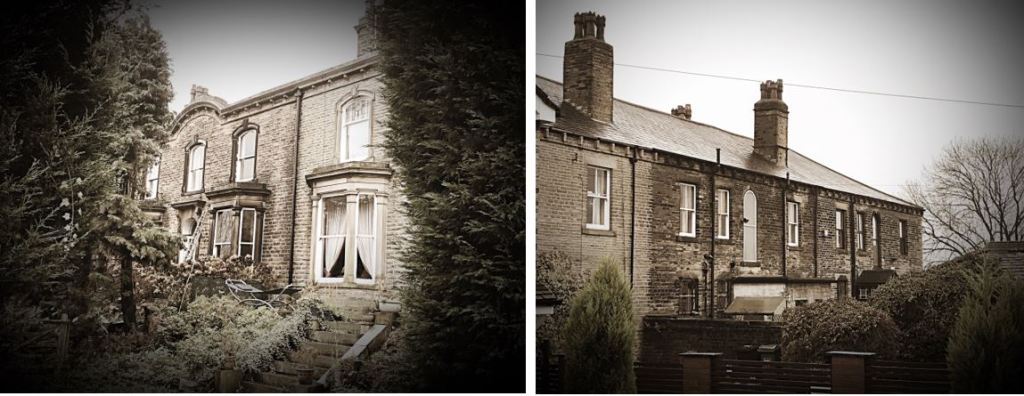
The houses where all three Heaton brothers lived and died – Photo by Jane Roberts

Another inquest, another hostelry – this time the Cricketers’ Arms Hotel, Heckmondwike. The jury returned a verdict of “accidentally scalded.

John was interred in Heckmondwike Cemetery on 9 November 1885. His wife, Elizabeth, was in the early months of pregnancy. She gave birth to a daughter, Georgina, on 28 May 1886. On 18 September that year the family were back in Heckmondwike Cemetery once more – this time for Georgina’s burial.


The surviving Heaton brother, George, did not carry on with the family business. In 1887 the chemical and oil refining works, along with other ventures including the farm, the Copperas Works in Roberttown, and several properties, were all put up for sale.17 In the 1891 census he is described as a retired manufacturing chemist. In his retirement George split his time between Heckmondwike and Scarborough.

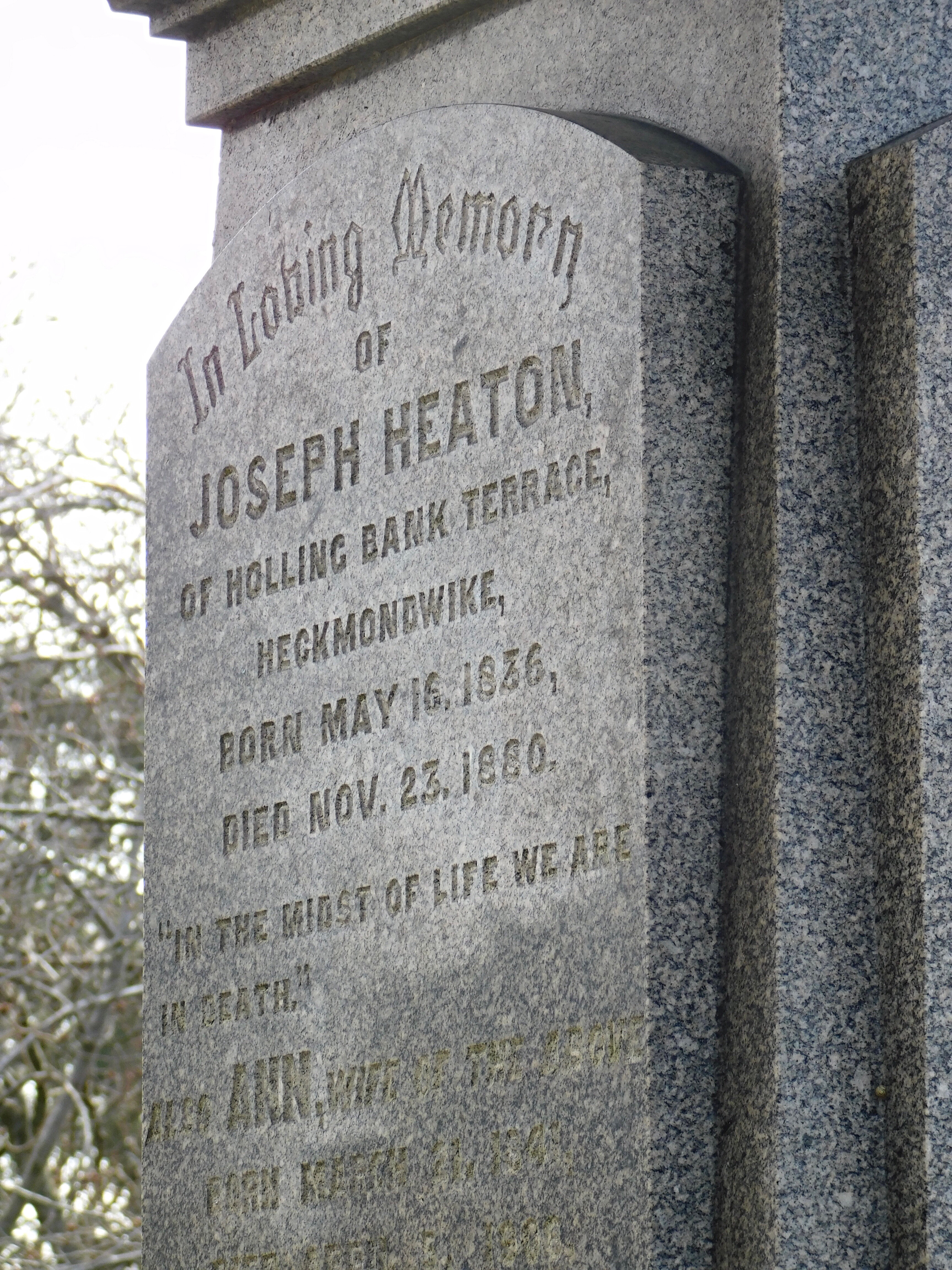
The Heaton headstone in Heckmondwike cemetery, pictured in detail below, gives clues to one of George’s major interests – Freemasonry. Both he and his brother Joseph, right up until their deaths, were members of the Amphibious Lodge in Heckmondwike. In 1896 George became Grand Master of the Lodge.

George died suddenly on 22 January 1898. He left a widow Mary (née Akeroyd) who he married at St Paul’s in Huddersfield on 25 November 1868. The couple’s two sons predeceased George. James William died, age 8, on 24 June 1878; Albert Edward died on 13 July 1879 just short of his fourth birthday. Both were buried in Heckmondwike cemetery and are commemorated on the family headstone.

George’s obituary appeared in The Freemason. It read:

Obituary.
BRO. GEORGE HEATON.

Bro. George Heaton, of Hollinbank-terrace, Heckmondwike, died somewhat suddenly on Saturday morning, the 22nd instant. He was 60 years of age, and was formerly in business as a manufacturing chemist and oil extractor. Bro. Heaton, who leaves a widow but no family, was formerly a member of the Board of Health,18 and for a while took an active interest in the Chamber of Commerce.19 It was in connection with Freemasonry, however, that he was best known. He joined the Amphibious Lodge, No. 258, Heckmondwike a quarter of a century ago, and has been a munificent patron of Masonic Charities. A few years ago he contributed 1200 guineas to the Royal Masonic Benevolent Institution, and quite recently he gave 1300 guineas to the Royal Masonic Institution for Girls. He was a P[ast] M[aster] of his lodge, and had also held a prominent position in the Provincial Grand Lodge of West Yorkshire. Although his death was unexpected, he has not enjoyed good health for some time.20

Shortly after his death an oil portrait of George was completed. Commissioned during his lifetime, he was depicted in full regalia with decorations and seals of office as Provincial Grand Deacon of West Yorkshire. The full sized figure, measuring 7 feet 6 inches by 5 feet 6 inches, was hung in the Heckmondwike Masonic Hall. If this portrait still exists, and if there is an image of it, I would love to know. It would be great to include it as part of this blog.


Not including that final catastrophic 1914 explosion, the above sequence of events with numerous fires at the chemical works, and four of the five deaths being work-related but all in entirely different ways, shows the dangers our ancestors faced in days before health and safety. And this sequence was nothing out of the ordinary, as the newspaper accounts of accidents across factories, mills, mines and other workplaces in this period testify. Perhaps what is noteworthy about the Heaton Chemical Works story is the fact that it cost two of the three brothers their lives. Perhaps George made the correct decision in quitting when he did.


I will leave you with one final series of images for the Heaton family: the two family headstones with their inscriptions for James and his sons Joseph, George and John. These lie in the shadow of the now derelict Twin Chapels in Heckmondwike cemetery.

Notes:
1. Inquest notes, West Riding Coroner’s Notebook, West Yorkshire Archives, Ref: C493/K/2/1/86;
2. It is unclear if grease is a separate substance, or if it is a local word for oil;
3. Leeds Mercury, 9 March 1863;
4. Batley Reporter and Guardian, 15 February 1879;
5. Batley Reporter and Guardian, 21 February 1874;
6. Batley Reporter and Guardian, 7 February 1874;
7. Using the MeasuringWorth website at https://www.measuringworth.com/index.php, this equates to a real price today of £935,300;
8. £1,500 is equates to a real price today of £153,600 using the above MeasuringWorth website;
9. Sources from the time give her name as Ann Gill, widow from Birstall. After David Miller’s death, Ann remarried in April 1866 at Weeton. Her husband was Samuel Gill. He died in 1868. In 1871 Ann is living with Edward Gill at Hightown, described as his wife. They actually married in August 1873 at St Peter’s, Birstall;
10. Inquest notes, West Yorkshire Archives, Ref: C493/K/2/1/36;
11. It’s not clear from the reports, but given George was coming from Dewsbury Moor it is likely he was approaching the Butcher’s Arms crossroads from the Dewsbury Gate Road side, directly opposite Staincliffe Hall Road;
12. Inquest notes, West Riding Coroner’s Notebook, West Yorkshire Archives, Ref: C493/K/2/1/36;
13. Inquest notes, West Riding Coroner’s Notebook, West Yorkshire Archives, Ref: C493/K/2/1/53;
14. Inquest notes, West Riding Coroner’s Notebook, West Yorkshire Archives, Ref: C493/K/2/1/86;
15. Ibid;
16. Using the top-end estimate of £15,000, this equates to an eye-watering real price today of £1,632,000 using the above MeasuringWorth website;
17. Yorkshire Post and Leeds Intelligencer, 1 and 5 February 1887;
18. Heckmondwike, where he served one term of three years;
19. Again in Heckmondwike;
20. The Freemason, 28 January 1898.

Other Sources:
1841 – 1891 Censuses;
Baptism Registers – Birstall St Peter’s, Leicester All Saints and Staincliffe Christ Church;
Directories;
• Freemasonry Membership Registers
;
GRO Indexes;
Heckmondwike Cemetery Burial Registers;
Marriage Registers – Barnby Dun Parish Church, Birstall St Peter’s, Huddersfield St Pauls and Scarborough St Mary’s;
National Library of Scotland Maps;
• National Probate Calendar
;
• Newspapers, various dates – including Batley News, Batley Reporter and Guardian, Bradford Observer, Dewsbury Reporter, Huddersfield Chronicle, Huddersfield Daily Examiner, Leeds Mercury, Leeds Times, Wakefield Free Press, and Yorkshire Post and Leeds Intelligencer;
• West Riding Coroner’s Notebook;
• Wikimedia Commons;
St Mary of the Angels, Batley: One-Place Study Update – 1 to 31 March 2021 Additions

This is the latest update of the pages relating to my Batley St Mary’s one-place study, the details of which I announced here.

Moses Stubley

During the past month I have added eight new pages. These include four weekly newspaper summaries. There are also three War Memorial biographies – those of Michael Flynn, Thomas Foley D.C.M., and Moses Stubley.

I have also updated Austin Nolan’s biography with some new information about a childhood scrape he got into with two other of the St Mary’s lads.

Finally I have identified several more men who served and survived, and have accordingly updated that page. The eighth page is a biography of one man in that category, Thomas Donlan. The biographies of the others will follow in due course.

Below is the full list of pages to date. I have annotated the *NEW* ones, plus the *UPDATED* page, so you can easily pick these out. Click on the link and it will take you straight to the relevant page.

1. About my St Mary of the Angels Catholic Church War Memorial One-Place Study;

Batley Descriptions – Directories etc.
2. 1914: Borough of Batley – Town Information from the Annual Report of the Medical Officer of Health.

Biographies: Men Associated with St Mary’s Who Died but Who are Not on the Memorial
3. Reginald Roberts
4. William Frederick Townsend

Biographies: The War Memorial Men
5. Edmund Battye
6. Michael Brannan
7. Thomas Curley
8. Michael Flynn *NEW*
9. Thomas Foley D.C.M. *NEW*
10. Michael Horan
William McManus – See William Townsend below
11. Patrick Naifsey
12. Austin Nolan *UPDATED* – Previously unseen information from childhood.
13. Moses Stubley *NEW*
14. William Townsend, also known as McManus

Biographies: Those who Served and Survived (this includes a list of those identified to date and who will later have dedicated biographical pages) *UPDATED*
15. James Delaney
16. Thomas Donlan *NEW*

Burials, Cemeteries, Headstones and MIs
17. Cemetery and Memorial Details
18. War Memorial Chronology of Deaths

During This Week
19. 1914, 8 August – Batley News
20. 1914, 15 August – Batley News
21. 1914, 22 August – Batley News
22. 1914, 29 August – Batley News
23. 1914, 5 September – Batley News
24. 1914, 12 September – Batley News
25. 1914, 19 September – Batley News
26. 1914, 26 September – Batley News
27. 1914, 3 October – Batley News
28. 1914, 10 October – Batley News
29. 1914, 17 October – Batley News
30. 1914, 24 October – Batley News
31. 1914, 31 October – Batley News
32. 1914, 7 November – Batley News
33. 1914, 14 November – Batley News
34. 1914, 21 November – Batley News
35. 1914, 28 November – Batley News
36. 1914, 5 December – Batley News
37. 1914, 12 December – Batley News
38. 1914, 19 December – Batley News
39. 1914, 24 December – Batley News
40. 1915, 2 January – Batley News
41. 1915, 9 January – Batley News
42. 1915, 16 January – Batley News
43. 1915, 23 January – Batley News
44. 1915, 30 January – Batley News
45. 1915, 6 February – Batley News
46. 1915, 13 February – Batley News
47. 1915, 20 February – Batley News
48. 1915, 27 February – Batley News
49. 1915, 6 March – Batley News *NEW*
50. 1915, 13 March – Batley News *NEW*
51. 1915, 20 March – Batley News *NEW*
52. 1915, 27 March – Batley News *NEW*

Miscellany of Information
53. The Controversial Role Played by St Mary’s Schoolchildren in the 1907 Batley Pageant
54. The Great War: A Brief Overview of What Led Britain into the War
55. Willie and Edward Barber – Poems
56. A St Mary’s School Sensation

St Mary of the Angels, Batley: One-Place Study Update – 1 to 28 February 2021 Additions

William McManus

This is the latest update of the pages relating to my Batley St Mary’s one-place study, the details of which I announced here.

During the past month I have added seven pages. These include four weekly newspaper summaries. There are also two biographies, those of Edmund Battye and William McManus/Townsend. And in the miscellany section is a story about an alleged sensational incident regarding a pupil and the acting head teacher of St Mary’s school.

I have also identified several more men who served and survived, and have accordingly updated that page. I have also updated Patrick Naifsey’s biography, after establishing the family connection which would have drawn him to settle in the Batley area.

Below is the full list of pages to date. I have annotated the *NEW* ones, plus the *UPDATED* page, so you can easily pick these out.

1. About my St Mary of the Angels Catholic Church War Memorial One-Place Study;

Batley Descriptions – Directories etc.
2. 1914: Borough of Batley – Town Information from the Annual Report of the Medical Officer of Health.

Biographies: Men Associated with St Mary’s Who Died but Who are Not on the Memorial
3. Reginald Roberts
4. William Frederick Townsend

Biographies: The War Memorial Men
5. Austin Nolan
6. Edmund Battye *NEW*
7. Michael Brannan
8. Michael Horan
9. Patrick Naifsey *UPDATED* (to include new family and service record information)
10. Thomas Curley
11. William Townsend, also known as McManus *NEW*

Biographies: Those who Served and Survived (this includes a list of those identified to date and who will later have dedicated biographical pages) *UPDATED*
12. James Delaney

Burials, Cemeteries, Headstones and MIs
13. Cemetery and Memorial Details
14. War Memorial Chronology of Deaths

During This Week
15. 1914, 8 August – Batley News
16. 1914, 15 August – Batley News
17. 1914, 22 August – Batley News
18. 1914, 29 August – Batley News
19. 1914, 5 September – Batley News
20. 1914, 12 September – Batley News
21. 1914, 19 September – Batley News
22. 1914, 26 September – Batley News
23. 1914, 3 October – Batley News
24. 1914, 10 October – Batley News
25. 1914, 17 October – Batley News
26. 1914, 24 October – Batley News
27. 1914, 31 October – Batley News
28. 1914, 7 November – Batley News
29. 1914, 14 November – Batley News
30. 1914, 21 November – Batley News
31. 1914, 28 November – Batley News
32. 1914, 5 December – Batley News
33. 1914, 12 December – Batley News
34. 1914, 19 December – Batley News
35. 1914, 24 December – Batley News
36. 1915, 2 January – Batley News
37. 1915, 9 January – Batley News
38. 1915, 16 January – Batley News
39. 1915, 23 January – Batley News
40. 1915, 30 January – Batley News
41. 1915, 6 February – Batley News *NEW*
42. 1915, 13 February – Batley News *NEW*
43. 1915, 20 February – Batley News *NEW*
44. 1915, 27 February – Batley News *NEW*

Miscellany of Information
45. The Controversial Role Played by St Mary’s Schoolchildren in the 1907 Batley Pageant
46. The Great War: A Brief Overview of What Led Britain into the War
47. Willie and Edward Barber – Poems
48. A St Mary’s School Sensation *NEW*

St Mary of the Angels, Batley: One-Place Study Update – 2 to 31 January 2021 Additions

St Mary of the Angels Church, Photo by Jane Roberts

This is the latest update of the pages relating to my Batley St Mary’s one-place study, the details of which I announced here

During the past month I have added eight pages. These include seven weekly newspaper summaries. There is also one biography, that of William Frederick Townsend. This was one of several name and name variants used by this mystery Royal Naval Volunteer Reserve man with theatre connections, who is buried beneath a CWGC headstone in Batley cemetery.

I have also identified more men who served and survived, and have accordingly updated that page.

Below is the full list of pages to date. I have annotated the *NEW* ones, plus the *UPDATED* page, so you can easily pick these out.

1. About my St Mary of the Angels Catholic Church War Memorial One-Place Study;

Batley Descriptions – Directories etc.
2. 1914: Borough of Batley – Town Information from the Annual Report of the Medical Officer of Health.

Biographies: Men Associated with St Mary’s Who Died but Who are Not on the Memorial
3. Reginald Roberts
4. William Frederick Townsend *NEW*

Biographies: The War Memorial Men
5. Austin Nolan
6. Michael Brannan
7. Michael Horan
8. Patrick Naifsey
9. Thomas Curley

Biographies: Those who Served and Survived (this includes a list of those identified to date and who will later have dedicated biographical pages) *UPDATED*
10. James Delaney

Burials, Cemeteries, Headstones and MIs
11. Cemetery and Memorial Details
12. War Memorial Chronology of Deaths

During This Week
13. 1914, 8 August – Batley News
14. 1914, 15 August – Batley News
15. 1914, 22 August – Batley News
16. 1914, 29 August – Batley News
17. 1914, 5 September – Batley News
18. 1914, 12 September – Batley News
19. 1914, 19 September – Batley News
20. 1914, 26 September – Batley News
21. 1914, 3 October – Batley News *NEW*
22. 1914, 10 October – Batley News *NEW*
23. 1914, 17 October – Batley News
24. 1914, 24 October – Batley News
25. 1914, 31 October – Batley News
26. 1914, 7 November – Batley News
27. 1914, 14 November – Batley News
28. 1914, 21 November – Batley News
29. 1914, 28 November – Batley News
30. 1914, 5 December – Batley News
31. 1914, 12 December – Batley News
32. 1914, 19 December – Batley News
33. 1914, 24 December – Batley News
34. 1915, 2 January – Batley News *NEW*
35. 1915, 9 January – Batley News *NEW*
36. 1915, 16 January – Batley News *NEW*
37. 1915, 23 January – Batley News *NEW*
38. 1915, 30 January – Batley News *NEW*

Miscellany of Information
39. The Controversial Role Played by St Mary’s Schoolchildren in the 1907 Batley Pageant
40. The Great War: A Brief Overview of What Led Britain into the War
41. Willie and Edward Barber – Poems

St Mary of the Angels, Batley: One-Place Study Update – 6 December 2020 to 1 January 2021 Additions

St Mary of the Angels Church, Photo by Jane Roberts

This is the latest update of the pages relating to my Batley St Mary’s one-place study, the details of which I announced here.

During the last few week I have added seven pages. These include six weekly newspaper summaries. There is also one biography, that of Patrick Naifsey, which encompasses apparitions, miracles, evictions, Kipling and an Irish Great War poet, as well as the County Mayo/Batley connection.

I have also identified more men who served and survived, and have accordingly updated that page.

Below is the full list of pages to date. I have annotated the *NEW* ones, plus the *UPDATED* page, so you can easily pick these out.

1. About my St Mary of the Angels Catholic Church War Memorial One-Place Study;

Batley Descriptions – Directories etc.
2. 1914: Borough of Batley – Town Information from the Annual Report of the Medical Officer of Health.

Biographies: Men Associated with St Mary’s Who Died but Who are Not on the Memorial
3. Reginald Roberts

Biographies: The War Memorial Men
4. Austin Nolan
5. Michael Brannan
6. Michael Horan
7. Patrick Naifsey *NEW*
8. Thomas Curley

Biographies: Those who Served and Survived (this includes a list of those identified to date and who will later have dedicated biographical pages) *UPDATED*
9. James Delaney

Burials, Cemeteries, Headstones and MIs
10. Cemetery and Memorial Details
11. War Memorial Chronology of Deaths

During This Week
12. 1914, 8 August – Batley News
13. 1914, 15 August – Batley News
14. 1914, 22 August – Batley News
15. 1914, 29 August – Batley News
16. 1914, 5 September – Batley News
17. 1914, 12 September – Batley News
18. 1914, 19 September – Batley News *NEW*
19. 1914, 26 September – Batley News *NEW*
20. 1914, 17 October – Batley News
21. 1914, 24 October – Batley News
22. 1914, 31 October – Batley News
23. 1914, 7 November – Batley News
24. 1914, 14 November – Batley News
25. 1914, 21 November – Batley News
26. 1914, 28 November – Batley News
27. 1914, 5 December – Batley News *NEW*
28. 1914, 12 December – Batley News *NEW*
29. 1914, 19 December – Batley News *NEW*
30. 1914, 24 December – Batley News *NEW*

Miscellany of Information
31. The Controversial Role Played by St Mary’s Schoolchildren in the 1907 Batley Pageant
32. The Great War: A Brief Overview of What Led Britain into the War
33. Willie and Edward Barber – Poems

St Mary of the Angels, Batley: One-Place Study Update – 16 October 2020 to 5 December 2020 Additions

St Mary of the Angels, Batley – Photo by Jane Roberts

Although you may think my blog posts appear to have been thin on the ground of late, the pages relating to my one-place study, as announced here, have more than made up for it. Since its official launch on 15 October 2020 there have been 22 additions.

These are the pages to date. I have indicated the 22 additions.

1. About my St Mary of the Angels Catholic Church War Memorial One-Place Study;

Batley Descriptions – Directories etc.
2. 1914: Borough of Batley – Town Information from the Annual Report of the Medical Officer of Health. *NEW*

Biographies: Men Associated with St Mary’s Who Died but Who are Not on the Memorial
3. Reginald Roberts *NEW*

Biographies: The War Memorial Men
4. Austin Nolan *NEW*
5. Michael Brannan *NEW*
6. Michael Horan
7. Thomas Curley

Biographies: Those who Served and Survived (this includes a list of those identified to date and who will later have dedicated biographical pages) *NEW*
8. James Delaney *NEW*

Burials, Cemeteries, Headstones and MIs
9. Cemetery and Memorial Details *NEW*
10. War Memorial Chronology of Deaths *NEW*

During This Week
11. 1914, 8 August – Batley News *NEW*
12. 1914, 15 August – Batley News *NEW*
13. 1914, 22 August – Batley News *NEW*
14. 1914, 29 August – Batley News *NEW*
15. 1914, 5 September – Batley News *NEW*
16. 1914, 12 September – Batley News *NEW*
17. 1914, 17 October – Batley News *NEW*
18. 1914, 24 October – Batley News *NEW*
19. 1914, 31 October – Batley News *NEW*
20. 1914, 7 November – Batley News *NEW*
21. 1914, 14 November – Batley News *NEW*
22. 1914, 21 November – Batley News *NEW*
23. 1914, 28 November – Batley News *NEW*

Miscellany of Information
24. The Controversial Role Played by St Mary’s Schoolchildren in the 1907 Batley Pageant
25. The Great War: A Brief Overview of What Led Britain into the War *NEW*
26. Willie and Edward Barber – Poems

Batley War Memorial and the War Memorial Fund

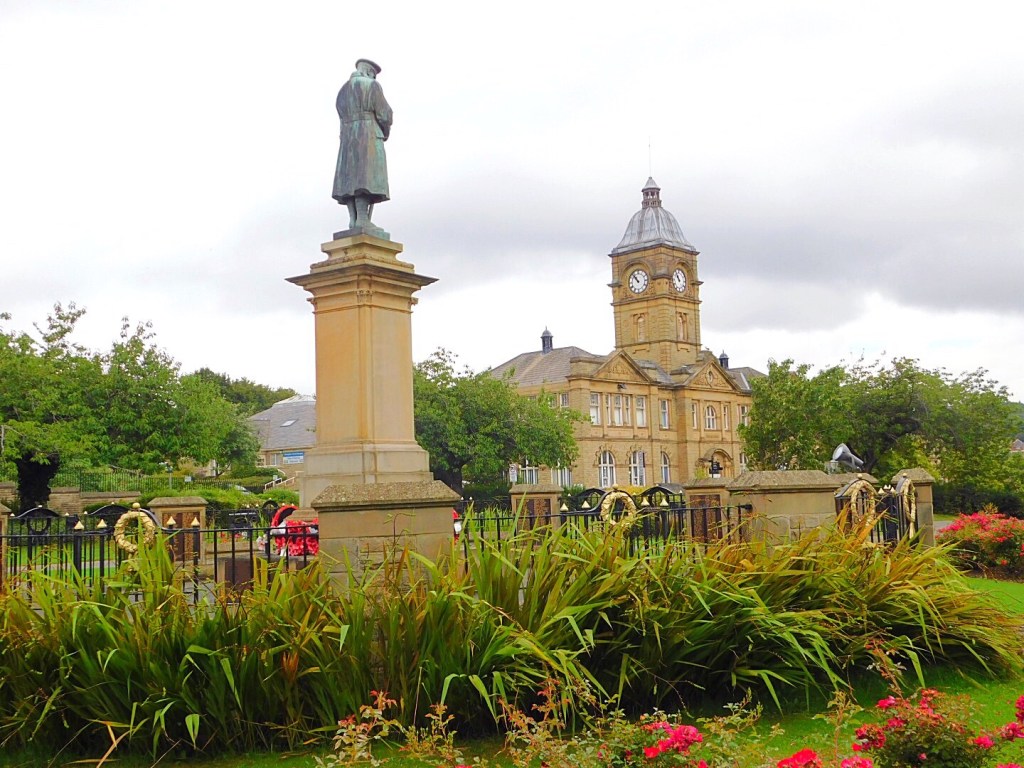
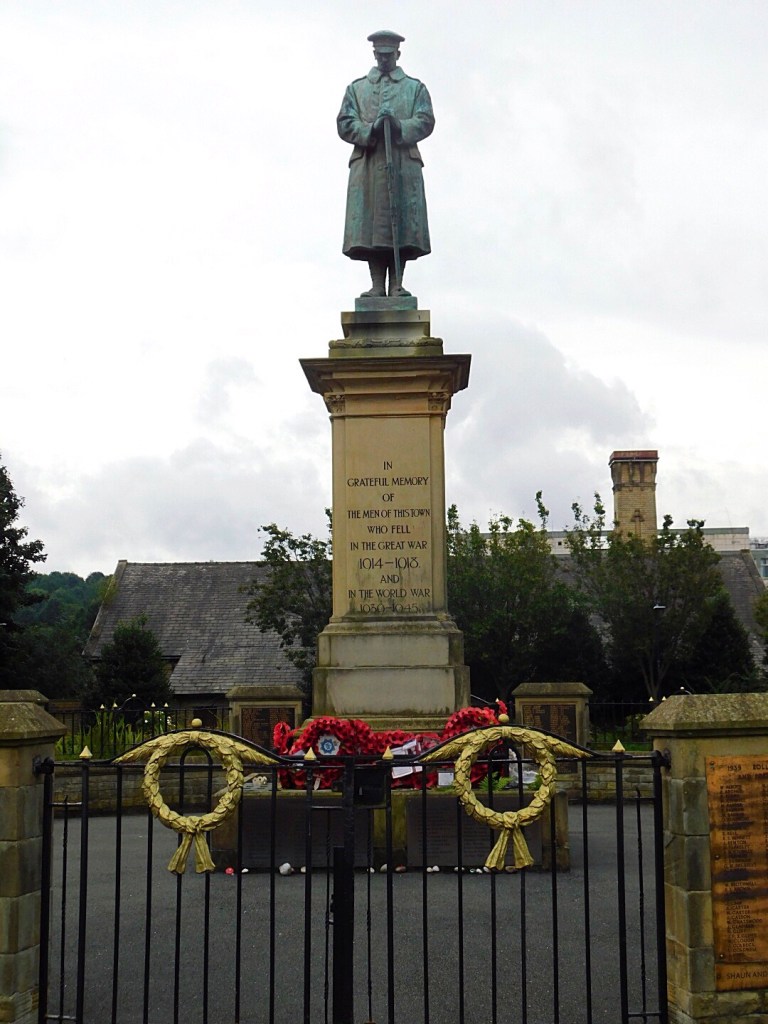
It is one of Batley’s most iconic sites. The soldier in the Memorial Gardens looking down solemnly over the names of Batley’s Fallen. But the design, and location, of the town’s War Memorial could have been totally different. And, it may come as a surprise, the town commemorated its Great War Fallen with far more than this Memorial. Here’s the story about the debates which went on in Batley about a suitable form of remembrance.

The Batley War Memorial Figure – Photo by Jane Roberts

The Great War officially ended on 28 June 1919 with the signing of the Treaty of Versailles. It was over a year later, on 9 August 1920, when Batley Borough’s General Purposes Committee resolved that “a representative Committee be appointed to consider and report to a public meeting on the question of the provision of some suitable War Memorial for this Borough.”

The War Memorial Committee was initially made up of the Mayor, Aldermen and Councillors, who were able to add others as deemed appropriate. In addition to these Borough worthies, those involved in the War Memorial Committee, and its offshoots, eventually comprised of representatives from each of the following organisations:

  • Borough Magistrates;
  • Co-opted Members of the Library Committee;
  • Co-opted Members of the Education Committee;
  • Co-opted Members of the Technical School Committee;
  • Chamber of Commerce;
  • Chamber of Trade;
  • Committee of the Batley & District Hospital;
  • Batley Workingmen’s Club;
  • Soothill Workingmen’s Club:
  • Batley Co-operative Society Ltd.;
  • Batley Paxton Society;
  • Temperance Society, Batley;
  • Trades & Friendly Club, Batley;
  • Carlinghow Workingmen’s Club;
  • Liberal Club, Batley;
  • Liberal Club, Staincliffe;
  • Conservative Club, Batley;
  • United Irish League Club, Batley;
  • St John Ambulance Association, Batley Division;
  • Batley Cricket, Athletic and Football. Club;
  • Independent Labour Party, Batley Branch;
  • Primrose League, Batley;
  • Women’s Liberal Association, Batley;
  • Co-operative Women’s Guild, Batley;
  • Teachers Association, Batley Branch;
  • Independent Labour Party Women’s Branch;
  • P.M.E. Batley (Hanover Street Church);
  • British Women’s Temperance Association (BWTA), Batley Branch;
  • BWTA Staincliffe Branch;
  • BWTA Hanging Heaton Branch;
  • Batley Old Band;
  • Batley Nursing Service;
  • Batley Ex-Servicemen’s Social Club; and
  • Batley Branch British Legion.

At the War Memorial Committee Meeting on 11 October 1920, three resolutions were passed:

  1. That they should recommend to a public meeting that a suitable monument be erected in the Borough as one way in which to perpetuate the memory of those from Batley who fell in the War;
  2. That it should also be recommended that a portion of any War Memorial Fund should be go towards the extension of Batley & District Hospital. Alongside this, that a Sub-Committee be appointed to consider and report upon the amount of pensions being paid to widows and other dependents of the men from the Borough who fell in the Great War; and
  3. That subscribers to any arising War Memorial Fund should be allowed to earmark their subscriptions to any one or more of the selected schemes.
Batley War Memorial in Winter – Photo by Jane Roberts

The pension aspect was considered further in January 1922. In this meeting the War Memorial Sub-Committee decided in view of the increased amount of State pensions payable to War widows and War dependents, and the decrease in the cost of living, the Batley war Memorial Scheme should be confined to raising subscriptions to erect a suitable monument. The main Committee accepted this recommendation and, as a result, the establishment of a larger benevolent fund was deferred. Essentially this meant it was scrapped.

The War Memorial Committee then appointed another Sub-Committee to prepare and consider plans for the erection of the War Memorial.

On 20 February 1922 this War Memorial Sub-Committee discussed the siting of the Memorial. One suggestion was part of Batley Parish Church Yard. However it was felt a new Memorial inappropriate for an old church yard. The two remaining options were the park, adjoining Bradford Road; or the Market Place, because of its accessibility. Objections to the latter were raised on the grounds that the market would be too crowded. As an alternative, another portion of the Market Estate was proposed – the open ground at the top of the Market Hill. The Committee voted on the two options, and overwhelming decision was Market Hill. The Borough Surveyor had the task of preparing a rough layout in time for the next meeting.

The Sub-Committee reconvened on 6 March 1922 for further discussions, based on the layout drawn up by the Borough Surveyor. Some did not like the proximity of the Memorial to the police station. Others still argued for a more central market position. But the top of the Market Hill won the day, with the lay-out approved to put forward for main committee sign-off.

The Borough Engineer was asked to obtain sketch models for the Monument and a walled enclosure on the Market Hill site, with the design of the Monument left to the discretion of the artists. A cost of £1,500 was set as part of the design specifications.

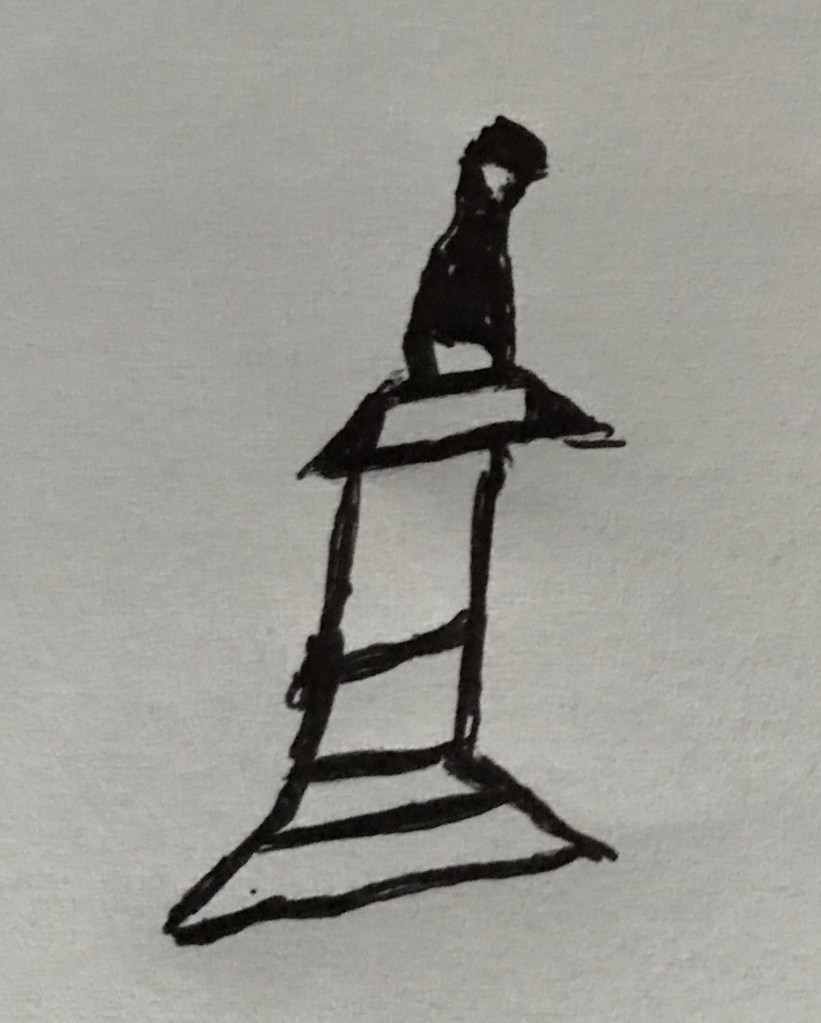
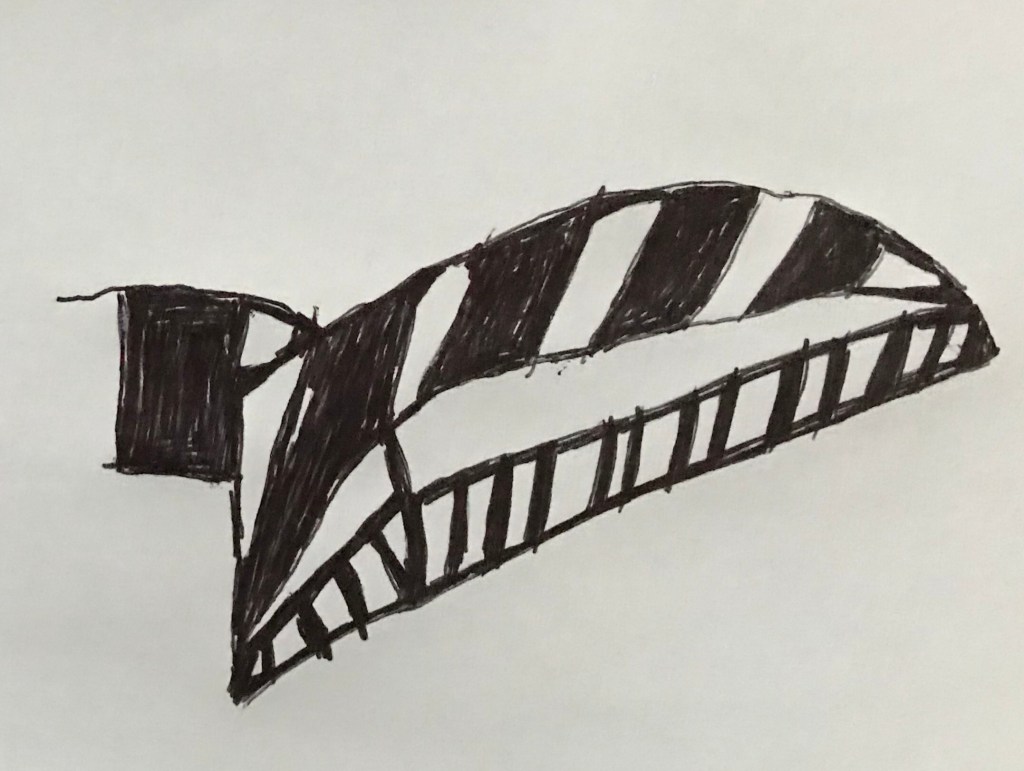
The Borough Engineer brought 16 submitted designs to the 15 May 1922 meeting. Two designs were selected – one by Messrs. Wright and Sons Limited of Bradford; and the other by Messrs. R.L Bolton and Son of Cheltenham. The Committee also wanted a third design in the form of another Cross, so the decision was taken to ask Messrs. Kelly of Bradford and Messrs. Scott of Dewsbury to resubmit designs so one of these crosses could also be considered. The rough minutes of the meeting contained rudimentary doodles of the designs. I have reproduced these below. Yes, my sketches are bad. But in my defence they are very good replicas of those in the draft minutes!

Now thoughts turned to names on the Memorial. The Town Clerk was asked to compile a nucleus list consisting of name, rank and unit. This could then be circulated amongst churches, clubs etc, and checked with information from official bodies like the War Pensions Department and Post Office. Once this nucleus list was established, it would be publicly available for consultation in the Town Hall and library, and advertised in the local papers.

June 1922 came and went. The War Memorial Sub-Committee failed to reach a design decision. More designs had come in. More were sought. And the Town Clerk and Borough Surveyor were instructed to obtain photographs of monuments already erected in other towns.

These photographs were presented on the 30 August 1922 War Memorial Sub-Committee meeting. Finally two designs were settled on. As in May it was the design by Bradford’s Messrs Wright and Sons Ltd, at a cost of £2,000. This was a figure on a pedestal. However, the Sub-Committee decided to ask this firm to submit an alternative design for the figure. The second design selected was by Mr L.T. Moore of London. This was a tall pillar on a plinth surmounted by a Cross. Lions were depicted on the sketch, and the Sub-Committee wanted an amended design without the lions.

The Memorial site and designs now went before the full War Memorial Committee on 8 September 1922. They overwhelmingly concurred that the Market Estate site was preferable to the park, 20 votes to 4, with one abstention. But the designs attracted more debate.

The Borough Surveyor outlined the design of Messrs Wright and Sons Ltd. In a pose symbolic of attendance at a funeral, a bronze soldier stood on a Bolton Wood Stone pedestal. But some were dissatisfied with a soldier. Alternate suggestions bandied about included a Winged Figure for Victory. Another suggestion was for a Sailor, a Soldier and an Airman; and taking this combined services theme a step further, a single symbolic figure representing all three services was mooted. But the line was held. This bronze soldier was the design decided upon by the Sub-Committee, and it was this design which the full Committee had to consider.

Mr L. T. Moore‘s design was similarly debated by the Committee. Rather than lions surrounding the cross, could it not be the figure from the first design, came the suggestion? It was confirmed that the Sub-Committee agreed that the lions be removed. The War Memorial Committee choice here was therefore the cross with or without figures.

Finally it came to a vote. With 23 in favour against nil, and two abstentions, Messers Wright & Sons Ltd Soldier design was the one chosen at Sub-Committee stage for Batley’s War Memorial.

The next step was the approval of these decisions by the General Purposes Committee of the Town Council (28 September 1922), and sign-off by the Town Council itself (5 October). Both passed as stood – the Market Hill area of the Market Estate, and Messers Wright & Sons Ltd were confirmed. Preparations were now taken to enclose and lay out a portion of the Market Estate for the Monument, and to inform the people of Batley.

The town’s meeting took place on 30 November 1922. Even here there was a last-ditch unsuccessful attempt to force a reconsideration of the the Market Estate location for the Memorial. But the plans were finally signed off here, with only three dissentients.

The town’s meeting also saw the newly-elected Mayor, Councillor Hamilton Crothers, formally launch the Mayor’s Fund-Raising Appeal to pay for the Memorial. At the meeting it was announced that an initial £750 had been donated equally by Messrs G. & J. Stubley, Messrs J., T. & J. Taylor Ltd, and Mrs Adeline Stubley. By 1 August 1923 the Mayor’s Appeal stood at £2,248 7s and 6d, with donations coming in from across the town, way in excess of the amount needed.

Batley War Memorial in Summer – Photo by Jane Roberts

In parallel to the fund-raising appeal, collecting the names of the Fallen moved onto the next phase. In February 1923 forms were issued to householders in the Borough asking for the particulars of any relative who was killed or whose death was certified as due to wounds received, or disease contracted in the War. In addition to this house-to-house canvass, names were obtained through the War Pensions Department, Clubs, Institutes, Religious bodies etc. Information poured in, on officially distributive pro formas, in various books placed in the municipal buildings, and by post. Multiple clubs, organisations and churches also submitted names. All this information was used to produce lists, with numerous corrections and iterations leading to multiple versions and refinements. A format of the list was also published in order to receive further names, or any corrections (including spellings). This was an enormous task, in a time when information had to be cross-checked, compared, collated, sorted and organised manually – then typewritten.

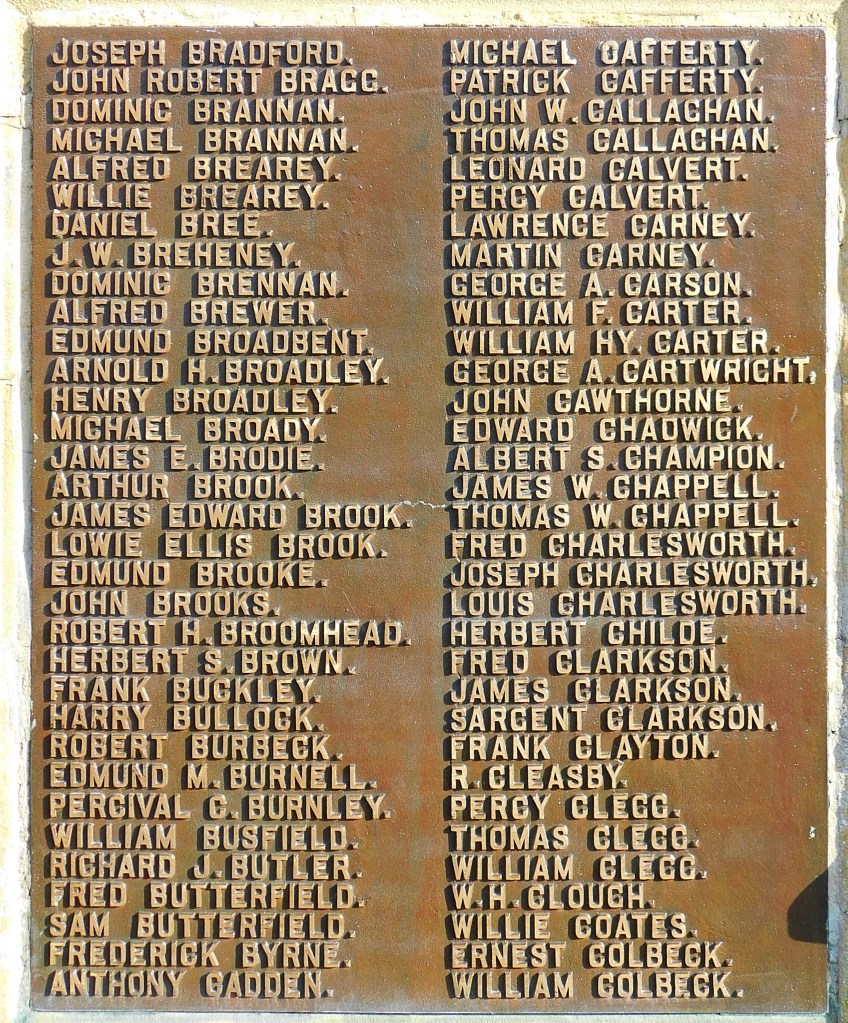
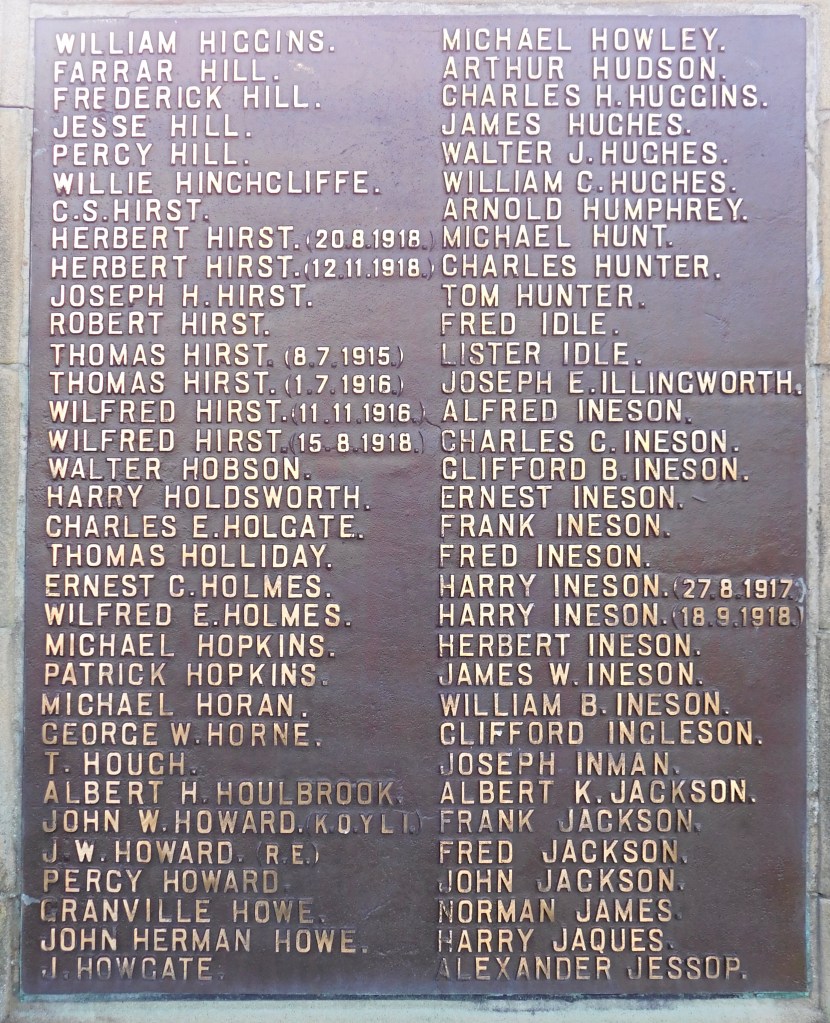
By August 1923 a satisfactory draft list showing rank, name, regiment and date of death was produced. This list – 782 names in total – was forwarded to the chosen contractor, Messrs Wright and Sons Ltd of Bradford, for them to prepare the twelve bronze tablets for the Memorial. These tablets would include the men’s Christian and surnames, organised in alphabetical surname order.

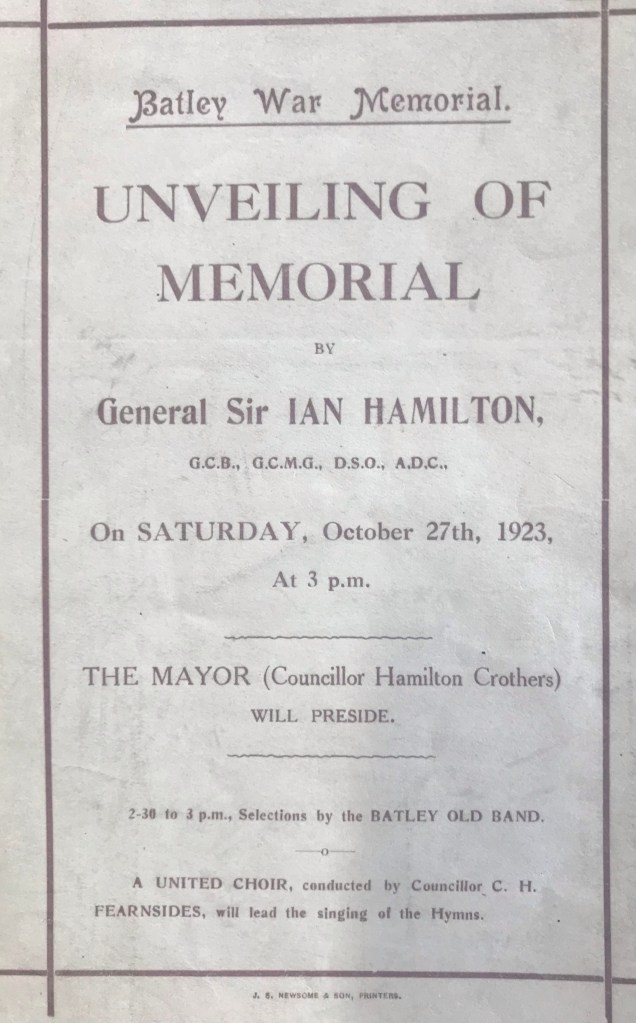
On 6 September 1923 the Sub-Committee responsible for the unveiling of the War Memorial met formally for the first time. They had not long to make arrangements for the event, which they set for 27 October 1923. In terms of who would perform the unveiling, the Sub-Committee tasked the Mayor with approaching either Field Marshal Earl Haig, Admiral Earl Beatty, General Ian Hamilton or General Harrington, G.O.C. Northern Command

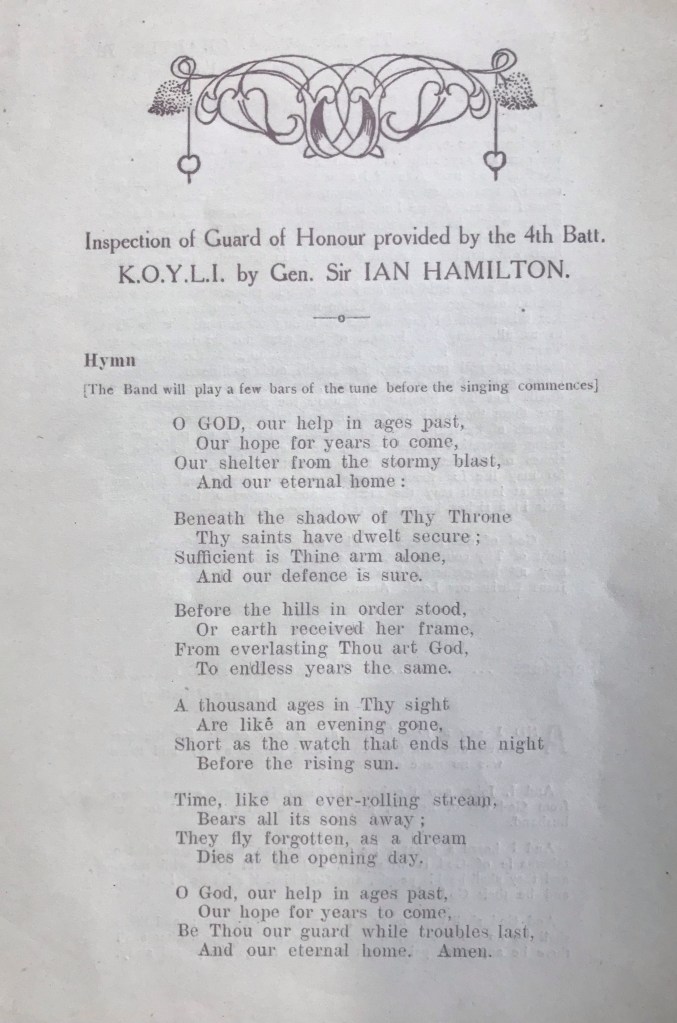
General Sir Ian Hamilton, commander at Gallipoli, had retired from the Army in 1920. But he subsequently took a keen interest in the work of the British Legion, and he was in great demand as a speaker for veteran organisations. Despite the very short notice he agreed to perform the unveiling of Batley’s War Memorial.

And yet, even at this late stage, there had been no decision as to the War Memorial inscription. Those discussions continued during September. By early October the sculptors finally received confirmation that the inscription would be:

In grateful memory of the men of this town who fell in the Great War 1914- 1918.

Batley War Memorial Inscription – Photo by Jane Roberts

The War Memorial unveiling ceremony commenced at 3pm on 27 October 1923. General Hamilton, in his short address, said it was not enough to raise a memorial to the nearly 800 dead. The people must take their part to prevent the world entering upon another period of war, and to save their children from suffering as they themselves had suffered. The inscription on the War Memorial today, shows General Hamilton’s hope did not come to pass.

The images below are from the official programme for the ceremony.

At the wreath-laying ceremony which followed the unveiling, nearly one hundred relatives of the fallen men laid flowers at the foot of the Memorial.

Batley finally had its War Memorial.

Unveiling of Batley War Memorial

So what of the other proposals for the Mayor’s War Memorial Fund? As explained earlier, there were originally three:

  • The now fulfilled erection of a monument;
  • The augmenting of the pensions received by widows and other dependents of men from the Borough who fell – an aim which was quickly dropped; and
  • Contributing to the Batley Hospital Extension scheme.

From 1924 onwards the move was made to ensure that the surplus of the Mayor’s Appeal Fund be devoted to the urgently needed hospital extension “in such a manner as to help perpetuate the memory of those who fell in the Great War.

In fact, the Mayor’s War Memorial Appeal Fund had been so well-supported by the folk of Batley that £750 was duly handed to the Board of Batley Hospital on 30 April 1926. And there was still a surplus available. Around £100 of this was earmarked for a suitable Memorial Plaque for the hospital to commemorate the gift from the War Memorial Fund. It was mooted that this could possibly be in the new entrance hall of the hospital, but the final decision as to location would be for the Hospital Board. This £136 surplus was still under discussion in 1934.

In 1935 it was resolved at last. A Memorial plaque would definitely be erected. Two choices for wording were considered. The final decision was:

To assist
in perpetuating the memory
of the men of Batley
who fell in the Great War 1914-1918
whose names are recorded on
the town’s War Memorial
the sum of £862 was given
from the War Memorial Fund
towards the cost of the extension
of this Hospital
begun 1924, completed 1928.

There was one other tangible form of remembrance. In 1925 the War Memorial Committee decided to seek tenders for a Memorial Tablet Frame containing the names of Batley’s Fallen. Despite these tenders being commissioned and received in 1925, nothing happened for almost another ten years. Finally in 1935 another set of tenders were requested. The specification decided upon was for two English Oak Mural Tablets, encasing behind glass parchment scrolls containing the names of the 782 fallen. These were to be displayed inside Batley Library. The 1935 tender request was quite specific that this was to be English Oak. Perhaps this was a throwback to 1925 when one of the aborted tenders, from Harry Senior, cabinet maker of Daisy Hill, Dewsbury, showing an astounding lack of awareness, stated his quote was for frames of PRIME QUALITY AUSTRIAN OAK ! (And yes, his quote did have this phrase in capital letters).

Messrs. Osborn Hoyle Ltd, Engravers, Die Sinkers and Stamp Makers of 17 Bond Street, Dewsbury finally won the tender, at a cost of £14 4s for the frames, and £7 10s for the 12 parchment scrolls and glass. There was also an additional cost of supplying and fixing 108 bronze letters on the oak frames, amounting to £4 1s 1d. This work was all complete by August 1935. This firm also won the contract for the Hospital Memorial plaque.

The Oak Memorial Tablets are now in Batley Town Hall.

But does anyone recall seeing the bronze Memorial Plaque in Batley Hospital, or know what became of it since the hospital’s closure? It did briefly resurface back in 2014, but I’ve not found out what happened after that. I’ve not noticed it in Batley Town Hall, but since researching the War Memorial history I’ve been unable to go down to check. It may be it is still in storage somewhere. I really do hope it can go on display once more at some point. After all, it is part of our town’s history, and it is a tribute to our ancestors’ efforts to commemorate our town’s Great War Fallen in perpetuity.

Batley Hospital Plaque, on Display at Dewsbury Town Hall in around 2014/15 Photo donated and permission granted to use in this blog

Finally, this Remembrance Sunday will not be like others because of the pandemic restrictions. If you have not been able to buy your usual poppy locally this year, and do feel able to donate to the Royal British Legion, here is the link to the Poppy Appeal 2020.

Batley War Memorial in Autumn – Photo by Jane Roberts

Postscript:
Finally a big thank you for the donations already received to keep this website going. 

The website has always been free to use, but it does cost me money to operate. In the current difficult economic climate I am considering if I can continue to afford to keep running it as a free resource, especially as I have to balance the research time against work commitments. 

If you have enjoyed reading the various pieces, and would like to make a donation towards keeping the website up and running in its current open access format, it would be very much appreciated. 

Please click here to be taken to the PayPal donation link. By making a donation you will be helping to keep the website online and freely available for all. 

Thank you.


Footnotes:
• I am gradually uploading mini-biographies for the St Mary of the Angels Catholic Church parishioners on the One-Place Study section of my website. The list of St Mary’s War Memorial men is here, with links to the biographies.
• For more information about those on the War Memorial see Batley’s Roll of Honour;

Healey’s Peace Festival of 1919

As a lifelong Healey, Batley resident, a treasured piece of the village’s history which I own is a commemorative mug. It is linked to Healey’s peace celebrations, which marked the end of the Great War.

Healey Peace Celebrations Commemorative Beaker

Given it is the Remembrance period, it seems a fitting time to share the history behind the commemorative mug, or beaker as it was termed at the time.

If you have Healey, or Batley, links you may recognise some of the names or the streets mentioned in the Healey Peace Festival story. I certainly do. Many of the surnames were familiar ones to me growing up in the area over half a century later. And the procession passed along the streets of my childhood and youth, and by my current home.

First of all to set the scene. Even before the signing of the Treaty of Versailles on 28 June 1919, the Treaty which was to officially end the war with Germany, the country was gearing up to celebrate. The government was keen that any local festivities should be put on hold for a collective celebration of peace by the entire country. Their initial plans were for national celebrations over four days at the beginning of August, to coincide with the summer Bank Holiday on 4 August. But this was reduced to one day of simultaneous celebrations across the Empire on 19 July, with King George V proclaiming the day would be a Bank Holiday and Public Holiday throughout the United Kingdom.

But even though 19 July 1919 was the official national ‘Peace Day’ this did not put a stop to the extension of local celebrations, in line with initial plans, over the August Bank Holiday weekend.

And this was the case in Healey, Batley, which held its Peace Festival on Saturday 2 August 1919

The Batley News of 9 August 1919 reported Healey’s celebrations as follows. Note spelling and punctuation is as per the article, and some of the print is not legible:

HEALEY’S PEACE FESTIVAL
Brilliant and Entertaining Spectacle.
Glorious Feast for the Children.
Fancy Costumes and Sports Results.

There was an atmosphere of joy in Healey on Saturday, when the little village threw itself heart and soul into Peace rejoicing. The streets were gaily decorated with flags and bunting, and several of the residents had transformed the appearance of their houses into that of fairy dwellings. Flags were flying from the windows, and the fronts of the houses were a mass of red, white and blue.

When the procession assembled in White Lee Road at two o’clock the weather was somewhat undecided, and it looked, indeed, as if the workers’ splendid efforts were going to be spoiled. Luckily, however, there were only one or two showers, and everything passed on beautifully. By 2.30 the procession was organised, and proceeded along White Lee Road, Healey Lane, Deighton Lane, Trafalgar Street, West Park Road, Healey Lane, to Mr. A. Oldroyd’s field (kindly lent for the occasion), where the children sang the National Anthem and “O God, our Help in ages past,” under the conductorship of Mr. J. H. Wagner.

Mr. W. T. Exley (President) walked at the head of a picturesque procession, and he was accompanied by a little girl dressed as Red Riding Hood, and a boy dressed as Boy Blue. Decorated bicycles and tricycles followed, some gaily attired in patriotic colours, and others covered with charming flowers, A [?]der in khaki was heartily applauded. He had built his machine to represent a tank, and with the guns projecting from the framework, the machine looked very warlike.

There was a blaze of colour amongst the boys and girls, who represented various Allied nations, including Japan, India, Spain and China. Several boys and girls were also attired in Scotch costumes. Britannia followed, and behind her was a decorated wagon containing young children. A novel and interesting group of children with dolls’ perambulators presented a pretty appearance. The little carriages were tastefully adorned with flowers and ribands. One of the turnouts was decorated as a Red Cross carrier.

Humorous characters followed, and after them came boys and girls in historical dresses, including courtiers, etc. John Bull was a striking figure, and succeeding a motor wagon load of children who seemed to enjoy the fun, was Liversedge Parish Church Boys’ Brigade drum and fife band, who were followed by pierrots and humorous characters, conspicuous amongst whom was an impersonator of Charlie Chaplin. One member of the procession represented the Kaiser. A competitor who caused much merriment wore a fireman’s hat and coat and a Scotch kilt, with khaki puttees. A woman dressed in red, white and blue material, and wheeling two rag dolls in a carriage, also raised roars of merriment.

The Prize-Winners.

Prizes were awarded for the three best competitors in all the classes, and the following were the awards:-
Decorated bicycle or tricycle, for boys under 16. – 1, Albert Oldfield; 2, Fred Wadsworth; 3, Jos. Preston.
Best dressed Allied girl, under 16. – 1, Dorothy Tattersfield; 2, Grace Auty; 3, Kathleen Blackburn.
Best dressed Allied boy, under 16. – 1, Walter Senior; 2, Wm. J. Newsome; 3, Harold Tattersfield.
Best child’s doll turnout, girls under 11. – 1, Kathleen Armitage; 2, F. M. Walker; 3, Florence Senior.
Basket of flowers. – 1, Floris Robinson; 2, Esther Blackburn; 3, Kathleen Raine.
Best dressed humorous boy under 16. – 1, Harold Boocock; 2, Herbert Auty; 3, James A. Illingworth.
Best dressed historical boy under 16. – 1, Lawrence Smith; 2, Clifford Newsome; 3, Willie Sykes.
Best dressed novel boy, under 16. – 1, Wilfred Bald[w]in; 2, Ernest Riley; 3, G. Tattersfield.
Best dressed humorous girl under 16. – 1, Ivy Bailey. [No other names].
Best dressed historical girl under 16. – 1, Madge Barber; 2, Edna Bruce; 3, Barbara Tattersfield.
Best dressed novel girl under 16. – 1, May King; 2, Lilian Trott; 3, May Swallow.
Best dressed humorous gentleman. – 1, Mrs. Illingworth; [yes, it does say Mrs.] 2, Smith Senior; 3, Percy Riley.
Best dressed humorous ladies. 1, Mr. Illingworth; [yes, it does say Mr.] 2, Mrs. Swallow; 3, Mary Fisher.

The judges, Messrs. J. F. Whitaker, A. Jowett and F. W. Gaunt, had a very difficult task to perform in selecting the winners owing to the keen competition, and both winners and losers merited high praise. The prizes in each class were of the value of 10s., 5s. And 2s. 6d.

After the judging, tea was provided in a large marquee for boys and girls under 16 who had taken part in the procession. Children who were unable to attend owing to sickness or employment will receive due consideration if their cases have been notified to the officials.

Interesting Sports.

In the evening sports, including flat races, sack races, skipping and three-legged races, were held, and suitable prizes given.

The winners were:-

60 Yards Flat Race, girls under 9. – 1 Olive Gibson, 2 Elsie Barber, 3 [?]y Sykes.
60 Yards Flat Race, boys under 9. – 1 Geo. Atkinson, 2 Fred Wadsworth, 3 Frank Pyatt.
80 Yards Flat Race, girls under 12. – 1 Alice Sykes, 2 Edna Bruce, 3 Elsie Lee.
80 Yards Flat Race, boys under 12. – 1 John Rhodes, 2 Laurence Blackburn, 3 Ronald Kershaw.
Wheelbarrow Race, boys over 12. – 1 W. Parker and C. Preston, 2 [Blank] Flowers and Frank Scott, 3 [Blank] Gibson and J. Robinson.
Potato Race, girls under 12. – 1 Gerty Parker, 2 Dorothy Wilkinson, 3 Elsie Lee.
Three-legged Race, boys under 12. – 1 J. Rhodes and N. Scott, 2 Horace Greenald and R. Wharton, 3 Lawrence Blackburn and [Blank] Boocock.
80 Yards Skipping Race, girls under 12. – 1 Edna Bruce, 2 Elsie Lee, 3 Alice Sykes.
60 Yards Sack Race, boys under 12. – 1 Ralph Ward, 2 W. Baldwin, 3 John Rhodes.
100 Yards Flat Race, boys over 12. – 1 Geo. Tattersfield, 2 Clifford Preston, 3 M. Gibson.
100 Yards Skipping Race, girls over 12. – 1 Marion Barker, 2 Ivy Bailey, 3 Dorothy Tattersfield.
60 Yards Sack Race, boys over 12. – 1 Willie Parker, 2 Clifford Preston, 3 M. Gibson.
100 Yards Flat Race, girls over 12. – 1 Lilian Sykes, 2 Louise Robinson, 3 Marion Barker.
Three-legged race, girls over 12. – 1 Muriel Pyatt and Lilian Trott, 2 Dorothy Sykes and Annie Autie, 3 May King and Rene Redfearn.

The children hugely enjoyed Professor Candler’s famous punch-and-judy show. There was also dancing round the Maypole by a number of children. Batley Old Band played for dancing. To complete an excellent day’s enjoyment there was a grand firework display after ten o’clock.

A beaker souvenir will be presented to each child under 16 resident in Healey, at an early date.

Hard-Working Officials.

The following are the officers of the committee, who worked hard for the success of the proceedings, along with others:- Messers. W. T. Exley (president), C. P. Tattersfield and J. A. Oldroyd (joint treasurers), and E. Bruce and H. G. Auty (joint secretaries). The officials on Saturday were: Chief marshall, Mr J. A. Blackburn; assistant marshall, Mr. Saml. Brearley; band, Mr. J. H. Wagner; decorated cycles, Mr. P. Ward; Allied girls (Mr. J. A. Blackburn (D.L); Allied boys, Mr. A. Newsome; child’s turnout, Mr. W. Whiteley; flower girls, Mr. Pinder; decorated wagon, Mr. F. Jowett; humorous boys, Mr. G. H. Wilson; historical boys, Mr. H. Haley; novel boys, Mr. G. Naylor; humorous girls, Mr. Colbeck, B. Barber; historical girls, Mr. H. Sykes; novel girls, Mr. A. Gaunt; motor waggon (children), Mr. F. Jowett; drum and Fife band, Messrs. Parkinson and W. T. Stone; adult gentlemen, Mr. J. Stone; adult ladies, Mr. C. H. Preston; stewards, Messrs. J. A. Tattersfield and J. W. Haigh; competitors’ stewards, Messrs. Battye, Pinder and Preston; bell men, Messrs. Cordingley and Bennett; prize stewards, Rev. Geo. Trippett and Mr. A, Oldroyd; handicappers, Messrs. E. Robinson and C. Buckley; starter, Mr. J. A. Blackburn (D.L.).

I must admit reading the article gave me an immense sense of pride in the Healey of my childhood. It even reminded me of the Queen’s Silver Jubilee Celebrations in 1977 at the now gone Harrison’s Social Club and fields on Healey Lane. Us children were given commemorative mugs then. Sadly I’m not sure what happened to mine.

But it is one of these antique 1919 Peace beakers that I have, presented to one of the Healey under 16s over a century ago. I’m not sure who owned it originally. But I will treasure it. And it will be handed on to future generations with Healey village links.

Healey Peace Celebrations Commemorative Beaker

From Devon to Batley – A Gardener’s Life

The following is based on some research I did for the Family and Community Historical Research Society (FACHRS) gardeners mini project last year. The aim was to research a specific gardener from your locality. I was allocated Job Kenwood, who is recorded as living in Batley in the 1881 census.

This local connection element to research is one of the key things which attracted me to FACHRS. The benefit of this was certainly borne out with Job Kenwood, for I discovered the subject of my mini project had a surprising personal connection. And, as I investigated him, it transpired that gardening formed only a small portion of his life. He was well known in Batley, as well as throughout East Devon, not purely for his horticultural skills.

Job Kenwood was born in Buckerell, Devon, in around 1855 [1], the son of Whimple-born cordwainer Robert Kenwood and his wife Maria (née Goldsworthy). Buckerell described as ‘a pleasant village and parish, in the Otter valley, 3½miles W. by S. of Honiton…[2] had 343 inhabitants in the 1851 census [3], the year prior to Robert and Maria’s marriage. Job was baptised in Buckerell parish church on 25 February 1855 [4].

The 1861 census found the family living at Butts Cottage in Buckerell. The household comprised of 32-year-old boot maker Robert, 31-year-old Maria, six-year-old Job and his older sister, Rhoda, age seven [5].

By 1871 Job had left his parent’s home and was working as an apprentice gardener. He was one of five other single men employed as gardeners or apprentices, and lodging in the household of another unmarried gardener Thomas Shingles in Bicton, Devon [6].

Bicton was a small village of 181 inhabitants in 1871 [7]. But, as hinted by the occupations of those men Job shared a house with, the village had a renowned feature. A feature which made it a true horticultural mecca, with Victorian railways transporting admiring visitors from far and wide. It was the location of Bicton manor which boasted some impressive, well-established botanical gardens, described as one of the most impressive gardens in Devon and the United Kingdom in the nineteenth century [8]. Bicton Gardens remain a popular Devon attraction to this date, open to explore even in these difficult COVID-19 times.

Dating from the 18th century, an 1893 description gives some idea of the impressive nature of these gardens:

Bicton House…stands in a fine park of 74 acres, well filled with timber, and containing a small lake; the gardens are tastefully laid out, and have acquired much celebrity from the completeness and rarity of the trees, shrubs and flowers here collected, and the systematic character of their arrangement; in the park is a fine avenue of oak, beech and the Chili pine (araucaria imbricata); the arboretum contains the finest collection of trees in Europe… [9]

It is unlikely that Job spent much, if any, time working under the tutelage of the James Barnes. Barnes was the widely-known director and manager of Bicton Gardens, working in that capacity for almost 30 years until his retirement in 1869. Given Job would only have been around 14 then, any overlap would only have been very brief. But Barnes’ influence and legacy, right down to his strict behavioural rules (no pipe smoking, and no coming to work in a dirty shirt and with unlaced shoes), would still have been strongly felt in 1871. This despite a landmark Queen’s Bench libel case against his former employer Lady Rolle following his departure. A case which Barnes famously won.

Novice gardeners, and those serving apprenticeships, would learn by example initially, and through helping more experienced gardeners. They would start off with basic tasks such as soil sieving, washing pots or cleaning the greenhouse. They would learn to recognise plants, and differentiate between weeds. As they improved they would move onto the different gardening departments. The kitchen garden was often the first port of call, then the flower garden, and from there glasshouses with their hothouse fruit and early vegetables, as well as exotic ferns and orchids. Here heating, ventilating, shading and watering were amongst the early skills learned. From there it would be the plant department, then fruit. Knowledge of breeding a wide range of plants through hybridasiton and propagation were other important skills. In moving through the various departments, the developing gardener would become familiar with the various tools of the trade.

Commercial gardening, in market gardens or nurseries, was yet another angle; as was building up relationships with specialists in the various fields, and learning about the new exotic plants being introduced to Victorian Britain through far-flung exploration and widening travel horizons. All this would take several years, with a genuine apprenticeship lasting until the age of 21.

Whilst it might be possible to do much of the required learning in one location, especially at large gardens such as Bicton, some exponents recommended annual moves. And moving from county to county was definitely the way to gain experience of different climatic conditions. Therefore, gardeners tended to move regularly whilst learning, to acquire a range of work experience, training in different settings and experiencing different aspects of the craft [10].

Job, whilst not moving annually, did move to a number of locations to build up his experience and expertise. Leaving Bicton, he continued his formative gardening years with the renowned Victorian horticultural Veitch dynasty at their prestigious Royal Nurseries, Chelsea [11]. The Veitch family, who had links to Devon and indeed Lady Rolle of Bicton, sought plants worldwide. As a result, their nurseries became specialists in ferns, orchids, tropical species and new, rare plants. This would have provided a unique and enviable horticultural masterclass for the budding gardener.

1876 proved a memorable year for the Kenwood family. The changing seasons, the drum which beat the rhythm of Job’s working life, also counted out the huge changes on his family life. The progressing year marked a Kenwood marriage, re-location, birth and death.

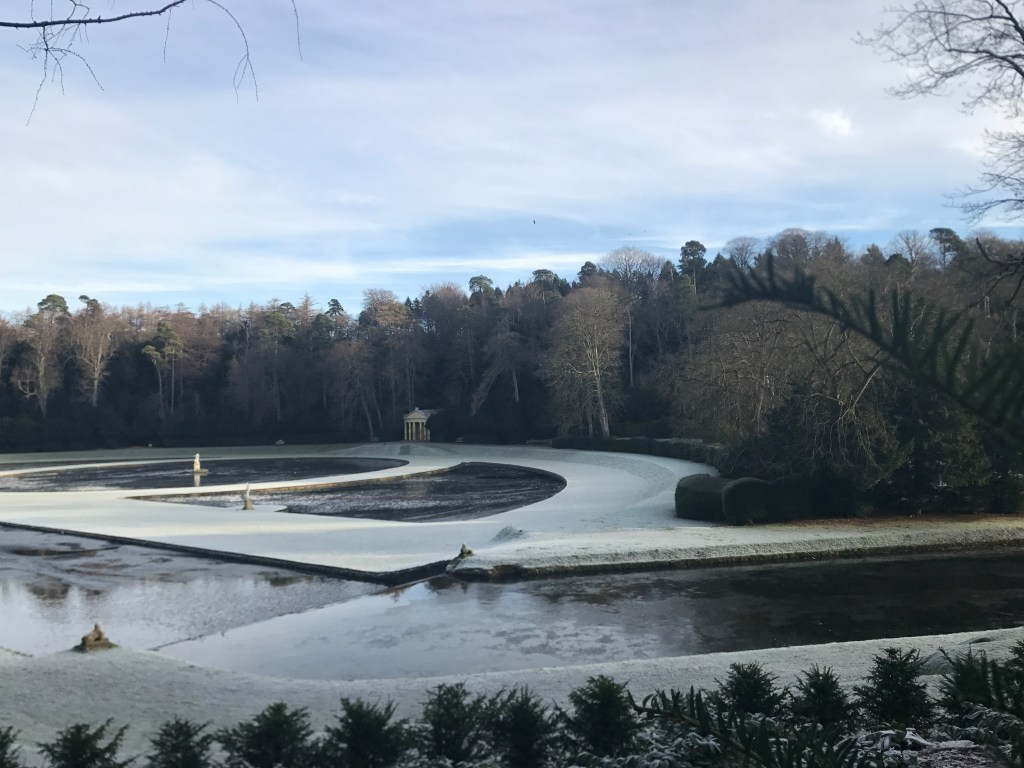
At the beginning of that year Job’s residence was Studley Royal, near Ripon in North Yorkshire. The main garden here is the Studley Royal water garden. Today this is a UNESCO World Heritage site, managed by the National Trust. Historic England’s description reads:

A park of the late C17 probably with earlier origins, a water garden and pleasure grounds of c 1718-30 laid out by owner John Aislabie which were extended to include the ruins of Fountains Abbey by his son William Aislabie from 1768 onwards. The site has been described as ‘one of the most spectacular scenic compositions in England’ (Hussey 1967) and ‘the finest formal water-garden in the country’ (Jellicoe et al 1986) [12].

Studley Royal Water Gardens in Winter and Summer – Photo by Jane Roberts

Perhaps this is where Job now honed his craft. But it was at Nocton Parish Church in Lincolnshire on 11 January 1876 that 22-year-old Devonian, now described as a gardener, married shepherd’s daughter, 21-year-old Eleanor (Ellen) Pask [13]. It cannot have escaped the attention of those witnessing the wedding that there was a pressing need for the couple’s marriage. The bride was entering the third trimester of pregnancy.

The winter of 1876 scarcely over, and early spring heralded the arrival of the couple’s firstborn. Daughter Ellen Maria arrived in April 1876 [14], with the family now living in Batley [15]. The West Yorkshire town’s 19th century growth, and wealth, was based on its burgeoning woollen mills: in particular the production of its invention of shoddy and mungo, whereby rags were sorted, ground and recycled into new cloth. In 1801 Batley’s population stood at 2,574. By 1871 this had risen to 20,871 and ten years later stood at 27,505. The town must have seemed a world away, let alone over 260 miles, from Job’s childhood home of Buckerell. No more so than on 6 October 1876 when the burial of Job’s father, Robert, took place at Buckerell parish church [16].

The Kenwood’s Yorkshire life continued. In January 1878 son Robert Henry Kenwood was born at Healey, Batley, completing Job and Ellen’s family [17]. Healey was a hamlet in Batley township, whose population was chiefly engaged in the rag trade and blanket manufacture.

Yet, even though he lived in this industrial town, he retained links with Studley Royal. He is recorded on a number of occasions as amongst the prize winners at Studley Royal Flower Show. For example, in 1879 he won prizes for the ‘best arranged stand or vase for the drawing room’ and the heaviest bunch of grapes [18].

These shows were clearly keenly competitive, for ten years later Job featured in several Yorkshire papers following a controversy at the 1889 Studley Royal Flower Show. One paper reported it as follows:

Mr. W. Alves, Borrage Nurseries, was first for best arranged stand or vase, a most artistic and choice collection. J. Kenwood, of Batley, who was second, lodged an objection on the ground that Mr. Alves was neither an amateur nor a gentleman’s gardener… [19]

Clearly his objection was not upheld, as results confirm Mr Alves as the victor in this class. But it shows the importance attached by the gardening fraternity to the winning of these prizes. Presumably these wins boosted their gardening credentials, and potentially their job prospects.

The Kenwood family address in the 1881 census was Healey, Batley. This census shows the family income earned from Job’s gardening was supplemented by a lodger. George Kemp, originally from Lincolnshire, worked as a police constable [20].

In 1891 Job, his wife and son were living in a recently built terraced property at Prospect Terrace in Batley [21]. Again, this is in the Healey area. Daughter Ellen Maria was in Lincoln visiting her aunt and uncle. Job was now described as a domestic servant (gardener).

Prospect Terrace, Healey, Batley – Photos by Jane Roberts

There were several large houses in the Healey area belonging to prominent Batley townsfolk which may have provided his employment. The nearest house, literally a stone’s throw from Prospect Terrace, was Healey House. This was the home of widow Martha Taylor, and her five children, plus three servants. Martha’s deceased husband was Joshua Taylor, who died in July 1879. A prominent local mill owner, Joshua along with brothers John and Thomas, founded the firm of J., T. and J. Taylor. Of all the woollen manufacturers in town, Taylors were arguably the most notable. And it was for the family of Joshua, in the 2½ acre grounds of 18th century Healey House, that Job’s horticultural skills were employed.

Healey House – Date Unknown

And this was where my personal connection comes in. Over a century after Job Kenwood left Batley, my husband and I posed for our wedding photographs in the gardens he once tended. Who knows – he may have laid his gardening gloves and secateurs upon some of the shrubs and trees we stood amongst on our wedding day?

Circumstantial evidence points to his links to the family from the mid-1880s. For example, in March 1885 the Kenwoods were listed amongst the gift-givers at the marriage of Joshua’s daughter Julia – appropriately their present was a flower stand [22]. The following year Job and his wife gifted a glass strawberry dish and jug, whilst their children’s presents were flower vases, for the marriage of another Taylor girl, Alice Jane [23]. But conclusive employment proof is in a newspaper report of a talk Job gave about ‘The Vine’ to a gathering of fifty at the Batley and District Chrysanthemum and Paxton Society – no doubt drawing on his knowledge from his heaviest bunch of grapes prize-winning exploits of over a decade earlier! The report crucially describes him as a gardener to Mrs Taylor, of Healey [24].

These gardening talks, combined with his competitive streak – as evidenced in the Studley Royal Flower Show incident – give hints that Job was not lacking in confidence and had cerebral leanings. The strong, confident penmanship, with a flourish on the ‘K’, when signing his name in the Nocton marriage register perhaps offers another clue to Job’s intellectual pursuits. This aspect is something which can be overlooked, given the physical, hands-on characteristics of gardening. But gardening could also embrace a broad range of more academic elements, including landscape surveying, design, a knowledge of Greek and Latin, botany and mathematical calculations. All were important for any gardener who wanted to “get on”. And the ethos of moral and self improvement through education was an important Victorian doctrine. Job embraced this doctrine, as is demonstrated from his time in Batley onwards.

Besides giving gardening talks, Job was involved in other aspects of community life in Batley. Sharing his employer’s political and religious persuasions, he was heavily involved in both Liberal politics and the Congregational Church at Hanover Street. He is frequently noted in local newspapers participating in Liberal meetings. For example, in 1886 at a meeting of Liberals at Carlinghow, Job was elected as one of the association’s West Ward Healey and Staincliffe representatives [25]. He often chaired meetings of the Batley Congregational Young Men’s Literary Society. He also had a keen interest in education locally. The role he played here, and the esteem in which he was held, is evidenced by a presentation made to him when he finally left Batley in 1891.

PRESENTATION TO A SECRETARY. – A meeting of the Sunday School Union was held on Tuesday evening in the Town Mission Hall, under the presidency of Mr. Wesley Lodge, for the purpose of presenting Mr. J. Kenwood, secretary, who is removing to Honiton, South Devon, a copy of the “Oxford Teacher’s Bible,” as a small acknowledgment for his services. – Mr. J. Gladwin, in making the presentation, spoke of Mr. Kenwood’s connection with the Union, which had extended over a period of six years, as representative of the Hanover-street school…Mr. Kenwood said he received the present of a Bible…with as much heart pleasure as any man could receive a more costly prize. He spoke of the good which he had received at the Union, and encouragement given to him in many a trial by the meetings he had had with them. He thanked the Committee heartily for the token of respect. [26]

It appears once in Honiton he switched from domestic service to commercial horticulture. Job Kenwood became the proprietor of a shop, operating as a seedsman [27]. The 1901 census confirms this occupational gear-change with Job Kenwood residing at New Street, and working as a seedsman, a shopkeeper on his own account. Also, in the household is wife Ellen and son Robert Henry. Robert is a boot cutter, following the trade of his grandfather and great grandfather rather than his green-fingered dad. The family were prosperous enough to employ a general domestic servant [28]. The business is pictured in a postcard dating from 1904 [29].

Job’s political, religious and educational activities continued apace once in Honiton. An ardent Congregationalist, a life Deacon and Treasurer of the Honiton Congregational Church (the latter role he held for almost 40 years), he was one of those summoned for refusing to pay the sectarian proportion of the Education Rate on conscientious grounds [30]. Other roles included President of the local YMCA Debating Society. Then a huge forward step politically when, in the autumn 1905 Municipal Elections, he was elected to Honiton Town Council, representing St Paul’s Ward. It was a position he held until 1924. He was also appointed as a manager of Honiton National Schools by Devon County Council, and was still attending meetings a fortnight before his death in 1937 [31].

The 1911 census saw a more radical occupational switch for Job. Now living at Meadow View in Honiton with wife Ellen, he worked as a bookkeeper for a boot manufacturer [32]. One presumes this was linked to the business of his son Robert Henry, and brother-in-law William Doble (husband of Job’s sister Rhoda). Both the Kenwood children were now married with families of their own – Ellen Maria’s marriage to farmer Walter John Collins was registered in 1901. The following year Robert Henry married Florence Katie Otton.

On 11 January 1936 Job and Ellen Kenwood celebrated their diamond wedding anniversary. The occasion was marked with a presentation of a blue Morocco handbag to Ellen and a seat walking stick to Job. They also received a telegram of congratulations from the King and Queen. And their Batley connections remembered them too, in the form of an autograph card signed by thirty-two Batley friends, and a telegram from former Batley mayor, Elsie Taylor [33]. She happened to be one of the daughters of Joshua Taylor, growing up at Healey House whilst Job worked there.

Ellen and Job Kenwood in Later Life

A little over three months later, on 14 April, Ellen was dead [34]. She too had shared her husband’s devotion and dedication to the Congregational Church at Honiton, where she had been a member for 45 years. Her well-attended funeral took place at that church [35]. It was the second family blow to Job in a matter of weeks, with his sister Rhoda’s funeral taking place at the beginning of April.

Job died in the early morning of 1 February 1937, age 82, after a very short illness. He was active up until a week before his death, even attending a meeting of the Honiton National Schools Board in mid-January. His funeral took place at his beloved Honiton Congregational Church on 4 February [36].

Probate was granted in London on 15 March 1937 to his son Robert Henry Kenwood, and son-in-law Walter John Collins. Effects totalled £1417 12s 6d [37].

FACHRS previous mini projects have included a range of occupations from governesses to station masters and bank managers. The current one is parlour maids. If you want to get involved check out their website at http://www.fachrs.com/

Footnotes
[1] GRO Birth Reference, Honiton, March Quarter 1855, Volume 5B, Page 23, accessed via Findmypast
[2] White, William. History, Gazetteer, and Directory of Devonshire, and the City and County of the City of Exeter: Comprising a General Survey of the County of Devon, and the Diocese of Exeter: with Separate Historical, Statistical, & Topographical Descriptions of All the Boroughs, Towns, Ports … Sheffield: Printed for the author, by Robert Leader, and sold by Wm. White, Sheffield by his agents, and Simpkin, Marshall, London, 1850., accessed via Ancestry;
[3] https://www.visionofbritain.org.uk/place/4803 accessed 3 April 2020, Buckerell 1851 census data;
[4] Baptism Register, Buckerell parish church, accessed via Findmypast, original record South West Heritage Trust, Reference 1091A/PR/1/3;
[5] 1861 census of England and Wales, accessed via Findmypast, original record at The National Archives (TNA), Kew, Reference RG09/1377/88/4;
[6] 1871 census of England and Wales, accessed via Findmypast, original record at TNA, Kew, Reference RG10/2046/-/8;
[7] White, William. … Directory of … Devon … (1878-9). Sheffield: William White, 1878., accessed via Ancestry;
[8] Greener, Rosemary Clare. The Rise of the Professional Gardener in Nineteenth-Century Devon ; A Social and Economic History. University of Exeter, 2009;
[9] Kelly’s Directory of Devonshire. London: Kelly & Co., 1893;
[10] Greener, Rosemary Clare. The Rise of the Professional Gardener in Nineteenth-Century Devon ; A Social and Economic History. University of Exeter, 2009;
[11] Exeter and Plymouth Gazette, 5 February 1937;
[12] https://historicengland.org.uk/listing/the-list/list-entry/1000410, accessed 3 April 2020, Studley Royal, Historic England;
[13] Marriage Register, Nocton parish church, accessed via Findmypast, original record at Lincolnshire Archives, Reference Nocton Parish 1/10;
[14] The 1939 Register gives Ellen’s date of birth as 21 April 1875 (incorrect year), accessed via Findmypast, original record at TNA, Reference RG101/6821D/014/2 Letter Code WFND;
[15] GRO Birth Index, June Quarter 1876, Dewsbury, Volume 9B, Page 684, accessed via the GRO Website;
[16] Buckerell parish church burial register, accessed via Findmypast, original record at South West Heritage Trust, Reference 1091A/PR/1/7;
[17] GRO Birth Index, January Quarter 1878, Dewsbury, Volume 9B, Page 631, accessed via Findmypast GRO Indexes. The 1939 Register gives Robert’s date of birth as 18 January 1878, Reference RG101/6821A/017/34, Letter Code WFNA;
[18] Pateley Bridge and Nidderdale Herald, 23 August 1879;
[19] Ibid, 17 August 1889;
[20] 1881 census of England and Wales, accessed via Findmypast; original record at TNA, Kew, Reference RG11/4549/74/38;
[21] 1891 census of England and Wales, accessed via Findmypast, original record at TNA, Kew, Reference RG12/3721/16/1;
[22] Batley Reporter and Guardian, 28 March 1885;
[23] Batley News, 14 April 1886;
[24] Batley News, 26 April 1890;
[25] Batley News, 3 April 1886;
[26] Batley News, 13 November 1891;
[27] Kelly’s Directory of Devonshire. London: Kelly & Co., 1893;
[28] 1901 census of England and Wales, accessed via Findmypast, original record at TNA, Kew, Reference RG13/2022/29/11;
[29] Francis Frith Postcard, Joe (sic) Kenwood Seedsman, New Street, Honiton, 1904, accessed via Ancestry.co.uk UK, City, Town and Village Photos, 1857-2015. Unfortunately, copyright restrictions prevent reproduction;
[30] Western Times, 1 December 1903 and 14 June 1904;
[31] Exeter and Plymouth Gazette, 5 February 1937;
[32] 1911 census of England and Wales, accessed via Findmypast, original record at TNA, Kew, Reference RG14/12538;
[33] Exeter and Plymouth Gazette, 17 January 1936;
[34] Western Times, 17 April 1936;
[35] Exeter and Plymouth Gazette, 24 April 1936;
[36] Exeter and Plymouth Gazette, 5 February 1937;
[37] England and Wales, National Probate Calendar (Index of Wills and Administrations), 1858-1995, accessed via Ancestry.co.uk, original data Principal Probate Registry, Calendar of the Grants of Probate and Letters of Administration made in the Probate Registries of the High Court of Justice in England.

The Britannia Mills Tragedy – ‘Lord Help Me!’

It was 6pm on the evening of Thursday 20 October 1892. It had been an unsettled, breezy day with the constant threat of rain. As darkness descended, the signal was given for work to cease at Britannia Mills. Looms gradually abated, day-shift weavers turned off their lights, and those women not working overtime tied their handkerchiefs round their heads in preparation to leave the building and venture out into the chill, autumnal night.

Extract of OS Six-inch map, Yorkshire CCXXXII.NE, Surveyed 1888-1892, Published 1894

The building on Geldard Road in Birstall, known locally as ‘Slopers’ Mill, was a five-storey structure. The lower two floors were occupied by Messrs. Charles Robinson and Company, Carlinghow woollen manufacturers. The upper storeys were tenanted by Leeds woollen manufacturers Messrs. Hartley Brothers. The top floor contained around 30 looms, with about two thirds operating that Thursday.

Britannia Mills photographed after the July 1905 fire – source unknown

The distance from the ground to the fifth floor was around 30-35 yards [1]. Whilst a long, winding staircase could be used, after a tough day’s work tired workers from the upper floors often preferred to use the mill hoist, commonly used to carry goods between floors. This hoist, located in the centre of the building, controlled a contraption which workers referred to as a cage. Essentially an open-sided box with a wooden roof and floor, it was supported by an iron rope, and worked by pulleys and gearing suspended from girders: in effect a primitive lift system.

For younger workers the journey in this cage no doubt was tremendous fun, adding a frisson of excitement at the end of their arduous workday.

It was set in motion by pulling one of the two guide ropes at the side. One of these ropes acted as a brake. There was no one person designated to operate the hoist. It was started and reversed by the person nearest the ropes, something which might have particularly appealed to teenage boys. Youngsters did not see any danger with it. In fact 15-year-old Hilda North, who had worked in the Hartley portion of the mill for around a week, told her father on the second day there she only got one foot on the hoist when it descended. And it was not unheard of for agile workers to jump into the cage as it passed the lower floors.

The hoist was so popular with the workers that around five weavers from the top floor regularly knocked off at 5.55pm in order to beat the rush, and avoid the inevitable overcrowding. Because overcrowding was commonplace. Reports state many as 20 workers crammed into it on occasions. They rushed to it at the end of their shift, like children racing to leave school. In fact many were only teenagers.

James Gray, the engineman at the mill for eight years and whose responsibilities included looking after the engine powering the mill machinery, had been unaware of any mechanical issues with the hoist in that time. However, it was not his responsibility to oversee and maintain it. And he couldn’t remember any official inspection or maintenance of it by an external official either. The only incident he recalled was around five or six years earlier, when too many people in it caused it to land with a bump.

As a result of that incident the maximum capacity was limited to eight, and pulling on the ropes whilst was in motion was prohibited. The penalty for contravening these instructions ranged from a severe 1s fine to instant dismissal – although it seems these punishments were never meted out. There was a warning note at the hoist entrance, a legacy of the earlier incident, put up by the previous mill owners.

Wording on the Hoist Warning Notice

Although prominent, it was perhaps too high for some even if they could read [2]. Neither were new starters routinely informed about the restrictions; nor did it appear to be discussed generally, not even by those aware that the regulations were regularly being breached.

John Howitt, a warp dresser working at Hartleys for a fortnight, only used the hoist if it did not exceed maximum capacity even if it meant waiting. But he admitted he never thought to warn younger workers ignoring the rules [3]. And 15-year-old Mary Alice Mann, a recently employed weaver at Hartleys stated “I saw other people go down in the hoist, and I went with them.[4] No thought did she give to numbers.

That Thursday evening was no different. Eager workers, keen to quickly return home, rushed and pushed to make their way towards the exit. A crowd on the top floor jostled and jockeyed for position in the cage, with cries of “Let us get in.” Perhaps some on the lower floors had stolen a march, already in the cage before it reached the upper storey, similar to the tricks we use today at busy lifts: that was one rumour circulating later. According to at least one report one lad, Edwin Day, jumped in as it made its descent. In all, it appears around 16 people were now crammed in. It may have even been as many as 18, for collating names from various newspaper reports the occupants included:

  • Fred Beevers, Carlinghow. Born in July 1875, the son of Andrew and Sarah Ann Beevers, in 1891 the family lived on Coal Pit Lane with Fred working as a cloth presser;
  • Elizabeth Birbeck, 38-year-old wife of Turner Birbeck. They lived at Lambsfield Place, Geldard Road, Birstall. She only started work that week as weaver at Hartleys. Other information shows she was born on 7 May 1853, the daughter of John and Hannah Gooder, and she married Turner on 25 October 1873 at St Peter’s Church in Birstall;
  • Edwin Blakey Day, age 14. He was a piecer and the son of postman Ernest Day of Union Street, Birstall [5]. He had worked six months for Robinsons, but was due to start work the following week at Carr Mill;
  • Edith Crossley [6], weaver, wife of James Crossley of Geldard Road. Other sources show she was born in Holmfirth on 8 February 1861, the daughter of Hugh and Mary Ramsden, and married James Booth Crossley on 23 July 1881 at St Saviour’s, Brownhill;
  • Jane Donnelly, Richmond Street, Batley. Looking at other sources it seems likely she was the Dublin-born wife of Richard Donnelly, maiden name Egan. Her age was 30 in the 1891 census and she worked as a woollen machine feeder;
  • Ann Frankland, wife of collier James Frankland, of Britannia Cottages, Geldard Road. Further investigation shows she was born on 18 March 1869 and was the sister of Elizabeth Birbeck. She married James on 1 February 1890 at Batley All Saints;
  • Gooder, sister of Mrs Birbeck. No Christian name is given in the reports, which only mention she is a girl. Although possible this may be the recently married Ann Frankland, it is equally possible this is another of the Gooder sisters. Weight is added to this because in some of the casualty lists both Ann Frankland and ‘a girl named Gooder’ appear. But there is nothing conclusive;
  • Hannah Mary Grayson, Birstall. Putting together other sources she is likely to be the daughter of Solomon and Mary Grayson (and its many surname variants) who was born on 26 November 1863. In the 1891 census she is living with her widowed mother at Cross Street in Birstall [7], and working as a wool cloth weaver. She married George Easby at St Peter’s, Birstall on 8 January 1897;
  • Walter Jones, age 13, piecer, son of tripe dresser Edward Jones and wife Sarah Ann of Low Lane, Birstall. He was born on 12 March 1879;
  • Joshua Kellett, age 15, piecer, son of John and Mary Kellett of White Lee Road, Batley;
  • Nellie Lee, Skelsey Row, Batley;
  • Mary Alice Mann, 15, daughter of Mark and Elizabeth Mann. She was born on 5 November 1876 and lived with her family at Geldard Road, Birstall. She had been employed as a weaver for one week in the Hartley-run portion of the mill;
  • Kate McGuire, a young woman living in Batley. Although unverified, this might have been the 23-year-old niece of Michael McGuire living at Parker Buildings, Whittaker Street in the 1891 census;
  • Henry Mitchell, the son of Annie Mitchell, of Geldard Road, Birstall. Not employed at the mill, he had been there to drop tea off for another worker. The newspaper reports put his age at 9 or 10. My research points he was likely to be 9-year-old Harry Mitchell born on 17 October 1883, the son of Annie and William Mitchell. In 1891 he was living at Geldard Road with his mother and his maternal grandmother Mary Ann Ramsden. He was the nephew of Edith Crossley;
  • Sarah Moon, age 53, weaver and wife of tobacco pipe maker Charles Moon. They lived at Boar Terrace, Geldard Road, Birstall. Sarah and widower Charles married at Tong St James on 9 May 1880 – it was her second marriage too. Sarah was born in Cleckheaton on 24 December 1839, the daughter of James and Sarah Haigh. She married her first husband William Firth in Halifax on 7 October 1860, but was widowed with two young sons, in early 1865. Sarah only started work at Hartley’s on the afternoon of 18 October, in place of Annie Williams who was ill;
  • Hilda North, the daughter of George and his Irish-born wife Ellen North. Born on 11 February 1877, her family home was 22 Carlinghow Lane. When the accident occurred she had worked as a weaver for only one week in the Hartley portion of Britannia Mills. Well-liked by all who knew her, Hilda and her family were long associated with St Mary’s RC Church in Batley. In fact some newspapers claimed Hilda was a member of the church choir, though this was disputed in a subsequent report [8].
  • A boy named Ramsden. There are no further details. It is possible that this might be a confusion with Henry Mitchell (above); and
  • Ada Rymer, age 17 [9]. Born on 31 May 1875, she was the daughter of Thomas and Eliza Rymer. In 1891 the family address was Riding Street, White Lee, Batley;

Elizabeth Birbeck, holding one of the guide ropes, gave the signal and the cage began its descent. It quickly became apparent that things were not right: the cage was travelling faster than usual. Someone called out “Steady it!” Fred Beevers pulled one of the guide ropes which temporarily righted things. However, before it reached the halfway point, it hurtled out of control down the shaft. Shouting “Pull the rope! Pull the rope!” Elizabeth Birbeck grabbed the left hand side, whilst Fred Beevers took hold of the right. The pair desperately battled to steady the cage. Someone else screamed, and Edith Crossley cried out “Let’s jump up,” in a vain attempt to slow the cage’s descent. But in the words of Mary Alice Mann it “banged reight to t’bottom.” As the cage struck the floor Elizabeth Birbeck exclaimed “Lord, help me!” These were her final recorded words.

Some of the occupants were thrown out of the cage which, with the force of the impact, rebounded around three feet into the air. It smashed to the floor for a second time, and this ripped down the hoist’s gears and support girders. Weighing about a ton, these crashed on top of the cage.

The Hoist Gear and Accident Aftermath

The tremendous noise alerted those elsewhere in the mill, and workers rushed to the disaster site. James Gray immediately stopped the engine. Shocked and injured cage occupants emerged coughing and stunned from the dust-shrouded scene. The air gradually cleared, revealing the horrific sight of the crushed and splintered cage. Some mill workers were trapped under the wreckage.

Blocks were hastily assembled and the debris lifted off the badly mangled bodies, with Edwin Day first to be released. Those prominent in the rescue included John Leach, Joseph Wright, John Howitt and W. Lockwood.

News of the accident spread quickly beyond the mill. Crowds gathered at the gates, anxious to hear news of their loved ones. Wider in Birstall, and neighbouring areas, small knots of people gathered to speculate about events. Hushed voices and murmurs, rising to excited and expectant tones as they craned their necks to see the comings and goings at the mill. The local police rushed to the scene, pushing past the throng of people. Birstall doctors, Bridgeman and Field, were quickly summoned to tend to the injured.

By around 6.15pm news of fatalities reached those outside. The arrival of Ambrosine Fox (née Renshaw) must have been a signal, even before the names of the dead seeped out more generally. Married to miner Abraham Fox, the family lived at Chapel Lane in Birstall. Although Ambrosine has no occupation listed in the 1891 census, it seems she was one of the local go-to women for laying out the dead. Maybe she also helped bring local children into the world too, as these two tasks often went hand in hand.

Within the mill boundaries those who perished were taken to the burling shed. Here, illuminated by lamplight, Ambrosine Fox carried out the grim task of carefully laying out their bodies. This traditionally involved undressing and washing them, plugging the various orifices, possibly placing coins on their eyes and something (commonly a bandage) under their chins to keep the eyes and mouth closed. The body would be then dressed in its burial clothes, with bandages or ribbons tied around the body to hold it straight and ready for the coffin.

Four fatalities resulted from the accident, and they suffered horrific injuries caused by the falling debris. Those killed were:

  • Elizabeth Birbeck, the most badly injured. Although her face was unmarked, her body incurred severe crush trauma;
  • Edwin Blakey Day suffered mainly head injuries, but also a broken right leg;
  • Hilda North broke her right leg in two places, her left arm was severed at the elbow, her neck was put out and her head split open; and
  • Sarah Moon had a partially severed right leg, chest crush injuries and a fractured skull.

In terms of the injured, Edith Crossley suffered from shock; Ann Frankland had a broken foot; Walter Jones injured his left knee; Joshua Kellett sustained a broken left arm; Mary Alice Mann escaped with only a black eye; Henry Mitchell bruised his left thigh; and Ada Rymer had severe shock. Fortunately none had life-threatening injuries, and all were taken back to their homes to recuperate. It appears all others in the cage had no injuries of note. The belief was if the hoist gears and girders had remained intact, all inside the cage would have survived. It was the fact they came down which proved fatal.

Families were left mourning their loved ones. They also had the ordeal of the inquest, which opened at Birstall’s Coach and Six Inn within 24 hours of the accident. The current building is a 1950s replacement of the earlier structure. The inquest swiftness was down to the need to keep the bodies fresh. No conclusion was reached at this initial hearing, as a report on the condition of the hoist was deemed necessary. But at least funeral arrangements could now be made.

Later that day, Friday 21 October, Reverend Charles Gordon, the parish priest of St Mary’s, Batley, visited the distressed family of Hilda North to try offer some comfort, but presumably to also discuss these funeral arrangements. As was the custom (and for practical reasons with the majority of bodies still being kept at home between death and burial) funerals quickly followed death. So, on the afternoon of Sunday 23 October, less than 72 hours after the accident, all four interments took place.

A triple ceremony, for Edwin Day, Elizabeth Birbeck and Sarah Moon, was held at St Peter’s, Birstall. The coffins set off from their respective homes, and in a praiseworthy feat of co-ordination by Birstall undertakers Messrs. J Akeroyd and Sons, the processions met up as they journeyed to the church, timed to reach there at 4pm. In the procession were many of those in the hoist when the accident occurred. Crowds lined the route, tears staining the cheeks of bystanders. The numbers led one report to claim that:

…the multitude of people in the town on Sunday…was never exceeded at any time in the annals of the town on an occasion of that description… [10]

St Peter’s Parish Church, Birstall – Photograph by Jane Roberts

As the cortège approached the church, a muffled peal rang out from the church belfry. The three coffins were gently removed from the three hearses in absolute silence and carried into the crowded church for a service. Not all those present could fit in the building, forcing many more to assemble outside. The coffins were then borne to their final resting places in the churchyard, as the solemn, muffled peal of the bell pierced the silence. The sun shone brilliantly throughout, but a bitingly cold wind swept the graveside. There:

The children wailed continuously, the women were loud in their lamentations, and men were completely broken down…[11]

Once the service ended the trio of coffins were covered with earth. Mourners dispersed, offering words of sympathy to the bereaved families as they left. As darkness fell over the now-empty churchyard, the many wreaths laying on the three burial mounds stood silent witness to the tragic events.

That same afternoon Hilda North was committed to rest in Batley cemetery, in a similarly impressive service conducted by the Reverend Charles Gordon. Once more the approach to her final resting place was lined with a huge throng of people. The cemetery too brimmed with mourners, with a vast number of wreaths placed on her grave.

Batley Cemetery, Hilda North’s Damaged Headstone – Photograph by Jane Roberts

The adjourned inquest resumed at the Coach and Six on 28 October, with a report from Bradford engineer John Waugh into the state of the hoist. After establishing this did not contribute to the accident, the jury reached a verdict that:

…the deceased were killed by the falling of the cage of the hoist and the subsequent fall of the gear and supports of the said hoist, by the crowding into the cage of a greater number of persons than it was calculated to carry, and by the improper use of the gear ropes by some of the persons in the cage, that the overcrowding of the cage was in contravention of a warning which was conspicuously pasted up on the door of the hoist chamber…[12]

Britannia Mills in 2020 – Photograph by Jane Roberts

Finally, for those familiar with Birstall and wondering why Britannia Mills today does not bear any resemblance to the five-storey building of 1892, the answer is the all-too familiar fate which befell many mills: fire. In July 1905, when under the ownership of Batley mayor George Hirst and primarily occupied by the Extract Wool and Merino Company which he chaired, a fire took hold and ravaged the building. The reconstruction resulted in the smaller structure we are familiar with today. But as you pass, do pause and think. Over a century ago four local people lost their lives here, simply by going to work. Two of them would, by today’s standards, be still of school age. How times have (thankfully) changed.


Postscript:
Finally a big thank you for the donations already received to keep this website going. 

The website has always been free to use, but it does cost me money to operate. In the current difficult economic climate I am considering if I can continue to afford to keep running it as a free resource, especially as I have to balance the research time against work commitments. 

If you have enjoyed reading the various pieces, and would like to make a donation towards keeping the website up and running in its current open access format, it would be very much appreciated. 

Please click here to be taken to the PayPal donation link. By making a donation you will be helping to keep the website online and freely available for all. 

Thank you.


Notes:
[1] Some reports say almost 40 yards. 1 yard = 3 feet. I suspect these reports may be an exaggeration, because an official report quoted in the Batley Reporter and Guardian of 29 October 1892 into the state of the hoist mentions the distance from the hoist girders to the floor was 67 feet;
[2] 6 feet off the ground according to Mary Alice Mann;
[3] Batley Reporter and Guardian, 22 October 1892;
[4] Batley News, 28 October 1892;
[5] Some reports say Low Lane. They also incorrectly give his father’s name as Edward;
[6] Some reports incorrectly state Eva;
[7] In the 1891 census she is recorded as Hannah May Grayson, and her mother is Mary Medcalf, TNA Reference RG12/3722/70/17. Her birth in the Dewsbury Registration District in the December quarter of 1863 is under Gration;
[8] Batley News, 28 October 1892;
[9] Newspaper reports give her age as 18;
[10] Batley Reporter and Guardian, 29 October 1892;
[11] Ibid;
[12] Yorkshire Evening Post, 28 October 1892.

Sources:
• 1861-1901 England and Wales censuses;
• Batley All Saints church marriage register;
• Batley Cemetery burial register;
• Batley News – 21 and 28 October 1892, and 21 July 1905;Batley News
– 21 and 28 October 1892, and 21 July 1905;
• Batley Reporter & Guardian
– 22 and 29 October 1892, and 21 July 1905;
• Birstall St Peter’s church parish registers (baptisms, marriages and burials);
• Funeral Practices, British Customs: https://www.encyclopedia.com/medicine/encyclopedias-almanacs-transcripts-and-maps/funeral-practices-british-customs
• Leeds Mercury – 24 October 1892;
Leeds Times – 22 October 1892;
• OS Map is reproduced with the permission of the National Library of Scotland under a Creative Commons licence. https://maps.nls.uk/index.html
• Tong St James parish register (marriages);
Yorkshire Evening Post – 21, 24 and 28 October 1892;