Category Archives: Yorkshire

The Night the Luftwaffe Bombed Batley and Dewsbury

12 December 1940 had been a cold winter’s day. As darkness drew in, families across the Heavy Woollen District prepared to hunker down for their second wartime Christmas.

Money was tight – no change there for most. So no sacks full of Christmas presents for the children. Again no change for many. But people were making the best of it, continuing peacetime Christmas traditions. Like the Hartley family in Savile Town, making a Christmas cake with a neighbour that evening – a reminder of the ordinariness of preparations of past Christmases [1].

But this was far from a normal Christmas. The strangeness of separation from loved ones in this so-called season of goodwill, bundled up with anxiety for the safety of those absentees, bound lots of families together. Mrs Hill in Batley faced a difficult Christmas – her first as a young widow with four children under the age of six. Over in Dewsbury, the Callaghan family were getting ready to spend Christmas with their latest family addition, a seventh child born earlier that year. Their eldest, 15-year-old Jack, typical of many teenage lads, was caught up with the excitement of pretending to shoot German planes out of the Yorkshire skies from his open bedroom window, accompanied by his own ack-ack-ack sound effects. His Air Raid Protection (ARP) Warden father quickly dragged him away, ensuring the window was firmly shut and blacked out. Within four years Jack would be serving with the Royal Navy craft in the D-Day landings.

At around 7.30pm the blood-chilling wail of the air raid sirens sounded across the Batley and Dewsbury districts, ending that evening’s attempts to recreate the normal of Christmases past. This was their new wartime normal. The anti-aircraft guns, based in Caulms Wood and what is now hole number 2 of Hanging Heaton Golf Club, began firing.

View over Batley from Hanging Heaton going towards the golf course, site of the anti-aircraft Guns – Photo by Jane Roberts

Perhaps there was an air of calm as people made their way to various air raid shelters. After all, they’d experienced this before, and the alarms always proved thankfully false.

Various organisations had these bomb shelters – for example St Mary’s RC school’s log book notes shortly after the war declaration that air raid shelters were built. One was under construction at Batley hospital in March 1940 – I know because it cost my grandad his life. Some sheltered in the strongest part of their house – cellars, sculleries, or simply under kitchen tables.

Others had purpose-built Anderson shelters in their gardens, erected right from the early days of the war. My dad remembers his dad building one, which would’ve been in the very first months after war broke out. Many families kept theirs post-war, converted to garden storage. They were a common site for many a year after the war.
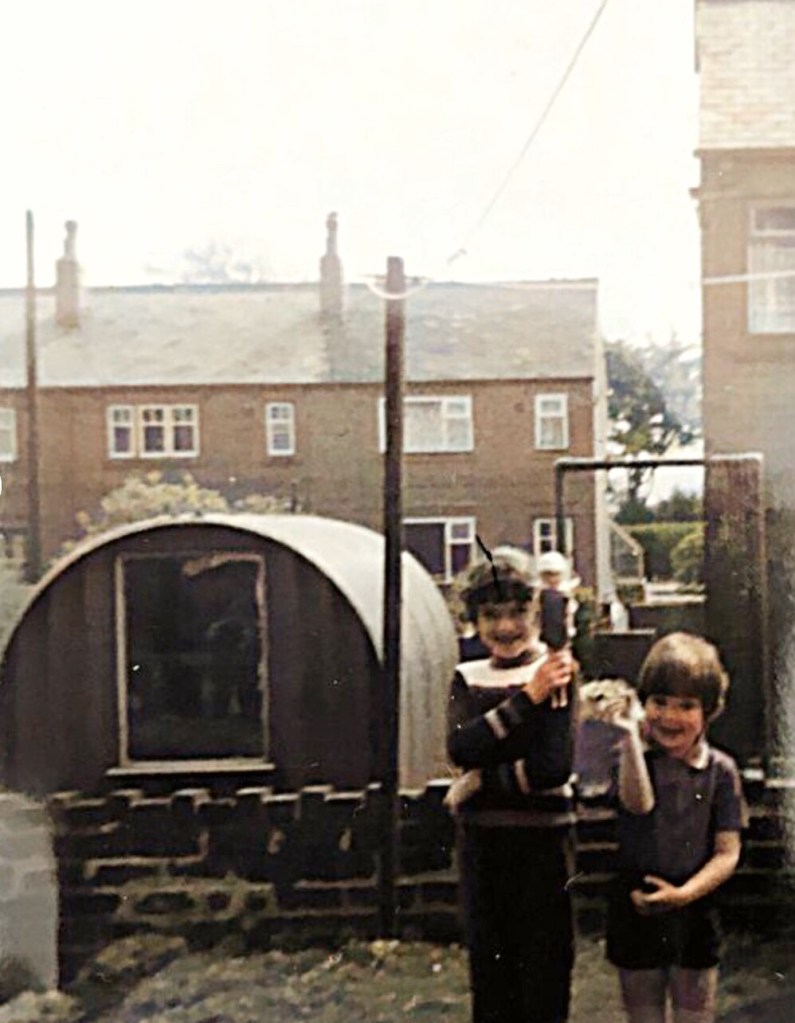
This Mortimer Street, Batley, Anderson shelter existed well into the 1980s – Photo by Pauline Hill

Communal shelters existed with wooden slatted seats inside, like the soil-covered brick built one at Staincliffe. There was also a communal shelter at Leeds Road, Dewsbury. The tunnel at the bottom of Primrose Hill, close to Lady Ann Road, was another example. Vera May recalls sheltering there as a child during the 12 December 1940 raid. Men who worked at Taylor’s mill were also there, and Vera remembers: ‘They were great with us children, singing with us so we would not be afraid[2]. For, unlike most nights, this was no false alarm. The Luftwaffe this time were not passing over Batley and Dewsbury on their way to/from bombing another unfortunate town or city. Tonight it was for real, the turn of the heart of the Heavy Woollen district with its rail lines and mills manufacturing cloth for the military to face Hitler’s wrath.

Following the failure of the Battle of Britain, the Luftwaffe were now targeting Britain’s industrial and military centres. Sheffield was the focus for Operation Crucible, with bombing during the nights of the 12 and 15 December 1940. The targets of the raids were the multiple steel and iron works, collieries, and coke ovens along the Don Valley. One theory is that the bombing of Batley and Dewsbury was a mis-targeting from this attack, rather than these two towns being the specific objectives. Whatever, the results were disastrous for many of the townsfolk.

The night sky over Batley and Dewsbury lit up with parachute flares and tracer fire, as baskets of incendiary bombs and parachute mines rained down. Houses shook, window frames rattled, glass shattered, masonry and roof slates tumbled to the ground, water spurted out from fractured taps and pipes, and plaster fell from ceilings. As the bombs hurtled earthwards they made terrifying whistling and screaming sounds. Those sheltering braced themselves for the next ‘hit’, hunched over with hands protecting heads, then after each blast ensuring all others in the shelter were still OK.

It was not a constant bombardment. In the quieter periods, when the drone of the planes died away, people emerged troglodyte-like from their places of safety to check the damage, try extinguish any lights, and bale water onto house fires. Then they darted back in at the launch of the next attack wave.

Geoffrey Whitehead, an eight-year-old Batley schoolboy, vividly recalls that terrifying night. His grandparents, Charles and Harriet Whitehead, ran the off-licence at 1 Bunkers Lane. They also lived ‘over the shop’, along with Geoffrey and his parents. When the sirens sounded, Geoffrey’s father, Austin, set off towards Mayman Lane for his voluntary Auxiliary Fire Service (AFS) work. Normally the rest of the family would go to the brick-built communal shelter at the bottom of Common Road. But the planes were upon them too quickly. With bombs already raining down, there was simply not time to risk walking the short distance to Common Road. Instead the family made their way down to the beer cellar and sheltered under the table there. The cellar roof was reinforced with plaster-covered wooden planks. So great were the shock-waves from the bombs, in particular one huge blast, that white plaster flecks came away from the ceiling [3].

As time passed, the air became ever more thick with smoke and dust, flames engulfed buildings, while the stench of sulphur from the high explosive bombs weighed heavy. Throughout it all, the Civil Defence Services, stretched to the limit, worked valiantly. They were assisted by brave and alert householders who had buckets of sand and water at the ready. These AFS personnel (Austin Whitehead possibly amongst them), soldiers, police and ARP Wardens checked on sheltering householders, went into homes to extinguish fires left in grates, smothered incendiary bombs with sand, operated stirrup pumps to douse flames, entered burning buildings to ensure no-one was inside, retrieved valuables and carried furniture from homes impossible to save. Delayed action fuse bombs and unexploded devices posed further threats to the rescuers. Yet they carried on regardless in the face of unimaginable danger.

Numerous incidents were reported across Batley. Joe Shepley, a fruiterer and ARP Warden, and David Woodcock were injured by flying splinters. One housewife caught an incendiary bomb in a bucket of water as it ripped through her ceiling – fortunately little damage was done. The home of Albert Stevenson and his bride of three weeks, Edith (née Thewlis), had a similarly lucky escape when soldiers quickly extinguished an incendiary bomb which landed in their bedroom. Private Rutter risked his life by entering a blazing building in which he thought someone was trapped. Luckily no-one was inside, but the soldier had the presence of mind to bring out furniture. Soldiers saved a laundry from flames, as well as the Well Lane mineral water works, despite knowing there was an unexploded bomb near the latter.

In the same area of Well Lane, Superintendent Horace Horne, an ambulance driver, had been instructing a class of ambulance cadets when the first bombs fell. They assisted in the operations to save the St John Ambulance headquarters and a storage building opposite, removing to safety the ambulances and most of the first aid stores.

Others reported the AFS and ARP personnel ‘carrying an adult invalid from a dilapidated house’ and ‘searching beneath a mass of overhanging slates and splintered rafters for someone who might be trapped in debris[4].

A cinema was hit, but again escaped relatively unscathed. Bombs landed in fields – I wonder if this was the one which my dad remembers landing in Carter’s field? My uncle can also remember a massive depression at the bottom of Healey Lane which he believed was a result of bomb damage. Was it from this raid?

And the major blast which shook the cellar in which Geoffrey Whitehead sheltered, was the result of a huge bomb which landed in fields near what is now Manor Way. He visited the crater site the following day and recalls the hole being so huge you could fit a double decker bus in it. He also remembers collecting shrapnel from it, now long since lost [5].

The Purlwell area of Batley was particularly badly affected. St Andrew’s church was the first in the Wakefield Diocese to be damaged by air raids. In the immediate aftermath repair costs were put at £1,000. The £400 East Window was pitted with splinters. One wall was so unsafe, with the organ visible through a gaping crack in the masonry, that rebuilding was thought necessary. The only door not blown out was the stout, oak entrance door.

St Andrew’s Church, Purlwell, Batley – Photo by Jane Roberts

Houses round and about the church suffered significant bomb and blast damage. It was in this locality that Batley’s first air-raid fatality lost his life. Private Herbert Courtney Channon of the Royal Army Service Corps was in Purlwell Hall Road when he was struck in the neck by shrapnel and killed instantly. Some say he was decapitated. His friends, standing either side of him, had lucky escapes being flung to the ground by the blast. Private Channon’s body was returned to his family for burial in Chard, Somerset later that month [6].

Even with the departure of the German raiders in the early hours of the 13 December, the danger did not pass. As the all-clear rang out at around 1am, amidst air thick with smoke and fumes, the rubble of smouldering buildings, the danger of unstable masonry and the risk posed by unexploded and delayed action bombs, the civil defence volunteers and demolition squads continued to work. The presence of ‘live’ devices meant the temporary evacuation of many houses, swelling the ranks of those bombed out of their homes.

Around 400 Batley residents slept that night in a school refuge centre. They were given meals in two Sunday schools. Most of the displaced were thankfully able to return to their homes by the following nightfall. One Batley man whose house suffered bomb appreciatively stated:

Kindly folk spontaneously brought food for us, invited us to their houses for meals. Tradesman offered us anything we needed, and young ladies served hot tea to us during the salvage. [7]

According to the official statistics compiled from Intelligence Reports into enemy activity on British domestic soil, that night Batley suffered five casualties comprising one killed and four injured. In fact two people in the town died as a result of the German raid. In addition to soldier Herbert Courtney Channon, local mill hand Percy Ingham also lost his life.

Percy was born in Birstall on 24 April 1894, the son of Harry and Sarah Ann Ingham. He married Annie Phillips on 7 February 1920 at St Mary of the Angels RC Church in Batley.

St Mary of the Angels, Batley – Photo by Jane Roberts

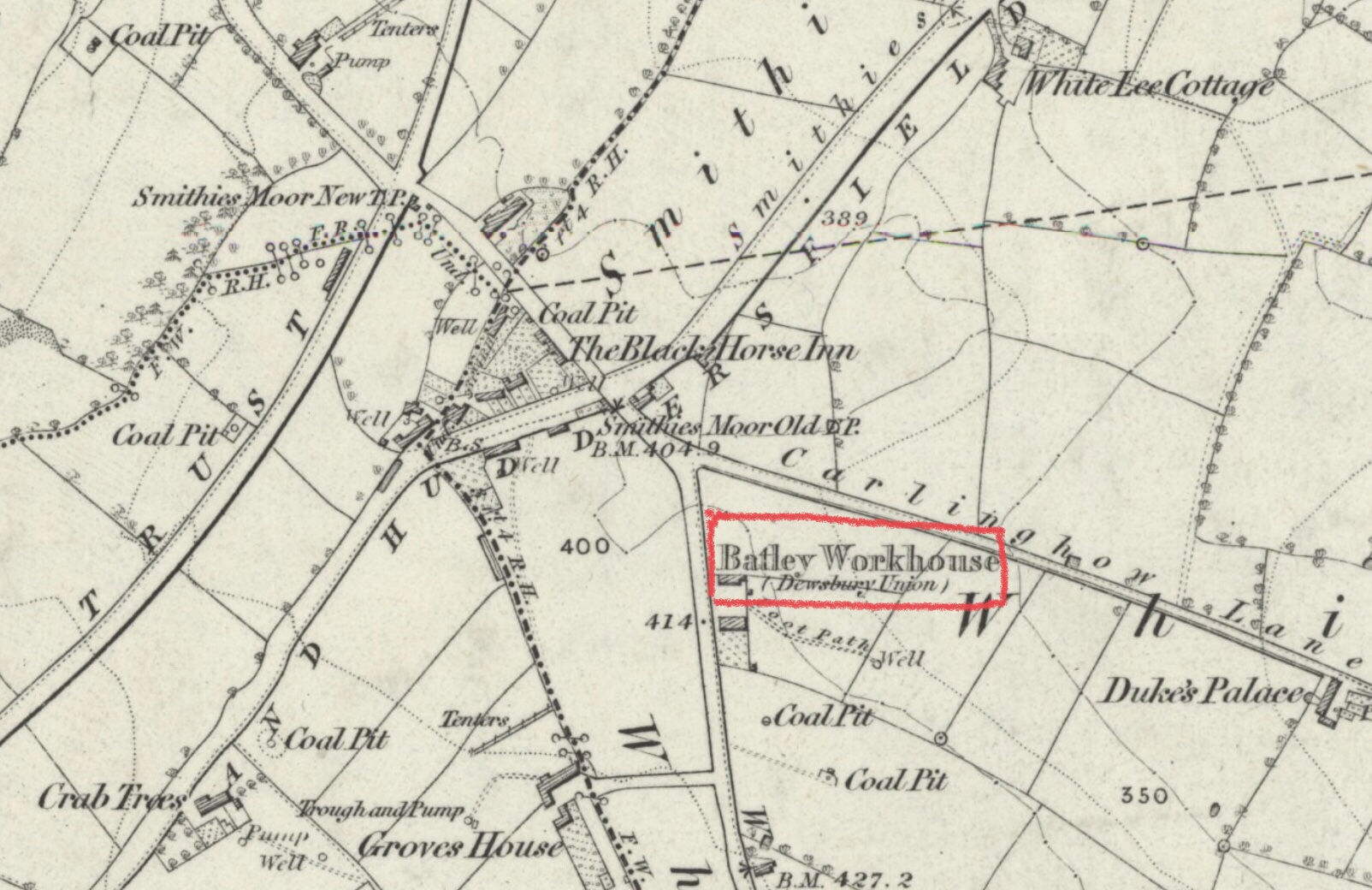
On the night of the raid, Percy sustained injuries at his home at 61 Purlwell Hall Road, the same street where Private Channon was cut down. Percy was taken to Staincliffe hospital where, despite all efforts, he died on 16 December 1940. Part of the old hospital buildings (previously Dewsbury Union Workhouse and the workhouse infirmary, as well as a military hospital in the First World War) exist today.

Staincliffe Hospital, now known as Dewsbury District Hospital and part of the Mid Yorkshire Hospitals NHS Trust – Photo by Jane Roberts

Percy’s funeral, conducted by Catholic priest John J Burns, took place on 20 December 1940. He is interred in Batley cemetery and his resting place is marked with a headstone. He is also commemorated in the roll of World War Two civilian dead held at Westminster Abbey, and on the Commonwealth War Grave’s Commission (CWGC) database.
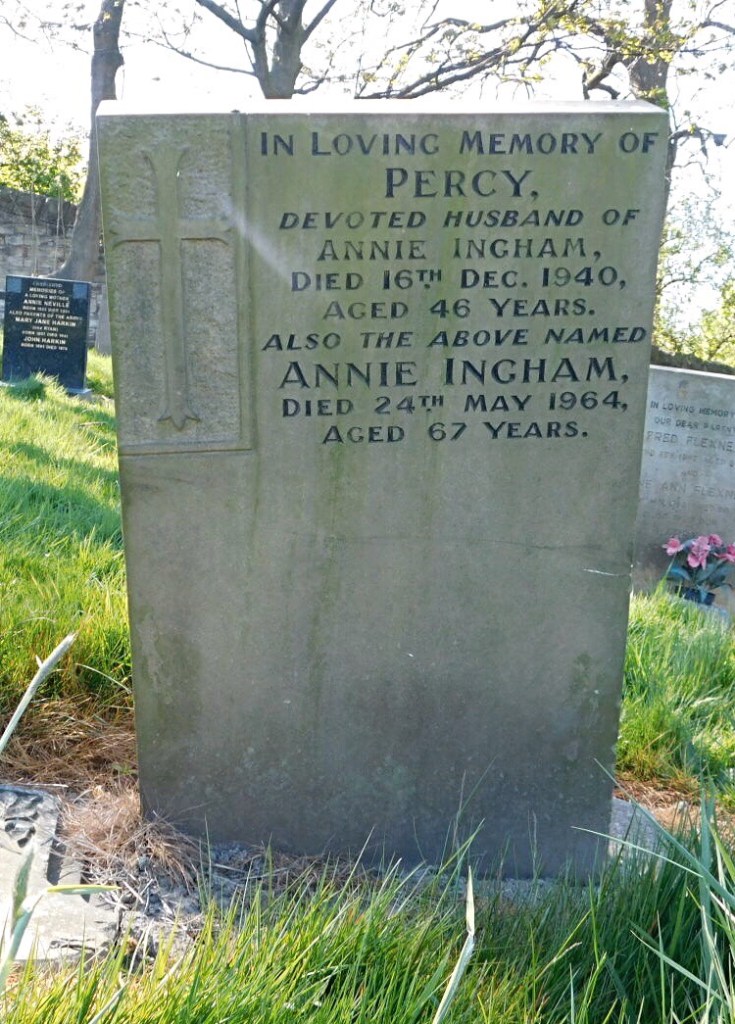
Batley Cemetery, Headstone of Percy Ingham – Photo by Jane Roberts

Neighbouring Dewsbury also suffered in the 12 December raid, with five people losing their lives.

Brenda Hartley, her mother Hilda and neighbour Nellie Naylor, abandoned their Christmas cake baking at 13 North View, Savile Town. Initially they went into their cellar, but as Nellie’s husband, Harry, was due home they made a hair-raising dash to the cellar in the Naylor house next door but one. It was a decision which saved their lives. Harry arrived 15 minutes later. Shortly afterwards a bomb landed on the house they had vacated only a short time ago.

Initially unconscious, the group soon came round to find they were now buried alive. Their terrifying ordeal lasted several hours. Brenda’s mother sustained severe injuries, unable to move under the debris. There was a fear at one point that Hilda would drown, when water used to put out the fires above seeped steadily into the cellar. Harry, thankfully, managed to alert the firemen before it was too late. Rescuers eventually managed to dig a hole the size of an oven door into the cellar, through which a plank was inserted. Then, one by one, those entombed were pulled out to safety. However, the family at 14 North View were not so lucky as Brenda’s father, Dennis, soon learned.

Dennis cycled home immediately after hearing about the Savile Town bombing. He had been working the night shift at Newsome’s mill in Batley Carr. He did not know if his wife and daughter had survived. When he finally got through the cordon protecting devastated North View from the general public, he had a heart-stopping moment when:

…the A.R.P. Men told him they had just found two bodies. They had walked over them thinking they were pillows, but they turned out to be Mrs Scott and her daughter Enid who lived next door to us. Mr Scott was working at his shop, he was a cobbler in Thornhill Lees… [8]

Mary Ann Scott (née Platts) was originally from Carlinghow, Batley. Born in 1879 [9], her 61st birthday was only days away. She married boot and shoe repairer Harry Scott at Carlinghow St John’s on 16 April 1906 [10]. Before her marriage she worked as a weaver at Carlinghow mills (at that stage owned by Brooke Wilford & Co.,) and was a prominent member of the Carlinghow church, teaching in its Sunday school. After her marriage the family settled at 14 North View, and this was their home when Enid, their only child, was born on 7 August 1908. Enid attended Savile Town St Mary’s School, and Wheelwright Girls’ Grammar School. Her working life was spent in office and company secretary roles in Ossett. She also was a volunteer at the Dewsbury ARP Report Centre.

Harry was working at his boot repairing business at Brewery Lane, Thornhill Lees, when the attack occurred. That saved his life. On Tuesday 17 December, after a double funeral service at Carlinghow St John’s, it was Harry’s sad duty to walk behind the coffins of his wife and daughter as they were carried to Batley cemetery for interment. No headstone marks their final resting place. But, like Percy Ingham, their names live on in the Westminster Abbey roll of honour and on the CWGC database.

That day marked three more burials – this time all in Dewsbury cemetery. All three men were members of the Dewsbury Home Guard and were employed in Messrs. Crawshaw and Warburton’s Shaw Cross Colliery. The men were in the colliery offices at the former Ridings colliery on Wakefield Road [11], which was wrecked by a parachute mine. A row of terrace houses on Wakefield Road (Sunny Bank, numbers 72 to 82) were also destroyed in the attack. Fortunately the residents there had taken to the communal shelter and all survived. But the Home Guard men were not so fortunate.

Extract of Six-inch OS Map: Yorkshire CCXLVII.NE; Revised 1938; Published 1948. Shows Dewsbury and location of bombed Crawshaw and Warburton Colliery Offices and North View, Savile Town

Section Leader Sidney Burridge, of 351 Victoria Terrace, Leeds Road, Dewsbury, was a 46-year-old married man. Employed as a colliery deputy at Shaw Cross colliery, it was the same type of job undertaken by his father. Born on 5 July 1894, the son of James Hartley Burridge and wife Jane Elizabeth, he was baptised at St Philip’s church, Dewsbury [12]. It started his lifelong association with the church. It was here, on 8 September 1914, that he married Sophia Squires [13]. And it was the vicar at St Philip’s who conducted his funeral service, with a Union Jack-draped coffin and a Home Guard escort signifying his Local Defence Volunteer role. Outside work, Sidney was a member of Eastborough Working Men’s Club and Dewsbury Rugby League Football Club, both associations represented at his funeral. He left a widow and two children.

The Headstone of Sidney Burridge, Dewsbury Cemetery – Photo by Jane Roberts

Section Commander Ernest Lodge was another of the Home Guard fatalities. He sold house coals and briquettes for Messrs. Crawshaw and Warbuton. Born on 15 November 1893, he was the son of weaver Harry Lodge of Lepton and his wife Elizabeth [14]. Ernest’s mother died around three years later, and on 29 September 1900 Harry re-married at Dewsbury, St Mark’s [15]. His new wife was Sarah Elizabeth Oddy.

Ernest married widow Alice Wilson (formerly Chatwood) at Moorlands Wesleyan Chapel, Dewsbury on 20 July 1929 [16]. The couple both sang with their choir and, at the time of Ernest’s death, lived at 12, Thirlmere Road, Dewsbury.

He too was accorded a funeral with the honour of a Union Jack-covered coffin. Members of the Home Guard lined the path to his grave, which Dewsbury cemetery staff had bordered with evergreen.
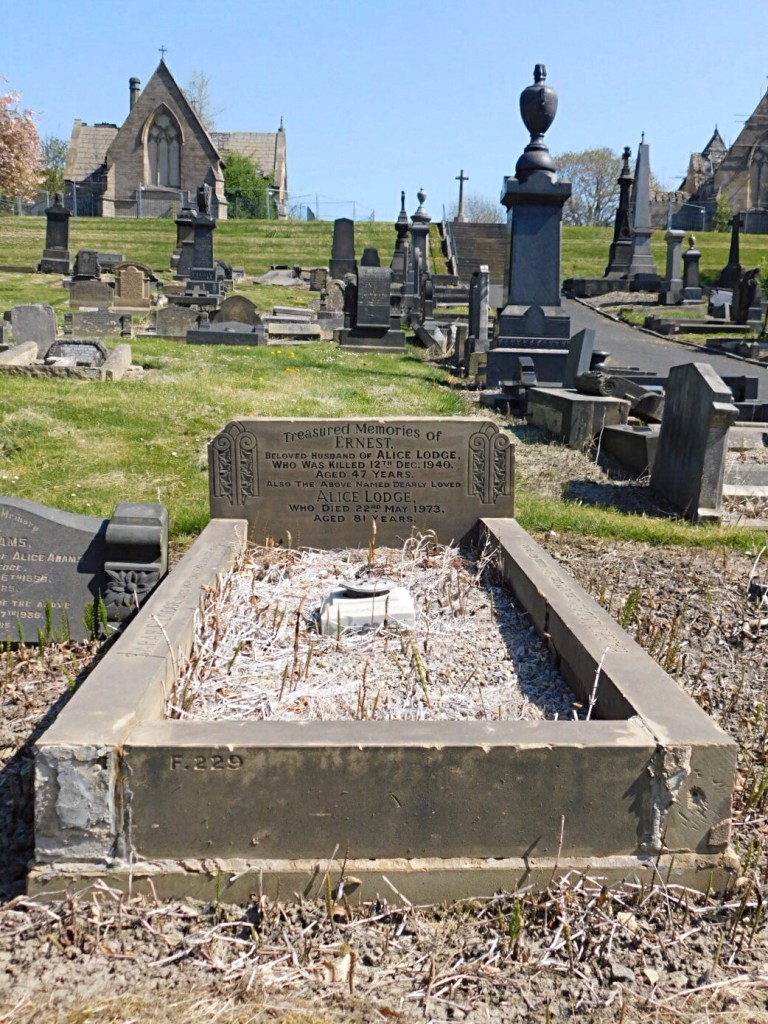
The Headstone of Ernest Lodge, Dewsbury Cemetery – Photo by Jane Roberts

Section Commander Wilfred King was the third Home Guard casualty that night. Born on 31 May 1905 at Commonside, Hanging Heaton, he was the son of George and Martha Ann King. A coal hewer at the Shaw Cross pit, he lived with his parents at 457, Leeds Road, Dewsbury.

In a particularly cruel twist of fate, his 28-year-old bride-to-be Mary Glover, of Thornton Street, instead of preparing for her wedding scheduled for later that week, now found herself attending her fiancé’s funeral. She addressed her floral tribute ‘from his broken-hearted and sorrowing sweetheart’. Wilfred’s funeral service was held at the Boothroyd Lane Providence Independent, prior to interment at Dewsbury Cemetery.
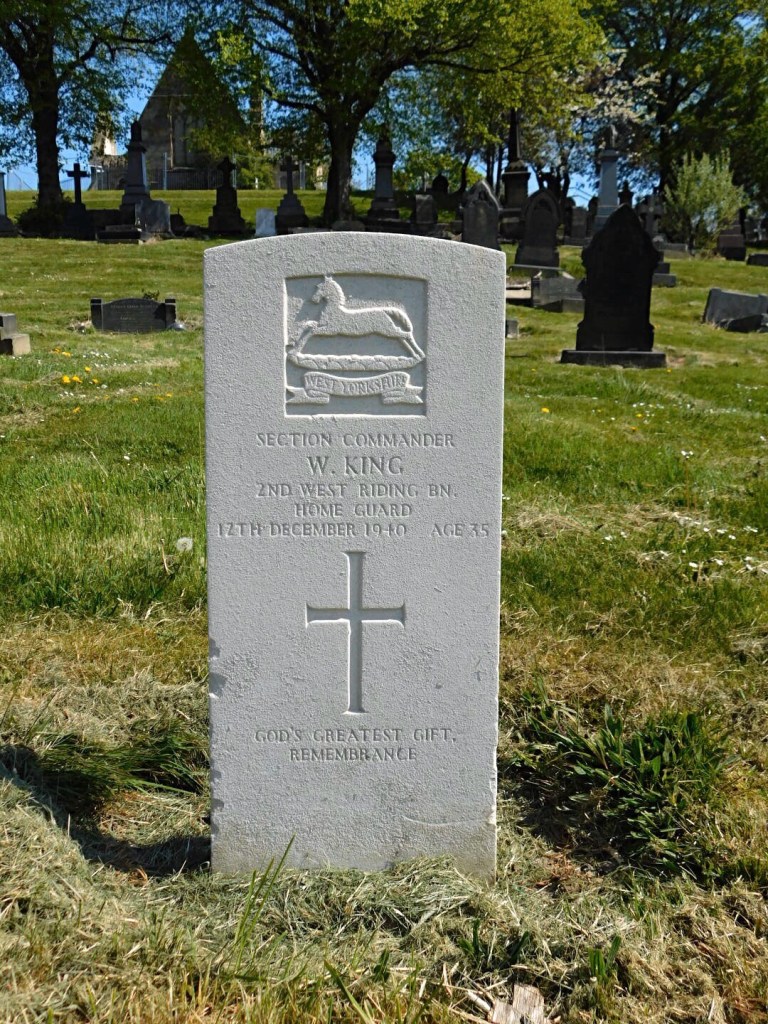
The Headstone of Wilfred King, Dewsbury Cemetery – Photo by Jane Roberts

But that did not mark the extent of local deaths in the bombing raid of the night of 12/13 December 1940. As I mentioned at the outset, the main focus of the bombing that night was the city of Sheffield with its vital steel and iron works. Arthur Brewer, a long-time resident of Ravensthorpe, was in Sheffield that night.

Arthur was born in Birstall on 30 July 1907. The son of Earl and Mary Brewer, he was baptised at the Mount Zion Chapel at White Lee on 1 September 1907 [17]. Some time after 1911 the family moved to Ravensthorpe, and after leaving school Arthur began a career as a musician, specialising in the drums.

He played regularly at the Town Hall in Mirfield and Dewsbury’s Majestic cinema. He then joined the renowned Paul Zaharoff in London, famed for his international band. Subsequently Arthur went on tour playing in numerous city hotels, including a 16-week stint in Jersey.

In 1935 Arthur married Mary Goddard. For the 18 months prior to his death Arthur was based in Sheffield playing with a band in hotels across the city. In down-times he supplemented his income with lorry driving. Initially Mary stayed with him: she is registered there in the 1939 register. But later she moved to the comparative safety of Dewsbury, and was living with her in-laws at Thornhill Street, in Savile Town. Also with her was her and Arthur’s two children, the youngest only three month’s old at the time of raid. Perhaps it was the birth of the baby which prompted the move.

It is a cruel irony that both Savile Town and Sheffield were simultaneously under a Luftwaffe siege: The security of both Mary and Arthur was at stake that December night.

At about 11.20pm Arthur was in the Marples Hotel in Sheffield with fellow-band member Donovan Russell. The seven-storey Marples Hotel and pub on Fitzalan Square had operated under several names since the 1870’s, initially starting out as the Wine and Spirit Commercial Hotel, and latterly the London Mart. But it was still known as The Marples. And it’s name was to be forever etched in history for the events of that night.

At 11.44pm, as over 70 people sheltered in its cellar, it took a direct hit from a 500lb German bomb. Arthur was believed to be amongst those sheltering. Donovan Russell had a lucky escape – he left Arthur there just 20 minutes before the bomb struck. The entire building collapsed.

It was not until 10am the following day that rescue attempts began, initial assessments being survival was impossible. Amazingly seven people were rescued. But that was all. It is estimated around seventy people died in the building, the biggest single loss of life during the Sheffield Blitz. Arthur was amongst that number. If there was any consolation, death was believed to be instantaneous.

Over the following weeks the site was cleared. 64 bodies were eventually recovered, and partial remains of a further six or seven people. Only 14 were visually identified. Personnal belongings were used in the process of formal identification for most of the others.

As of mid-January the only item belonging to Arthur which Mary recovered were the lenses of his glasses. When probate was granted on 12 March 1942, the entry confirmed identification of his body at the hotel. The entry read:

BREWER Arthur of 34 Thornhill-street Savile Town Dewsbury Yorkshire who is believed to have been killed through war operations on 12 December 1940 and whose dead body was found at Marples Hotel Fitzalan-square Sheffield Administration Wakefield 12 March to March Brewer widow.
Effects £161 5s [18]

I’ve planned this local history tale for some time. I wanted to publish it to coincide with the 75th anniversary of VE Day. Unfortunately, because of the current battle the world faces against the invisible coronavirus enemy, my research was prematurely curtailed. However, I wanted to go ahead with publication as a tribute to our ancestors of 80 years ago. Once some kind of research normality resumes I hope to update this post.

Finally, the Bombing Britain website, which draws together intelligence reports of enemy action on British domestic soil, records only this one direct air raid on Dewsbury. Batley had two recorded air raids. The evening of 12 December into the early hours of 13 December, and one on the night of 15/16 December 1940. This latter raid had no recorded casualties. If anyone does have any memories of these events, or life on the Home Front in Batley and Dewsbury generally, please do contact me.

ADDITIONAL INFORMATION
It appears the Bombing Britain site covering enemy action over British soil may under-report the bombs which landed over the Batley and Dewsbury area. West Yorkshire Archives produced an ARP Bomb Map for the night of 14/15 March 1941. It can be found at here and includes an unexploded bomb almost opposite what is now Healey Community Centre.


Postscript:
Finally a big thank you for the donations already received to keep this website going. 

The website has always been free to use, but it does cost me money to operate. In the current difficult economic climate I am considering if I can continue to afford to keep running it as a free resource, especially as I have to balance the research time against work commitments. 

If you have enjoyed reading the various pieces, and would like to make a donation towards keeping the website up and running in its current open access format, it would be very much appreciated. 

Please click here to be taken to the PayPal donation link. By making a donation you will be helping to keep the website online and freely available for all. 

Thank you.


Notes:
[1] WW2 People’s War archive of wartime memories, bbc.co.uk/ww2peopleswar, Brenda Hartley, now Haley, Reference A2843750;
[2] Vera May – Batley History Group Facebook Page, Jane Roberts post 19 April 2020;
[3] Geoffrey Whitehead, retired Batley Boy’s High School deputy headmaster, in conversation with Jane Roberts dated 27 April 2020;
[4] Batley News, 21 December 1940;
[5] Geoffrey Whitehead, Ibid;
[6] Exeter and Plymouth Gazette, 27 December 1940;
[7] Batley News, 21 December 1940;
[8] WW2 People’s War archive of wartime memories, bbc.co.uk/ww2peopleswar, Brenda Hartley, now Haley, Reference A2843750;
[9] Birstall St Peter’s baptism register, born on 23 December 1879 and baptised on 25 January 1880, accessed via Ancestry.co.uk West Yorkshire Church of England births and baptisms 1813-1910, original record at West Yorkshire Archive Services, Reference WDP5/1/2/9;
[10] Carlinghow St John’s marriage register, accessed via Ancestry.co.uk West Yorkshire Church of England Marriages and Banns, 1813-1935, original record at West Yorkshire Archive Services, Reference WDP132/1/2/2;
[11] England & Wales National Probate Calendar, Sidney Burridge, Probate Date 27 November 1941 gives the place of death. Accessed via Ancestry.co.uk;
[12] St Philip’s, Dewsbury, baptism register, accessed via Ancestry.co.uk West Yorkshire Church of England births and baptisms 1813-1910, original record at West Yorkshire Archive Services, Reference WDP9/439;
[13] St Philip’s, Dewsbury, marriage register, accessed via Ancestry.co.uk West Yorkshire Church of England Marriages and Banns, 1813-1935, original record at West Yorkshire Archive Services, Reference WDP9/443;
[14] Baptism of Earnest [sic] Lodge, Huddersfield Northumberland Street Methodist Circuit, accessed via Ancestry.co.uk West Yorkshire, Non-Conformist Records, 1646-1985, original record at West Yorkshire Archives Service, Reference KC295/3;
[15] St Mark’s, Dewsbury, marriage register, accessed via Ancestry.co.uk West Yorkshire Church of England Marriages and Banns, 1813-1935, original record at West Yorkshire Archive Services, Reference WDP228/1/2/2;
[16] Marriage register of Moorlands Wesleyan Chapel, Boothroyd Lane, Dewsbury, accessed via Ancestry.co.uk West Yorkshire, Non-Conformist Records, 1646-1985, original record at West Yorkshire Archives Service, Reference C111/207;
[17] Mount Zion, White Lee, Baptism register, accessed via Ancestry.co.uk West Yorkshire, Non-Conformist Records, 1646-1985, original record at West Yorkshire Archives Service, Reference C10/15/1/1/1;
[18] England & Wales National Probate Calendar, Arthur Brewer, Probate Date 12 March 1942; Accessed via Ancestry.co.uk

Sources:
1939 Register, accessed via Findmypast and Ancestry.co.uk;
Batley Cemetery Burial Records;
• Batley News, 14 and 21 December 1940 and 18 January 1941
;
• BBC WW2 People’s War
, bbc.co.uk/ww2peopleswar ;
• Bombing Britain website, TNA file series HO203, intelligence reports of enemy action on British domestic soil http://www.warstateandsociety.com/Bombing-Britain ;
• Chariots of Wrath, Sam Whitworth, published 2016
;
• Commonwealth War Graves Commission website, https://www.cwgc.org/
;
• England and Wales Censuses 1881-1911 (various);
Exeter and Plymouth Gazette, 27 December 1940;
Farnham Maltings website, The Marples Tragedy (Sheffield Blitzm 1940), https://farnhammaltings.com/newsmarples-tragedy/ ;
Hanging Heaton Golf Club website, https://www.hhgc.org/about-hhgc/
National Probate Calendar, Herbert Courtney Channon, Sidney Burridge, Arthur Brewer, Enid Scott, Ernest Lodge;
• OS Map is reproduced with the permission of the National Library of Scotland under a Creative Commons licence. https://maps.nls.uk/index.html
Parish Registers – various;
Sheffield History website, The Marples, https://www.sheffieldhistory.co.uk/forums/topic/98-the-marples/ ;
• The Chris Hobbs website, Marples Hotel, https://www.chrishobbs.com/marples1940.htm ;
• The History of Batley 1800 – 1974, Malcolm H Haigh, published 1985;
Sheffield Libraries blogspot, Sheffield Blitz: lost eyewitness account from Marples Hotel survivor comes to light in archives, http://shefflibraries.blogspot.com/2017/07/sheffield-blitz-lost-eyewitness-account.html ;
Western Times, 27 December 1940;
WW2 People’s War archive of wartime memories, bbc.co.uk/ww2peopleswar, Brenda Hartley, now Haley, Reference A2843750; Edward Lomax (Dewsbury), Reference A2875782; Ronald Tolson Schofield (Dewsbury), Reference A2843886; and Derrick Sharp (Batley), Reference A2339291;

UPDATE:
This has generated many memories and comments. There are the fantastic ones which have been posted in the WordPress comments section for this post below.
In addition there have been lots posted elsewhere on social media and I have gathered them together here.
• Brian Howgate on Facebook page Batley Photos Old and New wrote: My grandparents lived exactly opposite St Andrews Church in purlwell Hall Road. There house got serverly damaged when the bomb dropped on the church.
• On the same site Lesley Dyer wrote: My grandfather not only worked during the day but was also did his bit as a warden who had to go out and watch out for any incendries dropping which started fires and had to put them out before the German bomber’s came over, it went on for weeks, until one night another warden had told my grandfather that St. Andrews had been hit taking its roof, as a man stood in a shop doorway and the blast/shock wave blew him back into the shop, luckily he survived, the church roof & windows had gone altogether, along with homes in the area had also been damaged too.
• Also on that page Kevin Mcguire wrote: Our next door neighbour had a[n] Anderson shelter which he kept all his gardening gear they did not look that safe to me as a kid there were air aid shelters every where great for exploring and playing Japs and commanders with wooden guns.
• Again on the Batley Photos site Joan Chappell recalled: As a child I went to St. Andrews church. We were told that the reason it had chairs and not pews like most other churches was because it was bombed during the war.
• Also on Batley Photos Jack Dane wrote: ….when we lived on Purwell Crescent I have always had this memory of my mother leaving me outside our gate crying because it was pitch black she ran back into the house to fetch something she had forgotten when we were on our way to our neighbours air raid shelter, the date of the bombing puts me at 3 year old which seems about right if it was that particular night.
On the Shoddy Matters Facebook Page Christine Lawton wrote: My husband is named after Wilfred king he was a friend of there family.
• On the same page Ian Sewell said: I remember the bunkers up Caulms Wood with the huge stones.
• Also on Shoddy Matters David Wilby wrote: ….growing up [I] remember seeing where the bomb had dropped, up by the farm on Staincliffe hall road, near the top of Deighton Lane.
• And in another Shoddy Matters post Chrissie Chapman wrote: I have lived up Carters fields all my life and was told that the house I own had the gable wall blown down due to a bomb from the war. The wall was rebuilt and I now think, after reading this, it must have been from the bombs that fell on Carters Field . We often played, as children, in the air raid shelter that was on waste land next to the Parochial Hall.
• Linked to Chrissie’s post, on Dewsbury Pictures Old and New Facebook page David Riley said: My aunt Dorie’s gable end was blown up by the bomb in Carters Field had to move into my mum and dads in Northbank Rd near Mullins farm. David also said they lived in the last block of four [houses] facing Healey, Northbank fields by the top of the football pitch. Looking at the 1939 Register, the address for Doris Boden was 173 North Bank Road, Batley.
• Also on the Dewsbury page John Riley wrote: My auntie who lived down Robin Lane, used to find large lumps of shrapnel in the garden which she said came off the exploding AA shells fired from Caulms Wood.
• On Twitter Ghulam Nabi wrote: I attended Birkdale High School in 1974 and top half which was formerly the Girls Grammar school had air raid shelters all around the grounds.. Some of the lads found them and used to skip lessons by hiding in there. As an aside, the Girls Grammar School was Wheelwright, the former school of one of the air raid victims, Enid Scott.

A Rifleman’s Crime of Passion

Murder! Murder! He’s murdering our Hannah in the house!’ The terrified screams of an old lady tore through the night silence of Batley’s Hume Street and New Street area. It was around 11pm on Saturday 19 August 1865.

Joseph Pease, a labourer living near to the Brook household, heard the cries for help, and rushed into the two-roomed cottage, home of 60-year-old widow Sarah Brook (also known as Sally). A horrific tableau met his eyes. The compact downstairs area, comprising a kitchen with stone stairs leading to the upper chamber, a fireplace directly facing the entrance door and to the right a cupboard bed, was blood splattered, from floor to furniture and walls. A young boy, the grandson of the old lady, cowered screaming on the far side of the bed, trying to evade danger. Plunging a bayonet repeatedly into his neck stood a youth, dressed in Rifle Corps uniform. Facing the youth, at the far side of the kitchen, was 18-year-old Hannah Brook, daughter of Sarah. Dressed in a black frock, blood was pouring from her neck and mouth. Another witness described how blood was ‘sponging from a hole in her side.’ [1]

Pease rushed at the man, 19-year-old Eli Sykes, and seized him, though he was stabbed in the thigh and slightly injured in the struggle. William Fawcett, a cabinet maker, who had been visiting his father-in-law in Hume Street, followed up and managed to wrench the bayonet, dripping with blood from assailant and victims, from Sykes. He removed it from the scene for safety.

Others swiftly appeared, alerted by the commotion. Someone carried Sarah Brook, her white nightdress now blood-soaked, to the bed where she died. Others gave Hannah water. She attempted to speak, but could not. Within minutes she too was dead. Both women had received multiple stab wounds (Sarah nine and Hannah seven), including fatal punctures to their hearts.

Meanwhile, the police arrived at the house, now surrounded by hundreds of people despite it being nearly midnight. Sykes was restrained in a chair. His rifle was on a table, the stock broken in two. Police Sergeant English, of the West Riding Constabulary, charged the silent Sykes with murder. At this point he finally opened his eyes and looked towards the bed where the two women lay.

Dr William Bayldon, amongst those officials summoned to the house, examined Sykes’ wounds and found them not to be serious. He declared hind sufficiently fit to be transferred to the Dewsbury lock-up. Here Dr W.H. Thornton re-examined the prisoner and agreed that, although the wounds were deep, they were not fatal.

On Tuesday 22 August 1865 the double funeral of Sarah and Hannah Brook took place at Batley Parish Church. People arrived at Batley railway station by the trainload. Many viewed the corpses, laid out in the very room where they met their brutal fate less than three days before. The faces of the deceased were bare, heads covered by skull-caps, countenances placid and at peace.

People from across the West Riding, including Leeds, Bradford, Wakefield, Halifax and Heckmondwike, lined the funeral route. Estimates put the numbers of spectators in the region of at least 20,000. The church was packed with people in their working clothes. Amongst those paying their final respects was a young man from Wakefield – James Henry Ashton.

Female acquaintances carried the coffins of the women to their burial place: older women carried the coffin of Sarah, whilst young mill girls carried Hannah’s. They were interred in a grave around 20 yards away from the church yard entrance gates, on the south east side of the church.

Batley Parish Church – Photo by Jane Roberts

The murders horrified not only those living in the growing, industrial mill town of Batley, but sent shockwaves across the country. The recurring question was why? What had caused a seemingly law-abiding young man to commit such a brutal crime?

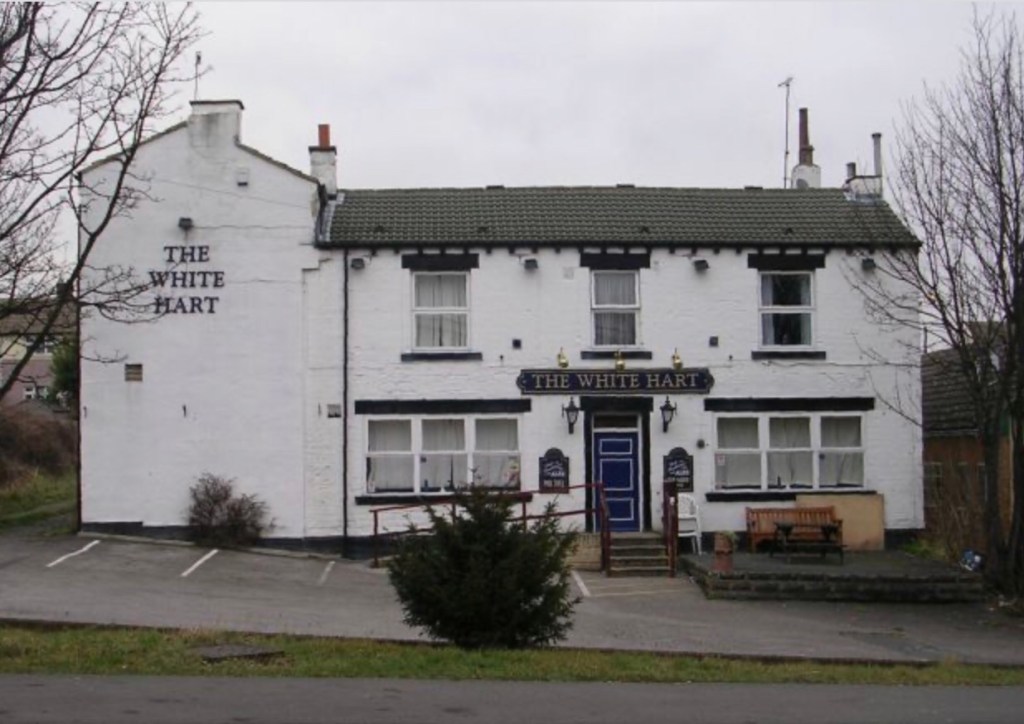
Initial details began to appear through official channels in days after the murder. Two inquest hearings took place before the Coroner at the White Hart Hotel in Batley, a local pub which is now a residential property. A wilful murder verdict resulted .

© Copyright Betty Longbottom and licensed for reuse under creativecommons.org/licenses/by-sa/2.0

Eli also appeared before the local magistrates. In his initial appearance, a seated Eli looked weak with a scarf round his neck, but with scarcely any evidence of his self-inflicted throat wounds. The main hearing took place at Dewsbury court house.

As a result of this magistrates hearing, Eli was committed to trial at the next Leeds Assizes on a murder charge. Here, at Leeds Town Hall on 19 December 1865, the full case was heard. It provided even more information and drama to an eager audience.

Hannah Brook was born in Batley in 1847, the daughter of weaver Mark Brook and his wife Sarah (née Darnbrook). Sarah was previously married to Robert Fearnley, who died in 1837, so Hannah had a number of half-siblings. By 1861 the family had moved from the Havercroft area of Batley to Hume Street, and in July 1864 Mark died. Thereafter Sarah lived upon the income derived from a small property near Batley [2]. Hannah, described as a cheerful girl, worked as a mill hand [3] at Alexandra Mill in Batley.

Eli Sykes was a cloth-finisher. Born in Ossett in 1846 he was the son of cordwainer John Sykes and his wife Sarah Ellis. The family moved to Dewsbury in around 1850/51, and by 1865 they lived at Batley Carr, almost opposite Holy Trinity Church. Although described as holding a humble position in society, they were a very respectable family.

After the events that fateful August night, a few isolated newspapers described Eli as a shady young man, with a wild, roving disposition who had caused much trouble for his parents since leaving Sunday School. But these are outliers. The overwhelming number of accounts testify to his good character. They paint a picture of a well-behaved, quiet, industrious young man. One work colleague, William Bentley Walton described him as straightforward and peaceable. He had worked with Sykes for three years and never had a quarrel with him. Robert Jones, a neighbour of the Brooks family, said he always appeared a quiet, well-conducted lad and his manner towards Hannah was invariably kind and affectionate. Hannah Hirst, a friend of Hannah Brook who had known Eli for three years, said they ‘always appeared to be very affectionate when together. He was very kind to Hannah…’ and she ‘…never heard any quarrel between them.’ [4]

For about two years prior to that August night, like many other young men Eli spent his free time with the local military unit. It was a social activity, away from the confines of home and work. In Eli’s case he was a Private in the No3 (Batley Carr) Company of the 29th (Dewsbury) West York Volunteer Corps. His fellow members there vouched for his steady nature, general civility and good behaviour.

Eli and Hannah met on 10 March 1863 during celebrations which took place countrywide marking the marriage of Queen Victoria’s eldest son Prince Albert Edward of Wales to Princess Alexandra of Denmark. Their friendship developed to full-blown courtship, with Eli a frequent visitor to the Brook house. Despite a short break up in the early days of their relationship which they quickly patched up, the general assumption by all was the logical next step for the pair was marriage. They seemed well-suited. Eli had a reliable mill job to provide for a wife and, eventually, family. And by all accounts he was a steady young man. But they were young, possibly too young to commit for life. And emotions could quickly change.

And this proved the case for Hannah. For some reason in July 1865 her feelings towards Eli cooled. The indication was she had met someone else – a man from Wakefield named James Henry Ashton: the man mentioned amongst the mourners at her funeral the following month. Their meetings included a picnic at Howley Hall, where she was seen dancing with him. But whether he was the cause of the change in Hannah is unclear. Some sources suggest she took up with James whilst still seeing Eli. Others claim the relationship with Eli was already over by the time she became involved with James.

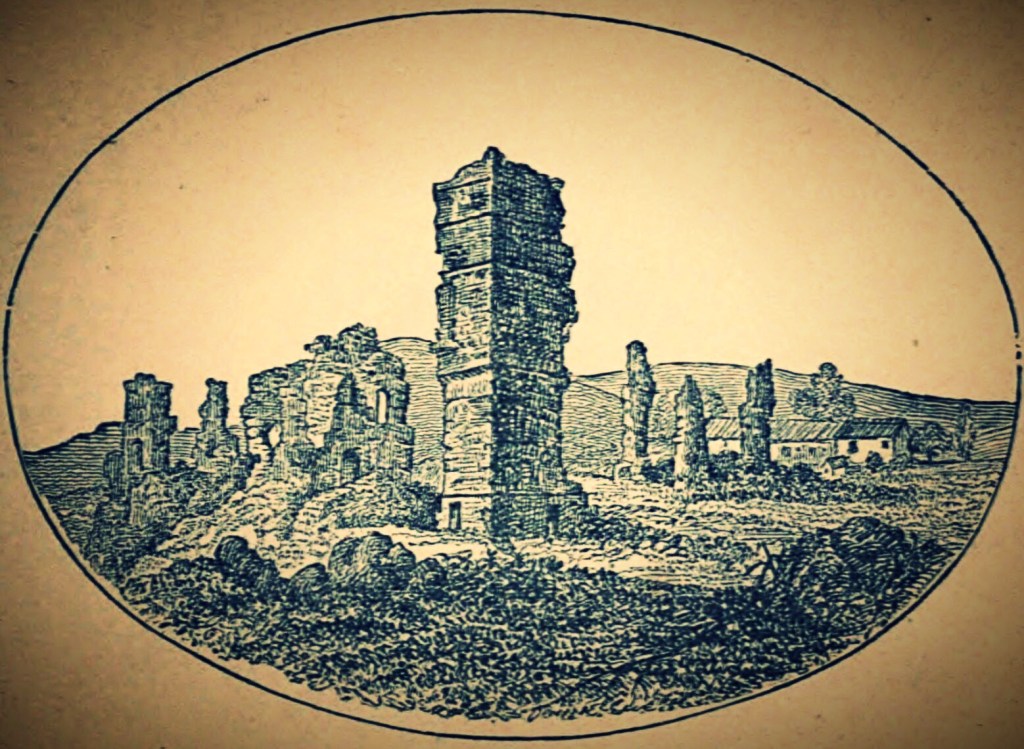
1881 Illustration of Howley Hall Ruins – published in 1881 (out of copyright)

Despite Hannah repeatedly telling Eli that their relationship was over, he would not accept it. As far as he was concerned she was the love of his life. He doggedly followed her trying to persuade her to change her mind, often turning up unannounced at her Hume Street home. Friends advised Eli to let it drop. One who cautioned thus was power loom weaver George Fearnley, who happened to be Hannah’s brother. Eli told George how grieved he was at Hannah’s refusal to see him, and he did not know what to do. George told Eli he was being a foolish lad, and that there were plenty other girls.

Hannah Hirst was another one who witnessed Eli’s continued pursuit of his former sweetheart. On 13 July Miss Brook took tea at Miss Hirst’s Batley Carr home, an occurrence noticed by Eli. Later that night, after Hannah Brook returned home, Eli called at the Hirst home. He told Miss Hirst that Hannah’s new love would be coming over the following week. Then, striking his hat violently against a chair, he declared ‘If I don’t have her, no one else shall.’ Hannah Hirst stated ‘Eli, I think you are going out of your mind.’ His ominous response was ‘You’ll see.

The day of the murder coincided with a large agricultural and flower show in neighbouring Drighlington. Three companies of the West Yorks Volunteer Corps, amongst them Eli, caught the train to Drighlington to join up with the Birstall contingent for drill. At 8pm they marched back to the railway station were they were served either a half pint of ale, or ginger beer, prior to catching the 9.30pm train back to Batley. Despite three carriages being reserved for the men, not all could entrain due to the vast numbers returning from the show. Eli, though, did have a place and, with about 90 comrades, arrived in Batley at 9.40pm. Some lingered at the station chatting, or waiting for the 10pm train to Dewsbury. Others set off to walk home, including Eli. When he and a friend reached Hick Lane, Eli suggested detouring into Batley. Due to the late hour the friend declined, leaving Eli to carry on alone.

William Bentley Walton was in The Commercial Inn at around 10.30pm, when he saw Eli dressed in his volunteer uniform, rifle in hand and bayonet sheathed at his side. Friends and workmates, Eli told him he was going to Hannah’s. William advised him against it, knowing from earlier conversations with Eli that she had told him to stay away. It was advice Eli chose to ignore. Perhaps it did not help that William told Eli he had seen Hannah go by about 15 minutes earlier. Instead of passing through Batley Eli made the fateful decision to turn off for the Brook’s cottage. All accounts agreed Eli was sober, so drink did not influence what happened next.

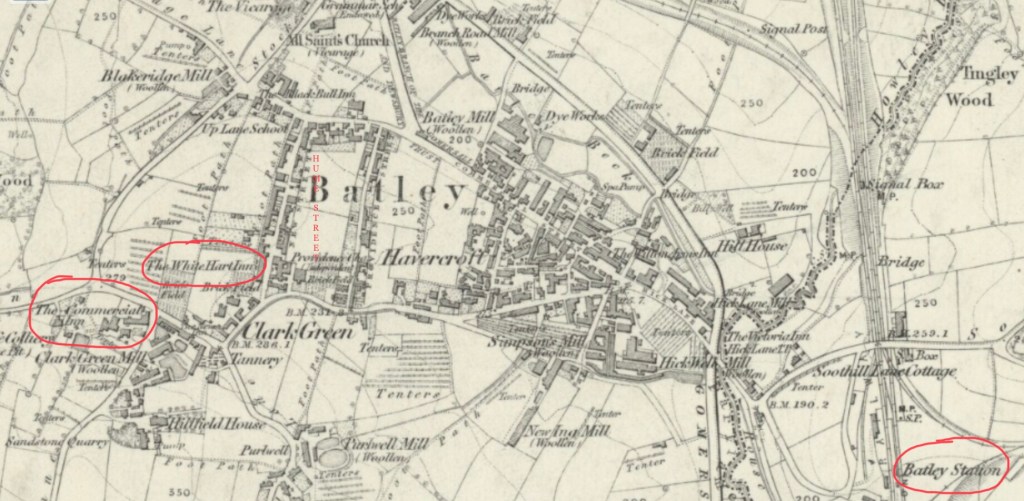
Extract of Six-inch OS Map: Yorkshire 232. Surveyed 1847 to 1851; Published 1854 – Shows Batley with some key locations marked up

Robert Jones, who lived next door but one to Sarah and Hannah, made his way to nearby New Street between 11-12pm. He noticed Eli and Hannah talking outside her Hume Street home. Robert politely asked the couple if they had been to the show. Both said no. He left them still talking, no indication of anything more serious going on. However, the situation rapidly deteriorated in the short time it took for Robert to quickly visit New Street and return to his Hume Street home.

Despite the seeming civility of the conversation witnessed by Robert, Eli’s visit was once more an unwelcome one. By now he was inside the house, again asking Hannah to go back out with him. Once more Hannah said no. Hannah’s mother became involved telling Eli to go away, they did not want him there. Meanwhile, according to Eli’s testimony, a now seated Hannah began singing a popular ballad ‘The Gay Cavalier’ about a man disappointed by the lady he loved. It contained the lyrics ‘She may go to Hong Kong for me’, with Hannah replacing the ‘She’ for ‘You’. Driven to a fury by the perceived taunts and rejection by his former love, he raised his rifle and struck Hannah across her head with the butt, a blow so hard it cracked the stock. The force knocked Hannah out of the chair. Eli then drew out his bayonet, and the stabbing frenzy on both Hannah and her mother commenced. And it was at this point Sarah raised the alarm call, drawing first Joseph Pease and William Fawcett, followed by a host of other neighbours and the police.

Once in custody, according to police statements, Eli reportedly said ‘I feel easier in my mind, and better satisfied now than before I did it.’ He also allegedly said ‘Although I murdered her I loved her – I have told her many a time I’d have my revenge, and I’ve got it now.[5] The police also reported his apparent indifference whilst in custody, Eli laughing and whistling as if nothing had happened. It was as if he failed to recognise the magnitude of his crime. His only display of real emotion appeared to be when his family visited him.

The trial at the Leeds Assizes on 19 December 1865 would bring home the enormity soon enough. Prior to the trial, on 8 December, he was transferred to the imposing Victorian edifice of Armley Gaol. Opened under 20 years earlier as Leeds Borough Gaol, it had only recently taken over from York Castle as the place where West Riding executions were carried out. The first two had taken place as recently as September 1864.

Leeds Town Hall – Published in 1862, out of copyright

From early morning of the trial at the court in Leeds Town Hall, the corridors teamed with people. Many came from the Batley and Dewsbury area, a high proportion of them gaily-dressed women, their frocks incongruous to a court setting. Perhaps the fact this magnificent building had been opened only in 1858 by Queen Victoria, as much as the trial, enticed the good folk of Batley and Dewsbury. It was a day out.

Those lucky enough to gain entry to the crowded courtroom listened intently to the parade of witnesses. Eli’s defence argued that jealousy drove him to commit the crime. In the heat of the moment he lost all sense of reason. His temporary insanity meant it was manslaughter not murder. Justice Shee, in his summing up, would have none of this. Within 30 minutes the jury announced its guilty verdict.

In a show of emotion which reduced many in the courtroom to tears, Eli made his impassioned address. Sobbing, tears almost blinding him and choking his every word, he stated:

My Lord, and gentlemen of the jury, – I never had it in my mind to do it before it was done. If these were my dying words, I could say in the presence of God that I never meant to kill Hannah. I never struck her with the rifle. God only knows what happened in that house that night. He only knows what she said to me – how she began singing, and said words that I never thought could have come out of a woman’s mouth. And yet I loved her; in my heart I loved her as never woman was loved before, if my doom is death, I hope I shall meet her in heaven. But I don’t think I shall be hanged; the Queen will be merciful to me. I never thought it would come to this. Many a time have I gone with her to Wakefield, but little did I think she was deceiving me and went to meet another sweetheart. If she had not jeered at me, I would not have hurt her for my life. I hope I shall meet her in heaven, and I can only pray that if my doom is to be death that God will take my sufferings from me. I hope that my prayers shall be answered, and that we shall meet in that glorious land where we shall never be parted. She has gone to that land, and I will die to get to her….. [6]

Although the statement deeply affected the Judge, it did not change the sentence. Eli was to be executed by hanging. With the Judge’s final words of ‘And may God, in his infinite mercy, have mercy on your soul’ ringing in his ears, Eli was removed to Armley Gaol to await his fate.

Eli’s trial address had a wider impact. Public opinion was divided as to the correctness of the sentence. Petitions sprang up requesting a commutation of it. George Armitage, one of the magistrates who committed Eli to trial at the Assizes, similarly expressed himself in favour of a reduced sentence. A piece in the Leeds Mercury on 21 December praised Eli’s character, spoke of his pure, honourable and ardent love for Hannah, pointedly saying little was known about her character. They also seemed to support Eli’s belief, expressed at the Assizes, that Hannah was deceiving him saying ‘we do not see that the correctness of his belief is called into question’. The conclusion they hinted at was Eli deserved a more lenient punishment than the death sentence. On the scale of murder, perhaps this was one which was not cold-blooded and calculated. It perhaps held some element of justification. How many times since has some apportionment of blame been attached to women victims of crime?

For Hannah and Sarah’s grieving family, this Leeds Mercury piece proved too much. George Fearnley felt compelled to write to the paper to set the record straight about the piece which ‘reflects in a most unjust and unwarrantable manner upon the conduct and character of my lamented sister…’. His letter, dated 28 December, featured in the Leeds Mercury on 30 December. In it he refuted allegations that Hannah deceived Eli by going with him to Wakefield to meet another lover. The only occasions they went to Wakefield together was to see friends there. In a lengthy missive he also asserted that Sykes:

…knew well … that before her feelings towards him had so far changed as to induce her to prefer another, my sister had insisted upon breaking off her connection with him and told him to stay away; and so far from her having encouraged his addresses after this time, she uniformly refused to see him, and did all she could to compel him to discontinue his visits…I presume, Gentlemen, that neither you nor any one else will deny that my sister had a perfect right, if she so wished it, to break off her connection with Sykes; and having done so, she had also a right to keep company with another if she chose, and that, too, without subjecting herself to annoyance, to threats, or to murder…I conclude by asking from the public a verdict that shall acquit her of all blame… [7]

Even as this letter was being read and digested by the public to which George appealed, the case had undergone a new, dramatic, and unexpected, twist.

Eli returned to Armley Gaol after his conviction and was placed under the day care of warder Charles Hampshire, a man with 17 years experience. Charles Jacups took over responsibility at night. The men were ordered to keep the prisoner under constant watch.

The Gaol had two cells for condemned prisoners. Initially Eli was placed in the cell on the ground floor, but subsequently was moved to the cell on the floor above due to concerns about the suicide risk posed by the other condemned man, Patrick Welsh. No such concerns were held for Eli, who spoke a good deal about religion and still appeared to entertain the hope that the Queen would commute his sentence to penal servitude. The prison chaplain, Rev Middleton, who visited Eli daily, also entertained no concerns about his state of mind.

On Saturday 23 December the chaplain visited Eli at 5.15pm and left at around 6pm. He failed to lock the door. Charles Hampshire also failed to check Eli was secure in his cell after the chaplain’s visit. Thomas Hampshire, brother of Charles, another experienced warder compounded the error. A trusted employee, he had worked at Armley Gaol since its opening, and prior to that he served five years at Wakefield prison. That evening it was his duty to call the roll and check the cell doors were double locked. He commenced the check at 5.45pm and finished at 6.20pm. Eli’s door appeared to be secure…but it was not. The mistake had huge consequences, including the suspension of Charles Hampshire and the dismissal of Thomas.

At about 6.40pm a large crash, like the firing of guns, echoed in the confines of the prison. Eli had escaped from his cell. Unhindered, he managed to get to the floor above, where he climbed on the balustrade and threw himself on to the flags around 20-25 feet below [8]. He landed on his feet, before falling over and banging his head, rendering himself unconscious for about half an hour. He did suffer convulsions in the initial aftermath, but his leg injuries were the main concern, in particular the compound fracture to his left ankle which haemorrhaged. William Nicholson Price, the prison surgeon, along with the Leeds Infirmary surgeon Mr Wheelhouse, stabilised him and he seemed to progress favourably. However, Eli did try to hinder his recovery throughout, attempting to remove his bandages and doing his utmost to prevent routine medical checks.

The opinion was Eli had attempted suicide to spare his mother, believing his hanging would be the death of her. But all in authority remained hopeful that hanging would be his just fate. In fact stringent attempts were made to ensure he remained alive for his appointed date with the hangman’s noose on 15 January 1866.

In the afternoon and evening of 3 January 1866 Eli suffered a couple of secondary haemorrhages. Both were staunched and, once again, although weakened he seemingly rallied. It proved a temporary recovery. On the evening of 6 January a further bleed occurred. Once again the flow was stemmed, and reduced to an ooze. Eli’s condition continued to deteriorate though, despite best efforts of those charged with his care. Conscious throughout this period, he died in his prison cell at about 9.20pm that night.

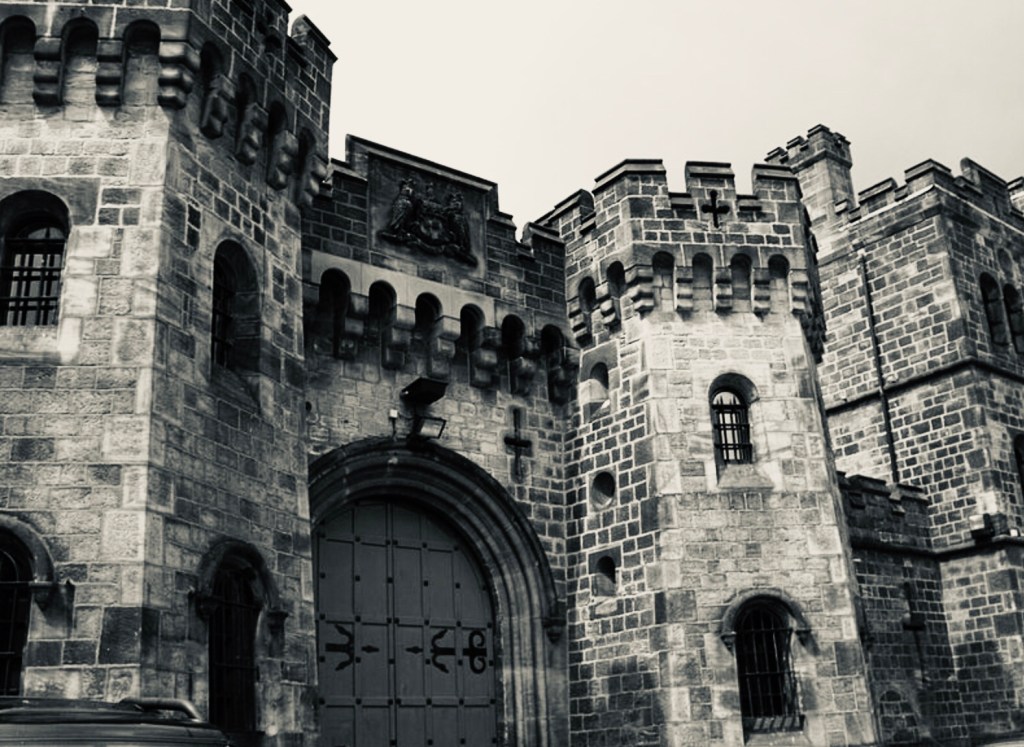
Old Gate Armley Gaol (edited Black & White) – Wikimedia Commons, Creative Commons License 3.0 (Share Alike)

The inquest took place on 9 January. That day a letter appeared in the Leeds Mercury. Dated 8 January 1866, it was from Eli’s father. With remarkable restraint, John Sykes wrote to highlight the lack of compassion shown to both himself and his wife. They arrived at Armley Gaol that morning to view their son’s body and say a final goodbye. The Governor refused permission without a magistrate’s order. John left his wife at the prison whilst he went into Leeds to obtain the necessary documentation. Yet even with signed authority the Governor would not allow John and Sarah entry to see their son one last time.

John Sykes was present at the inquest though. Here the jury reached a verdict of Felo de Se (suicide). Eli’s burial was ordered to take place at midnight in the precincts of Armley Gaol, without any religious ceremony.

The sensational events captured public imagination to such an extent that enterprising publishers sold fly-sheets containing lurid (and often inaccurate) details about the case. The events in Batley were even immortalised in verse. It seems only fitting to end this post with one such example.

Miss Hannah Brooks [sic] was a factory maiden,
By every one she was well liked;
And long poor Hannah had been courted,
By the young cloth-worker, Eli Sykes,
Hannah Brook forsook her lover
Which caused him the maid to kill,
And her aged tender mother
By his hands their blood was spilled.

In Yorkshire, such a dreadful murder
Before we’re sure was never seen;
Committed was by Eli Sykes –
A youth, whose age is but nineteen.
He lov’d the maiden to distraction –
From drill he went straightway;
Hannah harshly with her mother
Ordered Eli Sykes away.

As he stood in his regimentals,
So frantically he gazed around;
And with the butt-end of his rifle,
Quickly knocked his true-love down.
Her mother strove to save her daughter –
He did in frenzy swear an oath,
And plunged his bayonet in each body
Many times and killed them both.

He strove then to commit self-murder,
But was prevented as we see;
The factory maiden and her mother,
Who was aged sixty-three, [9]
There in death’s cold arms was sleeping,
Weltering in their crimson gore;
Friends and neighbours round them weeping,
For them they’d see in life no more.

Notes:
[1] Leeds Mercury – 22 August 1865;
[2] Yorkshire Gazette – 26 August 1865;
[3] Some reports indicate she was a power loom weaver;
[4] Leeds Mercury – 20 December 1865;
[5] Leeds Mercury – 22 August 1865;
[6] Yorkshire Gazette – 23 December 1865;
[7] Leeds Mercury – 30 December 1865;
[8] A letter from Prison Surgeon William Nicholson Price which featured in the Leeds Mercury of 26 December 1865 said the drop was around 25-26 feet;
[9] Other records put Sarah’s age as 60, and her baptism at Birstall St Peter’s on 20 January 1805 (Sarah Darnbrough) suggests this is likely to be her correct age.

Sources (in addition to those mentioned in the notes):

  • 1841-1861 Censuses, England and Wales;
  • Annals of Yorkshire, 1862 and 1866;
  • Barnsley Chronicle – 2 September 1865;
  • Bradford Observer – 4 January 1866;
  • GRO Birth and Death registrations;
  • Home Office Correspondence and Warrants, HO13/108/236, 23 December 1865, accessed via Findmypast;
  • Home Office Correspondence and Warrants, HO13/108/245, 13 January 1866, accessed via Findmypast;
  • Home Office Criminal Registers, HO27 Piece 142, 13 December 1865, accessed via Findmypast;
  • Home Office and Prison Commission Prison Records, PCOM2/417/74, accessed via Findmypast
  • Illustrated Police News – 27 September 1934;
  • Leeds Mercury – 23 and 28 August 1865, 21 December 1865, 9 and 10 January 1866;
  • Leeds Times – 23 and 30 December 1865;
  • Old Yorkshire, 1881;
  • Parish registers – Batley, Birstall and St Paul’s Hanging Heaton, accessed via Ancestry.co.uk;
  • The OS Map is reproduced with the permission of the National Library of Scotland under a Creative Commons licence. https://maps.nls.uk/index.html
  • Yorkshire Gazette – 28 August 1865

Newspapers accessed via The British Newspaper Archive and Findmypast

The Mysterious Mr Marshall of Gildersome

Do you have an ancestor who seems to appear as if from nowhere? My 4x great grandfather is in this category. On the surface there should be no problem finding his origins. There’s no mystery about him in census records. His marriage, wife, children and death are all traceable. He’s consistent in all his information. All evidence points to him being born in Gildersome, West Riding of Yorkshire, between 1799-1800. But that’s as far as I can get with him. Can I pin down his parents? Can I heck.

I’m writing this blog post more for me, to see if writing up my research will help me identify any gaps, or perhaps other avenues to explore. I’ve lost 10 years of my life to this man, you could save 10 minutes by stopping at this point. You have been warned!

You’re still with me? Well, let me introduce you to my mystery man. Step forward Abraham Marshall.

As mentioned he was born in Gildersome [1]. In calculating his date of birth, his census information [2] and age at death are remarkably consistent. If they are to be believed he was born between 8 March 1799 and 1 March 1800. He worked as a woollen cloth weaver – this throughout his life. Abraham’s address is similarly consistent – Gildersome Street.

He was able to sign his name – and here his surname is consistently spelled as Marshall. Despite this my brain is aching with Marshall spelling permutations – yes I’ve tried that one too – because variations appear when others spell the surname. Abraham’s signature appears when acting as a witness, or informant, for some family birth, marriage and death events. He also signed his name in the register when he married Hannah Greenwood on 26 February 1823 at St Peter’s Church, Birstall [3]. Looking at the witnesses to this marriage, one features frequently in this capacity in the register for this period, so probably a parish official. The other is Benjamin Ellis, but to date there’s no obvious connection to the Marshall or Greenwood families.

St Peter’s, Birstall – Photo by Jane Roberts

I have traced seven children born to Abraham and Hannah. These were:

  • Harriet – born on 2 August and baptised at St Peter’s, Birstall on 31 August 1823 [4];
  • Caroline – same church, born 29 May 1826 and baptised 3 September 1826 [5];
  • Salena (Selina) – same church, born 20 March 1829 and baptised on 21 June 1829 [6];
  • Milton – born circa 1831 [7]. No baptism yet traced;
  • Ann – born 7 February 1835. Baptised St Peter’s, Birstall 22 July 1855 [8];
  • Amelia – born 13 February 1838 [9]. No baptism yet traced.
  • Oliver – born circa 1841 [10]. No baptism yet traced.

Interestingly, there was no problem tracing Church of England baptisms for the first three children. The fifth child, Ann, was baptised when 20 years of age. But so far there is nothing for Milton, Oliver or Amelia. Combined with Ann’s adult baptism, one theory is this is a family with non-conformist leanings. It is evident in the baptisms of some of Abraham and Hannah’s grandchildren. And the area generally did have a non-conformist tradition. This includes Quaker links, with a meetings taking place from the turn of the 18th century.

Abraham’s wife died on 16 October 1860 [11]. He died of old age on 1 March 1878, age 78 [12]. Burials were Church of England – Morley St Peter’s [13], where son Milton was buried only two months earlier, and Gildersome St Peter’s [14] respectively.

Extract of Abraham Marshall’s GRO Death Certificate: Image © Crown Copyright and posted in compliance with General Register Office copyright guidance

In summary, there is nothing startling about Abraham. His information throughout his life is remarkably consistent. Yet his origins remain a mystery.

There are several baptisms for Yorkshire Abraham Marshalls between 1795 to 1815. It’s not as uncommon a name as I first hoped. But none have births obviously within the 1799-1800 parameters.

Gildersome wasn’t a parish in its own right in this period. It was part of the parish of Batley. There is one interesting Batley parish baptism for a child who was born on 18 October 1804. It took place on 19 April 1812 for Abrham son of Abrham Marshall, a labourer, and his wife Hannah (née Absen) [15]. The family had non-Conformist associations, with other children baptised at Morley Independent Chapel. But following this Abraham further shows he too was born in Morley. Crucially he can be traced in the censuses. So clearly not my Abraham.

There is, however, a baptism for one Abraham Marshall actually from Gildersome in the 1795-1815 period. A non-conformist one. This is recorded in the register for Morley Methodist Chapel. He was the son of Joseph and Rachell [sic] Marshall of Gildersome Street. Born on 10 July 1797, he was baptised on 30 July 1797 [16].

This was the second child of the couple baptised in this Chapel. Their daughter, Rachel, was born on 25 October 1795 and baptised 25 September 1796 [17].

Baptisms for two earlier children took place under the auspices of the Established Church at Batley All Saints. Mary was born on 23 July 1791 and baptised on 25 March 1792 [18]; and Sarah born on 7 March 1793 and baptised a few months later on 28 July [19]. The Batley parish register in this period is a wonderful Dade-style one, a pot of genealogy gold. From the entries Joseph is a clothier [20], the son of William Marshall. Rachel is the daughter of Christopher Jackson.

Joseph and Rachel married by Banns on 3 January 1791 at Batley All Saints, witnessed by Benjamin Wilkinson and John Marshall [21]. According to the 1841 census Rachel was not from Yorkshire [22]. Then, age 85, she is living at Gildersome with 40-year-old Rachel Marshall, Joseph Marshall and Mary Marshall. It transpires this trio was her unmarried daughter with two illegitimate children. There is also a 28-year-old coal miner, Joseph Dawson.

I’ve tracked Rachel (senior) back to her baptism on 12 September 1756 at St Bartholomew’s church in Colne, Lancashire [23]. She died in Gildersome on 21 September 1841, at the grand age of 87 [24]. Unfortunately the informant, a Joseph Dawson (inmate), offers no clues – he’s probably the man from the census three months earlier. The disappointment was it’s not my Abraham Marshall who registered the death. That would’ve been the answer to my prayers.

Extract from Rachel Marshall’s GRO Death Certificate: Image © Crown Copyright and posted in compliance with General Register Office copyright guidance

As things stand Abraham son of Joseph Marshall and his wife Rachel Jackson, is a possible candidate. His birth location fits; his birth date is within two years of the anticipated one, far from an unheard of discrepancy; I’ve not found any marriage or burial for him (although neither have I found anything definite for Mary or Sarah), so he’s not been eliminated that way; there is the occupational link of clothier between father Joseph and my Abraham; and, even more tenuously, there is my Living DNA test ethnicity results which does have an unexpected North West England component. This is all I have to go on. Far from enough to positively prove the connection.

And there are niggles too. Big ones.

The first is that birth date – the fact my Abraham is very consistent in records definitely tied to him, means the 1797 birth date of this candidate jars.

Then there are naming patterns. Names of fathers, mothers and siblings are often passed through generations. Although not proof definite, it can be a clue to relationship links. None of Abraham’s known children were named Joseph or Rachel. Neither do Mary or Sarah feature. So there are no shared names between my Abraham and this candidate.

There’s the fact neither Mary Marshall (b1791 and Sarah (b1793) are picked up anywhere else in records. If I can’t find what became of them, does that mean I’m also less likely to find out anything further for 1797 Abraham because I’m looking in the wrong place or the records haven’t survived? So the fact I haven’t eliminated him is not conclusive evidence.

And finally there are no obvious connections between the families of my Abraham and what could be his mother and sister, the two Rachels, in terms of family marriage witnesses and death informants. And yes, in addition to senior Rachel death registration, I’ve checked all the witnesses to my Abraham’s children’s marriages [25], plus those for the two children of Rachel (junior) [26]. The only thing I haven’t checked yet is who registered Rachel junior’s death.

There is another possibility too. As we’ve seen Abraham and Hannah’s choice of names was not conventional. 1829 Salena (Selina) and 1831 Milton are of particular note. And they’re not unique to Marshalls in this period. Over at Thornhill St Michael and All Angels parish church, Whitley miner Jeremiah Marshall and his wife Mary (née Howarth) had daughter, Selina, baptised on 4 September 1825 [27]; and son, Milton, on 14 September 1828 [28]. So was Jeremiah connected to my Abraham? Other than the naming similarities, there is nothing else to go on.

Jeremiah was born in Tong in circa 1791/2. I’ve not traced his baptism. A miner by trade, he attested on 29 August 1810 with the 1st Regiment of Lifeguards. [29] It was in London that he married Mary, on 7 April 1817 in Kensington parish church [30]. The following year, on 31 October, he was discharged to pension [31] and returned to Yorkshire with wife and son Henry, born just prior to discharge on 27 August 1818. The family initially settled in the mining community of Whitley and it was at Flockton Zion that Henry was baptised on 6 May 1819 [32]. In addition to Henry, Selina and Milton, their other children included Thornhill St Michael’s baptised James [33], Nancy [34] and Edwin [35]. Plus Bradford St Peter’s parish church (now the cathedral) baptised Squire [36] and Emma [37], when the family re-located from Whitley to Bowling.

Jeremiah, noted as being blind, was living separately from his wife and children in Bradford in 1851 [38]. He died on 31 May 1857, age 66 [39].

I have gone through the located parish register marriage entries for his children [40] and there is no apparent witness link in them to my Abraham Marshall or his children.

Other than being born in the same decade, both in Yorkshire about 1.5 miles apart as the crow flies, and having two children with the same unusual names, there is nothing more at this point to connect Jeremiah and my Abraham.

And on the subject of marriages and witnesses, my heart momentarily leapt with some Oliver Marshall associated entries. I really did think I’d found a link to Jeremiah, via my Abraham’s youngest son. Sadly it wasn’t to be – and has added another family into the mix. On 10 October 1863 Oliver Marshall married Sophia Marshall (yes, Marshall marriages add to the fun) at St Peter’s, Birstall [41]. Her father was miner Jeremiah Marshall.

Two years earlier an Oliver Marshall acted as a witness in the Batley All Saints marriage of John Marshall, son of Jeremiah [42]. John and Sophia were siblings. Their father, Jeremiah, was the son of Isaac Marshall.

And this is where it gets even more complicated. Jeremiah was baptised on 15 September 1816, age 3, along with his 1-year-old brother Abraham and infant brother William [43]. They were the children of Gildersome miner Isaac Marshall and his wife Hannah. Another son, John, was born in 1820 but not baptised until 1837 at St Paul’s, Birkenshaw [44]. I’ve not definitively traced Isaac’s baptism and I have a couple of potential non-conformist burials for him – but no ages given. One small success is I found he married Hannah Marshall (!) at Batley All Saints on 17 May 1812 [45].

So was Isaac (or even Hannah) connected to Abraham and/or Jeremiah? Or are the naming similarities a pure coincidence? Again more work to be done. But at least there are some angles to work with.

One final research point. Some Ancestry trees link 1800-born Gildersome Abraham Marshall as the son of Abraham Marshall (baptised in 1780) and Alice Pennock. No details of any marriage. But doing some further investigation it appears Alice was from Pennsylvania USA, as was her husband Abraham – he served in the American Revolution. They married in Pennsylvania in 1786, their children (including an Abraham) were all born there, and the couple both both died there. There is no evidence tying them directly to my Gildersome-born Abraham Marshall…but they did have a son named….Milton. And this family did have Quaker links.

It may now ultimately come down to trying to reconstruct all Marshall families in the area in the period – and the non-conformist angle makes it less than straightforward. It may be not everything is traceable. Hence my problem with baptisms for Isaac, Jeremiah and possibly my Abraham. I also need to see if any Quaker records exist, even if it is for elimination purposes. Writing this piece has made me aware this is something I’ve overlooked.

The point is family history research is not always simple. It is not a couple of hours work and hey presto, back to the 16th century. I want to ensure my research stacks up and meets genealogical proof standards. It can be tempting to take the easy option – in this case slot in my Abraham as being the son of Joseph and Rachel. However, as it stands, I’m not confident there is sufficient proof. And I want to ensure I’m researching my family tree. So more work is required.

Congratulations if you’ve reached this far. I primarily wrote this to try to marshall my thoughts about my Marshall research. It is, therefore, hardly the most scintillating read. Be thankful I’ve not shared all the details of searches conducted – these are in my search log.

It may be you stuck with it because you have Marshall ancestors. If you are working on these families, and have even possibly undertaken a DNA test, do please feel free to drop me a line. In the meantime I will continue to chip away at Abraham. I’ve been at it in and off fir 10 years . But I think I’m in for an even longer haul.

Notes:

[1] 1851 and 1871 censuses, the 1861 indicates Gildersome Street. The National Archives (TNA) Reference HO107/2314/69/32, RG09/3352/147/22 and RG10/4529/13/20, accessed via Findmypast;
[2] 1851-1871 censuses. Even in the 1841 census his age (40) fits given the rounding down convention, but because of this convention it doesn’t carry the same weight. 1841 census TNA Reference HO107/1299/2/43/4;
[3] Original register at West Yorkshire Archive Service, Reference Number WDP5/1/3/7, accessed via Ancestry.co.uk West Yorkshire, England, Church of England Marriages and Banns, 1813-1935;
[4] Original register at West Yorkshire Archive Service, Reference Number WDP5/1/2/3, accessed via Ancestry.co.uk West Yorkshire, England, Church of England Births and Baptisms, 1813-1910;
[5] Ibid;
[6] Original register at West Yorkshire Archive Service, Reference Number WDP5/1/2/4, accessed via Ancestry.co.uk West Yorkshire, England, Church of England Births and Baptisms, 1813-1910;
[7] Birth calculated based on census, marriage and death records;
[8] Original register at West Yorkshire Archive Service, Reference Number WDP5/1/2/8, accessed via Ancestry.co.uk West Yorkshire, England, Church of England Births and Baptisms, 1813-1910;
[9] Birth certificate, GRO Reference 1838, March Quarter, Leeds, Volume 23, Page 422, accessed via the GRO website;
[10] Birth registered in 1841, June Quarter, Leeds, Volume 23, Page 473, accessed via the GRO website;
[11] Death certificate, GRO Reference 1860, December Quarter, Hunslet, Volume 9b, Page 160, accessed via the GRO website;
[12] Death certificate, GRO Reference 1878, March Quarter, Bramley, Volume 9b, Page 238, accessed via the GRO website;
[13] Original register at West Yorkshire Archive Service, Reference Number WDP195/3/1, accessed via Ancestry.co.uk West Yorkshire, England, Church of England Deaths and Burials, 1813-1985;
[14] Original register at West Yorkshire Archive Service, Reference Number WDP26/1/18, accessed via Ancestry.co.uk West Yorkshire, England, Church of England Births and Baptisms, 1813-1910;
[15] Original register at West Yorkshire Archive Service, Reference Number WDP37/2, accessed via Ancestry.co.uk West Yorkshire, England, Church of England Baptisms, Marriages and Burials, 1512-1812;
[16] West Yorkshire Archive Service Reference C12/16/1, accessed via Ancestry.co.uk West Yorkshire, Non-Conformist Records, 1646-1985;
[17] Ibid;
[18] Original register at West Yorkshire Archive Service, Reference Number WDP37/2, accessed via Ancestry.co.uk West Yorkshire, England, Church of England Baptisms, Marriages and Burials, 1512-1812;
[19] Ibid;
[20] Rachel’s 1841 death certificate, however, indicates her deceased husband was a labourer;
[21] Original register at West Yorkshire Archive Service, Reference Number WDP37/15, accessed via Ancestry.co.uk West Yorkshire, England, Church of England Baptisms, Marriages and Burials, 1512-1812;
[22] 1841 census TNA Reference HO107/1290/2/47/12;
[23] Original register at Lancashire Archives, Reference PR 3172/1/6, accessed via Ancestry.co.uk Lancashire, England, Church of England Baptisms, Marriages and Burials, 1538-1812;
[24] Death certificate, GRO Reference 1841, September Quarter, Leeds, Volume 23, Page 279, accessed via the GRO website;
[25] Harriet Marshall married Henry Peace (at Bradford St Peter’s on 2 May 1853 – father incorrectly named, but other records confirm this is Abraham’s daughter (William Holmes and Christopher Gibson); Caroline Marshall married Peter Aveyard on 4 June 1846 at Gildersome, St Peter (J Tappenden and Ann Elizabeth Hartley); Selina Marshall married Charles Ellam at Gildersome St Peters on 27 November 1848 (William Marshall and James Labley). She then married John Blakley Glover in the same church on 25 December 1858 (Samuel Scott & James Glover); Milton Marshall married Mary Hardcastle at Tong, St James on 8 June 1854 (David Clark and Peter Aveyard); Ann Marshall married George Auty on 30 November 1872 at St Peter’s, Morley (Charles Hargreave? and Mary Ann Rogerson); Amelia Marshall married Abraham Hartley on 29 July 1861 at St Mary Magdalene, Outwood (Amos Hartley and Oliver Marshall); and Oliver Marshall married Sophia Marshall at St Peter’s, Birstall on 10 October 1863 (Henry Ellam and George Bromley);
[26] Joseph Marshall married Hannah Mary Guy at St Peter’s, Leeds on 11 July 1852 (George Thornbury and ? Moore); and Mary Marshall married Richard Brook on 4 June 1846 at Morley, St Peter (Joseph Marshall and Julius Whitehead);
[27] Original register at West Yorkshire Archive Service, New Reference Number WDP14/1/2/1, accessed via Ancestry.co.uk West Yorkshire, England, Church of England Births and Baptisms, 1813-1910;
[28] Original register at West Yorkshire Archive Service, New Reference Number WDP14/1/2/2, accessed via Ancestry.co.uk West Yorkshire, England, Church of England Births and Baptisms, 1813-1910;
[29] TNA Ref Wo 97, Box 7, Box Record Number 19 Chelsea Pensioners British Army Service Records 1760-1913 accessed via Findmypast;
[30] Original register at London Metropolitan Archives, London, Reference Number: DL/T/47/21, accessed via Ancestry.co.uk London, England, Church of England Marriages and Banns, 1754-1932;
[31] TNA Ref Wo 22, Piece Number 35, Halifax – Royal Hospital Chelsea: Returns Of Payment Of Army And Other Pensions 1842-1883 accessed via Findmypast
[32] Original at TNA, General Register Office: Registers of Births, Marriages and Deaths surrendered to the Non-parochial Registers Commissions of 1837 and 1857; Class Number: RG 4; Piece Number: 3161, Accessed via Ancestry.co.uk;
[33] Baptised 9 September 1821. Original register at West Yorkshire Archive Service, New Reference Number WDP14/1/2/1, accessed via Ancestry.co.uk West Yorkshire, England, Church of England Births and Baptisms, 1813-1910;
[34] Baptised 9 March 1823. Original register at West Yorkshire Archive Service, New Reference Number: WDP14/1/2/1, accessed via Ancestry.co.uk West Yorkshire, England, Church of England Births and Baptisms, 1813-1910;
[35] Baptised 24 February 1833. Original register at West Yorkshire Archive Service, New Reference Number WDP14/1/2/2, accessed via Ancestry.co.uk West Yorkshire, England, Church of England Births and Baptisms, 1813-1910;[36] Born [1?]2 February 1837, baptised 7 June 1837. Original register at West Yorkshire Archive Service, New Reference Number BDP14, accessed via Ancestry.co.uk West Yorkshire, England, Church of England Births and Baptisms, 1813-1910;
[37] Born 4 July 1839, baptised 30 June 1844. Original register at West Yorkshire Archive Service, New Reference Number BDP14, accessed via Ancestry.co.uk West Yorkshire, England, Church of England Births and Baptisms, 1813-1910;
[38] 1851 census TNA Reference HO107/2305/155/14;
[39] TNA Ref Wo 22, Piece Number 35, Halifax – Royal Hospital Chelsea: Returns Of Payment Of Army And Other Pensions 1842-1883 accessed via Findmypast and GRO Reference 1857, June Quarter, Bradford and North Bierley, Volume 9b, Page 27. Note GRO death is 66, the Army pension record states 64;
[40] James married Mary Ann Jowett on 8 December 1844 at Bradford, St Peter; Nancy possibly married John Noble on 21 May 1843 at Tong, St James; Selina married Richard Rhodes at Calverley, St Wilfred on 18 February 1849; Milton married Elizabeth Appleyard at St Philip’s, Leeds on 7 February 1853; Edwin married Margaret Storey on 14 June 1856 at Shipley parish church (under the name of Edward!); Squire married Mercy Hodgson on 30 August 1856 at Bradford, St Peter; and Emma married Samuel Baldwin at St Peter’s, Bradford on 22 February 1880;
[41] Original register at West Yorkshire Archive Service, no reference given, accessed via Ancestry.co.uk West Yorkshire, England, Church of England Marriages and Banns, 1813-1935;
[42] 23 November 1861 marriage, John Marshall and Bessy Hartley, original register at West Yorkshire Archive Service, Reference Number WDP37/21, accessed via Ancestry.co.uk West Yorkshire, England, Church of England Marriages and Banns, 1813-1935;
[43] Original register at West Yorkshire Archive Service, New Reference Number WDP37/3, accessed via Ancestry.co.uk West Yorkshire, England, Church of England Births and Baptisms, 1813-1910;
[44] Original register at West Yorkshire Archive, new Reference Number WDP90/1/1/1, accessed via Ancestry.co.uk West Yorkshire, England, Church of England Births and Baptisms, 1813-1910;
[45] Original register at West Yorkshire Archive, new Reference Number WDP37/16, accessed via Ancestry.co.uk West Yorkshire, England, Church of England Baptisms, Marriages and Burials, 1512-1812

Batley’s Record-Breaking Rat-Catcher

On Christmas Eve 1933, after a fortnight’s illness, Batley’s nationally acclaimed rat-catcher Thomas Cassidy died.

During his working life his skills were in much demand by a cross-section of businesses and organisations: From local mill owners and town Corporations, including Batley and Dewsbury; to railway companies such as the London and North Western, North Eastern, Midland and Scottish Railways. This latter work took him throughout Britain and Ireland. 

A bit of a local legend, a thrilled journalist even reported of spending a most exciting four hours, with some lively experiences, under the Dark Arches in Leeds in the company of Thomas Cassidy, one of his sons and a fox terrier named Gipsy. The Dark Arches are the brick-built network of arches constructed in the 1860s to support the railway station.

Thomas Cassidy – Photo Supplied by a Descendant
Not to be re-published without permission of family

The two major records Thomas claimed were:

  • 1,227 rats caught alive and 446 killed in six hours for Ossett Corporation; and
  • 153 [out of 155] rats caught in thirteen minutes on the premises of a hide and skin merchant in Heckmondwike in 1908. This was unassisted by dog or ferret.

For the latter he is recognised by Spen Valley Civic Society with plaque number 18 on the Spen Fame Trail. This plaque is located on The Green in Heckmondwike. 

Spen Fame Trail Plaque Number 18, Thomas Cassidy – Photo by Jane Roberts

Well-known in the Batley area, he was not an unfamiliar sight in the local courts either. On at least one occasion he regaled the Bench with his rat-catching exploits including, in 1907, another tale of his expertise … and possibly the explanation for his appearances before the Batley magistrates. This time he boasted of capturing 154 rodents in 75 minutes which he sold for 4d. each – but the money went on drink. The newspapers prefaced this court report with a rather lurid description of one of Thomas’ more colourful claims to local notoriety, describing him as:

Batley’s professional rat-catcher, and the individual who, some time ago at a local polling booth, bit off the heads of a couple of live rats in the presence of disgusted voters [1].

Born in Batley’s New Street on 3 February 1870, he was the son of labourer John Cassidy, who hailed from County Clare, Ireland and his West Ardsley-born wife Emma (née Garlick). He was baptised at St Mary of the Angels RC church in Batley.

St Mary of the Angels RC Church, Batley – Photo by Jane Roberts

Thomas married Harriet Ann McDonagh [2] at the same church as he was baptised, on 13 February 1892. By this stage he worked as a coal miner. Their children included Johanna, Emma Jane (who died in infancy), Robert Ernest, Thomas, John Edward, Leo, Mary and Arthur.

His rat-catching exploits were inspired following a walk near Batley, when he saw a refuse tip ‘alive’ with rats. He explained:

I went home, took a pillow slip off my bed, and soon had it full of live rats from the tip. I sold these at 4d. each to people with dogs they wanted to train as ratters.
I had 10s. 6d. to take home, and I’m glad to say I gave my mother ten shillings. I’d never had so much before…I was only earning eighteen pence a day in the pit as a pumper” [3].

The refuse tip became a gold mine for him, as he progressively cleared it of all vermin. So lucrative did this new business line prove, in around 1904 he left the pit for good to become a full-time rat-catcher.

Rat-catching was a national obsession. In fact at the end of 1919 the Government passed a Rats and Mice (Destruction) Act, such was the concern about their capacity to spread disease, destroy property and contaminate food. A new war raged in this inter-war period, and during each November there was even a designated National Rat Week endorsed by the Ministry of Agriculture when a nationwide effort was made to destroy the creatures to control the population. Publicity for the campaign was widespread via the press, billboard posters and in the cinema. This included a specially commissioned government “Kill That Rat” Pathé film in 1919. Leeds Corporation produced its own rat killing promotional newsreel in 1920. Entitled “It’s Rough on the Rats” it demonstrated the launch of its asphyxiating gas offensive.

For Thomas business was booming and he became a minor celebrity. He held long-term contracts as official rat-catcher in two Leeds railway stations, and it was this work which the Leeds Mercury’s Special Correspondent shadowed (literally as the work was undertaken by candle light) in 1923.

A huge mound of refuse, sweepings from 10 railway station platforms of the London and North Eastern railway station above, accumulated in the Dark Arches. Here the rats thrived.

philld / Leeds dark arches from Little Neville street / CC BY-SA 2.0
Taken in 2008

As a preliminary to his clearance work Thomas, along with his son, turned over the refuse mound – a mixture of food, dust, cinders and even crockery – revealing holes big enough for rabbits. In the process they were cornering the creatures in preparation for their capture. The rats could be heard scurrying below – huge creatures sustained by all the railway detritus.

The Cassidy’s fox terrier Gipsy was tied to a drain pipe, becoming increasingly excited by the activity. 

Then the work began. 

With their bare hands Cassidy and his son began catching the rats, shoving them in an army kit bag. Other rats were strangled. Those trying to flee were caught in string netting strewn across a mesh barrier which fenced off the bay of the archway. They were forced back into the clutches of the Cassidys.  

Thomas was now bleeding profusely from a rat bite to his thumb knuckle, but undeterred he carried on. An occupational hazard, his hands bore the marks of his work over many years. Yet he had only sustained blood poisoning five times from rat bites in 30+ years’. 

Gipsy bit through her leash, eager to join in the killing spree. After four hours, exhausted by their exertions, they finished. The bag contained 36 live rats and 60 dead. Gipsy accounted for around a further 40. Only one rat managed to escape. At the end of their work Thomas told the reporter

I’ve a fox at home which will kill rats quicker’n’ that ‘ere dog [4].

Perhaps this was one of the foxes which he captured in 1921, for his snaring exploits extended beyond rats. The Yorkshire press reported on his fox-catching efforts, which extended over two days. The result was a haul of two foxes from a drain near Wilton Park. One was a four-feet-long dog fox weighing 17½lbs. The other was a 42-inch-long 13¾lbs vixen. Methods unsuccessfully employed in this star capture included cayenne pepper and a fox terrier. Finally he and his colleague hit on the ingenious idea of sweeping the drain with prickly brushes roped together. This did the trick.

As for his rat-catching methods, Thomas remained slightly coyer. Ferrets were commonly used by others to catch rats. New Street station in Leeds was the scene of some of Thomas’ heaviest slaughtering. Three different rat breeds could be found in its refreshment rooms. It was in this station he once lost a ferret for three days. When finally located it was in such a bad state after constant fighting with rats it had to be destroyed. By 1926 Thomas no longer used ferrets, preferring to use what he termed as ‘secret methods’. 

He was clearly keen to keep his tricks of the trade in-house, explaining his art in only general terms. He occasionally employed dogs, owning two fox terrier bitches by 1926. He preferred bitches to dogs because they were keener, fiercer and more easily controlled. He was not a general believer in poison. This he reserved for factories, where wholesale slaughter was required. He claimed to have killed thousands of rats using this technique at the Dewsbury mills of M. Oldroyd & Sons and Wormald & Walkers. But his favoured method was to catch his prey with his bare hands, delivering the killer blow by banging their heads on the floor.

And throughout his career he retained a great respect for the cunning, ferocity, thoroughness and perseverance of his enemy, the rat.

https://pixabay.com/photos/animal-rat-foraging-close-up-655308/ -Image by Oldiefan from Pixabay

Thomas, who died in the same street in which he was born, was buried in Batley cemetery on 28 December 1933.

Batley Cemetery – Photo by Jane Roberts

Here are some rat-catching tips from the 1920s:

  • Don’t touch a dead rat – use a shovel;
  • Don’t leave the old homes of an exterminated rat colony intact as you will soon have another settlement. Fill the holes with cement, or failing that, a mixture of tar and broken glass;
  • Don’t touch bait with your fingers as rats won’t come near it. Use a spoon tied at the end of a two-foot pole;
  • Don’t forget to warn people and keep domestic animals away from baits;
  • Don’t forget that a change of bait – kipper instead of cheese for instance – works wonders; and
  • Don’t forget you are liable to a £20 fine if you allow your property to be rat-infested.

Notes:
[1] Bradford Daily Telegraph, 16 February 1907;
[2] The spelling of Harriet’s surname varies depending on record, including McDonegh, Donegh, Donagh and McDunach;
[3] The Leeds Mercury, 3 November 1926;
[4] The Leeds Mercury, 29 September 1923

Other Sources:

A Batley Boy’s Fatal Shooting

On the evening of Friday 24 April 1896 as the life ebbed from seven-year-old George Sharpe [1], he named the person responsible for shooting him – his playmate Alfred Brearey.

George was the son of rag grinder Jesse Sharpe and his wife Mary Wilson. The couple married at Batley Parish Church on 28 April 1877 [2]. It was Mary’s second marriage. Her first husband Fearnley Windle died in 1875, age 19 [3], just over a year after their marriage in the same church [4]

George was born on 27 April 1888. By the time of the 1891 census the family were living in the Healey area of Batley, at 41 Healey Street. In addition to George, their other children included Joseph (12), Rebecca (9), Letitia (6), Alice (5) and Lily (4 months) [5]. Ten years later they were at 5 Clark Green Street [6]. But at the time the incident took place their address was 4 Knowles Hill, otherwise known as Baines Street, off Dark Lane in Batley, with George attending Purlwell Board School.

Healey Street – Photo by Jane Roberts

Who was the boy accused of the fatal shooting? Many of the records, including the notes of Coroner Thomas Taylor, refer to him as Arthur. But clues exist that this is not the full story.  There are several other references naming him as Alfred or Alfy, many of these within the same documents which refer to him as Arthur. 

The report in The Batley News of 1 May 1896 provides the answer to this confusion. A footnote states:

It will be seen that the prisoner was referred to in almost every case as “Arthur.” His Christian name is Alfred. 

Accordingly, Alfred was the name by which he was summoned before this Court. His birth date was also helpfully confirmed in the Batley Borough Court evidence as reported in the same edition of The Batley News – Alfred was 11 on 8 April. 

Combining this information with General Register Office birth registrations, the fact he was the nephew of Benjamin Wilkinson Crossley, and his father was a carrier named Thomas all pinpoints him as being the son of Thomas and Martha Ann Brearey (née Crossley), who married in 1871. His baptism [7] at Batley Carr Wesleyan Methodist Chapel on 18 May 1885 confirms his 8 April 1885 birth date, and a Hanging Heaton residence [8].

Alfred was one of 14 children born in the marriage, but by 1911 only seven were still alive, with Alfred being the only surviving son. In 1891 the family lived at Mill Lane [9], and it was the Hanging Heaton Mill Lane Board School which Alfred attended. But, prior to the shooting, the family moved to Norfolk Street which was close to where the Sharpe family lived. It was once Alfred “flitted” here that he became friends with George.

Norfolk Street, opposite Baines Street – Photo by Jane Roberts

I have pieced together the events of the evening of George’s death from various reports on the two official hearings, including the inquest notes made personally by Coroner Thomas Taylor.

First came the inquest on 27 April 1896. With a bitter twist of fate this would have been George’s eighth birthday. Held at The Commercial, this piece of Batley history is no longer a public house and was ear-marked for demolition to make way for apartments. I’m not sure if that is still on the cards.

The Commercial at the bottom of Dark Lane – Photo by Jane Roberts

Two days later, on Wednesday 29 April, the boy accused of causing George’s death appeared before the Batley Magistrates in a special session of the Borough Court.

In my narrative, to avoid confusion, I will use his officially registered name, Alfred. Though do bear in mind if you are searching yourself many of the original references are actually in the name of Arthur.

This is my summary of events.

On the evening of his death George came home from school at about 4.30pm and, after having his tea, he asked if he could go with Alfred to Farfield Nursery. He set off at around 5pm. This was the final time his mother saw him alive. The nursery, located near the Lady Ann Railway Crossing in Batley, was owned by Alfred’s uncle, Benjamin Wilkinson Crossley – a gardener, seedsman and florist who lived at Park Farm on Grovesnor Road. The Kelly’s West Riding of Yorkshire Directory of 1893 describes Crossley’s multiple floristry services which included:

….ball & wedding bouquets made to order, cut flowers with ferns for table decoration, Memorial wreaths & crosses of white flowers at short notice & moderate prices.

In addition to the nursery, he had an establishment located on Branch Road, easily accessible to potential customers popping into the town centre. Presumably it was from these premises that orders for flowers could be placed.

The 1895 published map of Batley shows Farfield Nursery to be of such a significant size to feature. In 1929 when, after 48 years ownership by B.W. Crossley & Sons, the market garden and rhubarb forcing business was sold, it consisted of five acres with greenhouses, cold frames, two large forcing sheds and three dwelling houses [10]. Back in 1896 it was where Alfred’s father, Thomas, had employment as a carter. 

Extract of Six-inch OS Map Surveyed 1888 to 1892, Published 1895 showing location of Nursery, Hospital, Commercial (Inquest), and the streets where the boys lived – Adapted

Alfred was in the habit of going to the nursery most evenings to wait for his father to finish work. For the past month or so, whilst waiting, he had undertaken simple tasks such as pricking out and transplanting seedlings. George, at most, accompanied him to the nursery on only a handful of occasions.

This particular evening Alfred went into the potting shed to prick out seedlings, whilst George played, running about the nursery land. Head gardener George Benson left his office in the potting shed at around 6.10pm. He claimed to have locked the office door and put the key in its usual place, hanging by a nail outside the office at a height of about five feet. In the office was a single-barrelled shotgun. This was stored on a beam about seven or eight feet from the ground, but it was accessible to boys if they climbed on the office table. Used for scaring or shooting the pigeons, these birds posed a constant threat to seedlings and crops. In fact, only recently they had destroyed almost all the pea crop. However, it was debatable whether the birds should actually have been shot – many local men owned racing pigeons and some of these birds were quite valuable, as indicated in my blog post about the fate of some local Batley youths who stole pigeons to earn cash. Benson fired the gun on Thursday, and reloaded it with shot and powder on Friday morning. He placed a cap on the gun along with a label on the trigger indicating the weapon was loaded.

Within 20 minutes of Benson’s departure, at around 6.30pm, Benjamin Crossley was summoned by his nephew to the nursery. A boy had fallen in the gardens and was bleeding. Crossley could get no more information from Alfred, so he hurried to the nursery to investigate. He found George face-down on the cart road about eight yards or so from the potting shed, with a trail of blood leading back to it. Crossley turned the boy over and asked what was wrong. Cinders embedded in his face from his fall, George uttered the chilling words: Alfred had shot him.

George asked for some water, and the child took a sip. Crossley then went to get medical help and the police. On his way he saw Batley Councillor Rooke Garbutt in the garden of his Howley View home and informed him of the incident. Garbutt, the manager at John Jubb and Sons shoddy manufacturers at Batley’s Phoenix Mills, hurried to the nursery which quickly became a hive of activity. In the melee Arthur melted away. He went to the home of George’s parents. 

Jesse Sharpe was now home from work. Ironically, he worked in the same mills as Garbutt. He had eaten his tea and was smoking his pipe when Alfred turned up. It was around 6.45pm. Alfred seemed frightened and was trembling, which prompted Mary to ask where George was. Alfred spoke two words only – “He’s dead.” With that he left. Stunned by the news, Jesse went to find out what on earth was happening.

Back at the nursery Rooke Garbutt was doing his best to assist the boy, who had a wound the size of half a crown in his right side between his ribs. From the air being expelled from the hole, the shot had clearly entered his lung. Deep red blood flowed, which Garbutt tried to stem with his handkerchief. Garbutt judged by the jagged shape of the wound, and the absence of pellet marks, the lad had been shot at close range. He asked the child’s name and, on at least two occasions, he questioned who had shot him. The response never changed. Alfred Brearey. 

Dr Wilkinson arrived on the scene, and immediately judged nothing could be done. George was placed on an ambulance cart and Garbutt, assisted by others, started the journey to Batley Hospital. From the description provided, and with Garbutt said to be between the shafts, it appears this was a cart pulled by the men rather than one drawn by horses. There were various designs of these wheeled ambulance litters and carts throughout the country in this period. The example below is one of the models in use. Others, like the Bischoffsheim hand ambulance which was particularly favoured by London police in this era, were akin to wheeled stretchers. What is unclear is if the mode of transport used for George was an improvised ambulance cart, rather than an official one – especially given there appears to be no named official bearers.

An example of an ambulance, Wrington Cottage Hospital Ambulance, Horace Swete. https://wellcomecollection.org/works/act7mvnt Credit: Wellcome CollectionCC BY

On their way to the hospital Mrs Dyson of Grosvenor Road came out to dab George’s lips with brandy. She gave the ambulance-carriers the bottle in case more should be required. George managed one final word “mother” and, as the ambulance neared the hospital on Carlinghow Field Hill, he breathed his last.

Garbutt passed him to the care of Miss Kanann, hospital Matron, who did her utmost to revive George, but to no avail. Drs Russell and Keighley arrived and pronounced death. 

George did not stand a chance. The gunshot had fractured his ribs, perforated the lower part of his right lung, and caused injuries to his liver and abdominal cavity. His body was carried back to his home. Catherine Smith of Thorn Bank Cottage on Dark Lane, who had seen George leave his house at 5pm, only around three hours later was laying out his body. She burned his blood-soaked vest and shirt to spare his mother further distress, an action which earned censure from the Coroner. Evidence should not be destroyed. George’s mother finally saw her son at home at around 11pm, once Catherine work was complete.

Meanwhile police brought in Alfred on suspicion of having caused the death of George Sharpe. Inspector Weightman interrogated him. He described Alfred as quite calm, but uncooperative. Alfred stuck to his story. He had found George on the ground; George had fallen; and Alfred had not seen a gun.

Weightman finally took him to the nursery at 9pm, where Crossley and Garbutt met them. The office gun had vanished from its stated place on the beam. Even then Alfred denied ever seeing a gun, but eventually said it had been in a corner of the building. A search ensued and, after around 10 minutes, the discharged weapon was found beneath a bench with the exploded cap still in place. When Alfred’s father arrived, the lad said Benson had told a story – the office door was unlocked and the gun was not hung up. The police decided to release George into his father’s custody whilst investigations continued.

On Sunday evening, Alfred, accompanied by his parents and a sister went to the Sharpe house. It was an act which demanded tremendous courage under the circumstances. One cannot imagine the reaction and emotions of the Sharpe family when the boy accused of killing their son turned up on their doorstep. At first Alfred denied having shot George, but when pressed by Jesse he finally admitted to it.

The Coroner’s inquest, headed by Thomas Taylor, was held the following morning, 27 April. Taylor was critical of the nursery’s gun practices. Firstly, he questioned the necessity for having one at all, suggesting they should employ a boy to scare the birds. He also criticised the way in which the nursery kept the gun, particularly the fact it was stored fully loaded.  

As for the shooting, he pointed out only George had provided evidence that Alfred was responsible, as the admission extracted by Jesse was inadmissible in Court.

In summary, Taylor stated the boys had no right to be in the office where the gun was kept, but they had got into boy-like mischief. It was impossible to say whether they were simply curiously examining the gun or playing with it. But it was unlikely Arthur would fetch the gun and deliberately shoot his friend. If a person over 14 years old killed another it was murder, unless the contrary could be proved. However, if the person was under seven it was no crime in law. Between the ages of seven and 14, as in Alfred’s case, the jury needed to consider whether the perpetrator had sufficient comprehension to know what he was doing. The jury must consider whether Alfred was playing, as boys would do, and this was an accident; or if he shot George wilfully and with knowledge and understanding. The jury deliberated for 15 minutes before returning a verdict of “Death from Misadventure.” 

That very day, on what should have been George’s eight birthday, he was laid to rest in Batley cemetery. 

The Borough Court hearing of 29 April initially did not reveal anything further, other than Alfred had never been in any trouble, and caused no problems at home. It was in Court that Alfred was finally interrogated publicly, this not being allowed at the inquest.  And it was here, in a dramatic turn, he finally revealed his version of events that fateful evening.

He stated George entered the potting shed asking to see the plants tended by Alfred. The office door was wide open. George went in, got the gun from behind the door and gave it to Alfred. Alfred was trying to put it back when it knocked something and went off. Both he and George were in close proximity in the office when it happened. Sharpe ran for about 10 yards then fell. 

The Mayor’s summing up and address to Alfred was recorded in The Batley News. He told Alfred that his:

….future might be a bright and successful one….but a cloud would hang over him. If he desired to get on in the world he should remember that it was only by being honourable and upright that he could hope to succeed, and he hoped the events of the past few days would be a lesson to him and to boys outside not to meddle with anything that did not belong to them. Had the gun not been touched except by those to whom it belonged a great deal of misery would have been spared. A liar was worse than a thief, for doors could be locked against a thief but the mouth of a liar could not be bolted. He trusted therefore that the prisoner would take warning. If he [took to heart all that has been said] he would find himself not merely a good lad but a good citizen, and (if he married) a good husband.[11]

The Bench duly agreed with the verdict of the Coroner’s Jury – George’s death was the result of misadventure. Alfred was discharged. 

Whether the full truth came out in Court when Alfred finally admitted responsibility, we will never know. But the scenario described by Coroner Thomas Taylor at the earlier inquest does seem plausible. This was a case of lads messing around. Whether George did get the gun, or whether it was Alfred wanting to show off to his younger friend, is unclear. What is obvious, reading through all the evidence, it does seem to have been a horrible accident. Alfred was only just 11, a child himself. He would have been traumatised by the events of that evening – in shock and extremely frightened. No wonder he did not dare admit what happened. But still he went to seek help.

As for Crossley, he unsurprisingly declined the option to take back his gun. The Coroner’s words of two days earlier clearly hit home. If the gun had been stored correctly none of this would have happened. A boy would still be alive to celebrate his birthday. A mother and father would still have their son.

But even though this was all clearly a tragic accident, Mary Sharpe’s reaction is one with which everyone will sympathise. On hearing the verdict, she burst into tears and said “he has got off scot free, whilst we have lost our George.” 

So, what became of Alfred Brearey? Did he heed the advice given by the Court? It seems he did. A warper at Taylor’s Blakeridge Mills, he married Florence Shephard on 2 September 1905 at Batley Parish Church [12]. He was an active member of St John’s Church, Carlinghow where he was Secretary for their football club. A sports enthusiast, he was a particularly good cyclist and member of the Yorkshire Road Club. They awarded him a medal in 1909 for his record-breaking ride to Goole and back in 4¾ hours. He went on to serve with the Duke of Wellington’s (West Riding Regiment) in World War One, and was killed in action on 27 August 1917. He has no know gave and is commemorated on the Tyne Cot Memorial. At home he is remembered on Batley War Memorial and is recognised in the Rev. W.E. Cleworth’s Soothill War Register and Record book [13].

Alfred Brearey – The Batley News, 15 September 1917

For more details about Alfred Brearey see Batley’s Roll of Honour website.

Footnotes:
[1] Other records have the spelling Sharp, but for consistency I will use the Sharpe variant;
[2] Jesse Sharp/Mary Windle Marriage, Batley Parish Church Marriage Register, accessed via Ancestry.com. West Yorkshire, England, Church of England Marriages and Banns, 1813-1935 [database on-line]. Original record at West Yorkshire Archive Service, Reference WDP37/27;
[3] GRO Death Registration for Fearnley Windle, accessed via the GRO website, reference June Quarter 1875, Dewsbury District, Volume 9B, Page 388;
[4] Fearnley Windle/Mary Wilson marriage, Batley Parish Church Marriage Register, 19 September 1874, accessed via Ancestry.com. West Yorkshire, England, Church of England Marriages and Banns, 1813-1935 [database on-line]. Original record at West Yorkshire Archive Service, Reference WDP37/26;
[5] Sharp family, 1891 census England & Wales, accessed via Ancestry.com. 1891 England Census [database on-line]. Original record The National Archives Class: RG12; Piece: 3721; Folio: 137; Page: 31
[6] Sharp family, 1901 census England & Wales, accessed via Ancestry.com. 1901 England Census [database on-line]. Original record The National Archives, Kew Class: RG13; Piece: 4258; Folio: 49; Page: 1;
[7] His name is entered as Brearley in the Baptism Register. The error is replicated for some of his siblings. Even the Coroner in his notes occasionally records his name as Brearley, and then this is amended. Baptisms for other of Thomas and Martha Ann’s children are recorded under the surnames of Brearey or Breary;
[8] Baptism of Arthur Brearley [sic], Batley Carr Wesleyan Methodist Chapel, accessed via Ancestry.com. West Yorkshire, Non-Conformist Records, 1646-1985 [database on-line]. Original record at West Yorkshire Archive Service, Reference C7/1/2;
[9] Brearey family, 1891 census England & Wales, accessed via  Ancestry.com. 1891 England Census [database on-line], original record The National Archives RG12; Piece: 3736; Folio: 14; Page: 22;
[10] The Leeds Mercury, 11 September 1929, accessed via Findmypast;
[11] The Batley News & Advertiser – 1 May 1896;
[12] Alfred Brearey/Florence Shepherd marriage, Batley Parish Church marriage register, accessed via Ancestry.com. West Yorkshire, England, Church of England Marriages and Banns, 1813-1935 [database on-line]. Original record at West Yorkshire Archive Service, Reference WDP37/36
[13] Cleworth, Rev. W.E. Urban District of Soothill Upper, Yorkshire, War Register and Records, 1914-1919. Batley: E.F. Roberts, n.d.

Other sources:

  • Inquest notes for George Sharpe, Coroner Thomas Taylor’s notes, accessed via Ancestry.com. West Yorkshire, England, Wakefield Charities Coroners Notebooks, 1852-1909 [database on-line]. Original record at West Yorkshire Archive Service Reference C493/K/2/1/198
  • Kelly’s West Riding Directory, 1893, accessed via Ancestry.co.uk
  • OS Map Reproduced with the permission of the National Library of Scotland under a Creative Commons licence. https://maps.nls.uk/index.html
  • The Batley News and Guardian – 2 May 1896
  • The Huddersfield Daily Examiner – 28 and 30 April 1896, accessed via Findmypast
  • The Leeds Mercury – 25 April 1896, accessed via Findmypast
  • The Leeds Times – 2 May 1896, accessed via Findmypast
  • The Yorkshire Evening Post – 25, 27 and 29 April 1896, accessed via Findmypast
  • Wellcome Collectionhttps://wellcomecollection.org/

Mining Genealogy Gold – A Hidden Gem in Leeds Central Library

As a family historian, I’m always on the look-out for sources which flesh out the lives of my ancestors. Leeds Central Library has one particular gem which deserves a spotlight. For those of us with early Victorian mining ancestry it is a must.

The Children’s Employment Commission looking at children and young persons working in mines published its findings in 1842 [1]. This report is only a fraction of the evidence gathered. It draws on the masses of summaries, information and interviews produced by its Sub-Commissioners countrywide. These far more detailed Sub-Commissioners’ reports formed separate publications, reprinted by the Irish University Press in 1968 as part of its Industrial Revolution Parliamentary papers series [2]. Leeds Library holds two volumes of this evidence, containing a wealth of information which did not make the cut for the main report.

Appointed from late 1840 onwards, the remits of these Sub-Commissioners encompassed all fields of mining – from coal, to copper, tin, lead, zinc and ironstone. It covers those toiling underground, as well as those engaged in surface work and smelting. All corners of the country are represented – including Scotland, Wales and Southern Ireland. So it would be a mistake to think it is only relevant for those with Yorkshire or coal mining ancestry.

Yorkshire coal mining, though, is my particular interest, and the focus of this summary. However, this summary will give you a taster for the information available for other regions and sectors of mining.

Three Sub-Commissioners reported on the West Riding coal mining areas. Their evidence spans both volumes, and the amount of name-rich genealogical information they produced is staggering. We owe tremendous thanks to the trio.

  • William Raynor Wood examined the employment of children and young persons in the collieries and iron works of the towns of Bradford and Leeds;
  • Samuel S. Scriven investigated those employed in the collieries around the Halifax and Bradford districts; and
  • Jelinger C. Symons looked at the remainder of the Yorkshire coal field.

They considered a range of issues including ages, numbers of children, the employment of girls and women, how the children were hired, the jobs they undertook, their wages, their working hours including night shifts, their workplace conditions including accidents, meals both in and outside the workplace, holidays, how they were treated, their educational standards and the impact the work took on their physical, religious and moral condition. These findings are illustrated with sketches of children and youths at work, diagrams showing pit layouts and illustrations of machinery.

The physical and moral conditions of the children and young persons employed in mines and manufactures. London: HMSO, John W. Parker, 1843. Folding plate showing children transporting coal in mines and collieries. Credit: Wellcome Collection. CC BY

Tables and appendices collate an array of information, some of which is unexpected material. Fatal pit accidents in a 3½ year period in Bradford and Halifax District feature, with the names and many ages of the victims. There are lists of child workers in particular pits. These include details of in excess of 200 named Bradford and Halifax hurriers with their ages, height, physical condition, whether they could read and write, along with their employment details. There is a tabulated medical examination of children in Dewsbury Colliery. There are also tables showing the names, ages and wages of the three youngest children and three oldest young people working at selected collieries. Beyond this, for comparison purposes, similar wage, age, physical and educational information is collated for children in other industries such as worsted workers in Halifax, or scribblers, carders, spinners and card setters. So, don’t rule out evidence relating to mines if you have ancestors working in other industries.

Crucially, these findings were based on interviews with a cross section of people directly involved in, or with an interest, in mining. You get the usual suspects – coal mine proprietors, doctors, workhouse staff and vicars. But you also have statements from coal miners, mothers and fathers of children employed in the industry, as well as the children themselves. Working class folk whose voices are not ordinarily heard. Here are the real treasures of these reports. You can almost hear the accents and regional phraseology of these long-gone people in the written statements. And yes, there is an explanation of terms generally in use among colliers of the West Riding. Addle, agate, leet, lake and mashed up are my favourites [3].

Each interview is prefaced by the deponent’s name and gives location, age and employment details. And because the interviews were conducted at around the time of the 1841 census, it is easy to cross match them to your ancestors. From this you can find out precisely where they worked, what they did, wider family information, their health, their educational standard, what they ate, even where they lived and their previous abodes.

My 4x great grandfather Jonathan Ibbetson, a widower, and three of his children, are interviewed by Symons. These include his 11½-year-old daughter, Elizabeth. From the interviews I learned that two out of his three daughters worked below ground, one having done so since the age of six. The girls were hurriers, employed by their brother. This was common practice – the colliers, not the mine proprietors, generally employed, and paid, hurriers themselves. The hurrier’s job was to convey the empty corves (wagons, usually with small wheels) to the miner, help fill them with coal, then push the laden corves by dragging, pushing, or ‘thrusting’ them with their heads in readiness for them to be taken to the surface. In this case the two girls worked together, thrusting the corves a distance of 160 yards, and back, which Elizabeth says hurt and made her head sore. On average they conveyed 16 full corves daily. We learn the family moved from Queenshead (Queensbury) to the Birkenshaw area, and worked in Mr Harrison’s pit in Gomersal. We also learn of their poverty, with John (a hurrier, aged 13½) saying:

I have been to Sunday-school. I stop at home now, I’ve no clothes to go in; I stop in because I’ve no clothes to go and lake with other little lads.

One particularly shameful practice, the plight of pauper apprentices, is highlighted in the evidence. Poor Law Unions were in effect binding out workhouse children to miners to work as hurriers. Dewsbury Poor Law Union were singled out for particular censure for putting out a Batley workhouse boy, Thomas Townend, to work for a Thornhill collier. Symons described it as:

A very gross case of the unduly early employment of a workhouse child…before he was quite five years old.

Thomas is interviewed saying:

I remember being in the pit. I liked it; but they would not let me stay.

For those of you who watched the BBC TV series ‘Gentleman Jack’ there is evidence from children working at the Rawson-owned Swan Bank and Bank Bottom collieries, as well as ones employed at the late Miss Anne Lister’s Listerwick Pit [4]. There are also details about the ages and wages of some hurriers at Listerwick.

And where else would you get an entire section devoted to the families of six colliers in Flockton? Not only do you get the names, ages, relationships, occupations and wages of every household member, you get a summary of their weekly food and fuel consumption, along with a description of their house, garden, and furniture right down to the books they owned.  There is even a pen piece for each family. Samuel and Martha Taylor’s reads:

The parents of this man were ignorant, being totally uneducated, and their moral character not good; yet, notwithstanding, he has turned out a very respectable man; and having married an industrious, worthy young woman, he is likely to become a good member of society. His wife has taught him to read and write; and though brought up amidst dirt and disorder his cottage presents a pleasing picture of comfort.

Pure genealogy gold!

Even if your ancestor is not interviewed or mentioned by name, the evidence is well worth consulting for the incredible overview of all aspects of the everyday lives and work of those employed in the mines in this period.

As a result of the investigation, the Mines and Collieries Act of 1842 was passed. Crucially, from 1 March 1843, it was made illegal to employ women or girls of whatever age underground in any mine or colliery in Britain. Boys under the age of 10 were no longer permitted to work below ground either.

This blog pulls together my three previous posts on this subject. These are:

With special thanks to the staff at the Leeds Local and Family History library for their help in locating a copy of the Children’s Employment Commission: Appendix to the First Report of Commissioners, Mines: Part I: Reports and Evidence from Sub-Commissioners, Industrial Revolution Children’s Employment, Volumes 7 and 8.

Notes:
[1] Children’s Employment Commission – First Report of the Commissioners: Mines. London: Printed by William Clowes for H.M.S.O., 1842
[2] Children’s Employment Commission: Appendix to the First Report of Commissioners, Mines: Part I: Reports and Evidence from Sub-Commissioners, Industrial Revolution Children’s Employment, Volumes 7 and 8. 141 Thomas St., Dublin: Irish University Press, 1968.
[3] To earn; to be employed; as it happens; to be idling/passing time; and disabled/worn out.
[4] Anne Lister died in September 1840 and the evidence was taken in May 1841, but the boys had worked there for around three years.

Anne Lister’s Pit Children

‘Gentleman Jack’ catapulted Anne Lister and her diaries to national and international fame. The pitting of wits between her and the Rawson family over coal was one of the threads running throughout the series. But whilst Anne’s written thoughts are receiving widespread attention, lesser known are the words of the children who toiled underground in the coal mines of Anne and those of her Rawson rivals.

Anne Lister Blue Plaque at Shibden Hall – Photograph by Kathryn Badon

But they are there, albeit fleetingly, giving a tantalisingly brief glimpse into the life and times of these youngsters. As you read their testimonies you can almost hear their voices speaking across the centuries.

Samuel S. Scriven collected oral evidence from a handful of children who worked at Anne’s Listerwick coal pit and Rawson’s Swan Bank and Bank Bottom collieries. Their names and words connect real people to the otherwise anonymous individuals whose labour was an essential part of the chain bringing the coal to the surface. Beyond that, Scriven also collated some wage and accident information – the former covering Anne’s pit, and the latter including a Rawson-owned colliery, so even more details about real people working the mines. Scriven did this in his role as a Sub-Commissioner reporting to the Children’s Employment Commission looking at mines, with the findings published in 1842. Scriven’s patch included collieries in the West Riding in and around the Halifax and Bradford Unions. He visited around 200 coal and ironstone pits there, and descended around 70.

The evidence he, and other Sub-Commissioners collected, provided the basis for the final report [1]. This final report, however, is only a fraction of the evidence collected. Fortunately for family, local and social historians, the findings of the Sub-Commissioners were published separately. I consulted the volume containing Scriven’s evidence [2], a copy of which is available at Leeds Central Library.

Scriven categorises Messrs Rawson’s Bank Bottom Pit as a day hole worked by means of a tunnel. Their Swan Bank Pit, and Miss Lister’s Listerwick colliery were shaft mines worked by steam engine. 

As for the evidence, the children were interviewed by Scriven in May 1841, after Anne’s death the previous September. The interviews of Listerwick children are prefaced with the fact Anne’s executors were in charge at this point. But the child workers giving evidence had been employed at Listerwick whilst Anne was still alive.

I make no apologies for including the full transcripts from Scriven’s evidence as I believe these voices deserve to be heard. I have copied them exactly so the regional accents and phraseology are not lost through editing. They are as follows:

Rawson-Owned Collieries

Messrs. Jeremiah Rawson’s Colliery, Swan Bank and Bank Bottom
No.11. Edward Jones, aged 9. May 10 [1841]
I don’t know how old I am; I can’t tell how long I have been here to work, not so long; I worked at Listerwick Colliery afore I comed here. I never went to day-school; I have been to Sunday-school, at the Chapel school in Halifax. I can read, I cannot write. I come to pit at six o’clock in the morning and go home sometimes at seven, and six, and five, in the evening, but it’s all as happens, if I gets my work done early or late. I gets my breakfast afore I come – porridge and bread and treacle. I generally bring my dinner with me, and sometimes take an hour to eat it, sometimes half an hour. I drive galloways [3] in and out the hole [tunnel 800 yards to shaft] [4].

And:

No.12. Edward Butterworth, aged 13. May 10 [1841]
I hurry corves [5] for Joseph Jeek; have been employed three years in the pit; I thrust [6] mostly, but sometimes pull; I wear a belt round my waist; the corves are 14 stone; I hurry singly about 300 yards. I hurry from 16 to 22 corves a-day before I go home. I come at six o’clock or half-past, and leave at four, sometimes after; I get my breakfast before I come, and bring my dinner [a cake] [7] with me, which I eat in pit; I eat it always when I am hurrying; I do not take any time for it, because I have to follow up the galloways. I go home to tea, and get potatoes and meat. I sometimes, with three others, come at ten o’clock at night, and work up to six in the morning, then go home to bed, and get up again at noon; I then go laking [playing] until drinking time [tea], then go laking again until work. This next week I turn abut with others, and shall go to work at two o’clock in the afternoon and stay until ten at night. I went to day-school at Oldham; I go to Sunday-school now; I cannot read or write; I work with all my clothes off except my vest; my feet are pretty sound now, but I hurt them by treading ‘top of the coals, which run into them and makes them sore. I never met with any accident in pit. I have never seen any sulphur here, but have at Bank Bottom; I have never been burnt [8].

And:

No.13. William Whittaker, aged 16. May 10 [1841]
I hurry corves for Frank Holden. I have worked for Rawson eight years, hurrying corves here all the time. I never went to a day-school; I cannot read or write. I come to work at six o’clock in the morning, and leave at four, five, and six, that’s according to the forwardness of my work; I get my breakfast before I come [tea and cake], and bring my dinner [cake and butter] with me. There is no stated times at which we get our dinners; the galloways get their feed, and then the colliers make me get out coals in readiness for the galloways when they come back. I eat my cake when I am thrusting. The bare patch on my head is caused by thrusting [all the hair is worn off]. The height of the corves is not more than two feet; they are made of sheet-iron; the height of our ways is a yard and four inches; some places are not more than a yard. I hurry naked, except my waistcoat. My feet arn’t so very tender, but sometimes run matter. We have no girls working with us. My master behaves very well to me. Some of them behave badly to other lads, they pales them [thrash] with their fists, that is if they are long in hurrying. I am always very tired when I go home. I would rather work eight hours a-day than twelve. I think all the rest of the boys would [9].

Lister-Owned Pits

The Executors of the late Miss Lister, Lister Wick Coal Pit
No.24. John Brook, aged 13. May 15 [1841]
I have worked nearly three years in the pit as a hurrier; I generally go down into the pit at seven o’clock, but sometimes at half-past six and sometimes at eight; I sometimes come up to fetch my dinner which I eat whilst at work in the pit; I generally leave at six in the evening and have a dinner when I get home, and get potatoes and often bacon. I have not worked at night for half a year or more, then I worked at night week and week about; this was on account of driving a “head” and water in the pit. I never went to day-school, but I go to Sunday-school; I cannot read or write; I have begun with “Reading Made Easy.” We have no girls working in the pit with us, but about 20 lads; there was one girl worked here for two days, Sam Mann’s daughter, about 10 or 11 years old; “it was to flay her because she was a bad ‘un;” she was frightened and cried, and said “she’d be a gude lass if they’d let her out.” I hurry the corves about 100 yards from the workings; our gateways that you have been through are a yard high; I never got hurt in the pit, but cut my feet sometimes; I take all my clothes off except my shirt, cap and waistcoat – all the rest of the boys do the same [10].

And:

No.25. James Grandage, aged 14. May 15 [1841]
I have worked in the pit three years as a hurrier, altogether in this and Mr Rawson’s pit; I never went to day-school, I go to Sunday-school; I cannot read or write; they teach me in “Reading Made Easy,” but I cannot tell my letters yet. I come with the rest of the boys at seven o’clock in the morning; I go home at all times at night; I have never been later than eight; I come to work every day, but I do not know what makes me longer some days than others, unless that it is that sometimes we do more and sometimes less; I do not think it is hard work, but I do not like it “none so well;” one reason is, because there is danger, another is, that I like daylight; I would rather work eight hours than twelve, because I think it enough; I get tired after eight hours; I hurry better than 200 yards; I do not know the weight if the corves; I hurry singly; I sometimes get five corves out a-day, sometimes twenty; the difference is I “get” [11] a bit sometimes. I get my breakfast of porridge before I come, and bring my dinner of bacon and cake with me; I eat it whilst at work, not being allowed any time for eating it; I get nothing after that until I come up, then I get milk porridge and go to bed; my health is very good, and I have never met with any accident in the pit; I sometimes hurt my feet with running barefooted over the coals – they bleed and run matter; I was never laid up by it; the men behave very well to me [12].

Listerwick was one of the pits Scriven went down and he reported finding no girls, but more than 20 boys who were all well and healthy.  

One final deposition comes from the perspective of the colliery owners – Joseph Rawson on behalf of Mr Jeremiah Rawson’s Colliery at Bank Bottom.

No.28. Mr Rawson, jun., principle. May 17 [1841]
We have only one pit, with two entrances, one at Swanbank, the other at Bankbottom; I do not know how many men we have employed or how many children, at a guess I should say 60 men and boys. Our coals are brought up the shaft by machines, and are then drawn to the tail end by galloways. All the children are hired by the colliers, and are paid by the week I believe, but I do not know much about that; we pay the men by the dozen corves; it is the practice for both parties to go into work together and come out together; I do not know whether they get their breakfasts before they go or get any at all; they get nothing until they come out again when they have done their work, sometimes at four o’clock, sometimes at seven; they do not always work six days in the week, not more than four sometimes; the only reason that I know of is that they drink two days; about four full days is as much as they ought to do, that is, if they get out the quantity they undertake to do, which is 24 corves, which enables them to absent themselves the other two days of the week. If men work every day in the week, instead of four days and idled the other two, it would be much better for them; the children would not then be overworked; the children are very ignorant, they get no school at all the generality of them, and would rather be running about the street [13].

I identified several points emerging from these interviews. Firstly, children switched between the Rawson pits and those of Anne Lister, even though they had only been working a short time. There was no rigid employer loyalty apparent, no pit owner favoured above the other. Scriven in his report highlights children and colliers continually changed their place of occupation. 

Unlike pits elsewhere in the West Riding, neither of these pits had girls routinely working underground as hurriers. Furthermore, there was a clear realisation that people knew for a fact underground work was beyond unpleasant – it was frightening. The form of punishment meted out to Sam Mann’s daughter indicates this. 

It also makes crystal clear the mine owners had no contractual arrangement with the hurriers, to the extent that Joseph Rawson claimed not to know how many worked underground. They did not care by what means the work was done. Essentially their concern was that the coal was mined and they paid the coal getters/hewers to do this by the corve-load. It was the miners themselves who were responsible for employing these children to convey the coal corves.

And it must be said many families did depend on the income brought in by these children for day-to-day survival. Every little helped. And if you employed your own child, it saved you having to pay another one to do the work. It was also believed that introducing children to underground work at a young age was absolutely necessary to accustom them to the conditions, enable them to gain experience to progress to better-paid jobs and eventually bring home higher wages to support families of their own. It was necessary training. Finally, in this pre-compulsory education era, work (even in mines) offered some measure of childcare.

The table below gives more details about the ages and wages of youngsters employed in the late Miss Lister’s Listerwick colliery. 

In all, 26 boys working there were examined, with their average wage amounting to 3s 11d each per week. Another five collieries in the area were also examined. Including Listerwick, 352 children and young persons between the age of 6 and 18 worked in them. The overall average wage amounted to 4s 8½ d per child per week. This average was higher than the wages of 161 children working as scribblers, carders and spinners which were provided for comparison purposes – 4s 4½d per week; and the wages of 119 card setters whose average wage was 1s 7d.

One final piece of evidence which relates to the collieries featured in ‘Gentleman Jack’ is the return of deaths resulting from accidents and explosions over the previous 3 years and 6 months in the coal mines of the Bradford and Halifax District. The return, compiled by Scriven, details 50 deaths. I have not gone through them all, but five definitely relate to Rawson’s Swan Bank Colliery as proved by cross-matching against newspaper reports.

On 31 August 1838 [14] Francis (Frank) Taylor, age 10, died as a result of a fire-damp explosion. Injured in the same incident was James Lumb who died later in September [15] (note the published Scriven evidence [16] records his name as Lumley and incorrectly gives his death date as 17 April 1838. Errors do occur in reports and it always pays to cross-check). The newspapers stated the accident was a result of carelessness by the boys who had left pit doors open [17]. But Scriven’s published report states the explosion was caused by the neglect of John Crossley, master of the lads, who failed to go into the pit first [18].

On 1 March 1839 [19] Joseph Gray, an 11-year-old hurrier working for a 19-year-old identified in the newspaper only as Mr Sheard, was killed by a large rock falling on him from the roof. Sheard was badly injured in the incident [20].

On 11 June 1840 30-year-old William Sheard died as a result of an explosion of fire-damp [21]. In addition, five lads were “dreadfully scorched[22] in the incident. William was warned the day before of the suspected presence of fire-damp in the workings. His response was “it was idleness, and he would flay the damp away.[23] The following morning he entered with a candle, causing the explosion. His 15-year-old brother, Joseph who was presumably one of the “scorched,” died on 15 June [24] as a result of the same incident. His brother had made him go into the pit workings [25].

These five deaths in this one coal mine illustrate the daily perils faced by all those working underground. It was dangerous, hard work.

As a result of the report of the Children’s Employment Commission, the Mines and Collieries Act of 1842 was passed. Crucially, from 1 March 1843, it was made illegal to employ women or girls of whatever age underground in any mine or colliery in Britain. Boys under the age of 10 were no longer permitted to work below ground either. However, the Act when implemented would not have prevented the boys interviewed here from working underground.

With special thanks to the staff at the Leeds Local and Family History library for their help in locating a copy of the Children’s Employment Commission: Appendix to the First Report of Commissioners, Mines: Part I: Reports and Evidence from Sub-Commissioners.

This is one of a series of four posts. The others are:

Notes:
[1] Children’s Employment Commission – First Report of the Commissioners: Mines. London: Printed by William Clowes for H.M.S.O., 1842 – out of copyright, accessed via Google Books.
[2] Children’s Employment Commission: Appendix to the First Report of Commissioners, Mines: Part I: Reports and Evidence from Sub-Commissioners, Industrial Revolution Children’s Employment, Volume 8. 141 Thomas St., Dublin: Irish University Press, 1968.
[3] Rawson’s Swan Bank Colliery also used horses for part of the process of transporting coal underground.
[4] Children’s Employment Commission: Appendix to the First Report of Commissioners, Mines: Part I: Reports and Evidence from Sub-Commissioners, Industrial Revolution Children’s Employment, Volume 8. 141 Thomas St., Dublin: Irish University Press, 1968.
[5] Hurriers, employed by miners themselves, conveyed the coal from where it was hewn to the shaft by means of corves. These oblong small-wheeled wagons were pushed or pulled through the low, narrow passages.[6] Using your head to push the corves. 
[7] Scriven states cakes are either a flat thin coarse oaten cake peculiar to the North or a wheat cake weighing about six ounces.
[8] Children’s Employment Commission: Appendix to the First Report of Commissioners, Mines: Part I: Reports and Evidence from Sub-Commissioners, Industrial Revolution Children’s Employment, Volume 8. 141 Thomas St., Dublin: Irish University Press, 1968.
[9] Ibid.
[10] Ibid.
[11] Cut out the coal. Those mining the coal were known as getters or hewers.
[12] Children’s Employment Commission: Appendix to the First Report of Commissioners, Mines: Part I: Reports and Evidence from Sub-Commissioners, Industrial Revolution Children’s Employment, Volume 8. 141 Thomas St., Dublin: Irish University Press, 1968.
[13] Ibid
[14] Ibid.
[15] The Northern Star & Leeds General Advertiser, 22 September 1838; and The Leeds Times, 22 September 1838.
[16] Children’s Employment Commission: Appendix to the First Report of Commissioners, Mines: Part I: Reports and Evidence from Sub-Commissioners, Industrial Revolution Children’s Employment, Volume 8. 141 Thomas St., Dublin: Irish University Press, 1968.
[17] The Northern Star & Leeds General Advertiser, 1 September 1838.[18] Children’s Employment Commission: Appendix to the First Report of Commissioners, Mines: Part I: Reports and Evidence from Sub-Commissioners, Industrial Revolution Children’s Employment, Volume 8. 141 Thomas St., Dublin: Irish University Press, 1968.
[19] Ibid.
[20] The Leeds Mercury, 9 March 1839; and The Leeds Times, 9 March 1839.[21] Children’s Employment Commission: Appendix to the First Report of Commissioners, Mines: Part I: Reports and Evidence from Sub-Commissioners, Industrial Revolution Children’s Employment, Volume 8. 141 Thomas St., Dublin: Irish University Press, 1968.
[22] The Witness, 20 June 1840.
[23] Ibid
[24] The Bradford Observer, 18 June 1840; The Leeds Mercury, 20 June 1840; The Bell’s New Weekly Messenger, 21 June 1840.
[25] Children’s Employment Commission: Appendix to the First Report of Commissioners, Mines: Part I: Reports and Evidence from Sub-Commissioners, Industrial Revolution Children’s Employment, Volume 8. 141 Thomas St., Dublin: Irish University Press, 1968.

Coal Mining Children: “I’ve Heard I Shall Go to Heaven If I’m A Good Girl”

Have you ever stumbled across what could be the words of your ordinary, working-class ancestors? The type who never usually feature in records beyond those associated with births, marriages and deaths? Words which well over 150 years later hit you like a hammer blow? You can imagine them speaking those words, and through them have a totally unique and unexpected window into their lives. Here is my experience.

Several years ago, when reading extracts of depositions contained within the First Report to the Children’s Employment Commission [1] looking at mines, a series of familiar names featured. Brief extracts were published in various parts of the 1842 Report.

The names were:

  • J. Ibbetson, collier in poor health, age 53, Birkenshaw;
  • John Ibbetson, 13½-years-old. No further details;
  • James Ibbetson, aged about twenty, Collier at Mr Harrison’s Pit, Gomersal whose two sisters aged twelve and a half and between eight and nine worked as his hurriers; and
  • Elizabeth Ibbetson, a hurrier at Mr Harrison’s Pit, Gomersal. Age not stated.

Because they appeared in distinctly separate parts of the Report, there was nothing to indicate if this was one or more families. But the names stood out because my 4x great grandfather, Jonathan Ibbetson (and variant spellings [2]), was a coal miner. Born in around 1788 in Halifax, by the 1841 census (name recorded as Hibbeson) [3] he was living at Tong More Side, Birkenshaw cum Hunsworth. The household comprised of Jonathan Hibbeson (50), a coal miner; William (20); Martha (15); John (14); Bettey (11); and Mary (9) [4]. Jonathan’s wife, Elizabeth Rushworth, who he married on 25 February 1811 in Halifax Parish Church, which is dedicated to St John the Baptist [5], is not in the census household. I have not traced her burial yet, but the possibility is she was dead by 1841. In the 1851 census, which provides more family relationship details, Jonathan is described as a widower.

At the time of Jonathan and Elizabeth’s marriage their abode was Ovenden. They subsequently lived in Queensbury, and possibly the Thornton area, before Jonathan ended up in Birkenshaw. A family with non-Conformist leanings their children included:

  • Hannah, baptised 20 August 1811 at Mount Zion Chapel, Ovenden. Other information includes she was the daughter of Jonathan and Betty Ibbitson of Swilhill [6];
  • John, son of Jonathan and Betty Ibbeson of Swilhill. Baptised 28 August 1814 at Mount Zion Chapel, Ovenden [7]. Possible burial 7 March 1815, age 9 months at the Parish Church of St Mary’s Illingworth. Abode Ovenden [8];
  • James, baptised 16 June 1816 at Mount Zion Chapel, Ovenden. The son of Jonathan and Betty Ibbetson of Skylark Hall [9];
  • William, born on 4 August 1821 and baptised at Mount Zion Chapel, Ovenden on 5 September 1821, son of Jonathan and Betty Ibbotson of Bradshaw Row in Ovenden [10]. Points to note, if being precise he was two months shy of 20 in the 1841 census, so technically his age should have been rounded down to 15; Also, although his earlier census birthplaces are given as Thornton and, bizarrely, Birstall, by 1871 and 1881 it is corrected to Ovenden;
  • Martha, my 3x great grandmother. I’ve not traced her baptism, but other sources indicate she was born in around 1824/25 in either Bradford, Thornton or Queensbury, depending on the three censuses where her birthplace is given. Why, oh why aren’t ancestors consistent with information?
  • John was born in around 1827 and his burial is in the parish register of St Paul’s, Birkenshaw on 15 February 1844, age 17. He is recorded as being the son of collier Jonathan Ibbetson [11];
  • Elizabeth (Bettey in the 1841 census) was born in around 1830 likely in Queensbury, although again the censuses for her vary [12]. She was baptised at St Paul’s, Birkenshaw on 25 December 1844. Her parents are named as Jonathan and Elizabeth Ibbotson [13]; and
  • Mary was born in around 1832 in Queensbury or Thornton [14]. She was baptised at the same time as sister Elizabeth [15].

There was possibly another son named Joseph, born circa 1820. More of him, and why I believe he is linked to the family, is perhaps the subject for a later post.

St Paul’s Church, Birkenshaw – Photo by Jane Roberts

I never have much opportunity to research my family history to the extent I would wish nowadays. It was only earlier in July 2019 that I finally got around to investigating the Children’s Commission Report further. This meant a visit to Leeds Central Library’s Local and Family History section where the volumes containing appendices to the Report are held [16]. These contain the statements of the various witnesses who gave evidence to the Sub-Commissioners, extracts of which were used in the Report.

They make powerful, and emotionally challenging, reading. In order not to dilute their impact I’ve published in full the Ibbetson statements, and that of the Gomersal pit owner in whose mine they worked. These statements were given to Sub-Commissioner Jelinger C. Symons in 1841. He investigated the West Riding coal mines (excluding those in the Leeds, Bradford and Halifax areas).

No. 263. – James Ibbetson, aged about 20. Examined at Mr. Harrison’s Pit, Gomersal, May 26, 1841: –
I am a collier. There are three hurriers [17] in the pit; two are girls; they are my sisters. They hurry for me. None hurry here with belt and chain [18]. The oldest is 12½. The youngest is between 8 and 9. She has been working ever since she was 6 years old. They have both hurried together since she was 6 years old. Sometimes when I have got my stint I come out as I have done to-day, and leave them to fill and hurry. I have gone down at 4 and 5 and 6, and the lasses come at 8, and they get out about 5. They stop at 12, and if the men have some feeling they let them stop pit an hour, but there are not many but what keep them tugging at it. The girls hurry to dip [19]. The distance is 160 yards. The corves weigh 3½cwt. each, and they hurry 22 on average. I don’t think it proper for girls to be in pit. I know I could get boys, but my sisters are more to be depended on; they are capital hurriers. Some hurriers are kept to work with sharp speaking, and sometimes paid with pick-shaft, and anything else the men can lay their hands on. I saw two people killed at Queen’s Head, where they are less civilized than here; and the rope slipped off the gin and jerked and broke, and they were killed. At Harrison’s other pit there are eight boys.

No. 264. – John Ibbetson. Examined May 26, 1841, at Mr. Harrison’s Pit, Gomersal: –
I am 13½. I hurry alone. I go down at 7, and sometimes at 8. Sometimes we work a whole day, and then it’s 5 when we come out. I stop at 12, and my sisters too, for an hour and a half. I like being in pit. I’ve been down 6 year or better. I thrust with my head [20] where the coals touch the top of the gates and then we have to push. In all the bank-gates they don’t cut it down enough. I have been to Sunday-school. I stop at home now, I’ve no clothes to go in; I stop in because I’ve no clothes to go and lake [21] with other little lads. I read spelling-book. I don’t know who Jesus Christ was; I never saw him but I’ve seen Foster who prays about him. I’ve heard something about him, but I never heard that he was put to death.

A Hurrier Pushing a Full Corve with his Head – Newspaper Image Over 100 Years Old

No. 265. – Mr Joseph Harrison. Examined May 26, 1841, at Gomersal:-
I don’t employ the hurriers; they are entirely under the control of the men, but when they quarrel I interfere to prevent it. I don’t approve of girls coming. I allow two as a favour. I have four pits and 18 children. They thrust two together when they are little. In the bank-gates the coal will catch the roofs sometimes, because we leave seven or eight inches inferior. We don’t require children younger than 10 years, as far as our experience. They can do very little before they are at that age, and I would as lief be without them. We could do if they were to allow us to draw coals for eight hours, with an additional hour for meals. If they could thus make colliers work regular it would be a good thing. They will sometimes work for 12 or 13 hours, and then they will lake perhaps. The getters don’t leave the children to fill and hurry here after they come out of pit, except it be a corf or two. If hurriers are prohibited from working till they are 10, I don’t know whether we could get enough or not.

No. 266. – Elizabeth Ibbetson. Examined at Mr Harrison’s Pit, Gomersal, May 26, 1841:-
I am 11 ½ years old. I don’t like being at pit so weel [sic]; it’s too hard work for us. My sister hurries with me. I’ve been two year and a half in this pit. It tires my legs and arms; not much in my back. I get my feet wet. I come down at 7 and 8. I come out at 4, and sometimes at 2, and sometimes stay till 6. I laked on Saturday, for I had gotten cold. I am wet in the feet now; they are often wet. We rest an hour one day with another, but we stop none at Saturdays. I push the corf with my head, and it hurts me, and is sore. I go to Sunday-school to Methodists every Sunday. I read A B C. I’ve heard I shall go to heaven if I’m a good girl, and to hell if I’m bad; but I never heard nought at all about Jesus Christ. We are used very well, but sometimes the hurriers fall out, and then they pay us. My father works at pit.

No. 267. – John Ibbetson, aged 53. Examined at Birkenshaw, near Birstall [undated]: – 
I have been 45 years in the pits. I am the father of the children you have examined at Mr. Harrison’s pit. I have had three ribs on one side and two on the other broken, and my collar-bone, and my leg skinned. My reason for taking these girls into the pit is that I can get nought else for them to do. I can’t get enough wages to dress the boys for going to school. I get 5s. 6d. For the girls, and I and my two sons earn 17s. 6d. on average a-week. I am done up. I cannot addle [22] much. The eldest girl does nothing at all. We get potatoes and a bit of meat or bacon when they come out of the pit. I knew a man called Joseph Cawthrey, who sent a child in at 4 years old; and there are many who go to thrust behind at that time, and many go at 5 and 6; but it is soon enough for them to go at 9 or 10; the sooner they go in the sooner their constitution is mashed up [23], I have been 13 hours in a pit since I have been here, but 8 hours is plenty. The children went with us and came back with us; they worked as long as we did. The colliers and the children about here will be 12 hours from the time they go away till they come home. They could not addle a living if they were stinted to work to 8 hours at present ages. The children don’t get schooling as they ought to have. I cannot deny it. I cannot get the means. I have suffered from asthma, and am regularly knocked up. A collier cannot stand the work regularly. We must stop now and then, or he would be mashed up before any time. We cannot afford to keep Collier-Monday [24] as we used to do.

The statements are far more detailed than the brief extracts in the published Report, which is a synthesis of masses of evidence. In fact not all statements made the final cut, so if your ancestor is not mentioned in the final Report it is still worth checking the appendices.

The full statements now confirm that a 53-year-old miner John Ibbetson along with sons James (aged about 20) and John (13½), and daughter Elizabeth (11½ or 12½ depending on deposition) plus another unnamed daughter aged between 8 and 9, worked at Mr Harrison’s pit in Gomersal. They confirm the absence of a mother. They also confirm an older, unnamed, daughter who “does nothing at all.” This older daughter would fit with Martha, my 3x great grandmother. Presumably she is taking care of the household chores, in place of her mother. Methodism is indicated, in terms of religion, but the children only have a sketchy concept of the Bible. There is a Birkenshaw link – which is where John Ibbetson provided his testimony. Gomersal to Birkenshaw is about two miles, so perfectly feasible for a work commute. It is also clear John is in poor health and the family is struggling to make ends meet.

The desperation in the statement of the father is palpable. The family managed as best they could. It appears the girls were given priority for clothes, with Elizabeth rather than John being sufficiently well-dressed to attend Sunday School, and their father admitting as much.

There is also the acknowledgement that sending the girls (and even young boys) to work down in the coal mines was not something their father would do through choice – but the income was needed for them to keep going, to keep the family together. There was, I guess, always the dreaded spectre of the workhouse with its associated stigma that somehow you had failed your kith and kin, alongside the threat of family separation. You did all you could to avoid it. If it meant children working, so be it.

It must also be said it was believed that in order to get children accustomed to mine work, and to be able to progress, they needed to be introduced to it at an early age. And, in this pre-compulsory education era, work (even in mines) also offered some measure of childcare – especially if there was no mother, or a working mother.

There is the sense of pride by James in the work his sisters undertook. It is to be hoped that he was a miner who looked kindly on them whilst they toiled, because this attitude could have a huge impact on the lot of the young hurrier. For instance, did he notice when they were tired and, if so, did he let them rest for a little while when they arrived at his bank, and in doing so did he fill the corve himself? Did he help push off the laden corves? His sister Elizabeth indicates she was treated well. And still there remains the image in my mind of the tired, wet Elizabeth with aching limbs and head sore from pushing the corve, yet wanting to be a good girl so she could go to heaven.

And then there is young John, accepting his lot, taking simple pleasures from ‘laking ’, and enjoying his work despite its hardships. His innocent words about never having seen Jesus Christ are echoing in my ears.

But is this my family? The ages for children John, Elizabeth and Mary given in the Commission evidence correspond with the ages ascertained from my family history research for my Ibbetson ancestors. The age of their father John roughly matches that of my 4x great grandfather Jonathan, with 53 equating to a year of birth circa 1788. It also is distinctly possible that John could have been used in the witness statement rather than Jonathan. I’ve reviewed details for a sample of witnesses elsewhere and cross-matched against the 1841 census. From this there is evidence that names do not always match up exactly with this census; and ages do not in all cases match precisely with those given in the 1841 census for under 15’s. [25].

The 1841 census, taken on 6 June, was only a couple of weeks after the Ibbetsons gave evidence to the Commission. As illustrated earlier, at that time the census household comprised of Jonathan, William, Martha, John, Bettey and Mary. I have gone through the 1841 census for the Birkenshaw and Gomersal areas page by page and can find no other Ibbetson (and variant) family who would fit as a unit with the names of those giving evidence. I suppose there is always a remote possibility the family giving evidence left the area in between their Commission interviews and the census date; or even that they were for some reason missing from the census. But, taken with other evidence, I think this is unlikely.

But there remains one major anomaly which makes me hesitate from saying with absolute certainty this is my family giving evidence to the Children’s Commission. It is the discrepancy with an approximately 20-year-old son named James. Although Jonathan did have a son named James, he is not present in the 1841 census household. In any case he would be around 25, not 20. The implication from the Commission statement is the son who gave evidence is still at home and contributing to the family income. Yet it seems a big stretch though to think the name James might be recorded as William. This is the one piece of conflicting evidence I have been unable to resolve.

Neither have I definitively discovered what happened to James. I have traced no death and, so far, I have two living candidates for him – but neither are totally satisfactory. One is married to Ann (née Binns) [26] and living in Birkenshaw in 1841 and 1861 (Thornton in 1851). At the moment he is seeming the most likely, although I’ve yet to find his marriage. My hope was it would be in the Civil Registration era and name his father. But I am still searching. This James died in a mining accident in November 1870 [27], with his age given as 56 [28 and 29], so not quite a fit. His census birthplace is Thornton [30], so not a match for the baptism details. His children included Margaret, Hannah, Ellen, Emma, John, Sophia, Mary, Betsy and Annice.

The other James Ibbetson married Priscilla Robinson in Bradford Parish Church in December 1833 [31] and is living in Thornton in 1841. I have some issues with this one. These include that whilst his bride’s entry in the parish register notes she is a minor and marries with consent, his details do not. If he was baptised shortly after his birth he too would be a minor. I suppose he may not have been baptised as a baby, but it is a niggle. As is the fact the likely death for him, registered in the December Quarter of 1847 gives his age as 35 [32], equating to a year of birth circa 1812. On the plus side is the naming pattern for his children which include some familiar ones – William, Martha, Mary and Betty, alongside the less familiar Joshua and Nancy.

It is here I have one final piece of evidence to throw into the mix, and one which I feel tilts the balance towards it being my family. It comes in the 26 May 1841 Commission statement of ‘James’ Ibbetson when he says “I saw two people killed at Queen’s Head…

Queensbury, midway between Halifax and Bradford, and a location which in censuses is intermittently cited as the birthplace of various younger Ibbetsons, was not known as such until 1863. Prior to that it was Queenshead. In fact, in the 1861 census Elizabeth’s birthplace is given as Queenshead, Halifax [33]. And it is this which provides yet another link to my Ibbetson family and makes me believe, on balance, it is them who provided statements to the Commission.

This combination of locational links along with the similarity in names, ages, religion, motherlessness, plus my exhaustive search of the 1841 census for any alternatives in the Birkenshaw/Gomersal areas, all add to the weight of evidence supporting this being my family.

So, what happened to my Ibbetson ancestors?

Jonathan’s health was “mashed up”. Whereas for the burial of his son John in 1844 he is still a collier, by the baptism of daughters Elizabeth and Mary at the end of the year he is a labourer. The 1851 census states he was ‘formerly a miner’. He died on 21 February 1857 at Dewsbury Union Workhouse of bronchitis. His occupation recorded on his death certificate is ‘blacking hawker[34].

Advert for Nubian Blacking, Chem & Drg.1879. Credit: Wellcome Collection. CC BY

Blacking was used for cleaning, polishing and – crucially – waterproofing boots and shoes. Such footwear was not the disposable item of today. These were precious, valuable essentials for everyday life which had to last. If you didn’t have them you couldn’t work. If you couldn’t work, you didn’t have money to support the family. To my mind 19th century blacking is like petrol and diesel of today. Essential for getting to and from work, as well as actually doing the job. So often boots feature amongst stolen items in court reports. Reading school log books and countless children are unable to attend school, particularly in winter weather, through lack of suitable footwear. They were costly and had to be cared for. Blacking was part of their regular maintenance regime. In 1824 the 11-year-old Charles Dickens was sent out to work in Warren’s Blacking Factory, pasting labels onto individual pots of boot blacking polish, a job which had a significant impact on his life. Blacking was also used widely around the Victorian home for polishing the kitchen range and grates in fireplaces. Jonathan, no longer fit for strenuous mining work, was now selling this essential commodity.

Jonathan’s burial is recorded in the register of Dewsbury Parish Church on 25 February 1857 [35].

Of the children at home in 1841:

  • William married twice, and died in 1890. His burial is recorded in the register of Birkenshaw St Paul’s on 5 March 1890 [36];
  • John died in 1844, as mentioned earlier. He was only 17;
  • Martha married Joseph Hill at Hartshead Parish Church on 21 November 1842 [37] and died 4 February 1881 [38]. Her burial is in the Drighlington St Paul’s register on 7 February 1881 [39];
  • Elizabeth married Joseph Haigh on 1 April 1850 at St James, Tong [40] and died in 1883. Her burial is entered in the Birkenshaw St Paul’s Register on 31 March 1883 [41]; and
  • Mary married James Noble at St Peter’s Bradford parish church on 25 December 1850 [42]. The newly married couple are living in Birkenshaw with her father in the 1851 census. She died in 1893, with the Allerton Bywater Parish Church burial register noting the burial date as 19 January 1893 [43].

This tale also goes to show family history research is often not neat and simple with all loose ends tied up. It can be a messy affair, with partial and contradictory information and many negative of eliminatory searches in order to try achieve the genealogical proof standard. It can be a long, ongoing process. And, as such, I do not discount at a later date unearthing more information which might conclusively prove (or demolish) my case.

I would like to conclude by saying a special thank you to the staff at Leeds Local and Family History Library for their help in locating a copy of the Children’s Employment Commission: Appendix to the First Report of Commissioners, Mines: Part I: Reports and Evidence from Sub-Commissioners, Volume 7. This work was key to my research, and illustrates once more why we should love, use and cherish our local libraries as a unique, integral, and ‘accessible for all’ resource.

This is one of a series of four posts on the evidence of the Sub-Commissioners. The others are:

Notes:
[1] Children’s Employment Commission – First Report of the Commissioners: Mines. London: Printed by William Clowes for H.M.S.O., 1842.
[2] The possibilities are endless. Examples include Ibbetson, Ibbotson, Ibotson, Ibbitson, Ibberson, Ibbeson, Hibbison, Hibetson, Hibberson etc.
[3] Hibbeson household, 1841 Census; accessed via Findmypast; original record at The National Archives, UK, Kew (TNA), Reference HO107/1291/4/12/17.
[4] Note this census rounded down to the nearest five years those aged 15 and over.
[5] Jonathan Ibbotson and Elizabeth Rushworth’s marriage entry, parish register of St John the Baptist, Halifax; accessed via Ancestry.co.uk, West Yorkshire, England, Church of England Baptisms, Marriages and Burials, 1512-1812 [database on-line]; original record at West Yorkshire Archive Service, New Reference Number: WDP53/1/3/13.
[6] Hannah Ibbitston’s baptism, Mount Zion Chapel, Ovenden; accessed via Ancestry.co.uk, England & Wales, Non-Conformist and Non-Parochial Registers, 1567-1970 [database on-line]; original record at TNA, General Register Office (GRO): Registers of Births, Marriages and Deaths surrendered to the Non-parochial Registers Commissions of 1837 and 1857; Class Number: RG 4; Piece Number: 3408.
[7] John Ibbeson’s baptism, Mount Zion Chapel, Ovenden; accessed via Ancestry.co.uk, England & Wales, Non-Conformist and Non-Parochial Registers, 1567-1970 [database on-line]; original record at TNA, GRO: Registers of Births, Marriages and Deaths surrendered to the Non-parochial Registers Commissions of 1837 and 1857; Class Number: RG 4; Piece Number: 3408.
[8] John Ibbotson’s burial entry, burial register of Illingworth St Mary; accessed via Ancestry.co.uk, West Yorkshire, England, Church of England Deaths and Burials, 1813-1985 [database on-line]; original record at West Yorkshire Archive Service, New Reference Number: WDP73/1/4/1.
[9] James Ibbetson’s baptism, Mount Zion Chapel, Ovenden; accessed via Ancestry.co.uk, England & Wales, Non-Conformist and Non-Parochial Registers, 1567-1970 [database on-line]; original record at TNA, GRO: Registers of Births, Marriages and Deaths surrendered to the Non-parochial Registers Commissions of 1837 and 1857; Class Number: RG 4; Piece Number: 3408.
[10] William Ibbotson’s baptism, Mount Zion Chapel, Ovenden; accessed via Ancestry.co.uk, England & Wales, Non-Conformist and Non-Parochial Registers, 1567-1970 [database on-line]; original record at TNA, GRO: Registers of Births, Marriages and Deaths surrendered to the Non-parochial Registers Commissions of 1837 and 1857; Class Number: RG 4; Piece Number: 3409.
[11] John Ibbetson’s burial entry, burial register St Paul’s, Birkenshaw; accessed via Ancestry.co.uk, West Yorkshire, England, Church of England Deaths and Burials, 1813-1985 [database on-line]; original record at West Yorkshire Archive Service, Wakefield, Yorkshire, England; New Reference Number: WDP90/1/3/1.
[12] Bradford, Queenshead – Halifax, Thornhill, and Queensbury in the censuses between 1851-1881.
[13] Elizabeth Ibbotson’s baptism entry, baptism register St Paul’s, Birkenshaw; accessed via Ancestry.co.uk, West Yorkshire, England, Church of England Births and Baptisms, 1813-1910 [database on-line]; original record at West Yorkshire Archive Service, Reference Number: WDP90/1/1/1.[14] 1861 and 1871 censuses indicate Thornton; 1881 and 1891 Queensbury. The 1851 states Halifax.
[15] For Mary Ibbotson’s baptism, see [13].
[16] Children’s Employment Commission: Appendix to the First Report of Commissioners, Mines: Part I: Reports and Evidence from Sub-Commissioners, Industrial Revolution Children’s Employment, Volume 7. 141 Thomas St., Dublin: Irish University Press, 1968.
[17] Locally, hurriers conveyed coal from where it was hewn to the shaft by means of corves (wagons, usually small-wheeled), either dragging or pushing their loads. Often it meant running as quickly as possible up an incline with a full load.
[18] The hurrier wears a belt around their waist and a chain, attached to the corve (the wagon for transporting the coal). In the thinner seams this chain would runs between the child’s legs and, on all fours, they pull the coal corves like an animal.
[19] Coal lies at an inclined plane with the downward inclination known as the dip in Yorkshire.
[20] To push the coal corves with your head.
[21] To idle, or pass the time away.
[22] To earn.
[23] Disabled or worn out.
[24] Collier-Monday was the tradition of an unofficial, customary holiday which long existed in the coal mining industry. The Bolton Evening News of 23 February 1905 stated “It is the custom of miners to have one day’s play a week, which has gained for it the name of “Colliers’ Monday,” and that this is recognised is shown by the fact that notices placed at some pit heads state that men absenting themselves for two days are liable for dismissal…”
[25] I have used under 15s as the benchmark as the convention typically (but not exclusively) used in the 1841 census is to round down those aged over 14 to the nearest 5 years.
[26] Ann’s maiden name has been identified via the GRO indexes for the births of the couple’s children.
[27] Bradford Observer, 21 September 1870.
[28] James Ibbotson, GRO Death Registration, Bradford, September Quarter 1870, Volume 9b, Page 13; accessed via FreeBMD.
[29] Death of James Ibbotson, 17 September 1870; accessed via Ancestry.co.uk Web: UK, Coal Mining Accidents and Deaths Index, 1878-1935 [database on-line]; original data Coalmining Accidents and Deaths. The Coalmining History Resource Centre. http://www.cmhrc.co.uk/site/disasters/index.html
[30] 1851 census for James Ibitson; accessed via Findmypast; original record at TNA; Reference HO107/2311/165/16 and 1861 census for James Ibbitson, TNA Reference RG09/3403/127/3.
[31] James Ibbiston and Priscilla Robinson marriage entry, marriage register of Bradford St Peter Parish Church; accessed via West Yorkshire, England, Church of England Marriages and Banns, 1813-1935 [database on-line]; original record at West Yorkshire Archive Service, Reference Number: BDP14.
[32] James Ibbotson GRO Death Registration, Bradford, December Quarter 1847, Volume 23, Page 135; accessed via the GRO website.
[33] 1861 census entry for Elizabeth Haigh; accessed via Findmypast; original record at TNA, Reference RG09/3403/114/11.
[34] Jonathan Ibbitson’s Death Certificate; GRO Reference Dewsbury, March Quarter 1857, Volume 9B, Page 322, age 70.
[35] Jonathan Ibbotson’s burial entry, burial register of All Saints Parish Church, Dewsbury, age 70; accessed via Ancestry.co.uk, West Yorkshire, England, Church of England Deaths and Burials, 1813-1985 [database on-line]; original record West Yorkshire Archive Service, New Reference Number: WDP9/52.
[36] William Ibbotson’s burial entry, burial register of St Paul’s, Birkenshaw, age given as 65; accessed via Ancestry.co.uk, West Yorkshire, England, Church of England Deaths and Burials, 1813-1985 [database on-line]; original record at West Yorkshire Archive Service, New Reference Number: WDP90/1/3/2.
[37] Joseph Hill and Martha Ibbotson, Marriage Certificate; GRO Reference Halifax, December Quarter 1842, Volume 22, Page 197.
[38] Martha Hill, Death Certificate; GRO Reference Leeds, March Quarter 1881, Volume 9B, Page 355, age 57.
[39] Martha Hill’s burial entry, burial register of St Paul’s, Drighlington; accessed via Ancestry.co.uk, West Yorkshire, England, Church of England Deaths and Burials, 1813-1985 [database on-line]; original record at West Yorkshire Archive Service, New Reference Number: WDP124/1/4/3.
[40] Joseph Haigh and Elizabeth Ibbeson’s marriage entry, marriage register of Tong, St James Parish Church; accessed via Ancestry.co.uk, West Yorkshire, England, Church of England Marriages and Banns, 1813-1935 [database on-line]; original record at West Yorkshire Archive Service, no reference provided online.
[41] Elizabeth Haigh’s burial entry, burial register of St Paul’s, Birkenshaw, age given as 56; accessed via Ancestry.co.uk, West Yorkshire, England, Church of England Deaths and Burials, 1813-1985 [database on-line]; original record at West Yorkshire Archive Service, New Reference Number: WDP90/1/3/2.
[42] James Noble and Mary Ibbotson’s marriage entry, marriage register of St Peter’s, Bradford Parish Church; accessed via Ancestry.co.uk, West Yorkshire, England, Church of England Marriages and Banns, 1813-1935 [database on-line]; original record at West Yorkshire Archive Service, Reference Number: BDP14.
[43] Mary Noble’s burial entry, burial register of Allerton Bywater Parish Church, age recorded as 59; accessed via Ancestry.co.uk, West Yorkshire, England, Church of England Deaths and Burials, 1813-1985 [database on-line]; original record West Yorkshire Archive Service, New Reference Number: RDP3/3/1.

The Shame of a Workhouse – An Infant Down the Pit

The publication in 1842 of Children’s Employment Commission’s investigation into the condition and treatment of children in the mines and collieries of the United Kingdom made for particularly shameful reading in Batley. It shone a very unwelcome spotlight on the treatment of workhouse children across the whole of the Dewsbury Poor Law Union in general, with the Batley at the epicentre of the scandal.

To be fair, the investigation highlighted a catalogue of shocking examples countrywide with children, girls as well as boys, working in the pits from very early ages. So horrific were some examples that newspapers compared the practice of children employed underground to a form of slavery.

Sub-Commissioner Jelinger C. Symons, who investigated the West Riding mines (excluding Leeds, Bradford and Halifax) stated:

There are well attested instances of children being taken into coal-pits as early as five years of age. These are very extreme cases; but many begin as trapdoor-keepers, and even as hurriers, as early as seven. Eight is as nearly as I can ascertain the usual age at which children begin to work in coal-pits, except in thin seams when they often come earlier [1].

Trapdoor-keepers, otherwise known as trappers, were employed directly by mine owners. They opened the doors in the mine allowing the coal corves (the tubs used for transporting the coal) to pass through. They also ensured the doors closed afterwards removing any blockages, such as spilled coal, which would prevent this. Often a 12-hour day, it was a responsible job too. This process of opening and closing doors provided ventilation essential to prevent a build-up of dangerous methane gas. It was a lonely job, undertaken in damp, ill-ventilated, drafty conditions and often in total darkness, unless on the occasions when “a good-natured collier will bestow a little bit of candle on them as a treat.[2]

Hurriers, employed by miners themselves, conveyed the coal from where it was hewn to the shaft by means of corves. These oblong small-wheeled wagons were pushed or pulled through the low, narrow passages. Symons wrote:

There is something very oppressive at first sight in the employment of children hurrying all day in passages under 30 inches in height, and altogether not much above the size of an ordinary drain….. [3]

Hurriers and Thrusters with Corves full of Coal – 1842 [4]

The weights of the corves varied. Symons, in his West Riding report, stated that when full these vehicles carried between 2 to 10 cwt of coal, with the corves themselves weighing around 2 to 2.5 cwt. The number of journeys made and distance travelled also varied between pits. Examples cited in Symons’ report ranged from 16 to 24 full corves transported a day and anything between over two miles to nine miles travelled, depending on factors such as weight of the corves, distance to the shaft, the height and incline and whether the hurriers could hand over the final pull to horses, which some pits used. The very youngest hurriers could work in pairs, with those pushing also known as thrusters. The hurrier would also help the miner load the coal onto the corves, including riddling the coal. They were sometimes left alone to finish the task of loading if their hewer knocked off early.

The physical and moral conditions of the children and young persons employed in mines and manufactures. London: HMSO, John W. Parker, 1843. Folding plate showing children transporting coal in mines and collieries. Credit: Wellcome Collection. CC BY

It was noted that in mining communities, miners with large, young families had a tendency to take their children to work in the mine at an earlier age than better off miners who already had several older children working in the pits and contributing to the family income.

However, the case which was an embarrassment to the local authorities in the parishes which formed the Dewsbury Poor Law Union involved a pauper child, Thomas Townend [5].

In the care of the workhouse authorities, the youngster was ‘apprenticed’ out in contravention of the minimum age allowed for such children. This had been seven under the Parish Apprentices Act of 1698, but increased to not under nine in the Parish Apprentices Act of 1816. These pauper apprenticeships were usually not into skilled trades, but as farm labourers or servants. The industrial revolution opened up factories and mines as an option too. Apprenticeships for these children were largely seen as a form of cheap labour rather than teaching a skilled trade. They also provided an opportunity to offload the responsibility and, more importantly, cost of supporting a pauper child from the authorities. The child’s parents (if living) had no legal rights in the matter.

The example, involving a boy in Batley workhouse, was described by Symons as “A very gross case of the unduly early employment of a workhouse child….” apprenticed to a collier in Thornhill “before he was quite five years old”! [6]

The witness statements about the incident in the Appendix documents make for damning reading. I’ve reproduced the relevant passages in full.

No. 180. – Thomas Rayner, Esq., Surgeon, Birstall, wrote as follows. Dec. 26, 1840:
In mines where children are employed, in one coal-pit they will work perhaps 8 hours a-day, and in others 12 hours a-day. It is customary in some districts for miners to take six or seven apprentices; and I am now going to relate what has taken place in my own presence frequently during the past year.
I am guardian for the township of Gomersall [sic], in the Dewsbury Union. When I first attended the Board meetings, I was surprised to find so many applications from miners for apprentices from the Union Workhouse, the answer was, “Go to the house and select for yourself, and we will bind [7] you the one you select.” In some cases children (boys) have been selected at 7 and 8 years of age, because they were strong and healthy. Upon inquiry, I found no question had been asked as to age; and if in a few months the man found the boy was not strong enough (without reference to his age), he brings him back. One instance occurred only on the 24th December, last Thursday, and the boy is again in the Union Workhouse, only 7 years of age. I remonstrated with the other guardians on the enormity of binding a boy so young: they told me they had not bound him, nor should they do until he was 9 years of age; but is not this the same as binding? This boy’s master had five or six in the same way. I am the only surgeon who has ever been a member of the Dewsbury Board of Guardians and the other members do not like to be interfered with. Now, in such a case if the child must have had a certificate of fitness before being sent, he never would have been sent. I was astonished that such things could be…..[8]

No. 181. – Mrs. Lee, Matron of the Workhouse at Batley. Examined May 5, [1841] at Batley Poorhouse, near Birstall: –
The boy Thomas Townend, went on trial to a colliery at Thornhill, belonging to Mr. Ingham; he went on the 19th March, 1840, and came back again in the 6th April, 1840. He is entered in my book as being born in 1836. The reason he was sent back was, that he was pilfering into a neighbour’s house. He went to a collier, who employed him. It is the practice of the colliers or masters who want children to go to the Board-room, and they get an order to take a child, after they have picked them out at the workhouse. They inquire what the age is; they are not bound before 10, but they go on trial before that. Joseph Booth was born in 1833; he was discharged from here 12th March, 1840; he went to Robert Lumb, a collier, but an uncle interfered and took the child away, because he was not he thought, sufficiently fed. He went to his uncle, and remained at uncle’s till he was re-admitted on December 24th at this house. George Booth, a brother of Joseph Booth, is now at Dewsbury poorhouse. I am quite sure that Townend was not hurt in health by going to the pit. I believe there was a mistake made by the Board about his age. [9]

No. 182. – Joseph Booth, examined May 5, [1841] at the same workhouse, aged 8 years: –
I remember being in the pit; I used to hurry with another; I used to like being in the pit. Please they gave me plenty to eat. We used to go in at 5 in the morning, and they came out at 5. We had a bit of bread to eat in the pit, and stopped to eat it; we used to sit down to have it. There were four boys and six girls. The work did not tire me much. [10]

No. 183. – Thomas Townend (stated to be born in 1836). Examined at the said Workhouse: –
I remember being in the pit. I liked it; but they would not let me stay. [11]

No. 268. – Thomas Rayner, Esq., Surgeon, of Birstall. Examined May 26, 1841, at Birstall:-
….The Board of Guardians at Batley apprentice children without due care to ascertain their age. The boy Thomas Townend, aged 5 years, would not have been brought back to the workhouse had not the grandfather interfered and demanded it. We threatened to acquaint Mr. Chadwick and the Commissioners with it….. [12]

Another witness, Joseph Ellison, Esq., of Birkenshaw, a former Guardian , claimed it was notorious that when colliers needed hurriers they applied to Poor Law Guardians for pauper children because “They cannot get them elsewhere, on account of the severity of the labour and treatment hurriers experience; and which makes parents prefer any other sort of employment for their children.[13]

Essentially, the Dewsbury Poor Law Union was deliberately circumventing the rules around pauper apprentices by using such words as ‘trial’, thus claiming the children were not officially bound until they were of the correct age.

The case of Thomas Townend drew special attention from the Poor Law Commissioners. This was the national body providing Parliament with operational information around the Poor Law, and having responsibility for collating statistics and formulating regulations and procedures. As a result of the investigations of the Employment Commission, on 27 June 1842 a letter was sent from the Poor Law Commission to the Guardians of the Dewsbury Union [14] asking about the practice of sending children from the Union Workhouses to work in mines. They requested a return showing details of every child under the age of 16 apprenticed to work in a coal mine from 1840 to 1842. A similar missive went to the Halifax Union Board of Guardians, among others.

The Dewsbury Union return of 9 July 1842 is below. A bigger version can be found here.

In addition, William Carr, Clerk of Dewsbury Union, addressed specifically the case of Thomas Townend stating:

With regard to Thomas Townend, who was sent out of the workhouse to a coal miner on trial at five years old, I have to remark, that he, at that time, appeared by the workhouse books to be upwards of seven years of age. The child had been removed, along with other paupers, from one of the township workhouses to the union workhouse; and as the master of the township workhouse kept no account of the ages of the inmates, the union officers were obliged to get the ages of the paupers from the paupers themselves and their friends; and in this way Thomas Townend was put down seven instead of five. As soon as the error was discovered, which was in a few days after the child was sent out of the workhouse, he was sent back to the workhouse. [15]

Absolutely no mention that it was the intervention of his grandfather, and the threat of reporting the case to Edwin Chadwick and the Poor Law Commissioners that prompted his return to the workhouse, as indicated by Thomas Rayner in his deposition to Symons.

The Poor Law Commissioners were keen to have further information about the boy, writing to the Dewsbury Union Clerk on 14 July 1842 asking:

In reference to the case of one of the children, Thomas Townend, I am to request that the Commissioners may be informed what has become of the boy since he was returned to the workhouse, and whether he is in the workhouse still. [16]

Carr fired a reply back on 16 July 1842 informing the Poor Law Commission that since his return on trial (the Guardians still at pains to stress this was no apprenticeship) with William Bradshaw he had remained in the Union Workhouse at Batley. [17] The location of this workhouse is shown on the map below. Anyone familiar with the White Lee Road/Carlinghow Lane area of town will recognise the spot, which is now housing.

Extract of Six-inch OS Map Surveyed 1847 to 1851, Published 1854 Showing location of Batley Workhouse – Adapted

I have traced Thomas Townend in Batley workhouse in the 6 June 1841 census [18], but nothing definite subsequent to his mention in the July 1842 letter. Unfortunately, of the few remaining records left, the Board of Guardian Minutes, held by West Yorkshire Archive Services do not survive beyond 1842.

As a result of the report of the Children’s Employment Commission, the Mines and Collieries Act of 1842 was passed. Crucially, from 1 March 1843, it was made illegal to employ women or girls of whatever age underground in any mine or colliery in Britain. Boys under the age of 10 were no longer permitted to work below ground either.

As for pauper apprentices, the Poor Law Amendment Act of 1844 banned the binding of children under nine years of age, and of children who could not read or write their name.

This is the first in a series of four posts about the the evidence of the Sub-Commissioners who investigated the employment of children and young persons in mining, resulting in the 1842 Report. The other posts are:

Notes:

[1] Children’s Employment Commission: Appendix to the First Report of Commissioners, Mines: Part I: Reports and Evidence from Sub-Commissioners, Industrial Revolution Children’s Employment, Volume 7. 141 Thomas St., Dublin: Irish University Press, 1968.
[2] Ibid
[3] Ibid
[4] Children’s Employment Commission – First Report of the Commissioners: Mines. London: Printed by William Clowes for H.M.S.O., 1842 – out of copyright, accessed via The Internet Archive
[5] In most documents his name is Townend. However, in the Children’s Employment Commission – First Report of the Commissioners: Mines the spelling is Townsend.
[6] Children’s Employment Commission: Appendix to the First Report of Commissioners, Mines: Part I: Reports and Evidence from Sub-Commissioners, Industrial Revolution Children’s Employment, Volume 7. 141 Thomas St., Dublin: Irish University Press, 1968.
[7] Put out to apprenticeship.
[8] Children’s Employment Commission: Appendix to the First Report of Commissioners, Mines: Part I: Reports and Evidence from Sub-Commissioners, Industrial Revolution Children’s Employment, Volume 7. 141 Thomas St., Dublin: Irish University Press, 1968.
[9] Ibid
[10] Ibid
[11] Ibid
[12] Ibid
[13] Children’s Employment Commission – First Report of the Commissioners: Mines. London: Printed by William Clowes for H.M.S.O., 1842
[14] The Board of Guardians oversaw the operations of the particular Poor Law Union, in this case Dewsbury Union. The Guardians were drawn from all the constituent parishes of the Union. At this stage Batley had two Guardians on the Board of 23. Other parishes represented were Heckmondwike, Lower Whitley and Thornhill (one each); Liversedge, Morley, Ossett and Soothill (two each); Gomersal and Mirfield (three each); and Dewsbury (four). Source http://www.workhouses.org.uk/
[15] Parliamentary Papers Volume 1842:v.35. London: H.M.S.O., 1842.
[16] Ibid
[17] Ibid
[18] Thomas Townend, 1841 Census. Accessed via Findmypast, Reference HO107/1267/67/2

Sources:

  • Children’s Employment Commission: Appendix to the First Report of Commissioners, Mines: Part I: Reports and Evidence from Sub-Commissioners, Industrial Revolution Children’s Employment, Volume 7. 141 Thomas St., Dublin: Irish University Press, 1968.
  • Children’s Employment Commission – First Report of the Commissioners: Mines. London: Printed by William Clowes for H.M.S.O., 1842. Accessed via Google Books
  • Parliamentary Papers Volume 1842:v.35. London: H.M.S.O., 1842. Accessed via Google Books
  • The Condition and Treatment of the Children Employed in the Mines and Collieries of the United Kingdom. London: W. Strange, 1842. Accessed via The Internet Archive
  • Higginbotham, Peter. “The History of the Workhouse by Peter Higginbotham.” Accessed July 31, 2019. http://www.workhouses.org.uk/.
  • Lake, Fiona, and Rosemary Preece. Voices from the Dark: Women and Children in Yorkshire Coal Mines. Place of Publication Not Identified: Overton, 1992.
  • Raymond, Stuart A. My Ancestor Was an Apprentice, How Can I Find out More about Him? London: Society of Genealogists Enterprises, 2010.
  • OS Map Reproduced with the permission of the National Library of Scotland under a Creative Commons licence. https://maps.nls.uk/index.html
  • Wellcome Library https://wellcomelibrary.org/

With special thanks to the staff at the Leeds Local and Family History library for their help in locating a copy of the Children’s Employment Commission: Appendix to the First Report of Commissioners, Mines: Part I: Reports and Evidence from Sub-Commissioners.

The Mystery of the Body Dumped in Batley

It was 4.30am on 30 May 1881. 14-year-old Peter Kelly, a hurrier at West End Colliery, was making his way to work. As he approached Mary Wrigglesworth’s [1] house and butcher’s shop, a short distance from his home, he noticed a shape crouched in the doorway. Curiosity piqued, he investigated further. A bare arm poked out from under a sack. This was tied loosely round the body with a clothes line. The feet were also bound. There was no movement from the figure, no response to Peter’s enquiries. Life was extinct.

Peter called the attention of another miner, Joss Lee, who was also on his way to work. Joss stood watch over the body whilst Peter returned home to fetch his father William, who untied the cord to reveal a semi-naked body. The police were hastily summoned. They bundled the corpse onto a handcart, and removed it to Joseph Kemp’s Victoria Hotel, Carlinghow.  Dr Myles William O’Reilly of Batley Carr, the district Medical Officer for the West Riding Constabulary, was called to examine the body.

The Victoria, Carlinghow – Photograph by Jane Roberts

The combined police and preliminary medical examination revealed the body was bound by its legs, arms and torso in a strange sitting position, and covered with a potato sack. Clothed in only trousers with braces hanging loose, elastic-side boots and grey stockings, around its neck was a paper collar with a button still attached and embedded in the swollen neck. This appeared to indicate a shirt had possibly been ripped or cut away. By the side of the body was a coat and vest, and on top of the sack was a billycock hat [2]

On checking the pockets no money was found, only some old letters from 1880, business cards for a Bradford Westgate eatery, keys, a knife, a purse containing spectacles and some old bills, the most recent dated 26 May 1881. There were also three cartes de visite style photographs taken some time ago. One was of two women, whilst another was of the victim with a woman. One of the images, according to reports in The York Herald, was identified as Miss Wrigglesworth [3], the person in whose doorstep the body had been dumped. All this documentation enabled quick identification of the body, despite the dark, swollen appearance of the face.

As Monday 30 May 1881 dawned, 43-year-old bachelor John Critchley, second son of prominent local Batley coal mine proprietor and J.P. James Critchley, became the centre of a potential murder enquiry. And it soon became clear the location where his body was discovered held particular significance – John Critchley and Mary Wrigglesworth had been on intimate terms, according to some reports, for almost 20 years, although his family objected to the relationship and she, it seemed, “had not regarded him with particular favour[4]. Nevertheless, he was well-known in the neighbourhood, with some sections of the press reporting him as being a frequent visitor to Mary’s shop.

When the police roused her to break the news that her former sweetheart had been found dead on her doorstep, she fainted. Revived with smelling salts, she informed them they had broken up some time ago, she had last seen John before Christmas and she had heard only vague rumours of his whereabouts and mode of life.

The Huddersfield Chronicle paints a vivid picture of High Street, where the body was found, describing it as a narrow street:

….partially filled with houses and small shops, built in a straggling manner; and directly opposite the butcher’s shop in question, where Miss Wrigglesworth resided and carried on business, there is a respectable-looking cottage house, one storey high. Nearly opposite is the Lord Nelson beerhouse [this, according to police evidence, had closed promptly at 10pm on Sunday night] and some cottages, evidently occupied by colliers or mill workers. Above the butcher’s shop are some newly-erected ones, used for various purposes. The main point of interest is a small shop which has been erected close to the gable of the house, which forms one of a row of three – two-storied old cottages – and in the one at the end nearest the road lived Miss Wrigglesworth…. [5] 

You can almost picture the narrow dirt road that night, no more than seven yards [6] at its widest, with its higgledy-piggledy houses, all quiet but for the occasional trot of horses and rumble of cart wheels. Unlit by street lights, somewhere in the vicinity are persons unknown, alert and watchful, awaiting the chance to dispose of the body of John Critchley.

Extract of Six-inch OS Map Surveyed 1888 -1892, Published 1895 Showing location of High Street and the Victoria Hotel – Adapted

The District Coroner Thomas Taylor Esq, who had three inquests over in Dewsbury that day, was hastily contacted. An early inquest and post mortem to determine the cause of death were deemed vital – decomposition was already well-advanced and a lid needed to be quickly put on the wild local and even national speculation, with theories that this was a brutal murder rapidly gaining ground. Large groups of people were already congregating around the Victoria Hotel to discuss the sensational situation and speculating about potential murder methods. The most popular theories included John Critchley had been shot or kicked to death [7] with his body immersed in water for several days after [8].

That very same evening, at 9pm, John Critchley’s inquest formally opened at the Victoria Hotel. The jury was sworn in and accountant Joseph Fenton elected foreman. This first meeting only covered the formalities of identification, and once these preliminaries were complete it adjourned.

Walter Critchley, coal proprietor of Grosvenor Terrace, confirmed the body downstairs was that of his brother. From his evidence it transpired his brother lived a somewhat unconventional life. 

Born on 4 August 1837 and baptised on 25 August that year at Dewsbury All Saints [9], John was the second son of James and Sarah Jane Critchley (née Illingworth). Their other children included Robert Illingworth (1835) Thomas (1840, died 1850), Charles James (1843), Jane Elizabeth (1848), Mary (born and died 1850), Walter (1853), William Henry (1855) and Mary Ellen (1857).

James and Sarah Jane married in Dewsbury All Saints church on 8 January 1835 [10]. James, born in Warley near Halifax, was described as a card maker [11], but he had his fingers in many business pies. In the 1841 census the family lived at Market Place in Dewsbury with James described as a publican [12]. In 1851 whilst John was at boarding school in Pontefract [13] his parents are recorded at 615 Market Place, Dewsbury with the multiplicity of James’ interests becoming obvious – coal dealer, card maker and inn keeper all listed in the census occupation column [14]. In 1861, and living at the Top of Batley Carr, James’ occupation had crystallised, now described as a coal owner employing 4 boys and 100 men. John was back with his family in this census, his occupation being a farmer of 130 acres employing six men, three smiths, three agents, six cart men and eight labourers [15]. In 1871 [16] and 1881 [17] James was a coal proprietor and now the Critchleys lived at the magnificently imposing Batley Hall. But in neither of these censuses can John be found. 

From the inquest evidence John’s failure to put down any roots came into sharp focus. Walter revealed at one point his brother worked as a cardmaker for older brother Robert Illingworth Critchley, but could not settle to business. As a result, at the time of his death, he had no fixed occupation. His base, when in the area, was his parents’ Batley Hall home. But he frequently left home for weeks at a time, with minimal contact with his family who often had no idea of his whereabouts. Walter revealed he last saw his brother in November and he had last been in touch via a letter at Christmas when John’s address was lodgings at 24 James Street, Bradford. After that, no contact with his family is recorded [18]. Neither is John at that location in the 1881 census.

However, despite his failure to keep in touch with his family since Christmas, he had visited the area relatively recently as the newspapers soon established. About a month prior to the discovery of his body, Miss Wrigglesworth’s sister had seen him in Batley Carr, but not to speak to. And an acquaintance had spoken to him in Dewsbury towards the end of March, when he had been very chatty [19].

The post-mortem was carried out at the Victoria Hotel at 4am on the morning of 31 May by Dr O’Reilly, assisted by the Critchley family doctor, Mr Stockwell. The early hour was chosen because of the rapidness of decomposition, but also no doubt in an effort to minimise the chance of large, excitable crowds gathering. Although the location, a public house, might seem odd to us today, post mortems could still be carried out in public houses and even private homes in this period. Only six years had passed since the 1875 Public Health Act which had legislated for local authorities to provide public mortuaries and dedicated suitable places to conduct post mortems. And only in January and February 1881 was the Victoria Hotel the location for a series of very high-profile inquests relating to a major boiler explosion at a Carlinghow mill, an explosion which resulted in the deaths of 16 workers. 

The post mortem results were not revealed until the inquest reopened on 2 June, but essentially no marks of violence were found on the body. There was no evidence of immersion in water. Decomposition was suggestive of death taking place at least 48 hours before O’Reilly first saw the body. The only visible cause which could account for death was fatty degeneration of the heart [20]. However, given the odd nature of the case, O’Reilly arranged for various organs and tissue samples to be sent for further analysis to Thomas Scattergood, eminent Leeds surgeon and lecturer on Forensic Medicine and Toxicology at the Leeds School of Medicine.

Post mortem formalities complete, Critchley’s body was placed in a leaden coffin and soldered firmly shut. It was then lowered in an oak cask and taken to Batley Hall, the family home.

Batley Hall – Photograph by Jane Roberts

Shortly after 11am the following morning, 1 June 1881, the hearse, three mourning coaches and a number of mostly empty private carriages left the Hall for the private burial ceremony in Batley Cemetery.

The massive wreath-strewn, polished oak coffin was adorned with brass fittings and the plate bore the inscription “In Memory of John Critchley, of Batley Hall, aged 43 years.” The coffin was carried by a number of Messrs. Critchley workmen, and many employees attended the service. Chief mourners were John’s parents Mr and Mrs James Critchley, brothers Robert Illingworth Critchley and his wife, Charles James Critchley, Walter Critchley and his wife, brother Willie Critchley, sister Mary Ellen and her husband Arthur Jubb, and aunt Ann Critchley. Rev. T. G. Davies, vicar of Batley, conducted the service, which was not without incident. Policemen were stationed around the cemetery perimeter to keep back the large crowds congregated outside. During the ceremony, an unseemly struggle broke out, which resulted in the storming of the cemetery gates and a considerable number of female factory workers gaining entry.

Critchley Family Headstone at Batley Cemetery – Photograph by Jane Roberts

Whispers from the post mortem now started to seep out, and the mood shifted slightly. Newspapers started to point out that the deceased was of medium height and very stout and “what the medical fraternity would regard as an apoplectic subject…[21]. Others stated:

The impression that the deceased has not been murdered appears to be gaining ground in the district….The supposition…that the unhappy man had probably died amongst the companions of his wretchedness, and that they, to clear themselves of possible odium, got rid of the body in the most ingenious manner they could hit upon, seems to be regarded as the most probable theory [22].

So, whilst maybe not murder, they believed his lifestyle and the company he kept materially contributed to his demise. 

All this speculation was proving extremely distressing to his family, a fact which the Critchley family solicitor, Mr Scholefield, was at pains to point out when the inquest reopened at the Victoria Hotel on 2 June. This undoubtedly influenced The Dewsbury Reporter’s assessment of John, in which they played down any hint of a debauched lifestyle:

…when he returned [home] he always came back healthy and in good condition, and seldom if ever appeared to have been drinking to excess. He was not a drunkard, though fond of what is called a social glass. He was a generous-hearted man, always ready to help a friend, full of good humour, chatty and agreeable, and not at all the man against whom a person might be supposed to cherish a grudge and desire to do him bodily harm.[23]

This second phase of the inquest, on 2 June 1881, saw a parade of witnesses [24]. These included Robert Hammerton, the proprietor of a Bradford eating house whose business cards were found on John Critchley’s body. The deceased was a regular visitor to Hammerton’s establishment, which was located just around the corner from his last known address. He confirmed Critchley last visited on the afternoon of 26 May and ate a meal of lamb, new potatoes, steeped peas and mint sauce. Hammerton described Critchley as being “merry” and apparently affected by drink, but also added this was the worse state of intoxication he had seen him in. Critchley had briefly fallen asleep, and finally left at around 3pm. This was the last recorded sighting of John Critchley alive. 

Other witnesses included Peter Kelly, William Kelly, William Jenkinson (a card fettler living at High Street), George Addy (a Sergeant with the West Riding Constabulary), Myles William O’Reilly, John Dyson (a West Riding Police Constable), and Zillah Susan Booth (wife of stonemason William Booth and another High Street resident). 

Of particular interest in these testimonies were the reports by William Jenkinson, John Dyson and Zillah Booth. The former, a close neighbour of Mary Wrigglesworth, had been out around midnight and noticed nothing. Around 1.45am he was awoken by a trap passing in the direction of his neighbour’s shop. His house was separated from Mary Wrigglesworth’s by an entrance to a Yard. Going at a quick trot, he was not aware of the trap stopping. 

Zillah Booth also reported hearing a trap going towards Miss Wrigglesworth’s shop at around 1.35am. She stated two people, one a woman, walked ahead of it. She heard no voices, only footsteps. Within five minutes the trap returned, at a quicker pace accompanied by the walkers. The female carried on down the road whilst the trap turned off down Beck Lane. The trap had a distinctive sound, as if the wheels had been muffled [25]. She had heard the same vehicle, a light cart, the previous night at 2.10am when it had travelled in the direction of Miss Wriggleswoth’s shop, a 100 yards from the Booth residence, again rapidly returning within minutes. 

John Dyson was the policeman whose beat covered High Street for the key period. A clear night, between 9pm on Sunday and 3am on Monday he patrolled the street five times. He last passed Miss Wrigglesworth’s shop at around 2.35am as day was breaking but noticed nothing unusual. Corroboration that he had not shirked his duty came from the watchman from Messrs. J and R Talbot’s Bullrush Mill, who accompanied PC Dyson on his last sweep of High Street. 

According to the notes made by Coroner Thomas Taylor, the only vehicle PC Dyson saw whilst on duty was a dogcart (a light horse-drawn vehicle) going towards Carlinghow, down High Street and through Cross Bank at 11pm, containing four people. However, newspaper reports of the inquest also note the policeman saw a conveyance used for carrying dead horses between 11.30pm and midnight. It was opposite Bullrush Mill and it passed Victoria Street going towards Dewsbury. He never saw or heard the trap just before 2am which the two High Street residents reported.

The inquest adjourned once more to await the results of tissue and organ tests, and allow for further police enquiries in Leeds and Bradford ad well as locally.  It resumed at the Victoria Hotel on Thursday 9 June 1881 [26]. The principal witness was Leeds Surgeon Thomas Scattergood who presented his findings: There was no evidence that John Critchley’s death was the result of poisoning. 

Superintendent Airton, of the West Riding Constabulary, offered no further evidence. Despite extensive enquiries there were no reported sightings of John Critchley between leaving Mr Hammerton’s refreshment room on the afternoon of Thursday 26 May and the estimated time of death at midnight on Friday 27 May. Airton did suggest presenting a further witness, a woman, who had seen John Critchley enter and shortly afterwards leave Mary Wrigglrsworth’s shop, this only two weeks prior to his death. The jury following guidance from the Coroner, who pointed out that as this was a fortnight before Critchley’s death it would probably not help determine cause of death, decided against calling her. 

After some deliberation, and with the overwhelming evidence of the two medical men that no poison was evident and that fatty degeneration of the heart was the cause of death, the jury delivered its verdict: “That John Critchley was found dead on a doorstep in Carlinghow on 30th May, 1881, and the jury are unanimous in their verdict, based on medical evidence, that the deceased died from natural causes.

The jury urged the police to continue their investigations as to the place of death and how the body ended up on a Carlinghow doorstep. But in effect that was it. Whether John Critchley’s body was clandestinely transported to Miss Wrigglesworth’s abode by persons wishing to avoid the unwelcome scrutiny his death might have caused them, or even his family, was not discovered. But it is clear they were not strangers to him, given the location they chose to dispose of his body. 

By the time of the 1891 census Mary Wrigglesworth, now described as a general shopkeeper, resided at Wood Hill, Dewsbury [27]. Her former butcher’s shop and house, street name now changed from High Street to Cross Bank Street, was listed on the 1891 census but annotated to say no-one “slept in the place[28]. Subsequent censuses, and it is the more familiar name of Cross Bank Road which appears. I wonder if it is possible the shop later became Millman butchers? The location, opposite the Nelson would fit. These buildings have long since gone in the Batley clearances.

The imposing Critchley family headstone marking their Batley cemetery burial plot, in its prestigious location in front of the twin chapels alongside the graves of other local dignitaries and businessmen, makes for interesting reading once you know the story of John. Exact dates mark the passing of his parents and other family members. John’s simply reads “Died May 1881” for a reason – the exact date is not known.

Inscriptions on the Critchley Headstone – Photograph by Jane Roberts

And next time you have a drink in the Victoria public house, pause and think. You are privileged to be drinking in a place steeped in Batley’s hidden and long-forgotten history! 


Postscript:
Finally a big thank you for the donations already received to keep this website going. 

The website has always been free to use, but it does cost me money to operate. In the current difficult economic climate I am considering if I can continue to afford to keep running it as a free resource, especially as I have to balance the research time against work commitments. 

If you have enjoyed reading the various pieces, and would like to make a donation towards keeping the website up and running in its current open access format, it would be very much appreciated. 

Please click here to be taken to the PayPal donation link. By making a donation you will be helping to keep the website online and freely available for all. 

Thank you.


Notes:
[1] In many reports, including Thomas Taylor’s inquest notes, she is referred to as Mary Wrigglesworth. In census documents and her 16 April 1837 baptism entry in Birstall parish register she is Wigglesworth. For consistency I have used the Wrigglesworth spelling used by the Coroner.
[2] Bowler hat.
[3] The York Herald, 1 June 1881.
[4] The York Herald, 1 June 1881.
[5] The Huddersfield Chronicle, 4 June 1881
[6] Thomas Taylor’s inquest notes of PC John Dyson’s 2 June 1881 evidence states 7 yards wide, whilst The Dewsbury Reporter of 4 June 1881 states PC Dyson said 5 yards.
[7] The Manchester Evening News, 31 May 1881.
[8] The Manchester Evening News, 1 June 1881.
[9] Dewsbury All Saints Baptism Register, accessed via Ancestry.co.uk, West Yorkshire, England, Church of England Births and Baptisms, 1813-1910 [database on-line]. Original at West Yorkshire Archive Service Reference WDP9/11.
[10] Dewsbury All Saints Marriage Register, accessed via Ancestry.co.uk, West Yorkshire, England, Church of England Marriages and Banns, 1813-1935 [database on-line]. Original at West Yorkshire Archive Service Reference WDP9/22.
[11] Manufacturing the combs and implements for combing (carding) wool.[12] 1841 Census, Reference HO107/1268/45/19, accessed via Findmypast.[13] 1851 Census, Reference HO107/2330/108/3, accessed via Ancestry.co.uk.
[14] 1851 Census, Reference HO107/2324/325/28, accessed via Findmypast.[15] 1861 Census, Reference RG09/3399/96/36, accessed via Findmypast.
[16] 1871 Census, Reference RG10/4583/22/37.
[17] 1881 Census, Reference RG11/4546/152/24.
[18] 30 May 1881 John Critchley Inquest, Thomas Taylor Esq (Coroner) Notes, accessed via Ancestry.co.uk West Yorkshire, England, Wakefield Charities Coroners Notebooks, 1852-1909 [database on-line]. Original at West Yorkshire Archives Service (Wakefield), Reference C493/K/2/1/142.
[19] The Dewsbury Reporter, 4 June 1881.
[20] 2 June 1881 John Critchley Inquest, Thomas Taylor Esq (Coroner) Notes, accessed via Ancestry.co.uk West Yorkshire, England, Wakefield Charities Coroners Notebooks, 1852-1909 [database on-line]. Original at West Yorkshire Archives Service (Wakefield), Reference C493/K/2/1/142.
[21] The Manchester Evening News, 31 May 1881.
[22] The Yorkshire Post and Leeds Intelligencer, 1 June 1881.
[23] The Dewsbury Reporter, 4 June 1881.
[24] 2 June 1881 John Critchley Inquest, Thomas Taylor Esq (Coroner) Notes, accessed via Ancestry.co.uk West Yorkshire, England, Wakefield Charities Coroners Notebooks, 1852-1909 [database on-line]. Original at West Yorkshire Archives Service (Wakefield), Reference C493/K/2/1/142
[25] Huddersfield Chronicle, 4 June 1881.
[26] 9 June 1881 John Critchley Inquest, Thomas Taylor Esq (Coroner) Notes, accessed via Ancestry.co.uk West Yorkshire, England, Wakefield Charities Coroners Notebooks, 1852-1909 [database on-line]. Original at West Yorkshire Archives Service (Wakefield), Reference C493/K/2/1/142.
[27] 1891 Census, Reference RG12/3735/57/7, accessed via Findmypast.
[28] 1891 Census, Reference RG12/3721/30/28, accessed via Findmypast.

OS Map Reproduced with the permission of the National Library of Scotland https://maps.nls.uk/index.html under a Creative Commons licence.