This is the latest Batley St Mary’s one-place study update, looking at the posts added in February 2023. The update also contains links to all the posts in the study to date.
If you are new to to this one-place study and want to know what it is all about, click here. Otherwise read on to discover all the other posts, new and old, containing a wealth of parish, parishioner and wider local Batley history.
St Mary’s Church – photo by Jane Roberts
February 2023 saw the addition of six new posts, bringing the total number for the study to 218. Two others were updated.
The additions included four weekly newspaper pages for February 1917. I have accordingly updated the surname index to these During This Week newspaper pieces, so you can easily identify newspaper snippets relevant to your family.
Unfortunately, because I have been in hospital throughout most of February, there have been no new Memorial biographies. And although more men who served and survived have been identified and that page includes these new names, no new biographies were added here this month either.
The posts which were added this month are a new occupation post – that of mason’s labourer. And the 1918 Infants’ School Log Book.
Below is the full list of pages to date. I have annotated the *NEW* and *UPDATED* ones, so you can easily pick these out. Click on the link and it will take you straight to the relevant page.
Postscript: Finally a big thank you for the donations already received to keep this website going. They really do help.
The website has always been free to use, but it does cost me money to operate. In the current difficult economic climate I am considering if I can continue to afford to keep running it as a free resource, especially as I have to balance the research time against work commitments.
If you have enjoyed reading the various pieces, and would like to make a donation towards keeping the website up and running in its current open access format, it would be very much appreciated.
Please click here to be taken to the PayPal donation link. By making a donation you will be helping to keep the website online and freely available for all.
This is the latest Batley St Mary’s one-place study update, looking at the posts added in January 2023. The update also contains links to all the posts in the study to date.
If you are new to to this one-place study and want to know what it is all about, click here. Otherwise read on to discover all the other posts, new and old, containing a wealth of parish, parishioner and wider local Batley history.
St Mary’s Church – photo by Jane Roberts
January 2023 saw the addition of nine new posts, bringing the total number for the study to 212. Three other pages were updated. Two other categories, looking at statistics for Batley and the parish of St Mary’s, were renamed.
The additions included four weekly newspaper pages for January 1917. I have accordingly updated the surname index to these During This Week newspaper pieces, so you can easily identify newspaper snippets relevant to your family.
January saw the addition of two new Memorial biographies, those for Arthur William Bayldon Woodhead and Martin Gallagher,
More men who served and survived have been identified and that page includes these new names. However, no new biographies were added here this month. They will follow in due course.
And this month there is an unusual tale in the Miscellany of Information section – a post about a bizarre crime which took place in Batley cemetery under cover of black-out darkness in 1942.
As for the renamed categories, Batley Descriptions now becomes Batley Statistics and Descriptions – Population, Health, Mortality, Fertility etc. It will cover general information about Batley. This will provide an overview of the town where St Mary of the Angels is located and therefore some more context to the lives of the parishioners. Two new posts have been added here. One looks at the population of Batley between 1801 and 1939. The other looks at Batley in the 1921 census, with all the changes wrought by the war.
The other renamed category is Population, Health, Mortality and Fertility, which has been renamed Batley St Mary’s Population, Health, Mortality and Fertility Information and Comparisons. This will look at population and health issues at a parish rather than town level, and may draw on information from the town section to enable comparisons.
Below is the full list of pages to date. I have annotated the *NEW* and *UPDATED* ones, so you can easily pick these out. Click on the link and it will take you straight to the relevant page.
Postscript: Finally a big thank you for the donations already received to keep this website going. They really do help.
The website has always been free to use, but it does cost me money to operate. In the current difficult economic climate I am considering if I can continue to afford to keep running it as a free resource, especially as I have to balance the research time against work commitments.
If you have enjoyed reading the various pieces, and would like to make a donation towards keeping the website up and running in its current open access format, it would be very much appreciated.
Please click here to be taken to the PayPal donation link. By making a donation you will be helping to keep the website online and freely available for all.
On an evening in late May 1942, under cover of darkness in wartime black-out Batley, a bizarre crime was under way. The mystery would make headlines in newspapers across the country – including the nationals.
On Saturday night, 23 May, Allan Pollard of Coal Pit Lane, employed by Batley Corporation as the Cemetery Ranger, undertook his normal routine at Batley cemetery. At 8pm, after checking thoroughly to make sure everything was in order and that the grounds were empty of the living, he locked the gates for the night.
In Batley police station, Monday 25 May was proving a fairly routine morning for 27-year-old Police Constable Arthur Peakman of the West Riding of Yorkshire Constabulary. But things took a dramatic turn and became anything but routine at 9.25am, when Robert Edward Cardwell, foreman gardener at Batley cemetery, burst in to report a strange occurrence.
Cardwell lived on Towngate Road, local to the cemetery, and had entered the cemetery grounds at 7.50am on Sunday morning. He could not believe the sight which met his eyes in the Roman Catholic portion. One of the graves, S.1078, had been re-opened. The opening measured five feet long, two feet wide and five feet deep. Soil had been thrown on surrounding graves causing damage to five of them, estimated to be around five shillings in each case.
Cardwell initially informed Fred Burn, the Cemetery Registrar, who confirmed the grave had been opened without his permission. After going through the register and identifying the owners of the affected graves, they agreed the incident must be reported to the police… although there was a delay of a day between the discovery of the incident and its official reporting.
After hearing Cardwell’s incredible tale and taking down his official statement, PC Peakman, accompanied by his superior, Sergeant Micklethwaite went to investigate. The graves were located near to the boundary wall on the Healey side of the cemetery. In this period, prior to the building of Healey Estate, it was a particularly secluded area.
Ordnance Survey Maps – Six-inch England and Wales, 1842-1952, Yorkshire CCXXXII.11.SE, Revised: 1938, Published: 1946 – National Library of Scotland, shared under the the Creative Commons Attribution (CC-BY) licence.
With trepidation, the two policemen used a prodder to examine the plot further. It was with immense relief that around one foot below the re-opened depth the prodder struck something solid – the coffin was still there. It had not been tampered with. Nothing appeared to have been stolen from this grave, or those surrounding it.
Continuing their search of the cemetery and surrounding fields, the policemen found traces of clay on the boundary wall, indicating where someone had climbed over to the Cemetery Fields footpath. There the trail ended. The police also found a small area of clay with the imprint of clothing on it. The assumption is this is where the culprit had knelt. Unfortunately the ‘digger’ had been sufficiently alert to ensure he left no tools.
The conclusion of the investigating officers was :
The person who re-opened the grave is evidently strong and virile and might be called an expert in the use of a spade judging form the method in which he cut the clay out.1
Photo by Jane Roberts
But who had carried out this act? And why, as none of the burials in the graves involved in this odd event were so remarkable as to warrant this attention? Was it a solo venture, or were there accomplices? What was being sought? Did the ‘digger’ or ‘diggers’ achieve their objectives, or were they disturbed? Did they fail to complete their task before daybreak and the lifting of blackout restrictions, just after 5am. And which graves were involved?
The disturbed plot was owned by Lilian Igo. The grave contained the body of her husband, 32-year-old James Igo, a Denby Grange Colliery miner, who died in hospital on 8 February after a sudden illness. A parishioner of St Joseph’s, the Batley Carr Catholic parish, his funeral was conducted in Batley cemetery on 13 February 1940.
The damaged graves belonged to:
Michael Finn, an ex-serviceman from the Great War. His wife Ann was buried there on 24 April 1941, age 60.2 They were St Mary’s parishioners.
James Harkin (sometimes the spelling is Horkin). The Harkin family were associated with St Mary’s parish. James’ 57-year-old wife, Mary, was buried there on 2 April 1931.
John William Harkin, whose 45-year-old wife Mary Jane, was buried there on 30 March 1941.3 This family were also associated with St Mary’s.
Mary Hill. This grave contained the body of her 33-year-old husband John Herbert (Jack) Hill. He had been killed in a tragic accident whilst building an air-raid shelter at Batley Hospital on 14 March 1940. A former St Mary’s parishioner, the family had recently moved into St Joseph’s parish.
Mary Travis. The most recent burial in this grave, on 17 October 1940, was 44-year-old Harold Travis, husband of Agnes (formerly Cairns) of St Mary’s parish.
Batley Cemetery, Photo by Jane Roberts
Following up, PC Peakman now conducted a series of interviews. Later that day he took formal evidence from Cemetery Ranger Allan Pollard, who was adamant that between 6pm and 8pm on 23 May, on his two visits in the vicinity of the grave, all was correct.
Peakman also spoke with Mary Ann Igo (mother of James), Lilian Igo (his widow) and Fathers Kennedy and McMendmin, priests at St Josephs, who had officiated at the funeral.
Accompanied by Inspector Hunter, Peakman’s enquiries continued. These included another visit to Lilian Igo. The policemen also spoke with her father, Harry Riley. Others questioned included Joe Igo and his wife, (brother and sister-in-law of James), Edward Kerfoot (stepbrother of James) and Fathers McBride and Mahoney of St Mary’s. All to no avail. No useful information was gained. They were no further forward in solving the mystery.
The police maintained a nightly vigil of the cemetery for a week afterwards, but no further incidents occurred.
The Batley News paid surprisingly little attention to the strange goings-on in the cemetery, giving them minimal coverage. Describing it as an “Incident That Stirred up the Imagination”4 the newspaper castigated London and provincial newspapers for letting their imaginations run riot. The Batley News take was:
…there is little to relate except that the earth was removed in the dead of night and the digging had been neatly done…it seems a trivial event in the history of a town to create national interest.5
But national interest it did create, with reports of police guards in the cemetery to prevent further desecration of graves. The Daily Mirror even interviewed James’s bewildered mother, with her quotes appearing in the newspaper, as follows:
Why should James’s grave have been chosen? He had not been married for a year when he died in hospital a few days after two urgent operations.6
The most macabre theory doing the rounds involved a Yorkshire murder victim.
On the evening of 10 June 1939 Charles Borman, an amateur bird-spotter, made a gruesome discovery in a hedge at Leggett Wood, Scholes: a newspaper parcel containing the head of a woman. Police were summoned and two further similar parcels discovered, containing the woman’s left arm and left leg. The woman’s torso was discovered two days later in Low Wood, near Wellington Hill, Leeds.
The victim was identified as 20-year-old Thornhill-born Ethel Wraithmell, also known as Shirley, whose last known residence was Leeds.
Ethel’s brother, Harry, lived in Batley. For this reason apparently, on 21 July 1939, her remains were encased in a square box and interred in a public grave in Batley cemetery. The location of this public grave was only yards away from the disturbed graves.
Police continued to investigate the “Leeds Torso” case. Almost a year elapsed before it was finally solved. On 27 April 1940, 28-year-old railway worker Wilfred Lowe handed himself into the police, with the words:
I have heard you have been making further inquiries and I have come to tell you it is me you want.7
Wilfred Lowe’s trial commenced at Leeds Assizes on 15 July 1940. He pleaded not guilty. On the second day of the trial, the jury reached its verdict. They agreed, acquitting him of murder, but finding him guilty of manslaughter. He was sentenced to twelve months’ imprisonment.
These sensational events would still be very familiar to many West Riding folk. However, in Batley, the theory of any link between the Wraithmell case and the grave re-opening was roundly dismissed. Registrar Fred Burn told the police he believed the perpetrator had opened the grave he intended to, as all the graves in that portion had number stones. It was not a case of mistaking the grave for that of Ethel Wraithmell.
With police investigations at a dead end, on 3 June 1942 Dewsbury-based Superintendent Stone, wrote to the Batley Town Clerk to inform him that:
…so far no trace has been found of the person or persons responsible….Should any information concerning the matter be obtained I will have you informed.8
The files I viewed contained no further information, although it is clear some other documents concerning the case did exist. Unfortunately, I have not traced them. Perhaps they do not survive.
However, this story does show the importance of local archives. I found the initial information about this bizarre episode purely by chance. I was intrigued by a West Yorkshire Archive Service (WYAS) catalogue description which read “Crime report relating to the re-opening of a grave by persons unknown in Batley Cemetery.” The documents were held by the Kirklees Branch of the WYAS. I quickly made an appointment to view them before this branch’s temporary closure.
When I began reading the file, my interest increased, because it was the Catholic part of Batley Cemetery. It fitted in with my Batley St Mary’s one-place study. My jaw hit the floor though as I read on. One of the graves involved in the incident was my grandad’s.
The files held a series of crime scene photos – and these include my grandad’s damaged grave, with its original wooden cross maker. I cannot publish these photos as they are subject to WYAS copyright. But they are an amazing addition to my family history. And it was a story no living member of the family had heard about.
It goes to show that archives catalogue descriptions (if they do exist, as not everything is catalogued) do not always tell the full story – they are signposts. And research curiosity does sometimes really pay unexpected dividends.
As yet I’ve not found out the identity of the individual(s) who tampered with the grave. Neither have I found a motive. Perhaps the mystery was never solved….unless you know different?
Postscript: Finally a big thank you for the donations already received to keep this website going.
The website has always been free to use, but it does cost me money to operate. In the current difficult economic climate I am considering if I can continue to afford to keep running it as a free resource, especially as I have to balance the research time against work commitments.
If you have enjoyed reading the various pieces, and would like to make a donation towards keeping the website up and running in its current open access format, it would be very much appreciated.
Please click here to be taken to the PayPal donation link. By making a donation you will be helping to keep the website online and freely available for all.
Thank you.
Footnotes: 1. Crime report relating to the re-opening of a grave by persons unknown at Batley Cemetery, WYAS, Ref KMT1/Box63/TB83. 2. In Robert Edward Cardwell’s witness statement, as taken by PC Peakman, Michael Finn is incorrectly referred to as Michael Timms. 3. The Batley Cemetery Burial Register incorrectly records her age as 69. 4. Batley News, 6 June 1942. 5. Ibid. 6. Daily Mirror, 1 June 1942. 7. Yorkshire Evening Post, 21 May 1940. 8. Crime report, Ibid.
Other Sources: • 1939 Register. • Batley Cemetery Burial Register. • Batley News, 22 July 1939, 17 February 1940, 16 March 1940, 23 March 1940, 20 July 1940, 19 October 1940, 5 April 1941, 26 April 1941, 23 May 1942. • Bradford Observer, 30 May 1942. • Census of England and Wales, 1891 – 1921. • Daily News (London), 30 May 1942. • GRO Indexes. • Leeds Mercury, 15 June 1939, 22 June 1939, 23 June 1939. • Nottingham Evening Post, 30 May 1942. • Parish Registers (various). • Yorkshire Evening Post, 12 June 1939, 13 June 1939, 14 June 1939, 15 June 1939, 17 June 1939, 22 June 1939, 29 April 1940, 21 May 1940, 3 July 1940, 15 July 1940, 16 July 1940, 17 July 1940, 29 May 1942. • Yorkshire Post & Leeds Intelligencer, 12 June 1939, 13 June 1939.
Over 24 hours later and I’m full of remorse. Not over an auction purchase. Rather over an item I stopped bidding on.
The item for sale with Mellors and Kirk, Nottingham, was described as:
Batley, Yorkshire. An album of photographs, 1906, of studio portraits of the children of the Fancy Dress Ball held at the Town Hall in January 1906, approximately 222 sepia toned, rectangular, oval and round silver prints mounted recto and verso on substantial linen hinged leaves (44 x 38cm) with occasional pencil captions and guards, gilt tooled black calf armorial binding with leather label on marbled end paper inscribed A SOUVENIR OF THE JUVENILE FANCY DRESS BALL GIVEN BY THE MAYOR AND MAYORESS (ALDERMAN & MRS GEORGE HIRST) AT THE TOWN HALL BATLEY JANUARY 1906, a.e.g., by Ingle & Son Binders Leeds, in baize lined folding mahogany boxGood condition with slight wear to the gilt arms and slight wear to cover corners, the baize lining of the mahogany box moth eaten, exterior of mahogany scratched and chipped
Description of Lot 1209, Mellors and Kirk Fine Books and Manuscripts Auction, 19 January 2023 – Auction website https://www.mellorsandkirk.com/
The photographs accompanying it were lush. Unfortunately I cannot show them here because they will be subject to the auctioneer’s copyright.
Through pre-auction research I’d found out all about the fancy dress ball. Crucially I had the names of all the children attending, along with individual descriptions of their costumes so I could start putting names to photos
In my mind I had already planned to do a series of blog posts about the fancy dress ball in the town hall using the album. I would try to match the children to their photos, alongside mini-biographies about each of them.
19 January 2023, and auction day dawned. I sensibly set myself a limit, and logged on. And, as I thought at the time, I equally sensibly bowed out when the bidding exceeded my cap. But even then I had a niggling anxiety that I had been far too cautious. That’s my usual downfall, playing things safe.
The lot finally went for over the initial auction estimate. The hammer price was £450, plus those pesky buyer’s premiums/online bidding fees.
And now I’m now bitterly regretting it. It would have been a perfect fit for my passion for the history of Batley, especially in late 19th and early 20th centuries, and my blog.
If I had my time again I would have set my cap far higher to own, and more importantly to be able to share, this unique piece of Batley history.
I am so hoping the album has gone to someone who will really cherish and preserve it – perhaps a descendant of one of the children.
At the start of January 2022 many of us were eagerly awaiting the 1921 Census release, so we could find out about our families in post-Great War England and Wales. I wrote about the background to this census and what type of information to look out for here.
One year on, I thought it time for me to note some findings relating to Batley generally. This includes the debate the 1921 census results caused locally in the months and years which followed their release. This was the type of debate happening up and down the country, so you may find this post interesting even if your ancestors did not live in Batley in this period. It may also be helpful if you want to compare the findings for your area of interest with Batley, an industrial Yorkshire town with a population of 36,137, whose growth over the previous hundred years was built on its textile industry. And it will definitely be of interest if your family lived in 1921 Batley, to compare them against the overall populace of the town.
Census night was 19 June 1921. It was delayed from its planned April date because of the state of emergency declared as a result of the coal miners’ strike. In the week after the census, Batley’s local newspapers reported that the enumerators were on the whole well-received across the district. Some difficulties did arise though. In many cases forms were not filled in ready for collection on Monday as specified (although the census instructions contained the originally intended 25 April collection date.) Instead some unfortunate enumerators were delayed in their duties, having to wait for them to be completed when they called round. In some cases enumerators were still collecting forms on Tuesday. One frustrated enumerator had to call ten times to get the return from one resident. Apparently the enumerators also encountered many amusing incidents – unfortunately for us they did not wish to repeat them to the local journalists for publication.1
Although there were few refusals to fill in the papers, errors and omissions were reported to have abounded, with many householders feeling the form was needlessly complex and one enumerator claiming “only about 4 per cent of the papers would be quite accurate.”2 It was also noted that with an absence of ink in many households, pencil was resorted to for completing the forms.3
So, what were the findings for Batley Municipal Borough in 1921?
When the preliminary figures came out in August 1921, there was one main headline for Batley – after decades of an increasing population, the number of inhabitants recorded on census night now stood at 36,151. This was a decrease of 238 since 1911. When the census figures were reviewed and finalised in 1923, the amended 1921 population figure was even lower – 36,137, marking a 252 decrease over 1911.4 For the remainder of this post, unless stated, I will stick with the final confirmed numbers rather than the preliminary ones released in August 1921.
This decrease was not predicted. In fact in May 1921, the month before the 1921 Census, Batley’s Medical Officer, G. H. Pearce, was finalising his 1920 annual health report for the town. In this the population for Batley as at the end of 1920 was put at 36,527 based on the Registrar General’s estimates.5 This was a small increase over the 1911 Census figure. So the 1921 figure was not really anticipated.
However, in hindsight this decrease should not have been any surprise to anyone, and that was the received wisdom once the figures did come out. You have only to take a look at the in excess of 800 names on Batley War Memorial to see the impact of the Great War locally. This was recognised in the reporting analysis.
Batley War Memorial
And it was not only this loss of a generation of men. There was also a fall in the birth rate during the war years, as a consequence of so many being away serving in the military. In 1914 Batley’s birth rate was 22.1 per thousand. By 1919 it had dropped to 16.4 per thousand, with a low point in 1917 of 15.7 per thousand.6
There had also been the flu pandemic which pushed the 1918 death rate in Batley up to 19.7 per thousand – with 104 extra deaths directly attributed to the pandemic that year, and a further 83 in 1919.7
In the opinion of Dr Pearce, the town’s medical officer, the combination of war losses, a declining birth rate and the hit of the flu pandemic largely accounted for Batley’s population decrease. The conclusion reached was, but for the war, there would have been no population decrease.8
And there was cause for optimism going forward, in that by 1920 Batley’s birth rate had bounced back, jumping to 24.3 per thousand.9
But broader factors had to be considered too. Local occupations also impacted on population growth. Batley was dominated by its textile industry. The 1921 Census once again confirmed this. A total of 7,885 people (3,842 males and 4,043 females) aged 12 and over were classed as textile workers. This equated to 296 male workers per 1,000 and 622 female workers per 1,000 occupied in this industry. To this should be added a further 599 individuals (14 males and 585 females) involved in rag, bone and bottle sorting, which fell under a different occupational classification – and a significant proportion of these would be rag sorters for the local mills. The textile industry was way ahead of Batley’s second employer, the mining and quarrying sector, which accounted for 1,688 males. I will cover Batley occupations in detail in a separate post at a later date.
In general terms in Yorkshire it was found mining-dominated districts had increased in population between 1911 and 1921, whereas those where the textile industries were paramount had remained practically stationary in population compared to 1911.10
To demonstrate the difference in population growth between 1911 and 1921 in mining and textile districts, the Yorkshire Post of 24 August 1921 compared the West Riding districts of Bingley, Elland, Golcar, Saddleworth, Shipley, Skipton and Sowerby Bridge, where textile industries were dominant, with eight West Riding mining districts of similar size – Bentley-with-Arksey, Bolton-on-Dearne, Castleford, Mexborough, Stanley, Wath-on-Dearne, Wombwell and Worsborough. These textile areas had a total population of a little over 100,000 in 1911, and by 1921 this had fallen by 19. In contrast the mining areas had a population increase of 16,566, or over 15 per cent, three times as great an increase than for the whole county.
One reason given for this difference was something said to be well-known in official circles – textile operatives had very much smaller families than many classes of working people.11
And the war even played a part in population growth in certain areas between 1911 and 1921. Wartime industries drew people into areas such as Barrow-in-Furness and other locations associated with heavy industry. Sheffield, for example, had an inrush of munitions workers. These workers boosted the population, and post-war there was no corresponding mass exodus due, it is said, to problems for these workers in moving and securing houses elsewhere. This in part was the explanation for why Sheffield had a population increase of around 30,000 between 1911 and 1921. In contrast, any new wartime industries brought to Batley though were relatively small, and the area was not a population importer during the war, focussing on what it always did – textile manufacture.12
Industrial environment also had an impact on sex distribution, with men generally outnumbering women in the mining areas. The same Yorkshire Post survey of mining/textile districts referred to earlier, showed that in the seven textile towns there were 1,202 females to 1,000 males; in mining towns only 938. This is born out when looking specifically at Batley, where this figure was 1,171 females per 1,000 males, an increase over the 1911 female/male ratio of 1,149:1,000. Essentially textile areas drew in women who could undertake the type of work offered in mills, and this also helped retain the existing female population. In mining dominated areas there was less work to draw in women, and there was a push away for local women seeking work.
Housing – or rather lack of it – brought into sharp focus another issue for Batley, where it was argued overcrowding limited population growth and was a factor in the 1921 census figures. The housing dilemma had been perceived as a problem for many years in Batley, with the levels of overcrowding described as considerable. Dr Pearce pointed out that the Registrar General’s analysis from the 1911 census was 19.3 per cent of Batley residents were living in overcrowded conditions, based on the standard of more than two people per room.13 Though this had improved – in part due to the war and men being away on military service – it was still a problem. Yet despite it, only 24 houses had been built in Batley between 1916 and 1920.14 In fact, because of the lack of progress, in November 1919 the Housing and Town Planning Committee passed a resolution that 500 houses be erected in Batley.15
There were also problems around the type of housing, as highlighted in the Medical Officer’s annual report in 1920. The town had few middle class type dwellings. Essentially the housing stock was split between working class dwellings and mansions, with the former predominating. Many of these working class houses were back-to-back, consisting of only two rooms, one above the other, and built in long rows. As for their condition, many had damp problems as a result of defective roofs, walls or absence of damp proof courses, lack of light and defective ventilation. Sanitary standards also lagged behind modern ideals, with hundreds of water closets being shared by the occupants of two dwelling houses. There were also still large numbers of brick fixed receptacles for ashes and refuse, rather than the preferred covered metal ash bins.
The housing shortage was even said to have prevented many from getting married.16 The housing problem was seen as a long-term brake on population growth, especially if road transport developed as was expected, which would mean some moving out from the crowded centres. Already a good many miners employed in Batley Borough lived outside the area.17 Dr Pearce was of the view that if more houses were built, more people would live in Batley.18
However, even in the years immediately after the census there was a clear lack of action. When Dr Pearce issued his Medical Report for 1924 he pointed out the 1919 Batley Town Council housing programme of 500 new houses still had not yet been fulfilled. And in the meantime the situation had worsened – Dr Pearce now estimated that Batley needed 2,000 more houses.19
There was one other major factor which many blamed for Batley’s population decline in the 1921 census – timing. As I pointed out at the beginning census night was 19 June 1921. Although attempts were made to avoid the holidays in the big industrial towns of the north, it was inevitable that some were away. One unnamed Batley official went as far as to say the whole of Batley’s decrease might be accounted for by this.20 A quick look through the Batley returns shows a raft annotated with phrases such as “not at home” or “away from house”. Official statistics show 212 Batley dwellings were vacant on census night. With 9,509 recorded as occupied, that is around a 2.2 per cent vacancy rate. In cases where the census form is annotated “not at home” etc., it is as well to also check the address page as this may give the occupier’s name. And it is true that the seaside resorts of Blackpool, Scarborough, Whitby, Filey, Hornsea, Saltburn and the like had noticeably swelled numbers when compared to 1911.
A few other interesting information snippets from the 1921 Census Batley details.
The impact of the war was reflected in some entries of men who had returned. For example 36-year-old Adam Gregory’s occupation is “an ex-soldier under treatment.”21 23-year-old John William Boot’s occupation entry reads “Disabled during the Great War.”22 Dennis Kennedy, from the Batley St Mary’s One-Place Study, has a similar occupation entry, “Disabled at war unable to work.”23 Whilst 31-year-old John Lynch, a coal miner by trade, was also unable to work. His former coal-mining occupation is scored through and replaced by “Disabled Soldier.”24
The census also included a new question around orphanhood, with entries for children under 15 having to state if both parents were alive, if the father was dead, the mother dead or both parents dead. The Great War had an impact here. In Batley of the 9,303 children in this under 15 category, 698 had dead fathers, the mother had died in 196 cases, and 34 children had lost both parents. A further 105 replied not known, or had left this section incomplete. It did mean though that 8,270 children had both parents alive. However, it was acknowledged that there were issues with how census forms were filled in for this new question.
This census also included a question for the first time around marriages dissolved by divorce, in recognition of its increased availability. 16,682 people in England and Wales declared themselves so. In Batley, according to the official figures, this amounted to three men and five women. Table 1, below, taken from the 1921 Census, shows Batley’s population by marital condition. It also shows the age splits between males and females.
Table 1 – Extracted from Table 14a of the 1921 Census, Yorkshire
Table 2 looks in graphical form at the percentage male/female age split, including the lost Great War Generation differences.
Table 2 – Extracted from Table 14a of the 1921 Census, Yorkshire
In terms of age, the average age of males in Batley was 30.5, and females 30.6.
To draw all this together here are some more Tables illustrating different Batley population aspects based on the 1921 Census, and in some cases with comparisons to 1911 to show the changes. Tip, if the font is too small to read, click on the Table to bring up a new screen with an enlarged version.
Table 3 shows the housing of private families in Batley in 1921, with a comparison to the 1911 census.
Table 3 – Extracted from Table IX of the 1921 Census, Yorkshire
In Batley there were 0.85 people per room in 1921, compared to the County average of 1.04. In Batley there was an average of 3.85 persons per family in 1921 compared to 3.97 in 1911. There was an average of 3.29 rooms per dwelling, so towards the lower number in comparison with other areas of Yorkshire – Leeds for example was 4.19, Dewsbury 3.42. Though Birstall, at 3.21, was lower. Note rooms covered the usual living rooms, including bedrooms and kitchens, but excluding sculleries, landings, lobbies, closets, bathrooms, or any warehouse, office or other shop rooms. On the plus side the percentage population living in more than 2 persons per room had dropped from 19.3 per cent in 1911 to 18.8 in 1921, and all this equated to a 27 per cent deficiency in rooms. Although not at as bad as, for example, Birstall at 22.6 per cent (room deficiency of 28.9 per cent) or Birkenshaw at 21.8 (room deficiency of 30.1 per cent), it was worse than Dewsbury’s 18 per cent (room deficiency of 24.2) or at the other extreme Ilkley with a room surplus of 27.8 per cent. And saying that Batley’s population was far higher then Birstall, Birkenshaw or Ilkley.
Table 4 shows Batley’s population in 1921, with comparisons to previous censuses. This table clearly illustrates the small decline in population between 1911 and 1921, after a growth in the 1901-1911 decade.
Table 4 – Extracted from Table 2 of the 1921 Census, Yorkshire
Table 5 shows the acreage, population, private families and dwellings statistics for Batley. Here you can clearly see the differences between the areas in Batley, with the North and Soothill Wards having a large acreage with a comparatively small population, whilst the West and East Wards have far less land, but contain a much larger population. For example the East Ward, being the most densely populated, has 33.7 people per acre, compared with the overall Batley average of 11.2.
Table 5 – Extracted from Table 3 of the 1921 Census, Yorkshire
Table 6 contains analyses of the buildings and structurally separate dwellings in Batley in 1921. The upper part of the table looks at the classes of buildings (split between five groups). The lower part of the table is split into two parts. The left looks in at Group V buildings. Whilst in the right-hand side the analysis according to dwellings is continued in respect of certain selected classes of private family occupation. Note 212 dwellings were vacant on census night.
Table 6 – Extracted from Table 10 of the 1921 Census, Yorkshire
Table 7 contains an analysis of the private families within Batley according to the number of persons in the family, and the number of rooms occupied by the family.
Table 7 – Extracted from Table 11 of the 1921 Census, Yorkshire.
Table 8 illustrates the number of people in Batley attending educational establishments. These are split by age, sex and whether attending school full or part time.
Table 8 – Extracted from Table 15 of the 1921 Census, Yorkshire
The final series of tables – Table 9, 10 and 11 – are different ways of displaying the previous datasets. These are as set out in the 1923 Borough of Batley Annual Report of the Medical Officer of Health, G. H. Pearce.
Table 9 – Batley Municipal Borough Buildings, Dwellings, Rooms and Families, 1921 CensusTable 10 – Batley Municipal Borough – Ward Populations, 1921 CensusTable 11 – Housing of Private Families – Batley Municipal Borough – 1921 Census
These overall statistics for Batley, and other statistics gathered as the study progresses, including the additional detail around occupation, will enable comparisons to be made for the Catholic population against the overall population of the town. For example looking at the number of people per family, the number of people per room etc., or comparing the Catholic and non-Catholic population on an individual street or two similar sized streets. Also did those who worked in the textile industry really have smaller families than those from, for example, mining families?
One final point to note for family historians looking for ancestors in Batley. There are issues with the Batley census returns. If you cannot find your family in this census it may be because some household returns were damaged and have not been indexed by Findmypast. It is worth trying workarounds to look at the images. I have had success for example searching by address – and although the writing was faint and therefore not indexed, I have been able to work out sufficient portions to confirm it was the family I was seeking and add to my knowledge of them.
Postscript: Finally a big thank you for the donations already received to keep this website going.
The website has always been free to use, but it does cost me money to operate. In the current difficult economic climate I am considering if I can continue to afford to keep running it as a free resource, especially as I have to balance the research time against work commitments.
If you have enjoyed reading the various pieces, and would like to make a donation towards keeping the website up and running in its current open access format, it would be very much appreciated.
Please click here to be taken to the PayPal donation link. By making a donation you will be helping to keep the website online and freely available for all.
Thank you.
Footnotes: 1. Batley Reporter, 24 June 1921 and Batley News, 25 June 1921. 2. Batley Reporter, 24 June 1921. 3. Batley News, 25 June 1921. 4. The official 1911 census figures for Batley’s population was 36,389. However, in several Medical Officer reports it is consistently put at 36,395. I have stuck with the official figures. 5. Borough of Batley Annual Report of the Medical Officer of Health for the Year 1920 – G. H. Pearce. 6. Borough of Batley Annual Report of the Medical Officer of Health for the Year 1919 – G. H. Pearce. 7. Ibid. 8. Batley Reporter, 26 August 1921 and Batley News, 27 August 1921. 9. Borough of Batley Annual Report of the Medical Officer of Health for the Year 1920 – G. H. Pearce. 10. Yorkshire Post, 24 August 1921. 11. Batley Reporter, 26 August 1921. 12. Ibid. 13. Batley News, 27 August 1921. 14. Borough of Batley Annual Report of the Medical Officer of Health for the Year 1920 – G. H. Pearce. 15. Borough of Batley Annual Report of the Medical Officer of Health for the Year 1919 – G. H. Pearce and Batley Reporter, 26 August 1921 16. Batley Reporter, 26 August 1921 17. Batley News, 27 August 1921 18. Ibid. 19. Borough of Batley Annual Report of the Medical Officer of Health for the Year 1924 – G. H. Pearce 20. Batley News, 27 August 1921 21. 1921 Census, The National Archives (TNA), Ref RG15/22341/30 22. 1921 Census, TNA, Ref RG15/22328/306 23. 1921 Census, TNA, Ref RG15/22346/7 24. 1921 Census, TNA, Ref RG15/22345/160
The Batley St Mary’s one-place study hit a major milestone in December 2022 – the two hundredth post was published, a little over two years after the study started. More of that later.
If you are new to to this one-place study and want to know what it is all about, click here. Otherwise read on to find out what the milestone post was, and discover all the other posts, new and old, containing a wealth of parish, parishioner and wider local Batley history.
St Mary’s Church – photo by Jane Roberts
December 2022 saw the addition of eight new posts, bringing the total number for the study to 203. Two other pages were updated.
The additions included five weekly newspaper pages for December 1916. I have accordingly updated the surname index to these During This Week newspaper pieces, so you can easily identify newspaper snippets relevant to your family.
There were also three new school log books added, for the infants’ department. These covered 1913, 1916 and 1917. And it is the 1917 log book which has the distinction of being the study’s two hundredth post.
Unfortunately, due to other work priorities, this month there were no new Memorial biographies. I hope to begin adding to them once more in the New Year, if time and work permits. And, although more men who served and survived have been identified and that page includes these new names, no new biographies were added here either.
Below is the full list of pages to date. I have annotated the *NEW* and *UPDATED* ones, so you can easily pick these out. Click on the link and it will take you straight to the relevant page.
Postscript: My website has always been free to use, but it does cost me money to operate. In the current difficult economic climate I am considering whether I can continue to afford to keep running it as a free resource, especially given the time this research takes.
If you have enjoyed reading the various pieces, and would like to make a donation towards keeping the website up and running in its current open access format, it would be very much appreciated.
Please click here to be taken to the PayPal donation link. By making a donation you will be helping to keep the website online and freely available for all.
Batley Baths, on Cambridge Street, regularly feature in my St Mary’s One-Place Study news update posts, with mentions of the various school swimming competitions at which St Mary’s schoolchildren excelled. The facility, even in its early days, was an integral part of the community. As Batley Baths enter a period of Kirklees Council-enforced closure due to the financial squeeze, I thought it a fitting time to write a post about the vision Batley Corporation had for their town with the opening of the Public Baths in 1893.
Batley Baths, 17 December 2022, the day after its official temporary closure – photo by Jane Roberts
The issue of having public baths in Batley had been talked about for years, but it was only in 1891 that the Council almost unanimously agreed that they should be publicly provided for the town – despite some criticism by ratepayers.
The plans for them had a far broader function than what we today associate with swimming baths. They were not purely for recreation. This was an era when most households did not have bathrooms and access to clean, hot running water. So, in addition to swimming facilities, they also provided the opportunity for the town’s inhabitants to have a bath, in what were termed slipper baths. The Corporation also envisaged providing the ultimate in ablution luxury, with the addition of Turkish baths.
However, mindful of the financial sensitivities, in order to keep costs under £10,000, the original vision was scaled back. This meant a reduction in the number of slipper baths originally planned, and the Turkish baths were held in abeyance until such a time as finance became available. But the Corporation was adamant on one point: whatever was done should be of a permanent character and a credit to the town.1
The formal contract for the baths was let on 19 February 1892, with an estimated cost of £8,051 10s. 8d.2 They were designed by Walter Hanstock. The list of contractors included mason, Isaac Nelson, Birstall Road, Leeds; joiner, Henry Brooke, Batley; plumber, James Walshaw, Batley; plasterer, William Parker, Heckmondwike; slater, J. M. Thornton, Heckmondwike; ironfounders, J. Bagahaw and Sons, Limited, Batley; engineers, Thomas Bradford and Co., Manchester; fireproofers, George Greenwood and Sons, Halifax; patent glazing, T. W. Helliwell and Co., Brighouse; and painter, Ned Ramsden, Dewsbury.3
Amidst huge celebrations, in what was described as a red-letter day in Batley’s history,4 the foundation stone for the Public Baths was laid by Batley’s Mayor, Alderman Henry Brooke, J.P., on 2 July 1892. A bottle was placed in the cavity under the stone containing copies of the local papers for the date, a description of the building, an account of the day’s proceedings, a copy of the Batley Year Book and specimens of coins of the realm.5 Incidentally the memorial stone for the Technical School, opposite, was laid immediatley after this ceremony, by James Stubley. More of that later.
Batley Baths foundation stone – photo by Jane Roberts
An 1892 description of the as yet incomplete building read as follows:
Public Baths, the property of the Corporation are now (1892) in course of erection on the Market estate, and will be opened in 1893, at an estimated cost of £10,000; the building is of stone in the Renaissance style, from plans by Mr. Walter Hanstock, architect, of this town, and will comprise 1st and 2nd class swimming baths, the former measuring 73 feet by 36 feet 6 inches within the walls, and the latter 89 feet by 46 feet, 15 gentlemen’s slipper baths, and 5 for ladies, with provision for the future construction of Turkish baths; there will also be a residence for the manager, wash house, laundry, drying and mangling rooms, offices &c.6
By spring of 1893 work was nearing completion, coming in well under budget. As a result, on 9 May 1893, the contract was placed for the installation of Turkish baths, at an estimated cost £456 9s. 4d. As mentioned, these were removed from the earlier plans because of cost concerns. The total amount of the two contracts came in at £8,508, with the total estimated cost of the works which included the architect’s commission, clerk of works salary, and furnishings not expected to exceed £9,400 – well below the initial £10,000 limit.7 In actuality the total expenditure was put at £9,180 3s 7d, with the Baths Committee of the Corporation, and architect Walter Hanstock, receiving hearty congratulations on their below-budget achievement.8
The first Baths Manager was John Duffus of Manchester, assisted by his wife Mary Ann. They were paid 35s per week, with house, rent, etc free.9 In July 1893, even before the formal opening of the establishment, he had resigned. John W Dunnell, previous manager at Bradford Corporation’s baths and on the earlier appointment shortlist, replaced him later that moth. Dunnell’s wife, Sarah Ellen, took up the position of matron.
John proved a huge success, with visitors described as:
…meeting courtesy and kindness at the hands of the genial manager, who does everything he can for the comfort of those who wish to patronise this speedily and completely arranged institution.10
The Dunnells were so highly regarded that, at the September 1895 Batley annual Town Council meeting, John Dunnell was described as “one of the best servants who ever came into the town”, and the success of the public baths was attributed largely to the couple’s efforts. The Corporation’s appreciation was reflected in a salary increase from £91 to £100 per annum.11 The Dunnells served Batley for almost 7½ years, tendering their resignations as Manager and Manageress of the Public Baths in October 1900 to take up similar positions at Cardiff.
Other appointments followed those of Baths Manager. On 7 September 1893 the Corporation’s General Purposes Committee approved the transfer of William Lister to the Turkish baths from 9 September, with a wage of 24s a week. Other appointments approved at this meeting included a young man to assist in the slipper and swimming baths, on a salary of 16s a week; a young woman to help Mrs Dunnell in the ladies department and on laundry work, at 12s per week; and a young man hired as a money taker, on 10s a week.12
The informal opening of the two public swimming baths took place on Saturday 13 May 1893, the formal ceremony being delayed until the completion of works on the Turkish and slipper baths. That Saturday, way before the turnstiles opened, youths congregated in the vicinity. Once the ticket office opened there was a rush to be amongst the first to use the facilities. The first ticket sold for the second-class bath was to a young man named I. Riley; whilst another youth, Spencer Newsome, received the first admission ticket to the first-class bath. These two hold the distinction of having made the first plunge into the two new baths.
Within a short time the second-class bath, which was the busier of the two, was described as “fairly alive with bathers.”13 That first day 84 men and 90 boys bought tickets for the first-class bath, and 470 men and 6 boys to second class. The receipts for admission, extra towels and drawers (the swimming garments worn by men/boys, full costumes not required as they swam in separate sessions to the ladies) came to £6 14s. 8d. By Thursday night 1,648 had visited the baths, with total receipts amounting to £19 1s. 8d.14 Any fears that the building would be a “white elephant” were being quickly dispelled.
However, the towels and drawers did later prove an issue, with reports in August 1894 of bathers damaging the loaned accessories. As a result, placards were put up in the Baths offering a 5s. reward to any person giving information which led to the conviction of any person destroying towels, drawers or other linen and articles supplied for his use.15
The Turkish and slipper baths were completed later that summer of 1893. More details about these wondrous facilities appeared in the Batley News of 1 September 1893, as follows:
There are two hot rooms – one at a temperature of 150 degrees, and the other 200 degrees, capable of accommodating about fourteen and six persons respectively at one time. White marble slabs (with cushions) have been fixed, while in the shampooing room the appointments seem to lack nothing. Provision is made for cold and hot spray, rain, shower, and needle baths, besides a vapour bath. The cooling room – a cosy place – contains six apartments, furnished with couch, mirrors, &c. The partitions are of stained wood, with front pillars of polished mahogany – indeed the whole of the rooms with their separate equipment appear to be of the best possible kind. White glazed brickwork predominates both in the Turkish bathrooms and in the slipper baths, about twenty of which (including five for ladies) have been laid down. In the first class department a cold shower is fixed over each bath, with waterproof sheet arrangement to prevent splashing, and at the end of the corridor will be found a small compartment containing vapour, shower, spray, and needle baths. The charge for a first-class slipper has been fixed at 6d., half this price being charged for the second class. The advantages in the first department are in the shape of extra towels, brushes, and soap, this latter commodity not being included in the 3d. charge. The ladies baths adjoin the Turkish room, and will be open every day in the week. Several alterations have been made to the entrances and pay office since the original plans were drawn, the brick walls in the first-class swimming bath have been varnished, and now that the entire building has been completed the visitor can see how substantial and lasting is the work that has been done.
The charges for the Turkish Baths, as later advertised from 27 November 1893, were as follows:
Batley News, 24 November 1893
With the Turkish and slipper baths nearing completion, the date for the formal opening of the Public Baths was set for 9 September 1893.
At this official opening, Mayor Councillor J. Auty announced 35,659 people had passed through the turnstiles to swim in the baths since 13 May, with hundreds of young people learning how to swim as a result.16
In his vote of thanks to the Mayor, Mark Oldroyd MP cited the proverb that “cleanliness is next to godliness,” and directly referenced the importance of the bathing facilities provided by the public baths, particularly when considering the occupations townsfolk were involved in. He said it was a duty to provide somewhere “to enable the people living in such Boroughs all the means of enjoyment and recreation, and such sanitary facilities as were necessary for a civilised and intelligent community.”17
Further speeches by the gathered dignitaries indicated how it was now felt it necessary to make available water in such quantities and of such quality that everyone could wash themselves and have the luxury of a bath. There was the hope that ultimately everyone would think it just as necessary as to get their breakfast to go and have a bath.18 So these new Public Baths were definitely seen as providing far more than a local leisure facility.
Descriptions of the baths in February 1893 talk of the first-class bath’s walls of glazed white, brown and black brick, with the upper portion panelled in pressed red and buff brick. The walls of the tank were of white glazed brick, and the bottom had thick white glazed tiles, with black bands. The dressing closets were of pitch pine, with polished white Italian marble divisions. At this stage the second class bath was still being worked on, with tiling at the bottom underway.19
The description of the baths, as given at the time of their official September 1893 opening was:
The bath buildings are 109ft. 6in. in frontage and 126ft. deep, and comprise two swimming baths, the second class being 89ft. by 46ft. complete, with a water measure of 75ft. by 30ft. This bath has a spectators’ gallery, with dressing boxes under the same with slate division on each side, and one end for entertainments, with three staircases for the same. The first-class swimming bath is 73ft. 6in by 36ft. 6in., and water measure 63ft. by 24ft. Dressing boxes are provided on one side, with polished white marble divisions. Spacious entrances are provided from Cambridge Street direct to each bath, with office between same, and comfortable house above. Fifteen slipper baths are placed on the left hand side of the second-class entrance, five being for first-class baths and ten for second-class bathers. On the corresponding side there are five slipper baths provided for ladies, open all the year round. In the rear of these baths is situated a suite of Turkish baths, comprising cooling room, with five couches and sanitary arrangements; shampooing room, with marble slab, steambox, needle and shower baths; two hot rooms are provided, and the smaller one may be kept at a temperature of 230 degrees of heat. [Note this is a higher temperature than recorded in the 1 September 1993 piece.] The laundry is on the ground floor level, and immediately between the two swimming baths. All the bath buildings are arranged on one floor level, and top lights to open, which is a great advantage in economising labour and superintending. A crypt is provided under the whole of the buildings to readily get to all the supply pipes, hot water circulations, steam pipes, &c., &c., so that every joint may be got to without any cutting. All the walls in bath buildings are lined with glazed bricks in various colours to avoid plastering, and woodworking is omitted wherever possible to reduce the list of repairs to a minimum amount.20
In their Review of the Year in the Batley News of 29 December 1893
The great event, which will mark Councillor Auty’s year of office as Mayor, was the opening of the Public Baths. The swimming baths were opened without ceremony on the 13th of May, and during the first five days 1,648 persons passed the turnstile; and up to the 8th June – less than a month – no fewer than 9,000 persons paid for admission, the receipts being about £100…and the manner in which the public has availed itself of the slipper and Turkish baths amply justifies the Corporation in the erection of such aids to health and cleanliness.
Batley Baths circa 1900s – unknown source
In May 1894, a year after the informal opening, the numbers turning up at the facilities continued apace. Returns for the four weeks ending 19 May showed 346 men and 113 boys attending the first-class swimming bath, and 1,516 men and 204 boys admitted to the second-class bath. During the month only two ladies took advantage of the weekly half-day set aside for them in the first-class bath. As for the slipper baths, 402 men and 21 ladies availed themselves of the facilities. The Turkish baths hosted 131 men and 24 women. The total number of bathers booked for the month was 2,985, an increase of 580 over the previous four weeks, and receipts amounted to £39 6s. 0d. The number of bathers between the 13 May 1893 opening to 19 May 1894 stood at 51,228, with total receipts of £551 19s. 8d.21
The low number of ladies swimming was an early concern for the authorities. Efforts were made to increase the female uptake, playing down the worryingly low numbers. For example a piece went in the Batley News of 15 September 1893 pointing out that the ladies’ slipper baths were open every day, and that first class swimming and Turkish baths were reserved for ladies on Wednesdays. It went on to say that once this fact becomes generally known, the ladies’ department will be very popular.
In June/July 1894 the decision was made to employ a Ladies’ Instructor of Swimming, Mrs Wilson, on a month’s trial. The trial was a success. On 23 June 1894 75 ladies attended the swimming bath, with a slight increase to 76 on 30 June, and by 7 July the number attending was 111.22 As a result on 18 July 1894 she was engaged as a Ladies’ Instructor in Swimming, on wages of 10s 6d per week, providing lessons from 3.30 to 4.30, and 6.30 to 7.30 each Wednesday afternoon and evening.23
In June 1895 the decision was taken to form a Ladies’ Swimming Club, totally independent from the men’s which had been formed in May 1893. An advert was placed in the newspaper seeking applications to join. By November 1895 the Ladies Swimming Club was claimed to be the strongest in Yorkshire, with 175 members.24
Batley News notice about the formation of Batley Ladies’ Swimming Club – 21 June 1895
As for the building’s wider uses, the laundry section was subject to particular debate. A description of the state-of-the-art facilities when being first built stated it contained a four horse power engine, a patent air washing machine, one of Bradford’s patent “Vowel” washing machines, and a patent hydro for drying the clothes, a washing trough, mangle, and all other appliances, all worked by steam power. There were also five drying-horses.25
In addition to this being a time when few homes had bathing facilities, it was also a period when homes had limited facilities for washing clothes. As a result there were suggestions that it could be used as an experimental public laundry for the town. A letter to that effect appeared in the Batley Reporter of 24 February 1893:
LAUNDRY AT THE BATHS.
Mr. Editor, —Kindly allow me through your columns to call public attention to the baths, now nearly completed. It is very desirable that they be made of the highest possible service to the inhabitants of Batley. It is generally admitted that a public laundry would be a boon to the town. This want is practically supplied in these baths, with all tmachinaey and apparatus up to date, in the centre of the population; and arrangements could easily be made for famiies to do their won washing, or a laundry staff might be employed on the premises as it is in other towns.
Batley Hygienic Steam Laundry opened on Bradford Road in Feburary 1899. However, by 1895 The Technical School were using the wash-house at the baths for women’s laundry classes, paying for the gas consumed.26 By 1949/50 the laundry was described as being used for washing all the establishement’s towels and linen. It also laundered the table linen for civic catering and Town Hall departments, including all the towels for the Corporation Offices.27
But laundry classes for the Technical School was not the limit of education provided by Batley’s Public Baths. In 1896 Batley School Board arranged for the appointment of a swimming master and mistress for their schools, with Charles Sedgbeer in charge of lessons for boys, and Miss Walton for girls – the forerunners to Mr Blackburn of my day.28 By June 1898 swimming instruction was well underway. The boys were taught in batches on Tuesday and Thursday each week, with the girls “having a lively time” on Wednesdays.29 By 1897 Batley School Board included swimming instruction as part of the school curriculum for the schools under their auspices.30
Various updates to the baths have taken place over the years, including a plant for the continuous filtration of the swimming baths water in 1915, allowing for the entire contents of the baths to be filtered and sterilised every four hours. That does make me wonder what the water quality was like in the pre-sterilisation days.
In 1946 the large swimming bath was completely modernised, and a new reinforced balcony erected incorporating a cafe bar. The dressing boxes were also renewed, while the surrounds of the swimming bath were tiled, taking the place of the older concrete. The smaller swimming bath was altered in around 1949. By 1948 the yearly numbers attending the baths had increased to some 116,000.31
As testimony to the desire of those running Batley in this period to erect a building that would be permanent and a credit to the town, the baths is amongst Historic England’s designated Listed Buildings. The Grade II Listed entry reads:
Public Baths. 1893. Designed by Walter Hanstock. Rock-faced stone with ashlar dressings and slate roofs. Main front has central projecting entrance block, 3 storey with a hipped roof and a central stack. 3 single light transom windows with flanking pilasters and linking entablature which continues across the single flanking doorways. These dooorways have double panel doors and overlights in moulded ashlar surrounds with swagged pediments. Above two 2-light cross casements with flanking pilasters and entablature hoods, between these windows a decorative panel with a winged cherub supporting 2 pilasters. Above 2 unusual cross mullion, through-eaves dormer windows with elaborate carved pedimented gables with finials. Eitherside are single storey wings, each with 5 circular windows in elaborately carved surrounds. Between are single Doric pilasters and a continuous entablature, the outer bays have double pilasters. Above a balustrade with single urns at either end. Side facades are single storey. To left, rear a tall square chimney stack with elaborate bracketed top. Interior. Central block contains much of its original interior, including miner glazed entrance screens and doors with stained glass panels, plus doors, windows, staircase, fireplaces and ceilings. The large pool to the left has an inserted ceiling though the original viewing gallery still survives above.32
Examples of stained glasswork at Batley Baths – photos by Jane Roberts
According to an article in The Guardian in 2011, there were only 13 out of 50 listed Victorian and Edwardian pools in England still open to the public.33 Hopefully in 2023 this shining example of Batley’s civic pride, and a jewel in our leisure crown, will be restored to the community.
Finally, back to the Technical School which was located on the opposite side of the road to the Public Baths, whose foundation stone was laid the same day. That building was officially opened on 28 October 1893. But there is a question mark over the frontage of the respective buildings. The Public Baths are adorned with a winged cherub, whereas the now former Technical School bizarrely has a mermaid over the doorway. Surely they should have been the other way round?
Batley Public Baths and Technical School carvings – photos by Jane Roberts
Cambridge Street entrance to Batley Baths – photo by Jane Roberts
Footnote: The baths never reopened after the temporary closure. Despite opposition, petitions and the option of a community buyout, on 28 January 2026 Kirklees Council auctioned off this much-loved and well-used public health facility for a pitiful £318,000. This shameless and shameful Huddersfield-centric Council, and its useless local Councillors, hell-bent on cultural vandalism and wiping out our local history and heritage, would rather have a town centre full of same-styled fast food places and vape shops, rather than a diverse place with something which appeals to all ages and demographics. The old pre-1974 Batley Borough Council, and Batley Councillors who had civic pride and were interested in bettering the town, would never have allowed this to happen. I cannot adequately express my contempt for Kirklees Council.
Postscript: Finally a big thank you for the donations already received to keep this website going.
The website has always been free to use, but it does cost me money to operate. In the current difficult economic climate I am considering if I can continue to afford to keep running it as a free resource, especially as I have to balance the research time against work commitments.
If you have enjoyed reading the various pieces, and would like to make a donation towards keeping the website up and running in its current open access format, it would be very much appreciated.
Please click here to be taken to the PayPal donation link. By making a donation you will be helping to keep the website online and freely available for all.
Thank you.
Footnotes: 1. Batley Reporter, 9 July 1892. 2. Batley Reporter, 16 September 1893. 3. Ibid. 4. Batley News, 8 July 1892. 5. Batley Reporter, 9 July 1892. 6. Kelly’s Directory of the West Riding of Yorkshire, 1893.: With New Map of the Riding, and Large Plans of Leeds, Sheffield and Rotherham. Kelly & Co., 1892. 7. Batley Reporter, 16 September 1893. 8. Batley News, 29 December 1893. 9. Batley Reporter, 6 May 1893. 10. Batley News, 27 April 1894. 11. Batley News, 6 Sept 1895. 12. Batley News, 6 Oct 1893. 13. Batley News, 19 May 1893. 14. Ibid. 15. Batley News, 10 Aug 1894 16. Batley News, 15 September 1893. 17. Batley Reporter, 16 September 1893. 18. Ibid. 19. Batley Reporter, 4 February 1893. 20. Batley Reporter, 16 September 1893. 21. Batley News, 25 May 1894. 22. Batley News, 13 July 1894. 23. Batley News, 10 Aug 1894. 24. Batley News, 8 Nov 1895. 25. Batley Reporter, 4 February 1893. 26. Batley News, 6 September 1895. 27. Borough of Batley Swimming Baths Booklet, published circa 1949/50. 28. Batley News, 2 April 1896. 29. Batley News, 19 Jun 1896. 30. Batley Reporter, 3 April 1897. 31. Borough of Batley Swimming Baths Booklet, Ibid. 32. “Public Baths, Non Civil Parish – 1253988: Historic England.” , Non Civil Parish – 1253988 | Historic England. Accessed December 17, 2022. https://historicengland.org.uk/listing/the-list/list-entry/1253988?section=official-list-entry. 33. “Opinion: Why Bramley Baths Is a Jewel in Leeds’ Leisure Crown | John Baron.” The Guardian. Guardian News and Media, March 28, 2011. https://www.theguardian.com/leeds/2011/mar/28/bramley-baths-jewel-leeds-leisure-crown.
This is the latest Batley St Mary’s one-place study update. If you want to know more about the background to this one-place study click here. Otherwise read on to discover all the posts, new and old, containing a wealth of parish, parishioner and wider local Batley history.
St Mary’s Church – photo by Jane Roberts
November 2022 saw the addition of six new posts, bringing the total number for the study to 195. Two other pages were updated.
The additions included four weekly newspaper pages for November 1916. I have accordingly updated the surname index to these During This Week newspaper pieces, so you can easily identify newspaper snippets relevant to your family.
I have written two new War Memorial biographies, those of Thomas William Chappell and Henry Groark.
More men who served and survived have been identified. I have updated that page accordingly. No new biographies were added here in November, but they will follow in due course.
Below is the full list of pages to date. I have annotated the *NEW* and *UPDATED* ones, so you can easily pick these out. Click on the link and it will take you straight to the relevant page.
Postscript: My website has always been free to use, but it does cost me money to operate. In the current difficult economic climate I’m having to consider whether I can continue to afford to keep running it as a free resource.
If you have enjoyed reading the various pieces, and would like to make a donation towards keeping the website up and running in its current open access format, it would be very much appreciated.
Please click here to be taken to the PayPal donation link. By making a donation you will be helping to keep the website online and freely available for all.
This is the latest Batley St Mary’s one-place study update. If you want to know more about the background to this one-place study click here. Otherwise read on to discover all the posts, new and old, containing a wealth of parish, parishioner and wider local Batley history.
St Mary’s Church – photo by Jane Roberts
October 2022 saw the addition of seven new posts, bringing the total number for the study to 189. Two other pages were updated.
The additions included four weekly newspaper pages for October 1916. I have accordingly updated the surname index to these During This Week newspaper pieces, so you can easily identify newspaper snippets relevant to your family.
I have written one new War Memorial biography, that of Patrick Hopkins.
More men who served and survived have been identified. I have updated that page accordingly. No new biographies were added here in October.
The Infant School log book for 1915 has been added to the School Log Books section.
Finally for this month there is one new piece in the Miscellany of Information section, about the Batley Peace Medal. Although written from a St Mary’s perspective, this is of far wider Batley local history interest.
Below is the full list of pages to date. I have annotated the *NEW* and *UPDATED* ones, so you can easily pick these out. Click on the link and it will take you straight to the relevant page.
Postscript: My website has always been free to use, but it does cost me money to operate. In the current difficult economic climate I’m having to consider whether I can continue to afford to keep running it as a free resource.
If you have enjoyed reading the various pieces, and would like to make a donation towards keeping the website up and running in its current open access format, it would be very much appreciated.
Please click here to be taken to the PayPal donation link. By making a donation you will be helping to keep the website online and freely available for all.
One side indicates why the medal was produced. It says it is:
TO COMMEMORATE THE VICTORIOUS CONCLUSION OF THE GREAT WAR
The other side, with the town’s coat of arms, gives the date of presentation and by whom, with the words
PRESENTED BY ALD. D. STUBLEY MAYOR OF BATLEY • 1919 •
The reason for the medal is therefore clear – to commemorate the ending of the First World War.
But who was the medal presented to? How many were presented? And when was the presentation made?
This piece will answer these questions, and more.
In the weeks and months after the Armistice, thoughts at a national level were turning to how to mark the signing of the final peace treaty. It was a difficult issue given many families up and down the country were grieving, or had loved ones permanently maimed, and discharged veterans were flooding home to face uncertain futures. Celebrations would be hard for many. Which in part explains why the Government decision was delayed for several months.
In early April 1919 the Batley Corporation Town Clerk, Joseph Hanson Craik, wrote to the local MP, Gerald France, to see if the Government had any timing information on the likely signing of “Peace.” Also to find out when there would be any indication of the lead from London about the nature of celebrations to mark it. The answer came back that it was all still pending.1
But the Corporation recognised they needed to get on with preparations in advance of this final decision from government. It proved a wise move. It was not until the beginning of July 1919, after the 28 June 1919 signing of the Treaty of Versailles, that the Government made the formal announcement that 19 July 1919 would be designated National Peace Day, and a Bank Holiday.
It meant July was a frenetic period of activity for Batley Corporation and the Peace Celebration Committee. They designated the Batley Borough peace celebrations were to be held between 17 and 22 July 1919, with – in addition to the 19 July national Bank Holiday – the 21 and 22 July designated as general holidays locally. A series of events were planned. These included schools’ events scheduled for 17 July, as this was the day the elementary schools broke up for the summer holiday.
As far back as March 1919 Town Clerk Craik was setting wheels in motion for these school events, compiling estimates of the number of scholars on the roll in Batley.
The schools in the Borough were:
Batley Parish C.E.
Brownhill C.E.
Carlinghow.
Field Lane.
Healey.
Park Road.
Purlwell.
St Mary’s R.C.
Staincliffe C.E.
Warwick Road.
Gregory Street.
Hanging Heaton.
Mill Lane.
Boys’ Grammar.
Girls’ Grammar.
On 23 March Batley Corporation calculated numbers on the roll stood at 5,610, split between 5,200 elementary scholars, 190 at the Boys Grammar School and 220 at the Girls Grammar School. There was also an estimated 210 teachers, of which 187 were at Elementary Schools. The Education Committee Returns of School Attendance for the month of April 1919 supported the Elementary roll figure.
The breakdown of numbers for St Mary’s, the school I am particularly interested in and which forms part of my one-place study, was as follows:
St Mary’s RC
Accommodation
Number on Roll
Actual Attendance
Average Attendance
Per Cent Attendance
Boys
96
110
108
101
91.4
Mixed
310
241
241
224
92.8
Infants
169
125
119
97
80.1
Total
575
476
468
422
89.2
Batley Education Committee – Returns of School Attendance for the Month of April, 1919 for St Mary’s RC School
You will need to scroll across if you cannot see the full table on your screen.
Part of the reason for collating school children numbers was the decision that each school child would be presented with a token to mark peace. Options investigated included children’s Peace Celebration commemoration cards, and the Educational Publishing Company’s ‘Victory’ peace souvenir books, of which they produced three versions tailored to age. But in the end Batley Borough went with a commemorative Peace Medal.
In April 1919 medal and badge makers, including J.R. Gaunt and Son of London and Birmingham’s Meer Jones & Co., were contacted about their Peace Medal designs, with quotes being sought for a tentative quantity of between 5,500 to 6,000 medals. In the end the order went to Fattorini, and for two designs – one for schoolchildren and the other for teachers. The medal is one those presented to a Batley schoolchild.
Charles Holt, Market Inspector and Town Hall Keeper, had the unenviable task of counting the medals once they arrived in early July. On 12 July 1919 the Town Clerk confirmed to the Mayor:
Mr. Holt has counted up and checked the Scholars Medals (white metal) and has returned the number delivered by Messrs. Fattorini as 6006. I have since received a further box from Fattorini containing Bronze Oxydized Medals with silk cord suspenders. The number of these has been checked by Mr. Holt and he returns same as 255. From a Return furnished to me this morning by Mr. Elliott there would appear to be including the 2 Grammar Schools, 5950 scholars on the Register and 191 Teachers.2
The final July 1919 tally for medals for St Mary’s was 112 boys and three teachers, 145 infants and four teachers, and 244 mixed with eight teachers.
By 11 July Batley Education Committee were able to finalise the 17 July Peace Celebration for schools. The schools were given a timetable for the Thursday morning mayoral Commemorative Peace Medal visit, with the times firmed up in a further letter on 13 July.
In a precise schedule, St Mary’s children had a five-minute slot for their mayoral visit between 11.19 and 11.24, sandwiched between Carlinghow and Batley Parish schools. The children were to be assembled in the school yard ready and waiting at the appointed time wearing their medals. So no personal medal presentation by the mayor to each child.
In the afternoon of 17 July a tea was provided across the schools, capped at one shilling per head. As it was thought unlikely Infants Departments would reach that sum, they were also provided with sweets amounting to around 3d per child. For Senior Departments it was recommended after tea an additional bun should be given to each child. And in a period of post-war shortages, in order to obtain sugar for the tea, teachers made applications to the local Food Controller with details of numbers and the retailer from which the school wanted to purchase their supply.
Afterwards a Children’s Sports event was held at Mount Pleasant, commencing at 5.45.
It was decreed:
The children of each Department should be arranged four abreast according to height, the smaller children in advance, and marched through the main entrance to the Football Ground in time to be in their places on the Ground at 5.50 p.m. prompt…Please request the children to bring their hand flags.3
Verses from the hymn “O God, our help in ages past” were then to be sung, before the children took up their places in school groups round the field.
The Children’s’ Peace Sports programme of events schedule was:
Flat Race. 100 yards. Boys. 15 and over. 1 heat run as final.
Flat Race. 100 yards. Girls. 15 and over. 1 heat run as final.
Flat Race. 80 yards. Boys. 7 to 9 years. 3 heats.
Running Skipping Race. 60 yards. Girls. Under 10. Heats.
Tug of War – Team of 8 boys per school. Those age 13 and over prior to 1 May 1919 could not complete. Heats 1 and 2. Lots were drawn and Brownhill, St Mary’s and Carlinghow had byes.
Plant Pot Race. 15 yards. Girls. Age over 13. 3 heats and finals.
Wheelbarrow Race. 35 yards. Boys. Open age. 3 heats.
Potato Race . 60 yards. Girls. Under 10. 3 heats. 6 potatoes to be collected, spaced two yards apart.
Flat Race. 100 yards. Boys. 12 and over. 3 heats.
Charlie Chaplin Competition – Judging of Competitors.
Potato Race. 80 yards. Girls. 10 to 13. 3 heats.
Tug-of-War semi-final.
Pillow Fight on Poles. Boys. Ages between 13 and 14. Rounds 1 and 2. Semi-final and final.
Obstacle Races. Boys. Open age. 3 heats and final.
Egg and Spoon Race. 100 yards. Girls. Open age. 3 heats. Desert spoons and pot eggs to be provided by the competitors.
Flat Race. 100 yards. Boys. 13 to 15. 3 heats.
Flat Race. 100 yards. Girls. 13 to 15. 3 heats.
Wheelbarrow Race. 35 yards. Boys. Open age. Final.
Week-End Race. 60 yards. Girls. Open age. 3 heats.
Sack Race. Boys. Open age. 3 heats.
Flat Race. 80 yards. Boys. 7 to 9. Final.
Running Skipping Race. 60 yards. Girls. Under 10. Final.
Tug-of-War. Boys. Final.
Week-End Race. 60 yards. Girls. Open age. Final.
Flat Race. Boys. 100 yards. 9 to 12. Final.
Running Skipping Races. 80 yards. Girls. 10 to 13. Final.
Potato Race. 60 yards. Girls. Under 10. Final.
Potato Race. 80 yards. Girls. 10 to 13. Final.
Flat Race. 100 yards. Boys. 12 and over. Final.
Egg and Spoon Races. 100 yards. Girls. Open age. Final.
Flat Race. 100 Yards. Boys. 13 to 15. Final.
Flat Race. 100 Yards. Girls. 13 to 15. Final.
Sack Race. Boys. Final.
Although distances are in imperial measurements, many of the events are similar to those of a 21st century school sports days. But others were of the time, for example the reference to Charlie Chaplin.
The plant-pot race is an unfamiliar one today. The entrants had to bring two earthenware plant pots, size optional. They had to travel the race distance standing on these pots. If competitors fell off their pots, or touched the ground with their feet, they had to commence again from the starting point.
The Week-End race is another which may need explanation. For this each competitor had to bring a hat and jacket in a parcel. This was laid in-field 20 yards from the starting point. The competitor had to run to the parcel, put on the clothes, run a further 20 yards, disrobe and tie the hat and jacket back up in the parcel, then run the final 20 yards as a flat race.
The child age limits for the races were age as of 1 May. Each school was to send two competitors for each event, (excluding the Tug of War and Grammar School designated events). Grammar school events were essentially those for ages 15 and over, and to some extent 13-15 – though Elementary School children fulfilling this latter age criteria could enter. Prizes were awarded for 1st, 2nd and 3rd place. Perhaps the books and commemorative cards looked into earlier by the Corporation ended up forming these prizes.
The Batley Old Band were booked to provide musical entertainment. Morris dancers and other side-shows, including a Punch and Judy show, a ventriloquist and a conjurer, were laid on. These moved about the ground so all the children could view the performances. The general public were be welcomed to join the festivities after 6pm. Thousands took up the offer, with “not a dull moment from start to finish.”4
The Batley News of 19 July 1919 gives some brief details about the schoool’s events of 17 July. The piece reads:
Yesterday some six thousand school children enjoyed the Mayor’s hospitality. His Worship visited the schools in the morning and addressed the scholars, and commemoration medals were given teachers and children. In the afternoon the elder scholars proceeded to the football field at Mount Pleasant, where sports were enjoyed and an interesting gala, with fire balloons and a band concert. The junior scholars were entertained on their own school premises.
The Batley Reporter provided more information:
The children have been excitedly anticipating the event for many days and they had a right royal time. In the morning the Mayor (Alderman D. Stubley), accompanied by the Mayoress (Mrs. John Stubley)….visited every school in the borough, and at each school there was was an interesting and picturesque ceremony. The children, wearing the neat commemorative medal presented to each scholar by the Mayor, were marshalled in the playground, and they greeted most enthusiastically the arrival of the Mayor and Mayoress. There was flag-waving, singing and cheers, and many other interesting incidents at many of the schools, but as the Mayor and Mayoress were only able to spend five minutes at each place the proceedings were necessarily short. The Mayor personally presented a commemorative medal to each teacher and addressed a few appropriate words to the assembled scholars. The Mayoress received quite a number of beautiful bouquets, and before the end of the tour the Mayor’s motor-car was lavishly adorned with lovely flowers.
In the afternoon the children re-assembled at their respective schools, where they were regaled with tea, as the guests of the Mayor. Afterwards the scholars of the upper schools, including the pupils at the two Grammar schools, marched in procession to the football field at Mount Pleasant, where they assembled en masse for the singing, under the conductorship of Mr. J. Chapman, of three verses of “O God, our Help in ages past” and the National Anthem. Afterwards, the children simply revelled in the sports, for which prizes were provided by the Mayor.5
The complete list of children participating in the sports day does not feature in either newspaper. I do however have names of some of the participants, provided to the Education Committee in advance of the event. Unfortunately, because it was a preliminary list, it is very sketchy. Focusing on my one-place study, these are the St Mary’s names submitted:
Flat Race – Boys – 7-9: St Mary’s names not provided.
Running Skipping Race – Girls – Under 10: St Mary’s names not provided.
Plant Pot Race – Girls – St Mary’s names not provided.
Flat Race – Boys – 9-12: T. Carrey [I suspect this is a mis-spelling of Carney] and J. W. Levvitt.
Running Skipping Race – Girls – Over 10 – St Mary’s names not provided.
Wheelbarrow Race – Boys – Open Age – R. Dewhirst/T. Judge and H. Hardy/E. Power.
Potato Race – Girls – Under 10 – St Mary’s names not provided.
Flat Race – Boys – 12 and over – G. Delaney and J. Lumb.
Charlie Chaplin – P. Howley.
Potato Race – Girls – Over 10 – St Mary’s names not provided.
Pillow Fight on Poles – Boys – L. Cassidy.
Obstacle Races – Boys – Open Age – J. Maloney and N. Gavaghan.
Egg and Spoon Race – Girls – St Mary’s names not provided.
Flat Race – Boys – 13 to 15 – J. Lyons and M. Howley.
Flat Race – Girls – 13 to 15 – No St Mary’s entry.
Week-End Races – Girls – Open Age – St Mary’s names not provided.
Sack Race – Boys – Open Age – W. Bottomley and T. Kilkenny.
And the Batley Reporter and Guardian did provide a full list of the winners of the various events.6 It is rather lengthy, so again I will focus on my St Mary’s one-place study. In the Girls’ races:
T. Murphy was amongst the Under 10 Skipping Race heat qualifiers, finishing 3rd in the final.
M. Hopkins and N. Moran were amongst the heat qualifiers in the Plant Pot Race, but did not finish in the final first three.
N. Monaghan was amongst the Under 10 Potato Race qualifiers, but for some reason the final was not run.
In the Boys’ events:
J. W. Lev[v]itt qualified for the final of the 100 yards Flat Race.
J. Lyons came third in the 100 yards Flat Race for ages 13 to 15.
W. Bottomley was amongst the Sack Race qualifiers, finishing second in the final.
Finally school log books give more clues of the day’s events. Although there was no reference to it in the St Mary’s Infant School log book, the St Mary’s Boys’ Department entry for 17 July 1919 read:
Peace celebrations in school. Visit of the Mayor and Mayoress and presentation to the schoolchildren of medals to commemorate Peace. School closed at noon for the Midsummer Holidays.7
The Mixed Department log book gave more details:
School closes this day at noon for the Midsummer holidays. School visited this morning by the Mayor and Mayoress of Batley. Medals were given to the children in commemoration of the Victorious conclusion of the Great War.
A tea party will be given in the afternoon, and sports will be held in the cricket field.8
As I said, the school’s event was only one part of the celebrations. Other events included a parade, entertainment and fireworks, a military sports afternoon, a mayoral function for discharged and disabled sailors and soldiers and repatriated prisoner of war, an “Old Folks Tea” hosted by the Mayoress, and a similar one for the mothers of the Batley Maternity and Child Welfare Centre. All these events were finalised within days of the government’s Peace Day confirmation. And in the pre-computer and internet era, and with even telephone in its early years, the co-ordination, pace and organisation on display by Batley Corporation is something to admire.
To conclude, if you have one of the medals illustrated it was one of 5,950 presented to the school children of Batley on 17 July 1919 to commemorate the signing of the Treaty of Versailles marking the official end of the Great War. Or possibly one of the 56 spare medals.
Finally, if anyone has one of the medal presented to teachers, I would love to be able to add an image of it to this post.
Postscript: If you have enjoyed reading this post and would like to make a donation towards ensuring the continued running of this website, it would be very much appreciated.
Please click here to be taken to the PayPal donation link.
Thank you.
Footnotes: 1. Exchange of letters between Joseph H. Craik and Gerald A. France, M.P., dated 4 and 7 April 1919. 2. Draft of letter from Batley Town Clerk, Joseph H. Craik, to the Mayor, dated 12 July 1919. 3. Batley Education Committee letter to schools, dated 11 July 1919. 4. Batley Reporter and Guardian, 25 July 1919. 5. Batley Reporter and Guardian, 18 July 1919. 6. Batley Reporter and Guardian, 25 July 1919. 7. St Mary’s Boys’ School log book. 8. St Mary’s School Mixed Department log book.
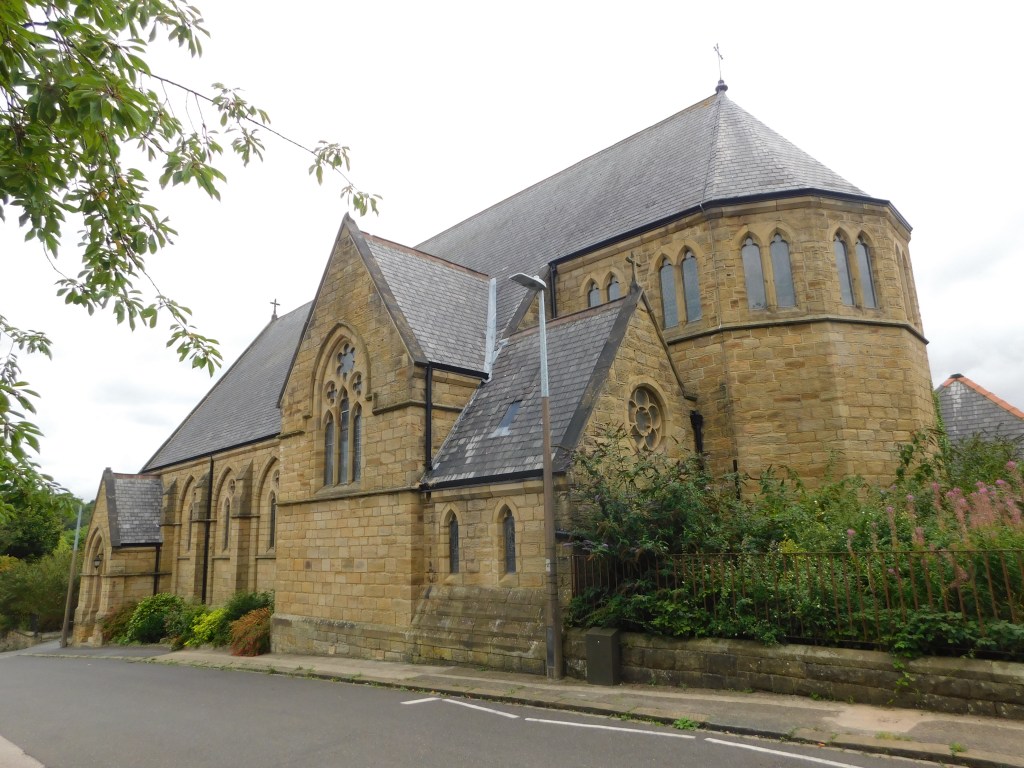
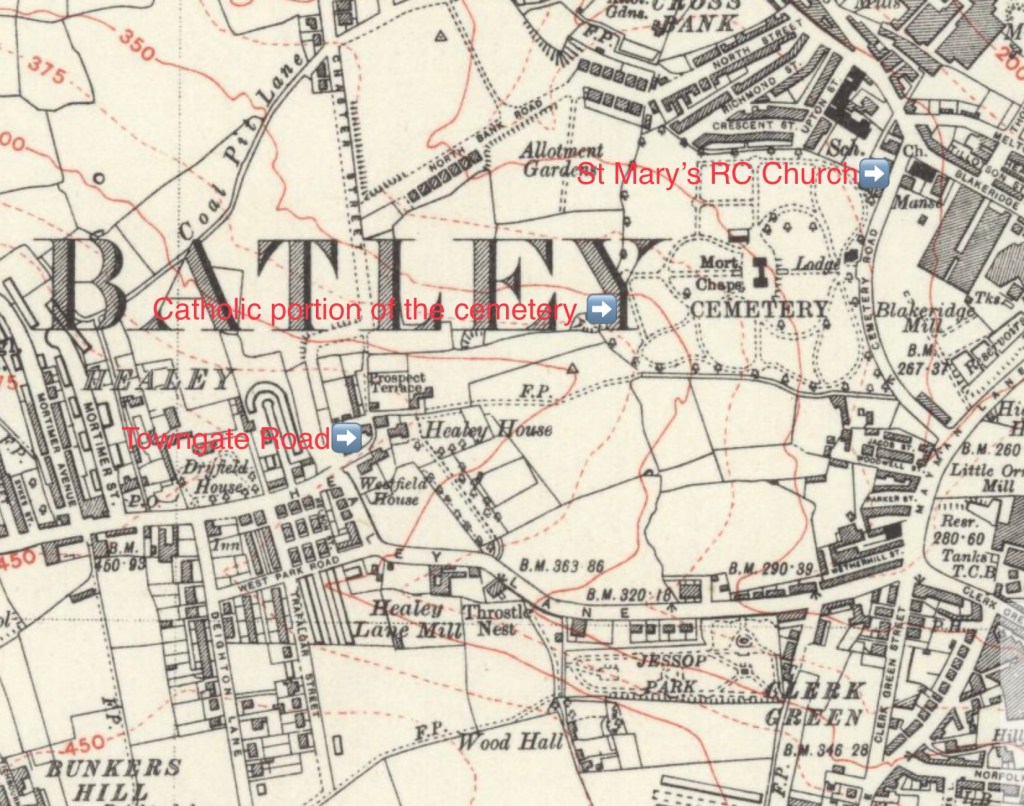

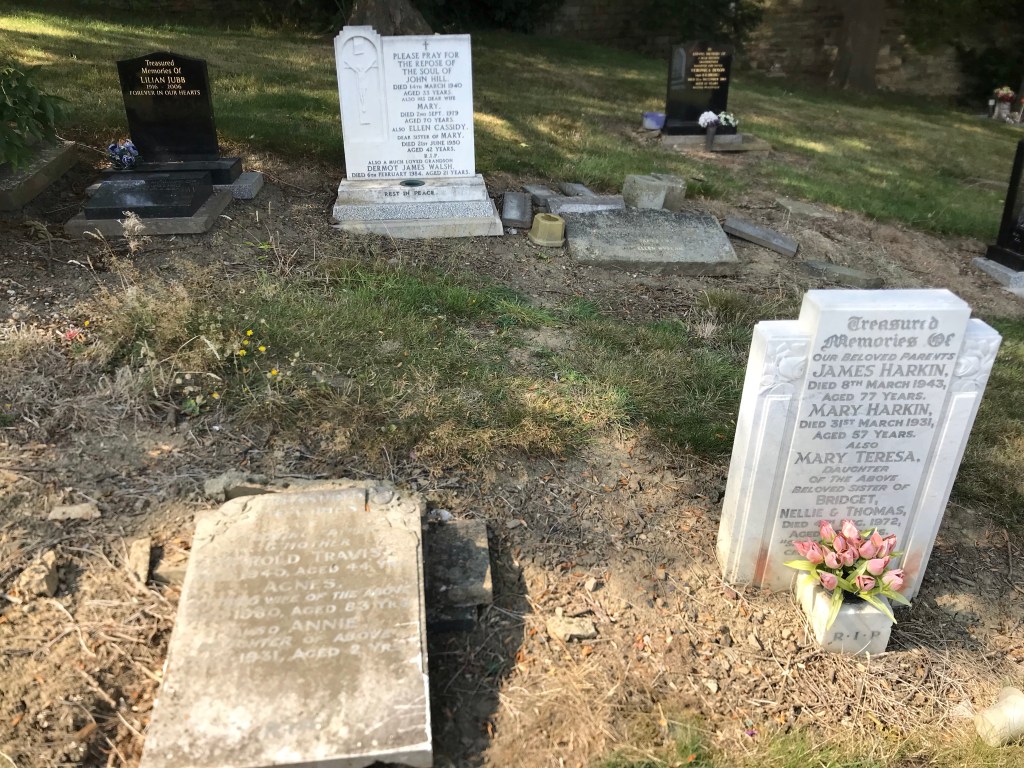


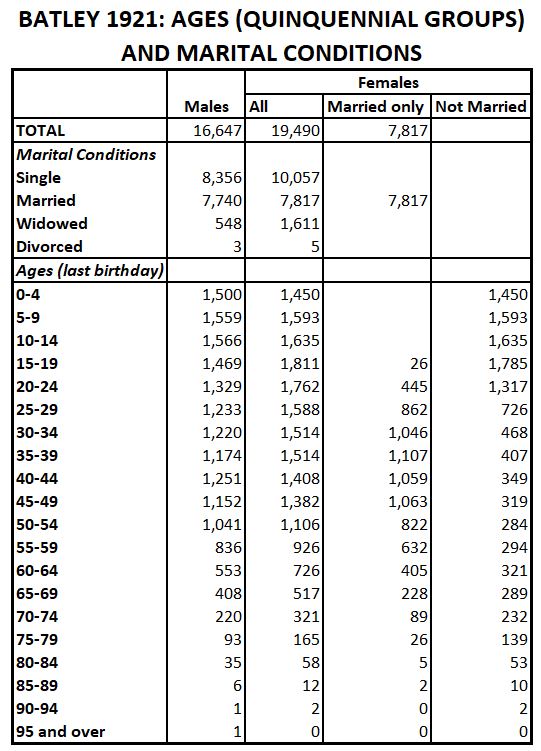
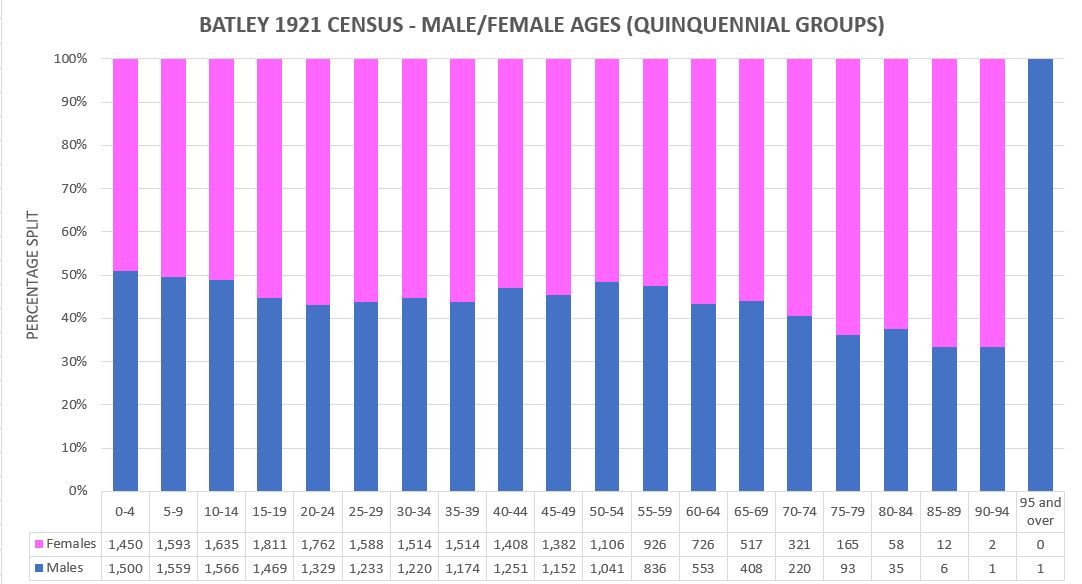

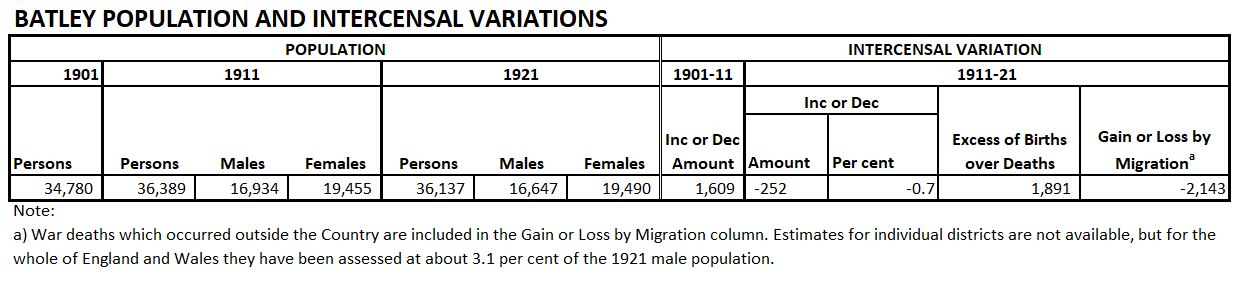
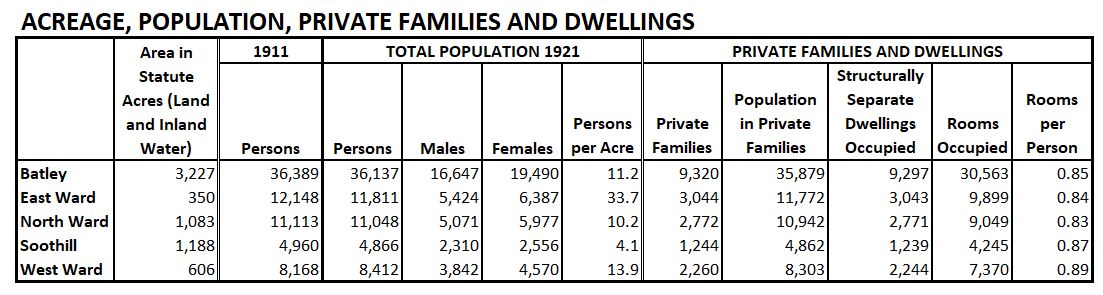


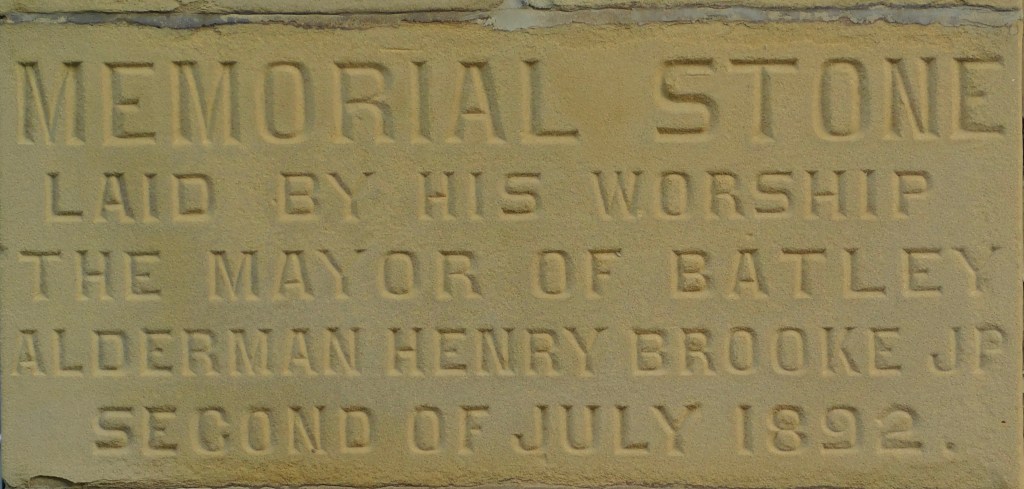
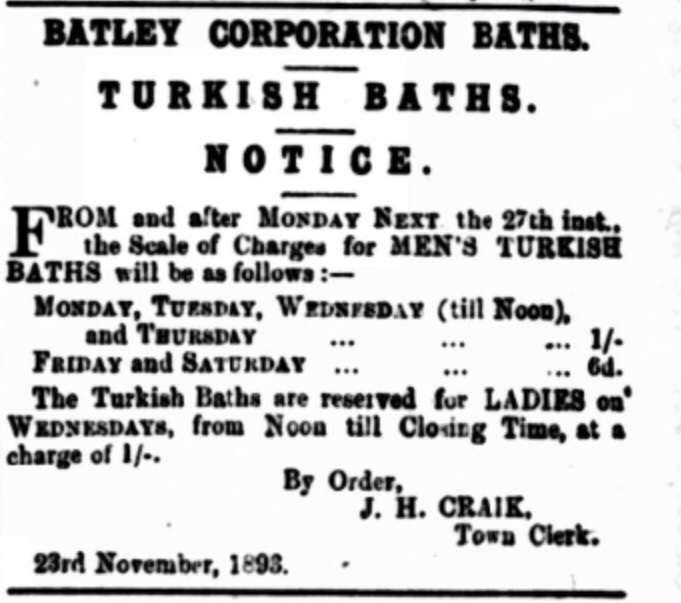

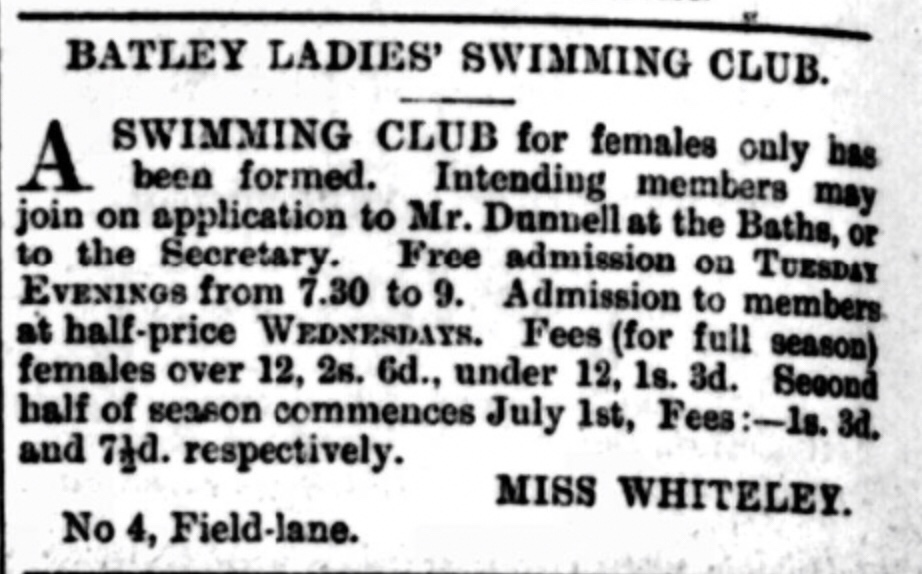


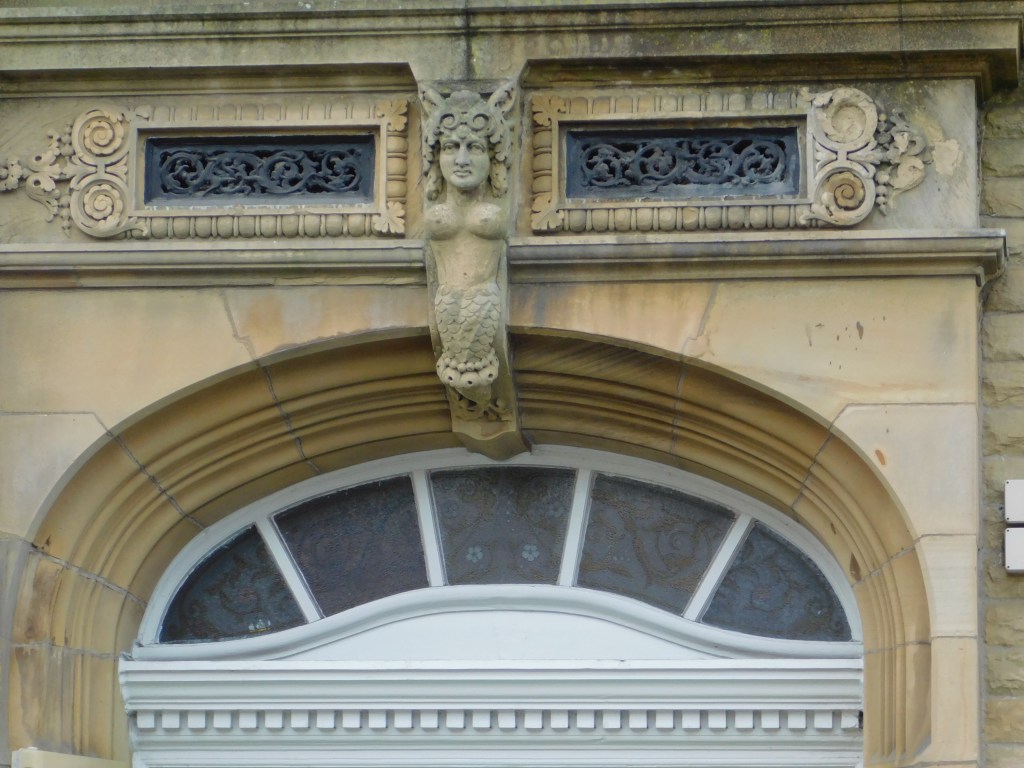
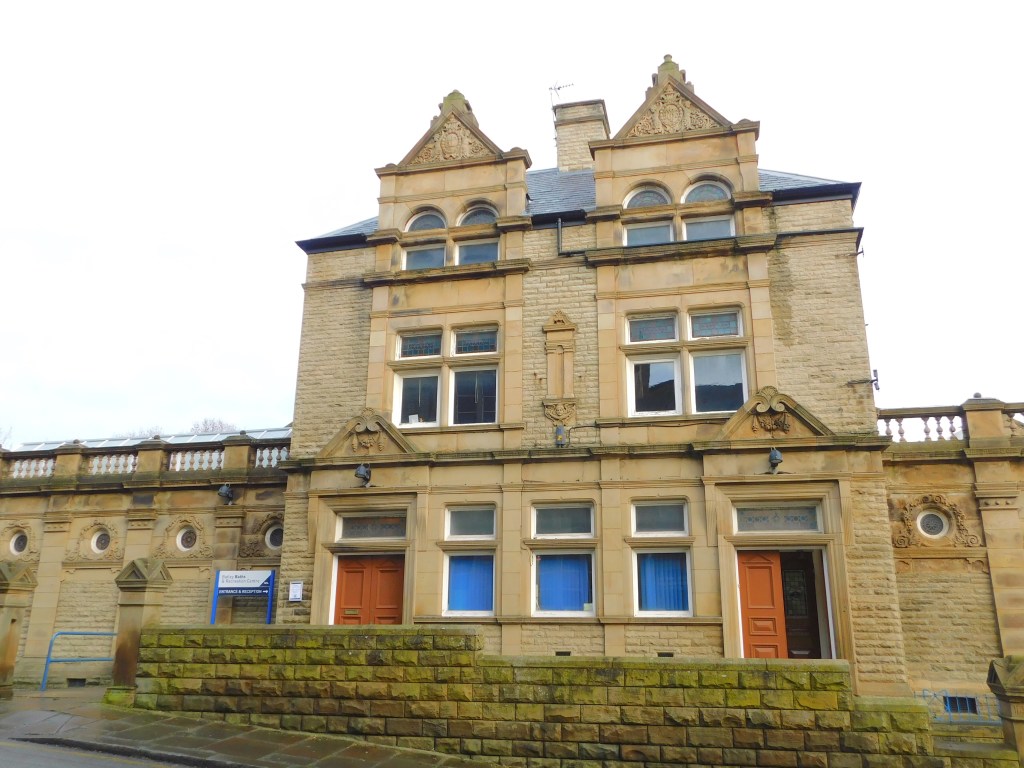
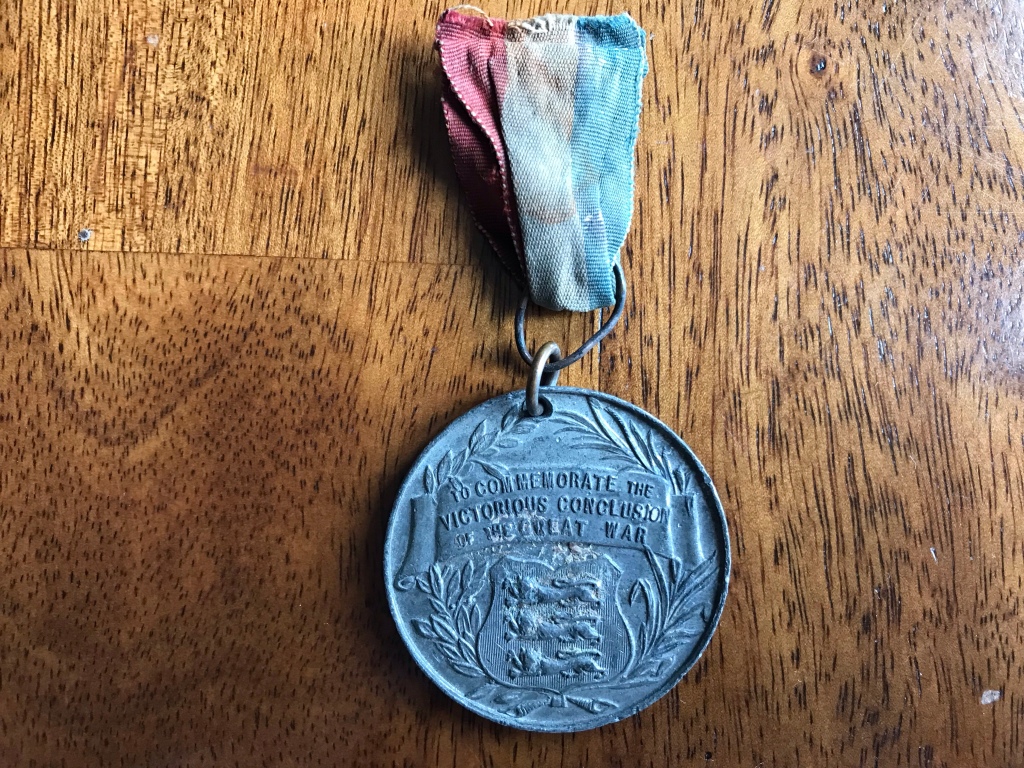
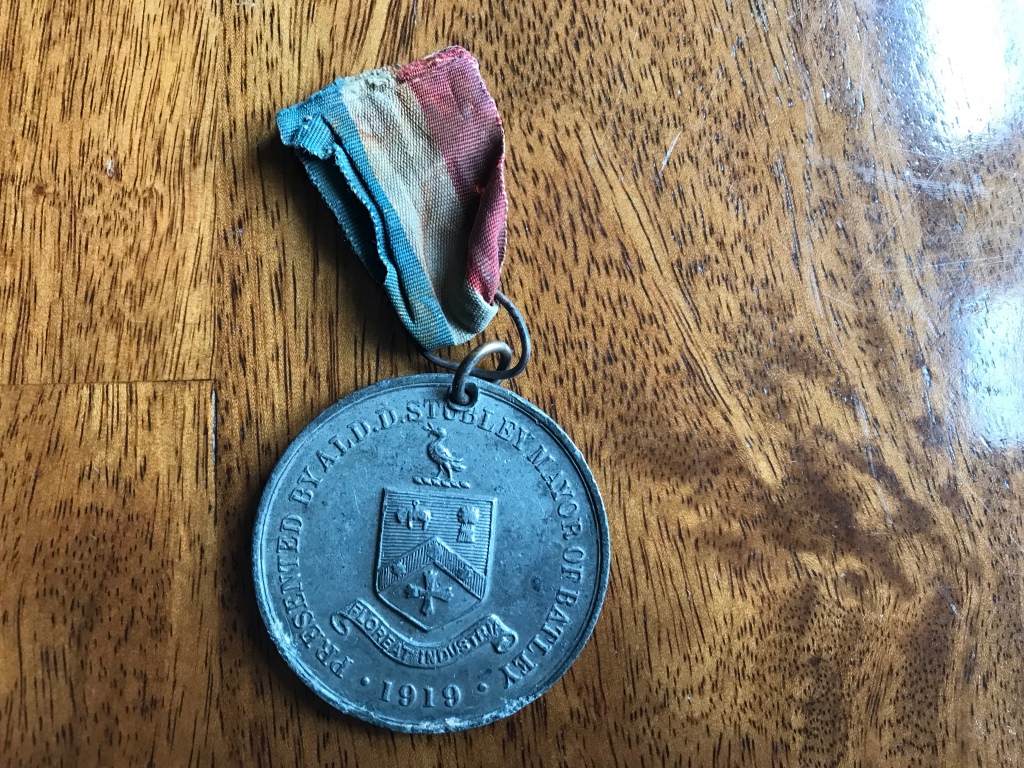


 Past To Present Genealogy