Category Archives: Genealogy

St Mary of the Angels, Batley: One-Place Study Update – 1 to 31 December 2022 Additions

The Batley St Mary’s one-place study hit a major milestone in December 2022 – the two hundredth post was published, a little over two years after the study started. More of that later.

If you are new to to this one-place study and want to know what it is all about, click here. Otherwise read on to find out what the milestone post was, and discover all the other posts, new and old, containing a wealth of parish, parishioner and wider local Batley history.
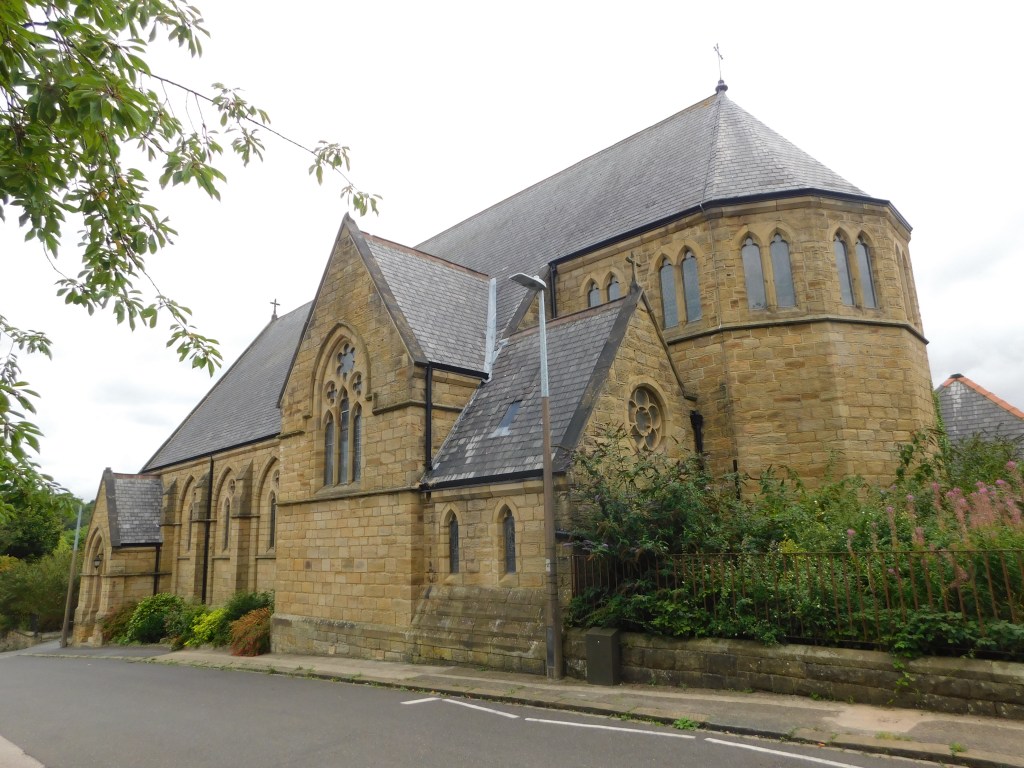
St Mary’s Church – photo by Jane Roberts

December 2022 saw the addition of eight new posts, bringing the total number for the study to 203. Two other pages were updated.

The additions included five weekly newspaper pages for December 1916. I have accordingly updated the surname index to these During This Week newspaper pieces, so you can easily identify newspaper snippets relevant to your family.

There were also three new school log books added, for the infants’ department. These covered 1913, 1916 and 1917. And it is the 1917 log book which has the distinction of being the study’s two hundredth post.

Unfortunately, due to other work priorities, this month there were no new Memorial biographies. I hope to begin adding to them once more in the New Year, if time and work permits. And, although more men who served and survived have been identified and that page includes these new names, no new biographies were added here either.

Below is the full list of pages to date. I have annotated the *NEW* and *UPDATED* ones, so you can easily pick these out. Click on the link and it will take you straight to the relevant page.


1. About my St Mary of the Angels Catholic Church War Memorial One-Place Study;

Batley Descriptions – Directories etc.
2. 1914: Borough of Batley – Town Information from the Annual Report of the Medical Officer of Health.

Biographies: Men Associated with St Mary’s Who Died but Who Are Not on the Memorial 
3. Thomas Gannon 
4. Reginald Roberts 
5. William Frederick Townsend

Biographies: The War Memorial Men
6. Edward Barber
7. Herbert Booth
8. Edmund Battye
9. Dominick (aka George) Brannan
10. Michael Brannan
11. John Brooks
12. Michael Cafferty
13. Patrick Cafferty
14. Lawrence Carney
15. Martin Carney
16. Thomas William Chappell
17. Thomas Curley
18. Peter Doherty
19. Thomas Donlan
20. Thomas Finneran
21. Michael Flynn
22. Thomas Foley D.C.M.
23. James Garner
24. Thomas Gavaghan
25. Henry Groark
26. Michael Groark (also known as Rourke)
27. James Griffin
28. Patrick Hopkins
29. Michael Horan
William McManus – See William Townsend below
30. Thomas McNamara
31. Patrick Naifsey
32. Austin Nolan
33. Robert Randerson
34. James Rush
35. Moses Stubley
36. William Townsend, also known as McManus
37. James Trainor
38. Richard Carroll Walsh

Biographies: Those who Served and Survived (this includes a list of those identified to date and who will later have dedicated biographical pages) *UPDATED*
39. Patrick Cassidy 
40. James Delaney
41. Thomas Donlan (senior) 
42. Thomas Gannon 
43. Michael Rush

Burials, Cemeteries, Headstones and MIs
44. Cemetery and Memorial Details 
45. War Memorial Chronology of Deaths

During This Week
46. During This Week Newspaper Index *UPDATED*
47. 1914, 8 August – Batley News
48. 1914, 15 August – Batley News
49. 1914, 22 August – Batley News
50. 1914, 29 August – Batley News
51. 1914, 5 September – Batley News
52. 1914, 12 September – Batley News
53. 1914, 19 September – Batley News
54. 1914, 26 September – Batley News
55. 1914, 3 October – Batley News
56. 1914, 10 October – Batley News
57. 1914, 17 October – Batley News
58. 1914, 24 October – Batley News
59. 1914, 31 October – Batley News
60. 1914, 7 November – Batley News
61. 1914, 14 November – Batley News
62. 1914, 21 November – Batley News
63. 1914, 28 November – Batley News
64. 1914, 5 December – Batley News
65. 1914, 12 December – Batley News
66. 1914, 19 December – Batley News
67. 1914, 24 December – Batley News
68. 1915, 2 January – Batley News
69. 1915, 9 January – Batley News
70. 1915, 16 January – Batley News
71. 1915, 23 January – Batley News
72. 1915, 30 January – Batley News
73. 1915, 6 February – Batley News
74. 1915, 13 February – Batley News
75. 1915, 20 February – Batley News
76. 1915, 27 February – Batley News
77. 1915, 6 March – Batley News
78. 1915, 13 March – Batley News
79. 1915, 20 March – Batley News
80. 1915, 27 March – Batley News
81. 1915, 3 April – Batley News
82. 1915, 10 April – Batley News
83. 1915, 17 April – Batley News
84. 1915, 24 April – Batley News
85. 1915, 1 May – Batley News
86. 1915, 8 May – Batley News
87. 1915, 15 May – Batley News
88. 1915, 22 May – Batley News
89. 1915, 29 May – Batley News
90. 1915, 5 June – Batley News
91. 1915, 12 June – Batley News
92. 1915, 19 June – Batley News
93. 1915, 26 June – Batley News
94. 1915, 3 July – Batley News
95. 1915, 10 July – Batley News
96. 1915, 17 July – Batley News
97. 1915, 24 July – Batley News
98. 1915, 31 July – Batley News
99. 1915, 7 August – Batley News
100. 1915, 14 August – Batley News
101. 1915, 21 August – Batley News
102. 1915, 28 August – Batley News
103. 1915, 4 September – Batley News
104. 1915, 11 September – Batley News
105. 1915, 18 September – Batley News
106. 1915, 25 September – Batley News
107. 1915, 2 October – Batley News
108. 1915, 9 October – Batley News
109. 1915, 16 October – Batley News
110. 1915, 23 October – Batley News
111. 1915, 30 October – Batley News
112. 1915, 6 November – Batley News
113. 1915, 13 November – Batley News
114. 1915, 20 November – Batley News
115. 1915, 27 November – Batley News
116. 1915, 4 December – Batley News
117. 1915, 11 December – Batley News
118. 1915, 18 December – Batley News
119. 1915, 23 December – Batley News
120. 1916, 1 January – Batley News
121. 1916, 8 January – Batley News
122. 1916, 15 January – Batley News
123. 1916, 22 January – Batley News
124. 1916, 29 January – Batley News
125. 1916, 5 February – Batley News
126. 1916, 12 February – Batley News
127. 1916, 19 February – Batley News
128. 1916, 26 February – Batley News
129. 1916, 4 March – Batley News
130. 1916, 11 March – Batley News
131. 1916, 18 March – Batley News
132. 1916, 25 March – Batley News
133. 1916, 1 April – Batley News
134. 1916, 8 April – Batley News
135. 1916, 15 April – Batley News
136. 1916, 22 April – Batley News
137. 1916, 29 April – Batley News
138. 1916, 6 May – Batley News
139. 1916, 13 May – Batley News
140. 1916, 20 May – Batley News
141. 1916, 27 May – Batley News
142. 1916, 3 June – Batley News
143. 1916, 10 June – Batley News
144. 1916, 17 June – Batley News
145. 1916, 24 June – Batley News
146. 1916, 1 July – Batley News
147. 1916, 8 July – Batley News
148. 1916, 15 July – Batley News
149. 1916, 22 July – Batley News
150. 1916, 29 July – Batley News
151. 1916, 5 August – Batley News
152. 1916, 12 August – Batley News
153. 1916, 19 August – Batley News
154. 1916, 26 August – Batley News
155. 1916, 2 September – Batley News
156. 1916, 9 September – Batley News
157. 1916, 16 September – Batley News
158. 1916, 23 September – Batley News
159. 1916, 30 September – Batley News
160. 1916, 7 October – Batley News
161. 1916, 14 October – Batley News
162. 1916, 21 October – Batley News
163. 1916, 28 October – Batley News
164. 1916, 4 November – Batley News
165. 1916, 11 November – Batley News
166. 1916, 18 November – Batley News
167. 1916, 25 November – Batley News
168. 1916, 2 December – Batley News *NEW*
169. 1916, 9 December – Batley News *NEW*
170. 1916, 16 December – Batley News *NEW*
171. 1916, 23 December – Batley News *NEW*
172. 1916, 30 December – Batley News *NEW*

Miscellany of Information
173. The Controversial Role Played by St Mary’s Schoolchildren in the 1907 Batley Pageant
174. The Great War: A Brief Overview of What Led Britain into the War
175. Willie and Edward Barber – Poems
176. A St Mary’s School Sensation
177. St Mary of the Angels Catholic Church – 1929 Consecration Service
178. A “Peace” of Batley History

Occupations and Employment Information
179. Occupations: Confidential Clerk
180. Occupations: Lamp Cleaner
181. Occupations: Limelight Operator
182. Occupations: Office Boy/Girl
183. Occupations: Piecer/Piecener
184. Occupations: Rag Grinder
185. Occupations: Willeyer

The Families
186. A Death in the Church

School Log Books
187. Boys’ School – Log Book, 1913
188. Boys’ School – Log Book, 1914
189. Boys’ School – Log Book, 1915
190. Boys’ School – Log Book, 1916
191. Boys’ School – Log Book, 1917
192. Boys’ School – Log Book, 1918
193. Boys’ School – Log Book, 1919
194. Boys’ School – Log Book, 1920
195. Infant School – Log Book 1913 *NEW*
196. Infant School – Log Book 1914
197. Infant School – Log Book 1915
198. Infant School – Log Book 1916 *NEW*
199. Infant School – Log Book 1917 *NEW*

Population, Health, Mortality and Fertility
200. 1914: The Health of Batley School Children Generally, with a Particular Focus on St Mary’s School Children

World War Two
201. World War Two Chronology of Deaths
202. Michael Flatley
203. William Smith


Postscript:
My website has always been free to use, but it does cost me money to operate. In the current difficult economic climate I am considering whether I can continue to afford to keep running it as a free resource, especially given the time this research takes.

If you have enjoyed reading the various pieces, and would like to make a donation towards keeping the website up and running in its current open access format, it would be very much appreciated. 

Please click here to be taken to the PayPal donation link. By making a donation you will be helping to keep the website online and freely available for all. 

Thank you.

An Unexpected Holiday Family History Link

Family historians will ‘get’ the feeling of pure elation I felt one damp Tuesday afternoon in Northumberland in late November 2022.

The changeable weather that day prompted a post-lunch visit to Kirkharle Courtyard. These converted 18th century stone farm buildings house a lovely selection of independent craft and artisan shops, so it seemed a perfect pre-Christmas haven to escape any threatened showers. Here’s the website link for more details.

Kirkharle Coffee House – photo by Jane Roberts

As it happened, the weather improved which meant we could explore further the wider Courtyard surroundings.

The tiny hamlet of Kirkharle was the birthplace of the iconic landscape gardener Lancelot “Capability” Brown. Here the Shakespeare of English gardening took the first fledgling steps in his illustrious career, employed as a gardener on Sir William Loraine’s Kirkharle estate until 1739.

But he retained a connection to his birthplace, and first employer’s family, even after he had moved onwards and upwards. One of his landscape designs for Kirkharle was discovered in 1980, shoved at the back of some drawers. Thought to date from around 1770, when he was at nearby Alnwick, his vision finally came to fruition in 2010, interpreted and adapted to fit the current Kirkharle landscape. We enjoyed a pleasant stroll around the serpentine lake, the centrepiece of this plan.

As usual, driven by the obsession of a family historian, I now felt compelled to visit Kirkharle’s tiny church. It is only a short walk from the courtyard complex, and on the way you pass a Grade II listed monument to Robert Loraine who was “barbarously murdered” here by the Scots in 1483. He was on his way home from church when set upon by them.

In a gruesome warning to others who would – like him – defend the borderlands against the Scottish raiders, the attackers cut his corpse up into tiny pieces, stuffed them into his horse’s saddlebags and set it loose to wander home. That was some kind of warning message!

The Loraine Monument, Kirkharle – photo by Jane Roberts

The inscription reads:

This
New stone was set up
In the place of an
old one by S[i]r William
Loraine Bar[one]t in 1728
In Memory of Robert
Loraine his Ancestor
Who was Barbarously
Murderd in this place
by the Scots in 1483
for his good service to
his Country against
their thefts & Robbery
As he was returning
home from the Church
Alone Where he had
Been at his private
Devotions

This replacement monument would have been erected during the period “Capability” Brown worked here.

On then to St Wilfrid’s Church, or St Wilfred in the Historic England Grade I listing. This small, simple, squat building, dating mainly from 1336 and restored in 1884, is best known as the baptism place of “Capability” Brown, on 30 August 1716.

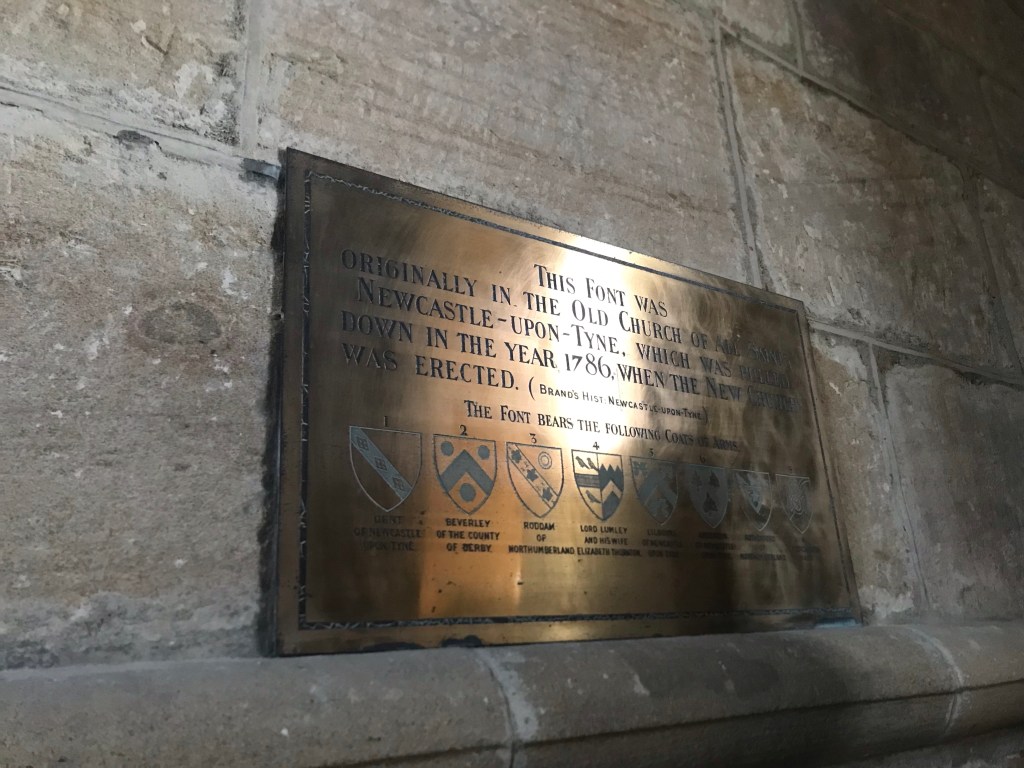
Inside I was drawn to the font. Dating from the 15th/16th century, I was stunned to discover until 1786 it was the baptismal font at the old All Saints church, Newcastle upon Tyne. Therefore not the one in which a young “Capability” Brown was inducted into the church. For me this was no disappointment – it was now far more thrilling and personal.

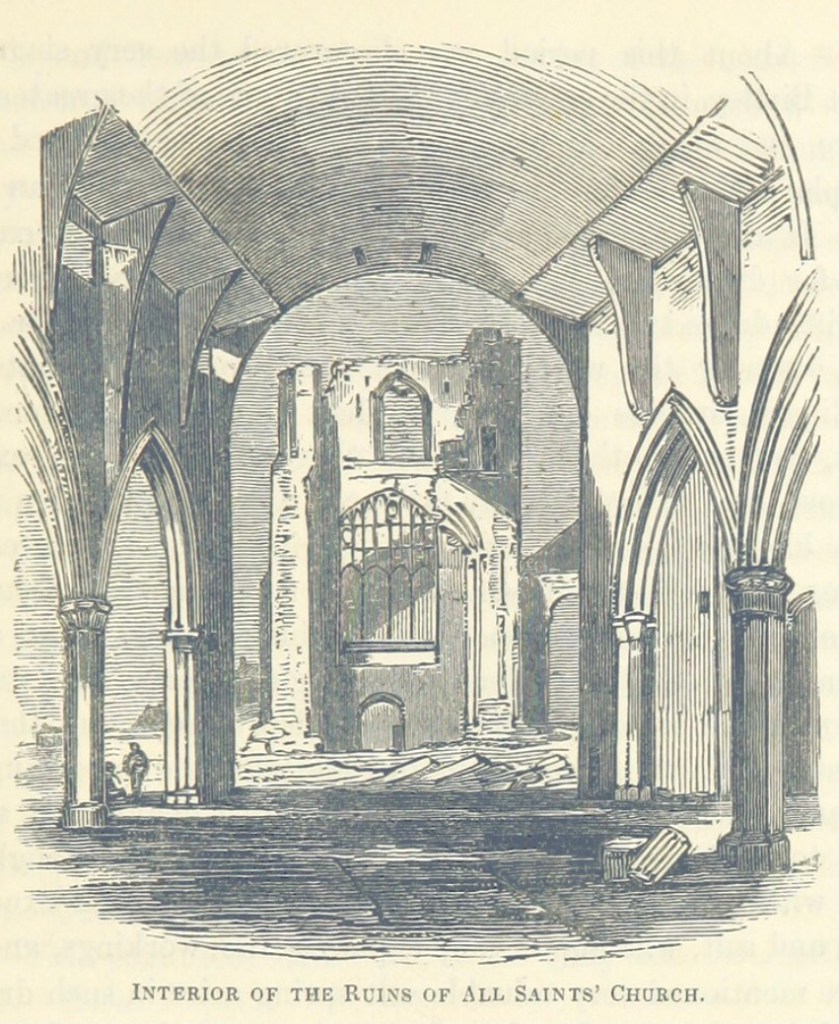
Image if the old All Saints church, from Sopwith’s A Historical and Descriptive Account of All Saints’ Church, in Newcastle upon Tyne’, published in 1826, out of copyright.

Completed in 1286 and initially known as All Hallows’ church, by 1786 the old All Saints church in Newcastle upon Tyne had fallen into such a state of disrepair and collapse that a meeting of parishioners in the vestry room on Easter Tuesday, 18 April voted unanimously to completely demolish it and build a new church.1

Ruined interior of the old All Saints’ Church, Newcastle upon Tyne, from
The local historian’s table book, of remarkable occurences, historical facts, traditions, legendary and descriptive ballads, etc., etc., connected with the counties of Newcastle-upon-Tyne, Northumberland and Durham, Vol II – published 1841 – out of copyright

The last service in the old church was held on 9 July 1786, and by August 1789 its total demolition was complete.2 This included disposal of all the old fixtures and fittings, even to the extent of placing an advert in the Newcastle Courant of 15 July 1786 requesting anyone entitled to any of the monuments or monumental inscriptions to immediately remove them.

The foundation stone for the new church was laid on 14 August 1786, and the building completed with the placing of the top stone of the spire on 21 October 1796. It went on to be used as a place of worship until 1959.

The new All Saints Church, Newcastle upon Tyne, from Sopwith’s A Historical and Descriptive Account of All Saints’ Church, in Newcastle upon Tyne’, published in 1826, out of copyright.

But back to my particular interest – the old All Saints church font, now at Kirkharle. I discovered it had a varied – and colourful – history. This included being hidden by stone mason Cuthbert Maxwell from Scots raiders in around 1640. It was eventually reinstated in the Newcastle upon Tyne church in 1660 following the Restoration of King Charles II.3

The font from the old Newcastle All Saints Church demolished in 1786, it is now at St Wilfrid’s Kirkharle – photo by Jane Roberts

There is a description of the font in T. Sopwith’s A Historical and Descriptive Account of All Saints’ Church, in Newcastle upon Tyne. It reads:

The font, which was of stone, was placed immediately on entering the body of the Church by the middle aisle, a situation which it generally occupied in former times, and by which was intimated the baptismal entrance of the Christian Church. It was a plain octangular pillar, the sides of which extending outward at the top, formed large cavettos,4 supporting an octagon of a larger size, with concave sides, decorated with armorial bearings…Above this octagon which contained the bason,4 a cover was formerly suspended. In the churchwardens’ accounts for 1636, mention occurs of a charge for hanging the font cover – in 1685, a bason and cover for the font cost £2, and in 1700, it was new painted and gilded. On the demolition of the Church, the stone font was given to Alderman Hugh Hornby, by whom it was placed in the garden of his house, in Pilgrim-Street, and left there when the house was sold to Mr. Clapham.6

Its worn appearance may therefore owe something to its period as a garden ornament.

So how did it come to end up in a tiny church in rural Northumberland?

In 1836 Thomas Anderson of Little Harle purchased Kirkharle from the Loraine family. His father had acquired the font three years earlier. When St Wilfrid’s was restored in 1884, Thomas’ son George placed the font in the church.6

And why did all this send shivers down my spine?

Newcastle All Saints was a church associated with my paternal ancestors. It is where my 4x great grandmother, Ann Jackson, was baptised on 22 August 1773. More details of her here.

I’d quite by chance stumbled across a religious artefact associated with my family history. I had absolutely no idea the baptismal font from her era was at Kirkharle.

This was the highlight of my holiday – made all the better for its sheer unexpectedness.


Footnotes:
1. Mackenzie, E. A Descriptive and Historical Account of the Town and County of Newcastle upon Tyne Including the Borough of Gateshead. Vol 1, 1827. Page 292-322
2. Sopwith, Thomas. A Historical and Descriptive Account of All Saints’ Church in Newcastle upon Tyne: Illustrated with Plans, Views, & Architectural Details. Newcastle: Edward Walker, 1826. Page 21
3. Bourne, Henry. The History of Newcastle upon Tyne or, the Ancient and Present State of That Town. by the Late Henry Bourne, M.A. Curate of All-Hallows in Newcastle. Newcastle upon Tyne: J White, 1736.
4. A concave moulding with a regular curved profile that is part of a circle, widely used in architecture as well as furniture, picture frames, metalwork and other decorative arts.
5. A variant spelling of basin.
6. Sopwith, Thomas, ibid. Page 40
7. Information board at St Wilfrid’s church, Kirkharle.


Other sources not directly referenced:
• “Biography: Lanelot ‘Capability’ Brown – The Gardens Trust.” Accessed November 27, 2022. https://thegardenstrust.org/wp-content/uploads/2016/11/Lancelot_Capability_Brown_biog.pdf.
• “Brown, Lancelot [Known as Capability Brown] (Bap. 1716, d. 1783), Landscape Gardener and Architect.” Oxford Dictionary of National Biography. Accessed November 27, 2022. https://www.oxforddnb.com/view/10.1093/ref:odnb/9780198614128.001.0001/odnb-9780198614128-e-3635.
• “Church of St Wilfred, Kirkwhelpington – 1370499: Historic England.” , Kirkwhelpington – 1370499 | Historic England. Accessed November 27, 2022. https://historicengland.org.uk/listing/the-list/list-entry/1370499?section=official-list-entry.
• Countryfilemag. “Kirkharle, Northumberland.” Countryfile.com. Countryfile.com, November 9, 2018. https://www.countryfile.com/go-outdoors/days-out/kirkharle-northumberland/.
• “Development of Kirkharle Landscape and Lake.” Development of Kirkharle Landscape and Lake – News | Capability Brown. Accessed November 27, 2022. https://www.capabilitybrown.org.uk/news/development-kirkharle-landscape-and-lake/.
• “Kirkharle Hall, History & Visiting: Historic Tyne & Wear Guide.” Britain Express. Accessed November 27, 2022. https://www.britainexpress.com/attractions.htm?attraction=3438.
• “Kirkharle, Northumberland – St Wilfrid.” Northernvicar’s Blog, August 23, 2019. https://www.northernvicar.co.uk/2019/08/23/kirkharle-northumberland-st-wilfrid/.
• Kelly’s Directory of Durham and Northumberland: With Coloured Maps: 1921
. London: Kelly’s Directories Ltd., 1921. Page 171.
• “Loraine Memorial Stone C.60 Yards South-West of Kirkharle Manor, Kirkwhelpington – 1155480: Historic England.” , Kirkwhelpington – 1155480 | Historic England. Accessed November 27, 2022. https://historicengland.org.uk/listing/the-list/list-entry/1155480.
• “Monument to Robert Loraine, Kirkharle: Co-Curate.” Co-curate. Accessed November 27, 2022. https://co-curate.ncl.ac.uk/resources/view/79099/.
• Richardson, Moses Aaron. The Local Historian’s Table Book: Of Remarkable Occurences, Historical Facts, Traditions, Legendary and Descriptive Ballads, &c., &c., Connected with the Counties of Newcastle-upon-Tyne, Northumberland and Durham. 2. Vol. 2. Newcastle-upon-Tyne: M.A. Richardson, 1841.

Lusitania Talk – 10 May 2022

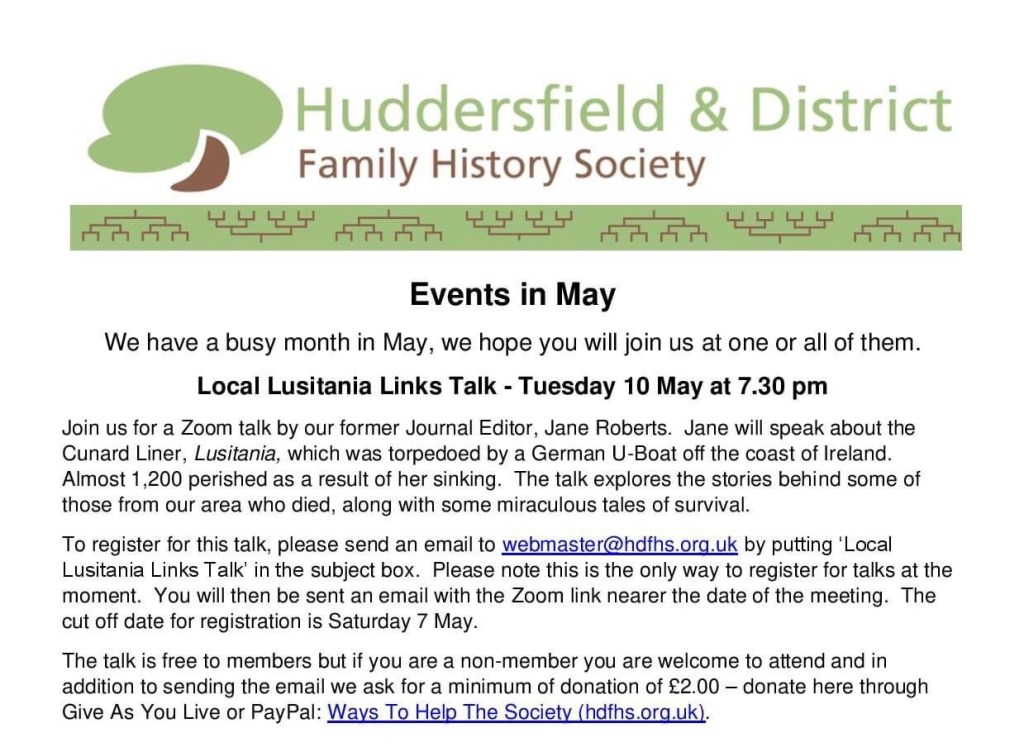
A heads up that I will be giving a talk via Zoom at 7.30 p.m. on 10 May 2022 about the Lusitania sinking of 7 May 1915.

Lusitania Medal Box – Photo by Jane Roberts

Huddersfield and District Family History Society are hosting the talk and more details are in the advert below. Essentially it is free for Society members, and a minimum £2 donation for non-members. Registering is by sending an email with ‘Local Lusitania Links’ in the subject box to webmaster@hdfhs.org.uk

As well as background details, I will be exploring some of the local links from around the family history society area to illustrate why the sinking had such a huge impact on our community.

It should be a fascinating talk packed with information and some amazing tales of loss and survival.

Top Ten 1921 Census Tips

The dust is beginning to settle on the 1921 Census release, and I’ve had chance to familiarise myself with Findmypast’s online search, Here are some tips to help you get the best out of it.


1. Draw up your wish list and set your budget.
I’m not entering into the debate over the cost of viewing the 1921 Census online, or the tie-in with Findmypast as sole provider for the immediate future. Only to say it is standard for these major record releases, and company’s have to recoup the massive digitisation costs involved. Filming, transcribing and indexing something on this scale does not come cheap. And there is opportunity to access the 1921 Census for free – at The National Archives (Kew), Manchester Central Library, and The National Library of Wales (Aberystwyth). But then you need to factor in transport costs, and possibly an overnight stay. Family history, like many other hobbies and interests, does cost.

What I will say is before you even start searching is draw up a wish list of those people you are most interested in, prioritise them, set your maximum budget and stick to it. Otherwise it is all too easy to get carried away.

I compiled my immediate wish list, for direct line ancestors alive in 1921, and stuck to it. It amounted to eight images. Any other records, including ones relating to my one-name study (there are 527 people named Aveyard in this census), and my Batley St Mary’s one-place study will have to wait until I can get to Manchester Central Library for free access, or until it all becomes part of the Findmypast subscription.


2. Play around with searches to familiarise yourself with the system.
The second piece of advice I would give is don’t dive straight in. Play around with searches to get used to how the system works. That way you are going to get the best, and most accurate, results – and crucially minimise the risk of purchasing the wrong record.


3. Be aware of transcription errors.
This release appears to be littered with them across the entire range of possible searches, and this will affect results. Try to keep an open mind when searching. Be flexible with searches, and alert to possible transcriptions errors.

For example, for one of my ancestors the Christian name Martin was incorrectly transcribed as Morton, perhaps signalling the transcriber as a fan of the Morton Farrier Genetic Genealogist book series! I did not automatically discount the entry. Based on other information I was able to identify it as a likely error and took the plunge. But it could, depending on the error scale, result in a negative search. And the pay-per-view angle may rule out speculative purchases.

There is a transcription error reporting mechanism if you purchase the transcript – as I said I’ve not done this, preferring to spend my money on the original image. If you have not purchased the transcript you can still report the error, but the method is via email to Findmypast, at transcriptsupport@findmypast.com. The link giving more details about this is here.


4. Make use of the Advance Search facilities.
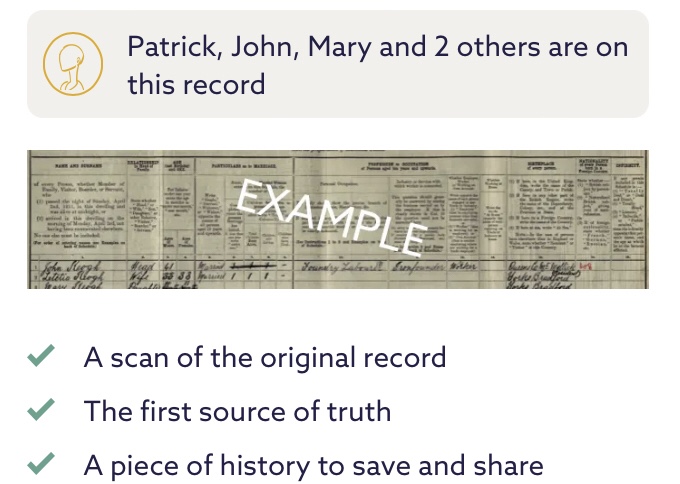
When you conduct a search you are given some basic information to enable you to determine if the result is the one for your family. For example, when searching for my great grandad Patrick Cassidy in Batley, the following clues are given.

Findmypast image

The hint says the record includes Patrick, John, Mary and two others. My problem with this was no John is linked to my great grandad’s family. And who are the two others? Can I confirm these names? Was this the correct family?

There is a simple way you can drill down this information to a more complete, granular level. Go to the Advanced Search. Leave the ‘Who’ boxes blank, and go down to the ‘Parish’ box and put in ‘Batley,’ and in other ‘Other Household Member” box type ‘Patrick Cassidy’. The results confirm the full names, birth year and birthplace of the other four members of the household, including Anne Cassidy, Mary Cassidy and Nelly Cassidy, plus Durham-born John Nixon. All this gave me confidence that I would be purchasing the correct record.

This is one example of an Advanced Search which worked well in this instance, though it may prove more challenging for common names. And some found Registration District worked better than Parish.

However, do not be put off. There are lots of other filters and options too. It is a case of playing with them to find the ones which help narrow the results suited to particular circumstances. And you can find lots of information simply through the free Advanced Search – and this may be sufficient to construct plans and spreadsheets for example for a one-place or one-name study.

One other thing to be aware of when searching on age is this census has a change. It gives it in years and months, with those under one month noted as such, rather than only years. This may affect searches, though it is always good practice to broaden age searches to give years +/- either side, as accuracy and ages in the census do not necessarily go hand-in-hand.

And, in a similar vein, do always keep at the back of your mind transcription errors and (in)accuracy of information provided by ancestors, which can skew results. Which leads onto Tip 5.


5. Be aware people may not be where expected, or tell the truth with the information they give.
There’s always the possibility that people may not be with their family on census night. The timing of this census, 19 June, instead of early spring has added complications. People may have been on holiday.

There is also the issue of seasonal workers. My County Mayo-born grandpa, who by the mid-1920s was in Batley, looks to be over on a farm in Cheshire with two of his brothers in this census, working as a farm labourer. They are appropriately living in Irish Man’s Cottage! The men in this family did have a tendency to come over to England in the summer for seasonal farm labouring work, and this appears to be borne out in the 1921 Census. It may also be the case for others normally resident in Ireland but who came over to England seasonally to undertake work on farms. It is worth checking to see if they do feature.

And, as ever, be alert for those half-truths and downright misleading lies which always creep in and can affect your search.

Again it is a case of keeping an open mind – though the pay per view element of this release may curtail the ability to undertake speculative downloads. This is a luxury which may best be reserved for the free access locations at The National Archives (Kew), Manchester Central Library, and The National Library of Wales (Aberystwyth). But you can undertake the prepatory work from home using the free basic searches, short of any image purchase.


6. View the image, not the transcript.
Linked to 3 (above), I would advise the image purchase option is always preferable to buying a transcript, even if it costs slightly more. The transcript may contain multiple errors which, unless you view the image, you will be oblivious to. Whereas if you view the image you can see exactly what the entry should say. And it may include details not referred to in the transcript. And there is always that added frisson of excitement of seeing the actual handwriting and signature of those completing the form.


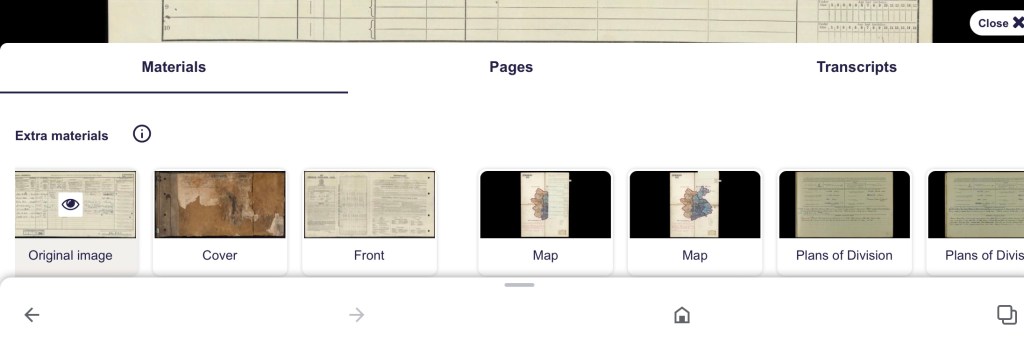
7. Make sure you click on the Extra Materials.
Your purchase covers more documents than the original image. Don’t focus on this image at the expense of the ‘Extra Materials.’

‘Extra Materials’ available through purchasing the image – Findmypast

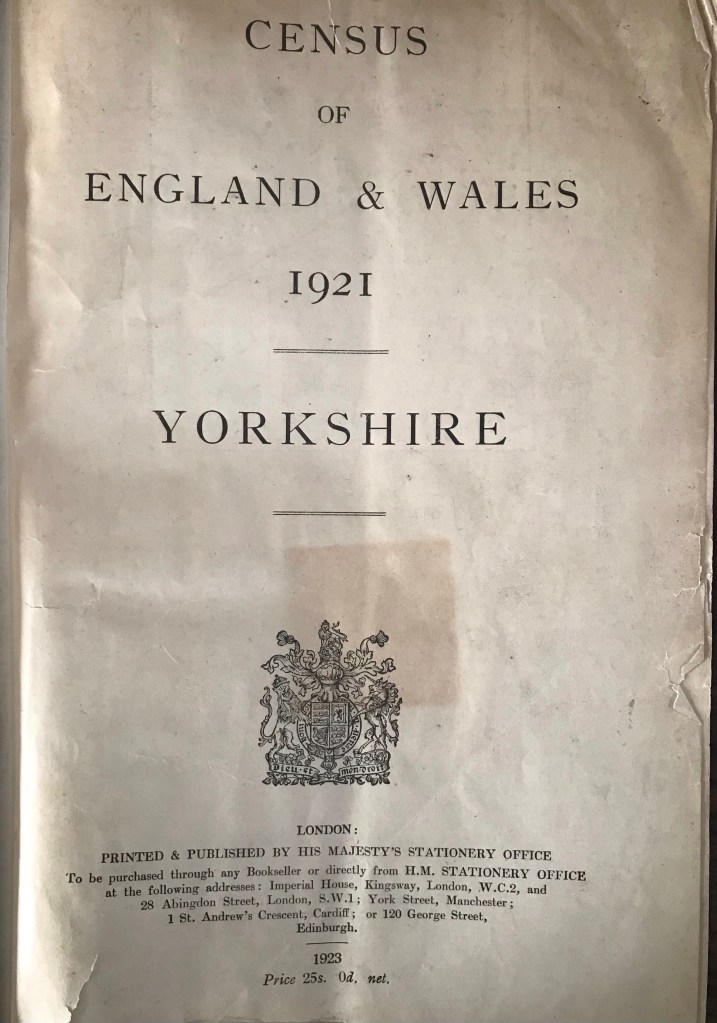
In these you will find the cover, which contains the RG15 Series Reference for the original household image, and Piece Number. Though I must admit my preferred method for obtaining the document reference is by downloading and saving the image (see 9, below), simply because the cover may be difficult to read and downloading/saving provides more accuracy by hopefully cutting out any enumerator error. Also be aware it is not a full reference number.

The ‘Front’ document contains that all-important address which is missing from the original household image. For more details about addresses see 8, below.

There are also maps which, besides pinpointing the area linked to the household, also have some useful background information – for example, population numbers, or details of any boundary changes.

The final files in these ‘Extra Materials’ are Plans of the Division. There may be more than one of these. The plans contain Enumeration District information, including boundaries and contents, basically the route the enumerator took. So, for example, for one set of my Hill ancestors, the Enumeration District where they lived comprised of:

Commencing at 1 Richmond Street taking all houses on left hand side to top odd nos. thence all houses in Vera Street, Crescent Street, Back Crescent Street all yards and Back Upton Street and down the left hand side of Upton Street to bottom even nos.

This is all vital information to pinpointing where the Hill family lived. This is particularly important if it is an area is unfamiliar to you, or if the streets have long-since gone. It will enable you to easily identify the area in old OS maps.

Note, once you have purchased an image it, along with the extra materials, are available to you each time you log on to Findmypast. So, if you missed them in your first eager foray into the census, you have not lost the opportunity.


8. The address is not missing when viewing the image.
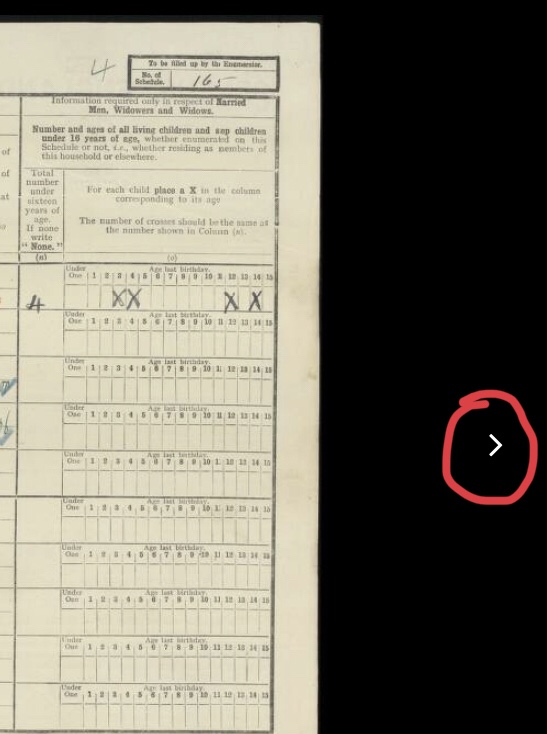
Whilst it may not be immediately obvious, contrary to what some on social media believe, the address is there. There are two ways of accessing it. The ‘Extra Materials’ document suite includes one entitled ‘Front.’ This has the schedule which includes the address.

The same document can be accessed by clicking on the arrow to the right of the completed household schedule. Do be careful when using this method that you do not click too far as this will take you to the next household schedule and the option to buy it.

Clicking this arrow should take you to the address image – Findmypast

9. Download the images to save, including that all-important document reference.
Always save the document images to ensure you always have access to them. The best way of doing this, and getting the clearest image, is by using the ‘download record’ facility. When saving this way the RG15 document reference and piece number is included in the file title. It is not the full reference number, but it is a start.

You can also get the document reference from the cover, which is in the extra materials.

It is good practice to note the document reference, and including it as part of the file title is ideal.


10. Take note of the employment information.
The single most exciting information section in this census from my point of view is that on employment. Not only is there the occupation title, but for those working for an employer the name of that employer is provided, along with the place of work. This is fertile ground for further research to expand your knowledge of not only what your ancestor’s occupation was, but also where they worked, and investigation as to what business records survive – including any relating to employees.

For example, my husband’s 14-year-old grandma is described as a pottery paintress at Keeling and Co. Ltd, Dalehall, Staffs. I can now find out more about this pottery works.

My nana was a 16-year-old cloth weaver at J., T. & J. Taylor’s woollen manufacturers. West Yorkshire Archive Services has some company records which may be worth checking.

A whole series of my male ancestors worked in the coal mining industry. This census was taken during the coal miners’ strike. My ancestors do give their coal mining employment details, with the ominous words “Out of Work”. The names of their employers, and the specific coal mines, means I can now look at local papers to find out about the effect of industrial action generally locally, as well as how it affected specific coal mines. For me these include confirmation that my great grandfather did indeed work at Soothill Wood Colliery, Batley.


For my previous 1921 Census post, which looks at its background, includes some tips, has things to look out for, discusses why it is so important, & explains why I’m looking forward to it, click here.


Postscript:
Finally a big thank you for the donations already received to keep this website going. 

The website has always been free to use, but it does cost me money to operate. In the current difficult economic climate I am considering if I can continue to afford to keep running it as a free resource, especially as I have to balance the research time against work commitments. 

If you have enjoyed reading the various pieces, and would like to make a donation towards keeping the website up and running in its current open access format, it would be very much appreciated. 

Please click here to be taken to the PayPal donation link. By making a donation you will be helping to keep the website online and freely available for all. 

Thank you.

St Mary of the Angels, Batley: One-Place Study Update – 1 to 31 December 2021 Additions

This is the latest update of the pages relating to my Batley St Mary’s one-place study, the details of which I announced here.

St Mary of the Angels Church, Batley

In the past month I have added four weekly newspaper pages for December 1915. I have accordingly updated the surname index to these During This Week newspaper pieces, so you can easily identify newspaper snippets relevant to your family.

More men who served and survived have been identified. I have updated that page accordingly. No new biographies for these men have been added this month. They will follow in due course.

I have written one new biography for a War Memorial man, that of Thomas Finneran.

Finally for this month, I have added a new name to the page relating to biographies of men associated with St Mary’s who died but who are not remembered on the War Memorial.

Below is the full list of pages to date. I have annotated the *NEW* ones, plus the *UPDATED* pages, so you can easily pick these out. Click on the link and it will take you straight to the relevant page.


1. About my St Mary of the Angels Catholic Church War Memorial One-Place Study;

Batley Descriptions – Directories etc.
2. 1914: Borough of Batley – Town Information from the Annual Report of the Medical Officer of Health.

Biographies: Men Associated with St Mary’s Who Died but Who Are Not on the Memorial *UPDATED*
3. Reginald Roberts
4. William Frederick Townsend

Biographies: The War Memorial Men
5. Herbert Booth
6. Edmund Battye
7. Michael Brannan
8. John Brooks
9. Martin Carney
10. Thomas Curley
11. Thomas Donlan
12. Thomas Finneran *NEW*
13. Michael Flynn
14. Thomas Foley D.C.M.
15. Michael Groark (also known as Rourke)
16. James Griffin
17. Michael Horan
William McManus – See William Townsend below
18. Thomas McNamara
19. Patrick Naifsey
20. Austin Nolan
21. James Rush
22. Moses Stubley
23. William Townsend, also known as McManus

Biographies: Those who Served and Survived (this includes a list of those identified to date and who will later have dedicated biographical pages) *UPDATED*
24. James Delaney
25. Thomas Donlan (senior)
26. Michael Rush

Burials, Cemeteries, Headstones and MIs
27. Cemetery and Memorial Details
28. War Memorial Chronology of Deaths

During This Week
29. During This Week Newspaper Index *UPDATED*
30. 1914, 8 August – Batley News
31. 1914, 15 August – Batley News
32. 1914, 22 August – Batley News
33. 1914, 29 August – Batley News
34. 1914, 5 September – Batley News
35. 1914, 12 September – Batley News
36. 1914, 19 September – Batley News
37. 1914, 26 September – Batley News
38. 1914, 3 October – Batley News
39. 1914, 10 October – Batley News
40. 1914, 17 October – Batley News
41. 1914, 24 October – Batley News
42. 1914, 31 October – Batley News
43. 1914, 7 November – Batley News
44. 1914, 14 November – Batley News
45. 1914, 21 November – Batley News
46. 1914, 28 November – Batley News
47. 1914, 5 December – Batley News
48. 1914, 12 December – Batley News
49. 1914, 19 December – Batley News
50. 1914, 24 December – Batley News
51. 1915, 2 January – Batley News
52. 1915, 9 January – Batley News
53. 1915, 16 January – Batley News
54. 1915, 23 January – Batley News
55. 1915, 30 January – Batley News
56. 1915, 6 February – Batley News
57. 1915, 13 February – Batley News
58. 1915, 20 February – Batley News
59. 1915, 27 February – Batley News
60. 1915, 6 March – Batley News
61. 1915, 13 March – Batley News
62. 1915, 20 March – Batley News
63. 1915, 27 March – Batley News
64. 1915, 3 April – Batley News
65. 1915, 10 April – Batley News
66. 1915, 17 April – Batley News
67. 1915, 24 April – Batley News
68. 1915, 1 May – Batley News
69. 1915, 8 May – Batley News
70. 1915, 15 May – Batley News
71. 1915, 22 May – Batley News
72. 1915, 29 May – Batley News
73. 1915, 5 June – Batley News
74. 1915, 12 June – Batley News
75. 1915, 19 June – Batley News
76. 1915, 26 June – Batley News
77. 1915, 3 July – Batley News
78. 1915, 10 July – Batley News
79. 1915, 17 July – Batley News
80. 1915, 24 July – Batley News
81. 1915, 31 July – Batley News
82. 1915, 7 August – Batley News
83. 1915, 14 August – Batley News
84. 1915, 21 August – Batley News
85. 1915, 28 August – Batley News
86. 1915, 4 September – Batley News
87. 1915, 11 September – Batley News
88. 1915, 18 September – Batley News
89. 1915, 25 September – Batley News
90. 1915, 2 October – Batley News
91. 1915, 9 October – Batley News
92. 1915, 16 October – Batley News
93. 1915, 23 October – Batley News
94. 1915, 30 October – Batley News
95. 1915, 6 November – Batley News
96. 1915, 13 November – Batley News
97. 1915, 20 November – Batley News
98. 1915, 27 November – Batley News
99. 1915, 4 December – Batley News *NEW*
100. 1915, 11 December – Batley News *NEW*
101. 1915, 18 December – Batley News *NEW*
102. 1915, 23 December – Batley News *NEW*

Miscellany of Information
103. The Controversial Role Played by St Mary’s Schoolchildren in the 1907 Batley Pageant
104. The Great War: A Brief Overview of What Led Britain into the War
105. Willie and Edward Barber – Poems
106. A St Mary’s School Sensation

Occupations and Employment Information
107. Occupations: Rag Grinder
108. Limelight Operator

The Families
109. A Death in the Church

Population, Health, Mortality and Fertility
110. 1914: The Health of Batley School Children Generally, with a Particular Focus on St Mary’s School Children

World War Two
111. World War Two Chronology of Deaths
112. Michael Flatley

Why Family Historians are Excited About the 1921 Census Release

Forget the New Year countdown and the return of Big Ben’s bongs this year. Instead, like many other family historians, I’m counting the days down to 6 January 2022, the day which marks 1921 census release day. Its family clues and secrets have been hidden for over 100 years. But this is the day when they will finally be revealed.

But why are family and local historians so excited? What is its background? Why is it so important for family and local history? How can you access it?

I’ll try to answer those questions in this post.


Background:
This was the census conducted in the immediate aftermath of the Great War, the Spanish flu pandemic and the introduction of voting rights for some women. It was a time of turmoil, upheaval and change.

The census was eventually taken on 19 June 1921, delayed for two months from its originally planned date of 24 April 1921, because of the state of emergency declared as a result of the coal miners’ strike.

Although care was taken to avoid holidays in the big industrial towns of the north, do be aware of the possibility the delay to the summer months may mean your family could be away from their expected residence.


What Information Will the Census Contain?

This census had the usual familiar mix of questions, but with some crucial omissions and additions from the 1911 Census. Questions included:

  • Name and Surname;
  • Relationship to the Head of Household;
  • Age – in years and (in a difference to previous censuses) completed months, with those under one month noted as such;
  • Sex;
  • Marriage or Orphanhood – For those 15 and over this means single, married, widowed or if the marriage has been dissolved. For children under under 15 this includes details about which parents are living/dead;
  • Birthplace and Nationality;
  • Personal Occupation (including attending school), Employment and Place of Work;
  • Married Men, Widowers and Widows also complete details about the number and ages of all living children and step children under 16 years of age, whether residing in the household or elsewhere.

The enumerator who collected the form was also responsible for recording the number of “living rooms” at the premises. And, for the first time, individuals in a household could also make separate confidential returns.

I’m disappointed that the so-called fertility question is missing from this census, with no information given about the number of completed years of marriage and the total number of children born within it, split between still living and dead. There question around blindness, deafness and dumbness has also gone.

But there are some big compensating questions. For example the changes to the questions around work will add a new family history component. This was introduced to find out about the travelling involved to get to a place of employment. The question around dissolved marriages is an interesting commentary about the recognition of increased availability of divorce. I am interested to see if any of my family is amongst the 16,682 people who declared themselves divorced on the returns. And, in light of the aftermath of the Great War and influenza pandemic, the recording of information for under 15s about whether both parents were alive or if either or both parents had died is a sad snapshot on the fragility of life.

If you want to familiarise yourself with the 1921 Census household form for England in advance of 6 January, you can download a copy here, courtesy of the ONS (Office for National Statistics) website.1


Why the Excitement with this Census Release?
All new major record releases are exciting. But for many the 1921 Census will be particularly special. From the poignant moment of seeing family members in a census for the first or last time, to finding out the impact the War had on family and community structures; to discovering the employment and possibly employers of their ancestors in this period of industrial strife, to where they were – and who they were with – on census night. Then there’s societal changes at the start of the Roaring Twenties, like the increase of divorce, and changes in the work of women from previous censuses. And not forgetting the inevitable disentangling of truth from mistakes and pure fiction in the entries of our ancestors – no, they were not always honest on official documents!

On the more humorous side, will there be any quirky, or protest, entries this time? And what will be the most unusual or unexpected occupation or name?

All this information, even these errors, half-truths and lies, will shed new light on the lives and characters of our ancestors – the type of information we family historians are constantly seeking.

Crucially, it is an excitement not to be repeated for another 30 years, because the next census release will not be until 2051, with the 1951 Census.

For many, this will be the last chance to experience the anticipation and thrill surrounding a census release. The highs of finding that missing piece of the family history puzzle, to simply finding out a little more about the lives of your ancestors. To the lows of will the site crash with the volume of hits?


My Census Plans
I have spent the Christmas period drawing up my family history census wish list.

I’m looking forward to the release on a personal family history level to find if my grandpa had made the move from Ireland to England at this point. If so, where was he living? And was he with family who had already made the move?

I also want to discover what various direct line ancestors and their families were doing. In particular, only three months before this census, my great grandfather died aged only 42. I want to see if there is any evidence of impact on his family. For example, were they still in the same home? Was the family still all together? Did my great grandmother have an occupation listed?

Also, being from a long line of coal mining ancestors, I want to see how many were still involved in the industry, especially given the census backdrop of a coal miners’ strike.

I have a wider interest in this census too, for my St Mary’s Batley One-Place Study. This focuses on the parish particularly in World War One, looking at not only those who served and died, but those who returned home, and the parish as a whole. I’m interested in seeing the impact both the war and the flu pandemic had on the parish population and family structures, with a particular interest in those families who had suffered war casualties. I’m also interested in any further Irish migration to the parish between 1911 and 1921. And I want to build up a bigger picture about employment in the parish. Batley was a significant textile town with the industry employing both men and women. The other major industry for the area was coal. Given this was the period of the coal miners’ strike, I want to see what impact this had on the census employment returns for the parishioners. Also, for returning military, was there a difference between their 1911 and 1921 employment? This, though, because of the scale, may be a longer-term plan based on a visit to one of the free access sites.


Note, the following section is now partially out-of date, with Findmypast’s wider release of the census for those with a relevant subscription.

How Can I View the 1921 Census?
Now for the all-important administrative details about census access.

1. Who does this Census release cover?
• This release covers 38 million people in England and Wales. Technically the full scope of it is England & Wales, the Channel Islands, the Isle of Man and the Armed Forces at sea or overseas (including in the nascent Irish Free State).
2. When can you access it?
• The launch date is 00.01 GMT on 6 January 2022.
3. Where can you access it?
• Online it will be available via commercial genealogy dataset provider Findmypast. They won the National Archives digitisation contract and have exclusivity for the 1921 census for up to three years. This will be the only online provider access during this period.
• In-person access of the digital images is available at The National Archives, Kew. The census will also be available via Findmypast at the Manchester Central Library, and the National Library of Wales, Aberystwyth.
• If you are still unsure, professional genealogists (including me) are undertaking census lookups. This may prove more efficient, accurate, cost-effective and ultimately less stressful.
4. How much does it cost?
• You will be able to search the indexes on Findmypast for free. But a pay-per-view system will operate to actually view the transcripts and images. It costs £2.50 for every record transcript, and £3.50 for every original record image.
• If you are a 12-month Pro subscriber there is a 10% discount.
• Whether a transcription or image, purchasing the record of one individual will allow you to view the entire household’s census return in that purchased format. Unless that person was in an institution.
5. Can you access the 1921 Census for free?
• Yes. It will be available to view digitally at The National Archives at Kew. It is also available to view free via Findmypast at Manchester Central Library and the National Library of Wales, Aberystwyth.
6. Which countries does the release cover?
• The release applies to England and Wales.
• Indexed images of the 1921 Scottish Census will be released on http://www.scotlandspeople.gov.uk and in the Scotlands People Centre, Edinburgh, in the latter half of 2022.
• The 1921 Census was not taken in Ireland due to the Irish War of Independence. Censuses in Ireland and Northern Ireland were conducted in 1926.

In addition, Findmypast has some useful information too https://www.findmypast.co.uk/1921-census

Update:
If you’re planning on going to Manchester Central Library to access the 1921 Census, the image below (posted on the Manchester and Lancashire Family History Society Facebook page) gives some important information. It’s essential pre-visit planning reading.


I’ll end this post with some snippets from Yorkshire to get you in the census mood.


The Sheffield Independent and Sheffield Daily Telegraph newspapers for 21 June 1921, reported on the case of three census wanderers. On census night, Sheffield police were tasked with searching highways and by-ways to round up those living outside. The three men, brought before the magistrates on 20 June and charged with lodging out, or wandering abroad without visible means of subsistence, included George H Jerram, of no fixed abode. He was found at 12.30am asleep in one of the Tinsley Park coke ovens with only 5d in his possession. He could not afford any lodgings.

Jerram remarked that “he was lodging out in France from August, 1914, to April, 1920,” and since coming out of the Army had only worked five weeks.”2

The Chairman discharged him, giving him the opportunity to fill out his census form.

I wonder if he will appear?


The Yorkshire Post of 21 June 1921 had a reporter going round an industrial quarter of Leeds with a census enumerator. Someone asked: “We have not put the dog on the paper. Will that be all right?

I wonder if pets will feature though, something I wrote about in an earlier census piece. Please click here if you want to read this, and the other quirky entries which have appeared in previous censuses.


However, a dismal story of unemployment and overcrowding also emerged in this Yorkshire Post piece.

  • For example, an Irish woman and her brother (both single), their brother, sister-in-law, and seven children aged 3 to 19, living in four rooms, Three of the adults were out of work;
  • A coal-hawker and a son assisting him, both out of work, two errand boy sons out of work, and five children attending school, with only one son (aged 20) working;
  • An out-of-work boot riveter, his wife and six children, ranging from 23 years old downwards, living in three rooms.

Occupants were described as being terribly afraid they would be turned out of their squalid dwellings because of overcrowding. Authority could, and did, strike fear.

In Grimsby, forms revealed in one instance five families living in four rooms; in another seven families were in one house, with a further house consisting of eight families.


The Hull Daily Mail of 21 June 1921 reported on a census conundrum regarding a baby born after midnight but before 1am (British Summer Time), the equivalent of 11pm and midnight Greenwich mean time. Was the baby born too late for the census? No definite pronouncement was made, but the assumption was the system in operation at the time, British Summer Time, would govern such questions.

I wonder if anyone does have an example of a child recorded in this census who should technically not be?


And in an example of a potential missing entry, a correspondent’s letter appeared in the Halifax Daily Courier and Guardian of 25 June 1921. Essentially, a son completed the household form for his father (the head), himself, his sister, and his sister’s three children (two grandsons and a grand daughter of the household head). They all slept in the house on census night. However, when the enumerator collected the form, he said the grandchildren should not be recorded and crossed them out. The correspondent was concerned they would not now be counted.

Again, some of us may therefore have difficulty in finding people we know should be there. It may simply be down to a mis-transcription, or not adopting the correct research strategies. But it could also really be down to an omission, or deliberate dissembling to disguise identity. This is an example where a professional researcher may be able to help.


So get ready for 6 January, and the big day in the family history world. I hope you find what you’re looking for.


Postscript:
Finally a big thank you for the donations already received to keep this website going. 

The website has always been free to use, but it does cost me money to operate. In the current difficult economic climate I am considering if I can continue to afford to keep running it as a free resource, especially as I have to balance the research time against work commitments. 

If you have enjoyed reading the various pieces, and would like to make a donation towards keeping the website up and running in its current open access format, it would be very much appreciated. 

Please click here to be taken to the PayPal donation link. By making a donation you will be helping to keep the website online and freely available for all. 

Thank you.

Footnotes:
1. For Wales and Monmouthshire, there was an extra question for each person (over three years) on whether they spoke English and Welsh, English only or Welsh only; and for Scotland (when that is released) watch out for the extra questions about whether each person (over three years) spoke Gaelic only and also whether they were entitled to benefits under the National Insurance (Health) Acts;
2. Sheffield Independent, 21 June 1921;

St Mary of the Angels, Batley: One-Place Study Update – 1 to 30 November 2021 Additions

This is the latest update of the pages relating to my Batley St Mary’s one-place study, the details of which I announced here.

St Mary of the Angels Church, Batley

In the past month I have added four weekly newspaper pages for November 1915. I have accordingly updated the surname index to these During This Week newspaper pieces, so you can easily identify newspaper snippets relevant to your family.

More men who served and survived have been identified. I have updated that page accordingly. No new biographies have been added this month. These will follow in due course.

Finally for this month the biography for Second World War man Michael Flatley had been updated to include a colour photograph.

Below is the full list of pages to date. I have annotated the *NEW* ones, plus the *UPDATED* pages, so you can easily pick these out. Click on the link and it will take you straight to the relevant page.


1. About my St Mary of the Angels Catholic Church War Memorial One-Place Study;

Batley Descriptions – Directories etc.
2. 1914: Borough of Batley – Town Information from the Annual Report of the Medical Officer of Health.

Biographies: Men Associated with St Mary’s Who Died but Who Are Not on the Memorial 
3. Reginald Roberts
4. William Frederick Townsend

Biographies: The War Memorial Men
5. Herbert Booth
6. Edmund Battye
7. Michael Brannan
8. John Brooks
9. Martin Carney
10. Thomas Curley
11. Thomas Donlan
12. Michael Flynn
13. Thomas Foley D.C.M.
14. Michael Groark (also known as Rourke)
15. James Griffin
16. Michael Horan
William McManus – See William Townsend below
17. Thomas McNamara
18. Patrick Naifsey
19. Austin Nolan
20. James Rush
21. Moses Stubley
22. William Townsend, also known as McManus

Biographies: Those who Served and Survived (this includes a list of those identified to date and who will later have dedicated biographical pages) *UPDATED*
23. James Delaney
24. Thomas Donlan (senior)
25. Michael Rush

Burials, Cemeteries, Headstones and MIs
26. Cemetery and Memorial Details 
27. War Memorial Chronology of Deaths

During This Week
28. During This Week Newspaper Index *UPDATED*
29. 1914, 8 August – Batley News
30. 1914, 15 August – Batley News
31. 1914, 22 August – Batley News
32. 1914, 29 August – Batley News
33. 1914, 5 September – Batley News
34. 1914, 12 September – Batley News
35. 1914, 19 September – Batley News
36. 1914, 26 September – Batley News
37. 1914, 3 October – Batley News
38. 1914, 10 October – Batley News
39. 1914, 17 October – Batley News
40. 1914, 24 October – Batley News
41. 1914, 31 October – Batley News
42. 1914, 7 November – Batley News
43. 1914, 14 November – Batley News
44. 1914, 21 November – Batley News
45. 1914, 28 November – Batley News
46. 1914, 5 December – Batley News
47. 1914, 12 December – Batley News
48. 1914, 19 December – Batley News
49. 1914, 24 December – Batley News
50. 1915, 2 January – Batley News
51. 1915, 9 January – Batley News
52. 1915, 16 January – Batley News
53. 1915, 23 January – Batley News
54. 1915, 30 January – Batley News
55. 1915, 6 February – Batley News
56. 1915, 13 February – Batley News
57. 1915, 20 February – Batley News
58. 1915, 27 February – Batley News
59. 1915, 6 March – Batley News
60. 1915, 13 March – Batley News
61. 1915, 20 March – Batley News
62. 1915, 27 March – Batley News
63. 1915, 3 April – Batley News
64. 1915, 10 April – Batley News
65. 1915, 17 April – Batley News
66. 1915, 24 April – Batley News
67. 1915, 1 May – Batley News
68. 1915, 8 May – Batley News
69. 1915, 15 May – Batley News
70. 1915, 22 May – Batley News
71. 1915, 29 May – Batley News
72. 1915, 5 June – Batley News
73. 1915, 12 June – Batley News
74. 1915, 19 June – Batley News
75. 1915, 26 June – Batley News
76. 1915, 3 July – Batley News
77. 1915, 10 July – Batley News
78. 1915, 17 July – Batley News
79. 1915, 24 July – Batley News
80. 1915, 31 July – Batley News
81. 1915, 7 August – Batley News
82. 1915, 14 August – Batley News
83. 1915, 21 August – Batley News
84. 1915, 28 August – Batley News
85. 1915, 4 September – Batley News
86. 1915, 11 September – Batley News
87. 1915, 18 September – Batley News
88. 1915, 25 September – Batley News
89. 1915, 2 October – Batley News
90. 1915, 9 October – Batley News
91. 1915, 16 October – Batley News
92. 1915, 23 October – Batley News
93. 1915, 30 October – Batley News
94. 1915, 6 November – Batley News *NEW*
95. 1915, 13 November – Batley News *NEW*
96. 1915, 20 November – Batley News *NEW*
97. 1915, 27 November – Batley News *NEW*

Miscellany of Information
98. The Controversial Role Played by St Mary’s Schoolchildren in the 1907 Batley Pageant
99. The Great War: A Brief Overview of What Led Britain into the War
100. Willie and Edward Barber – Poems
101. A St Mary’s School Sensation

Occupations and Employment Information
102. Occupations: Rag Grinder
103. Limelight Operator

The Families
104. A Death in the Church

Population, Health, Mortality and Fertility
105. 1914: The Health of Batley School Children Generally, with a Particular Focus on St Mary’s School Children

World War Two
106. World War Two Chronology of Deaths
107. Michael Flatley *UPDATED*


Postscript:
Finally a big thank you for the donations already received to keep this website going. 

The website has always been free to use, but it does cost me money to operate. In the current difficult economic climate I am considering if I can continue to afford to keep running it as a free resource, especially as I have to balance the research time against work commitments. 

If you have enjoyed reading the various pieces, and would like to make a donation towards keeping the website up and running in its current open access format, it would be very much appreciated. 

Please click here to be taken to the PayPal donation link. By making a donation you will be helping to keep the website online and freely available for all. 

Thank you.

St Mary of the Angels, Batley: One-Place Study Update – 1 to 31 October 2021 Additions

This is the latest update of the pages relating to my Batley St Mary’s one-place study, the details of which I announced here.

St Mary of the Angels Church, Batley

In the past month I have added seven new pages. These include five weekly newspaper summary pages for October 1915. I have accordingly updated the surname index to these During This Week newspaper pieces, so you can easily identify newspaper snippets relevant to your family.

There is one new War Memorial biography, that of James Rush.

More men who served and survived have been identified. I have updated that page accordingly. No new biographies have been added this month. These will follow in due course. However, the biography of Thomas Donlan (senior) has been updated, with additional information.

The final new page for this month is an occupational one, that of a limelight operator.

Below is the full list of pages to date. I have annotated the *NEW* ones, plus the *UPDATED* pages, so you can easily pick these out. Click on the link and it will take you straight to the relevant page.


1. About my St Mary of the Angels Catholic Church War Memorial One-Place Study;

Batley Descriptions – Directories etc.
2. 1914: Borough of Batley – Town Information from the Annual Report of the Medical Officer of Health.

Biographies: Men Associated with St Mary’s Who Died but Who Are Not on the Memorial 
3. Reginald Roberts
4. William Frederick Townsend

Biographies: The War Memorial Men
5. Herbert Booth
6. Edmund Battye
7. Michael Brannan
8. John Brooks
9. Martin Carney
10. Thomas Curley
11. Thomas Donlan
12. Michael Flynn
13. Thomas Foley D.C.M.
14. Michael Groark (also known as Rourke)
15. James Griffin
16. Michael Horan
William McManus – See William Townsend below
17. Thomas McNamara
18. Patrick Naifsey
19. Austin Nolan
20. James Rush *NEW*
21. Moses Stubley
22. William Townsend, also known as McManus

Biographies: Those who Served and Survived (this includes a list of those identified to date and who will later have dedicated biographical pages) *UPDATED*
23. James Delaney
24. Thomas Donlan (senior) *UPDATED*
25. Michael Rush

Burials, Cemeteries, Headstones and MIs
26. Cemetery and Memorial Details
27. War Memorial Chronology of Deaths

During This Week
28. During This Week Newspaper Index *UPDATED*
29. 1914, 8 August – Batley News
30. 1914, 15 August – Batley News
31. 1914, 22 August – Batley News
32. 1914, 29 August – Batley News
33. 1914, 5 September – Batley News
34. 1914, 12 September – Batley News
35. 1914, 19 September – Batley News
36. 1914, 26 September – Batley News
37. 1914, 3 October – Batley News
38. 1914, 10 October – Batley News
39. 1914, 17 October – Batley News
40. 1914, 24 October – Batley News
41. 1914, 31 October – Batley News
42. 1914, 7 November – Batley News
43. 1914, 14 November – Batley News
44. 1914, 21 November – Batley News
45. 1914, 28 November – Batley News
46. 1914, 5 December – Batley News
47. 1914, 12 December – Batley News
48. 1914, 19 December – Batley News
49. 1914, 24 December – Batley News
50. 1915, 2 January – Batley News
51. 1915, 9 January – Batley News
52. 1915, 16 January – Batley News
53. 1915, 23 January – Batley News
54. 1915, 30 January – Batley News
55. 1915, 6 February – Batley News
56. 1915, 13 February – Batley News
57. 1915, 20 February – Batley News
58. 1915, 27 February – Batley News
59. 1915, 6 March – Batley News
60. 1915, 13 March – Batley News
61. 1915, 20 March – Batley News
62. 1915, 27 March – Batley News
63. 1915, 3 April – Batley News
64. 1915, 10 April – Batley News
65. 1915, 17 April – Batley News
66. 1915, 24 April – Batley News
67. 1915, 1 May – Batley News
68. 1915, 8 May – Batley News
69. 1915, 15 May – Batley News
70. 1915, 22 May – Batley News
71. 1915, 29 May – Batley News
72. 1915, 5 June – Batley News
73. 1915, 12 June – Batley News
74. 1915, 19 June – Batley News
75. 1915, 26 June – Batley News
76. 1915, 3 July – Batley News
77. 1915, 10 July – Batley News
78. 1915, 17 July – Batley News
79. 1915, 24 July – Batley News
80. 1915, 31 July – Batley News
81. 1915, 7 August – Batley News
82. 1915, 14 August – Batley News
83. 1915, 21 August – Batley News
84. 1915, 28 August – Batley News
85. 1915, 4 September – Batley News
86. 1915, 11 September – Batley News
87. 1915, 18 September – Batley News
88. 1915, 25 September – Batley News
89. 1915, 2 October – Batley News *NEW*
90. 1915, 9 October – Batley News *NEW*
91. 1915, 16 October – Batley News *NEW*
92. 1915, 23 October – Batley News *NEW*
93. 1915, 30 October – Batley News *NEW*

Miscellany of Information
94. The Controversial Role Played by St Mary’s Schoolchildren in the 1907 Batley Pageant
95. The Great War: A Brief Overview of What Led Britain into the War
96. Willie and Edward Barber – Poems
97. A St Mary’s School Sensation

Occupations and Employment Information
98. Occupations: Rag Grinder
99. Limelight Operator *NEW*

Population, Health, Mortality and Fertility
100. 1914: The Health of Batley School Children Generally, with a Particular Focus on St Mary’s School Children

The Families
101. A Death in the Church

World War Two
102. World War Two Chronology of Deaths
103. Michael Flatley

St Mary of the Angels, Batley: One-Place Study Update – 1 to 30 September 2021 Additions

This is the latest update of the pages relating to my Batley St Mary’s one-place study, the details of which I announced here.

St Mary of the Angels Church, Batley

In the past month I have added eight new pages, including a major news announcement for September. This is the extension of the study to include those from the parish who died in the Second World War.

Although the church has no War Memorial commemorating parishioners who died in World War Two, with the help of Batley’s Roll of Honour I am seeking to identify them and publish mini-biographies as part of this one-place study. These new pages include the background to the Second World War element of the study; a list of those identified to date; and the first of these biographies, Michael Flatley.

Turning to World War One, there are four weekly newspaper summary pages for September 1915. I have accordingly updated the surname index to these During This Week newspaper pieces, so you can easily identify newspaper snippets relevant to your family.

The biography of Thomas McNamara has been updated, with additional information.

More men who served and survived have been identified. I have updated that page accordingly. This month I have published a biography for one of these men, Michael Rush. He survived both the 2nd Boer War and the First World War. The biographies of other men in this section will follow in due course.

Below is the full list of pages to date. I have annotated the *NEW* ones, plus the *UPDATED* pages, so you can easily pick these out. Click on the link and it will take you straight to the relevant page.


1. About my St Mary of the Angels Catholic Church War Memorial One-Place Study;

Batley Descriptions – Directories etc.
2. 1914: Borough of Batley – Town Information from the Annual Report of the Medical Officer of Health.

Biographies: Men Associated with St Mary’s Who Died but Who Are Not on the Memorial 
3. Reginald Roberts
4. William Frederick Townsend

Biographies: The War Memorial Men
5. Herbert Booth
6. Edmund Battye
7. Michael Brannan
8. John Brooks
9. Martin Carney
10. Thomas Curley
11. Thomas Donlan
12. Michael Flynn
13. Thomas Foley D.C.M.
14. Michael Groark (also known as Rourke)
15. James Griffin
16. Michael Horan
William McManus – See William Townsend below
17. Thomas McNamara *UPDATED*
18. Patrick Naifsey
19. Austin Nolan
20. Moses Stubley
21. William Townsend, also known as McManus

Biographies: Those who Served and Survived (this includes a list of those identified to date and who will later have dedicated biographical pages) *UPDATED*
22. James Delaney
23. Thomas Donlan (senior)
24. Michael Rush *NEW*

Burials, Cemeteries, Headstones and MIs
25. Cemetery and Memorial Details
26. War Memorial Chronology of Deaths

During This Week
27. During This Week Newspaper Index *UPDATED*
28. 1914, 8 August – Batley News
29. 1914, 15 August – Batley News
30. 1914, 22 August – Batley News
31. 1914, 29 August – Batley News
32. 1914, 5 September – Batley News
33. 1914, 12 September – Batley News
34. 1914, 19 September – Batley News
35. 1914, 26 September – Batley News
36. 1914, 3 October – Batley News
37. 1914, 10 October – Batley News
38. 1914, 17 October – Batley News
39. 1914, 24 October – Batley News
40. 1914, 31 October – Batley News
41. 1914, 7 November – Batley News
42. 1914, 14 November – Batley News
43. 1914, 21 November – Batley News
44. 1914, 28 November – Batley News
45. 1914, 5 December – Batley News
46. 1914, 12 December – Batley News
47. 1914, 19 December – Batley News
48. 1914, 24 December – Batley News
49. 1915, 2 January – Batley News
50. 1915, 9 January – Batley News
51. 1915, 16 January – Batley News
52. 1915, 23 January – Batley News
53. 1915, 30 January – Batley News
54. 1915, 6 February – Batley News
55. 1915, 13 February – Batley News
56. 1915, 20 February – Batley News
57. 1915, 27 February – Batley News
58. 1915, 6 March – Batley News
59. 1915, 13 March – Batley News
60. 1915, 20 March – Batley News
61. 1915, 27 March – Batley News
62. 1915, 3 April – Batley News
63. 1915, 10 April – Batley News
64. 1915, 17 April – Batley News
65. 1915, 24 April – Batley News
66. 1915, 1 May – Batley News
67. 1915, 8 May – Batley News
68. 1915, 15 May – Batley News
69. 1915, 22 May – Batley News
70. 1915, 29 May – Batley News
71. 1915, 5 June – Batley News
72. 1915, 12 June – Batley News
73. 1915, 19 June – Batley News
74. 1915, 26 June – Batley News
75. 1915, 3 July – Batley News
76. 1915, 10 July – Batley News
77. 1915, 17 July – Batley News
78. 1915, 24 July – Batley News
79. 1915, 31 July – Batley News
80. 1915, 7 August – Batley News
81. 1915, 14 August – Batley News
82. 1915, 21 August – Batley News
83. 1915, 28 August – Batley News
84. 1915, 4 September – Batley News *NEW*
85. 1915, 11 September – Batley News *NEW*
86. 1915, 18 September – Batley News *NEW*
87. 1915, 25 September – Batley News *NEW*

Miscellany of Information
88. The Controversial Role Played by St Mary’s Schoolchildren in the 1907 Batley Pageant
89. The Great War: A Brief Overview of What Led Britain into the War
90. Willie and Edward Barber – Poems
91. A St Mary’s School Sensation

Occupations and Employment Information
92. Occupations: Rag Grinder

Population, Health, Mortality and Fertility
93. 1914: The Health of Batley School Children Generally, with a Particular Focus on St Mary’s School Children

The Families
94. A Death in the Church

World War Two *NEW*
95. World War Two Chronology of Deaths *NEW*
96. Michael Flatley *NEW*

St Mary of the Angels, Batley: One-Place Study Update – 1 to 31 August 2021 Additions

This is the latest update of the pages relating to my Batley St Mary’s one-place study, the details of which I announced here.

In the past month I have added seven new pages. These include four weekly newspaper summary pages. I have accordingly updated the surname index to these During This Week newspaper pieces, so you can easily identify newspaper snippets relevant to your family.

There is one new War Memorial biography – that of John Brooks. I have also updated the biography of Herbert Booth to include a new photograph of a Batley street, dating from around 1910.

I’ve also written the first post in the occupations and employment category, describing the job of a rag grinder.

Patent Rag Grinding Machine, The History and Antiquities of Morley, in the West Riding of the County of York, 1876 – out of copyright

And there is the first post in the families section, entitled A Death in the Church.

Finally for this month, more men who served and survived have been identified. I have also updated that page. The biographies of these men will follow in due course. 

Below is the full list of pages to date. I have annotated the *NEW* ones, plus the *UPDATED* pages, so you can easily pick these out. Click on the link and it will take you straight to the relevant page.


1. About my St Mary of the Angels Catholic Church War Memorial One-Place Study;

Batley Descriptions – Directories etc.
2. 1914: Borough of Batley – Town Information from the Annual Report of the Medical Officer of Health.

Biographies: Men Associated with St Mary’s Who Died but Who Are Not on the Memorial 
3. Reginald Roberts
4. William Frederick Townsend

Biographies: The War Memorial Men
5. Herbert Booth *UPDATED*
6. Edmund Battye
7. Michael Brannan
8. John Brooks *NEW*
9. Martin Carney
10. Thomas Curley
11. Thomas Donlan
12. Michael Flynn
13. Thomas Foley D.C.M.
14. Michael Groark (also known as Rourke)
15. James Griffin
16. Michael Horan
William McManus – See William Townsend below
17. Thomas McNamara
18. Patrick Naifsey
19. Austin Nolan
20. Moses Stubley
21. William Townsend, also known as McManus

Biographies: Those who Served and Survived (this includes a list of those identified to date and who will later have dedicated biographical pages) *UPDATED*
22. James Delaney
23. Thomas Donlan (senior)

Burials, Cemeteries, Headstones and MIs
24. Cemetery and Memorial Details
25. War Memorial Chronology of Deaths

During This Week
26. During This Week Newspaper Index *UPDATED*
27. 1914, 8 August – Batley News
28. 1914, 15 August – Batley News
29. 1914, 22 August – Batley News
30. 1914, 29 August – Batley News
31. 1914, 5 September – Batley News
32. 1914, 12 September – Batley News
33. 1914, 19 September – Batley News
34. 1914, 26 September – Batley News
35. 1914, 3 October – Batley News
36. 1914, 10 October – Batley News
37. 1914, 17 October – Batley News
38. 1914, 24 October – Batley News
39. 1914, 31 October – Batley News
40. 1914, 7 November – Batley News
41. 1914, 14 November – Batley News
42. 1914, 21 November – Batley News
43. 1914, 28 November – Batley News
44. 1914, 5 December – Batley News
45. 1914, 12 December – Batley News
46. 1914, 19 December – Batley News
47. 1914, 24 December – Batley News
48. 1915, 2 January – Batley News
49. 1915, 9 January – Batley News
50. 1915, 16 January – Batley News
51. 1915, 23 January – Batley News
52. 1915, 30 January – Batley News
53. 1915, 6 February – Batley News
54. 1915, 13 February – Batley News
55. 1915, 20 February – Batley News
56. 1915, 27 February – Batley News
57. 1915, 6 March – Batley News
58. 1915, 13 March – Batley News
59. 1915, 20 March – Batley News
60. 1915, 27 March – Batley News
61. 1915, 3 April – Batley News
62. 1915, 10 April – Batley News
63. 1915, 17 April – Batley News
64. 1915, 24 April – Batley News
65. 1915, 1 May – Batley News
66. 1915, 8 May – Batley News
67. 1915, 15 May – Batley News
68. 1915, 22 May – Batley News
69. 1915, 29 May – Batley News
70. 1915, 5 June – Batley News
71. 1915, 12 June – Batley News
72. 1915, 19 June – Batley News
73. 1915, 26 June – Batley News
74. 1915, 3 July – Batley News
75. 1915, 10 July – Batley News
76. 1915, 17 July – Batley News
77. 1915, 24 July – Batley News
78. 1915, 31 July – Batley News
79. 1915, 7 August – Batley News *NEW*
80. 1915, 14 August – Batley News *NEW*
81. 1915, 21 August – Batley News *NEW*
82. 1915, 28 August – Batley News *NEW*

Miscellany of Information
83. The Controversial Role Played by St Mary’s Schoolchildren in the 1907 Batley Pageant
84. The Great War: A Brief Overview of What Led Britain into the War
85. Willie and Edward Barber – Poems
86. A St Mary’s School Sensation

Occupations and Employment Information
87. Occupations: Rag Grinder *NEW*

Population, Health, Mortality and Fertility
88. 1914: The Health of Batley School Children Generally, with a Particular Focus on St Mary’s School Children

The Families
89. A Death in the Church *NEW*