Category Archives: Family History

Talk: Researching Your Great War Army Ancestors. (Includes details of my other 2020 talks)

Heads up about my forthcoming talk on 4 March at Leeds Central Library.

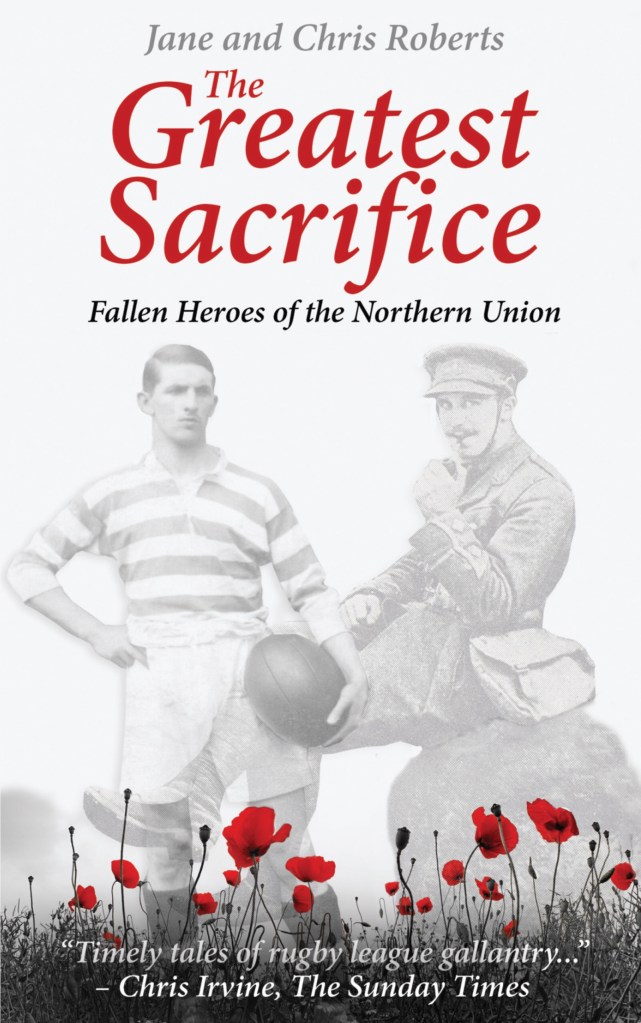
Based on my groundbreaking book The Greatest Sacrifice: Fallen Heroes of the Northern Union about rugby league players who died in World War 1, the talk investigates the stories behind some of the men. It will also be packed with tips for researching your own Great War Army ancestors.

The book, co-authored with Rugby League writer Chris Roberts, has received widespread acclaim, locally and nationally, in print and on radio. The reviews include:

The talk will take place in the Leodis Room, starting at 1pm. It will last for one hour, with opportunity to ask questions. Tickets are free and available through Ticket Source. You can also contact the library direct on 0113 378 5005.

This is one of a series of talks I give. The others scheduled for 2020 are:

  • Blogging for Family and Local History; and
  • The Home Front: the White Lee Explosion of 1914

For more details about these talks please contact me at: pasttopresentgenealogy@btinternet.com

That’s also the contact if you would like to buy a copy of the book. The price, including p&p within the U.K., is £14.99. It is also available direct from the publisher, Scratching Shed Publishing Ltd. It is also stocked at independent Leeds bookshop, Philip Howard Books. And it’s also available from the normal retail outlets.

Why Family History is Like A Box of Chocolates

It’s the end of January and I’m still eating my way through my Christmas chocolates. As I do so I can’t help but compare them with my family history research.

Each box and tin contains an overwhelming selection. One temptation is to dive in and, without any planning or forethought, work your way right through the entire box. That can be true of family history. A scattergun approach, jumping from one tempting ancestor to another. It’s great to start with, but ultimately it becomes less and less satisfying.

The other similarity is that often in that box or tin, some flavours and types are your favourites. You may be like me and go for them first (coconut is my personal weakness). The least tempting I leave till the end, and then I’m faced with nothing but a heap of orange creams which I must force myself to eat (it has to be done). Again, family history research can be the same. You have your favourite ancestors and these are the ones you go for first. You can’t get enough of them. Other ancestors, for whatever reason, don’t hold the same interest. These are the ones left for another day. And when you do pick them up, they’re not very satisfying.

On the same theme some chocolates are expensive. Others have more substance. Or they may have multiple layers and taste sensations. These could be your wealthy ancestors, or your ancestors with lots of associated records or the ones with really fascinating and varied lives.

My final comparison is that you can have too much of a good thing. It’s that end of January feeling when eating chocolates becomes a huge chore rather than a great pleasure. Personally I’m at the stage of not wanting to see another chocolate, but I feel I must plough on. And yes, hard as it is to believe, that can happen with research too. Family history morning, noon and night can leave you jaded by it all. That initial enthusiasm can wear off. So it’s good to have a break from it, even if only for a week or so. Then, like chocolates, you can return to it with renewed enthusiasm!

Actually, in hindsight, I may have eaten far too many chocolates this month. And done too much family history too (only joking). Which is why I’m having such fanciful thoughts. Normal service will be resumed in February.

Will Your Family History Research Die With You?

What plans have you made to preserve for your family history research after your death? That’s a question I posed nearly two years ago. Dealing with life from cradle to grave and beyond, you’d think this would be something family historians, more than most groups, were on top of.

Wrong.  Almost half of those who responded said they had no plan in place. Reasons for this varied, including no-one in the family was interested; the researcher had no close relatives; or even simply a case that they had never given it a thought. Surprisingly, this latter response didn’t apply only to those new to family history. I guess we don’t like to think of a time when we’re not here!

What will become of my research is something I’ve considered ever since. Not least because I was one of the ‘no plan’ cohort. I guess I hoped it would all be OK. But, thinking about it, it isn’t fair to let my relatives and executors sort it out. In addition to their grief, they will have enough practical arrangements to deal with. And under those circumstances, there is a possibility it all may be thrown away as the easy option. So, I need to take responsibility and make things easier for them. It’s up to me to decide what I want to happen to my research…including if I’m happy for it to be destroyed.

The bottom line is I don’t want it to end up in the bin after I’m gone. And I expect many other family historians, one-name and one-place ‘studiers’ feel the same about their work. That means making plans now.

For some, the emotional and personal aspect of family history research means the ideal solution is to bequeath it to an immediate family member…assuming there is someone eager and able to take it on. Although conversely, does this ultimately rob them of the pleasure of research? That’s another dilemma.

In the case of a one-name study, there may be someone else willing to continue researching that name.

But beyond that, there are other alternatives. In this piece I’ve put forward some of these wider options.

Three key points from the outset.

  1. You need to check that the individual(s) and organisation(s) who you intend leaving your research to are happy to receive it. They simply might not have the space or resources to house it. If it’s an organisation, it may not be suitable for them. And, particularly if it is an organisation, it’s only fair to make sure your donation is going to be in a format acceptable to them. All this requires planning. Which leads on to the second point.
  2. If possible, do make sure you have properly organised and labelled your research. That’s one of the reasons for including in my 2020 New Year’s Resolutions the commitment to review all my research and ensure full source citations are included. Then I need to make sure it’s stored in an organised, logical manner. That means it’s far easier for it to be passed on, and those looking at it in later years can fully understand the sources used, any gaps with them, and the arguments underpinning the conclusions. And finally;
  3. Whatever you decide, do formalise it by including it in your will. In addition, do make sure several people know this is your wish. You don’t want it ending up in the skip before the will has been executed.

So what are the wider options?

Many family history societies have library sections which take donations. Some will have established formal donation policies. It’s worth making contact to see if your research is something they would be interested in, especially if it fits with the area they cover. 

Check out local history societies too. Again they may have a library section to accommodate research, or even an active website where they can share information about local families.

It may be worth contacting your local Council’s library department, particularly if there is a main local studies library, or if the various branch libraries specialise in local history themes. It is worth bearing in mind, though, the funding pressures facing libraries. Many have downsized or closed in recent years, with reference sections being particularly squeezed. 

Depending on the type of documents you have, would a local archive be interested?

Nationally, organisations such as the Society of Genealogists (SoG) take donations. Their collections policy states they welcome “original work and papers of genealogists and family historians as well as material primarily of genealogical interest which other archives are not interested in.” More details about donating to the SoG are here.

If you have a one-name study check out the Guild of One-Name Studies, and their page which explains more about preserving your study, including an example will codicil. 

Ultimately, it may be that your research covers a number of distinct areas, and is best split between multiple organisations. But, if so, even more reason for you to do the planning now. 

There are other things to consider when bequeathing your research, particularly to an organisation or repository. These include asking yourself if they are likely to be around long-term to ensure your work is preserved. With so many organisations struggling due to cut-backs or falling membership numbers, their future viability is a genuine factor. If so, can you include provisions for that eventuality? For example, will your donation be classed as a permanent gift, or is a loan possible?  If your aim is to ensure your research is made available to others after your death, will the recipient be able to deliver that level of accessibility? And would you want access to be free? Also, because there is a financial cost to the organisation in cataloguing, storing, conserving and making available your research, do consider making an accompanying monetary bequest.

Finally, there are some practical steps you can take to share and disseminate your work in your lifetime. These include blogging, creating a website, having a family history FaceBook Page, uploading a public version of your family tree (e.g. via Ancestry or GenesReunited), sharing information with relevant one-place or one-name studies, or even writing a family history book and distributing copies to relatives. But some of these may lead to whole new topics…not least around preserving your digital legacy! 

Hopefully this has given you some ideas. As for me, I’m leaving everything to an interested family member. I’ve also got my blog which includes some family history tales. And in 2014 I wrote and distributed my paternal family history book (which now needs updating). Which reminds me, I must do one for my mum’s side – something I’d overlooked until writing this post. Family history is never done!

The Civil Service Marriage Bar – Attitudes to Women and Work in the Mid-20th Century

I love Call the Midwife. A recent episode, set in 1965, about illegitimacy and the pressure on single women to give up their baby (or marry) really does give pause for thought about attitudes towards women in society generally, even within living memory.

It got me thinking wider about beliefs about the role of women in the middle part of the 20th century, particularly married working women. Certain jobs today are perceived as traditionally female occupations. As a former civil servant, I have an interest in this work area. Civil Service jobs, particularly junior administrative and clerical roles, may fall within this traditionally ‘female’ category. But perhaps that impression may not be quite as it seems.

Today 53.9% of the UK Civil Service are women, of all relationship statuses. However, in the not-so-distant past, this was not the case. Until the Great War, it was a male-dominated profession. Yes, the labour vacuum created by the two wars did result in the influx of female workers. But the position was far more nuanced – particularly with regard to marital status. The way the Civil Service was structured and operated in the mid 20th century was transformed totally by the end of the century.

A Day in the Life of a Wartime Housewife- Everyday Life in London, England, 1941, a ‘girl clerk in a war-time organisation’  – Wikimedia Commons – Ministry of Information Photo Division Photographer [Public domain], http://media.iwm.org.uk/iwm/mediaLib//41/media-41026/large.jpg

One key factor influencing Civil Service employment in the early and middle part of the 20th century, which may not be obvious today, was the distinction between established and unestablished Civil Servants. Linked to this was a marriage bar for established female Civil Servants, a ban imposed by the government.

It meant married women couldn’t become established (permanent, pensionable) Civil Servants [1], and single women who were in the established cadre had to resign when they did marry, unless granted a waiver to continue. This waiver was an exceptional occurrence, with only eight of these granted between 1934 and 1938. In effect, married women were second-class citizens.

The Civil Service position regarding married women working in permanent roles was not unique. Similar restrictions on the employment of married women applied for a wide range of professions, some of these also traditionally viewed as suited to women. These included the post office (part of the Civil Service until the 1960s), banking, teaching and nursing.

The reasons for having this restriction included the view that it was the woman’s responsibility after marriage to look after her husband. Marriage was, in fact, a career in its own right – albeit unpaid! In 1944, when the marriage bar issue was under discussion by the Union of Post Office Workers, one representative argued:

In this country we have always held that a woman’s place is in the home.

This from someone in an organisation championing worker’s rights!

A Day in the Life of a Wartime Housewife- Everyday Life in London, England, 1941, ‘preparing the evening meal – Wikimedia Commons – Ministry of Information Photo Division Photographer [Public domain], http://media.iwm.org.uk/iwm/mediaLib//41/media-41031/large.jpg

It was also perceived that women became less efficient employees once married, as their minds were no longer wholly on their job. They also needed time off to have children, and were unpunctual or absent because of their family responsibilities. Linked to this was the belief that it was the fundamental right of a man to be the provider in his own home. Working wives somehow shifted this balance, emasculating their husbands. Furthermore, married working women reduced employment opportunities for men, and this contributed to male unemployment. These women also took jobs and promotion opportunities away from single women, who needed work more than their married (and supposedly financially supported) sisters. And perhaps I’m being cynical here, but it also saved money. Pay was linked to time-served progression. Forcing women out on marriage meant their progression up the pay scale was curtailed.

But attitudes slowly shifted as the Second World War drew to a close, and practicalities were weighed up. Banishing a whole section of the female population to the kitchen again, and denying them rights to a full working life, was becoming an increasingly difficult line to hold. Once more, women needed to plug wartime labour market gaps, and stepped up to the plate effectively. There was also a growing realisation that the experience, ideas and contributions of a whole section of society was being denied. Female university graduates were put off from applying for jobs with no long-term prospects. Arguments were put forward that married female employment was not a cause of male unemployment, and pulling a whole section of women out of the workforce was not the answer. The push for equality, and freedom of choice, therefore gained traction, despite ingrained prejudices. And, ironically, labour-saving devices around the home helped too, freeing time and opening up the world of work to more women.

The marriage bar was gradually removed from 1944 onwards (this was the date the wider teaching profession lifted the restriction). The Civil Service was only slightly behind the pace – it was becoming increasingly untenable for government to continue with the policy. For well over a decade, the restriction on married women working in the established Civil Service had been under discussion. It had a Marriage Bar Committee investigating various aspects associated with the policy, both pros and cons. There was even a National Whitley Council report on the subject. The decision could no longer be kicked into the long grass.

The marriage bar was finally abolished in October 1946 for the Home Civil Service, and 1973 for Foreign Service employment. More details about this are at here.

In his explanatory parliamentary statement on 15 October 1946, Labour Chancellor of the Exchequer, Edward Hugh John Neale Dalton, said:

In future, married women will not be ineligible by reason of their marriage for appointment to established posts in the Home Civil Service, and women who remain in the Service will be required to comply with the normal conditions and practices of their employment, including regular attendance, the working of overtime when necessary and the acceptance of the liability to transfer within the United Kingdom and outside it. Those who, on account of domestic responsibilities or otherwise, are unable to comply with these conditions will not be retained in Service.
The abolition of the marriage bar will take effect today. It will not give any right of reinstatement to women who in the past have been required to resign from the Civil Service on marriage. Marriage gratuities will be paid [2], as hitherto, to women who voluntarily resign from established Civil Service posts on marriage.

However, the opposition to the removal of the marriage bar in the Civil Service and elsewhere continued to be aired well into the 1950s. For example, at the Civil Service Conference of 1950, a motion to re-introduce it was defeated by 7,348 votes to 5,454.

The arguments for its re-imposition focused around easing the redundancy threat facing established officers, particularly married men. Questions were also raised about the future shape of the Civil Service. The implication being this was a step on the slippery slope to employing married women with children. It raised the question:

What kind of Civil Service are we building up? Next we’ll be asking to requisition playpens so they can bring their children into the office.

There were even cartoons depicting the chaos of infants in the office.

And some were unhappy at the potential job competition faced by single women from their married counterparts. Men clearly had an ulterior motive for espousing this view, although some single women did put it forward too.

An illustration of the denial of jobs for unmarried women argument was seen at the Union of Post Office Workers Annual Conference of 1953. This was a union which had campaigned for the removal of the marriage bar in the Civil Service. Yet at their 1953 Conference, attempts were made to seek reimposition of the ban on married women in the Post Office. Those in favour here claimed it was unfair that single women who had dependents were being denied an income, whilst married women were able to afford TV sets and washing machines from their dual family income. The Conference contained the immortal lines of one speaker:

Do not let us have girls standing in unemployment queues while their married colleagues are going about looking like bookies wives.

However, the situation of married women working did gradually become tolerated and accepted.

By 15 September 1958, The Times, in a feature on Whitehall Women, focusing on Administrative Class (senior hierarchy) rather than the more junior Executive, Clerical and other Officer Classes, was extolling the opportunities in the Home Civil Service for suitably qualified women, stating that:

…the State is an enlightened employer recognising by generous maternity leave that a married woman may have children in the course of her career and arrange her life so she can have the best of these two worlds.

It went on to cover advantages such as annual leave, a five-day week, the prospect of travel to places such as Paris, Bonn, Geneva and Washington, and, from 1961, equal pay with male colleagues. This was all aimed at enticing more female university graduates to apply for a Civil Service career.

Yet even in this article there was the whiff of sexism, with lines such as:

If they are attractive, as well as having good brains, “they are most useful” to quote an official “in swaying meetings.”

Despite the example set by government for Home Service Civil Servants, the marriage bar continued formally and informally in the private sector even beyond the 1950s. For example, Barclays Bank did not abolish it until 1961. And there was still a bar in place for Foreign Service Civil Servants into the early 1970s.

So it is well worth considering this specific restriction on the employment of women when investigating the occupations of your female ancestors. Did such a restriction play a part in their career choices, even the choices for university graduates? And did it also play a part in prematurely ending their working lives, effectively forcing them to leave their jobs and work colleagues? And imagine how that felt, cut adrift from the familiar routine of their lives, their friends and daily interactions, let alone the monetary impact.

It also is worth considering that the Civil Service wasn’t structured as now – it contained two classes of workers: established (which is probably what we regard today as the Civil Service) and unestablished. And very different terms and conditions of employment existed when compared to today. Even if jobs and professions continue today, do investigate the terms and conditions which existed for your ancestors. You may be surprised.

Finally, the marriage bar and societal attitudes towards it, provides yet another fascinating insight into the lives of our female ancestors, and the job choices they had. And it is another example of the pitfall of using 21st century eyes to view the lives of our ancestors, and their work (and life) options. Many did not choose to give up work, they were in effect forced out because they married and their job did not permit them to continue under these circumstances.

Notes:
[1] The Civil Service structure, and its strict recruitment and promotion procedures, was a complex system. In addition to established permanent Civil Servants, there existed another tier of unestablished employees. The unestablished Civil Service were essentially supposed to be non-permanent staff, not subject to the superannuation act. They were meant to plug gaps such as those created during wartime, or through seasonal fluctuations. They could be easily dispensed with when conditions changed, thus protecting established staff from the threat of redundancy. Recruitment of these temporary staff tended to be on a Departmental level and not as a result of stringent centrally imposed examinations. It was therefore a concern that if these unestablished workers did gain entry to the established ranks (which could happen) they would not match the rigorous intellectual standards attained by examination entrant Civil Servants. Nevertheless there was some blurring, with an increasing tendency for unestablished posts to become temporary in name only without the benefits of permanency. This in itself resulted in pressure for change. However, even as late as 1 January 1965 there were approximately 159,000 temporary non-industrial civil servants.
[2] These length of service based gratuities were paid upon marriage to permanent female civil servants who had worked a minimum of six (established) years.


Postscript:
Finally a big thank you for the donations already received to keep this website going.

The website has always been free to use, but it does cost me money to operate. In the current difficult economic climate I am considering if I can continue to afford to keep running it as a free resource, especially as I have to balance the research time against work commitments. 

If you have enjoyed reading the various pieces, and would like to make a donation towards keeping the website up and running in its current open access format, it would be very much appreciated. 

Please click here to be taken to the PayPal donation link. By making a donation you will be helping to keep the website online and freely available for all. 

Thank you.


Sources:

Five Tips for a Family History Cemetery Visit

Perhaps taphophilia and family history go hand in hand? I can spend ages wandering through a cemetery marvelling at the various headstone designs and reading the inscriptions. The architecture and symbolic imagery of some headstones is simply stunning. They contain so many stories, so much history and they silently speak volumes about attitudes towards death, culture, beliefs, religion, mourning and mortality over the ages.

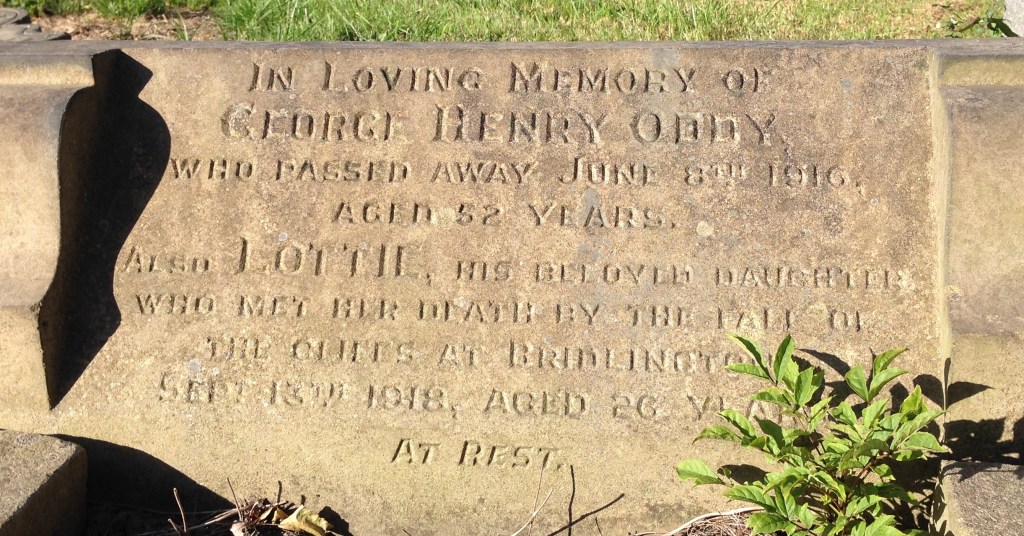
Lottie Oddy’s Batley Cemetery Headstone – “who met her death by the fall of the cliffs at Bridlington” – Photo by Jane Roberts

Importantly, for family historians, they can contain clues about family sizes, family relationships, occupations, interests and causes of death. For example, Lottie Oddy’s headstone (above) in Batley Cemetery, details her unusual death cause – a tale I wrote about in an earlier blog. And only the other day in Masham I discovered several occupational graves, including that of Ralph Edon (below).

Ralph Edon’s Headstone Inscription at Masham Giving Some Occupational Information (Late Surgeon, 35th Regiment) – Photo by Jane Roberts

They may record deaths of family members buried elsewhere. For example, several headstones in Batley cemetery record deaths of Great War servicemen buried overseas, or with no known grave. On a personal level for my research, a Hallas headstone at Roberttown All Saints includes the name of a child buried at Mirfield St Mary’s.

Some clues may be very subtle. One headstone in Batley cemetery recorded death dates for all family members bar one. Further investigation revealed his body had been dumped on a doorstep, and the exact date of death was unknown.

And don’t forget to note wider details. The headstone, or burial location within the cemetery, could be an indication of the family’s wealth or standing in the community.

I’ve visited so many cemeteries over the years, hunting down the headstones of ancestors and those I’m researching. Here are five tips to get the most out of family history tombstone tourism. 

Plan your visit. Make a note of names, dates and plot numbers. Check cemetery opening times – not all are open 24/7. There may be a useful cemetery website, a church or local authority contact point. 

See if there’s a map of the cemetery showing plot sections and plot numbers. Are there separate sections for different religious denominations e.g. a consecrated section for Church of England burials, and an unconsecrated area for other denominations? Even within the unconsecrated sections, there may be a clear division between Catholic and nonconformist areas. 

Some local authorities may, for a fee, be able to say who is buried in a particular plot and if there is a headstone. Many cemeteries have ‘Friends Of’ groups, or there may be a family history society who has made a note of Memorial Inscriptions. They too may have information databases.

Cemetery registers may be available. If possible, try to note details of other plots in the particular section you are seeking. Your plot of interest may not have a headstone, and grave markers can be obscured. But you may be able to pinpoint your ancestor’s unmarked burial place from the neighbouring headstones. 

Another tip is to check sites such as Find A Grave or BillionGraves and download the Apps. Their images and GPS may help in pinpointing a specific grave.

When you get to the cemetery don’t rush in. Take a general look to get an overview, establish bearings and see if the cemetery has identifiable sections depending on burial time period. 

Dress sensibly and come prepared. Cemeteries can be vast, and a visit can involve lots of walking. The ground is often uneven, and not all burial grounds are immaculately kept. They can be overgrown with long grass, thorns and tendrils whipping around your knee and ankles, all hiding lots of biting insects. In wet weather the long grass may soak through points of contact. So stout, comfortable walking shoes are the order of the day. No heels, canvas shoes or open toed-sandals. Long trousers too. If it’s hot weather slap on the sunscreen and fetch your water. Pack waterproofs in case of a sudden downpour. And take something to kneel on – your waterproofs (if you’re not using them!) Even something as simple as a plastic bag comes in handy here. Without an improvised kneeler, damp, muddy trouser knees can be an uncomfortable occupational hazard of headstone photography – I speak from experience!

Take a pencil and notebook to record findings (including negative) and to write out problematical inscriptions, indicating where the gaps or issues are. It’s like a transcription exercise! In fact it may be prudent to copy in full all important inscriptions in your notebook, in case there is a problem with photographs which goes unnoticed until your return home.

And, sad to say, do take sensible safety precautions. Cemeteries can be lonely places. So explore in daylight, accompanied if possible, and not carrying lots of expensive kit.

Photograph. I take multiple snaps on both my camera and phone camera.  If there’s a sign indicating cemetery name, that’s the first image. It signposts where the subsequent headstone images were taken. 

Next, I take images of the full headstone from various angles, followed by close-ups of the inscription. These close-ups can run into several images depending on the headstone size, and the number and length of inscriptions. I include images from both back, front and, if appropriate the sides of the headstone. And don’t ignore the base of the headstone, peaking out at ground level. All these areas may contain inscriptions or additional details. One good example of this was the headstone of the Hallas Family at Kirkburton All Hallows. The front of the grave includes details of my 5x great grandparents Amos and Ann Hallas. Low down it indicates the grave owner is George Hallas, my 4x great grandfather. The reverse of the headstone has a gem of an inscription about the bizarre and unexpected way their daughter Esther met her death in July 1817, which I wrote about in my first ever blog post.

Front and Back of the Hallas Headstone at Kirkburton All Hallows – Photo by Jane Roberts

Finally, I take wider shots to include neighbouring headstones. These too may have a connection, as family headstones may be grouped together.

Once back home I can play about with image settings and use various photo editor apps and programmes. Manipulating the images may help overcome inscription legibility issues. 

Don’t be tempted to clean the headstone unless you know exactly what you’re doing, and you have permission. It can be frustrating if an inscription is obscured by algae or lichen, or if weathering has faded lettering. But irreparable damage can be done to the headstone by trying to clean it using inappropriate methods and products, or using remedies such as flour or shaving foam to make the engraving legible. And do remember some plants are actually protected by law. I personally stick to nothing more than a light dousing with water to see if that removes headstone dirt or improves legibility. For me, going beyond that is simply not worth the risk.

Record findings and check information. Do this as soon as possible after your trip, and include the visit date. Graveyards and headstones change over the years. It’s easy to put this mundane chore off, so it becomes caught up in a huge work backlog. Then you forget what you’ve done and where you’ve saved the information. It may even get damaged, erased or permanently lost. All of which could create more work in the long run – through trying to find your original photographs and notes, or even duplicating the work through unnecessary repeat visits.

Also, do not automatically accept any inscription as gospel. Headstones are not official records, and even official records are not immune from errors! Headstones may post-date an individual’s death by some years, and details may be mis-remembered. As a result, ages, dates and information may be incorrect. I’ve seen countless examples of this. As with any other source, headstone inscriptions should be not used in isolation. Their accuracy should be weighed up against other sources.

Hopefully these tips will help you plan your next family history cemetery expedition.

Footnote: Another trick is using a reflective surface, or torch, to light inscriptions from different angles, which can help deciphering them. With thanks to Sue Adams of Family Folk

It has also been suggested don’t take your children with you. After the initial spurt of enthusiasm they can easily get bored!


Postscript:
Finally a big thank you for the donations already received to keep this website going. 

The website has always been free to use, but it does cost me money to operate. In the current difficult economic climate I am considering if I can continue to afford to keep running it as a free resource, especially as I have to balance the research time against work commitments. 

If you have enjoyed reading the various pieces, and would like to make a donation towards keeping the website up and running in its current open access format, it would be very much appreciated. 

Please click here to be taken to the PayPal donation link. By making a donation you will be helping to keep the website online and freely available for all. 

Thank you.

Ten Things You Wish You’d Known Before Starting Your Family History

Many will be starting their family history research in the New Year. That’s the time of year I embarked on my quest many moons ago, when my brother bought me some books as a Christmas present.

The other day I got to thinking about the mistakes I made in those early days, and the advice I wish I’d been given at the outset. Here are 10 tips I wish my younger genie had been given.

A selection of my research record books (see Goal 6)
  1. Talk to relatives…but only if they want to. Don’t push it. Not all relatives will be comfortable with this, particularly if there are skeletons in the family history cupboard. If they do agree to talk, bear in mind the memory isn’t infallible. Names, dates and events may not be recalled with total accuracy. And there may be some air-brushing to glass over uncomfortable truths.
  2. Make a note of all the sources and references for your findings. That includes the document description, location and reference number. If it was accessed via an online search, note the website address, document dataset and search date. Basically anything and everything you will need to locate it again.
  3. Make a note of all searches – negative as well as positive. It avoids unnecessary repeat searches. Note the search date. This helps with online searches. You only need to repeat when the dataset is updated.
  4. Tempting as it is, avoid the scattergun approach. Plan your research strategy. If you plan, you focus. Don’t try do everything in one go. Concentrate on one person, issue, family at a time. Define the problem, and look at which records may help. Work through methodically.
  5. Don’t accept online family trees as gospel. It’s all too easy if you’re new to family history to accept the research of others without question. Do so at your peril – you could find yourself barking up the wrong tree. Do your own research.
  6. Record your findings as soon as possible. Don’t build up a backlog. I started with a card index system which I still continue. I also now record on a family history software programme. But it could also as easily be an ancestral notebook, or downloading forms such as those available on the FamilySearch Wiki. It’s whatever works for you. The key point is you do it, so your research is up to date. you can quickly evaluate it and spot the gaps.
  7. Don’t get hung up on spellings. Literacy levels and accents all impacted. Be open-minded. Some of my family surnames have upwards of 20 spelling variations. Even Christian names could vary.
  8. By the same token be aware that your ancestors were not necessarily consistent with facts. They may have not known their exact birthday. They may have wished to bend the truth. My great grandmother lied about her age to make it appear she was closer to the age of her husband. She and my great grandfather lied in the 1911 census about the number of years they had been married, to cover illegitimacy of children. Your ancestors were human. And humans don’t always tell the truth. So when searching, build up in parameters either side of dates. Question, question, question. And refer back constantly to previous findings,
  9. Join a family history society. Consider courses. Read to expand your knowledge. Ask if you’re not sure. And accept help. We’ve all been there. And genealogists are a friendly bunch.
  10. Finally be aware – family history research could end up taking over your life. You’re never finished.

I do hope these tips help you start your research on the right track!

My Family History Goals for 2020

2020 promises to be another busy and exciting family history year, both professionally and personally. Away from my professional research, I’m continuing with my monthly family history column in ‘Down Your Way’ magazine. I’m also starting my second year as editor of the Huddersfield & District Family History Society Journal.

But, as ever, I want to set myself some personal family history and general research targets. I’m aiming for a variety of tasks which will be mentally stimulating and stretching, as well as emotionally rewarding. Setting them down in writing will, I hope, focus my mind on these specific pieces of work. If I formally write them down, I can’t ignore them.

Keep on Blogging: If you’d have said back in 2016 how many would read my blog in 2019 I’d be gobsmacked. Due to other time-pressures, blogging is becoming increasingly difficult. The local history pieces are particularly labour-intensive. However, because the mix of local history, family history tales, genealogy tips and one-name studies posts is proving of interest I want to continue with the variety.  I am formally committing to continuing writing a minimum of two posts per month. 

Conference Commitment: In 2020 I aim to attend one national event, as well as a mixture of courses, talks and local family history fairs. I do feel formalising this is a signal that family history is not only looking backwards. It is pushing forwards, equipped with new skills and strategies.

Tree Review: My family tree has been developing for over 15 years. In 2020 I want to revisit this early research. This is important because my skills today are so much more advanced than my 2004 research abilities. Looking at everything with fresh eyes, using the knowledge I’ve gained over these years, may help me spot gaps and provide a wrecking-ball to earlier brick walls. I also want to re-visit my earlier research to include full source citations. When I started out I was more concerned with the thrill of the hunt, rather than establishing fully documented proof. Now I realise the importance of the latter, not only for me and the need to record the sources for hypothesis and their results, but also for the future generations to whom I will pass on the family history baton. They need to see exactly how I built my proof case.

A New Book Beckons: After completing ‘The Greatest Sacrifice: Fallen Heroes of the Northern Union‘ I said never again to researching and writing another book. The whole experience of authorship was akin to having a baby. The anxiety, doubts and pain of researching, writing, re-writing and proofing took over my life for months. My daily existence revolved around producing a perfect book which would do full justice to those in it. In the final weeks my entire being seemed to be totally devoted to creating this entity. It was my first thought in the morning, my last at night … it even haunted my sleep. And even then, once I’d given birth to it, the nurturing continued. I wanted to ensure others loved it the way I did. Seeing the fruits of all my labour was an overwhelming experience. And now, over a year on from publication, it is out there with a life of its own. I’m there guiding it and watching over it.

But it’s gained its independence. And I’m now ready to create once more. So 2020 will be the start of my new book’s research and development phase. Publication won’t be until 2021 at the earliest. I won’t say too much for now. But it will be based around giving voices to those not normally heard. And it will use my family history research skills. Watch this space for further updates.

It’s Good to Talk: I have already delivered several talks locally. However, I’m expanding on this in 2020. I am rolling out three talks aimed at family and local history audiences. They are about my Rugby League WW1 book, and more generally researching Great War Army ancestors; a Batley and Spen Valley local history talk; and, based on my experience as a genealogy blogger, I have one talk dedicated to blogging for family and local history.

For more details about these talks, including fees, please contact me at: pasttopresentgenealogy@btinternet.com

All that remains is for me to thank you for reading my blog in 2019, and to wish you a very Happy New Year. May it be all that you hope.

My Family History Year Reviewed (2019)

2019 has been a busy year on the family history front, but not quite in the way anticipated when setting my New Year’s Resolutions. Part of the issue has been time spent on my two regular writing commitments: my monthly family history column in Yorkshire nostalgia magazine ‘Down Your Way’; and my role as the editor of the Huddersfield and District Family History Society Quarterly Journal. I will be continuing with both in 2020.

In addition to the above-mentioned responsibilities, research work has taken off. And in the last couple of months family illness had a significant impact on my spare time, and ultimately 2019 resolution performance.  

So, how did I do?

My 4x great grandfather Abraham Marshall is still on hold…and he was a hang-over from 2018. Which goes to show how neglected my personal research is at the moment because it’s a low priority compared to my work for others.

I also committed to some continuing professional development goals involving a mix of courses, talks and lectures. Happily, I more than achieved here. As a general observation, I was disappointed I could not make Family Tree Live, The Genealogy Show or RootsTech London due to prior engagements. I hope to remedy this in 2020 by attending a minimum of one national event.

Data extraction for my Aveyard One-Name Study went well in the early half of the year, but tailed off in the second part. But it does continue. I keep telling myself it’s a marathon, not a sprint. As for Aveyard blog posts, I committed to six in 2019. I only wrote five, that tailing off too in correlation to my data collection. But on a positive, I’m further ahead than 12 months ago; and I am now beginning to receive, and answer, inquiries.

As for sewing, my family tree project is underway. Time permitting, it will be completed in 2020. 

Not a formal 2019 resolution, but my blog continued to grow. I aimed to do two posts per month, which I more than achieved with a final yearly tally of 33 (including this post). I’m not going to do my usual annual statistical analysis, as the time I would devote to this is probably best spent researching other blog posts. But my 2019 numbers are significantly higher than 2018. Thank you for all your support. I’m thrilled that my family and local history musings and tips continue to be relevant and engaging. I aim to continue the output in 2020, with the same mixture of themes.

No year-end firework spectacular for my 2019 New Year’s Resolution performance, but by no means a damp squib. On balance I’m content with how it panned out.

In my next post I will set out in more detail my family history goals for 2020…including some interesting developments,

For Some Their War Was Not Over

Armistice Day 2019, the 11th hour of the 11th day of the 11th month, marked the centenary of the first two-minute silence. The tradition of holding a silence to remember the dead began a year after World War One ended. But for many wounded ex-servicemen their personal battle was not over when the guns ceased firing. Not even a year on as the country paused to reflect.

As the country fell silent at 11am on Monday, I attended a Project Bugle graveside wreath-laying ceremony for St Mary of the Angel’s man Sergeant Joseph Edward Munns of the 12th King’s Own (Yorkshire Light Infantry). He was awarded the Military Medal (formally announced in The London Gazette of 13 September 1918) for saving the life of an officer trapped under the debris of a burning building whilst seriously wounded himself – wounds which resulted in a badly damaged right arm and the amputation of his right foot. He died at Prescot Hospital on 7 January 1921, age 32, and is buried in Batley Cemetery. Because he died before the Commonwealth War Graves Commission (CWGC) cut-off point of 31 August 1921 he has a CWGC headstone and is commemorated on their Debt of Honour database.

Project Bugle Wreath-Laying Ceremony for Sgt Joseph Edward Munns – Photo by Jane Roberts

Whilst in the cemetery I also visited the grave of another St Mary’s man, Gunner James Delaney. He was my mum’s uncle, married to my nana’s sister. My mum never knew him, but according to her family he was a lovely man. I have a photograph of him and on the back is written the fact that he died of injuries he received during the Great War. He died on 27 January 1928 so was not eligible for an official CWGC headstone. He features on no database of the dead. He is not recalled on any War Memorial. He is but one of so many others whose deaths occurred years after the end of the War, but whose lives were cut short as a result of the injuries and health issues directly attributable to it. They are casualties as much as those who died whilst the war raged. They are the forgotten casualties.

James’ headstone reflects his sacrifice, bearing his rank and Regimental details.

Here is his story.

James Delaney was born in Batley on 9 July 1895, the son of Dublin-born John Delaney and his wife Ann McLouglin, who hailed from Dumfries in Scotland. The family were associated with St Mary of the Angels RC church in Batley, where James was baptised. His older siblings included Sarah Ann, William, John Edward and Charles Emmett. From the 1881 to 1911 censuses the family lived in the Courts off Taylor Street in Batley. In the 1911 census it was 4 Court, 2 Taylor Street, with James now working as a cloth finisher. This was his abode and occupation when he attested in Batley on 9 December 1915, age 20.

He was mobilised on 28 December 1915 and the following day posted to 1B Reserve Brigade, Royal Field Artillery (RFA) at Forest Row Camp in East Sussex, assigned Service Number 111921. His Company Conduct Sheet whilst at Forest Row shows only two offences. He was absent from 6.30pm parade on 9 May 1916. Then he overstayed his leave from midnight on 28 May 1916 until 4pm on 30 May 1916. For this latter offence he was deprived two day’s pay and sentenced to the humiliation of Field Punishment No.2., shackled in irons and liable to undertake menial and heavy labour. But these were relatively minor misdemeanours and overall his military character was described as very good.

On 15 July 1916 Gunner Delaney was posted to France, joining the ‘A’ Battery of the 80th Brigade RFA on 24 July, part of the 17th Divisional Artillery. Their Unit War Diary refers to reinforcements of men and horses being allotted that day, whilst in camp at Dernancourt. The RFA operated the army’s medium calibre guns and howitzers. These mobile guns were horse-drawn, and deployed close to the front line. 

James joined his unit in the midst of the Battle of the Somme. The Unit War Diary notes total casualties for July, (killed, wounded and from sickness) was 5 officers, 124 other ranks, and 32 horses. These rates explain the need for reinforcements.

On 1 August 1916 they moved to the Montauban area, where James saw action until the 20 August when the Brigade was withdrawn. Days later the news came through the Brigade was being broken up to supply guns and personnel to other Brigades in the Division. James was deployed to ‘A’ Battery in the 78th Brigade. His first full month in action had seen much lower losses than in July, with only two other ranks killed and 16 wounded.

September was spent with his new unit. His final days at the beginning of October 1916 saw them operating in the Hebuterne area, with the guns primarily employed in wire cutting. However, James was back on home soil on 11 October 1916, with 5C Reserve Brigade. 

His Casualty sheet and Medical History forms are not among his surviving service records, so the specific reason for his return home is unclear. However, he was back on the Western Front on 30 May 1917, joining the 24th Divisional Ammunition Column (DAC) on 12 June 1917 in Belgium. DACs were responsible for transporting all ammunition and artillery as well as small arms for the Division, taking it as far forward as possible for collection by batteries and infantry brigades. This made them targets for enemy guns and aircraft. They also provided reinforcements of men for the RFA. James was once more in action in another infamous battle – 3rd Ypres, better known as Passchendaele. 

But yet again his stint did not last long and he was once more back in England on 21 July 1917. From notes on his service records it is clear this was as a result of injury or illness as he now spent time in 3rd Northern General Hospital, Sheffield. There are no more details as to the specific problem at this point in time.

Following his discharge from hospital he re-joined 5C Reserve Brigade at Charlton Park on 8 September 1917. But it is clear he never re-gained his health. He was compulsorily transferred to the Royal Engineers in June 1918, serving with the Tyne Electrical Engineers at Haslar Barracks, Gosport. His new rank was Pioneer, and new Service Number 365987.

Suffering from the painful condition of neuritis, this disorder is defined as inflammation of the nerves. It can be caused by injury, infection or autoimmune disease. In addition to pain, symptoms include tenderness, impaired sensation, numbness or hypersensitivity, weakened strength and diminished reflexes. Maybe this was the legacy of the injuries which necessitated his earlier hospital stay. His resulting health category of B3 meant he was only fit for sedentary work. As a result, he was only capable of undertaking HQ Fatigues work.

James’ condition was serious enough to lead to his discharge on 1 October 1918. After serving for two years and 278 days he was no longer deemed fit for military service. He was awarded a conditional pension of 11s per week, to be reviewed after 52 weeks. This pension continued beyond this date, over the years mainly set at 12s per week with his disability estimated at 30 per cent. 

He returned home to Batley and towards the end of 1919 married 19-year-old Ethel Rhodes. The couple settled at 18 Brearley Street, Mount Pleasant, Batley, with James back at his old job as a worsted cloth finisher. The couple had no children. In brittle health after the tolls of the war, Ethel became his carer as well as his wife. It was a role she made her job for others after James’ death.

James Delaney and Wife Ethel Rhodes

James died on 27 January 1928 as a result of cardiac failure, myocardial disease and rheumatoid arthritis. He was only 32. He died with Ethel by his bedside not at home in Batley, but in the East Lancashire Soldiers’ and Sailors’ Home, Park Lane, in the Higher Broughton area of Salford. 

This was an establishment for disabled servicemen opened under the auspices of the East Lancashire Branch of the British Red Cross Society. With a massive influx of wounded men returning home to ad-hoc care facilities, in the summer of 1916 the organisation – along with the Mayor of Manchester and the Earl of Derby – was involved in the launch of a public appeal to raise money to provide suitable accommodation in which they could be cared for. By the end of September 1916, and after only one month, £22,841 was raised. The fund hit the £75,000 mark by February 1917, an amazing amount for a cash-strapped war-torn society. The appeal was so successful it enabled the provision of not one but five homes which, by 1921, provided in excess of 100 beds. One of these still provides care for ex-service personnel today.

Two of the private houses purchased to provide these facilities were on Park Lane, and both were still in operation in 1929. Miss A.E. Tasker was the sister in charge of Palm House, whilst Miss M. Tracy was the matron at Broughton House. Neither James’ death certificate or the newspaper notices by his wife, parents and siblings indicate in which home he died. He was buried in Batley cemetery on 31 January 1928.

Ethel was understandably devastated after her husband’s death. Her mother, Edith, was instrumental in helping her through this intensely difficult period, when at one period in particular Ethel felt she had no reason to carry on. She did eventually re-build her life and married Fred Armitage in 1931. Ethel never had children. She died on 8 November 1958 and chose to be buried alongside James.

As a footnote to this story, the one surviving former East Lancashire home for Disabled Servicemen is Broughton House. More details about its history, current work and future plans are here. It includes information about how you can help support the continuing work of the charity, because funds are needed throughout the year, not just in the period leading up to Armistice Day.

Sources:

  • 24th Divisional Ammunition Column (DAC) Unit War Diary WO 95/2198/3;
  • 78th Brigade Royal Field Artillery Unit War Diary WO 95/1991/3;
  • 80th Brigade Royal Field Artillery Unit War Diary WO 95/1991/5;
  • 1929 Kelly’s Directory of Manchester, Salford and Suburbs;
  • 1881 to 1911 England and Wales censuses;
  • Batley Cemetery burial records;
  • Batley News – 13 July 1918 and 4 February 1928;
  • Batley Reporter and Guardian – 12 July 1918 and 4 February 1928;
  • Broughton House website https://www.broughtonhouse.com/
  • Burnley News – 9 November 1921;
  • Commonwealth War Graves Commission;
  • GRO Death Certificate for James Delaney
  • Manchester Evening News – 30 September 1916;
  • The London Gazette 13 September 1918;
  • The Long, Long Trail website https://www.longlongtrail.co.uk/
  • The Western Front Association Pension Record Index Card and Ledgers;
  • WO 363 War Office: Soldiers’ Documents, First World War ‘Burnt Documents.’

Mining Genealogy Gold – A Hidden Gem in Leeds Central Library

As a family historian, I’m always on the look-out for sources which flesh out the lives of my ancestors. Leeds Central Library has one particular gem which deserves a spotlight. For those of us with early Victorian mining ancestry it is a must.

The Children’s Employment Commission looking at children and young persons working in mines published its findings in 1842 [1]. This report is only a fraction of the evidence gathered. It draws on the masses of summaries, information and interviews produced by its Sub-Commissioners countrywide. These far more detailed Sub-Commissioners’ reports formed separate publications, reprinted by the Irish University Press in 1968 as part of its Industrial Revolution Parliamentary papers series [2]. Leeds Library holds two volumes of this evidence, containing a wealth of information which did not make the cut for the main report.

Appointed from late 1840 onwards, the remits of these Sub-Commissioners encompassed all fields of mining – from coal, to copper, tin, lead, zinc and ironstone. It covers those toiling underground, as well as those engaged in surface work and smelting. All corners of the country are represented – including Scotland, Wales and Southern Ireland. So it would be a mistake to think it is only relevant for those with Yorkshire or coal mining ancestry.

Yorkshire coal mining, though, is my particular interest, and the focus of this summary. However, this summary will give you a taster for the information available for other regions and sectors of mining.

Three Sub-Commissioners reported on the West Riding coal mining areas. Their evidence spans both volumes, and the amount of name-rich genealogical information they produced is staggering. We owe tremendous thanks to the trio.

  • William Raynor Wood examined the employment of children and young persons in the collieries and iron works of the towns of Bradford and Leeds;
  • Samuel S. Scriven investigated those employed in the collieries around the Halifax and Bradford districts; and
  • Jelinger C. Symons looked at the remainder of the Yorkshire coal field.

They considered a range of issues including ages, numbers of children, the employment of girls and women, how the children were hired, the jobs they undertook, their wages, their working hours including night shifts, their workplace conditions including accidents, meals both in and outside the workplace, holidays, how they were treated, their educational standards and the impact the work took on their physical, religious and moral condition. These findings are illustrated with sketches of children and youths at work, diagrams showing pit layouts and illustrations of machinery.

The physical and moral conditions of the children and young persons employed in mines and manufactures. London: HMSO, John W. Parker, 1843. Folding plate showing children transporting coal in mines and collieries. Credit: Wellcome Collection. CC BY

Tables and appendices collate an array of information, some of which is unexpected material. Fatal pit accidents in a 3½ year period in Bradford and Halifax District feature, with the names and many ages of the victims. There are lists of child workers in particular pits. These include details of in excess of 200 named Bradford and Halifax hurriers with their ages, height, physical condition, whether they could read and write, along with their employment details. There is a tabulated medical examination of children in Dewsbury Colliery. There are also tables showing the names, ages and wages of the three youngest children and three oldest young people working at selected collieries. Beyond this, for comparison purposes, similar wage, age, physical and educational information is collated for children in other industries such as worsted workers in Halifax, or scribblers, carders, spinners and card setters. So, don’t rule out evidence relating to mines if you have ancestors working in other industries.

Crucially, these findings were based on interviews with a cross section of people directly involved in, or with an interest, in mining. You get the usual suspects – coal mine proprietors, doctors, workhouse staff and vicars. But you also have statements from coal miners, mothers and fathers of children employed in the industry, as well as the children themselves. Working class folk whose voices are not ordinarily heard. Here are the real treasures of these reports. You can almost hear the accents and regional phraseology of these long-gone people in the written statements. And yes, there is an explanation of terms generally in use among colliers of the West Riding. Addle, agate, leet, lake and mashed up are my favourites [3].

Each interview is prefaced by the deponent’s name and gives location, age and employment details. And because the interviews were conducted at around the time of the 1841 census, it is easy to cross match them to your ancestors. From this you can find out precisely where they worked, what they did, wider family information, their health, their educational standard, what they ate, even where they lived and their previous abodes.

My 4x great grandfather Jonathan Ibbetson, a widower, and three of his children, are interviewed by Symons. These include his 11½-year-old daughter, Elizabeth. From the interviews I learned that two out of his three daughters worked below ground, one having done so since the age of six. The girls were hurriers, employed by their brother. This was common practice – the colliers, not the mine proprietors, generally employed, and paid, hurriers themselves. The hurrier’s job was to convey the empty corves (wagons, usually with small wheels) to the miner, help fill them with coal, then push the laden corves by dragging, pushing, or ‘thrusting’ them with their heads in readiness for them to be taken to the surface. In this case the two girls worked together, thrusting the corves a distance of 160 yards, and back, which Elizabeth says hurt and made her head sore. On average they conveyed 16 full corves daily. We learn the family moved from Queenshead (Queensbury) to the Birkenshaw area, and worked in Mr Harrison’s pit in Gomersal. We also learn of their poverty, with John (a hurrier, aged 13½) saying:

I have been to Sunday-school. I stop at home now, I’ve no clothes to go in; I stop in because I’ve no clothes to go and lake with other little lads.

One particularly shameful practice, the plight of pauper apprentices, is highlighted in the evidence. Poor Law Unions were in effect binding out workhouse children to miners to work as hurriers. Dewsbury Poor Law Union were singled out for particular censure for putting out a Batley workhouse boy, Thomas Townend, to work for a Thornhill collier. Symons described it as:

A very gross case of the unduly early employment of a workhouse child…before he was quite five years old.

Thomas is interviewed saying:

I remember being in the pit. I liked it; but they would not let me stay.

For those of you who watched the BBC TV series ‘Gentleman Jack’ there is evidence from children working at the Rawson-owned Swan Bank and Bank Bottom collieries, as well as ones employed at the late Miss Anne Lister’s Listerwick Pit [4]. There are also details about the ages and wages of some hurriers at Listerwick.

And where else would you get an entire section devoted to the families of six colliers in Flockton? Not only do you get the names, ages, relationships, occupations and wages of every household member, you get a summary of their weekly food and fuel consumption, along with a description of their house, garden, and furniture right down to the books they owned.  There is even a pen piece for each family. Samuel and Martha Taylor’s reads:

The parents of this man were ignorant, being totally uneducated, and their moral character not good; yet, notwithstanding, he has turned out a very respectable man; and having married an industrious, worthy young woman, he is likely to become a good member of society. His wife has taught him to read and write; and though brought up amidst dirt and disorder his cottage presents a pleasing picture of comfort.

Pure genealogy gold!

Even if your ancestor is not interviewed or mentioned by name, the evidence is well worth consulting for the incredible overview of all aspects of the everyday lives and work of those employed in the mines in this period.

As a result of the investigation, the Mines and Collieries Act of 1842 was passed. Crucially, from 1 March 1843, it was made illegal to employ women or girls of whatever age underground in any mine or colliery in Britain. Boys under the age of 10 were no longer permitted to work below ground either.

This blog pulls together my three previous posts on this subject. These are:

With special thanks to the staff at the Leeds Local and Family History library for their help in locating a copy of the Children’s Employment Commission: Appendix to the First Report of Commissioners, Mines: Part I: Reports and Evidence from Sub-Commissioners, Industrial Revolution Children’s Employment, Volumes 7 and 8.

Notes:
[1] Children’s Employment Commission – First Report of the Commissioners: Mines. London: Printed by William Clowes for H.M.S.O., 1842
[2] Children’s Employment Commission: Appendix to the First Report of Commissioners, Mines: Part I: Reports and Evidence from Sub-Commissioners, Industrial Revolution Children’s Employment, Volumes 7 and 8. 141 Thomas St., Dublin: Irish University Press, 1968.
[3] To earn; to be employed; as it happens; to be idling/passing time; and disabled/worn out.
[4] Anne Lister died in September 1840 and the evidence was taken in May 1841, but the boys had worked there for around three years.