No two days are ever the same for a professional genealogist, as demonstrated by a research commission I undertook this summer for Leeds-based artist Ellie Harrison, and Polite Rebellion – the company with which she works.
Polite Rebellion Artist Ellie Harrison and me at the Loose Ends Exhibition
Working to a tight deadline, my research drew together some threads of Ellie’s family history, and was a small part of the background detail to her much broader overall artistic display concept.
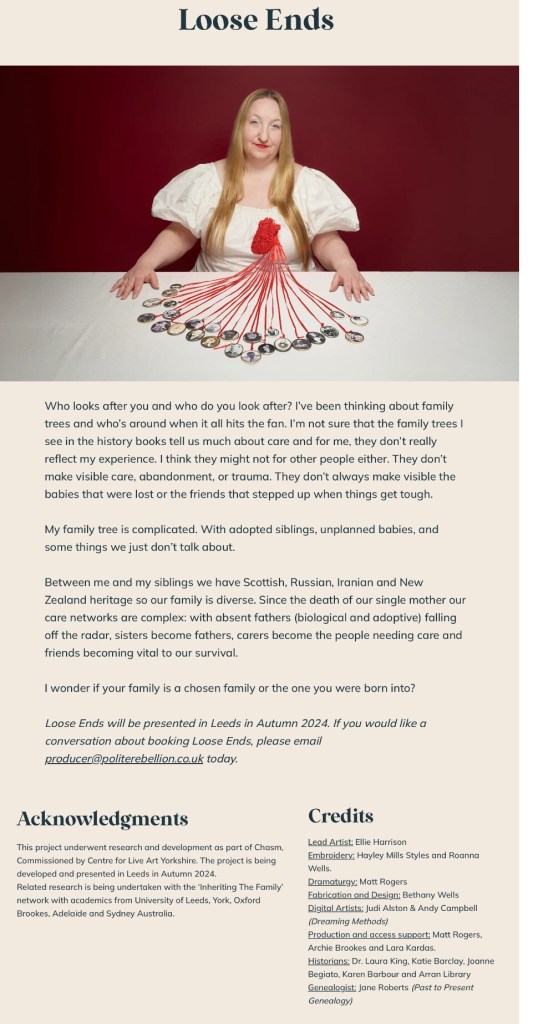
Loose Ends Credits
Ellie’s thought-provoking interactive exhibition, Loose Ends, is now currently showing in Leeds as part of November’s Compass Art Festival. This Festival brings a variety of interactive art projects into the city.
The Loose Ends exhibition space, Leeds Trinity Shopping Centre Albion Street entrance (near Boots).
I dropped by for the opening day of Loose Ends (22 November 2024).
The Loose Ends component of the Festival is based in a pop-up shop in the Leeds Trinity Shopping Centre. Visually striking, this interactive and immersive experience invites you to think about your family tree in its broadest sense. It goes beyond the traditional historical concept of mother, father, siblings, grandparents, great grandparents, which in reality – as every family historian knows – is rarely so neatly packaged. It also highlights there are often unspoken topics and secrets within families.
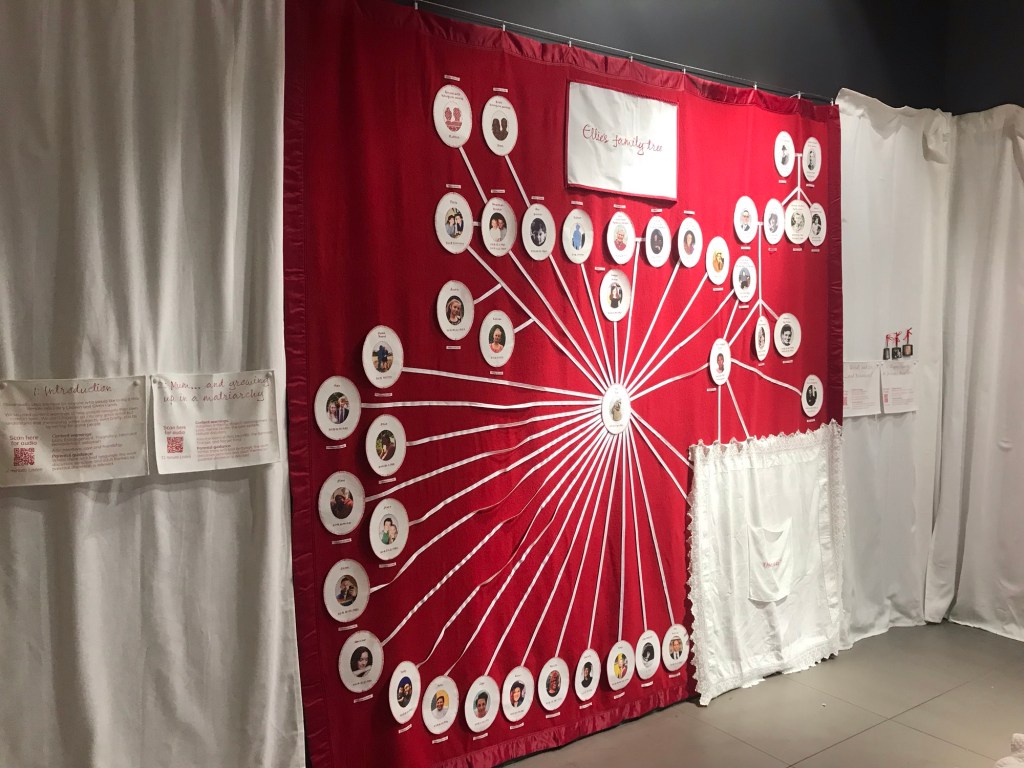
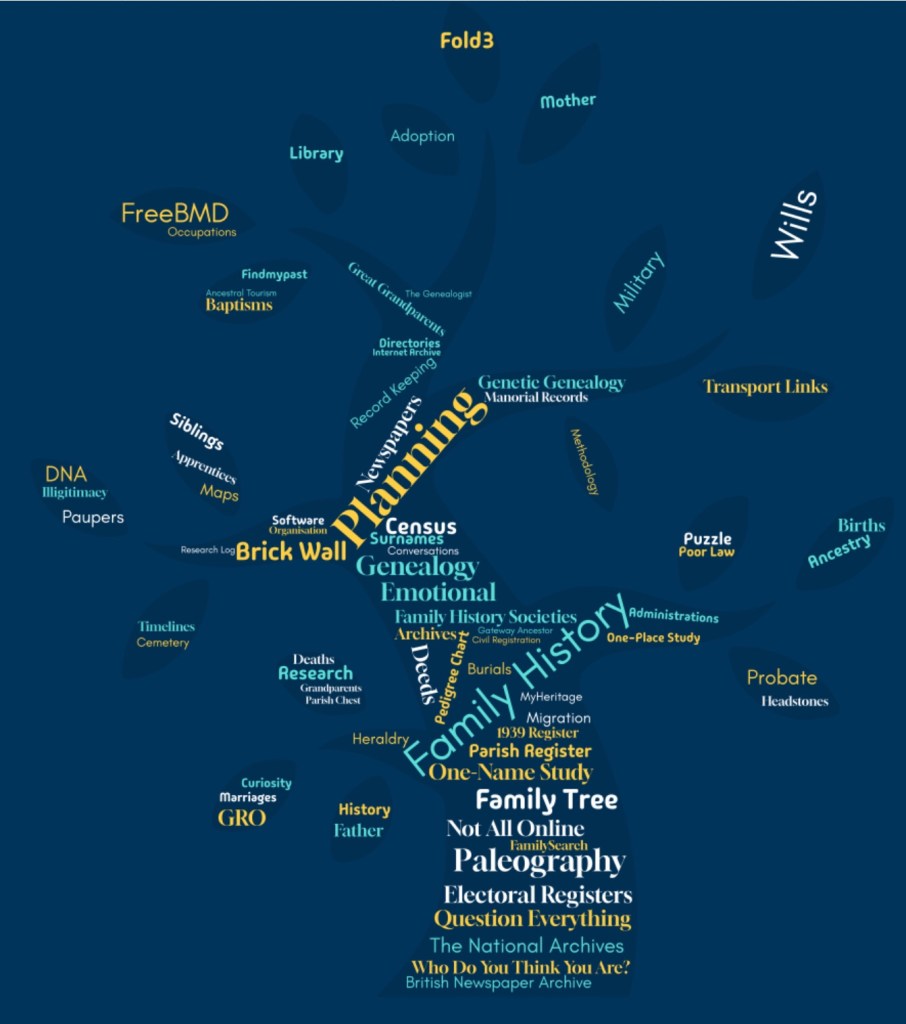
Ellie’s family tree
It challenges you to consider what makes your family, inviting you to explore its complexities, the transient nature of some relationships weighed against more enduring ones, with this weighting not necessarily measured by blood links. You are asked to even consider the importance of wider friendship circles – a take on your FAN Club (Friends/Families, Associates and Neighbours).
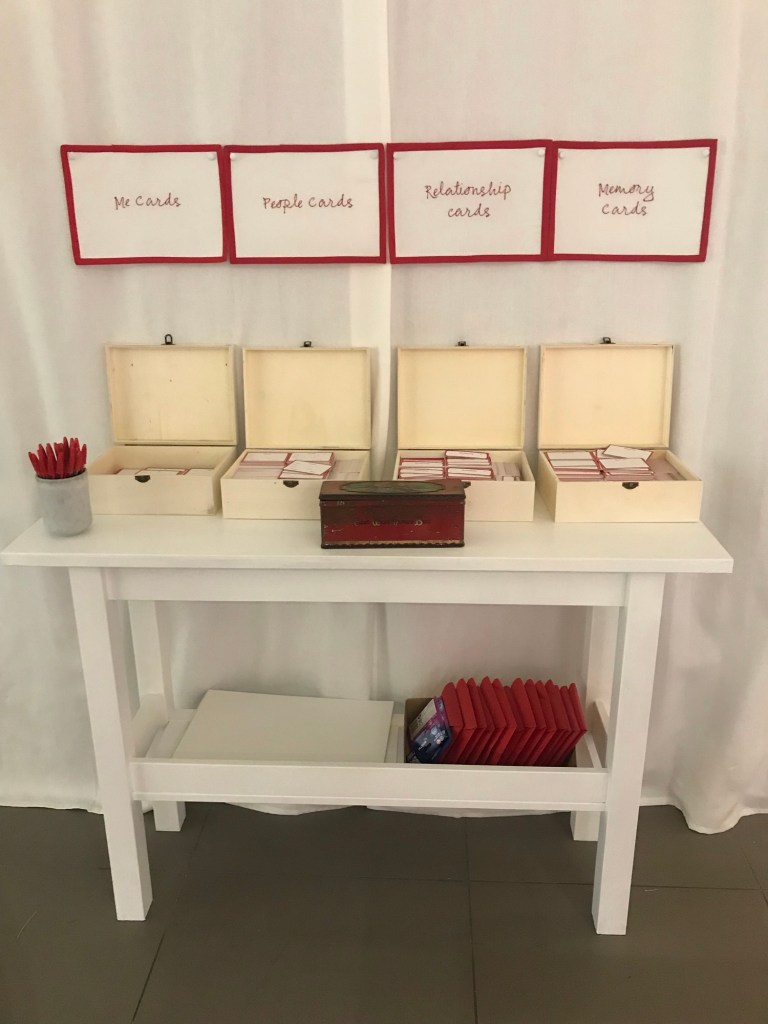
A chance to explore what makes your family tree
More details about the Loose Ends exhibition, including where to find it, can be found here.
But you need to be quick as it only runs from 22 – 24 November, and 28 – 30 November 2024.
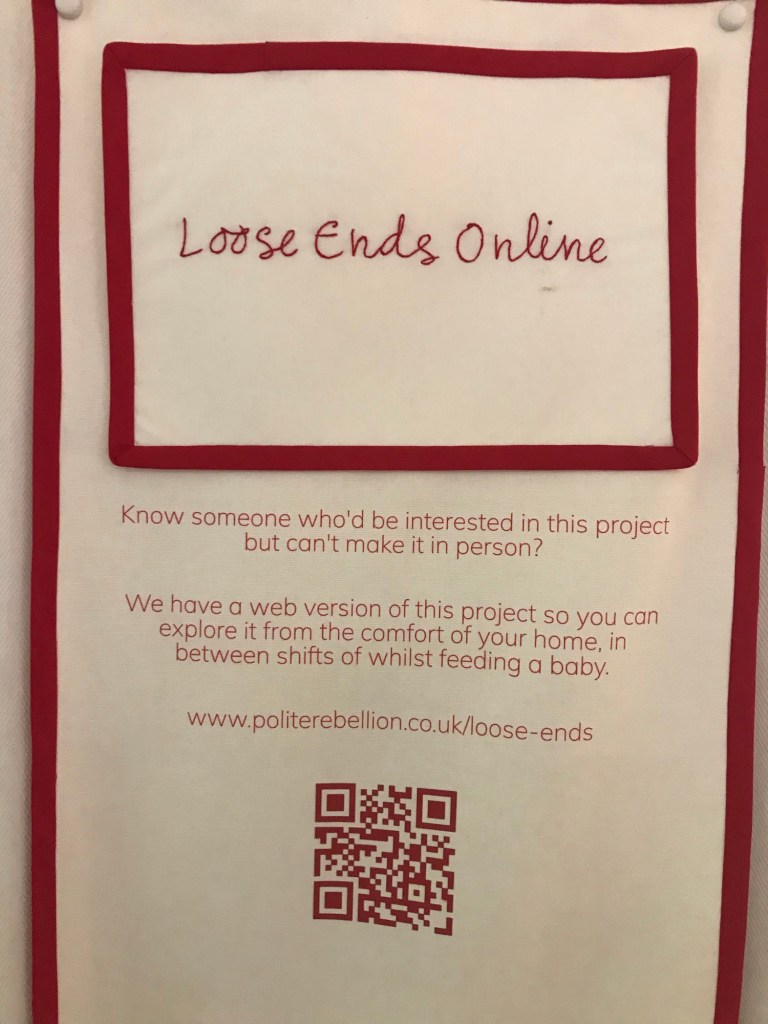
If you can’t make it, here’s the QR Code to scan and enter virtually.
Loose Ends QR Code
A huge thank you to Ellie for commissioning me to undertake her research. I loved doing it, because no two family trees are ever the same – as is demonstrated by the exhibition.
For more details about commissioning me for your research, please click here.
If you are looking for a family or local history speaker during 2025 and 2026, here are the details of my current talks:
Charles the Pigeon and a Yorkshire Spy.
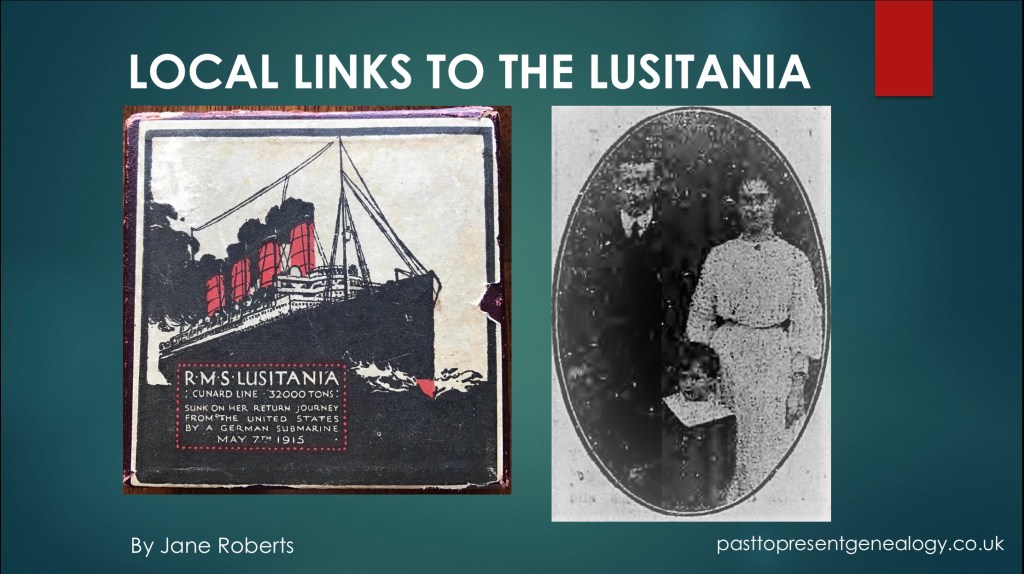
Local Links to the Lusitania.
My Batley St Mary’s One-Place Study. (Covers the history of the Irish in Batley and the Catholic parish of Batley St Mary of the Angels until turn of the 20th century).
The Home Front: the White Lee Explosion of 1914 and the Unlucky History of the Site (available from September 2026).
Tips for Researching your Great War Ancestors. This is based around my book about Northern Union – rugby league – players killed in the First World War. For local history groups, I can drop the research tips aspect, and base the talk solely about the players.
How to Research your Family Tree. This talk will help those embarking on their family history journey, but it will also provide useful reminders and advice for those who have already started out on their ancestral adventure.
The first four have a distinctly Yorkshire flavour. The fifth will be tailored around rugby league players from your locality. The family tree research talk can be geared around research tips for Yorkshire ancestors.
Charles the Pigeon and a Yorkshire Spy is the story of an unsung Yorkshire hero, living behind enemy lines and carrying out works of espionage and sabotage during World War One. His adopted pigeon Charles played an important part in these wartime exploits. Their daring deeds are more like a boy’s adventure story than real life. But this is a true tale of wartime courage, and one which deserves wider telling.
Local Links to the Lusitania focuses on people with Yorkshire connections on board the Cunard liner, torpedoed and sunk off the Irish coast on 7 May 1915. The sinking did not affect only the rich and famous. Many Yorkshire people were involved. This talk explores some of their stories.
There is a possibility this talk can be tailored to your local area.
My Batley St Mary’s talk is based around my one-place study into the Catholic parish of St Mary of the Angels, with a focus on its early history and period up to the 1880s. It investigates what a one-place study is, why I embarked on one, why I chose this particular study, as well as my findings – including the Irish migration angle, how they were received locally, the building of the church, all with a focus on ordinary parishioners.
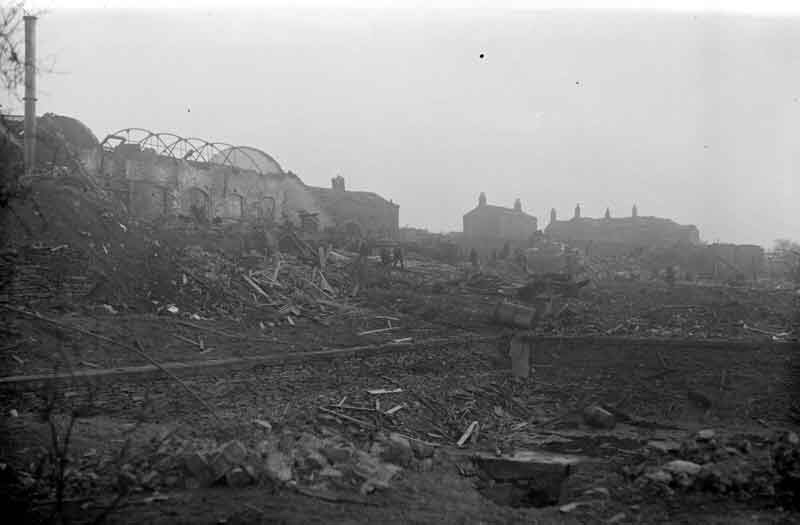
The Home Front: the White Lee Explosion of 1914 is a talk based around the events of December 1914 when a devastating explosion, caused during the manufacture of picric acid for the war effort, took place at White Lee. It resulted in deaths and injuries, as well as damage across a vast area of Batley, Heckmondwike and the Spen Valley. It is an event often overlooked because of later explosions in Yorkshire at Low Moor and Barnbow. This talk aims to provide more information about this Heavy Woollen District incident, the forerunner to the later explosions. The talk will explore the unlucky history of the site, as well as the events on the day and the aftermath.
Based on my groundbreaking book The Greatest Sacrifice: Fallen Heroes of the Northern Union about rugby league players who died in World War One, the talk investigates the stories behind some of the men. It is also packed with tips for researching your own Great War Army ancestors.
In this talk I will guide you through building your family tree. I will cover the basics to help you start your research on the right track, give you lots of tips, help you avoid those all-important pitfalls, and provide ideas for taking your research further. If required, I can slant this talk towards Yorkshire ancestral research.
This morning I attended a behind-the-scenes guided tour of the Leeds branch of the West Yorkshire Archive Service (WYAS), part of a series of free events organised by Libraries in Leeds.
Guided by archivist Vicky Grindrod, it was an informative, fascinating and entertaining peek at what goes on beyond those search room doors. As a frequent archives visitor, it was really useful to get some idea of what is involved in getting documents to that search room desk. Equally, for those with only a minimal knowledge about an archive – like my husband – it was a demystifying introduction to what for some might appear to be an offputting environment only for academics.
Located in Morley, the West Yorkshire Joint Services building accommodates not only the archive, but cross-county organisations including archaeology and trading standards services. Hence the many bags full of archaeological dig soil, and various weights and hoists in evidence in certain areas.
The shared nature of the building is part of the reason why documents need pre-ordering in advance of visits, along with the need to juggle search room space each day depending on what type of materials visitors want to see, and the fact documents may not necessarily always be held on site.
We learned about the work which goes on to get new material archive-ready, from vans bringing it to the unloading area, to assessing documents for mould and bugs, decontaminating them, and undertaking the conservation work to get them strong-room fit. It’s all very technical, down to ensuring air flow systems don’t spread any air-borne pollutants from new material to the rest of the archive, regular bug monitoring, down to maintaining optimum storage temperatures (15-18 degrees) and humidity levels (55 per cent).
We also found how small the archive team is, the variety of jobs they undertake, and how this is evolving to take account of the new digital document mediums and the challenges that brings – from the risk of cyber attacks, to mitigating technology changes which can make earlier digital documents unreadable.
There’s also the ongoing cataloguing work, including of holdings already at the archives which require more detailed descriptions. This is an area in which volunteers can get involved, especially those with skills and knowledge linked to the collections. The Tetley’s brewery collection might be one which will appeal to many!
A Selection of Material from the Waddington Collection
We were also introduced to the range of archive holdings. From the John Waddington collection with monopoly boards and prototype Cluedo designs (“Shall we play Murder? I think it was Colonel Yellow with a bomb in the Conservatory.”); to the World War One material including diaries, letters, Fattorini Leeds Bantam Battalion badge designs, and poor relief book entries (indoor and outdoor) for ex-soldiers, including one suffering from shell shock, and a boy who enlisted age 15½, was discharged in July 1916 as underage and now had phthisis.
Then there was the array of waterways documents, which included a hot-spot map of deaths along the Leeds canal, along with an anonomysed list of children fished out of it in the 1940s…all boys.
More surprising was the maritime-related material, given the land-locked nature of the Leeds area. Intriguingly, the archive has a range of material relating to naval impressment, with details of names, ages and parishes of those who were forced into the navy and escaped. There was also table of rates of wages on HMS Jolly from 1711. Plus lots of photographs of those serving in the navy. All a legacy of family estate papers, and our seafaring and British Empire history.
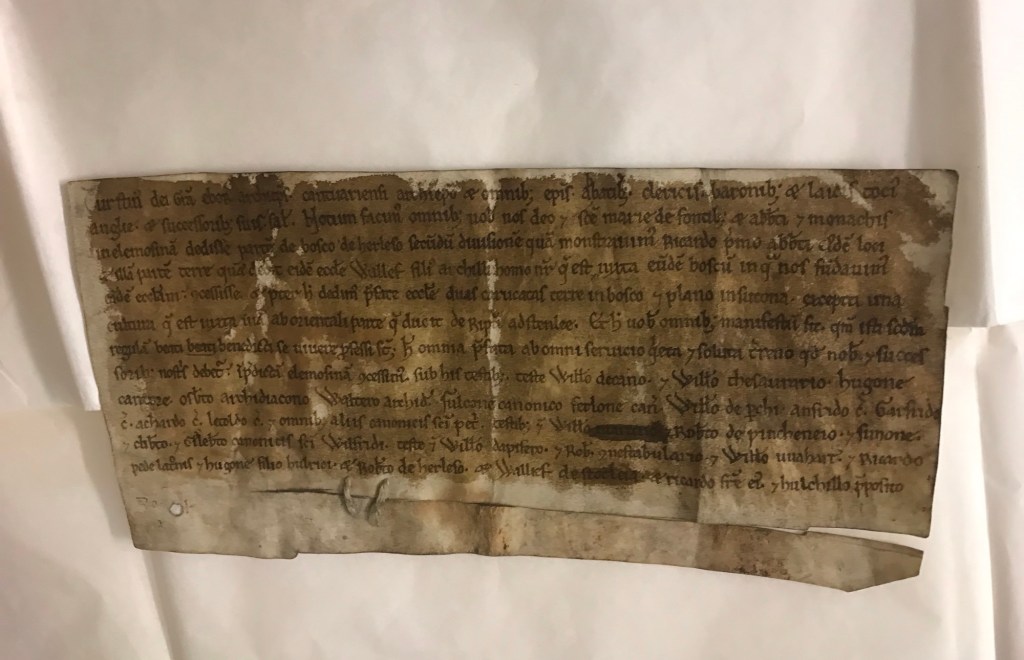
But if you think a 1711 document is old, it was a mere infant compared to the oldest document held by WYAS, and housed at Leeds. That document is pictured below, and it is one we were allowed to hold.
Document Reference: WYL150/925. Feoffment, Thurstan Archbishop of York to the monks of Fountains Abbey.
Dating from circa 1138 – almost 900 years old – this document is from the Fountains Abbey Collection – because the Leeds branch of WYAS has collections from outside the Leeds area, and even beyond the current West Yorkshire boundaries. It details the grant of land made to the monks at Fountains Abbey as long as they continued to live according to the rules of St Benedict. For more details about it click here.
And to listen to the translation of the oldest document in the Fountains Abbey collection, click here.
Those on today’s tour really did touch history.
If you do get the chance to do a backstage visit to an archive, go for it. It is well worth it, and you may be surprised what your local archive does hold!
Despite it being an extremely busy work month during October, I did add five new posts to the Batley St Mary of the Angels One-Place Study, bringing the total number to 363 posts. In addition to the five new posts, a further three were updated.
This update contains the list of all the St Mary’s posts published up to the end of October 2024, including links to them, with last month’s new and updated posts signposted so you can easily locate them.
If you want to know the background, and what is involved in a one-place study, click here. Otherwise read on, to discover a wealth of parish, parishioner and wider local Batley history.
Batley St Mary of the Angels
Yet again no new War Memorial biographies have been added this month. I know I keep saying it, but I really do hope to write some for next month, work permitting. One though, Robert Randerson, was updated. And I have added more parishioners to the list of those who served in, and survived, the First World War section, so this list has been updated too.
The Bulletin for Batley St Mary of the Angels and Birstall St Patrick section, has an addition. This is the piece covering the parish history snippets which were included in the parish bulletins during October 2024.
And the other October additions are in the During This Week newspaper section, with four new pages covering the editions of the Batley News published during the month of October 1918. I have accordingly updated the surname index to these During This Week newspaper pieces, so you can easily identify newspaper snippets relevant to your family.
And this month I have a question about the newspaper round-up pieces. I will continue to add the Batley News ones for the First World War period beyond the Armistice date of 11 November 1918. I plan to continue to the end of 1918. My question is, what should I do after that?
Should I continue with the Batley News to June 1919 and the official ending of the war, or should I end at 31 December 1918?
If I end at 31 December 1918, should I then start with the Batley Reporter from August 1914 to December 1918? Whilst there is some overlap between the two newspapers, there are some significant differences too.
Or should I start with the Batley News for the Second World War (September 1939 to September 1945). If that is the preferred option, I may have to edit it down as there will be so much relevant to St Mary’s.
Please do let me know. Either email me at the contact details towards the end of this piece. Or send a comment via the WordPress comments option. Or if you are reading this on Facebook or X (formerly Twitter), just leave a comment there.
Below is the full list of pages to date. I have annotated the *NEW* and *UPDATED* ones, so you can easily pick these out. Click on the link and it will take you straight to the relevant page.
Finally, if you do have any information about, or photos of, parishioners from the period of the First World War please do get in touch. It does not have to be War Memorial men. It could be those who served and survived, or indeed any other men, women and children from the parish.
I would also be interested in information about, and photos of, those parishioners who were killed in World War Two, or others from the parish who undertook any war service and survived. This can be as broad as serving in the military, or work in munitions factories, the Land Army, even taking in refugees. This is an area I’m looking to develop in the future.
Postscript: I want to say a big thank you for the donations already received to keep this website going. They really do help.
The website has always been free to use, and I want to continue this policy in the future. However, it does cost me money to operate – from undertaking the research to website hosting costs. In the current difficult economic climate I do have to regularly consider if I can afford to continue running it as a free resource.
If you have enjoyed reading the various pieces, and would like to make a donation towards keeping the website up and running in its current open access format, it would be very much appreciated.
Please click 👉🏻here👈🏻 to be taken to the PayPal donation link. By making a donation you will be helping to keep the website online and freely available for all.









 Past To Present Genealogy