Tag Archives: WW1

WW1 Remembrance in Verse: “In Memoriam” and “Roll of Honour” Newspaper Columns

This is the last of my three blog posts in this period of Remembrance. It focuses on the WW1 period.

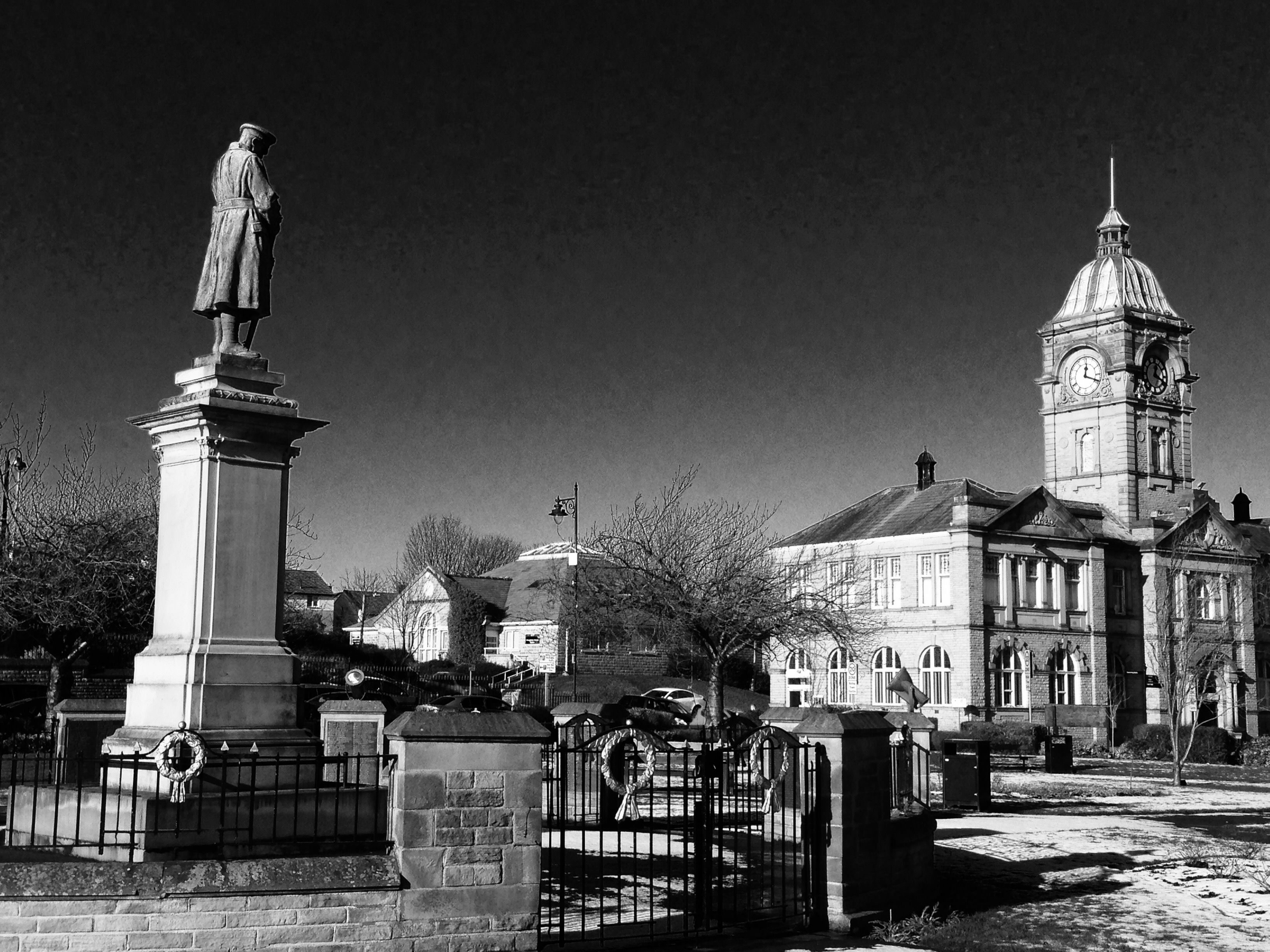
Batley War Memorial

Batley War Memorial

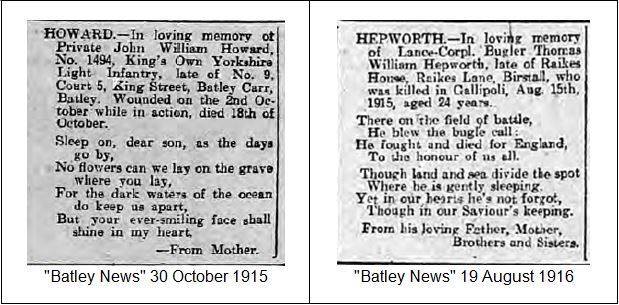
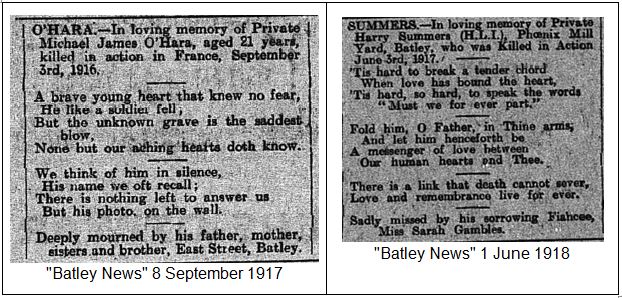
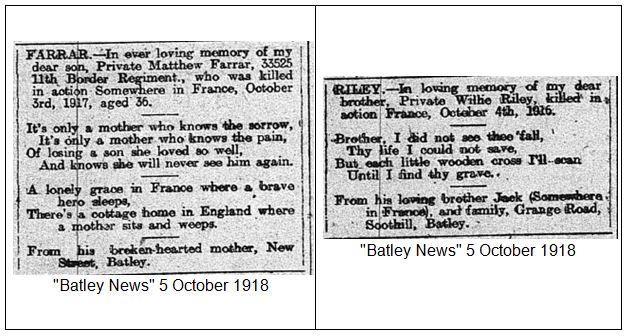
As the Great War progressed and the anniversaries of the Fallen came and went, the local newspaper “In Memoriam” and, later, dedicated “Roll of Honour” columns were increasingly filled with moving tributes to lost husbands, sons, fathers, brothers and fiancées. Although less frequent in late 1915 and throughout 1916, this phenomenon became particularly notable from 1917 onwards and endured in the years beyond the end of the conflict.

Many were recurrent standard verses, or variations on standard themes: grief; absence; young lives cut short; a mother’s pain; religious sentiments; Remembrance; doing one’s duty; sacrifice; wooden crosses; graves overseas far from home, or no known grave; not being present in their loved one’s dying moments; occasionally the difficulty of seeing others return; and even reproach for those who caused the war.

Although not war poetry, they are powerful representations of family grief and loss which echo across the ages.

My mother’s brother died in Aden whilst on National Service in 1955. These family tributes from another era are the ones which, in all my St Mary’s War Memorial research, left the greatest impression on her, resonating with her emotions 60 years later.

These “In Memoriam” and “Roll of Honour” notices provide an accessible window into this aspect of the War, the emotions of those left behind. They are also a continuing legacy for family historians. They can provide service details, place and even circumstances of death, names and addresses of family members (including married sisters) and details of fiancées all of which can aid research.

Here is a selection from the local Batley newspapers[1].

Remembrance 1

Remembrance 2

Remembrance 3

Remembrance 4

Remembrance 5

Remembrance 6

Remembrance 7

Remembrance 8

Sources:

  • Batley News – various dates
  • Batley War Memorial photo by Jane Roberts

[1] These are not confined to those servicemen on the St Mary’s War Memorial

Shrapnel and Shelletta: Baby Names and their Links to War, Remembrance and Commemoration

In these weeks leading up to Remembrance Sunday, my thoughts turned to some research I first undertook in 2011 around baby names. In particular the commemoration aspect behind some name choices, especially in times of conflict. Name choices which went beyond bestowing a “conventional” Christian name on a baby in honour of, or affection for, a relative or friend, living or dead.

Unusually this train of thought was prompted by the 16 December 1914 German naval bombardment of Hartlepool, Scarborough and Whitby. This had an unexpected impact on my West Yorkshire family history. In the course of researching this event I discovered a snippet in the “Batley News” of 9 January 1915 which captured my attention. It recorded the birth of a baby girl in Hartlepool. Her unusual name commemorated the momentous events occurring locally and wider afield at the time of her birth: Shelletta Louvain.

Shelletta is clearly a reference to the events in Hartlepool; Louvain is presumably a mark of respect and signifying a shared experience with Belgian city of Louvain destroyed by the German Army in August 1914. GRO records show the birth of a “Shelletta L Liddle” in the Hartlepool Registration District in Q1 of 1915.

Commenting on the child’s name, the “Wells Journal” asked its readers to “…. think of the poor fate of the poor Hartlepool girl …born to the accompaniment of shell fire, who has been condemned by her parents to go through live bearing the burden of the name Shelletta Louvain!

Shelletta 3

The same paper recorded a Whitby child born during the bombardment of that town, named George Shrapnel Griffin. Other papers quipped if the child had been a girl they could have christened her Shrapnelly. George was, according to the “Whitby Gazette” born at the precise moment the first shell burst over the town! His birth elicited a letter to the family containing the King’s best wishes.

Baby George Shrapnel Griffin with his proud parents Mr and Mrs Edward Griffin

Baby George Shrapnel Griffin with his proud parents Mr and Mrs Edward Griffin

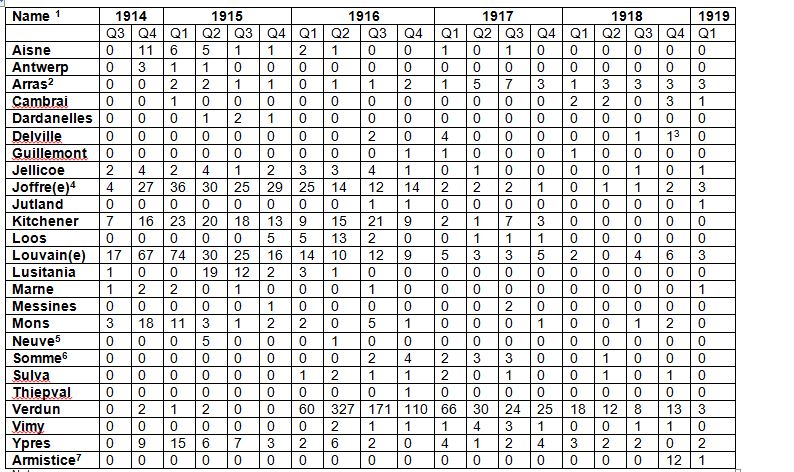
This chance find of a couple of event/place associated names prompted a search into similarly World War One associated Christian names in England and Wales. Using FreeBMD[1], this resulted in the following:

Baby's Names Table 1b

Notes:
1 = I have taken the total from FreeBMD, unadjusted for duplicates.
2 = Includes an Arrasy and Arrasina
3 = Some of the children named Delville had middle names starting with the initial “W” which may possibly have been for “Wood”, one child in 1918 had the Christian name “Delvillewood”.
4 = Includes Joffrena, Joffrene, Joffreen, Joffrench, Joffree, Joffrein and Joffrey.
5 = Battle was called Neuve-Chapelle. Four out of the six children had middle names starting with the letter C.
6 = Includes a Sommeria
7 = Includes an Armisticia

I discovered a sprinkling of children named Belgium and France and even a Poperinghe if I widened my search dates to 1920.

So there is a mixture of battle, personality and event associated names. Verdun, more usually linked with French losses, is surprisingly an overwhelmingly popular choice for both male and female babies. Dorrien, in honour of General Smith-Dorrien and a name I did not analyse in detail, proved popular in the early part of the war.

There will be far more examples. And my search does not include middle names, such as the one given to baby George Griffin. Incidentally no child was given the Christian name of Shrapnel, in my FreeBMD search.

No major surprise, but the registration quarters for these war-linked names mainly coincide with the dates of the various battles/events. For example the children named Antwerp were registered in Q4 1914, and Q1 and Q2 of 1915. This is consistent with the early October 1914 timing of the Defence of Antwerp by the British Royal Naval Division and Rawlinson’s IV Corps.  And Q2 1915 was the peak quarter for the registration of children named Luisitania, coinciding with the sinking of that ship on 7 May 1915.

It would be interesting to investigate if the Registration Districts in which these events were recorded correspond with the areas where the various battalions fought, especially pre-1917 when they had a more “local” affinity.  Also to know why parents chose these names for their children: Was it patriotism? Defiance? Or was it to commemorate a significant event at the time of the child’s birth, as in the case of Shelletta and George Shrapnel? Was it in honour and remembrance of the battle in which a husband or family member lost their life? Or more generally in recognition of where a husband fought? And did these names prove, as suggested in the “Wells Journal“, a burden in later life?

Incidentally the explanation for George’s name, as indicated in the “Whitby Gazette“, was: “George, after that of the King, in whose glorious reign England is rendering her greatest of many services to humanity by crushing Prussian militarism, and Shrapnel, as commemorating the German attack on our undefended town, so dear to all Yorkshire folk, and so famous in its history“. Sadly George never survived infancy to find out whether his name was to prove a burden or otherwise.  According to the same newspaper he died on 23 May 1915.

George Griffin The Cragg

The naming of children after battles and events associated with war is not peculiar to the First World War. Looking at names given to babies during the period of the 2nd Boer War, October 1899-May 1902, I identified the following:

Baby's Names Table 2

Notes:
1 = I have taken the total from FreeBMD, unadjusted for duplicates
2 = Includes a Kimberley Mafeking
3 = Magersfontein Paardeberg

Going back even further to the Crimean War, Inkerman first made an appearance in 1855 and also in subsequent years, proving extremely popular. Crimea, Balaclava and even a Sevastopol occur in the GRO indexes.

So baby names can provide a link to historical events at the time of birth, and another research angle.

If anyone has any of these names, or names of similar war-related origins, I would love to know!

Sources:

  • FreeBMD: http://www.freebmd.org.uk/
  • “Batley News” – 9 January 1915
  • “Wells Journal” – 8 January 1915
  • “Whitby Gazette” – 8 January 1915 and 28 May 1915

[1] Research originally conducted in July 2011 and updated in January-February 2015

Remembered by Families in Batley Cemetery; Remembered by the CWGC Elsewhere

This is the first of my posts in the run up to Remembrance Sunday.

The work of the Commonwealth War Graves Commission (CWGC) is familiar to many. They care for cemeteries and memorials in 23,000 locations across 154 countries, ensuring the 1.7 million people from Commonwealth forces who lost their lives as a result of the two world wars are never forgotten.

Batley cemetery contains CWGC 66 burials. Predominantly these plots have standard CWGC headstones, but there are also some Private Memorials where families chose to erect their own headstone on a war grave. All are listed on the CWGC website.[1]

Unsurprisingly some families who had loved ones commemorated elsewhere by the CWGC, chose also to include their names on family headstones in home cemeteries. This is not exclusively confined to those military personnel with no known graves.  These are not classed as war graves. The service person is not buried there. So they are entirely distinct from CWGC recognised Private Memorials.

These inscriptions would provide a focal point close to home for families of service personnel with no known grave, or buried far from home. They are a visible sign of love, acknowledgement and family remembrance.

These headstones can prove invaluable for researchers in terms of family and service details. But, as they are not war graves, they are not recorded by the CWGC. So it is a case of seeking them out.

Here are four I spotted in Batley cemetery.

Able Seaman Farrar Hill, killed on 31 January 1918[2] when his submarine, HMS E/50,  was lost in the North Sea. It is believed to have struck a mine near the South Dogger Light Vessel.  He is commemorated on the Plymouth Naval Memorial. But he is remembered on the Hill family headstone.

Farrar Hill - family headstone

Farrar Hill – family headstone

Pte Robert Hirst, 6th Bn King’s Own Yorkshire Light Infantry. He was killed in action on 24 September 1915 and has no known grave. His name appears on The Ypres (Menin Gate) Memorial. His family have included his name on a relatively new headstone in Batley cemetery.

Robert Hirst's relatively new headstone

Robert Hirst’s relatively new headstone

Rifleman Edward Leonard, 1st/8th Bn West Yorkshire Regiment, killed in action on 2 July 1916 and commemorated on the Thiepval Memorial. His sister Annie, a munitions worker at the Barnbow factory at Garforth, Leeds, died on 21 July 1916 from picric acid poisoning – the same day as the Leonard family received news Edward was missing. His and Annie’s name appear on the headstone.

Headstone - Edward Leonard

The Leonard family headstone

Pte Albert Smith of the 2nd/5th Bn Duke of Wellington’s (West Riding) Regiment died of wounds on 27 May 1918. He is buried in Bagneux British Cemetery, Gezaincourt, France but he is also included on his family headstone.

The Smith family headstone - including Albert Smith

The Smith family headstone – including Albert Smith

So, even for those service men and women commemorated on CWGC memorials and in cemeteries elsewhere, do not discount information provided on family headstones closer to home.

The Royal British Legion launched its 2015 Poppy Appeal on 22 October. This is their link: http://www.britishlegion.org.uk/

Sources:


[1] http://www.cwgc.org/
[2] Some sources indicate the submarine was lost “on or around 1 February 1918”, but 31 January is the CWGC date

A Family Casualty: 12 October 1915 Dewsbury Tram Disaster – “It’s just like Ypres”

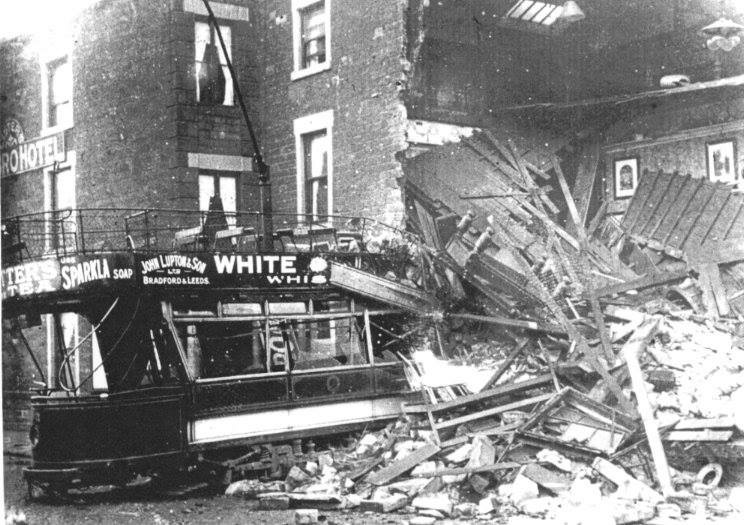
Tuesday 12 October 1915: the day when the runaway 4.10 afternoon tram from Earlsheaton wreaked havoc in Dewsbury town centre, eliciting comparisons to war-torn Belgium. One soldier witnessing the aftermath exclaimed “It’s just like Ypres”, whilst other sightseers observed it was “A bit of Belgium” or likened it to a Zeppelin raid.

Losing control on the steep incline of Wakefield Road, the tram shot past the Dewsbury terminus, careered past the end of the lines and over the setts, before finally crashing into buildings on Market Square. Here it demolished Messrs Hiltons Boot Shop, several upper rooms of the popular Scarborough Hotel hostelry and badly damaged the neighbouring Messrs Lidbetter, Sons and Co., provision merchants. In the course of its destructive path the tram also collided with two horse-drawn vehicles near the Town Hall.

Aftermath of Collision Aftermath of Collision

One early theory for the accident was the slight  drizzle on Tuesday afternoon caused the Number 3 tram to skid – greasy tracks had caused an incident in the same spot previously. But this was discounted by an eye-witness account from one of the injured. Mrs Oldroyd said that the trolley pole had left the overhead wire higher up the hill leaving the driver with no means of braking.

A notoriously treacherous location, it was counted fortunate that the latest mishap occurred in the late afternoon of what was half-day closing in the usually busy town. At 4.20pm the shops were shut and only a few people were around. As a result only seven people were injured. These were listed in the newspapers as:

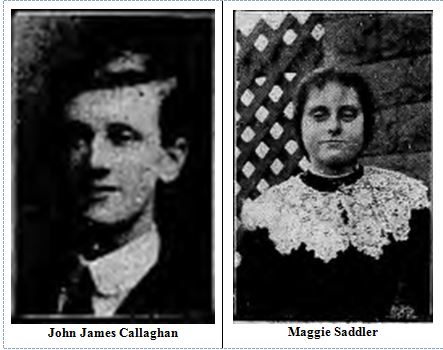
  • John James Callaghan (21), living in Ossett. The tramcar driver gallantly stuck to his post until the very last before he was either violently thrown, or jumped, from his platform into the road. He suffered head cuts and concussion. Born in Falls of Schuylkill, Philadelphia he moved to Ossett with his family when about six months old. He worked for the tram company from the age of 13, becoming a driver less than a year prior to the accident;
  • Maggie Saddler (28), living in Ossett. The tramcar conductress also incurred head wounds and concussion. She too stuck to her post as the vehicle hurtled out of control. She had been in the role for under three months, a change brought about by the war. Prior to that she worked as a domestic in Bridlington. But the downturn in trade in the seaside resort as a result of the war, combined with job opportunities afforded by it with men serving with the military, led to this change ;
  • Ethel Oldroyd and her daughters Edith (7) and Phyllis (3) from Earlsheaton were the only three tramcar passengers. Ethel sustained cuts on her right leg, hand and shoulder, a sprained ankle and bruises. Edith received head and knee cuts. Whilst Phyllis incurred cuts and abrasions. Fortunately these injuries were only minor. Her husband, away in Uxbridge with the 5th West Yorkshires, was granted permission to return home as soon as news reached him that evening;
  • Mrs Violet Pinder (49) of Purwell Lane, Batley fractured her leg in the incident;
  • Mrs Ethel Noble (25) of Wakefield Road, Dewsbury, the daughter of Violet Pinder, suffered bruising and shock.

Callaghan and Saddler

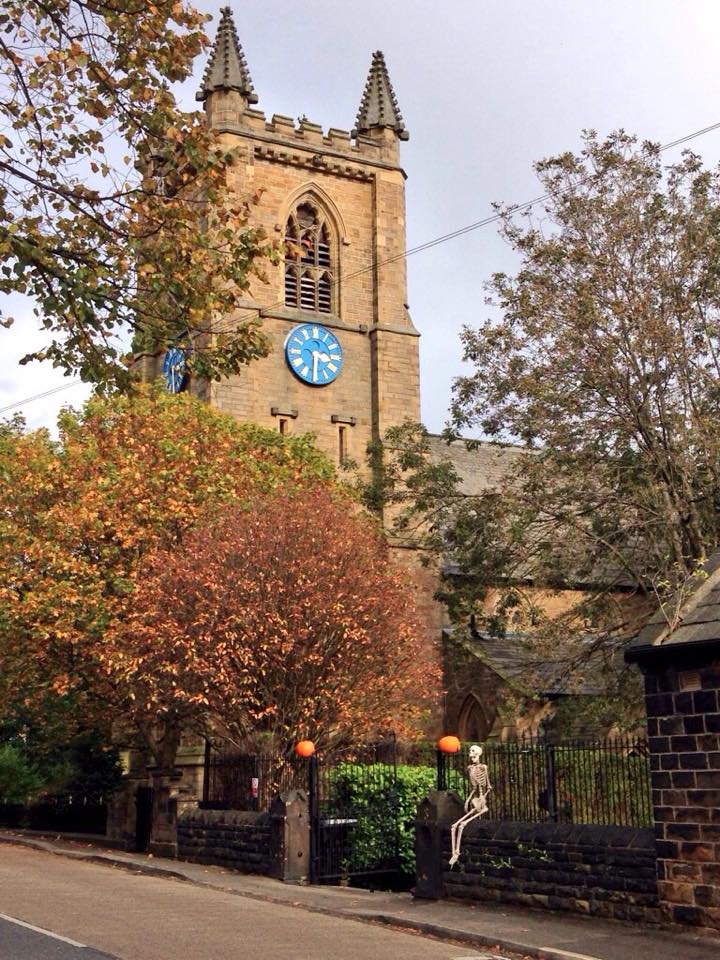
It is the latter two passengers who link to my family history. Violet Pinder was the youngest daughter of my 3x great grandmother Ann Hallas and her husband, the wonderfully named Herod Jennings. A large family of 12 children Violet was born in Heckmondwike in 1866. Along with her siblings William, Eliza and Rose she was baptised at Staincliffe Chirst Church on 5 November 1868. The family seemed to go for mass baptisms or none at all![1]

Staincliffe Church (with Halloween guest) Staincliffe Church (with Halloween guest)

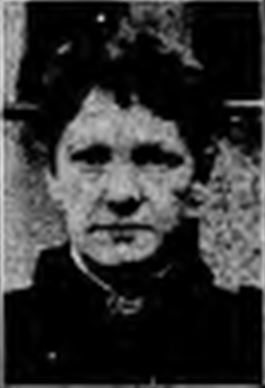
Violet worked as a cloth weaver prior to her marriage, and this continued intermittently afterwards. She married coal miner Samuel Pinder on 4 August 1886 at Batley Parish Church. Subsequently Samuel worked as a fish salesman. Ethel, the daughter caught up in the runaway tram incident, was the second of their six children.

Violet Pinder Violet Pinder

At 4pm that Tuesday afternoon Violet and her recently married daughter decided to go for a walk. Some discussion ensued as to the route to take before, arm-in-arm, the pair decided to look at shop windows in town. They had not gone very far, just above the Town Hall, when they heard the noise of the approaching tram and screaming. Before they could take any action the tram smashed into the back of the pony and cart of general carrier, Mr Benjamin Buckley. He had tried, but failed to avoid the collision by turning into Rishworth Street, at the corner of the Town Hall. It was too late. His cart, carrying a load of rags, was sent flying and knocked down the mother and daughter.

Ethel came round to find herself lying in Wakefield Road near to the pony. There was some suggestion her injuries were caused by the pounding of the horse’s hooves as she lay unconscious in the initial aftermath. Violet lay prostrate some distance away in Rishworth Street, her left boot badly cut and torn with the heels of both taken clean off by the force of the accident. Ethel summoned up enough strength to run over to her mother where she promptly collapsed, unable to move any further.

As luck would have it in the motor vehicle behind the tram was trained nurse, Miss Maude Kaye. She rendered first aid to the victims until medical assistance arrived. Ethel and Violet were conveyed initially to the Town Hall before a horse-drawn ambulance took them, the conductor and conductress to Dewsbury Infirmary. The Oldroyd family were less seriously injured and returned home after receiving treatment at the scene of the accident.

Ethel was able to leave hospital the following day, and the newspapers reported early in November that John James and Maggie had also left hospital to recuperate at home. Violet was less fortunate though spending several weeks in hospital recovering from her injury.

She did recover and died in 1938, aged 71.

The enquiry into why Tram No.3 ran away was held in Dewsbury Town Hall on 11 November 1915. By this stage all the victims had ‘practically recovered.’

John James Callaghan, in giving evidence, explained he became a conductor for Dewsbury and Ossett Tramways Company in 1912, began training as a motor-man the previous Christmas and took up duty as a motor-man on the Ossett and Earlsheaton routes on 20 August – less than two months before the accident.

On the afternoon of the accident, when he began his shift for the day, he had made five journeys between Dewsbury and Earlsheaton on No.3 car without mishap. He started the fateful journey from Earlsheaton at 4.10pm, and made the usual stop at the junction before turning into Wakefield Road. With the car in check and power applied to the brakes he continued at not more than four miles per hour. The rails were in bad condition, greasy after a rain shower, and he repeatedly applied sand to the rails to keep the car under control. However, on testing the hand-brake, the car gained speed and shot away. John James applied the hand-brake again, but the car continued at pace, it reached the points and went out of control. In order to try and avert a disaster John James continuously sanded the rails and used the emergency brake, to no avail. The brakes failed.

Other witnesses from the Tramway Company were called including Fred Dale, the motor-man who John James Callaghan had taken over from on the tram earlier that day. He said the vehicle was in working order, as did Albert Davis, the car-shed foreman who had thoroughly overhauled and examined No.3 car the previous day. He had re-examined the car after the accident and, but for the damage it the collision caused, it was still in good order. In his opinion defective brakes were not the reason for the crash. He believed the driver had under-estimated the state of the rails and simply applied the hand-brake. Then he sanded the rails and applied the brake too sharply and was unable to recover control as the wheels were skidding. Once control was lost Davis admitted there was no infallible mechanism for regaining control.

Another driver, who was in the tram behind, said the rails were bad because of the rain, he could tell by the rising dust John James was sanding the tracks, and – before the tram went round the bend and out of sight – it was already skidding. He also said a car had never got out of control whilst he was descending that hill.

It seems that the accident was a combination of poor weather conditions affecting a difficult stretch of track, and an inexperienced driver.

A century on all the locations are very familiar to me. I walk past Staincliffe Church regularly. I occasionally drive down the very steep incline of Wakefield Road from Earlsheaton to Dewsbury. I am regularly in Dewsbury in the area around the Town Hall. There are no signs of the accident which caused such a stir in the area, and had a direct impact on my family history.

Sources:

  • Ancestry.co.uk – Staincliffe Chirst Church baptism register http://home.ancestry.co.uk/
  • Batley News 16 October 1915 and 13 November 1915
  • Dewsbury District News 15 October 1915
  • Hartshead St Peter’s Parish Register – baptisms
  • Batley All Saints Parish Register – marriages
  • FindMyPast – Censuses http://www.findmypast.co.uk/

[1] 16 June 1857 marked the baptisms at Hartshead of children Henry, Ellen and Louisa. Henry was 13 at the time, and not the son of Herod. My 2x gt grandmother, Elizabeth, was not baptised until 1901. Other children do not appear to have been baptised. I’ve not traced any non conformist records either, so perhaps an indication of religious ambivalence.

Pro Patria, Pro Rege, Pro Familia: WW1 Centenary Visit

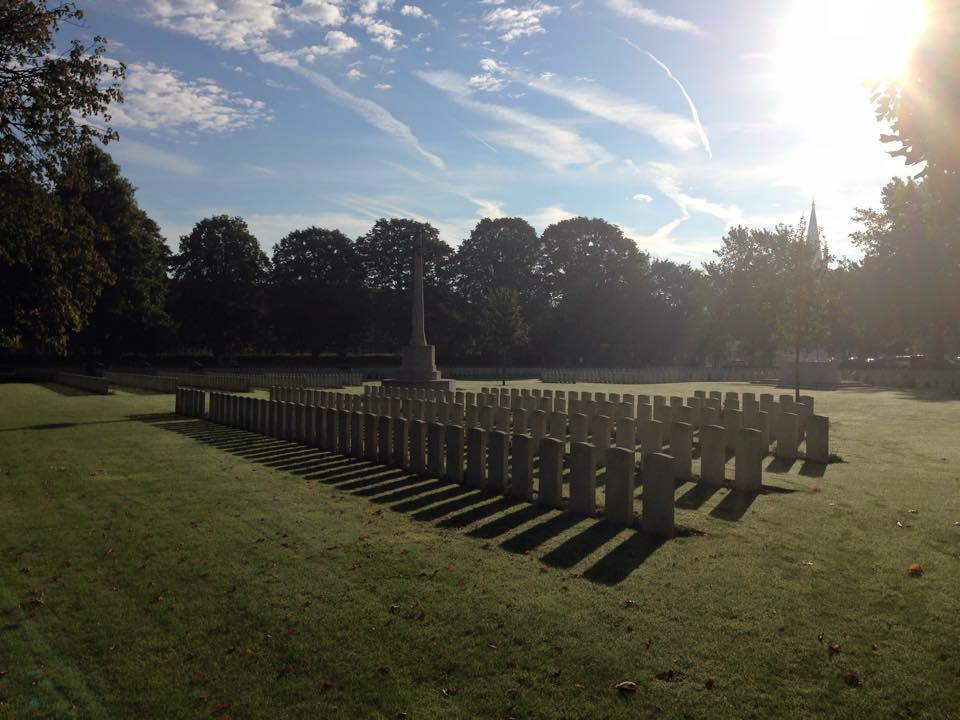
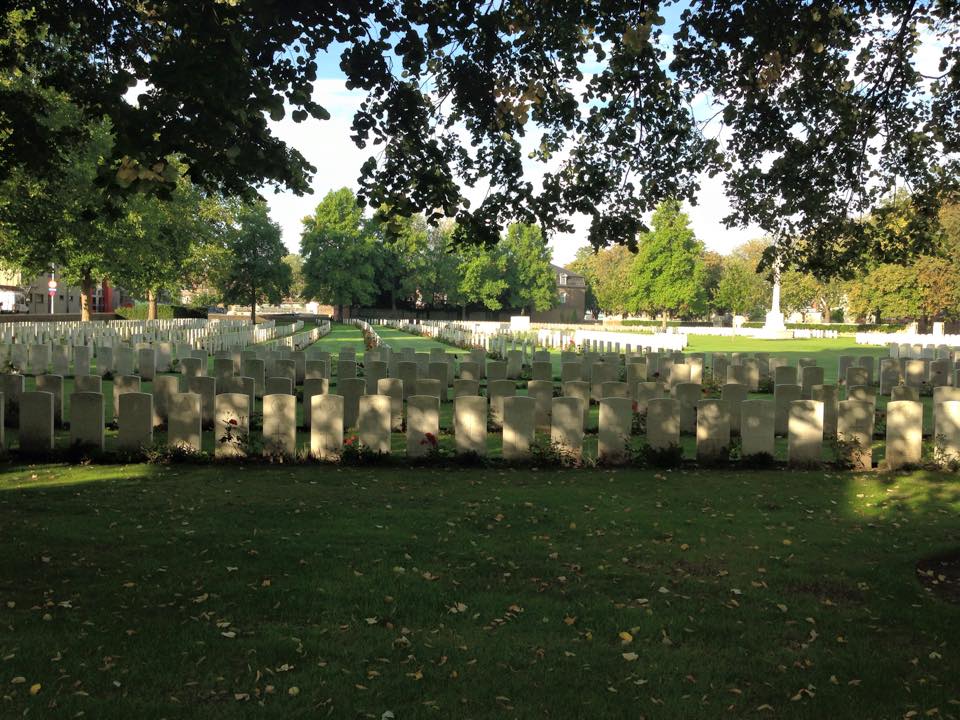
Last weekend I returned to Ypres. A visit I felt compelled to make. 19 September marked the centenary of the death of my great grand uncle, Jesse Hill.[1] So it seemed appropriate to visit his grave in Ypres Reservoir Cemetery.

Ypres Reservoir Cemetery

Ypres Reservoir Cemetery

It was a weekend full of coincidences. And an unforgettable one. The events of 100 years ago still resonate emotionally with many today.

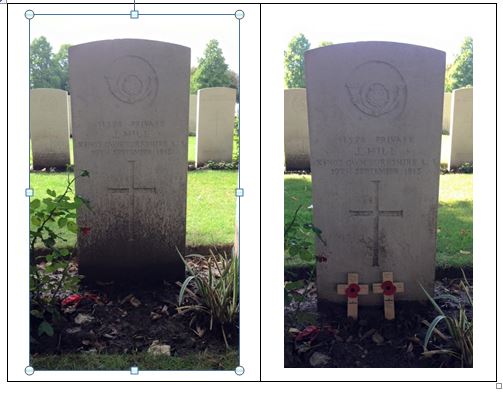
I visited Jesse’s grave on Friday evening, the eve of the anniversary. The headstone is beneath trees and as a result every time I’ve visited it’s rather mud-splattered. Friday was no different. However when I returned first thing on Saturday morning, the anniversary of his death, the headstone had been cleaned!

There was only one other person in the cemetery at 9.30 that morning – and it was someone I know from home! He was visiting the graves of Dewsbury men from 6th Battalion King’s Own Yorkshire Light Infantry (KOYLI), comrades of Jesse, who died at around the same time. So a huge coincidence that we’d both travelled 350 miles and turned up in that cemetery at the exact same time.

Ypres Reservoir Cemetery

Ypres Reservoir Cemetery

Before I left I placed a poppy cross, brought all the way from Batley, on Jesse’s grave.

From Unit War Diary maps, I’d located the area occupied by the 6th KOYLI the morning Jesse died. So on Saturday afternoon I walked around Railway Wood and what was the vicinity of the ‘H’ Sector trenches. Walking the ground brought home the frighteningly close proximity of the British Front Line to the German trenches in a way maps cannot. And it made the concept of “friendly fire” incidents far more understandable.

RE Grave, Railway Wood

RE Grave, Railway Wood

On that walk my husband found two pieces of shrapnel. It’s not unusual, but then again in all my many visits it’s only happened to us on two previous occasions – so it did feel incredible that this find occurred on the 100th anniversary and in that very location.

On Sunday morning I returned to Ypres Reservoir Cemetery. Unbelievably a second poppy cross lay on Jesse’s grave. A look I the visitor register confirmed that another Hill descendent also had the urge to pay an anniversary visit Jesse’s grave.

Jesse Hill's headstone

Jesse Hill’s headstone

Later that morning I attended a Rededication Service at Birr Cross Roads cemetery. Thanks to the patience, perseverance and unstinting efforts of Australian volunteer researchers, three soldiers’ headstones previously carrying the “unknown” epitaph now have identities; and the families of these three Australian soldiers, Pte Huntsman, Pte Eacott and Pte Neilson, now have named graves to visit. It speaks volumes of the emotional pull of the events so long ago that families of all three soldiers travelled halfway across the world to be at the service. It was a privilege to be there too.

Birr Cross Roads Rededication Service

Birr Cross Roads Rededication Service

Other visits that day included Tyne Cot Cemetery and Memorial. The sheer size of the cemetery even after many visits is difficult to take in with 11,956 First World War servicemen buried or commemorated here, of which in excess of 8,000 are unidentified. The list of almost 35,000 names on the memorial is equally staggering.

Tyne Cot Cemetery and Memorial

Tyne Cot Cemetery and Memorial

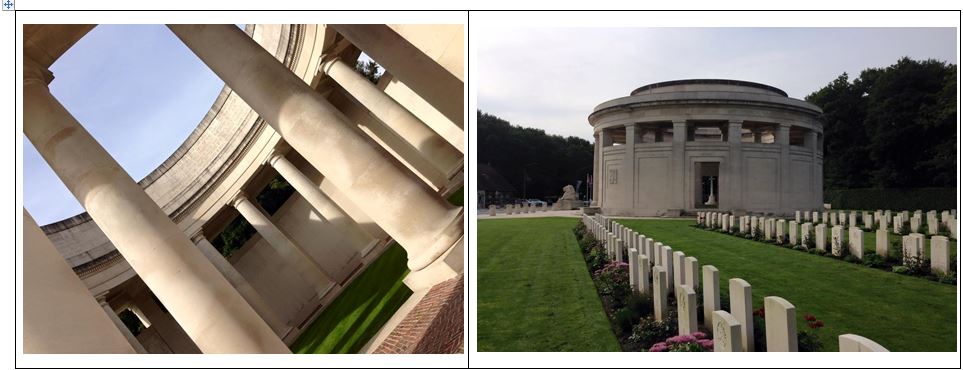
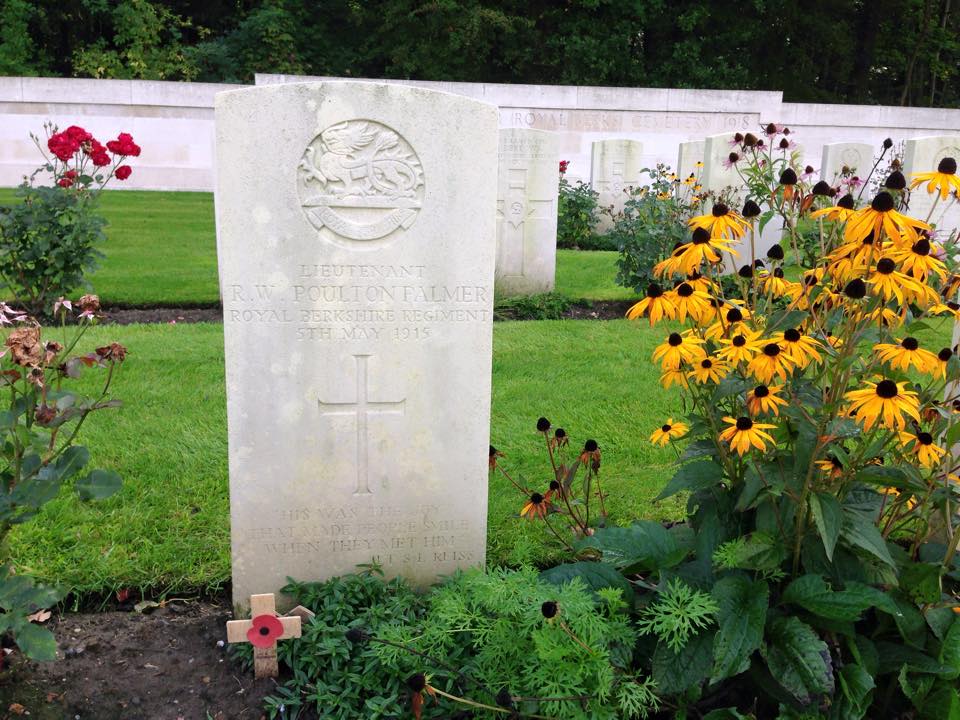
I returned home on Monday. On the way back to Calais I stopped off at the first CWGC site I ever visited: the majestic, lion-flanked Ploegsteert Memorial. Although I’m a Rugby League fan, as it’s the Rugby Union World Cup it seemed appropriate to pop across the road to call by the grave of England Rugby Union captain Ronald Poulton Palmer at Hyde Park Corner (Royal Berks) Cemetery.

Ploegsteert Memorial

Ploegsteert Memorial


Ronald Poulton Palmer's Grave

Ronald Poulton Palmer’s Grave

Final stop was Lijssenthoek Military Cemetery. I wanted to visit the graves of three men whose lives I researched and who have connections to my home Parish of Batley St Mary’s: John Collins, Henry Groa(r)k and Patrick Lyons. The cemetery has an excellent visitor centre with information about the soldiers buried there. I’ve supplied information about the St Mary’s men, and there is a webpage if others wish to do the same.[2] There is also a wall containing some of their images. The first one I noticed was remarkably familiar – the photo of Patrick Lyons. It seemed a fitting end to my latest visit to Belgium.

Lijssenthoek Visitor Centre

Lijssenthoek Visitor Centre

[1] See blog post https://t.co/JcKGrZVh7t

[2] http://www.lijssenthoek.be/en/page/160/visitor-centre.html

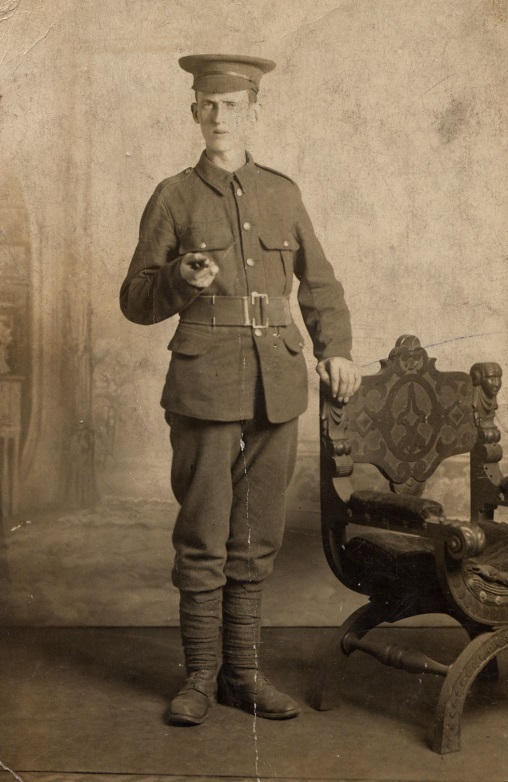
Pte Jesse Hill, 6th (Service) Battalion, The King’s Own (Yorkshire Light Infantry): 13 November 1895 to 19 September 1915. Never Forgotten

I’m hoping to travel to Ypres Reservoir Cemetery again soon. I’ve been several times over the past few years. But this will be a particularly poignant visit. It will mark 100 years since the death of my great grandad’s youngest brother Jesse Hill, killed in action in WW1.

Jesse was the son of Joseph Hill and his second wife Mary Ann Simpson. He was born on 13 November 1895 at Rouse Mill Lane, Soothill and grew up in the family’s home on Spurr Street, just across the road from Batley railway station and all the grand cloth selling houses which lined Station Road.

An extremely popular boy, he attended Mill Lane Council School where he was a prominent member of both the school cricket and football team.

After leaving school he joined the finishing department at Messrs Wrigley and Parker’s Greenhill Mills minutes down the road from his home. This was one of the many mills upon which Batley’s fortunes were built upon.

Whilst Jesse was in the early stages of his working life older brother Charlie enlisted in the Army. Jesse therefore had direct contact with a serving soldier and first-hand accounts of military life.

When war was declared on 4 August 1914 the persuasiveness of the recruiting sergeant’s triple-pronged seduction techniques of a general appeal to patriotism, the more specific exhortation of defence of your country and women-folk from the barbaric Germans and the desperate desire to avoid accusations of shirking duty and the accompanying dreaded white feather of cowardice kindled a response in Jesse.

Swept along with a tide of emotion and the fear of missing out on adventure because, after all, it would be over quickly, Jesse was one of those young men who in their thousands gathered in the Dewsbury recruiting office and recruiting offices the length and breadth of the Kingdom to take the King’s Shilling. Jesse even added a year to his age in order to ensure he would be accepted. And with a cursory medical and a few swift pen strokes on 7 August 1914 Jesse was in the Army for the duration, duly assigned to the newly formed 6th (Service) Battalion, The King’s Own (Yorkshire Light Infantry), (KOYLI).

Pte Jesse Hill, 11598, 6th Bn The King's Own (Yorkshire Light Infantry) Pte Jesse Hill, 11578, 6th Bn The King’s Own (Yorkshire Light Infantry)

From Pontefract the Battalion moved initially to Woking and then in November 1914 to Witley Camp, Surrey one of the many temporary army training camps flung up in those early months of the war. In February 1915 they moved to Aldershot for their final preparations prior to deployment overseas.

It was whilst at Aldershot and with embarkation for France and the Front Line looming that Jesse wrote his will. He used the standard Army Form designed specifically for the purpose. The harsh reality that he may never return may have struck home by filling in this one basic form. His will, dated 17 March 1915, was witnessed by two Birstall men, Thomas Kelly and John W Learoyd. He named his now married half-sister Nellie Armstrong, daughter of Mary Ann Simpson, as Executor.

The will stated that in the event of his death and following discharge of debts and funeral expenses, everything was to go to his sister Martha, a testimony to the closeness of Jesse and his youngest sister.

On 20 May 1915 an advance party from the Battalion were sent from Aldershot to Southampton in preparation for departure to France. On 21 May 1915 the main body of men split into two groups and, accompanied by music played by the band of the 8th Devon Regiment, marched to the railway station at Aldershot ready for departure to Folkestone. By 11pm that night they arrived in Folkestone where they embarked on a cross channel steamer and, after a calm crossing, arrived in Boulogne in the early hours of 22 May. From there they marched the two miles to Ostrohove Camp where they remained for just one night before moving up the line and into Belgium by the end of the month.

Belgium was the sector which was the focus of sustained fighting at this point of the war. Only a month earlier the first gas attack on the Western Front, perpetrated by the Germans, took place initiating the 2nd Battle of Ypres. 2nd Ypres ended on 25 May pushing the Allies back, compressing the Salient and bringing the Front Line closer to Allied held Ypres. Reinforcements were urgently needed, and it was to this “hot spot” that the 6th KOYLI and Jesse Hill were sent.

This is where they remained for the next few months, undergoing the rotational routine of trench warfare. Typically most men spent five days in the frontline, five in reserve, five back at the frontline and finally five in reserve. However, this was not fixed because, if circumstances demanded it, they could spend anything between four and eight days in the frontline trenches. While some men were in the front fire trenches, others would occupy the support lines, ready to provide reinforcement when hard-pressed in an attack or a raid. Finally the battalion was removed from the frontline trenches and taken to the rear areas, a process known as relief and carried out at the dead of night via the communication trenches. But even when in reserve trenches they were kept busy and still at risk, undertaking sentry duty and providing digging, wiring and ration parties.

This became Jesse’s daily routine in the areas around Ypres, Vlamertinghe, Hooge, Sanctuary Wood areas, frequently negotiating the Menin Road and Hellfire Corner to get from Ypres to the frontline trenches.

During these months he had a couple of narrow escapes. On one occasion he and four others were buried by shell wreckage; on another time a “motor char-a-banc” in which he was travelling overturned and Jesse sustained what were described as comparatively slight injuries.

On the evening of 15 September 1915 it was the 6th KOYLI’s turn to have another spell in the trenches leaving Ypres through the Menin Gate, up the Menin Road and into the frontline. It appears that Jesse was in “A” Company in H16, H17, S17, H16A and H15A trenches.

The Area Around the The area around the 1915 “H” Sector Trenches, taken on one of my earlier visits to Belgium

It was all fairly standard stuff. During the relief, always a dangerous time, the Battalion lost a Machine Gun Sergeant and four men just after arrival in H14 to a large shell. On the 16 September 1915 the diary notes continuous shelling from their own guns behind the lines, as they were trying an experimental shell. The German reply was not vigorous. All in all the 16 September was a fairly quiet night, with 60 more men coming up from base as the Battalion had been allocated far too much work and were having to carry their own rations. 17 September followed a similar pattern. Shelling increased from both sides on 18 September and six men from “B” Company were killed as a result, but overall once again the night was described as “peaceful comparatively”.

Friday 19 September dawned with heavy bombardment from the Allied guns at 4.50am. These rounds fell short of the German Lines and gradually became shorter and shorter until they were raining rapidly on the British held trenches, mainly around H18 and H19. However, because the telephone was out and the Forward Observation Officer had been killed, the Officer Commanding in the trenches could not report back to the guns. Shells were now hitting H18, H17A, the bombing post at H18A and H19 and casualties sustained – both dead and wounded.

19 September is the day that official records, both CWGC and his Army Death Certificate, state Jesse died. If so, he was killed by this so-called friendly fire.

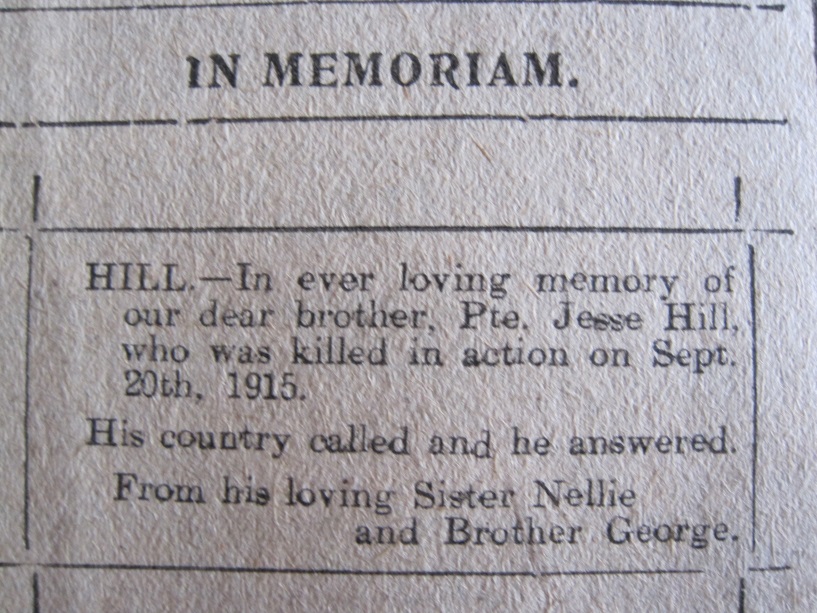
However, there is a small question mark. On the first anniversary of his death in September 1916 an “In Memoriam” notice appeared in the local newspapers. This indicates that the family believed his death occurred on 20 September.

In Memoriam Notice from In Memoriam Notice from “The Dewsbury District News” of 30 September 1916

The Unit War Diary for 20 September notes that at 4.55am High Explosives from Hill 60 landed at Charing Cross killing six men.

Pte Healey wrote to Jesse’s family and the details appeared in the local papers in mid-October. The newspaper article puts it bluntly as follows: 

“A companion named Private Healey wrote to the relatives a few days ago informing them that Private Hill met his death suddenly, both legs and part of his body being blown off, and an official intimation confirms the sad news”.

So, although official records state Jesse’s death took place on 19 September, it may conceivably have been 20 September.

CWGC records show that after the war Jesse’s body was recovered in June 1919. The trench map reference appears to relate to the Ypres area.  I initially believed he may have been buried in what was known Ypres Reservoir Middle Cemetery, (also called “Prison Cemetery No.2” and “Middle Prison Cemetery”), which was located near the prison and reservoir. It was used in August and September 1915, and rarely afterwards. It contained the graves of 107 soldiers from the United Kingdom, 41 of which were from the 6th KOYLI.  However a further analysis of CWGC records appears to discount this theory. After the War the graves from Middle Prison Cemetery, other small burial grounds around Ypres and graves from the Salient battlefields were brought together in one cemetery, Ypres Reservoir. This is Jesse’s final resting place.

Jesse Hill's Headstone - Ypres Reservoir Cemetery Jesse Hill’s Headstone – Ypres Reservoir Cemetery

Jesse was awarded the awarded the 1914-15 Star, Victory Medal and British War Medal. He is remembered on the Batley War Memorial and the Soothill Upper War Memorial at St Paul’s, Hanging Heaton.  The UK, Army Registers of Soldiers’ Effects show following his death that the Army owed his sister, Martha, as next of kin, £1 13s 3d and a £3 10s war gratuity.  

Jesse Hill Batley War Memorial Batley War Memorial Inscription – Jesse’s name, along wit the name of his nephew Percy

Sources:

  • Ancestry.co.uk – British Army WWI Medal Rolls Index Cards, 1914-1920 Army Registers of Soldiers’ Effects, 1901-1929: http://home.ancestry.co.uk/
  • “Batley News” – 9 October 1915
  • Birth Certificate
  • CWGC: http://www.cwgc.org/
  • Death Certificate
  • “Dewsbury District News” – 16 October 1915 and 30 September 1916
  • FindMyPast – Census information, Soldiers Died in the Great War: http://www.cwgc.org/
  • Gov.UK Website – Find a Soldier’s Will: https://www.gov.uk/probate-search
  • The National Archives – Unit War Diary, 43 Infantry Brigade: 6 Battalion King’s Own Yorkshire Light Infantry. WO 95/1906/1: http://www.nationalarchives.gov.uk/
  • “War Register and Records of War Service 1914-1920 Urban District of Soothill Upper” – Rev W E Cleworth MA
  • Photos of Jesse Hill, “H” sector trenches, headstone and Batley War  Memorial inscription – my own

Copyright

© Jane Roberts and PastToPresentGenealogy, 2015. Unauthorized use and/or duplication of this material without express and written permission from this blog’s author and/or owner is strictly prohibited. Excerpts and links may be used, provided that full and clear credit is given to Jane Roberts and PastToPresentGenealogy with appropriate and specific direction to the original content.

Batley Rugby League Club’s WW1 History-Maker

Some debate occurred in the Yorkshire press in March 1915 as to who was the first Northern Union player in Yorkshire and beyond to obtain a commission in The Great War.

The “Huddersfield Daily Examiner[1] and “Yorkshire Evening Post[2] declared that in Yorkshire the accolade fell to Wakefield Trinity’s William Lindsay Beattie who was appointed temporary 2nd Lieutenant in the Border Regiment on 15 March 1915.[3] He lost his life on 27 January 1917. Lancashire-based Wigan’s Gwyn Thomas was reputed to be the first commissioned Northern Union player. However, I believe this event occurred towards the end of 1914. Thomas survived the war and joined Huddersfield in 1919.

Both papers overlooked Batley winger, Robert Randerson.

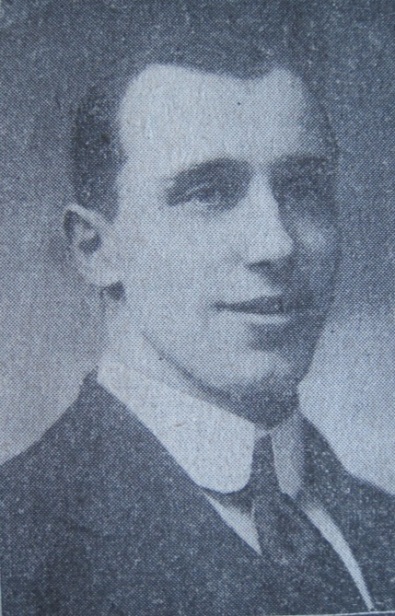
Robert Randerson Robert Randerson

Robert, (or Bob as he was known according to the local press), joined the Leeds University Officer’s Training Corps (OTC) shortly after Britain’s entry into the War. “The London Gazette” of 25 August 1914 lists Robert as amongst those OTC cadets and ex-cadets appointed as temporary 2nd Lieutenants.[4] Promotion quickly followed. In January 1915[5]“The London Gazette” announced his appointment to temporary Lieutenant with effect from 10 December 1914. Only months later, on 15 May 1915, he became a temporary Captain as notified in a June edition of the same official journal.[6]

Letters of correction to the papers followed; and the Batley Club itself was adamant the honour belonged to its player. In its Annual Meeting of May 1915 it pronounced:

“Randerson…..was the first N.U. player to receive a commission. This honour has been claimed by others but it belongs to Lieut. Randerson and the Batley Club”[7]

Within weeks of this discussion, on 7 August 1915, Robert was to lose his life in the “Yorkshire Landings” at Gallipoli.[8]

Robert was born in York in late 1890, the son of Robert and Annie Randerson (neé Wilkinson). His siblings included Annie (1886), Benjamin (1889), William (1892), John Wilkinson (1897) and George (1899).

The family were comfortably off with Robert senior earning his living as a master corn miller then as a grocer and corn merchant. By 1901 the family lived on Haxby Road, York and remained here at the time of Robert’s death.

They were an old Catholic family with strong religious convictions and connections. After training at Ushaw, Robert’s uncle Benjamin served as a priest initially briefly at St Patrick’s, Leeds, then St Charles Borromeo, Hull and lastly, until his death in 1897, at St Hilda’s, Whitby. In the 1911 census Robert’s sister, Annie, was a nun residing at St Wilfrid’s Priory, Arundel. She was employed as a head mistress at the town’s St Phillip’s Infants’ School.[9] His younger brother, John, was a boarder at the Franciscan College at Cowley, Oxfordshire.

The 1911 census shows Robert, a former pupil at Archbishop Holgate’s Grammar School in York, following his sister Annie’s educational career path. A student at St Mary’s College, Hammersmith, the objective of this establishment was to train Catholic men to serve as teachers in Catholic schools throughout the country. Robert demonstrated his sporting ability whilst studying here. In an inter-College sports contest he broke all previous records for the 100 yard flat race, covering the ground in a shade over 10 seconds.

Robert came to Batley in around 1913 as an assistant master at St Mary’s school. He soon became involved in the wider Parish community, holding the role of choirmaster at St Mary’s church.

But he became known beyond the town’s Catholic population when he started playing rugby for Batley. Initially in the reserves, he made his first team debut in a cup-tie at Halifax on 14 March 1914. His career was limited by the outbreak of war, but in this short time he made five appearances for the Batley first team scoring four tries.

At the declaration of war Robert’s strong sense of duty kicked in. He was the first Batley player to enlist and was quoted as saying:

“I am not a fighting man; I don’t like to fight, but I ought to go and fight at a time like this”.

He served with the 6th (Service) Battalion, Alexandra, Princess of Wales’s Own (Yorkshire Regiment), one of Kitchener’s New Army battalions. His enlistment necessitated a re-arrangement of the St Mary’s Boys Department school timetable, an event noted in the school log book.

It was whilst serving with the Yorkshire Regiment based at Belton Park, Grantham, that he made his final appearance for Batley against Keighley on 10 October 1914. He told the club secretary Kershaw Newton that it would be his last game with the Gallant Youths until peace was signed as, with his exhaustive training programme of marching, drilling, lectures and special studies as an officer on top of his ordinary duties, he was “about played out by the weekend”.

Additionally, with his officer responsibilities, he could not afford to risk a rugby playing injury.

“….I have 60 men under me and am responsible for them, and will have to lead them in war. To make them and myself efficient requires all my time and energy, and I do not think it would be right to risk laying myself up with an injury….”

Poignantly he wrote:

“…..I will come and hope to see many of my old friends round the railings as a sort of good-bye until we get the serious business through and when honour and justice are satisfied I trust to have many a jolly game on the hill”.[10]

Robert scored one try in Batley’s 19-0 victory. But, ironically given his concerns about injury before the game, he suffered the misfortune of a kick to the head. This blow confined him to a darkened room for a few days on returning to Belton Park.

At the beginning of July 1915 Robert and his Battalion left Liverpool bound ultimately for the Dardanelles. Initially landing at Mudros they moved onto the island staging post of Imbros to acclimatise and practice night landings and attacks. On the evening of the 6 August they left Imbros and at around 11pm that night they finally disembarked on the Gallipoli peninsular, south east of Nibrunesi Point on B Beach. The aim was to take Lala Baba, a low hill between the southern side of Suvla Bay and the Salt Lake.

Map of Suvla Bay and ANZAC Cove from Gallipoli Diary, Vol. 2 by Sir Ian Hamilton - Edward Arnold, London - From Wikimedia Commons Map of Suvla Bay and ANZAC Cove from Gallipoli Diary, Vol. 2 by Sir Ian Hamilton – Edward Arnold, London, 1920 or before – From Wikimedia Commons

As the men moved off from the sea shore they were immediately engulfed by the darkness of the night, it being impossible to see a body of troops at a few yards distance.

Lala Baba was eventually taken, but the Unit War Diary records a heavy price paid with 16 officers and about 250 other rank casualties (killed and wounded) in the fighting during those first hours of the night of 6/7 August 1915. This was out of a total of 25 officers and 750 other ranks that set off from Imbros only a short time earlier.

Robert was amongst those officers killed. He died on 7 August 1915 within hours of landing. According to a fellow officer he met an instantaneous death as a result of a gunshot wound to the head. In a letter to Robert’s father he wrote:

“We made our landing of the evening of the 6th August below the Salt Lake. The 6th York’s covered the landing of the rest of the Brigade. At about 10a.m we disembarked from the barge with little opposition and started up the peninsular to take a hill called Talla Baba, and there we lost a lot of men. I got there just before 12 midnight. Some of our men had gone over and some were held up by the Turks entrenched on top and there were several of our officers wounded and killed there, I was told your son had been killed there and the sergeant who told me said that he had been shot through the head, so his death seems to have been instantaneous”.[11]

The first news of Robert’s demise reached Batley around the 12 August when Mrs Power, with whom he had apartments in Norfolk Street before the war, received a brief note from his father informing her that he had been killed in the Dardanelles.

Local tributes poured in for him, newspapers referring to him as “Gentleman Bob”.“The Batley Reporter and Guardian” praised his “manly character and sterling qualities” concluding he “was a true sportsman and a most popular player on the field and a perfect gentleman in private life”.[12]  

The Batley News eulogised his virtues saying:

“A pattern of good conduct on the football field, handsome appearance, of excellent physique, and a splendid teacher, his demise removes from the Heavy Woollen District one whose manifold example commends itself to the rising generation”. [13]

The members of the Batley Education Committee were equally fulsome with their tributes to Robert in their meeting at the end of September 1915. They expressed sympathy with his family and appreciation for his work in the town. Alderman H North said that:

“Captain Randerson was a typical gentleman; an ideal leader of boys and a man appreciated by his scholars and school managers. …… His death had removed from Batley a most capable servant of the education committee….. The town was poorer by his demise”. 

His death was also noted in Catholic newspaper “The Tablet”[14]

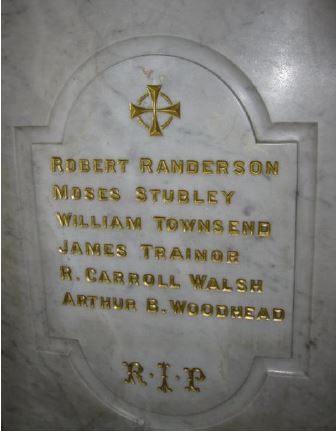
Robert Randerson, remembered on Batley St Mary's War Memorial Robert Randerson, remembered on Batley St Mary’s War Memorial

I will leave the final word on Robert from the school in which he worked. Almost exactly one year to the day from the St Mary’s log book entry about timetable changes forced by Robert’s enlistment, the same log book has an entry on 16 August 1915 announcing that school re-opened after the midsummer holiday. It went on to say in a restrained, understated way:

“News received that Captain Randerson, Assistant Master from this school, was killed in action at the Dardanelles on August 7th”. 

Sources:

  • Batley News
  • Batley Reporter and Guardian
  • Commonwealth War Graves Commission
  • FindMyPast – newspapers, census records and Teacher’s Registration Council Registers: http://www.findmypast.co.uk/
  • School Log Book – Batley St Mary’s
  • “St Mary of the Angels War Memorial” – Jane Roberts
  • “The Gazette” website: https://www.thegazette.co.uk/
  • “The Tablet” archive: http://archive.thetablet.co.uk/
  • The National Archives Catalogue Reference: WO/95/4299: Unit War Diary – 32 Infantry Brigade, 6th Battalion Yorkshire Regiment 1 July 1915-31 December 1915
  • Wikimedia Commons – Map of Suvla Bay and ANZAC Cove from Gallipoli Diary, Vol. 2 by Sir Ian Hamilton – Edward Arnold, London, 1920 or before

[1]“Huddersfield Daily Examiner”, 25 March 1915
[2]“Yorkshire Evening Post”, 27 March 1915
[3]“The London Gazette”, Publication date: 19 March 1915, Issue: 29106, Page: 2745
[4]“The London Gazette”, 25 August 1914, Issue 28879, Page 6697
[5]The London Gazette”, 15 January 1915, Supplement 29043 Page 594
[6]The London Gazette”, 11 June 1915, Supplement 29192 Page 5736
[7]“Batley News”, 22 May 1915
[8]http://www.cwgc.org/media/50615/suvla_version_7.pdf
[9] The Teacher’s Registration Council Registers show she was headmistress at St Phillips between 1910-1916
[10]“Batley News”, 10 October 1914
[11]“Batley Reporter and Guardian”, 1 October 1915
[12]“Batley Reporter and Guardian”, 13 August 1915
[13]“Batley News”, 21 August 1915
[14]“The Tablet” Et Cietera, 28 August 1915 http://archive.thetablet.co.uk/article/28th-august-1915/23/et-cietera and Catholic Roll of Honour, 1 January 1916 http://archive.thetablet.co.uk/article/1st-january-1916/13/the-catholic-roll-of-honour

Copyright

© Jane Roberts and PastToPresentGenealogy, 2015. Unauthorized use and/or duplication of this material without express and written permission from this blog’s author and/or owner is strictly prohibited. Excerpts and links may be used, provided that full and clear credit is given to Jane Roberts and PastToPresentGenealogy with appropriate and specific direction to the original content.

The Battle of Bellewaarde, 16 June 1915: A Batley woman’s efforts to discover her Royal Scots Fusilier husband’s fate

This blog posting is the story of two people: Michael Rourke and his wife Margaret Duffy. Michael died during World War 1.  The story is as much about him as it is about his wife and the extraordinary efforts she made to discover his fate.

Both were parishioners of Batley St Mary’s RC Church, ordinary working class Yorkshire folk, with the County Mayo background typical of the parish.  Margaret did not have the money and contacts of some who found themselves in similar desperate positions during the war.  But she had persistence, ingenuity and determination.  Her story is the story of many other families up and down the country trying to find out what had happened to missing husbands, fathers and sons.

Michael and Margaret do not have any link to my family. This work is based on research I did for my charity booklet about the men named on the Batley St Mary’s War Memorial.

Michael was born in West Town, Dewsbury in 1877. He was the eldest child of Irish-born parents, Patrick and Bridget Groark (neé Mullany) who married in 1876.

At this point it is worth mentioning the complexity of certain Irish surnames which, even in the late 19th/early 20th century, continued to have various versions.  Groark was one of these, and the family can be found using a number of variants including Groark, Rourke and even Groak. I have referred to Michael as “Rourke” throughout, as this was then name he used when enlisting in the Army in the 1890s, and indeed the family seemed to use this version initially.  But by around 1900, at the time of the birth of their youngest child Agnes, the family were transitioning from Rourke to Groark, and this version became the commonly used one as the 20th century progressed.

Michael was one of ten children. His siblings included Mary Ann (1879), James (born in 1881 but who died the following year), Maggie (1883), Lizzie (1887), James (1889), Henry (1892), Francis (1894), Nellie (1896) and Agnes (1900).

Initially the family lived in the Dewsbury RC parish of St Paulinus.  In 1881 they resided on Ingham Road, Dewsbury with Patrick described as a cart driver.   By 1889, as is shown in the baptism for their second son bearing the name James, the family had moved to neighbouring Batley.  James was their first child to be baptised in St Mary’s parish.

In 1891 they were recorded as living at North Street, Cross Bank, one of many streets of houses in the vicinity of St Mary’s church; then in Wooller Houses, in nearby Carlinghow in 1901.  By 1911 they were back in North Street.  During this period Patrick worked in agriculture as a farm labourer, and the 1911 census gave more detail specifying that he was a cowman.  Bridget worked in the woollen industry in 1881 as a weaver and in the following census as a rag sorter.

13-year-old Michael is recorded in the 1891 census as working as a coal miner.  In April 1897 he enlisted in the Militia with the 3rd Battalion, The King’s Own (Yorkshire Light Infantry).  As mentioned earlier his attestation papers were under the name “Rourke” and indicate that he was employed as a hurrier at Critchley’s colliery. It is in this name that all his military records can be found.

“Hurrier” was the Yorkshire term for the person who moved the coal tubs from the coal face where it had been hewed to the shaft at the pit bottom. They might be known as a waggoner in some parts of the country, a drawer in Lancashire, a putter in Northumberland or a haulage-man in Scotland.  Hurriers in this period were usually youths as this was one of the early stages in a normal career progression pattern through underground pit roles.

The same attestation papers also provide a physical description. Michael was 5’3” and 104lbs, fresh complexioned with light grey eyes and dark hair.  However within a week of signing up, he purchased his discharge for £1.

In July 1897, still employed by Critchley’s  but this time as a collier, he changed his mind and re-enlisted  in the Militia serving once more with the 3rd KOYLI for just over 12 months before transferring to the Regular Army with the Royal Scots Fusiliers in July 1898.  His Regular Army attestation papers describe him as 5’3¾” and 111lbs, fresh complexioned with light grey eyes and brown hair.  He had a small, round scar over the outer end of his right brow and a scar on the back of his right middle finger.

However a pattern was emerging as, yet again, Michael had a change of heart and in November 1898 was discharged on payment of £10, half of which was refunded in May 1899. He returned once more to work for his former employer at Critchley’s colliery.

The reason for the refund is not mentioned. But the probable cause is because, true to his previous form, Michael had once again signed Militia attestation papers in January 1899 with the 3rd KOYLI and by April 1899 was back with the Royal Scots Fusiliers[1]. The 1901 census shows him at home with his family, but his occupation is a soldier.

I have not tracked Michael’s life in the next 10 years, but according to newspaper reports he did serve in South Africa in the 2nd Boer War.

By 1911, Michael had returned home to Batley. Weeks prior to the 1911 census Michael’s mother Bridget died.  She was buried in Batley Cemetery at the beginning of March.  Michael was now once more out of the Army and living with his family.   He had changed career totally and now worked in the woollen industry as a mill hand willier[2].  This was his occupation immediately before the war at Messers Chas Robinson and Company’s mill.

On 7 June 1913 Michael married at St Mary of the Angels Church. His bride was Margaret Haley (neé Duffy), a widow with three children.

Margaret was born on 11 December 1876, the daughter of County Mayo-born coal miner Patrick Duffy and his wife Mary (neé Regan). The Duffy’s have two other younger daughters recorded in censuses – Mary and Catherine.  A fourth daughter, Bridget, died infancy. The family lived in Birstall[3] with Margaret, when reaching working age, being employed in the local woollen industry as a weaver.

Margaret married general labourer John William Haley in late 1899 and the couple settled in Whitwood, Castleford.  The marriage was short for John died in 1903, age 34. At the time Margaret had two children, Thomas (1900) and Patrick (1902). She was also heavily pregnant.  She returned home to Birstall and her family.  Daughter Margaret Kathleen was born in late 1903. By 1911 Margaret and her three children were residing with her widowed father in the town, but she moved to Batley after her marriage.

According to the baptismal register at St Mary’s, Michael and Margaret’s only child, a son named Michael, was born on 11 April 1914. The family lived at North Street, Cross Bank and this was the family address when war was declared.

Michael and his three brothers all joined the Army.  Michael was immediately called up as a National Reservist, going out to France with the 1st Battalion, The Royal Scots Fusiliers in early September 1914[4]. James enlisted with the York and Lancaster Regiment; whilst Henry and Francis served with The King’s Own (Yorkshire Light Infantry).

Michael Rourke

Pte Michael Rourke, 6093, 1st Bn Royal Scots Fusiliers

In early November 1914 Margaret received an official communication from the Infantry Record Office at Hamilton informing her that her husband had been admitted to hospital at Port-le-Grand, suffering from bronchitis.  She had not received a letter from him since the middle of October and was naturally very anxious about his condition, although the communiqué did give her  some small measure of reassurance that any news about his health would be immediately passed on to her.  Shortly afterwards, that same month, he was invalided home with rheumatism.  After a spell in England he returned to the Front for a second time.

In May 1915 a letter from him was published in the “Batley News”.  He said he was well and the weather very hot.  He also mentioned that the men got a bath and change of clothing when out of the trenches.  He also enclosed a copy of an address to his Battalion by his Brigade Commander, highly complementing them on their part in an action in which Michael participated.  This read:

“In order to cover the right flank of troops on our left, your battalion was ordered to take up a very bad and exposed position on a forward slope and sure enough on the morning after you were exposed to a very heavy shell fire, followed by an infantry attack by vastly superior numbers.  The Germans came pouring through, and it soon became obvious that your position was untenable, and we were ordered to take up a position further back. 

The Colonel, gallant soldier that he was, decided, and rightly to hold his ground, and the Royal Scots Fusiliers fought, and fought until the Germans absolutely surrounded and swarmed into the trenches.  I think it was perfectly splendid.  Mind you, it was not a case of “hands up” or any nonsense of that sort.  It was a fight to a finish.  What more do you want?  Why, even a German General came to the Colonel afterwards and congratulated him and said he could not understand how his men had held out so long.  You may well be proud to belong to such a regiment, and, I am proud to have you in my brigade. 

General Sir Smith Dorrien also praised the RSF for their fine work after Neuve Chappelle.  He visited them in billets and addressed them in terms of high praise.  “None but the best troops could do the work, and so I sent you, and you have done it”

 Michael’s last letter home was dated 14 June 1915.  By early July his family were becoming increasingly uneasy as to his wellbeing, but there was still no definite information.  The first disquieting news had arrived from a fellow-Batley soldier in late June. Pte C King of the 1st Northumberland Fusiliers wrote to Margaret on 21 June as follows:

“Mick and I were together on June 15th and promised that if anything happened to either of us on the 16th we would write to his home.  I hope you will not take this too seriously but live in hope; I went round his regiment and could not find any Mick.  Some of his pals told me he was wounded”.

Writing to Mr. A Baines of Upton Street, Cross Bank, Batley on 30 June Pte King wrote further about the fate of his friend:

“I am very sorry for Mrs Rourke.  His regiment was in the charge with us on the day I will never forget – the 16th of June.  I saw for myself that he was amongst the missing, but there is hope yet.  It was a bloody sight but a grand charge.  We had a lot of casualties and they lay all over.  My deepest sympathy goes to Mrs Rourke, for I am very much afraid that poor Mick is gone.  The Germans shelled us for 27½ hours after we made the charge and the men were blown to bits; it was hell”.

There then followed months of uncertainty interspersed with inconclusive, sometimes conflicting, information, as Margaret desperately tried to find any information as to what had become of Michael.

Around the same time as she received news from Pte King, she also received information that her husband had been wounded and taken into a Chelsea Hospital.  She asked the Record Office for information but they told her that her husband’s name had not yet appeared on any casualty list, and no report had been received that he had been admitted to any hospital.

But Margaret did not give up this line of inquiry; instead, using her church contacts, she followed it up by contacting Father F Kerr McClement of St Mary’s, Cadogan Street, Chelsea[5] to see if he could be of assistance.  Unfortunately he was unable to provide any positive news, writing to her:

“I am sorry you have had so much anxiety as to your husband and I have done my best to find his whereabouts.  He is not in St Mark’s College, Chelsea (which is generally known as Chelsea Hospital) nor in St Georges Hyde Park Corner, Victoria, Tite Street, or in any of the private hospitals visited by us”.  

On Saturday 17 July, Mrs Rourke finally received a communication from the War Office stating that they were sorry to inform her that her husband had been missing since the 16 June. At the time he was serving with the 1st Battalion’s “A” Company.

Margaret’s next recorded steps were to contact two organisations with expertise in tracing the whereabouts of missing soldiers – the British Red Cross and Order of St John Inquiry Department for Wounded and Missing Men.  The former organisation responded with the following news:

“Pte Pilgrim, of this regiment (the Royal Scots Fusiliers), who is now in No 2 Canadian General Hospital, Le Treport, tells us that there are two men named Rourke in his regiment.  The man whom he knows something about is a slim man, slightly built dark, with a moustache, about 38 years of age.  This man was wounded at Hooge on June 16th, and could not be brought in, as the Germans had retaken trenches which they had lost.  We do not know if this refers to the man for whom you are inquiring; perhaps from the description you could tell us if it is so.  But you must remember that it is not at all certain from this report what happened to Pte Rourke.  We hope to obtain more information which will make the matter clearer.”

The description given matched Michael’s. The records of the International Committee of the Red Cross do show that Margaret made enquiries about Michael, but sadly only the card noting this and Margaret’s address exist.

As more and more news filtered through, it appeared that Michael had taken part in an attack at Hooge where the Allies captured four lines of German trenches.  The Germans counter-attacked re-capturing the last two trenches.  Michael lay wounded in the third line of trenches, but so severe was the action that when the retreat came and the Germans re-captured that line, his comrades were unable to take their wounded colleagues back with them.

Margaret still did not give up, continuing to write to authorities in an attempt to establish any firm news of her husband’s fate, clinging to the hope that if not lying injured in an Allied hospital, perhaps he was being held as a prisoner of war.  With this in mind her next step was to write to the King of Spain.

Spain was a neutral country and King Alfonso XIII contributed a great deal to improving the treatment of prisoners throughout the conflict.  At his own expense he maintained a staff of 40 who helped him serve as an intermediary between prisoners and their families, using the Spanish diplomatic network in his endeavours.  In response to her plea for assistance she received the following reply:

“Palacio Real de Madrid,
October 30 1915

Madam, – I am ordered by His Majesty the King, my august sovereign, to answer your letter petitioning His Majesty to cause enquiries to be made in Berlin with regard to Mr Michael Rourke, you husband.  Although His Majesty’s Embassy in Berlin is charged only with the interests of France and Russia, His Majesty being desirous nevertheless of demonstrating his interests in British subjects, has graciously acceded to your request, and has commanded the Spanish Ambassador in Berlin to communicate with Great Britain’s representative there – the United States Ambassador – in order that in conjunction with the latter the necessary investigations may be made.  His Majesty earnestly hopes that these enquiries may be the means of procuring satisfactory information for you – E de Swire”.

Satisfactory information sadly was not forthcoming and Margaret continued in her quest.

Many other women were also tirelessly pursuing word about their missing menfolk, with advertisements for information appearing in newspapers.  It was in one of the Sunday papers that Margaret saw an advert from Elizabeth Morton from Chesterfield seeking news about her husband Lance Corpl Thomas Morton, 1st Royal Scots Fusiliers, reported missing on 16 June 1915 at Hooge.   Noting that this soldier was in the same Battalion as her husband and had been missing since the same date, Margaret wrote to Mrs Morton expressing sympathy with her and pointing out that she was in the same predicament.

Mrs Morton had received a response to her advert from a Pte Harry Thomson of the 1st Royal Scots Fusiliers, who was in a military hospital in Newcastle on Tyne.  He communicated the news of her husband’s death.  Mrs Morton passed Pte Thomson’s address to Margaret in the hope that he would be able to shed some light as to the fate of Michael.  Margaret wrote to him and received the following response:

“I am sorry to tell you that your husband, Pte Michael Rourke, was killed on the 16th June 1915.  He was slightly wounded with myself and Lance Corporal Morton.  I wanted him to go back to the dressing station and get looked after there, but he would not hear of it.  He wanted to go on and have it out with the Germans as he called it.  We went on together for about 20 yards when he fell with a bullet through the head.  He never spoke after it.  We managed to get him and some more of our men back later on and bury them behind our firing line.  I am sorry to have to tell you the sad news Mrs. Rourke, but it is best to know the truth.  The regiment lost very heavily that morning. The Royal Scots Fusiliers did their work very well.  I am glad to say that I am keeping a little better.  This is the second time I have been wounded.  I hope you are keeping well, yourself and all your family.  Anything also that you want to know about “Mick”, as we used to call him, I shall be pleased to tell you if I can.  I must close now as the doctor is on the rounds”.

Margaret forwarded the letter onto the War Office.  Towards the end of May 1916, eleven months after initially being posted missing, she received a letter in reply which confirmed that her husband was dead.  The letter read:

“Madame, with reference enquiry concerning Pte Rourke 1st Royal Scots Fusiliers I am directed to inform you that no further news having been received relative to this soldier, who has been missing since the 16th June 1915, the Army Council have been regretfully constrained to conclude that he is dead and that his death took place on the 16th June 1915 or since.  I am to express the sympathy of the Army Council with the relatives of the deceased:-your obedient servant C.F. Waitherton[6].

Michael died in what was known as the Battle of Bellewaarde. His body was never identified.  According to the website[7] dedicated to remembering the Battle, more than 1,000 men lost their lives within a 12 hour period on 16 June 1915, in an area of approximately ½ mile square.

Menin Gate Inscription

Menin Gate Inscription

Michael is commemorated on the Ypres (Menin Gate) memorial, alongside the names of more than 54,000 other officers and men whose graves are not known. These include Lance Corporal Thomas Morton, husband of Elizabeth, with whom Margaret had corresponded during her search.

Of Michael’s other brothers only the youngest, Francis, survived the war.

From cemetery and BMD records it appears Margaret never remarried. There is a burial in Batley Cemetery in April 1957 for Margaret Groark, aged 80.

The Menin Gate

The Menin Gate

Sources:

Copyright

© Jane Roberts and PastToPresentGenealogy, 2015. Unauthorized use and/or duplication of this material without express and written permission from this blog’s author and/or owner is strictly prohibited. Excerpts and links may be used, provided that full and clear credit is given to Jane Roberts and PastToPresentGenealogy with appropriate and specific direction to the original content.

[1] I have traced six sets of attestation papers for Michael.
[2] A wilier/willeyer was someone who fed the willeying machine  which was used to break down the rag and wool, thus separating and cleaning the fibres
[3] Birstall adjoins Batley. Up until 1905 when St Patrick’s parish was established in its own right, Birstall fell within the Catholic parish of St Mary’s, Batley.
[4] Service Number 6093
[5] One of the oldest Roman Catholic parishes in central London
[6]  This featured in two newspapers, the “Batley Reporter and Guardian” and the “Batley News”. The latter indicates the letter was signed C F Watherston.
[7] http://www.bellewaarde1915.co.uk/ Website includes extracts of the 1st Battalion Royal Scots Fusiliers Unit War Diary.
Three Men; two towns; one Parish (Batley, Poperinge and St Mary’s in WW1)

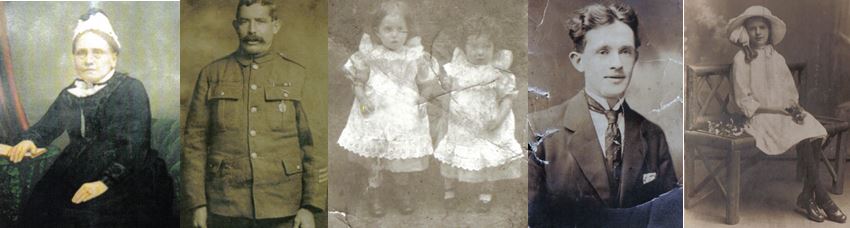
This is the story of three men, a series of coincidences and a twist of fate linking the West Yorkshire town of Batley, its Roman Catholic Parish of St Mary of the Angels and the Belgian town of Poperinghe[1] during World War 1.  The men are Michael James Flynn, Thomas Foley and Julien Cornelius Kestelyn[2].  Michael Flynn and Thomas Foley, whose lives followed remarkably similar patterns, were Army Reservists who re-joined their regiments at the outbreak of war. Julien Kestelyn was a Belgian priest.

St Mary of the Angels RC Church, Batley

St Mary of the Angels RC Church, Batley

Michael Flynn was born in Batley on 17 December 1879 and baptised at St Mary’s in January 1880. His parents Thomas Flynn and Ellen Egan came from County Mayo, the area where the majority of the Irish population of Batley originated. By 1871, when Thomas and Ellen married, Irish born families and their children made up around ten per cent of the town’s population. Michael was one of the Flynn’s seven children.  Thomas Flynn supported his family by working initially as a coal miner and then as a pit banksman, the mine surface worker responsible for raising and lowering the cage.  In  1911 he was a night watchman in the employ of Batley Corporation.

In civilian life Michael followed his father’s coalmining footsteps, working as a coal hewer. This was the man who extracted the coal from the coal face.  He plied his trade in the coal mines of Batley and Barnsley but at the outbreak of war he was back in Batley and employed at Howley Park Colliery.

In addition to his mining job Michael also served in the Militia for six years.  In March 1902, at the tail end of the 2nd Boer War, he joined the 3rd King’s Own (Yorkshire Light Infantry). His attestation papers describe him as 5’5½” tall and weighing 130lbs.  He had a ruddy complexion, dark grey eyes and dark hair.  He had five scars on the small of his back down his spine and his left little finger had been deformed as a result of an accident.

At the time Michael enlisted, the Militia was a volunteer force, seen as an alternative to the Regular Army.  After volunteering and undergoing basic training, men returned to civilian life but reported for regular periods of military training. They were not normally obliged to serve abroad, although some did during the South African War (1899 -1902).   In 1908 as a result of the Haldane reforms, the Militia battalions were turned into Special Reserve battalions, which trained part-time just as the Militia had, but would provide drafts to reinforce the regular battalions of their regiments in the event of war. It was in the midst of these changes that Michael was discharged as time-expired in March 1908, returning to his hometown and parish.
Thomas Foley was from a remarkably similar background to Michael Flynn. Two years Michael’s junior, he was born in Batley on 10 December 1881 and baptised at St Mary’s later that month.   His parents, John and Bridget Foley (neé Cafferty) were, like Michael’s, from County Mayo. Like the Flynn’s, the Foley’s had seven children.  And, in another similarity, Thomas’ father also undertook a number of different jobs to provide for his family, though these were far more disparate than the ones carried out by Michael’s father.  John Foley’s jobs included a mason’s labourer, gas stoker, coal miner and latterly a willeyer in the shoddy industry of Batley.  This job involved feeding the willeying machine used to break down the rag and wool, thus separating and cleaning the fibres.  Employed at J T & J Taylor’s Blakeridge Mills, he was described as an industrious and well-respected employee.

Like Michael, Thomas was a coal hewer who enlisted with the Militia.  At the time of his enlistment he was employed by Critchley’s.  He signed up slightly earlier than Michael, in November 1899, just before his 18th birthday. According to his attestation papers the 5’4½”, 112lbs, fresh complexioned, blue-eyed, red-headed teen joined the 3rd West Riding Regiment.[3]  Whereas Michael’s Militia service was home-based, Thomas did serve overseas as his military service coincided with the 2nd Boer War. The mobilisation of Militia needed an official order of embodiment into the Army and this was announced in November and December 1899. Thomas’ record shows that he was “embodied” with the Regiment on 22 February 1900 and “disembodied” on 10 May 1902.

His experiences in the Militia must have given him a taste for Army life, because in March 1903 he enlisted in the Regular Army, joining The Cheshire Regiment.   He signed up for 12 years – three years in the Regulars followed by nine years in the Army Reserve.  By now he was a shade over 5’6”[4] weighed 130lbs and had a heart tattoo on his left forearm.   His conduct whilst in the Army was described as good. However his records do show the occasional instances of drunkenness (especially in his early days around Chester), violently resisting escort, attempting to damage Government property, absenting himself and using threatening language towards a NCO.   Interestingly, given his Irish background, one occasion was on St Patrick’s Day 1904 when he absented himself from Tattoo until he was found drunk and creating a disturbance in barracks at Aldershot.

In terms of skills, his musketry classification was 1st Class and he passed instruction classes in swimming. The latter is no surprise. His old school of St Mary’s was renowned locally for its excellent swimmers, regularly winning local inter-school competitions.

Thomas went onto the Army Reserve in the spring of 1906, returning to Batley to work as a miner, this time at Messrs Crawshaw and Warburton’s Shaw Cross Colliery.  And whilst living in the town, like Michael, he became a member of the St Mary’s (Batley) Branch of the National Catholic Benefit and Thrift Society, a Catholic insurance organisation.

He remained in Batley for around seven years before deciding to seek better wages abroad. On 24 April 1913 he set sail from Liverpool on board the “Arabic” bound for the port of Halifax, intending to make a new life in Canada. Some reports indicate he settled in St John, New Brunswick. Others state Kensington.

Britain’s entry into the War on 4 August 1914 was to change everything for both men. As Reservists, Michael and Thomas were re-called to the Colours: The former to the 2nd Battalion, The King’s Own (Yorkshire Light Infantry); the latter to the 1st Battalion, The Cheshire Regiment.

Thomas was one of many British Army Reservists who returned to England from Canada on-board the “Corinthian”. The ship sailed from Montreal and Thomas embarked at Quebec, docking in the port of London on 4 September 1914.  He enjoyed an unexpected four days furlough at the end of September 1914 which enabled him to visit his family and friends in Batley for a final time, before re-joining his Regiment.  He also left his medals, including from the South Africa campaign, with his family for safe-keeping.

At the beginning of October 1914 Thomas went to France. The 1st Battalion the Cheshire Regiment was desperately in need of re-enforcements. According to the Unit War Diary, it had lost 78 per cent of its strength in the retreat after the 24 August 1914 Battle of Mons.

Michael arrived in France a couple of months later in early December 1914. His Battalion had also taken part in the retreat from Mons.   Their War Diary shows that they incurred 600 casualties following the Battle of Le Cateau on 26 August 1914. In common with all other Battalions on the Front, a steady leach of men was maintained thereafter so reinforcements were continually required to feed the beast of war.

By the New Year both men were in Belgium.  In the meantime an influx of Belgium refugees were arriving in Britain.  It is estimated that 250,000 made their home here during the course of the war affecting all areas, including Batley.

There was much sympathy for the plight of “Plucky Little Belgium” and widespread horror at the atrocities inflicted upon it by the invading Germans. This translated into an outpouring of offers of accommodation and a network of voluntary relief work across Britain, with Belgian Relief Funds established countrywide to support the refugees.

At the beginning of October 1914 the Citizens’ Sub-Committee for Belgian Relief accepted Batley’s offer of accommodation at Shaftsbury House, Upper Batley.  The doctors of Batley also undertook to provide their services free of charge for the refugees.

The first batch of 25 Belgians arrived in the town later that month. They were greeted at the railway station by a Mayoral welcoming party and cheered on by thousands of townsfolk as they made their way to their new Batley home. The full complement of refugees was listed in the local paper, accompanied by selected photos and tales of frightful brutalities suffered at the hands of the German invaders, all serving to whip up public support for the war.

List of  Belgian refugees arriving in Batley in October 1914

List of Belgian refugees arriving in Batley in October 1914

By early November the Batley Belgian Relief Fund stood at £141 5s 10½d.  At the end of the month with offers of more accommodation, the town had around 50 refugees in a number of locations with the papers continuing to provide details of the names, ages, abode and occupations of what were paternalistically referred to as “our refugees”.

One month later the Relief Fund had doubled, standing at £282 12s 8½d, including a 5th donation from St Mary’s RC Church. The latest sum contributed by parishioners amounted to £3 12s 10d.

The papers provided regular progress updates of the “Belgian guests,” including employment, illnesses suffered, hospitalisation, deaths, day-to-day activities, news of further arrivals and departures and information about funds raised to support them.  All of which ramped up sympathy and a willingness to assist.

Fundraising and helping Belgian refugees was a way for the people of Britain to feel as if they were contributing to the war effort whilst their husbands, sons and fathers were away fighting for that plucky little country. This included the families of the military men of Batley St Mary’s, who may have had an added incentive to donate given the Catholicism of Belgium.

Thomas Foley’s last letter home, which his parents received on 3 March 1915, was described as “cheerful” and intimated that he was in the best of health.

It appears that on 7 March 1915 whilst in action Thomas suffered fatal injuries.   His  Casualty Form  notes that he was treated initially by the 94th Field Ambulance for what was described as a “bullet wound left shoulder, right of neck and lung injured”[5].   From there he was transferred down the line to Number 3 Casualty Clearing Station (CCS) Clearing Hospital at Poperinghe. The town was well situated, being the nearest sizeable and relatively safe location to Ypres, suffering only the occasional long range bombardment.  So at this stage of the war it was an ideal position for a CCS.

The purpose of CCS’s was to treat the injured so they could be returned to duty quickly or evacuated to a Base Hospital. They moved location frequently.  According to some records Number 3 CCS was at Hazebrouck during March, the period of Thomas’ death, and did not move until April to Poperinghe. But the Poperinghe location is further confirmed in his entry in “The Army Registers of Soldiers’ Effects”.

Thomas was too seriously injured to transfer to a Base Hospital. He died from his wounds at the CCS on 11 March. His Casualty Form records his burial in the military cemetery of Poperinghe and indicates that his grave was marked with a cross duly inscribed.  His family received official news of his death in early April.

Grave of Pte Thomas Foley DCM, 7114, 1st Battalion The Cheshire Regiment, Poperinghe Old Military Cemetery

Grave of Pte Thomas Foley DCM, 7114, 1st Battalion The Cheshire Regiment, Poperinghe Old Military Cemetery

It later transpired that, whilst injured, he performed acts of heroism and courage and for these actions he was awarded the Distinguished Conduct Medal (DCM).  According to the Batley News he was the first Batley man to win the coveted distinction. The full citation, which was published in the supplement to the London Gazette on 30 June 1915, said:

“For conspicuous gallantry and devotion to duty, notably on the night of March 7th, 1915, when he went out in front of our trenches to bring in some stretcher bearers who had lost their way.  Subsequently he went out three times under heavy fire to bring in wounded men, and although wounded more than once himself he continued to carry out his duty.”

The medal was forwarded to his father in September 1915.  Along with the medal came a letter from Major Parr from the Infantry Records at Shrewsbury, on behalf of the Colonel of the Regiment.  Major Parr wrote:

“In forwarding the medal I trust you will allow me to add my sympathy in the loss of your son, and trust that the decoration for his gallant conduct may be some consolation in your trouble”.

John Foley said of his son, ‘Although I am his father, I do not hesitate to say that a finer, straighter, or cleaner lad has not set foot on the fields of France’.  Only a month later, on 15 October 1915, Thomas’ mother, Bridget, died

A month after Thomas’ death, Michael Flynn died from wounds in the same CCS on 12 April 1915.  His last letter arrived home on the day he died.  In it he said that they were having a rough time.

It is unclear when he received his fatal injuries.  But in the period leading up to his death, from 1–10 April 1915 the 2nd KOYLI were alternating between the support and front line trenches in the Verbrande Molen area, south east of Ypres.  On 1 April the Unit War Diary notes that although the enemy’s artillery was active, it did little damage.  This changed on 5 April when they were in the front line trenches and “D” Company in Trench 35 were heavily shelled and bombed at intervals throughout the day.  They suffered 14 casualties.  The shelling and bombing continued the following day.  The 2nd KOYLI received support from Belgian artillery but unfortunately one of their shells fell short landing in 36 Trench, wounding 5 men from “A” Company.  They were relieved later that day and went to the support dugouts, with “D” Company returning to Ypres.  But even at Ypres they were not safe, a shell hitting Battalion HQ on 7 April causing more casualties.  Late on 7 April those companies in the support trenches were back in the front line trenches, relieving the Dorsets.  This was a quieter period for the Battalion, with heavy firing to the left of their positions.   They were relieved by the Dorsets on the 10 April and returned to billets to rest.

A companion, Private Matthew McDonald,   who had been with Michael at Ypres which he called “the death trap” wrote, “It is not war, but murder, out there.”

Michael was buried just one row away from Thomas in Poperinghe Old Military Cemetery and their names appear next to each other in the CWGC Cemetery Register.

Grave of Pte Michael Flynn, 15338, 2nd Battalion The King's Own (Yorkshire Light Infantry), Poperinghe Old Military Cemetery

Grave of Pte Michael Flynn, 15338, 2nd Battalion The King’s Own (Yorkshire Light Infantry), Poperinghe Old Military Cemetery

But there is one further, less transparent, link between the Parish of St Mary’s and Poperinghe.  And that link is a Belgian priest, Fr Julien Kestelyn. He was born on 12 August 1888 at Krombeke, around five miles away Poperinghe but by October 1914 he was at the town’s Catholic College of St Stanislas’.  His life too was altered by the war, bringing about his move to a foreign land. But this was a move in the opposite direction to the St Mary’s duo, from Belgium to England.

Newspaper reports in Batley indicate that Father Kestelyn was ordained a priest in the trenches in the early days of the conflict, acted as a Chaplain for the Belgian Army and also assisted in Red Cross work at the Front. Other sources state he was ordained a priest in De Panne, a coastal town in Flanders during April 1915 by the Auxiliary Bishop of Mechelen.

He came to England shortly afterwards to act as Chaplain to the Belgian refugees in the Heavy Woollen District[6].  Initially, from May 1915, he was based at St Patrick’s, Birstall but by the beginning of June 1916 he transferred to a neighbouring Parish, becoming one of the priests at Batley St Mary’s.

In addition to his ministerial work within the Parish and for the Belgian refugee community throughout the district, he had a genuine interest in academia and education generally. This manifested itself in a number of areas.  According to the papers he was involved in opening a school for Belgian children in Huddersfield[7]. He produced literary papers and gave lectures on Ireland. And, in September 1918, he secured an Intermediate BA at Leeds University.

In the final months of his ministry at St Mary’s, the baptisms he conducted included that of a nephew of Thomas Foley.[8]

Fr Kestelyn left Batley in July 1919 to return home to Belgium and take up a post once again at the College in Poperinghe, teaching English amongst other subjects.

Father Julien Kestelyn

Father Julien Kestelyn

Prior to his departure he was presented with a cheque £130 and other tokens of appreciation from St Mary’s.    A few words from the farewell address by parishioners illustrate the high regard in which they held the Belgian priest. Wishing him health and strength to continue his work back home they also said:

“For your untiring care and deep devotion you have earned our loving gratitude, and your memory will be ever cherished in the hearts of all at St Mary’s”.

Sadly his health did not hold. Falling ill at around Christmas 1919 he never recovered. He died in Poperinghe on 9 March 1920.  The news was greeted with great sorrow in Batley and Birstall. A mass was celebrated at St Patrick’s, Birstall led by Dean John Joseph Lea of St Mary’s, with whom Fr Kestelyn had worked, and involving priests from across the Diocese.

So this is the story of two single men from the same Roman Catholic Parish in Batley whose lives and backgrounds followed similar patterns, who served in different Regiments, died in the same CCS just a month apart and are buried in close proximity in the same cemetery in Poperinghe.  And a Catholic priest, prior to the First World War working in Poperinghe, who moved to the Parish from which these men hailed, ministered to their families’ spiritual needs at a traumatic time in their lives and returned to post-war Belgium  only to die in Poperinghe within months of his homecoming. All were in their early 30’s.

Sources:

[1] The modern spelling is Poperinge

[2] In England he was referred to as Father Julian Kestelyn.

[3] Newspaper reports state that this service was with the West Yorkshire Regiment.

[4] He had reached 5’7” when he transferred to the Army Reserve three years later.

[5] Curiously, the Field Ambulance records treating these injuries on the 6 March and transferring him to hospital on 7 March.

[6] This is the area around Batley and Dewsbury in West Yorkshire.  It was so-named because the shoddy and mungo wool industry on which the region’s prosperity was based was used to produce heavy coatings, duffels and blankets. Ironically, as a result of the War, the demand for its products soared.

[7] The priest on the left of this photo of Belgian schoolchildren in Huddersfield may possibly be Fr Kestelyn http://www.examiner.co.uk/lifestyle/nostalgia/belgian-invasion-huddersfield-1914-6898591

[8] 16 March 1919 baptism of John Reginald, the son of Thomas’ Foley’s sister Mary Lizzie.