Tag Archives: Batley

A library is not a luxury but one of the necessities of life 

Henry Ward Beecher’s quote is something I truly believe. Sadly I don’t think Kirklees Council understand it. Less than a year on from the last round of council cuts which prompted me to write about the important roles libraries play in family history, it appears with the latest council budget vote we are now on track for a cull of unprecedented proportions.

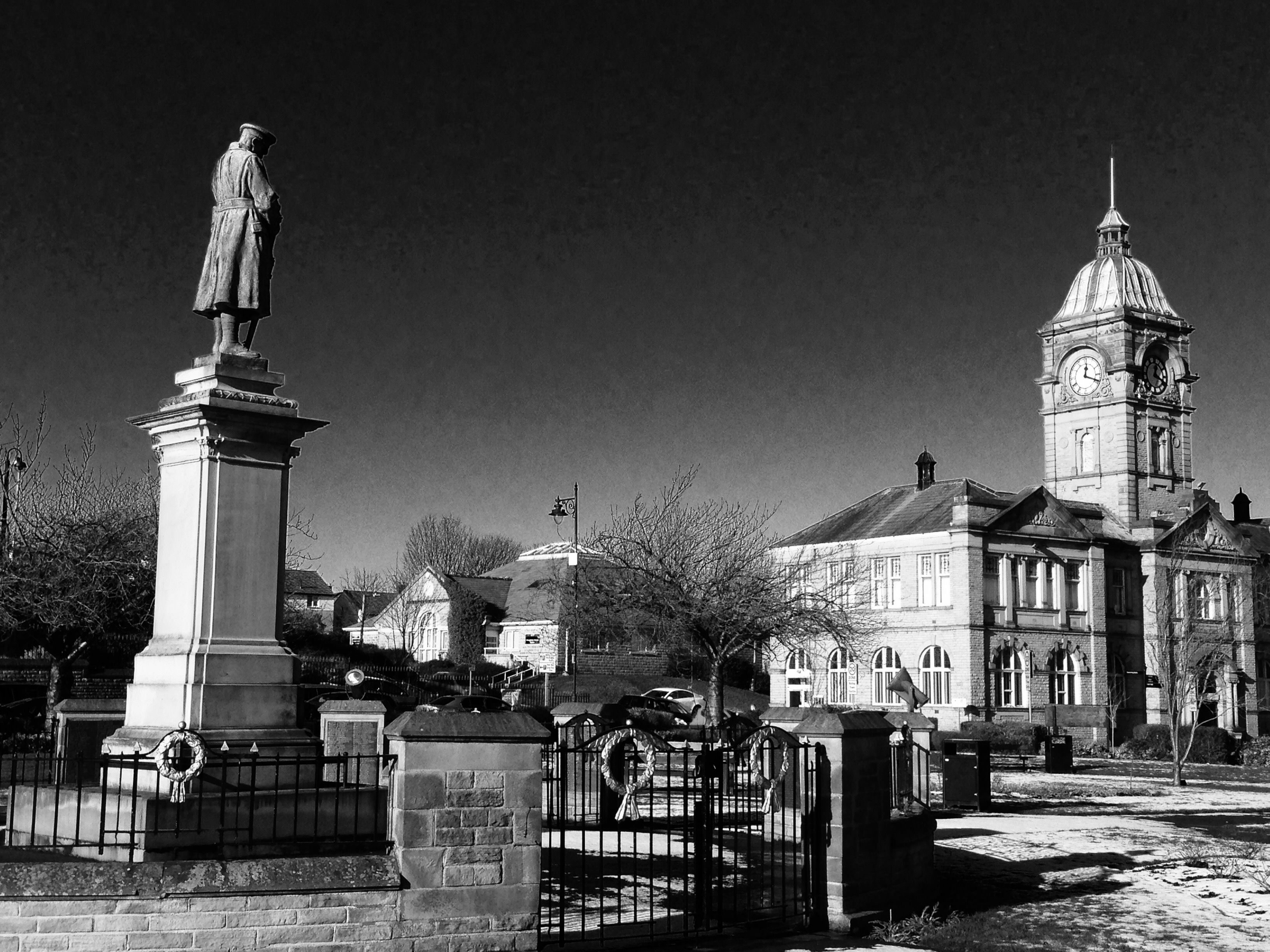
Batley Library – Photo by Jane Roberts

Last year, following a public consultation, Kirklees closed two of its 26 library branches. However, it ceased funding a further 14, handing them over to community groups and volunteers to run.  The numbers of council staff employed in the remaining libraries were slashed and opening hours reduced. Batley library cut its weekly opening hours from 48.5 to 35 in September 2016 as a result. 

This appears to be just a taster of things to come. “Public Libraries News“, in article at the end of January 2017 entitled “USA and Canada see library usage rise: 3/4 budget cuts in Walsall and Kirklees” reported Kirklees would have a £1.7m cut to the library budget 2017/18 (from £3.9m to £2.2m). This equates to £1.85m cuts from start 2016 to end 2018. This is on top of last cut of £1.8m cut in 2015/16, meaning budget cut by 72% cut in three years.

In effect, as a result of these latest cuts, we will be looking potentially at just two funded libraries (Huddersfield and Dewsbury) to serve the entire population of around 435k and rising in the Kirklees Metropolitan Council area. Arguably one of the worst library culls nationwide. 

I’m not getting into the whys and wherefores for these cuts. It is undeniable that councils like Kirklees face a major central government funding recession, and Kirklees receives government funding way below the national household level. However, to quote Eleanor Crumblehulme:  “Cutting libraries during a recession is like cutting hospitals during a plague“. 

Sadly, libraries are not seen as an essential service. Mention bins and folk are up in arms because it has a direct everyday impact on all households. Cuts to libraries, museums and parks don’t have the same impact. As a result, fewer people stand up for them in any tangible way. Councils know this. They know where the main battles lie. Libraries, and broader culture, are easy targets.

However I believe libraries must be seen as an essential community resource. They are used across all age-groups. They also have a big influence in drawing together a diverse community.  In the words of Libba Bray “The library card is a passport to wonders and miracles, glimpses into other lives, religions, experiences, the hopes and dreams and strivings of ALL human beings, and it is this passport that opens our eyes and hearts to the world beyond our front doors, that is one of our best hopes against tyranny, xenophobia, hopelessness, despair, anarchy, and ignorance“. 

Libraries play a part in the Jo Cox legacy about combatting loneliness. This in turn has links to community health and well-being, with mental health being high on the political agenda. One in three adults aged 16-74 (37 per cent) with conditions such as anxiety or depression, surveyed in England, were accessing mental health treatment, in 2014. Overall, around one in six adults (17 per cent) surveyed in England met the criteria for a common mental disorder (CMD) in 2014. Around one in four people every year develop anxiety, depression or other related conditions.

Libraries have a vital role in combatting anxiety and depression. They are a window on an outside world, providing a safe, welcoming social hub. Besides the range of self-help books, they offer volunteering and socialising opportunities. They host activities, crafts, community groups and surgeries for local politicians at council and government level. They have newspapers. There are talks and a wide range of exhibitions. They offer computers, internet access, printing and photocopying. There are events for children. Batley has Memory Lane Café sessions for those experiencing dementia. In February the library hosted a bowel cancer screening information session with a GP registrar. This is the February Batley library newsletter, highlighting the wide range of services.

Libraries engender a love of books from an early age, aid literacy and afford an opportunity for learning and development, outside of school. Not every child has access to books or computers at home. Not everyone has transport or can afford to travel if their library closes. They are a repository for local history and civic pride. They, and other public amenities such as Town Halls, markets, Post Offices, Police Stations, swimming baths, technology colleges, shops and even Job Centres are things that draw people into a town centre. Start removing them and bit by bit the town centre declines, becomes delipidated, deserted and eventually a crime-ridden no-go area.

Libraries are also free. To quote Lady Bird Johnson “Perhaps no place in any community is so totally democratic as the town library. The only entrance requirement is interest“. And Anne Herbert was spot on when she said “Libraries will get you through times of no money better than money will get you through times of no libraries“.

But to get back to my key message about the Council library budget annihilation. It’s all well and good people grumbling and complaining about cuts to local services. I’ve seen many social media moans about how unfairly communities outside the central Huddersfield are treated. But how many of these people actually use their local library? By the time they wake up it will be too late. Years later they will laud the halcyon days of libraries and rue their unavailability for their children and grandchildren. But through their inactivity they shoulder the blame for this loss alongside any government or council.

So, my challenge to all those who say they value their library and community: Don’t sit back and throw sideline pebbles which achieve nothing. If you don’t want to lose your library now really is the time to show your support. Get out your library card, visit your local library, get involved, and start borrowing some books and e-books (yes libraries embrace technology). Beyond that, lobby your local Councillors. Write to your MP asking they raise the funding issue at government level. Bombard the local media with letters. Challenge. Use. Support. And do your utmost to “Save Your Library“.

My final quote is from Ray Bradbury. “Without libraries what have we? We have no past and no future

Postscript:
Finally a big thank you for the donations already received to keep this website going. 

The website has always been free to use, but it does cost me money to operate. In the current difficult economic climate I am considering if I can continue to afford to keep running it as a free resource, especially as I have to balance the research time against work commitments. 

If you have enjoyed reading the various pieces, and would like to make a donation towards keeping the website up and running in its current open access format, it would be very much appreciated. 

Please click here to be taken to the PayPal donation link. By making a donation you will be helping to keep the website online and freely available for all. 

Thank you.

Sources:

Healey, Batley WW1 Remembrance Project – 1918 Electoral Register List of Men

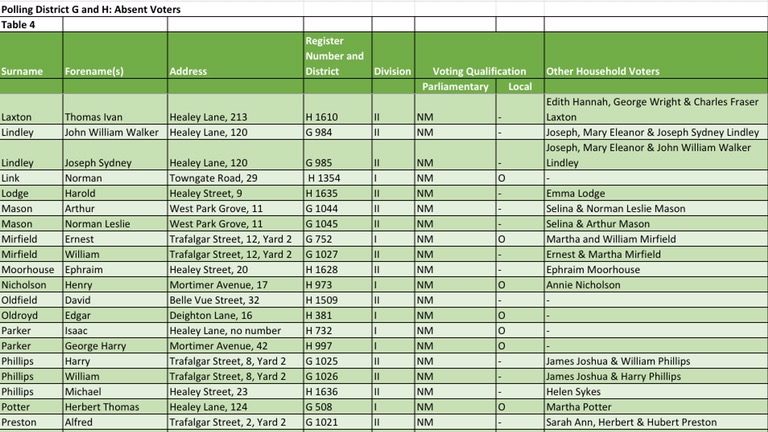
Thanks to the wonderful Batley Library staff and volunteers, the missing Batley Borough 1918 Electoral Register was located just before Christmas. I spent the early few days of February beavering away on it to extract the absent Healey naval and military voters, and put them into spreadsheet format.  

This work has significantly expanded the list of servicemen I initially identified using CWGC records of those who died, the WO 363 “Burnt Records” and WO 364 records of those discharged for medical/capability reasons. This initial list identified 39 men, though I have subsequently discovered an additional man. He is Arthur Ellis, a rag merchant whose address was 263 Healey Lane. He served with the Grenadier Guards, Service Number 27774. 

The Electoral Register, signed off on 1 October 1918 by the Batley Town Clerk’s Office, identified 121 men, though there is a small overlap with my earlier findings. The numerical difference is indicative of the limited numbers of soldiers’ service records surviving, with around two thirds of them being totally lost or irretrievably damaged during WW2 1940 bombing. 

First bit of background information about voting entitlement and the Electoral Register. The Representation of the People Act 1918 came into force in time for the December 1918 general election. One of the drivers for electoral reform included the fact only men who had been resident in the country for 12 months prior to a general election were entitled to vote. This residential qualification, combined with the property ones, meant many serving King and Country overseas were effectively disenfranchised. The Act abolished these restrictions and extended the vote to all men over the age of 21. Additionally, men who had served in the war could vote from the age of 19. However Conscientious Objectors were disenfranchised for five years. The Act also gave the vote to women over the age of 30 who met a property qualification, wives who were over 30 of all husbands who were entitled to vote in local government elections and also to those who were university graduates.  

However, it should be noted that parliamentary and local government franchises were not the same. Hence the 1918 register is split into three categories. 

  • Division I: Persons qualified as both parliamentary and local government electors; 
  • Division II: Persons qualified as parliamentary electors but not as local government electors; and 
  • Division III: Persons qualified as local government electors but not as parliamentary electors.  

Abbreviations used are:

  • R: Residence qualification;
 
  • BP: Business Premises qualification;
 
  • O: Occupation qualification;
 
  • HO: Qualification through husband’s qualification;  
  • NM: Naval or Military voter; and  
  • a: indicates absent voters. 

So here are the names of those identified from the 1918 Electoral Register.


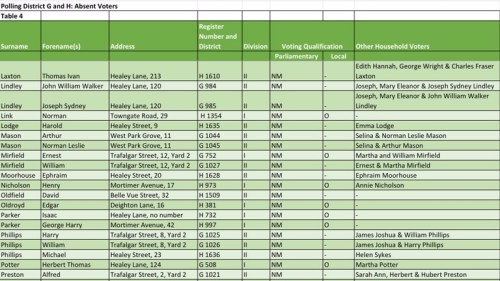
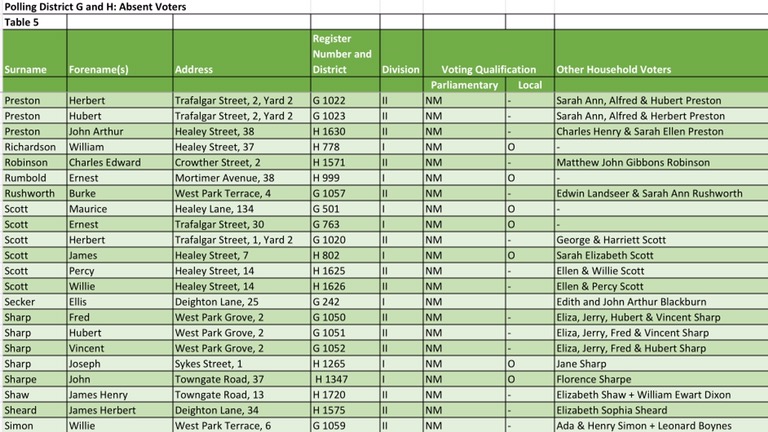
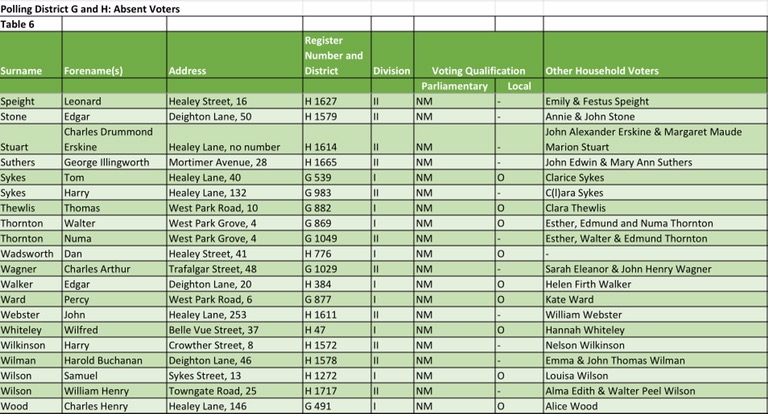
The men on my Healey list all fall within both the absent and Naval and Military categories. The information was supplied by next of kin so may not be accurate. It may include men who were killed after its compilation. And addresses may not necessarily reflect actual residence, but merely be the most convenient address, for example the in-laws where the man’s wife was living whilst he was serving, or a friend’s home. 

It is also worth emphasising this is the Electoral Register. It isn’t what is commonly known as the Absent Voters List (AVL). These lists, generated to provide servicemen and nurses with voting cards, ballot papers or proxy voting forms depending on where they were serving, gave far more detail. They normally included regiment, number, rank and home address. Sadly, despite checking with West Yorkshire Archives and Huddersfield Local Studies Library, I’ve been unable to locate the one for Batley Borough. It may be it no longer survives. The AVL would have provided so much more crucial identification information. But the Electoral Register is better than nothing. 

The Register also enabled me to further define the parameters of this project. I used the Batley West Ward Polling Districts G and H to identify the relevant streets. These are:

  • Belle Vue Street 
  • Crowther Street 
  • Deighton Lane 
  • Healey Lane (excluding the numbers falling within Polling District I. These are mainly below 79, with the exception of some numbers in the 40s which fall within District G) 
  • Healey Street 
  • Mortimer Avenue 
  • Sykes Street 
  • Towngate Road 
  • Trafalgar Street 
  • West Park Grove 
  • West Park Road 
  • West Park Terrace 

These are in addition to Nelson Street and Prospect Terrace identified from earlier research. Looking at the 1911 Census Summary Books some Chaster Street houses may also fall within the catchment area.

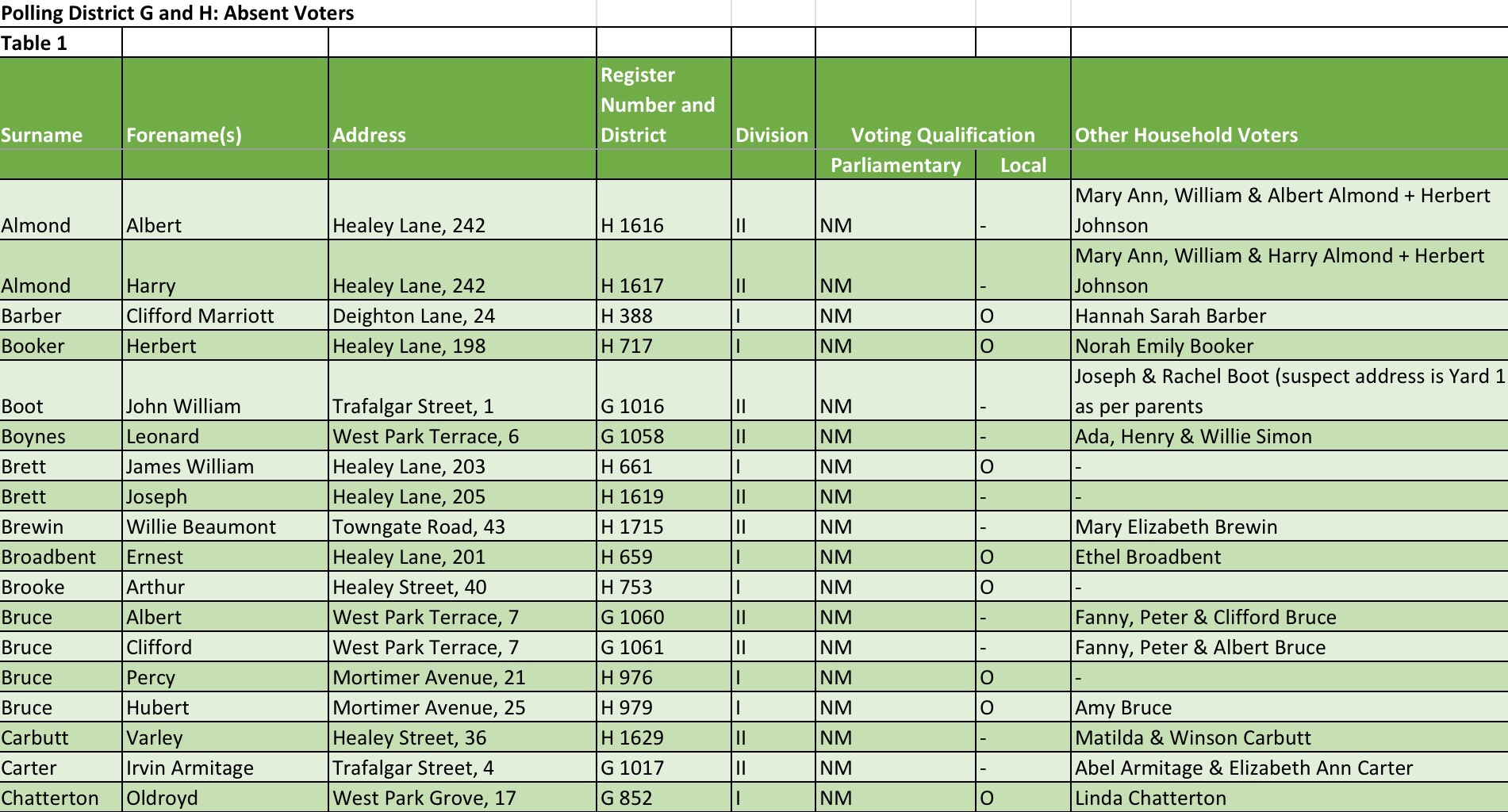
The men’s details from the Electoral Register are contained in the following six tables. I checked across all three Divisions to identify other voters registered at the men’s given addresses, in the hope this provides more family clues.

So I can give myself an early 2017 back pat. This data extraction was one of my 2017 New Year’s Resolutions. I’d targeted a March completion, so I’m ahead of schedule and I can now begin the hard research, although I am still toying with the idea of the newspaper trawl. I know from previous experience how much value this adds. It’s a case of whether I have the time to do it alone!

Previous posts in this series are: 

Sources:

  • Register of Electors 1918, Parliamentary Borough of Batley and Morley 
  • 1911 Census Summary Books 

Happy Birthday and Farewell: A Father’s Love

16 December 1914 marked a momentous day for my family. My grandma celebrated her sixth birthday. But not any old ordinary birthday in Batley for her, spent with her mum, dad and seven year old sister Nellie. This birthday was unlike any other.

Astonishingly, I discovered this of all days was the day her 46 year-old father, my great-grandfather Patrick Cassidy, chose to enlist with the local regiment, King’s Own Yorkshire Light Infantry (KOYLI). Patrick, born in 1868 in Hagfield, County Mayo, even knocked several years off his age to ensure he would be accepted. His attestation papers show he claimed to be 35 years and 11 months.

I knew my great-grandfather had been in the Army. My grandma told a tale of a motor vehicle turning up at their Hume Street home containing someone to see her dad. The story goes that the officer inside was the one he’d acted as batman for. I had no date for this event, but given my grandma remembered it, I’d guessed in sometime after 1912.

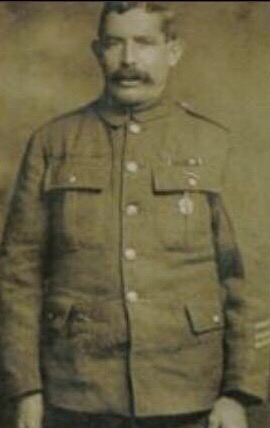
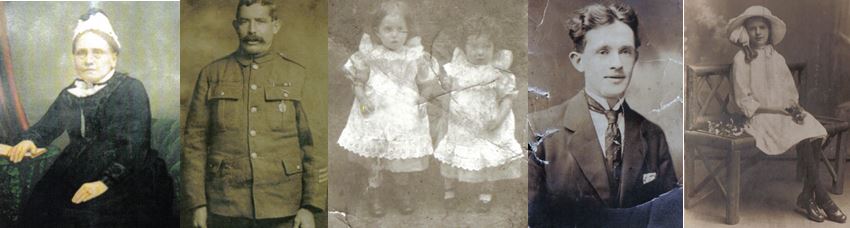
However, because of his age, I’d discounted him seeing his military service during the Great War. Combined with his age, his uniform in one of the family photos, with its three point-up chevrons on the lower left sleeve indicating 12 years good conduct, indicated pre-war service. I’d marked it as pre-1904, as he’d first turned up in Batley in January of that year. And by then he was a labourer. That was also his occupation when he married Ann Loftus in 1906. And also in the 1911 census.

Patrick Cassidy

As it happens his attestation papers backed up this earlier service theory. He confirmed to the attesting officer he had previous time-expired service with the Duke of Wellington’s Regiment (West Riding). He described it as 33rd and 76th West Riding, harking back to 1881 and the Cardwell Reforms when the Halifax depot 33rd and 76th Regiments of Foot merged.

One thing I found amusing from these papers: My grandma, who adored her father, always gave the impression of him being a tall man. According to his army forms he stood at the incredible height of…….5’ 3.5”. Just goes to show, don’t take all oral family history as gospel!

Anyway, back to the lie over his age. As an ex-soldier, by this stage of the war, the age limit was 45, not 38 as for other volunteers. So he really did go overboard with his age reduction. In fact, with his precise 35 years and 11 months, it seemed he was still working to the end of August 1914 rule change for volunteers without previous service, when the upper age limit was increased from 30 to 35. He really was determined to do his bit.

Still, I couldn’t get my head round it. Not the fact he chose to sign up. Not even the fact he lied about his age to do so. But why on earth would he do it on his young daughter’s birthday? Why not wait till a few days later? In fact, why not wait till after Christmas? Had there been some major family row that prompted it? Or had a close family member or friend, as yet unidentified by me, died whilst serving? Was my great grandfather out to avenge their death? Those were the only explanations I could come up with.

His papers offered no clues whatsoever as to why he would act in this way and leave his wife, children and labouring job in Batley to take this huge risk. Or did they?

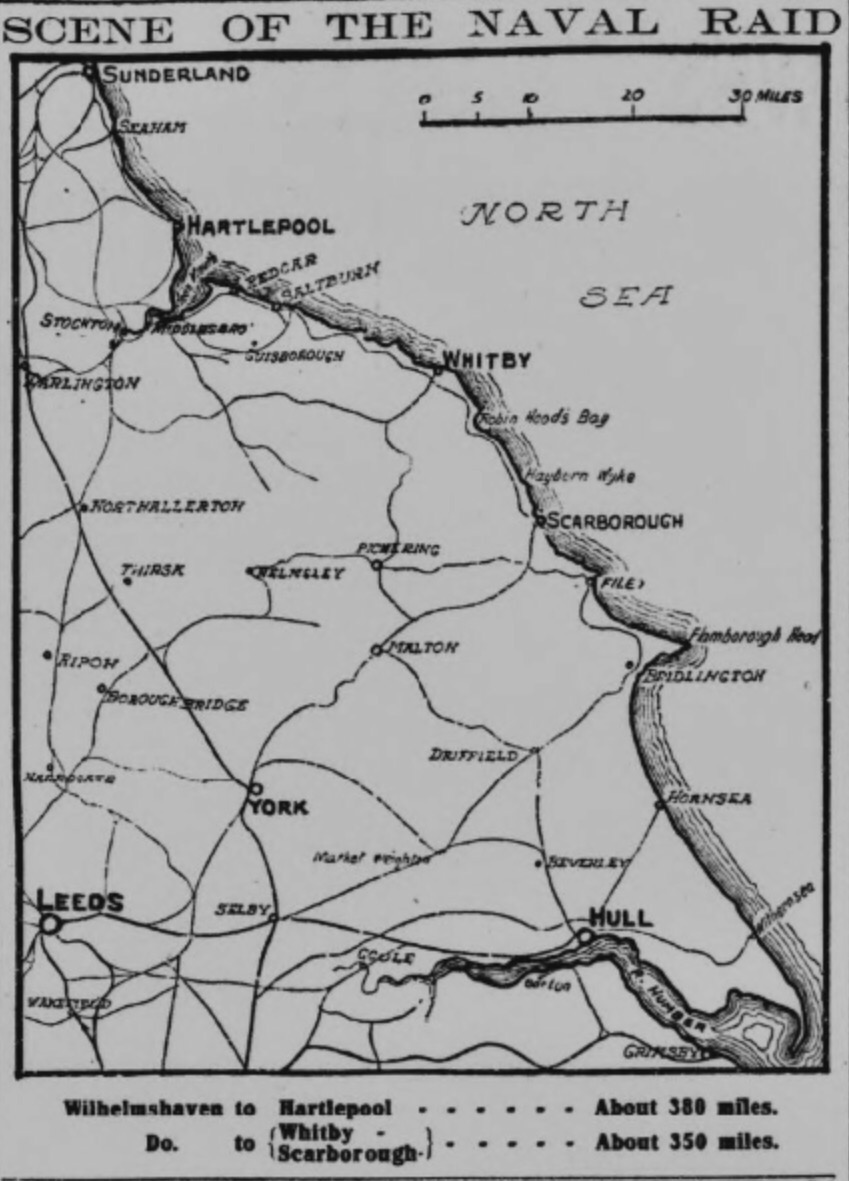
Several months later, whilst doing some general research, I realised the papers did contain the answer. The key was in the date. I’d been looking at it in narrow family terms, my grandma’s birthday. I’d not looked at any wider historical events. Besides being my grandma’s sixth birthday, Wednesday the 16 December 1914 marked the day German Imperial Navy ships Seydiltz, Moltke, Blücher, Derfflinger and Von Der Tann bombarded the east coast towns of Scarborough, Whitby and Hartlepool with a final toll of over 130 killed and almost 600 injured. 

The attacks occurred from around 8am to 9.30am that morning. In the immediate aftermath, in scenes reminiscent of Belgium and France, refugees fled their homes seeking safety inland. Distressed residents from the stricken towns, some still in slippers and nightdresses, disembarked in local railway stations with tales of terror and destruction and reports of “scarcely a building left standing.” The historic landmarks of Whitby Abbey and Scarborough Castle suffered damage. Famous seaside hotels, like Scarborough’s Grand Hotel, bore shell scars.

The Grand Hotel, Scarborough

From 16 December onwards newspapers the length and breadth of the country carried the stories of this exodus, along with tales of death, injury and destruction wreaked. This from “The Yorkshire Evening Post” of 16 December reporting of arrivals in Leeds at 11 o’clock “One woman who arrived was wearing her bedroom slippers; in her arms was a two-year-old son in her nightdress and an outer garment lent by someone on the train.”

Another refugee was Mrs Knaggs, who lived in the vicinity of Scarborough’s damaged Grand Hotel. She arrived in Leeds on the 1 o’clock train into Leeds with her eight-year-old daughter and a few hastily packed groceries. She recalled meeting “…scores of women and children. All seemed unconsciously making for the railway station. Some were half dressed, and carried with them all manner of household articles. Another refugee had a child of a fortnight old in her arms, and with her was another partly-dressed girl of fourteen…..The streets of Scarborough were filled with women. These refugees were without food, money and very scantily clothed.”

Whitby resident Mrs Hogg was another Leeds arrival. Her house was struck by a shell. She recounted: “Outside shells were flying about, tearing up the pavement and damaging houses….In the fields in the outskirts of town big holes were torn in the ground and all the telegraph wires were down. People were hurrying along, some with a few belongings they had managed to get together. One man was carrying a parrot and two bird-cages. My little boy had run out of the house in his slippers. He lost his slippers on the way, and had to walk in his stocking feet.

The German navy were dubbed the baby-killers of Scarborough, a reference to one of the victims, 14 month old John Shields Ryalls. In a letter to the Mayor of Scarborough on 20 December 1914 Winston Churchill, First Lord of the Admiralty wrote: “Whatever fears of arms the German Navy hereafter perform, the stigma of ‘Baby-Killers of Scarborough’ will brand its officers and men while sailors sail the seas.” 

Baby Ryall’s picture along with another victim, 15 year-old boy scout George Harland Taylor, featured prominently in the press with inflammatory headings like “Slain by Germans” and “Killed by the Raiders.” Others included 28 year-old Miss Ada Crow, due to be married to her army fiancé, Sergeant G.R. Sturdy, on what turned out to be the day of her funeral.

Some were of the opinion that the attack was the best thing that could have happened – it would give a boost to recruitment, now waning after the initial rush following the declaration of war. Battalions would be filled on the back of the attack.

By 18 December newspapers were reporting a material increase in numbers coming forward to recruiting offices, particularly in the areas affected by the bombardment. And from 18 December a new recruitment poster made its appearance:

AVENGE SCARBOROUGH 
Up and at ‘em now!
The wholesale murder of innocent women and children demands vengeance.
Men of England, the innocent victims of German brutality call upon you to avenge them. Show the German barbarians that Britain’s shores cannot be bombarded with impunity. Duty calls you now.
Go to-day to the nearest recruiting depot and offer your services for your King, home, and country.

This theme was echoed in subsequent recruitment poster campaigns. This included a depiction of the ruins of 2 Wykeham Street, Scarborough where four died: Johanna Bennett (58), her son Albert Featherstone Bennett (22) a driver in the RFA, and two young boys John Christopher Ward (9 according to newspapers, although GRO entry gives his age as 10) and George James Barnes (5).

My great-grandfather didn’t wait for these rallying call to arms. He went to the recruiting office on the very day of the attack. Maybe the White Lee picric acid explosion with rumours of German sabotage only a fortnight earlier, which caused death and devastation to Heckmondwike and Batley, also played a part in his thinking. Though I can’t be 100 percent sure, it looks like he enlisted because he wanted to protect his family. The bombardment of east coast town, with the huge loss of life and the streams of refugees which followed, brought the war so much closer to home. The Yorkshire seaside resorts of Whitby and Scarborough were particularly popular local holiday destinations. In fact when war was declared only four months earlier the local Territorials, 1/4th KOYLI, were on their summer camp in Whitby. No longer was it a distant war affecting civilians – women and children – in foreign lands. It was now in Yorkshire. His family were now under threat. He couldn’t stand aside any longer.

So what became of him? The attestation papers indicated his resurrected army career with the KOYLI proved short-lived. On 15 January 1915 he was discharged as unlikely to become an efficient soldier. Unsurprising given his age. But the discharge setback did not deter him. It wasn’t the end of his military service.

By pure chance I found an entry in the “Batley Reporter and Guardian” of 27 August 1915. Private Patrick Cassidy of Hume Street appeared in Batley Borough Court charged with being absent without leave from the 3/4th battalion Duke of Wellington’s Regiment, who were stationed at Halifax. So he’d gone back to his old regiment. The Batley Borough Court records gave the offence date as 24 Aug 1915. He pleaded guilty and was remanded to await a military escort.  I wonder if this has any link to the vehicle my grandma recalled?

The 3/4th Duke of Wellington’s was formed in March 1915 so it seems Patrick may have remained a civilian for as little as a couple of months after leaving the KOYLI. The battalion remained in England throughout the war, stationed at Clipstone Camp, Rugeley Camp, Bromeswell (Woodbridge) and Southend, training and supplying drafts for overseas service. I’ve traced no Medal Index Card for Patrick so it seems he remained on home shores. However he did see the war out. In the Batley Electoral Register of 1918 he is listed as being absent as a naval or military voter.  Unfortunately the detailed Absent Voter List for Batley does not appear to have survived. This would potentially have confirmed his service number and regiment.

So this tale goes to show that when researching family history you need to look at wider historical events be it local, national or international. They too have an impact on the lives and decisions made by ancestors and can help you see your family history in a new light.

Sources:  

  • Batley Borough Court Records – West Yorkshire Archives
  • Batley Register of Electors – 1918
  • GRO Indexes
  • Imperial War Museum Poster from 1915: “Men of Britain! Will You Stand This?” © IWM (Art.IWM PST 5119). Shared and re-used under the terms of the IWM Non Commercial Licence
  • Newspapers including:
  1. Batley Reporter and Guardian – 27 August 1915.
  2. Leeds Mercury – 17 December 1914
  3. Yorkshire Evening Post – 16 and 18 December 1914
  4. The Leeds Mercury – 21 December 1914
  • WO 364 -Soldiers’ Documents from Pension Claims, First World War

Death of a Barnbow Canary: WW1 Munitions Work

The past few weeks have focused on those who served and lost their lives during the Battle of the Somme. But what about those closer to home whose efforts may have gone largely unnoticed?

In this blog post I’m turning my attention to another centenary. 21 July 2016 marks the 100th anniversary of the death of Barnbow munitions worker Ann (Annie) Leonard.

Ann Leonard

Annie Leonard

Annie was born in Morley in late 1891[1].  She was the eldest daughter of Leeds-born William and Emma Leonard (neé Dowd).  The couple married in 1890 and, including Annie, they had 10 children.  One child died in infancy but Annie’s other siblings included Edward (1894), Alice (1896), Walter (1897), Agnes (1900), Doris (1902), Ethel (1904), Elsie (1906) and Nellie (1908).  All but Annie and Edward were baptised at St Mary’s RC Church, Batley.

In the 1891 census William and Emma lived at Springfield Lane, Morley. William was a coal miner.  In 1901 the couple had five children and were still living at Morley, but their address had changed to New Park Street.  William was now a coal miner deputy. This was the official employed in a supervisory capacity at the pit with responsibility for setting props and general safety matters.

By 1906 the family had moved to Batley and the 1911 census gives their address as North Bank Road, Cross Bank. This remained the family address when Annie died.  At the time of this census William still worked as a coal miner deputy below ground.  19-year-old Annie, in common with many other local women, had employment in a woollen mill working as a cloth weaver.

War changed all this. Within weeks of its outbreak Annie’s eldest brother Edward, a former Batley Grammar School pupil with a talent for art, enlisted with the Leeds Rifles. He went to France in April 1915.

Around the time Edward went overseas the “shell scandal” debate raged at home, with the shortage of high explosives being cited as the reason for failure in battles and loss of soldiers’ lives. The war was lasting longer than anticipated; the number of men in military service was adversely affecting industrial and manufacturing output, including munitions manufacture; and the quantity of shells required was outstripping that of any other previous conflict. For example in the first 35 minutes of the March 1915 attack at Neuve Chappelle  more shells were consumed than in the entire 2nd Boer War.  There was a countrywide cry for “shells, and still more shells”.

The Government response was the 1915 Munitions of War Act with far-reaching Government powers in production. National Shell and National Projectile Factories were established, and National Filling Factories set up to fill these shell casings with explosives and attach fuses.

For_King_and_Country_Art.IWMART6513 (2)

IWM Public Domain image by Edward F Skinner. See Wikimedia Commons footnote.

Interestingly, shortly after his arrival in France, Edward wrote a letter home to one of his sisters, possibly Annie. It is particularly noteworthy for his description of German shelling.

Taking things all round, we have had a very quiet week as far as shells, etc, go. We had about the busiest day yesterday when the enemy started sending us shells and trench mortars over…..You can hear them whistle over, but cannot tell to a few hundred yards where they are going to burst.  They “don’t half” make a row when they burst. 

But the trench mortars are the worst. You can see them coming in the daytime.  They look like bottles coming at about the speed a man throws a cricket ball.  When they drop they are about 10 seconds before they burst; but when they do they shake everything for a good distance away.  Personally, I think they are the most terrible things they send”.

Leeds had taken an initiative early in the war in setting up a shell production factory at the Leeds Forge Company, Armley. In August 1915 they took it a step further and oversaw the construction of the First National Shell Filling Factory at Barnbow, between Crossgates and Garforth.

Covering 313 acres at first, but eventually extending to 400, by December 1915 filling operations commenced with the employment initially of around 50 women. Operations were expanded with the Ministry of Munitons’ decision to install an Amatol filling factory at Barnbow in spring of 1916. Amatol was highly explosive, formed by mixing tri-nitro-tolene (TNT) and ammonium nitrate.

Barnbow was now responsible for filling and assembling QF artillery ammunition (13pdr, 18pdr and 4.5 inch), shrapnel and high explosive (HE). Output soon reached 6,000 shells a day.

Once the war ended and secrecy restrictions no longer applied, newspapers published the following statistics for Barnbow shell production:

  • 12,000 tons of TNT were mixed with 26,350 tons of ammonium nitrate producing 38,350 tons of amatol;
  • In the cartridge factory more than 61,000 tons of propellant (NCT and cordite) were made up into breech-loading cartridges, the highest record for one week being 938 tons. This material had to be carefully weighed on scales into ounces and drachms, giving an indication of labour intensivity and precision[2].
  • Over 36 million breach loading cartridges were charged;
  • Nearly 25 million shells were filled;
  • Over 19 million shells were completed with fuses and packed into boxes;
  • 566,000 tons of finished ammunition was dispatched overseas;
  • If laid end to end the 18-pounder shells alone measured a distance of 3,200 miles, equivalent to the distance from London to New York

By October 1916 the workforce totalled around 16,000, although numbers subsequently declined to around 9,000. 93 per cent of employees were women and girls, with a woman/man ratio of roughly 16:1. About one third of the employees came from Leeds. Others were from Castleford, Normanton, Pontefract, Wakefield, Harrogate, Knaresborough, York, Selby, Tadcaster, Wetherby and surrounding areas.

In addition to railway lines for transporting raw materials and finished products, the North Eastern Railway Company operated 38 “Barnbow Specials” a day. These trains transported the workers to and from the site. There were also 15 ordinary trains.  The workers had free work travel permits.

The Barnbow girls employed on shell-filling earned an average of around £3 a week. However, when the bonus scheme operated some girls could earn as much as £10-£12. Compare this to the wage of a domestic servant who earned as little as two shillings and six pence a week.

But the hours were long and the working conditions arduous, in part due to the nature of the explosive material the girls were working with. Nothing causing static and sparks was allowed: so rubber-soled shoes, smocks, caps only and no matches, cigarettes, combs or hairpins. Initially set up with two shifts a day, soon a three eight-hour round-the clock shift system came into operation. The girls normally worked six days a week with one in three Saturdays off. No holidays. No strikes.

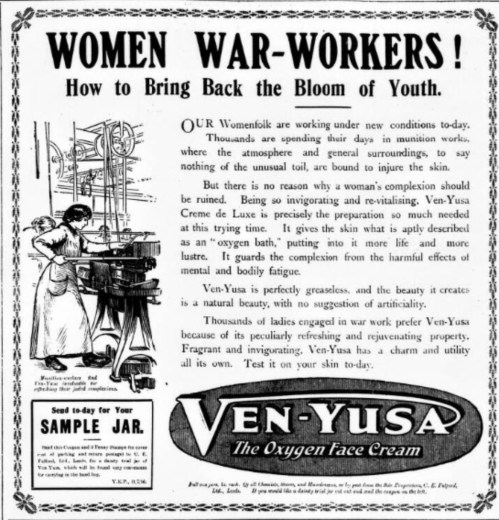
But above all the work was dangerous. Not for nothing was the pay high (but not the equivalent of a man!) There was the very real risk of explosion, three occurring at the Barnbow factory during the war. But more insidiously, the women worked with toxic material, and were at high risk of poisoning.  The symptoms included nausea, vomiting, chest and abdominal pain, headaches, blurred vision, nose and throat problems. However the most obvious manifestation was the yellowing of the skin caused by toxic jaundice, earning the girls the nickname of “canaries”.  Newspapers regularly advertised a skin product called Ven-Yusa aimed at preserving the complexion, and the “munitionettes” were a specific target-market for this product.

image

Ven-Yusa advert – The Yorkshire Evening Post, 11 July 1916


Milk was also thought to counteract the yellowness. So besides its three canteens, Barnbow had its own farm with crops and animals. Its 120 cattle produced 300 gallons of milk a day. The workers were allowed to drink as much milk and barley water as they wanted.

Despite the hard toil and dangers there was no shortage of women willing to apply for this work. Recruitment of such a large workforce over such a short space of time meant the opening of a new office at Wellesley Barracks, Leeds specifically for the task. One of the early employees Mrs Edith Haigh in an interview with the “Yorkshire Evening Post” in 1939 described her interview as follows: 

“When I applied for work a woman interviewer asked me if my nerves were good, and told me to breathe deeply so that she could see how my lungs were. “Are you afraid of shells?” she asked. “I don’t suppose I shall be,” I said. “You are willing to undertake it?” “Yes, I’ll take it, whatever it is.”

It was this working environment Annie entered. As well as patriotic duty, perhaps her brother’s service and letter about shells had some influence.

With preparations for the Battle of the Somme, increased shell production was imperative. Annie was employed as a filler and stemmer at the factory. Explosive powder was poured, or “stemmed,” into the shell casings. A mallet and wooden drift was then used to compact the powder.  Elsie McIntyre filled shells at Barnbow. She described the work as follows:

“We had to stem… when it first opened in the early part of the war, we had to stem the powder into shells with broom handles and mallets.  You see, you’d have your shell and the broom handle, your tin of powder. And you’d put a bit in, stem it down, put a bit more in, stem it down. It took you all your time to get it all in. It was very hard work”.

Annie had not been working there long, but on 25 June 1916 she returned home complaining of sickness. Her face took on the typical yellow hue associated with munitions work. The family called in Doctor Fox. They also consulted a specialist. All to no avail. Annie’s condition worsened and she died on the morning of 21 July 1916.

Within hours of Annie’s death, her grieving family received more tragic news, with a wire informing them  Edward had not been seen since heavy fighting on the 2 July. He was officially reported as missing.

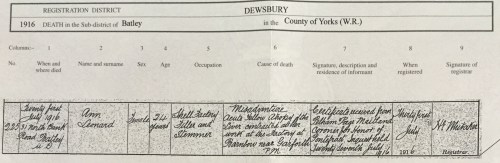
Annie’s inquest was heard behind closed doors on 27 July. Her death was recorded as “Misadventure. Acute yellow atrophy of the liver contracted at her work at the factory at Barnbow near Garforth”.

image

Annie Leonard’s Death Certificate

At this very difficult time for the Leonard family, with their daughter’s death and their deep anxiety about Edward’s fate, they still took the trouble to publicly thank people for their support, writing to the “Batley News“. Their letter was published on 29 July 1916 as follows:

Mr and Mrs Leonard and family desire to take this opportunity to offer their deepest thanks, and express our most heartfelt gratitude to neighbours, friends and relations for their kindness and consideration, and most of all for the help and sympathy extended to us in this our hour of double trouble. We also send our thanks and sincere gratitude to the compatriots of our late daughter Annie working in the Barnbow Munition Factory, for the way in which they have shown their love for one who was only amongst them for such a brief time.

We earnestly desire our neighbours, who have shown such a love as is seldom found even in one’s own family, to accept these brief words of appreciation, in as much as it is impossible to express our deep feelings at such unassuming love, help and friendship shown by all. We therefore ask all to again accept our thanks.

Besides being such a wonderful tribute to friends and neighbours, it highlights the support and camaraderie of Annie’s fellow Barnbow workers.

In late September 1916 the Leonard family received a further War Office communication. This updated the previous earlier information that Edward was missing.  It was a bitter blow. He was now officially reported killed.  Directly and indirectly the Battle of the Somme had claimed the lives of two of William and Emma’s children. Their eldest son fighting; their eldest daughter producing the shells required in the conflict.

The government was aware of the dangers of poisoning resulting from munitions work before Annie’s death, yet tried to play it down. They were keen to ensure an adequate labour supply to work in the munitions factories. In May 1916 the work was categorised a dangerous trade, but initially little happened in the way of regulations.

Investigations into the poisoning risks continued and in August 1916 “The Lancet” published the work of two female doctors, Drs Agnes Livingstone-Learmouth and Barbara Martin Cunningham. They were medical officers in munitions factories who studied the phenomena for a number of months. They produced a raft of  recommendations including 21-40 age limits for TNT workers, provision of washing facilities, mandatory regular medical examinations, and moving workers elsewhere after 12 weeks.  Following this, regulations were established with full-time doctors appointed to all large factories and part-time ones to the smaller operatives.

The topic of TNT poisoning also grabbed Parliamentary attention. In October 1916 Mr Anderson asked whether the Home Secretary was aware that of the 472 cases of industrial poisoning reported during the nine months to September 1916, 120 occurred from toxic jaundice, and that of the 62 deaths 33 were attributable to this cause. He asked how many of these were due to TNT poisoning. Mr Brace, Under-Secretary at the Home Office said of these 95 of poisoning cases were a result of TNT, and the number of deaths was 28. He went on to say “Every step is being taken by my department, in concert with the Ministry of Munitions, to investigate and deal with this disease.”

In November 1916 Mr Brace was again obliged to state that 41 workers in the UK had died in the six months to 31 October 1916 from either TNT poisoning or inhaling poisonous fumes.

But criticism of the measures taken to safeguard health continued. Echoing the cause of death verdict reached in Annie Leonard’s inquest, on 11 November 1916 Gertrude Ford in wrote in “The Daily Herald”:

Since we last “observed” the world of women there has been another death from TNT poisoning; followed by another assurance from the Home Office that only some sort of “mistake” or “misadventure” was responsible. A properly administered Act, of course, leaves no loophole for “mistakes” that spell death to the workers affected by its operation. The accompanying assurance that everything will now be done to safeguard the health of the munitions-makers is an implied admission of the. If now, why not earlier?

Yet even in December 1916 the Government was asserting the danger from TNT poisoning “seems to be much exaggerated in the popular mind”.  However, the tighter regulations did begin to take effect and the death rates reduced. It is difficult to say with certainty the number of munition worker deaths attributable to poisoning. Some state as low as 109, while other estimates put it in the region of 400.

Annie is commemorated on the local Carlinghow memorial, at St John’s Church. She is one of 1,400 women whose names are inscribed on the oak screens of the National Women’s Memorial  at York Minister.  Her brother Edward, who has no known grave, is commemorated at Thiepval. There is a family burial plot at Batley cemetery, where both are remembered on the now broken headstone.

On 21 July I intend visiting the grave to pay my respects.

Batley Cemetery Leonard

Annie and Edward Leonard’s Headstone in Batley Cemetery by Jane Roberts

A footnote to this story. Annie Leonard is not on the Batley War Memorial. Annie’s brother Walter did write to the Batley Town Clerk as follows:

Re. War Memorial
Dear Sir
With reference to the above I should like to draw your attention to the omittion [sic] of my sister’s name from the roll of honour.
She was the only Baltey [sic] girl who gave her life for her King & Country, and is on the roll of honour at Carlinghow St. John’s and Carlinghow Working Men’s Club, so I think it only fair to her and her folks that she should be placed amongst the Baltey [sic] Roll of honour.
She worked at the Barnbow Factory and was poisoned by T.N.T. poisoning.
Hoping this will meet your approval.
Yours Faithfully
W. Leonard
Her name ANNIE LEONARD

The letter was annotated with a large ‘No’.

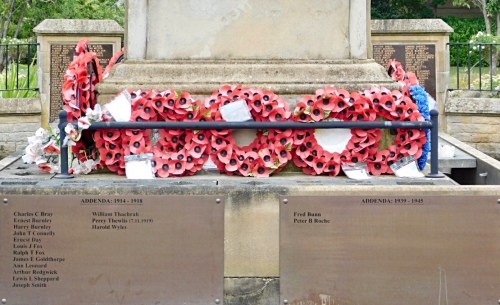
Than omission has now been corrected. During the First World War centenary commemorations members of Batley History Group, who had undertaken research into those named on the War Memorial, identified Annie amongst those local people not remembered. As a result of their work their names, including Annie’s, were added to the Memorial in 2019.

Batley’s Roll of Honour website continues its work, remembering those on the Batley and Birstall War Memorials.

Sources:

[1] Birth registered in Q4 1891 Dewsbury 9b 580
[2] One-eighth of an ounce

GRO Picture Credit: 

Extract from GRO death register entry for Annie Leonard: Image © Crown Copyright and posted in compliance with General Register Office copyright guidance

A Setback to my Healey War Memorial Project

At the moment I’m angry: bitterly angry and disappointed.

I went to Batley library on 3 December to check out the 1918 Electoral Register held in the reference section. I was horrified to discover it missing. I couldn’t believe it. I spent a full hour checking the shelves in the reference library, not just the cabinet in which the full range of registers are housed, in the vain hope the book had been mis-filed. All to no avail.

Electoral Registers minus the 1918 One

I last looked at the 1918 register in October 2015, when I made some notes about my family. This time I wanted to use it for my Healey project. The register showed absent voters and indicated by a “NM” if they were in the navy or military. For some of those serving their country this may be one of the only surviving records of their sacrifice. Because of this it is arguably one of the most important of the Batley electoral registers.

Maybe someone has borrowed it. Though as its a reference book, and no one on duty in the library knew it was missing, I think I’m clutching at straws here. 

Cynically I think whoever has taken it knows exactly it’s value. To my mind the alternative, and most probably the most likely, unpalatable option is it has been stolen. If this is the case, I reckon it is permenantly lost. Unless someone’s conscience is wracked with guilt. I do hope it is.

If it is gone forever I’m disgusted. Disgusted that someone has taken from the community what is a vital resource for those researching family or WW1 history. Shame on them. I hope they’re really pleased with themselves for robbing everyone, including those named within the pages of the register, of their history and legacy. An utterly despicable act. But I doubt they have a shred of remorse about it. If they had, to take it would not have crossed their mind.

Personally I can’t get my head round why anyone would be so selfish. The book was available. They had library access to it. Why take it? It is a sad indictment on society that someone felt it their right to behave in such a despicable way.

I’m now left trying to source an alternative copy, preferably locally.  So far without success. This is not one of the electoral registers available on commercial sites. If anyone knows of the (preferably) local whereabouts of a copy of the register, please let me know. It could be the difference in me discovering the WW1 service of a Healey man. 

And because of one person’s lack of morals and callous disregard of doing the right thing, many others will be similarly deprived of such an important local resource.

Update: I am pleased to report that the 1918 Electoral Register has now unexpectedly re-surfaced. It was not in the locked cabinet where it should be housed. Library staff discoverd it tucked away behind books elsewhere in the library. My Healey Project has a new lease of life.

Start of my Healey, Batley WW1 Remembrance Project

When I researched the men on the War Memorial of Batley St Mary’s, one thing I quickly realised was that the names there represented but a fraction of those parishioners serving in the military.  

British Army statistics alone illustrate this. Roughly 8.7m men served in it at one point or another during the war. This includes Empire and Indian Army contingents. Of these about 5.7m were from the British Isles (including Ireland). From this 8.7m total, approximately 957,000 lost there lives (of which Royal Navy and RFC/RAF casualties were 39,527), and about 705,000 of these were from the British Isles. So between 11-12% of those in the British Army died, depending on whether you look at the total or narrow it to British Isles only. 

Whilst research often concentrates on those that died, one of the things I wanted to do was find about all those who served, whether or not they made the ultimate sacrifice. Many of the survivors were physically wounded and mentally scarred, some to a life-changing extent. I have a couple of great-uncles in those categories. Again, looking at the British Army statistics almost 2,273,000 were wounded (although this figure has an element of double-counting, in that if you were wounded twice you appeared twice in the numbers). Of those wounded 18% returned to duty but in modified roles, for example garrison or sedentary work. And 8% were invalided out altogether, no longer fit for military service. Families and communities were affected forever. 

For me Remembrance Sunday includes all those who served; all those affected be it killed, wounded physically or mentally, and those who returned home with no obvious lasting ill-effects but had given up part of their lives to serve.

Sadly very few local memorials or records give these full community details. Locally one such record which stands out as doing this is that of Soothill. More information on this here

I would love to try to find out about all those from the broader Batley area, to complement this Soothill treasure.  But doing this alone is impracticable. Time and record survival are the major stumbling blocks. Key to providing addresses are service records. But about two thirds of soldiers’ service records were totally lost or irretrievably damaged during WW2 1940 bombing. Those that have survived are in the National Archives WO 363 “burnt records” series. And, as mentioned, this is the overwhelmingly predominant service.  

My other option was to trawl through the two Batley newspapers from the time, “The Batley News” and “The Batley Reporter & Guardian,” making a note of all mention of those from the Batley area serving in the Armed Services. I’ve made no secret about wanting to do this. It would be a fantastic local resource. But unless I had years to spare concentrating on it, I couldn’t do it alone. The same considerations applied to Batley St Mary’s, with the added factor of connecting random names and addresses in Batley with a specific Catholic Parish. 

So I’m going to attempt a compromise, and focus on one area of Batley: Healey. It doesn’t have a Batley St Mary’s WW1 connection, but it’s the area I grew up in. And it’s the one where I still live. It is also more manageable size-wise. However the deciding factor in my choice is one soldier in particular, whose record I accidentally stumbled upon. But more of that in another post. 

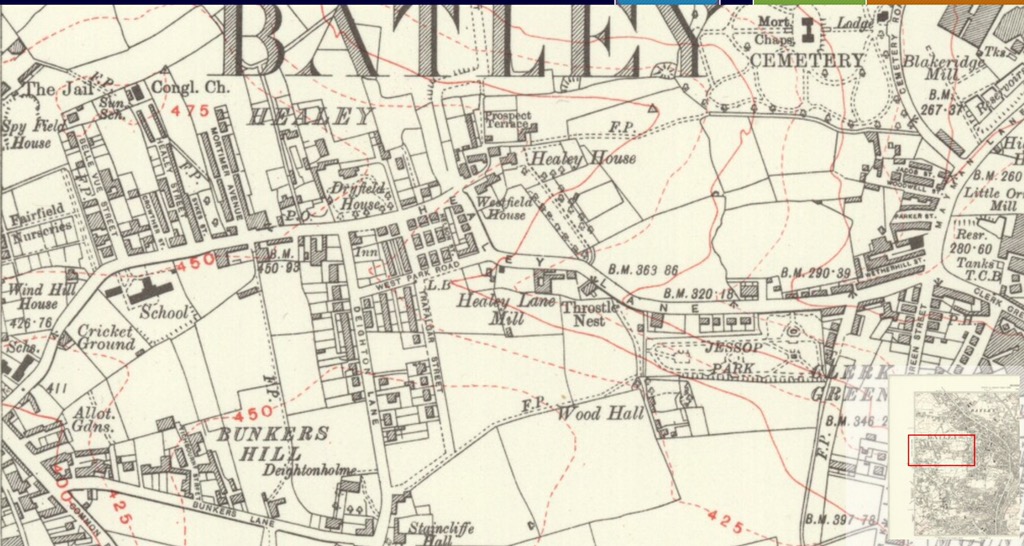
A couple of maps from 1905 and 1931 below pinpoint the area. 

Healey in 1905

Healey in 1931


Initially I’ve used three sources:

  • CWGC information of the dead, where next of kin addresses mention addresses from the Healey, Batley area; 
  • WO 363 “Burnt Records” which include a Healey, Batley address via Ancestry.co.uk; and 
  • WO 364 records of those discharged for medical reasons (illness or wounds) during the First World War 

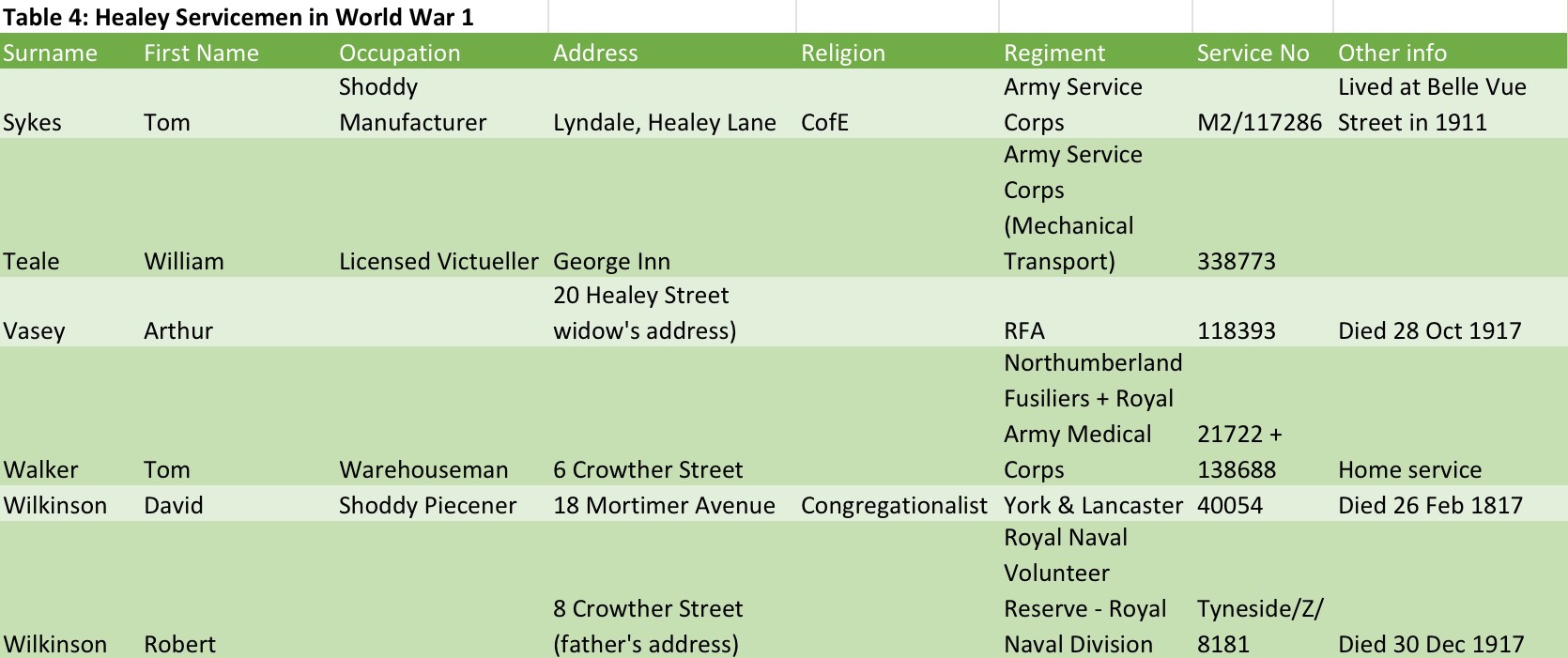
My initial analysis of these has produced the four Tables below. 


Over the next couple of years, till the centenary of Armistice Day, I intend doing a brief biography of each of these men.

I also intend going through at least one of the newspapers to identify other Healey men. Although doing this will probably extend the length of time for the project. A case of playing it by ear.

If anyone has any information about Healey men in WW1, it would be most welcome. It would also be lovely to extend this beyond Healey in WW1, to do a similar project for Healey in WW2. With the current centenary commemorations it is all too easy to overlook the sacrifices made by a more recent generation. So again names and information to kick-start this would be very much appreciated. 

I know I’m setting myself another potentially big but interesting task. Something a bit broader than War Memorial research, recognising the part the men across a community played. 

Sources:

Letters: Life, Love, Death & The Somme

Letter from Lance Corporal Herbert Booth, 9th  Battalion The King’s Own (Yorkshire Light Infantry) to his brother James shortly before 1 July 1916 – Published in the “Batley News” 12 August 1916
 “Well, old boy I do not know when I shall be able to write you another letter after this. In fact I will tell you the truth, it is like the song “It may be for years, or it may be for ever”; but never mind lad, whatever happens to me you can depend on me meeting it with a brave heart.  I will tell you this kid, it is going to be one of the biggest scraps that has ever been known, and I have not the slightest wish to withdraw.  If the worst happens, it is only death, and that comes to everybody at some time or another.  I understand by your letter that you have been rejected.  I know that you would like to have a smack at the Huns, but never mind, you have the satisfaction of knowing that you offered your services to your King, and that is what a lot of single young men have not had the pluck to do.  If things turn out right, and I have luck enough to come through this job safely I shall be able to tell you as much as anyone here can.  This is my tenth month out here and I have not been away from the battle area one month out of the ten.  Perhaps by the time you get this you have read all about this affair in your papers.  If I have the good luck to come out alive I will drop you a field card or a line of some sort at the earliest possible convenience, and let you know how I have gone on.”

WW1 Silk Postcard – my own collection

Letter from Lieut R.H. Ibbotson to Ellen Booth, Herbert’s wife – Published in the “Batley News” 12 and 19 August 1916
“I have received your inquiry about your husband, Lce-Corpl Herbert Booth, and am extremely distressed to have to tell you that the news I have to give you is of the very worst, and that your husband was killed in action on the 1st of July.  He took part in the magnificent advance made by this Battalion.  I am sorry I did not know your husband personally.  I have only just come to this Company to command it from the transport which I looked after during the attack.  None of the officers in “A” Company who took part in the attack are here now, they were all either killed or wounded.  Anything I can say in a letter to you cannot possibly help you, I am afraid, to bear this terrible blow, but I can honestly say that you have my deepest and absolute sincere sympathy”

Letter from Pte W H Fisher writing from Grovelands Hospital, Old South Gate, London – Published in the “Batley News” 26 August 1916
“Corporal Booth was one of my best pals. We went “over the top” on the morning of July 1st, like two brothers, and we had only got about 30 yards out when he was hit right through the temple.  I had to leave him and got about another 150 yards when I was wounded.  I spoke to him, but he never spoke”.

Roll of Honour In Memoriam Notice – Published in the “Batley News” 26 August 1916
Booth – Lce-Corpl Herbt. Booth, KOYLI, killed in action on July 1stWe little thought when we said good-bye
We parted forever and you were to die
But the unknown grave is the bitterest blow
None but aching hearts can know

From father, mother, sister and brother-in-law

Roll of Honour In Memoriam Notice – Published in the “Batley News” 7 July 1917
Booth – In loving memory of my dear husband, Lance Corporal Herbert Booth, who was Killed in Action, July 1st 1916.

We often sit and mourn for him,
But not with outward show,
For the heart that mourns sincerely
Mourns silently and low,
We think of him in silence,
His name we oft-times call,
But there is nothing left to answer
But his photo on the wall
RIP

From his wife and children, 6, Beck Lane, Carlinghow

Roll of Honour In Memoriam Notice – Published in the “Batley News” 6 July 1918
Booth – In loving remembrance of our dear brother, Lance-Corporal Herbert Booth, 9th Batt. KOYLI who was killed on the Somme, July 1st 1916.

Brother of ours on the grim field of Battle
Died fighting for honour, and all that is
True
Brother of ours, you’re a man and a hero.

From his brother and sister-in-law, James and Cissie, 3 Crow Nest, St James’ Street, Burnley

Roll of Honour In Memoriam Notice – Published in the “Batley News” 3 July 1920
Booth – In loving memory of a dear son and brother, Lance-Corporal Herbert Booth KOYLI, killed in action July 1st 1916

Only a wooden cross
Only a name and number
O God let angels guard the spot
Where our dear one doth slumber

From his dear mother and father, sister and brother-in-law, 13 Carlinghow Hill, Batley

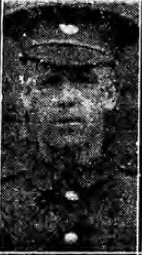
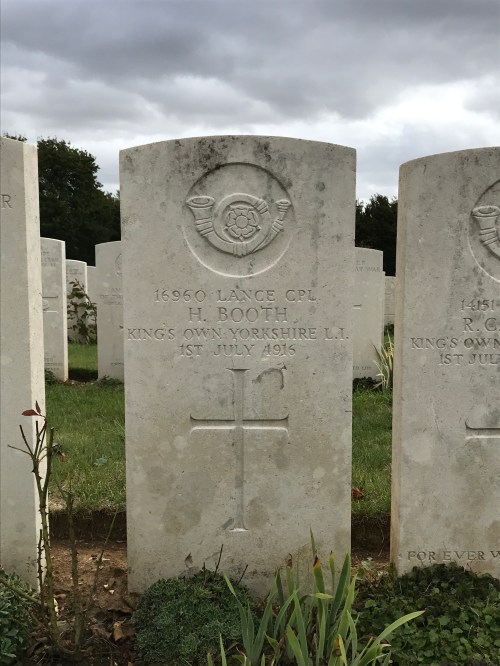
Lance Corporal Herbert Booth
9th (Service) Battalion, The King’s Own (Yorkshire Light Infantry).
Born: 15 May 1885
Killed in Action: 1 July 1916
Age: 31
Buried: Gordon Dump Cemetery, Ovillers-La Boisselle
Husband of Ellen and father of James and Hilda

Sources:

  • Batley News – Various Dates
  • CWGC
  • Parish Registers – St John’s, Carlinghow (CofE) and St Mary of the Angels, Batley (RC)

Pigeon-Stealing in Batley

An entry dated 13 March 1908 in the Batley Borough Court records attracted my attention. On that day two 13-year-old boys and another aged 12 appeared before the Town Hall Magistrates charged with pigeon-stealing. They stood accused of taking four dark, dappled birds on 8 March from Back Cross Park Street.

image

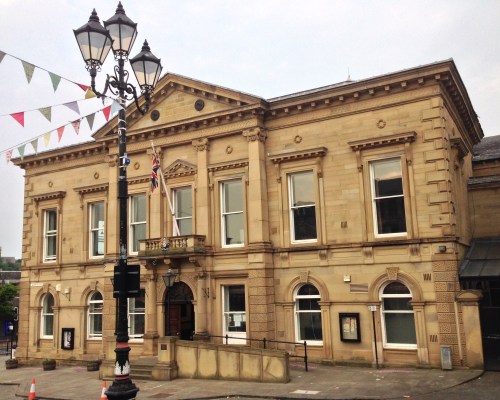
Batley Town Hall – Photo by Jane Roberts

Juvenile crime was not uncommon in the Court listings. But two things attracted me to this one:

  • The sentencing notes were slightly unusual; and
  • I recognised the names of all three lads.

The Court Register entry combined with the newspaper report build up a fuller picture. It should be noted that the newspaper is, in some crucial areas, at variance with the Court record. The name of one of the lads is slightly different. And the ages are given as 12, 13 and 14.

The birds belonged to miner Robert Dewhirst. They were housed in a cote containing 15 pigeons. Robert locked it at around 5pm on Sunday teatime. When he checked it at around 5am the following morning he found the door swinging open, the padlock discarded on the floor and four birds missing. They had an estimated value of £2 according to the Court notes.

Later that day the birds were recovered. They were in the possession of Robert Clarkson, a Commercial Street fish and game dealer. He said he told the boys the pigeons were old and not worth more than 6d. He also claimed to have told them to fetch the owner and he would pay for them. The boys never returned. The Court Register and papers are silent about any charges preferred against Robert, so it seems there were none.

The three youths, a school boy, errand boy and pony driver, were not so fortunate. Two pleaded guilty to the charge; the other put in a “not guilty” plea.  Despite this he was convicted of the crime, along with his two friends.

This is where the sentencing twist came into play. They were discharged on entering recognizances for 12 months. They were instructed as to their good behaviour during this time. During this period they were to be under the supervision of Mr Gladwin, the probation officer. He was to visit them and submit regular reports to the magistrates about their conduct. Alongside this a 20s surety applied.

The noteworthy facet of the sentencing: this was the first ever case for the local probation officer.

Pigeon Stealing

Newspaper Headline

This new service owed its origins in 1876 to Hertfordshire printer Frederic Rainer, a volunteer with the Church of England Temperance Society (CETS). Initially London-based, it worked with magistrates via the London Police Courts Mission (LPCM) to release offenders on condition they kept in touch and accepted guidance from the “missionaries”.  The system was extended countrywide with the 1886 Probation of First Time Offenders Act. With an emphasis on religious mission and temperance, this Act allowed courts to appoint similar missionaries if they wanted to. Few chose to do so.

The 1907 Probation of Offenders Act gave these missionaries official status as “officers of the court”.  Furthermore it was now possible for courts to appoint probation officers paid for by the local authority.  The Act allowed courts to suspend punishment and discharge offenders who entered into a recognisance of between one and three years. As part of the conditions of this suspension, the offender agreed to be supervised by a “probation officer”.

Durham-born James Gladwin was Batley’s Probation Officer. He had held the Town Missionary post for a number of years, being recorded as such from the 1901 census onwards[1]. However the three Batley lads, all from St Mary’s parish, were his first cases following the 1907 Probation Act.

The sentence was partially effective. Two of the lads did indeed steer clear of further trouble. Sadly, the youngest failed to do so. He appeared once more before the Magistrates on 7 December 1908. This time he was charged with stealing a pair of men’s moleskin trousers, valued at 2s 6d from Joseph Bennett’s Commercial Street pawnshop on 5 December. Bennett took the precaution of ticketing his shop contents. The lad failed to notice this. So when he then attempted to pawn them at another shop on Wellington Street, Bennett’s mark was recognised and the boy apprehended.

This was around nine months after the pigeon-stealing incident, which as a result now came into play. Mr Gladwin, his Probation Officer, gave his character opinion of the lad. He was sorry, but not surprised, to see him in trouble again. He was always on “the edge of it”, always promising to do better. Police Inspector Wright said the lad was a bad influence on the other boys in town. Despite pleadings from his father, he was now convicted of both the trouser and pigeon-stealing offences. To save him from a life of trouble he was sentenced to five years in a Reformatory.

The Reformatory system was established in 1854 for under-16s convicted of crime. With concern about the way children were treated in the criminal system, the Philanthropic Society was at the forefront of this change to the criminal system. Children sent to Reformatory schools spent between two to five years there. However, until 1899, those committed to such establishments still spent 14 days in an adult prison first. This was thankfully no longer the case by the time of this lad’s sentence.

As a Catholic he was sent to serve out his sentence at St William’s School for Training Catholic Boys, situated at Holme upon Spalding Moor, near Market Weighton in the East Riding. Founded in 1856 as the Yorkshire Catholic Reform School, this was in a remote, rural location. The work the boys undertook reflected its countryside locality, with a large proportion dividing their time between studies and farm labouring. Other trades included shoemakers, bricklayers, printers, tailors, bookbinders, laundry and horse boys.

At the time he entered the Reformatory, it was headed by Rev Charles Ottaway who took over in 1906. It was Father Ottaway who instigated the name-change to St William’s. He was still in charge in the 1911 census, where the boy is shown as an inmate dividing his time between schooling and working as a farm boy labourer.

Under Father Ottaway’s regime the boys wore a uniform of plain cord knickers and a tweed coat. However despite the uniform and name-change, the Reformatory under his tenure was noted for its poor discipline and too frequent punishments, as noted in highly critical inspection reports. The covering letter to a December 1911 inspection said:

Father Ottaway overloaded, boys have insufficient food, overwork and lack of recreation, stunted in growth and underweight, approved dietary scale not adhered to and substitutes inadequate, punishments not accurately recorded, carelessness, cells unfit for use…..

Another report in May 1912 by Brigdier Mark Sykes M.P., a member of the Reformatory Committtee, noted amongst other things improper cleaning; ill-shod boys in ragged, disreputable clothing; an unvaried, disgusting diet; too frequent and too trivial punishments; inadequate fire-safety and escape provisions and damnning indictments on various staff members. His report ended:

I consider that with the exception of Mr Hart it would be best to discharge the whole of the present staff and start afresh“.

In short the entire establishment lacked go and discipline. 

The declining numbers of boys being admitted during Father Ottaway’s tenure was a probable reflection of the lack of  care, schooling, work-training  and basic facilities such as toilets and washing on offer there. Nevertheless Batley Borough Court continued to use it for its “wayward” Catholic boys, including two sent there in March 1912 for stealing a box of biscuits. And Father Ottaway remained in charge until the summer of 1912.

Back to the pigeon and trouser-stealing boy though. The lad’s father had a maintenance order of 2s a week imposed by the Court, in order to provide for his son’s upkeep in this establishment. Parents had to contribute towards the costs, and this was means-tested based on the family income. As the newspaper noted the family had £2 10s coming into the household each week.

East Riding Archives hold extensive records for this particular Reformatory, including admission registers, report books and medical registers.[2] So well worth a visit for those with ancestors who spent time there, either working or as inmates.

At the beginning of this post I mentioned I recognised the names of all three lads charged with pigeon-stealing[3].  They are all connected with my parish church. And all three lads were dead just over eight years following the pigeon incident. All lost their lives in the Great War: One in 1914, the other 1915 and the final one in 1916. They are all on the church War Memorial.

I have deliberately not named any of the boys involved.

Sources:

[1] In 1891 his occupation was given as “home missionary”
[2] East Riding Archives Finding Reference DDSW, St William’s Community Home
[3] I have taken the Court Register names to be the correct ones. As I mentioned earlier in the post, the only newspaper report for this incident had a different Christian name and slightly different surname for one of the boys. However checking baptisms, births and censuses there is no-one matching the newspaper name.

“You’ve a Mother and a Father. That’s All You Need to Know” – Batley Borough Court Records: Part 3

I thought long and hard before writing this post, the third in my Batley Borough Court paternity proof series. The reason for the deliberation is it concerns family information not discussed for years, if at all in living memory. “You’ve a mother and a father. That’s all you need to know” is a phrase that springs to mind. But I wanted to know more than that. So on and off I ferreted away at records.

The deciding factors for me in going ahead in writing this are:

  • it relates to my family history;
  • those directly affected are no longer alive. Neither are immediate subsequent generations;
  • the events took place over 100 years ago;
  • the information is publicly available;
  • when researching my family history I want to be even-handed with all aspects, the good and the not so good; and
  • this post may give an indication of some of the sources that are available when looking into the issue of tracing fathers of illegitimate ancestors.

I was elated with the find. Here the Batley Borough Court records have solved one of my long-standing family mysteries, as outlined in an earlier post about Parish Registers. It relates to the paternity of my great grandmother Bridget Gavan’s second child, a daughter, born on 28 August 1893.

The parish priest at St Mary of the Angels, Batley, at the time of the child’s baptism the following month believed Bridget to be married. The baptismal entry in the parish register is under the name “Regan” and Bridget’s husband is named as Charles Regan. The only problem: Bridget was not married. So proof you cannot always take what is written in parish registers as 100% accurate.

A later priest realised the error. When the girl’s marriage took place, some decades later, he noted against her baptismal entry that she married under the name Gavin [sic]. Yes the priests were meticulous in the practice of annotating baptismal entries with later marriage details!

But, although the baptismal entry gave a potential lead into the child’s father, I could not definitively identify Charles Regan. Not until a search of the Batley Borough Court register.

On 5 February 1894 Bridget Gavan was the complainant in a bastardy case heard at Batley Town Hall against Charles Ragan (note the subtle spelling difference here). Charles was ordered to pay 3/ a week until the unnamed child reached the age of 13. As well as court costs he also had to pay birth expenses of £1:1:0. So this provides corroboration of the baptismal paternity information.

Charles Ragan features a further eight times in the Borough Court Register between 1894-1907[1]. Three of these relate to police charges of drunk and riotous behaviour in various areas of Batley. The other five are cases brought by Bridget for bastardy arrears. Full details are at Table 1.Charles Ragan BBC

It can be seen from the entries that Bridget gave Charles time to pay on two occasions. Some of the bastardy cases took place after Bridget’s marriage in November 1897. And some of the adjudications around the bastardy arrears involved straight custodial sentences, without the option of paying a fine.

This then led me to the collection of West Yorkshire Archives Prison Records on Ancestry.

Bingo! I was astounded to find 20 entries in the Wakefield Prison Records Nominal Registers relating to Charles for appearances before West Riding Courts at Wakefield and Dewsbury as well as Batley. They relate to the various bastardy cases heard at Batley, outlined above, as well as charges in all areas for drunkenness and non-payment of costs.

Wakefield Prison

Wakefield Prison Image from around 1916 shared by David Studdard on the Maggie Blanck Website – see Sources

It appears that even where Charles had the option of paying a fine he chose not to do so, or perhaps simply could not afford to, and the alternative custodial sentence was enforced.  This includes one of the instances where Bridget had allowed extra time: Hence the large numbers of entries for him in the Wakefield prison register.

For my research purposes these entries provide a basic description of Charles, his age, religion, occupation, education level and, crucially, a birthplace. Although the records are not consistent, particularly around education levels which range from “imperfect” to “read and write” through to Standards I-III[2], they give a general picture.

Charles was around 5’5” tall, with brown hair, had only a very basic level of education and his employment varied from colliery worker to miner to labourer, so manual work. His birthplace was given as Leeds and further narrowed in some of the register entries to the Beeston/Holbeck area.  And his date of birth was somewhere between 1869-1876. Despite the variations, they clearly all relate to the same man given the detail provided including the previous custodial reference number.

The entries are summarised in Tables 2a and 2bCharles Ragan 2a

Charles Ragan 2bLooking at the censuses with this fresh information, Charles Joseph Ragan, to give him his full name, was born in Holbeck in 1869. He was the son of Irish-born coal miner John Ragan and his wife Sarah Norfolk, a local girl from Hunslet. The couple married in 1866 and by the time of the 1871 census the family was recorded living in Holbeck. Besides Charles other children included six year-old Hannah Norfolk, three year-old Thomas and infant daughter Sarah.

The 1881 census reveals further siblings of Charles: George, age eight; six year-old John; Arthur, four; and Elizabeth, two. By this time Charles had employment as a dray-boy.

1891 shows a move to East Ardsley and two further additions John and Sarah’s family – Alice born in around 1882 and Walter in 1884. Charles now worked as a coal miner, like his father.

The work opportunities in the relatively new pits in East Ardsley probably initiated the move from the Leeds area. The town’s extensive collieries were owned by Robert Holliday and Sons, with East Ardsley Colliery being known as Holliday’s Pit. They started to sink two shafts here in 1872, on land leased from the Cardigan estate. A third shaft was sunk in 1877. By 1881 in excess of 300 East Ardsley men were employed in mining. In 1899 the colliery produced 200,000 tons annually, making it the 11th largest Yorkshire coalfield.

Returning to Charles’ brushes with the law, newspaper reports added a little more detail, but not much. For example in the March 1900 case around arrears, Bridget revealed that Charles had failed to make payments for their seven year-old daughter for three years. Possibly this corresponded with the time Bridget was involved with her soon-to-be husband, who she married in late 1897.

The reports also indicate Charles lived at Lawns in August 1897 and thereafter in East Ardsley. Did his forays from there into Batley indicate he remained in loose contact with his daughter?  Or were other family connections the draw? There were a number of Ragans living in Batley during this period.

In terms of character, Charles certainly seemed fond of a tipple, given the number of drink-related offences. One from the West Riding Police Court, Wakefield, involved the assault on William Forrest, the landlord of an East Ardsley pub, the “Bedford Arms“.  George Mullins was his partner in this crime. The report in the “Sheffield Daily Telegraph” of 24 August 1897 read:

…the defendants did not appear, it being stated they had left the district. On the afternoon of Friday, the 13th inst., the defendents went to the public-house, created a disturbance, refused to leave, and on being forcibly ejected, Mullins bit the landlord on one of his arms, both men struck and attacked him, and defendants re-entered the house and again assaulted the landlord“.

geograph-3204067-by-Betty-Longbottom

The Bedford Arms, East Ardsley

 So what became of Charles Ragan? By August 1906 he was free of his weekly payments for his daughter, she being 13. It appears he married 34 year-old widow Jane Worth (maiden name Sow(e)ry) on 24 December 1911 at St Mary the Virgin, Hunslet. A quick scan of GRO records reveals the birth of three children, all registered in the Hunslet District between 1913 and 1917.

Charles’ death is registered in Leeds North in Q4 1932. He was 63. He is buried in Hunslet Cemetry.

Bridget died in 1947. Their daughter died more than 45 years ago.

See here for Part 1 and Part 2 of my Batley Borough Court series of posts.

Sources:

[1] Up until the end of my search in 1916
[2] See The Victorian School website for a descriptor of the various levels as they applied from 1872 http://www.victorianschool.co.uk/school%20history%20lessons.html

Borough Court Records: Crime, Punishment & Bastardy in Batley – Part 2, “Kissing Cousins?”

This is the second part of my Batley Borough Court records series. Part 1 can be found here.

Mary Jennings was my 2x great grandmother’s sister, the daughter of Ann Hallas and Herod Jennings. She was born on 16 May 1858, probably in Hartshead, and baptised on 18 May 1859 at St Mary’s, Mirfield.

By the time of the 1881 census her father, Herod, was dead. She lived at Clark Green[1], Batley with her widowed mother Ann who headed the household, and brothers William and James.

Relation Frank Thornton, a 23 year-old coal miner from Hartshead, was also present that census night.  Ann’s sister Louisa Hallas and her husband George Thornton had a son, Franklin, born on the 31 January 1858. Baptised at St Mary’s, Mirfield, on the same day as Mary, his name was often shortened in records to Frank. I assumed this was the man in the Jennings household.

There was a final member of the household that 3 April night: A one-year-old girl named Sarah Ann. She is described on the form as daughter. However Ann at this stage was 56 and a widow for over three years.  Without a birth certificate I worked on the theory Sarah Ann was Ann’s granddaughter. Her birth was registered in Q2 1880, but it’s a case of another too costly certificate to satisfy idle curiosity. Subsequent censuses proved the theory though.

On 24 April 1890 Mary Jennings married 32 year-old mill hand William Blackwell at Batley Parish church. In the censuses of 1891 (Batley) and 1901 (Sherburn in Elmet), Sarah Ann is living in William and Mary’s home, described as “daughter”.

Batley Parish Church – photo by Jane Roberts

But I still did not know who Sarah Ann’s father was…..until I looked at the Batley Borough Court records. On 2 July 1880, shortly after Sarah Ann’s birth, Mary Jennings was named as the claimant and Frank Thornton the defendant in a bastardy case. The hearing was adjourned until 5 July when, in Frank’s absence, an order was made for him to pay 3s per week until the child reached 13 years of age. As well as court costs, he also had to pay £1 10s for the birth expenses.

There now followed a regular procession of non-payment cases. Newspaper reports and prison records flesh out the sorry story. The Batley Borough Court records made tracing these additional sources so much easier. The newspapers involved are not online, so no Optical Character Recognition (OCR) search help here. The prison records only provide the prisoner’s name, so that first court case name lead was crucial for searching these.

The first of the non-payment cases in response to the 5 July 1880 award occurred on 13 May 1881, just over a month after the census. Mary, according to a note in the register margins, was destitute. The upshot was a two month prison sentence for Frank. He served his sentence at Wakefield. The “Nominal Register” prison record provides a description. Frank had received no education and worked as a collier. He stood at s shade over 5’10” with brown hair. The entry also shows he had four previous convictions, with the reference given to his last prison register entry, enabling backtracking.

Another method of looking at convictions is via the “Index to [Nominal] Registers”.  These may span a number of years. It means you can track the references to all previous prison register entries in that time span in one go. They too provide a basic description and birthplace of the prisoner. The Index has not been catalogued in the Ancestry search, but I found it a useful complementary check because some of the “Nominal Registers” have missing volumes which the Index can help fill.

Anyway back to Mary and Frank. Clearly the prison sentence shock failed because he was in court again on 22 May 1882. By then he owed £10 6s in bastardy arrears and, in addition to costs, the court ordered him to pay £1 immediately and thereafter 8s a week to pay off the outstanding balance. It seems this was complied with. There is no record of a custodial imposition.

There was an interval of nearly four years before a very intense period of court activity adjudicating on the disputed domestic matters of Mary and Frank. On 8 January 1886 Frank owed 13 weeks-worth of payments. At 3s a week, this amounted to £1 19s according to the Court register. Another month’s jail sentence followed.

On 8 February 1886, within a couple of days of ending this January one-month prison sentence Frank appeared at the Borough Court once more. He needed to show cause why he should not be sent to prison in default of complying with the bastardy order. His arrears were recorded at £2 2s[2].  Frank said he had no means of paying.  A further 14 day committal followed for him, unless he could find a bondsman that day.  No bondsman was forthcoming, so it was back to Wakefield prison for Frank.

But that did not mark the end. Released from prison on Saturday 20 February, he was immediately apprehended on the same charge. He found himself bounced back into court again on Monday 22 February. Even the newspaper reports now referred to him in sympathetic tones as “the poor man“. Arrears were listed as £1 19s[3] so presumably he had managed to pay a small amount. Frank now promised to pay all the money. He faced a further one month jail sentence, but this was suspended for 28 days to allow him to fulfil his promise to make his payments. It seems he managed it, as there is no imprisonment record.

So who was Frank Thornton? Did the relation comment in the 1881 census refer to him being the nephew of Ann and cousin of Mary, as I initially thought? Was it a reference to Sarah Ann’s paternity? Or was it both? I’ve used censuses, GRO indexes, prison records and newspaper reports to try to pinpoint him.

Including the names Frank, Franklin and Francis in any searches there are a number of “possibles”. However in terms of Hartshead/Mirfield-born alternatives, the birthplace given in prison registers, other than cousin Frank, there appears to be just one. But there is a slight discrepancy with the year of birth (1860) of this alternative, and his occupation does not fit. So it can be discounted. Bringing me back to Mary’s cousin.

Ignoring the birthplace given in the prison records and extending beyond Hartshead/Mirfield does produce other options, but again the stumbling block is job description. There are no feasible coal-miners, although jobs could change. But even allowing for a career switch, why would I want to ignore the birthplace anyway? This is consistent in the prison records.

Extending the search to his other custodial sentences and newspaper coverage of them, including one in 1879 for assaulting a police officer, I still cannot definitively point to Frank being the son of George and Louisa Thornton. However, the evidence so far leads me to think that Sarah Ann’s father was indeed Mary’s cousin. But there is no absolute proof, certainly no reference in the newspapers.

It appears Frank married in Q2 of 1882 (another certificate on my long wish list). Maybe this was the reason behind the May 1882 non-payment. By the time of the 1886 sequence of court cases he had a young family, which again may have strained finances and resulted in him trying to avoid obligations for this first child. By the time of the 1891 census the Thornton family were living near Barnsley and by 1901 they had settled in the north east of England.

So once more the Batley Borough Court records have provided leads and a potential solution to a family paternity mystery, but with quite a different outcome from the previous case. If indeed the father of Mary’s child was her cousin, as it seems, one can only wonder at the strains this whole situation placed on wider family.

There is a third case, with yet another twist, here.

Sources:

  • Batley Borough Court Records – West Yorkshire Archives
  • Batley News” and “Batley Reporter” newspapers, various dates in February 1886
  • Parish Registers – Parish Churches of St Mary’s, Mirfield and All Saints, Batley – available online at http://home.ancestry.co.uk/
  • Censuses – 1861-1911
  • GRO Indexes
  • West Riding Prison Records, “Wakefield Index to [Nominal] Registers” and “Nominal Registers” – available online at http://home.ancestry.co.uk/

[1] The modern spelling is Clerk Green
[2] £2 6s reported in the newspapers
[3] £2 3s in the newspaper reports