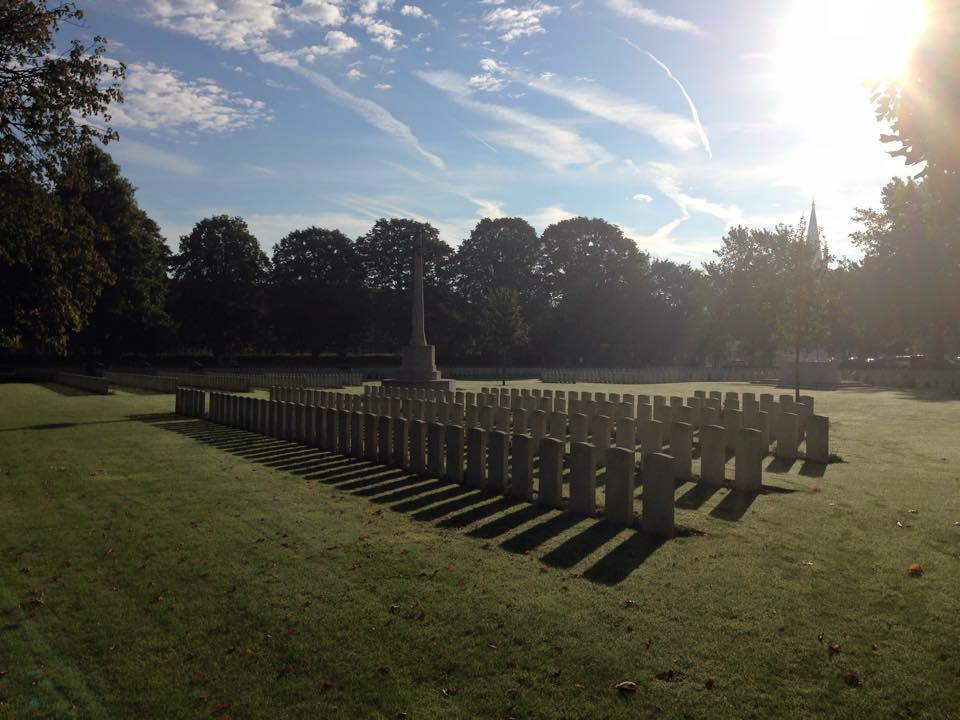
Last weekend I returned to Ypres. A visit I felt compelled to make. 19 September marked the centenary of the death of my great grand uncle, Jesse Hill.[1] So it seemed appropriate to visit his grave in Ypres Reservoir Cemetery.
Ypres Reservoir Cemetery
It was a weekend full of coincidences. And an unforgettable one. The events of 100 years ago still resonate emotionally with many today.
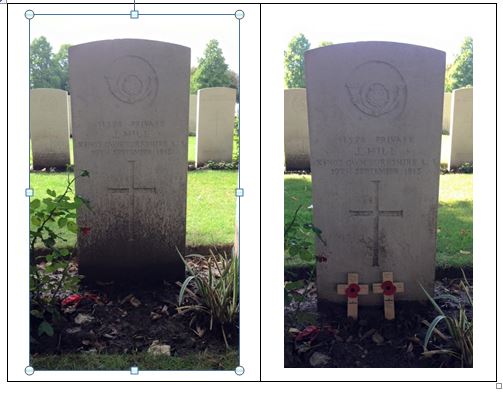
I visited Jesse’s grave on Friday evening, the eve of the anniversary. The headstone is beneath trees and as a result every time I’ve visited it’s rather mud-splattered. Friday was no different. However when I returned first thing on Saturday morning, the anniversary of his death, the headstone had been cleaned!
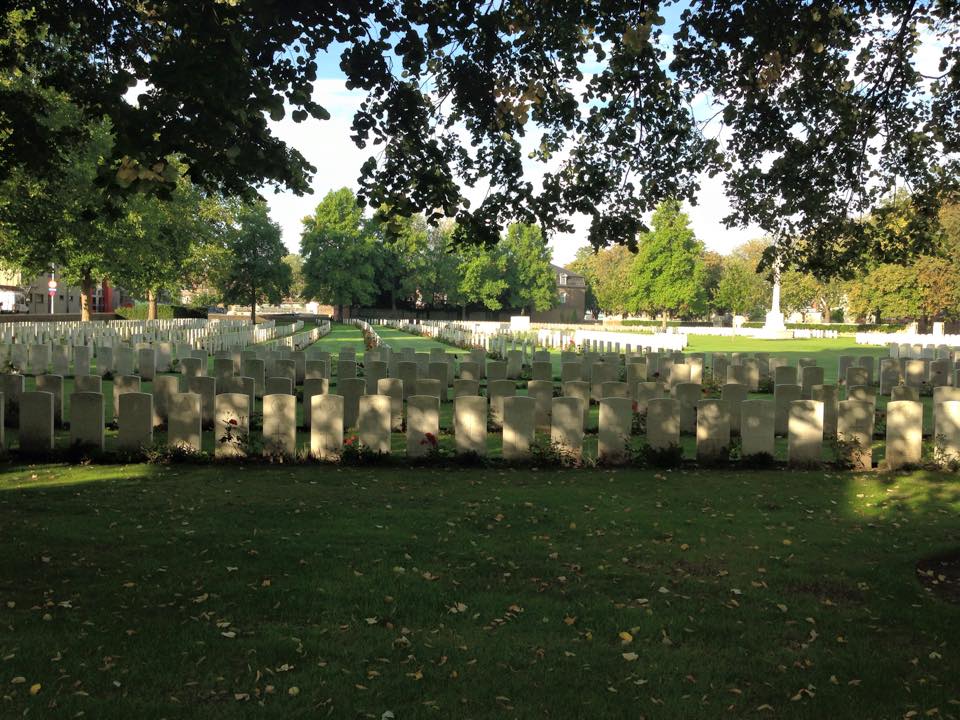
There was only one other person in the cemetery at 9.30 that morning – and it was someone I know from home! He was visiting the graves of Dewsbury men from 6th Battalion King’s Own Yorkshire Light Infantry (KOYLI), comrades of Jesse, who died at around the same time. So a huge coincidence that we’d both travelled 350 miles and turned up in that cemetery at the exact same time.
Ypres Reservoir Cemetery
Before I left I placed a poppy cross, brought all the way from Batley, on Jesse’s grave.
From Unit War Diary maps, I’d located the area occupied by the 6th KOYLI the morning Jesse died. So on Saturday afternoon I walked around Railway Wood and what was the vicinity of the ‘H’ Sector trenches. Walking the ground brought home the frighteningly close proximity of the British Front Line to the German trenches in a way maps cannot. And it made the concept of “friendly fire” incidents far more understandable.
RE Grave, Railway Wood
On that walk my husband found two pieces of shrapnel. It’s not unusual, but then again in all my many visits it’s only happened to us on two previous occasions – so it did feel incredible that this find occurred on the 100th anniversary and in that very location.
On Sunday morning I returned to Ypres Reservoir Cemetery. Unbelievably a second poppy cross lay on Jesse’s grave. A look I the visitor register confirmed that another Hill descendent also had the urge to pay an anniversary visit Jesse’s grave.
Jesse Hill’s headstone
Later that morning I attended a Rededication Service at Birr Cross Roads cemetery. Thanks to the patience, perseverance and unstinting efforts of Australian volunteer researchers, three soldiers’ headstones previously carrying the “unknown” epitaph now have identities; and the families of these three Australian soldiers, Pte Huntsman, Pte Eacott and Pte Neilson, now have named graves to visit. It speaks volumes of the emotional pull of the events so long ago that families of all three soldiers travelled halfway across the world to be at the service. It was a privilege to be there too.
Birr Cross Roads Rededication Service
Other visits that day included Tyne Cot Cemetery and Memorial. The sheer size of the cemetery even after many visits is difficult to take in with 11,956 First World War servicemen buried or commemorated here, of which in excess of 8,000 are unidentified. The list of almost 35,000 names on the memorial is equally staggering.
Tyne Cot Cemetery and Memorial
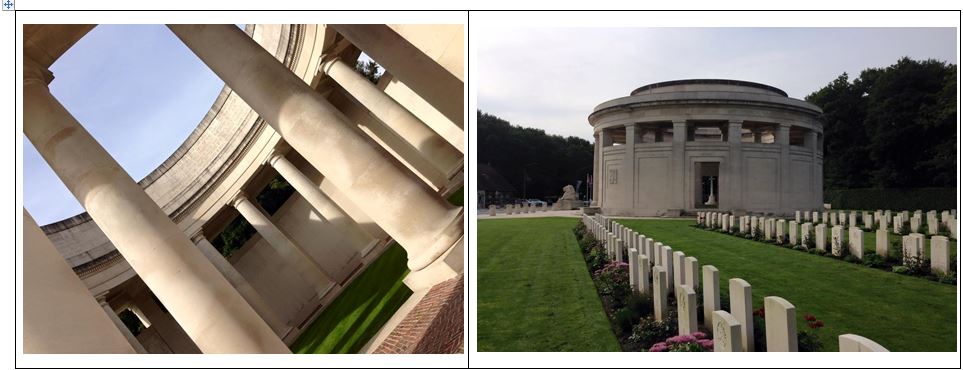
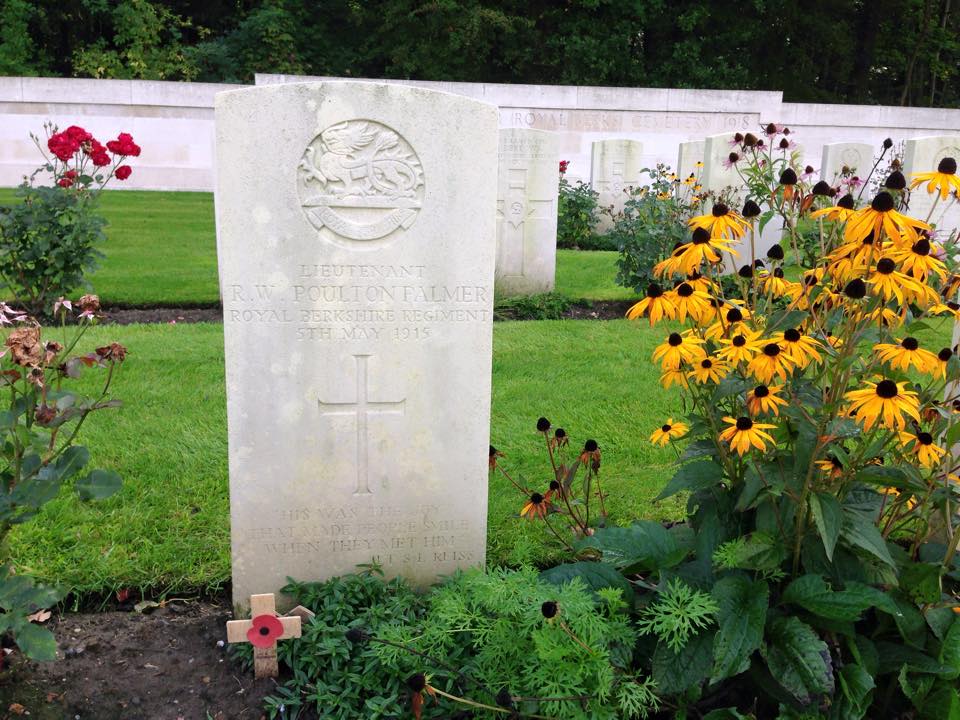
I returned home on Monday. On the way back to Calais I stopped off at the first CWGC site I ever visited: the majestic, lion-flanked Ploegsteert Memorial. Although I’m a Rugby League fan, as it’s the Rugby Union World Cup it seemed appropriate to pop across the road to call by the grave of England Rugby Union captain Ronald Poulton Palmer at Hyde Park Corner (Royal Berks) Cemetery.
Ploegsteert Memorial
Ronald Poulton Palmer’s Grave
Final stop was Lijssenthoek Military Cemetery. I wanted to visit the graves of three men whose lives I researched and who have connections to my home Parish of Batley St Mary’s: John Collins, Henry Groa(r)k and Patrick Lyons. The cemetery has an excellent visitor centre with information about the soldiers buried there. I’ve supplied information about the St Mary’s men, and there is a webpage if others wish to do the same.[2] There is also a wall containing some of their images. The first one I noticed was remarkably familiar – the photo of Patrick Lyons. It seemed a fitting end to my latest visit to Belgium.
I’m hoping to travel to Ypres Reservoir Cemetery again soon. I’ve been several times over the past few years. But this will be a particularly poignant visit. It will mark 100 years since the death of my great grandad’s youngest brother Jesse Hill, killed in action in WW1.
Jesse was the son of Joseph Hill and his second wife Mary Ann Simpson. He was born on 13 November 1895 at Rouse Mill Lane, Soothill and grew up in the family’s home on Spurr Street, just across the road from Batley railway station and all the grand cloth selling houses which lined Station Road.
An extremely popular boy, he attended Mill Lane Council School where he was a prominent member of both the school cricket and football team.
After leaving school he joined the finishing department at Messrs Wrigley and Parker’s Greenhill Mills minutes down the road from his home. This was one of the many mills upon which Batley’s fortunes were built upon.
Whilst Jesse was in the early stages of his working life older brother Charlie enlisted in the Army. Jesse therefore had direct contact with a serving soldier and first-hand accounts of military life.
When war was declared on 4 August 1914 the persuasiveness of the recruiting sergeant’s triple-pronged seduction techniques of a general appeal to patriotism, the more specific exhortation of defence of your country and women-folk from the barbaric Germans and the desperate desire to avoid accusations of shirking duty and the accompanying dreaded white feather of cowardice kindled a response in Jesse.
Swept along with a tide of emotion and the fear of missing out on adventure because, after all, it would be over quickly, Jesse was one of those young men who in their thousands gathered in the Dewsbury recruiting office and recruiting offices the length and breadth of the Kingdom to take the King’s Shilling. Jesse even added a year to his age in order to ensure he would be accepted. And with a cursory medical and a few swift pen strokes on 7 August 1914 Jesse was in the Army for the duration, duly assigned to the newly formed 6th (Service) Battalion, The King’s Own (Yorkshire Light Infantry), (KOYLI).
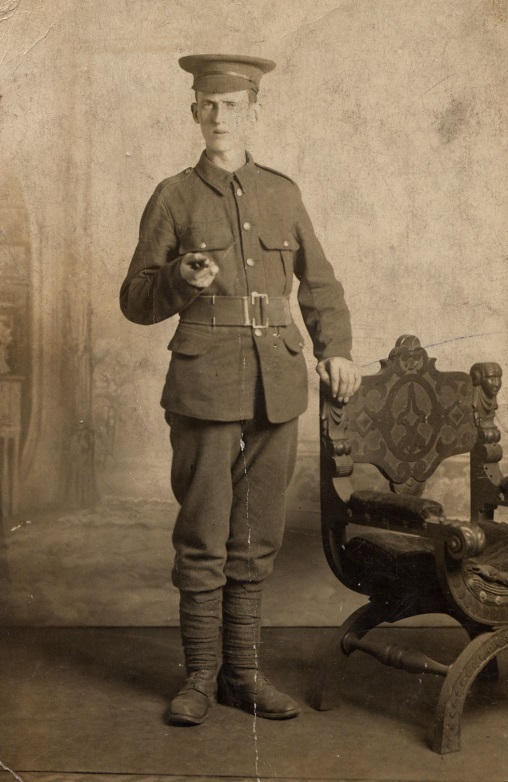
Pte Jesse Hill, 11578, 6th Bn The King’s Own (Yorkshire Light Infantry)
From Pontefract the Battalion moved initially to Woking and then in November 1914 to Witley Camp, Surrey one of the many temporary army training camps flung up in those early months of the war. In February 1915 they moved to Aldershot for their final preparations prior to deployment overseas.
It was whilst at Aldershot and with embarkation for France and the Front Line looming that Jesse wrote his will. He used the standard Army Form designed specifically for the purpose. The harsh reality that he may never return may have struck home by filling in this one basic form. His will, dated 17 March 1915, was witnessed by two Birstall men, Thomas Kelly and John W Learoyd. He named his now married half-sister Nellie Armstrong, daughter of Mary Ann Simpson, as Executor.
The will stated that in the event of his death and following discharge of debts and funeral expenses, everything was to go to his sister Martha, a testimony to the closeness of Jesse and his youngest sister.
On 20 May 1915 an advance party from the Battalion were sent from Aldershot to Southampton in preparation for departure to France. On 21 May 1915 the main body of men split into two groups and, accompanied by music played by the band of the 8th Devon Regiment, marched to the railway station at Aldershot ready for departure to Folkestone. By 11pm that night they arrived in Folkestone where they embarked on a cross channel steamer and, after a calm crossing, arrived in Boulogne in the early hours of 22 May. From there they marched the two miles to Ostrohove Camp where they remained for just one night before moving up the line and into Belgium by the end of the month.
Belgium was the sector which was the focus of sustained fighting at this point of the war. Only a month earlier the first gas attack on the Western Front, perpetrated by the Germans, took place initiating the 2nd Battle of Ypres. 2nd Ypres ended on 25 May pushing the Allies back, compressing the Salient and bringing the Front Line closer to Allied held Ypres. Reinforcements were urgently needed, and it was to this “hot spot” that the 6th KOYLI and Jesse Hill were sent.
This is where they remained for the next few months, undergoing the rotational routine of trench warfare. Typically most men spent five days in the frontline, five in reserve, five back at the frontline and finally five in reserve. However, this was not fixed because, if circumstances demanded it, they could spend anything between four and eight days in the frontline trenches. While some men were in the front fire trenches, others would occupy the support lines, ready to provide reinforcement when hard-pressed in an attack or a raid. Finally the battalion was removed from the frontline trenches and taken to the rear areas, a process known as relief and carried out at the dead of night via the communication trenches. But even when in reserve trenches they were kept busy and still at risk, undertaking sentry duty and providing digging, wiring and ration parties.
This became Jesse’s daily routine in the areas around Ypres, Vlamertinghe, Hooge, Sanctuary Wood areas, frequently negotiating the Menin Road and Hellfire Corner to get from Ypres to the frontline trenches.
During these months he had a couple of narrow escapes. On one occasion he and four others were buried by shell wreckage; on another time a “motor char-a-banc” in which he was travelling overturned and Jesse sustained what were described as comparatively slight injuries.
On the evening of 15 September 1915 it was the 6th KOYLI’s turn to have another spell in the trenches leaving Ypres through the Menin Gate, up the Menin Road and into the frontline. It appears that Jesse was in “A” Company in H16, H17, S17, H16A and H15A trenches.
The area around the 1915 “H” Sector Trenches, taken on one of my earlier visits to Belgium
It was all fairly standard stuff. During the relief, always a dangerous time, the Battalion lost a Machine Gun Sergeant and four men just after arrival in H14 to a large shell. On the 16 September 1915 the diary notes continuous shelling from their own guns behind the lines, as they were trying an experimental shell. The German reply was not vigorous. All in all the 16 September was a fairly quiet night, with 60 more men coming up from base as the Battalion had been allocated far too much work and were having to carry their own rations. 17 September followed a similar pattern. Shelling increased from both sides on 18 September and six men from “B” Company were killed as a result, but overall once again the night was described as “peaceful comparatively”.
Friday 19 September dawned with heavy bombardment from the Allied guns at 4.50am. These rounds fell short of the German Lines and gradually became shorter and shorter until they were raining rapidly on the British held trenches, mainly around H18 and H19. However, because the telephone was out and the Forward Observation Officer had been killed, the Officer Commanding in the trenches could not report back to the guns. Shells were now hitting H18, H17A, the bombing post at H18A and H19 and casualties sustained – both dead and wounded.
19 September is the day that official records, both CWGC and his Army Death Certificate, state Jesse died. If so, he was killed by this so-called friendly fire.
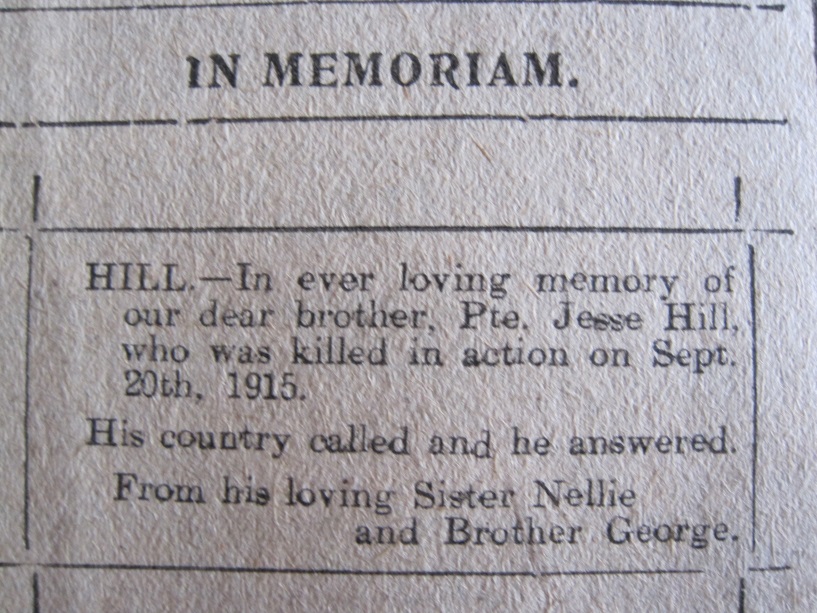
However, there is a small question mark. On the first anniversary of his death in September 1916 an “In Memoriam” notice appeared in the local newspapers. This indicates that the family believed his death occurred on 20 September.
In Memoriam Notice from “The Dewsbury District News” of 30 September 1916
The Unit War Diary for 20 September notes that at 4.55am High Explosives from Hill 60 landed at Charing Cross killing six men.
Pte Healey wrote to Jesse’s family and the details appeared in the local papers in mid-October. The newspaper article puts it bluntly as follows:
“A companion named Private Healey wrote to the relatives a few days ago informing them that Private Hill met his death suddenly, both legs and part of his body being blown off, and an official intimation confirms the sad news”.
So, although official records state Jesse’s death took place on 19 September, it may conceivably have been 20 September.
CWGC records show that after the war Jesse’s body was recovered in June 1919. The trench map reference appears to relate to the Ypres area. I initially believed he may have been buried in what was known Ypres Reservoir Middle Cemetery, (also called “Prison Cemetery No.2” and “Middle Prison Cemetery”), which was located near the prison and reservoir. It was used in August and September 1915, and rarely afterwards. It contained the graves of 107 soldiers from the United Kingdom, 41 of which were from the 6th KOYLI. However a further analysis of CWGC records appears to discount this theory. After the War the graves from Middle Prison Cemetery, other small burial grounds around Ypres and graves from the Salient battlefields were brought together in one cemetery, Ypres Reservoir. This is Jesse’s final resting place.
Jesse Hill’s Headstone – Ypres Reservoir Cemetery
Jesse was awarded the awarded the 1914-15 Star, Victory Medal and British War Medal. He is remembered on the Batley War Memorial and the Soothill Upper War Memorial at St Paul’s, Hanging Heaton. The UK, Army Registers of Soldiers’ Effects show following his death that the Army owed his sister, Martha, as next of kin, £1 13s 3d and a £3 10s war gratuity.
Batley War Memorial Inscription – Jesse’s name, along wit the name of his nephew Percy
Sources:
Ancestry.co.uk – British Army WWI Medal Rolls Index Cards, 1914-1920 Army Registers of Soldiers’ Effects, 1901-1929: http://home.ancestry.co.uk/
The National Archives – Unit War Diary, 43 Infantry Brigade: 6 Battalion King’s Own Yorkshire Light Infantry. WO 95/1906/1: http://www.nationalarchives.gov.uk/
“War Register and Records of War Service 1914-1920 Urban District of Soothill Upper” – Rev W E Cleworth MA
Photos of Jesse Hill, “H” sector trenches, headstone and Batley War Memorial inscription – my own
An intriguing inscription on a Batley cemetery headstone led me to discover the story behind Lottie Oddy and her fiancé James Purdy.
Born in around 1892 Charlotte Emma Oddy, known as Lottie, was the daughter of butcher George Henry Oddy and his wife Emma (neé Popplewell). They lived at Staincliffe Road, Dewsbury. Lottie worked as a sewing machinist making blouses at Carrbrooke Manufacturing Co. She left her employers during the war to take over the book keeping and clerical duties at Oddy and Fox rag merchants based at Common Road, Staincliffe. This change was caused by the absence of her brother, Spedding. A partner in the firm, he was away serving in as a despatch rider in the Royal Tank Corps.
Lottie’s fiancé, James Purdy was born on 13 August 1890. He was one of four sons of Batley Carr residents Walter and Susanna Purdy (nee Raspin). James’ father worked as a foreman rag grinder at Messers Thomas Purdy and Sons, a mungo and shoddy manufacturer located on Bradford Road, Batley Carr. Initially James also worked in the rag and shoddy warehouse but he found manual labour a struggle due to his delicate health. He therefore established his own rag merchants business in around 1913 which, according to newspapers, was flourishing. His delicate health meant he was exempt from military service, although this was due for review in January 1919.
The sweethearts were from the nonconformist tradition. James was connected with the Batley Carr Primitive Methodist Chapel; Lottie with the Staincliffe Wesleyan Church. Described as a devoted couple, they had known each other for a number of years and, according to some newspapers, had been engaged for about five or six.[1]
On 7 September 1918 they joined Lottie’s widowed mother[2] and her sister, Gertie, for a two week holiday to Bridlington. The Oddy family were frequent visitors to the town, holidaying in the resort for several years.
On the afternoon of Friday 13 September Lottie and James went out for a walk but promised to join Gertie and some friends later that afternoon on the sea front. They failed to turn up. There then followed a frantic search involving police from Bridlington and Batley Carr, the harbour master, boatmen and friends and family of the couple, including James’ father who travelled to Bridlington to assist.
Their mysterious disappearance was covered nationwide. They had no known worries; their engagement had family approval; they did not boat, and indeed investigations had found no craft missing; their baggage remained in their Horsforth Avenue apartments; and they normally stayed around the area of the sea front, occasionally walking towards Flamborough. An accident was always recognised as a distinct possibility. Fears of a landslide due to the recent wet weather formed one suggested line of investigation. But even this direction had proved fruitless. They had in effect vanished without trace from a busy seaside town.
The hope remained that they would turn up alive and well, although James’ father did say that he felt as though his son was calling to him for help.
Police issued their descriptions. 5’2” Lottie was brown-haired, blue-eyed, fresh complexioned and of robust appearance. When she left her apartment she wore a gold and brown woollen sports coat, grey mixture frieze skirt, white blouse, black stockings, black shoes, black felt hat and a raincoat. She carried a black moiré bag and had a diamond ring. She also left the apartments with a book.
James stood at 5’1”[3]. Of medium build, he had a slight stoop, a pale complexion and was clean-shaven with rich brown hair. He wore a grey suit, black tie with a gold pin in it, brown mackintosh, light cap and black boots. He had a gold signet ring on his left hand.
No sign of the couple could be found and their disappearance remained a mystery until Saturday 21 September. First thing that morning a retired farmer, Arthur Mason, took a stroll along the South Sands. It was a route he walked regularly. Over recent days he had noticed a cliff fall. The day before his latest walk the sea had been rough with a higher tide than in previous days, reaching right up to the cliffs. Mr Mason noticed it had washed away part of the clay from the fall, exposing a man’s blood-covered head and shoulders. He immediately notified the authorities. Soldiers and police extracted the couple’s bodies from the clay in which they were entombed.
The inquest later that day concluded Lottie and James had been sitting beneath the cliff on James’ coat, when 10-12 tons of overhanging clay broke free and fell on them. James apparently heard something and was in the process of getting up in an effort to protect his fiancée. He had his hand outstretched towards Lottie. She had been sitting on the coat reading her book. Her right hand reached out towards James, and beside her left hand was the open book. This was Alice and Claude Askew’s “The Tocsin: A Romance of the Great War”.[4]
This stretch of beach had been the scene of a previous accident in September 1904, when a Bridlington Grammar School junior master and pupil died as the result of a cliff fall whilst out fossil hunting[5]. A noticeboard erected warning people about the danger of sitting under the cliffs had been washed away several years ago and never replaced.
The Coroner, Mr Herbert Brown, recorded a verdict of accidental death due to a fall of the cliff. This caused the suffocation of Lottie and James. He said he would call the authorities about the necessity of erecting warning signs.
Lottie Oddy’s Batley cemetery headstone – “who met her death by the fall of the cliffs at Bridlington”
James’ funeral took place on 24 September and Lottie’s the following day. They are buried in family graves in separate areas of Batley cemetery.
Ironically at the beginning of October 1918 the papers reported yet another Bridlington cliff tragedy, with the death of 22 year old Bradford woman Ethel Keal. She fell over the cliffs at Sewerby.
Sources:
Ancestry.co.uk: Baptism and Marriage Records (West Yorkshire Non-Conformist records) http://home.ancestry.co.uk/
Batley Cemetery Burial Register
Batley News 21 and 28 September 1918
Batley Reporter and Guardian 20 and 27 September 1918
FindMyPast: BMD and Census record, plus newspapers ( Hull Daily Mail 16 September 1918, 21 September 1918, 23 September 1918, Yorkshire Evening Post 20 September 1918, Yorkshire Post and Leeds Intelligencer 23 September 1918, Driffield Times 28 September 1918), http://www.findmypast.co.uk/
[1] One report indicates an eight year engagement. [2] Lottie’s father, George, died in 1916. [3] Again newspapers varied, some stating 5’3” [4] Alice and Claude Askew were extremely popular husband and wife authors. Associated with the Serbian Campaign, the couple drowned in October 1917 when the boat they were sailing in from Italy to Corfu sank following German submarine torpedo attack. [5] Mr A Graham Allen and Jack Broomhead. Another pupil, Joseph Baker, escaped.
I can immerse myself for hours in Parish Registers, tracking my ancestors and their communities. They can often lead to research breakthroughs. Conversely they can result in further knotty puzzles. Other than the normal but frustrating non-appearance in a register, or the ones containing multiple difficult to untangle options, here is a brief selection from my family tree.
Brick Wall Breakers 1) The baptism on 7 March 1779 at All Saints, Batley for Benjamin Rynder. This is the brother of my 5x great grandmother, Sarah, and his entry is in a Dade style register. So not only does it provide his birth date, his parent’s names and residence and father’s occupation, it also provides his grandparent’s names. It makes tracing the family back a whole lot easier. It also helps with linking to similarly Dade-style recorded siblings and cousins. Sarah’s baptism in 1777 does not contain this level of detail. Maternal Line
2) All Hallows Kirkburton Burial Register gave a cause of death for my 4x great grandfather George’s sister, Esther Hallas. The entry on 13 July 1817 states a cause of death: “Killed by Lightning”. This entry led to further research breakthroughs feeding into Esther’s story, my first blog post.[1]Maternal Line
3) Robert Hudson, the brother of my 4x great grandfather David. His St Michael’s East Ardsley burial entry of 1 November 1831 gives a cause of death “Hung himself in the Coal Pit Cabin”. In following this up I unearthed a rather unsavoury tale which I will return to in the autumn. Maternal Line
4) The burial of George Hallas, my 4x great grandfather, solved the mystery of his father. I had, until this point, a number of possible options. George died aged 69. Nevertheless his burial entry on 12 May 1864 in the Mirfield St Mary’s burial register provided his father’s name, Amos. This information enabled me to go back two further generations. Maternal Line
5) This could easily have fallen into the “Mystery Creator” category. According to his birth certificate John Callaghan, my grandfather, was born on 16 June 1895. However, the transcript of the County Mayo Kilmovee baptism[2] register states his baptism took place on 30 May 1895 in Glan Chapel. One possible explanation is the family could not get to Castlebar to register the birth within the prescribed time-limits, so were creative with his date of birth to avoid a fine. He used to claim he had two birthdays – so this corroborates the tale. Maternal Line
Mystery Creators 6) My great grandmother’s first daughter was born in 1893 out of wedlock. The Parish Register of St Mary of the Angels, Batley has a bizarre entry which indicates otherwise. According to this daughter’s baptismal entry my great grandmother was married to Charles Regan. I have traced no record of this “phantom” marriage, or of Charles Regan. My great grandmother’s eventual Registry Office 1897 marriage certificate indicates she was a spinster. So was Charles her daughter’s real father? Paternal Line (I have anonymised this as it is comparatively recent).
7) The mystifying John Loftus. Another one from Ireland, this time from the County Mayo Kilbeagh Parish baptisms. The entry clearly indicates the baptism on 3 October 1869 of a son, John (Joannes), to John Loftus and Ann Barrett. John and Ann are my 2x great grandparents. I have been unable to trace a birth certificate for their son John. What I have discovered is the birth certificate for a daughter, Ellen, born on 30 September 1869. So have I a missing child of John Loftus and Ann Barrett, or is entry a red herring? Paternal Line
8) Sushanna Hill, my 4x great grandfather’s sister has a perplexing baptism entry in the wonderful Dade-style Sherburn in Elmet Parish Register. Usually Dade Registers are an absolute genealogical god-send. This one has led to a brick wall. Sushanna is the first-born child of Francis and Sarah Hill, so the Dade entry provides a wealth of family history information. The entry for Sushanna reads:
“1st Daughter of Francis of Sherburn, taylor. Son of Francis of Sherburn, wheel carpenter by Esther his wife, daughter of John Simpson of Brayton, yeoman. Mother – Sarah, daughter of Philip Gibson of Little Fenton, farmer, by Sushanna his wife daughter of [blank]. Born Monday 29th August 1785 and baptised the same day”.
I cannot find concrete evidence to support Francis’ parentage as recorded in the entry. As a result I have been unable to trace this line any further back. I have a suspicion that it is a false lead. I think I do know Francis’ parentage. This is one of the nuts I am hoping genealogical DNA tests will ultimately crack. Paternal Line
9) William Hill’s baptism at St Mary’s, Whitkirk on 14 July 1816 is another strange one. William is the brother of my 3x great grandfather. Joseph. According to the Parish Register he is the illegitimate son of Grace Pennington. No mention of “Hill” in the entry whatsoever. In fact Grace Pennington married Francis Hill by licence in that Parish in September 1811. There is however a footnote at the bottom of the page as follows:
“It was discovered when this child was brought to church September 1st having been privately baptized July 14th that this was an erroneous entry, Grace Pennington being lawfully married, and that the entry should have been William son of Francis & Grace Hill, Halton, Butcher. Signed this second of September 1816”
Signatories were the vicar and “Francis Hill, the father of the said child”. I would love to know the story behind this error and its subsequent discovery.[3]Paternal Line
10) My 4x great grandmother Zilla(h)[4] Rhodes, baptised at All Saints, Batley on 29 September 1780. The Dade Register does not help as she is described as a bastard. Neither are there any details provided of her mother Sarah’s parentage. From further entries in the register it appears Sarah went onto have another illegitimate daughter, Mary, in 1784. There are also possibly a further two illegitimate daughters in the 1790s. In turn Zillah had three, possibly four, illegitimate children. So far I have been unable to trace any further details, including through using Poor Law or Bastardy records, because of the paucity of surviving material. But to have so many illegitimate children does seem a tad unusual. Maternal line
Image from Pixabay.com
There are many other examples, but this is my starter for ten.
Sources:
All Hallows, Kirkburton – Burials
All Saints, Batley – Baptisms
All Saints, Sherburn in Elmet – Baptisms
National Library of Ireland Catholic Parish Registers – Kilbeagh Parish baptisms, Microfilm 04224 / 17 http://registers.nli.ie/
Transcript of the Kilmovee Baptisms from the former East Mayo.org website
[1] See my first blog post, “Death by Lightning” [2] This is too late a date for the National Library of Ireland Parish Registers website. Some time ago there was a fantastic East Mayo website which had transcripts of the parish registers. Sadly this has long since gone. But it can be found using the Internet Archive Wayback Machine [3] William and Francis feature in my blog post entitled “Attempted Murder in Halton? The Perverse Joy of Old Newspapers” [4] Syllah in the baptism entry
25 August 2014. A significant date for me. The day my uncle Brian died. The person responsible for my family history interest.
In the days before online research, uncle Brian made a tentative start finding out about his family tree. He wasn’t a car-driver so he did it the hard way, visiting libraries and record offices by public transport.
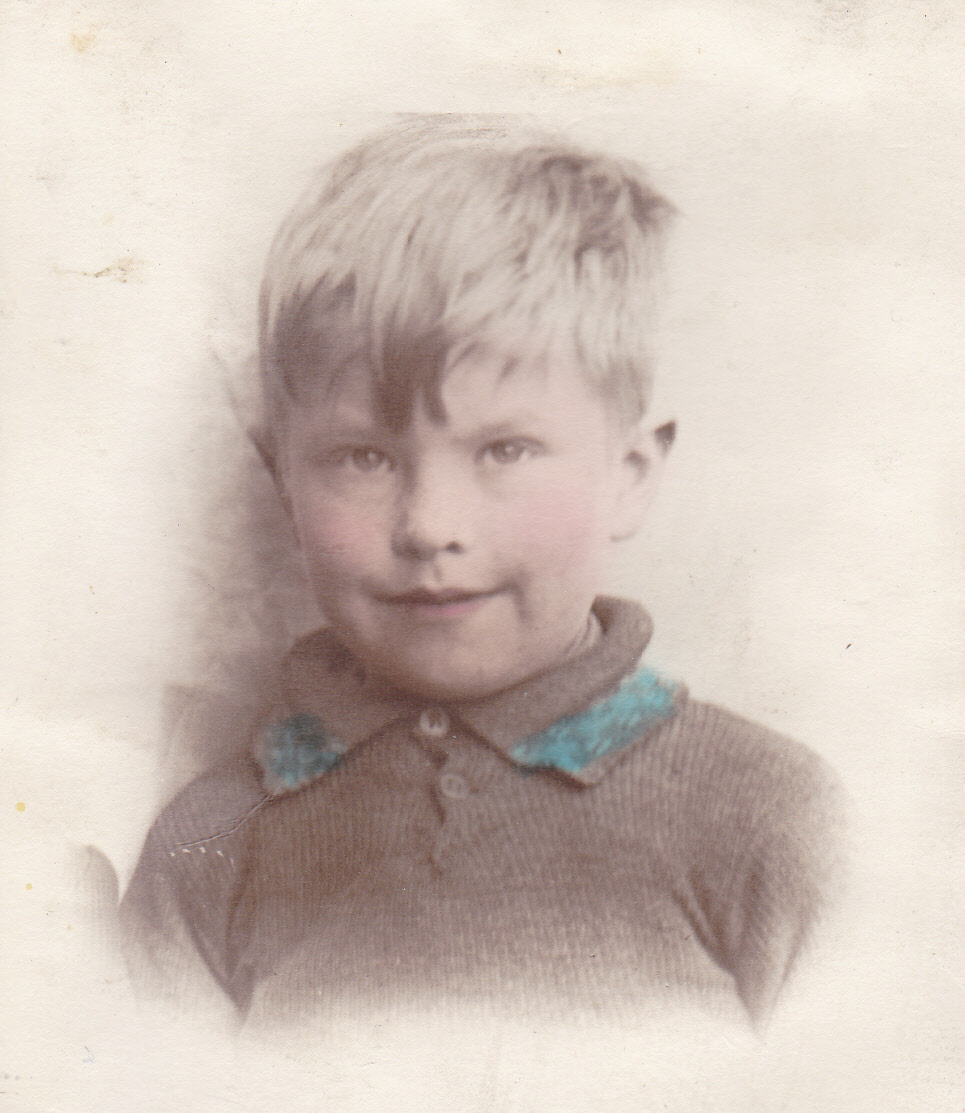
Brian Callaghan age 7
It was the story of my nana’s brother, who died after being knocked down by a car in 1910, which initially captured my interest. Seeing grainy photocopies of those old newspaper snippets, which uncle Brian had discovered trawling through library microfilms, kindled in me the desire to find out more. But it was a few more years before I did anything, not until my brother bought me some general family history research books for Christmas 2005.
Since then I’ve been bitten by the family history bug. I’d share relevant finds with my uncle Brian, who married later in life and never had any family of his own.
A distant relative once said about family history research, “you’ve got a mother and a father. That’s all you need to know“. I wanted to know far more than that.
Uncle Brian too was so genuinely interested. And now I miss sharing my latest discovery with him; or asking questions about the “olden days“. I also regret not finding the time to ask more.
I make no apologies to returning to newspapers again. They are a fantastic family history resource. This is another fabulous FindmyPast newspaper find[1] which relates to my family. It concerns my 4x great grandfather Francis Hill and his son William. Without newspapers I would have struggled to discover this story.
Francis Hill was born in Sherburn in Elmet in 1789. In 1811 he married Grace Pennington, from Halton in the parish of Whitkirk. This is where they settled and raised their family. By the late winter of 1841/2 William, aged around 27, was the couple’s eldest son.
It is the unpleasant confrontation between father and son which the newspapers sensationally reported. The only witness to the events that dark February night was Grace. It appears the whole affair may have remained hidden if it had not come to the attention of the vicar of Whitkirk, Reverend Martineau, who passed the information on to the appropriate authorities. Thank goodness for Reverend Martineau, I say! Though I doubt that sentiment was shared by my ancestors.
Contradictory statements were given by father and son as to the cause of the quarrel. William, an unmarried coal miner, claimed he arrived home on the night of 16 February 1842 at about 11.30pm to find his father the worse for liquor, eating some bacon and bread with a pocket knife. Francis, a labourer, had been unemployed for some time and William remonstrated with him for dissipating his money in such a manner. On the other hand Francis claims William came home in an intoxicated state and he chastised his son for arriving home at such an hour and in that condition.
William’s account was during the course of the argument he struck his father with, what the reports described as “a violent blow”. This knocked Francis off his chair and onto the floor. Francis got up and William was about to hit him again when he slipped and fell onto the knife which his father was still holding. The blade plunged into William’s left side resulting in the protrusion of a portion of his intestines.
William’s account, provided the following day, corresponds in most details with the one given by his mother. She stated her son struck his father, knocking him out of the chair. He was about to continue the assault when Francis, in self-defence, struck out with his knife penetrating the left side of William’s stomach, just below his heart.
This sounds more credible than the tale William told about slipping and falling onto a knife which his father had, rather improbably, retained hold of during the attack.
The statement of Mr Nunneley, the surgeon who attended William, concurs with Grace. He said it was impossible that falling onto the knife could have caused the wound. It was caused by a blow. The surgeon was doubtful whether William would ever recover.
Amusingly to 21st century readers Francis, who would have been aged 52 at the time, was described by the newspapers as “an old man”. He was remanded to prison to await the result of his son’s injury, charged with stabbing William in so serious a manner as to endanger his life.
He remained there for around a month. Not until 29 March 1842 was William recovered sufficiently to appear in front of the West Riding Magistrates. He refused to press charges against his father who was therefore discharged from custody.
William survived the injury and he married in April 1843. He continued to work as a coal miner.
So although not overjoyed at this unedifying depiction of my ancestors, I am thankful for the controversy because of the details it adds to my family history.
FindMyPast – newspapers: http://www.findmypast.co.uk/ (“Leeds Intelligencer” 19 February 1842, “Leeds Mercury” 19 February 1842, “Northern Star and Leeds General Advertiser” 26 February 1842, “Leeds Mercury” 2 April 1842).
Pixabay image of pocket knife (free for commercial use/no attribution required: https://pixabay.com/
[1] As OCR is not always the most accurate I also searched on the British Newspaper Archive site. Although I am not a subscriber, you can identify the paper and page number and then go back to FindMyPast armed with the newspaper details to check it out. Even this did not find all the results, including crucially the outcome of the case. I read through the papers to fill in the gaps.
In a blog post last month I mentioned that newspapers have offered up some promising articles which may relate to my 5x great grandfather, chimney sweep Stephen Burnett.[1] This all follows on from a newspaper report of a removal order challenge in 1830 which revealed his name and the fact that he plied his trade in the early 1770s in the Stockton-on-Tees area of County Durham. Details of this removal order leading to my discovery of his identity are in Part 1, posted in July 2015.
Covering the period 1776-1780, these latest newspaper extracts all offer further research clues for Stephen Burnett which I will follow up once I can arrange a visit to Durham Record Office.
The initial two articles are in the “General Hue and Cry” section of the “Newcastle Courant” in August 1776.[2] A reward of one guinea is offered for the apprehension of Margaret Brown and Stephen Burnett. She is described as a 22-23 year old, middle-sized, good-looking woman with a scar on her forehead apparently caused by a burn or scald. She frequently travelled the country in the company of a chimney sweep named Stephen Burnett. The notice states Stephen rescued Margaret from the Constable of Stockton-on-Tees. At the time of her escape she was wearing a flowered cotton gown, a black cotton coat, a black beaver hat and a striped petticoat. Margaret is accused of imposing on the unwary by telling fortunes. The name, trade and operational area of her co-accused correspond with that of my 5x great grandfather Stephen Burnett and perhaps provide another indication of character.
The next mention of Stephen is in two editions of the “Newcastle Chronicle” in March 1778. The 21 March 1778 edition has a cryptic paragraph which states:
“Last week one Burnett, a strolling chimney-sweeper, was detected at Stockton with a boy about 12 years old, who had been stolen from his parents at Newcastle some time ago. What a pity it is that peace officers do not exert their authority in examining and bringing to justice all such delinquents”
The following week the newspaper followed up the story.[3] They learned the original article was aimed at Stephen Burnett, a chimney sweep from Bishopwearmouth, near Sunderland. He also rented, and occasionally resided at, a house in Stockton.
Taking offence at the allegations, the slur on his character and the “opprobrious epitaph of delinquent” Stephen also placed an advert in the same paper. He strongly refuted this slanderous paragraph designed to prejudice his character. He stated that he could produce testimonials that he and his boys had the honour of being employed be some of the greatest personages in the North East. He offered a reward of one guinea to anyone who discovered those responsible for writing and sending the libellous article. This was no small sum of money, equivalent to the buying power of six days craftsmen wages in the building trade.[4]
During this period the issue of the plight of children employed as sweeps was starting to gain traction. The advert and reward demonstrate the strength of Stephen’s feelings about the allegations. He went on the offensive to publicly deny them in an attempt to clear any associated stain on his name and reputation which might impact on his business and possibly his ability to recruit climbing boys in future.
One slight concern to me is the statement contained within the advert that no other person named Burnett employed as a chimney sweep had been in Stockton for upwards of six years past. My 5x great grandfather was there as a chimney sweep at the start of the 1770s with his illegitimate son Robert being born on the road to Darlington at a place called Long Newton in around 1771. But the similarities in name which is by no means common, the location and occupation all seem to point to there being a family connection even if it is not the same man. And at the end of the day the date question-mark is only marginal, the dates are not set in stone and are open to interpretation. I do believe this, in all probability, to be my ancestor.
The final snippet is from the “Newcastle Courant” of 25 March 1780 with an advert posted by Stephen Burnett, Sunderland chimney sweep, seeking the whereabouts of two boys he had hired as chimney sweepers. The lads had deserted from their servitude on Sunday 12 March 1780. The first, Peter Evens, was aged around 15 years old and had been hired for a year; the younger of the two absconders, William Wilson, was Stephen’s bound servant (ie apprentice). Aged around 12, he measured 4ft tall. William’s height is indicative that small, under-nourished children were ideally suited to climbing the narrow chimney flues.[5] Stephen once again offered a one guinea reward and all reasonable expenses for the runaways’ apprehension, and also offered a warning of prosecution to anyone else who employed the lads.
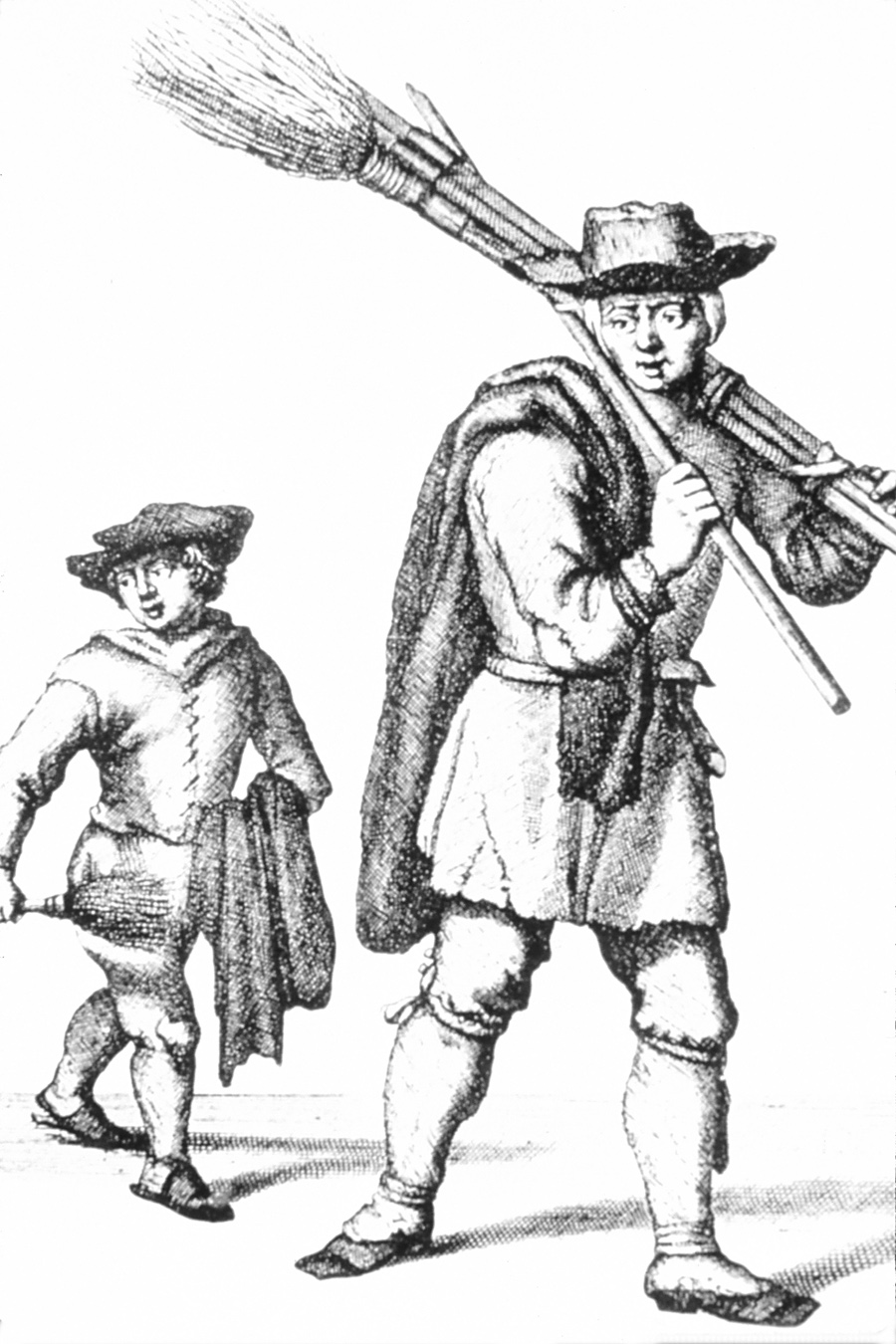
An eighteenth century drawing of some chimney sweeps. They were seen as one of the earliest cases of occupational cancer, as observed in 1770 by Percival Pott. Source: National Cancer Institute from Wikimedia Commons: https://visualsonline.cancer.gov/details.cfm?imageid=2106
I must admit to a certain amount of discomfort that my 5x great grandfather was a master sweep and was also implicated in stealing children for those ends. Parish authorities apprenticed poor children to chimney sweeps as climbing boys; impoverished parents sold their children to master sweeps even into the nineteenth century. But there are also tales of chimney sweeps stealing children. One of the most well-known surrounds the son, or in some versions nephew, of Elizabeth Montagu.[6] He was kidnapped, feared dead, only to return to the home of Elizabeth some years later in the employ of a sweep engaged to clean the chimneys. Thereafter, until her death in 1800, she hosted a breakfast annually on 1 May for young chimney sweeps.
Another philanthropist with a concern for chimney sweeps was London merchant Jonas Hanway. From the 1760s onwards he was an early campaigner in the efforts to improve the working lot of sweeps’ apprentices. As a result of his crusade the 1788 Chimney Sweep Act was passed specifying a minimum age of eight for apprentice sweeps. This, however, was not enforced with children, boys as well as girls, as young as four continuing to be engaged in the business.
The cruelty of masters to their climbing boys was notorious. Physical punishment was widespread. Tales of small children being forced to climb chimneys by sticking pins into their feet or lighting straw behind them were commonplace. The children led a brutal existence, working in filthy, dark, frightening, dangerous conditions by day, with no guarantee of washing facilities after, and sleeping on sacks of soot by night.
In 1817 a House of Commons Report on boy chimney sweeps looking at their conditions between 1788 and 1817 found that:
“It is in evidence that they are stolen from their parents, and inveigled out of workhouses; that in order to conquer the natural repugnance of the infants to ascend the narrow and dangerous chimneys, to clean which their labour is required, blows are used; that pins are forced into their feet by the boy that follows them up the chimney, in order to compel them to ascend it; and that lighted straw has been applied for that purpose; that the children are subject to sores and bruises, and wounds and burns on their thighs, knees and elbows”;
And:
“…. a sweep might be shut up in a flue for six hours and expected to carry bags of soot weighing up to 30lbs. Many suffered ‘deformity of the spine, legs and arms’ or contracted testicular cancer”[7]
So the thought that an ancestor of mine was involved in this business is the most disquieting thing I have found in my family history research to date. As a result of this, the words of William Blake’s poem, written around the time Stephen was operating, have taken on greater meaning.
“When my mother died I was very young, And my father sold me while yet my tongue Could scarcely cry weep weep weep weep. So your chimneys I sweep and in soot I sleep.”[8]
[1] These were discovered via FindMyPast and the British Newspaper Archive. As the OCR for FindMyPast newspapers is not the most accurate, I did the Stephen Burnett search on the British Newspaper Archive site too. Although I am not a subscriber, you can identify the paper and page number and then go back to FindMyPast armed with the newspaper details to check it out. [2] 17 and 24 August 1776 [3]“Newcastle Chronicle” 28 March 1778 [4] Using The National Archives Currency Converter, 1780/2005 buying power comparison [5] A check on FindMyPast and Ancestry.co.uk TNA IR1 series of Apprentice Duty Registers 1709-1811 reveals no mention of Stephen Burnett. The Duty was a levy on apprentice premiums, but this levy was exempt for masters taking on charity and Poor Law apprentices. [6] The veracity of the tale is open to question http://onelondonone.blogspot.co.uk/2011/05/mrs-montagu-and-chimney-sweeps.html [7] Report from the Committee of the honourable the House of Commons on the Employment of Boys in Sweeping of Chimneys – 1817 [8]“The Chimney-Sweeper” – William Blake, “Songs of Innocence” 1789
Some debate occurred in the Yorkshire press in March 1915 as to who was the first Northern Union player in Yorkshire and beyond to obtain a commission in The Great War.
The “Huddersfield Daily Examiner[1]” and “Yorkshire Evening Post[2]” declared that in Yorkshire the accolade fell to Wakefield Trinity’s William Lindsay Beattie who was appointed temporary 2nd Lieutenant in the Border Regiment on 15 March 1915.[3] He lost his life on 27 January 1917. Lancashire-based Wigan’s Gwyn Thomas was reputed to be the first commissioned Northern Union player. However, I believe this event occurred towards the end of 1914. Thomas survived the war and joined Huddersfield in 1919.
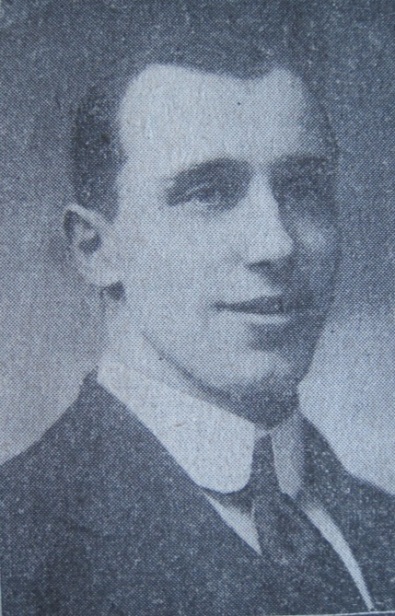
Both papers overlooked Batley winger, Robert Randerson.
Robert Randerson
Robert, (or Bob as he was known according to the local press), joined the Leeds University Officer’s Training Corps (OTC) shortly after Britain’s entry into the War. “The London Gazette” of 25 August 1914 lists Robert as amongst those OTC cadets and ex-cadets appointed as temporary 2nd Lieutenants.[4] Promotion quickly followed. In January 1915[5]“The London Gazette” announced his appointment to temporary Lieutenant with effect from 10 December 1914. Only months later, on 15 May 1915, he became a temporary Captain as notified in a June edition of the same official journal.[6]
Letters of correction to the papers followed; and the Batley Club itself was adamant the honour belonged to its player. In its Annual Meeting of May 1915 it pronounced:
“Randerson…..was the first N.U. player to receive a commission. This honour has been claimed by others but it belongs to Lieut. Randerson and the Batley Club”[7]
Within weeks of this discussion, on 7 August 1915, Robert was to lose his life in the “Yorkshire Landings” at Gallipoli.[8]
Robert was born in York in late 1890, the son of Robert and Annie Randerson (neé Wilkinson). His siblings included Annie (1886), Benjamin (1889), William (1892), John Wilkinson (1897) and George (1899).
The family were comfortably off with Robert senior earning his living as a master corn miller then as a grocer and corn merchant. By 1901 the family lived on Haxby Road, York and remained here at the time of Robert’s death.
They were an old Catholic family with strong religious convictions and connections. After training at Ushaw, Robert’s uncle Benjamin served as a priest initially briefly at St Patrick’s, Leeds, then St Charles Borromeo, Hull and lastly, until his death in 1897, at St Hilda’s, Whitby. In the 1911 census Robert’s sister, Annie, was a nun residing at St Wilfrid’s Priory, Arundel. She was employed as a head mistress at the town’s St Phillip’s Infants’ School.[9] His younger brother, John, was a boarder at the Franciscan College at Cowley, Oxfordshire.
The 1911 census shows Robert, a former pupil at Archbishop Holgate’s Grammar School in York, following his sister Annie’s educational career path. A student at St Mary’s College, Hammersmith, the objective of this establishment was to train Catholic men to serve as teachers in Catholic schools throughout the country. Robert demonstrated his sporting ability whilst studying here. In an inter-College sports contest he broke all previous records for the 100 yard flat race, covering the ground in a shade over 10 seconds.
Robert came to Batley in around 1913 as an assistant master at St Mary’s school. He soon became involved in the wider Parish community, holding the role of choirmaster at St Mary’s church.
But he became known beyond the town’s Catholic population when he started playing rugby for Batley. Initially in the reserves, he made his first team debut in a cup-tie at Halifax on 14 March 1914. His career was limited by the outbreak of war, but in this short time he made five appearances for the Batley first team scoring four tries.
At the declaration of war Robert’s strong sense of duty kicked in. He was the first Batley player to enlist and was quoted as saying:
“I am not a fighting man; I don’t like to fight, but I ought to go and fight at a time like this”.
He served with the 6th (Service) Battalion, Alexandra, Princess of Wales’s Own (Yorkshire Regiment), one of Kitchener’s New Army battalions. His enlistment necessitated a re-arrangement of the St Mary’s Boys Department school timetable, an event noted in the school log book.
It was whilst serving with the Yorkshire Regiment based at Belton Park, Grantham, that he made his final appearance for Batley against Keighley on 10 October 1914. He told the club secretary Kershaw Newton that it would be his last game with the Gallant Youths until peace was signed as, with his exhaustive training programme of marching, drilling, lectures and special studies as an officer on top of his ordinary duties, he was “about played out by the weekend”.
Additionally, with his officer responsibilities, he could not afford to risk a rugby playing injury.
“….I have 60 men under me and am responsible for them, and will have to lead them in war. To make them and myself efficient requires all my time and energy, and I do not think it would be right to risk laying myself up with an injury….”
Poignantly he wrote:
“…..I will come and hope to see many of my old friends round the railings as a sort of good-bye until we get the serious business through and when honour and justice are satisfied I trust to have many a jolly game on the hill”.[10]
Robert scored one try in Batley’s 19-0 victory. But, ironically given his concerns about injury before the game, he suffered the misfortune of a kick to the head. This blow confined him to a darkened room for a few days on returning to Belton Park.
At the beginning of July 1915 Robert and his Battalion left Liverpool bound ultimately for the Dardanelles. Initially landing at Mudros they moved onto the island staging post of Imbros to acclimatise and practice night landings and attacks. On the evening of the 6 August they left Imbros and at around 11pm that night they finally disembarked on the Gallipoli peninsular, south east of Nibrunesi Point on B Beach. The aim was to take Lala Baba, a low hill between the southern side of Suvla Bay and the Salt Lake.
Map of Suvla Bay and ANZAC Cove from Gallipoli Diary, Vol. 2 by Sir Ian Hamilton – Edward Arnold, London, 1920 or before – From Wikimedia Commons
As the men moved off from the sea shore they were immediately engulfed by the darkness of the night, it being impossible to see a body of troops at a few yards distance.
Lala Baba was eventually taken, but the Unit War Diary records a heavy price paid with 16 officers and about 250 other rank casualties (killed and wounded) in the fighting during those first hours of the night of 6/7 August 1915. This was out of a total of 25 officers and 750 other ranks that set off from Imbros only a short time earlier.
Robert was amongst those officers killed. He died on 7 August 1915 within hours of landing. According to a fellow officer he met an instantaneous death as a result of a gunshot wound to the head. In a letter to Robert’s father he wrote:
“We made our landing of the evening of the 6th August below the Salt Lake. The 6th York’s covered the landing of the rest of the Brigade. At about 10a.m we disembarked from the barge with little opposition and started up the peninsular to take a hill called Talla Baba, and there we lost a lot of men. I got there just before 12 midnight. Some of our men had gone over and some were held up by the Turks entrenched on top and there were several of our officers wounded and killed there, I was told your son had been killed there and the sergeant who told me said that he had been shot through the head, so his death seems to have been instantaneous”.[11]
The first news of Robert’s demise reached Batley around the 12 August when Mrs Power, with whom he had apartments in Norfolk Street before the war, received a brief note from his father informing her that he had been killed in the Dardanelles.
Local tributes poured in for him, newspapers referring to him as “Gentleman Bob”.“The Batley Reporter and Guardian” praised his “manly character and sterling qualities” concluding he “was a true sportsman and a most popular player on the field and a perfect gentleman in private life”.[12]
The Batley News eulogised his virtues saying:
“A pattern of good conduct on the football field, handsome appearance, of excellent physique, and a splendid teacher, his demise removes from the Heavy Woollen District one whose manifold example commends itself to the rising generation”. [13]
The members of the Batley Education Committee were equally fulsome with their tributes to Robert in their meeting at the end of September 1915. They expressed sympathy with his family and appreciation for his work in the town. Alderman H North said that:
“Captain Randerson was a typical gentleman; an ideal leader of boys and a man appreciated by his scholars and school managers. …… His death had removed from Batley a most capable servant of the education committee….. The town was poorer by his demise”.
His death was also noted in Catholic newspaper “The Tablet”[14]
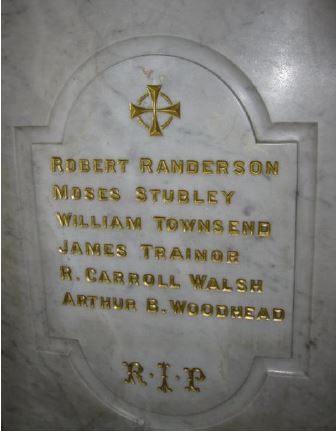
Robert Randerson, remembered on Batley St Mary’s War Memorial
I will leave the final word on Robert from the school in which he worked. Almost exactly one year to the day from the St Mary’s log book entry about timetable changes forced by Robert’s enlistment, the same log book has an entry on 16 August 1915 announcing that school re-opened after the midsummer holiday. It went on to say in a restrained, understated way:
“News received that Captain Randerson, Assistant Master from this school, was killed in action at the Dardanelles on August 7th”.
Sources:
Batley News
Batley Reporter and Guardian
Commonwealth War Graves Commission
FindMyPast – newspapers, census records and Teacher’s Registration Council Registers: http://www.findmypast.co.uk/
School Log Book – Batley St Mary’s
“St Mary of the Angels War Memorial” – Jane Roberts
The National Archives Catalogue Reference: WO/95/4299: Unit War Diary – 32 Infantry Brigade, 6th Battalion Yorkshire Regiment 1 July 1915-31 December 1915
Wikimedia Commons – Map of Suvla Bay and ANZAC Cove from Gallipoli Diary, Vol. 2 by Sir Ian Hamilton – Edward Arnold, London, 1920 or before
This is the third in my series of posts about my genetic genealogy journey. I ended my last post at the waiting game phase, all kits on their way. Things have progressed and I thought it helpful to provide an update.
I have included the information below of the various test stages to give some indication as to the variability of posting/processing times:
Test Type
Posted
Arrived
Lab Processing Starts
Anticipated Result Date
Result Arrived
Ancestry autosomal (mum)
27 June
3 July
7 July
6-8 weeks
13 July
Ancestry autosomal (dad)
27 June
15 July
18 July
6-8 weeks
FTDNA Family Finder (me)
29 June
11 July including lab processing stage
5-19 August
FTDNA Y-DNA 37 (dad)
29 June
13 July including lab processing stage
23 Sept – 7 October
FTDNA mtFull Sequence
29 June
13 July including lab processing stage
26 August – 9 September
There is a lengthy delay in the anticipated result date of the FTDNA Y-DNA test. Hopefully this is a good sign, due to its popularity and hence the number of testers.
But the thing I found must perplexing was the difference in timescales for mum and dad’s Ancestry tests. These were both posted the same day from England to Dublin. The results for mum’s test came through significantly ahead of schedule, in fact even before dad’s vial of spit got there.
I really did suspect his was lost in the post but, when I asked, Ancestry said it allows 20 working days before a test is designated such.
More amazingly the FTDNA tests posted a couple of days after dad’s Ancestry one, and destined for Texas, arrived before his Ancestry test.
But dad’s test did finally reach its destination. So the moral of the story, which seems to be the DNA theme, is do not give up hope and do not assume tests posted on the same day will arrive at roughly the same time! And one final thing to watch out for, there can be a delay between the test actions being annotated on the site and the email notification reaching you.
Mum’s Ancestry results came in on 13 July, a mere 17 days after posting. I have now had a quick preliminary look at them and these are my initial findings.
First thing to say is the site is easy to navigate and a pleasing mix of charts, tables and expandable “?” Boxes. It is all very intuitive and clear.
In terms of ethnicity there are no surprises. My mum has an English mother and Irish father. Her ethnicity results show 63% Great Britain, 34% Ireland. Of the four trace regions, Ancestry state “it is possible that these regions appear by chance and are not actually part of your genetic ethnicity”. So on this basis I am not claiming any tentative Armada, possibly false in any case, ancestry.
Mum’s Ancestry DNA Test Ethnicity Breakdown
The results correspond with all my research to date (going back to the early 17th century on mum’s maternal line). It is good to have general confirmation of my research. But this is more an interesting coffee-table talking point rather than anything more substantive.
Then onto the meaty stuff – the DNA matches. The upfront view is mum has 44 4th cousins or closer and one shared ancestor hint. The latter is like the Ancestry tree shaky leaves.
I excitedly went to the “View all DNA matches” button and immediately felt overwhelmed, but thrilled, to see 57 pages of them, with around 50 entries per page. These are split into relationship ranges and confidence levels. The 4th cousin box refers to possible 4th – 6th cousins range and this is the first batch of matches listed in mum’s case, as this is the closest identified relationship.
Mum naturally has a significantly larger distant cousin category, with a possible range of 5th– 8th cousins. This is the remaining 56 and a bit pages.
Ancestry assign the following “confidence” ratings to the matches: “Extremely High”, “Very High”, “High”, “Good” and “Moderate”.
At this point it may be worth mentioning that ISOGG has a useful piece explaining the Ancestry confidence scores and their realism. It may be that the percentages for sharing a common ancestor are set too high[1]. There is also the caveat that the “AncestryDNA database is 99% American, and it is not yet known if these ranges will apply in the same way to other populations”.
Enthused I spent an afternoon ploughing through the first page of matches, only to become increasingly frustrated. This page included all 44 4th cousin matches. Six of these had “extremely high” confidence markings and the remainder “very high”. There were also two “very high” and four “high” distant cousins on this page.
Clicking onto the individual matches brings you to the next level. There is a “Pedigree and Surnames” tab which identifies all the surnames associated with the match’s tree. Helpfully shared surnames are pinpointed at the start, so this cuts out trawling through a whole list of surnames to pick out the ones in common. There is also the tree section on the right hand side of the page.
A second tab entitled “maps and locations” has a summary column as well as a map with coloured indicators identifying your family tree locations (blue) and those of the DNA match (mustard). Any shared locations are immediately recognisable, as the pointer for these is green.
A word of caution though – the maps are not entirely accurate. I uploaded my tree via a Family Historian GEDCOM file. The Ancestry programme has some fundamental discrepancies because my descriptors do not accord exactly with the Ancestry format. For example some of my Yorkshire ancestors are placed in the Isle of Man, Kent and the North East. I have corrected this.
Of less importance, but useful to know, is that if a vague location descriptor is attached, such as England or Ireland, the pointer will appear in the middle of the country. Or some may have assigned a county level rather than place-specific location. For example I have seen several matches with County Mayo as a location, (including a couple on my tree), but no further detail as to where in Mayo. So do not take the pointers at face value.
Worth using is the “Note” box. I am entering brief details about the DNA match’s tree and any obvious connections. It is also helping me keep track of the reviewed matches.
Example of Ancestry DNA relationship/confidence levels and my notes
However my initial enthusiasm soon evaporated as it began to feel more like an exercise in futility. Of the 44 4th cousin matches six have private trees, although some of these do have public trees elsewhere on Ancestry; 11 have no tree; and five have less than ten people in their tree. Possibly some of these are individuals trying to find their DNA roots. Though this means straightaway a significant proportion are rendered relatively meaningless for my DNA purposes, at least for the immediate future.
When I first embarked on this journey I did wonder about linking my hitherto private tree to the test. I have for several years steered clear of putting my tree in the public domain, for privacy/copying reasons, having had my fingers burned years ago when I had a public Genes Reunited tree. It was a horrid experience and that copied information is still out there on a website. It is not something I ever wish to repeat. So I get perfectly why some trees are private. Others may, for personal family sensitivities, decide against a public tree. It is after all an individual decision.
However in the end I decided to do a reduced, skeleton-form tree specifically for DNA test purposes. My reasoning for doing this is having a private tree might cause people to by-pass me; it might be of assistance to other potential matches and facilitate contact in the interest of a shared goal; it could eliminate protracted fishing-questions; and it hopefully will minimise the risk of wholesale copying, my big fear.
Anyway, back to the DNA results. Of the remainder of mum’s matches with trees of more than ten individuals, a couple are of peripheral interest and I may in due course make contact. At least though there is something concrete to base any contact with the tree-owners on. For the other matches on this first page there is no obvious connection.
I will go through the remaining 56 pages of matches over the coming months. But I will prioritise my search focusing first on those with larger, accessible trees. I will also make more judicious use of the location/surname search filters as this will indicate common data even in private trees, although in the latter cases just at the top level. And hopefully, as I become more familiar with what the site has to offer, my frustration will decrease.
And I have not entirely given up hope. My mum’s shared ancestor hint is a distant cousin match with a “good” confidence rating. This appears on page four of the matches. There is a tree attached. And, from this, the match is at 6th cousin level. It does not break down any brick walls for me, but it is a start.
So, in summary, I am finding that genetic genealogy is no silver bullet to break through brick walls. It is more of a long game and another tool in the genealogy box. Hopefully DNA match success rates for me will improve as more and more people, especially from England and Ireland[2], sign up. I am even considering doing the test myself.
But the bottom line is you are still reliant on people linking a meaningful tree to their DNA test; or those with private trees responding to messages; and those trees being accurate.
8 July saw the launch of the National Library of Ireland’s (NLI) Catholic Parish Registers website[1]. As with any new launch patience was important in the early hours. Heavy traffic did slow the system down initially. However, I eventually managed to connect with the website that evening.
I have now spent a few very satisfying hours looking for the records for my County Mayo ancestors. These are my early thoughts.
Obvious really, but you do need to have an idea where your ancestors were from, and from there the Catholic parish. This does not necessarily correspond to the Civil Parish. It also pays to be aware of adjacent parishes and also any parish boundary changes. The NLI Parish Registers website provides a helpful link[2] to help identify the appropriate parish and there are other websites and books[3] which perform similar functions. In cases where you are unsure of the location of your ancestors Griffiths Valuation and surname distribution patterns[4] may provide clues. But if like me you have ancestors called Murphy, the use of these can be limited. Fortunately I know the area of East Mayo from which most of my ancestors hailed although a couple are proving elusive.
There are limitations in terms of date coverage. The registers start from the 1740s/50s in some areas of Ireland and generally end in around 1880, although there are some exceptions to this cut-off point. Registers in County Mayo tend to start later. The County Mayo parishes I am interested in illustrate this. Kilbeagh baptisms range from 1855-1881, marriages 1845-1866 and a different marriage set on a separate film for 1855-1881; Kilmovee has 1854-1881 and 1855-1881 (not the same entries) baptisms, with marriages 1824-1848 and 1854-1880; Knock baptisms range from 1868-1881 and marriages from 1875-1881. So not a great deal of coverage in terms of years to follow a family generationally, and the baptisms and marriages timeframes do not correspond exactly. Relating this to one branch of my family, my grandpa, John Callaghan, was born in 1895 in Carrowbeg near Kilkelly, County Mayo. His parents Michael Callaghan and Mary Murphy were married in 1883 and his eldest sibling was born in 1884. None of these events fall within the dates of the Kilmovee registers. I can follow his mother’s family (she was born in around 1856), from Sonvolaun, in the Kilmovee registers. But his father was born in around 1848 and possibly came from Shanveghera Townland (Knock), for which there is no coverage for the relevant period. So the registers have been of limited help here[5].
There are 56 parishes across Ireland which are not covered – fortunately this does not affect the parishes of my ancestors which all feature to some extent, although maybe perhaps not for the years I would want. Ballycroy in County Mayo is an example where there is no coverage.
The registers cover mainly baptisms and marriages. So if you are seeking burials you are probably going to be out of luck. This is the case for all the known Catholic parishes of my ancestors. In my quick scan of County Mayo I only found Kilfian, Killasser and Kilmoremoy (which also falls into Sligo) had burials.
Christian names are in Latin. Can be a bit daunting at first but there are websites which help with this.[6]
The names in the registers are not searchable by keyword. So it is old-fashioned page by page trawl through the scanned microfilmed document, although you can narrow the date parameters if necessary. To be honest I love looking through the complete register. It gives me more of a feel for the community in which my ancestors lived. I also have an indication as to surname spelling variations. It also means I am not reliant on someone else and their possible omissions and errors in transcribing or indexing. You can fast track the process if you have Ancestry[7] access using their “Ireland, Selection of Catholic Baptisms 1742-1881”,“Ireland, Selection of Catholic Marriages and Banns 1742-1884” and “Ireland, Selection of Catholic Parish Deaths 1756-1881”. Be warned though the Latin name issue can create problems if you do use this method. A search for my paternal great grandfather Patrick Cassidy under is Anglicised name does not come up on this Ancestry search. But he can be found under “Patritius Cassidy.” So consider wildcard searches.
National Library of Ireland, Catholic Parish of Kilbeagh Baptisms 1 Jan 1855-16 Jan 1881, Microfilm 04224 / 17 – 5 April 1868 Patrick Cassidy baptism
I love the fact that for baptisms mother’s maiden names and sponsors (godparents) are included in the registers. These can provide further family connection pointers.
One of the Kilbeagh Marriage Registers[8] provided an “impedimenta” column providing additional information such as degrees of relationship, so again useful follow up clues.
Finally it does help to know the history behind the records to explain why things are the way they are. In this respect I find “Irish Church Records” edited by James G Ryan a useful, clear-written reference.
Yes, in common with other similar projects there are some pages where writing is faint and difficult to read. One page I looked at in Kilbeagh[9] had what looked like a leaf, but was probably a giant ink-splodge, obliterating part of the page. Not great if that is the page you are interested in.
But I am overjoyed that such a fantastic, free genealogy resource is now available for those with Irish Catholic ancestry. And the site is one to which I shall return frequently as I try to find out more about my County Mayo roots, including my pre-famine Gavan and Knavesy (and its numerous variants)[10] ancestors, for whom I have still to identify origins.
Finally, to date the identified County Mayo surnames relevant to my direct-line ancestry are:
















 Past To Present Genealogy