A Dirty Tale from a Yorkshire Town 

Imagine the following street scenes.

A crowd of “…..30 to 40 people waiting for water around the public well. The most they get at a time was ….about three gallons, and for this …..the poor people had to go to the well as late as 11 o’clock at night, and as early as 2 or 3 o’clock in the morning”.

It is a common practice for the people to excavate cesspools in the rock to receive the house refuse, which would otherwise be thrown on the surface of the streets”.

In some parts of the town he believed there was not more than one privy to 20 houses, all of which were probably densely overcrowded”.

The entrance into the fold or yard in which this [large common] privy was situated was blocked up with offensive matter, and the smell was quite overpowering”.

And houses with “…as many as four families were found herding together in one small room”.

This was Batley in 1852, as described to an official inquiry looking at the state of the town’s sewerage, drainage, water supply and sanitary condition. What on the surface seems a fairly dull, uninspiring document proves to be anything but. The report is packed with evidence from Batley residents and officials detailing the town’s appalling sanitation and water provisions.

The investigation in to the state of Batley’s sanitation resulted directly from the 1848 Public Health Act. The purpose of this Act was to promote the public’s health and to ensure “more effective provision … for improving sanitary conditions of towns and populace places in England and Wales”.

Prompted by social reformer Edwin Chadwick, one of the 1834 Poor Law architects, he argued that improving the health of the poor by reducing illness and deaths from infectious diseases would reduce the numbers seeking poor relief. The money saved by reducing the burden of relief would outweigh the costs of public health measures, such as improved drainage and sewerage, provision of clean drinking water and refuse removal. It took the 1848 cholera outbreak to force the Government’s hand. The Act was introduced, making public health a local responsibility, establishing a structure to deal with public health issues and paving the way for future public health developments.

Under the 1848 Public Health Act provisions, 218 out of Batley’s 1,934 ratepayers, (elsewhere the document mentions  1,935 ratepayers), requested a preliminary inquiry which was held at the Wilton Arms before William Ranger, Superintending Inspector to the General Board of Health. His written findings were delivered in August 1852.

There is a wealth of information in the report, ranging from the growth of the town, mortality and burial charges to daily life and conditions, changing demography and attitudes to the Irish.

The impression given in Ranger’s report is of a rapidly expanding manufacturing cluster comprising of six townships in 17 square miles, all facing similar water and sanitation problems. These townships , Batley, Heckmondwike, Dewsbury, Liversedge, Gomersal and Cleckheaton, had a combined population of 50,000 but the largest of them on its own totalled a little over than 14,000. As such, they lacked the individual resources in terms of population numbers and finances, to forge independent solutions. Dewsbury was first to apply the Public Health Act, Batley and Heckmondwike followed suit, starting with this inquiry.

The shortage of water provided a recurring theme in the report. The drought of late 1851, which continued into the spring of 1852, aggravated the situation. But the main issues were the town’s population growth combined with its industries. The sinking of colliery shafts cut supplies to the town’s wells draining them of water, and in any case this water was too hard for cooking and cleaning. The waste and refuse from the burgeoning textile mills, combined with sewage and refuse from houses accommodating a rapidly expanding population, polluted its streams.

The problem affected all areas of the township, from Carlinghow to Healey. People queued often two to three hours throughout the day and night at public wells to fill three-gallon containers, known locally as kits. Many chose to go at night for shorter queues. Some, like Mr Stubley and Mr E. Taylor, kept children at home specifically for the task of water collection. Others, with no family, had to fit water collection in around long working days. People collected rain water to supplement meagre supplies. Those with money attempted to sink wells, often costly and unsuccessful.

The poor water quality caused disease. According to Rev. Andrew Cassels, vicar at Batley Parish Church, the beck in Batley was in an extremely bad state. A few years previously, mortality of those living near it was so high, as a result of fever, that entire families were wiped out. Mr H. Ingram stated his wife had suffered from incapacitating diarrhoea for a considerable time due to the impure water. Mr J Willans said cattle refused to drink from the beck at Carlinghow; whilst others trailed their livestock for several miles to get drinkable water. As a result milk yields decreased.
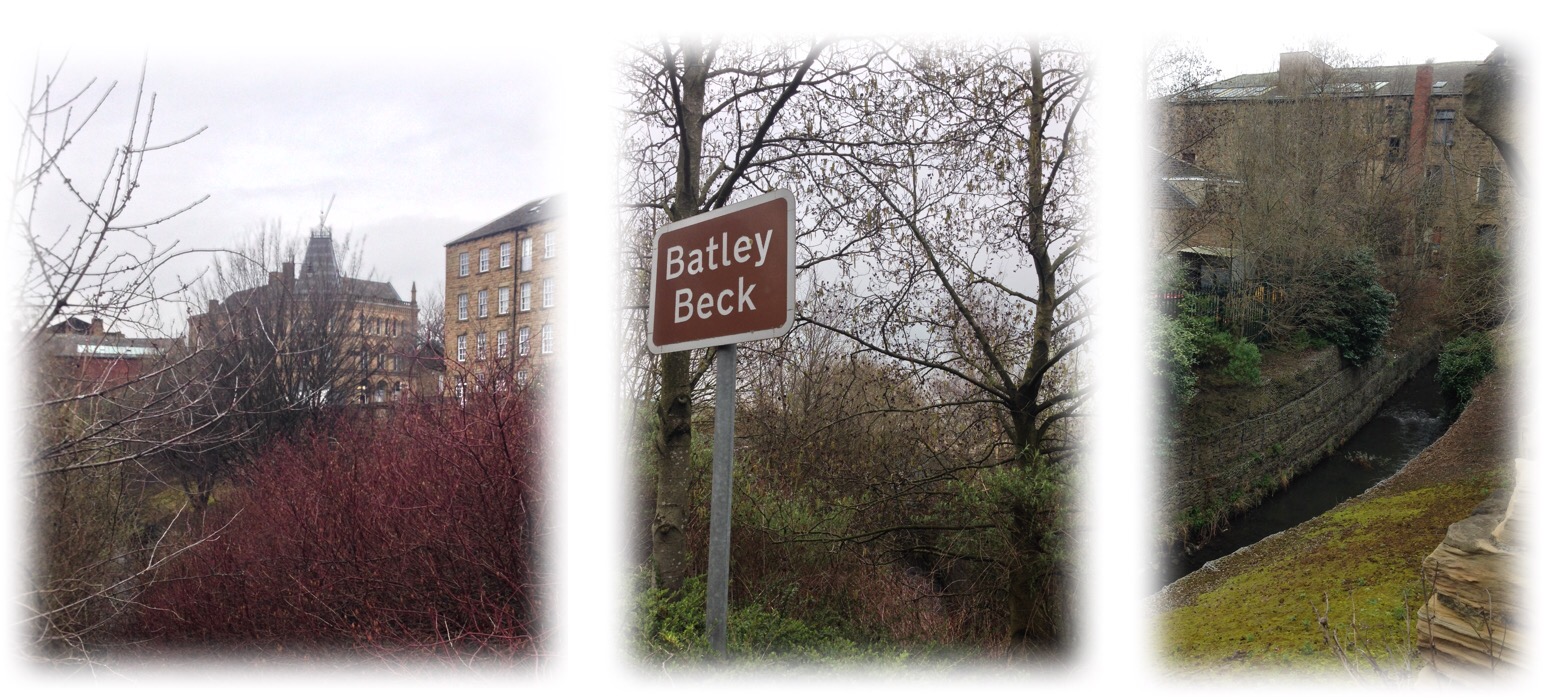
Batley Beck – Photos by Jane Roberts

But, whatever means they employed to collect drinkable water, it still proved insufficient. People resorted to paying water carriers ½d for three gallons of better quality water from a well in neighbouring Morley. Most spent at least 2d to 4d a week for this water, a not insubstantial sum for the poor.  Some paid more – for instance J.T. Marriott paid 2s a week. John Jubb said the normal range was between 3d and 1s 6d. It all depended on the size of family and their finances.

The other issue was lack of sewerage, drains and toilets. Descriptions abounded of areas with no sewers, or ones choked up to the point of overflowing. In other areas houses springing up to accommodate the growing population did not have connections to the main sewers or access to privies. Where privies existed, multiple households shared them, and consequently they became so blocked as to be unusable. Liquid refuse collected outside houses. Rubbish, including the euphemistically named night-soil (human faeces), was thrown in the street or placed in privately-dug street cesspools, from which it then leaked. Animal waste provided another health hazard. For instance horse transport in towns, and the accompanying manure, compounded the issue. Houses were poorly ventilated. The stench was overpowering.

The Irish came in for particular criticism in the report. The Great Famine, and ensuing mass emigration, commenced in 1845. The famine was only just abating by 1852, by which time Batley had seen a huge influx of Irish, mainly from County Mayo. Medical man George Allbutt said “There had been a considerable immigration of Irish into Batley and neighbouring townships during the last few years, and these people were most filthy in their habits”. John Jubb went even further in his condemnation stating “The immigration of Irish into the district had made it more filthy and unwholesome than it would otherwise have been. These people were in fact demoralizing [sic] the whole town”. One amusing conclusion, hinting at the rivalry between Batley and Dewsbury, read “It is right to say, that many of the Irish, formerly residents in Dewsbury, are now living in Batley, but their habits in no way improved”. What is clear though, the Irish lived in the worst ventilated, overcrowded accommodation and were consequently extremely hard-hit by contagious diseases.

During the cholera epidemic the largest number of fatal cases occurred in a cellar occupied by Irish people. In 1847 typhus was rife in the Irish enclave at Brown-Hill. However disease was not confined to the Irish. Typhus regularly affected Healey, not an area typically associated with that comunity. Saying that, it is particularly striking that the Healey Lane area of the village/hamlet, which was occupied by the Irish, suffered disproportionally.

Other areas noteworthy for typhus included Carlinghow (until the beck was covered), New Street, Chapel Fold and Burnley’s Fold. In the September and October 1851 typhus fever outbreak, scarcely a household in Newsome’s Fold, which adjoined a large privy, was unaffected by the disease.

Henry Brearley, Batley District Registrar, reported 438 death between 1 August 1850-6 July 1852. Epidemic, endemic and contagious diseases accounted for 65 of these, including 21 from measles, 12 from scarlatina, nine from typhus fever and five from smallpox. In fact there was an outbreak of the latter disease at Parson’s Fold, at the exact time William Ranger conducted his inspection.

Given the connection between health and those receiving poor relief, 119 men, women and children under 16 in Batley received maintenance in the six months to 25 March 1852 , the overwhelming majority outdoor rather than in the workhouse. The total cost for expenditure on the poor in the period exceeded £439, and ranged from officers’ salaries, to medical bills, the maintenance of lunatics in asylum and burials of paupers dying in the workhouse.

But the problems did not end with death. The burial ground was another source of health concerns. This in an era before the establishment of Batley’s public cemetery, which was not laid out until 1865. Situated in the Old Churchyard at All Saints Batley Parish Church, the Rev Cassels testified the burial ground was so overcrowded “it was difficult to make a fresh grave without disturbing some of those already existing”. Others, like J.M. Marriott thought the old burial ground should be closed because “the extreme wetness of the soil rendered it an unfit place for interments”. There was the imminent prospect of a further plot of churchyard burial land following the Earl of Wilton’s donation of an extra portion of adjoining ground. Nevertheless it was all very worrying, with a rapidly expanding population and the increasing awareness of having burial grounds in town centres. Just think about the water run-off, diseased, decomposing bodies and resulting contaminated water supplies .

The report gives a year-by-year breakdown of burials in the ten-year period from 1842/3. A total of 1,408 burials took place. 1849/50 saw the highest number, 254. This was almost 100 more than the next highest year, 1848/9. These years coincided with the British cholera epidemic. The report also provides a breakdown of burial costs, including 1s for the clergyman, 8d for the clerk, 1-8s for the sexton depending on grave depth, varying costs depending on headstone type and 4d or 6d for mounding the grave up following interment.

Other fascinating insights included street lighting. In today’s light-polluted environment where stars cannot be seen, it is hard to imagine Batley as a place where pitch-black darkness descended many areas at nightfall. Complaints of no gas lamps from ½-1 mile of homes were commonplace, despite paying gas lighting rates, and this in places like Carlinghow Lane. Imagine having to make your way in the dark, through refuse-filled streets, to and from the well to collect three gallons of water.

One final snippet of particular interest to me with my Healey origins, is a year ending 25 March 1849 highways entry. It shows the princely sum of over a £1 paid for young trees when widening Healey Lane. I wonder if any of these trees stand today? I will look at them with new eyes now.

As a result of the inquiry and Ranger’s report, a Batley District Local Board of Health was established in 1853. Batley, along with the local boards of Dewsbury and Heckmondwike, obtained an Act of Parliament in 1854 for supplying the three districts with water. The White’s 1858 Directory stated the waterworks were approaching completion, supplied from large reservoirs excavated in the moorland dells near Dunford Bridge, 17 miles south-west of Dewsbury. The water was intended to be conveyed in open culverts and large cast-iron pipes to service reservoirs at Boothroyd and Staincliffe. The former was to supply Dewsbury and the latter Batley and Heckmondwike. Both this Directory, and the 1857 Post Office Directory of Yorkshire, named Thomas Dean as the clerk for Batley. By 1860 water was coming through.

However the amalgamation of Batley, Dewsbury and Heckmondwike was never going to work, such was the rivalry between the towns. The joint Water Board scheme was doomed for failure right from the start, with reservoir leaks, water shortages and friction about rights to excess water, if a town failed to use its right to a third of the supplies: Dewsbury seemingly preferring to sell its surplus to areas other than partner Batley, even when Batley was short and willing to pay.

By 1870 Batley had had enough of the politicking and inadequate water supply. With the town’s industrial growth the Corporation felt they could now go it alone. Accordingly they obtained an Acts of Parliament in 1871 and 1878 to build their own waterworks. The works were situated on the eastern slopes of the Pennine chain, between Holmfirth and Dunford Bridge. It included three reservoirs, Yateholme (work commencing 1874), Riding Wood (work starting in 1874) and Ramsden (with an 1881 building start date). Their combined capacity was around 231,000,000 gallons of water. This was conveyed by means of a large main to the service reservoir at Staincliffe, and from there distributed throughout Batley. Construction work on the Staincliffe service reservoir finally commenced in 1875. These works were erected at a cost of £360,000.

Staincliffe Reservoir – Photo by Jane Roberts

For those with Batley ancestors, the male-exclusive group mentioned in the 1852 report include:

  • Henry Akeroyd
  • George Allbutt, Esq
  • William Bailey
  • J(ohn) Blackburn, a resident
  • Henry Brearley, Registrar
  • Rev Andrew Cassels, Vicar of Batley
  • Joseph Chadwick, Local Government Board of Surveyors 25 March 1852
  • Mr (Robert) Clapham, sub-agent to the Earl of Wilton
  • B Clay
  • John Day
  • Thomas Dean, Esq, residing at Healey, on the Local Government Board of Surveyors 25 March 1852,
  • Benjamin Exley
  • D Fox
  • S Fox
  • John Gledhill, Local Government Board of Surveyors 25 March 1852
  • Richard Greenwood, clothier
  • W(illiam) Hall, assistant overseer
  • Mr Hampson, head agent for the Earl of Wilton
  • J Hepworth
  • Mr Ibbetson, a ratepayer
  • Mr A Ibbetson (possibly Mr Ibbetson, above)
  • H Ingram
  • John Jubb, a resident ratepayer (there is also a John Jubb, Local Government Board of Surveyors 25 March 1852, so possibly the same man)
  • J Jubb (possibly John or Joseph Jubb)
  • Joseph Jubb, jun, Local Government Board of Surveyors 25 March 1852
  • Samuel Jubb
  • W(illiam) Knowles Esq, Surgeon
  • J.T. Marriott
  • Mr Porritt, sexton
  • Mr Shackleton
  • Mr (John) Sharp
  • Mr Spedding
  • Mr Stubley, a resident ratepayer
  • E Taylor
  • George Thornton
  • A(braham) Walker, Carlinghow Lane
  • John Whitaker
  • Mr (Thomas) Wilby, Local Government Board of Surveyors 25 March 1852
  • J Willans
  • Mr (David) Wilson, Local Government Board of Surveyors 25 March 1852

Names in brackets are where a name appears in the report as a surname only in one place, with a full Christian name elsewhere. So possibly the same man.

Sources:

  • Report to the General Board of Health on a Preliminary Inquiry into the Sewerage, Drainage, and the Supply of Water, and the Sanitary Condition of the Inhabitants of the Township of Batley” – William Ranger Esq, 16 August 1852
  • Post Office Directory of Yorkshire – 1857
  • William White’s Directory and Topography of the Boroughs of Leeds, Halifax, Huddersfield, and Wakefield; Dewsbury, Heckmondwike etc – 1858
  • The History of Batley” – Malcolm H Haigh
  • Kelly’s Directory of the West Riding of Yorkshire – 1927
  • Borough of Batley Year Book 1959-60 (courtesy of Wendy Storey)

The Early History of Batley Carnegie Library – Providing World Book Day for Thousands of Days and Multiple Generations

In my last post, in response to the latest Kirklees Council budget threat to our library service, I wrote about the value of libraries. In this post I look at the early days of my local library, Batley, the services it offered to the local community and their reading habits between 19 October 1908-March 1915.  

Batley library’s establishment epitomises the enlightened thinking of late Victorian/early Edwardian Corporations, industrialists and philanthropists. They had the vision to see the immense benefits libraries provided for education, the economy and wider society. From access to books and knowledge for all, irrespective of background and finances; to the realisation that an educated workforce could contribute to industry and the country’s wealth; from the morally and self-improving leisure opportunities they afforded; to the social benefits this offered in terms of crime reduction. These may seem old-fashioned concepts, but they are relevant still today.

The 1850 Public Libraries Act established the principle of free public libraries. A subsequent amendment in 1855 Act allowed boroughs to charge an increased rate of 1d rate to fund the provision. It proved insufficient, with by 1869 only 35 places opening public libraries. This is where philanthropists such as Andrew Carnegie stepped in. 

The son of a Dunfermline weaver, the Carnegie family emigrated to America in 1848 when he was 13, settling in Allegheny, Pennsylvania. Starting off as a bobbin boy, he was fortunate to have access to books as a result of the generosity of a local man who made his library available to local working boys. Self-taught from these books, Carnegie progressed from the bobbin mill, to become a messenger at a telegraph company, then a telegraph operator, eventually moving to the Pennsylvania Railroad where he rose to become a superintendent, age 24. From there his investment and business interests developed, resulting in his steel company. Carnegie’s experience instilled in him the belief anyone with access to books, and the desire to learn, could educate themselves and improve their position in society. Free libraries provided such educational opportunities for those without financial advantage. 

In 1901 he sold his company to J.P. Morgan for $480m and was free to devote himself totally to his philanthropic works. His personal experience of the benefits books provided, led him to donate money for the building of 2,509 Carnegie libraries between 1883-1929. 660 of these are in the UK.  

In providing funds to establish libraries, Carnegie required the local government to: 

  • demonstrate the need for a public library;
  • provide the building site;
  • pay to staff and maintain the library;
  • draw from public funds to run the library—not use only private donations; and,
  • provide free service to all.

By doing this he felt his grants would inspire communities to take ownership for their libraries and be responsible for looking after them going forward.

Batley did have a couple of libraries: Batley Cooperative Society and Batley Working Men’s Club & Institute, lending around 700 books per week between them. However, neither were free to the general public. Accordingly Batley Corporation approached Carnegie. Lauded as a progressive community, in January 1903 the Corporation received confirmation he was prepared to donate £6,000 subject to the normal rules, including providing a site and adopting the Free Libraries Act and under this raising £400 per year for its maintenance via the maximum 1d rate. He subsequently provided an additional £988 for the clock tower. A transfer from gas rates added another £1,914 16s 6d. Batley’s achievement was a cause of envy for neighbours, and rivals, Dewsbury.

Sketch of Batley library – “Batley News”, 18 October 1907

The Ackroyd Trust provided the Corporation with land for the building because a library met their educational purposes criteria. Once the final hurdle with Charity Commission and Education Department was overcome, (they had indicated that money applicable for education could not go towards public libraries), the Foundation Stone for the iconic market place building was laid on 18 July 1905.

Designed by Messrs. Walter Hanstock & Son, at a cost of £8,902 16s 6d,, Batley’s Carnegie library officially opened on 19 October 1907 with an initial stock of 7,260 volumes. It offered lending and reference libraries, a librarian’s room, news and reading rooms and a ladies’ room. The first book borrowed, by the Mayor, W. J. Ineson, J.P., was the Bible.

Annual Report Cover

The early days of the library are portrayed in its annual reports. In the early years these reports ran from 19 October – 18 October, the 12 month period from the library opening. This changed in 1911. That report ran until 31 March 1913, 17.5 months. Thereafter the year fell within traditional 1 April – 31 March patterns. 

The library had a staff of five. The 2nd annual report for the year 19 October 1908-18 October 1909 shows these comprised of librarian Alfred Errington, assistants James H Shaw and Alfred North, and caretaker Alfred Moody. Later staff in the period included assistants Annie E. Newsome, Winifred M. Peel and Evelyn M. Walker and caretakers Nelson Howard and Arthur F Garner. Their hours were long – the reading rooms opened from 8.30am-9.30pm; the work painstakingly labour intensive with many hours spent on tasks such as producing a catalogue of holdings, or repairing books. In the year ending 1914/1915 they installed a small binding plant to allow staff to do more of this repair work in-house, but the librarians had so little spare time it did not receive much use that year!

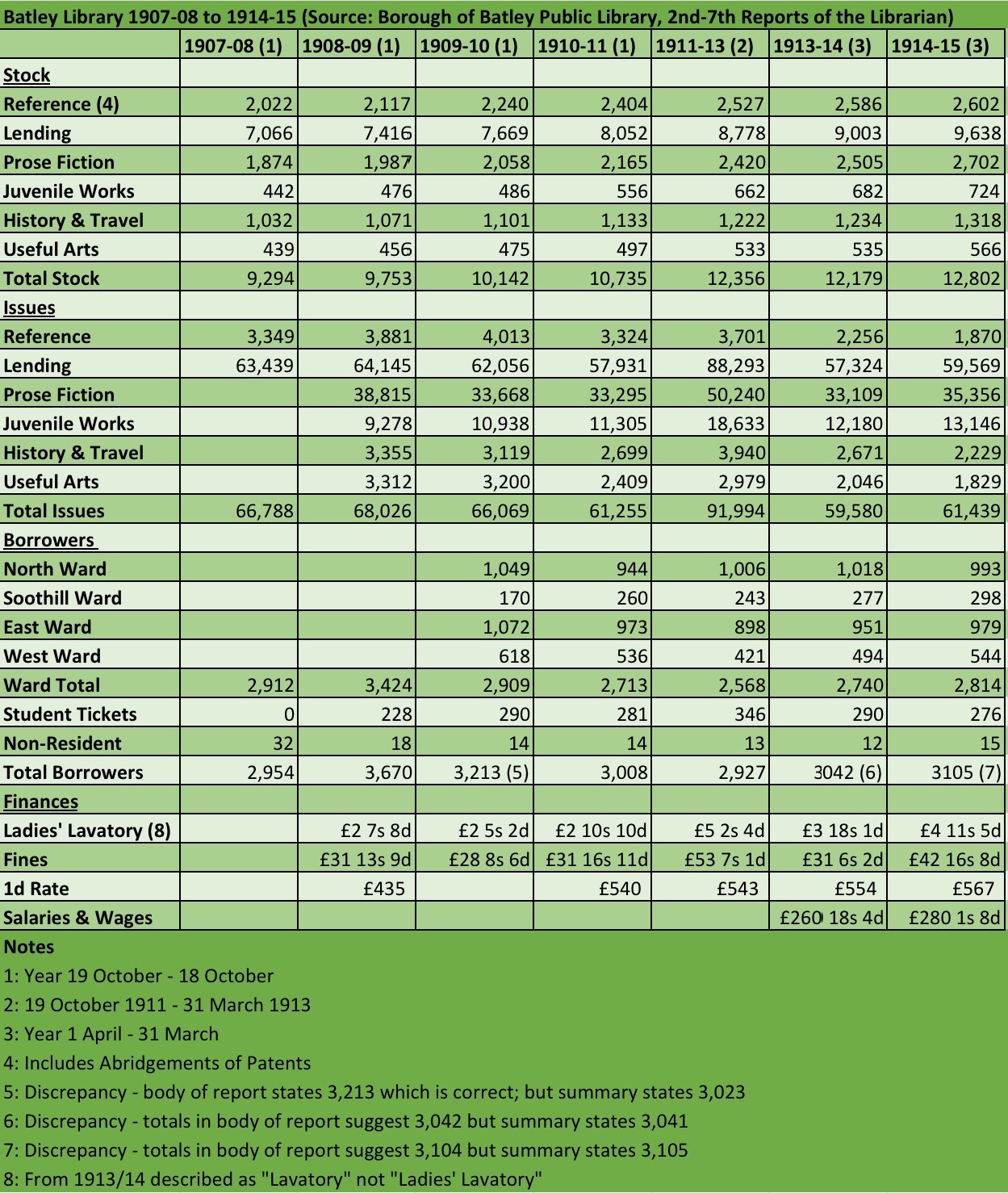
These reports provide a fascinating insight into the early days of the library. The Table below shows some figures illustrating its development.

A few things struck me. Firstly the somewhat bizarre ladies’ lavatory income. In 1908/9 it raised £2 7s 8d, rising to £4 11s 5d in 1914/15, by which time men were presumably being charged to use the facilities, as the “ladies’” element was dropped and the money raised had almost doubled. The library staff were also extremely efficient in chasing up book returns and fines, with personal visits made to those unresponsive to postal reminders. The 1d rate increase was implemented, despite some early dissenters. By 1914/15 this raised £567 towards the running costs of the library. Finally, on the surface to modern eyes, how little things cost. For example a £58 5s 9d payment to Mr W.H. Sykes of Batley in summer of 1913, for cleaning and redecorating, the first refurbishment since the library’s opening. In 1914/15 annual salaries and wages stood at just over £280; electricity, gas and fittings a shade over £40; rates, water and water rents £21 8s; and, reflecting the fuel supplies and industrial heritage, a shade over £16 was spent on coal. At today’s values fuel prices of £56 would equate to just over £4,000.

A common theme of the early reports is the initiatives taken to increase the popularity of the library. The number of borrowers, talks attended, books issued, their range and number attracted much attention. Adaptation, development and improvement featured in those early days, as much as today. The key difference appears to be the store those local government officials put on the value of a library providing a levelling opportunity for all, a theme much in evidence right from the opening ceremony. Maybe that’s the difference between then and now. Back then folk had to really dig in and fight for the basics; today things are taken for granted and consequently undervalued. 

Special Student Tickets, introduced in 1908/09, allowed readers an extra ticket for non fiction works. The reference library boasted a substantial body of coal mining books; textile trade volumes were materially extended in the period 1911-13, all relevant to the predominant local industries, in the hope of attracting Technical School students.

A winter season of half-hour library talks and lectures commenced in January 1908 to attract people to the library. These covered literature, science, art, music and travel, some accompanied by lantern shows. The themes ranged from “A Talk on Elementary Astronomy” and “The Norse Mythology, an influence on the Development of Anglo-Saxon Character”, to “John Milton“, “Individual Responsibility and Social Reform”, “What and How to Read”, and “The Story the Brontës”. Children were catered for too, with Walter Bagshaw giving talks on subjects such as “Peeps into Sunny Italy” and “Reason and Instinct, or, Do Animals Think?” One speaker was Rev Fr John O’Connor from Heckmondwike, a great friend of G.K. Chesterton. “Fr. Brown” in the Fr. Brown novels is based on him. Appropriately one of his talks was entitled “Belloc and Chesterton”. By the end of the 1914/15 season 77 talks has been given. That season saw the highest average attendance, 97. 1914/15 also saw the commencement of talks by the local branch of The Workers’ Educational Association.

Reading circles were established and adapted, moving away from subjects such as Shakespeare’s Henry V to more populist contemporary subjects such as Kipling, to boost participation. Photography, travel and water colour exhibitions also took place, the latter featuring originals by J.M.W. Turner and attended by over 5,000.

In 1909/10, the substantial increase in loans of juvenile fiction led Mr Errington to urge the library committee to extend the privilege to borrow books to under 14s. April 1912 marked the launch of a School Library scheme in partnership with the Education Committee. Initially six local schools participated: Hanging Heaton, Brownhill and Staincliffe CofE, Carlinghow Boys, Warwick Road Boys, Healey Mixed. Each school received 50 books on rotation, and by 31 March 1913 over 8,000 volumes had circulated. By 31 March 1914 four further schools joined the scheme: Mill Lane, Gregory Street Girls, Purlwell Boys and Warwick Road Girls. In the three years to 31 March 1915, 33,287 volumes were issued via the school scheme and a further 37,226 by the Juvenile Section of the lending library. 20 per cent of these were non fiction issues. More schools were applying to join, and head teachers reported the beneficial educational impact of access to good books. However, a formal, dedicated Young People’s Department did not open in the library until 1928.

Another 1912 development was the August introduction of the Open Access system, where borrowers could browse the library. Prior to this they had to ask if a book was available, and wait for the librarian to fetch it. Theoretically the closed system reduced book theft, but did little to encourage reading. By 1915 Mr Errington proudly announced that of 160,000 volumes issued under Open Access, not a single volume had been lost.

The library reports give a wonderful snapshot into the times and community. From the weather, the exceptionally fine summer of 1910 blamed for a decline in the number of books issued; to war, with the average number of books issued per day declining from 221 in 1913/14 (library open 269.5 days) to 219 in 1914/15 (open 280.5 days), due to the numbers in H.M. Forces and overtime in the mills. Noticeably, enrolled women borrowers shaded men. And war saw reading choices shifting to lighter options with loans of fiction, literature, music and juvenile works increasing. The only other category seeing an upturn was sociology, because it included army and navy books.   The array of over 20 railway timetables testified to the importance of this mode of transport. The wide range of newspapers and magazines, numbering in excess of 100, in the reading rooms demonstrated the importance of the print media in these pre-wireless and TV days. Their titles illustrated the interests of the time and the local industries, including “Fur and Feather”, “Farm, Field and Fireside”, “Sons of Temperance”, “Weldon’s Ladies’ Journal”, “Colliery Guardian”, “Textile Recorder” and “Waste Trade World”. The library reading rooms for a short time even boasted “Die Woche”, reflecting the area’s textile manufacturing links with Germany. Unsurprisingly, this publication disappeared from the shelves by 1914/15.

And what does this have to do with family history? Well, besides the plethora of family history resources offered by libraries today including local history reference resources (not online), newspapers (not on the British Newspaper Archive/FindMyPast), access to subscription sites like Ancestry, and local censuses and parish registers on microfilm/fiche there is the actual library history. The development and history of a local library itself adds context to the lives and times of ancestors. The annual library reports are name-rich sources. Not only of the great and the good, those on the Committee and those who donated or gave talks. But also the library staff. This is an extract from the report for year ending 18 October 1910 WW1: “James H. Shaw, the Senior Assistant, resigned in June to take up duties in the office of the Borough Accountant…..Mr A. Moody, who held the post of Caretaker since October 1908….had to relinquish his post on account of ill health”. James H. Shaw is one of the Healey residents identified for the Healey Great War project.

For me the library reflects my ancestors’ community, their hopes, aspirations, dreams and lives. I imagine them using Batley library right from its inception. And I thank those enlightened people of the early 20th century. What a great gift to the town.

I’ve timed this post to mark World Book Day 2017, to acknowledge the important role local libraries have played in opening the world of books to many generations. The poster below shows events at Batley library on Saturday 4 March.

Sources:

A library is not a luxury but one of the necessities of life 

Henry Ward Beecher’s quote is something I truly believe. Sadly I don’t think Kirklees Council understand it. Less than a year on from the last round of council cuts which prompted me to write about the important roles libraries play in family history, it appears with the latest council budget vote we are now on track for a cull of unprecedented proportions.

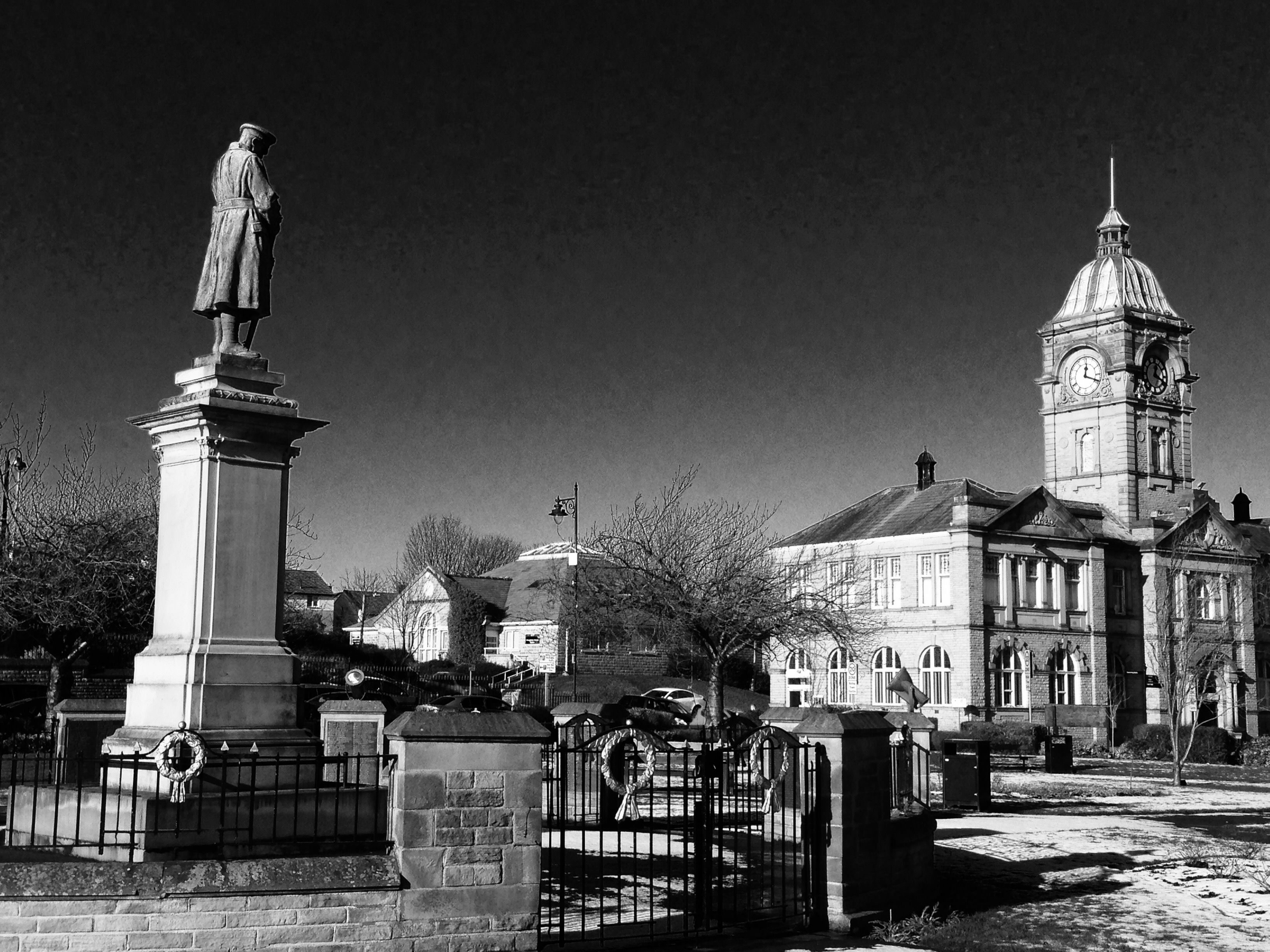
Batley Library – Photo by Jane Roberts

Last year, following a public consultation, Kirklees closed two of its 26 library branches. However, it ceased funding a further 14, handing them over to community groups and volunteers to run.  The numbers of council staff employed in the remaining libraries were slashed and opening hours reduced. Batley library cut its weekly opening hours from 48.5 to 35 in September 2016 as a result. 

This appears to be just a taster of things to come. “Public Libraries News“, in article at the end of January 2017 entitled “USA and Canada see library usage rise: 3/4 budget cuts in Walsall and Kirklees” reported Kirklees would have a £1.7m cut to the library budget 2017/18 (from £3.9m to £2.2m). This equates to £1.85m cuts from start 2016 to end 2018. This is on top of last cut of £1.8m cut in 2015/16, meaning budget cut by 72% cut in three years.

In effect, as a result of these latest cuts, we will be looking potentially at just two funded libraries (Huddersfield and Dewsbury) to serve the entire population of around 435k and rising in the Kirklees Metropolitan Council area. Arguably one of the worst library culls nationwide. 

I’m not getting into the whys and wherefores for these cuts. It is undeniable that councils like Kirklees face a major central government funding recession, and Kirklees receives government funding way below the national household level. However, to quote Eleanor Crumblehulme:  “Cutting libraries during a recession is like cutting hospitals during a plague“. 

Sadly, libraries are not seen as an essential service. Mention bins and folk are up in arms because it has a direct everyday impact on all households. Cuts to libraries, museums and parks don’t have the same impact. As a result, fewer people stand up for them in any tangible way. Councils know this. They know where the main battles lie. Libraries, and broader culture, are easy targets.

However I believe libraries must be seen as an essential community resource. They are used across all age-groups. They also have a big influence in drawing together a diverse community.  In the words of Libba Bray “The library card is a passport to wonders and miracles, glimpses into other lives, religions, experiences, the hopes and dreams and strivings of ALL human beings, and it is this passport that opens our eyes and hearts to the world beyond our front doors, that is one of our best hopes against tyranny, xenophobia, hopelessness, despair, anarchy, and ignorance“. 

Libraries play a part in the Jo Cox legacy about combatting loneliness. This in turn has links to community health and well-being, with mental health being high on the political agenda. One in three adults aged 16-74 (37 per cent) with conditions such as anxiety or depression, surveyed in England, were accessing mental health treatment, in 2014. Overall, around one in six adults (17 per cent) surveyed in England met the criteria for a common mental disorder (CMD) in 2014. Around one in four people every year develop anxiety, depression or other related conditions.

Libraries have a vital role in combatting anxiety and depression. They are a window on an outside world, providing a safe, welcoming social hub. Besides the range of self-help books, they offer volunteering and socialising opportunities. They host activities, crafts, community groups and surgeries for local politicians at council and government level. They have newspapers. There are talks and a wide range of exhibitions. They offer computers, internet access, printing and photocopying. There are events for children. Batley has Memory Lane Café sessions for those experiencing dementia. In February the library hosted a bowel cancer screening information session with a GP registrar. This is the February Batley library newsletter, highlighting the wide range of services.

Libraries engender a love of books from an early age, aid literacy and afford an opportunity for learning and development, outside of school. Not every child has access to books or computers at home. Not everyone has transport or can afford to travel if their library closes. They are a repository for local history and civic pride. They, and other public amenities such as Town Halls, markets, Post Offices, Police Stations, swimming baths, technology colleges, shops and even Job Centres are things that draw people into a town centre. Start removing them and bit by bit the town centre declines, becomes delipidated, deserted and eventually a crime-ridden no-go area.

Libraries are also free. To quote Lady Bird Johnson “Perhaps no place in any community is so totally democratic as the town library. The only entrance requirement is interest“. And Anne Herbert was spot on when she said “Libraries will get you through times of no money better than money will get you through times of no libraries“.

But to get back to my key message about the Council library budget annihilation. It’s all well and good people grumbling and complaining about cuts to local services. I’ve seen many social media moans about how unfairly communities outside the central Huddersfield are treated. But how many of these people actually use their local library? By the time they wake up it will be too late. Years later they will laud the halcyon days of libraries and rue their unavailability for their children and grandchildren. But through their inactivity they shoulder the blame for this loss alongside any government or council.

So, my challenge to all those who say they value their library and community: Don’t sit back and throw sideline pebbles which achieve nothing. If you don’t want to lose your library now really is the time to show your support. Get out your library card, visit your local library, get involved, and start borrowing some books and e-books (yes libraries embrace technology). Beyond that, lobby your local Councillors. Write to your MP asking they raise the funding issue at government level. Bombard the local media with letters. Challenge. Use. Support. And do your utmost to “Save Your Library“.

My final quote is from Ray Bradbury. “Without libraries what have we? We have no past and no future

Postscript:
Finally a big thank you for the donations already received to keep this website going. 

The website has always been free to use, but it does cost me money to operate. In the current difficult economic climate I am considering if I can continue to afford to keep running it as a free resource, especially as I have to balance the research time against work commitments. 

If you have enjoyed reading the various pieces, and would like to make a donation towards keeping the website up and running in its current open access format, it would be very much appreciated. 

Please click here to be taken to the PayPal donation link. By making a donation you will be helping to keep the website online and freely available for all. 

Thank you.

Sources:

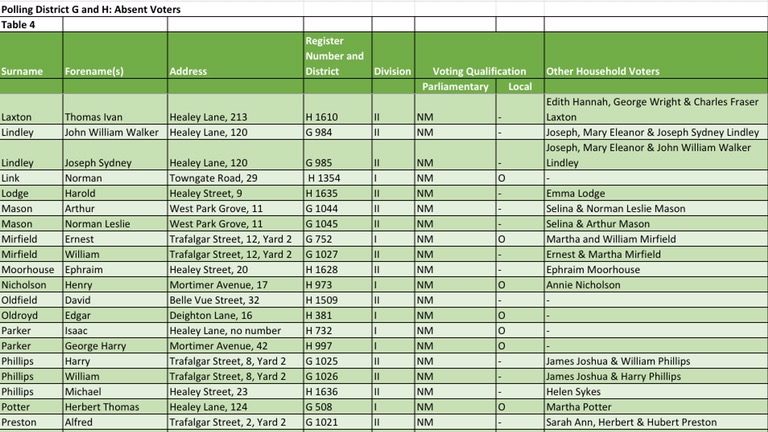
Healey, Batley WW1 Remembrance Project – 1918 Electoral Register List of Men

Thanks to the wonderful Batley Library staff and volunteers, the missing Batley Borough 1918 Electoral Register was located just before Christmas. I spent the early few days of February beavering away on it to extract the absent Healey naval and military voters, and put them into spreadsheet format.  

This work has significantly expanded the list of servicemen I initially identified using CWGC records of those who died, the WO 363 “Burnt Records” and WO 364 records of those discharged for medical/capability reasons. This initial list identified 39 men, though I have subsequently discovered an additional man. He is Arthur Ellis, a rag merchant whose address was 263 Healey Lane. He served with the Grenadier Guards, Service Number 27774. 

The Electoral Register, signed off on 1 October 1918 by the Batley Town Clerk’s Office, identified 121 men, though there is a small overlap with my earlier findings. The numerical difference is indicative of the limited numbers of soldiers’ service records surviving, with around two thirds of them being totally lost or irretrievably damaged during WW2 1940 bombing. 

First bit of background information about voting entitlement and the Electoral Register. The Representation of the People Act 1918 came into force in time for the December 1918 general election. One of the drivers for electoral reform included the fact only men who had been resident in the country for 12 months prior to a general election were entitled to vote. This residential qualification, combined with the property ones, meant many serving King and Country overseas were effectively disenfranchised. The Act abolished these restrictions and extended the vote to all men over the age of 21. Additionally, men who had served in the war could vote from the age of 19. However Conscientious Objectors were disenfranchised for five years. The Act also gave the vote to women over the age of 30 who met a property qualification, wives who were over 30 of all husbands who were entitled to vote in local government elections and also to those who were university graduates.  

However, it should be noted that parliamentary and local government franchises were not the same. Hence the 1918 register is split into three categories. 

  • Division I: Persons qualified as both parliamentary and local government electors; 
  • Division II: Persons qualified as parliamentary electors but not as local government electors; and 
  • Division III: Persons qualified as local government electors but not as parliamentary electors.  

Abbreviations used are:

  • R: Residence qualification;
 
  • BP: Business Premises qualification;
 
  • O: Occupation qualification;
 
  • HO: Qualification through husband’s qualification;  
  • NM: Naval or Military voter; and  
  • a: indicates absent voters. 

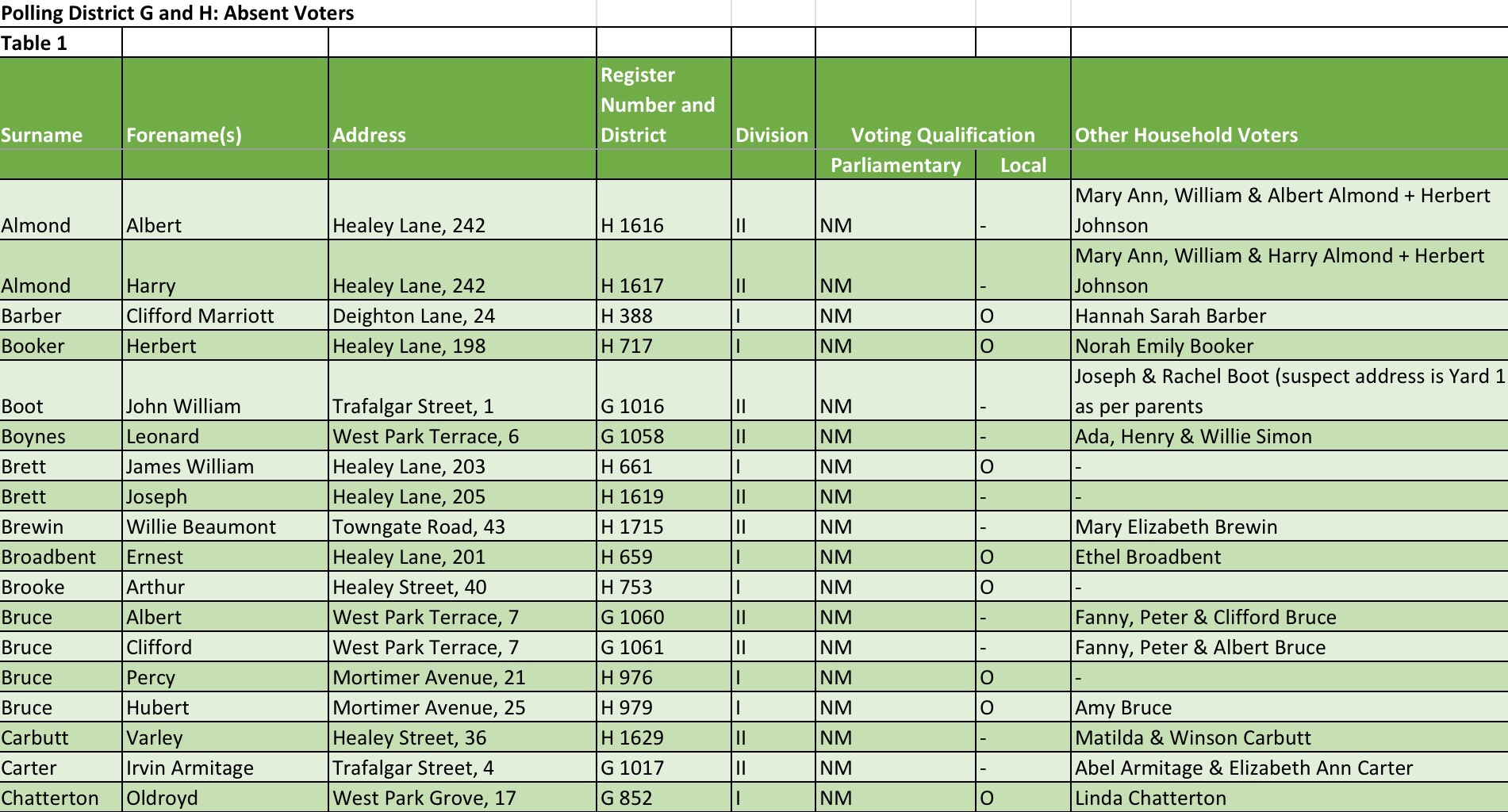
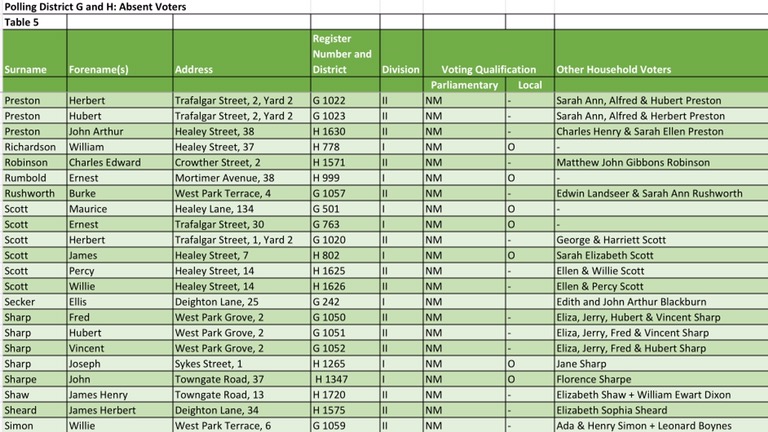
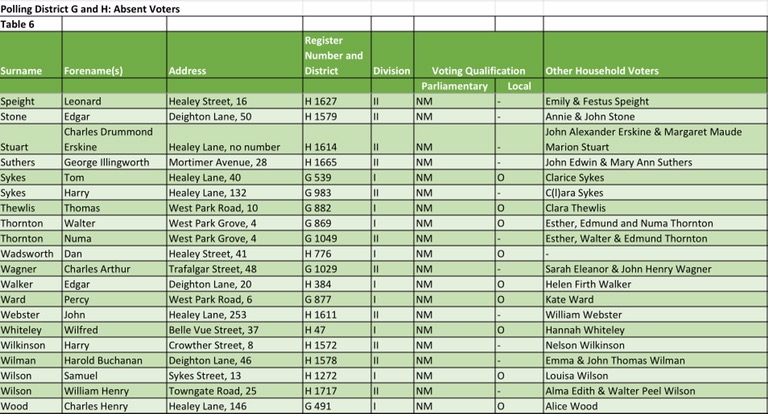
So here are the names of those identified from the 1918 Electoral Register.


The men on my Healey list all fall within both the absent and Naval and Military categories. The information was supplied by next of kin so may not be accurate. It may include men who were killed after its compilation. And addresses may not necessarily reflect actual residence, but merely be the most convenient address, for example the in-laws where the man’s wife was living whilst he was serving, or a friend’s home. 

It is also worth emphasising this is the Electoral Register. It isn’t what is commonly known as the Absent Voters List (AVL). These lists, generated to provide servicemen and nurses with voting cards, ballot papers or proxy voting forms depending on where they were serving, gave far more detail. They normally included regiment, number, rank and home address. Sadly, despite checking with West Yorkshire Archives and Huddersfield Local Studies Library, I’ve been unable to locate the one for Batley Borough. It may be it no longer survives. The AVL would have provided so much more crucial identification information. But the Electoral Register is better than nothing. 

The Register also enabled me to further define the parameters of this project. I used the Batley West Ward Polling Districts G and H to identify the relevant streets. These are:

  • Belle Vue Street 
  • Crowther Street 
  • Deighton Lane 
  • Healey Lane (excluding the numbers falling within Polling District I. These are mainly below 79, with the exception of some numbers in the 40s which fall within District G) 
  • Healey Street 
  • Mortimer Avenue 
  • Sykes Street 
  • Towngate Road 
  • Trafalgar Street 
  • West Park Grove 
  • West Park Road 
  • West Park Terrace 

These are in addition to Nelson Street and Prospect Terrace identified from earlier research. Looking at the 1911 Census Summary Books some Chaster Street houses may also fall within the catchment area.

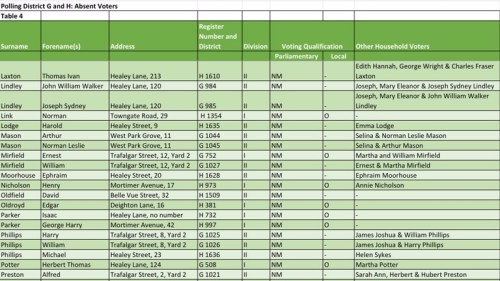
The men’s details from the Electoral Register are contained in the following six tables. I checked across all three Divisions to identify other voters registered at the men’s given addresses, in the hope this provides more family clues.

So I can give myself an early 2017 back pat. This data extraction was one of my 2017 New Year’s Resolutions. I’d targeted a March completion, so I’m ahead of schedule and I can now begin the hard research, although I am still toying with the idea of the newspaper trawl. I know from previous experience how much value this adds. It’s a case of whether I have the time to do it alone!

Previous posts in this series are: 

Sources:

  • Register of Electors 1918, Parliamentary Borough of Batley and Morley 
  • 1911 Census Summary Books 

A Short Life Remembered: Death by Dentition

This is another in my “Short Lives Remembered” series. It is another child discovered as a direct result of the General Register Office (GRO) birth and death index search facilities introduced in 2016. I’ve not found any baptism details for this child. She was born and died in between censuses. Her burial gives no family details. So tracing her relied on civil registration and mother’s maiden name in the new search options. 

What I find most shocking about this child is the cause of death, which is put down to an ordinary, if painful and occasionally distressing, right of passage for babies and toddlers today. 

Ann Jennings was born on 12 February 1869 at Carlinghow Lane, Batley. The daughter of coal miner Herod Jennings and his wife Ann Hallas, she had 10 older siblings. All were still living by the time of Ann’s birth. This was no mean feat in an era of high infant mortality, when the most seemingly trivial illness or incident could extinguish life. Poverty, locality, environment, housing, sanitation, medical care, public health and class all played a part. The 34th Annual Report of the Registrar General (1871) illustrates the perilous nature of early years survival. Looking at the under 5 age-group, between 1838-1871 out of every 1,000 girls, 62.7 died. The corresponding figure for boys was 72.6. In the five years 1866-1870 the figures were 63.4 and 73. And looking only at 1870, 64.4 per 1,000 girls under 5 and 75.0 of boys died. 

Ann Jennings was one of the girls in 1870. She died on 15 January 1870 at Spring Mill Yard. Cause of death was dentition. In other words teething. This seemed incredible, that something so innocuous resulted in death.  

Yes, it can be an unpleasant time. I remember my daughter’s intermittent episodes of irritability, sleeplessness, drooling, flushed cheeks and raised temperatures. Calpol and Bonjela became medicine cupboard staples during this period. Teething rings, some special cooling ones, were added to her array of toys. But that’s as far as it went. I never realised it could be a cause of death. So I investigated further – and became more astounded at how common it was.

A bit of background first. As with many childhood development milestones there are no hard and fast dates for the emergence of that first set of baby teeth. It normally starts at around the six to nine months stage, with each of the 20 teeth taking about eight days to emerge. The whole process lasts for around two years.

Back to the Annual Report of the Registrar General. This time I looked at the 33rd report covering the 1870 statistics, the year of Ann’s death. In the West Riding of Yorkshire 232 female deaths and 287 male deaths were attributed to teething. In total 4,183 deaths registered in England had teething as the cause.

In 1783 Frenchman Jean Baptiste Timothée Baumes wrote “A Treatise on First Dentition and The Frequently Serious Disorders Which Depend on It”. In it he claimed teething “….may often be be found the cause of death of a great number of infants”. The view was still prevalent almost a century later. According to the 35th Annual Report of the Registrar General, looking at 1872 statistics: “Teething is one of the first marked steps in development after birth, and by inducing convulsions and other irritative reflex diseases, it is chargeable with a certain number of deaths”.

The conclusion reached by medical professionals of the time was because the teething coincided process with the ages of high mortality, it was actually responsible for infant illness and death. According to accepted medical wisdom teething led to a number of afflictions and displayed a variety of symptoms including convulsions, diarrhoea, bronchitis, croup, vomiting, neck abscesses, insanity and meningitis. The teething phase was perceived as fraught with risk, a process to be dreaded.

Added to this, teething treatments could in themselves prove fatal. Even today there are stories of homeopathic teething tablets causing death. Back in the 19th century treatments ranged from dangerous to downright barbaric, with some treatments a combination of the two.   

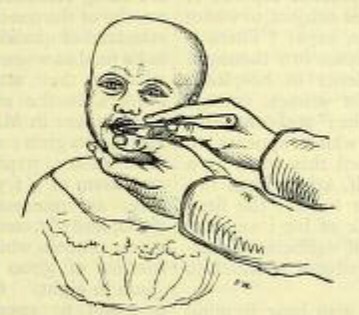
What could you do to make the passage of teeth through gum easier? Well, the obvious answer was to lance the gum, making a deep incision to facilitate the emergence of the offending tooth. This in a pre-anaesthetic, pre-sterilisation era carried it’s own risks. Leeches applied to the gums provided another solution.

And what could you do to relieve the pain, reduce excitement, regulate the bowels and induce sleep in the restless teething babe? Newspapers were full of the answers, with adverts for soothing remedies which parents, fearful of the dangers of dentition, were induced to purchase. In this unregulated, uncontrolled period of medicine druggists and pharmacists made their own propriety and patented concoctions with no details of ingredients. But these included opium, cocaine, mercury, morphine and alcohol, with rubbing whisky in gums of teething children even touted in more recent times. All of these could lead to addiction and death. The risk was not unknown. Cassell’s Household Guide of 1884 for instance acknowledged the danger of giving narcotics to children – but reassured parents that it was acceptable if such remedies were recognised as teething powders. So by trying to do the right thing and following advice, parents were in fact endangering their babies.

In fact in 1869 a 9-month old girl from Gravesend, Catherine Sarah Cobham, was poisoned as a result of a chemist dispensing strychnine instead of powdered sugar as a teething remedy. Incredible too that sugar was touted for teething – presumably leading to tooth decay later if the baby survived! 

So who knows if Ann really did die as a result of teething. Was it a case of medical misdiagnosis? She was struggling at the teething stage and they did not look beyond that for a death cause; or did teething really cause something along the lines of a fatal chest infection or convulsions (though the certificate doesn’t elaborate); or was it even a teething remedy gone wrong? We will never know. So she is just another statistic, amongst thousands of others, whose death was attributed to dentition. Her funeral took place on 17 January 1870 at Batley Parish Church. 

Others who feature in this series of “Short Lives Remembered” posts are: 

Postscript:
Finally a big thank you for the donations already received to keep this website going. 

The website has always been free to use, but it does cost me money to operate. In the current difficult economic climate I am considering if I can continue to afford to keep running it as a free resource, especially as I have to balance the research time against work commitments. 

If you have enjoyed reading the various pieces, and would like to make a donation towards keeping the website up and running in its current open access format, it would be very much appreciated. 

Please click here to be taken to the PayPal donation link. By making a donation you will be helping to keep the website online and freely available for all. 

Thank you.

Sources:

  • GRO Birth and Death entries for Ann Jennings
  • 33rd Annual Report of the Registrar General (1870) 
  • 34th Annual Report of the Registrar General (1871) 
  • 35th Annual Report of the Registrar General (1872) 
  • A Treatise on First Dentition and The Frequently Serious Disorders Which Depend on It” by Jean Baptiste Timothée Baumes (1783) – Google Books 
  • Cassell’s Household Guide to Every Department of Practical Life: Being a Complete Encyclopaedia of Domestic and Social Economy Vol 1” (1884) – Internet Archive 
  • Dewsbury Reporter” – 9 November 1872 
  • Treatments for Children: Teething – https://www.rpharms.com/museum-pdfs/g-teethingtreatments.pdf
  • Parish Register – Batley (All Saints) Parish Church  

Finding your Brontë links

One of my Christmas holiday viewing highlights was “To Walk Invisible.” Sally Wainwright’s drama focused on the years between 1845-1848, with the four surviving Brontë siblings and their father all together in Haworth. It portrayed Charlotte, Emily and Anne’s journey to become published authors, set against the backdrop of their increasingly bitter brother Branwell’s spiralling alcohol-fuelled (possibly with a touch of opium thrown in) decline and the bleak, isolation of their Haworth home. The Rev Patrick Brontë is shown as a distant but gentle figure, struggling with his failing eyesight and vainly trying to halt his beloved only son’s self-destruction. 

It is a story that has fascinated me. Haworth is on my doorstep, a short drive away, and a place I’ve visited frequently ever since childhood. The Parsonage Museum, the church of St Michael’s and wandering round its overcrowded Victorian graveyard, and a walk to Brontë Falls and onwards to Top Withens (Wuthering Heights) all feature on my things I like to do list. Although I have to be in an energetic mood for the latter. If not, a mooch up and down the cobbled Main Street, including the Black Bull frequented by Branwell is an alternative. Last year I, along with many others, walked from Haworth village to Penistone Hill to see the film set recreation of the Parsonage. 

Haworth Parsonage and the Recreated Film Set Parsonage – Photos by Jane Roberts

But even within minutes of my home there are a host of Brontë connections. The Rydings in Birstall was the early home of Ellen Nussey, Charlotte’s close friend who witnessed her marriage to Arthur Bell Nicholls in June 1854. The Rydings is believed to be the basis of Thornfield Hall in arguably Charlotte’s best known novel, “Jane Eyre”. Although not accessible to the general public, I was lucky enough to visit a few years ago on a Malcolm Haigh History Walk. Oakwell Hall, also in Birstall, right on my doorstep and a jewel in the crown of Kirklees Council, is the inspiration for Fieldhead in Charlotte’s novel “Shirley.” I have attached the link to a leaflet about local Brontë connections. Sadly Kirklees Council in its 2016 cut-backs permanently closed Red House Museum in Gomersal, home of another of Charlotte’s friends, Mary Taylor, and Briarmans in “Shirley.” 

The Rydings and Oakwell Hall, Birstall – Photos by Jane Roberts

The leaflet also highlights several local churches. Patrick Brontë was ordained into the Church of England as a deacon in 1806 and priest in 1807. He is most associated with Haworth, being appointed Perpetual Curate of Haworth, Stanbury and Oxenhope in 1820, and remaining there until is death in 1861. However, prior to this appointment he held curacies at a number of other churches. The places associated with him are: 

  • Wethersfield, Essex (1806-1809), Parish Registers for St Mary Magdalene are available on Essex Archives Online 
  • Wellington, Shropshire (1809). Parish Registers on FindMyPast 
  • Dewsbury, Yorkshire (1809-1811), Parish Registers on Ancestry.co.uk and Bishop’s Transcipts (BTs) of them on FindMyPast 
  • Hartshead-cum-Clifton, Yorkshire (1811-1815). Maria Brontë’s baptism took place here. She was the eldest of the Brontë children and died in 1825. BTs are on FindMyPast. 
  • Thornton, Yorkshire (1815-1820). This is where Charlotte, (Patrick) Branwell, Emily and Anne were baptised, along with sister Elizabeth who died in 1825. The BTs of the registers, including these Brontë baptisms, are on FindMyPast. 

So if you have ancestors who were baptised, married or buried in these places, check the parish registers for the name of the minister. See if it was Patrick Brontë (or the early variant Brunty which appears in the Hartshead BTs). One word of caution. Pre-1813 registers were not standardised, so naming the person performing the ceremony prior to that date may only extend to marriages. From 1 January 1813, following Rose’s Act of 1812, printed paper registers with a standardised format included details of the person officiating, so this includes for baptisms and burials as well as marriages.

I did check, having ancestors in Hartshead, Dewsbury and Thornton. But unfortunately they are fractionally either side of the relevant dates for Patrick Brontë. One lot were, in any case,nonconformists. So I was unsuccessful in finding that hoped-for Brontë family connection to add family history colour.

However you may be luckier. You never know, you might find the officiating minister was Patrick Brontë, father of these literary legends. So you might have your very own (tenuous) Brontë link in your family history story. 

Sources:  

Is Family History “Proper” History?

This is my 100th blog post, and my first as an ex-civil servant. So to mark this milestone I’ve decided look at family history as a subject, and give my perspective on its place in the overall discipline of history. Does it actually deserve to be classed as history? 

Perhaps some do look down on it, thinking its a kind of “dumbed down” version of history. After all there’s nothing to collecting the names of a bunch of ancestors and tagging them with a few vital event dates. But that’s missing the whole point. Family history isn’t only about creating a tree full of connected names.

For me family history is a specific strand of history and is as valid a discipline as studying the Tudor period, or being an expert in the English Civil War. My history degree covered what are probably regarded as “traditional” history topics such as the origins of the Great War, the Russian Revolution, Latin American Independence Wars and politics, the Enlightenment and history of ideas or the foreign policy of the Chamberlain government. However, other elements had a definite family and social history slant. These included children in British society, parish registers, censuses, and various Factory and Education Acts.  

In fact family history encompasses a far broader time sweep than many specialist areas, with their comparatively narrow timeframes. More than that, it covers a wide breadth of elements. It requires a knowledge of international, national, local, economic, industrial, religious, medical, agricultural, demographic, political, judicial, legislative and social history – to name but a few areas. 

This broader historical perspective in turn leads to an understanding of when individual records so vital for family history were created and why, and crucially what is consequently available to further research. For instance parish registers and poor law developments down to the impact of the Civil War and Commonweath through to voting rights. 

At the same time geographical knowledge plays a part, from parish and administrative boundaries to the development of towns, transport links and migration routes and patterns. A bit of Latin and the ability to decipher handwriting akin to the meandering of a spider who has paddled in an ink puddle also helps.Family history therefore goes way beyond parish register and census hopping to create a list of names. It’s way more exciting.

To me family history ranges from contextualising the lives and times of my ancestors within events such as the Industrial Revolution, the English Civil War, or the First World War; it also drills down to putting specific life-changing decisions or events into the framework of national and international events, like the shelling of Scarborough, Whitby and Hartlepool and my great grandad’s decision to enlist. Or the Irish Famine, its impact in County Mayo and the decisions made by my ancestors to remain or leave. 

Furthermore family history has enhanced my historical knowledge, drawing me to investigate areas that broader history would not touch upon. Lesser known events such as miners strikes in specific localities, such as Drighlington, and the impact it had on ancestral lives, leading onto coal mining communities and occupations generally; or the growth or decline of towns and villages, or industries and occupations and the associated migration patterns or job switches. It has also led me to conducting greater in-depth investigation into factors affecting their lives such as judicial changes, the Poor Law, various Factory Acts or diseases such as TB, diabetes and smallpox along with accompanying medical advances; without my family history hat on, for me these events would be looked at in a high-level generalised way and not considered in detail or applied to individuals who are my flesh and blood. Examining them in relation to my family makes them more real. And by extension it leads to communicating finds to other family members and hopefully making history more accessible, relevant and real to them.

And, as that’s the case, for me family history is truly one other strand of the various disciplines falling under the generic umbrella of history.  So done properly, and not a paper-chase exercise of populating a tree with thousands of names, the answer to those who cast doubts on its merits is an unequivocal yes: Family history is truly “proper” history.

Final Fanfare for 2016

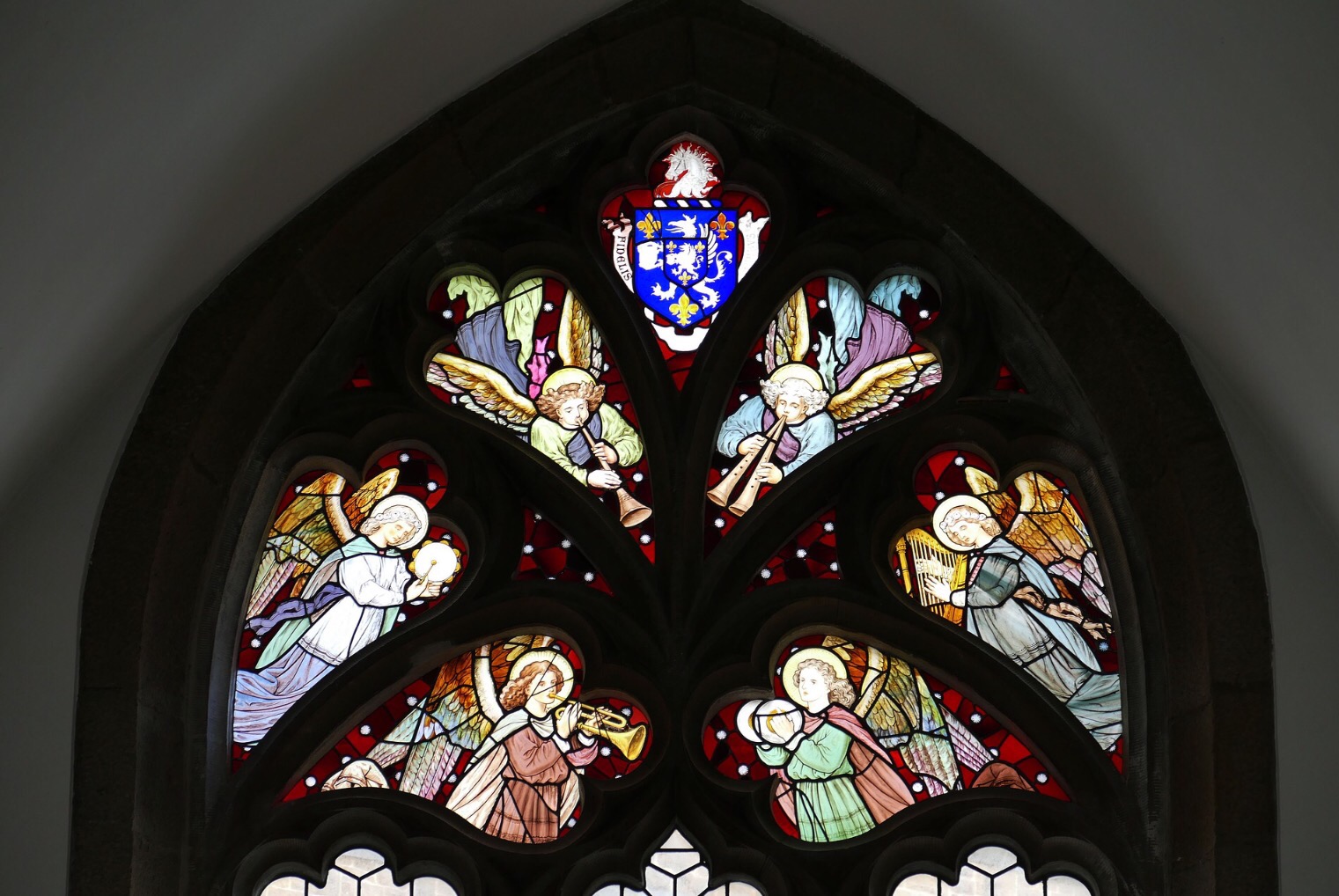
Often it’s so easy to dwell on life’s failures and the things that didn’t go well, rather than remember and focus on successes. Many of us find it exceedingly embarrassing to blow our own trumpets. It’s not the done thing. Bushel-hiding comes easier to many of us.

Picture courtesy of Pixabay.com

One of the banes of my civil service working life was the mid-year and annual review process. Gathering documented evidence of achievements throughout the year was a part of this. It was contrary to my nature and I found it a hugely painful experience. 

However in hindsight this exercise may have psychological benefits. It serves as a positive reminder of success when things aren’t going so well. It’s a bit like a gratitude journal, but specifically focusing on one particular aspect of life.

So I’m going to apply it to my 2016 family history year, identifying what I regard as my top 10 positives, covering a broad range of topics on a number of levels:

  • My blog. This grew and developed throughout 2016. People have read it and taken time out to share, like and provide feedback. In viewing terms it has quadrupled since 2015;
  • Completing the last of my Pharos Intermediate Modules and passing all with distinction, achieving the top marks  overall in the 2016 cohert of completers. The ceremony at the Society of Genealogists in June has to rank amongst the top of my 2016 highlights;
  • Taking on client work. In 2016 I began undertaking work for others. It gave me immense satisfaction to connect others with their family history. Their obvious pleasure and positive feedback confirmed this is a valued service, and one I am proud of;
  • In June I sold the final copies of my St Mary’s Batley War Memorial book raising money for the parish roof appeal and the Royal British Legion Poppy Appeal;
  • West Yorkshire Archives closed its Wakefield office in May in preparation for its move to a brand new building in 2017. In those final weeks before closure I set myself a target of going through the Batley Borough Court records. I had to fit it around work and an operation which effectively put me out of action for three weeks. But I did it and, in the process, found some useful family history information confirming parentage of three separate children;
  • Having a family history story about a census in-betweener published in the April 2016 edition of the Huddersfield & District Family History Society Journal. Thomas Gavan, the eldest child of my great grandmother was born in 1889 and died six months later. His death was the subject of an inquest;
  • Somme Visits. I was lucky enough to be awarded tickets in the ballot for the Somme centenary commemoration at Thiepval. An incredibly moving and thought provoking experience, which I feel immensely privileged to have been part of. I was back again in Flanders and the Somme in September, this time on the family history trail. I followed in the footsteps of a WW1 ancestor on the Ypres Salient thanks to battlefield guide Sabine Declercq. I met a distant relative for the first time at a 100th anniversary cemetery visit. And I experienced an amazing set of coincidences on the Somme, as featured here;
  • Newspaper articles. In July I featured twice in the Huddersfield Daily Examiner. In one article I talked about family history, what got me into it and gave some quick tips. They also published one of my research pieces about the death of Annie Leonard, a Batley munitions worker in WW1;
  • Helping others, for example assisting with local research projects or providing general advice or information;
  • Finally those individual little pieces of success which make family history so addictive. This year these included the discovery that my 5x great grandmother, born in around  1748 was a one-handed gypsy. Also the find that my 4x great grandfather and some of his children gave evidence to the 1842 Royal Commission looking at the employment of women and children in mines; and I found several hitherto unknown children thanks to the additional information on the GRO indexes towards the end of the year, which have shifted the family history kaleidoscope picture. 

I really do suggest this as an exercise. It re-enforces self worth, especially in those inevitably bleaker times. It serves as a reminder of our indidual achievements and wider contributions, all too easily forgotten when things go wrong. Analysing what went well, just as much as what didn’t go as planned, can help replicate success in the future. And it spurs us on to do more. I  will refer back to this as a beacon of light in my darker moments of 2017.

My 2016 Blogging Year Review

I was a tad disappointed when I realised WordPress wouldn’t be doing their normal review of the year. So I’m doing my own version – minus the cool graphics.  

Image from Pixabay.com

First the headlines, as nicked from the previous WordPress review. The concert hall at the Sydney Opera House holds 2,700 people. This blog was viewed over 12,000 times in 2015. If it were a concert at Sydney Opera House, it would take about 4 sold-out performances for that many people to see it. 

My best day: Well that would be 7 September 2016 with 360 views. My most popular day was Wednesday with 19% of views. And my most popular time is 8pm with 10% of views. This chimes with my posting pattern, as I tend to follow a Wednesday or Thursday evening routine.

How did they find you: Over 2,500 reached my site via Search Engines. Where search terms were identified, the top one was “jane roberts of batley.” Facebook clicks were responsible for over 2,200 referrals and Twitter almost 1,500.  

Where did they come from: Unsurprisingly, as I’m based in England, over 7,600 were from the UK. Almost 2,000 from the USA. Australia and Canada views were around 600 each. But I had views as far afield as Hong Kong, Japan, Afghanistan, Argentina, India and Saudi Arabia. 

Top posts of 2016: Other than general home page/archives and about, these were: 

  • Which Type of Family Historian Are You? This was a tongue in cheek post assessing family historian characters; 
  • A German Family in WW1 England. This delved into the anti-German pork butcher riots and the impact on a Yorkshire family;
  • Death of a Barnbow Canary looked at the dangerous work undertaken by women in WW1 munitions factories, focusing on Annie Leonard from Batley. She died as a direct result of her work at Barnbow in 1916;
  • General Register Office (GRO) Index: New and Free. The exciting new index of births and deaths which gave a different set of information and search options to identify hitherto hidden ancestors; and
  • In a similar vein, Fabulous News for those with Irish Ancestry covered the free release of the Irish General Register Office (GRO) images of births of over 100 years ago, marriages of over 75 years ago and deaths of over 50 years ago. 

A couple of my favourite posts which didn’t make the top five were my surprise discovery about my 2x great grandfather, the subject of two separate murderous assaults. And my look at how broader historical events can impact on family history, with my great grandfather’s decision to enlist in December 1914 in Happy Birthday and Farewell

My blog started in April 2015. In those first nine months it had a smidgen over 2,900 views What is pleasing is the enduring interest in some of my early posts, which remained amongst my most popular ones in 2016. For example my family connection to the 1915 Dewsbury tram disaster, likened to Ypres. Or Shrapnel and Shelletta, where I looked at baby names and their links to war, remembrance and commemoration. 

In 2016 I averaged roughly about 322 per views month. In 2016 this has grown to over 1,000 per month. My blog has developed into a mixture of personal family history stories, more general news updates, exploration of specific records and how they can be used in family history research and Batley-area focused posts. I’m also going to use my blog for my Aveyard one-name study and Healey, Batley WW1 project. Hopefully these topics and projects remain of interest, but any other suggestions would be welcome. I love reading the comments submitted and seeing the likes (well over 100 of each in 2016), as this alongside views really does help me gauge interest.

So what does 2017 hold? Well, as I said in my New Year Resolutions, I may not sustain my 2016 output as I want to focus on other in-depth projects and research. But I am committed to doing two posts a month, more if I have the time. So we’ll see how it goes.

Wishing everyone a happy, healthy and peaceful 2017.

Image from Pixabay.com

Sources:

New Year, Clean Slate: My 2017 New Year’s Resolutions, or is that Wishlist?

Right, it’s time for my look ahead at the things I want to achieve in 2017. It’s a scary, but exciting, year in prospect as at the end of the month I finally quit my civil service job of 30 years. I’m still not sure if I’ve made the right decision, but I know I need to re-balance my life and put family and health first. The decision for the Department of Health to downsize, shedding a third of its staff, seemed the right time to do this. 

Initially I’m going to take a bit of a break from things. I know I need to step back and recharge my batteries, take time out to relax and learn how to enjoy life again. But then I’m intending to be back with renewed vigour. I’m hoping my regained freedom will leave me more time to concentrate on family history, client work and free up time to take on volunteering roles. Although saying that, I haven’t entirely ruled out looking for a part-time job later in 2017. 

In terms of personal family history goals I’ve decided to stick to just five. So here goes. 

Aveyard One-Name Study: I started this in 2016, and I am taking it at a fairly relaxed pace fitting it around genealogy course work and personal research. But I do want to complete my census data collection in 2017. I also want to go through the new GRO indexes too, to identify any additional entries there, and complement my earlier birth, marriage and death civil registration data. If I do complete all this in 2017 I will be more than happy. 

Healey War Memorial Project: Another thing I started in 2016. By the end of March I want to complete my data extraction from the 1918 Batley Borough Electoral Register. After a brief panic at the end of 2016, when this crucial book did a library vanishing act, the wonderful staff and volunteers at Batley Library have located it and it is now once more locked away in its rightful cabinet. It’s now full steam ahead with identifying absent military voters. Ideally as part of this I also want to check out the local papers of the time. But realistically, on my own, is this achievable?  I haven’t ruled it out though. (Any volunteers to help would be very welcome). Anyway, the absent voters combined with surviving service and pensions records, provide a basis. So, once I’ve completed my absent voters list, it will leave me clear to begin researching and writing up the stories of the men. 

Blog Posts: Almost by default my blog gathered pace in 2016. Unintentionally I ended up doing a post a week, with some weeks producing even greater output. The blog has developed into a mixture of family history research, general genealogy updates and Batley focused posts. Whilst I love doing it, I may not sustain the 2016 level. However I am aiming for a steady two posts per month. I will publish my 2016 blogging review in my next offering.

Palaeography Practice: This is something I find a headache (literally). However I know I need to put in more effort. I am aiming to do one transcription per week, to get and keep my eye in. 

Finally a very personal piece of research:  It involves investigating a family history mystery involving a brush maker, Yorkshire asylums, a will and an army officer. This is something I’ve been meaning to do since February 2016. But it is a big piece of work involving many different strands and families, including some transcription work, and I keep getting distracted. Like many others I seem to spend more time on the family history others at the expense of my own. However I want to solve the mystery in 2017 and I’m setting aside July to do it.

What may get in the way is my natural inclination to go off on genealogy tangents as new pieces of information capture my imagination, follow new record sets and do research for others. Also I’m committed to an intensive series of courses up until the end of June, which will significantly eat into my time. However I will post a mid-year update. I’m hoping committing to doing so will help my focus on these objectives, and pull me back on track if I feel they are going off the rails. 

Wishing you all a happy, healthy New Year, packed full of family history fun. 

Source:

WordCloud created using http://www.wordclouds.com