This is the latest update of the pages relating to my Batley St Mary’s one-place study, the details of which I announced here.
St Mary of the Angels Church, Batley
In the past month I have added eight new pages, including a major news announcement for September. This is the extension of the study to include those from the parish who died in the Second World War.
Although the church has no War Memorial commemorating parishioners who died in World War Two, with the help of Batley’s Roll of Honour I am seeking to identify them and publish mini-biographies as part of this one-place study. These new pages include the background to the Second World War element of the study; a list of those identified to date; and the first of these biographies, Michael Flatley.
Turning to World War One, there are four weekly newspaper summary pages for September 1915. I have accordingly updated the surname index to these During This Week newspaper pieces, so you can easily identify newspaper snippets relevant to your family.
The biography of Thomas McNamara has been updated, with additional information.
More men who served and survived have been identified. I have updated that page accordingly. This month I have published a biography for one of these men, Michael Rush. He survived both the 2nd Boer War and the First World War. The biographies of other men in this section will follow in due course.
Below is the full list of pages to date. I have annotated the *NEW* ones, plus the *UPDATED* pages, so you can easily pick these out. Click on the link and it will take you straight to the relevant page.
A cemetery can tell you so much about a town’s past. It is a physical representation of the lives of many of its inhabitants – years, decades and even centuries after they departed its soil. Headstones provide a snapshot of their lives. The uniform layout of burial registers record the passing of the rich, the less well-off and the impoverished. And combined, their lives and deaths chart the history and development of a town over time.
Batley cemetery, and its register, is no exception. The first burial recorded in the register’s consecrated (Church of England) portion of the cemetery is on 19 January 1867 for nine-week-old William Henry Stockwell; in the unconsecrated section it is 25-year-old Mary Fox, on 10 November 1866. She, therefore, is the first registered burial in the cemetery. In this post I will focus on one grave in the consecrated section.
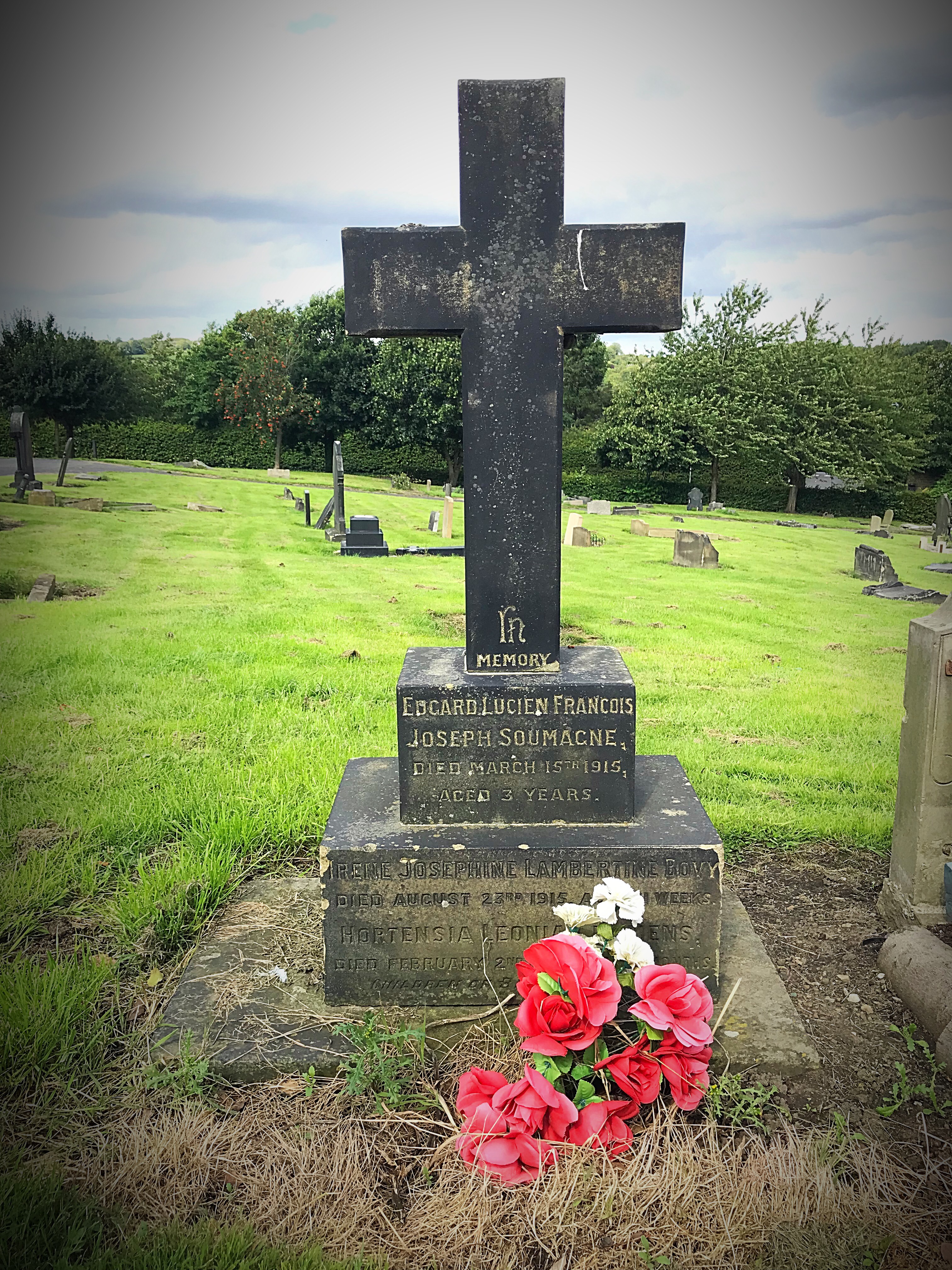
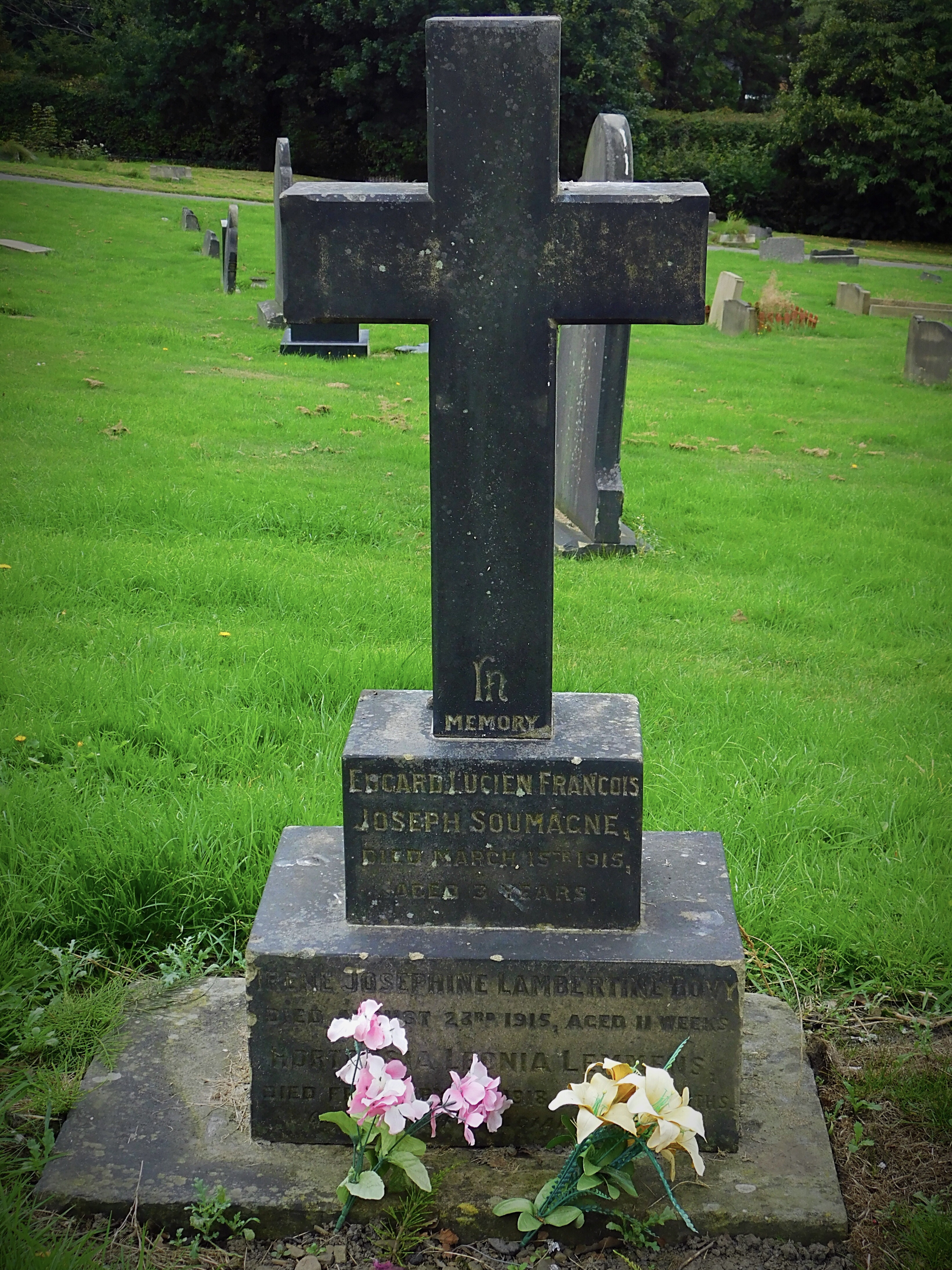
This grave has a headstone. It marks the loss of three young lives. The children are all from different families. One was buried in accordance with the rites of the Church of England. The other two were Catholic burials. All have unusual names for the area. Particularly striking is how, over a century after the occupants of the grave were buried, artificial flowers are still being placed at the foot of the cross.
So how did these three children come to be buried in Batley cemetery?
Flowers at the foot of children’s grave – one photo taken in August 2019, the other in August 2021 – Photos by Jane Roberts
Their story starts in August 1914, the outbreak of the Great War and the German invasion of Belgium. These children were refugees, either driven directly from their home by war, or born in this country subsequently to parents forced to flee Belgium. Many came to Great Britain, and towns countrywide welcomed them. By the end of 1914 an estimated 110,000 Belgian refugees were in the country.1
The first Belgium refugees officially arrived in Batley on 17 October. A mixture of single people and family groups, they numbered 25 in total.2 They were accommodated at Shaftesbury House, Upper Batley. This was the residence of the late Alderman J. J. Parker, an ex-Mayor of the Borough. It was fitted out and furnished free of charge by Batley residents. The refugees were also provided with free medical care, and Batley Corporation waived any rates on the property.
In those first months Batley people showed an intense interest in the new arrivals, and the newspapers contained regular updates about the town’s Belgian guests. There were even set visiting days, so locals could turn up to show sympathy and solidarity with them. The generosity of the Batley public continued, with monetary donations and increasing offers of accommodation resulting in the ability to house even more Belgian refugees.
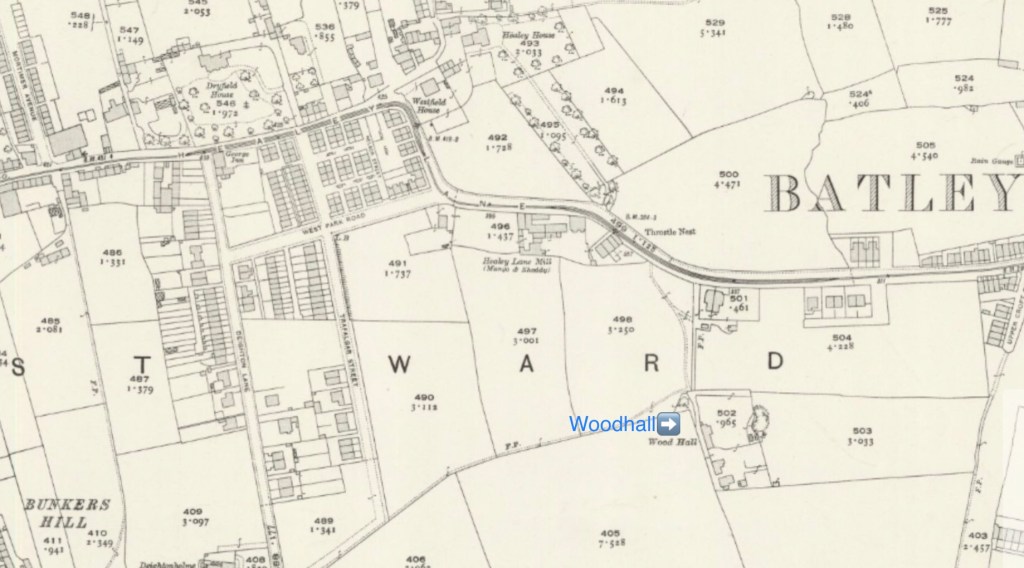
Eighteen more arrived on 21 November. Nine went to Woodhall, in a house provided by Henry Jessop. The others were housed in properties on Byron Street, Kelvin Grove and Primrose Hill. The continuing swell of housing offers meant that by February 1915 almost 70 Belgian refugees were based in Batley.3
Their new homes were supplied by a variety of locals. These included Staff Nurse Alice Musto, who offered up her home on the Warwick Road corner of Taylor Street whilst she was away serving with the Territorial Nursing Force.4 As experience built up, it was found that these separate family houses were best for homing the refugees. Though the larger multi-occupancy group houses still had an important role in that they helped the newly-arrived, providing company and support for them until they became familiar with the area, people and language.
Support facilities for the displaced foreigners grew. A special class for Belgian children was established at St Paulinus RC School in Dewsbury. Attended by 15 scholars, their Belgian teacher was Miss Callens, who herself had arrived in the country only recently. The Tramway Company provided free travel for those children living a distance from school. Meals were provided free by members of the St Paulinus congregation.5
English language classes were provided for adults. Entertainment was also laid on. Christmas parties and gifts were supplied. The area even had Catholic priests who themselves were refugees from Belgium. They were attached to the local churches to minister to the refugee flock. These included Father Julien Kestelyn at Birstall St Patrick’s, subsequently posted to St Mary’s; and Father Paul van de Pitte, initially at St Joseph’s, Batley Carr.
In regards to religious observance, one amusing incident occurred soon after the refugees’ arrival. An offer from a Batley resident to take a family group to church was enthusiastically accepted. The lady, not a Catholic, ascertained the times of Sunday mass at St Mary’s, based on the assumption that all from Belgium were Catholic. She even accompanied them to church, neglecting her own religious observances that day. Except it transpired after mass that the Belgian family were actually Protestants! It turned out the initial batch of Woodhall refugees were non-Catholics. So a girl living there had provision made for her to attend Staincliffe Church school.
Batley townsfolk continued to make regular contributions to the Belgian Relief Fund. For example, by June 1915 St Mary’s RC Church had made 17 separate donations to the fund following church collections.6
Tensions did exist though, for instance around the cost of maintaining these refugees. In January 1915, whilst dismissing public murmurings about them being treated too well, it was agreed that care was needed not to spoil them. By the beginning of October 1915, when the mutual decision was made that the refugees were to feed and clothe themselves wherever the man’s work permitted it, the town’s Belgian Refugees Fund donations stood at £914 5s.7 In simple purchasing power terms that equates to £74,900 at today’s values.8 Support remained though. For example, housing, coal and lighting would continue to be provided free of charge.
On 14 December 1914 a particularly unsavoury incident occurred. At 6.15am 19-year-old Woodhall resident Jean Joseph Soumagne was attacked going to work at J Blackburn and Co’s mill. Whilst making his way down the footpath to Healey Lane, a man sprang from behind a wall, stabbed him in the cheek and right thigh, then threw him down in the mud, before making his escape under cover of darkness. There is no mention of Joseph being targeted because of his nationality, but the implication is there, especially because nothing was taken.9 Jean Joseph subsequently applied to join the Belgian Army.10
And it was the youngest Soumagne child who was the first young refugee to be buried in the grave in Batley cemetery, in a plot purchased by the local Belgian Relief Committee. Forty-year-old Antwerp nickel-plater Lucien Soumagne, his 43-year-old wife Marie, and children Jean Joseph (19), Lucien (16) and Edgard Lucien (3) were amongst the original nine Woodhall residents who arrived at the house in November 1914.11 Mr and Mrs Soumagne had prominent roles within the Batley Belgian community, liaising with authorities and seemingly acting as spokespersons in particular for the Woodhall refugees. The family were non-Catholics, which may partly explain why this burial plot was purchased in the Consecrated Church of England portion of Batley cemetery.
Edgard died on 15 March 1915 as a result of diphtheria. Thankfully rare in this country now due to childhood vaccination, this highly-infectious, primarily respiratory-spread disease was a killer back in 1915. The sore throat, high temperature, headache and nausea rapidly led to difficulty in breathing and swallowing. It could also damage the heart, kidneys and liver, and affect the skin. The disease reached epidemic proportions in Batley in 1915. Ninety six cases were notified that year, the highest proportion since 1893. A particularly bad outbreak occurred in the last quarter of 1915, centred around youngsters over 14 who had left school. Almost all of these were in the Cobden Street area of town, and connected with Irish Roman Catholics. Because of its infectious nature, 87 of the year’s 96 sufferers were admitted to hospital.12 It was here, at the Oakwell Isolation Hospital, that Edgard died – just one of 18 diphtheria deaths in Batley that year.
He was interred in Batley cemetery on 18 March, in a service conducted amidst fleeting snow, by the Batley Parish Church curate, Rev. J. S. Walker. In addition to his parents, brothers, and local people closely involved with the refugees, his paternal aunt – herself a refugee – travelled up from Bedfordshire.
The next child to be laid to rest in this plot was an 11-week-old baby girl, Irene Josephine Lambertine Bovy. Her birth was registered in the Kings Norton district of Birmingham, the daughter of Mr and Mrs Phillipe D. J. Bovy. The family only arrived in Batley the month prior to Irene’s death, to live with relatives at Woodhall, which now included Catholics amongst its residents. She passed away on the morning of 23 September 1915. Like Edgard, she too died in hospital as a result of another childhood killer disease, whooping cough. All 16 deaths recorded in 1915 in Batley Borough for this disease related to children under the age of five.13 Again this is another disease today successfully combatted by childhood vaccination. Irene’s burial took place on 25 September, conducted by Catholic priest Paul van de Pitte.
The final child buried here is the six-month old daughter of Belgian soldier Leon Lemmens. Hortensia Leoni Lemmens’ birth was registered in Dewsbury in 1917. Latterly she and her mother had been staying at Rock Farm, Upper Batley, with another family of Belgian refugees. Prior to that they had been supported at Osborne Terrace (see first map) by members of Batley Conservative Club, who continued this support in paying for the child’s burial expenses. Hortensia died on the 2 February 1918, and her funeral – conducted by Batley St Mary’s Catholic priest Father Shea – took place on the 5 February.
The headstone which marks the grave notes they are the children of Belgian refugees. It reads:
IN MEMORY EDGARD LUCIEN FRANCOIS JOSEPH SOUMAGNE, DIED MARCH 15TH 1915, AGED 3 YEARS. IRENE JOSEPHINE LAMBERTINE BOVY, DIED AUGUST 23RD 1915, AGED 11 WEEKS. HORTENSIA LEONI LEMMENS DIED FEBRUARY 2ND 1918, AGED 6 MONTHS. CHILDREN OF BELGIAN REFUGEES
Close-up of the inscription – Photo by Jane Roberts
And, curiously, even a century after their deaths, someone is remembering their loss by regularly placing the artificial flowers on their grave.
Footnotes: 1. Batley News, 2 January 1915; 2. Batley News, 24 October 1914; 3. Batley News, 6 February 1915; 4. Batley News, 30 January 1915; 5. Batley News, 28 November 1915; 6. Batley News, 12 June 1915; 7. Batley News, 2 October 1915; 8. Measuring Worth website, https://www.measuringworth.com/index.php; 9. Batley News, 19 December 1915; 10. Batley News, 16 January 1915; 11. Batley News, 28 November 1915; 12. Pearce, G H. Borough of Batley Annual Report of the Medical Officer of Health For the Year 1915. JS Newsome, Batley, 1916; and 13. Ibid.
Other Sources: • Batley Cemetery Burial Registers; • Batley News, 5 December 1914, 9 January 1915, 20 March 1915, 25 September 1915, 9 October 1915, and 9 February 1918; • GRO Indexes; and • National Library of Scotland website
This is the latest update of the pages relating to my Batley St Mary’s one-place study, the details of which I announced here.
In the past month I have added seven new pages. These include four weekly newspaper summary pages. I have accordingly updated the surname index to these During This Week newspaper pieces, so you can easily identify newspaper snippets relevant to your family.
There is one new War Memorial biography – that of John Brooks. I have also updated the biography of Herbert Booth to include a new photograph of a Batley street, dating from around 1910.
I’ve also written the first post in the occupations and employment category, describing the job of a rag grinder.
Patent Rag Grinding Machine, The History and Antiquities of Morley, in the West Riding of the County of York, 1876 – out of copyright
And there is the first post in the families section, entitled A Death in the Church.
Finally for this month, more men who served and survived have been identified. I have also updated that page. The biographies of these men will follow in due course.
Below is the full list of pages to date. I have annotated the *NEW* ones, plus the *UPDATED* pages, so you can easily pick these out. Click on the link and it will take you straight to the relevant page.
This is the latest update of the pages relating to my Batley St Mary’s one-place study, the details of which I announced here.
St Mary of the Angels Church – Photo by Jane Roberts
In the past month I have added six new pages. These include five weekly newspaper summary pages. I have accordingly updated the surname index to these During This Week newspaper pieces, so you can easily identify newspaper snippets relevant to your family.
There is one new War Memorial biography – that of Herbert Booth.
Finally for this month, more men who served and survived have been identified. I have also updated that page. The biographies of these men will follow in due course.
Below is the full list of pages to date. I have annotated the *NEW* ones, plus the *UPDATED* page, so you can easily pick these out. Click on the link and it will take you straight to the relevant page.
This is the latest update of the pages relating to my Batley St Mary’s one-place study, the details of which I announced here.
St Mary of the Angels Church – Photo by Jane Roberts
In the past month I have added seven new pages. These include four weekly newspaper summary pages. I have accordingly updated the surname index to these During This Week newspaper pieces, so you can easily identify newspaper snippets relevant to your family.
There are also two new War Memorial biographies – those of Martin Carney and Michael Groark (also known as Rourke).
In addition, more men who served and survived have been identified. I have also updated that page. The biographies of these men will follow in due course.
Finally, for June’s additions, there is a brand new post about the health of Batley school children in 1914, with a focus on those at St Mary’s. This will be the first in a series looking a population, health, fertility and mortality.
Below is the full list of pages to date. I have annotated the *NEW* ones, plus the *UPDATED* page, so you can easily pick these out. Click on the link and it will take you straight to the relevant page.
This is the latest update of the pages relating to my Batley St Mary’s one-place study, the details of which I announced here.
St Mary of the Angels Church – Photo by Jane Roberts
In the past month I have added six new pages. These include five weekly newspaper summary pages. I have accordingly updated the surname index to these During This Week newspaper pieces, so you can easily identify newspaper snippets relevant to your family.
There is also one new War Memorial biography – that of James Griffin.
Finally more men who served and survived have been identified. I have also updated that page. The biographies of these men will follow in due course.
Below is the full list of pages to date. I have annotated the *NEW* ones, plus the *UPDATED* page, so you can easily pick these out. Click on the link and it will take you straight to the relevant page.
This is the latest update of the pages relating to my Batley St Mary’s one-place study, the details of which I announced here.
Thomas Donlan – one of the new biographies in April
In the past month I have added seven new pages. These include four weekly newspaper summary pages. I have also produced a surname index to these During This Week newspaper pieces, so you can easily identify newspaper snippets relevant to your family.
There are also two War Memorial biographies – those of Thomas Donlan and Thomas McNamara.
Another man linked to the parish who is not on the War Memorial but who died has also been identified, and that page has been updated to reflect this man’s name. I will be writing biographies for all these men as the study progresses. I have amended the section covering Burials, Cemeteries, Headstones and MIs to include this additional soldier.
Finally more men who served and survived have been identified. I have accordingly updated that page. The biographies of these will follow in due course.
Below is the full list of pages to date. I have annotated the *NEW* ones, plus the *UPDATED* page, so you can easily pick these out. Click on the link and it will take you straight to the relevant page.
This is the latest update of the pages relating to my Batley St Mary’s one-place study, the details of which I announced here.
Moses Stubley
During the past month I have added eight new pages. These include four weekly newspaper summaries. There are also three War Memorial biographies – those of Michael Flynn, Thomas Foley D.C.M., and Moses Stubley.
I have also updated Austin Nolan’s biography with some new information about a childhood scrape he got into with two other of the St Mary’s lads.
Finally I have identified several more men who served and survived, and have accordingly updated that page. The eighth page is a biography of one man in that category, Thomas Donlan. The biographies of the others will follow in due course.
Below is the full list of pages to date. I have annotated the *NEW* ones, plus the *UPDATED* page, so you can easily pick these out. Click on the link and it will take you straight to the relevant page.
This is the latest update of the pages relating to my Batley St Mary’s one-place study, the details of which I announced here.
During the past month I have added seven pages. These include four weekly newspaper summaries. There are also two biographies, those of Edmund Battye and William McManus/Townsend. And in the miscellany section is a story about an alleged sensational incident regarding a pupil and the acting head teacher of St Mary’s school.
I have also identified several more men who served and survived, and have accordingly updated that page. I have also updated Patrick Naifsey’s biography, after establishing the family connection which would have drawn him to settle in the Batley area.
Below is the full list of pages to date. I have annotated the *NEW* ones, plus the *UPDATED* page, so you can easily pick these out.
St Mary of the Angels Church, Photo by Jane Roberts
This is the latest update of the pages relating to my Batley St Mary’s one-place study, the details of which I announced here.
During the past month I have added eight pages. These include seven weekly newspaper summaries. There is also one biography, that of William Frederick Townsend. This was one of several name and name variants used by this mystery Royal Naval Volunteer Reserve man with theatre connections, who is buried beneath a CWGC headstone in Batley cemetery.
I have also identified more men who served and survived, and have accordingly updated that page.
Below is the full list of pages to date. I have annotated the *NEW* ones, plus the *UPDATED* page, so you can easily pick these out.






 Past To Present Genealogy