Category Archives: Schools

St Mary of the Angels, Batley: One-Place Study Update – 1 to 30 June 2023 Additions

June 2023 was another milestone month for the Batley St Mary’s one-place study. This month the study notched up its 250th post. This latest update contains the list of all the posts to date, including links to them.

If you are new to to this one-place study and want to know what it is all about, click here. Otherwise read on to discover all the other posts, new and old, containing a wealth of parish, parishioner and wider local Batley history.

During June eight posts were in added, bringing the total number for the study to 253. Four others were updated.

These additions included five weekly newspaper pages for June 1917. One of these marked the study’s 250th post. I have accordingly updated the surname index to these During This Week newspaper pieces, so you can easily identify newspaper snippets relevant to your family.

Patrick Lyons was added to the First World War Memorial biographies. Michael Lydon’s was updated.

Dozens more men who served and survived the First World War have been identified and are included in that section, though no new biographies were added here this month. They will follow in due course.

There was one new school log book added in June, covering the Mixed Department in 1916.

The final addition this month was to the section on Electoral Registers. It covers Batley’s North Ward, Polling Districts A and B.

Below is the full list of pages to date. I have annotated the *NEW* and *UPDATED* ones, so you can easily pick these out. Click on the link and it will take you straight to the relevant page.


Finally for this month, if you do have any information about, or photos of, parishioners from the period of the First World War please do get in touch. It does not have to be War Memorial men. It could be those who served and survived, or indeed any other men, women and children from the parish. 

I would also be interested in information about, and photos of, those parishioners who were killed in World War Two, or others from the parish who undertook any war service and survived. This can be as broad as serving in the military, or work in munitions factories, the Land Army, even taking in refugees. This is an area I’m looking to develop in the future.

I can be contacted at: pasttopresentgenealogy@btinternet.com


Postscript:
I want to say a big thank you for the donations already received to keep this website going. They really do help.

The website has always been free to use, and I want to continue this policy in the future. However, it does cost me money to operate – from undertaking the research to website hosting costs. In the current difficult economic climate I do have to regularly consider if I can afford to continue running it as a free resource.

If you have enjoyed reading the various pieces, and would like to make a donation towards keeping the website up and running in its current open access format, it would be very much appreciated. 

Please click 👉🏻here👈🏻 to be taken to the PayPal donation link. By making a donation you will be helping to keep the website online and freely available for all. 

Thank you.


1. About my St Mary of the Angels Catholic Church War Memorial One-Place Study;

Batley St Mary’s Population, Health, Mortality and Fertility Information and Comparisons
2.  1914: The Health of Batley School Children Generally, with a Particular Focus on St Mary’s School Children

Batley Statistics and Descriptions – Population, Health, Mortality, Fertility etc.
3. 1914: Borough of Batley – Town Information from the Annual Report of the Medical Officer of Health.
4. Batley and the 1921 Census 
5. Batley Population Statistics 1801-1939

Biographies: Men Associated with St Mary’s Who Died but Who Are Not on the Memorial 
6. Thomas Gannon 
7. Reginald Roberts 
8. William Frederick Townsend

Biographies: The War Memorial Men
9. Edward Barber
10. William Barber (Memorial name spelling)
11. Herbert Booth
12. Edmund Battye
13. Dominick (aka George) Brannan
14. Michael Brannan
15. John Brooks
16. Michael Cafferty
17. Patrick Cafferty
18. Lawrence Carney
19. Martin Carney
20. Thomas William Chappell
21. Thomas Curley
22. Peter Doherty
23. Thomas Donlan
24. Mathew Farrer
25. Thomas Finneran
26. Michael Flynn
27. Thomas Foley D.C.M.
28. Martin Gallagher
29. James Garner
30. Thomas Gavaghan
31. Henry Groark
32. James Groark
33. Michael Groark (also known as Rourke)
34. James Griffin
35. Patrick Hopkins
36. Michael Horan
William McManus – See William Townsend below
37. John Leech
38. Michael Lydon *UPDATED*
39. Patrick Lyons *NEW*
40. Thomas McNamara
41. Patrick Naifsey
42. Austin Nolan
43. Robert Randerson
44. James Rush
45. Moses Stubley
46. William Townsend, also known as McManus
47. James Trainor
48. Richard Carroll Walsh
49. Arthur William Bayldon Woodhead

Biographies: Those who Served and Survived (this includes a list of those identified to date and who will later have dedicated biographical pages) *UPDATED*
50. Patrick Cassidy
51. James Delaney
52. Thomas Donlan (senior)
53. Thomas Gannon
54. Michael Rush

Burials, Cemeteries, Headstones and MIs
55. Cemetery and Memorial Details
56. War Memorial Chronology of Deaths

During This Week
57. During This Week Newspaper Index *UPDATED*
58. 1914, 8 August – Batley News
59. 1914, 15 August – Batley News
60. 1914, 22 August – Batley News
61. 1914, 29 August – Batley News
62. 1914, 5 September – Batley News
63. 1914, 12 September – Batley News
64. 1914, 19 September – Batley News
65. 1914, 26 September – Batley News
66. 1914, 3 October – Batley News
67. 1914, 10 October – Batley News
68. 1914, 17 October – Batley News
69. 1914, 24 October – Batley News
70. 1914, 31 October – Batley News
71. 1914, 7 November – Batley News
72. 1914, 14 November – Batley News
73. 1914, 21 November – Batley News
74. 1914, 28 November – Batley News
75. 1914, 5 December – Batley News
76. 1914, 12 December – Batley News
77. 1914, 19 December – Batley News
78. 1914, 24 December – Batley News
79. 1915, 2 January – Batley News
80. 1915, 9 January – Batley News
81. 1915, 16 January – Batley News
82. 1915, 23 January – Batley News
83. 1915, 30 January – Batley News
84. 1915, 6 February – Batley News
85. 1915, 13 February – Batley News
86. 1915, 20 February – Batley News
87. 1915, 27 February – Batley News
88. 1915, 6 March – Batley News
89. 1915, 13 March – Batley News
90. 1915, 20 March – Batley News
91. 1915, 27 March – Batley News
92. 1915, 3 April – Batley News
93. 1915, 10 April – Batley News
94. 1915, 17 April – Batley News
95. 1915, 24 April – Batley News
96. 1915, 1 May – Batley News
97. 1915, 8 May – Batley News
98. 1915, 15 May – Batley News
99. 1915, 22 May – Batley News
100. 1915, 29 May – Batley News
101. 1915, 5 June – Batley News
102. 1915, 12 June – Batley News
103. 1915, 19 June – Batley News
104. 1915, 26 June – Batley News
105. 1915, 3 July – Batley News
106. 1915, 10 July – Batley News
107. 1915, 17 July – Batley News
108. 1915, 24 July – Batley News
109. 1915, 31 July – Batley News
110. 1915, 7 August – Batley News
111. 1915, 14 August – Batley News
112. 1915, 21 August – Batley News
113. 1915, 28 August – Batley News
114. 1915, 4 September – Batley News
115. 1915, 11 September – Batley News
116. 1915, 18 September – Batley News
117. 1915, 25 September – Batley News
118. 1915, 2 October – Batley News
119. 1915, 9 October – Batley News
120. 1915, 16 October – Batley News
121. 1915, 23 October – Batley News
122. 1915, 30 October – Batley News
123. 1915, 6 November – Batley News
124. 1915, 13 November – Batley News
125. 1915, 20 November – Batley News
126. 1915, 27 November – Batley News
127. 1915, 4 December – Batley News
128. 1915, 11 December – Batley News
129. 1915, 18 December – Batley News
130. 1915, 23 December – Batley News
131. 1916, 1 January – Batley News
132. 1916, 8 January – Batley News
133. 1916, 15 January – Batley News
134. 1916, 22 January – Batley News
135. 1916, 29 January – Batley News
136. 1916, 5 February – Batley News
137. 1916, 12 February – Batley News
138. 1916, 19 February – Batley News
139. 1916, 26 February – Batley News
140. 1916, 4 March – Batley News
141. 1916, 11 March – Batley News
142. 1916, 18 March – Batley News
143. 1916, 25 March – Batley News
144. 1916, 1 April – Batley News
145. 1916, 8 April – Batley News
146. 1916, 15 April – Batley News
147. 1916, 22 April – Batley News
148. 1916, 29 April – Batley News
149. 1916, 6 May – Batley News
150. 1916, 13 May – Batley News
151. 1916, 20 May – Batley News
152. 1916, 27 May – Batley News
153. 1916, 3 June – Batley News
154. 1916, 10 June – Batley News
155. 1916, 17 June – Batley News
156. 1916, 24 June – Batley News
157. 1916, 1 July – Batley News
158. 1916, 8 July – Batley News
159. 1916, 15 July – Batley News
160. 1916, 22 July – Batley News
161. 1916, 29 July – Batley News
162. 1916, 5 August – Batley News
163. 1916, 12 August – Batley News
164. 1916, 19 August – Batley News
165. 1916, 26 August – Batley News
166. 1916, 2 September – Batley News
167. 1916, 9 September – Batley News
168. 1916, 16 September – Batley News
169. 1916, 23 September – Batley News
170. 1916, 30 September – Batley News
171. 1916, 7 October – Batley News
172. 1916, 14 October – Batley News
173. 1916, 21 October – Batley News
174. 1916, 28 October – Batley News
175. 1916, 4 November – Batley News
176. 1916, 11 November – Batley News
177. 1916, 18 November – Batley News
178. 1916, 25 November – Batley News
179. 1916, 2 December – Batley News
180. 1916, 9 December – Batley News
181. 1916, 16 December – Batley News
182. 1916, 23 December – Batley News
183. 1916, 30 December – Batley News
184. 1917, 6 January – Batley News
185. 1917, 13 January – Batley News
186. 1917, 20 January – Batley News
187. 1917, 27 January – Batley News
188. 1917, 3 February – Batley News
189. 1917, 10 February – Batley News
190. 1917, 17 February – Batley News
191. 1917, 24 February – Batley News
192. 1917, 3 March – Batley News
193. 1917, 10 March – Batley News
194. 1917, 17 March – Batley News
195. 1917, 24 March – Batley News
196. 1917, 31 March – Batley News
197. 1917, 7 April – Batley News
198. 1917, 14 April – Batley News
199. 1917, 21 April – Batley News
200. 1917, 28 April – Batley News
201. 1917, 5 May – Batley News
202. 1917, 12 May – Batley News
203. 1917, 19 May – Batley News
204. 1917, 26 May – Batley News
205. 1917, 2 June – Batley News *NEW*
206. 1917, 9 June – Batley News *NEW*
207. 1917, 16 June – Batley News *NEW*
208. 1917, 23 June – Batley News *NEW*
209. 1917, 30 June – Batley News * NEW*

Electoral Registers 1918-1921 *UPDATED*
210. 1918 Batley Electoral Register, North Ward, Polling Districts A and B – Naval and Military Voters *NEW*

Miscellany of Information
211. A Colliery Accident with Tragic Consequences
212. A Grave Disturbance in Batley
213. A “Peace” of Batley History
214. A St Mary’s School Sensation
215. Hot-Cross Buns and the Yorkshire Tea-Cake Dilemma. Plus A Suggested Meal Planner for Batley Families in 1917
216. St Mary of the Angels Catholic Church – 1929 Consecration Service
217. The Controversial Role Played by St Mary’s Schoolchildren in the 1907 Batley Pageant
218. The Great War: A Brief Overview of What Led Britain into the War
219. Willie and Edward Barber – Poems

Occupations and Employment Information
220. Occupations: Colliery Byeworker/Byeworkman/Byworker/Bye-Worker/By-Worker
221. Occupations: Confidential Clerk
222. Occupations: Lamp Cleaner
223. Occupations: Limelight Operator
224. Occupations: Mason’s Labourer
225. Occupations: Office Boy/Girl
226. Occupations: Piecer/Piecener
227. Occupations: Rag Grinder
228. Occupations: Willeyer

The Families
229. A Death in the Church

School Log Books
230. Boys’ School – Log Book, 1913
231. Boys’ School – Log Book, 1914
232. Boys’ School – Log Book, 1915
233. Boys’ School – Log Book, 1916
234. Boys’ School – Log Book, 1917
235. Boys’ School – Log Book, 1918
236. Boys’ School – Log Book, 1919
237. Boys’ School – Log Book, 1920
238. Infant School – Log Book, 1913
239. Infant School – Log Book, 1914
240. Infant School – Log Book, 1915
241. Infant School – Log Book, 1916
242. Infant School – Log Book, 1917
243. Infant School – Log Book, 1918
244. Infant School – Log Book, 1919
245. Infant School – Log Book, 1920
246. Mixed Department – Log Book, 1913
247. Mixed Department – Log Book, 1914
248. Mixed Department – Log Book, 1915
249. Mixed Department – Log Book, 1916 *NEW*

World War Two
250. World War Two Chronology of Deaths
251. Thomas Egan
252. Michael Flatley
253. William Smith

St Mary of the Angels, Batley: One-Place Study Update – 1 to 31 May 2023 Additions

This is the latest Batley St Mary’s one-place study update, looking at the posts added during May 2023. This update also contains links to all the posts in the study to date.

If you are new to to this one-place study and want to know what it is all about, click here. Otherwise read on to discover all the other posts, new and old, containing a wealth of parish, parishioner and wider local Batley history.

St Mary’s Church as seen from Batley Cemetery – photo by Jane Roberts

During May nine posts were in added, bringing the total number for the study to 245. Two others were updated.

These additions included four weekly newspaper pages for May 1917. I have accordingly updated the surname index to these During This Week newspaper pieces, so you can easily identify newspaper snippets relevant to your family.

Two new Great War Memorial biographies were added, Matthew Farrar and Willie Barber.

More men who served and survived the First World War have been identified and are included in that section, though no new biographies were added here this month. They will follow in due course.

Thomas Egan’s biography was added to those men from the parish who died in World War Two.

The final additions this month are two new school log books, covering the Mixed Department in 1914 and 1915.

Below is the full list of pages to date. I have annotated the *NEW* and *UPDATED* ones, so you can easily pick these out. Click on the link and it will take you straight to the relevant page.


Finally for this month, if you do have any information about, or photos of, parishioners from the period of the First World War please do get in touch. It does not have to be War Memorial men. It could be those who served and survived, or indeed any other men, women and children from the parish. 

I would also be interested in information about, and photos of, those parishioners who were killed in World War Two, or others from the parish who undertook any war service and survived. This can be as broad as serving in the military, or work in munitions factories, the Land Army, even taking in refugees. This is an area I’m looking to develop in the future.

I can be contacted at: pasttopresentgenealogy@btinternet.com


Postscript:
I want to say a big thank you for the donations already received to keep this website going. They really do help.

The website has always been free to use, and I want to continue this policy in the future. However, it does cost me money to operate – from undertaking the research to website hosting costs. In the current difficult economic climate I do have to regularly consider if I can afford to continue running it as a free resource. 

If you have enjoyed reading the various pieces, and would like to make a donation towards keeping the website up and running in its current open access format, it would be very much appreciated. 

Please click 👉🏻here👈🏻 to be taken to the PayPal donation link. By making a donation you will be helping to keep the website online and freely available for all. 

Thank you.


1. About my St Mary of the Angels Catholic Church War Memorial One-Place Study;

Batley St Mary’s Population, Health, Mortality and Fertility Information and Comparisons
2.  1914: The Health of Batley School Children Generally, with a Particular Focus on St Mary’s School Children

Batley Statistics and Descriptions – Population, Health, Mortality, Fertility etc.
3. 1914: Borough of Batley – Town Information from the Annual Report of the Medical Officer of Health.
4. Batley and the 1921 Census 
5. Batley Population Statistics 1801-1939

Biographies: Men Associated with St Mary’s Who Died but Who Are Not on the Memorial 
6. Thomas Gannon 
7. Reginald Roberts 
8. William Frederick Townsend

Biographies: The War Memorial Men
9. Edward Barber
10. William Barber (Memorial name spelling) *NEW*
11. Herbert Booth
12. Edmund Battye
13. Dominick (aka George) Brannan
14. Michael Brannan
15. John Brooks
16. Michael Cafferty
17. Patrick Cafferty
18. Lawrence Carney
19. Martin Carney
20. Thomas William Chappell
21. Thomas Curley
22. Peter Doherty
23. Thomas Donlan
24. Mathew Farrer (Memorial name spelling) *NEW*
25. Thomas Finneran
26. Michael Flynn
27. Thomas Foley D.C.M.
28. Martin Gallagher
29. James Garner
30. Thomas Gavaghan
31. Henry Groark
32. James Groark
33. Michael Groark (also known as Rourke)
34. James Griffin
35. Patrick Hopkins
36. Michael Horan
William McManus – See William Townsend below
37. John Leech
38. Michael Lydon
39. Thomas McNamara
40. Patrick Naifsey
41. Austin Nolan
42. Robert Randerson
43. James Rush
44. Moses Stubley
45. William Townsend, also known as McManus
46. James Trainor
47. Richard Carroll Walsh
48. Arthur William Bayldon Woodhead

Biographies: Those who Served and Survived (this includes a list of those identified to date and who will later have dedicated biographical pages) *UPDATED*
49. Patrick Cassidy
50. James Delaney
51. Thomas Donlan (senior)
52. Thomas Gannon
53. Michael Rush

Burials, Cemeteries, Headstones and MIs
54. Cemetery and Memorial Details
55. War Memorial Chronology of Deaths

During This Week
56. During This Week Newspaper Index *UPDATED*
57. 1914, 8 August – Batley News
58. 1914, 15 August – Batley News
59. 1914, 22 August – Batley News
60. 1914, 29 August – Batley News
61. 1914, 5 September – Batley News
62. 1914, 12 September – Batley News
63. 1914, 19 September – Batley News
64. 1914, 26 September – Batley News
65. 1914, 3 October – Batley News
66. 1914, 10 October – Batley News
67. 1914, 17 October – Batley News
68. 1914, 24 October – Batley News
69. 1914, 31 October – Batley News
79. 1914, 7 November – Batley News
71. 1914, 14 November – Batley News
72. 1914, 21 November – Batley News
73. 1914, 28 November – Batley News
74. 1914, 5 December – Batley News
75. 1914, 12 December – Batley News
76. 1914, 19 December – Batley News
77. 1914, 24 December – Batley News
78. 1915, 2 January – Batley News
79. 1915, 9 January – Batley News
80. 1915, 16 January – Batley News
81. 1915, 23 January – Batley News
82. 1915, 30 January – Batley News
83. 1915, 6 February – Batley News
84. 1915, 13 February – Batley News
85. 1915, 20 February – Batley News
86. 1915, 27 February – Batley News
87. 1915, 6 March – Batley News
88. 1915, 13 March – Batley News
89. 1915, 20 March – Batley News
90. 1915, 27 March – Batley News
91. 1915, 3 April – Batley News
92. 1915, 10 April – Batley News
93. 1915, 17 April – Batley News
94. 1915, 24 April – Batley News
95. 1915, 1 May – Batley News
96. 1915, 8 May – Batley News
97. 1915, 15 May – Batley News
98. 1915, 22 May – Batley News
99. 1915, 29 May – Batley News
100. 1915, 5 June – Batley News
101. 1915, 12 June – Batley News
102. 1915, 19 June – Batley News
103. 1915, 26 June – Batley News
104. 1915, 3 July – Batley News
105. 1915, 10 July – Batley News
106. 1915, 17 July – Batley News
107. 1915, 24 July – Batley News
108. 1915, 31 July – Batley News
109. 1915, 7 August – Batley News
110. 1915, 14 August – Batley News
111. 1915, 21 August – Batley News
112. 1915, 28 August – Batley News
113. 1915, 4 September – Batley News
114. 1915, 11 September – Batley News
115. 1915, 18 September – Batley News
116. 1915, 25 September – Batley News
117. 1915, 2 October – Batley News
118. 1915, 9 October – Batley News
119. 1915, 16 October – Batley News
120. 1915, 23 October – Batley News
121. 1915, 30 October – Batley News
122. 1915, 6 November – Batley News
123. 1915, 13 November – Batley News
124. 1915, 20 November – Batley News
125. 1915, 27 November – Batley News
126. 1915, 4 December – Batley News
127. 1915, 11 December – Batley News
128. 1915, 18 December – Batley News
129. 1915, 23 December – Batley News
130. 1916, 1 January – Batley News
131. 1916, 8 January – Batley News
132. 1916, 15 January – Batley News
133. 1916, 22 January – Batley News
134. 1916, 29 January – Batley News
135. 1916, 5 February – Batley News
136. 1916, 12 February – Batley News
137. 1916, 19 February – Batley News
138. 1916, 26 February – Batley News
139. 1916, 4 March – Batley News
140. 1916, 11 March – Batley News
141. 1916, 18 March – Batley News
142. 1916, 25 March – Batley News
143. 1916, 1 April – Batley News
144. 1916, 8 April – Batley News
145. 1916, 15 April – Batley News
146. 1916, 22 April – Batley News
147. 1916, 29 April – Batley News
148. 1916, 6 May – Batley News
149. 1916, 13 May – Batley News
150. 1916, 20 May – Batley News
151. 1916, 27 May – Batley News
152. 1916, 3 June – Batley News
153. 1916, 10 June – Batley News
154. 1916, 17 June – Batley News
155. 1916, 24 June – Batley News
156. 1916, 1 July – Batley News
157. 1916, 8 July – Batley News
158. 1916, 15 July – Batley News
159. 1916, 22 July – Batley News
160. 1916, 29 July – Batley News
161. 1916, 5 August – Batley News
162. 1916, 12 August – Batley News
163. 1916, 19 August – Batley News
164. 1916, 26 August – Batley News
165. 1916, 2 September – Batley News
166. 1916, 9 September – Batley News
167. 1916, 16 September – Batley News
168. 1916, 23 September – Batley News
169. 1916, 30 September – Batley News
170. 1916, 7 October – Batley News
171. 1916, 14 October – Batley News
172. 1916, 21 October – Batley News
173. 1916, 28 October – Batley News
174. 1916, 4 November – Batley News
175. 1916, 11 November – Batley News
176. 1916, 18 November – Batley News
177. 1916, 25 November – Batley News
178. 1916, 2 December – Batley News
179. 1916, 9 December – Batley News
180. 1916, 16 December – Batley News
181. 1916, 23 December – Batley News
182. 1916, 30 December – Batley News
183. 1917, 6 January – Batley News
184. 1917, 13 January – Batley News
185. 1917, 20 January – Batley News
186. 1917, 27 January – Batley News
187. 1917, 3 February – Batley News
188. 1917, 10 February – Batley News
189. 1917, 17 February – Batley News
190. 1917, 24 February – Batley News
191. 1917, 3 March – Batley News
192. 1917, 10 March – Batley News
193. 1917, 17 March – Batley News
194. 1917, 24 March – Batley News
195. 1917, 31 March – Batley News
196. 1917, 7 April – Batley News
197. 1917, 14 April – Batley News
198. 1917, 21 April – Batley News
199. 1917, 28 April – Batley News
200. 1917, 5 May – Batley News *NEW*
201. 1917, 12 May – Batley News *NEW*
202. 1917, 19 May – Batley News *NEW*
203. 1917, 26 May – Batley News *NEW*

Miscellany of Information
204. A Colliery Accident with Tragic Consequences
205. A Grave Disturbance in Batley
206. A “Peace” of Batley History
207. A St Mary’s School Sensation
208. Hot-Cross Buns and the Yorkshire Tea-Cake Dilemma. Plus A Suggested Meal Planner for Batley Families in 1917 *NEW*
209. St Mary of the Angels Catholic Church – 1929 Consecration Service
210. The Controversial Role Played by St Mary’s Schoolchildren in the 1907 Batley Pageant
211. The Great War: A Brief Overview of What Led Britain into the War
212. Willie and Edward Barber – Poems

Occupations and Employment Information
213. Occupations: Colliery Byeworker/Byeworkman/Byworker/Bye-Worker/By-Worker
214. Occupations: Confidential Clerk
215. Occupations: Lamp Cleaner
216. Occupations: Limelight Operator
217. Occupations: Mason’s Labourer
218. Occupations: Office Boy/Girl
219. Occupations: Piecer/Piecener
220. Occupations: Rag Grinder
221. Occupations: Willeyer

The Families
222. A Death in the Church

School Log Books
223. Boys’ School – Log Book, 1913
224. Boys’ School – Log Book, 1914
225. Boys’ School – Log Book, 1915
226. Boys’ School – Log Book, 1916
227. Boys’ School – Log Book, 1917
228. Boys’ School – Log Book, 1918
229. Boys’ School – Log Book, 1919
230. Boys’ School – Log Book, 1920
231. Infant School – Log Book, 1913
232. Infant School – Log Book, 1914
233. Infant School – Log Book, 1915
234. Infant School – Log Book, 1916
235. Infant School – Log Book, 1917
236. Infant School – Log Book, 1918
237. Infant School – Log Book, 1919
238. Infant School – Log Book, 1920
239. Mixed Department – Log Book, 1913
240. Mixed Department – Log Book, 1914 *NEW*
241. Mixed Department – Log Book, 1915 *NEW*

World War Two
242. World War Two Chronology of Deaths
243. Thomas Egan *NEW*
244. Michael Flatley
245. William Smith

St Mary of the Angels, Batley: One-Place Study Update – 1 to 31 October 2022 Additions

This is the latest Batley St Mary’s one-place study update. If you want to know more about the background to this one-place study click here. Otherwise read on to discover all the posts, new and old, containing a wealth of parish, parishioner and wider local Batley history.

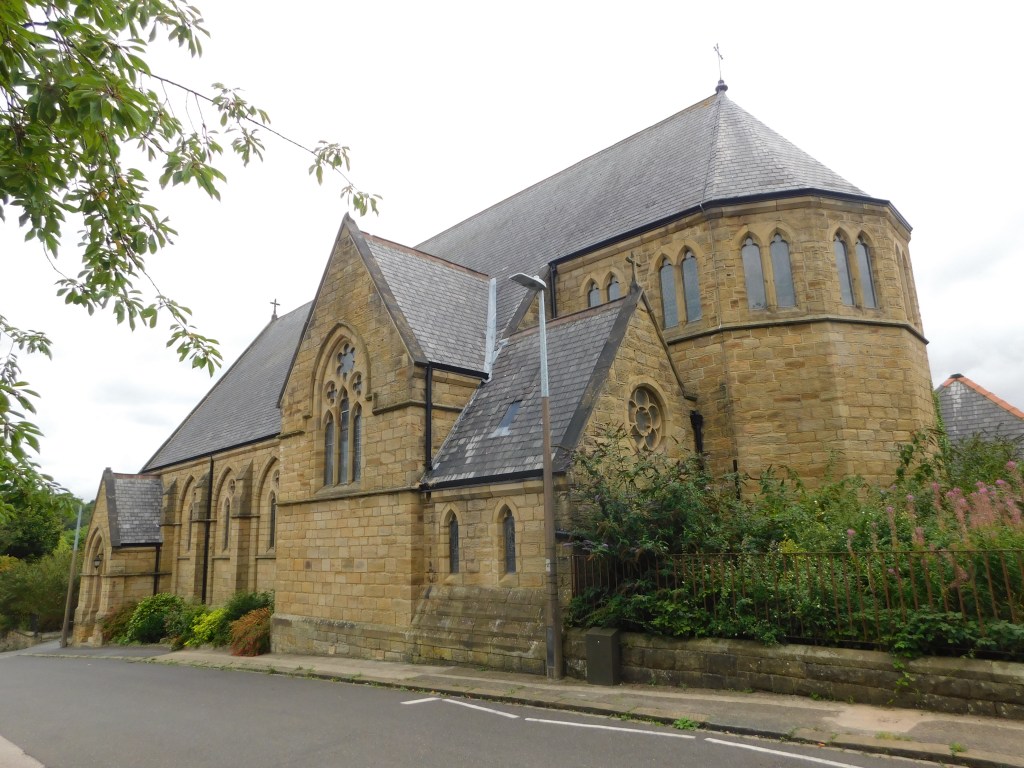
St Mary’s Church – photo by Jane Roberts

October 2022 saw the addition of seven new posts, bringing the total number for the study to 189. Two other pages were updated.

The additions included four weekly newspaper pages for October 1916. I have accordingly updated the surname index to these During This Week newspaper pieces, so you can easily identify newspaper snippets relevant to your family.

I have written one new War Memorial biography, that of Patrick Hopkins.

More men who served and survived have been identified. I have updated that page accordingly. No new biographies were added here in October.

The Infant School log book for 1915 has been added to the School Log Books section.

Finally for this month there is one new piece in the Miscellany of Information section, about the Batley Peace Medal. Although written from a St Mary’s perspective, this is of far wider Batley local history interest.

Below is the full list of pages to date. I have annotated the *NEW* and *UPDATED* ones, so you can easily pick these out. Click on the link and it will take you straight to the relevant page.


1. About my St Mary of the Angels Catholic Church War Memorial One-Place Study;

Batley Descriptions – Directories etc.
2. 1914: Borough of Batley – Town Information from the Annual Report of the Medical Officer of Health.

Biographies: Men Associated with St Mary’s Who Died but Who Are Not on the Memorial
3. Thomas Gannon
4. Reginald Roberts
5. William Frederick Townsend

Biographies: The War Memorial Men
6. Edward Barber
7. Herbert Booth
8. Edmund Battye
9. Dominick (aka George) Brannan
10. Michael Brannan
11. John Brooks
12. Michael Cafferty
13. Patrick Cafferty
14. Lawrence Carney
15. Martin Carney
16. Thomas Curley
17. Peter Doherty
18. Thomas Donlan
19. Thomas Finneran
20. Michael Flynn
21. Thomas Foley D.C.M.
22. James Garner
23. Thomas Gavaghan
24. Michael Groark (also known as Rourke)
25. James Griffin
26. Patrick Hopkins *NEW*
27. Michael Horan
William McManus – See William Townsend below
28. Thomas McNamara
29. Patrick Naifsey
30. Austin Nolan
31. Robert Randerson
32. James Rush
33. Moses Stubley
34. William Townsend, also known as McManus
35. James Trainor
36. Richard Carroll Walsh

Biographies: Those who Served and Survived (this includes a list of those identified to date and who will later have dedicated biographical pages) *UPDATED*
37. Patrick Cassidy
38. James Delaney
39. Thomas Donlan (senior)
40. Thomas Gannon
41. Michael Rush

Burials, Cemeteries, Headstones and MIs
42. Cemetery and Memorial Details
43. War Memorial Chronology of Deaths

Miscellany of Information
162. The Controversial Role Played by St Mary’s Schoolchildren in the 1907 Batley Pageant
163. The Great War: A Brief Overview of What Led Britain into the War
164. Willie and Edward Barber – Poems
165. A St Mary’s School Sensation
166. St Mary of the Angels Catholic Church – 1929 Consecration Service
167. A “Peace” of Batley History *NEW*

During This Week
44. During This Week Newspaper Index *UPDATED*
45. 1914, 8 August – Batley News
46. 1914, 15 August – Batley News
47. 1914, 22 August – Batley News
48. 1914, 29 August – Batley News
49. 1914, 5 September – Batley News
50. 1914, 12 September – Batley News
51. 1914, 19 September – Batley News
52. 1914, 26 September – Batley News
53. 1914, 3 October – Batley News
54. 1914, 10 October – Batley News
55. 1914, 17 October – Batley News
56. 1914, 24 October – Batley News
57. 1914, 31 October – Batley News
58. 1914, 7 November – Batley News
59. 1914, 14 November – Batley News
60. 1914, 21 November – Batley News
61. 1914, 28 November – Batley News
62. 1914, 5 December – Batley News
63. 1914, 12 December – Batley News
64. 1914, 19 December – Batley News
65. 1914, 24 December – Batley News
66. 1915, 2 January – Batley News
67. 1915, 9 January – Batley News
68. 1915, 16 January – Batley News
69. 1915, 23 January – Batley News
70. 1915, 30 January – Batley News
71. 1915, 6 February – Batley News
72. 1915, 13 February – Batley News
73. 1915, 20 February – Batley News
74. 1915, 27 February – Batley News
75. 1915, 6 March – Batley News
76. 1915, 13 March – Batley News
77. 1915, 20 March – Batley News
78. 1915, 27 March – Batley News
79. 1915, 3 April – Batley News
80. 1915, 10 April – Batley News
81. 1915, 17 April – Batley News
82. 1915, 24 April – Batley News
83. 1915, 1 May – Batley News
84. 1915, 8 May – Batley News
85. 1915, 15 May – Batley News
86. 1915, 22 May – Batley News
87. 1915, 29 May – Batley News
88. 1915, 5 June – Batley News
89. 1915, 12 June – Batley News
90. 1915, 19 June – Batley News
91. 1915, 26 June – Batley News
92. 1915, 3 July – Batley News
93. 1915, 10 July – Batley News
94. 1915, 17 July – Batley News
95. 1915, 24 July – Batley News
96. 1915, 31 July – Batley News
97. 1915, 7 August – Batley News
98. 1915, 14 August – Batley News
99. 1915, 21 August – Batley News
100. 1915, 28 August – Batley News
101. 1915, 4 September – Batley News
102. 1915, 11 September – Batley News
103. 1915, 18 September – Batley News
104. 1915, 25 September – Batley News
105. 1915, 2 October – Batley News
106. 1915, 9 October – Batley News
107. 1915, 16 October – Batley News
108. 1915, 23 October – Batley News
109. 1915, 30 October – Batley News
110. 1915, 6 November – Batley News
111. 1915, 13 November – Batley News
112. 1915, 20 November – Batley News
113. 1915, 27 November – Batley News
114. 1915, 4 December – Batley News
115. 1915, 11 December – Batley News
116. 1915, 18 December – Batley News
117. 1915, 23 December – Batley News
118. 1916, 1 January – Batley News
119. 1916, 8 January – Batley News
120. 1916, 15 January – Batley News
121. 1916, 22 January – Batley News
122. 1916, 29 January – Batley News
123. 1916, 5 February – Batley News
124. 1916, 12 February – Batley News
125. 1916, 19 February – Batley News
126. 1916, 26 February – Batley News
127. 1916, 4 March – Batley News
128. 1916, 11 March – Batley News
129. 1916, 18 March – Batley News
130. 1916, 25 March – Batley News
131. 1916, 1 April – Batley News
132. 1916, 8 April – Batley News
133. 1916, 15 April – Batley News
134. 1916, 22 April – Batley News
135. 1916, 29 April – Batley News
136. 1916, 6 May – Batley News
137. 1916, 13 May – Batley News
138. 1916, 20 May – Batley News
139. 1916, 27 May – Batley News
140. 1916, 3 June – Batley News
141. 1916, 10 June – Batley News
142. 1916, 17 June – Batley News
143. 1916, 24 June – Batley News
144. 1916, 1 July – Batley News
145. 1916, 8 July – Batley News
146. 1916, 15 July – Batley News
147. 1916, 22 July – Batley News
148. 1916, 29 July – Batley News
149. 1916, 5 August – Batley News
150. 1916, 12 August – Batley News
151. 1916, 19 August – Batley News
152. 1916, 26 August – Batley News
153. 1916, 2 September – Batley News
154. 1916, 9 September – Batley News
155. 1916, 16 September – Batley News
156. 1916, 23 September – Batley News
157. 1916, 30 September – Batley News
158. 1916, 7 October – Batley News *NEW*
159. 1916, 14 October – Batley News *NEW*
160. 1916, 21 October – Batley News *NEW*
161. 1916, 28 October – Batley News *NEW*

Occupations and Employment Information
168. Occupations: Confidential Clerk
169. Occupations: Lamp Cleaner
170. Occupations: Limelight Operator
171. Occupations: Office Boy/Girl
172. Occupations: Piecer/Piecener
173. Occupations: Rag Grinder
174. Occupations: Willeyer

The Families
175. A Death in the Church

School Log Books
176. Boys’ School – Log Book, 1913
177. Boys’ School – Log Book, 1914
178. Boys’ School – Log Book, 1915
179. Boys’ School – Log Book, 1916
180. Boys’ School – Log Book, 1917
181. Boys’ School – Log Book, 1918
182. Boys’ School – Log Book, 1919
183. Boys’ School – Log Book, 1920
184. Infant School – Log Book 1914
185. Infant School – Log Book 1915 *NEW*

Population, Health, Mortality and Fertility
186. 1914: The Health of Batley School Children Generally, with a Particular Focus on St Mary’s School Children

World War Two
187. World War Two Chronology of Deaths
188. Michael Flatley
189. William Smith


Postscript:
My website has always been free to use, but it does cost me money to operate. In the current difficult economic climate I’m having to consider whether I can continue to afford to keep running it as a free resource.

If you have enjoyed reading the various pieces, and would like to make a donation towards keeping the website up and running in its current open access format, it would be very much appreciated.

Please click here to be taken to the PayPal donation link. By making a donation you will be helping to keep the website online and freely available for all.

Thank you.

Do You Own a ‘Peace’ of Batley History?

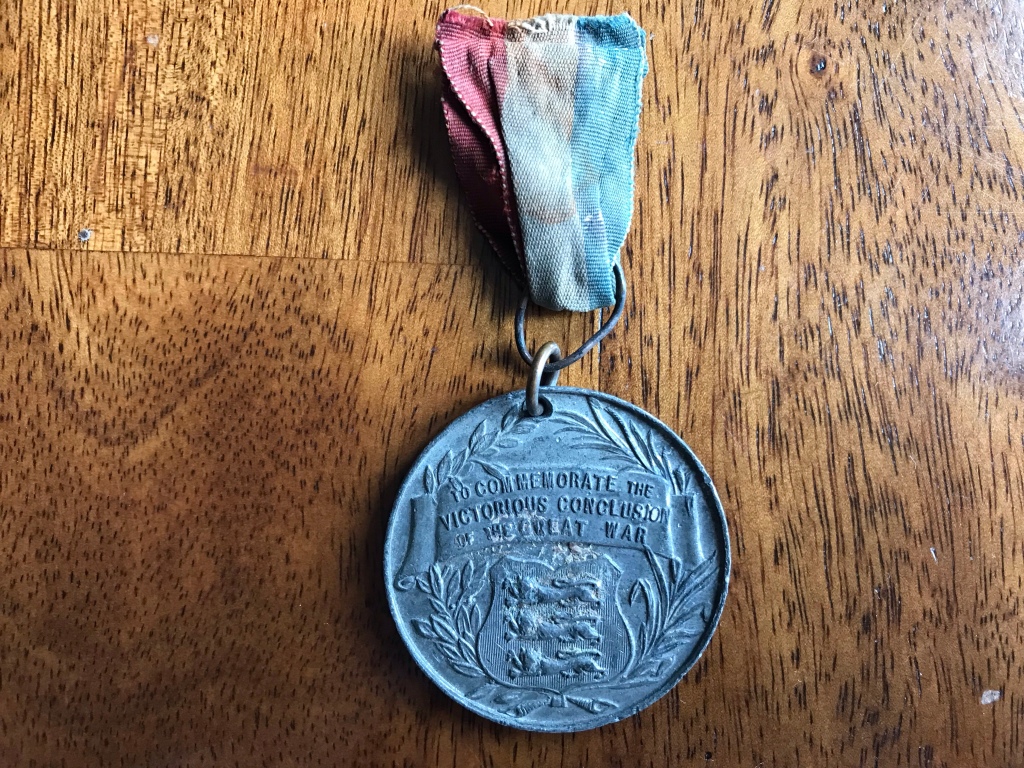
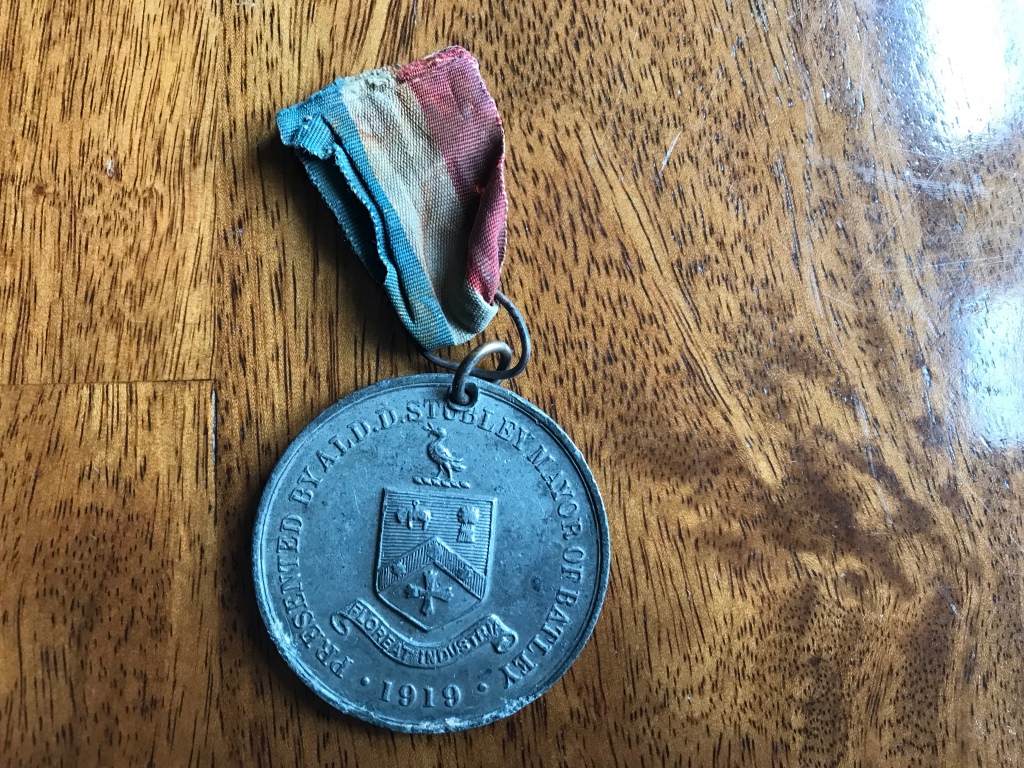
The medal below is a piece of Batley history.

One side indicates why the medal was produced. It says it is:

TO COMMEMORATE THE VICTORIOUS CONCLUSION OF THE GREAT WAR

The other side, with the town’s coat of arms, gives the date of presentation and by whom, with the words

PRESENTED BY ALD. D. STUBLEY MAYOR OF BATLEY • 1919 •

The reason for the medal is therefore clear – to commemorate the ending of the First World War.

But who was the medal presented to? How many were presented? And when was the presentation made?

This piece will answer these questions, and more.


In the weeks and months after the Armistice, thoughts at a national level were turning to how to mark the signing of the final peace treaty. It was a difficult issue given many families up and down the country were grieving, or had loved ones permanently maimed, and discharged veterans were flooding home to face uncertain futures. Celebrations would be hard for many. Which in part explains why the Government decision was delayed for several months.

In early April 1919 the Batley Corporation Town Clerk, Joseph Hanson Craik, wrote to the local MP, Gerald France, to see if the Government had any timing information on the likely signing of “Peace.” Also to find out when there would be any indication of the lead from London about the nature of celebrations to mark it. The answer came back that it was all still pending.1

But the Corporation recognised they needed to get on with preparations in advance of this final decision from government. It proved a wise move. It was not until the beginning of July 1919, after the 28 June 1919 signing of the Treaty of Versailles, that the Government made the formal announcement that 19 July 1919 would be designated National Peace Day, and a Bank Holiday. 

It meant July was a frenetic period of activity for Batley Corporation and the Peace Celebration Committee. They designated the Batley Borough peace celebrations were to be held between 17 and 22 July 1919, with – in addition to the 19 July national Bank Holiday – the 21 and 22 July designated as general holidays locally. A series of events were planned. These included schools’ events scheduled for 17 July, as this was the day the elementary schools broke up for the summer holiday.

As far back as March 1919 Town Clerk Craik was setting wheels in motion for these school events, compiling estimates of the number of scholars on the roll in Batley. 

The schools in the Borough were:

  • Batley Parish C.E.
  • Brownhill C.E.
  • Carlinghow.
  • Field Lane.
  • Healey.
  • Park Road.
  • Purlwell.
  • St Mary’s R.C.
  • Staincliffe C.E.
  • Warwick Road.
  • Gregory Street.
  • Hanging Heaton.
  • Mill Lane. 
  • Boys’ Grammar. 
  • Girls’ Grammar.

On 23 March Batley Corporation calculated numbers on the roll stood at 5,610, split between 5,200 elementary scholars, 190 at the Boys Grammar School and 220 at the Girls Grammar School. There was also an estimated 210 teachers, of which 187 were at Elementary Schools. The Education Committee Returns of School Attendance for the month of April 1919 supported the Elementary roll figure.

The breakdown of numbers for St Mary’s, the school I am particularly interested in and which forms part of my one-place study, was as follows:

St Mary’s RCAccommodationNumber on RollActual AttendanceAverage AttendancePer Cent Attendance
Boys9611010810191.4
Mixed31024124122492.8
Infants1691251199780.1
Total57547646842289.2
Batley Education Committee – Returns of School Attendance for the Month of April, 1919 for St Mary’s RC School

You will need to scroll across if you cannot see the full table on your screen.


Part of the reason for collating school children numbers was the decision that each school child would be presented with a token to mark peace. Options investigated included children’s Peace Celebration commemoration cards, and the Educational Publishing Company’s ‘Victory’ peace souvenir books, of which they produced three versions tailored to age. But in the end Batley Borough went with a commemorative Peace Medal. 

In April 1919 medal and badge makers, including J.R. Gaunt and Son of London and Birmingham’s Meer Jones & Co., were contacted about their Peace Medal designs, with quotes being sought for a tentative quantity of between 5,500 to 6,000 medals. In the end the order went to Fattorini, and for two designs – one for schoolchildren and the other for teachers. The medal is one those presented to a Batley schoolchild.

Charles Holt, Market Inspector and Town Hall Keeper, had the unenviable task of counting the medals once they arrived in early July. On 12 July 1919 the Town Clerk confirmed to the Mayor:

Mr. Holt has counted up and checked the Scholars Medals (white metal) and has returned the number delivered by Messrs. Fattorini as 6006. I have since received a further box from Fattorini containing Bronze Oxydized Medals with silk cord suspenders. The number of these has been checked by Mr. Holt and he returns same as 255. From a Return furnished to me this morning by Mr. Elliott there would appear to be including the 2 Grammar Schools, 5950 scholars on the Register and 191 Teachers.2

The final July 1919 tally for medals for St Mary’s was 112 boys and three teachers, 145 infants and four teachers, and 244 mixed with eight teachers. 


By 11 July Batley Education Committee were able to finalise the 17 July Peace Celebration for schools. The schools were given a timetable for the Thursday morning mayoral Commemorative Peace Medal visit, with the times firmed up in a further letter on 13 July. 

In a precise schedule, St Mary’s children had a five-minute slot for their mayoral visit between 11.19 and 11.24, sandwiched between Carlinghow and Batley Parish schools. The children were to be assembled in the school yard ready and waiting at the appointed time wearing their medals. So no personal medal presentation by the mayor to each child. 

In the afternoon of 17 July a tea was provided across the schools, capped at one shilling per head. As it was thought unlikely Infants Departments would reach that sum, they were also provided with sweets amounting to around 3d per child. For Senior Departments it was recommended after tea an additional bun should be given to each child. And in a period of post-war shortages, in order to obtain sugar for the tea, teachers made applications to the local Food Controller with details of numbers and the retailer from which the school wanted to purchase their supply.

Afterwards a Children’s Sports event was held at Mount Pleasant, commencing at 5.45. 

It was decreed:

The children of each Department should be arranged four abreast according to height, the smaller children in advance, and marched through the main entrance to the Football Ground in time to be in their places on the Ground at 5.50 p.m. prompt…Please request the children to bring their hand flags.3

Verses from the hymn “O God, our help in ages past” were then to be sung, before the children took up their places in school groups round the field. 

The Children’s’ Peace Sports programme of events schedule was:

  1. Flat Race. 100 yards. Boys. 15 and over. 1 heat run as final.
  2. Flat Race. 100 yards. Girls. 15 and over. 1 heat run as final.
  3. Flat Race. 80 yards. Boys. 7 to 9 years. 3 heats.
  4. Running Skipping Race. 60 yards. Girls. Under 10. Heats.
  5. Tug of War – Team of 8 boys per school. Those age 13 and over prior to 1 May 1919 could not complete. Heats 1 and 2. Lots were drawn and Brownhill, St Mary’s and Carlinghow had byes.
  6. Plant Pot Race. 15 yards. Girls. Age over 13. 3 heats and finals.
  7. Flat Race. 100 yards. Boys. 9 to 12. 2 heats.
  8. Running Skipping Race. 80 yards. Girls. 10 to 13. 3 heats.
  9. Wheelbarrow Race. 35 yards. Boys. Open age. 3 heats.
  10. Potato Race . 60 yards. Girls. Under 10. 3 heats. 6 potatoes to be collected, spaced two yards apart.
  11. Flat Race. 100 yards. Boys. 12 and over. 3 heats.
  12. Charlie Chaplin Competition – Judging of Competitors.
  13. Potato Race. 80 yards. Girls. 10 to 13. 3 heats.
  14. Tug-of-War semi-final.
  15. Pillow Fight on Poles. Boys. Ages between 13 and 14. Rounds 1 and 2. Semi-final and final.
  16. Obstacle Races. Boys. Open age. 3 heats and final.
  17. Egg and Spoon Race. 100 yards. Girls. Open age. 3 heats. Desert spoons and pot eggs to be provided by the competitors.
  18. Flat Race. 100 yards. Boys. 13 to 15. 3 heats.
  19. Flat Race. 100 yards. Girls. 13 to 15. 3 heats.
  20. Wheelbarrow Race. 35 yards. Boys. Open age. Final.
  21. Week-End Race. 60 yards. Girls. Open age. 3 heats.
  22. Sack Race. Boys. Open age. 3 heats.
  23. Flat Race. 80 yards. Boys. 7 to 9. Final.
  24. Running Skipping Race. 60 yards. Girls. Under 10. Final.
  25. Tug-of-War. Boys. Final.
  26. Week-End Race. 60 yards. Girls. Open age. Final.
  27. Flat Race. Boys. 100 yards. 9 to 12. Final.
  28. Running Skipping Races. 80 yards. Girls. 10 to 13. Final.
  29. Potato Race. 60 yards. Girls. Under 10. Final.
  30. Potato Race. 80 yards. Girls. 10 to 13. Final.
  31. Flat Race. 100 yards. Boys. 12 and over. Final.
  32. Egg and Spoon Races. 100 yards. Girls. Open age. Final.
  33. Flat Race. 100 Yards. Boys. 13 to 15. Final.
  34. Flat Race. 100 Yards. Girls. 13 to 15. Final.
  35. Sack Race. Boys. Final.

Although distances are in imperial measurements, many of the events are similar to those of a 21st century school sports days. But others were of the time, for example the reference to Charlie Chaplin. 

The plant-pot race is an unfamiliar one today. The entrants had to bring two earthenware plant pots, size optional. They had to travel the race distance standing on these pots. If competitors fell off their pots, or touched the ground with their feet, they had to commence again from the starting point. 

The Week-End race is another which may need explanation. For this each competitor had to bring a hat and jacket in a parcel. This was laid in-field 20 yards from the starting point. The competitor had to run to the parcel, put on the clothes, run a further 20 yards, disrobe and tie the hat and jacket back up in the parcel, then run the final 20 yards as a flat race.

The child age limits for the races were age as of 1 May. Each school was to send two competitors for each event, (excluding the Tug of War and Grammar School designated events). Grammar school events were essentially those for ages 15 and over, and to some extent 13-15 – though Elementary School children fulfilling this latter age criteria could enter. Prizes were awarded for 1st, 2nd and 3rd place. Perhaps the books and commemorative cards looked into earlier by the Corporation ended up forming these prizes.

The Batley Old Band were booked to provide musical entertainment. Morris dancers and other side-shows, including a Punch and Judy show, a ventriloquist and a conjurer, were laid on. These moved about the ground so all the children could view the performances. The general public were be welcomed to join the festivities after 6pm. Thousands took up the offer, with “not a dull moment from start to finish.4


The Batley News of 19 July 1919 gives some brief details about the schoool’s events of 17 July. The piece reads:

Yesterday some six thousand school children enjoyed the Mayor’s hospitality. His Worship visited the schools in the morning and addressed the scholars, and commemoration medals were given teachers and children. In the afternoon the elder scholars proceeded to the football field at Mount Pleasant, where sports were enjoyed and an interesting gala, with fire balloons and a band concert. The junior scholars were entertained on their own school premises.

The Batley Reporter provided more information:

The children have been excitedly anticipating the event for many days and they had a right royal time. In the morning the Mayor (Alderman D. Stubley), accompanied by the Mayoress (Mrs. John Stubley)….visited every school in the borough, and at each school there was was an interesting and picturesque ceremony. The children, wearing the neat commemorative medal presented to each scholar by the Mayor, were marshalled in the playground, and they greeted most enthusiastically the arrival of the Mayor and Mayoress. There was flag-waving, singing and cheers, and many other interesting incidents at many of the schools, but as the Mayor and Mayoress were only able to spend five minutes at each place the proceedings were necessarily short. The Mayor personally presented a commemorative medal to each teacher and addressed a few appropriate words to the assembled scholars. The Mayoress received quite a number of beautiful bouquets, and before the end of the tour the Mayor’s motor-car was lavishly adorned with lovely flowers.

In the afternoon the children re-assembled at their respective schools, where they were regaled with tea, as the guests of the Mayor. Afterwards the scholars of the upper schools, including the pupils at the two Grammar schools, marched in procession to the football field at Mount Pleasant, where they assembled en masse for the singing, under the conductorship of Mr. J. Chapman, of three verses of “O God, our Help in ages past” and the National Anthem. Afterwards, the children simply revelled in the sports, for which prizes were provided by the Mayor.5

The complete list of children participating in the sports day does not feature in either newspaper. I do however have names of some of the participants, provided to the Education Committee in advance of the event. Unfortunately, because it was a preliminary list, it is very sketchy. Focusing on my one-place study, these are the St Mary’s names submitted:

  • Flat Race – Boys – 7-9: St Mary’s names not provided.
  • Running Skipping Race – Girls – Under 10: St Mary’s names not provided.
  • Plant Pot Race – Girls – St Mary’s names not provided.
  • Flat Race – Boys – 9-12: T. Carrey [I suspect this is a mis-spelling of Carney] and J. W. Levvitt. 
  • Running Skipping Race – Girls – Over 10 – St Mary’s names not provided.
  • Wheelbarrow Race – Boys – Open Age – R. Dewhirst/T. Judge and H. Hardy/E. Power.
  • Potato Race – Girls – Under 10 – St Mary’s names not provided.
  • Flat Race – Boys – 12 and over – G. Delaney and J. Lumb.
  • Charlie Chaplin – P. Howley.
  • Potato Race – Girls – Over 10 – St Mary’s names not provided.
  • Pillow Fight on Poles – Boys – L. Cassidy.
  • Obstacle Races – Boys – Open Age – J. Maloney and N. Gavaghan. 
  • Egg and Spoon Race – Girls – St Mary’s names not provided.
  • Flat Race – Boys – 13 to 15 – J. Lyons and M. Howley.
  • Flat Race – Girls – 13 to 15 – No St Mary’s entry.
  • Week-End Races – Girls – Open Age – St Mary’s names not provided.
  • Sack Race – Boys – Open Age – W. Bottomley and T. Kilkenny.

And the Batley Reporter and Guardian did provide a full list of the winners of the various events.6 It is rather lengthy, so again I will focus on my St Mary’s one-place study. In the Girls’ races:

  • T. Murphy was amongst the Under 10 Skipping Race heat qualifiers, finishing 3rd in the final.
  • M. Hopkins and N. Moran were amongst the heat qualifiers in the Plant Pot Race, but did not finish in the final first three.
  • N. Monaghan was amongst the Under 10 Potato Race qualifiers, but for some reason the final was not run. 

In the Boys’ events:

  • J. W. Lev[v]itt qualified for the final of the 100 yards Flat Race.
  • J. Lyons came third in the 100 yards Flat Race for ages 13 to 15.
  • W. Bottomley was amongst the Sack Race qualifiers, finishing second in the final. 

Finally school log books give more clues of the day’s events. Although there was no reference to it in the St Mary’s Infant School log book, the St Mary’s Boys’ Department entry for 17 July 1919 read:

Peace celebrations in school. Visit of the Mayor and Mayoress and presentation to the schoolchildren of medals to commemorate Peace. School closed at noon for the Midsummer Holidays.7

The Mixed Department log book gave more details:

School closes this day at noon for the Midsummer holidays. School visited this morning by the Mayor and Mayoress of Batley. Medals were given to the children in commemoration of the Victorious conclusion of the Great War.

A tea party will be given in the afternoon, and sports will be held in the cricket field.8


As I said, the school’s event was only one part of the celebrations. Other events included a parade, entertainment and fireworks, a military sports afternoon, a mayoral function for discharged and disabled sailors and soldiers and repatriated prisoner of war, an “Old Folks Tea” hosted by the Mayoress, and a similar one for the mothers of the Batley Maternity and Child Welfare Centre. All these events were finalised within days of the government’s Peace Day confirmation. And in the pre-computer and internet era, and with even telephone in its early years, the co-ordination, pace and organisation on display by Batley Corporation is something to admire.


To conclude, if you have one of the medals illustrated it was one of 5,950 presented to the school children of Batley on 17 July 1919 to commemorate the signing of the Treaty of Versailles marking the official end of the Great War. Or possibly one of the 56 spare medals.

Finally, if anyone has one of the medal presented to teachers, I would love to be able to add an image of it to this post. 


Postscript:
If you have enjoyed reading this post and would like to make a donation towards ensuring the continued running of this website, it would be very much appreciated.

Please click here to be taken to the PayPal donation link.

Thank you. 


Footnotes:
1. Exchange of letters between Joseph H. Craik and Gerald A. France, M.P., dated 4 and 7 April 1919.
2. Draft of letter from Batley Town Clerk, Joseph H. Craik, to the Mayor, dated 12 July 1919.
3. Batley Education Committee letter to schools, dated 11 July 1919.
4. Batley Reporter and Guardian, 25 July 1919.
5. Batley Reporter and Guardian, 18 July 1919.
6. Batley Reporter and Guardian, 25 July 1919.
7. St Mary’s Boys’ School log book.
8. St Mary’s School Mixed Department log book.

St Mary of the Angels, Batley: One-Place Study Update – 1 to 30 September 2022 Additions

This is the latest update of the pages relating to my Batley St Mary’s one-place study. If you want to know more about the background to my one-place study click here. Otherwise read on to discover all the posts, new and old, containing a wealth of parish, parishioner and wider local Batley history.

St Mary’s Church – photo by Jane Roberts

September 2022 saw the addition of 10 new posts, bringing the total number for the study to 182. Two other pages were updated.

The additions included five weekly newspaper pages for September 1916. I have accordingly updated the surname index to these During This Week newspaper pieces, so you can easily identify newspaper snippets relevant to your family.

I have written two new biographies for War Memorial men – Michael and Patrick Cafferty. There is also a new biography for a parishioner who died but is not on the Memorial – Thomas Gannon

More men who served and survived have been identified. I have updated that page accordingly. One new biography has been added to this section in September – that of another Thomas Gannon.

Finally for this month there is one new piece in the Miscellany of Information section, about the 1929 service of consecration of the church and the new altar.

Below is the full list of pages to date. I have annotated the *NEW* ones, plus the *UPDATED* pages, so you can easily pick these out. Click on the link and it will take you straight to the relevant page.


1. About my St Mary of the Angels Catholic Church War Memorial One-Place Study;

Batley Descriptions – Directories etc.
2. 1914: Borough of Batley – Town Information from the Annual Report of the Medical Officer of Health.

Biographies: Men Associated with St Mary’s Who Died but Who Are Not on the Memorial
3. Thomas Gannon *NEW*
4. Reginald Roberts
5. William Frederick Townsend

Biographies: The War Memorial Men
6. Edward Barber
7. Herbert Booth
8. Edmund Battye
9. Dominick (aka George) Brannan
10. Michael Brannan
11. John Brooks
12. Michael Cafferty *NEW*
13. Patrick Cafferty *NEW*
14. Lawrence Carney
15. Martin Carney
16. Thomas Curley
17. Peter Doherty
18. Thomas Donlan
19. Thomas Finneran
20. Michael Flynn
21. Thomas Foley D.C.M.
22. James Garner
23. Thomas Gavaghan
24. Michael Groark (also known as Rourke)
25. James Griffin
26. Michael Horan
William McManus – See William Townsend below
27. Thomas McNamara
28. Patrick Naifsey
29. Austin Nolan
30. Robert Randerson
31. James Rush
32. Moses Stubley
33. William Townsend, also known as McManus
34. James Trainor
35. Richard Carroll Walsh

Biographies: Those who Served and Survived (this includes a list of those identified to date and who will later have dedicated biographical pages) *UPDATED*
36. Patrick Cassidy
37. James Delaney
38. Thomas Donlan (senior)
39. Thomas Gannon *NEW*
40. Michael Rush

Burials, Cemeteries, Headstones and MIs
41. Cemetery and Memorial Details
42. War Memorial Chronology of Deaths

During This Week
43. During This Week Newspaper Index *UPDATED*
44. 1914, 8 August – Batley News
45. 1914, 15 August – Batley News
46. 1914, 22 August – Batley News
47. 1914, 29 August – Batley News
48. 1914, 5 September – Batley News
49. 1914, 12 September – Batley News
50. 1914, 19 September – Batley News
51. 1914, 26 September – Batley News
52. 1914, 3 October – Batley News
53. 1914, 10 October – Batley News
54. 1914, 17 October – Batley News
55. 1914, 24 October – Batley News
56. 1914, 31 October – Batley News
57. 1914, 7 November – Batley News
58. 1914, 14 November – Batley News
59. 1914, 21 November – Batley News
60. 1914, 28 November – Batley News
61. 1914, 5 December – Batley News
62. 1914, 12 December – Batley News
63. 1914, 19 December – Batley News
64. 1914, 24 December – Batley News
65. 1915, 2 January – Batley News
66. 1915, 9 January – Batley News
67. 1915, 16 January – Batley News
68. 1915, 23 January – Batley News
69. 1915, 30 January – Batley News
70. 1915, 6 February – Batley News
71. 1915, 13 February – Batley News
72. 1915, 20 February – Batley News
73. 1915, 27 February – Batley News
74. 1915, 6 March – Batley News
75. 1915, 13 March – Batley News
76. 1915, 20 March – Batley News
77. 1915, 27 March – Batley News
78. 1915, 3 April – Batley News
79. 1915, 10 April – Batley News
80. 1915, 17 April – Batley News
81. 1915, 24 April – Batley News
82. 1915, 1 May – Batley News
83. 1915, 8 May – Batley News
84. 1915, 15 May – Batley News
85. 1915, 22 May – Batley News
86. 1915, 29 May – Batley News
87. 1915, 5 June – Batley News
88. 1915, 12 June – Batley News
89. 1915, 19 June – Batley News
90. 1915, 26 June – Batley News
91. 1915, 3 July – Batley News
92. 1915, 10 July – Batley News
93. 1915, 17 July – Batley News
94. 1915, 24 July – Batley News
95. 1915, 31 July – Batley News
96. 1915, 7 August – Batley News
97. 1915, 14 August – Batley News
98. 1915, 21 August – Batley News
99. 1915, 28 August – Batley News
100. 1915, 4 September – Batley News
101. 1915, 11 September – Batley News
102. 1915, 18 September – Batley News
103. 1915, 25 September – Batley News
104. 1915, 2 October – Batley News
105. 1915, 9 October – Batley News
106. 1915, 16 October – Batley News
107. 1915, 23 October – Batley News
108. 1915, 30 October – Batley News
109. 1915, 6 November – Batley News
110. 1915, 13 November – Batley News
111. 1915, 20 November – Batley News
112. 1915, 27 November – Batley News
113. 1915, 4 December – Batley News
114. 1915, 11 December – Batley News
115. 1915, 18 December – Batley News
116. 1915, 23 December – Batley News
117. 1916, 1 January – Batley News
118. 1916, 8 January – Batley News
119. 1916, 15 January – Batley News
120. 1916, 22 January – Batley News
121. 1916, 29 January – Batley News
122. 1916, 5 February – Batley News
123. 1916, 12 February – Batley News
124. 1916, 19 February – Batley News
125. 1916, 26 February – Batley News
126. 1916, 4 March – Batley News
127. 1916, 11 March – Batley News
128. 1916, 18 March – Batley News
129. 1916, 25 March – Batley News
130. 1916, 1 April – Batley News
131. 1916, 8 April – Batley News
132. 1916, 15 April – Batley News
133. 1916, 22 April – Batley News
134. 1916, 29 April – Batley News
135. 1916, 6 May – Batley News
136. 1916, 13 May – Batley News
137. 1916, 20 May – Batley News
138. 1916, 27 May – Batley News
139. 1916, 3 June – Batley News
140. 1916, 10 June – Batley News
141. 1916, 17 June – Batley News
142. 1916, 24 June – Batley News
143. 1916, 1 July – Batley News
144. 1916, 8 July – Batley News
145. 1916, 15 July – Batley News
146. 1916, 22 July – Batley News
147. 1916, 29 July – Batley News
148. 1916, 5 August – Batley News
149. 1916, 12 August – Batley News
150. 1916, 19 August – Batley News
151. 1916, 26 August – Batley News
152. 1916, 2 September – Batley News *NEW*
153. 1916, 9 September – Batley News *NEW*
154. 1916, 16 September – Batley News *NEW*
155. 1916, 23 September – Batley News *NEW*
156. 1916, 30 September – Batley News *NEW*

Miscellany of Information
157. The Controversial Role Played by St Mary’s Schoolchildren in the 1907 Batley Pageant
158. The Great War: A Brief Overview of What Led Britain into the War
159. Willie and Edward Barber – Poems
160. A St Mary’s School Sensation
161. St Mary of the Angels Catholic Church – 1929 Consecration Service *NEW*

Occupations and Employment Information
162. Occupations: Confidential Clerk
163. Occupations: Lamp Cleaner
164. Occupations: Limelight Operator
165. Occupations: Office Boy/Girl
166. Occupations: Piecer/Piecener
167. Occupations: Rag Grinder
168. Occupations: Willeyer

The Families
169. A Death in the Church

School Log Books
170. Boys’ School – Log Book, 1913
171. Boys’ School – Log Book, 1914
172. Boys’ School – Log Book, 1915
173. Boys’ School – Log Book, 1916
174. Boys’ School – Log Book, 1917
175. Boys’ School – Log Book, 1918
176. Boys’ School – Log Book, 1919
177. Boys’ School – Log Book, 1920
178. Infant School – Log Book 1914

Population, Health, Mortality and Fertility
179. 1914: The Health of Batley School Children Generally, with a Particular Focus on St Mary’s School Children

World War Two
180. World War Two Chronology of Deaths
181. Michael Flatley
182. William Smith


Postscript:
If you have enjoyed reading this post and would like to make a donation towards ensuring the continued running of this website, it would be very much appreciated.

Please click here to be taken to the PayPal donation link.

Thank you. 

St Mary of the Angels, Batley: One-Place Study Update – 1 to 30 April 2022 Additions

This is the latest update of the pages relating to my Batley St Mary’s one-place study, the details of which I announced here.

St Mary of the Angels, Batley

April saw the addition of eight new pages. Two other pages were updated.

The additions included five weekly newspaper pages for April 1916. I have accordingly updated the surname index to these During This Week newspaper pieces, so you can easily identify newspaper snippets relevant to your family.

More men who served and survived have been identified. I have updated that page accordingly. No new biographies for these men have been added this month. They will follow in due course.

I have written one biography for a War Memorial man: Lawrence Carney.

This month there are two new school log book pages. These are the ones for the Boys’ Department in 1914 and 1915.

Below is the full list of pages to date. I have annotated the *NEW* ones, plus the *UPDATED* pages, so you can easily pick these out. Click on the link and it will take you straight to the relevant page.


1. About my St Mary of the Angels Catholic Church War Memorial One-Place Study;

Batley Descriptions – Directories etc.
2. 1914: Borough of Batley – Town Information from the Annual Report of the Medical Officer of Health.

Biographies: Men Associated with St Mary’s Who Died but Who Are Not on the Memorial 
3. Reginald Roberts 
4. William Frederick Townsend

Biographies: The War Memorial Men
5. Herbert Booth
6. Edmund Battye
7. Dominick (aka George) Brannan
8. Michael Brannan
9. John Brooks
10. Lawrence Carney *NEW*
11. Martin Carney
12. Thomas Curley
13. Peter Doherty
14. Thomas Donlan
15. Thomas Finneran
16. Michael Flynn
17. Thomas Foley D.C.M.
18. Thomas Gavaghan
19. Michael Groark (also known as Rourke)
20. James Griffin
21. Michael Horan
William McManus – See William Townsend below
22. Thomas McNamara
23. Patrick Naifsey
24. Austin Nolan
25. Robert Randerson
26. James Rush
27. Moses Stubley
28. William Townsend, also known as McManus

Biographies: Those who Served and Survived (this includes a list of those identified to date and who will later have dedicated biographical pages) *UPDATED*
29. James Delaney
30. Thomas Donlan (senior)
31. Michael Rush

Burials, Cemeteries, Headstones and MIs
32. Cemetery and Memorial Details
33. War Memorial Chronology of Deaths

During This Week
34. During This Week Newspaper Index *UPDATED*
35. 1914, 8 August – Batley News
36. 1914, 15 August – Batley News
37. 1914, 22 August – Batley News
38. 1914, 29 August – Batley News
39. 1914, 5 September – Batley News
40. 1914, 12 September – Batley News
41. 1914, 19 September – Batley News
42. 1914, 26 September – Batley News
43. 1914, 3 October – Batley News
44. 1914, 10 October – Batley News
45. 1914, 17 October – Batley News
46. 1914, 24 October – Batley News
47. 1914, 31 October – Batley News
48. 1914, 7 November – Batley News
49. 1914, 14 November – Batley News
50. 1914, 21 November – Batley News
51. 1914, 28 November – Batley News
52. 1914, 5 December – Batley News
53. 1914, 12 December – Batley News
54. 1914, 19 December – Batley News
55. 1914, 24 December – Batley News
56. 1915, 2 January – Batley News
57. 1915, 9 January – Batley News
58. 1915, 16 January – Batley News
59. 1915, 23 January – Batley News
60. 1915, 30 January – Batley News
61. 1915, 6 February – Batley News
62. 1915, 13 February – Batley News
63. 1915, 20 February – Batley News
64. 1915, 27 February – Batley News
65. 1915, 6 March – Batley News
66. 1915, 13 March – Batley News
67. 1915, 20 March – Batley News
68. 1915, 27 March – Batley News
69. 1915, 3 April – Batley News
70. 1915, 10 April – Batley News
71. 1915, 17 April – Batley News
72. 1915, 24 April – Batley News
73. 1915, 1 May – Batley News
74. 1915, 8 May – Batley News
75. 1915, 15 May – Batley News
76. 1915, 22 May – Batley News
77. 1915, 29 May – Batley News
78. 1915, 5 June – Batley News
79. 1915, 12 June – Batley News
80. 1915, 19 June – Batley News
81. 1915, 26 June – Batley News
82. 1915, 3 July – Batley News
83. 1915, 10 July – Batley News
84. 1915, 17 July – Batley News
85. 1915, 24 July – Batley News
86. 1915, 31 July – Batley News
87. 1915, 7 August – Batley News
88. 1915, 14 August – Batley News
89. 1915, 21 August – Batley News
90. 1915, 28 August – Batley News
91. 1915, 4 September – Batley News
92. 1915, 11 September – Batley News
93. 1915, 18 September – Batley News
94. 1915, 25 September – Batley News
95. 1915, 2 October – Batley News
96. 1915, 9 October – Batley News
97. 1915, 16 October – Batley News
98. 1915, 23 October – Batley News
99. 1915, 30 October – Batley News
100. 1915, 6 November – Batley News
101. 1915, 13 November – Batley News
102. 1915, 20 November – Batley News
103. 1915, 27 November – Batley News
104. 1915, 4 December – Batley News
105. 1915, 11 December – Batley News
106. 1915, 18 December – Batley News
107. 1915, 23 December – Batley News
108. 1916, 1 January – Batley News
109. 1916, 8 January – Batley News
110. 1916, 15 January – Batley News
111. 1916, 22 January – Batley News
112. 1916, 29 January – Batley News
113. 1916, 5 February – Batley News
114. 1916, 12 February – Batley News
115. 1916, 19 February – Batley News
116. 1916, 26 February – Batley News
117. 1916, 4 March – Batley News
118. 1916, 11 March – Batley News
119. 1916, 18 March – Batley News
120. 1916, 25 March – Batley News
121. 1916, 1 April – Batley News *NEW*
122. 1916, 8 April – Batley News *NEW*
123. 1916, 15 April – Batley News *NEW*
124. 1916, 22 April – Batley News *NEW*
125. 1916, 29 April – Batley News *NEW*

Miscellany of Information
126. The Controversial Role Played by St Mary’s Schoolchildren in the 1907 Batley Pageant
127. The Great War: A Brief Overview of What Led Britain into the War
128. Willie and Edward Barber – Poems
129. A St Mary’s School Sensation

Occupations and Employment Information
130. Occupations: Confidential Clerk
131. Occupations: Limelight Operator
132. Occupations: Office Boy/Girl
133. Occupations: Rag Grinder
134. Occupations: Willeyer

The Families
135. A Death in the Church

School Log Books
136. Boys’ School – Log Book, 1913
137. Boys’ School – Log Book, 1914 *NEW*
138. Boys’ School – Log Book, 1915 *NEW*

Population, Health, Mortality and Fertility
139. 1914: The Health of Batley School Children Generally, with a Particular Focus on St Mary’s School Children

World War Two
140. World War Two Chronology of Deaths
141. Michael Flatley

St Mary of the Angels, Batley: One-Place Study Update – 1 to 31 March 2022 Additions

This is the latest update of the pages relating to my Batley St Mary’s one-place study, the details of which I announced here.

A selection of school log books – Photo by Jane Roberts

March saw the addition of seven new pages. Two other pages were updated.

Although March may therefore appear to have been quiet, I have been working away in the background on a new strand to the St Mary’s One-Place Study – the school. More of that later.

The additions included four weekly newspaper pages for March 1916. I have accordingly updated the surname index to these During This Week newspaper pieces, so you can easily identify newspaper snippets relevant to your family.

More men who served and survived have been identified. I have updated that page accordingly. No new biographies for these men have been added this month. They will follow in due course.

I have written one biography for a War Memorial man: Robert Randerson. A Batley rugby league player and St Mary’s school teacher, his first days at the school are also recorded in the brand new section to the study – the school log books.

These log books were kept regularly by the school – the infants, mixed and boys’ departments. They record the everyday routine of their running. Some of the entries may be mundane, register checking for example. But amidst these entries are some real gems – for example unusual incidents, disease outbreaks, school outings, and issues relating to individual school children or teachers. Interwoven through them is the religious context to St Mary of the Angels school, and how local and national events also impacted on it. They provide a snapshot of Catholic school life in a bygone time. Crucially for this study, these particular logs are not available online or in the archives.

This month there are two new pages relating specifically to these log books. The first is a general introduction. The second is the 1913 log book entries for the newly formed Boys’ Department. And it is on these pages Robert Randerson appears.

Below is the full list of pages to date. I have annotated the *NEW* ones, plus the *UPDATED* pages, so you can easily pick these out. Click on the link and it will take you straight to the relevant page.


1. About my St Mary of the Angels Catholic Church War Memorial One-Place Study;

Batley Descriptions – Directories etc.
2. 1914: Borough of Batley – Town Information from the Annual Report of the Medical Officer of Health.

Biographies: Men Associated with St Mary’s Who Died but Who Are Not on the Memorial
3. Reginald Roberts
4. William Frederick Townsend

Biographies: The War Memorial Men
5. Herbert Booth
6. Edmund Battye
7. Dominick (aka George) Brannan
8. Michael Brannan
9. John Brooks
10. Martin Carney
11. Thomas Curley
12. Peter Doherty
13. Thomas Donlan
14. Thomas Finneran
15. Michael Flynn
16. Thomas Foley D.C.M.
17. Thomas Gavaghan
18. Michael Groark (also known as Rourke)
19. James Griffin
20. Michael Horan
William McManus – See William Townsend below
21. Thomas McNamara
22. Patrick Naifsey
23. Austin Nolan
24. Robert Randerson *NEW*
25. James Rush
26. Moses Stubley
27. William Townsend, also known as McManus

Biographies: Those who Served and Survived (this includes a list of those identified to date and who will later have dedicated biographical pages) *UPDATED*
28. James Delaney
29. Thomas Donlan (senior)
30. Michael Rush

Burials, Cemeteries, Headstones and MIs
31. Cemetery and Memorial Details
32. War Memorial Chronology of Deaths

During This Week
33. During This Week Newspaper Index *UPDATED*
34. 1914, 8 August – Batley News
35. 1914, 15 August – Batley News
36. 1914, 22 August – Batley News
37. 1914, 29 August – Batley News
38. 1914, 5 September – Batley News
39. 1914, 12 September – Batley News
40. 1914, 19 September – Batley News
41. 1914, 26 September – Batley News
42. 1914, 3 October – Batley News
43. 1914, 10 October – Batley News
44. 1914, 17 October – Batley News
45. 1914, 24 October – Batley News
46. 1914, 31 October – Batley News
47. 1914, 7 November – Batley News
48. 1914, 14 November – Batley News
49. 1914, 21 November – Batley News
50. 1914, 28 November – Batley News
51. 1914, 5 December – Batley News
52. 1914, 12 December – Batley News
53. 1914, 19 December – Batley News
54. 1914, 24 December – Batley News
55. 1915, 2 January – Batley News
56. 1915, 9 January – Batley News
57. 1915, 16 January – Batley News
58. 1915, 23 January – Batley News
59. 1915, 30 January – Batley News
60. 1915, 6 February – Batley News
61. 1915, 13 February – Batley News
62. 1915, 20 February – Batley News
63. 1915, 27 February – Batley News
64. 1915, 6 March – Batley News
65. 1915, 13 March – Batley News
66. 1915, 20 March – Batley News
67. 1915, 27 March – Batley News
68. 1915, 3 April – Batley News
69. 1915, 10 April – Batley News
70. 1915, 17 April – Batley News
71. 1915, 24 April – Batley News
72. 1915, 1 May – Batley News
73. 1915, 8 May – Batley News
74. 1915, 15 May – Batley News
75. 1915, 22 May – Batley News
76. 1915, 29 May – Batley News
77. 1915, 5 June – Batley News
78. 1915, 12 June – Batley News
79. 1915, 19 June – Batley News
80. 1915, 26 June – Batley News
81. 1915, 3 July – Batley News
82. 1915, 10 July – Batley News
83. 1915, 17 July – Batley News
84. 1915, 24 July – Batley News
85. 1915, 31 July – Batley News
86. 1915, 7 August – Batley News
87. 1915, 14 August – Batley News
88. 1915, 21 August – Batley News
89. 1915, 28 August – Batley News
90. 1915, 4 September – Batley News
91. 1915, 11 September – Batley News
92. 1915, 18 September – Batley News
93. 1915, 25 September – Batley News
94. 1915, 2 October – Batley News
95. 1915, 9 October – Batley News
96. 1915, 16 October – Batley News
97. 1915, 23 October – Batley News
98. 1915, 30 October – Batley News
99. 1915, 6 November – Batley News
100. 1915, 13 November – Batley News
101. 1915, 20 November – Batley News
102. 1915, 27 November – Batley News
103. 1915, 4 December – Batley News
104. 1915, 11 December – Batley News
105. 1915, 18 December – Batley News
106. 1915, 23 December – Batley News
107. 1916, 1 January – Batley News
108. 1916, 8 January – Batley News
109. 1916, 15 January – Batley News
110. 1916, 22 January – Batley News
111. 1916, 29 January – Batley News
112. 1916, 5 February – Batley News
113. 1916, 12 February – Batley News
114. 1916, 19 February – Batley News
115. 1916, 26 February – Batley News
116. 1916, 4 March – Batley News *NEW*
117. 1916, 11 March – Batley News *NEW*
118. 1916, 18 March – Batley News *NEW*
119. 1916, 25 March – Batley News *NEW*

Miscellany of Information
120. The Controversial Role Played by St Mary’s Schoolchildren in the 1907 Batley Pageant
121. The Great War: A Brief Overview of What Led Britain into the War
122. Willie and Edward Barber – Poems
123. A St Mary’s School Sensation

Occupations and Employment Information
124. Occupations: Confidential Clerk
125. Occupations: Limelight Operator
126. Occupations: Office Boy/Girl
127. Occupations: Rag Grinder
128. Occupations: Willeyer

The Families
129. A Death in the Church

School Log Books *NEW*
130. Boys’ School – Log Book, 1913 *NEW*

Population, Health, Mortality and Fertility
131. 1914: The Health of Batley School Children Generally, with a Particular Focus on St Mary’s School Children

World War Two
132. World War Two Chronology of Deaths
133. Michael Flatley

The Hanging Heaton Vicar Scandal – How Newspaper Reports Can Supplement Family and Local History

Passions were running high in Hanging Heaton in the summer of 1851. The vicar, Stephen Mathews, was attacked by a number of parishioners. Amongst the mob were Jane Halliwell who struck him several times with a coal basket, and James Scargill who hurled stones at him. As he beat a retreat the mob cried “Stone him! Stone him!

The case came before Dewsbury Magistrates at the end of July resulting in fines for Jane Halliwell, James Scargill, George and David Walker. This was the first of three connected cases to come before Dewsbury judiciary in less than two months. Events escalated further, culminating in the Bishop of Ripon ordering an official church inquiry in front of commissioners appointed by him under an Act for Better Enforcing Church Discipline. This was held over between 18 – 24 October 1851 at the Royal Hotel, Dewsbury.

The catalyst for these events was the birth of a boy on 27 May 1851, to unmarried 16-year-old Mary Halliwell of Soothill. Baptised on 29 July 1851 at Holy and Undivided Trinity church, Ossett cum Gawthorpe, he was named Stephen Mathews Halliwell…with the girl identifying the vicar as the child’s father. Jane Halliwell (née Scargill) was the girl’s mother, James Scargill her cousin.

Stephen Britannicus Mathews, the son of surgeon Stephen Mathews and his wife Anne, was born on 8 December 1790 in Calcutta. He was admitted to Cambridge University in 1807 and, after achieving his BA in 1812, he was ordained as a Deacon in Norwich in June 1812 and a priest in December that year. On 14 October 1813 he married Marian Ingle at St James Westminster. The marriage was by licence, Marian being a minor, with consent given by her widowed mother, Susanna.

The couple had one daughter, Helen, in around 1826. Between 1832 to 1837 Rev. Mathews was vicar at Knockholt in Kent. He arrived as incumbent at Hanging Heaton in 1840. The 1841 census saw him living along with Marian, Helen and two servants Amy Collins (35 in this age rounded down census) and local girl Achsah Day (15). By 1851 it was only him and Amy Collins, his wife and daughter having left him around a year ago.

The rebuilt St Paul’s Church, Hanging Heaton. Photo by Jane Roberts

In contrast to the vicar’s travels, Mary Halliwell’s life had been confined to Yorkshire. Her parents, Thomas Halliwell and Soothill-born Jane Scargill, married on 19 July 1834 at St Mary’s church in Prestwich, Lancashire. Mary’s baptism is recorded on 24 November 1834 at St Mary’s, Woodkirk. The family lived on Soothill Lane, with Thomas working as a shopkeeper.

By 1841 their circumstances had changed. Jane and Mary are recorded living at Soothill along with stone masons William (50), Thomas (30) and George (25) Scargill and seven-year-old James Scargill. Woodkirk baptism registers point to William being Jane’s father. The 1851 census shows 41-year-old stone mason Thomas now as head, with widow Jane (39) confirmed as his sister. She is officially listed as a housekeeper. But other sources show she also taught and undertook needlework, including sewing for the wife of the vicar of Woodkirk. Mary, age 16, is recorded as a scholar. Other household members included Thomas’ nephew James (17) and niece Harriet (1). The 1851 census, taken a just under two months away from the birth of Mary’s baby, hides the turmoil.

Mary was ailing, her body swelling. Later it was revealed she knew “she was in the family way” but the vicar had ordered her not to say anything. Her mother, despite the heavy hints and promptings of Batley Carr Surgeon William Rhodes, believed her daughter was suffering from dropsy – an illness already experienced in the family, and which had proved fatal. Dr Rhodes called in a favour and arranged for Mary to see a Leeds-based colleague, Dr Teale, in April. He confirmed Rhodes’ opinion: Mary was pregnant.

It was this pregnancy which led to the stoning of the vicar in late July. The newspapers indicated as much, with The Leeds Intelligencer report of the 2 August stating:

It appears some charge has been made or is about to be made against the rev. gentleman affecting the paternity of an illegitimate child.

The affiliation case came before Dewsbury Magistrates (J.B. Greenwood, J Hague, B. Wheatley and F. Wormald) on the 25 August. The densely crowded court listened to the evidence presented for the complainant. At 9pm Mr. William Watts, acting on behalf of the Rev. Mathews, announced he would not be calling any witnesses at this late hour. He felt assured the magistrates would not see anything in the prosecution evidence which would cause them to find his client guilty. He was correct. Mr Greenwood dismissed the case on the basis of insufficient evidence. At this point press coverage only merited a few paragraphs.

However the verdict created an outcry, with a feeling that justice had not been served. So much so that a rehearing was called for in mid-September. It took place in a court house “crowded to suffocation“, and lasted from 12 noon until 10pm. The magistrates included Hague and Wormald from the previous hearing, but also Rev. Allbut (vicar of Dewsbury), Rev. Milner [Miller] of Woodkirk, Rev. Collins of Ossett and Rev. Payne of Dewsbury Moor.

Mary was described in The Huddersfield Chronicle as:

…small of stature and possesses interesting features, though her general appearance is that of premature womanhood; and the suffererings which she must have undergone have left behind an apparent exhaustion and weakness.

It is clear from this newspaper’s report where their sympathies lie, describing her demeanour as quiet and unassuming, and giving evidence with great propriety.

The packed court heard how Mary, a scholar for nine years and latterly a paid teacher at Rev. Matthews’ school, had been subject to the vicar’s advances since September 1848 when she was just 14, although ‘connexion‘ did not take place until 25 August 1849. Assignations mainly took place in the schoolroom. She received a catalogue of presents, including trinkets, clothes and a portrait of the vicar as a young man. All these were listed in the various accounts of the hearing.Child welfare: Ragged School, Whitechapel, 19thC. (part of). Credit: Wellcome Collection. CC BY
A note was also produced, written by the vicar on 3 September 1849 when he was ill with cholera. It read:

MY POOR LITTLE MARY. If anything should happen to me remember there is a cheque in my desk, made payable to you only, and is duly signed, to authorise you to draw on the West Riding Bank for a sum of money which I have placed there for you, and it is yours alone. Remember this as the gift from your faithful and unchanging friend.

There were claims that in January 1850 Mary told the vicar she was pregnant (enciente was the delicate French term used by The Huddersfield Chronicle of 20 September 1851, mindful of Victorian sensibilities around such matters). As a result he procured three bottles of medicine for her which resulted in a miscarriage. Once she recovered, their relationship resumed. Her solicitor, Mr Scholes, even claimed that the vicar’s wife and daughter had left him as a result of the attention he paid to Mary.

Witnesses gave evidence as to him often being seen in the girl’s company. Her school monitor pay of 3s 6d a week continued even whilst her duties were reduced in order to hide her pregnancy. They heard how, when her pregnancy was confirmed, Rev. Mathews confessed to Mary’s mother he was the father.

Arrangements were hastily made to remove her to relatives, Mary and Rachel Spence, at Denshaw Beck in Woodkirk parish, in order to conceal the pregnancy. The Rev. Mathews involved himself in the finer details, including arrangements for transport and provision of a Morley doctor to attend her during her labour (apparently William Rhodes refused). He even gave Mary a purse containing 4s 6d when she departed for her safe-house. However, Mary stayed only five days before returning home. In a later hearing her mother said this was because both she and her brother thought it:

…wicked of us both to send her there to conceal the birth of a child when she was only a child herself. I did not know that she would ever come back alive, and I never could sleep until she came back again.

Mr Watts once more acted for Rev. Mathews. In cross-examining witnesses he suggested Mary had been involved with a 60-year-old shopkeeper, Benny Scargill, and a youth named William Wainwright. He also called into question the family sleeping arrangements, all sharing the same bedroom – with her uncle and nephew sleeping in one bed and Mary and her mother in another. It was in fact later revealed that this was the room in which Mary gave birth to her child, by which stage a modesty screen had been placed down the middle.

Describing Mary as a “wretched, depraved, lying girl” he claimed she, her mother and uncle had concocted the story to extort money from the vicar. He said there was no other evidence against his client, other than that presented by them. This was uncorroborated evidence, he asserted, which did not satisfy the requirement of the Act of Parliament dealing with these cases.

This Act, as explained in The Huddersfield Chronicle of 27 September 1851, stated that:

If the evidence of the mother [in an affiliation case] be corroborated in some material particular by other testimony, to the satisfaction of the said justices, they may adjudge the man to be the putative father of any such bastard child.

Once again Mr Watts declined to call any witnesses, although the justices insisted he call the Rev. Thomas Allbut, vicar of Dewsbury. His evidence included the fact that on 23 April 1851 Thomas Scargill, Mary’s uncle, had informed him that Mary was pregnant and Mr. Mathews was the father. As a result he interviewed Mary, and she too confirmed the vicar was father of her unborn child. Rev. Allbut admitted he thought the 3 September 1849 letter was a suspicious document, but when he interviewed the girl she said Mr Mathews was ill and she was a poor girl who had lost her character. Rev. Allbut informed them that the case had been referred to the Bishop of Ripon to consider.

Yet again Rev. Mathews gave no statement.

After 30 minutes deliberation the magistrates once more declined to make a maintenance order against the Rev. Matthews. The crowd showed their dissatisfaction with loud hisses which then gave way to:

a general utterance of merciless epithets upon Mr Mathews, the parsons, the church and state.

The case was now making national news. The Huddersfield Chronicle of 27 September entitled ‘Justices’ Justice‘ quoting from the London Examiner. The piece said the Rev. Mathews:

…is described as popular with the magistrates and gentry of the neighbourhood; and two clergymen, whose names occur in evidence, sat on the bench during the hearing of the case…..

It concluded:

As we are writing this article, we see that the case thus dismissed at the first hearing has again during the past week been brought on before the same bench of magistrates, with additional corroborative testimony. The magistrates again declined to make an order upon Mr. Matthews, [sic] stating that “the new evidence adduced had not materially strengthened the case.” We do not wonder at that. Short of evidence which should be of the most direct kind and not simply corroborative, we do not see how it would easily be possible to add strength to a case established so completely by so many witnesses, who stood up to swear one after another, and stood down again, in almost every instance unquestioned.

It was announced after the hearing that the case would probably be carried before another and more competent tribunal. Certainly it cannot rest as it stands. The interests of the church and society are not distinct; and it cannot be supposed that the exposure and punishment of clerical offenders brings a scandal which might be avoided by the church continuing to hold the worst kind of cruelty, vice, and hypocrisy, protected in her bosom.

Mary’s solicitor, describing her as the daughter of a poor widow woman, now publicly appealed for voluntary contributions to enable the bringing of a case of seduction against the Rev. Mathews at the next assizes.

It appeared the growing scandal now forced the Bishop of Ripon into action, leading to the final official inquiry lasting from 18 – 24 October in front of church-appointed commissioners. Mary attended dressed in mourning clothes. Within days of the end of the second hearing, her infant son died. His 19 September 1851 burial is recorded in the parish register of Ossett cum Gawthorpe.

The evidence in the church case was more lurid. The commissioners even proceeded to the home of Batley Carr surgeon William Rhodes who gave evidence from his sickbed. His testimony included further information about about Mary’s earlier miscarriage. It also included the declaration by her solicitor, Mr Scholes, that he could prove the vicar:

…had two bastard children by a girl called Mary Whitehead when he was a minister at Knock Holt, near Seven Oaks, in Kent, and that the girl was a Sunday scholar.

Prior to this hearing, anonymous letters had been sent to several local residents. These praised the virtues of Rev. Mathews, called Mary a common prostitute, claimed her mother Jane was never married (she produced her wedding certificate at this hearing), asserted all Jane’s sisters had lost their character and labelled the entire family as notorious. Witnesses testified the handwriting belonged to none other than the Rev. Matthews.

We have a further physical description of Mary given by Richard Green, superintendent of the Dewsbury district police. He said she was slight, at 5′ 1″ to 5′ 2″, and less than average strength. The vicar stood at 6′ 1″ or above.

Evidence on behalf of the vicar included children claiming he often gave them gifts by way of prizes at school. Some said this included the portrait of him as a young man…which Mary had chosen from a selection.

The proceedings closed on 24 October with the Commissioners declaring that sufficient prima facie grounds existed for further proceedings.

Yet again there had been one notable absentee from proceedings. Throughout the full hearing the Rev. Mathews, suspended from his duties at Hanging Heaton, failed to make any personal appearance to give his side of the story. His defence was subsequently given in the form of an open letter, published in The Leeds Intelligencer on 1 November 1851.

He said he had been compelled to keep back his evidence due to the further threats of action by Mary’s solicitor: basically he was wary of laying all his cards on the table. He denied all the charges, his natural kindness had been deliberately twisted by malign people. Throughout, his sole intention had been to protect Mary from inappropriate relationships and help her escape a life of sin and guilt, only to find himself duped. Mary was a friendless outcast in the parish, but he was determined to help her. He was never alone with her. He said he provided gifts, including clothing, not just to Mary, but to all the poorest children in school. She was not signalled out for special treatment. He also claimed the medicine he gave her was not to procure a miscarriage, but to treat her for scarlet fever which had also affected 30 other children in the parish. And some of these he visited more frequently than he did Mary. When, in September 1849, he was seized with the cholera outbreak prevalent in his parish, he gave her the note authorising the payment of £3 in the event of his death so that her mother could afford to place her in service, or some other suitable occupation. Similarly, the 4s 6d he gave her when she left for Denshaw Beck was because she professed to be penniless. He only reduced her lessons because he believed her to be ill with dropsy and wished to spare her any unnecessary exertion. And he continued to pay her because, as long as he could afford it, he never stopped paying salaries to those he employed, even when they were ill.

However, it failed to sway the church authorities. In March 1852 the Bishop of Ripon deprived the Rev. Stephen Mathews of the incumbency of Hanging Heaton for the “foul crime” of adultery with one of his parishioners, Mary Halliwell.

In June 1860, a couple of weeks after the death of Mary’s mother, the Bishop of Salisbury appointed the Rev. Mathews to the curacy of Zeals in Wiltshire. He died on 3 November 1868 at Saffron Walden.

Mary’s marriage to Emmanuel Halstead was registered in Dewsbury in the first quarter of 1866. The couple settled in Keighley. Their children included Jane, Alice Mary, Lillia, Samuel, Herbert Scargill and Sarah. Mary died on 13 January 1905. She is buried in Utley Cemetery, Keighley.

The case is not one I expected to discover locally, and in this period. The scandal and fall-out this shocking case must have caused in this small, close-knit community is unimaginable. The judicial advantage social standing or religious positions gives is nothing new. But looking at it from a purely factual standpoint, the thing that struck me above all else was the depth of social, historical and local information provided in the extensive reporting of this case – evidence not necessarily picked up elsewhere; information valuable even if your family is not among those named.

The parade of witnesses provide an insight into community relationships, occupations and employers. This includes details of women’s work such as washing and needlework, not necessarily shown in official records. It even includes the number of looms operated by individual families. There is information about when individual children began and ended their education. Physical descriptions are given too. We have corroborating evidence for Jane Scargill’s pre-civil registration marriage in another county. There are local features described such as the quarry, the tenter fields and the position of buildings in relation to others in the village. Disease outbreaks are identified. There is even reference to sleeping arrangements. Yes, the defendant’s solicitor may have used it to try to make some negative comment about Mary’s family – but was this representative of the realities of life for the poorest? And actually it resonates with the tale in my last blog post about my great grandma a century later – and she at one point lived in Hanging Heaton.

Yorkshire 232 Six Inch OS Map Extract, Surveyed 1847-1851, Published 1851. Adapted

The press reporting was eye-opening too, particularly the critical pieces such as appeared in The Huddersfield Chronicle. The reports point to Victorian sensibilities and long since gone language, with use of phrases such as ‘in the family way‘ or ‘enciente‘ and the distinctions made between ‘taking liberties‘ and ‘connexion‘. Yet, despite the tiptoeing around the sexual aspects, the condemnation of the verdicts, although couched, was unequivocal.

There are mentions of chip shops – but not our modern day understanding. This in the context of wood chips to light fires. There’s reference to a Mary visiting a planet reader in Leeds: a quaint term for a fortune teller.

And the contemporary descriptions of the day-to-day facilities and operation of this mid-19th century school are priceless. This includes information about the weekly attendance payment of 2d fixed due to the poverty of his parishioners, with this being insufficient to pay the salary of a master leading to the vicar personally training two female teachers. The monitorial system is described, with pupils being appointed as paid monitors with salaries dependent on age and experience. Their duties are described right down to cleaning and dusting the school and church after school and on Saturdays. There are even details about the school buildings (the quarry school was the one heavily featured in this tale), their fabric and furnishings.

In short it is a wonderful peak into the community.

For those with mid-nineteenth century Hanging Heaton ancestry I’ve included a list of those residents who gave evidence in the various cases and inquiries.

  • Thomas Albutt – Vicar, Dewsbury and rural dean of the district;
  • George Brearey – Clothier, Hanging Heaton, worked with Joseph Stansfield and occasionally Eliza Stansfield;
  • George Bromley – Clothier, Hanging Heaton;
  • Alfred Day – Hanging Heaton, 11;
  • Abraham Day – owned tenter field with two tenters. A tenter was a wooden frame on which cloth is stretched during the manufacturing process to retain its shape whilst drying;
  • Emma Day – Hanging Heaton;
  • Hephzibah Day – Former Sunday School Scholar and sister-in-law to Sarah. Age 22. Also the sister of Achsah, servant to the Mathews family in 1841;
  • Sarah Day – Wife of Henry Day, Manufacturer. Four children at Rev Mathews’ School
  • Sarah Jane Day – Hanging Heaton, 13;
  • George Gamble – Clothier, Hanging Heaton (some reports say Weaver, Batley). Employed by Abraham Day to tenter and teem;
  • Joseph Oldroyd Gill – confirmed school plan;
  • Richard Green – Superintendent of Police Dewsbury district;
  • Jane Halliwell – Widow, Soothill. Mother of Mary. Married Thomas in Prestwich. Did needlework for wife of George Dempster Miller;
  • Theophilius Hastings Ingham – Collector of Rates, Hanging Heaton. Brother-in-law of William Wainwright;
  • George Dempster Miller – Incumbent of Woodkirk;
  • Mary Mitchell – Chidswell, 11;
  • Charles Oldroyd – Weaver, Hanging Heaton;
  • Hannah Oldroyd – Hanging Heaton, sister of Charles;
  • Rachel Oldroyd – Earlsheaton, 14;
  • John Redfearn – Weaver, Hanging Heaton. Employed by Abraham Day to tenter and teem;
  • William Rhodes – Surgeon, Batley Carr;
  • Jane Richardson – Common Side, Hanging Heaton.15 last August. Went to Jane Halliwell for sewing instruction;
  • Hannah Rylah – Chidswell, 14 next New Year’s Day;
  • Benjamin Scargill – Shopkeeper, Chidswell, age about 60;
  • James Scargill – amongst those who attacked the Vicar, fined and bound over to keep the peace towards him. A James Scargill was nephew of Thomas;
  • Thomas Scargill – Stone Mason, Soothill. Uncle of Mary Halliwell;
  • Benjamin Shaw – Clothier, Shaw Cross;
  • Peter Senior – Clothier, Hanging Heaton. Employed by Abraham Day to tenter and teem;
  • Mary Spence – Husband of Joseph Spence, farmer. Daughter [in-law] of Rachel and living with her at Denshaw Beck. Washed for Rev Dempster Miller;
  • Rachel Spence – Widow, Denshaw Beck. Related to Jane and Mary Halliwell;
  • Eliza Stansfield – Hanging Heaton, wife of Joseph and occasionally worked with him and George Brearey;
  • Joseph Stansfield – Clothier, Hanging Heaton, works with George Brearey;
  • Mark Terry – Clothier, Chidswell;
  • Sarah Terry (Née Marshall) – Chidswell, former teacher, wife of Mark;
  • Esther Tolson – Teacher, Soothill, 24;
  • William Wainwright – organist, Sunday School teacher, carpenter who worked in uncle Charles Wainwright’s chip shop;
  • David Walker – son of sexton, John. Refused to attend Church Commissioners investigation unless expenses paid. Clothier, Shaw Cross. 26. A David Walker was among those who attacked the Vicar, fined and bound over to keep the peace towards him;
  • George Walker – among those who attacked the Vicar, fined and bound over to keep the peace towards him;
  • John Walker – Sexton, father of David. Refused to attend Commission unless transport provided to Dewsbury;
  • Thomas Ward – Rag Dealer, Hanging Heaton; and
  • Benjamin Wilson – no details.

Postscript:
Finally a big thank you for the donations already received to keep this website going. 

The website has always been free to use, but it does cost me money to operate. In the current difficult economic climate I am considering if I can continue to afford to keep running it as a free resource, especially as I have to balance the research time against work commitments. 

If you have enjoyed reading the various pieces, and would like to make a donation towards keeping the website up and running in its current open access format, it would be very much appreciated. 

Please click here to be taken to the PayPal donation link. By making a donation you will be helping to keep the website online and freely available for all. 

Thank you.

Sources:

  • 1841-1901 censuses, accessed via Ancestry.co.uk and Findmypast;
  • Burial Registers: Holy and Undivided Trinity, Ossett cum Gawthorpe; Batley All Saints. Both accessed via Ancestry.co.uk;
  • Death Date and Burial of Mary Halstead (née Halliwell), via Find A Grave Ancestry.com. UK and Ireland, Find A Grave Index, 1300s-Current [database on-line]. Provo, UT, USA: Ancestry.com Operations, Inc., 2012. Original data: Find A Grave. Find A Grave. http://www.findagrave.com/cgi-bin/fg.cgi.
  • Baptism Registers: Ossett cum Gawthorpe; Woodkirk St Mary’s; Both accessed via Ancestry.co.uk;
  • British India Office Ecclesiastical Returns – Parish Register Transcripts from the Presidency of Bengal, accessed via Findmypast;
  • Marriage Registers: St James, Picaddilly, Westminster; Prestwich St. Mary’s. Both accessed via Ancestry.co.uk;
  • GRO indexes for marriage of Mary Halliwell, accessed via Findmypast;
  • England & Wales, National Probate Calendar (Index of Wills and Administrations), 1858-1995, entry for Stephen Britannicus Mathews, accessed via Ancestry.co.uk
  • Alumni Cantabrigienses, accessed via GoogleBooks;
  • OS Map Reproduced with the permission of the National Library of Scotland https://maps.nls.uk/index.html under a Creative Commons licence.
  • Newspapers including: Carlisle Journal – 5 September 1851; The Huddersfield Chronicle – 20 September 1851, 27 September 1851; The Leeds Intelligencer – 2 August 1851, 30 August 1851, 18 October 1851, 25 October 1851, 1 November 1851; The Leeds Mercury – 6 March 1852; The Leeds Times – 30 August 1851, 20 September 1851, 25 October 1851; Liverpool Mercury – 2 September 1851. All accessed via Findmypast