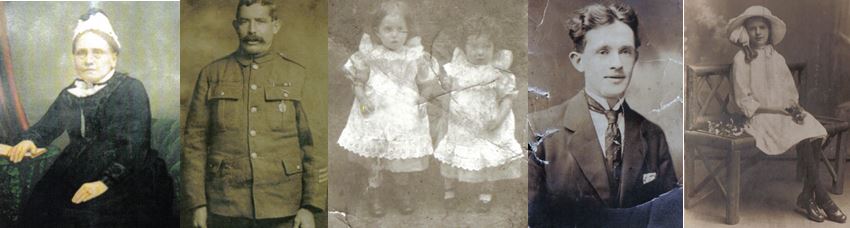
As a general rule I don’t normally ‘do’ recent family history blog posts. But I’m making an exception for this event in 1968. It concerns the death of my great uncle, Andrew Callaghan. The brother of my grandpa, Andrew never married and he has no direct descendants, so no-one is closely affected. I wanted to write this blog as otherwise he may never be remembered.
To set the scene, the Callaghan family were originally from the Townland of Carrabeg (Carrow Beg) in the District Electoral Division of Urlaur, in County Mayo. They were a farming family. Their two-roomed house housing eight in 1911 (two less than the decade before) was roofed not with slate, but with a perishable material such as wood or thatch. Their outbuildings consisted of a cow house and a piggery [1]. A typical rural family living from day to day.
My great grandfather, Michael, and some of his sons came over to England seasonally (East Yorkshire according to my uncle Brian) for farming work to supplement the family income. It was a lifestyle Andrew continued with, even when he took up permanent residence in England. He never really put down roots.
Mum only has vague memories of her uncle Andrew. One was a family anecdote about a cow. To pay for the passage to America for his eldest sister Bridget, Andrew was tasked with the responsibility of taking a fattened cow for sale at market. The cow was sold, but the family never saw the money. It all sounds slightly Jack and the Beanstalk-ish minus the beans and giant. Despite it all, Bridget did leave Ireland for a new life in North America in September 1909.
Another memory mum has is that of a gift her uncle Andrew gave her, a pen. It is something which stuck in her mind because presents in the family were rare, typically reserved for Christmas and birthdays. Maybe this was typical of growing up in the 1940s and 1950s.
Andrew led an itinerant lifestyle when he left County Mayo for England, moving where farm labouring work took him. He occasionally turned up at my grandparents house when he happened to be in the area, and short of cash! Grandpa usually fell soft but with a wife and eight children to support, this intermittent and unpredictable financial support was difficult.
As for his demise, mum recalls her dad being informed about the possible death of his brother following local media appeals for relatives of an Andrew Callaghan. It was mum’s brother-in-law – my dad’s sister’s husband Denis – who alerted the family. He worked in the local media industry and put two and two together.
Mum recalls her dad identified the body and, along with another brother Martin, he paid for the funeral. It was over in Wakefield. She also remembers whilst other family members viewed Andrew’s body she wasn’t allowed to, being advised it was bad luck because she was pregnant.
So I sort of knew about Andrew’s back-story. But you know the adage “A builder’s house is never finished?” Well I reckon the same applies to genealogists. I’m that busy doing family history for others, my own research is sadly neglected. In fact most of the writing for this blog post was done in the wee small hours!
Andrew’s death certificate [2] was something I never got round to ordering. The final push came with the impending General Register Office (GRO) price increases earlier this year (2019). This was a death certificate not covered by the cheaper PDF option, so I was especially determined to beat the price rise.
The certificate duly arrived in early February 2019, and it was an intriguing one. It states Andrew was 76, a farm labourer of no fixed abode. He died at Pinderfields Hospital, Wakefield on 7 February 1968. The copy certificate I have is dated 7 February 2019, so exactly 51 years to the date of his death. His death was not registered until some six weeks later, on 21 March 1968. This followed the 20 March inquest. Cause of death was pretty gruesome, as indicated in the certificate snapshot, below.
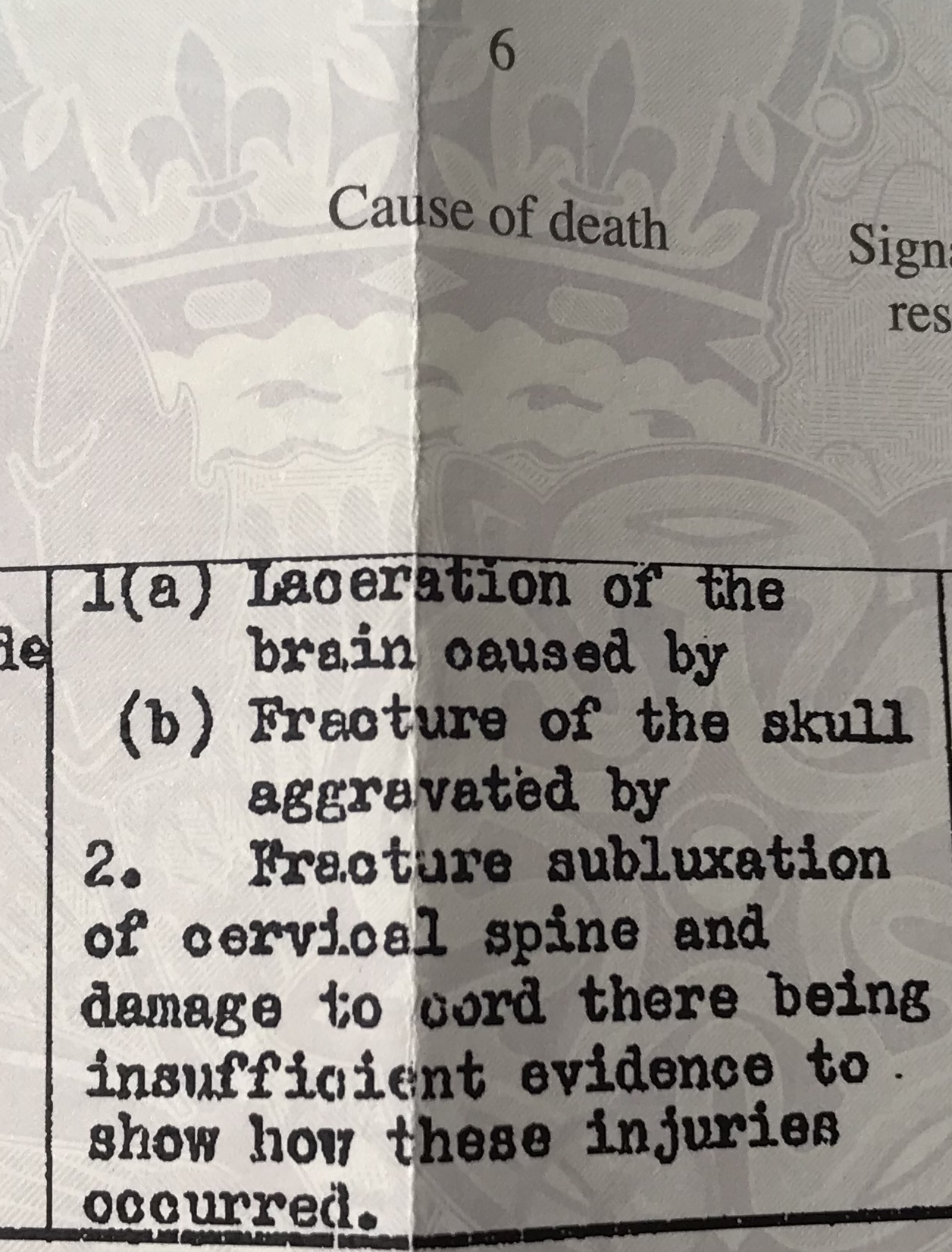
I was left with lots of questions. I don’t know why, but the hospital death threw me. But the big questions were around why was there a delay between death and inquest which consequently held up registration? Why “insufficient evidence” around the cause of such horrific-sounding injuries? Where had he sustained these injuries? What investigations were carried out to discover the cause of them?
Yet despite these questions, once more my quest to find the answers had to wait.
Five months later I finally squeezed in an opportunity to pick up Andrew’s story. I had a small window of time to look at the Wakefield Express. It’s a paper which is not online, so it meant a special visit to Wakefield Local Studies Library.
The series of reports spanning six weeks and three editions sums up the tale perfectly. I’ve reproduced the reports in full here.
Wakefield Express – 10 February 1968
Road victim
A 77-year-old Leeds man, Mr Andrew Callaghan, of Wharf Street, who was found lying with severe head injuries in the middle of Aberford Road, Stanley, on Tuesday, died in Pinderfields Hospital on Wednesday.
He is thought to have been struck by a vehicle.
Wakefield Express – 17 February 1968
‘Mystery man’s death appeal’
When an inquest opened on Tuesday on a 76-year-old man found lying injured in Aberford Road, Stanley, last week, the Coroner (Mr P. S. Gill) appealed for witnesses and relatives of the dead man to come forward.
He adjourned until March [?] the inquest on Andrew Callaghan, of no fixed address, who died in Pinderfields Hospital on February 7.
D.C. G. Browne (Coroner’s Officer) said Mr Callaghan was found lying in the road at the Leeds side of the Ne[w?]mark[et?] crossroads at about 12.[?] a.m. on February 6. It was snowing at the time.
He was suffering from injuries which suggested that he had been struck by a motor vehicle. He was taken to Clayton Hospital where he died next day.
NOT KNOWN
No witnesses of the accident had come forward and efforts to trace relatives had failed. Investigations by the West Riding Police were continuing.
D.C. Browne said he had found in the man’s possession official documents, including a birth certificate and pension book, giving his name and an address in Wharfe Street, Leeds. Inquiries had been made at the address, which was a type of lodging house, but he was not known there.
“From his clothing, I think he was of the labouring type, travelling the country,” he added.
Adjourning the inquest, the Coroner said: “I hope that someone [is] able to tell us something about the accident will come forward. I include in the appeal anyone who was travelling along the Aberford Road about midnight or late at night in February 5.”
Wakefield Express – 23 March 1968
Open verdict on man (76) found in road
A Wakefield inquest jury on Wednesday returned an Open verdict on Andrew Callaghan, aged 76, who died in Pinderfields Hospital on February 7 after being found lying injured in Aberford Road, Stanley.
The Coroner (Mr P. S. Gill) told the jury: “It would appear that he must have been struck by a motor vehicle, although there is no evidence that he was.”
He recalled that the inquest was adjourned on February 13, when an appeal was made for witnesses of the accident to come forward.
On that occasion the Coroner’s Officer (D.C. G Browne) said that Mr Callaghan was found lying in the road on the Leeds side of Newmarket crossroads at about 12.30 a.m. on February 6.
Documents in his possession gave his address as a lodging house in Leeds, but inquiries showed that he was not known there.
FIVE YEARS AGO
On Wednesday Mr John Callaghan [3], a retired trainer [4] of Moorside Avenue, [5] Dewsbury Moor, said that he had not seen his brother for five years. He was then a farm labourer. He did not know where he had been living.
John H. Kenward, of Queen Elizabeth Road, Eastmoor, said he was driving a car in Aberford Road when he saw Mr Callaghan lying in the road. He went to telephone for help and waited with another motorist, Mr David Lloyd Gladwin, of Grove Road, Wakefield, until the ambulance arrived.
“When I first arrived on the scene the body was covered with snow,” he added.
NO CLUES
P.C. D. Parker said he searched the area and found nothing to indicate how the accident occurred. No witnesses had been found who could give assistance.
Dr Joseph Adler, pathologist said Mr Callaghan seemed to have been struck about chest height and had received a fractured skull, a broken neck and broken arms.
At the close of the inquest, the Coroner expressed appreciation of the help given by Mr Kenward and Mr Gladwin.
Six things struck me:
- The inaccuracy of newspaper reports which reinforces the need to check against other sources. For example the first report said Andrew was 77; there are discrepancies in the spelling of Wharf(e) Street; and my grandpa’s occupation and address are incorrect. So corroborate and don’t take at face-value;
- These newspapers were chock-a-block with road traffic accidents and offences, a sign of the times maybe with less stringent driving laws, including ones around drink driving? It was only the year before Andrew’s death that the drink driving limit was introduced, but attitudes weren’t the same towards the offence as they are today. Or maybe more a comment about the changes in the local newspaper industry – far much more local news back then so stories that would never make it today with limited space and far fewer papers, were actually covered. Also maybe more incidents were routinely reported to the authorities, with driving and car-ownership on the increase yet still more of a rarity in the late 1960s than today. This is an interesting insight into the history of driving and road safety;
- The low-tech investigations of the time which seemed to be limited to visiting a Leeds address, putting out an appeal for witnesses and undertaking a search of the area. Also, as a lay person looking at the brief press reports, it seems incredible that they did not know whether or not the injuries were sustained by a motor vehicle. More to the point there seemed little impetus to find out;
- The total whitewash of an inquest. Someone was responsible. Yet was homeless Irishman Andrew so low down in the social pecking order that investigating his death really wasn’t worth pursuing beyond the preliminaries? This was the era of “No dogs, No Blacks, No Irish.” Within a couple of months of his death that was that, case wrapped up;
- The lonely, awfulness of Andrew’s life. To be out on a clearly bitterly cold late night in the depths of winter with no place to go. Maybe it was his choice, but a 76-year-old man who had lost touch with his family, with no place to call home, and whose essential travelling documents included his birth certificate because, let’s face it, there was no other place to keep it than on his person; and
- That today, with increasing level of social dislocation and homelessness, this situation will be one which continues with people dying alone in their homes or on the streets with no immediately identifiable next of kin.
At least I’ve now managed to find out more about my great uncle. But it’s an unsettling tale which has left me feeling incredibly disconcerted.
Footnote: Although it may not have impacted in this case, a delayed inquest may result in a death registration not falling within the expected Quarter, of even year.
Update via Twitter from Chalfont Research (@ChalfontR):
From the details in the blog entry, it looks like a classic example of knowing what happened, i.e. a hit & run road accident but having found no actual evidence or witnesses to be able to prove it, hence the open verdict.
Notes
- Callaghan Household, Ireland – 1911 Census, 15 Carrow Beg, Urlaur. Accessed via The National Archives, Ireland
- GRO Death Registration for Andrew Callaghan, age 76, March Quarter 1968, Wakefield, Volume 2D, Page 797. Accessed via Findmypast. Original Record, GRO England & Wales
- John Callaghan is my grandpa
- Occupation is incorrect. John Callaghan was a retired coal miner
- Address incorrect, should be Road not Avenue