Category Archives: History

The Early History of Batley Carnegie Library – Providing World Book Day for Thousands of Days and Multiple Generations

In my last post, in response to the latest Kirklees Council budget threat to our library service, I wrote about the value of libraries. In this post I look at the early days of my local library, Batley, the services it offered to the local community and their reading habits between 19 October 1908-March 1915.  

Batley library’s establishment epitomises the enlightened thinking of late Victorian/early Edwardian Corporations, industrialists and philanthropists. They had the vision to see the immense benefits libraries provided for education, the economy and wider society. From access to books and knowledge for all, irrespective of background and finances; to the realisation that an educated workforce could contribute to industry and the country’s wealth; from the morally and self-improving leisure opportunities they afforded; to the social benefits this offered in terms of crime reduction. These may seem old-fashioned concepts, but they are relevant still today.

The 1850 Public Libraries Act established the principle of free public libraries. A subsequent amendment in 1855 Act allowed boroughs to charge an increased rate of 1d rate to fund the provision. It proved insufficient, with by 1869 only 35 places opening public libraries. This is where philanthropists such as Andrew Carnegie stepped in. 

The son of a Dunfermline weaver, the Carnegie family emigrated to America in 1848 when he was 13, settling in Allegheny, Pennsylvania. Starting off as a bobbin boy, he was fortunate to have access to books as a result of the generosity of a local man who made his library available to local working boys. Self-taught from these books, Carnegie progressed from the bobbin mill, to become a messenger at a telegraph company, then a telegraph operator, eventually moving to the Pennsylvania Railroad where he rose to become a superintendent, age 24. From there his investment and business interests developed, resulting in his steel company. Carnegie’s experience instilled in him the belief anyone with access to books, and the desire to learn, could educate themselves and improve their position in society. Free libraries provided such educational opportunities for those without financial advantage. 

In 1901 he sold his company to J.P. Morgan for $480m and was free to devote himself totally to his philanthropic works. His personal experience of the benefits books provided, led him to donate money for the building of 2,509 Carnegie libraries between 1883-1929. 660 of these are in the UK.  

In providing funds to establish libraries, Carnegie required the local government to: 

  • demonstrate the need for a public library;
  • provide the building site;
  • pay to staff and maintain the library;
  • draw from public funds to run the library—not use only private donations; and,
  • provide free service to all.

By doing this he felt his grants would inspire communities to take ownership for their libraries and be responsible for looking after them going forward.

Batley did have a couple of libraries: Batley Cooperative Society and Batley Working Men’s Club & Institute, lending around 700 books per week between them. However, neither were free to the general public. Accordingly Batley Corporation approached Carnegie. Lauded as a progressive community, in January 1903 the Corporation received confirmation he was prepared to donate £6,000 subject to the normal rules, including providing a site and adopting the Free Libraries Act and under this raising £400 per year for its maintenance via the maximum 1d rate. He subsequently provided an additional £988 for the clock tower. A transfer from gas rates added another £1,914 16s 6d. Batley’s achievement was a cause of envy for neighbours, and rivals, Dewsbury.

Sketch of Batley library – “Batley News”, 18 October 1907

The Ackroyd Trust provided the Corporation with land for the building because a library met their educational purposes criteria. Once the final hurdle with Charity Commission and Education Department was overcome, (they had indicated that money applicable for education could not go towards public libraries), the Foundation Stone for the iconic market place building was laid on 18 July 1905.

Designed by Messrs. Walter Hanstock & Son, at a cost of £8,902 16s 6d,, Batley’s Carnegie library officially opened on 19 October 1907 with an initial stock of 7,260 volumes. It offered lending and reference libraries, a librarian’s room, news and reading rooms and a ladies’ room. The first book borrowed, by the Mayor, W. J. Ineson, J.P., was the Bible.

Annual Report Cover

The early days of the library are portrayed in its annual reports. In the early years these reports ran from 19 October – 18 October, the 12 month period from the library opening. This changed in 1911. That report ran until 31 March 1913, 17.5 months. Thereafter the year fell within traditional 1 April – 31 March patterns. 

The library had a staff of five. The 2nd annual report for the year 19 October 1908-18 October 1909 shows these comprised of librarian Alfred Errington, assistants James H Shaw and Alfred North, and caretaker Alfred Moody. Later staff in the period included assistants Annie E. Newsome, Winifred M. Peel and Evelyn M. Walker and caretakers Nelson Howard and Arthur F Garner. Their hours were long – the reading rooms opened from 8.30am-9.30pm; the work painstakingly labour intensive with many hours spent on tasks such as producing a catalogue of holdings, or repairing books. In the year ending 1914/1915 they installed a small binding plant to allow staff to do more of this repair work in-house, but the librarians had so little spare time it did not receive much use that year!

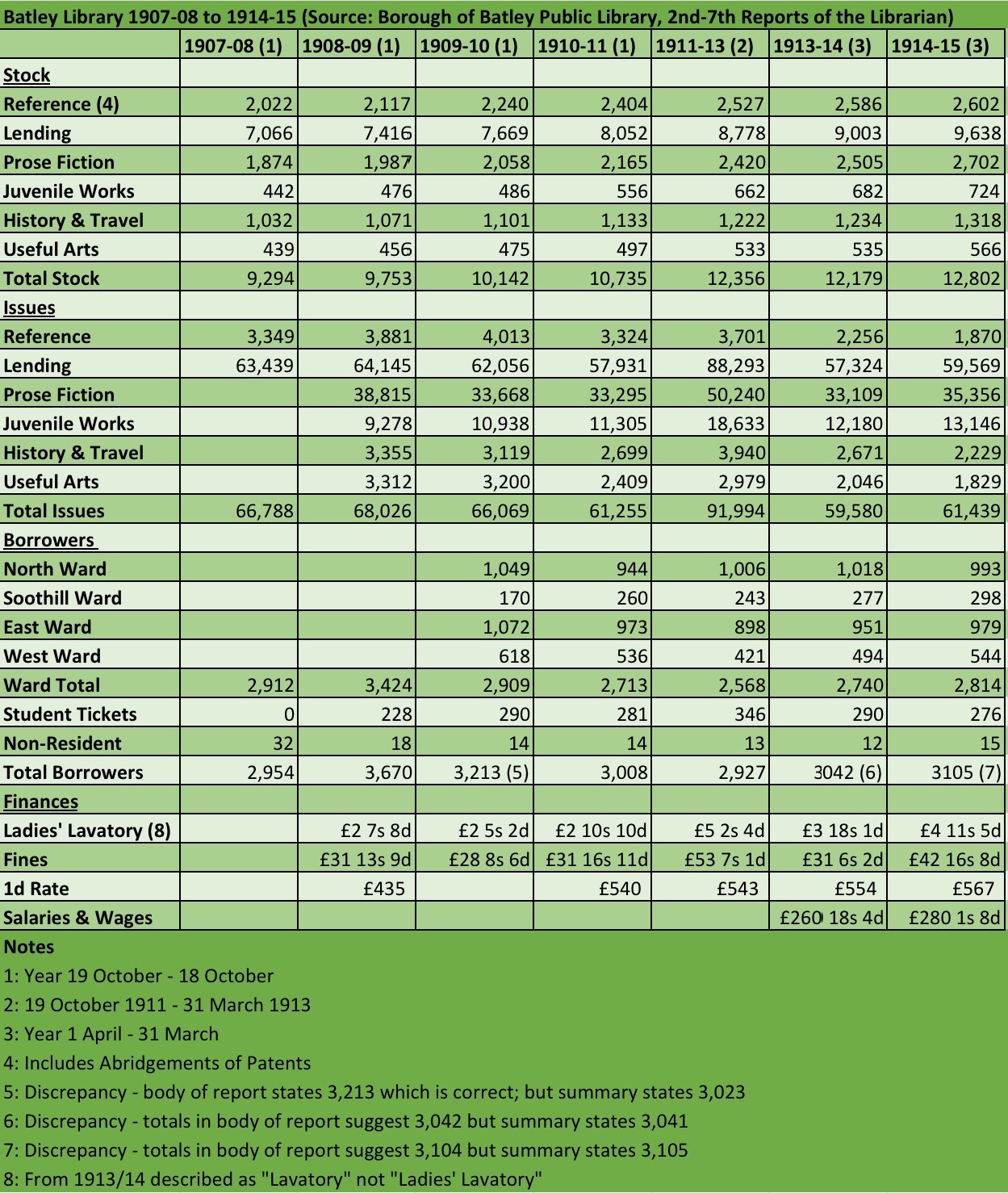
These reports provide a fascinating insight into the early days of the library. The Table below shows some figures illustrating its development.

A few things struck me. Firstly the somewhat bizarre ladies’ lavatory income. In 1908/9 it raised £2 7s 8d, rising to £4 11s 5d in 1914/15, by which time men were presumably being charged to use the facilities, as the “ladies’” element was dropped and the money raised had almost doubled. The library staff were also extremely efficient in chasing up book returns and fines, with personal visits made to those unresponsive to postal reminders. The 1d rate increase was implemented, despite some early dissenters. By 1914/15 this raised £567 towards the running costs of the library. Finally, on the surface to modern eyes, how little things cost. For example a £58 5s 9d payment to Mr W.H. Sykes of Batley in summer of 1913, for cleaning and redecorating, the first refurbishment since the library’s opening. In 1914/15 annual salaries and wages stood at just over £280; electricity, gas and fittings a shade over £40; rates, water and water rents £21 8s; and, reflecting the fuel supplies and industrial heritage, a shade over £16 was spent on coal. At today’s values fuel prices of £56 would equate to just over £4,000.

A common theme of the early reports is the initiatives taken to increase the popularity of the library. The number of borrowers, talks attended, books issued, their range and number attracted much attention. Adaptation, development and improvement featured in those early days, as much as today. The key difference appears to be the store those local government officials put on the value of a library providing a levelling opportunity for all, a theme much in evidence right from the opening ceremony. Maybe that’s the difference between then and now. Back then folk had to really dig in and fight for the basics; today things are taken for granted and consequently undervalued. 

Special Student Tickets, introduced in 1908/09, allowed readers an extra ticket for non fiction works. The reference library boasted a substantial body of coal mining books; textile trade volumes were materially extended in the period 1911-13, all relevant to the predominant local industries, in the hope of attracting Technical School students.

A winter season of half-hour library talks and lectures commenced in January 1908 to attract people to the library. These covered literature, science, art, music and travel, some accompanied by lantern shows. The themes ranged from “A Talk on Elementary Astronomy” and “The Norse Mythology, an influence on the Development of Anglo-Saxon Character”, to “John Milton“, “Individual Responsibility and Social Reform”, “What and How to Read”, and “The Story the Brontës”. Children were catered for too, with Walter Bagshaw giving talks on subjects such as “Peeps into Sunny Italy” and “Reason and Instinct, or, Do Animals Think?” One speaker was Rev Fr John O’Connor from Heckmondwike, a great friend of G.K. Chesterton. “Fr. Brown” in the Fr. Brown novels is based on him. Appropriately one of his talks was entitled “Belloc and Chesterton”. By the end of the 1914/15 season 77 talks has been given. That season saw the highest average attendance, 97. 1914/15 also saw the commencement of talks by the local branch of The Workers’ Educational Association.

Reading circles were established and adapted, moving away from subjects such as Shakespeare’s Henry V to more populist contemporary subjects such as Kipling, to boost participation. Photography, travel and water colour exhibitions also took place, the latter featuring originals by J.M.W. Turner and attended by over 5,000.

In 1909/10, the substantial increase in loans of juvenile fiction led Mr Errington to urge the library committee to extend the privilege to borrow books to under 14s. April 1912 marked the launch of a School Library scheme in partnership with the Education Committee. Initially six local schools participated: Hanging Heaton, Brownhill and Staincliffe CofE, Carlinghow Boys, Warwick Road Boys, Healey Mixed. Each school received 50 books on rotation, and by 31 March 1913 over 8,000 volumes had circulated. By 31 March 1914 four further schools joined the scheme: Mill Lane, Gregory Street Girls, Purlwell Boys and Warwick Road Girls. In the three years to 31 March 1915, 33,287 volumes were issued via the school scheme and a further 37,226 by the Juvenile Section of the lending library. 20 per cent of these were non fiction issues. More schools were applying to join, and head teachers reported the beneficial educational impact of access to good books. However, a formal, dedicated Young People’s Department did not open in the library until 1928.

Another 1912 development was the August introduction of the Open Access system, where borrowers could browse the library. Prior to this they had to ask if a book was available, and wait for the librarian to fetch it. Theoretically the closed system reduced book theft, but did little to encourage reading. By 1915 Mr Errington proudly announced that of 160,000 volumes issued under Open Access, not a single volume had been lost.

The library reports give a wonderful snapshot into the times and community. From the weather, the exceptionally fine summer of 1910 blamed for a decline in the number of books issued; to war, with the average number of books issued per day declining from 221 in 1913/14 (library open 269.5 days) to 219 in 1914/15 (open 280.5 days), due to the numbers in H.M. Forces and overtime in the mills. Noticeably, enrolled women borrowers shaded men. And war saw reading choices shifting to lighter options with loans of fiction, literature, music and juvenile works increasing. The only other category seeing an upturn was sociology, because it included army and navy books.   The array of over 20 railway timetables testified to the importance of this mode of transport. The wide range of newspapers and magazines, numbering in excess of 100, in the reading rooms demonstrated the importance of the print media in these pre-wireless and TV days. Their titles illustrated the interests of the time and the local industries, including “Fur and Feather”, “Farm, Field and Fireside”, “Sons of Temperance”, “Weldon’s Ladies’ Journal”, “Colliery Guardian”, “Textile Recorder” and “Waste Trade World”. The library reading rooms for a short time even boasted “Die Woche”, reflecting the area’s textile manufacturing links with Germany. Unsurprisingly, this publication disappeared from the shelves by 1914/15.

And what does this have to do with family history? Well, besides the plethora of family history resources offered by libraries today including local history reference resources (not online), newspapers (not on the British Newspaper Archive/FindMyPast), access to subscription sites like Ancestry, and local censuses and parish registers on microfilm/fiche there is the actual library history. The development and history of a local library itself adds context to the lives and times of ancestors. The annual library reports are name-rich sources. Not only of the great and the good, those on the Committee and those who donated or gave talks. But also the library staff. This is an extract from the report for year ending 18 October 1910 WW1: “James H. Shaw, the Senior Assistant, resigned in June to take up duties in the office of the Borough Accountant…..Mr A. Moody, who held the post of Caretaker since October 1908….had to relinquish his post on account of ill health”. James H. Shaw is one of the Healey residents identified for the Healey Great War project.

For me the library reflects my ancestors’ community, their hopes, aspirations, dreams and lives. I imagine them using Batley library right from its inception. And I thank those enlightened people of the early 20th century. What a great gift to the town.

I’ve timed this post to mark World Book Day 2017, to acknowledge the important role local libraries have played in opening the world of books to many generations. The poster below shows events at Batley library on Saturday 4 March.

Sources:

A Short Life Remembered: Death by Dentition

This is another in my “Short Lives Remembered” series. It is another child discovered as a direct result of the General Register Office (GRO) birth and death index search facilities introduced in 2016. I’ve not found any baptism details for this child. She was born and died in between censuses. Her burial gives no family details. So tracing her relied on civil registration and mother’s maiden name in the new search options. 

What I find most shocking about this child is the cause of death, which is put down to an ordinary, if painful and occasionally distressing, right of passage for babies and toddlers today. 

Ann Jennings was born on 12 February 1869 at Carlinghow Lane, Batley. The daughter of coal miner Herod Jennings and his wife Ann Hallas, she had 10 older siblings. All were still living by the time of Ann’s birth. This was no mean feat in an era of high infant mortality, when the most seemingly trivial illness or incident could extinguish life. Poverty, locality, environment, housing, sanitation, medical care, public health and class all played a part. The 34th Annual Report of the Registrar General (1871) illustrates the perilous nature of early years survival. Looking at the under 5 age-group, between 1838-1871 out of every 1,000 girls, 62.7 died. The corresponding figure for boys was 72.6. In the five years 1866-1870 the figures were 63.4 and 73. And looking only at 1870, 64.4 per 1,000 girls under 5 and 75.0 of boys died. 

Ann Jennings was one of the girls in 1870. She died on 15 January 1870 at Spring Mill Yard. Cause of death was dentition. In other words teething. This seemed incredible, that something so innocuous resulted in death.  

Yes, it can be an unpleasant time. I remember my daughter’s intermittent episodes of irritability, sleeplessness, drooling, flushed cheeks and raised temperatures. Calpol and Bonjela became medicine cupboard staples during this period. Teething rings, some special cooling ones, were added to her array of toys. But that’s as far as it went. I never realised it could be a cause of death. So I investigated further – and became more astounded at how common it was.

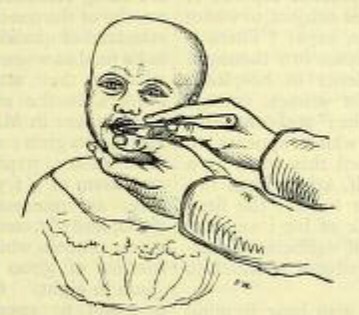
A bit of background first. As with many childhood development milestones there are no hard and fast dates for the emergence of that first set of baby teeth. It normally starts at around the six to nine months stage, with each of the 20 teeth taking about eight days to emerge. The whole process lasts for around two years.

Back to the Annual Report of the Registrar General. This time I looked at the 33rd report covering the 1870 statistics, the year of Ann’s death. In the West Riding of Yorkshire 232 female deaths and 287 male deaths were attributed to teething. In total 4,183 deaths registered in England had teething as the cause.

In 1783 Frenchman Jean Baptiste Timothée Baumes wrote “A Treatise on First Dentition and The Frequently Serious Disorders Which Depend on It”. In it he claimed teething “….may often be be found the cause of death of a great number of infants”. The view was still prevalent almost a century later. According to the 35th Annual Report of the Registrar General, looking at 1872 statistics: “Teething is one of the first marked steps in development after birth, and by inducing convulsions and other irritative reflex diseases, it is chargeable with a certain number of deaths”.

The conclusion reached by medical professionals of the time was because the teething coincided process with the ages of high mortality, it was actually responsible for infant illness and death. According to accepted medical wisdom teething led to a number of afflictions and displayed a variety of symptoms including convulsions, diarrhoea, bronchitis, croup, vomiting, neck abscesses, insanity and meningitis. The teething phase was perceived as fraught with risk, a process to be dreaded.

Added to this, teething treatments could in themselves prove fatal. Even today there are stories of homeopathic teething tablets causing death. Back in the 19th century treatments ranged from dangerous to downright barbaric, with some treatments a combination of the two.   

What could you do to make the passage of teeth through gum easier? Well, the obvious answer was to lance the gum, making a deep incision to facilitate the emergence of the offending tooth. This in a pre-anaesthetic, pre-sterilisation era carried it’s own risks. Leeches applied to the gums provided another solution.

And what could you do to relieve the pain, reduce excitement, regulate the bowels and induce sleep in the restless teething babe? Newspapers were full of the answers, with adverts for soothing remedies which parents, fearful of the dangers of dentition, were induced to purchase. In this unregulated, uncontrolled period of medicine druggists and pharmacists made their own propriety and patented concoctions with no details of ingredients. But these included opium, cocaine, mercury, morphine and alcohol, with rubbing whisky in gums of teething children even touted in more recent times. All of these could lead to addiction and death. The risk was not unknown. Cassell’s Household Guide of 1884 for instance acknowledged the danger of giving narcotics to children – but reassured parents that it was acceptable if such remedies were recognised as teething powders. So by trying to do the right thing and following advice, parents were in fact endangering their babies.

In fact in 1869 a 9-month old girl from Gravesend, Catherine Sarah Cobham, was poisoned as a result of a chemist dispensing strychnine instead of powdered sugar as a teething remedy. Incredible too that sugar was touted for teething – presumably leading to tooth decay later if the baby survived! 

So who knows if Ann really did die as a result of teething. Was it a case of medical misdiagnosis? She was struggling at the teething stage and they did not look beyond that for a death cause; or did teething really cause something along the lines of a fatal chest infection or convulsions (though the certificate doesn’t elaborate); or was it even a teething remedy gone wrong? We will never know. So she is just another statistic, amongst thousands of others, whose death was attributed to dentition. Her funeral took place on 17 January 1870 at Batley Parish Church. 

Others who feature in this series of “Short Lives Remembered” posts are: 

Postscript:
Finally a big thank you for the donations already received to keep this website going. 

The website has always been free to use, but it does cost me money to operate. In the current difficult economic climate I am considering if I can continue to afford to keep running it as a free resource, especially as I have to balance the research time against work commitments. 

If you have enjoyed reading the various pieces, and would like to make a donation towards keeping the website up and running in its current open access format, it would be very much appreciated. 

Please click here to be taken to the PayPal donation link. By making a donation you will be helping to keep the website online and freely available for all. 

Thank you.

Sources:

  • GRO Birth and Death entries for Ann Jennings
  • 33rd Annual Report of the Registrar General (1870) 
  • 34th Annual Report of the Registrar General (1871) 
  • 35th Annual Report of the Registrar General (1872) 
  • A Treatise on First Dentition and The Frequently Serious Disorders Which Depend on It” by Jean Baptiste Timothée Baumes (1783) – Google Books 
  • Cassell’s Household Guide to Every Department of Practical Life: Being a Complete Encyclopaedia of Domestic and Social Economy Vol 1” (1884) – Internet Archive 
  • Dewsbury Reporter” – 9 November 1872 
  • Treatments for Children: Teething – https://www.rpharms.com/museum-pdfs/g-teethingtreatments.pdf
  • Parish Register – Batley (All Saints) Parish Church  

Is Family History “Proper” History?

This is my 100th blog post, and my first as an ex-civil servant. So to mark this milestone I’ve decided look at family history as a subject, and give my perspective on its place in the overall discipline of history. Does it actually deserve to be classed as history? 

Perhaps some do look down on it, thinking its a kind of “dumbed down” version of history. After all there’s nothing to collecting the names of a bunch of ancestors and tagging them with a few vital event dates. But that’s missing the whole point. Family history isn’t only about creating a tree full of connected names.

For me family history is a specific strand of history and is as valid a discipline as studying the Tudor period, or being an expert in the English Civil War. My history degree covered what are probably regarded as “traditional” history topics such as the origins of the Great War, the Russian Revolution, Latin American Independence Wars and politics, the Enlightenment and history of ideas or the foreign policy of the Chamberlain government. However, other elements had a definite family and social history slant. These included children in British society, parish registers, censuses, and various Factory and Education Acts.  

In fact family history encompasses a far broader time sweep than many specialist areas, with their comparatively narrow timeframes. More than that, it covers a wide breadth of elements. It requires a knowledge of international, national, local, economic, industrial, religious, medical, agricultural, demographic, political, judicial, legislative and social history – to name but a few areas. 

This broader historical perspective in turn leads to an understanding of when individual records so vital for family history were created and why, and crucially what is consequently available to further research. For instance parish registers and poor law developments down to the impact of the Civil War and Commonweath through to voting rights. 

At the same time geographical knowledge plays a part, from parish and administrative boundaries to the development of towns, transport links and migration routes and patterns. A bit of Latin and the ability to decipher handwriting akin to the meandering of a spider who has paddled in an ink puddle also helps.Family history therefore goes way beyond parish register and census hopping to create a list of names. It’s way more exciting.

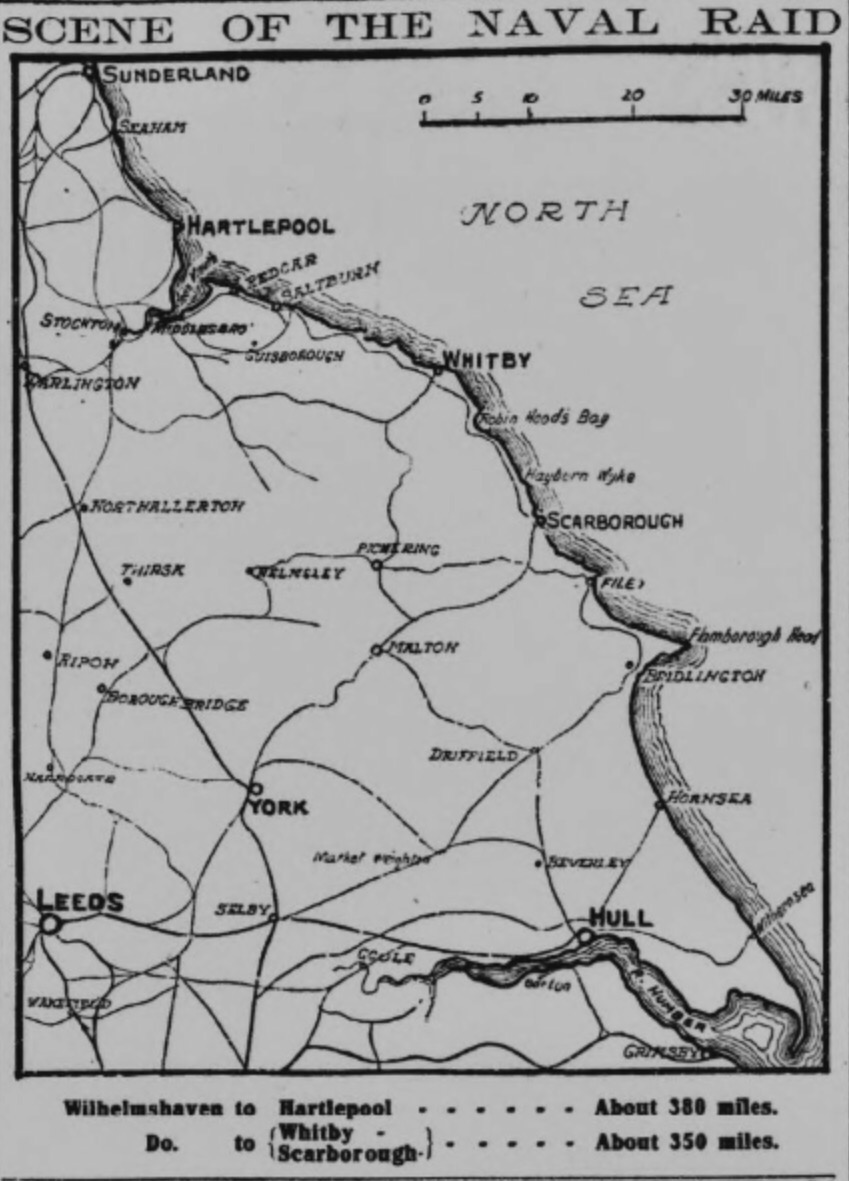
To me family history ranges from contextualising the lives and times of my ancestors within events such as the Industrial Revolution, the English Civil War, or the First World War; it also drills down to putting specific life-changing decisions or events into the framework of national and international events, like the shelling of Scarborough, Whitby and Hartlepool and my great grandad’s decision to enlist. Or the Irish Famine, its impact in County Mayo and the decisions made by my ancestors to remain or leave. 

Furthermore family history has enhanced my historical knowledge, drawing me to investigate areas that broader history would not touch upon. Lesser known events such as miners strikes in specific localities, such as Drighlington, and the impact it had on ancestral lives, leading onto coal mining communities and occupations generally; or the growth or decline of towns and villages, or industries and occupations and the associated migration patterns or job switches. It has also led me to conducting greater in-depth investigation into factors affecting their lives such as judicial changes, the Poor Law, various Factory Acts or diseases such as TB, diabetes and smallpox along with accompanying medical advances; without my family history hat on, for me these events would be looked at in a high-level generalised way and not considered in detail or applied to individuals who are my flesh and blood. Examining them in relation to my family makes them more real. And by extension it leads to communicating finds to other family members and hopefully making history more accessible, relevant and real to them.

And, as that’s the case, for me family history is truly one other strand of the various disciplines falling under the generic umbrella of history.  So done properly, and not a paper-chase exercise of populating a tree with thousands of names, the answer to those who cast doubts on its merits is an unequivocal yes: Family history is truly “proper” history.

Happy Birthday and Farewell: A Father’s Love

16 December 1914 marked a momentous day for my family. My grandma celebrated her sixth birthday. But not any old ordinary birthday in Batley for her, spent with her mum, dad and seven year old sister Nellie. This birthday was unlike any other.

Astonishingly, I discovered this of all days was the day her 46 year-old father, my great-grandfather Patrick Cassidy, chose to enlist with the local regiment, King’s Own Yorkshire Light Infantry (KOYLI). Patrick, born in 1868 in Hagfield, County Mayo, even knocked several years off his age to ensure he would be accepted. His attestation papers show he claimed to be 35 years and 11 months.

I knew my great-grandfather had been in the Army. My grandma told a tale of a motor vehicle turning up at their Hume Street home containing someone to see her dad. The story goes that the officer inside was the one he’d acted as batman for. I had no date for this event, but given my grandma remembered it, I’d guessed in sometime after 1912.

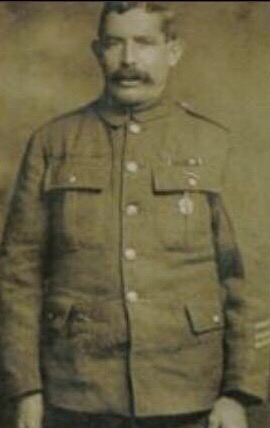
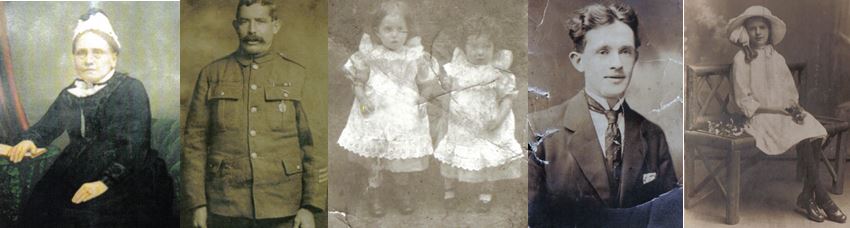
However, because of his age, I’d discounted him seeing his military service during the Great War. Combined with his age, his uniform in one of the family photos, with its three point-up chevrons on the lower left sleeve indicating 12 years good conduct, indicated pre-war service. I’d marked it as pre-1904, as he’d first turned up in Batley in January of that year. And by then he was a labourer. That was also his occupation when he married Ann Loftus in 1906. And also in the 1911 census.

Patrick Cassidy

As it happens his attestation papers backed up this earlier service theory. He confirmed to the attesting officer he had previous time-expired service with the Duke of Wellington’s Regiment (West Riding). He described it as 33rd and 76th West Riding, harking back to 1881 and the Cardwell Reforms when the Halifax depot 33rd and 76th Regiments of Foot merged.

One thing I found amusing from these papers: My grandma, who adored her father, always gave the impression of him being a tall man. According to his army forms he stood at the incredible height of…….5’ 3.5”. Just goes to show, don’t take all oral family history as gospel!

Anyway, back to the lie over his age. As an ex-soldier, by this stage of the war, the age limit was 45, not 38 as for other volunteers. So he really did go overboard with his age reduction. In fact, with his precise 35 years and 11 months, it seemed he was still working to the end of August 1914 rule change for volunteers without previous service, when the upper age limit was increased from 30 to 35. He really was determined to do his bit.

Still, I couldn’t get my head round it. Not the fact he chose to sign up. Not even the fact he lied about his age to do so. But why on earth would he do it on his young daughter’s birthday? Why not wait till a few days later? In fact, why not wait till after Christmas? Had there been some major family row that prompted it? Or had a close family member or friend, as yet unidentified by me, died whilst serving? Was my great grandfather out to avenge their death? Those were the only explanations I could come up with.

His papers offered no clues whatsoever as to why he would act in this way and leave his wife, children and labouring job in Batley to take this huge risk. Or did they?

Several months later, whilst doing some general research, I realised the papers did contain the answer. The key was in the date. I’d been looking at it in narrow family terms, my grandma’s birthday. I’d not looked at any wider historical events. Besides being my grandma’s sixth birthday, Wednesday the 16 December 1914 marked the day German Imperial Navy ships Seydiltz, Moltke, Blücher, Derfflinger and Von Der Tann bombarded the east coast towns of Scarborough, Whitby and Hartlepool with a final toll of over 130 killed and almost 600 injured. 

The attacks occurred from around 8am to 9.30am that morning. In the immediate aftermath, in scenes reminiscent of Belgium and France, refugees fled their homes seeking safety inland. Distressed residents from the stricken towns, some still in slippers and nightdresses, disembarked in local railway stations with tales of terror and destruction and reports of “scarcely a building left standing.” The historic landmarks of Whitby Abbey and Scarborough Castle suffered damage. Famous seaside hotels, like Scarborough’s Grand Hotel, bore shell scars.

The Grand Hotel, Scarborough

From 16 December onwards newspapers the length and breadth of the country carried the stories of this exodus, along with tales of death, injury and destruction wreaked. This from “The Yorkshire Evening Post” of 16 December reporting of arrivals in Leeds at 11 o’clock “One woman who arrived was wearing her bedroom slippers; in her arms was a two-year-old son in her nightdress and an outer garment lent by someone on the train.”

Another refugee was Mrs Knaggs, who lived in the vicinity of Scarborough’s damaged Grand Hotel. She arrived in Leeds on the 1 o’clock train into Leeds with her eight-year-old daughter and a few hastily packed groceries. She recalled meeting “…scores of women and children. All seemed unconsciously making for the railway station. Some were half dressed, and carried with them all manner of household articles. Another refugee had a child of a fortnight old in her arms, and with her was another partly-dressed girl of fourteen…..The streets of Scarborough were filled with women. These refugees were without food, money and very scantily clothed.”

Whitby resident Mrs Hogg was another Leeds arrival. Her house was struck by a shell. She recounted: “Outside shells were flying about, tearing up the pavement and damaging houses….In the fields in the outskirts of town big holes were torn in the ground and all the telegraph wires were down. People were hurrying along, some with a few belongings they had managed to get together. One man was carrying a parrot and two bird-cages. My little boy had run out of the house in his slippers. He lost his slippers on the way, and had to walk in his stocking feet.

The German navy were dubbed the baby-killers of Scarborough, a reference to one of the victims, 14 month old John Shields Ryalls. In a letter to the Mayor of Scarborough on 20 December 1914 Winston Churchill, First Lord of the Admiralty wrote: “Whatever fears of arms the German Navy hereafter perform, the stigma of ‘Baby-Killers of Scarborough’ will brand its officers and men while sailors sail the seas.” 

Baby Ryall’s picture along with another victim, 15 year-old boy scout George Harland Taylor, featured prominently in the press with inflammatory headings like “Slain by Germans” and “Killed by the Raiders.” Others included 28 year-old Miss Ada Crow, due to be married to her army fiancé, Sergeant G.R. Sturdy, on what turned out to be the day of her funeral.

Some were of the opinion that the attack was the best thing that could have happened – it would give a boost to recruitment, now waning after the initial rush following the declaration of war. Battalions would be filled on the back of the attack.

By 18 December newspapers were reporting a material increase in numbers coming forward to recruiting offices, particularly in the areas affected by the bombardment. And from 18 December a new recruitment poster made its appearance:

AVENGE SCARBOROUGH 
Up and at ‘em now!
The wholesale murder of innocent women and children demands vengeance.
Men of England, the innocent victims of German brutality call upon you to avenge them. Show the German barbarians that Britain’s shores cannot be bombarded with impunity. Duty calls you now.
Go to-day to the nearest recruiting depot and offer your services for your King, home, and country.

This theme was echoed in subsequent recruitment poster campaigns. This included a depiction of the ruins of 2 Wykeham Street, Scarborough where four died: Johanna Bennett (58), her son Albert Featherstone Bennett (22) a driver in the RFA, and two young boys John Christopher Ward (9 according to newspapers, although GRO entry gives his age as 10) and George James Barnes (5).

My great-grandfather didn’t wait for these rallying call to arms. He went to the recruiting office on the very day of the attack. Maybe the White Lee picric acid explosion with rumours of German sabotage only a fortnight earlier, which caused death and devastation to Heckmondwike and Batley, also played a part in his thinking. Though I can’t be 100 percent sure, it looks like he enlisted because he wanted to protect his family. The bombardment of east coast town, with the huge loss of life and the streams of refugees which followed, brought the war so much closer to home. The Yorkshire seaside resorts of Whitby and Scarborough were particularly popular local holiday destinations. In fact when war was declared only four months earlier the local Territorials, 1/4th KOYLI, were on their summer camp in Whitby. No longer was it a distant war affecting civilians – women and children – in foreign lands. It was now in Yorkshire. His family were now under threat. He couldn’t stand aside any longer.

So what became of him? The attestation papers indicated his resurrected army career with the KOYLI proved short-lived. On 15 January 1915 he was discharged as unlikely to become an efficient soldier. Unsurprising given his age. But the discharge setback did not deter him. It wasn’t the end of his military service.

By pure chance I found an entry in the “Batley Reporter and Guardian” of 27 August 1915. Private Patrick Cassidy of Hume Street appeared in Batley Borough Court charged with being absent without leave from the 3/4th battalion Duke of Wellington’s Regiment, who were stationed at Halifax. So he’d gone back to his old regiment. The Batley Borough Court records gave the offence date as 24 Aug 1915. He pleaded guilty and was remanded to await a military escort.  I wonder if this has any link to the vehicle my grandma recalled?

The 3/4th Duke of Wellington’s was formed in March 1915 so it seems Patrick may have remained a civilian for as little as a couple of months after leaving the KOYLI. The battalion remained in England throughout the war, stationed at Clipstone Camp, Rugeley Camp, Bromeswell (Woodbridge) and Southend, training and supplying drafts for overseas service. I’ve traced no Medal Index Card for Patrick so it seems he remained on home shores. However he did see the war out. In the Batley Electoral Register of 1918 he is listed as being absent as a naval or military voter.  Unfortunately the detailed Absent Voter List for Batley does not appear to have survived. This would potentially have confirmed his service number and regiment.

So this tale goes to show that when researching family history you need to look at wider historical events be it local, national or international. They too have an impact on the lives and decisions made by ancestors and can help you see your family history in a new light.

Sources:  

  • Batley Borough Court Records – West Yorkshire Archives
  • Batley Register of Electors – 1918
  • GRO Indexes
  • Imperial War Museum Poster from 1915: “Men of Britain! Will You Stand This?” © IWM (Art.IWM PST 5119). Shared and re-used under the terms of the IWM Non Commercial Licence
  • Newspapers including:
  1. Batley Reporter and Guardian – 27 August 1915.
  2. Leeds Mercury – 17 December 1914
  3. Yorkshire Evening Post – 16 and 18 December 1914
  4. The Leeds Mercury – 21 December 1914
  • WO 364 -Soldiers’ Documents from Pension Claims, First World War

A Setback to my Healey War Memorial Project

At the moment I’m angry: bitterly angry and disappointed.

I went to Batley library on 3 December to check out the 1918 Electoral Register held in the reference section. I was horrified to discover it missing. I couldn’t believe it. I spent a full hour checking the shelves in the reference library, not just the cabinet in which the full range of registers are housed, in the vain hope the book had been mis-filed. All to no avail.

Electoral Registers minus the 1918 One

I last looked at the 1918 register in October 2015, when I made some notes about my family. This time I wanted to use it for my Healey project. The register showed absent voters and indicated by a “NM” if they were in the navy or military. For some of those serving their country this may be one of the only surviving records of their sacrifice. Because of this it is arguably one of the most important of the Batley electoral registers.

Maybe someone has borrowed it. Though as its a reference book, and no one on duty in the library knew it was missing, I think I’m clutching at straws here. 

Cynically I think whoever has taken it knows exactly it’s value. To my mind the alternative, and most probably the most likely, unpalatable option is it has been stolen. If this is the case, I reckon it is permenantly lost. Unless someone’s conscience is wracked with guilt. I do hope it is.

If it is gone forever I’m disgusted. Disgusted that someone has taken from the community what is a vital resource for those researching family or WW1 history. Shame on them. I hope they’re really pleased with themselves for robbing everyone, including those named within the pages of the register, of their history and legacy. An utterly despicable act. But I doubt they have a shred of remorse about it. If they had, to take it would not have crossed their mind.

Personally I can’t get my head round why anyone would be so selfish. The book was available. They had library access to it. Why take it? It is a sad indictment on society that someone felt it their right to behave in such a despicable way.

I’m now left trying to source an alternative copy, preferably locally.  So far without success. This is not one of the electoral registers available on commercial sites. If anyone knows of the (preferably) local whereabouts of a copy of the register, please let me know. It could be the difference in me discovering the WW1 service of a Healey man. 

And because of one person’s lack of morals and callous disregard of doing the right thing, many others will be similarly deprived of such an important local resource.

Update: I am pleased to report that the 1918 Electoral Register has now unexpectedly re-surfaced. It was not in the locked cabinet where it should be housed. Library staff discoverd it tucked away behind books elsewhere in the library. My Healey Project has a new lease of life.

The Mysterious Wartime Disappearance of Sweethearts in Bridlington & the Batley Cemetery Link

An intriguing inscription on a Batley cemetery headstone led me to discover the story behind Lottie Oddy and her fiancé James Purdy.

Born in around 1892 Charlotte Emma Oddy, known as Lottie, was the daughter of butcher George Henry Oddy and his wife Emma (neé Popplewell). They lived at Staincliffe Road, Dewsbury. Lottie worked as a sewing machinist making blouses at Carrbrooke Manufacturing Co. She left her employers during the war to take over the book keeping and clerical duties at Oddy and Fox rag merchants based at Common Road, Staincliffe. This change was caused by the absence of her brother, Spedding. A partner in the firm, he was away serving in as a despatch rider in the Royal Tank Corps.

Lottie’s fiancé, James Purdy was born on 13 August 1890. He was one of four sons of Batley Carr residents Walter and Susanna Purdy (nee Raspin). James’ father worked as a foreman rag grinder at Messers Thomas Purdy and Sons, a mungo and shoddy manufacturer located on Bradford Road, Batley Carr. Initially James also worked in the rag and shoddy warehouse but he found manual labour a struggle due to his delicate health. He therefore established his own rag merchants business in around 1913 which, according to newspapers, was flourishing. His delicate health meant he was exempt from military service, although this was due for review in January 1919.

The sweethearts were from the nonconformist tradition. James was connected with the Batley Carr Primitive Methodist Chapel; Lottie with the Staincliffe Wesleyan Church. Described as a devoted couple, they had known each other for a number of years and, according to some newspapers, had been engaged for about five or six.[1]

On 7 September 1918 they joined Lottie’s widowed mother[2] and her sister, Gertie, for a two week holiday to Bridlington. The Oddy family were frequent visitors to the town, holidaying in the resort for several years.

On the afternoon of Friday 13 September Lottie and James went out for a walk but promised to join Gertie and some friends later that afternoon on the sea front. They failed to turn up. There then followed a frantic search involving police from Bridlington and Batley Carr, the harbour master, boatmen and friends and family of the couple, including James’ father who travelled to Bridlington to assist.

Their mysterious disappearance was covered nationwide. They had no known worries; their engagement had family approval; they did not boat, and indeed investigations had found no craft missing; their baggage remained in their Horsforth Avenue apartments; and they normally stayed around the area of the sea front, occasionally walking towards Flamborough. An accident was always recognised as a distinct possibility. Fears of a landslide due to the recent wet weather formed one suggested line of investigation. But even this direction had proved fruitless. They had in effect vanished without trace from a busy seaside town.

The hope remained that they would turn up alive and well, although James’ father did say that he felt as though his son was calling to him for help.

Police issued their descriptions. 5’2” Lottie was brown-haired, blue-eyed, fresh complexioned and of robust appearance. When she left her apartment she wore a gold and brown woollen sports coat, grey mixture frieze skirt, white blouse, black stockings, black shoes, black felt hat and a raincoat. She carried a black moiré bag and had a diamond ring. She also left the apartments with a book.

James stood at 5’1”[3]. Of medium build, he had a slight stoop, a pale complexion and was clean-shaven with rich brown hair. He wore a grey suit, black tie with a gold pin in it, brown mackintosh, light cap and black boots. He had a gold signet ring on his left hand.

No sign of the couple could be found and their disappearance remained a mystery until Saturday 21 September. First thing that morning a retired farmer, Arthur Mason, took a stroll along the South Sands. It was a route he walked regularly. Over recent days he had noticed a cliff fall. The day before his latest walk the sea had been rough with a higher tide than in previous days, reaching right up to the cliffs. Mr Mason noticed it had washed away part of the clay from the fall, exposing a man’s blood-covered head and shoulders. He immediately notified the authorities. Soldiers and police extracted the couple’s bodies from the clay in which they were entombed.

The inquest later that day concluded Lottie and James had been sitting beneath the cliff on James’ coat, when 10-12 tons of overhanging clay broke free and fell on them. James apparently heard something and was in the process of getting up in an effort to protect his fiancée. He had his hand outstretched towards Lottie. She had been sitting on the coat reading her book. Her right hand reached out towards James, and beside her left hand was the open book. This was Alice and Claude Askew’s “The Tocsin: A Romance of the Great War”.[4]

This stretch of beach had been the scene of a previous accident in September 1904, when a Bridlington Grammar School junior master and pupil died as the result of a cliff fall whilst out fossil hunting[5]. A noticeboard erected warning people about the danger of sitting under the cliffs had been washed away several years ago and never replaced.

The Coroner, Mr Herbert Brown, recorded a verdict of accidental death due to a fall of the cliff. This caused the suffocation of Lottie and James. He said he would call the authorities about the necessity of erecting warning signs.

Lottie Oddy's Batley cemetery headstone -

Lottie Oddy’s Batley cemetery headstone – “who met her death by the fall of the cliffs at Bridlington”

James’ funeral took place on 24 September and Lottie’s the following day. They are buried in family graves in separate areas of Batley cemetery.

Ironically at the beginning of October 1918 the papers reported yet another Bridlington cliff tragedy, with the death of 22 year old Bradford woman Ethel Keal. She fell over the cliffs at Sewerby.

Sources:

  • Ancestry.co.uk: Baptism and Marriage Records (West Yorkshire Non-Conformist records) http://home.ancestry.co.uk/
  • Batley Cemetery Burial Register
  • Batley News 21 and 28 September 1918
  • Batley Reporter and Guardian 20 and 27 September 1918
  • FindMyPast: BMD and Census record, plus newspapers ( Hull Daily Mail 16 September 1918, 21 September 1918, 23 September 1918, Yorkshire Evening Post 20 September 1918, Yorkshire Post and Leeds Intelligencer 23 September 1918, Driffield Times 28 September 1918), http://www.findmypast.co.uk/

[1] One report indicates an eight year engagement.
[2] Lottie’s father, George, died in 1916.
[3] Again newspapers varied, some stating 5’3”
[4] Alice and Claude Askew were extremely popular husband and wife authors. Associated with the Serbian Campaign, the couple drowned in October 1917 when the boat they were sailing in from Italy to Corfu sank following German submarine torpedo attack.
[5] Mr A Graham Allen and Jack Broomhead. Another pupil, Joseph Baker, escaped.

Copyright

© Jane Roberts and PastToPresentGenealogy, 2015. Unauthorized use and/or duplication of this material without express and written permission from this blog’s author and/or owner is strictly prohibited. Excerpts and links may be used, provided that full and clear credit is given to Jane Roberts and PastToPresentGenealogy with appropriate and specific direction to the original content.