Since then I have pinpointed many of the affected buildings, houses and addresses, including a general summary of the damage inflicted on each property.
This is the seventh, and final, post with these details so you can identify if your home was part of this event in our local history; or if a home associated with your family history was affected. It covers street names starting with the letters U to Z.
Some of the affected streets – photos by Jane Roberts
One note of caution, although many house numbers remain unchanged from that period, some may have undergone re-numbering in the intervening years. The numbers here are as they were during the war, not as they are today. Other houses have long gone.
Also, though hundreds of addresses are listed, I am aware from my earlier research that this is not the complete inventory – there are areas of Batley hit that night which are missing from the list.
Some final points to be aware of. I have detailed the information exactly as it was written, so the damage inventory columns are not consistent. For example ceiling damage sometimes comes under ‘contents’, at others under the ‘generally’ heading.
It is also clear this is not the complete story of damage inflicted. I am aware some buildings did suffer substantially more than is listed for them in the space-limited columns – for example gable ends needing rebuilding as a result of the air raid.
And, to my mind, the list of contents ruined does appear suspiciously light. For example it is hard to believe that crockery and furniture in the majority of houses was undamaged given the structural damage listed. Again has space played a part? There are exceptions – in one detailed entry for an address in another post, although the contents were not listed in the space provided, they were an add-on insertion at the top of the page. It is hard to believe that contents in the majority of entries for other houses suffered no similar damage. I believe it is likely that individual household forms were completed initially and the information then collated and condensed on one form covering all addresses, meaning layers of detail being missed in this overall summary.
Anyway, good luck with locating your home. Don’t forget to scroll across the table to get the full details – there are columns detailing the property description, address, and an indication of the extent of damage (i.e. roof, walls, floors, contents and general damage). And do check my website as I continue to add more posts listing affected houses.
Description1
Address
Roof
Walls
Floors
Contents
Generally
3, Upper Croft Road
Ceiling
Window
5, Upper Croft Road
Window
7, Upper Croft Road
Window
9, Upper Croft Road
Many Slates
Windows
10 Upper Croft Road
Window
Cinema
Victoria Hall (Regent Pictures)
Windows
1, Wards Place, Healey Lane
Many Slates
Window
2, Wards Place, Healey Lane
Many Slates
Windows
3, Wards Place, Healey Lane
Many Slates
Windows
79, Warwick Terrace Road
Ceiling
Window
85, Warwick Terrace Road
Dislodged
Ceiling
Window
80, Warwick Road
Window
125, Warwick Road
Windows
127, Warwick Road
Windows
129, Warwick Road
Windows
46, Wellington Street
Windows
49, Wellington Street
Many Slates
Ceiling
Shop
54, Wellington Street
Window
Shop
56, Wellington Street
Windows
Shop
60, Wellington Street
Window
Shop
60A, Wellington Street
Window
Shop
62, Wellington Street
Window
Shop
64, Wellington Street
Window2
Shop
66, Wellington Street
Window
House & Shop
70, Wellington Street
Window
House & Shop
72, Wellington Street
Window
Shop
74, Wellington Street
Window
Chapel
Methodist Church
Windows
Garage & Stable
Wellington Street
Slates
Burnt
Hearse Damaged
Windows
House
3, Yard 6, Wellington Street
Many Slates
Warehouse
113, Well Lane
Slates & Purling
Lead Gutter
Burnt
Windows
Warehouse
7, Well Lane
Slates
Burnt
Windows
Canteen3
18, Well Lane
Not Known [Possibly completely destroyed]
18A, Well Lane
Window
19, Well Lane
Many Slates & Purling
Ceiling
20A, Well Lane
Window & Frame
Warehouse4
Well Lane
Completely Destroyed
First-Aid Post & Mobile Unit Depot5
Well Lane
?
1, West Park Grove
Many Slates
Window
2, West Park Grove
Slates: Flashing
Ceiling
Windows
3, West Park Grove
Many Slates
Windows
4, West Park Grove
10 Slates
Lock
Windows
5, West Park Grove
Many Slates
Windows
6, West Park Grove
Many Slates
Ceiling
Ridge Tiles: Windows
7, West Park Grove
Window
8, West Park Grove
Many Slates
Lock
Windows
9, West Park Grove
Window
10, West Park Grove
Many Slates
Windows
11, West Park Grove
Many Slates
Ceiling
Windows
12, West Park Grove
Many Slates
Lock
Windows
13, West Park Grove
Windows
14, West Park Grove
Many Slates
Window
15, West Park Grove
Many Slates
17, West Park Grove
Many Slates
Window
18, West Park Grove
Many Slates
Windows
19, West Park Grove
Many Slates
Ceiling
Windows
20, West Park Grove
Many Slates
Windows
1, West Park Road
Many Slates
Windows
2, West Park Road
Many Slates
Windows
3, West Park Road
Many Slates
Plaster
Windows
4, West Park Road
Many Slates
Windows
6, West Park Road
Many Slates
Windows
8, West Park Road
Many Slates
Ceiling
Windows
8A, West Park Road
Ridge Tiles
Locks
10, West Park Road
Slight
Plaster
Windows
12, West Park Road
Many Slates
Windows
14, West Park Road
Many Slates
16, West Park Road
Rug & Carpet
Step & Windows
18, West Park Road
Many Slates
Windows
20, West Park Road
Many Slates
Lock
Window Frame
1, West Park Terrace
Many Slates
Ridge Tiles: Windows
2, West Park Terrace
Many Slates
Ceiling
Window
3, West Park Terrace
Many Slates
Ceiling
Windows
4, West Park Terrace
Many Slates
Windows
5, West Park Terrace
Many Slates
6, West Park Terrace
Many Slates
Window
7, West Park Terrace
Many Slates
Window
8, West Park Terrace
Many Slates
Window
9, West Park Terrace
Many Slates
10, West Park Terrace
Many Slates
Ceiling
11, West Park Terrace
Many Slates
12, West Park Terrace
Many Slates
Window
Shop
Wheatcroft
Windows & Blind
Shop
Wheatcroft
Window
55, Woodsome Estate
Slight Hole
4 Wood Street
Window
Data extracted from West Yorkshire Archive Services Ref KMT1/Box42/TB227 – This is only a portion of the information contained. I have not included owners, occupiers, rateable value etc.
For Part 1 – A to B see here. For Part 2 – C to F see here. For Part 3 – G to J see here. For Part 4 – K to N see here. For Part 5 – O to P see here. For Part 6 – Q to T see here.
Postscript: Finally a big thank you for the donations already received to keep this website going.
The website has always been free to use, but it does cost me money to operate. In the current difficult economic climate I am considering if I can continue to afford to keep running it as a free resource, especially as I have to balance the research time against work commitments.
If you have enjoyed reading the various pieces, and would like to make a donation towards keeping the website up and running in its current open access format, it would be very much appreciated.
Please click here to be taken to the PayPal donation link. By making a donation you will be helping to keep the website online and freely available for all.
Thank you.
Footnotes: 1. In this section of the list the ‘Description’ column is largely blank. The implication is these are houses, not business premises. 2. No damage is detailed, but Number 64 was an insertion between rows and the implication from my reading of the list is that the damage was a window. 3. This building was also on a separate form where the only column relating to damage was “Indiction of Extent of Damage to Contents”. It seems to be a form reserved for those buildings which suffered serious damage in the air raid. The entry on the line for 118 appears to be Not Known on the basis of the ditto marks, referring to the entry for the buildings above. But it is also bracketed with W. J. Ineson and Sons warehouse on Well Lane which is marked as completely destroyed. 4. This building’s details are annotated on the back of the original form, then scored out. It then appears on a separate form which only has one column entitled “Indiction of Extent of Damage to Contents”. It states that it was completely destroyed. For more information see my post about Batley’s First Air Raid which states it was burnt out. 5. This building’s details are annotated on the back of the original form, then scored out. Owned by W. J. Ineson, it then appears on a separate form which only has one column entitled “Indiction of Extent of Damage to Contents”. It seems to be a form reserved for those buildings which suffered serious damage in the air raid. The implication being this was amongst the heavily damaged/destroyed buildings. The entry for this building, in the indication of extent of damage to contents, is difficult to read – it potentially says None which would not fit with this form. If it was undamaged it should not be included. Neither does it seem to fit with the details in my post about Batley’s First Air Raid about the H.Q. for First Aid Parties being burnt out.
Since then I have pinpointed many of the affected buildings, houses and addresses, including a general summary of the damage inflicted on each property.
This is the sixth post with these details so you can identify if your home was part of this event in our local history; or if a home associated with your family history was affected. It covers street names starting with the letters Q to T. [Note for Prospect Terrace, Towngate Road see O to P, here.]
One note of caution, although many house numbers remain unchanged from that period, some may have undergone re-numbering in the intervening years. The numbers here are as they were during the war, not as they are today. Other houses have long gone.
Also, though hundreds of addresses are listed, I am aware from my earlier research that this is not the complete inventory – there are areas of Batley hit that night which are missing from the list.
Some final points to be aware of. I have detailed the information exactly as it was written, so the damage inventory columns are not consistent. For example ceiling damage sometimes comes under ‘contents’, at others under the ‘generally’ heading.
It is also clear this is not the complete story of damage inflicted. I am aware some buildings did suffer substantially more than is listed for them in the space-limited columns – for example gable ends needing rebuilding as a result of the air raid.
And, to my mind, the list of contents ruined does appear suspiciously light. For example it is hard to believe that crockery and furniture in the majority of houses was undamaged given the structural damage listed. Again has space played a part? There are exceptions – in one detailed entry for an address in another post, although the contents were not listed in the space provided, they were an add-on insertion at the top of the page. It is hard to believe that contents in the majority of entries for other houses suffered no similar damage. I believe it is likely that individual household forms were completed initially and the information then collated and condensed on one form covering all addresses, meaning layers of detail being missed in this overall summary.
Anyway, good luck with locating your home. Don’t forget to scroll across the table to get the full details – there are columns detailing the property description, address, and an indication of the extent of damage (i.e. roof, walls, floors, contents and general damage). And do check my website as I continue to add more posts listing affected houses.
Description1
Address
Roof
Walls
Floors
Contents
Generally
3A Queen Street
Window
57 Queen Street
Windows
60 Richmond Street
Windows
18 Snowden Street
Window
48 Snowden Street
Window
3 South Bank Road
Window
House
Staincliffe Hall
Windows
Staincliffe Hall Farm
Windows
Staincliffe Liberal Club
Windows
1 Suffolk Street
Ceilings
Windows
3 Suffolk Street
Ceilings
5 Suffolk Street
Ceilings
17 Suffolk Street
Window
19 Suffolk Street
Ceiling
21 Suffolk Street
Ceilings
Window
23 Suffolk Street
Ceiling
Window
27 Suffolk Street
Window
29 Suffolk Street
Window
31 Suffolk Street
Ceiling
33 Suffolk Street
Window
35 Suffolk Street
Window
21 Talbot Street
Window
34 Talbot Street
Window
38 Talbot Street
Window
43 Talbot Street
Lock
Window
47 Talbot Street
Window
49 Talbot Street
Lock
Window
53 Talbot Street
Windows
55 Talbot Street
Windows
59 Talbot Street
Windows & Frames
61 Talbot Street
Windows
63 Talbot Street
Windows
65 Talbot Street
Windows
67 Talbot Street
Windows
68 Talbot Street
Window
69 Talbot Street
Windows
70 Talbot Street
Window
71 Talbot Street
Windows
74 Talbot Street
Window
75 Talbot Street
Windows
78 Talbot Street
Window
1 Court 1 Talbot Street
Window
14, Yard 1, Taylor Street
Window
44 Taylor Street
Window
48 Taylor Street
Window
50 Taylor Street
Window
58 Taylor Street
Window
67 Taylor Street
Ceilings
72 Taylor Street
Window
74 Taylor Street
Window
78 Taylor Street
Windows
91 Taylor Street
Window
93 Taylor Street
Window
95 Taylor Street
Window & Frame
97 Taylor Street
Window
99 Taylor Street
Windows
109 Taylor Street
Windows
111 Taylor Street
Windows
113 Taylor Street
Windows
115 Taylor Street
Windows
117 Taylor Street
Windows
119 Taylor Street
Windows
121 Taylor Street
Windows
123 Taylor Street
Windows
125 Taylor Street
Ceiling
Windows
127 Taylor Street
Window
129 Taylor Street
Plaster
Window Frames
135 Taylor Street
Windows
137 Taylor Street
Windows
141 Taylor Street
Window
143 Taylor Street
Windows
145 Taylor Street
Ceiling
Window & Frame
147 Taylor Street
Window
149 Taylor Street
Plaster
Window & Frame
151 Taylor Street
Windows
153 Taylor Street
Ceiling
Windows
155 Taylor Street
Fireplace
Lock: Windows
157 Taylor Street
Locks: Windows
159 Taylor Street
Ceiling
Windows
161 Taylor Street
Lock: Windows
163 Taylor Street
Windows
165 Taylor Street
Windows
167 Taylor Street
Windows
169 Taylor Street
Many Slates
Windows: Lock
171 Taylor Street
Plaster
Windows
173 Taylor Street
Windows & Frame
175 Taylor Street
Windows & Frame
177 Taylor Street
Ridge Tiles
Windows
179 Taylor Street
Many Slates
Lock: Windows: Garden Wall
181 Taylor Street
Ceiling
Locks: Windows
183 Taylor Street
Many Slates
Window
185 Taylor Street
Window
187 Taylor Street
Window & Frame
189 Taylor Street
Tenant Away – Entry Impossible – Slight Damage Only
Window
191 Taylor Street
Many Slates
Lock: Windows
193 Taylor Street
Windows
195 Taylor Street
Window
197 Taylor Street
Many Slates
Ceilings
Lock: Windows
199 Taylor Street
Many Slates
Ceilings
Locks: Door: Windows
201 Taylor Street
Retaining Beam
Ceiling
Window
203 Taylor Street
Many Slates
Ceiling
Windows
205 Taylor Street
Many Slates
Locks: Windows & Frame, Greenhouse
207 Taylor Street
Ceiling
Windows
209 Taylor Street
Windows
211 Taylor Street
Many Slates
Ceiling
Windows & Frame
39 Royd Holme, Towngate Rd
Window
43 Towngate Rd
Ceiling: Lock
Windows
15 Town St, Batley Carr
Window
20 Trafalgar Street
3 Slates
Window
22 Trafalgar Street
Window
24 Trafalgar Street
12 Slates
Windows
26 Trafalgar Street
Many Slates
Ceilings
Windows
28 Trafalgar Street
Many Slates
Windows
30 Trafalgar Street
Many Slates
Ceilings
Lead Flashing & Windows
32 Trafalgar Street
Many Slates
Ceiling
Windows
34 Trafalgar Street
Many Slates
Ceiling
Windows
36 Trafalgar Street
Many Slates
Ceilings
Windows
38 Trafalgar Street
Many Slates
Ceiling
Window Frame
40 Trafalgar Street
Many Slates
Mullion
Lock
Window Frame & Windows
42 Trafalgar Street
Many Slates
Mullion
Door
Windows
44 Trafalgar Street
Many Slates
Windows
46 Trafalgar Street
Many Slates
Windows
48 Trafalgar Street
Windows
50 Trafalgar Street
Windows
52 Trafalgar Street
Locks
Windows
54 Trafalgar Street
Many Slates
Ceilings
Windows
56 Trafalgar Street
Many Slates
Ceilings
Windows
58 Trafalgar Street
20 Slates
Door Frame
Windows
60 Trafalgar Street
Many Slates
Ceiling
Windows
62 Trafalgar Street
Many Slates
Ceiling
Windows
Empty House Trafalgar St
Many Slates
Windows
New House Trafalgar St
Many Slates
Windows & Frames
Data extracted from West Yorkshire Archive Services Ref KMT1/Box42/TB227 – This is only a portion of the information contained. I have not included owners, occupiers, rateable value etc.
For Part 1 – A to B see here. For Part 2 – C to F see here. For Part 3 – G to J see here. For Part 4 – K to N see here. For Part 5 – O to P see here. For Part 7 – U to Z see here.
Postscript: Finally a big thank you for the donations already received to keep this website going.
The website has always been free to use, but it does cost me money to operate. In the current difficult economic climate I am considering if I can continue to afford to keep running it as a free resource, especially as I have to balance the research time against work commitments.
If you have enjoyed reading the various pieces, and would like to make a donation towards keeping the website up and running in its current open access format, it would be very much appreciated.
Please click here to be taken to the PayPal donation link. By making a donation you will be helping to keep the website online and freely available for all.
Thank you.
Footnotes: 1. In this section of the list the ‘Description’ column is largely blank. The implication is these are houses, not business premises.
Since then I have pinpointed many of the affected buildings, houses and addresses, including a general summary of the damage inflicted on each property.
This is the third post with these details so you can identify if your home was part of this event in our local history; or if a home associated with your family history was affected. It covers street names starting with the letters G through to J.
One of the streets covered in this post
One note of caution, although many house numbers remain unchanged from that period, some may have undergone re-numbering in the intervening years. The numbers in the table below are as they were during the war, not as they are today. Other houses have long gone.
Some of the houses damaged
Also, though hundreds of addresses are listed, I am aware from my earlier research that this is not the complete inventory – there are areas of Batley hit that night which are missing from the list.
Some final points to be aware of. I have detailed the information exactly as it was written, so the damage inventory columns are not consistent. For example ceiling damage sometimes comes under ‘contents’, at others under the ‘generally’ heading.
It is also clear this is not the complete story of damage inflicted. I am aware some buildings did suffer substantially more than is listed for them in the space-limited columns – for example gable ends needing rebuilding as a result of the air raid.
Some final points to be aware of. I have detailed the information exactly as it was written, so the damage inventory columns are not consistent. For example ceiling damage sometimes comes under ‘contents’, at others under the ‘generally’ heading.
It is also clear this is not the complete story of damage inflicted. I am aware some buildings did suffer substantially more than is listed for them in the space-limited columns – for example gable ends needing rebuilding as a result of the air raid.
And, to my mind, the list of contents ruined does appear suspiciously light. For example it is hard to believe that crockery and furniture in the majority of houses was undamaged given the structural damage listed. Again has space played a part? There are exceptions – in one detailed entry for an address in another post, although the contents were not listed in the space provided, they were an add-on insertion at the top of the page. It is hard to believe that contents in the majority of entries for other houses suffered no similar damage. I believe it is likely that individual household forms were completed initially and the information then collated and condensed on one form covering all addresses, meaning layers of detail being missed in this overall summary.
Anyway, good luck with locating your home. Don’t forget to scroll across the table to get the full details – there are columns detailing the property description, address, and an indication of the extent of damage (i.e. roof, walls, floors, contents and general damage). And do check my website as I continue to add more posts listing affected houses.
Description1
Address
Roof
Walls
Floors
Contents
Generally
1 Garden Street
Window
2 Garden Street
Window
3 Garden Street
Window
6 Garden Street
Window
8 Garden Street
Window
3 George Street
Window
13 George Street
Window
19 George Street
Window
13 Gladwin Street
Window
Gospel Hall
Much
Plaster
Ceilings
Windows
Grammar School
Sewer: Boundary Wall, Windows
2 Great Wood Street
Slight
Ceilings
W.C Pot: Windows
4 Great Wood Street
Slight
Ceilings
Windows
6 Great Wood Street
Slight
Ceilings
Windows
8 Great Wood Street
Slight
Ceilings
Partition: Windows
8 Healey Lane
Slight
Window
22 Healey Lane
Window
39 Healey Lane
Window
47 Healey Lane
Ornament
Window
49 Healey Lane
Window
50A Healey Lane
Windows
55 Healey Lane
Window
61 Healey Lane
Window
73 Healey Lane
Window
75 Healey Lane
Window
77 Healey Lane
Window
79 Healey Lane
Window
100 Healey Lane
Plaster
Windows
102 Healey Lane
Windows
118A Healey Lane
Window
120 Healey Lane
Many Slates
Ceilings
Windows
122 Healey Lane
Windows
126 Healey Lane
Many Slates
Windows
128 Healey Lane
Many Slates
130 Healey Lane
Chimney Flashing
Window
132 Healey Lane
Many Slates
Window
134 Healey Lane
Many Slates
Ceiling
Windows
138 Healey Lane
Many Slates
Ceilings
Windows
142 Healey Lane
Window
144 Healey Lane
Many Slates
Ceiling
Window
146 Healey Lane
Slight
Window
148 Healey Lane
Slight
Windows
154 Healey Lane
Windows
160 Healey Lane
Many Slates
Wardrobe
Window
199 Healey Lane
Window
Fried Fish Shop
219 Healey Lane
Window
Braeside, 46 Healey Lane
House
Westfield, Healey Lane
Many Slates
Windows
Wood Lea, 42 Healey Lane
Windows
Senior Boys’ School
Healey Lane
Slates
2 Highcliffe Road
Windows & Frame
4 Highcliffe Road
Windows
12 Highcliffe Road
Windows
16 Highcliffe Road
Ceilings
18 Highcliffe Road
Ceilings
22 Highcliffe Road
Windows
26 Highcliffe Road
Windows
36 Highcliffe Road
Ceiling
Windows & Frame
38 Highcliffe Road
Ceiling
Windows
40 Highcliffe Road
Ceiling
Windows
1 Holyoak Avenue
Many Slates
2 Holyoak Avenue
Many Slates
Ceilings
Steps Windows
3 Holyoak Avenue
Many Slates
Ceilings
Windows
4 Holyoak Avenue
Many Slates
Windows
5 Holyoak Avenue
Many Slates
Ceilings
Windows & Eaves Gutters
6 Holyoak Avenue
Many Slates
Windows
7 Holyoak Avenue
Many Slates
Windows
8 Holyoak Avenue
Many Slates
Windows
9 Holyoak Avenue
Many Slates
Ceilings
Eaves Gutter & Windows
10 Holyoak Avenue
Many Slates
Windows
11 Holyoak Avenue
Many Slates
Ceilings
Door & Windows
12 Holyoak Avenue
Many Slates
Windows
13 Holyoak Avenue
Many Slates
Ceilings
Door, Eaves & Windows
14 Holyoak Avenue
Many Slates
Windows
15 Holyoak Avenue
Many Slates
Ceilings
Door & Windows
16 Holyoak Avenue
Many Slates
Windows
10 Jacob Street
Window
12 Jacob Street
Window
Data extracted from West Yorkshire Archive Services Ref KMT1/Box42/TB227 – This is only a portion of the information contained. I have not included owners, occupiers, rateable value etc.
For Part 1 – A to B see here. For Part 2 – C to F see here. For Part 4 – K to N see here. For Part 5 – O to P see here. For Part 6 – Q to T see here. For Part 7 – U to Z see here.
Postscript: Finally a big thank you for the donations already received to keep this website going.
The website has always been free to use, but it does cost me money to operate. In the current difficult economic climate I am considering if I can continue to afford to keep running it as a free resource, especially as I have to balance the research time against work commitments.
If you have enjoyed reading the various pieces, and would like to make a donation towards keeping the website up and running in its current open access format, it would be very much appreciated.
Please click here to be taken to the PayPal donation link. By making a donation you will be helping to keep the website online and freely available for all.
Thank you.
Footnotes: 1. In this section of the list the ‘Description’ column is largely blank. The implication is these are houses, not business premises.
Since then I have pinpointed many of the affected buildings, houses and addresses, including a general summary of the damage inflicted on each property.
Two of the locations covered in this post
This is the second post with these details so you can identify if your home was part of this event in our local history; or if a home associated with your family history was affected. It covers street names from C to F.
One note of caution, although many house numbers remain unchanged from that period, some may have undergone re-numbering in the intervening years (e.g. potentially Deighton Lane, looking at the current numbering/house names and cross-matching to the house names/numbers on the air raid damage list, and also looking at OS maps for the period).1 The numbers here are as they were during the war, not as they are today. Other houses have long gone.
Three of the houses in the damaged properties address list
Also, though hundreds of addresses are listed, I am aware from my earlier research that this is not the complete inventory – there are areas of Batley hit that night which are missing from the list.
Some final points to be aware of. I have detailed the information exactly as it was written, so the damage inventory columns are not consistent. For example ceiling damage sometimes comes under ‘contents’, at others under the ‘generally’ heading.
It is also clear this is not the complete story of damage inflicted. I am aware some buildings did suffer substantially more than is listed for them in the space-limited columns – for example gable ends needing rebuilding as a result of the air raid.
And, to my mind, the list of contents ruined does appear suspiciously light. For example it is hard to believe that crockery and furniture in the majority of houses was undamaged given the structural damage listed. Again has space played a part? There are exceptions – in one detailed entry for an address in another post, although the contents were not listed in the space provided, they were an add-on insertion at the top of the page. It is hard to believe that contents in the majority of entries for other houses suffered no similar damage. I believe it is likely that individual household forms were completed initially and the information then collated and condensed on one form covering all addresses, meaning layers of detail being missed in this overall summary.
Anyway, good luck with locating your home. Don’t forget to scroll across the table to get the full details – there are columns detailing the property description, address, and an indication of the extent of damage (i.e. roof, walls, floors, contents and general damage). And do check my website as I continue to add more posts listing affected houses.
Description
Address
Roof
Walls
Floors
Contents
Generally
Caledonia Road, J E Etherington Ltd
Not known2
House
Oak Cottage, Caledonia Road
Many slates
Public Baths
Cambridge Street
Many slates
House
22 Carlinghow Lane
Window
House
8 Cedar Grove
Window
House
35 Chaster Street
Window
House
41 Chaster Street
Window
House
45 Chaster Street
Window
House
98 Chaster Street
Windows
House
100 Chaster Street
Windows
House
102 Chaster Street
Windows
House
104 Chaster Street
Windows
House
106 Chaster Street
Window
House
108 Chaster Street
Windows
House
110 Chaster Street
Windows
House
14 Clarence Street
Many slates
Ceiling
House
27 Cobden Street
Window
House
2 Colbeck Avenue
3 slates off
Windows
House
3 Colbeck Avenue
3 slates off
Window
House
4 Colbeck Avenue
12 slates off
Plaster
Wiring
Window
House
5 Colbeck Avenue
2 slates off
Window
House
6 Colbeck Avenue
3 slates off
Ceilings & Windows
House
7 Colbeck Avenue
Windows
House
9 Colbeck Avenue
1 Ceiling & Windows
House
11 Colbeck Avenue
Slight
Chimney pot & Windows
House
12 Colbeck Avenue
Windows
House
1 Colbeck Terrace
Slight
1 Ceiling & Windows
House
2 Colbeck Terrace
Windows
House
3 Colbeck Terrace
Slight
House
4 Colbeck Terrace
Light Bowl
Windows
House
5 Colbeck Terrace
Slight
Windows
House
6 Colbeck Terrace
Windows
House
7 Colbeck Terrace
Slight
Windows
House
8 Colbeck Terrace
Windows
House
9 Colbeck Terrace
Slight
Door Lock
Windows
House
10 Colbeck Terrace
Windows
House
11 Colbeck Terrace
Slight
House
12 Colbeck Terrace
Windows
Shop
25 Commercial Street
Window
Electricity Showrooms
Commercial Street
60?
House
94 Commonside
Window
House
33 Crescent Street
Window
House
8 Cross Bank Road
Window
House
62 Cross Bank Road
Window
House
45 Cross Park Street
Many slates
Burnt
Ceiling
Window
House
18 Dark Lane
Window
House
20 Dark Lane
Window
House
22 Dark Lane
Window
House
25 Dark Lane
Windows
House
45 Dark Lane
Ceilings
Windows
House
55 Dark Lane
Windows
House
2 Deighton Lane
Slight
Windows
House
4 Deighton Lane
Ceiling
House
6 Deighton Lane
Ceiling & Window
House
8 Deighton Lane
Ceiling & Windows
House
10 Deighton Lane
Door Lock
Windows
House
12 Deighton Lane
Window
House
14 Deighton Lane
Window
House
16 Deighton House, Deighton Lane
Slight
Ceiling
House
18 Deighton Lane
Window
House
25 Deighton Lane
Many slates
1 Ceiling
House
28 Deighton Lane
Slight
House & Greenhouse Windows
House
29 Deighton Lane
Many Slates
Windows
House
31 Deighton Lane
Many Slates
Windows
House
36 Deighton Lane
Many Slates
Window
House
38 Deighton Lane
Many Slates
Window
House
42 Deighton Lane
Many Slates
Ceiling
House
44 Deighton Lane
Many Slates
Ceilings & Windows
House
45 Deighton Lane
Many Slates
Windows
House
46 Deighton Lane
Windows & Garage
House
47 Deighton Lane
Many Tiles
Windows
House
51 Holmleigh, Deighton Lane
Window & Garage Roof
House
49 Deighton Lane
Many Tiles
House
53 Deighton Lane
Window
House
55 Deighton Lane
Many Slates
Window, Greenhouse & Garage
House
57 Deighton Lane
Many Slates
House & Greenhouse Windows
House
56 Fairholme, Deighton Lane
Many Slates
Windows
House
58 Deighton Lane
Many Slates
Windows
House
59 Deighton Lane
Curtains
Windows & Window Frame
House
60 Deighton Lane
Many Slates
Windows & Eaves Gutter
House
61 Deighton Lane
Window
House
63 Deighton Lane
Window
House
2 Denison Street
Much Damage – Tenant Away – Entry Impossible
Windows
House
4 Denison Street
Plaster
Ceilings
Lock: Windows & Frame
House
6 Denison Street
Plaster
Cellar Wall: Windows
House
8 Denison Street
Many Slates
Plaster
Ceiling
Windows & Frames: Locks
House
10 Denison Street
Many Slates
Plaster
Ceilings
Windows & Frames: Lock
House
12 Denison Street
Windows
House
14 Denison Street
Many Slates
Ceiling
Windows: Lock
House
16 Denison Street
Lock: Windows
House
18 Denison Street
Many Slates
Plaster
Ceilings
Windows & Frames: Lock
House
20 Denison Street
Plaster
Ceiling
Windows & Frames: Lock
House
22 Denison Street
Plaster
Ceilings
Windows & Frames
House
24 Denison Street
Many Slates
Plaster
Windows & Frames: Lock
House
29 Denison Street
Slight
Plaster
Ceilings
Doors, Windows & Frames
House
31 Denison Street
Slight
Plaster
Ceilings
Doors, Windows & Frames
House
33 Denison Street
Slight
Plaster
Ceilings
Doors, Windows & Frames
House
35 Denison Street
Slates: Purlins
Plaster
Ceilings
Doors, Windows & Frames
House
37 Denison Street
Slight
Plaster
Ceilings
Doors, Windows & Frames
House
39 Denison Street
Slight
Plaster
Ceilings
Doors, Windows & Frames
House
40 Denison Street
Flashing
Ceilings: Curtains
Windows & Frames: Doors
House
41 Denison Street
Plaster
Ceilings
Windows
House
42 Denison Street
Flashing
Ceilings
Locks: Fireplace: Windows
House
43 Denison Street
Ceilings
Windows
House
44 Denison Street
Many Slates etc
Plaster
Ceilings
Doors: Windows
House
45 Denison Street
Ceilings
Windows & Frames: Lock
House
46 Denison Street
Many Slates etc
Ceiling
Plinth: Windows & Frame. Doors
House
47 Denison Street
Ceilings
Windows
House
48 Denison Street
Ceiling
Fireplace: Locks: Windows
House
49 Denison Street
Many Slates
Plaster
Ceilings
Lock: Windows
House
50 Denison Street
Ceilings
Windows
House
51 Denison Street
Ceilings
Windows & Frame
House
52 Denison Street
Ceiling
Lock & Windows
House
53 Denison Street
Ceilings
Passage Wall: Windows
House
54 Denison Street
Many Slates
Ceiling
Locks & Windows
House
55 Denison Street
Many Slates
Ceilings
Windows
House
56 Denison Street
Ceilings
Locks & Windows
House
57 Denison Street
Ceilings
Door: Windows & Frames
House
58 Denison Street
Windows
House
59 Denison Street
Plaster
Passage Wall: Windows
House
60 Denison Street
Window
House
61 Denison Street
Ceiling
Lock: Windows
House
62 Denison Street
Many Slates
Locks & Window
House
63 Denison Street
Ceilings
Windows
House
64 Denison Street
Door & Windows
House
65 Denison Street
Many Slates
Plaster
Windows
House
66 Denison Street
Ceiling
Windows
House
67 Denison Street
Plaster
Ceiling
Windows
House
69 Denison Street
Plaster
Ceilings
Locks & Windows
House
71 Denison Street
Windows
House
73 Denison Street
Many Slates
Ceiling
Windows
House
75 Denison Street
Many Slates
Ceiling
Window
House
77 Denison Street
Many Slates
Window
House
79 Denison Street
Window
House & Shop
81 Denison Street
Shop & House Windows
31 Field Lane
Window
Garage (Paint Shop)
Field Lane
Slates
Council School
Field Lane
Window
Data extracted from West Yorkshire Archive Services Ref KMT1/Box42/TB227 – This is only a portion of the information contained. I have not included owners, occupiers, rateable value etc.
For Part 1 – A to B see here. For Part 3 – G to J see here. For Part 4 – K to N see here. For Part 5 – O to P see here. For Part 6 – Q to T see here. For Part 7 – U to Z see here.
Postscript: Finally a big thank you for the donations already received to keep this website going.
The website has always been free to use, but it does cost me money to operate. In the current difficult economic climate I am considering if I can continue to afford to keep running it as a free resource, especially as I have to balance the research time against work commitments.
If you have enjoyed reading the various pieces, and would like to make a donation towards keeping the website up and running in its current open access format, it would be very much appreciated.
Please click here to be taken to the PayPal donation link. By making a donation you will be helping to keep the website online and freely available for all.
Thank you.
Footnotes: 1. In these cases more detailed house history research is required. 2. This building was on a different form where the only column relating to damage was “Indiction of Extent of Damage to Contents”. Other buildings on this form suffered complete destruction. It seems to be a form reserved for those buildings which suffered serious damage. In an earlier post about Batley’s First Air Raid it is noted that a two-storey Rag Warehouse off Bridge Street belonging to J. E. Etherington Ltd had a stock of wool destroyed. Bridge Street backs onto Caledonia Road, so the entry on this form may refer to that building.
As a lifelong Healey, Batley resident, a treasured piece of the village’s history which I own is a commemorative mug. It is linked to Healey’s peace celebrations, which marked the end of the Great War.
Healey Peace Celebrations Commemorative Beaker
Given it is the Remembrance period, it seems a fitting time to share the history behind the commemorative mug, or beaker as it was termed at the time.
If you have Healey, or Batley, links you may recognise some of the names or the streets mentioned in the Healey Peace Festival story. I certainly do. Many of the surnames were familiar ones to me growing up in the area over half a century later. And the procession passed along the streets of my childhood and youth, and by my current home.
First of all to set the scene. Even before the signing of the Treaty of Versailles on 28 June 1919, the Treaty which was to officially end the war with Germany, the country was gearing up to celebrate. The government was keen that any local festivities should be put on hold for a collective celebration of peace by the entire country. Their initial plans were for national celebrations over four days at the beginning of August, to coincide with the summer Bank Holiday on 4 August. But this was reduced to one day of simultaneous celebrations across the Empire on 19 July, with King George V proclaiming the day would be a Bank Holiday and Public Holiday throughout the United Kingdom.
But even though 19 July 1919 was the official national ‘Peace Day’ this did not put a stop to the extension of local celebrations, in line with initial plans, over the August Bank Holiday weekend.
And this was the case in Healey, Batley, which held its Peace Festival on Saturday 2 August 1919
The Batley News of 9 August 1919 reported Healey’s celebrations as follows. Note spelling and punctuation is as per the article, and some of the print is not legible:
HEALEY’S PEACE FESTIVAL Brilliant and Entertaining Spectacle. Glorious Feast for the Children. Fancy Costumes and Sports Results.
There was an atmosphere of joy in Healey on Saturday, when the little village threw itself heart and soul into Peace rejoicing. The streets were gaily decorated with flags and bunting, and several of the residents had transformed the appearance of their houses into that of fairy dwellings. Flags were flying from the windows, and the fronts of the houses were a mass of red, white and blue.
When the procession assembled in White Lee Road at two o’clock the weather was somewhat undecided, and it looked, indeed, as if the workers’ splendid efforts were going to be spoiled. Luckily, however, there were only one or two showers, and everything passed on beautifully. By 2.30 the procession was organised, and proceeded along White Lee Road, Healey Lane, Deighton Lane, Trafalgar Street, West Park Road, Healey Lane, to Mr. A. Oldroyd’s field (kindly lent for the occasion), where the children sang the National Anthem and “O God, our Help in ages past,” under the conductorship of Mr. J. H. Wagner.
Mr. W. T. Exley (President) walked at the head of a picturesque procession, and he was accompanied by a little girl dressed as Red Riding Hood, and a boy dressed as Boy Blue. Decorated bicycles and tricycles followed, some gaily attired in patriotic colours, and others covered with charming flowers, A [?]der in khaki was heartily applauded. He had built his machine to represent a tank, and with the guns projecting from the framework, the machine looked very warlike.
There was a blaze of colour amongst the boys and girls, who represented various Allied nations, including Japan, India, Spain and China. Several boys and girls were also attired in Scotch costumes. Britannia followed, and behind her was a decorated wagon containing young children. A novel and interesting group of children with dolls’ perambulators presented a pretty appearance. The little carriages were tastefully adorned with flowers and ribands. One of the turnouts was decorated as a Red Cross carrier.
Humorous characters followed, and after them came boys and girls in historical dresses, including courtiers, etc. John Bull was a striking figure, and succeeding a motor wagon load of children who seemed to enjoy the fun, was Liversedge Parish Church Boys’ Brigade drum and fife band, who were followed by pierrots and humorous characters, conspicuous amongst whom was an impersonator of Charlie Chaplin. One member of the procession represented the Kaiser. A competitor who caused much merriment wore a fireman’s hat and coat and a Scotch kilt, with khaki puttees. A woman dressed in red, white and blue material, and wheeling two rag dolls in a carriage, also raised roars of merriment.
The Prize-Winners.
Prizes were awarded for the three best competitors in all the classes, and the following were the awards:- Decorated bicycle or tricycle, for boys under 16. – 1, Albert Oldfield; 2, Fred Wadsworth; 3, Jos. Preston. Best dressed Allied girl, under 16. – 1, Dorothy Tattersfield; 2, Grace Auty; 3, Kathleen Blackburn. Best dressed Allied boy, under 16. – 1, Walter Senior; 2, Wm. J. Newsome; 3, Harold Tattersfield. Best child’s doll turnout, girls under 11. – 1, Kathleen Armitage; 2, F. M. Walker; 3, Florence Senior. Basket of flowers. – 1, Floris Robinson; 2, Esther Blackburn; 3, Kathleen Raine. Best dressed humorous boy under 16. – 1, Harold Boocock; 2, Herbert Auty; 3, James A. Illingworth. Best dressed historical boy under 16. – 1, Lawrence Smith; 2, Clifford Newsome; 3, Willie Sykes. Best dressed novel boy, under 16. – 1, Wilfred Bald[w]in; 2, Ernest Riley; 3, G. Tattersfield. Best dressed humorous girl under 16. – 1, Ivy Bailey. [No other names]. Best dressed historical girl under 16. – 1, Madge Barber; 2, Edna Bruce; 3, Barbara Tattersfield. Best dressed novel girl under 16. – 1, May King; 2, Lilian Trott; 3, May Swallow. Best dressed humorous gentleman. – 1, Mrs. Illingworth; [yes, it does say Mrs.] 2, Smith Senior; 3, Percy Riley. Best dressed humorous ladies. 1, Mr. Illingworth; [yes, it does say Mr.] 2, Mrs. Swallow; 3, Mary Fisher.
The judges, Messrs. J. F. Whitaker, A. Jowett and F. W. Gaunt, had a very difficult task to perform in selecting the winners owing to the keen competition, and both winners and losers merited high praise. The prizes in each class were of the value of 10s., 5s. And 2s. 6d.
After the judging, tea was provided in a large marquee for boys and girls under 16 who had taken part in the procession. Children who were unable to attend owing to sickness or employment will receive due consideration if their cases have been notified to the officials.
Interesting Sports.
In the evening sports, including flat races, sack races, skipping and three-legged races, were held, and suitable prizes given.
The winners were:-
60 Yards Flat Race, girls under 9. – 1 Olive Gibson, 2 Elsie Barber, 3 [?]y Sykes. 60 Yards Flat Race, boys under 9. – 1 Geo. Atkinson, 2 Fred Wadsworth, 3 Frank Pyatt. 80 Yards Flat Race, girls under 12. – 1 Alice Sykes, 2 Edna Bruce, 3 Elsie Lee. 80 Yards Flat Race, boys under 12. – 1 John Rhodes, 2 Laurence Blackburn, 3 Ronald Kershaw. Wheelbarrow Race, boys over 12. – 1 W. Parker and C. Preston, 2 [Blank] Flowers and Frank Scott, 3 [Blank] Gibson and J. Robinson. Potato Race, girls under 12. – 1 Gerty Parker, 2 Dorothy Wilkinson, 3 Elsie Lee. Three-legged Race, boys under 12. – 1 J. Rhodes and N. Scott, 2 Horace Greenald and R. Wharton, 3 Lawrence Blackburn and [Blank] Boocock. 80 Yards Skipping Race, girls under 12. – 1 Edna Bruce, 2 Elsie Lee, 3 Alice Sykes. 60 Yards Sack Race, boys under 12. – 1 Ralph Ward, 2 W. Baldwin, 3 John Rhodes. 100 Yards Flat Race, boys over 12. – 1 Geo. Tattersfield, 2 Clifford Preston, 3 M. Gibson. 100 Yards Skipping Race, girls over 12. – 1 Marion Barker, 2 Ivy Bailey, 3 Dorothy Tattersfield. 60 Yards Sack Race, boys over 12. – 1 Willie Parker, 2 Clifford Preston, 3 M. Gibson. 100 Yards Flat Race, girls over 12. – 1 Lilian Sykes, 2 Louise Robinson, 3 Marion Barker. Three-legged race, girls over 12. – 1 Muriel Pyatt and Lilian Trott, 2 Dorothy Sykes and Annie Autie, 3 May King and Rene Redfearn.
The children hugely enjoyed Professor Candler’s famous punch-and-judy show. There was also dancing round the Maypole by a number of children. Batley Old Band played for dancing. To complete an excellent day’s enjoyment there was a grand firework display after ten o’clock.
A beaker souvenir will be presented to each child under 16 resident in Healey, at an early date.
Hard-Working Officials.
The following are the officers of the committee, who worked hard for the success of the proceedings, along with others:- Messers. W. T. Exley (president), C. P. Tattersfield and J. A. Oldroyd (joint treasurers), and E. Bruce and H. G. Auty (joint secretaries). The officials on Saturday were: Chief marshall, Mr J. A. Blackburn; assistant marshall, Mr. Saml. Brearley; band, Mr. J. H. Wagner; decorated cycles, Mr. P. Ward; Allied girls (Mr. J. A. Blackburn (D.L); Allied boys, Mr. A. Newsome; child’s turnout, Mr. W. Whiteley; flower girls, Mr. Pinder; decorated wagon, Mr. F. Jowett; humorous boys, Mr. G. H. Wilson; historical boys, Mr. H. Haley; novel boys, Mr. G. Naylor; humorous girls, Mr. Colbeck, B. Barber; historical girls, Mr. H. Sykes; novel girls, Mr. A. Gaunt; motor waggon (children), Mr. F. Jowett; drum and Fife band, Messrs. Parkinson and W. T. Stone; adult gentlemen, Mr. J. Stone; adult ladies, Mr. C. H. Preston; stewards, Messrs. J. A. Tattersfield and J. W. Haigh; competitors’ stewards, Messrs. Battye, Pinder and Preston; bell men, Messrs. Cordingley and Bennett; prize stewards, Rev. Geo. Trippett and Mr. A, Oldroyd; handicappers, Messrs. E. Robinson and C. Buckley; starter, Mr. J. A. Blackburn (D.L.).
I must admit reading the article gave me an immense sense of pride in the Healey of my childhood. It even reminded me of the Queen’s Silver Jubilee Celebrations in 1977 at the now gone Harrison’s Social Club and fields on Healey Lane. Us children were given commemorative mugs then. Sadly I’m not sure what happened to mine.
But it is one of these antique 1919 Peace beakers that I have, presented to one of the Healey under 16s over a century ago. I’m not sure who owned it originally. But I will treasure it. And it will be handed on to future generations with Healey village links.
Just before 2pm on Wednesday 2 December 1914, a tremendous explosion occurred. It centred on the Hollinbank Lane area of Heckmondwike. The ferocity was so great it was felt 50 miles away. A yellow mist and smoke enveloped the area, and an awful stench permeated everywhere. It was the early months of the War and people feared a Zeppelin attack, or some form of enemy sabotage. Madame Personne, a refugee who had escaped war-torn Belgium, now living in the comparative safety of a White Lee cottage, fainted from shock.
Close to the epicentre of the blast, homes and workplaces suffered major damage: roofs and doors were blown off, crockery smashed, furniture was damaged, wooden partitions in buildings were torn down, gas street lamp lanterns broke and, within a three-mile radius, thousands of glass panes shattered. Many homes were rendered uninhabitable. The scene represented a war zone, more familiar in Belgium and France.
Arthur Barber described the damage to his home:
Our houses were wrecked, all the windows being out and the roofs broken through, and much damage done inside also….The kitchen door was blown straight off, and the pantry blown down, and the staircase was riven off the walls. The cellars are practically tumbling in. All the hen-pens were blown in pieces. And where all the hens are we don’t know it is impossible to sleep there, and we are staying with relatives.
Collections were raised to help those whose homes were destroyed. The thousands of sightseers who visited in the aftermath helped swell the coffers.
Whole swathes of Heckmondwike, Cleckheaton, Healey and Batley were affected, with stories coming in from across the area. A tram car travelling between Batley and Heckmondwike temporarily lifted off its tracks. A man was thrown out of his sick-bed. Some workers at Messrs. J & F Popplewell’s rag works on Hollinbank Lane were forced to leap for safety from the top window of the mill, as the roof tumbled in. Scores of windows in Belle Vue Street, Healey were blown out. The pupils at Healey school were showered with glass as the windows shattered. As a result, several children were injured, with one boy, John William Stone, requiring treatment in Batley Hospital. The school was forced to close temporarily for repairs. Even Batley hospital did not escape damage, with an operating theatre window breaking during an operation.
Shoddy manufacturer Joseph Fox was particularly involved. Driving his car in the Healey area, it lifted off the ground with the strength of the blast. He witnessed the plate glass window of Healey Co-op stores fall out (known today as Healey Mini Market).
Healey Mini Market today, the former Healey Branch of the Batley Co-op – Photo by Jane Roberts
Fox was one of those involved in ferrying the scores of injured for treatment. And, returning to his Hollinbank Terrace home, he discovered his house was one of those buildings to have taken the brunt of the explosion’s impact. His wife’s maid May Thompson was in Batley Hospital with an eye injury caused by flying glass. The house, one of three in a terrace built originally for the Heaton brothers, still stands – now on Dale Lane.
The Houses on Hollinbank Terrace (now Dale Road) which bore the brunt of the 1914 blast – Photo by Jane Roberts
But all this was overshadowed by the total devastation and carnage at the seat of the explosion, the Henry Ellison-operated White Lee chemical works. Situated on high ground off Hollinbank Lane, the firm moved in as tenants of the former Heaton family-owned chemical factory in 1900. Ellison’s were an established chemical manufacturer. They quickly obtained a Government licence to make picric acid, a major component of lyddite used for the manufacture of shells, in their newly acquired White Lee premises. They undertook this work for a couple of years until the end of the Boer War in 1902, when demand for the product slumped. They briefly re-opened the factory in 1905 during the Russo-Japanese War, selling the picric acid to brokers. After this, demand tailed off once more and the works closed until August 1914.
Extract of Six-inch OS Maps: CCXXXII.SW and SE, revised 1905, published 1908 – National Library of Scotland – Adapted
The outbreak of the First World War proved a game-changer, with the Government’s need for picric acid for shell manufacture rocketing again. It was now a race to get the works ready to resume full-scale production, with buildings tarred inside and out, wooden floors covered with linoleum, and separating brick walls and rudimentary sprinkler systems in place. In total, the works comprised of five buildings in which the wet processes of picric acid manufacture were carried out. Four other buildings were used for drying, sifting/grinding, packing and storing the chemical.
Picric acid was regarded as safe in its pure state, but if it came into other substances, such as metals, it could form sensitive picrates which were dangerous. For this reason, production licences were required. Regulations limited the quantity of picric acid in any one area, ensured it was not confined and precautions had to be taken to ensure no foreign bodies were introduced to the production process. In order to avoid any ignition risk, no matches could be taken into the most dangerous areas, such as the sifting and grinding shed – so pockets were checked and sewn up before entry. Additionally, protective rubber overshoes had to be worn in these areas to prevent possible contamination by stones and nails. Commonly worn hobnail boots could be a particular issue, as they could cause sparks and, theoretically, the nails could be loosened by acid present on site. These objects could then contaminate the acid production, and potentially enter the grinding machines. The overshoes placed outside the doors to these areas, in theory, minimised the risk.
With all these precautions in place fire, not explosion, was believed to be the most immediate danger. If the fire was quickly put out to prevent the acid overheating, an explosion would be avoided.
On 2 November 1914 production recommenced at Ellison’s White Lee Works. On 19 November a government inspection found everything in good order, with only a few minor points identified due to the long period of building disuse. These were quickly rectified.
Labour was in short supply due to men enlisting, but picric acid production was not regarded as a skilled job. The company recruited a good, young analytical chemist from Cleckheaton, 22-year-old Bradford Grammar School and Leeds University educated Fred Wright. He had previously worked at the Barugh Benzol Works near Barnsley and, more recently, at the Benzol Works at Low Moor. However he had no previous experience with picric acid. He started work at White Lee only two weeks before the explosion.
Ellison’s also brought in a well-regarded employee from the Low Moor Chemical Works to act as foreman. 37-year-old James Nicholas had considerable experience of picric acid manufacturing.
The rest of the workers were recently recruited unskilled labourers, some starting on the day of the explosion. Because of the shortage of labour, these men worked across a number of areas of the production process, as required.
On 2 December, when the explosion occurred, 11 employees were on site. There were also several workmen engaged in construction, as the facilities were being extended to cope with the demands of the war. Unfortunately, these men were also caught up in the tragedy.
The afternoon shift started and production work was proceeding as usual. Wright and Nicholas worked in the packing shed, whilst three men were employed in the sifting and grinding room. At just before 2pm a massive blast occurred, centred on the sifting and grinding areas.
Buildings crumbled, a huge flash of flame soared into the sky, followed by dense clouds of yellow smoke. All that remained of the sifting and grinding shed area was a deep hole where the structure once stood. Peripheral works buildings were severely damaged, with any walls still standing being dangerously cracked. Surrounding fields were littered with masonry, smashed timber, pieces of machinery and roofing. Body parts were found for days afterwards. Containers holding liquid acid split, the corrosive liquid tracking down the hillside, which all added to the horrific scene.
Aftermath of the White Lee Explosion – Copyright of Kirklees Image Archive who granted permission for use in this blog post. Website http://www.kirkleesimages.org.uk/
One eyewitness, Leeds man James William Bellhouse working with a colleague on the roof of Robert Bruce’s William Royd cotton mill, stated:
The explosion made a tremendous row and blew us off the building. I saw a mass of flame, and the sky seemed to be lit up by a blazing red. A lot of debris were flying all up and around….
Bellhouse and his workmate were unharmed.
Some others had equally lucky escapes. A couple of men employed in the grinding area had not returned to work there for the afternoon shift. They had struggled to cope with the dust, despite covering their noses and mouths, and frequently opening the door. They survived.
Former Batley rugby league player Jim Gath of Wilton Street, Batley was on site to undertake work on the boiler. Minutes before the blast he decided to leave the boiler house to do some outside work. He had just climbed scaffolding when the explosion occurred. Covered by debris, only by sheer strength did he extricate himself, injuring his arm in the process. He remembered walking, then crawling, then nothing until he awoke in Dewsbury hospital.
William Sykes of Healey Street, Batley was working in the boiler house, which was demolished. According to reports at the time, concussed and dyed yellow by the fumes, he escaped too. However, this was not the whole story, and it did not end happily. Subsequent reports indicated he also sustained injuries to his legs and eyes. His health deteriorated and he died in July 1915. Coincidentally, his daughter Elizabeth, working in the nearby Robert Bruce-owned mill, suffered a compound fracture of her right arm.
The blast killed nine men outright. Another died in Dewsbury hospital later that day. The men were as follows.
Percy Ashton, born on 26 October 1892 was the son of Willie and Elizabeth Ashton (née Barker) of Tidswell Street, Heckmondwike. He was a joiner working on construction of the new buildings. A popular member of Dewsbury AFC, he was buried in Heckmondwike cemetery.
Heckmondwike Cemetery, Percy Ashton’s Headstone – Photo by Jane Roberts
Arthur Cooper, was born in Leeds on 19 February 1863. He married Martha Ann Wheelhouse in Leeds in 1885. A boot finisher for most of his working life, by 1893 he and his family were living in Lobley Street, Heckmondwike. He now had employment in the boot department at Heckmondwike Co-op. Sometime after the 1911 census he switched work to become a mason’s labourer for his neighbours, the Firth brothers. Initially amongst the missing, his body was found under rubble two days after the blast.
Albert Laycock Firth was a 51-year-old living at Lobley Street in Heckmondwike. He and his brothers Nimrod and Ralph were the stone masons erecting the new drying building. Ralph nipped back to their own Work’s yard prior to the blast, and heard the explosion. He identified his brother. Albert left a widow Elizabeth (née Briggs) who he married in 1893. The couple had three children in the 1911 census – Aked, James Albert and George.
Nimrod Firth the brother of Albert was 34 years of age. He also lived at Lobley Street. The son of James Firth and his wife Sarah Laycock, Nimrod married Lucy Wright in April 1913. He was identified through keys in his pocket. His funeral, along with that of his brother, took place at Heckmondwike Upper Independent Chapel.
James Nicholas was the works foreman. The 37-year-old was born in Herefordshire, but the family eventually settled in Cleckheaton. The 1901 census shows him employed as a picric acid labourer, so by 1914 he’d had at least 13 years experience of working with the chemical. Later that year he married Edith Emma Strickland. The couple went on to have four children – Harold Cookson, Eric, Edith Gladys and Laura. His brother John formally identified him. He was buried in Cleckheaton.
Clifford Thornton, a joiner from Boundary Street, Liversedge, only started building work at Ellison’s on the day of the explosion. Like Percy Ashton he was employed by Messrs. R Senior and Sons. A 25-year-old single man, he was the only living child of John Marsden Thornton and his wife Betty (née Cordingley). He survived the blast, but died as a result of his injuries at 4.05pm in Dewsbury Infirmary. An active member of Heckmondwike Upper Independent Chapel and Sunday School, this was where his funeral took place.
Heckmondwike Upper Independent Chapel – Photo by Jane Roberts
Fred Wright, worked as the establishment’s analytical chemist. From Cleckheaton, he was the 22-year-old son of Walter Henry Wright and his wife Elizabeth Savoury. Walter Wright was well known in local musical circles, being the organist at Providence Place Chapel, Cleckheaton and a former conductor of Cleckheaton Philharmonic Society. His son was so badly mutilated he was identified by the contents of his pockets (including a gold watch, purse, and visiting card) and a distinguishing mark. Fred was buried in Whitcliffe cemetery.
The three men working in the grinding room were William Berry, George Terry and James Alfred Morton (some sources mistakenly name him as John Edward Morton). Only identified amongst the dead from various items of clothing discovered in the days after the explosion, the partial human remains found which possibly belonged to them were buried in a single coffin in Heckmondwike cemetery. Father O’Connor, the parish priest at Heckmondwike Catholic Church (now the Holy Spirit Parish) conducted the service for Morton. Father O’Connor later became the inspiration for G.K. Chesterton’s fictional detective Father Brown.
William Berry transferred from Ellison’s Cleckheaton works two months prior to the blast. A labourer, he supervised the drying shed activities. 36 years of age, his widow Clara identified his overcoat. There was also his return railway ticket to Low Moor where he lived. Born in Halifax, he married Clara Hargreaves at All Saints, Salterhebble in July 1910. The couple had two children, Annie (b. 1911) and Arthur (b. 1913).
James Alfred Morton (38) was separated from his wife May, and living at Staincliffe. The son of Cornelius and Bridget Morton, he was a miner by trade. However, in recent years he worked as a casual labourer, most recently for a gardener in Batley Carr. He only started at the chemical works on Tuesday. His brother, Joseph, could only identify scraps of his clothing – parts of his trousers, shirt, coat and red, white and blue striped tie.
George Terry (22) of White Lee only started at Ellison’s on the Monday, previously working as a rag grinder in Batley. Initially his father wrongly identified one of the original bodies as his son, so badly mutilated was it. He was led away in a distressed state, only for others to realise the mistake. Days later, small strips of waistcoat and corduroy trousers belonging to George were identified by his widow Lilian. They had been married less than six months. She had left him at the gates of his work after lunch at 1.25pm on her way to visit her mother, and heard the explosion.
Commemorative Postcard from my Collection (note there is no image of James Alfred Morton who is wrongly named)
The official Home Office inquiry headed by Major Cooper-Key, Chief Inspector of Explosives, reported in January 1915. Although Cooper-Key found the wearing of protective overshoes was not strictly adhered to in the designated danger areas, crucially it was enforced in the sifting and grinding shed where the explosion occurred. He went on to conclude that Ellison’s complied with all the necessary regulations for picric acid manufacture, and could not be held responsible. Sabotage was also effectively ruled out.
He attributed the disaster to two factors. The ignition occurred in the sifting and grinding room, probably due to the accidental presence of a nail, stone or similar hard foreign body entering the grinding mill. Under normal circumstances this would have resulted in a spark and fire which would have been extinguished before the picric acid had chance to heat to explosion point. But the shed was extremely dusty, a situation exacerbated by the strong wind that day which constantly fanned the particles as the door opened and closed to try to let fresh air in. The initial ignition resulted in the explosion of this carbonaceous dust.
Although the White Lee explosion led to a review of picric acid manufacturing guidelines, it did not mark the end of accidents resulting from its manufacture during the war.
And the ten men who died on the day of the explosion, as well as William Sykes who died seven months later, are yet more local casualties of the First World War.
A plaque has been laid by the Spen Valley Civic Society to commemorate the event and those affected.
White Lee Disaster Plaque – Photo by Jane Roberts
Postscript: Finally a big thank you for the donations already received to keep this website going.
The website has always been free to use, but it does cost me money to operate. In the current difficult economic climate I am considering if I can continue to afford to keep running it as a free resource, especially as I have to balance the research time against work commitments.
If you have enjoyed reading the various pieces, and would like to make a donation towards keeping the website up and running in its current open access format, it would be very much appreciated.
Please click here to be taken to the PayPal donation link. By making a donation you will be helping to keep the website online and freely available for all.
Thank you.
Sources:
Multiple sources were used, including newspaper reports, the official accident report, censuses, civil registration indexes and parish registers.
Special thanks to Kirklees Image Archive for permission to reproduce their image of the aftermath of the explosion. http://www.kirkleesimages.org.uk/ This is a fabulous local pictorial archive. The images are subject to copyright restrictions.
It was a year which didn’t quite go as planned. It was a year full of heartache, but punctuated with moments of real joy and achievement. All of this impacted on my New Year’s Resolutions for 2017.
I had set myself five goals, but personal issues meant a major switch of focus. Mid-year both my husband and father had significant health problems resulting in lengthy hospitalisation for both. Then followed an even lengthier period of recuperation for my husband. Dad however lost his long battle with cancer. Genealogy took a back seat.
Going Forward but Looking Back: Snowflake and me – Photo by Chris Roberts
Given what happened I’m really satisfied with how I fared with my New Year’s Resolutions. My assessment of these are below.
Aveyard One-Name Study: Data collection is still ongoing in fits and starts. I did say I would be doing it at a relaxed pace, fitting it in and around. As things turned out it was more relaxed than anticipated. It was one of the non-essential pieces of work and, as a result, was one thing which ground to a halt when real life kicked in. I’m still working through the censuses.
Healey War Memorial Project: Names were quickly collected but again, because this was non-essential in the grander scheme of things as the year progressed, it has taken a back seat. And then my husband hi-jacked me for a different Great War project which has taken priority. More of that in my 2018 Resolutions.
Blog Posts: Through it all I’ve kept on blogging, averaging at just over two posts a month. So target met. I’ll do my annual blogging review shortly.
Palaeography Practice: Again another Resolution I’m happy with. The fact I signed up to a palaeography course with Pharos helped. I now enjoy transcribing. It’s my take on code-cracking. I need to keep practicing though. My archives visits certainly help.
Personal research into my brush maker ancestor, an asylum inmate, an army officer and two wills: I intended setting aside July to do this. For obvious reasons it never happened. However, I did manage to do a fair amount of the work later in the year by fitting it into an assessed genealogy assignment. I have a couple of loose ends to tie up, one of which involves a visit to the Borthwick Institute. But for all intents and purposes the work is done, and more besides. Although, as with much in family history, one brick wall broken leads to several more to crack.
Given the circumstances of the year, three out of five isn’t bad.
In other news, I am a civil servant no more. This has given me more time to devote to family history. I passed Year One of my Pharos Family History Skills and Strategies (Advanced) course. I have taken on a volunteering role as a committee member of Batley History Group. But the big news was in September I did something totally unplanned. I went to the Society of Genealogists to attend an interview and written test to become an Associate of the professional Association of Genealogists and Researchers in Archives (AGRA). I was thrilled to pass and see my profile on their website, especially given this was the period between dad’s death and his funeral. My pleasure was tinged with sadness: this was the first thing of major importance I couldn’t share with him.
So now I’m a professional genealogist, taking on client work and loving it. I take as much pleasure in researching for others as I do in undertaking my own family history journey of discovery.
A crowd of “…..30 to 40 people waiting for water around the public well. The most they get at a time was ….about three gallons, and for this …..the poor people had to go to the well as late as 11 o’clock at night, and as early as 2 or 3 o’clock in the morning”.
“It is a common practice for the people to excavate cesspools in the rock to receive the house refuse, which would otherwise be thrown on the surface of the streets”.
“In some parts of the town he believed there was not more than one privy to 20 houses, all of which were probably densely overcrowded”.
“The entrance into the fold or yard in which this [large common] privy was situated was blocked up with offensive matter, and the smell was quite overpowering”.
And houses with “…as many as four families were found herding together in one small room”.
This was Batley in 1852, as described to an official inquiry looking at the state of the town’s sewerage, drainage, water supply and sanitary condition. What on the surface seems a fairly dull, uninspiring document proves to be anything but. The report is packed with evidence from Batley residents and officials detailing the town’s appalling sanitation and water provisions.
The investigation in to the state of Batley’s sanitation resulted directly from the 1848 Public Health Act. The purpose of this Act was to promote the public’s health and to ensure “more effective provision … for improving sanitary conditions of towns and populace places in England and Wales”.
Prompted by social reformer Edwin Chadwick, one of the 1834 Poor Law architects, he argued that improving the health of the poor by reducing illness and deaths from infectious diseases would reduce the numbers seeking poor relief. The money saved by reducing the burden of relief would outweigh the costs of public health measures, such as improved drainage and sewerage, provision of clean drinking water and refuse removal. It took the 1848 cholera outbreak to force the Government’s hand. The Act was introduced, making public health a local responsibility, establishing a structure to deal with public health issues and paving the way for future public health developments.
Under the 1848 Public Health Act provisions, 218 out of Batley’s 1,934 ratepayers, (elsewhere the document mentions 1,935 ratepayers), requested a preliminary inquiry which was held at the Wilton Arms before William Ranger, Superintending Inspector to the General Board of Health. His written findings were delivered in August 1852.
There is a wealth of information in the report, ranging from the growth of the town, mortality and burial charges to daily life and conditions, changing demography and attitudes to the Irish.
The impression given in Ranger’s report is of a rapidly expanding manufacturing cluster comprising of six townships in 17 square miles, all facing similar water and sanitation problems. These townships , Batley, Heckmondwike, Dewsbury, Liversedge, Gomersal and Cleckheaton, had a combined population of 50,000 but the largest of them on its own totalled a little over than 14,000. As such, they lacked the individual resources in terms of population numbers and finances, to forge independent solutions. Dewsbury was first to apply the Public Health Act, Batley and Heckmondwike followed suit, starting with this inquiry.
The shortage of water provided a recurring theme in the report. The drought of late 1851, which continued into the spring of 1852, aggravated the situation. But the main issues were the town’s population growth combined with its industries. The sinking of colliery shafts cut supplies to the town’s wells draining them of water, and in any case this water was too hard for cooking and cleaning. The waste and refuse from the burgeoning textile mills, combined with sewage and refuse from houses accommodating a rapidly expanding population, polluted its streams.
The problem affected all areas of the township, from Carlinghow to Healey. People queued often two to three hours throughout the day and night at public wells to fill three-gallon containers, known locally as kits. Many chose to go at night for shorter queues. Some, like Mr Stubley and Mr E. Taylor, kept children at home specifically for the task of water collection. Others, with no family, had to fit water collection in around long working days. People collected rain water to supplement meagre supplies. Those with money attempted to sink wells, often costly and unsuccessful.
The poor water quality caused disease. According to Rev. Andrew Cassels, vicar at Batley Parish Church, the beck in Batley was in an extremely bad state. A few years previously, mortality of those living near it was so high, as a result of fever, that entire families were wiped out. Mr H. Ingram stated his wife had suffered from incapacitating diarrhoea for a considerable time due to the impure water. Mr J Willans said cattle refused to drink from the beck at Carlinghow; whilst others trailed their livestock for several miles to get drinkable water. As a result milk yields decreased.
Batley Beck – Photos by Jane Roberts
But, whatever means they employed to collect drinkable water, it still proved insufficient. People resorted to paying water carriers ½d for three gallons of better quality water from a well in neighbouring Morley. Most spent at least 2d to 4d a week for this water, a not insubstantial sum for the poor. Some paid more – for instance J.T. Marriott paid 2s a week. John Jubb said the normal range was between 3d and 1s 6d. It all depended on the size of family and their finances.
The other issue was lack of sewerage, drains and toilets. Descriptions abounded of areas with no sewers, or ones choked up to the point of overflowing. In other areas houses springing up to accommodate the growing population did not have connections to the main sewers or access to privies. Where privies existed, multiple households shared them, and consequently they became so blocked as to be unusable. Liquid refuse collected outside houses. Rubbish, including the euphemistically named night-soil (human faeces), was thrown in the street or placed in privately-dug street cesspools, from which it then leaked. Animal waste provided another health hazard. For instance horse transport in towns, and the accompanying manure, compounded the issue. Houses were poorly ventilated. The stench was overpowering.
The Irish came in for particular criticism in the report. The Great Famine, and ensuing mass emigration, commenced in 1845. The famine was only just abating by 1852, by which time Batley had seen a huge influx of Irish, mainly from County Mayo. Medical man George Allbutt said “There had been a considerable immigration of Irish into Batley and neighbouring townships during the last few years, and these people were most filthy in their habits”. John Jubb went even further in his condemnation stating “The immigration of Irish into the district had made it more filthy and unwholesome than it would otherwise have been. These people were in fact demoralizing [sic] the whole town”. One amusing conclusion, hinting at the rivalry between Batley and Dewsbury, read “It is right to say, that many of the Irish, formerly residents in Dewsbury, are now living in Batley, but their habits in no way improved”. What is clear though, the Irish lived in the worst ventilated, overcrowded accommodation and were consequently extremely hard-hit by contagious diseases.
During the cholera epidemic the largest number of fatal cases occurred in a cellar occupied by Irish people. In 1847 typhus was rife in the Irish enclave at Brown-Hill. However disease was not confined to the Irish. Typhus regularly affected Healey, not an area typically associated with that comunity. Saying that, it is particularly striking that the Healey Lane area of the village/hamlet, which was occupied by the Irish, suffered disproportionally.
Other areas noteworthy for typhus included Carlinghow (until the beck was covered), New Street, Chapel Fold and Burnley’s Fold. In the September and October 1851 typhus fever outbreak, scarcely a household in Newsome’s Fold, which adjoined a large privy, was unaffected by the disease.
Henry Brearley, Batley District Registrar, reported 438 death between 1 August 1850-6 July 1852. Epidemic, endemic and contagious diseases accounted for 65 of these, including 21 from measles, 12 from scarlatina, nine from typhus fever and five from smallpox. In fact there was an outbreak of the latter disease at Parson’s Fold, at the exact time William Ranger conducted his inspection.
Given the connection between health and those receiving poor relief, 119 men, women and children under 16 in Batley received maintenance in the six months to 25 March 1852 , the overwhelming majority outdoor rather than in the workhouse. The total cost for expenditure on the poor in the period exceeded £439, and ranged from officers’ salaries, to medical bills, the maintenance of lunatics in asylum and burials of paupers dying in the workhouse.
But the problems did not end with death. The burial ground was another source of health concerns. This in an era before the establishment of Batley’s public cemetery, which was not laid out until 1865. Situated in the Old Churchyard at All Saints Batley Parish Church, the Rev Cassels testified the burial ground was so overcrowded “it was difficult to make a fresh grave without disturbing some of those already existing”. Others, like J.M. Marriott thought the old burial ground should be closed because “the extreme wetness of the soil rendered it an unfit place for interments”. There was the imminent prospect of a further plot of churchyard burial land following the Earl of Wilton’s donation of an extra portion of adjoining ground. Nevertheless it was all very worrying, with a rapidly expanding population and the increasing awareness of having burial grounds in town centres. Just think about the water run-off, diseased, decomposing bodies and resulting contaminated water supplies .
The report gives a year-by-year breakdown of burials in the ten-year period from 1842/3. A total of 1,408 burials took place. 1849/50 saw the highest number, 254. This was almost 100 more than the next highest year, 1848/9. These years coincided with the British cholera epidemic. The report also provides a breakdown of burial costs, including 1s for the clergyman, 8d for the clerk, 1-8s for the sexton depending on grave depth, varying costs depending on headstone type and 4d or 6d for mounding the grave up following interment.
Other fascinating insights included street lighting. In today’s light-polluted environment where stars cannot be seen, it is hard to imagine Batley as a place where pitch-black darkness descended many areas at nightfall. Complaints of no gas lamps from ½-1 mile of homes were commonplace, despite paying gas lighting rates, and this in places like Carlinghow Lane. Imagine having to make your way in the dark, through refuse-filled streets, to and from the well to collect three gallons of water.
One final snippet of particular interest to me with my Healey origins, is a year ending 25 March 1849 highways entry. It shows the princely sum of over a £1 paid for young trees when widening Healey Lane. I wonder if any of these trees stand today? I will look at them with new eyes now.
As a result of the inquiry and Ranger’s report, a Batley District Local Board of Health was established in 1853. Batley, along with the local boards of Dewsbury and Heckmondwike, obtained an Act of Parliament in 1854 for supplying the three districts with water. The White’s 1858 Directory stated the waterworks were approaching completion, supplied from large reservoirs excavated in the moorland dells near Dunford Bridge, 17 miles south-west of Dewsbury. The water was intended to be conveyed in open culverts and large cast-iron pipes to service reservoirs at Boothroyd and Staincliffe. The former was to supply Dewsbury and the latter Batley and Heckmondwike. Both this Directory, and the 1857 Post Office Directory of Yorkshire, named Thomas Dean as the clerk for Batley. By 1860 water was coming through.
However the amalgamation of Batley, Dewsbury and Heckmondwike was never going to work, such was the rivalry between the towns. The joint Water Board scheme was doomed for failure right from the start, with reservoir leaks, water shortages and friction about rights to excess water, if a town failed to use its right to a third of the supplies: Dewsbury seemingly preferring to sell its surplus to areas other than partner Batley, even when Batley was short and willing to pay.
By 1870 Batley had had enough of the politicking and inadequate water supply. With the town’s industrial growth the Corporation felt they could now go it alone. Accordingly they obtained an Acts of Parliament in 1871 and 1878 to build their own waterworks. The works were situated on the eastern slopes of the Pennine chain, between Holmfirth and Dunford Bridge. It included three reservoirs, Yateholme (work commencing 1874), Riding Wood (work starting in 1874) and Ramsden (with an 1881 building start date). Their combined capacity was around 231,000,000 gallons of water. This was conveyed by means of a large main to the service reservoir at Staincliffe, and from there distributed throughout Batley. Construction work on the Staincliffe service reservoir finally commenced in 1875. These works were erected at a cost of £360,000.
Staincliffe Reservoir – Photo by Jane Roberts
For those with Batley ancestors, the male-exclusive group mentioned in the 1852 report include:
Henry Akeroyd
George Allbutt, Esq
William Bailey
J(ohn) Blackburn, a resident
Henry Brearley, Registrar
Rev Andrew Cassels, Vicar of Batley
Joseph Chadwick, Local Government Board of Surveyors 25 March 1852
Mr (Robert) Clapham, sub-agent to the Earl of Wilton
B Clay
John Day
Thomas Dean, Esq, residing at Healey, on the Local Government Board of Surveyors 25 March 1852,
Benjamin Exley
D Fox
S Fox
John Gledhill, Local Government Board of Surveyors 25 March 1852
Richard Greenwood, clothier
W(illiam) Hall, assistant overseer
Mr Hampson, head agent for the Earl of Wilton
J Hepworth
Mr Ibbetson, a ratepayer
Mr A Ibbetson (possibly Mr Ibbetson, above)
H Ingram
John Jubb, a resident ratepayer (there is also a John Jubb, Local Government Board of Surveyors 25 March 1852, so possibly the same man)
J Jubb (possibly John or Joseph Jubb)
Joseph Jubb, jun, Local Government Board of Surveyors 25 March 1852
Samuel Jubb
W(illiam) Knowles Esq, Surgeon
J.T. Marriott
Mr Porritt, sexton
Mr Shackleton
Mr (John) Sharp
Mr Spedding
Mr Stubley, a resident ratepayer
E Taylor
George Thornton
A(braham) Walker, Carlinghow Lane
John Whitaker
Mr (Thomas) Wilby, Local Government Board of Surveyors 25 March 1852
J Willans
Mr (David) Wilson, Local Government Board of Surveyors 25 March 1852
Names in brackets are where a name appears in the report as a surname only in one place, with a full Christian name elsewhere. So possibly the same man.
Sources:
“Report to the General Board of Health on a Preliminary Inquiry into the Sewerage, Drainage, and the Supply of Water, and the Sanitary Condition of the Inhabitants of the Township of Batley” – William Ranger Esq, 16 August 1852
Post Office Directory of Yorkshire – 1857
William White’s Directory and Topography of the Boroughs of Leeds, Halifax, Huddersfield, and Wakefield; Dewsbury, Heckmondwike etc – 1858
“The History of Batley” – Malcolm H Haigh
Kelly’s Directory of the West Riding of Yorkshire – 1927
Borough of Batley Year Book 1959-60 (courtesy of Wendy Storey)
In my last post, in response to the latest Kirklees Council budget threat to our library service, I wrote about the value of libraries. In this post I look at the early days of my local library, Batley, the services it offered to the local community and their reading habits between 19 October 1908-March 1915.
Batley library’s establishment epitomises the enlightened thinking of late Victorian/early Edwardian Corporations, industrialists and philanthropists. They had the vision to see the immense benefits libraries provided for education, the economy and wider society. From access to books and knowledge for all, irrespective of background and finances; to the realisation that an educated workforce could contribute to industry and the country’s wealth; from the morally and self-improving leisure opportunities they afforded; to the social benefits this offered in terms of crime reduction. These may seem old-fashioned concepts, but they are relevant still today.
The 1850 Public Libraries Act established the principle of free public libraries. A subsequent amendment in 1855 Act allowed boroughs to charge an increased rate of 1d rate to fund the provision. It proved insufficient, with by 1869 only 35 places opening public libraries. This is where philanthropists such as Andrew Carnegie stepped in.
The son of a Dunfermline weaver, the Carnegie family emigrated to America in 1848 when he was 13, settling in Allegheny, Pennsylvania. Starting off as a bobbin boy, he was fortunate to have access to books as a result of the generosity of a local man who made his library available to local working boys. Self-taught from these books, Carnegie progressed from the bobbin mill, to become a messenger at a telegraph company, then a telegraph operator, eventually moving to the Pennsylvania Railroad where he rose to become a superintendent, age 24. From there his investment and business interests developed, resulting in his steel company. Carnegie’s experience instilled in him the belief anyone with access to books, and the desire to learn, could educate themselves and improve their position in society. Free libraries provided such educational opportunities for those without financial advantage.
In 1901 he sold his company to J.P. Morgan for $480m and was free to devote himself totally to his philanthropic works. His personal experience of the benefits books provided, led him to donate money for the building of 2,509 Carnegie libraries between 1883-1929. 660 of these are in the UK.
In providing funds to establish libraries, Carnegie required the local government to:
demonstrate the need for a public library;
provide the building site;
pay to staff and maintain the library;
draw from public funds to run the library—not use only private donations; and,
provide free service to all.
By doing this he felt his grants would inspire communities to take ownership for their libraries and be responsible for looking after them going forward.
Batley did have a couple of libraries: Batley Cooperative Society and Batley Working Men’s Club & Institute, lending around 700 books per week between them. However, neither were free to the general public. Accordingly Batley Corporation approached Carnegie. Lauded as a progressive community, in January 1903 the Corporation received confirmation he was prepared to donate £6,000 subject to the normal rules, including providing a site and adopting the Free Libraries Act and under this raising £400 per year for its maintenance via the maximum 1d rate. He subsequently provided an additional £988 for the clock tower. A transfer from gas rates added another £1,914 16s 6d. Batley’s achievement was a cause of envy for neighbours, and rivals, Dewsbury.
Sketch of Batley library – “Batley News”, 18 October 1907
The Ackroyd Trust provided the Corporation with land for the building because a library met their educational purposes criteria. Once the final hurdle with Charity Commission and Education Department was overcome, (they had indicated that money applicable for education could not go towards public libraries), the Foundation Stone for the iconic market place building was laid on 18 July 1905.
Designed by Messrs. Walter Hanstock & Son, at a cost of £8,902 16s 6d,, Batley’s Carnegie library officially opened on 19 October 1907 with an initial stock of 7,260 volumes. It offered lending and reference libraries, a librarian’s room, news and reading rooms and a ladies’ room. The first book borrowed, by the Mayor, W. J. Ineson, J.P., was the Bible.
Annual Report Cover
The early days of the library are portrayed in its annual reports. In the early years these reports ran from 19 October – 18 October, the 12 month period from the library opening. This changed in 1911. That report ran until 31 March 1913, 17.5 months. Thereafter the year fell within traditional 1 April – 31 March patterns.
The library had a staff of five. The 2nd annual report for the year 19 October 1908-18 October 1909 shows these comprised of librarian Alfred Errington, assistants James H Shaw and Alfred North, and caretaker Alfred Moody. Later staff in the period included assistants Annie E. Newsome, Winifred M. Peel and Evelyn M. Walker and caretakers Nelson Howard and Arthur F Garner. Their hours were long – the reading rooms opened from 8.30am-9.30pm; the work painstakingly labour intensive with many hours spent on tasks such as producing a catalogue of holdings, or repairing books. In the year ending 1914/1915 they installed a small binding plant to allow staff to do more of this repair work in-house, but the librarians had so little spare time it did not receive much use that year!
These reports provide a fascinating insight into the early days of the library. The Table below shows some figures illustrating its development.
A few things struck me. Firstly the somewhat bizarre ladies’ lavatory income. In 1908/9 it raised £2 7s 8d, rising to £4 11s 5d in 1914/15, by which time men were presumably being charged to use the facilities, as the “ladies’” element was dropped and the money raised had almost doubled. The library staff were also extremely efficient in chasing up book returns and fines, with personal visits made to those unresponsive to postal reminders. The 1d rate increase was implemented, despite some early dissenters. By 1914/15 this raised £567 towards the running costs of the library. Finally, on the surface to modern eyes, how little things cost. For example a £58 5s 9d payment to Mr W.H. Sykes of Batley in summer of 1913, for cleaning and redecorating, the first refurbishment since the library’s opening. In 1914/15 annual salaries and wages stood at just over £280; electricity, gas and fittings a shade over £40; rates, water and water rents £21 8s; and, reflecting the fuel supplies and industrial heritage, a shade over £16 was spent on coal. At today’s values fuel prices of £56 would equate to just over £4,000.
A common theme of the early reports is the initiatives taken to increase the popularity of the library. The number of borrowers, talks attended, books issued, their range and number attracted much attention. Adaptation, development and improvement featured in those early days, as much as today. The key difference appears to be the store those local government officials put on the value of a library providing a levelling opportunity for all, a theme much in evidence right from the opening ceremony. Maybe that’s the difference between then and now. Back then folk had to really dig in and fight for the basics; today things are taken for granted and consequently undervalued.
Special Student Tickets, introduced in 1908/09, allowed readers an extra ticket for non fiction works. The reference library boasted a substantial body of coal mining books; textile trade volumes were materially extended in the period 1911-13, all relevant to the predominant local industries, in the hope of attracting Technical School students.
A winter season of half-hour library talks and lectures commenced in January 1908 to attract people to the library. These covered literature, science, art, music and travel, some accompanied by lantern shows. The themes ranged from “A Talk on Elementary Astronomy” and “The Norse Mythology, an influence on the Development of Anglo-Saxon Character”, to “John Milton“, “Individual Responsibility and Social Reform”, “What and How to Read”, and “The Story the Brontës”. Children were catered for too, with Walter Bagshaw giving talks on subjects such as “Peeps into Sunny Italy” and “Reason and Instinct, or, Do Animals Think?” One speaker was Rev Fr John O’Connor from Heckmondwike, a great friend of G.K. Chesterton. “Fr. Brown” in the Fr. Brown novels is based on him. Appropriately one of his talks was entitled “Belloc and Chesterton”. By the end of the 1914/15 season 77 talks has been given. That season saw the highest average attendance, 97. 1914/15 also saw the commencement of talks by the local branch of The Workers’ Educational Association.
Reading circles were established and adapted, moving away from subjects such as Shakespeare’s Henry V to more populist contemporary subjects such as Kipling, to boost participation. Photography, travel and water colour exhibitions also took place, the latter featuring originals by J.M.W. Turner and attended by over 5,000.
In 1909/10, the substantial increase in loans of juvenile fiction led Mr Errington to urge the library committee to extend the privilege to borrow books to under 14s. April 1912 marked the launch of a School Library scheme in partnership with the Education Committee. Initially six local schools participated: Hanging Heaton, Brownhill and Staincliffe CofE, Carlinghow Boys, Warwick Road Boys, Healey Mixed. Each school received 50 books on rotation, and by 31 March 1913 over 8,000 volumes had circulated. By 31 March 1914 four further schools joined the scheme: Mill Lane, Gregory Street Girls, Purlwell Boys and Warwick Road Girls. In the three years to 31 March 1915, 33,287 volumes were issued via the school scheme and a further 37,226 by the Juvenile Section of the lending library. 20 per cent of these were non fiction issues. More schools were applying to join, and head teachers reported the beneficial educational impact of access to good books. However, a formal, dedicated Young People’s Department did not open in the library until 1928.
Another 1912 development was the August introduction of the Open Access system, where borrowers could browse the library. Prior to this they had to ask if a book was available, and wait for the librarian to fetch it. Theoretically the closed system reduced book theft, but did little to encourage reading. By 1915 Mr Errington proudly announced that of 160,000 volumes issued under Open Access, not a single volume had been lost.
The library reports give a wonderful snapshot into the times and community. From the weather, the exceptionally fine summer of 1910 blamed for a decline in the number of books issued; to war, with the average number of books issued per day declining from 221 in 1913/14 (library open 269.5 days) to 219 in 1914/15 (open 280.5 days), due to the numbers in H.M. Forces and overtime in the mills. Noticeably, enrolled women borrowers shaded men. And war saw reading choices shifting to lighter options with loans of fiction, literature, music and juvenile works increasing. The only other category seeing an upturn was sociology, because it included army and navy books. The array of over 20 railway timetables testified to the importance of this mode of transport. The wide range of newspapers and magazines, numbering in excess of 100, in the reading rooms demonstrated the importance of the print media in these pre-wireless and TV days. Their titles illustrated the interests of the time and the local industries, including “Fur and Feather”, “Farm, Field and Fireside”, “Sons of Temperance”, “Weldon’s Ladies’ Journal”, “Colliery Guardian”, “Textile Recorder” and “Waste Trade World”. The library reading rooms for a short time even boasted “Die Woche”, reflecting the area’s textile manufacturing links with Germany. Unsurprisingly, this publication disappeared from the shelves by 1914/15.
And what does this have to do with family history? Well, besides the plethora of family history resources offered by libraries today including local history reference resources (not online), newspapers (not on the British Newspaper Archive/FindMyPast), access to subscription sites like Ancestry, and local censuses and parish registers on microfilm/fiche there is the actual library history. The development and history of a local library itself adds context to the lives and times of ancestors. The annual library reports are name-rich sources. Not only of the great and the good, those on the Committee and those who donated or gave talks. But also the library staff. This is an extract from the report for year ending 18 October 1910 WW1: “James H. Shaw, the Senior Assistant, resigned in June to take up duties in the office of the Borough Accountant…..Mr A. Moody, who held the post of Caretaker since October 1908….had to relinquish his post on account of ill health”. James H. Shaw is one of the Healey residents identified for the Healey Great War project.
For me the library reflects my ancestors’ community, their hopes, aspirations, dreams and lives. I imagine them using Batley library right from its inception. And I thank those enlightened people of the early 20th century. What a great gift to the town.
I’ve timed this post to mark World Book Day 2017, to acknowledge the important role local libraries have played in opening the world of books to many generations. The poster below shows events at Batley library on Saturday 4 March.
Sources:
The 2nd- 7th Annual Reports of Batley Library
A Social History of Education in England – John Lawson & Harold Silver
Wikipedia – Public Libraries Act 1850 & Andrew Carnegie
Thanks to the wonderful Batley Library staff and volunteers, the missing Batley Borough 1918 Electoral Register was located just before Christmas. I spent the early few days of February beavering away on it to extract the absent Healey naval and military voters, and put them into spreadsheet format.
This work has significantly expanded the list of servicemen I initially identified using CWGC records of those who died, the WO 363 “Burnt Records” and WO 364 records of those discharged for medical/capability reasons. This initial list identified 39 men, though I have subsequently discovered an additional man. He is Arthur Ellis, a rag merchant whose address was 263 Healey Lane. He served with the Grenadier Guards, Service Number 27774.
The Electoral Register, signed off on 1 October 1918 by the Batley Town Clerk’s Office, identified 121 men, though there is a small overlap with my earlier findings. The numerical difference is indicative of the limited numbers of soldiers’ service records surviving, with around two thirds of them being totally lost or irretrievably damaged during WW2 1940 bombing.
First bit of background information about voting entitlement and the Electoral Register. The Representation of the People Act 1918 came into force in time for the December 1918 general election. One of the drivers for electoral reform included the fact only men who had been resident in the country for 12 months prior to a general election were entitled to vote. This residential qualification, combined with the property ones, meant many serving King and Country overseas were effectively disenfranchised. The Act abolished these restrictions and extended the vote to all men over the age of 21. Additionally, men who had served in the war could vote from the age of 19. However Conscientious Objectors were disenfranchised for five years. The Act also gave the vote to women over the age of 30 who met a property qualification, wives who were over 30 of all husbands who were entitled to vote in local government elections and also to those who were university graduates.
However, it should be noted that parliamentary and local government franchises were not the same. Hence the 1918 register is split into three categories.
Division I: Persons qualified as both parliamentary and local government electors;
Division II: Persons qualified as parliamentary electors but not as local government electors; and
Division III: Persons qualified as local government electors but not as parliamentary electors.
Abbreviations used are:
R: Residence qualification;
BP: Business Premises qualification;
O: Occupation qualification;
HO: Qualification through husband’s qualification;
NM: Naval or Military voter; and
a: indicates absent voters.
So here are the names of those identified from the 1918 Electoral Register.
The men on my Healey list all fall within both the absent and Naval and Military categories. The information was supplied by next of kin so may not be accurate. It may include men who were killed after its compilation. And addresses may not necessarily reflect actual residence, but merely be the most convenient address, for example the in-laws where the man’s wife was living whilst he was serving, or a friend’s home.
It is also worth emphasising this is the Electoral Register. It isn’t what is commonly known as the Absent Voters List (AVL). These lists, generated to provide servicemen and nurses with voting cards, ballot papers or proxy voting forms depending on where they were serving, gave far more detail. They normally included regiment, number, rank and home address. Sadly, despite checking with West Yorkshire Archives and Huddersfield Local Studies Library, I’ve been unable to locate the one for Batley Borough. It may be it no longer survives. The AVL would have provided so much more crucial identification information. But the Electoral Register is better than nothing.
The Register also enabled me to further define the parameters of this project. I used the Batley West Ward Polling Districts G and H to identify the relevant streets. These are:
Belle Vue Street
Crowther Street
Deighton Lane
Healey Lane (excluding the numbers falling within Polling District I. These are mainly below 79, with the exception of some numbers in the 40s which fall within District G)
Healey Street
Mortimer Avenue
Sykes Street
Towngate Road
Trafalgar Street
West Park Grove
West Park Road
West Park Terrace
These are in addition to Nelson Street and Prospect Terrace identified from earlier research. Looking at the 1911 Census Summary Books some Chaster Street houses may also fall within the catchment area.
The men’s details from the Electoral Register are contained in the following six tables. I checked across all three Divisions to identify other voters registered at the men’s given addresses, in the hope this provides more family clues.
So I can give myself an early 2017 back pat. This data extraction was one of my 2017 New Year’s Resolutions. I’d targeted a March completion, so I’m ahead of schedule and I can now begin the hard research, although I am still toying with the idea of the newspaper trawl. I know from previous experience how much value this adds. It’s a case of whether I have the time to do it alone!
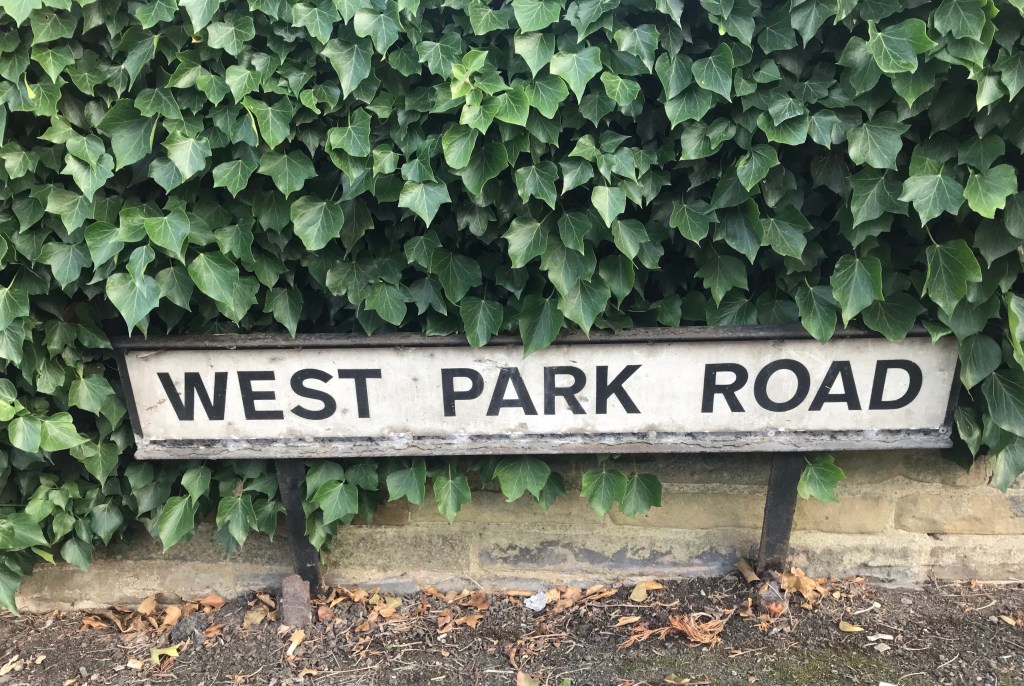


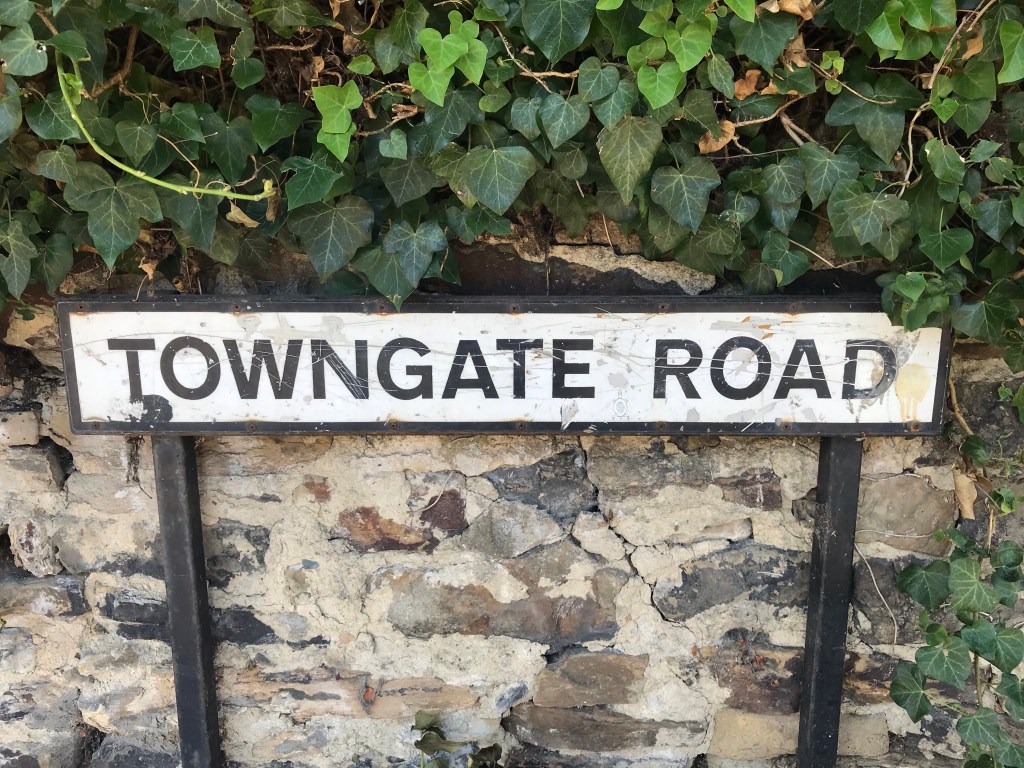


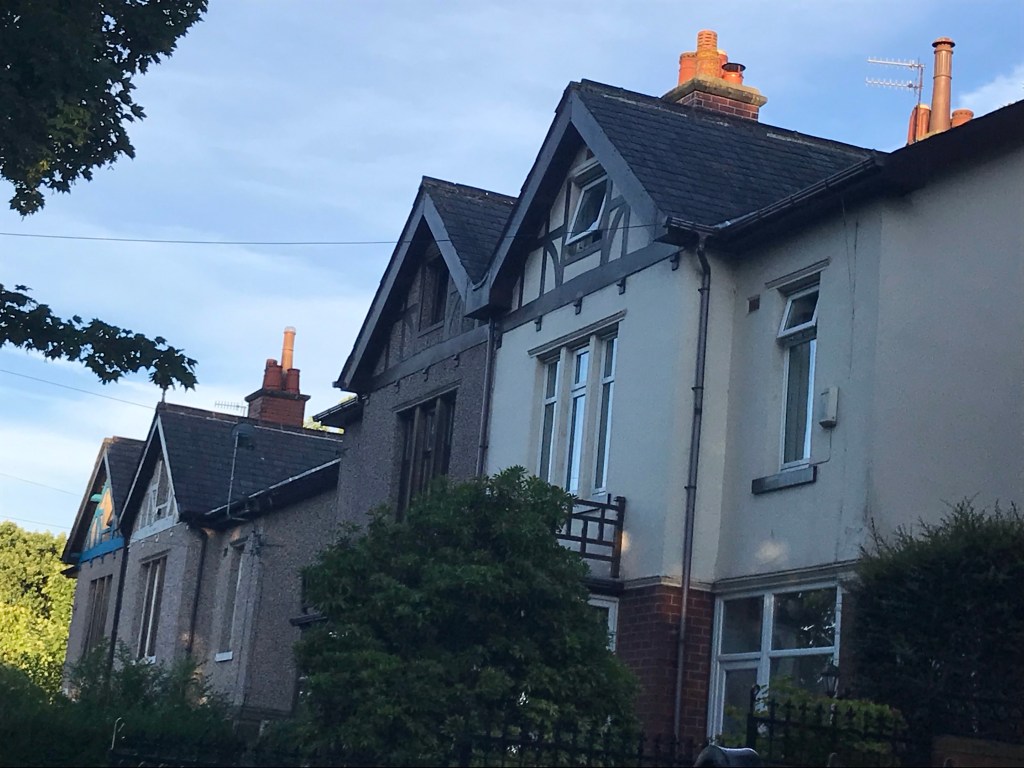
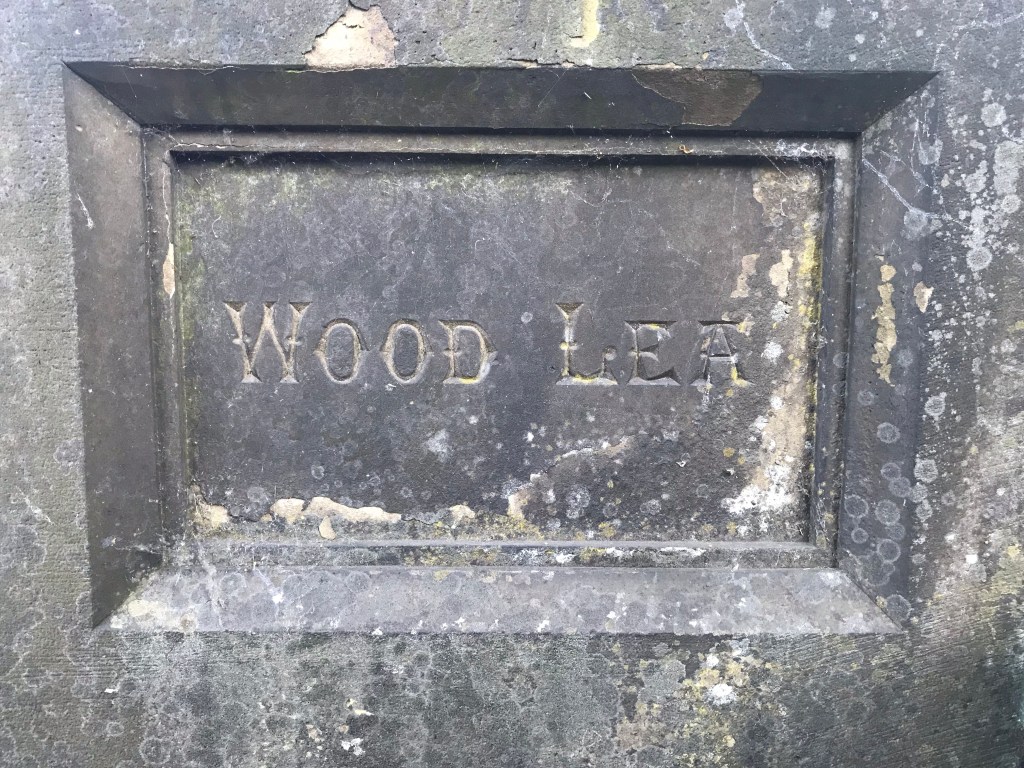
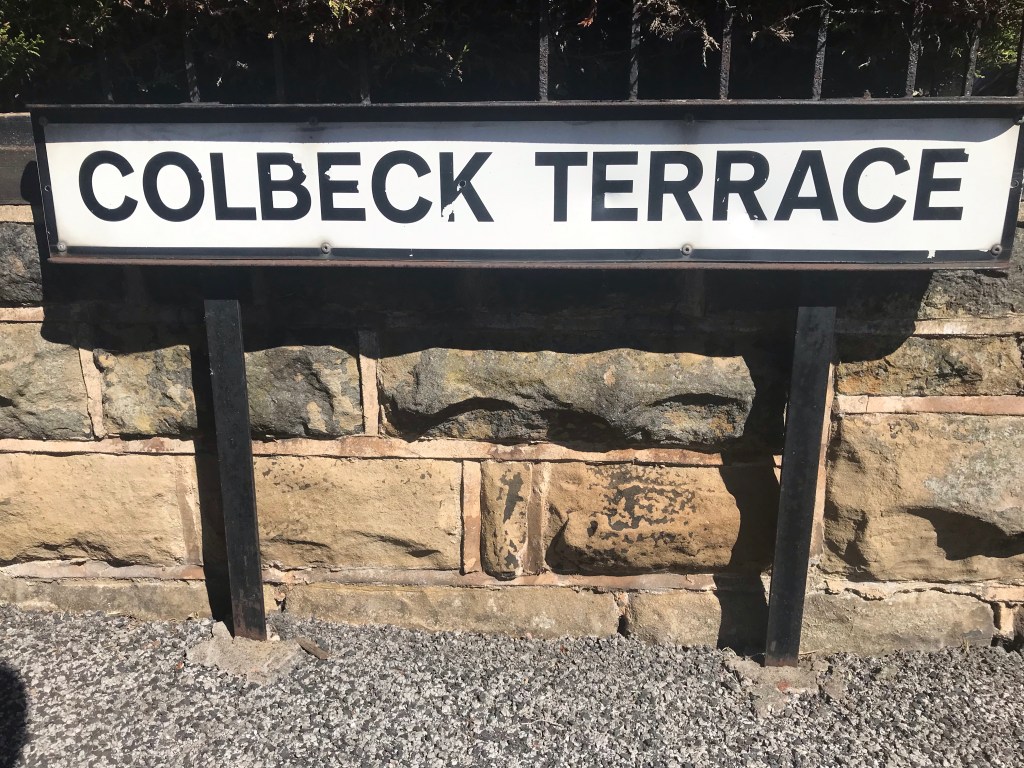


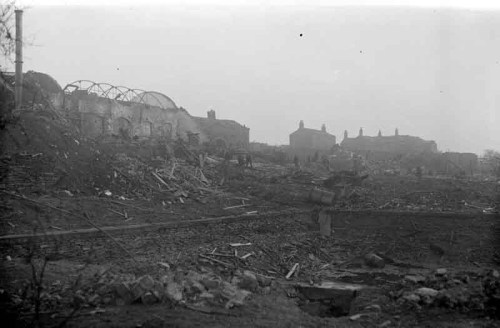


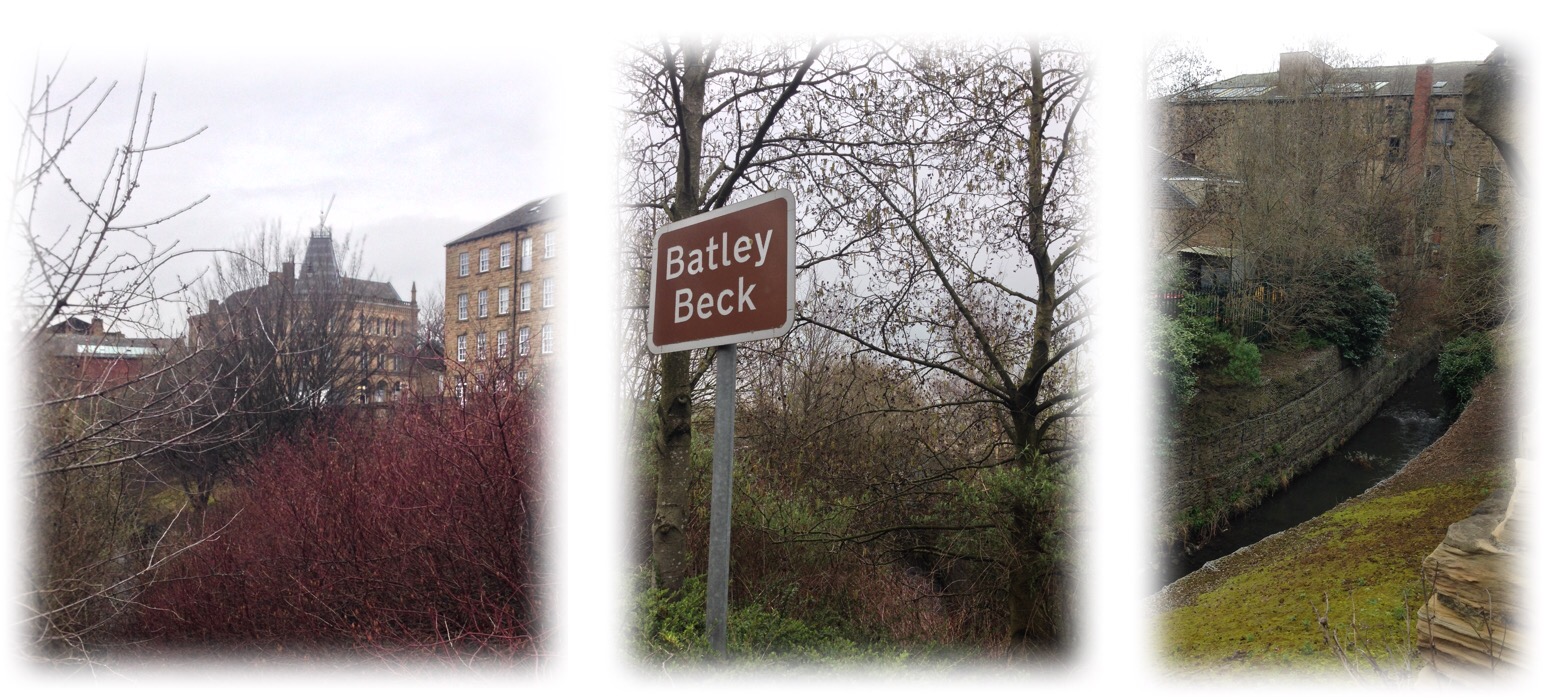


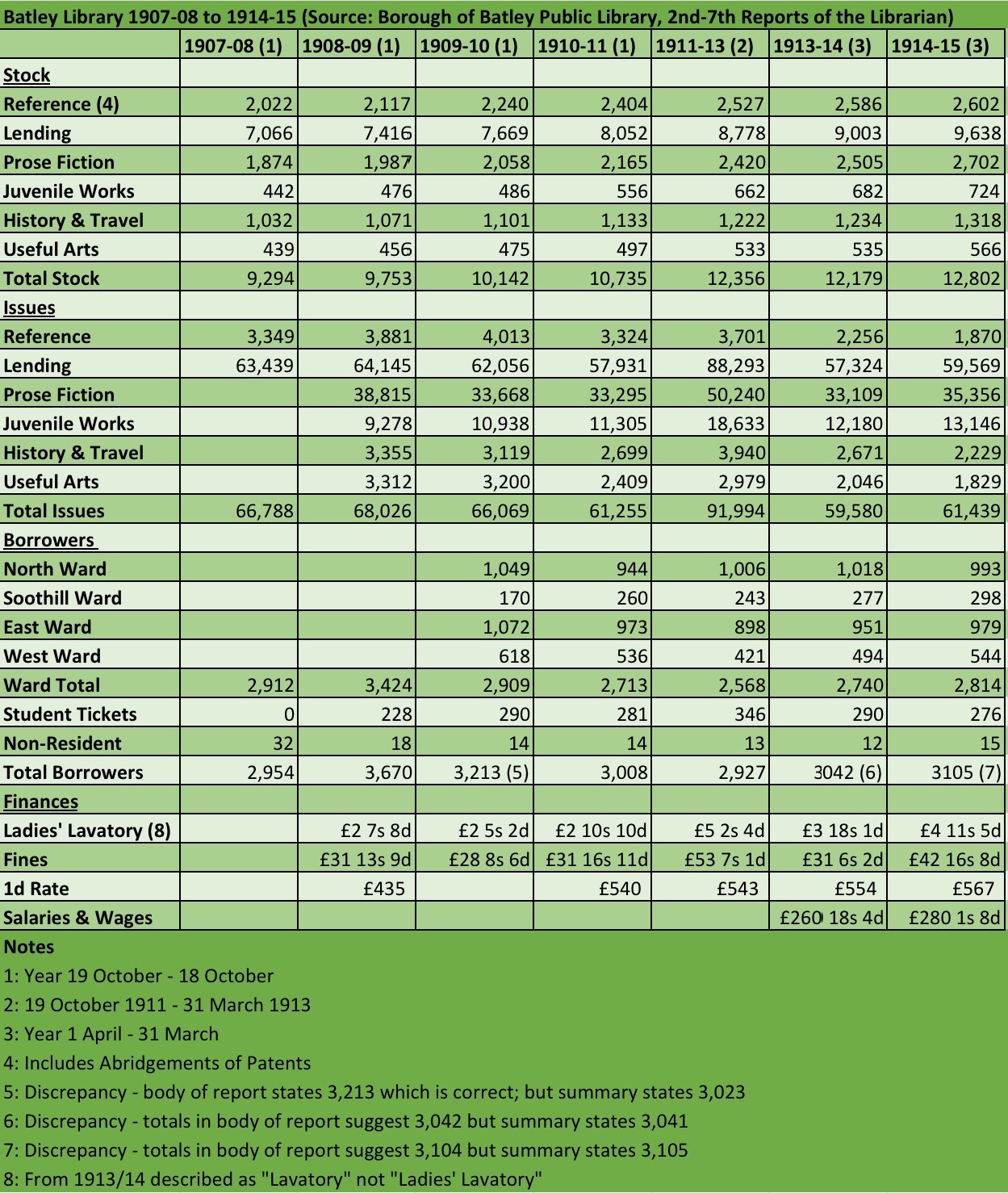

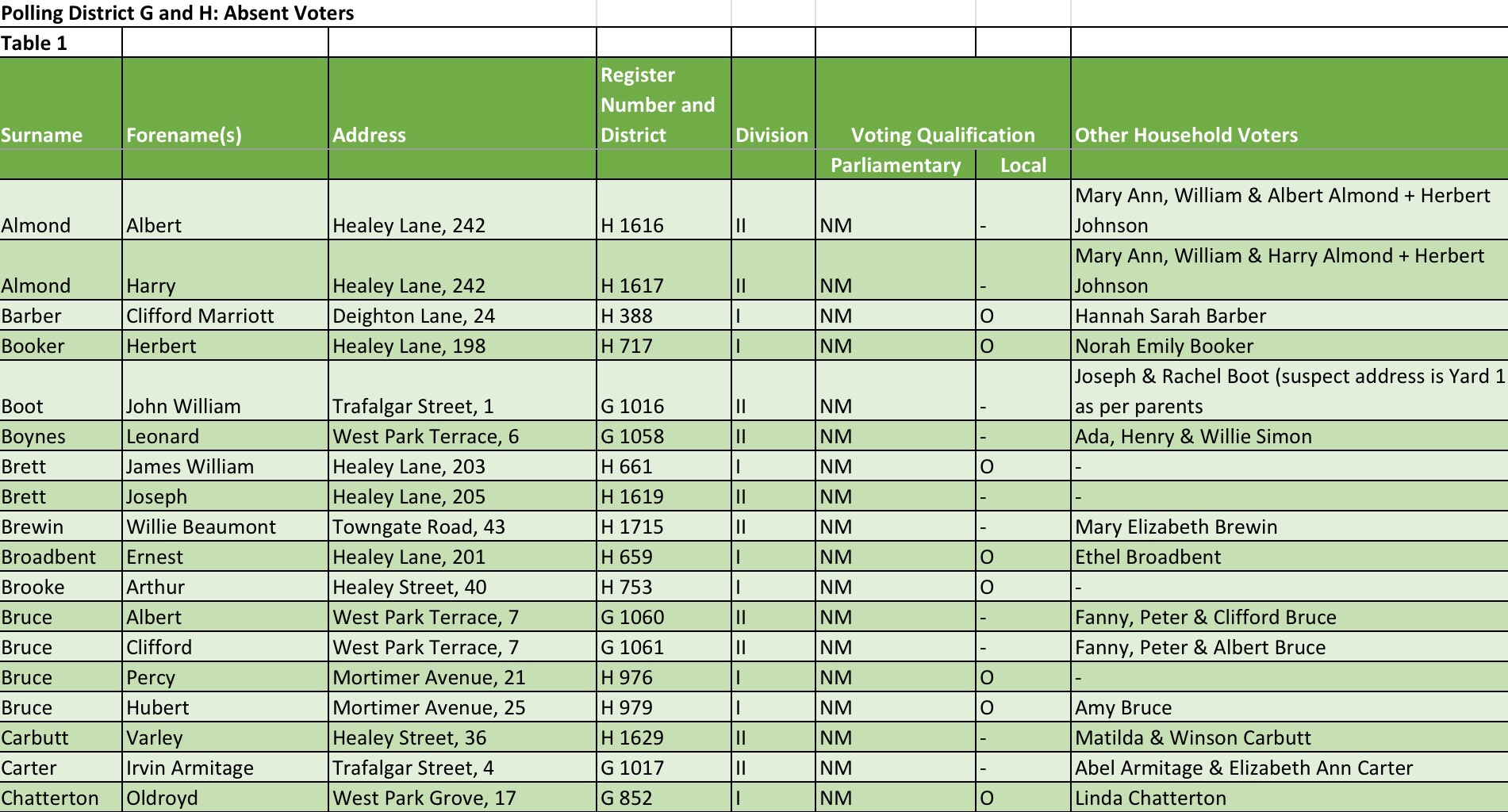


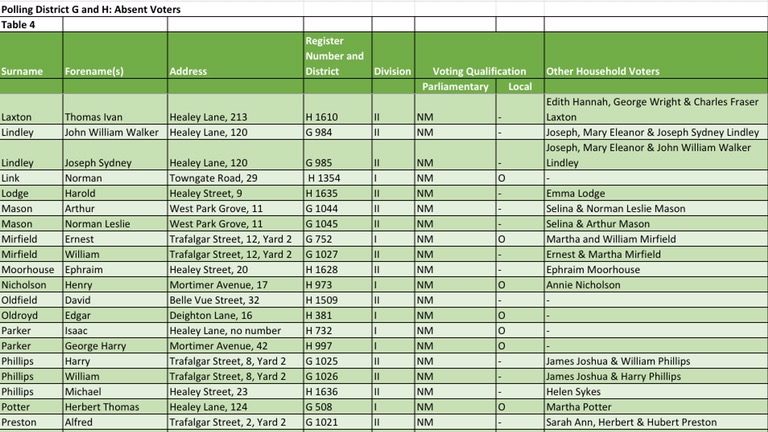


 Past To Present Genealogy