Since then I have pinpointed many of the affected buildings, houses and addresses, including a general summary of the damage inflicted on each property.
This is the third post with these details so you can identify if your home was part of this event in our local history; or if a home associated with your family history was affected. It covers street names starting with the letters G through to J.
One of the streets covered in this post
One note of caution, although many house numbers remain unchanged from that period, some may have undergone re-numbering in the intervening years. The numbers in the table below are as they were during the war, not as they are today. Other houses have long gone.
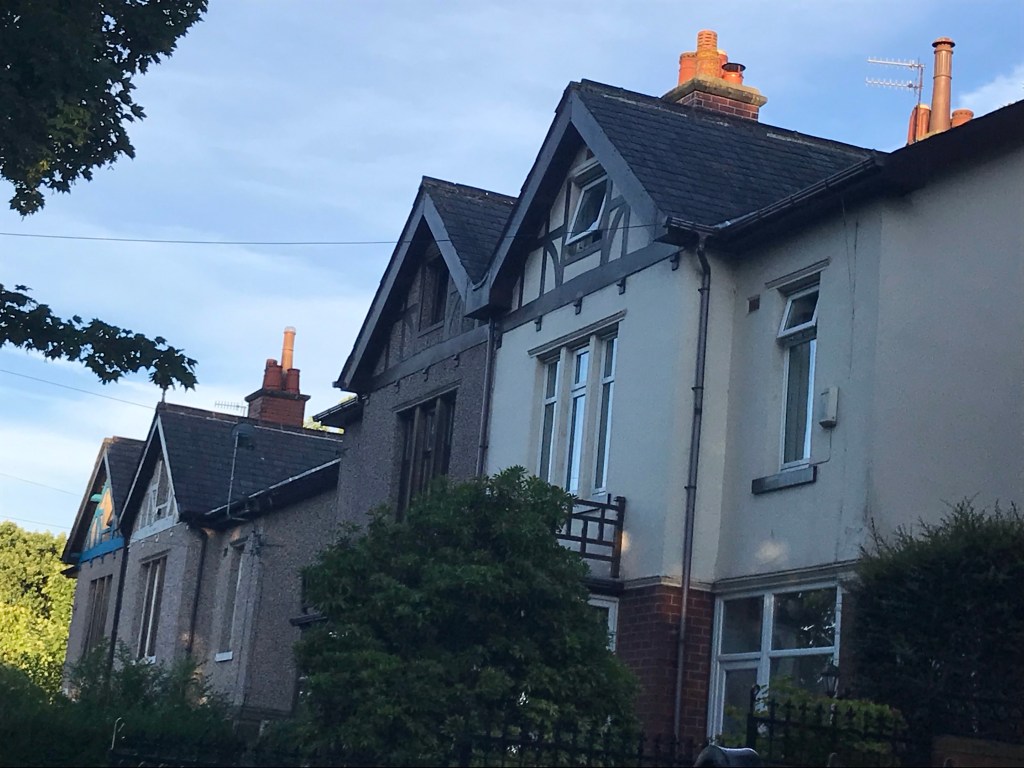
Some of the houses damaged
Also, though hundreds of addresses are listed, I am aware from my earlier research that this is not the complete inventory – there are areas of Batley hit that night which are missing from the list.
Some final points to be aware of. I have detailed the information exactly as it was written, so the damage inventory columns are not consistent. For example ceiling damage sometimes comes under ‘contents’, at others under the ‘generally’ heading.
It is also clear this is not the complete story of damage inflicted. I am aware some buildings did suffer substantially more than is listed for them in the space-limited columns – for example gable ends needing rebuilding as a result of the air raid.
Some final points to be aware of. I have detailed the information exactly as it was written, so the damage inventory columns are not consistent. For example ceiling damage sometimes comes under ‘contents’, at others under the ‘generally’ heading.
It is also clear this is not the complete story of damage inflicted. I am aware some buildings did suffer substantially more than is listed for them in the space-limited columns – for example gable ends needing rebuilding as a result of the air raid.
And, to my mind, the list of contents ruined does appear suspiciously light. For example it is hard to believe that crockery and furniture in the majority of houses was undamaged given the structural damage listed. Again has space played a part? There are exceptions – in one detailed entry for an address in another post, although the contents were not listed in the space provided, they were an add-on insertion at the top of the page. It is hard to believe that contents in the majority of entries for other houses suffered no similar damage. I believe it is likely that individual household forms were completed initially and the information then collated and condensed on one form covering all addresses, meaning layers of detail being missed in this overall summary.
Anyway, good luck with locating your home. Don’t forget to scroll across the table to get the full details – there are columns detailing the property description, address, and an indication of the extent of damage (i.e. roof, walls, floors, contents and general damage). And do check my website as I continue to add more posts listing affected houses.
Description1
Address
Roof
Walls
Floors
Contents
Generally
1 Garden Street
Window
2 Garden Street
Window
3 Garden Street
Window
6 Garden Street
Window
8 Garden Street
Window
3 George Street
Window
13 George Street
Window
19 George Street
Window
13 Gladwin Street
Window
Gospel Hall
Much
Plaster
Ceilings
Windows
Grammar School
Sewer: Boundary Wall, Windows
2 Great Wood Street
Slight
Ceilings
W.C Pot: Windows
4 Great Wood Street
Slight
Ceilings
Windows
6 Great Wood Street
Slight
Ceilings
Windows
8 Great Wood Street
Slight
Ceilings
Partition: Windows
8 Healey Lane
Slight
Window
22 Healey Lane
Window
39 Healey Lane
Window
47 Healey Lane
Ornament
Window
49 Healey Lane
Window
50A Healey Lane
Windows
55 Healey Lane
Window
61 Healey Lane
Window
73 Healey Lane
Window
75 Healey Lane
Window
77 Healey Lane
Window
79 Healey Lane
Window
100 Healey Lane
Plaster
Windows
102 Healey Lane
Windows
118A Healey Lane
Window
120 Healey Lane
Many Slates
Ceilings
Windows
122 Healey Lane
Windows
126 Healey Lane
Many Slates
Windows
128 Healey Lane
Many Slates
130 Healey Lane
Chimney Flashing
Window
132 Healey Lane
Many Slates
Window
134 Healey Lane
Many Slates
Ceiling
Windows
138 Healey Lane
Many Slates
Ceilings
Windows
142 Healey Lane
Window
144 Healey Lane
Many Slates
Ceiling
Window
146 Healey Lane
Slight
Window
148 Healey Lane
Slight
Windows
154 Healey Lane
Windows
160 Healey Lane
Many Slates
Wardrobe
Window
199 Healey Lane
Window
Fried Fish Shop
219 Healey Lane
Window
Braeside, 46 Healey Lane
House
Westfield, Healey Lane
Many Slates
Windows
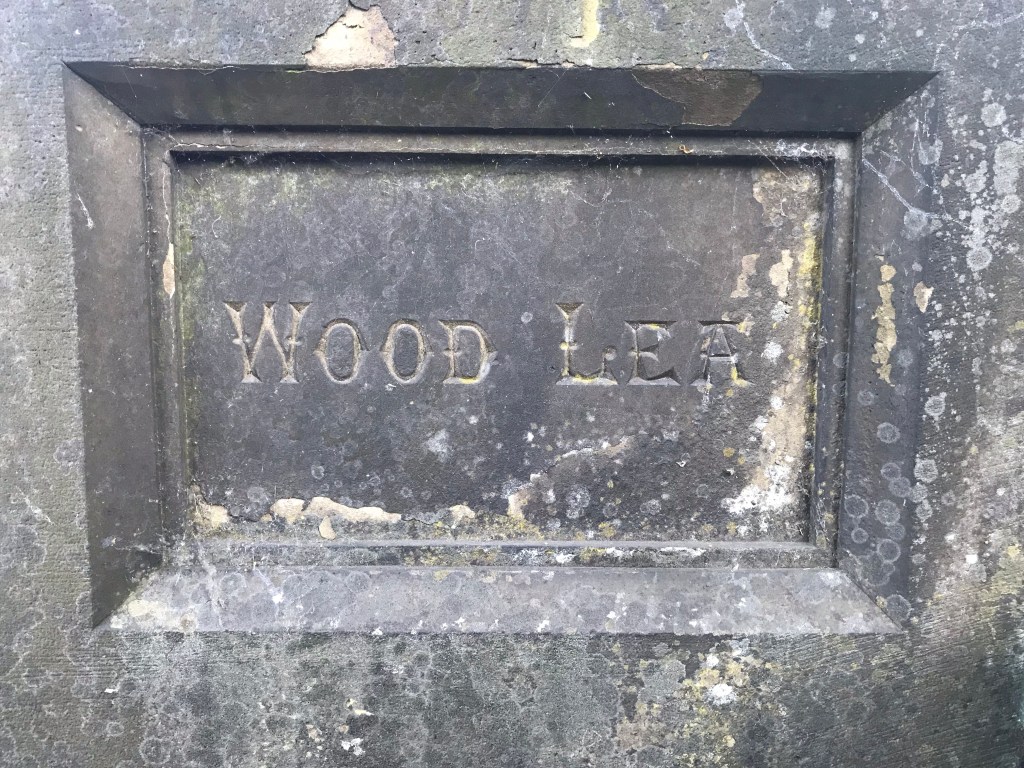
Wood Lea, 42 Healey Lane
Windows
Senior Boys’ School
Healey Lane
Slates
2 Highcliffe Road
Windows & Frame
4 Highcliffe Road
Windows
12 Highcliffe Road
Windows
16 Highcliffe Road
Ceilings
18 Highcliffe Road
Ceilings
22 Highcliffe Road
Windows
26 Highcliffe Road
Windows
36 Highcliffe Road
Ceiling
Windows & Frame
38 Highcliffe Road
Ceiling
Windows
40 Highcliffe Road
Ceiling
Windows
1 Holyoak Avenue
Many Slates
2 Holyoak Avenue
Many Slates
Ceilings
Steps Windows
3 Holyoak Avenue
Many Slates
Ceilings
Windows
4 Holyoak Avenue
Many Slates
Windows
5 Holyoak Avenue
Many Slates
Ceilings
Windows & Eaves Gutters
6 Holyoak Avenue
Many Slates
Windows
7 Holyoak Avenue
Many Slates
Windows
8 Holyoak Avenue
Many Slates
Windows
9 Holyoak Avenue
Many Slates
Ceilings
Eaves Gutter & Windows
10 Holyoak Avenue
Many Slates
Windows
11 Holyoak Avenue
Many Slates
Ceilings
Door & Windows
12 Holyoak Avenue
Many Slates
Windows
13 Holyoak Avenue
Many Slates
Ceilings
Door, Eaves & Windows
14 Holyoak Avenue
Many Slates
Windows
15 Holyoak Avenue
Many Slates
Ceilings
Door & Windows
16 Holyoak Avenue
Many Slates
Windows
10 Jacob Street
Window
12 Jacob Street
Window
Data extracted from West Yorkshire Archive Services Ref KMT1/Box42/TB227 – This is only a portion of the information contained. I have not included owners, occupiers, rateable value etc.
For Part 1 – A to B see here. For Part 2 – C to F see here. For Part 4 – K to N see here. For Part 5 – O to P see here. For Part 6 – Q to T see here. For Part 7 – U to Z see here.
Postscript: Finally a big thank you for the donations already received to keep this website going.
The website has always been free to use, but it does cost me money to operate. In the current difficult economic climate I am considering if I can continue to afford to keep running it as a free resource, especially as I have to balance the research time against work commitments.
If you have enjoyed reading the various pieces, and would like to make a donation towards keeping the website up and running in its current open access format, it would be very much appreciated.
Please click here to be taken to the PayPal donation link. By making a donation you will be helping to keep the website online and freely available for all.
Thank you.
Footnotes: 1. In this section of the list the ‘Description’ column is largely blank. The implication is these are houses, not business premises.
Just before 2pm on Wednesday 2 December 1914, a tremendous explosion occurred. It centred on the Hollinbank Lane area of Heckmondwike. The ferocity was so great it was felt 50 miles away. A yellow mist and smoke enveloped the area, and an awful stench permeated everywhere. It was the early months of the War and people feared a Zeppelin attack, or some form of enemy sabotage. Madame Personne, a refugee who had escaped war-torn Belgium, now living in the comparative safety of a White Lee cottage, fainted from shock.
Close to the epicentre of the blast, homes and workplaces suffered major damage: roofs and doors were blown off, crockery smashed, furniture was damaged, wooden partitions in buildings were torn down, gas street lamp lanterns broke and, within a three-mile radius, thousands of glass panes shattered. Many homes were rendered uninhabitable. The scene represented a war zone, more familiar in Belgium and France.
Arthur Barber described the damage to his home:
Our houses were wrecked, all the windows being out and the roofs broken through, and much damage done inside also….The kitchen door was blown straight off, and the pantry blown down, and the staircase was riven off the walls. The cellars are practically tumbling in. All the hen-pens were blown in pieces. And where all the hens are we don’t know it is impossible to sleep there, and we are staying with relatives.
Collections were raised to help those whose homes were destroyed. The thousands of sightseers who visited in the aftermath helped swell the coffers.
Whole swathes of Heckmondwike, Cleckheaton, Healey and Batley were affected, with stories coming in from across the area. A tram car travelling between Batley and Heckmondwike temporarily lifted off its tracks. A man was thrown out of his sick-bed. Some workers at Messrs. J & F Popplewell’s rag works on Hollinbank Lane were forced to leap for safety from the top window of the mill, as the roof tumbled in. Scores of windows in Belle Vue Street, Healey were blown out. The pupils at Healey school were showered with glass as the windows shattered. As a result, several children were injured, with one boy, John William Stone, requiring treatment in Batley Hospital. The school was forced to close temporarily for repairs. Even Batley hospital did not escape damage, with an operating theatre window breaking during an operation.
Shoddy manufacturer Joseph Fox was particularly involved. Driving his car in the Healey area, it lifted off the ground with the strength of the blast. He witnessed the plate glass window of Healey Co-op stores fall out (known today as Healey Mini Market).
Healey Mini Market today, the former Healey Branch of the Batley Co-op – Photo by Jane Roberts
Fox was one of those involved in ferrying the scores of injured for treatment. And, returning to his Hollinbank Terrace home, he discovered his house was one of those buildings to have taken the brunt of the explosion’s impact. His wife’s maid May Thompson was in Batley Hospital with an eye injury caused by flying glass. The house, one of three in a terrace built originally for the Heaton brothers, still stands – now on Dale Lane.
The Houses on Hollinbank Terrace (now Dale Road) which bore the brunt of the 1914 blast – Photo by Jane Roberts
But all this was overshadowed by the total devastation and carnage at the seat of the explosion, the Henry Ellison-operated White Lee chemical works. Situated on high ground off Hollinbank Lane, the firm moved in as tenants of the former Heaton family-owned chemical factory in 1900. Ellison’s were an established chemical manufacturer. They quickly obtained a Government licence to make picric acid, a major component of lyddite used for the manufacture of shells, in their newly acquired White Lee premises. They undertook this work for a couple of years until the end of the Boer War in 1902, when demand for the product slumped. They briefly re-opened the factory in 1905 during the Russo-Japanese War, selling the picric acid to brokers. After this, demand tailed off once more and the works closed until August 1914.
Extract of Six-inch OS Maps: CCXXXII.SW and SE, revised 1905, published 1908 – National Library of Scotland – Adapted
The outbreak of the First World War proved a game-changer, with the Government’s need for picric acid for shell manufacture rocketing again. It was now a race to get the works ready to resume full-scale production, with buildings tarred inside and out, wooden floors covered with linoleum, and separating brick walls and rudimentary sprinkler systems in place. In total, the works comprised of five buildings in which the wet processes of picric acid manufacture were carried out. Four other buildings were used for drying, sifting/grinding, packing and storing the chemical.
Picric acid was regarded as safe in its pure state, but if it came into other substances, such as metals, it could form sensitive picrates which were dangerous. For this reason, production licences were required. Regulations limited the quantity of picric acid in any one area, ensured it was not confined and precautions had to be taken to ensure no foreign bodies were introduced to the production process. In order to avoid any ignition risk, no matches could be taken into the most dangerous areas, such as the sifting and grinding shed – so pockets were checked and sewn up before entry. Additionally, protective rubber overshoes had to be worn in these areas to prevent possible contamination by stones and nails. Commonly worn hobnail boots could be a particular issue, as they could cause sparks and, theoretically, the nails could be loosened by acid present on site. These objects could then contaminate the acid production, and potentially enter the grinding machines. The overshoes placed outside the doors to these areas, in theory, minimised the risk.
With all these precautions in place fire, not explosion, was believed to be the most immediate danger. If the fire was quickly put out to prevent the acid overheating, an explosion would be avoided.
On 2 November 1914 production recommenced at Ellison’s White Lee Works. On 19 November a government inspection found everything in good order, with only a few minor points identified due to the long period of building disuse. These were quickly rectified.
Labour was in short supply due to men enlisting, but picric acid production was not regarded as a skilled job. The company recruited a good, young analytical chemist from Cleckheaton, 22-year-old Bradford Grammar School and Leeds University educated Fred Wright. He had previously worked at the Barugh Benzol Works near Barnsley and, more recently, at the Benzol Works at Low Moor. However he had no previous experience with picric acid. He started work at White Lee only two weeks before the explosion.
Ellison’s also brought in a well-regarded employee from the Low Moor Chemical Works to act as foreman. 37-year-old James Nicholas had considerable experience of picric acid manufacturing.
The rest of the workers were recently recruited unskilled labourers, some starting on the day of the explosion. Because of the shortage of labour, these men worked across a number of areas of the production process, as required.
On 2 December, when the explosion occurred, 11 employees were on site. There were also several workmen engaged in construction, as the facilities were being extended to cope with the demands of the war. Unfortunately, these men were also caught up in the tragedy.
The afternoon shift started and production work was proceeding as usual. Wright and Nicholas worked in the packing shed, whilst three men were employed in the sifting and grinding room. At just before 2pm a massive blast occurred, centred on the sifting and grinding areas.
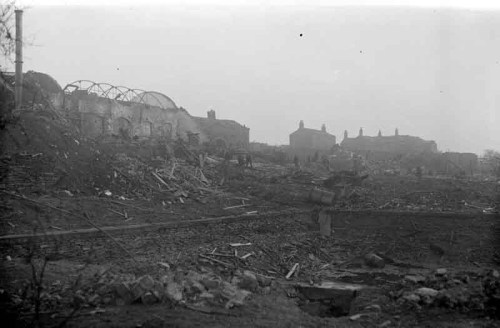
Buildings crumbled, a huge flash of flame soared into the sky, followed by dense clouds of yellow smoke. All that remained of the sifting and grinding shed area was a deep hole where the structure once stood. Peripheral works buildings were severely damaged, with any walls still standing being dangerously cracked. Surrounding fields were littered with masonry, smashed timber, pieces of machinery and roofing. Body parts were found for days afterwards. Containers holding liquid acid split, the corrosive liquid tracking down the hillside, which all added to the horrific scene.
Aftermath of the White Lee Explosion – Copyright of Kirklees Image Archive who granted permission for use in this blog post. Website http://www.kirkleesimages.org.uk/
One eyewitness, Leeds man James William Bellhouse working with a colleague on the roof of Robert Bruce’s William Royd cotton mill, stated:
The explosion made a tremendous row and blew us off the building. I saw a mass of flame, and the sky seemed to be lit up by a blazing red. A lot of debris were flying all up and around….
Bellhouse and his workmate were unharmed.
Some others had equally lucky escapes. A couple of men employed in the grinding area had not returned to work there for the afternoon shift. They had struggled to cope with the dust, despite covering their noses and mouths, and frequently opening the door. They survived.
Former Batley rugby league player Jim Gath of Wilton Street, Batley was on site to undertake work on the boiler. Minutes before the blast he decided to leave the boiler house to do some outside work. He had just climbed scaffolding when the explosion occurred. Covered by debris, only by sheer strength did he extricate himself, injuring his arm in the process. He remembered walking, then crawling, then nothing until he awoke in Dewsbury hospital.
William Sykes of Healey Street, Batley was working in the boiler house, which was demolished. According to reports at the time, concussed and dyed yellow by the fumes, he escaped too. However, this was not the whole story, and it did not end happily. Subsequent reports indicated he also sustained injuries to his legs and eyes. His health deteriorated and he died in July 1915. Coincidentally, his daughter Elizabeth, working in the nearby Robert Bruce-owned mill, suffered a compound fracture of her right arm.
The blast killed nine men outright. Another died in Dewsbury hospital later that day. The men were as follows.
Percy Ashton, born on 26 October 1892 was the son of Willie and Elizabeth Ashton (née Barker) of Tidswell Street, Heckmondwike. He was a joiner working on construction of the new buildings. A popular member of Dewsbury AFC, he was buried in Heckmondwike cemetery.
Heckmondwike Cemetery, Percy Ashton’s Headstone – Photo by Jane Roberts
Arthur Cooper, was born in Leeds on 19 February 1863. He married Martha Ann Wheelhouse in Leeds in 1885. A boot finisher for most of his working life, by 1893 he and his family were living in Lobley Street, Heckmondwike. He now had employment in the boot department at Heckmondwike Co-op. Sometime after the 1911 census he switched work to become a mason’s labourer for his neighbours, the Firth brothers. Initially amongst the missing, his body was found under rubble two days after the blast.
Albert Laycock Firth was a 51-year-old living at Lobley Street in Heckmondwike. He and his brothers Nimrod and Ralph were the stone masons erecting the new drying building. Ralph nipped back to their own Work’s yard prior to the blast, and heard the explosion. He identified his brother. Albert left a widow Elizabeth (née Briggs) who he married in 1893. The couple had three children in the 1911 census – Aked, James Albert and George.
Nimrod Firth the brother of Albert was 34 years of age. He also lived at Lobley Street. The son of James Firth and his wife Sarah Laycock, Nimrod married Lucy Wright in April 1913. He was identified through keys in his pocket. His funeral, along with that of his brother, took place at Heckmondwike Upper Independent Chapel.
James Nicholas was the works foreman. The 37-year-old was born in Herefordshire, but the family eventually settled in Cleckheaton. The 1901 census shows him employed as a picric acid labourer, so by 1914 he’d had at least 13 years experience of working with the chemical. Later that year he married Edith Emma Strickland. The couple went on to have four children – Harold Cookson, Eric, Edith Gladys and Laura. His brother John formally identified him. He was buried in Cleckheaton.
Clifford Thornton, a joiner from Boundary Street, Liversedge, only started building work at Ellison’s on the day of the explosion. Like Percy Ashton he was employed by Messrs. R Senior and Sons. A 25-year-old single man, he was the only living child of John Marsden Thornton and his wife Betty (née Cordingley). He survived the blast, but died as a result of his injuries at 4.05pm in Dewsbury Infirmary. An active member of Heckmondwike Upper Independent Chapel and Sunday School, this was where his funeral took place.
Heckmondwike Upper Independent Chapel – Photo by Jane Roberts
Fred Wright, worked as the establishment’s analytical chemist. From Cleckheaton, he was the 22-year-old son of Walter Henry Wright and his wife Elizabeth Savoury. Walter Wright was well known in local musical circles, being the organist at Providence Place Chapel, Cleckheaton and a former conductor of Cleckheaton Philharmonic Society. His son was so badly mutilated he was identified by the contents of his pockets (including a gold watch, purse, and visiting card) and a distinguishing mark. Fred was buried in Whitcliffe cemetery.
The three men working in the grinding room were William Berry, George Terry and James Alfred Morton (some sources mistakenly name him as John Edward Morton). Only identified amongst the dead from various items of clothing discovered in the days after the explosion, the partial human remains found which possibly belonged to them were buried in a single coffin in Heckmondwike cemetery. Father O’Connor, the parish priest at Heckmondwike Catholic Church (now the Holy Spirit Parish) conducted the service for Morton. Father O’Connor later became the inspiration for G.K. Chesterton’s fictional detective Father Brown.
William Berry transferred from Ellison’s Cleckheaton works two months prior to the blast. A labourer, he supervised the drying shed activities. 36 years of age, his widow Clara identified his overcoat. There was also his return railway ticket to Low Moor where he lived. Born in Halifax, he married Clara Hargreaves at All Saints, Salterhebble in July 1910. The couple had two children, Annie (b. 1911) and Arthur (b. 1913).
James Alfred Morton (38) was separated from his wife May, and living at Staincliffe. The son of Cornelius and Bridget Morton, he was a miner by trade. However, in recent years he worked as a casual labourer, most recently for a gardener in Batley Carr. He only started at the chemical works on Tuesday. His brother, Joseph, could only identify scraps of his clothing – parts of his trousers, shirt, coat and red, white and blue striped tie.
George Terry (22) of White Lee only started at Ellison’s on the Monday, previously working as a rag grinder in Batley. Initially his father wrongly identified one of the original bodies as his son, so badly mutilated was it. He was led away in a distressed state, only for others to realise the mistake. Days later, small strips of waistcoat and corduroy trousers belonging to George were identified by his widow Lilian. They had been married less than six months. She had left him at the gates of his work after lunch at 1.25pm on her way to visit her mother, and heard the explosion.
Commemorative Postcard from my Collection (note there is no image of James Alfred Morton who is wrongly named)
The official Home Office inquiry headed by Major Cooper-Key, Chief Inspector of Explosives, reported in January 1915. Although Cooper-Key found the wearing of protective overshoes was not strictly adhered to in the designated danger areas, crucially it was enforced in the sifting and grinding shed where the explosion occurred. He went on to conclude that Ellison’s complied with all the necessary regulations for picric acid manufacture, and could not be held responsible. Sabotage was also effectively ruled out.
He attributed the disaster to two factors. The ignition occurred in the sifting and grinding room, probably due to the accidental presence of a nail, stone or similar hard foreign body entering the grinding mill. Under normal circumstances this would have resulted in a spark and fire which would have been extinguished before the picric acid had chance to heat to explosion point. But the shed was extremely dusty, a situation exacerbated by the strong wind that day which constantly fanned the particles as the door opened and closed to try to let fresh air in. The initial ignition resulted in the explosion of this carbonaceous dust.
Although the White Lee explosion led to a review of picric acid manufacturing guidelines, it did not mark the end of accidents resulting from its manufacture during the war.
And the ten men who died on the day of the explosion, as well as William Sykes who died seven months later, are yet more local casualties of the First World War.
A plaque has been laid by the Spen Valley Civic Society to commemorate the event and those affected.
White Lee Disaster Plaque – Photo by Jane Roberts
Postscript: Finally a big thank you for the donations already received to keep this website going.
The website has always been free to use, but it does cost me money to operate. In the current difficult economic climate I am considering if I can continue to afford to keep running it as a free resource, especially as I have to balance the research time against work commitments.
If you have enjoyed reading the various pieces, and would like to make a donation towards keeping the website up and running in its current open access format, it would be very much appreciated.
Please click here to be taken to the PayPal donation link. By making a donation you will be helping to keep the website online and freely available for all.
Thank you.
Sources:
Multiple sources were used, including newspaper reports, the official accident report, censuses, civil registration indexes and parish registers.
Special thanks to Kirklees Image Archive for permission to reproduce their image of the aftermath of the explosion. http://www.kirkleesimages.org.uk/ This is a fabulous local pictorial archive. The images are subject to copyright restrictions.
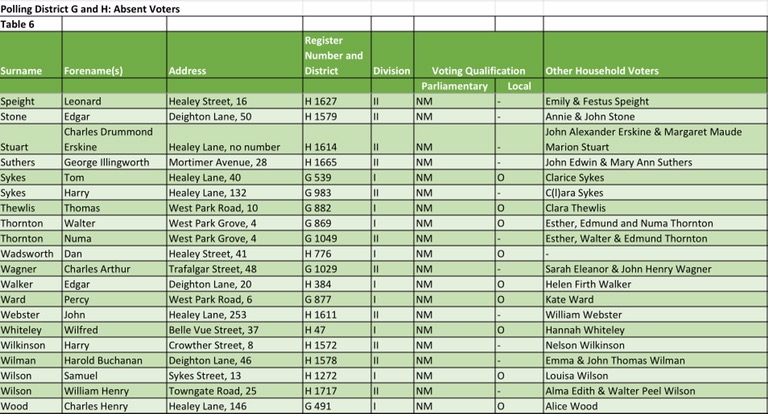
Thanks to the wonderful Batley Library staff and volunteers, the missing Batley Borough 1918 Electoral Register was located just before Christmas. I spent the early few days of February beavering away on it to extract the absent Healey naval and military voters, and put them into spreadsheet format.
This work has significantly expanded the list of servicemen I initially identified using CWGC records of those who died, the WO 363 “Burnt Records” and WO 364 records of those discharged for medical/capability reasons. This initial list identified 39 men, though I have subsequently discovered an additional man. He is Arthur Ellis, a rag merchant whose address was 263 Healey Lane. He served with the Grenadier Guards, Service Number 27774.
The Electoral Register, signed off on 1 October 1918 by the Batley Town Clerk’s Office, identified 121 men, though there is a small overlap with my earlier findings. The numerical difference is indicative of the limited numbers of soldiers’ service records surviving, with around two thirds of them being totally lost or irretrievably damaged during WW2 1940 bombing.
First bit of background information about voting entitlement and the Electoral Register. The Representation of the People Act 1918 came into force in time for the December 1918 general election. One of the drivers for electoral reform included the fact only men who had been resident in the country for 12 months prior to a general election were entitled to vote. This residential qualification, combined with the property ones, meant many serving King and Country overseas were effectively disenfranchised. The Act abolished these restrictions and extended the vote to all men over the age of 21. Additionally, men who had served in the war could vote from the age of 19. However Conscientious Objectors were disenfranchised for five years. The Act also gave the vote to women over the age of 30 who met a property qualification, wives who were over 30 of all husbands who were entitled to vote in local government elections and also to those who were university graduates.
However, it should be noted that parliamentary and local government franchises were not the same. Hence the 1918 register is split into three categories.
Division I: Persons qualified as both parliamentary and local government electors;
Division II: Persons qualified as parliamentary electors but not as local government electors; and
Division III: Persons qualified as local government electors but not as parliamentary electors.
Abbreviations used are:
R: Residence qualification;
BP: Business Premises qualification;
O: Occupation qualification;
HO: Qualification through husband’s qualification;
NM: Naval or Military voter; and
a: indicates absent voters.
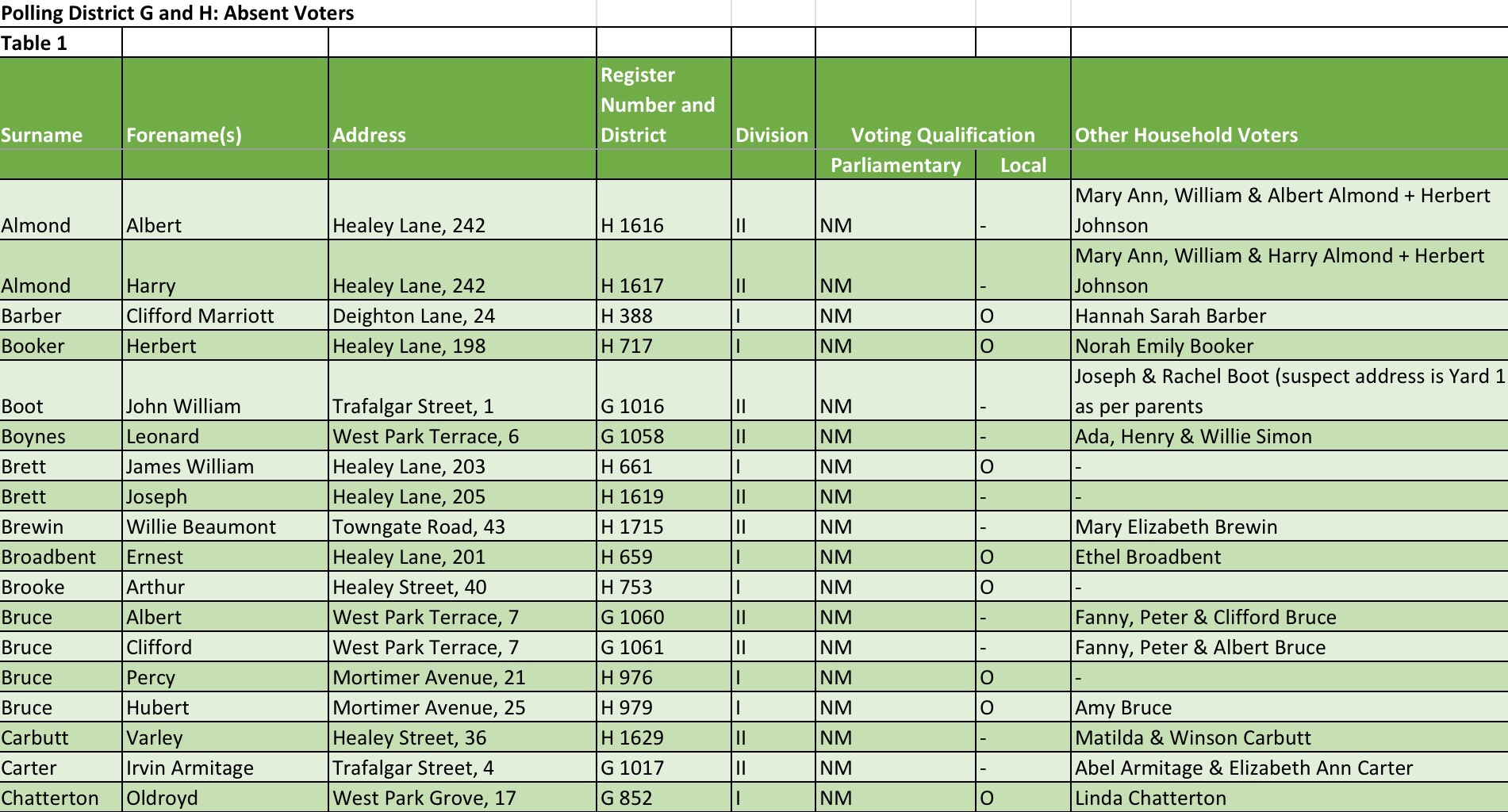
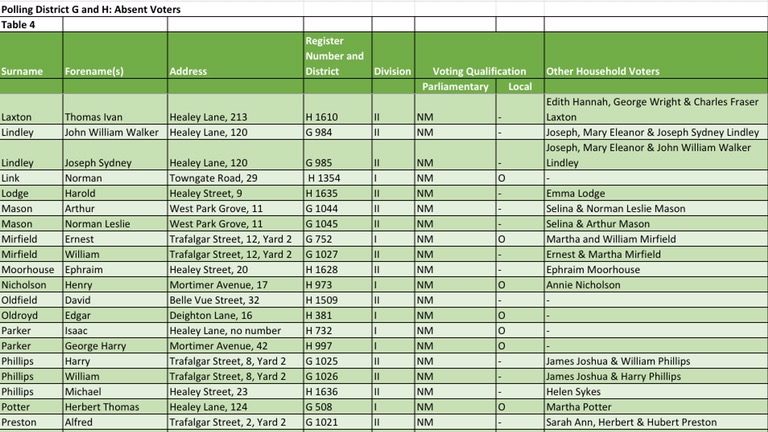
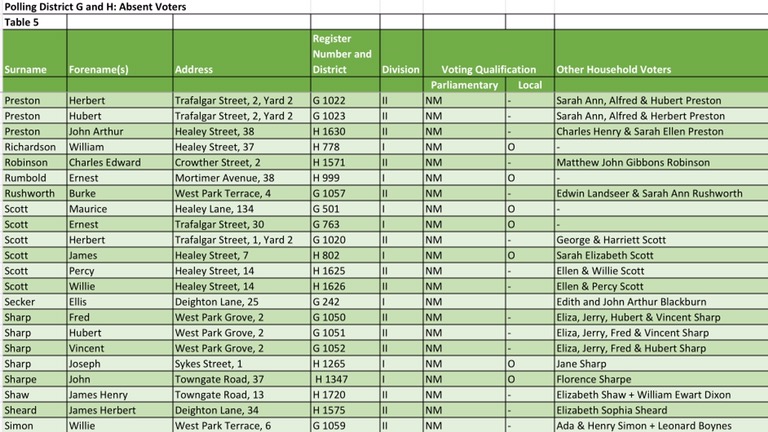
So here are the names of those identified from the 1918 Electoral Register.
The men on my Healey list all fall within both the absent and Naval and Military categories. The information was supplied by next of kin so may not be accurate. It may include men who were killed after its compilation. And addresses may not necessarily reflect actual residence, but merely be the most convenient address, for example the in-laws where the man’s wife was living whilst he was serving, or a friend’s home.
It is also worth emphasising this is the Electoral Register. It isn’t what is commonly known as the Absent Voters List (AVL). These lists, generated to provide servicemen and nurses with voting cards, ballot papers or proxy voting forms depending on where they were serving, gave far more detail. They normally included regiment, number, rank and home address. Sadly, despite checking with West Yorkshire Archives and Huddersfield Local Studies Library, I’ve been unable to locate the one for Batley Borough. It may be it no longer survives. The AVL would have provided so much more crucial identification information. But the Electoral Register is better than nothing.
The Register also enabled me to further define the parameters of this project. I used the Batley West Ward Polling Districts G and H to identify the relevant streets. These are:
Belle Vue Street
Crowther Street
Deighton Lane
Healey Lane (excluding the numbers falling within Polling District I. These are mainly below 79, with the exception of some numbers in the 40s which fall within District G)
Healey Street
Mortimer Avenue
Sykes Street
Towngate Road
Trafalgar Street
West Park Grove
West Park Road
West Park Terrace
These are in addition to Nelson Street and Prospect Terrace identified from earlier research. Looking at the 1911 Census Summary Books some Chaster Street houses may also fall within the catchment area.
The men’s details from the Electoral Register are contained in the following six tables. I checked across all three Divisions to identify other voters registered at the men’s given addresses, in the hope this provides more family clues.
So I can give myself an early 2017 back pat. This data extraction was one of my 2017 New Year’s Resolutions. I’d targeted a March completion, so I’m ahead of schedule and I can now begin the hard research, although I am still toying with the idea of the newspaper trawl. I know from previous experience how much value this adds. It’s a case of whether I have the time to do it alone!
At the moment I’m angry: bitterly angry and disappointed.
I went to Batley library on 3 December to check out the 1918 Electoral Register held in the reference section. I was horrified to discover it missing. I couldn’t believe it. I spent a full hour checking the shelves in the reference library, not just the cabinet in which the full range of registers are housed, in the vain hope the book had been mis-filed. All to no avail.
Electoral Registers minus the 1918 One
I last looked at the 1918 register in October 2015, when I made some notes about my family. This time I wanted to use it for my Healey project. The register showed absent voters and indicated by a “NM” if they were in the navy or military. For some of those serving their country this may be one of the only surviving records of their sacrifice. Because of this it is arguably one of the most important of the Batley electoral registers.
Maybe someone has borrowed it. Though as its a reference book, and no one on duty in the library knew it was missing, I think I’m clutching at straws here.
Cynically I think whoever has taken it knows exactly it’s value. To my mind the alternative, and most probably the most likely, unpalatable option is it has been stolen. If this is the case, I reckon it is permenantly lost. Unless someone’s conscience is wracked with guilt. I do hope it is.
If it is gone forever I’m disgusted. Disgusted that someone has taken from the community what is a vital resource for those researching family or WW1 history. Shame on them. I hope they’re really pleased with themselves for robbing everyone, including those named within the pages of the register, of their history and legacy. An utterly despicable act. But I doubt they have a shred of remorse about it. If they had, to take it would not have crossed their mind.
Personally I can’t get my head round why anyone would be so selfish. The book was available. They had library access to it. Why take it? It is a sad indictment on society that someone felt it their right to behave in such a despicable way.
I’m now left trying to source an alternative copy, preferably locally. So far without success. This is not one of the electoral registers available on commercial sites. If anyone knows of the (preferably) local whereabouts of a copy of the register, please let me know. It could be the difference in me discovering the WW1 service of a Healey man.
And because of one person’s lack of morals and callous disregard of doing the right thing, many others will be similarly deprived of such an important local resource.
Update: I am pleased to report that the 1918 Electoral Register has now unexpectedly re-surfaced. It was not in the locked cabinet where it should be housed. Library staff discoverd it tucked away behind books elsewhere in the library. My Healey Project has a new lease of life.
When I researched the men on the War Memorial of Batley St Mary’s, one thing I quickly realised was that the names there represented but a fraction of those parishioners serving in the military.
British Army statistics alone illustrate this. Roughly 8.7m men served in it at one point or another during the war. This includes Empire and Indian Army contingents. Of these about 5.7m were from the British Isles (including Ireland). From this 8.7m total, approximately 957,000 lost there lives (of which Royal Navy and RFC/RAF casualties were 39,527), and about 705,000 of these were from the British Isles. So between 11-12% of those in the British Army died, depending on whether you look at the total or narrow it to British Isles only.
Whilst research often concentrates on those that died, one of the things I wanted to do was find about all those who served, whether or not they made the ultimate sacrifice. Many of the survivors were physically wounded and mentally scarred, some to a life-changing extent. I have a couple of great-uncles in those categories. Again, looking at the British Army statistics almost 2,273,000 were wounded (although this figure has an element of double-counting, in that if you were wounded twice you appeared twice in the numbers). Of those wounded 18% returned to duty but in modified roles, for example garrison or sedentary work. And 8% were invalided out altogether, no longer fit for military service. Families and communities were affected forever.
For me Remembrance Sunday includes all those who served; all those affected be it killed, wounded physically or mentally, and those who returned home with no obvious lasting ill-effects but had given up part of their lives to serve.
Sadly very few local memorials or records give these full community details. Locally one such record which stands out as doing this is that of Soothill. More information on this here.
I would love to try to find out about all those from the broader Batley area, to complement this Soothill treasure. But doing this alone is impracticable. Time and record survival are the major stumbling blocks. Key to providing addresses are service records. But about two thirds of soldiers’ service records were totally lost or irretrievably damaged during WW2 1940 bombing. Those that have survived are in the National Archives WO 363 “burnt records” series. And, as mentioned, this is the overwhelmingly predominant service.
My other option was to trawl through the two Batley newspapers from the time, “The Batley News” and “The Batley Reporter & Guardian,” making a note of all mention of those from the Batley area serving in the Armed Services. I’ve made no secret about wanting to do this. It would be a fantastic local resource. But unless I had years to spare concentrating on it, I couldn’t do it alone. The same considerations applied to Batley St Mary’s, with the added factor of connecting random names and addresses in Batley with a specific Catholic Parish.
So I’m going to attempt a compromise, and focus on one area of Batley: Healey. It doesn’t have a Batley St Mary’s WW1 connection, but it’s the area I grew up in. And it’s the one where I still live. It is also more manageable size-wise. However the deciding factor in my choice is one soldier in particular, whose record I accidentally stumbled upon. But more of that in another post.
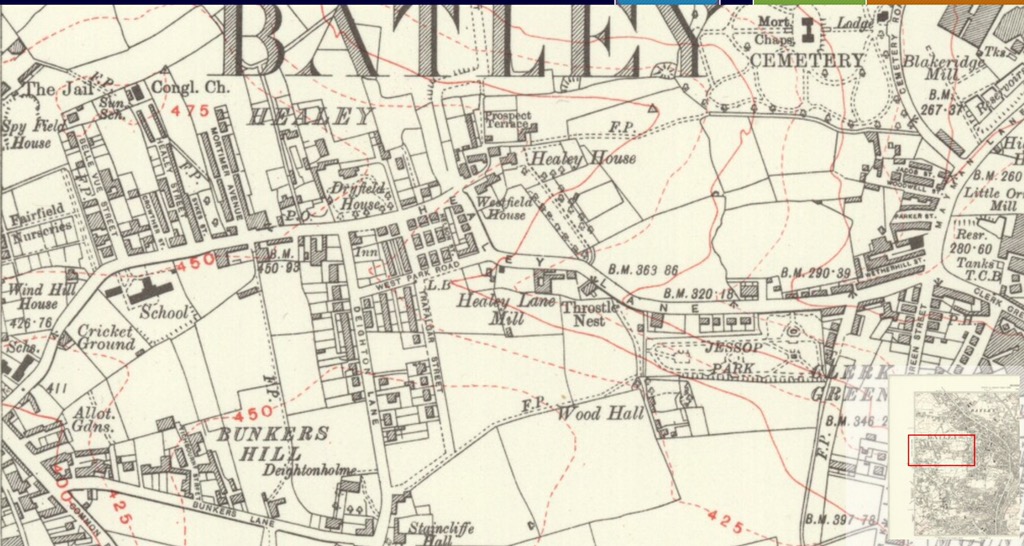
A couple of maps from 1905 and 1931 below pinpoint the area.
Healey in 1905
Healey in 1931
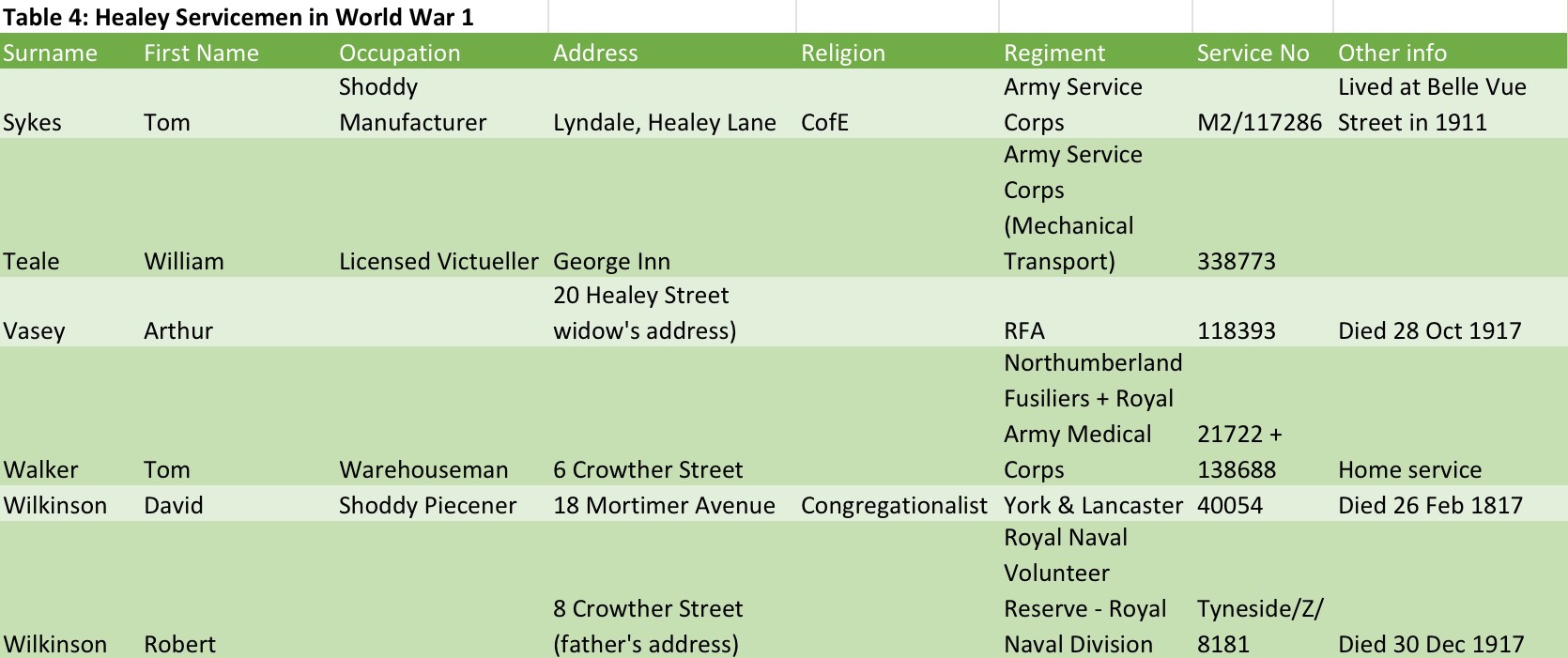
Initially I’ve used three sources:
CWGC information of the dead, where next of kin addresses mention addresses from the Healey, Batley area;
WO 363 “Burnt Records” which include a Healey, Batley address via Ancestry.co.uk; and
WO 364 records of those discharged for medical reasons (illness or wounds) during the First World War
My initial analysis of these has produced the four Tables below.
Over the next couple of years, till the centenary of Armistice Day, I intend doing a brief biography of each of these men.
I also intend going through at least one of the newspapers to identify other Healey men. Although doing this will probably extend the length of time for the project. A case of playing it by ear.
If anyone has any information about Healey men in WW1, it would be most welcome. It would also be lovely to extend this beyond Healey in WW1, to do a similar project for Healey in WW2. With the current centenary commemorations it is all too easy to overlook the sacrifices made by a more recent generation. So again names and information to kick-start this would be very much appreciated.
I know I’m setting myself another potentially big but interesting task. Something a bit broader than War Memorial research, recognising the part the men across a community played.














 Past To Present Genealogy