Tag Archives: Batley

Batley Rugby League Club’s WW1 History-Maker

Some debate occurred in the Yorkshire press in March 1915 as to who was the first Northern Union player in Yorkshire and beyond to obtain a commission in The Great War.

The “Huddersfield Daily Examiner[1] and “Yorkshire Evening Post[2] declared that in Yorkshire the accolade fell to Wakefield Trinity’s William Lindsay Beattie who was appointed temporary 2nd Lieutenant in the Border Regiment on 15 March 1915.[3] He lost his life on 27 January 1917. Lancashire-based Wigan’s Gwyn Thomas was reputed to be the first commissioned Northern Union player. However, I believe this event occurred towards the end of 1914. Thomas survived the war and joined Huddersfield in 1919.

Both papers overlooked Batley winger, Robert Randerson.

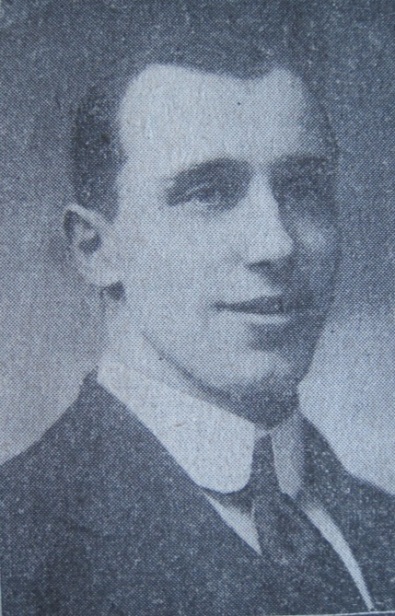
Robert Randerson Robert Randerson

Robert, (or Bob as he was known according to the local press), joined the Leeds University Officer’s Training Corps (OTC) shortly after Britain’s entry into the War. “The London Gazette” of 25 August 1914 lists Robert as amongst those OTC cadets and ex-cadets appointed as temporary 2nd Lieutenants.[4] Promotion quickly followed. In January 1915[5]“The London Gazette” announced his appointment to temporary Lieutenant with effect from 10 December 1914. Only months later, on 15 May 1915, he became a temporary Captain as notified in a June edition of the same official journal.[6]

Letters of correction to the papers followed; and the Batley Club itself was adamant the honour belonged to its player. In its Annual Meeting of May 1915 it pronounced:

“Randerson…..was the first N.U. player to receive a commission. This honour has been claimed by others but it belongs to Lieut. Randerson and the Batley Club”[7]

Within weeks of this discussion, on 7 August 1915, Robert was to lose his life in the “Yorkshire Landings” at Gallipoli.[8]

Robert was born in York in late 1890, the son of Robert and Annie Randerson (neé Wilkinson). His siblings included Annie (1886), Benjamin (1889), William (1892), John Wilkinson (1897) and George (1899).

The family were comfortably off with Robert senior earning his living as a master corn miller then as a grocer and corn merchant. By 1901 the family lived on Haxby Road, York and remained here at the time of Robert’s death.

They were an old Catholic family with strong religious convictions and connections. After training at Ushaw, Robert’s uncle Benjamin served as a priest initially briefly at St Patrick’s, Leeds, then St Charles Borromeo, Hull and lastly, until his death in 1897, at St Hilda’s, Whitby. In the 1911 census Robert’s sister, Annie, was a nun residing at St Wilfrid’s Priory, Arundel. She was employed as a head mistress at the town’s St Phillip’s Infants’ School.[9] His younger brother, John, was a boarder at the Franciscan College at Cowley, Oxfordshire.

The 1911 census shows Robert, a former pupil at Archbishop Holgate’s Grammar School in York, following his sister Annie’s educational career path. A student at St Mary’s College, Hammersmith, the objective of this establishment was to train Catholic men to serve as teachers in Catholic schools throughout the country. Robert demonstrated his sporting ability whilst studying here. In an inter-College sports contest he broke all previous records for the 100 yard flat race, covering the ground in a shade over 10 seconds.

Robert came to Batley in around 1913 as an assistant master at St Mary’s school. He soon became involved in the wider Parish community, holding the role of choirmaster at St Mary’s church.

But he became known beyond the town’s Catholic population when he started playing rugby for Batley. Initially in the reserves, he made his first team debut in a cup-tie at Halifax on 14 March 1914. His career was limited by the outbreak of war, but in this short time he made five appearances for the Batley first team scoring four tries.

At the declaration of war Robert’s strong sense of duty kicked in. He was the first Batley player to enlist and was quoted as saying:

“I am not a fighting man; I don’t like to fight, but I ought to go and fight at a time like this”.

He served with the 6th (Service) Battalion, Alexandra, Princess of Wales’s Own (Yorkshire Regiment), one of Kitchener’s New Army battalions. His enlistment necessitated a re-arrangement of the St Mary’s Boys Department school timetable, an event noted in the school log book.

It was whilst serving with the Yorkshire Regiment based at Belton Park, Grantham, that he made his final appearance for Batley against Keighley on 10 October 1914. He told the club secretary Kershaw Newton that it would be his last game with the Gallant Youths until peace was signed as, with his exhaustive training programme of marching, drilling, lectures and special studies as an officer on top of his ordinary duties, he was “about played out by the weekend”.

Additionally, with his officer responsibilities, he could not afford to risk a rugby playing injury.

“….I have 60 men under me and am responsible for them, and will have to lead them in war. To make them and myself efficient requires all my time and energy, and I do not think it would be right to risk laying myself up with an injury….”

Poignantly he wrote:

“…..I will come and hope to see many of my old friends round the railings as a sort of good-bye until we get the serious business through and when honour and justice are satisfied I trust to have many a jolly game on the hill”.[10]

Robert scored one try in Batley’s 19-0 victory. But, ironically given his concerns about injury before the game, he suffered the misfortune of a kick to the head. This blow confined him to a darkened room for a few days on returning to Belton Park.

At the beginning of July 1915 Robert and his Battalion left Liverpool bound ultimately for the Dardanelles. Initially landing at Mudros they moved onto the island staging post of Imbros to acclimatise and practice night landings and attacks. On the evening of the 6 August they left Imbros and at around 11pm that night they finally disembarked on the Gallipoli peninsular, south east of Nibrunesi Point on B Beach. The aim was to take Lala Baba, a low hill between the southern side of Suvla Bay and the Salt Lake.

Map of Suvla Bay and ANZAC Cove from Gallipoli Diary, Vol. 2 by Sir Ian Hamilton - Edward Arnold, London - From Wikimedia Commons Map of Suvla Bay and ANZAC Cove from Gallipoli Diary, Vol. 2 by Sir Ian Hamilton – Edward Arnold, London, 1920 or before – From Wikimedia Commons

As the men moved off from the sea shore they were immediately engulfed by the darkness of the night, it being impossible to see a body of troops at a few yards distance.

Lala Baba was eventually taken, but the Unit War Diary records a heavy price paid with 16 officers and about 250 other rank casualties (killed and wounded) in the fighting during those first hours of the night of 6/7 August 1915. This was out of a total of 25 officers and 750 other ranks that set off from Imbros only a short time earlier.

Robert was amongst those officers killed. He died on 7 August 1915 within hours of landing. According to a fellow officer he met an instantaneous death as a result of a gunshot wound to the head. In a letter to Robert’s father he wrote:

“We made our landing of the evening of the 6th August below the Salt Lake. The 6th York’s covered the landing of the rest of the Brigade. At about 10a.m we disembarked from the barge with little opposition and started up the peninsular to take a hill called Talla Baba, and there we lost a lot of men. I got there just before 12 midnight. Some of our men had gone over and some were held up by the Turks entrenched on top and there were several of our officers wounded and killed there, I was told your son had been killed there and the sergeant who told me said that he had been shot through the head, so his death seems to have been instantaneous”.[11]

The first news of Robert’s demise reached Batley around the 12 August when Mrs Power, with whom he had apartments in Norfolk Street before the war, received a brief note from his father informing her that he had been killed in the Dardanelles.

Local tributes poured in for him, newspapers referring to him as “Gentleman Bob”.“The Batley Reporter and Guardian” praised his “manly character and sterling qualities” concluding he “was a true sportsman and a most popular player on the field and a perfect gentleman in private life”.[12]  

The Batley News eulogised his virtues saying:

“A pattern of good conduct on the football field, handsome appearance, of excellent physique, and a splendid teacher, his demise removes from the Heavy Woollen District one whose manifold example commends itself to the rising generation”. [13]

The members of the Batley Education Committee were equally fulsome with their tributes to Robert in their meeting at the end of September 1915. They expressed sympathy with his family and appreciation for his work in the town. Alderman H North said that:

“Captain Randerson was a typical gentleman; an ideal leader of boys and a man appreciated by his scholars and school managers. …… His death had removed from Batley a most capable servant of the education committee….. The town was poorer by his demise”. 

His death was also noted in Catholic newspaper “The Tablet”[14]

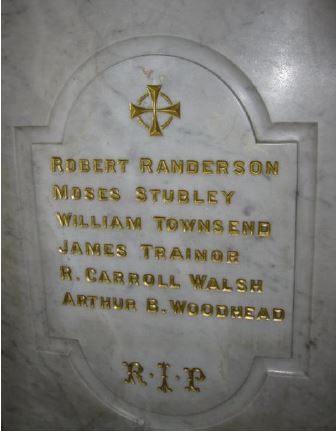
Robert Randerson, remembered on Batley St Mary's War Memorial Robert Randerson, remembered on Batley St Mary’s War Memorial

I will leave the final word on Robert from the school in which he worked. Almost exactly one year to the day from the St Mary’s log book entry about timetable changes forced by Robert’s enlistment, the same log book has an entry on 16 August 1915 announcing that school re-opened after the midsummer holiday. It went on to say in a restrained, understated way:

“News received that Captain Randerson, Assistant Master from this school, was killed in action at the Dardanelles on August 7th”. 

Sources:

  • Batley News
  • Batley Reporter and Guardian
  • Commonwealth War Graves Commission
  • FindMyPast – newspapers, census records and Teacher’s Registration Council Registers: http://www.findmypast.co.uk/
  • School Log Book – Batley St Mary’s
  • “St Mary of the Angels War Memorial” – Jane Roberts
  • “The Gazette” website: https://www.thegazette.co.uk/
  • “The Tablet” archive: http://archive.thetablet.co.uk/
  • The National Archives Catalogue Reference: WO/95/4299: Unit War Diary – 32 Infantry Brigade, 6th Battalion Yorkshire Regiment 1 July 1915-31 December 1915
  • Wikimedia Commons – Map of Suvla Bay and ANZAC Cove from Gallipoli Diary, Vol. 2 by Sir Ian Hamilton – Edward Arnold, London, 1920 or before

[1]“Huddersfield Daily Examiner”, 25 March 1915
[2]“Yorkshire Evening Post”, 27 March 1915
[3]“The London Gazette”, Publication date: 19 March 1915, Issue: 29106, Page: 2745
[4]“The London Gazette”, 25 August 1914, Issue 28879, Page 6697
[5]The London Gazette”, 15 January 1915, Supplement 29043 Page 594
[6]The London Gazette”, 11 June 1915, Supplement 29192 Page 5736
[7]“Batley News”, 22 May 1915
[8]http://www.cwgc.org/media/50615/suvla_version_7.pdf
[9] The Teacher’s Registration Council Registers show she was headmistress at St Phillips between 1910-1916
[10]“Batley News”, 10 October 1914
[11]“Batley Reporter and Guardian”, 1 October 1915
[12]“Batley Reporter and Guardian”, 13 August 1915
[13]“Batley News”, 21 August 1915
[14]“The Tablet” Et Cietera, 28 August 1915 http://archive.thetablet.co.uk/article/28th-august-1915/23/et-cietera and Catholic Roll of Honour, 1 January 1916 http://archive.thetablet.co.uk/article/1st-january-1916/13/the-catholic-roll-of-honour

Copyright

© Jane Roberts and PastToPresentGenealogy, 2015. Unauthorized use and/or duplication of this material without express and written permission from this blog’s author and/or owner is strictly prohibited. Excerpts and links may be used, provided that full and clear credit is given to Jane Roberts and PastToPresentGenealogy with appropriate and specific direction to the original content.

Bigamy in Batley? 

This is the curious tale of Stephen Burnett, the brother of my 3x great grandmother, and his wife Abigail Hirst.

Stephen was the son of Robert Burnett and his wife Ann Jackson. The Burnetts moved frequently in the early days of their marriage, probably as a result of Robert’s trade. He was a tinner/brazier.  Many young tinsmiths took to the road as pedlars or tinkers in an effort to save enough money to open a shop in town. Stephen’s baptism is recorded in the Flockton Register for St Michael and All Angels Church, Thornhill on 5 June 1796.[1]  The family eventually settled in Drighlington, where Robert opened his business.

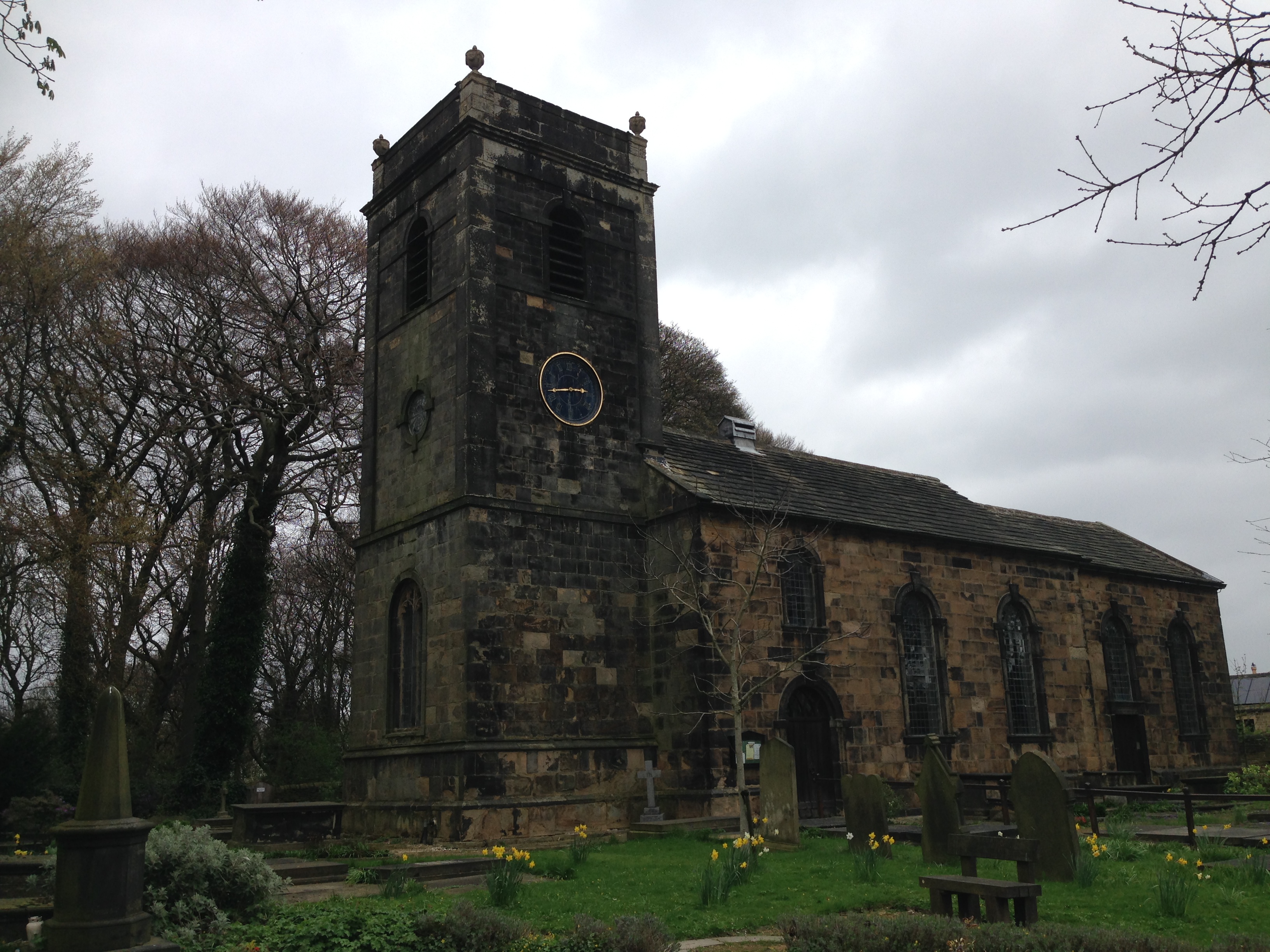
Stephen did not follow the family trade.  By the time he married Abigail Hirst on 24 December 1815 at All Saints, Batley Parish Church, following banns[2], he worked as a miner. Abigail was the daughter of John and Susannah Hirst[3]All Saints Church, Batley 2

During this period, Batley was not the normal location for marriages for Drighlington folk.  The town fell within the remit of Birstall Parish, and the normal venue for such occasions was St Peter’s Church in Birstall.

However, within a short time of their marriage, there appears to have followed a strange turn of events. On 14 November 1816, with Abigail pregnant, it seems that Stephen travelled to Leeds to enlist as a Private in the Army, joining the 51st Foot Regiment[4], the forerunner of the King’s Own Yorkshire Light Infantry.  Claiming to be 17 years of age he enlisted for life[5].

In the meantime Abigail, now living in Adwalton, gave birth to a son, Thomas, on 5 April 1817. The baptism took place at St Peter’s Birstall on 1 June[6]. Oddly, Stephen’s profession is described as a collier, no mention of the Army.

Stephen may have been in Yorkshire in January 1821 because a Stephen Burnett acted as a witness at the marriage of John Burnett at St Peter’s Birstall.  John was another of the children of Robert and Ann Burnett. The only question mark is that Robert’s father was also called Stephen, and to date I have not traced his death.

However, whatever the circumstances, Stephen was clearly estranged from his wife.  On 30 May 1825 in Batley Parish Church, the same location as her earlier nuptials, Abigail undertook what in effect appears to be a bigamous marriage to William Gallaway[7]. There is no marital status indicated for either party in the Parish Register.

It is a distinct possibility that Abigail was pregnant and this forced the issue. It appears she and William may have had a son, Joseph, born in Adwalton in around 1825. No baptism has been traced to confirm the parentage of Joseph. But he features in the 1841 and 1851 censuses with the family[8].

In this period there was a seven years’ absence defence for bigamy.  If a spouse had not been heard of for seven years and there was no indication as to whether they were still alive, in such circumstances the abandoned partner was free to re-marry.  A variation of this was if the spouse had been absent and overseas for seven years.[9]  If the spouse subsequently reappeared, the second marriage, although not bigamous, would be declared void.

However, if it was Stephen that visited home only four years earlier in 1821 this would cast serious doubt about the application of the seven year rule. An appearance at a family wedding would hardly go unnoticed. Neither could the overseas absence claim apply as, although Stephen enlisted in 1816, his Regiment was home-based until spring 1821.

Within months of Abigail’s “marriage” to William events took an unanticipated twist. In November 1825, after eight years’ Army service, Stephen was discharged to pension. He was suffering from an illness described as “organic disease of the thorax”, which he contracted in Falmouth in 1818. This was now serious enough to render him unfit for further military service.

His discharge papers describe his conduct as good. They state he was born in Flockton. They describe him as 5’6” tall, with brown hair, grey eyes and fair complexion. They also give his trade, a collier. It appears he immediately returned home to Drighlington, where he was again a witness at a family wedding – this time for his sister Mary in December that year.[10]

One cannot begin to imagine the consternation caused to William and Abigail when news of Stephen’s return reached them. Now at the very least their “marriage” would be declared void; at its worse the ignominy of a trial and the threat of transportation if convicted hovered over them if the truth came to light.

They were spared the ordeal.  An ill man, shortly after his return Stephen died aged 30.  His burial took place at St Paul’s, Drighlington on 4 July 1826[11].

This still left William and Abigail in a tricky situation. Now a widow she was free to marry and this is the course of action she took to legitimise her union with William. Swiftly after Stephen’s death, Abigail and William married at a different parish church, that of St James, Tong, on 1 October 1826[12]. The entry in the register now states Abigail is a widow.  And was it an accident or deliberate that William’s surname had subtly changed to Galloway?

Tong Parish Church

Tong Parish Church

To conclude the strange tale of Stephen and Abigail, their son Thomas survived to adulthood. In the 1841 census he is living in Tong with Abigail’s parents. He married Betty Webster on 6 March 1843 and the register entry names his father as Stephen Burnett, miner[13]. Thomas’ address at the time of his marriage is given as Farnley.  After initially living in Tong, Farnley appears to be where Abigail and William settled sometime between 1839 and 1841[14]. In addition to Joseph the couple had at least six other children. The youngest child was named “Hirst,” a reference to Abigail’s maiden name[15].

There are a number of question marks over the theory behind the story. These include the baptismal entry for Stephen and Abigail’s son Thomas, and the possible reappearance of Stephen in 1821 for John’s wedding. Another apparent discrepancy is Stephen’s signature. Stephen could sign his name. Because of this we have four samples signatures taken from marriage registers and his Army papers.

The entries in the various parish registers are fairly consistent. The signature on his Discharge Papers is not identical, being just his initial rather than full Christian name. But the rest of the signature is not out of step.

So is the Stephen Burnett in the Army the Drighlington Stephen Burnett? I suspect it is, as the mystery which surrounds Abigail and William Galloway’s two marriages coupled with the timing of Stephen’s Army discharge and death seem to point to something being amiss.

Sources:

  • Ancestry.co.uk: Parish Register of St Michael’s, Thornhill
  • Ancestry.co.uk: Parish Register of St Peter’s, Birstall
  • National Army Museum – History of the 51st Regiment of Foot http://www.nam.ac.uk/research/famous-units/51st-2nd-yorkshire-west-riding-or-kings-own-light-infantry-regiment
  • Find My Past: WO97 Royal Hospital Chelsea: Soldiers Service Documents
  • Ancestry.co.uk: Parish Register of Batley All Saints
  • Find My Past: 1841 and 1851 Census
  • Anestry.co.uk: Parish Register of St Peter’s, Leeds
  • Ancestry.co.uk: Parish Register of St James’, Tong
  • Ancestry.co.uk: Parish Register of Leeds St Peter’s Parish Church
  • Find My Past GRO BMD Records – Baptisms
  • “Marriage Law for Genealogists: the definitive guide” – Rebecca Probert
  • “Divorced, Bigamist, Bereaved?” – Rebecca Probert

[1] Thornhill St Michael’s Parish – Flockton Register
[2] Note the marriage was by banns and not by licence. So even if the parties were underage at the time of their marriage, it would not have subsequently be declared invalid
[3] Her baptism is recorded in the Parish Register of St Peter’s Birstall on 7 October 1798. At the time her parents lived in Drighlington, although there is sometimes some overlap in records between Drighlington and the neighbouring village of Adwalton. The 1851 census records Abigail as being born in Adwalton.[4] http://www.nam.ac.uk/research/famous-units/51st-2nd-yorkshire-west-riding-or-kings-own-light-infantry-regiment
[5] Find My Past, British Army Service Records: WO97 Chelsea Pensioners British  Army Service Records 1760-1913, Box 645, Box Record 95 – Discharge papers
[6] St Peter’s Parish Church Birstall Parish Register – Baptisms. Ancestry.co.uk transcript indicates 17 June for baptismal date, but this appears to be an error
[7] Batley All Saints Parish Register – Marriages, under the name Abigal Burnet
[8] This is supposition. In the 1841 census, when no family relationships were given, Joseph is recorded in the Farnley home of William and Abigail, age 16.  In the 1851 he is described as “son”. But that could equally refer to being the son of just William as it could to being the son of both William and Abigail.
[9] “Marriage Law for Genealogists” and “Divorce, Bigamist, Bereaved?” – Rebecca Probert
[10] Mary Burnett is my 3x Great Grandmother. Her marriage to William Clough is recorded in the St Peter’s Parish Church Birstall Parish Register – Marriages[11] St Paul’s Church, Drighlington – Burials
[12] St James’ Parish Church, Tong Parish Register – Marriages. The place did have family associations, as by the time of the 1841 census, Abigail’s parents lived here.
[13] Leeds St Peter’s Parish Church Parish Register – Marriages
[14] Given the birth places of their children according to the 1851 census, and the fact that by 1841 they were living in Farnley
[15] Hurst according to the 1851 census, but Hirst in the GRO entry and 1841 census,

The Battle of Bellewaarde, 16 June 1915: A Batley woman’s efforts to discover her Royal Scots Fusilier husband’s fate

This blog posting is the story of two people: Michael Rourke and his wife Margaret Duffy. Michael died during World War 1.  The story is as much about him as it is about his wife and the extraordinary efforts she made to discover his fate.

Both were parishioners of Batley St Mary’s RC Church, ordinary working class Yorkshire folk, with the County Mayo background typical of the parish.  Margaret did not have the money and contacts of some who found themselves in similar desperate positions during the war.  But she had persistence, ingenuity and determination.  Her story is the story of many other families up and down the country trying to find out what had happened to missing husbands, fathers and sons.

Michael and Margaret do not have any link to my family. This work is based on research I did for my charity booklet about the men named on the Batley St Mary’s War Memorial.

Michael was born in West Town, Dewsbury in 1877. He was the eldest child of Irish-born parents, Patrick and Bridget Groark (neé Mullany) who married in 1876.

At this point it is worth mentioning the complexity of certain Irish surnames which, even in the late 19th/early 20th century, continued to have various versions.  Groark was one of these, and the family can be found using a number of variants including Groark, Rourke and even Groak. I have referred to Michael as “Rourke” throughout, as this was then name he used when enlisting in the Army in the 1890s, and indeed the family seemed to use this version initially.  But by around 1900, at the time of the birth of their youngest child Agnes, the family were transitioning from Rourke to Groark, and this version became the commonly used one as the 20th century progressed.

Michael was one of ten children. His siblings included Mary Ann (1879), James (born in 1881 but who died the following year), Maggie (1883), Lizzie (1887), James (1889), Henry (1892), Francis (1894), Nellie (1896) and Agnes (1900).

Initially the family lived in the Dewsbury RC parish of St Paulinus.  In 1881 they resided on Ingham Road, Dewsbury with Patrick described as a cart driver.   By 1889, as is shown in the baptism for their second son bearing the name James, the family had moved to neighbouring Batley.  James was their first child to be baptised in St Mary’s parish.

In 1891 they were recorded as living at North Street, Cross Bank, one of many streets of houses in the vicinity of St Mary’s church; then in Wooller Houses, in nearby Carlinghow in 1901.  By 1911 they were back in North Street.  During this period Patrick worked in agriculture as a farm labourer, and the 1911 census gave more detail specifying that he was a cowman.  Bridget worked in the woollen industry in 1881 as a weaver and in the following census as a rag sorter.

13-year-old Michael is recorded in the 1891 census as working as a coal miner.  In April 1897 he enlisted in the Militia with the 3rd Battalion, The King’s Own (Yorkshire Light Infantry).  As mentioned earlier his attestation papers were under the name “Rourke” and indicate that he was employed as a hurrier at Critchley’s colliery. It is in this name that all his military records can be found.

“Hurrier” was the Yorkshire term for the person who moved the coal tubs from the coal face where it had been hewed to the shaft at the pit bottom. They might be known as a waggoner in some parts of the country, a drawer in Lancashire, a putter in Northumberland or a haulage-man in Scotland.  Hurriers in this period were usually youths as this was one of the early stages in a normal career progression pattern through underground pit roles.

The same attestation papers also provide a physical description. Michael was 5’3” and 104lbs, fresh complexioned with light grey eyes and dark hair.  However within a week of signing up, he purchased his discharge for £1.

In July 1897, still employed by Critchley’s  but this time as a collier, he changed his mind and re-enlisted  in the Militia serving once more with the 3rd KOYLI for just over 12 months before transferring to the Regular Army with the Royal Scots Fusiliers in July 1898.  His Regular Army attestation papers describe him as 5’3¾” and 111lbs, fresh complexioned with light grey eyes and brown hair.  He had a small, round scar over the outer end of his right brow and a scar on the back of his right middle finger.

However a pattern was emerging as, yet again, Michael had a change of heart and in November 1898 was discharged on payment of £10, half of which was refunded in May 1899. He returned once more to work for his former employer at Critchley’s colliery.

The reason for the refund is not mentioned. But the probable cause is because, true to his previous form, Michael had once again signed Militia attestation papers in January 1899 with the 3rd KOYLI and by April 1899 was back with the Royal Scots Fusiliers[1]. The 1901 census shows him at home with his family, but his occupation is a soldier.

I have not tracked Michael’s life in the next 10 years, but according to newspaper reports he did serve in South Africa in the 2nd Boer War.

By 1911, Michael had returned home to Batley. Weeks prior to the 1911 census Michael’s mother Bridget died.  She was buried in Batley Cemetery at the beginning of March.  Michael was now once more out of the Army and living with his family.   He had changed career totally and now worked in the woollen industry as a mill hand willier[2].  This was his occupation immediately before the war at Messers Chas Robinson and Company’s mill.

On 7 June 1913 Michael married at St Mary of the Angels Church. His bride was Margaret Haley (neé Duffy), a widow with three children.

Margaret was born on 11 December 1876, the daughter of County Mayo-born coal miner Patrick Duffy and his wife Mary (neé Regan). The Duffy’s have two other younger daughters recorded in censuses – Mary and Catherine.  A fourth daughter, Bridget, died infancy. The family lived in Birstall[3] with Margaret, when reaching working age, being employed in the local woollen industry as a weaver.

Margaret married general labourer John William Haley in late 1899 and the couple settled in Whitwood, Castleford.  The marriage was short for John died in 1903, age 34. At the time Margaret had two children, Thomas (1900) and Patrick (1902). She was also heavily pregnant.  She returned home to Birstall and her family.  Daughter Margaret Kathleen was born in late 1903. By 1911 Margaret and her three children were residing with her widowed father in the town, but she moved to Batley after her marriage.

According to the baptismal register at St Mary’s, Michael and Margaret’s only child, a son named Michael, was born on 11 April 1914. The family lived at North Street, Cross Bank and this was the family address when war was declared.

Michael and his three brothers all joined the Army.  Michael was immediately called up as a National Reservist, going out to France with the 1st Battalion, The Royal Scots Fusiliers in early September 1914[4]. James enlisted with the York and Lancaster Regiment; whilst Henry and Francis served with The King’s Own (Yorkshire Light Infantry).

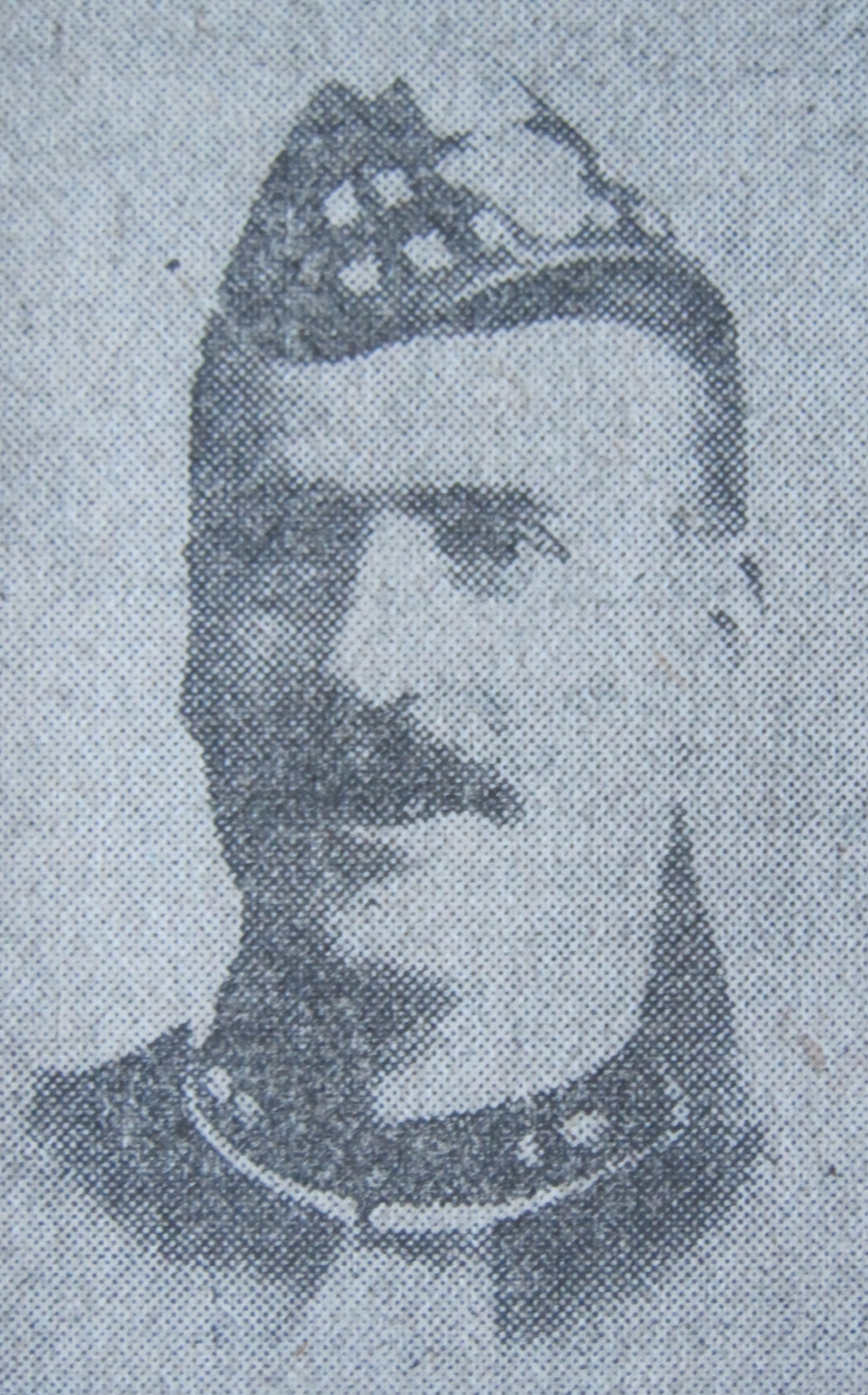
Michael Rourke

Pte Michael Rourke, 6093, 1st Bn Royal Scots Fusiliers

In early November 1914 Margaret received an official communication from the Infantry Record Office at Hamilton informing her that her husband had been admitted to hospital at Port-le-Grand, suffering from bronchitis.  She had not received a letter from him since the middle of October and was naturally very anxious about his condition, although the communiqué did give her  some small measure of reassurance that any news about his health would be immediately passed on to her.  Shortly afterwards, that same month, he was invalided home with rheumatism.  After a spell in England he returned to the Front for a second time.

In May 1915 a letter from him was published in the “Batley News”.  He said he was well and the weather very hot.  He also mentioned that the men got a bath and change of clothing when out of the trenches.  He also enclosed a copy of an address to his Battalion by his Brigade Commander, highly complementing them on their part in an action in which Michael participated.  This read:

“In order to cover the right flank of troops on our left, your battalion was ordered to take up a very bad and exposed position on a forward slope and sure enough on the morning after you were exposed to a very heavy shell fire, followed by an infantry attack by vastly superior numbers.  The Germans came pouring through, and it soon became obvious that your position was untenable, and we were ordered to take up a position further back. 

The Colonel, gallant soldier that he was, decided, and rightly to hold his ground, and the Royal Scots Fusiliers fought, and fought until the Germans absolutely surrounded and swarmed into the trenches.  I think it was perfectly splendid.  Mind you, it was not a case of “hands up” or any nonsense of that sort.  It was a fight to a finish.  What more do you want?  Why, even a German General came to the Colonel afterwards and congratulated him and said he could not understand how his men had held out so long.  You may well be proud to belong to such a regiment, and, I am proud to have you in my brigade. 

General Sir Smith Dorrien also praised the RSF for their fine work after Neuve Chappelle.  He visited them in billets and addressed them in terms of high praise.  “None but the best troops could do the work, and so I sent you, and you have done it”

 Michael’s last letter home was dated 14 June 1915.  By early July his family were becoming increasingly uneasy as to his wellbeing, but there was still no definite information.  The first disquieting news had arrived from a fellow-Batley soldier in late June. Pte C King of the 1st Northumberland Fusiliers wrote to Margaret on 21 June as follows:

“Mick and I were together on June 15th and promised that if anything happened to either of us on the 16th we would write to his home.  I hope you will not take this too seriously but live in hope; I went round his regiment and could not find any Mick.  Some of his pals told me he was wounded”.

Writing to Mr. A Baines of Upton Street, Cross Bank, Batley on 30 June Pte King wrote further about the fate of his friend:

“I am very sorry for Mrs Rourke.  His regiment was in the charge with us on the day I will never forget – the 16th of June.  I saw for myself that he was amongst the missing, but there is hope yet.  It was a bloody sight but a grand charge.  We had a lot of casualties and they lay all over.  My deepest sympathy goes to Mrs Rourke, for I am very much afraid that poor Mick is gone.  The Germans shelled us for 27½ hours after we made the charge and the men were blown to bits; it was hell”.

There then followed months of uncertainty interspersed with inconclusive, sometimes conflicting, information, as Margaret desperately tried to find any information as to what had become of Michael.

Around the same time as she received news from Pte King, she also received information that her husband had been wounded and taken into a Chelsea Hospital.  She asked the Record Office for information but they told her that her husband’s name had not yet appeared on any casualty list, and no report had been received that he had been admitted to any hospital.

But Margaret did not give up this line of inquiry; instead, using her church contacts, she followed it up by contacting Father F Kerr McClement of St Mary’s, Cadogan Street, Chelsea[5] to see if he could be of assistance.  Unfortunately he was unable to provide any positive news, writing to her:

“I am sorry you have had so much anxiety as to your husband and I have done my best to find his whereabouts.  He is not in St Mark’s College, Chelsea (which is generally known as Chelsea Hospital) nor in St Georges Hyde Park Corner, Victoria, Tite Street, or in any of the private hospitals visited by us”.  

On Saturday 17 July, Mrs Rourke finally received a communication from the War Office stating that they were sorry to inform her that her husband had been missing since the 16 June. At the time he was serving with the 1st Battalion’s “A” Company.

Margaret’s next recorded steps were to contact two organisations with expertise in tracing the whereabouts of missing soldiers – the British Red Cross and Order of St John Inquiry Department for Wounded and Missing Men.  The former organisation responded with the following news:

“Pte Pilgrim, of this regiment (the Royal Scots Fusiliers), who is now in No 2 Canadian General Hospital, Le Treport, tells us that there are two men named Rourke in his regiment.  The man whom he knows something about is a slim man, slightly built dark, with a moustache, about 38 years of age.  This man was wounded at Hooge on June 16th, and could not be brought in, as the Germans had retaken trenches which they had lost.  We do not know if this refers to the man for whom you are inquiring; perhaps from the description you could tell us if it is so.  But you must remember that it is not at all certain from this report what happened to Pte Rourke.  We hope to obtain more information which will make the matter clearer.”

The description given matched Michael’s. The records of the International Committee of the Red Cross do show that Margaret made enquiries about Michael, but sadly only the card noting this and Margaret’s address exist.

As more and more news filtered through, it appeared that Michael had taken part in an attack at Hooge where the Allies captured four lines of German trenches.  The Germans counter-attacked re-capturing the last two trenches.  Michael lay wounded in the third line of trenches, but so severe was the action that when the retreat came and the Germans re-captured that line, his comrades were unable to take their wounded colleagues back with them.

Margaret still did not give up, continuing to write to authorities in an attempt to establish any firm news of her husband’s fate, clinging to the hope that if not lying injured in an Allied hospital, perhaps he was being held as a prisoner of war.  With this in mind her next step was to write to the King of Spain.

Spain was a neutral country and King Alfonso XIII contributed a great deal to improving the treatment of prisoners throughout the conflict.  At his own expense he maintained a staff of 40 who helped him serve as an intermediary between prisoners and their families, using the Spanish diplomatic network in his endeavours.  In response to her plea for assistance she received the following reply:

“Palacio Real de Madrid,
October 30 1915

Madam, – I am ordered by His Majesty the King, my august sovereign, to answer your letter petitioning His Majesty to cause enquiries to be made in Berlin with regard to Mr Michael Rourke, you husband.  Although His Majesty’s Embassy in Berlin is charged only with the interests of France and Russia, His Majesty being desirous nevertheless of demonstrating his interests in British subjects, has graciously acceded to your request, and has commanded the Spanish Ambassador in Berlin to communicate with Great Britain’s representative there – the United States Ambassador – in order that in conjunction with the latter the necessary investigations may be made.  His Majesty earnestly hopes that these enquiries may be the means of procuring satisfactory information for you – E de Swire”.

Satisfactory information sadly was not forthcoming and Margaret continued in her quest.

Many other women were also tirelessly pursuing word about their missing menfolk, with advertisements for information appearing in newspapers.  It was in one of the Sunday papers that Margaret saw an advert from Elizabeth Morton from Chesterfield seeking news about her husband Lance Corpl Thomas Morton, 1st Royal Scots Fusiliers, reported missing on 16 June 1915 at Hooge.   Noting that this soldier was in the same Battalion as her husband and had been missing since the same date, Margaret wrote to Mrs Morton expressing sympathy with her and pointing out that she was in the same predicament.

Mrs Morton had received a response to her advert from a Pte Harry Thomson of the 1st Royal Scots Fusiliers, who was in a military hospital in Newcastle on Tyne.  He communicated the news of her husband’s death.  Mrs Morton passed Pte Thomson’s address to Margaret in the hope that he would be able to shed some light as to the fate of Michael.  Margaret wrote to him and received the following response:

“I am sorry to tell you that your husband, Pte Michael Rourke, was killed on the 16th June 1915.  He was slightly wounded with myself and Lance Corporal Morton.  I wanted him to go back to the dressing station and get looked after there, but he would not hear of it.  He wanted to go on and have it out with the Germans as he called it.  We went on together for about 20 yards when he fell with a bullet through the head.  He never spoke after it.  We managed to get him and some more of our men back later on and bury them behind our firing line.  I am sorry to have to tell you the sad news Mrs. Rourke, but it is best to know the truth.  The regiment lost very heavily that morning. The Royal Scots Fusiliers did their work very well.  I am glad to say that I am keeping a little better.  This is the second time I have been wounded.  I hope you are keeping well, yourself and all your family.  Anything also that you want to know about “Mick”, as we used to call him, I shall be pleased to tell you if I can.  I must close now as the doctor is on the rounds”.

Margaret forwarded the letter onto the War Office.  Towards the end of May 1916, eleven months after initially being posted missing, she received a letter in reply which confirmed that her husband was dead.  The letter read:

“Madame, with reference enquiry concerning Pte Rourke 1st Royal Scots Fusiliers I am directed to inform you that no further news having been received relative to this soldier, who has been missing since the 16th June 1915, the Army Council have been regretfully constrained to conclude that he is dead and that his death took place on the 16th June 1915 or since.  I am to express the sympathy of the Army Council with the relatives of the deceased:-your obedient servant C.F. Waitherton[6].

Michael died in what was known as the Battle of Bellewaarde. His body was never identified.  According to the website[7] dedicated to remembering the Battle, more than 1,000 men lost their lives within a 12 hour period on 16 June 1915, in an area of approximately ½ mile square.

Menin Gate Inscription

Menin Gate Inscription

Michael is commemorated on the Ypres (Menin Gate) memorial, alongside the names of more than 54,000 other officers and men whose graves are not known. These include Lance Corporal Thomas Morton, husband of Elizabeth, with whom Margaret had corresponded during her search.

Of Michael’s other brothers only the youngest, Francis, survived the war.

From cemetery and BMD records it appears Margaret never remarried. There is a burial in Batley Cemetery in April 1957 for Margaret Groark, aged 80.

The Menin Gate

The Menin Gate

Sources:

Copyright

© Jane Roberts and PastToPresentGenealogy, 2015. Unauthorized use and/or duplication of this material without express and written permission from this blog’s author and/or owner is strictly prohibited. Excerpts and links may be used, provided that full and clear credit is given to Jane Roberts and PastToPresentGenealogy with appropriate and specific direction to the original content.

[1] I have traced six sets of attestation papers for Michael.
[2] A wilier/willeyer was someone who fed the willeying machine  which was used to break down the rag and wool, thus separating and cleaning the fibres
[3] Birstall adjoins Batley. Up until 1905 when St Patrick’s parish was established in its own right, Birstall fell within the Catholic parish of St Mary’s, Batley.
[4] Service Number 6093
[5] One of the oldest Roman Catholic parishes in central London
[6]  This featured in two newspapers, the “Batley Reporter and Guardian” and the “Batley News”. The latter indicates the letter was signed C F Watherston.
[7] http://www.bellewaarde1915.co.uk/ Website includes extracts of the 1st Battalion Royal Scots Fusiliers Unit War Diary.
Three Men; two towns; one Parish (Batley, Poperinge and St Mary’s in WW1)

This is the story of three men, a series of coincidences and a twist of fate linking the West Yorkshire town of Batley, its Roman Catholic Parish of St Mary of the Angels and the Belgian town of Poperinghe[1] during World War 1.  The men are Michael James Flynn, Thomas Foley and Julien Cornelius Kestelyn[2].  Michael Flynn and Thomas Foley, whose lives followed remarkably similar patterns, were Army Reservists who re-joined their regiments at the outbreak of war. Julien Kestelyn was a Belgian priest.

St Mary of the Angels RC Church, Batley

St Mary of the Angels RC Church, Batley

Michael Flynn was born in Batley on 17 December 1879 and baptised at St Mary’s in January 1880. His parents Thomas Flynn and Ellen Egan came from County Mayo, the area where the majority of the Irish population of Batley originated. By 1871, when Thomas and Ellen married, Irish born families and their children made up around ten per cent of the town’s population. Michael was one of the Flynn’s seven children.  Thomas Flynn supported his family by working initially as a coal miner and then as a pit banksman, the mine surface worker responsible for raising and lowering the cage.  In  1911 he was a night watchman in the employ of Batley Corporation.

In civilian life Michael followed his father’s coalmining footsteps, working as a coal hewer. This was the man who extracted the coal from the coal face.  He plied his trade in the coal mines of Batley and Barnsley but at the outbreak of war he was back in Batley and employed at Howley Park Colliery.

In addition to his mining job Michael also served in the Militia for six years.  In March 1902, at the tail end of the 2nd Boer War, he joined the 3rd King’s Own (Yorkshire Light Infantry). His attestation papers describe him as 5’5½” tall and weighing 130lbs.  He had a ruddy complexion, dark grey eyes and dark hair.  He had five scars on the small of his back down his spine and his left little finger had been deformed as a result of an accident.

At the time Michael enlisted, the Militia was a volunteer force, seen as an alternative to the Regular Army.  After volunteering and undergoing basic training, men returned to civilian life but reported for regular periods of military training. They were not normally obliged to serve abroad, although some did during the South African War (1899 -1902).   In 1908 as a result of the Haldane reforms, the Militia battalions were turned into Special Reserve battalions, which trained part-time just as the Militia had, but would provide drafts to reinforce the regular battalions of their regiments in the event of war. It was in the midst of these changes that Michael was discharged as time-expired in March 1908, returning to his hometown and parish.

Thomas Foley was from a remarkably similar background to Michael Flynn. Two years Michael’s junior, he was born in Batley on 10 December 1881 and baptised at St Mary’s later that month.   His parents, John and Bridget Foley (neé Cafferty) were, like Michael’s, from County Mayo. Like the Flynn’s, the Foley’s had seven children.  And, in another similarity, Thomas’ father also undertook a number of different jobs to provide for his family, though these were far more disparate than the ones carried out by Michael’s father.  John Foley’s jobs included a mason’s labourer, gas stoker, coal miner and latterly a willeyer in the shoddy industry of Batley.  This job involved feeding the willeying machine used to break down the rag and wool, thus separating and cleaning the fibres.  Employed at J T & J Taylor’s Blakeridge Mills, he was described as an industrious and well-respected employee.

Like Michael, Thomas was a coal hewer who enlisted with the Militia.  At the time of his enlistment he was employed by Critchley’s.  He signed up slightly earlier than Michael, in November 1899, just before his 18th birthday. According to his attestation papers the 5’4½”, 112lbs, fresh complexioned, blue-eyed, red-headed teen joined the 3rd West Riding Regiment.[3]  Whereas Michael’s Militia service was home-based, Thomas did serve overseas as his military service coincided with the 2nd Boer War. The mobilisation of Militia needed an official order of embodiment into the Army and this was announced in November and December 1899. Thomas’ record shows that he was “embodied” with the Regiment on 22 February 1900 and “disembodied” on 10 May 1902.

His experiences in the Militia must have given him a taste for Army life, because in March 1903 he enlisted in the Regular Army, joining The Cheshire Regiment.   He signed up for 12 years – three years in the Regulars followed by nine years in the Army Reserve.  By now he was a shade over 5’6”[4] weighed 130lbs and had a heart tattoo on his left forearm.   His conduct whilst in the Army was described as good. However his records do show the occasional instances of drunkenness (especially in his early days around Chester), violently resisting escort, attempting to damage Government property, absenting himself and using threatening language towards a NCO.   Interestingly, given his Irish background, one occasion was on St Patrick’s Day 1904 when he absented himself from Tattoo until he was found drunk and creating a disturbance in barracks at Aldershot.

In terms of skills, his musketry classification was 1st Class and he passed instruction classes in swimming. The latter is no surprise. His old school of St Mary’s was renowned locally for its excellent swimmers, regularly winning local inter-school competitions.

Thomas went onto the Army Reserve in the spring of 1906, returning to Batley to work as a miner, this time at Messrs Crawshaw and Warburton’s Shaw Cross Colliery.  And whilst living in the town, like Michael, he became a member of the St Mary’s (Batley) Branch of the National Catholic Benefit and Thrift Society, a Catholic insurance organisation.

He remained in Batley for around seven years before deciding to seek better wages abroad. On 24 April 1913 he set sail from Liverpool on board the “Arabic” bound for the port of Halifax, intending to make a new life in Canada. Some reports indicate he settled in St John, New Brunswick. Others state Kensington.

Britain’s entry into the War on 4 August 1914 was to change everything for both men. As Reservists, Michael and Thomas were re-called to the Colours: The former to the 2nd Battalion, The King’s Own (Yorkshire Light Infantry); the latter to the 1st Battalion, The Cheshire Regiment.

Thomas was one of many British Army Reservists who returned to England from Canada on-board the “Corinthian”. The ship sailed from Montreal and Thomas embarked at Quebec, docking in the port of London on 4 September 1914.  He enjoyed an unexpected four days furlough at the end of September 1914 which enabled him to visit his family and friends in Batley for a final time, before re-joining his Regiment.  He also left his medals, including from the South Africa campaign, with his family for safe-keeping.

At the beginning of October 1914 Thomas went to France. The 1st Battalion the Cheshire Regiment was desperately in need of re-enforcements. According to the Unit War Diary, it had lost 78 per cent of its strength in the retreat after the 24 August 1914 Battle of Mons.

Michael arrived in France a couple of months later in early December 1914. His Battalion had also taken part in the retreat from Mons.   Their War Diary shows that they incurred 600 casualties following the Battle of Le Cateau on 26 August 1914. In common with all other Battalions on the Front, a steady leach of men was maintained thereafter so reinforcements were continually required to feed the beast of war.

By the New Year both men were in Belgium.  In the meantime an influx of Belgium refugees were arriving in Britain.  It is estimated that 250,000 made their home here during the course of the war affecting all areas, including Batley.

There was much sympathy for the plight of “Plucky Little Belgium” and widespread horror at the atrocities inflicted upon it by the invading Germans. This translated into an outpouring of offers of accommodation and a network of voluntary relief work across Britain, with Belgian Relief Funds established countrywide to support the refugees.

At the beginning of October 1914 the Citizens’ Sub-Committee for Belgian Relief accepted Batley’s offer of accommodation at Shaftsbury House, Upper Batley.  The doctors of Batley also undertook to provide their services free of charge for the refugees.

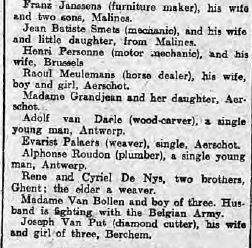
The first batch of 25 Belgians arrived in the town later that month. They were greeted at the railway station by a Mayoral welcoming party and cheered on by thousands of townsfolk as they made their way to their new Batley home. The full complement of refugees was listed in the local paper, accompanied by selected photos and tales of frightful brutalities suffered at the hands of the German invaders, all serving to whip up public support for the war.

List of  Belgian refugees arriving in Batley in October 1914

List of Belgian refugees arriving in Batley in October 1914

By early November the Batley Belgian Relief Fund stood at £141 5s 10½d.  At the end of the month with offers of more accommodation, the town had around 50 refugees in a number of locations with the papers continuing to provide details of the names, ages, abode and occupations of what were paternalistically referred to as “our refugees”.

One month later the Relief Fund had doubled, standing at £282 12s 8½d, including a 5th donation from St Mary’s RC Church. The latest sum contributed by parishioners amounted to £3 12s 10d.

The papers provided regular progress updates of the “Belgian guests,” including employment, illnesses suffered, hospitalisation, deaths, day-to-day activities, news of further arrivals and departures and information about funds raised to support them.  All of which ramped up sympathy and a willingness to assist.

Fundraising and helping Belgian refugees was a way for the people of Britain to feel as if they were contributing to the war effort whilst their husbands, sons and fathers were away fighting for that plucky little country. This included the families of the military men of Batley St Mary’s, who may have had an added incentive to donate given the Catholicism of Belgium.

Thomas Foley’s last letter home, which his parents received on 3 March 1915, was described as “cheerful” and intimated that he was in the best of health.

It appears that on 7 March 1915 whilst in action Thomas suffered fatal injuries.   His  Casualty Form  notes that he was treated initially by the 94th Field Ambulance for what was described as a “bullet wound left shoulder, right of neck and lung injured”[5].   From there he was transferred down the line to Number 3 Casualty Clearing Station (CCS) Clearing Hospital at Poperinghe. The town was well situated, being the nearest sizeable and relatively safe location to Ypres, suffering only the occasional long range bombardment.  So at this stage of the war it was an ideal position for a CCS.

The purpose of CCS’s was to treat the injured so they could be returned to duty quickly or evacuated to a Base Hospital. They moved location frequently.  According to some records Number 3 CCS was at Hazebrouck during March, the period of Thomas’ death, and did not move until April to Poperinghe. But the Poperinghe location is further confirmed in his entry in “The Army Registers of Soldiers’ Effects”.

Thomas was too seriously injured to transfer to a Base Hospital. He died from his wounds at the CCS on 11 March. His Casualty Form records his burial in the military cemetery of Poperinghe and indicates that his grave was marked with a cross duly inscribed.  His family received official news of his death in early April.

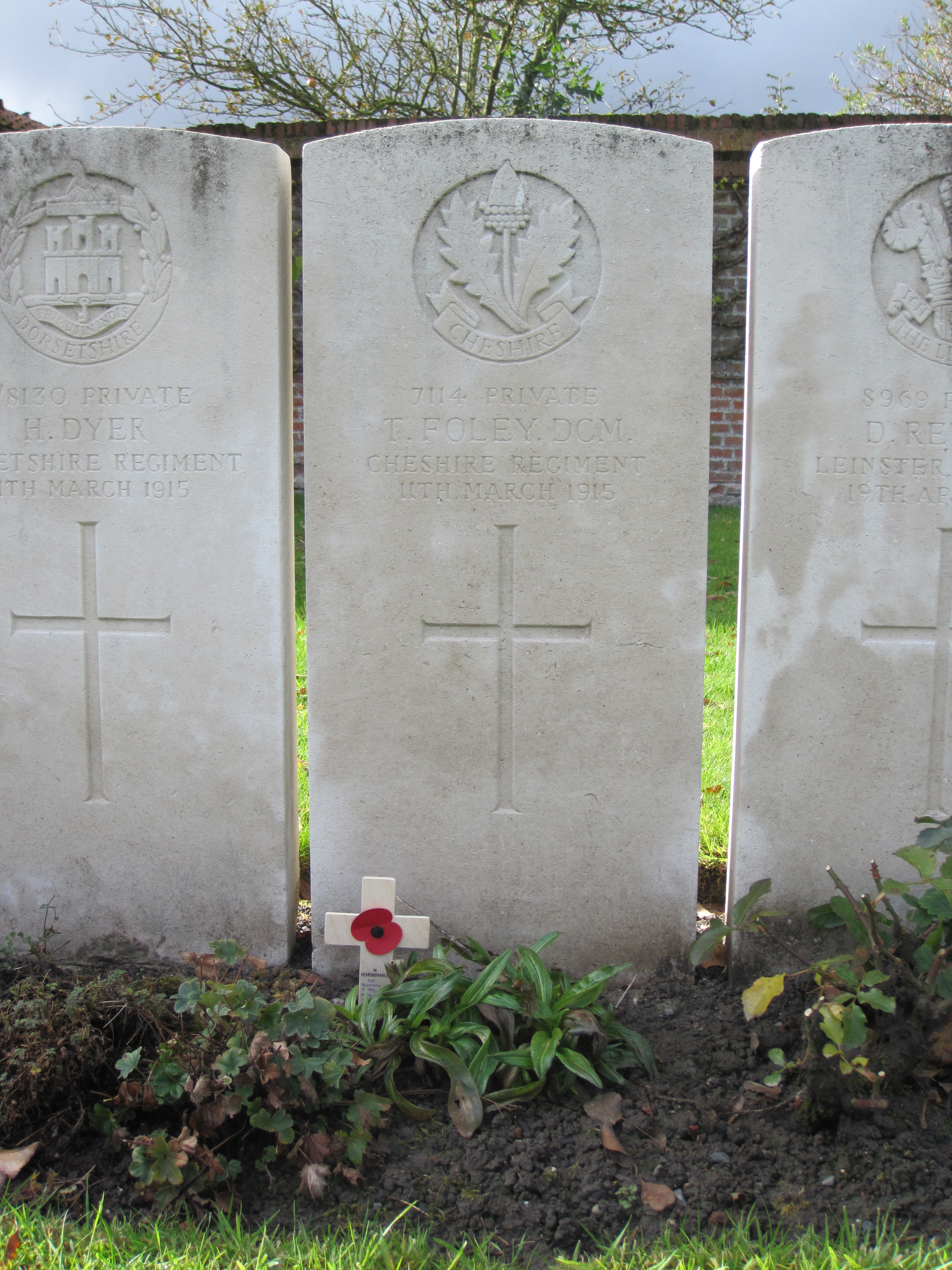
Grave of Pte Thomas Foley DCM, 7114, 1st Battalion The Cheshire Regiment, Poperinghe Old Military Cemetery

Grave of Pte Thomas Foley DCM, 7114, 1st Battalion The Cheshire Regiment, Poperinghe Old Military Cemetery

It later transpired that, whilst injured, he performed acts of heroism and courage and for these actions he was awarded the Distinguished Conduct Medal (DCM).  According to the Batley News he was the first Batley man to win the coveted distinction. The full citation, which was published in the supplement to the London Gazette on 30 June 1915, said:

“For conspicuous gallantry and devotion to duty, notably on the night of March 7th, 1915, when he went out in front of our trenches to bring in some stretcher bearers who had lost their way.  Subsequently he went out three times under heavy fire to bring in wounded men, and although wounded more than once himself he continued to carry out his duty.”

The medal was forwarded to his father in September 1915.  Along with the medal came a letter from Major Parr from the Infantry Records at Shrewsbury, on behalf of the Colonel of the Regiment.  Major Parr wrote:

“In forwarding the medal I trust you will allow me to add my sympathy in the loss of your son, and trust that the decoration for his gallant conduct may be some consolation in your trouble”.

John Foley said of his son, ‘Although I am his father, I do not hesitate to say that a finer, straighter, or cleaner lad has not set foot on the fields of France’.  Only a month later, on 15 October 1915, Thomas’ mother, Bridget, died

A month after Thomas’ death, Michael Flynn died from wounds in the same CCS on 12 April 1915.  His last letter arrived home on the day he died.  In it he said that they were having a rough time.

It is unclear when he received his fatal injuries.  But in the period leading up to his death, from 1–10 April 1915 the 2nd KOYLI were alternating between the support and front line trenches in the Verbrande Molen area, south east of Ypres.  On 1 April the Unit War Diary notes that although the enemy’s artillery was active, it did little damage.  This changed on 5 April when they were in the front line trenches and “D” Company in Trench 35 were heavily shelled and bombed at intervals throughout the day.  They suffered 14 casualties.  The shelling and bombing continued the following day.  The 2nd KOYLI received support from Belgian artillery but unfortunately one of their shells fell short landing in 36 Trench, wounding 5 men from “A” Company.  They were relieved later that day and went to the support dugouts, with “D” Company returning to Ypres.  But even at Ypres they were not safe, a shell hitting Battalion HQ on 7 April causing more casualties.  Late on 7 April those companies in the support trenches were back in the front line trenches, relieving the Dorsets.  This was a quieter period for the Battalion, with heavy firing to the left of their positions.   They were relieved by the Dorsets on the 10 April and returned to billets to rest.

A companion, Private Matthew McDonald,   who had been with Michael at Ypres which he called “the death trap” wrote, “It is not war, but murder, out there.”

Michael was buried just one row away from Thomas in Poperinghe Old Military Cemetery and their names appear next to each other in the CWGC Cemetery Register.

Grave of Pte Michael Flynn, 15338, 2nd Battalion The King's Own (Yorkshire Light Infantry), Poperinghe Old Military Cemetery

Grave of Pte Michael Flynn, 15338, 2nd Battalion The King’s Own (Yorkshire Light Infantry), Poperinghe Old Military Cemetery

But there is one further, less transparent, link between the Parish of St Mary’s and Poperinghe.  And that link is a Belgian priest, Fr Julien Kestelyn. He was born on 12 August 1888 at Krombeke, around five miles away Poperinghe but by October 1914 he was at the town’s Catholic College of St Stanislas’.  His life too was altered by the war, bringing about his move to a foreign land. But this was a move in the opposite direction to the St Mary’s duo, from Belgium to England.

Newspaper reports in Batley indicate that Father Kestelyn was ordained a priest in the trenches in the early days of the conflict, acted as a Chaplain for the Belgian Army and also assisted in Red Cross work at the Front. Other sources state he was ordained a priest in De Panne, a coastal town in Flanders during April 1915 by the Auxiliary Bishop of Mechelen.

He came to England shortly afterwards to act as Chaplain to the Belgian refugees in the Heavy Woollen District[6].  Initially, from May 1915, he was based at St Patrick’s, Birstall but by the beginning of June 1916 he transferred to a neighbouring Parish, becoming one of the priests at Batley St Mary’s.

In addition to his ministerial work within the Parish and for the Belgian refugee community throughout the district, he had a genuine interest in academia and education generally. This manifested itself in a number of areas.  According to the papers he was involved in opening a school for Belgian children in Huddersfield[7]. He produced literary papers and gave lectures on Ireland. And, in September 1918, he secured an Intermediate BA at Leeds University.

In the final months of his ministry at St Mary’s, the baptisms he conducted included that of a nephew of Thomas Foley.[8]

Fr Kestelyn left Batley in July 1919 to return home to Belgium and take up a post once again at the College in Poperinghe, teaching English amongst other subjects.

Father Julien Kestelyn

Father Julien Kestelyn

Prior to his departure he was presented with a cheque £130 and other tokens of appreciation from St Mary’s.    A few words from the farewell address by parishioners illustrate the high regard in which they held the Belgian priest. Wishing him health and strength to continue his work back home they also said:

“For your untiring care and deep devotion you have earned our loving gratitude, and your memory will be ever cherished in the hearts of all at St Mary’s”.

Sadly his health did not hold. Falling ill at around Christmas 1919 he never recovered. He died in Poperinghe on 9 March 1920.  The news was greeted with great sorrow in Batley and Birstall. A mass was celebrated at St Patrick’s, Birstall led by Dean John Joseph Lea of St Mary’s, with whom Fr Kestelyn had worked, and involving priests from across the Diocese.

So this is the story of two single men from the same Roman Catholic Parish in Batley whose lives and backgrounds followed similar patterns, who served in different Regiments, died in the same CCS just a month apart and are buried in close proximity in the same cemetery in Poperinghe.  And a Catholic priest, prior to the First World War working in Poperinghe, who moved to the Parish from which these men hailed, ministered to their families’ spiritual needs at a traumatic time in their lives and returned to post-war Belgium  only to die in Poperinghe within months of his homecoming. All were in their early 30’s.

Sources:

[1] The modern spelling is Poperinge

[2] In England he was referred to as Father Julian Kestelyn.

[3] Newspaper reports state that this service was with the West Yorkshire Regiment.

[4] He had reached 5’7” when he transferred to the Army Reserve three years later.

[5] Curiously, the Field Ambulance records treating these injuries on the 6 March and transferring him to hospital on 7 March.

[6] This is the area around Batley and Dewsbury in West Yorkshire.  It was so-named because the shoddy and mungo wool industry on which the region’s prosperity was based was used to produce heavy coatings, duffels and blankets. Ironically, as a result of the War, the demand for its products soared.

[7] The priest on the left of this photo of Belgian schoolchildren in Huddersfield may possibly be Fr Kestelyn http://www.examiner.co.uk/lifestyle/nostalgia/belgian-invasion-huddersfield-1914-6898591

[8] 16 March 1919 baptism of John Reginald, the son of Thomas’ Foley’s sister Mary Lizzie.

A Census “In-Betweener” – The Story of Thomas Gavan

This tale focuses on a very brief six month period following the birth of a teenager’s child which, but for the opportunity to see the original parish registers, may have been overlooked. When I did my research into this family the registers of St Mary of the Angels RC church, Batley were held by the parish. No copy existed in any archives although I understand that they may now be stored in those of the Leeds Diocese.

Bridget Gavan was the daughter of William and Bridget Gavan (nee Knavesey[1]).  The Gavan’s were originally from County Mayo, Ireland but arrived in England at around the time of the Great Famine. They are recorded at separate addresses in Blackwell Street, Kidderminster in the 1851 census and married in the town’s Roman Catholic Chapel on 25 January 1852.

The couple moved to Batley, West Yorkshire in around the spring of 1860.  Although I cannot be sure the precise impetus behind this move, it was probably a combination of work availability and County Mayo friendship networks. By early 1855 Kidderminster was suffering a decline in employment. Billing’s 1855 Worcestershire Directory and Gazetteer described trade in the town as in a depressed state with shop closures.

In contrast Batley was booming. Its shoddy industry had stimulated the town’s rapid growth. Mill jobs were available for men and women; and the development of the town with its associated infrastructure, housing and public building works generated employment for many including stone mason’s labourers, the craft William was engaged in. There was also a significant and growing Irish population, predominantly from the County Mayo area, the region from which the Gavan’s hailed. This included the Fitzpatrick’s, a family it appears William lodged with back in Kidderminster in 1851.

Bridget was born in Batley in 1869, the eighth of the Gavan’s nine children. As yet I have not traced her birth certificate. However in the early days of General Registration, a proportion of births simply slipped the net. In the period 1837-1875 in some areas of England it is estimated that up to 15 per cent of births were unregistered[2]. It appears that Bridget’s may possibly be one of these. However the parish register helpfully records she was baptised at St Mary’s on 23 May 1869 and the entry also indicates a date of birth of 2 May 1869. So the parish register proved invaluable even during the period of civil registration. Especially so given that in later years Bridget displayed some judicious flexibility with her age when she married a younger man.

However it is in 1889 that the parish register proves worth the genealogical equivalent of its weight in gold.  Without it I possibly may not have traced the birth of 19 year old unmarried Bridget’s first child.  Her marital status combined with the spelling of the infant’s surname as “Gaven” in the GRO indexes and the fact that the child died before the 1891 census all would have conspired to present a type of brick wall, albeit one of which I was unaware existed.

Amidst the 138 baptisms that took place in the parish in 1889 there is an entry for the baptism of a Thomas Gavan, son of Bridget, on 21 April 1889. From this I was able to locate the birth certificate which showed the child was born on 6 April 1889 at New Street, Batley. This may have been at her sister Mary’s house as she lived in this area at roughly this time.   Bridget’s mother died in 1884. Thereafter, despite her father still being alive, Bridget apparently lodged with various family members.

There is no indication as to who Thomas’ father was in either the baptismal entry or on the birth certificate.

Sadly Thomas did not survive long. He died on 22 October 1889 age six months. The death certificate records that his passing was the subject of an inquest. This took place the day following his demise at “The Bath Hotel” in Batley.

Accounts of this inquest exist in the town’s two local newspapers at the time, “The Batley News and Yorkshire Woollen District Advertiser” and “The Batley Reporter and Guardian”.  Additionally West Yorkshire Archives hold HM Coroner, Wakefield records for the period. These records have been digitised on Ancestry.co.uk and they contain the Coroner, Thomas Taylor’s, notes on Thomas Gavan’s inquest. These notes include witness statements from Bridget, her sister Margaret Hannan, a neighbour Esther Elwood and Emma Hallas who laid out Thomas’ body. Yet again the spelling of the family name changes depending on which source is used – Gaven in the inquest notes, Gavan in the “Batley News” and Gowan in the “Batley Reporter”. Nevertheless from these records the events leading up to his death can be reconstructed.

Bridget was employed as a feeder of a carding machine at a woollen mill, an occupation also termed as a scribbler feeder. Described as the largest machine in the woollen industry, the carding engine comprised a series of large and small cylinders. These were covered in closely set wire spikes. The blended wool passed through the machine, enabling the revolving cylinders to reduce the entangled mass of fibres into a filmy web. Each set of carding engines consisted of up to four machines, the first of which was called the scribbler and it was in this process which Bridget earned her living.  Her job would be to spread a certain weight of wool onto each marked section of a continuous apron.  Once the wool had passed through the cylinders of the scribbler it would be disentangled. It was then drawn off in continuous threads or “slivers.”

Bridget began this work when Thomas was two weeks old, leaving him in the care of her married sister. Though she had three surviving older sisters the implication is this was Margaret Hannan, with whom Bridget moved in about two months before Thomas’ death.  Margaret and her coal mining husband, John, lived at 2 Bank Foot, Batley. This was the house in which Thomas died.

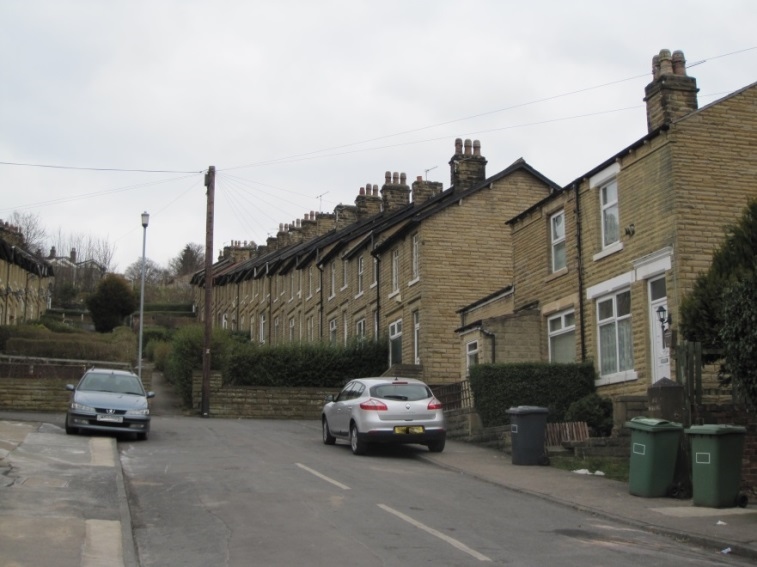
Bank Foot, Batley

Bank Foot, Batley

So began Bridget’s routine for the next six months: going to work in the mill early in the morning and returning home at mealtimes to feed her baby. The inquest revealed that she used a combination of breast milk, boiled milk and bread.

When Thomas was about four months old she also started giving him something she referred to in the inquest as “Infants Preservative”.  This was very probably “Atkinson and Barker’s Royal Infants’ Preservative”, a popular Victorian product for babies. Adverts played on the royal connection stating it was supplied to Her Majesty Queen Victoria. Promoted to be herbal, natural, narcotic-free, indeed the best and safest health tonic aimed at treating all manner of infant disorders ranging from teething and bowel problems to whooping cough and measles, what the adverts failed to mention was this medicine also in fact contained laudanum, an opiate.

Working mothers such as Bridget would believe they were doing the best for their children, giving them a good start to life warding off childhood illnesses and helping them flourish at a time of high infant mortality. At the same time the product may have had the seemingly added bonus of naturally calming the child whilst the mother worked long hours. And after all it was, according to the advertising, used by Royalty!

Interestingly it also claimed to give instant relief for convulsions which may also have been another factor in Bridget’s choice of product. For, on a Saturday afternoon about a month prior to his death, Thomas suffered a fit.  The Doctor was called and the child revived after being put into a bath of warm water. Despite suffering another fit about a week later he, in Bridget’s words, “continued lively”.

A few days before his death, Thomas was described as having a slight cough which affected his breathing. However by the Sunday and Monday he had seemingly recovered and there appeared to be no cause for concern.

On the morning of Tuesday 22 October Bridget arose and set off to work at 5.55am leaving Thomas in bed. However arriving at the mill “two or three minutes after the proper time” her employers sent her home. Back at the house she waited until 7am to wake Thomas and then brought him downstairs to feed him breast milk. There appeared to be no problem until 7.45am when she tried to take off his nightdress in order to wash him.  At this point he coughed and then suffered another convulsion.

Margaret now took charge, looking after Thomas whilst Bridget was sent to fetch a neighbour, Esther Elwood, and the doctor.  Within 10 minutes of Mrs Elwood’s arrival Thomas died very quietly in his cradle.  It was 8am. Bridget had not made it back in time. Although the Coroner’s notes make no reference to the arrival of the doctor the newspapers state that Dr Lauder turned up at about 8.30am but would not give a certificate, hence the inquest.

Thomas’ body was described as “very well nourished and free from any sign of disease and injury” by Emma Hallas, who undressed and washed him after his death.

The inquest returned a verdict of death from natural causes. Thomas’ death certificate records the cause of death as “probably pneumonia; convulsions 10 minutes”.

Bridget had taken insurance out with the Royal Liver Friendly Society for Thomas’ life within a short time of his birth. However even with this insurance, providing it was actually paid out, Bridget was still unable to afford a burial plot for her son. He was buried in a common grave in Batley Cemetery on 24 October. The burial register has yet another variation of the surname – this time Gavin.

By the time of the 1891 census Bridget was no longer with Margaret and John. Instead she was lodging with her sister Mary and family who now resided East Street in Batley. She was still employed as a scribbler feeder. She did not marry until 1897.

Without the parish register I may never have known about the inter-census birth and death of her first child, Thomas.

Bridget Gavan is my great grandmother.

Sources:

[1] There are multiple variants of the surname Knavesey, but this is the one used on the marriage certificate

[2]Ancestral Trails” – Mark Herber