Which Type of Family Historian Are You?

After several years immersed in family history research, along the way I’ve also observed my fellow researchers, and I include myself here. As a result I’ve identified several breeds within this species. Some are clearly pedigrees displaying one single personality trait. Others are more of the Heinz 57 variety, displaying a cross section of characteristics to varying degrees, depending on their inherited DNA.

Which Type of Family Historian Are You?

The categories I’ve identified are by no means exhaustive. I have listed them below, along with their core characteristics.

The Gatherer: This grouping is more concerned about how far back they can go and how many individuals their tree can hold, rather than in-depth individual stories of ancestors. It’s a contest, a badge of honour. Who can get back the furthest. Who can collect the most. What their tree lacks for in substance, they more than make up for with the thousands of names and dates populating the multiple branches. So many names it makes it difficult to distinguish the wood from the trees.  

The Gatherer

The Treehopper: These individuals hop from one public tree to another culling data. The Treehopper doesn’t evaluate this data to see if it is indeed their family. And they are oblivious to errors such as children born before parents and centuries old Methusalahs. Their philosophy is “it’s on the internet so it must be true“. 

There is much cross-fertilisation amongst the Treehopper populace, so the errors become self-perpetuating. 

The Plunderer: These folk are similar to the Treehopper breed in that they cherry pick data from others. But they are far more discerning. And they are not averse to passing the research off as their own. 

The Fortune Seeker: This bounty-hunting bunch are only interested in proving their connection to rich and famous. The richer and more famous the better. Their ace would be to have a link to royalty. A dinner-table topic to dine out on forever, whilst polishing their collective tiaras. 

The Fortune Seeker

The Carnivore: This sub-species is only interested in their meaty, gory ancestors. They wallow in the deepest, darkest entrails of their family history. Ordinary lives are not worth spending time researching. These individuals thrive on the blood-lust of murderers, criminals, victims, bigamists, incest intrigues, gruesome deaths, disasters and tragedies. The grislier the better, in order to feed their passion. 

The Nurturer: Always putting others before themselves, these kindly souls spend so much time helping others in their family history quest, that their own research is sadly neglected. They make occasional efforts to tend and grow their own tree, only to succumb once more to the cries of help from others. 

Whilst they do love assisting the more juvenile researchers in their midst, their plaintive moans of despair at their lack of personal tree-time can occasionally be heard echoing in archive corridors.

The Wanderer: These are the free spirits of the family history world. Or perhaps that should read the most easily distracted? They set off on one path, but part way through their research something more interesting attracts their attention and they change direction. They then spend hours wandering down this new road, before realising they’ve been diverted. Not to worry though. They’ll get to their destination eventually, but with lots of exciting adventures along the way. 

The Wanderer

The Aestivator: This is the spring/summer version of hibernation. During the, hopefully, good weather of these seasons aestivators concentrate on other hobbies and activities. The weather is too nice to be stuck indoors, at home or in archives, researching. The only trees they tend during this period are the ones in their gardens. The only nod towards family history research may be the occasional ancestral cemetery or location visit. Essentially they have entered a phase of genealogical torpor.

They emerge from their aestivation with renewed energy and enthusiasm, ready to conduct their desk-based research during the cold, dark, wet months of late autumn/winter. 

The Night Predator: These researchers burn the midnight oil. The daylight hours are eaten up by family and work demands. Once the children are safely tucked up in bed, partners craftily diverted and work consigned till tomorrow, the Night Predators’ family history papers come out and their computers are fired up. Time looses all track. One more minute becomes one more hour. Bed is but a distant port of call. The clock chimes an inconvenient 1am. Dawn brings its own dawning realisation, “I sleep to research more effectively.” Sleep, therefore, is an unwelcome, but essential, research interruption. And so eventually the Night Predator drags them-self wearily to bed, mind whirring on finds and strategies, counting ancestors not sheep.  

The Night Predator

The Protector: This group are the guardians of their family’s history. They unearth all aspects: good, bad and indifferent. They critically analyse and evaluate their research, recording it for posterity. They delve into all aspects, and historically and locally contextualise the lives of direct line and collateral ancestors. They collect, preserve, share, treasure and protect their finds to ensure no lives are forgotten. They engender a sense of family continuity.  

However be warned, their sheer single-minded obsession and enthusiasm may occasionally be too much for living family members. They have been known to bury their heads in their hands or flee for cover at the prospect of more quizzing or yet another tale from the Protector.

The Scavenger: These phenomena pull disparate facts swiftly together in a haphazard manner with no regard for considered research or truth. If someone has the same name, well that first match they encounter must be “The One“. No matter they may be from a totally unrelated parish, sometimes hundreds of miles away, there are multiple alternatives, or there are other irregularities. 

Time, history, geography, facts and other options are minor inconveniences, swiftly ignored or dismissed. The Scavenger relies on gut instinct at best. At worst they ram the wrong shaped piece in their family history puzzle and move on.

The Specimen Collector: This category has a sole focus on direct line ancestors only, so four grandparents, eight great grandparents, 16 2x great grandparents and so on. They can really put these ancestors under their genealogical microscope or magnifying glass to probe and delve into their lives in minute detail, without the overwhelming distraction of collateral ancestors. The downside is this researcher may miss breaking down a brick wall which may come from looking at these collateral lines.

The Specimen Collector

The Hunter: These individuals love the thrill of the ancestral chase. Nothing is more satisfying than a visit to the archives or a day spent surfing family history websites. 

Their homes are filled with hastily jotted notes on the back of discarded envelopes and scattered pieces of paper. They have multiple notebooks on the go at any one time, because they misplace the one they’re working on so swiftly grab another. Finds will be properly recorded another day …..maybe. For the time being it’s all retained in the head. Occasionally an overwhelming urge to put things in order overcomes these people. But it’s a temporary blip and instinctive habits are quickly resumed. For them it’s a case of nature over nurture. 

The Hunter

The Grazer: A solid type, who munches steadily and evenly paced through their family history feast. Day by day, piece by piece. Neither obsessively or frenetically. It is a lifetime’s work, no need to rush. It’s there to be savoured, mulled over and enjoyed.

Which one(s) am I? Well that’s for me to know and you to wonder. But all theses different elements and people combine to create the wonderful discipline, interest, hobby, livelihood and obsession that is family history.  

PS – This post is prompted by a bit of end of school holiday giddiness. Any other suggestions are most welcome. 

Sources:

A Short Life Remembered: King Cholera’s Deadly Reign

This is another in my “Short Lives Remembered” series. It focuses on often-forgotten children in family trees who died all too young. The ones who never had chance to marry, have children and descendants to cherish their memory. The ones who, but for family history researchers, would be forever forgotten.

This post is about Sarah Clough. Sadly the most remarkable thing I know about her life is her death.

Sarah was the fourth child of my 3x great grandparents William and Mary Clough (née Burnett). She was born on 22 February 1833 in Adwalton Yorkshire and baptised in the parish church of St Peter’s, Birstall on 2 June 1833.

Historically, Adwalton is probably best known for its part in the English Civil War: The scene of the Battle of Adwalton Moor, when the Royalist forces of the Earl of Newcastle defeated the Parliamentarian forces of Sir Thomas Fairfax bringing Yorkshire under Royalist control.

Alongside it’s neighbour Drighlington, to where the Clough family moved, this was an otherwise historically unremarkable village, following the normal industrial revolution growth and development patterns of other West Riding villages in the 19th century.

By the time of Sarah’s birth, textile manufacture was supplanting farming and mining as principal occupations in Adwalton and Drighlington. William, her father, worked as a clothier, following the traditional occupations of the area. This was before fate stepped in and his working life took a totally different path. But that’s for another time.

Sarah only features in one census, that of 1841. She is shown living in Drighlington with her parents and three older siblings. The next record I have is her death certificate. Which brings me to a period in time when Drighlington hit the news for entirely unwelcome reasons.

Sarah died there on 10 August 1849, age 16. No occupation given, so I do not know if she followed her elder sister into a worsted spinning job in one of the area’s relatively new mills. She’s described merely as the daughter of William Clough. He registered her death the following day.

The certificate reveals she suffered one of those truly awful, and all too common, deaths of our ancestors. It indicates she died after suffering for 11 hours from “malignant cholera”.

Cause of Death Extract from Sarah Clough’s Death Certificate

So once more I venture into the depressing medical world family history researchers frequently inhabit. This time learning about cholera.

Malignant cholera was one of the names given to Asiatic cholera. This was distinct from English cholera. Adverts in 1849 stated that English cholera, which all persons more or less suffered from in summer months, was characterised by “violent looseness of the bowels, attended with sickness, and in extreme cases violent cramps”.  In other words dysentery and food poisoning, more commonly known as gastroenteritis today. If left untreated it could result in Asiatic cholera, or so some quack newspaper adverts claimed.

English Cholera Description, “Leeds Intelligencer” 25 August 1849

In fact Asiatic cholera was a different entity. Originating in India, it first reached the shores of Great Britain in the autumn of 1831, after its relentless march across Europe. It’s first victim was in Sunderland. The epidemic dissipated the following Autumn, but not before claiming the souls of some 32,000 people, roughly a 50 per cent death rate of those afflicted. In these pre-civil registration days this is only a rough estimate, with ranges fluctuating between 20,000 to 50,000+[1]

L0008118 A dead victim of cholera at Sunderland in 1832. Coloured lit

L0008118 A dead victim of cholera at Sunderland in 1832. Coloured lit Credit: Wellcome Library, London. Wellcome Images images@wellcome.ac.uk http://wellcomeimages.org A dead victim of cholera at Sunderland in 1832 by IWG. Coloured Lithograph Circa 1832 Published: – Copyrighted work available under Creative Commons Attribution only licence CC BY 4.0 http://creativecommons.org/licenses/by/4.0/

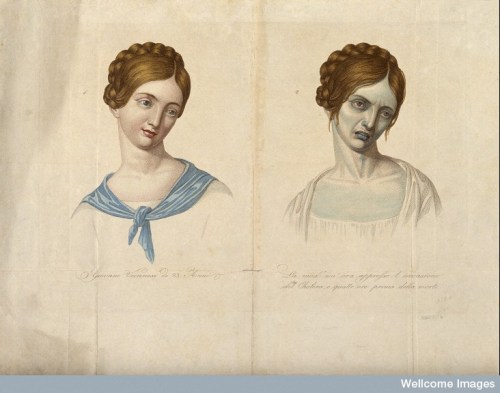
Like English cholera, Asiatic cholera also struck without warning, but it’s symptoms were more extreme. Although not the top killer in the country during the period, its high mortality rate and the speed with which it killed caused panic. Those afflicted were gripped by dramatic diarrhoea, terrible abdominal cramps and vomiting. In the most severe cases the loss of body fluids was so appalling that the victims rapidly became dehydrated, cold, withered and gaunt. Often their faces became unrecognisably shrunken and they could develop a blue-grey tinge to their skin. The swiftness with which victims succumbed is illustrated by the fact that Sarah was dead within 11 hours of the onset of her symptoms.

V0010485 A young Viennese woman, aged 23, depicted before and after

V0010485 A young Viennese woman, aged 23, depicted before and after Credit: Wellcome Library, London. Wellcome Images images@wellcome.ac.uk http://wellcomeimages.org A young Viennesen woman, aged 23, depicted before and after contracting cholera. Coloured stipple engraving. Published: – Copyrighted work available under Creative Commons Attribution only licence CC BY 4.0 http://creativecommons.org/licenses/by/4.0/

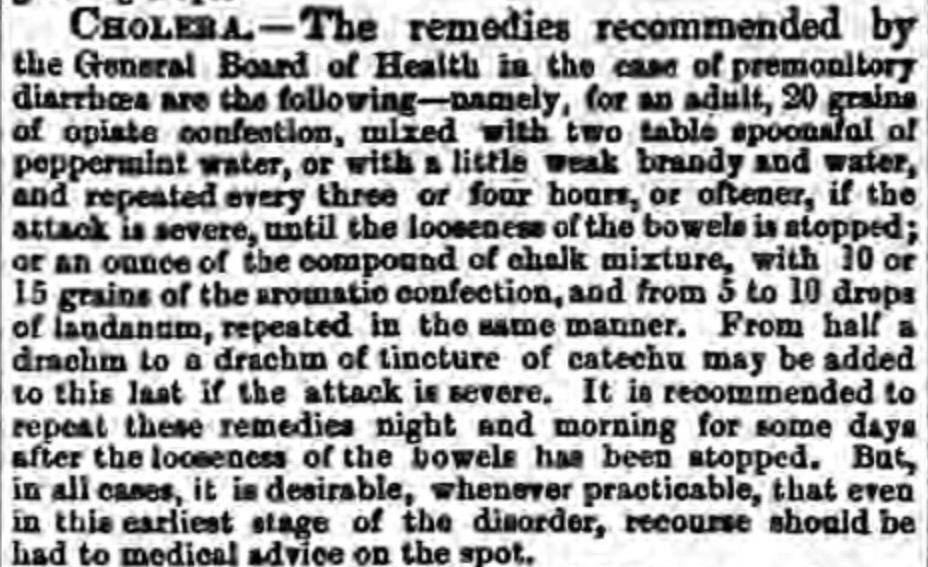
Victims died as a result of dehydration, sometimes hastened by medical ministrations which could be based on purging the body of impurities. Laxatives, such as mercury, and emetics like opium were amongst the armoury of potentially prescribed medications. Hardly the most suitable concoctions to give to patients already exhausted from sickness and diarrhoea. Other remedies touted at this time were passing steam over the patient or pouring boiling water on the patient’s stomach, brandy, bloodletting and “hot air baths”, all of which made dehydration worse. Even arsenic was prescribed.

Official advice, as well as druggists adverts, featured in the press of the day. All equally ineffective.

Official Cholera Remedy – ” Leeds Intelligencer” 23 June 1849

Fundamental to the grip the frightening disease had on the country was the lack of understanding of its causes and transmission. The prevalent theory was that the disease was caused and spread by smelly, contaminated air, otherwise known as miasma. Getting rid of foul smells, including improved sanitation, would combat the deadly menace. Attempts were made to fumigate buildings in affected communities by burning sulphur or tar. Drinking brandy or eating copious quantities of garlic were also widely believed to be a preventative measures.

L0003001 A court for King Cholera

L0003001 A court for King Cholera Credit: Wellcome Library, London. Wellcome Images images@wellcome.ac.uk http://wellcomeimages.org ‘A court for King Cholera’ is hardly an exaggeration of many dwelling places of the poor in London. 19th century Punch Published: 1852 Copyrighted work available under Creative Commons Attribution only licence CC BY 4.0 http://creativecommons.org/licenses/by/4.0/

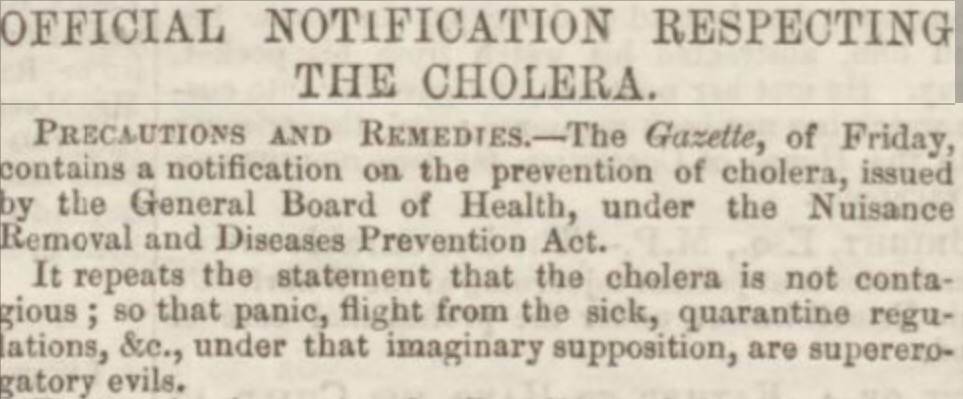
Medical thinking had not progressed beyond this when the next deadly wave of the disease spread through Britain throughout 1848-49. The poor still lived in cramped and unhygienic conditions, sewerage was still largely inadequate and water supplies were still vulnerable to contamination: All these factors exacerbated by urbanisation. The miasma theory still held sway, promoted by the likes of social reformer Edwin Chadwick. There was no expert agreement about whether or not it was contagious, with debates on the subject aired in the press.

“The Leeds Times” 14 October 1848

However prudent advice in “The Leeds Mercury” of 29 September 1849 suggested precautions such as burning beds and clothing of the deceased and, in what looks like an early attempt funeral humour, “early (though not premature) interment“. In 1849 Dr John Snow publicly stated the disease was transmitted through water. His voice was dismissed.

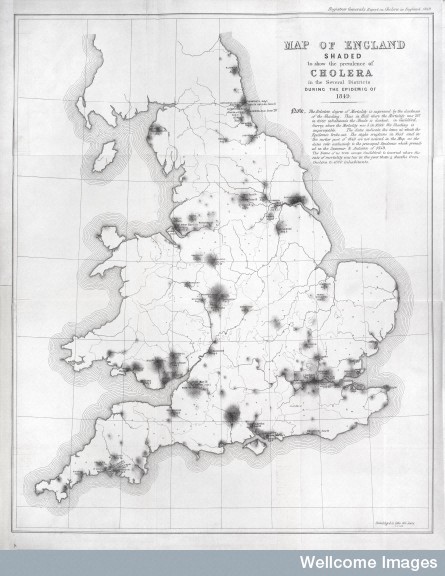
In terms of fatalities this second outbreak of the disease proved to be the most serious of 19th century epidemics to hit Britain. Estimates vary between 53,000 and 62,000 lives lost[2], including that of Sarah Clough.

L0039174 Map of England showing prevalence of cholera, 1849

L0039174 Map of England showing prevalence of cholera, 1849 Credit: Wellcome Library, London. Wellcome Images images@wellcome.ac.uk http://wellcomeimages.org Map of England shaded to show the prevalence of cholera in the several districts during the epidemic of 1849. The relative degree of mortality is expressed in the darkness of the shading. The dates indicate the time at which the epidemic broke out. Printed Reproduction 1852 Report on the mortality of cholera in England, 1848-49. Great Britain. General Register Office. Published: 1852. Copyrighted work available under Creative Commons Attribution only licence CC BY 4.0 http://creativecommons.org/licenses/by/4.0/


Drighlington was particularly hard hit. Looking at the Drighlington St Paul’s burial register Sarah was just one of many of the village’s inhabitants to die in the summer of 1849.

A look at the a parish register shows 17 burials in August 1849. Of these 15 were Drighlington inhabitants, two from Adwalton. Sarah’s burial took place on 11 August 1849. Compare this with three June burials; four in July; one in September; four in October. Looking at the month of August in the years sandwiching 1849, August 1848 had four burials; whilst August 1850 shows only one. So a dramatic spike that cholera-affected month of August 1849.

The terror of the inhabitants felt is unimaginable: An illness with an incorrectly vague cause and no known cure sweeping their hometown; neighbours, friends and families being suddenly struck down; a succession of funerals held in the local church; many more suffering the distressing and debilitating effects of the illness. 

Newspapers, filled daily with cholera returns and countrywide reports, ratcheted up anxiety levels. They even remarked on the disproportionate numbers affected in Drighlington. For example, this from the “Bradford Observer” of 16 August 1849:

In our last number, we recorded a death from Asiatic cholera in Drighlington. Since then, five other cases have occurred, all of which proved fatal. Taking into consideration the size of the village and the population, this fearful malady is spreading more rapidly than in towns, where the population is so dense. The number of deaths from Asiatic cholera since the commencement a fortnight ago being seven, besides several others from English cholera”.

The “Leeds Intelligencer” of 18 August 1849 put the number of deaths at 11 and described clean-up measures to tackle the outbreak.

“Leeds Intelligencer” 18 August 1849

Put into context the 1851 population of Drighlington township was 2,740. So 11 cholera-related deaths in such a short space of time, not to mention those infected and recovering, and it’s easy to see how ravages of the illness would affect a significant proportion of the village one way or another.

Two further waves of cholera swept Britain but with decreasing death tolls – the 1853-54 outbreak claimed 20,000 souls[3]. Following this outbreak John Snow was able to prove his theory about the bacterial nature of the disease, when he isolated the source of the 1854 Soho outbreak to a contaminated Broad Street water pump.

Although full acceptance was slow, it was an important step in paving the way to laying to rest the bad air/miasma theory. This, ironically combined with the Public Health Acts and Sanitary Act resulting from the work of Chadwick, meant the disease was increasingly more effectively prevented and the 1865-66 epidemic accounted for a mere 10,000 – 14,000 deaths, depending on statistical sources.[4].

It wasn’t until 1883 that a German doctor, Robert Koch, isolated the cholera bacillus. And over 30 years more years elapsed before a vaccination became generally available in 1914.

So the short life of Sarah Clough is significant for the disease which cut it short. Just one of many thousands of people mowed down in Britain alone in what were the worldwide 19th century cholera pandemics. As a result of my research into Sarah’s death, the disease for me is now more than a name.

Others who feature in this series of “Short Lives Remembered” posts are:


Footnotes:

Sources: 

GRO Picture Credit: 

Extract from GRO death register entry for Sarah Clough: Image © Crown Copyright and posted in compliance with General Register Office copyright guidance.

Ordinary Lives: Family History is Best Left in the Graves of Our Ancestors?

Last night a family member asked if I’d unearthed any more embarrassing incidents in our family history. The individual appeared to be particularly concerned about the stigma from having a one-handed gypsy ancestor who gave birth to an illegitimate son whilst on the road in the company of a gaggle of 18th century chimney sweep apprentices. They straw-clutchingly tried to point out that giving birth on the roadside was perfectly normal for the period. There was no ambulance service, or so their argument went.  

And so lies one of the dichotomies of family history. My relative seemingly didn’t want any hint of scandal in our background. They wanted an ordinary, uneventful lineage. They took anything otherwise as casting some kind of lingering reputational stain passed down through the generations. A case of these things are best left in the past. Dirty linen, no matter how old, should never see the light of day. The dead should be portrayed as paragons of virtue. Their human weaknesses buried alongside them in their graves. In short the skeletons of ancestors should be left in their graves. 

They want a family tree populated with ancestors who lived ordinary, unremarkable, hard-working lives, with no speck of scandal. 

Batley Cemetery – Photo by Jane Roberts

Yet for others these more unusual events add colour to the every-dayness of “born, baptised, married, died, buried” records. They stand in the camp of ordinary lives are boring. Not worthy of re-discovery. Unremarkable genealogy is uninteresting. I’m not sure how true this is but, for example, the ordinariness of Michael Parkinson’s ancestry is cited as the reason why his story was ditched by “Who Do You Think You Are?” 

For me family history is about every-day lives. Some are ordinary, some are less so. But that’s part of the rich tapestry of life. It’s a mixture of all sorts. And you can’t gloss over the less palatable tales. No more so than you should discount the mundane. All facets are equally valid.  

Hidden Names: Indecisive and Tricky to Downright Confusing Ancestors

I remember well my husband and I spending hours pouring over a book of baby names throughout my pregnancy trying to decide on boy/girl options for the impending arrival of our little bundle of joy. OK, not so much him as me.

We were sure of our choices for a boy – William Patrick. Less so for a girl. Alice was the early favourite, although we were not entirely convinced. That was until our daughter arrived and within minutes we did a sudden about-turn to Amelia Grace. This was way before Amelia featured in the annual top 10 lists of baby names produced, so we were not swayed (or should that be put off?) by popular opinion. Then it was down to the Registry Office to make her official, like generations of parents before.

My well-thumbed book of Babies Names

But it’s not always that straightforward. What happens if you change your mind after the official form filling? If you decide after all it wasn’t the right choice? Perhaps the parent doing the registering put down the wrong name, or an “unagreed” one.

In my recent family history I’ve a couple of examples, with unofficial solutions. My grandma registered my dad’s birth. He has a Christian and middle name. Seemingly the Christian name was my grandma’s choice – her dad’s name, Patrick. My grandad wasn’t best pleased when he found out after the deed was done. As a compromise my dad has always gone by his middle name. Something that causes endless confusion when dealing with officialdom, the only time when he’s ever referred to as Patrick. But at least we know about it so it’s not an issue – though it might be for future family historians, seeking him under his every-day name!

And there was a bit of pay-back for my grandma’s trickery. Her next son was born on St Patrick’s day – but she’d already used the name!

I also have a maternal aunt. Looking for her in the GRO indexes is problematical. My grandpa registered her under the wrong name, apparently the name of a former girlfriend. Imagine explaining that one away. Unsurprisingly she’s never used that name, although it is remarkably similar to the one she goes by .

Mind you my grandpa has a tendency to mess up birth registration. To be honest I’m surprised my nana let him do it again after the example of my aunt. But she did. The result is my mum’s birth is registered on the wrong day – something she didn’t discover till getting a copy of her certificate when leaving school, much to her embarrassment. Now, like the queen, she has two birthdays. She chooses, from year to year, which is the most convenient date to celebrate.

I suppose it’s sometimes all too easy to forget when researching your family tree that these are not one-dimensional, generational paper-trail figures. They were real people, with emotions and feelings and lives just as rich, rounded and complex as ours today. So although I shouldn’t have been, it was somewhat of a shock to find even earlier examples when I delved into my family tree and bought those all-important birth certificates. But these were examples where the families concerned actually did something about it through official channels.

Permissible but unusual, you could change to the name registered for a child providing it was done within 12 months. There is a column on the birth certificate indicating “name entered after registration” catering for this eventuality. Normal procedure was that the Minister performing the baptism provided a certificate confirming the child’s baptismal name; if unbaptised, the mother or father signed a certificate. This had to be taken to the registrar or superintendant registrar and a fee paid. So not a light undertaking given the financial and time implications, not to say knowledge in the first place that this was an option.

I’ve discovered two examples in my direct line ancestry. The first is for my 2x great grandmother Kezia(h) Clough. Born in Drighlington on 21 October 1850 she was the 6th, and youngest, daughter of William and Mary Clough (née Burnett). On 12 November 1850 Mary registered the baby’s birth, signing with her mark. Her daughter’s registered name was Emma. However, there is an entry in the name-change column. In this case it indicates the alteration to Kesia (another variation). No date as to when the amendment took place. The baptismal register at St Peter’s, Birstall, shows the child was baptised with the name Kezia on 29 December 1850. So the decision was made relatively quickly.

I’ve no idea why the change of heart. Mary did have a sister named Keziah who died in 1837. But that was over 13 years before the birth of Emma/Kezia, and Mary had two other daughters born after her sister’s death. So ample opportunity to name a daughter after her sister, without an after-registration moment of enlightenment. The reason will forever be a mystery.

Kezia Clough’s Birth Certificate

You might have observed that I’ve alluded to the fact there are variant spellings of Kezia on official documents. Sometimes the alternative Keziah is used. Something else to consider in that elusive ancestor hunt.

The other example is my great grandad Jack Hill. Coincidentally he is the son of Kezia and her husband Joseph Hill. Jack was their third son. Born on on 10 December 1872, Joseph registered him on 13 December, under the name Herbert. The amendment column shows a post-registration change of name to John Herbert. Again nothing to indicate when the change was made. Some months after birth, on 25 May 1873, he was baptised John Herbert at Birstall St Peter’s. So another bit of naming confusion thrown into the ancestral search mix – the diminutive: Jack being a diminutive of John.

Once more no clues as to why the change. Perhaps it was an afterthought nod towards Kezia’s brother John, who died in 1871. Or, the theory I’m leaning towards, is Herbert’s name was too close to the name of his older brother Albert (Bert & Bert), something hinted at in that May baptismal entry where “John Albert” is scored out and replaced by “John Herbert“.

Jack Hill’s St Peter’s Birstall Baptismal Entry

So lots of creative Christian name considerations when on the trail of ancestors:

  • Diminutives, some obvious such as Elizabeth/Lizzie/Betty and Joseph/Joe. Some less so such as John/Jack, Pauline/Polly, Sarah/Sally (yes I have those);
  • Spelling variations;
  • Christian names dropped, and possibly forgotten over time, in favour of middle names; and
  • Names being used for no obvious reason at all, other than to frustrate family history researchers. For example Cissie used instead of the registered name of Sabina (yes, that’s one of mine too).

Sources:

  • GRO birth certificates
  • Baptismal register, St Peter’s Birstall

GRO Picture Credit: 
Extract from GRO birth register entry for Kesia (Emma) Clough: Image © Crown Copyright and posted in compliance with General Register Office copyright guidance.

Aveyard One-Name-Study: Update

As it’s a while since I announced the start of my Aveyard One-Name-Study it’s about time I gave a progress update. 

In late spring I undertook an online “Introduction to One-Name Studies” course with Pharos Tutors. I wanted to start my study off on the right track. This course was designed with input from the Guild of One-Name Studies so it seemed ideal. And so it proved to be. The five weeks confirmed I’d chosen a theoretically manageable surname. It also gave me lots of ideas for running my study, from data collection, analysis and software tools, to publication and preservation.  

I didn’t jump straight in to my study at the end of the course. I’m not rushing to get it all done in one go. It’s a long-term commitment. I wanted to assimilate all I’d learned. I also had holidays booked!  

But I’m pleased to say I’m finally cracking on with data collection. I did consider doing a big data-scraping exercise, but in the end I’ve decided to go down the slow, methodical, manual route for some core datasets.  

I’ve finished my FreeBMD and Commonwealth War Graves Commission collections. These were straightforward Excel downloads, then tidying up the data. Now I’m in the census phase of data collecting. And the relaxed pace is proving the right one for me here. I’m getting a real “feel” for my Aveyard families by going through the census with a critical eye. And transcribing the data myself from the censuses is hopefully overcoming some of those errors which occur when relying solely on Ancestry or FindMyPast transcriptions. 

I’ve opted to use Excel for my data input in the first instance. The time spent on the manual data collection process has helped here too, by giving my chance to properly consider layout and key field names. But as a result of the course and subsequent research I’m also going to invest in Custodian. I do like a paper option and love my family history index cards. However I’m rapidly running out of house-room and I don’t want my daughter to leave home so I can have her bedroom……..Real family comes first. 


I’m aiming to break the back of data-collection and entry by next spring-time. But as I said I’m in no rush. This is a hobby. It’s fun. I don’t want it to be like work or become some awful “oh no, not that today” chore. I won’t lose sleep over missing a self-imposed deadline. I’m fitting this one around me and my family. So there may be periods of intense activity. But there may be longer ones when I don’t get anything done. If so that’s OK.

But already I’m getting hooked on this new, broader family history angle. And hopefully I may gain more Aveyard ancestors and an insight into their origins and wider inter-connections along the way.  

Family History Research Tips 

Those who follow me on social media may know I had my 15 minutes of fame this week courtesy of the local paper, “The Huddersfield Daily Examiner”. They approached me to see if they could use my story about Annie Leonard, a Barnbow munitions worker of the Great War who died as a result of work-related poisoning in July 1916. Their article is here.

The paper also wanted to do a general genealogy feature. I really didn’t know what to expect from this, or what angle they’d run with. So the interview, which lasted well over one hour, was fairly wide ranging. The resulting article included my tips for genealogists. I must admit to being caught on the hop here. It was towards the end of the interview and, not being used to this, I was feeling pretty exhausted. These were the tips I came up with off the top of my head: 

  • Work backwards using birth, marriage and death certificates.
  • The National Archives is a good starting point and includes research guides. In hindsight I’d expand on this one, saying check out some general family history “how to” books to familiarise yourself with the basics. 
  • Parish registers are invaluable for records before July 1837 civil registration.
  • If you have an unusual name it will probably be easier to research than a common one – however, whatever the surname, be aware of surname spelling variations.
  • Migration from our country or part of the country to another is a complication. Persistence is key. Think outside the box. Look at wider family and other sources including newspapers, local history and transport links. 

However, having time to consider, I’d add the following for anyone just starting out on their exciting journey of family history discovery:

  • Join a Family History Society (FHS). I’m in a few based around the locations of my ancestors. The advice and tips from this army of experts can be invaluable both for those starting out as well as those more advanced in their journey. FHS members have a wealth of local knowledge. And the regular meetings, research facilities and drop-in sessions, besides being informative, provide a social aspect to what can often be a solitary pursuit. Get involved. 
  • Be methodical and organised right from the start. Note searches, including negative ones. Record source references. Include dates and search parameters. Record your findings as soon as possible. Yes it might sound a boring chore. But it can save time in the long run. You reduce the risk of doing unnecessary repeat searches; or you can see where it might be worth doing follow-up searches, for example where providers have expanded or added new data sets. 
  • If you plan subscribing to genealogy sites, research which are the best ones for you. There is lots of genealogy subscription comparison advice on the Internet. Consider a short-term subscription to test the waters and see if a year long one is going to be worth your while. See if your local library offers free access to Ancestry or FindMyPast. GenealogyInTime Magazine has a list of the top 100 sites.  
  • Talk to older relatives and record what they can remember. This is one of my huge regrets. 
  • Don’t rely transcriptions. Shock, horror – they may contain errors! Whenever possible check sources out yourself.  

There are so many more tips. But I’ve limited myself to 10. Feel free to add any others!  

Brothers-in-Arms 

Sometimes we overlook more recent family history, concentrating on the more distant past. Currently events of 100 years ago are dominating the news, with national commemoration events for Battles such as Jutland and The Somme, to more individual and personal remembrances for the centenary of the death of a family member.

But here I will focus on a more recent conflict, World War II. We are moving towards a time when this too will disappear from living memory. Sadly those in my family with direct knowledge of this tale are long gone.

This post concerns the fate of Albert Edward Hill, or Ned as he was known: My grandad’s cousin.

Finding out the circumstances surrounding death in conflict can be challenging: Which battle; location; precise cause of death; time; even date; and perhaps there is no known burial place. World War II in many ways presents a bigger challenge than its predecessor, with the public availability of records.

However in Ned’s case it’s all fairly straightforward. He is buried locally at St Paul’s churchyard, Hanging Heaton. His death is well documented. It was not caused by some battle injury. It was the result of a totally avoidably, foolishly tragic accident following a night out.

Ned was born on 2 February 1901, one of the seven children of Albert Hill and Sarah Ann Summerscales. These included Harry who died shortly after birth in 1890; Percy, Annie, Lilian, Doris and Arthur.

Ned never married. The 1939 Register, the population list compiled at on 29 September, as a result of the outbreak of war, shows him living at Wood Lane, Hanging Heaton. He is in the household of his brother-in-law Harry Robertshaw along with Harry’s two young sons. Harry’s wife, Ned’s sister Annie died that summer, her burial taking place at St Paul’s Hanging Heaton on 6 July 1939.

In the 1939 Register Ned is recorded as working as a willeyer in a woollen mill. This was someone who operated what was termed a willeying machine. Fibres were fed into this machine, which separated and combed them ready for carding. Newspaper reports at the time of his death, however, indicate prior to his army service he worked as a builder’s labourer, employed by Hanging Heaton-based building contactors George Kilburn and sons. 

I do suspect some confusion in the report though, and this occupation possibly applied to his brother Arthur. In the 1939 Register he was a public works contractor’s labourer. 

Whatever the true facts are war changed all this, and some two-and-a-half years before his death Ned joined the Army, as a Gunner.

Albert E Hill Batley News July 28 1945 8 (2)

Gunner Hill

His death came entirely out of the blue. Summer 1945, and war in Europe over, Ned returned home to Batley on leave. He finally managed to meet up with his younger brother Arthur, a driver with the RASC, similarly on leave. This was the first time they had seen each other since Ned’s military service. Arthur had been in the Army for four years at this point, serving in Germany, Belgium, France and Holland.

Things must have seemed hopeful. They had survived so far. All being well they would be home soon permanently. The past tragedy of the family would not repeat itself….

Little could they have envisaged that this meeting would be their last, and in three weeks Ned would be dead.

Leave over and Ned returned back to his Unit, the 397 Battery, 122 Heavy Anti-Aircraft Artillery Regiment, stationed at Walberswick, near Southwold in Suffolk. This was part of the network of coastal defences, established in response to the threat of German invasion from May 1940 after their rapid victory in Western Europe. That German threat was now gone.

On 20 July 1945 he and another soldier from the same unit, Gunner Leonard Lomax, had evening leave. They left camp at 6pm that Friday for a night out in Southwold. The ferryman took them over the River Blyth and said he would return for them at 10-30-11.00pm.

An interesting aside is the ferry service from Walberswick had featured in Parliament only weeks earlier on 8 June 1945. There had been a seam steam-driven chain ferry which was discontinued in World War II, and it seems a rowing boat service replaced it. The ferry was privately owned and there had been problems in maintaining a regular service. Suffolk County Council was negotiating to acquire the ferry rights to ensure an adequate service.

Walberswick Ferry circa early 1940s Postcard, F Jenkins, Southwold

Ned and Leonard visited three public houses in Southwold and consumed about six pints of mixed beer. They left town at 10.15pm for the return ferry but there was no sign of the man with the boat. As they were debating whether to return to Southwold to catch the liberty truck to camp, a boat containing two soldiers came from the Walberswick side of the river.

These two soldiers, Lance Bombardier Edward Davis and Bombardier George Rennie were from another Battery. They heard shouts from the Southwold side of the river and thought some men from their Company were stranded as it appeared the ferry service had stopped. Despite having consumed three pints, or maybe because of it, seeing a boat moored in the water they decided to cross to collect their companions, but when they arrived found they were strangers. Nevertheless they offered Ned and Leonard a lift back. 

They clambered in the small boat, which turned out to be a yacht’s dingy and using the home-made paddles which were aboard the boat, Edward and George set about rowing back. About halfway across Leonard became aware of his feet feeling wet, water sloshing over the top of his shoes.

George and Edward were now having difficulty controlling the craft and stood up to paddle. They were about eight yards from the Walberswick side when the boat got into trouble with the tide and started to drift back towards Southwold and then seawards. The boat was filling up with water, either the result of a leak or overloading.  At this point Ned grabbed a paddle from Edward and the boat turned over throwing all four men into the river.

Leonard and George managed to get hold of a step ladder running down the harbour wall and climb ashore. They could not see the other two men, so made their way to Southwold to inform the police.

Meanwhile Edward, realising that Ned could not swim, tried to keep him up despite not being a strong swimmer himself. He managed to get them both to the concrete wall where Ned grabbed some weeds. Unfortunately they broke away. Edward continued to hold onto Ned but eventually became too exhausted and he had to let him go. Edward then managed to get hold of the ladder and escape.

In summing up the Coroner censured the boat’s occupants. The accident, he said, was the result of four “landlubbers” knowing nothing whatever about boating. The two soldiers should never have taken Leonard and Ned aboard because they overloaded the boat. There must have been some movement with the result that the boat capsized.

He went onto say that he hoped the tragedy would be a warning to others not to take boats without leave, and not to go on a swift running river like this one unless they were experienced persons who know how many a boat would take. “It is difficult to blame anyone because it is pure ignorance” he added.

A verdict of “Death through drowning through the upsetting of a boat” was recorded.

The Commanding Officer of the Battery wrote to Ned’s sister Doris extending his and the Battery’s sympathies as follows:

On behalf of the ranks of this battery wish to express to you our horror at this tragedy. Gunner Hill was a grand soldier and a man well-known and loved by the men of this unit”.

Ned’s body was brought back to Batley and he was buried in the church yard at St Paul’s, Hanging Heaton, just weeks before VJ Day and the war effectively ending.

Arthur survived the war. But Ned’s fate echoed that of another brother in another conflict, Percy. He died almost 29 years earlier in The Great War, during the Battle of the Somme.

Memories too of the newspaper “Roll of Honour In Memoriam” notices which the Hill family, including the then teenager Ned, placed in the papers all those decades before, mourning the loss of Percy.

Batley News – 5 October 1918
Hill – In sad but loving memory of our dear son and brother, 1736 Sergt Percy Hill, 1st-4th KOYLI (Batley Territorials) who died from wounds at Warloy Baillon, West of Albert, France, September 30th, 1916, aged 24 years.

When last we met, and fondly parted
Our hopes were high, our faith was strong,
We trusted that the separation
Though hard to bear would not be long 

We often sit and think of him when we are
all alone
This memory is the only thing we can call
our own;
Like ivy on the withered oak, when other
things decay
Our love for him will ever live, and never
fade away 

Ever remembered by his sorrowing mother, father, sisters and brothers, 92, Back Bromley Street, Hanging Heaton 

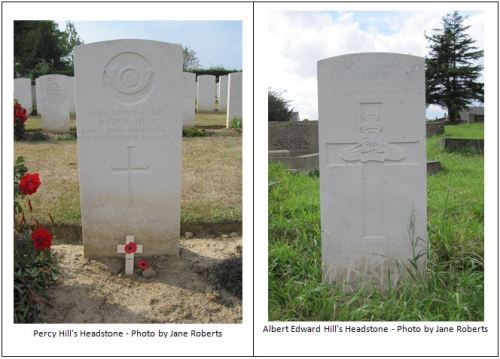
A family which had now lost a brother in both World Wars.Albert and Percy Hill Headstones

Sources:

Somme Centenary Commemorations – Thiepval, 1 July 2016

I’m still struggling to absorb the many levels of the amazing remembrance ceremony which took place on 1 July 2016. Still lost for words. Still unable to believe I attended the Somme centenary commemorations at Thiepval. It left me with a complex mix of feelings. It was a unique, emotional, exhausting, exhilarating and, strangely given the context, enjoyable experience. But above all it was an absolute privilege to be one of around 10,000 people present, to pay my respects and remember: from the great and the good, to those ordinary British, Irish and French citizens who were allocated tickets in the public ballot.

Somme Poppies

Somme Poppies – by Jane Roberts

I don’t have any family connections to any of the over 72,000 British and South African officers and men named on the Thiepval memorial, with no known grave. However I do have relatives of direct-line ancestors who died in the Battle of the Somme and have identified graves elsewhere. And the names of 11 men from my parish church, St Mary’s of the Angels RC Church, Batley are etched in the Thiepval Memorial stone: 11 men whose lives I researched:

  • Edward Barber: 18th (Service) Battalion, Prince of Wales’s Own (West Yorkshire Regiment)
  • Thomas W Chappell: 1st/4th Battalion, The King’s Own ( Yorkshire Light Infantry)
  • Thomas Finneran: 1st Battalion, The King’s (Liverpool Regiment)
  • Martin Gallagher: 6th (Service) Battalion, The King’s Own ( Yorkshire Light Infantry)
  • James Garner: 10th (Service) Battalion, The King’s Own ( Yorkshire Light Infantry)
  • Joseph Gavaghan: 17th (Service) Battalion, The Prince of Wales’s Own (West Yorkshire Regiment)
  • Patrick Hopkins: 9th (Service) Battalion, The Cameronians (Scottish Rifles)
  • Edward Leonard: 1st/8th Battalion, The Prince of Wales’s Own (West Yorkshire Regiment)
  • John Lyons: 1st Battalion, The King’s Own Scottish Borderers
  • Thomas McNamara: 7th (Service) Battalion, The King’s Own (Yorkshire Light Infantry)
  • Michael J O’Hara: 1st/4th Battalion, The Duke of Wellington’s (West Riding Regiment)

I applied for tickets in the public ballot last year, as did my husband, Chris. Neither of us were successful initially. However Chris received an e-mail in March informing him of a second chance of tickets if still interested. No question about it. He jumped at the opportunity.  To say we were thrilled was an understatement.

Although we have travelled several times to the area, this time rather than making independent arrangements we booked to go with Leger Holidays on their Somme Centenary Tour. That way we didn’t have the worry of sorting hotels and navigating the daunting exclusion zone which surrounded the area. We also had two full day’s organised tours of key areas of the Somme battlefield with a fabulously knowledgeable guide.

It also meant rather than being individuals we were able to experience the occasion as part of a group. That was, in my opinion, the best way to assimilate and process the emotions of the day: sharing with others who were there.

Somme Programme

Somme Centenary Programme Cover – by Jane Roberts

The commemoration was well organised, right from getting to and from the event, through to provision of food and drinks, even down to a goody bag with a poncho in case of rain. And goodness, was that needed at certain points during proceedings, especially given the umbrella ban. Torrential rain showers doesn’t adequately describe the day’s downpours.

And despite the heavy rain showers over a prolonged period in the lead up to the event the site looked perfect. The head gardener told us that planting preparations had commenced three years earlier.

All involved in organising such a complex and sensitive event in front and behind the scenes over many months deserve massive recognition and thanks: from planning, security, ticketing, staging, catering to those performing, showing guests to seats and tidying up afterwards. An incredible achievement.

The readings and music perfectly encapsulated the themes of honouring and remembering all those involved in the Battle of the Somme from the 1 July start date to 18 November end, reflecting a wide range of nations and roles.

It is difficult to pick any one highlight. If pushed for me it was the hauntingly beautiful Gaelic love song, “An Eala Bhàn”, (The White Swan). It was written during the Battle of the Somme by poet Donald MacDonald, serving with the 1st Battalion Cameron Highlanders, to his sweetheart Maggie Macleod. Listening to those bleak words sung in the crystal clear tones of Julie Fowlis against the backdrop of the Thiepval Memorial sent shivers down the spine.

I came away from the commemoration with an immense sense of admiration and thankfulness for all those who served 100 years ago. But I was also left with a profound feeling of sadness at the immense loss of lives, youth, innocence; with individuals, families and communities changed forever.

As I mentioned, because we travelled with Leger Holidays we visited a number of other key Somme sites and points of interest during our stay. These included Lochnagar Crater, the result of the detonation of the Lochnagar Mine at 7.28am on 1 July 1916, two minutes before Zero Hour and the launch of the Somme offensive; Delville Wood and the South African Memorial; Devonshire Trench and the scene of the 9th Devons advance straight into ferocious, concentrated enfilading German machine gun fire on 1 July, leaving 160 dead; Sheffield Memorial Park, commemorating the Pals Battalions of the British Army’s 31st Division; Newfoundland Park Memorial at Beaumont Hamel, with its largely untouched ground revealing the scars of shell craters and trenches, as well as its cemeteries, preserved trenches and memorials. This includes the Caribou, one of five on the Western Front, commemorating the Newfoundland Regiment; the town of Albert with its iconic Golden Virgin statue; and Pozières with its Australian connections.

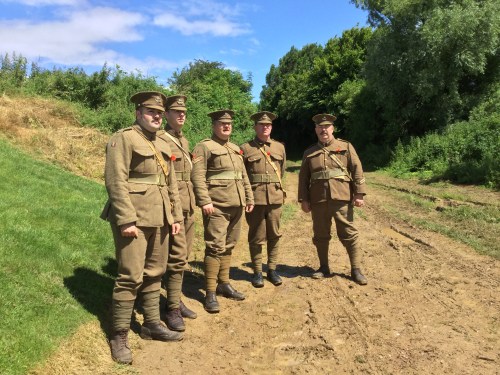
I experienced a couple of take-your-breath away moments. The first occurred at Sunken Lane, the scene of the famous Geoffrey Malins’ film of the 1st Lancashire Fusiliers shortly before they went over the top on 1 July 1916. As we arrived a group of soldiers in Great War uniforms walked towards us, an eerie reminder of events 100 years ago.

Sunken Lane.JPG

Sunken Lane – by Jane Roberts

The second was at Ulster Tower. In the midst of another torrential downpour I heard pipe music and saw the top of flags coming towards me from the direction of Connaught Cemetery. The sun came out as the men marched in for a wreath-laying ceremony. As the pipes played “When Johnny comes marching home again” I admit I had a lump in my throat.

I’ll end with some stats. 1 July 1916, the first day of the Battle of the Somme, left over 19,000 British dead. That was but one day in the 141 days of the Somme Offensive, which finally ended on 18 November 1916. By its end, out of the over 3.5million men who took part across all sides, there were well over one million casualties, dead, missing and wounded. It can however be easy to overlook the fact that the war dragged on for a further 723 days. And it lasted 1,568 days in total, from the first shots on 28 July 1914 to the 11 November 1918 Armistice.

img_3359

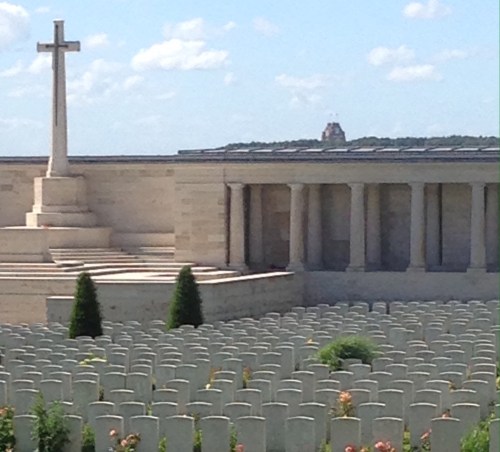
Pozieres British Cemetery and Memorial with Thiepval in the background – by Jane Roberts

 Sources:

  • All photos by Jane Roberts, except the poncho photo which is by Chris Roberts

Letters: Life, Love, Death & The Somme

Letter from Lance Corporal Herbert Booth, 9th  Battalion The King’s Own (Yorkshire Light Infantry) to his brother James shortly before 1 July 1916 – Published in the “Batley News” 12 August 1916
 “Well, old boy I do not know when I shall be able to write you another letter after this. In fact I will tell you the truth, it is like the song “It may be for years, or it may be for ever”; but never mind lad, whatever happens to me you can depend on me meeting it with a brave heart.  I will tell you this kid, it is going to be one of the biggest scraps that has ever been known, and I have not the slightest wish to withdraw.  If the worst happens, it is only death, and that comes to everybody at some time or another.  I understand by your letter that you have been rejected.  I know that you would like to have a smack at the Huns, but never mind, you have the satisfaction of knowing that you offered your services to your King, and that is what a lot of single young men have not had the pluck to do.  If things turn out right, and I have luck enough to come through this job safely I shall be able to tell you as much as anyone here can.  This is my tenth month out here and I have not been away from the battle area one month out of the ten.  Perhaps by the time you get this you have read all about this affair in your papers.  If I have the good luck to come out alive I will drop you a field card or a line of some sort at the earliest possible convenience, and let you know how I have gone on.”

WW1 Silk Postcard – my own collection

Letter from Lieut R.H. Ibbotson to Ellen Booth, Herbert’s wife – Published in the “Batley News” 12 and 19 August 1916
“I have received your inquiry about your husband, Lce-Corpl Herbert Booth, and am extremely distressed to have to tell you that the news I have to give you is of the very worst, and that your husband was killed in action on the 1st of July.  He took part in the magnificent advance made by this Battalion.  I am sorry I did not know your husband personally.  I have only just come to this Company to command it from the transport which I looked after during the attack.  None of the officers in “A” Company who took part in the attack are here now, they were all either killed or wounded.  Anything I can say in a letter to you cannot possibly help you, I am afraid, to bear this terrible blow, but I can honestly say that you have my deepest and absolute sincere sympathy”

Letter from Pte W H Fisher writing from Grovelands Hospital, Old South Gate, London – Published in the “Batley News” 26 August 1916
“Corporal Booth was one of my best pals. We went “over the top” on the morning of July 1st, like two brothers, and we had only got about 30 yards out when he was hit right through the temple.  I had to leave him and got about another 150 yards when I was wounded.  I spoke to him, but he never spoke”.

Roll of Honour In Memoriam Notice – Published in the “Batley News” 26 August 1916
Booth – Lce-Corpl Herbt. Booth, KOYLI, killed in action on July 1stWe little thought when we said good-bye
We parted forever and you were to die
But the unknown grave is the bitterest blow
None but aching hearts can know

From father, mother, sister and brother-in-law

Roll of Honour In Memoriam Notice – Published in the “Batley News” 7 July 1917
Booth – In loving memory of my dear husband, Lance Corporal Herbert Booth, who was Killed in Action, July 1st 1916.

We often sit and mourn for him,
But not with outward show,
For the heart that mourns sincerely
Mourns silently and low,
We think of him in silence,
His name we oft-times call,
But there is nothing left to answer
But his photo on the wall
RIP

From his wife and children, 6, Beck Lane, Carlinghow

Roll of Honour In Memoriam Notice – Published in the “Batley News” 6 July 1918
Booth – In loving remembrance of our dear brother, Lance-Corporal Herbert Booth, 9th Batt. KOYLI who was killed on the Somme, July 1st 1916.

Brother of ours on the grim field of Battle
Died fighting for honour, and all that is
True
Brother of ours, you’re a man and a hero.

From his brother and sister-in-law, James and Cissie, 3 Crow Nest, St James’ Street, Burnley

Roll of Honour In Memoriam Notice – Published in the “Batley News” 3 July 1920
Booth – In loving memory of a dear son and brother, Lance-Corporal Herbert Booth KOYLI, killed in action July 1st 1916

Only a wooden cross
Only a name and number
O God let angels guard the spot
Where our dear one doth slumber

From his dear mother and father, sister and brother-in-law, 13 Carlinghow Hill, Batley

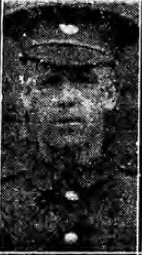
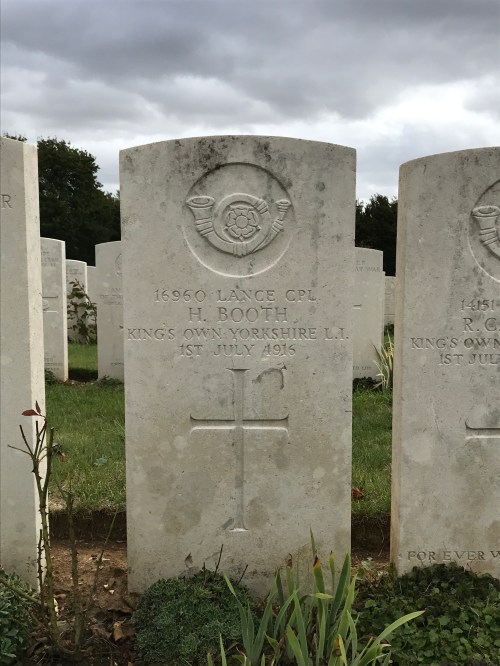
Lance Corporal Herbert Booth
9th (Service) Battalion, The King’s Own (Yorkshire Light Infantry).
Born: 15 May 1885
Killed in Action: 1 July 1916
Age: 31
Buried: Gordon Dump Cemetery, Ovillers-La Boisselle
Husband of Ellen and father of James and Hilda

Sources:

  • Batley News – Various Dates
  • CWGC
  • Parish Registers – St John’s, Carlinghow (CofE) and St Mary of the Angels, Batley (RC)

Pigeon-Stealing in Batley

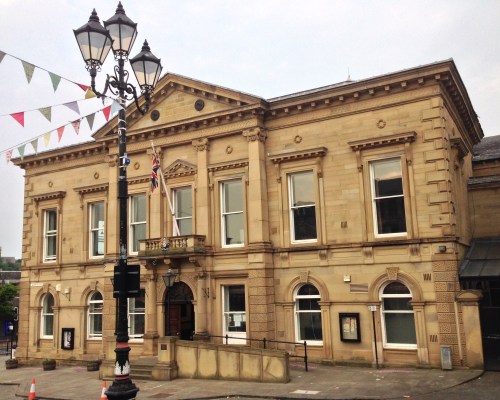
An entry dated 13 March 1908 in the Batley Borough Court records attracted my attention. On that day two 13-year-old boys and another aged 12 appeared before the Town Hall Magistrates charged with pigeon-stealing. They stood accused of taking four dark, dappled birds on 8 March from Back Cross Park Street.

image

Batley Town Hall – Photo by Jane Roberts

Juvenile crime was not uncommon in the Court listings. But two things attracted me to this one:

  • The sentencing notes were slightly unusual; and
  • I recognised the names of all three lads.

The Court Register entry combined with the newspaper report build up a fuller picture. It should be noted that the newspaper is, in some crucial areas, at variance with the Court record. The name of one of the lads is slightly different. And the ages are given as 12, 13 and 14.

The birds belonged to miner Robert Dewhirst. They were housed in a cote containing 15 pigeons. Robert locked it at around 5pm on Sunday teatime. When he checked it at around 5am the following morning he found the door swinging open, the padlock discarded on the floor and four birds missing. They had an estimated value of £2 according to the Court notes.

Later that day the birds were recovered. They were in the possession of Robert Clarkson, a Commercial Street fish and game dealer. He said he told the boys the pigeons were old and not worth more than 6d. He also claimed to have told them to fetch the owner and he would pay for them. The boys never returned. The Court Register and papers are silent about any charges preferred against Robert, so it seems there were none.

The three youths, a school boy, errand boy and pony driver, were not so fortunate. Two pleaded guilty to the charge; the other put in a “not guilty” plea.  Despite this he was convicted of the crime, along with his two friends.

This is where the sentencing twist came into play. They were discharged on entering recognizances for 12 months. They were instructed as to their good behaviour during this time. During this period they were to be under the supervision of Mr Gladwin, the probation officer. He was to visit them and submit regular reports to the magistrates about their conduct. Alongside this a 20s surety applied.

The noteworthy facet of the sentencing: this was the first ever case for the local probation officer.

Pigeon Stealing

Newspaper Headline

This new service owed its origins in 1876 to Hertfordshire printer Frederic Rainer, a volunteer with the Church of England Temperance Society (CETS). Initially London-based, it worked with magistrates via the London Police Courts Mission (LPCM) to release offenders on condition they kept in touch and accepted guidance from the “missionaries”.  The system was extended countrywide with the 1886 Probation of First Time Offenders Act. With an emphasis on religious mission and temperance, this Act allowed courts to appoint similar missionaries if they wanted to. Few chose to do so.

The 1907 Probation of Offenders Act gave these missionaries official status as “officers of the court”.  Furthermore it was now possible for courts to appoint probation officers paid for by the local authority.  The Act allowed courts to suspend punishment and discharge offenders who entered into a recognisance of between one and three years. As part of the conditions of this suspension, the offender agreed to be supervised by a “probation officer”.

Durham-born James Gladwin was Batley’s Probation Officer. He had held the Town Missionary post for a number of years, being recorded as such from the 1901 census onwards[1]. However the three Batley lads, all from St Mary’s parish, were his first cases following the 1907 Probation Act.

The sentence was partially effective. Two of the lads did indeed steer clear of further trouble. Sadly, the youngest failed to do so. He appeared once more before the Magistrates on 7 December 1908. This time he was charged with stealing a pair of men’s moleskin trousers, valued at 2s 6d from Joseph Bennett’s Commercial Street pawnshop on 5 December. Bennett took the precaution of ticketing his shop contents. The lad failed to notice this. So when he then attempted to pawn them at another shop on Wellington Street, Bennett’s mark was recognised and the boy apprehended.

This was around nine months after the pigeon-stealing incident, which as a result now came into play. Mr Gladwin, his Probation Officer, gave his character opinion of the lad. He was sorry, but not surprised, to see him in trouble again. He was always on “the edge of it”, always promising to do better. Police Inspector Wright said the lad was a bad influence on the other boys in town. Despite pleadings from his father, he was now convicted of both the trouser and pigeon-stealing offences. To save him from a life of trouble he was sentenced to five years in a Reformatory.

The Reformatory system was established in 1854 for under-16s convicted of crime. With concern about the way children were treated in the criminal system, the Philanthropic Society was at the forefront of this change to the criminal system. Children sent to Reformatory schools spent between two to five years there. However, until 1899, those committed to such establishments still spent 14 days in an adult prison first. This was thankfully no longer the case by the time of this lad’s sentence.

As a Catholic he was sent to serve out his sentence at St William’s School for Training Catholic Boys, situated at Holme upon Spalding Moor, near Market Weighton in the East Riding. Founded in 1856 as the Yorkshire Catholic Reform School, this was in a remote, rural location. The work the boys undertook reflected its countryside locality, with a large proportion dividing their time between studies and farm labouring. Other trades included shoemakers, bricklayers, printers, tailors, bookbinders, laundry and horse boys.

At the time he entered the Reformatory, it was headed by Rev Charles Ottaway who took over in 1906. It was Father Ottaway who instigated the name-change to St William’s. He was still in charge in the 1911 census, where the boy is shown as an inmate dividing his time between schooling and working as a farm boy labourer.

Under Father Ottaway’s regime the boys wore a uniform of plain cord knickers and a tweed coat. However despite the uniform and name-change, the Reformatory under his tenure was noted for its poor discipline and too frequent punishments, as noted in highly critical inspection reports. The covering letter to a December 1911 inspection said:

Father Ottaway overloaded, boys have insufficient food, overwork and lack of recreation, stunted in growth and underweight, approved dietary scale not adhered to and substitutes inadequate, punishments not accurately recorded, carelessness, cells unfit for use…..

Another report in May 1912 by Brigdier Mark Sykes M.P., a member of the Reformatory Committtee, noted amongst other things improper cleaning; ill-shod boys in ragged, disreputable clothing; an unvaried, disgusting diet; too frequent and too trivial punishments; inadequate fire-safety and escape provisions and damnning indictments on various staff members. His report ended:

I consider that with the exception of Mr Hart it would be best to discharge the whole of the present staff and start afresh“.

In short the entire establishment lacked go and discipline. 

The declining numbers of boys being admitted during Father Ottaway’s tenure was a probable reflection of the lack of  care, schooling, work-training  and basic facilities such as toilets and washing on offer there. Nevertheless Batley Borough Court continued to use it for its “wayward” Catholic boys, including two sent there in March 1912 for stealing a box of biscuits. And Father Ottaway remained in charge until the summer of 1912.

Back to the pigeon and trouser-stealing boy though. The lad’s father had a maintenance order of 2s a week imposed by the Court, in order to provide for his son’s upkeep in this establishment. Parents had to contribute towards the costs, and this was means-tested based on the family income. As the newspaper noted the family had £2 10s coming into the household each week.

East Riding Archives hold extensive records for this particular Reformatory, including admission registers, report books and medical registers.[2] So well worth a visit for those with ancestors who spent time there, either working or as inmates.

At the beginning of this post I mentioned I recognised the names of all three lads charged with pigeon-stealing[3].  They are all connected with my parish church. And all three lads were dead just over eight years following the pigeon incident. All lost their lives in the Great War: One in 1914, the other 1915 and the final one in 1916. They are all on the church War Memorial.

I have deliberately not named any of the boys involved.

Sources:

[1] In 1891 his occupation was given as “home missionary”
[2] East Riding Archives Finding Reference DDSW, St William’s Community Home
[3] I have taken the Court Register names to be the correct ones. As I mentioned earlier in the post, the only newspaper report for this incident had a different Christian name and slightly different surname for one of the boys. However checking baptisms, births and censuses there is no-one matching the newspaper name.