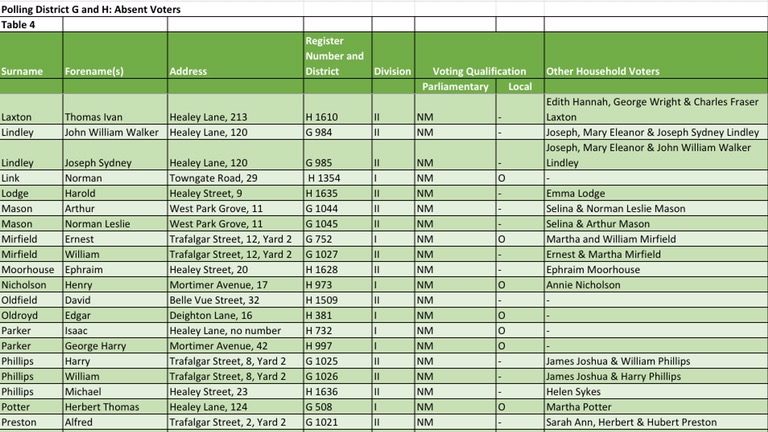
Thanks to the wonderful Batley Library staff and volunteers, the missing Batley Borough 1918 Electoral Register was located just before Christmas. I spent the early few days of February beavering away on it to extract the absent Healey naval and military voters, and put them into spreadsheet format.
This work has significantly expanded the list of servicemen I initially identified using CWGC records of those who died, the WO 363 “Burnt Records” and WO 364 records of those discharged for medical/capability reasons. This initial list identified 39 men, though I have subsequently discovered an additional man. He is Arthur Ellis, a rag merchant whose address was 263 Healey Lane. He served with the Grenadier Guards, Service Number 27774.
The Electoral Register, signed off on 1 October 1918 by the Batley Town Clerk’s Office, identified 121 men, though there is a small overlap with my earlier findings. The numerical difference is indicative of the limited numbers of soldiers’ service records surviving, with around two thirds of them being totally lost or irretrievably damaged during WW2 1940 bombing.
First bit of background information about voting entitlement and the Electoral Register. The Representation of the People Act 1918 came into force in time for the December 1918 general election. One of the drivers for electoral reform included the fact only men who had been resident in the country for 12 months prior to a general election were entitled to vote. This residential qualification, combined with the property ones, meant many serving King and Country overseas were effectively disenfranchised. The Act abolished these restrictions and extended the vote to all men over the age of 21. Additionally, men who had served in the war could vote from the age of 19. However Conscientious Objectors were disenfranchised for five years. The Act also gave the vote to women over the age of 30 who met a property qualification, wives who were over 30 of all husbands who were entitled to vote in local government elections and also to those who were university graduates.
However, it should be noted that parliamentary and local government franchises were not the same. Hence the 1918 register is split into three categories.
Division I: Persons qualified as both parliamentary and local government electors;
Division II: Persons qualified as parliamentary electors but not as local government electors; and
Division III: Persons qualified as local government electors but not as parliamentary electors.
Abbreviations used are:
R: Residence qualification;
BP: Business Premises qualification;
O: Occupation qualification;
HO: Qualification through husband’s qualification;
NM: Naval or Military voter; and
a: indicates absent voters.
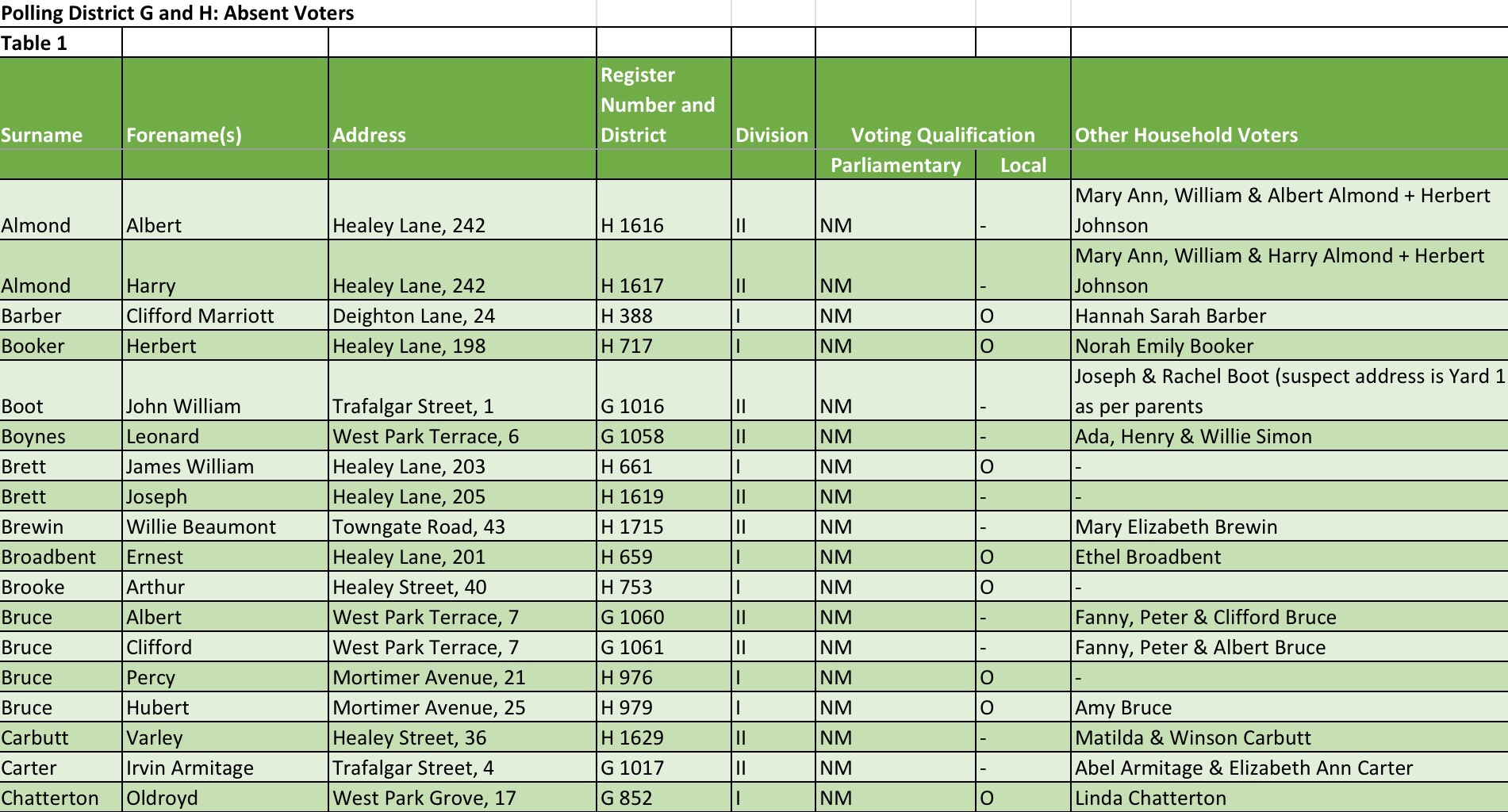
So here are the names of those identified from the 1918 Electoral Register.
The men on my Healey list all fall within both the absent and Naval and Military categories. The information was supplied by next of kin so may not be accurate. It may include men who were killed after its compilation. And addresses may not necessarily reflect actual residence, but merely be the most convenient address, for example the in-laws where the man’s wife was living whilst he was serving, or a friend’s home.
It is also worth emphasising this is the Electoral Register. It isn’t what is commonly known as the Absent Voters List (AVL). These lists, generated to provide servicemen and nurses with voting cards, ballot papers or proxy voting forms depending on where they were serving, gave far more detail. They normally included regiment, number, rank and home address. Sadly, despite checking with West Yorkshire Archives and Huddersfield Local Studies Library, I’ve been unable to locate the one for Batley Borough. It may be it no longer survives. The AVL would have provided so much more crucial identification information. But the Electoral Register is better than nothing.
The Register also enabled me to further define the parameters of this project. I used the Batley West Ward Polling Districts G and H to identify the relevant streets. These are:
Belle Vue Street
Crowther Street
Deighton Lane
Healey Lane (excluding the numbers falling within Polling District I. These are mainly below 79, with the exception of some numbers in the 40s which fall within District G)
Healey Street
Mortimer Avenue
Sykes Street
Towngate Road
Trafalgar Street
West Park Grove
West Park Road
West Park Terrace
These are in addition to Nelson Street and Prospect Terrace identified from earlier research. Looking at the 1911 Census Summary Books some Chaster Street houses may also fall within the catchment area.
The men’s details from the Electoral Register are contained in the following six tables. I checked across all three Divisions to identify other voters registered at the men’s given addresses, in the hope this provides more family clues.
So I can give myself an early 2017 back pat. This data extraction was one of my 2017 New Year’s Resolutions. I’d targeted a March completion, so I’m ahead of schedule and I can now begin the hard research, although I am still toying with the idea of the newspaper trawl. I know from previous experience how much value this adds. It’s a case of whether I have the time to do it alone!
This is another in my “Short Lives Remembered” series. It is another child discovered as a direct result of the General Register Office (GRO) birth and death index search facilities introduced in 2016. I’ve not found any baptism details for this child. She was born and died in between censuses. Her burial gives no family details. So tracing her relied on civil registration and mother’s maiden name in the new search options.
What I find most shocking about this child is the cause of death, which is put down to an ordinary, if painful and occasionally distressing, right of passage for babies and toddlers today.
Ann Jennings was born on 12 February 1869 at Carlinghow Lane, Batley. The daughter of coal miner Herod Jennings and his wife Ann Hallas, she had 10 older siblings. All were still living by the time of Ann’s birth. This was no mean feat in an era of high infant mortality, when the most seemingly trivial illness or incident could extinguish life. Poverty, locality, environment, housing, sanitation, medical care, public health and class all played a part. The 34th Annual Report of the Registrar General (1871) illustrates the perilous nature of early years survival. Looking at the under 5 age-group, between 1838-1871 out of every 1,000 girls, 62.7 died. The corresponding figure for boys was 72.6. In the five years 1866-1870 the figures were 63.4 and 73. And looking only at 1870, 64.4 per 1,000 girls under 5 and 75.0 of boys died.
Ann Jennings was one of the girls in 1870. She died on 15 January 1870 at Spring Mill Yard. Cause of death was dentition. In other words teething. This seemed incredible, that something so innocuous resulted in death.
Yes, it can be an unpleasant time. I remember my daughter’s intermittent episodes of irritability, sleeplessness, drooling, flushed cheeks and raised temperatures. Calpol and Bonjela became medicine cupboard staples during this period. Teething rings, some special cooling ones, were added to her array of toys. But that’s as far as it went. I never realised it could be a cause of death. So I investigated further – and became more astounded at how common it was.
A bit of background first. As with many childhood development milestones there are no hard and fast dates for the emergence of that first set of baby teeth. It normally starts at around the six to nine months stage, with each of the 20 teeth taking about eight days to emerge. The whole process lasts for around two years.
Back to the Annual Report of the Registrar General. This time I looked at the 33rd report covering the 1870 statistics, the year of Ann’s death. In the West Riding of Yorkshire 232 female deaths and 287 male deaths were attributed to teething. In total 4,183 deaths registered in England had teething as the cause.
In 1783 Frenchman Jean Baptiste Timothée Baumes wrote “A Treatise on First Dentition and The Frequently Serious Disorders Which Depend on It”. In it he claimed teething “….may often be be found the cause of death of a great number of infants”. The view was still prevalent almost a century later. According to the 35th Annual Report of the Registrar General, looking at 1872 statistics: “Teething is one of the first marked steps in development after birth, and by inducing convulsions and other irritative reflex diseases, it is chargeable with a certain number of deaths”.
The conclusion reached by medical professionals of the time was because the teething coincided process with the ages of high mortality, it was actually responsible for infant illness and death. According to accepted medical wisdom teething led to a number of afflictions and displayed a variety of symptoms including convulsions, diarrhoea, bronchitis, croup, vomiting, neck abscesses, insanity and meningitis. The teething phase was perceived as fraught with risk, a process to be dreaded.
Added to this, teething treatments could in themselves prove fatal. Even today there are stories of homeopathic teething tablets causing death. Back in the 19th century treatments ranged from dangerous to downright barbaric, with some treatments a combination of the two.
What could you do to make the passage of teeth through gum easier? Well, the obvious answer was to lance the gum, making a deep incision to facilitate the emergence of the offending tooth. This in a pre-anaesthetic, pre-sterilisation era carried it’s own risks. Leeches applied to the gums provided another solution.
And what could you do to relieve the pain, reduce excitement, regulate the bowels and induce sleep in the restless teething babe? Newspapers were full of the answers, with adverts for soothing remedies which parents, fearful of the dangers of dentition, were induced to purchase. In this unregulated, uncontrolled period of medicine druggists and pharmacists made their own propriety and patented concoctions with no details of ingredients. But these included opium, cocaine, mercury, morphine and alcohol, with rubbing whisky in gums of teething children even touted in more recent times. All of these could lead to addiction and death. The risk was not unknown. Cassell’s Household Guide of 1884 for instance acknowledged the danger of giving narcotics to children – but reassured parents that it was acceptable if such remedies were recognised as teething powders. So by trying to do the right thing and following advice, parents were in fact endangering their babies.
In fact in 1869 a 9-month old girl from Gravesend, Catherine Sarah Cobham, was poisoned as a result of a chemist dispensing strychnine instead of powdered sugar as a teething remedy. Incredible too that sugar was touted for teething – presumably leading to tooth decay later if the baby survived!
So who knows if Ann really did die as a result of teething. Was it a case of medical misdiagnosis? She was struggling at the teething stage and they did not look beyond that for a death cause; or did teething really cause something along the lines of a fatal chest infection or convulsions (though the certificate doesn’t elaborate); or was it even a teething remedy gone wrong? We will never know. So she is just another statistic, amongst thousands of others, whose death was attributed to dentition. Her funeral took place on 17 January 1870 at Batley Parish Church.
Others who feature in this series of “Short Lives Remembered” posts are:
Postscript: Finally a big thank you for the donations already received to keep this website going.
The website has always been free to use, but it does cost me money to operate. In the current difficult economic climate I am considering if I can continue to afford to keep running it as a free resource, especially as I have to balance the research time against work commitments.
If you have enjoyed reading the various pieces, and would like to make a donation towards keeping the website up and running in its current open access format, it would be very much appreciated.
Please click here to be taken to the PayPal donation link. By making a donation you will be helping to keep the website online and freely available for all.
Thank you.
Sources:
GRO Birth and Death entries for Ann Jennings
33rd Annual Report of the Registrar General (1870)
34th Annual Report of the Registrar General (1871)
35th Annual Report of the Registrar General (1872)
“A Treatise on First Dentition and The Frequently Serious Disorders Which Depend on It” by Jean Baptiste Timothée Baumes (1783) – Google Books
“Cassell’s Household Guide to Every Department of Practical Life: Being a Complete Encyclopaedia of Domestic and Social Economy Vol 1” (1884) – Internet Archive
One of my Christmas holiday viewing highlights was “To Walk Invisible.” Sally Wainwright’s drama focused on the years between 1845-1848, with the four surviving Brontë siblings and their father all together in Haworth. It portrayed Charlotte, Emily and Anne’s journey to become published authors, set against the backdrop of their increasingly bitter brother Branwell’s spiralling alcohol-fuelled (possibly with a touch of opium thrown in) decline and the bleak, isolation of their Haworth home. The Rev Patrick Brontë is shown as a distant but gentle figure, struggling with his failing eyesight and vainly trying to halt his beloved only son’s self-destruction.
It is a story that has fascinated me. Haworth is on my doorstep, a short drive away, and a place I’ve visited frequently ever since childhood. The Parsonage Museum, the church of St Michael’s and wandering round its overcrowded Victorian graveyard, and a walk to Brontë Falls and onwards to Top Withens (Wuthering Heights) all feature on my things I like to do list. Although I have to be in an energetic mood for the latter. If not, a mooch up and down the cobbled Main Street, including the Black Bull frequented by Branwell is an alternative. Last year I, along with many others, walked from Haworth village to Penistone Hill to see the film set recreation of the Parsonage.
Haworth Parsonage and the Recreated Film Set Parsonage – Photos by Jane Roberts
But even within minutes of my home there are a host of Brontë connections. The Rydings in Birstall was the early home of Ellen Nussey, Charlotte’s close friend who witnessed her marriage to Arthur Bell Nicholls in June 1854. The Rydings is believed to be the basis of Thornfield Hall in arguably Charlotte’s best known novel, “Jane Eyre”. Although not accessible to the general public, I was lucky enough to visit a few years ago on a Malcolm Haigh History Walk. Oakwell Hall, also in Birstall, right on my doorstep and a jewel in the crown of Kirklees Council, is the inspiration for Fieldhead in Charlotte’s novel “Shirley.” I have attached the link to a leaflet about local Brontë connections. Sadly Kirklees Council in its 2016 cut-backs permanently closed Red House Museum in Gomersal, home of another of Charlotte’s friends, Mary Taylor, and Briarmans in “Shirley.”
The Rydings and Oakwell Hall, Birstall – Photos by Jane Roberts
The leaflet also highlights several local churches. Patrick Brontë was ordained into the Church of England as a deacon in 1806 and priest in 1807. He is most associated with Haworth, being appointed Perpetual Curate of Haworth, Stanbury and Oxenhope in 1820, and remaining there until is death in 1861. However, prior to this appointment he held curacies at a number of other churches. The places associated with him are:
Wethersfield, Essex (1806-1809), Parish Registers for St Mary Magdalene are available on Essex Archives Online
Wellington, Shropshire (1809). Parish Registers on FindMyPast
Dewsbury, Yorkshire (1809-1811), Parish Registers on Ancestry.co.uk and Bishop’s Transcipts (BTs) of them on FindMyPast
Hartshead-cum-Clifton, Yorkshire (1811-1815). Maria Brontë’s baptism took place here. She was the eldest of the Brontë children and died in 1825. BTs are on FindMyPast.
Thornton, Yorkshire (1815-1820). This is where Charlotte, (Patrick) Branwell, Emily and Anne were baptised, along with sister Elizabeth who died in 1825. The BTs of the registers, including these Brontë baptisms, are on FindMyPast.
So if you have ancestors who were baptised, married or buried in these places, check the parish registers for the name of the minister. See if it was Patrick Brontë (or the early variant Brunty which appears in the Hartshead BTs). One word of caution. Pre-1813 registers were not standardised, so naming the person performing the ceremony prior to that date may only extend to marriages. From 1 January 1813, following Rose’s Act of 1812, printed paper registers with a standardised format included details of the person officiating, so this includes for baptisms and burials as well as marriages.
I did check, having ancestors in Hartshead, Dewsbury and Thornton. But unfortunately they are fractionally either side of the relevant dates for Patrick Brontë. One lot were, in any case,nonconformists. So I was unsuccessful in finding that hoped-for Brontë family connection to add family history colour.
However you may be luckier. You never know, you might find the officiating minister was Patrick Brontë, father of these literary legends. So you might have your very own (tenuous) Brontë link in your family history story.
This is my 100th blog post, and my first as an ex-civil servant. So to mark this milestone I’ve decided look at family history as a subject, and give my perspective on its place in the overall discipline of history. Does it actually deserve to be classed as history?
Perhaps some do look down on it, thinking its a kind of “dumbed down” version of history. After all there’s nothing to collecting the names of a bunch of ancestors and tagging them with a few vital event dates. But that’s missing the whole point. Family history isn’t only about creating a tree full of connected names.
For me family history is a specific strand of history and is as valid a discipline as studying the Tudor period, or being an expert in the English Civil War. My history degree covered what are probably regarded as “traditional” history topics such as the origins of the Great War, the Russian Revolution, Latin American Independence Wars and politics, the Enlightenment and history of ideas or the foreign policy of the Chamberlain government. However, other elements had a definite family and social history slant. These included children in British society, parish registers, censuses, and various Factory and Education Acts.
In fact family history encompasses a far broader time sweep than many specialist areas, with their comparatively narrow timeframes. More than that, it covers a wide breadth of elements. It requires a knowledge of international, national, local, economic, industrial, religious, medical, agricultural, demographic, political, judicial, legislative and social history – to name but a few areas.
This broader historical perspective in turn leads to an understanding of when individual records so vital for family history were created and why, and crucially what is consequently available to further research. For instance parish registers and poor law developments down to the impact of the Civil War and Commonweath through to voting rights.
At the same time geographical knowledge plays a part, from parish and administrative boundaries to the development of towns, transport links and migration routes and patterns. A bit of Latin and the ability to decipher handwriting akin to the meandering of a spider who has paddled in an ink puddle also helps.Family history therefore goes way beyond parish register and census hopping to create a list of names. It’s way more exciting.
To me family history ranges from contextualising the lives and times of my ancestors within events such as the Industrial Revolution, the English Civil War, or the First World War; it also drills down to putting specific life-changing decisions or events into the framework of national and international events, like the shelling of Scarborough, Whitby and Hartlepool and my great grandad’s decision to enlist. Or the Irish Famine, its impact in County Mayo and the decisions made by my ancestors to remain or leave.
Furthermore family history has enhanced my historical knowledge, drawing me to investigate areas that broader history would not touch upon. Lesser known events such as miners strikes in specific localities, such as Drighlington, and the impact it had on ancestral lives, leading onto coal mining communities and occupations generally; or the growth or decline of towns and villages, or industries and occupations and the associated migration patterns or job switches. It has also led me to conducting greater in-depth investigation into factors affecting their lives such as judicial changes, the Poor Law, various Factory Acts or diseases such as TB, diabetes and smallpox along with accompanying medical advances; without my family history hat on, for me these events would be looked at in a high-level generalised way and not considered in detail or applied to individuals who are my flesh and blood. Examining them in relation to my family makes them more real. And by extension it leads to communicating finds to other family members and hopefully making history more accessible, relevant and real to them.
And, as that’s the case, for me family history is truly one other strand of the various disciplines falling under the generic umbrella of history. So done properly, and not a paper-chase exercise of populating a tree with thousands of names, the answer to those who cast doubts on its merits is an unequivocal yes: Family history is truly “proper” history.
Often it’s so easy to dwell on life’s failures and the things that didn’t go well, rather than remember and focus on successes. Many of us find it exceedingly embarrassing to blow our own trumpets. It’s not the done thing. Bushel-hiding comes easier to many of us.
Picture courtesy of Pixabay.com
One of the banes of my civil service working life was the mid-year and annual review process. Gathering documented evidence of achievements throughout the year was a part of this. It was contrary to my nature and I found it a hugely painful experience.
However in hindsight this exercise may have psychological benefits. It serves as a positive reminder of success when things aren’t going so well. It’s a bit like a gratitude journal, but specifically focusing on one particular aspect of life.
So I’m going to apply it to my 2016 family history year, identifying what I regard as my top 10 positives, covering a broad range of topics on a number of levels:
My blog. This grew and developed throughout 2016. People have read it and taken time out to share, like and provide feedback. In viewing terms it has quadrupled since 2015;
Completing the last of my Pharos Intermediate Modules and passing all with distinction, achieving the top marks overall in the 2016 cohert of completers. The ceremony at the Society of Genealogists in June has to rank amongst the top of my 2016 highlights;
Taking on client work. In 2016 I began undertaking work for others. It gave me immense satisfaction to connect others with their family history. Their obvious pleasure and positive feedback confirmed this is a valued service, and one I am proud of;
In June I sold the final copies of my St Mary’s Batley War Memorial book raising money for the parish roof appeal and the Royal British Legion Poppy Appeal;
West Yorkshire Archives closed its Wakefield office in May in preparation for its move to a brand new building in 2017. In those final weeks before closure I set myself a target of going through the Batley Borough Court records. I had to fit it around work and an operation which effectively put me out of action for three weeks. But I did it and, in the process, found some useful family history information confirming parentage of three separate children;
Having a family history story about a census in-betweener published in the April 2016 edition of the Huddersfield & District Family History Society Journal. Thomas Gavan, the eldest child of my great grandmother was born in 1889 and died six months later. His death was the subject of an inquest;
Somme Visits. I was lucky enough to be awarded tickets in the ballot for the Somme centenary commemoration at Thiepval. An incredibly moving and thought provoking experience, which I feel immensely privileged to have been part of. I was back again in Flanders and the Somme in September, this time on the family history trail. I followed in the footsteps of a WW1 ancestor on the Ypres Salient thanks to battlefield guide Sabine Declercq. I met a distant relative for the first time at a 100th anniversary cemetery visit. And I experienced an amazing set of coincidences on the Somme, as featured here;
Newspaper articles. In July I featured twice in the Huddersfield Daily Examiner. In one article I talked about family history, what got me into it and gave some quick tips. They also published one of my research pieces about the death of Annie Leonard, a Batley munitions worker in WW1;
Helping others, for example assisting with local research projects or providing general advice or information;
Finally those individual little pieces of success which make family history so addictive. This year these included the discovery that my 5x great grandmother, born in around 1748 was a one-handed gypsy. Also the find that my 4x great grandfather and some of his children gave evidence to the 1842 Royal Commission looking at the employment of women and children in mines; and I found several hitherto unknown children thanks to the additional information on the GRO indexes towards the end of the year, which have shifted the family history kaleidoscope picture.
I really do suggest this as an exercise. It re-enforces self worth, especially in those inevitably bleaker times. It serves as a reminder of our indidual achievements and wider contributions, all too easily forgotten when things go wrong. Analysing what went well, just as much as what didn’t go as planned, can help replicate success in the future. And it spurs us on to do more. I will refer back to this as a beacon of light in my darker moments of 2017.
I was a tad disappointed when I realised WordPress wouldn’t be doing their normal review of the year. So I’m doing my own version – minus the cool graphics.
Image from Pixabay.com
First the headlines, as nicked from the previous WordPress review. The concert hall at the Sydney Opera House holds 2,700 people. This blog was viewed over 12,000 times in 2015. If it were a concert at Sydney Opera House, it would take about 4 sold-out performances for that many people to see it.
My best day: Well that would be 7 September 2016 with 360 views. My most popular day was Wednesday with 19% of views. And my most popular time is 8pm with 10% of views. This chimes with my posting pattern, as I tend to follow a Wednesday or Thursday evening routine.
How did they find you: Over 2,500 reached my site via Search Engines. Where search terms were identified, the top one was “jane roberts of batley.” Facebook clicks were responsible for over 2,200 referrals and Twitter almost 1,500.
Where did they come from: Unsurprisingly, as I’m based in England, over 7,600 were from the UK. Almost 2,000 from the USA. Australia and Canada views were around 600 each. But I had views as far afield as Hong Kong, Japan, Afghanistan, Argentina, India and Saudi Arabia.
Top posts of 2016: Other than general home page/archives and about, these were:
A German Family in WW1 England. This delved into the anti-German pork butcher riots and the impact on a Yorkshire family;
Death of a Barnbow Canary looked at the dangerous work undertaken by women in WW1 munitions factories, focusing on Annie Leonard from Batley. She died as a direct result of her work at Barnbow in 1916;
General Register Office (GRO) Index: New and Free. The exciting new index of births and deaths which gave a different set of information and search options to identify hitherto hidden ancestors; and
In a similar vein, Fabulous News for those with Irish Ancestry covered the free release of the Irish General Register Office (GRO) images of births of over 100 years ago, marriages of over 75 years ago and deaths of over 50 years ago.
A couple of my favourite posts which didn’t make the top five were my surprise discovery about my 2x great grandfather, the subject of two separate murderous assaults. And my look at how broader historical events can impact on family history, with my great grandfather’s decision to enlist in December 1914 in Happy Birthday and Farewell.
My blog started in April 2015. In those first nine months it had a smidgen over 2,900 views What is pleasing is the enduring interest in some of my early posts, which remained amongst my most popular ones in 2016. For example my family connection to the 1915 Dewsbury tram disaster, likened to Ypres. Or Shrapnel and Shelletta, where I looked at baby names and their links to war, remembrance and commemoration.
In 2016 I averaged roughly about 322 per views month. In 2016 this has grown to over 1,000 per month. My blog has developed into a mixture of personal family history stories, more general news updates, exploration of specific records and how they can be used in family history research and Batley-area focused posts. I’m also going to use my blog for my Aveyard one-name study and Healey, Batley WW1 project. Hopefully these topics and projects remain of interest, but any other suggestions would be welcome. I love reading the comments submitted and seeing the likes (well over 100 of each in 2016), as this alongside views really does help me gauge interest.
So what does 2017 hold? Well, as I said in my New Year Resolutions, I may not sustain my 2016 output as I want to focus on other in-depth projects and research. But I am committed to doing two posts a month, more if I have the time. So we’ll see how it goes.
Wishing everyone a happy, healthy and peaceful 2017.
Right, it’s time for my look ahead at the things I want to achieve in 2017. It’s a scary, but exciting, year in prospect as at the end of the month I finally quit my civil service job of 30 years. I’m still not sure if I’ve made the right decision, but I know I need to re-balance my life and put family and health first. The decision for the Department of Health to downsize, shedding a third of its staff, seemed the right time to do this.
Initially I’m going to take a bit of a break from things. I know I need to step back and recharge my batteries, take time out to relax and learn how to enjoy life again. But then I’m intending to be back with renewed vigour. I’m hoping my regained freedom will leave me more time to concentrate on family history, client work and free up time to take on volunteering roles. Although saying that, I haven’t entirely ruled out looking for a part-time job later in 2017.
In terms of personal family history goals I’ve decided to stick to just five. So here goes.
Aveyard One-Name Study: I started this in 2016, and I am taking it at a fairly relaxed pace fitting it around genealogy course work and personal research. But I do want to complete my census data collection in 2017. I also want to go through the new GRO indexes too, to identify any additional entries there, and complement my earlier birth, marriage and death civil registration data. If I do complete all this in 2017 I will be more than happy.
Healey War Memorial Project: Another thing I started in 2016. By the end of March I want to complete my data extraction from the 1918 Batley Borough Electoral Register. After a brief panic at the end of 2016, when this crucial book did a library vanishing act, the wonderful staff and volunteers at Batley Library have located it and it is now once more locked away in its rightful cabinet. It’s now full steam ahead with identifying absent military voters. Ideally as part of this I also want to check out the local papers of the time. But realistically, on my own, is this achievable? I haven’t ruled it out though. (Any volunteers to help would be very welcome). Anyway, the absent voters combined with surviving service and pensions records, provide a basis. So, once I’ve completed my absent voters list, it will leave me clear to begin researching and writing up the stories of the men.
Blog Posts: Almost by default my blog gathered pace in 2016. Unintentionally I ended up doing a post a week, with some weeks producing even greater output. The blog has developed into a mixture of family history research, general genealogy updates and Batley focused posts. Whilst I love doing it, I may not sustain the 2016 level. However I am aiming for a steady two posts per month. I will publish my 2016 blogging review in my next offering.
Palaeography Practice: This is something I find a headache (literally). However I know I need to put in more effort. I am aiming to do one transcription per week, to get and keep my eye in.
Finally a very personal piece of research: It involves investigating a family history mystery involving a brush maker, Yorkshire asylums, a will and an army officer. This is something I’ve been meaning to do since February 2016. But it is a big piece of work involving many different strands and families, including some transcription work, and I keep getting distracted. Like many others I seem to spend more time on the family history others at the expense of my own. However I want to solve the mystery in 2017 and I’m setting aside July to do it.
What may get in the way is my natural inclination to go off on genealogy tangents as new pieces of information capture my imagination, follow new record sets and do research for others. Also I’m committed to an intensive series of courses up until the end of June, which will significantly eat into my time. However I will post a mid-year update. I’m hoping committing to doing so will help my focus on these objectives, and pull me back on track if I feel they are going off the rails.
Wishing you all a happy, healthy New Year, packed full of family history fun.
This is my last post before Christmas, and I thought I better make it seasonal. After writing about my Christmas family name last year, Herod, today I had a quick look for any names with more pleasant connotations. A quick scan of General Register Office (GRO) birth indexes reveal the following selection:
Christopher Tingle – mainly modern occurrences. But one dates from Q2 1847 Islington
There are a handful of babies named Ivy Holly (surname). They include one from Q2 1891 Eastbourne;
Christmas Holly Bell Jeffreys is registered in Q1 1910 Easthampstead. Only the initial “B” appears in the index. The 1911 census confirms this stood for “Bell”;
Mistletoe Spencer was registered in Q1 1910 in Doncaster. Mistletoe has gained slightly in popularity in recent years;
Holly Berry, Berry being the surname, is again more popular in the modern era. The earliest civil registration occurence is in Q1 1880 Barnstaple;
Holly Lavinia S Bush was registered in Q2 1899 Southampton;
Christmas Rose appears once, registered in Q1 1873 Maldon;
Bethlehem Shepherd features in Q1 1865 Chesterfield. There was also a Harry Bethlehem Shepherd in Q4 1878 Sheffield;
An unusual name, but Virgin Mary appears occasionally, including baby Cotton who was registered in Q4 1875 Stow;
There are a host of babies named Harold Angel, including one registered in Q1 1903 Burton;
There are a couple of Christmas Angels. Robert Christmas Angel’s birth was registered in Q1 1870 Yarmouth whilst William Christmas Angel features in Q1 1890 Flegg;
Christmas Carroll is there once, registered in the St Saviour District, Q1 1892;
Lillian Ruth Christmas Tree was registered in the Canterbury District in Q1 1903. The letter “C” appears in the index. Her baptism in January 1903 at St Stephen’s, Hackington confirms “C” stood for “Christmas”;
There are a few babies named Xmas, including Nellie Xmas Pulleyn whose birth was registered in Q1 1869 in the Croydon District. A Xmas Hollingworth was registered in Q4 1871 Barton upon Irwell;
Yule is there too, including Yule Mary Bedford registered in Q1 1909 Worcester;
Weather-related ones also crop up. I particularly like Amelia Snow Manning, registered in the Spalding District in Q1 1883;
On a weather theme, there are two Winter Frost babies. One in Q1 1859 Kidderminster. The other in Q1 1873 Aston;
Finally no Christmas list would be complete without Santa Claus. In this case Santa Claus Losack whose birth was registered in Q1 1891 in the Holborn District of London. And he was actually born on Christmas Day 1890, the son of dressmaker Bella Losack.
Many of our Christmas traditions originate from Victorian times, and this is when it really took off as the festival we recognise today. So it seems clear, with the dates in which the majority of birth registrations occured, that many of these babies were named with the time of year in mind.
Photo by Jane Roberts
Anyway there’s only one thing I can end with saying to everyone: Mary Christmas, and there are many of them in the birth indexes.
Sources:
GRO Indexes of Births
1911 England Census
Baptisms at Stephen’s, Hackington at Canterbury Cathedral Archives, reference U3/39/1/5 (FMP)
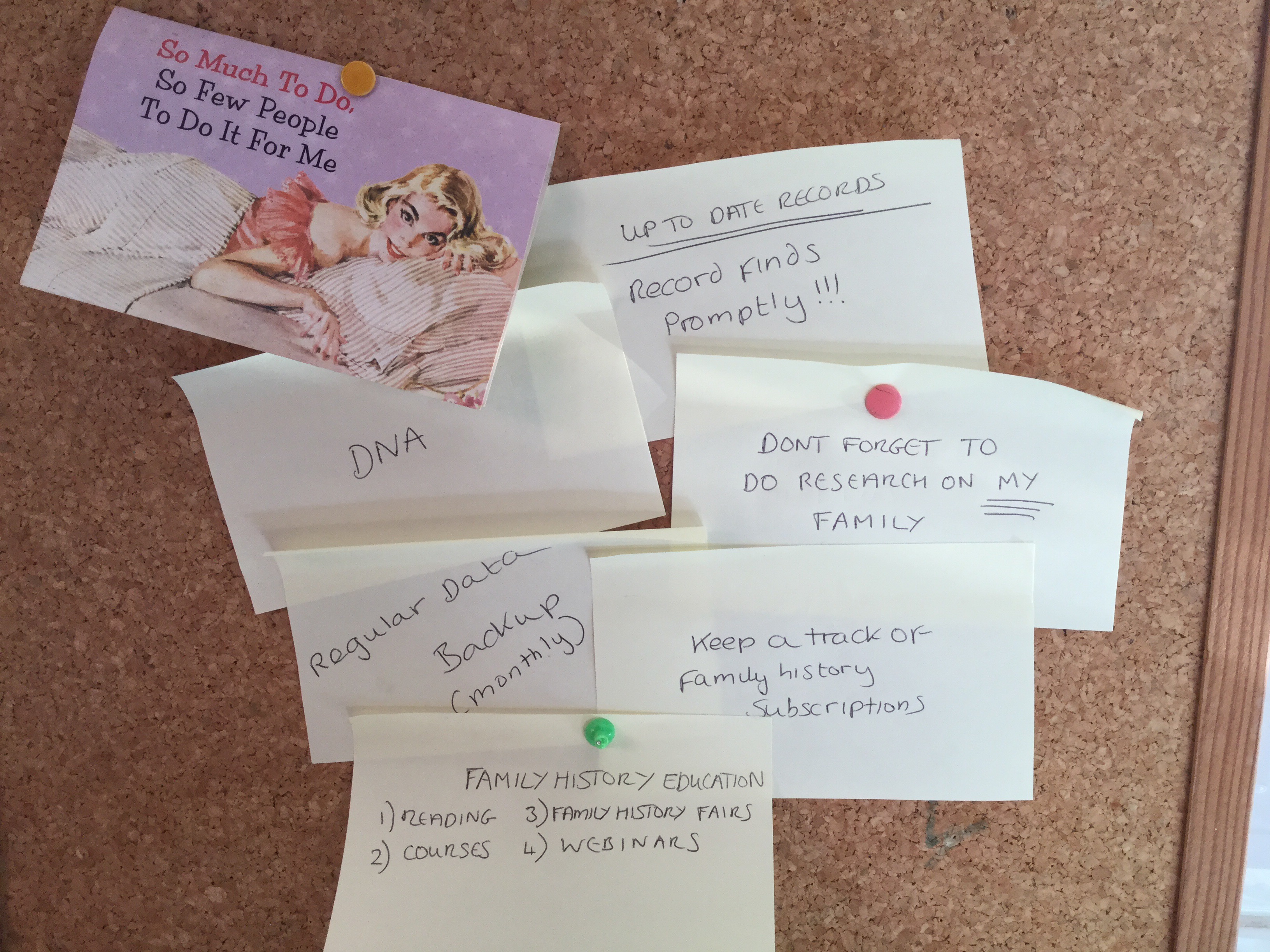
As I review my 2016 New Year’s Resolutions, I’m left thinking they turned into a bit of mixed bag. Some were fully achieved; others partly; and one, to be brutally honest, was an abject fail. Regular Data Back-Ups: This started out brightly. But by October, when I bought my new laptop, they came to an abrupt halt. I still haven’t got to grips with the newest frustration in my life. I have a technology phobia. I loved my old laptop mainly because I was used to it. The thought of having to confront the multitude of tasks that accompany a new machine – such as adapting to Windows 10, loading my Family Historian and other packages or setting up my printer – fills me with dread. And as my old laptop is on its last legs I daren’t use that either. So it’s been a period of avoidance. And now, this holiday season, I’m going to have to be brave and take the plunge with this new family addition. This includes transferring all the muddle of work I’ve fudged together, on a multitude of other devices in this technological wasteland of time, to my nemesis – and backing it all up. Although as I write this (on my iPad) I still can’t bring myself to face the trauma.
Record Keeping: I did catch up with cataloging all my outstanding records, and then I kept up with record keeping……for a few months. But by the end of the year I lapsed once more.The computer issues proved one (major) factor in this. The other element is the whole host of new online records, which overwhelmed me. I was like a kid in a sweet shop with the online launch of Irish GRO birth, marriage and death entries, quickly followed by the new online England and Wales GRO index. The final straw was the GRO PDF trial. I now have masses of certificates to add to my latest record keeping backlog.
Get a Grip of Subscriptions: A success. All are listed. I am monitoring usage and I am cutting back, albeit reluctantly, on my lesser used ones.
Keep Informed about Latest Family History Developments: Another one which went well. I attended two family history fairs. I did do the reading I committed to – but not on the bus. The lure of dozing proved too much here. I undertook several webinars. I completed my Pharos Tutors Family History Skills and Strategies (Intermediate) modules. I’ve now embarked on the Advanced course. So I can tick this box
Get Back to my own Family History Research: A mixed picture here. I did fit in personal research – just not the research I planned. I made no progress with my husband’s tree. Neither did I start mum’s family history book. Other pieces of research took precedence. I crammed in a series of visits to West Yorkshire Archives (Wakefield) before its relocation closure, and the results here led to new family history diversions. As did my visit to Tyne and Wear Archives. Not to mention the raft of new data releases. I also took on new, unanticipated ventures. These included starting a One-Name Study, choosing my great grandmother’s very Yorkshire surname: Aveyard. I also launched my Healey Great War Project.
DNA: I hold my hands up. This proved an almost total failure. Other than periodically scanning my matches and sending the odd email, I’ve made very little progress. I have responded to the emails I received. Sadly, not all of mine have met with the same response rate. But it’s not been an unmitigated disaster. I’m in touch with some wonderful, newly-discovered distant cousins – it’s now a case of working out the exact links!
So there are a couple of key lessons for me. The first is to stay focused on the goals I set throughout the year. The second is to be mindful of my technology issues, and try to address them. Hopefully evaluating my 2016 Resolutions will help me when turning my mind to my 2017 wish-list! I’ve already decided to put DNA on the back-burner though.
16 December 1914 marked a momentous day for my family. My grandma celebrated her sixth birthday. But not any old ordinary birthday in Batley for her, spent with her mum, dad and seven year old sister Nellie. This birthday was unlike any other.
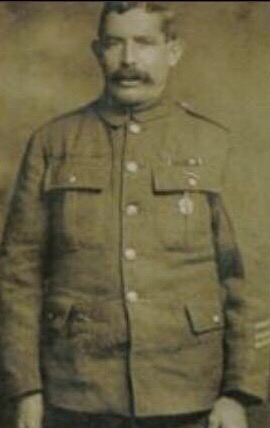
Astonishingly, I discovered this of all days was the day her 46 year-old father, my great-grandfather Patrick Cassidy, chose to enlist with the local regiment, King’s Own Yorkshire Light Infantry (KOYLI). Patrick, born in 1868 in Hagfield, County Mayo, even knocked several years off his age to ensure he would be accepted. His attestation papers show he claimed to be 35 years and 11 months.
I knew my great-grandfather had been in the Army. My grandma told a tale of a motor vehicle turning up at their Hume Street home containing someone to see her dad. The story goes that the officer inside was the one he’d acted as batman for. I had no date for this event, but given my grandma remembered it, I’d guessed in sometime after 1912.
However, because of his age, I’d discounted him seeing his military service during the Great War. Combined with his age, his uniform in one of the family photos, with its three point-up chevrons on the lower left sleeve indicating 12 years good conduct, indicated pre-war service. I’d marked it as pre-1904, as he’d first turned up in Batley in January of that year. And by then he was a labourer. That was also his occupation when he married Ann Loftus in 1906. And also in the 1911 census.
Patrick Cassidy
As it happens his attestation papers backed up this earlier service theory. He confirmed to the attesting officer he had previous time-expired service with the Duke of Wellington’s Regiment (West Riding). He described it as 33rd and 76th West Riding, harking back to 1881 and the Cardwell Reforms when the Halifax depot 33rd and 76th Regiments of Foot merged.
One thing I found amusing from these papers: My grandma, who adored her father, always gave the impression of him being a tall man. According to his army forms he stood at the incredible height of…….5’ 3.5”. Just goes to show, don’t take all oral family history as gospel!
Anyway, back to the lie over his age. As an ex-soldier, by this stage of the war, the age limit was 45, not 38 as for other volunteers. So he really did go overboard with his age reduction. In fact, with his precise 35 years and 11 months, it seemed he was still working to the end of August 1914 rule change for volunteers without previous service, when the upper age limit was increased from 30 to 35. He really was determined to do his bit.
Still, I couldn’t get my head round it. Not the fact he chose to sign up. Not even the fact he lied about his age to do so. But why on earth would he do it on his young daughter’s birthday? Why not wait till a few days later? In fact, why not wait till after Christmas? Had there been some major family row that prompted it? Or had a close family member or friend, as yet unidentified by me, died whilst serving? Was my great grandfather out to avenge their death? Those were the only explanations I could come up with.
His papers offered no clues whatsoever as to why he would act in this way and leave his wife, children and labouring job in Batley to take this huge risk. Or did they?
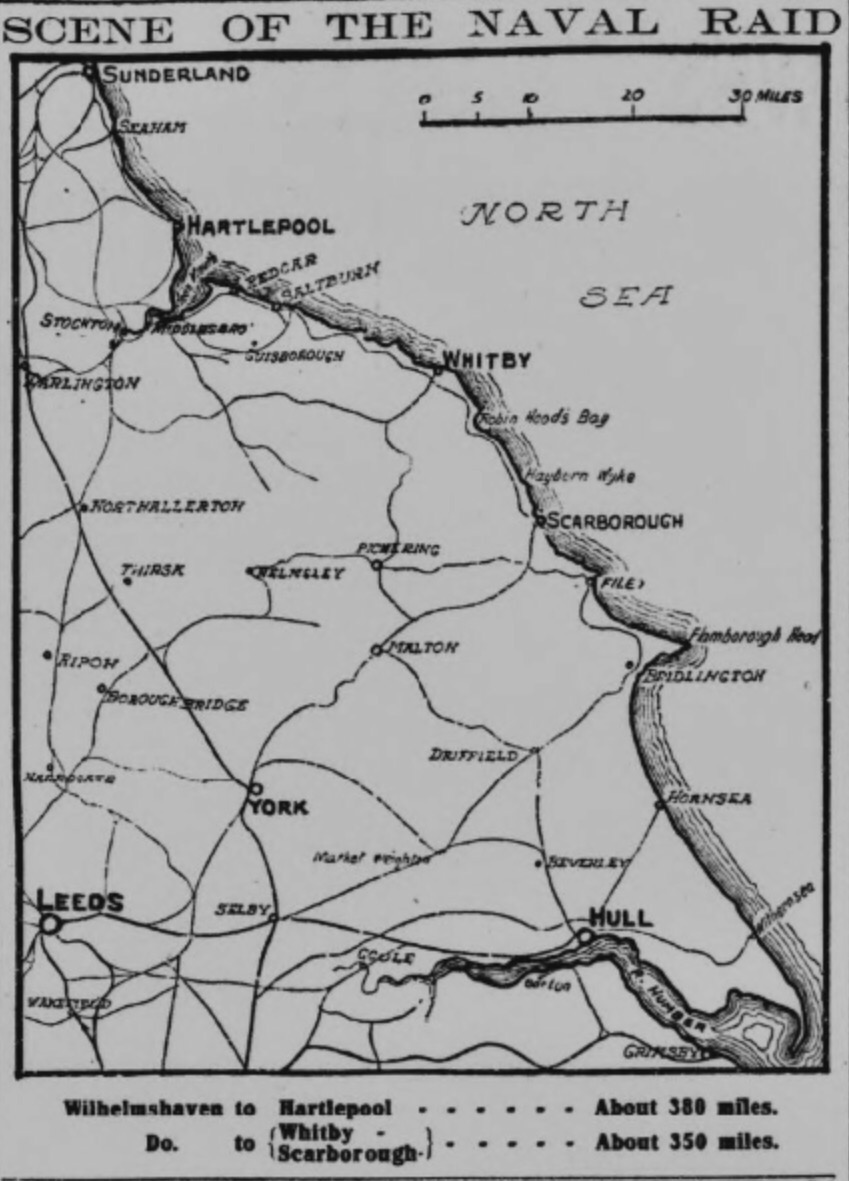
Several months later, whilst doing some general research, I realised the papers did contain the answer. The key was in the date. I’d been looking at it in narrow family terms, my grandma’s birthday. I’d not looked at any wider historical events. Besides being my grandma’s sixth birthday, Wednesday the 16 December 1914 marked the day German Imperial Navy ships Seydiltz, Moltke, Blücher, Derfflinger and Von Der Tann bombarded the east coast towns of Scarborough, Whitby and Hartlepool with a final toll of over 130 killed and almost 600 injured.
The attacks occurred from around 8am to 9.30am that morning. In the immediate aftermath, in scenes reminiscent of Belgium and France, refugees fled their homes seeking safety inland. Distressed residents from the stricken towns, some still in slippers and nightdresses, disembarked in local railway stations with tales of terror and destruction and reports of “scarcely a building left standing.” The historic landmarks of Whitby Abbey and Scarborough Castle suffered damage. Famous seaside hotels, like Scarborough’s Grand Hotel, bore shell scars.
The Grand Hotel, Scarborough
From 16 December onwards newspapers the length and breadth of the country carried the stories of this exodus, along with tales of death, injury and destruction wreaked. This from “The Yorkshire Evening Post” of 16 December reporting of arrivals in Leeds at 11 o’clock “One woman who arrived was wearing her bedroom slippers; in her arms was a two-year-old son in her nightdress and an outer garment lent by someone on the train.”
Another refugee was Mrs Knaggs, who lived in the vicinity of Scarborough’s damaged Grand Hotel. She arrived in Leeds on the 1 o’clock train into Leeds with her eight-year-old daughter and a few hastily packed groceries. She recalled meeting “…scores of women and children. All seemed unconsciously making for the railway station. Some were half dressed, and carried with them all manner of household articles. Another refugee had a child of a fortnight old in her arms, and with her was another partly-dressed girl of fourteen…..The streets of Scarborough were filled with women. These refugees were without food, money and very scantily clothed.”
Whitby resident Mrs Hogg was another Leeds arrival. Her house was struck by a shell. She recounted: “Outside shells were flying about, tearing up the pavement and damaging houses….In the fields in the outskirts of town big holes were torn in the ground and all the telegraph wires were down. People were hurrying along, some with a few belongings they had managed to get together. One man was carrying a parrot and two bird-cages. My little boy had run out of the house in his slippers. He lost his slippers on the way, and had to walk in his stocking feet.”
The German navy were dubbed the baby-killers of Scarborough, a reference to one of the victims, 14 month old John Shields Ryalls. In a letter to the Mayor of Scarborough on 20 December 1914 Winston Churchill, First Lord of the Admiralty wrote: “Whatever fears of arms the German Navy hereafter perform, the stigma of ‘Baby-Killers of Scarborough’ will brand its officers and men while sailors sail the seas.”
Baby Ryall’s picture along with another victim, 15 year-old boy scout George Harland Taylor, featured prominently in the press with inflammatory headings like “Slain by Germans” and “Killed by the Raiders.” Others included 28 year-old Miss Ada Crow, due to be married to her army fiancé, Sergeant G.R. Sturdy, on what turned out to be the day of her funeral.
John Shields Ryalls
George Harland Taylor
Some were of the opinion that the attack was the best thing that could have happened – it would give a boost to recruitment, now waning after the initial rush following the declaration of war. Battalions would be filled on the back of the attack.
By 18 December newspapers were reporting a material increase in numbers coming forward to recruiting offices, particularly in the areas affected by the bombardment. And from 18 December a new recruitment poster made its appearance:
AVENGE SCARBOROUGH Up and at ‘em now! The wholesale murder of innocent women and children demands vengeance. Men of England, the innocent victims of German brutality call upon you to avenge them. Show the German barbarians that Britain’s shores cannot be bombarded with impunity. Duty calls you now. Go to-day to the nearest recruiting depot and offer your services for your King, home, and country.
This theme was echoed in subsequent recruitment poster campaigns. This included a depiction of the ruins of 2 Wykeham Street, Scarborough where four died: Johanna Bennett (58), her son Albert Featherstone Bennett (22) a driver in the RFA, and two young boys John Christopher Ward (9 according to newspapers, although GRO entry gives his age as 10) and George James Barnes (5).
My great-grandfather didn’t wait for these rallying call to arms. He went to the recruiting office on the very day of the attack. Maybe the White Lee picric acid explosion with rumours of German sabotage only a fortnight earlier, which caused death and devastation to Heckmondwike and Batley, also played a part in his thinking. Though I can’t be 100 percent sure, it looks like he enlisted because he wanted to protect his family. The bombardment of east coast town, with the huge loss of life and the streams of refugees which followed, brought the war so much closer to home. The Yorkshire seaside resorts of Whitby and Scarborough were particularly popular local holiday destinations. In fact when war was declared only four months earlier the local Territorials, 1/4th KOYLI, were on their summer camp in Whitby. No longer was it a distant war affecting civilians – women and children – in foreign lands. It was now in Yorkshire. His family were now under threat. He couldn’t stand aside any longer.
So what became of him? The attestation papers indicated his resurrected army career with the KOYLI proved short-lived. On 15 January 1915 he was discharged as unlikely to become an efficient soldier. Unsurprising given his age. But the discharge setback did not deter him. It wasn’t the end of his military service.
By pure chance I found an entry in the “Batley Reporter and Guardian” of 27 August 1915. Private Patrick Cassidy of Hume Street appeared in Batley Borough Court charged with being absent without leave from the 3/4th battalion Duke of Wellington’s Regiment, who were stationed at Halifax. So he’d gone back to his old regiment. The Batley Borough Court records gave the offence date as 24 Aug 1915. He pleaded guilty and was remanded to await a military escort. I wonder if this has any link to the vehicle my grandma recalled?
The 3/4th Duke of Wellington’s was formed in March 1915 so it seems Patrick may have remained a civilian for as little as a couple of months after leaving the KOYLI. The battalion remained in England throughout the war, stationed at Clipstone Camp, Rugeley Camp, Bromeswell (Woodbridge) and Southend, training and supplying drafts for overseas service. I’ve traced no Medal Index Card for Patrick so it seems he remained on home shores. However he did see the war out. In the Batley Electoral Register of 1918 he is listed as being absent as a naval or military voter. Unfortunately the detailed Absent Voter List for Batley does not appear to have survived. This would potentially have confirmed his service number and regiment.
So this tale goes to show that when researching family history you need to look at wider historical events be it local, national or international. They too have an impact on the lives and decisions made by ancestors and can help you see your family history in a new light.
Sources:
Batley Borough Court Records – West Yorkshire Archives


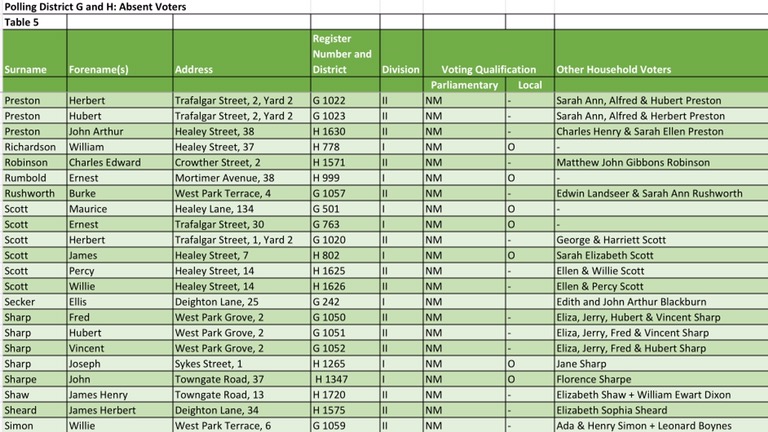
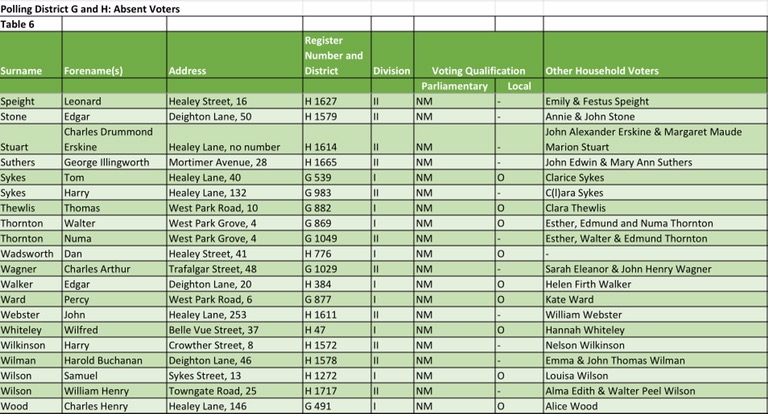 The men on my Healey list all fall within both the absent and Naval and Military categories. The information was supplied by next of kin so may not be accurate. It may include men who were killed after its compilation. And addresses may not necessarily reflect actual residence, but merely be the most convenient address, for example the in-laws where the man’s wife was living whilst he was serving, or a friend’s home.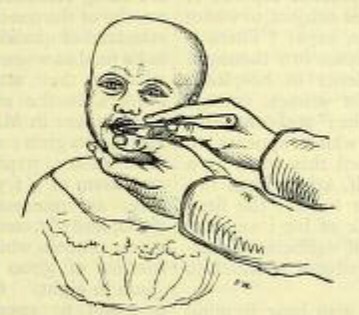







 Past To Present Genealogy