Category Archives: Family History

Ordinary Lives: Family History is Best Left in the Graves of Our Ancestors?

Last night a family member asked if I’d unearthed any more embarrassing incidents in our family history. The individual appeared to be particularly concerned about the stigma from having a one-handed gypsy ancestor who gave birth to an illegitimate son whilst on the road in the company of a gaggle of 18th century chimney sweep apprentices. They straw-clutchingly tried to point out that giving birth on the roadside was perfectly normal for the period. There was no ambulance service, or so their argument went.  

And so lies one of the dichotomies of family history. My relative seemingly didn’t want any hint of scandal in our background. They wanted an ordinary, uneventful lineage. They took anything otherwise as casting some kind of lingering reputational stain passed down through the generations. A case of these things are best left in the past. Dirty linen, no matter how old, should never see the light of day. The dead should be portrayed as paragons of virtue. Their human weaknesses buried alongside them in their graves. In short the skeletons of ancestors should be left in their graves. 

They want a family tree populated with ancestors who lived ordinary, unremarkable, hard-working lives, with no speck of scandal. 

Batley Cemetery – Photo by Jane Roberts

Yet for others these more unusual events add colour to the every-dayness of “born, baptised, married, died, buried” records. They stand in the camp of ordinary lives are boring. Not worthy of re-discovery. Unremarkable genealogy is uninteresting. I’m not sure how true this is but, for example, the ordinariness of Michael Parkinson’s ancestry is cited as the reason why his story was ditched by “Who Do You Think You Are?” 

For me family history is about every-day lives. Some are ordinary, some are less so. But that’s part of the rich tapestry of life. It’s a mixture of all sorts. And you can’t gloss over the less palatable tales. No more so than you should discount the mundane. All facets are equally valid.  

Hidden Names: Indecisive and Tricky to Downright Confusing Ancestors

I remember well my husband and I spending hours pouring over a book of baby names throughout my pregnancy trying to decide on boy/girl options for the impending arrival of our little bundle of joy. OK, not so much him as me.

We were sure of our choices for a boy – William Patrick. Less so for a girl. Alice was the early favourite, although we were not entirely convinced. That was until our daughter arrived and within minutes we did a sudden about-turn to Amelia Grace. This was way before Amelia featured in the annual top 10 lists of baby names produced, so we were not swayed (or should that be put off?) by popular opinion. Then it was down to the Registry Office to make her official, like generations of parents before.

My well-thumbed book of Babies Names

But it’s not always that straightforward. What happens if you change your mind after the official form filling? If you decide after all it wasn’t the right choice? Perhaps the parent doing the registering put down the wrong name, or an “unagreed” one.

In my recent family history I’ve a couple of examples, with unofficial solutions. My grandma registered my dad’s birth. He has a Christian and middle name. Seemingly the Christian name was my grandma’s choice – her dad’s name, Patrick. My grandad wasn’t best pleased when he found out after the deed was done. As a compromise my dad has always gone by his middle name. Something that causes endless confusion when dealing with officialdom, the only time when he’s ever referred to as Patrick. But at least we know about it so it’s not an issue – though it might be for future family historians, seeking him under his every-day name!

And there was a bit of pay-back for my grandma’s trickery. Her next son was born on St Patrick’s day – but she’d already used the name!

I also have a maternal aunt. Looking for her in the GRO indexes is problematical. My grandpa registered her under the wrong name, apparently the name of a former girlfriend. Imagine explaining that one away. Unsurprisingly she’s never used that name, although it is remarkably similar to the one she goes by .

Mind you my grandpa has a tendency to mess up birth registration. To be honest I’m surprised my nana let him do it again after the example of my aunt. But she did. The result is my mum’s birth is registered on the wrong day – something she didn’t discover till getting a copy of her certificate when leaving school, much to her embarrassment. Now, like the queen, she has two birthdays. She chooses, from year to year, which is the most convenient date to celebrate.

I suppose it’s sometimes all too easy to forget when researching your family tree that these are not one-dimensional, generational paper-trail figures. They were real people, with emotions and feelings and lives just as rich, rounded and complex as ours today. So although I shouldn’t have been, it was somewhat of a shock to find even earlier examples when I delved into my family tree and bought those all-important birth certificates. But these were examples where the families concerned actually did something about it through official channels.

Permissible but unusual, you could change to the name registered for a child providing it was done within 12 months. There is a column on the birth certificate indicating “name entered after registration” catering for this eventuality. Normal procedure was that the Minister performing the baptism provided a certificate confirming the child’s baptismal name; if unbaptised, the mother or father signed a certificate. This had to be taken to the registrar or superintendant registrar and a fee paid. So not a light undertaking given the financial and time implications, not to say knowledge in the first place that this was an option.

I’ve discovered two examples in my direct line ancestry. The first is for my 2x great grandmother Kezia(h) Clough. Born in Drighlington on 21 October 1850 she was the 6th, and youngest, daughter of William and Mary Clough (née Burnett). On 12 November 1850 Mary registered the baby’s birth, signing with her mark. Her daughter’s registered name was Emma. However, there is an entry in the name-change column. In this case it indicates the alteration to Kesia (another variation). No date as to when the amendment took place. The baptismal register at St Peter’s, Birstall, shows the child was baptised with the name Kezia on 29 December 1850. So the decision was made relatively quickly.

I’ve no idea why the change of heart. Mary did have a sister named Keziah who died in 1837. But that was over 13 years before the birth of Emma/Kezia, and Mary had two other daughters born after her sister’s death. So ample opportunity to name a daughter after her sister, without an after-registration moment of enlightenment. The reason will forever be a mystery.

Kezia Clough’s Birth Certificate

You might have observed that I’ve alluded to the fact there are variant spellings of Kezia on official documents. Sometimes the alternative Keziah is used. Something else to consider in that elusive ancestor hunt.

The other example is my great grandad Jack Hill. Coincidentally he is the son of Kezia and her husband Joseph Hill. Jack was their third son. Born on on 10 December 1872, Joseph registered him on 13 December, under the name Herbert. The amendment column shows a post-registration change of name to John Herbert. Again nothing to indicate when the change was made. Some months after birth, on 25 May 1873, he was baptised John Herbert at Birstall St Peter’s. So another bit of naming confusion thrown into the ancestral search mix – the diminutive: Jack being a diminutive of John.

Once more no clues as to why the change. Perhaps it was an afterthought nod towards Kezia’s brother John, who died in 1871. Or, the theory I’m leaning towards, is Herbert’s name was too close to the name of his older brother Albert (Bert & Bert), something hinted at in that May baptismal entry where “John Albert” is scored out and replaced by “John Herbert“.

Jack Hill’s St Peter’s Birstall Baptismal Entry

So lots of creative Christian name considerations when on the trail of ancestors:

  • Diminutives, some obvious such as Elizabeth/Lizzie/Betty and Joseph/Joe. Some less so such as John/Jack, Pauline/Polly, Sarah/Sally (yes I have those);
  • Spelling variations;
  • Christian names dropped, and possibly forgotten over time, in favour of middle names; and
  • Names being used for no obvious reason at all, other than to frustrate family history researchers. For example Cissie used instead of the registered name of Sabina (yes, that’s one of mine too).

Sources:

  • GRO birth certificates
  • Baptismal register, St Peter’s Birstall

GRO Picture Credit: 
Extract from GRO birth register entry for Kesia (Emma) Clough: Image © Crown Copyright and posted in compliance with General Register Office copyright guidance.

Brothers-in-Arms 

Sometimes we overlook more recent family history, concentrating on the more distant past. Currently events of 100 years ago are dominating the news, with national commemoration events for Battles such as Jutland and The Somme, to more individual and personal remembrances for the centenary of the death of a family member.

But here I will focus on a more recent conflict, World War II. We are moving towards a time when this too will disappear from living memory. Sadly those in my family with direct knowledge of this tale are long gone.

This post concerns the fate of Albert Edward Hill, or Ned as he was known: My grandad’s cousin.

Finding out the circumstances surrounding death in conflict can be challenging: Which battle; location; precise cause of death; time; even date; and perhaps there is no known burial place. World War II in many ways presents a bigger challenge than its predecessor, with the public availability of records.

However in Ned’s case it’s all fairly straightforward. He is buried locally at St Paul’s churchyard, Hanging Heaton. His death is well documented. It was not caused by some battle injury. It was the result of a totally avoidably, foolishly tragic accident following a night out.

Ned was born on 2 February 1901, one of the seven children of Albert Hill and Sarah Ann Summerscales. These included Harry who died shortly after birth in 1890; Percy, Annie, Lilian, Doris and Arthur.

Ned never married. The 1939 Register, the population list compiled at on 29 September, as a result of the outbreak of war, shows him living at Wood Lane, Hanging Heaton. He is in the household of his brother-in-law Harry Robertshaw along with Harry’s two young sons. Harry’s wife, Ned’s sister Annie died that summer, her burial taking place at St Paul’s Hanging Heaton on 6 July 1939.

In the 1939 Register Ned is recorded as working as a willeyer in a woollen mill. This was someone who operated what was termed a willeying machine. Fibres were fed into this machine, which separated and combed them ready for carding. Newspaper reports at the time of his death, however, indicate prior to his army service he worked as a builder’s labourer, employed by Hanging Heaton-based building contactors George Kilburn and sons. 

I do suspect some confusion in the report though, and this occupation possibly applied to his brother Arthur. In the 1939 Register he was a public works contractor’s labourer. 

Whatever the true facts are war changed all this, and some two-and-a-half years before his death Ned joined the Army, as a Gunner.

Albert E Hill Batley News July 28 1945 8 (2)

Gunner Hill

His death came entirely out of the blue. Summer 1945, and war in Europe over, Ned returned home to Batley on leave. He finally managed to meet up with his younger brother Arthur, a driver with the RASC, similarly on leave. This was the first time they had seen each other since Ned’s military service. Arthur had been in the Army for four years at this point, serving in Germany, Belgium, France and Holland.

Things must have seemed hopeful. They had survived so far. All being well they would be home soon permanently. The past tragedy of the family would not repeat itself….

Little could they have envisaged that this meeting would be their last, and in three weeks Ned would be dead.

Leave over and Ned returned back to his Unit, the 397 Battery, 122 Heavy Anti-Aircraft Artillery Regiment, stationed at Walberswick, near Southwold in Suffolk. This was part of the network of coastal defences, established in response to the threat of German invasion from May 1940 after their rapid victory in Western Europe. That German threat was now gone.

On 20 July 1945 he and another soldier from the same unit, Gunner Leonard Lomax, had evening leave. They left camp at 6pm that Friday for a night out in Southwold. The ferryman took them over the River Blyth and said he would return for them at 10-30-11.00pm.

An interesting aside is the ferry service from Walberswick had featured in Parliament only weeks earlier on 8 June 1945. There had been a seam steam-driven chain ferry which was discontinued in World War II, and it seems a rowing boat service replaced it. The ferry was privately owned and there had been problems in maintaining a regular service. Suffolk County Council was negotiating to acquire the ferry rights to ensure an adequate service.

Walberswick Ferry circa early 1940s Postcard, F Jenkins, Southwold

Ned and Leonard visited three public houses in Southwold and consumed about six pints of mixed beer. They left town at 10.15pm for the return ferry but there was no sign of the man with the boat. As they were debating whether to return to Southwold to catch the liberty truck to camp, a boat containing two soldiers came from the Walberswick side of the river.

These two soldiers, Lance Bombardier Edward Davis and Bombardier George Rennie were from another Battery. They heard shouts from the Southwold side of the river and thought some men from their Company were stranded as it appeared the ferry service had stopped. Despite having consumed three pints, or maybe because of it, seeing a boat moored in the water they decided to cross to collect their companions, but when they arrived found they were strangers. Nevertheless they offered Ned and Leonard a lift back. 

They clambered in the small boat, which turned out to be a yacht’s dingy and using the home-made paddles which were aboard the boat, Edward and George set about rowing back. About halfway across Leonard became aware of his feet feeling wet, water sloshing over the top of his shoes.

George and Edward were now having difficulty controlling the craft and stood up to paddle. They were about eight yards from the Walberswick side when the boat got into trouble with the tide and started to drift back towards Southwold and then seawards. The boat was filling up with water, either the result of a leak or overloading.  At this point Ned grabbed a paddle from Edward and the boat turned over throwing all four men into the river.

Leonard and George managed to get hold of a step ladder running down the harbour wall and climb ashore. They could not see the other two men, so made their way to Southwold to inform the police.

Meanwhile Edward, realising that Ned could not swim, tried to keep him up despite not being a strong swimmer himself. He managed to get them both to the concrete wall where Ned grabbed some weeds. Unfortunately they broke away. Edward continued to hold onto Ned but eventually became too exhausted and he had to let him go. Edward then managed to get hold of the ladder and escape.

In summing up the Coroner censured the boat’s occupants. The accident, he said, was the result of four “landlubbers” knowing nothing whatever about boating. The two soldiers should never have taken Leonard and Ned aboard because they overloaded the boat. There must have been some movement with the result that the boat capsized.

He went onto say that he hoped the tragedy would be a warning to others not to take boats without leave, and not to go on a swift running river like this one unless they were experienced persons who know how many a boat would take. “It is difficult to blame anyone because it is pure ignorance” he added.

A verdict of “Death through drowning through the upsetting of a boat” was recorded.

The Commanding Officer of the Battery wrote to Ned’s sister Doris extending his and the Battery’s sympathies as follows:

On behalf of the ranks of this battery wish to express to you our horror at this tragedy. Gunner Hill was a grand soldier and a man well-known and loved by the men of this unit”.

Ned’s body was brought back to Batley and he was buried in the church yard at St Paul’s, Hanging Heaton, just weeks before VJ Day and the war effectively ending.

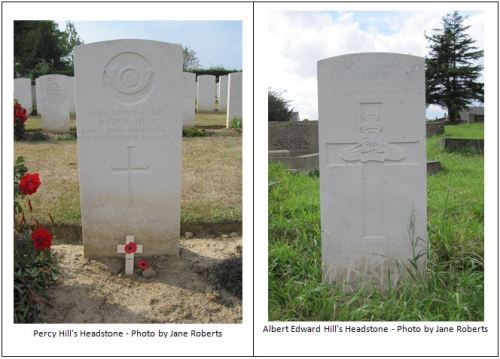
Arthur survived the war. But Ned’s fate echoed that of another brother in another conflict, Percy. He died almost 29 years earlier in The Great War, during the Battle of the Somme.

Memories too of the newspaper “Roll of Honour In Memoriam” notices which the Hill family, including the then teenager Ned, placed in the papers all those decades before, mourning the loss of Percy.

Batley News – 5 October 1918
Hill – In sad but loving memory of our dear son and brother, 1736 Sergt Percy Hill, 1st-4th KOYLI (Batley Territorials) who died from wounds at Warloy Baillon, West of Albert, France, September 30th, 1916, aged 24 years.

When last we met, and fondly parted
Our hopes were high, our faith was strong,
We trusted that the separation
Though hard to bear would not be long 

We often sit and think of him when we are
all alone
This memory is the only thing we can call
our own;
Like ivy on the withered oak, when other
things decay
Our love for him will ever live, and never
fade away 

Ever remembered by his sorrowing mother, father, sisters and brothers, 92, Back Bromley Street, Hanging Heaton 

A family which had now lost a brother in both World Wars.Albert and Percy Hill Headstones

Sources:

“You’ve a Mother and a Father. That’s All You Need to Know” – Batley Borough Court Records: Part 3

I thought long and hard before writing this post, the third in my Batley Borough Court paternity proof series. The reason for the deliberation is it concerns family information not discussed for years, if at all in living memory. “You’ve a mother and a father. That’s all you need to know” is a phrase that springs to mind. But I wanted to know more than that. So on and off I ferreted away at records.

The deciding factors for me in going ahead in writing this are:

  • it relates to my family history;
  • those directly affected are no longer alive. Neither are immediate subsequent generations;
  • the events took place over 100 years ago;
  • the information is publicly available;
  • when researching my family history I want to be even-handed with all aspects, the good and the not so good; and
  • this post may give an indication of some of the sources that are available when looking into the issue of tracing fathers of illegitimate ancestors.

I was elated with the find. Here the Batley Borough Court records have solved one of my long-standing family mysteries, as outlined in an earlier post about Parish Registers. It relates to the paternity of my great grandmother Bridget Gavan’s second child, a daughter, born on 28 August 1893.

The parish priest at St Mary of the Angels, Batley, at the time of the child’s baptism the following month believed Bridget to be married. The baptismal entry in the parish register is under the name “Regan” and Bridget’s husband is named as Charles Regan. The only problem: Bridget was not married. So proof you cannot always take what is written in parish registers as 100% accurate.

A later priest realised the error. When the girl’s marriage took place, some decades later, he noted against her baptismal entry that she married under the name Gavin [sic]. Yes the priests were meticulous in the practice of annotating baptismal entries with later marriage details!

But, although the baptismal entry gave a potential lead into the child’s father, I could not definitively identify Charles Regan. Not until a search of the Batley Borough Court register.

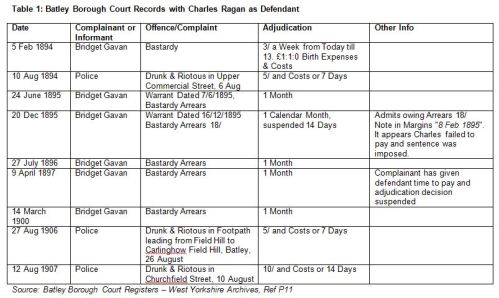
On 5 February 1894 Bridget Gavan was the complainant in a bastardy case heard at Batley Town Hall against Charles Ragan (note the subtle spelling difference here). Charles was ordered to pay 3/ a week until the unnamed child reached the age of 13. As well as court costs he also had to pay birth expenses of £1:1:0. So this provides corroboration of the baptismal paternity information.

Charles Ragan features a further eight times in the Borough Court Register between 1894-1907[1]. Three of these relate to police charges of drunk and riotous behaviour in various areas of Batley. The other five are cases brought by Bridget for bastardy arrears. Full details are at Table 1.Charles Ragan BBC

It can be seen from the entries that Bridget gave Charles time to pay on two occasions. Some of the bastardy cases took place after Bridget’s marriage in November 1897. And some of the adjudications around the bastardy arrears involved straight custodial sentences, without the option of paying a fine.

This then led me to the collection of West Yorkshire Archives Prison Records on Ancestry.

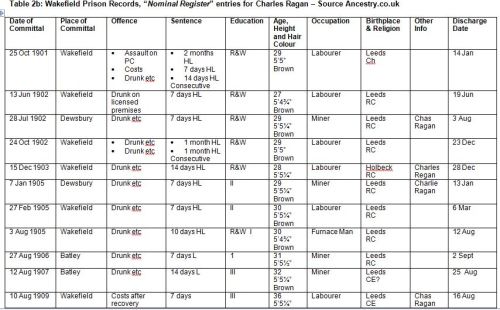
Bingo! I was astounded to find 20 entries in the Wakefield Prison Records Nominal Registers relating to Charles for appearances before West Riding Courts at Wakefield and Dewsbury as well as Batley. They relate to the various bastardy cases heard at Batley, outlined above, as well as charges in all areas for drunkenness and non-payment of costs.

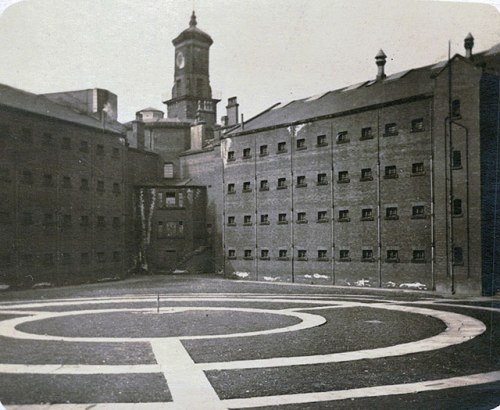
Wakefield Prison

Wakefield Prison Image from around 1916 shared by David Studdard on the Maggie Blanck Website – see Sources

It appears that even where Charles had the option of paying a fine he chose not to do so, or perhaps simply could not afford to, and the alternative custodial sentence was enforced.  This includes one of the instances where Bridget had allowed extra time: Hence the large numbers of entries for him in the Wakefield prison register.

For my research purposes these entries provide a basic description of Charles, his age, religion, occupation, education level and, crucially, a birthplace. Although the records are not consistent, particularly around education levels which range from “imperfect” to “read and write” through to Standards I-III[2], they give a general picture.

Charles was around 5’5” tall, with brown hair, had only a very basic level of education and his employment varied from colliery worker to miner to labourer, so manual work. His birthplace was given as Leeds and further narrowed in some of the register entries to the Beeston/Holbeck area.  And his date of birth was somewhere between 1869-1876. Despite the variations, they clearly all relate to the same man given the detail provided including the previous custodial reference number.

The entries are summarised in Tables 2a and 2bCharles Ragan 2a

Charles Ragan 2bLooking at the censuses with this fresh information, Charles Joseph Ragan, to give him his full name, was born in Holbeck in 1869. He was the son of Irish-born coal miner John Ragan and his wife Sarah Norfolk, a local girl from Hunslet. The couple married in 1866 and by the time of the 1871 census the family was recorded living in Holbeck. Besides Charles other children included six year-old Hannah Norfolk, three year-old Thomas and infant daughter Sarah.

The 1881 census reveals further siblings of Charles: George, age eight; six year-old John; Arthur, four; and Elizabeth, two. By this time Charles had employment as a dray-boy.

1891 shows a move to East Ardsley and two further additions John and Sarah’s family – Alice born in around 1882 and Walter in 1884. Charles now worked as a coal miner, like his father.

The work opportunities in the relatively new pits in East Ardsley probably initiated the move from the Leeds area. The town’s extensive collieries were owned by Robert Holliday and Sons, with East Ardsley Colliery being known as Holliday’s Pit. They started to sink two shafts here in 1872, on land leased from the Cardigan estate. A third shaft was sunk in 1877. By 1881 in excess of 300 East Ardsley men were employed in mining. In 1899 the colliery produced 200,000 tons annually, making it the 11th largest Yorkshire coalfield.

Returning to Charles’ brushes with the law, newspaper reports added a little more detail, but not much. For example in the March 1900 case around arrears, Bridget revealed that Charles had failed to make payments for their seven year-old daughter for three years. Possibly this corresponded with the time Bridget was involved with her soon-to-be husband, who she married in late 1897.

The reports also indicate Charles lived at Lawns in August 1897 and thereafter in East Ardsley. Did his forays from there into Batley indicate he remained in loose contact with his daughter?  Or were other family connections the draw? There were a number of Ragans living in Batley during this period.

In terms of character, Charles certainly seemed fond of a tipple, given the number of drink-related offences. One from the West Riding Police Court, Wakefield, involved the assault on William Forrest, the landlord of an East Ardsley pub, the “Bedford Arms“.  George Mullins was his partner in this crime. The report in the “Sheffield Daily Telegraph” of 24 August 1897 read:

…the defendants did not appear, it being stated they had left the district. On the afternoon of Friday, the 13th inst., the defendents went to the public-house, created a disturbance, refused to leave, and on being forcibly ejected, Mullins bit the landlord on one of his arms, both men struck and attacked him, and defendants re-entered the house and again assaulted the landlord“.

geograph-3204067-by-Betty-Longbottom

The Bedford Arms, East Ardsley

 So what became of Charles Ragan? By August 1906 he was free of his weekly payments for his daughter, she being 13. It appears he married 34 year-old widow Jane Worth (maiden name Sow(e)ry) on 24 December 1911 at St Mary the Virgin, Hunslet. A quick scan of GRO records reveals the birth of three children, all registered in the Hunslet District between 1913 and 1917.

Charles’ death is registered in Leeds North in Q4 1932. He was 63. He is buried in Hunslet Cemetry.

Bridget died in 1947. Their daughter died more than 45 years ago.

See here for Part 1 and Part 2 of my Batley Borough Court series of posts.

Sources:

[1] Up until the end of my search in 1916
[2] See The Victorian School website for a descriptor of the various levels as they applied from 1872 http://www.victorianschool.co.uk/school%20history%20lessons.html

Borough Court Records: Crime, Punishment & Bastardy in Batley – Part 2, “Kissing Cousins?”

This is the second part of my Batley Borough Court records series. Part 1 can be found here.

Mary Jennings was my 2x great grandmother’s sister, the daughter of Ann Hallas and Herod Jennings. She was born on 16 May 1858, probably in Hartshead, and baptised on 18 May 1859 at St Mary’s, Mirfield.

By the time of the 1881 census her father, Herod, was dead. She lived at Clark Green[1], Batley with her widowed mother Ann who headed the household, and brothers William and James.

Relation Frank Thornton, a 23 year-old coal miner from Hartshead, was also present that census night.  Ann’s sister Louisa Hallas and her husband George Thornton had a son, Franklin, born on the 31 January 1858. Baptised at St Mary’s, Mirfield, on the same day as Mary, his name was often shortened in records to Frank. I assumed this was the man in the Jennings household.

There was a final member of the household that 3 April night: A one-year-old girl named Sarah Ann. She is described on the form as daughter. However Ann at this stage was 56 and a widow for over three years.  Without a birth certificate I worked on the theory Sarah Ann was Ann’s granddaughter. Her birth was registered in Q2 1880, but it’s a case of another too costly certificate to satisfy idle curiosity. Subsequent censuses proved the theory though.

On 24 April 1890 Mary Jennings married 32 year-old mill hand William Blackwell at Batley Parish church. In the censuses of 1891 (Batley) and 1901 (Sherburn in Elmet), Sarah Ann is living in William and Mary’s home, described as “daughter”.

Batley Parish Church – photo by Jane Roberts

But I still did not know who Sarah Ann’s father was…..until I looked at the Batley Borough Court records. On 2 July 1880, shortly after Sarah Ann’s birth, Mary Jennings was named as the claimant and Frank Thornton the defendant in a bastardy case. The hearing was adjourned until 5 July when, in Frank’s absence, an order was made for him to pay 3s per week until the child reached 13 years of age. As well as court costs, he also had to pay £1 10s for the birth expenses.

There now followed a regular procession of non-payment cases. Newspaper reports and prison records flesh out the sorry story. The Batley Borough Court records made tracing these additional sources so much easier. The newspapers involved are not online, so no Optical Character Recognition (OCR) search help here. The prison records only provide the prisoner’s name, so that first court case name lead was crucial for searching these.

The first of the non-payment cases in response to the 5 July 1880 award occurred on 13 May 1881, just over a month after the census. Mary, according to a note in the register margins, was destitute. The upshot was a two month prison sentence for Frank. He served his sentence at Wakefield. The “Nominal Register” prison record provides a description. Frank had received no education and worked as a collier. He stood at s shade over 5’10” with brown hair. The entry also shows he had four previous convictions, with the reference given to his last prison register entry, enabling backtracking.

Another method of looking at convictions is via the “Index to [Nominal] Registers”.  These may span a number of years. It means you can track the references to all previous prison register entries in that time span in one go. They too provide a basic description and birthplace of the prisoner. The Index has not been catalogued in the Ancestry search, but I found it a useful complementary check because some of the “Nominal Registers” have missing volumes which the Index can help fill.

Anyway back to Mary and Frank. Clearly the prison sentence shock failed because he was in court again on 22 May 1882. By then he owed £10 6s in bastardy arrears and, in addition to costs, the court ordered him to pay £1 immediately and thereafter 8s a week to pay off the outstanding balance. It seems this was complied with. There is no record of a custodial imposition.

There was an interval of nearly four years before a very intense period of court activity adjudicating on the disputed domestic matters of Mary and Frank. On 8 January 1886 Frank owed 13 weeks-worth of payments. At 3s a week, this amounted to £1 19s according to the Court register. Another month’s jail sentence followed.

On 8 February 1886, within a couple of days of ending this January one-month prison sentence Frank appeared at the Borough Court once more. He needed to show cause why he should not be sent to prison in default of complying with the bastardy order. His arrears were recorded at £2 2s[2].  Frank said he had no means of paying.  A further 14 day committal followed for him, unless he could find a bondsman that day.  No bondsman was forthcoming, so it was back to Wakefield prison for Frank.

But that did not mark the end. Released from prison on Saturday 20 February, he was immediately apprehended on the same charge. He found himself bounced back into court again on Monday 22 February. Even the newspaper reports now referred to him in sympathetic tones as “the poor man“. Arrears were listed as £1 19s[3] so presumably he had managed to pay a small amount. Frank now promised to pay all the money. He faced a further one month jail sentence, but this was suspended for 28 days to allow him to fulfil his promise to make his payments. It seems he managed it, as there is no imprisonment record.

So who was Frank Thornton? Did the relation comment in the 1881 census refer to him being the nephew of Ann and cousin of Mary, as I initially thought? Was it a reference to Sarah Ann’s paternity? Or was it both? I’ve used censuses, GRO indexes, prison records and newspaper reports to try to pinpoint him.

Including the names Frank, Franklin and Francis in any searches there are a number of “possibles”. However in terms of Hartshead/Mirfield-born alternatives, the birthplace given in prison registers, other than cousin Frank, there appears to be just one. But there is a slight discrepancy with the year of birth (1860) of this alternative, and his occupation does not fit. So it can be discounted. Bringing me back to Mary’s cousin.

Ignoring the birthplace given in the prison records and extending beyond Hartshead/Mirfield does produce other options, but again the stumbling block is job description. There are no feasible coal-miners, although jobs could change. But even allowing for a career switch, why would I want to ignore the birthplace anyway? This is consistent in the prison records.

Extending the search to his other custodial sentences and newspaper coverage of them, including one in 1879 for assaulting a police officer, I still cannot definitively point to Frank being the son of George and Louisa Thornton. However, the evidence so far leads me to think that Sarah Ann’s father was indeed Mary’s cousin. But there is no absolute proof, certainly no reference in the newspapers.

It appears Frank married in Q2 of 1882 (another certificate on my long wish list). Maybe this was the reason behind the May 1882 non-payment. By the time of the 1886 sequence of court cases he had a young family, which again may have strained finances and resulted in him trying to avoid obligations for this first child. By the time of the 1891 census the Thornton family were living near Barnsley and by 1901 they had settled in the north east of England.

So once more the Batley Borough Court records have provided leads and a potential solution to a family paternity mystery, but with quite a different outcome from the previous case. If indeed the father of Mary’s child was her cousin, as it seems, one can only wonder at the strains this whole situation placed on wider family.

There is a third case, with yet another twist, here.

Sources:

  • Batley Borough Court Records – West Yorkshire Archives
  • Batley News” and “Batley Reporter” newspapers, various dates in February 1886
  • Parish Registers – Parish Churches of St Mary’s, Mirfield and All Saints, Batley – available online at http://home.ancestry.co.uk/
  • Censuses – 1861-1911
  • GRO Indexes
  • West Riding Prison Records, “Wakefield Index to [Nominal] Registers” and “Nominal Registers” – available online at http://home.ancestry.co.uk/

[1] The modern spelling is Clerk Green
[2] £2 6s reported in the newspapers
[3] £2 3s in the newspaper reports

Elation and Frustration: The Reality of Family History Research

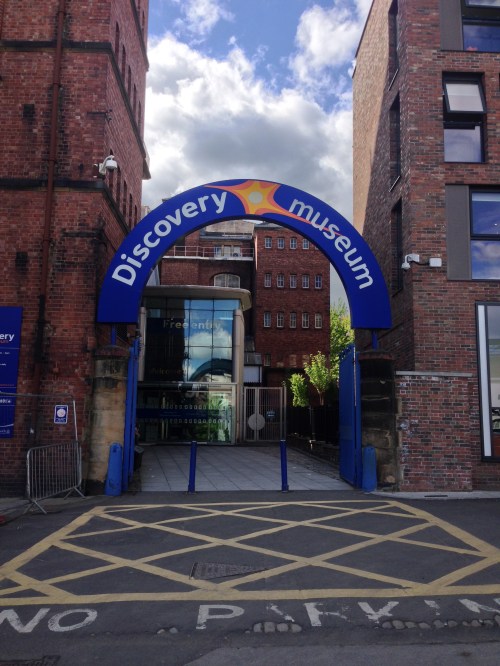
Another day, another archives visit. Off I went to the aptly named “Discovery Museum” in Newcastle which houses the Tyne and Wear Archives. Filled with anticipation and enthusiasm, I was on the trail of my one-handed gypsy 5x great grandmother Charlotte Burnett.

img_1606

Newcastle’s Discovery Museum – by Jane Roberts

As in my previous post about her, I knew she was in Newcastle in 1829. I knew the Newcastle All Saints Overseers of the Poor advertised seeking her whereabouts in February 1830. And I knew from the West Riding Quarter Sessions of April 1830 their advert bore fruit, as in indicated in Removal Orders and Child-Stealing Chimney Sweeps.

I also wanted to find any information about another linked family, that of my 4x great grandmother Ann Jackson. She married Charlotte’s son, Robert. She and her parents and siblings were from Newcastle All Saints Parish.

I decided against looking for anything about Robert Burnett and his father Stephen. It would have to wait as I needed to concentrate on one Parish.

I’d done my forward planning and had my list of records to search. So maybe this would be the next big breakthrough. But I only had three hours and my list was very long in terms of Newcastle All Saints Parish records and registers.

All Saints Church, Newcastle – by Jane Roberts

It didn’t prove long enough. My visit proved to be a mix of frustration and elation. One of those days. 

In terms of positives:

  • I took photographs on this visit, including of the previously discovered 27 May 1788 Bastardy Bond information for Ann Jackson’s illegitimate child. My photographic day pass cost £10 and I’m glad I went for the option;
  • I discovered more references in the early 1790s Vestry Minutes to Anne’s sister, Amelia. She was one of the Parish poor children undertaking work making pins in return for a small sum of money. More evidence of poor relief for the family and another occupation to explore;
  • The Apprenticeship Register had an entry on 9 February 1795 for 14 year-old Amelia Jackson. Her parents were dead. She was bound to George Thompson, a Sunderland gingerbread baker, until she was 21. So out of Parish and a new area to search. And confirmation that John and Elizabeth Jackson (my 5x great grandparents) were dead by early 1795 so a narrowing of search years; and
  • A meeting of the Vestry on 30 December 1829 noted the Removal Order from the Township of Drighlington for widow Jane Burnett (31), Ann (7), Stephen (5), Maria (4) and Jackson (1). Sadly no further details.

The negatives:

  • I didn’t have time to look at the microfilm All Saints Parish Registers so I’m still relying on my FreeReg searches;
  • Neither did I get chance to look at any overseers accounts, a big omission but I went for the quick searches first. In a way that was good. I’ve ticked off a batch of records and I have narrowed date parameters further;
  • Although I have a cut-off date for searches I still don’t know when Ann and Amelia’s parents died. Or what happened to sibling Jane; and
  • Charlotte Burnett is continuing to prove elusive.

The reality is research is not as portrayed in Who Do You Think You Are? It’s painstaking, time-consuming work. You may get lucky and find some quick-win gems, especially in the early stages of research. But it is more usually a long-game, sifting through un-indexed records with searches often gleaning little more than a negative result. Eventually puzzle pieces are slotted into place. However brick-walls remain. It’s certainly not one hour and here’s your entire family tree with lots of interesting accompanying family background information. You’re never done – there is always more to discover.

And it’s addictive. I’m already planning my next Tyne & Wear Archives visit, including looking at those Parish Registers, overseers accounts and possibly revisiting the various poor house records in the light of new information. But it may have to wait until 2017.

Sources:

  • Tyne and Wear Archives – Paupers’ Records: Newcastle All Saints Apprenticeship Register, Bastardy Bonds, Examination Books, Overseers Accounts, Select Vestry Meetings, Vestry Meetings and Removal Orders: https://twarchives.org.uk/

Borough Court Records: Crime, Punishment & Bastardy in Batley – Part 1

In my murderous assaults post I mentioned I would be undertaking a series of archives visits focusing on the Batley Borough Court registers to try to establish a fuller picture of court cases involving my ancestors.

The records are held at the Wakefield branch of West Yorkshire Archives. The office closed on 13 May 2016 in preparation for the move to a new building in early 2017. More details are here. So it was something of a race against time to complete this work. But I am pleased to report I did get there in the end. 

The registers are not available online – no, contrary to what some would hope, not everything is! So it is a case of visiting the archives and going through each register page by page. For me it’s a joyful experience, especially with a set of information-rich records for my family history like these proved to be.

West Yorkshire Archives, Wakefield Office – Photo by Jane Roberts

The Batley Borough Court records run from 1872-1974, 116 volumes in total. However with the 100 year legal restriction access limit, I only (!) had to go through 58 of them.

And it has been wonderfully, and unexpectedly, enlightening.

The registers contain columns giving information such as:

  • the date of the case;
  • name of informant/complainant;
  • name of the defendant and age if under 16;
  • nature of offence;
  • adjudication; and
  • the names of the Justices.

There are also other pertinent notes, for example if the fine was paid and, if not, when the custodial sentence was imposed.

Whilst the registers give only the bare bones, they do lead on to other sources, from bmd and employment records to prison registers and newspapers. And because you have a date for the case it is a short-cut for newspaper searching, especially for those “not online” papers, or where online newspaper optical character recognition (OCR) is problematical.

It also pays to check the other cases heard that day as they may be linked to the “partners in crime” of ancestors. 

The cases brought before the court cover the run-of-the-mill drunk and riotous or obscene language cases; incidents of stealing; animal cruelty; failure to send children to school; wilful damage; employees taking employers to court on non-payment of wages (from these I’ve learned the name of the stone mason who employed my 2x great grandfather William Gavan); to attempted suicide and more serious assault, indecent assault, rape and murder cases, some of which are referred onto a higher court. There are a fair few children brought before the Justices and punishments ranged from birch-strikes to reformatory and industrial school sentences. Smallpox vaccination exemptions, applications for children to perform in theatrical productions and beer selling licence transfers and applications also feature.

There are also more domestic-centred cases including married couple disputes, separation orders, orders relating to married women’s property, child neglect accusations, and unmarried mothers claiming maintenance payments for their illegitimate children – crucially providing the name of the father. These maintenance orders were lodged with the petty sessions, or other jurisdiction, local to the mother up to one year after the child’s birth. In these cases the burden of proof was very much weighted in favour of the mother, for obvious money-saving reasons.

Three women connected with my family history appear in this latter set of cases. All three cases have contrasting elements and outcomes, and will feature in three separate posts. This is the first.

Sarah Gavan was born in Kidderminster in June 1857, the third daughter of my 2x great grandparents William and Bridget Gavan (Knavesay). She was baptised in the town’s Catholic chapel on 5 July 1857. Within three years the family relocated to Batley.

On 19 September 1875 Sarah gave birth to her first child, a son named John Thomas. He was baptised at St Mary of the Angels RC church on 3 October 1875. The baptismal register entry starts to records a father’s name, “Thoma“, but this is scored out and there is no surname for him. Sarah was unmarried. But clearly the child’s father was common knowledge.

I am curious to see a birth certificate for John Thomas, to see if his father officially acknowledged him here. From 1875 the reputed father had to be present at the registration to formally consent to his name being included on the certificate. As the Act stated “The name, surname and occupation of an illegitimate child must not be entered except at the joint request of the father and mother; in which case both the father and mother must sign the entry as informants“.

Looking at the GRO indexes, I can’t see a relevant birth registration for a John Thomas Gavan (or variant). Interestingly the Dewsbury Registration District does have a birth registered for a John Thomas Connell in Q4 1875 Vol 9b Page 625. This is a possible, given subsequent research including bmds and the 1881 census onwards. I would love to look at this to see if it did relate to Sarah’s son, and if so why he is not registered under Gavan: Was “Thomas” from the baptismal register present to jointly register is son’s birth as it appears. Oh for the long awaited certificate price-reduction!

As indicated, my search of the Batley Borough Court records adds an additional layer of paternal proof and a new dimension to events. On 10 November 1875 Thomas Connell appeared before the court on a bastardy charge and was ordered to pay Sarah Gavan 3s a week from their child’s birth until the age of 14.

Payments were occasionally difficult for Irish-born pit-worker Thomas, and his parental responsibility not always diligently complied with. Perhaps his court appearances and fines played a part.

It appears that he, and a number of other coal miners, were taken to court in 1876 by their Batley colliery employer James Critchley for absenting themselves from service without appropriate notice. In Thomas’ case this was from 17-24 January, and his employer sought compensation of 17s 6d. The case was heard at Batley Borough Court on 26 January 1876 and Thomas, who failed to appear, was found guilty and ordered to pay. The incident was reported fully in the local papers.

Weeks later, on 28 February 1876, there is another court register entry with Sarah in the role of complainant against Thomas. The entry merely says bastardy, so presumably this is for arrears. The obvious conclusion is the colliery episode and subsequent fine played a part in his financial difficulties and failure to pay.

The next entry for a case between Sarah and Thomas was on 24 June 1878. This was adjourned for four weeks, until 22 July 1878. The July entry also contains an adjournment note.

After that nothing – because within the month the two were wed. Less than three years after John Thomas’ birth the couple married on 17 August 1878 at St Mary’s. They went on to have at least eight more children before Sarah’s death in 1907.

St Mary of the Angels RC Church, Batley – photo by Jane Roberts

The Borough Court register was a crucial part of evidence in ascertaining the paternity of Sarah’s baby . None of these bastardy cases against Thomas made it to the local papers, as far as I discovered.  Contrast this with the next family court case. To be continued

Sources:

  • Batley Borough Court Registers (P/11) – West Yorkshire Archives
  • Batley Cemetery Register (unconsecrated)
  • Batley Reporter” and “Dewsbury Reporter” newspapers of 29 January 1876
  • Census – 1861-1911
  • GRO indexes
  • Parish Registers – St Ambrose, Kidderminster & St Mary of the Angels, Batley
  • My ancestor was a bastard” by Ruth Paley


Visit Tips for Archives

My family history research is currently on hold whilst I recuperate following surgery. Whilst I rue my enforced house confinement and the temporary halt to my archives visits, I’ve set out some tips for future visits.

1200px-Coventry_History_Centre

Coventry History Centre – Wikimedia Commons Photo by Herry Lawford (see Sources)

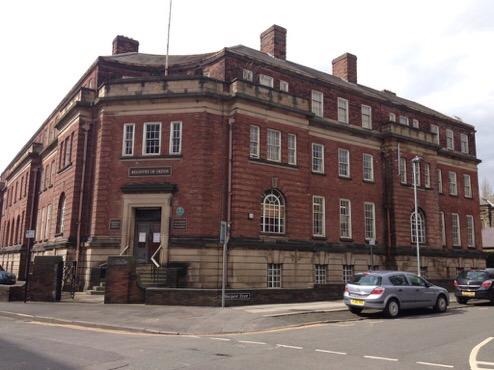
  1. Check opening times. Archives are not 9-5 open every day of the week places. If possible pre-book your visit to ensure there is space and the facilities you require are available – there may be limited reading room places, map tables and microfilm/fiche readers. And do let the archives know if you can’t make your slot so your space can be freed up;
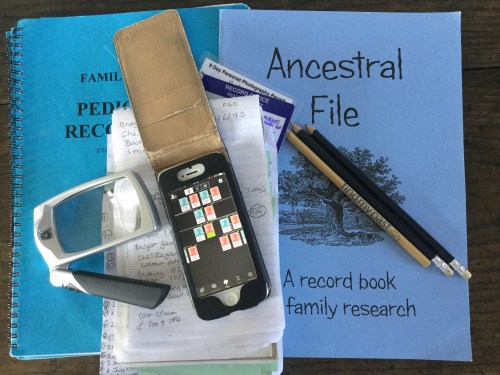
  2. Come prepared – plenty of sharpened pencils (pens not allowed), paper and a magnifier. Also your reader ticket, or appropriate signature/address identification to obtain one. Check if laptops etc are allowed; my preparation also includes checking online catalogues, which may not be the full range of holdings, and any visitor guides for particular archives advice;
  3. Don’t forget to bring your family tree/research notes. I have separate “Ancestral File” books for my maternal and paternal lines. I also have a (private) online tree available via the Ancestry app on my phone;
  4. Have a research plan. My plan includes preparing a list of documents I want to work through. I tend to focus on sources only available at the archives. An increasing number of collections are online, so for me looking at something readily available on Ancestry as a first step, for instance, may not necessarily be the best use of my time. I wouldn’t rule it out though as an online search may have produced ambiguous results;
  5. If possible order documents in advance because: a) they are not all necessarily held onsite; and b) if you have some documents ready for your arrival it saves valuable research time;
  6. Monitor the documents you have lined up throughout your visit to ensure you have a steady flow. Archives may not, for instance, bring down documents over the lunch period; or within a certain time before closing. There’s nothing worse than sitting twiddling your thumbs waiting with the only thing occupying your mind is counting wasted time! Although you could use the downtime to have a refreshment break (which may not necessarily be onsite), review your notes or revisit your research plan;
  7. If you want to take photographs consider which type of permit best suites your needs (eg day, year etc). But be aware not all documents are suitable for photographic reproduction – they may need to specialist equipment so need ordering. There may even be copyright restrictions;
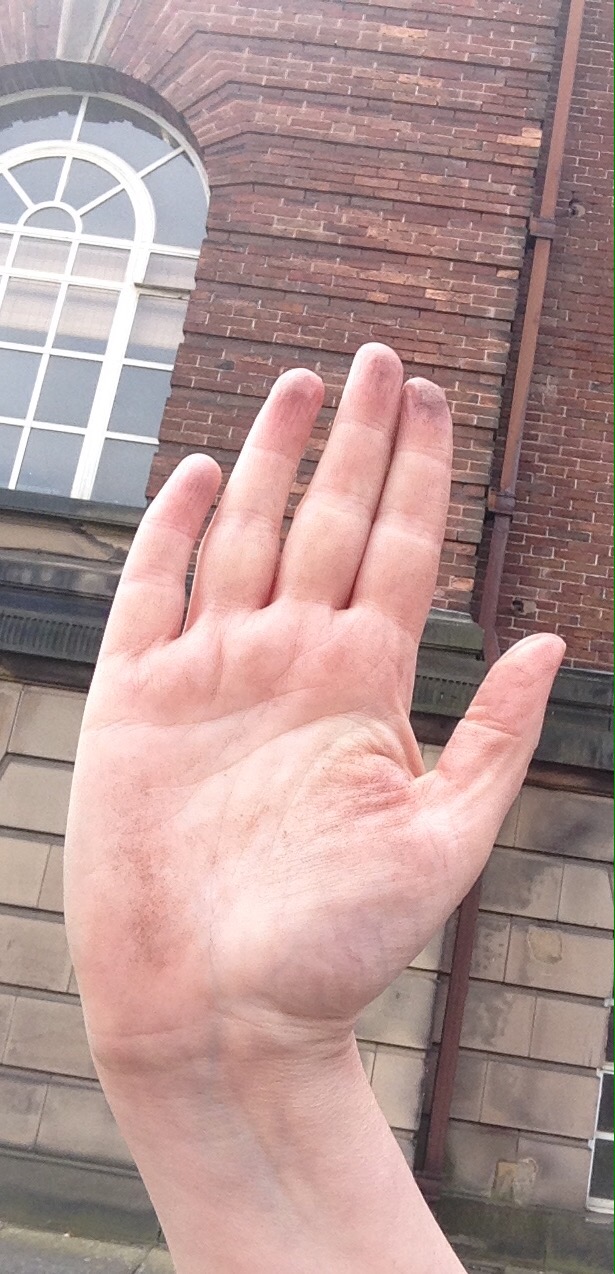
  8. Wear comfortable clothes, ones that you don’t mind getting dirty – be warned, old documents are dusty. 

    The “Archives Hands” Phenomenon

    Include a jumper/cardigan as some archives can be cold; 
  9. Check your notes and write them up as soon after your visit as possible. It’s easier to decipher “hieroglyphic” handwriting (well that’s what mine occasionally resembles) whilst it is fresh in your mind. If you’re not taking photographs read them through during your visit to make sure you’ve included key information; and
  10. Don’t be afraid to ask. Not everything is included in online catalogues. The staff have a wealth of knowledge, experience, know their collections, the geographical area and are used to dealing with all levels of expertise. Don’t go away from what might be a one-off visit thinking if only…..
Archive kit

My Archives Visit Kit – Photograph by Jane Roberts

Sources:


The Start of my Aveyard One-Name Study

I mentioned in my WDYTYA? Live 2016 write-up that I had registered a one-name study with the Guild of One-Name Studies. My chosen name is Aveyard, the maiden name of my great grandmother (maternal).

It is a predominantly Yorkshire surname. According to the British Surnames Database there were 343 occurrences of the surname in the 1881 census. The overwhelming majority of these were in Yorkshire (293), with a smattering in Cheshire, Leicestershire and Lancashire. So Yorkshire had a tad over 85% of the total.

Looking purely at total numbers of the surname, the main census districts were Gildersome, Gomersal, West Ardsley, Manningham and East Ardsley (the location of my direct line ancestors in 1881). In terms of frequency (the percentage of people with that surname) Middleton in Hunslet came top, followed by Gildersome, East Ardsley, West Ardsley and Lofthouse cum Carlton.

The top forenames for the Aveyard surname in the 1881 census were – William, John and George (male) and Sarah, Mary and Elizabeth (for female): So nothing startling there.

The top occupations, excluding scholar, were those typically Yorkshire ones of coal miner and woollen weaver.

The Database has approximate 21st century statistics for the surname. In the UK there are 138 surname-bearers (still mainly Yorkshire), USA has 107 and Australia 40.

So in theory a perfectly manageable number for a study.

The Internet Surname Database indicates it is a locational surname, believed to originate from “some minor place believed to be in Yorkshire”. The meaning is said to derive from the personal name “Afa” plus the word for an enclosure “geard”. The surname first made its appearance in the latter half of the 16th century. This was John Aveyeard, a witness at a 29 September 1587 Mirfield christening. Other early Yorkshire parish record occurrences of the surname cited by the Database are:

  • Robert Aveyard’s 18 June 1592 marriage to Anne Arandell at Mirfield;
  • Nycholas Aveyard’s 27  August 1621 Dewsbury marriage to Mary Bothe;
  • Ann, daughter of Richard Aveyard, was christened on 1 January 1624, at Thornhill;
  • Nicholas Aveyard married Debora Westerman on 29 November 1641, at Rothwell;

George Redmonds’ impressive book “A Dictionary of Yorkshire Surnames” has a slightly different take. The Huddersfield historian and local surnames expert states the interpretation of the surname is difficult. The earliest reference he discovered is in 1540 in the Dewsbury Parish Register. The register refers to Robert Janyn alias Hayvyerd. Redmonds theorises as Janyn was a diminutive of John frequently used by French immigrants, the surname may be linked to Robert Janyn’s French ancestry. He discovered a reference Robert Janyn of Soothill in 1524, so believes there may be examples of the surname earlier than 1540. He also makes reference to the interpretation by Peter McClure that the name might be a form of Halfyard, a predominantly Somerset and Devon surname, but he seems to discount this: Aveyard is occasionally spelled as Haveyard and Halfyard, but not until the 1800s.

The enormity of the task facing me is now sinking in. I’ve read the Guild of One Name-Studies book’ “Seven Pillars of Wisdom: The Art of One –Name Studies”. Tomorrow I begin a Pharos Tutors “Introduction to One-Name Studies” course. I hope this sets me on the right track in terms of collection, analysis and presentation of data for this new genealogy journey. And on 10 May 2016 I hope to attend the Huddersfield and District Family History Society talk at Dewsbury Town Hall by the Guild’s Yorkshire Regional Representative, David Burgess.

It’s very early days so will take a while for me to get up to speed and collect, collate and analyse data. In the meantime, the email address for my study is aveyard@one-name.org

Sources:


Removal Orders and Child Stealing Chimney Sweeps: Seeking a One-Handed Gypsy – Part 3

I’m preparing for another Tyne and Wear Archives visit so I’m reviewing my Burnett and Jackson ancestor research. Some of this research is in Part 1 and Part 2 of “Removal Orders and Child Stealing Chimney Sweeps

In these posts I wrote about how a newspaper article detailing the outcome of a Quarter Sessions case demolished some brick walls in my family history. In April 1830 Drighlington township unsuccessfully attempted to remove John Burnett’s widow, Jane, and her children to Newcastle All Saints parish. John was the brother of my 3x great grandmother.

The newspaper report provided family details which enabled me to progress back to child-stealing-accused chimney sweep Stephen Burnett and Charlotte, the woman he for some time lived in concubinage with – my 5x great grandparents.

Since writing these posts I’ve accumulated three more snippets of information, all from different sources. One of these has particular relevance for my proposed visit to Newcastle.

New Information
The first record is the administration granted to John Burnett’s widow, Jane, after he died intestate. This provides some additional pieces of background information. It states John died on 16 June 1829. Previously I only had his Drighlington burial date of 19 June 1829. The administration gives the names, abode and occupations of the two bondsmen: As yet no obvious family link, but you never know when this might be useful. I also have additional confirmation that he lived in Drighlington and that he was a collier (coalman on the administration).  Finally there is a written statement outlining the whole of his goods and chattels amounted to under £5.

The second piece of documentation is via the West Yorkshire Archive Service record set on Ancestry. The “Removal and Settlement” records show the Drighlington Churchwardens and Overseers of the Poor made a failed attempt in late 1829 to remove Jane Burnett and her children Nancy, Stephen, Maria and Jackson, to Halifax.  This is useful because it is further supporting evidence for the 27 June 1798 St John the Baptist, Halifax, baptism I traced for John. So all part of the migration pattern of the family – from Newcastle and the North East, to Cumbria and then down to Drighlington in Yorkshire via Halifax.

The third piece of information is a newspaper notice in early 1830. Thwarted by Halifax, the Drighlington poor law officials had All Saints parish in Newcastle firmly in their sights as a place to offload the potentially financially burdensome young family. On 9 December 1829 a Removal Order was issued, but Newcastle challenged it. This Order was respited pending an appeal. The January 1830 West Riding Quarter Sessions, held in Wakefield, show this appeal by the All Saints churchwardens and overseers would be heard at Easter 1830 Quarter Sessions at Pontefract. It was the report of this appeal which features in Part 1.

675px-All_Saints_Church,_Newcastle_2014 (2)

All Saints Church Newcastle – by Hewarthjb (see Sources for full details)

The overseers at All Saints now set about gathering evidence. And part of this was an appeal for the whereabouts of Charlotte Burnett. This advert appeared in the “The General Hue and Cry” column of the “Newcastle Courant” on 13 February 1830. It read:

One Pound Reward
If Charlotte Burnett be living, she will hear Something to her Advantage, by applying to Mr Salmon ___ Overseer for All Saints’ Parish, in this Town. She is upwards of 70 Years of Age[1] was born with one Hand only, and was last seen in this Neighbourhood in 1827, at which Time she was travelling with her Daughter and Children as Gipsies. It is presumed that she is known by the Name of Burnett. Any Person giving such Information as will enable Mr Salmon to find out her Place of Residence, shall receive the above Reward.
Newcastle, Feb 4 1830.”

The reward indicates the importance to the parish in locating what would be a prime witness for them.[2] From the notice I have an idea of the mobile lifestyle of Charlotte. There is confirmation of another branch of the family. There is also an indication of the hardship she faced, living with a disability for all of her life in such unforgiving times. So some more pieces in the family history jigsaw puzzle.

jigsaw-305576_1280 (2)

Jigsaw Image from Pixabay

The overseer succeeded in his search because Charlotte was traced and did appear at the appeal. The assumption that she used the name “Burnett” was correct, as was proved at the Easter Quarter Sessions. But I still do not know for sure whether she married Stephen Burnett. Neither do I know any maiden name.

The newspaper piece gives me some information to work with when I next visit to Tyne and Wear Archives – more parish record searches, including overseers accounts and vestry minutes for 1829-1831.

Sources:

  • All Saints Church, Newcastle picture from Wikimedia Commons under Creative Commons Attribution Share Alike License by Heworthjb – Own work, CC BY-SA 3.0, https://commons.wikimedia.org/w/index.php?curid=33465964Ancestry – West Yorkshire Archive Service; Calderdale, West Yorkshire, England; West Yorkshire, England, Removal and Settlement, 1627-1912 Ref OR 98
  • Ancestry – West Riding Quarter Sessions, Wakefield – January 1830
  • FindMyPast newspapers. “Newcastle Courant” – 13 February 1830
  • Measuring Worth: https://www.measuringworth.com/
  • Pixabay – Jigsaw Image
  • Prerogative Court of York – Administration for John Burnett – Jun 1829 – vol. 179, f – Borthwick Institute

[1] She was actually in her early 80s
[2] The Measuring Worth Calculator shows the 1830/2014 real price is of £1 is £79.97; labour value is £766.60 and income value is £1,429.00