This morning I attended a behind-the-scenes guided tour of the Leeds branch of the West Yorkshire Archive Service (WYAS), part of a series of free events organised by Libraries in Leeds.
Guided by archivist Vicky Grindrod, it was an informative, fascinating and entertaining peek at what goes on beyond those search room doors. As a frequent archives visitor, it was really useful to get some idea of what is involved in getting documents to that search room desk. Equally, for those with only a minimal knowledge about an archive – like my husband – it was a demystifying introduction to what for some might appear to be an offputting environment only for academics.
Located in Morley, the West Yorkshire Joint Services building accommodates not only the archive, but cross-county organisations including archaeology and trading standards services. Hence the many bags full of archaeological dig soil, and various weights and hoists in evidence in certain areas.
The shared nature of the building is part of the reason why documents need pre-ordering in advance of visits, along with the need to juggle search room space each day depending on what type of materials visitors want to see, and the fact documents may not necessarily always be held on site.
We learned about the work which goes on to get new material archive-ready, from vans bringing it to the unloading area, to assessing documents for mould and bugs, decontaminating them, and undertaking the conservation work to get them strong-room fit. It’s all very technical, down to ensuring air flow systems don’t spread any air-borne pollutants from new material to the rest of the archive, regular bug monitoring, down to maintaining optimum storage temperatures (15-18 degrees) and humidity levels (55 per cent).
We also found how small the archive team is, the variety of jobs they undertake, and how this is evolving to take account of the new digital document mediums and the challenges that brings – from the risk of cyber attacks, to mitigating technology changes which can make earlier digital documents unreadable.
There’s also the ongoing cataloguing work, including of holdings already at the archives which require more detailed descriptions. This is an area in which volunteers can get involved, especially those with skills and knowledge linked to the collections. The Tetley’s brewery collection might be one which will appeal to many!

We were also introduced to the range of archive holdings. From the John Waddington collection with monopoly boards and prototype Cluedo designs (“Shall we play Murder? I think it was Colonel Yellow with a bomb in the Conservatory.”); to the World War One material including diaries, letters, Fattorini Leeds Bantam Battalion badge designs, and poor relief book entries (indoor and outdoor) for ex-soldiers, including one suffering from shell shock, and a boy who enlisted age 15½, was discharged in July 1916 as underage and now had phthisis.
Then there was the array of waterways documents, which included a hot-spot map of deaths along the Leeds canal, along with an anonomysed list of children fished out of it in the 1940s…all boys.
More surprising was the maritime-related material, given the land-locked nature of the Leeds area. Intriguingly, the archive has a range of material relating to naval impressment, with details of names, ages and parishes of those who were forced into the navy and escaped. There was also table of rates of wages on HMS Jolly from 1711. Plus lots of photographs of those serving in the navy. All a legacy of family estate papers, and our seafaring and British Empire history.
But if you think a 1711 document is old, it was a mere infant compared to the oldest document held by WYAS, and housed at Leeds. That document is pictured below, and it is one we were allowed to hold.
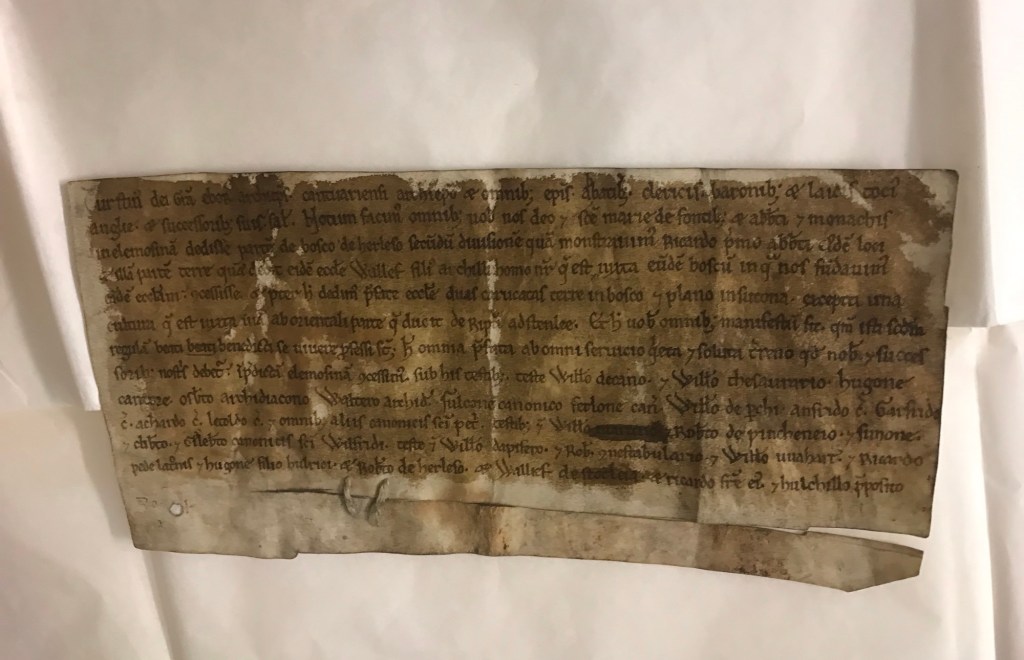
Dating from circa 1138 – almost 900 years old – this document is from the Fountains Abbey Collection – because the Leeds branch of WYAS has collections from outside the Leeds area, and even beyond the current West Yorkshire boundaries. It details the grant of land made to the monks at Fountains Abbey as long as they continued to live according to the rules of St Benedict. For more details about it click here.
And to listen to the translation of the oldest document in the Fountains Abbey collection, click here.
Those on today’s tour really did touch history.
If you do get the chance to do a backstage visit to an archive, go for it. It is well worth it, and you may be surprised what your local archive does hold!


 Past To Present Genealogy