Category Archives: Newcastle upon Tyne

An Unexpected Holiday Family History Link

Family historians will ‘get’ the feeling of pure elation I felt one damp Tuesday afternoon in Northumberland in late November 2022.

The changeable weather that day prompted a post-lunch visit to Kirkharle Courtyard. These converted 18th century stone farm buildings house a lovely selection of independent craft and artisan shops, so it seemed a perfect pre-Christmas haven to escape any threatened showers. Here’s the website link for more details.

Kirkharle Coffee House – photo by Jane Roberts

As it happened, the weather improved which meant we could explore further the wider Courtyard surroundings.

The tiny hamlet of Kirkharle was the birthplace of the iconic landscape gardener Lancelot “Capability” Brown. Here the Shakespeare of English gardening took the first fledgling steps in his illustrious career, employed as a gardener on Sir William Loraine’s Kirkharle estate until 1739.

But he retained a connection to his birthplace, and first employer’s family, even after he had moved onwards and upwards. One of his landscape designs for Kirkharle was discovered in 1980, shoved at the back of some drawers. Thought to date from around 1770, when he was at nearby Alnwick, his vision finally came to fruition in 2010, interpreted and adapted to fit the current Kirkharle landscape. We enjoyed a pleasant stroll around the serpentine lake, the centrepiece of this plan.

As usual, driven by the obsession of a family historian, I now felt compelled to visit Kirkharle’s tiny church. It is only a short walk from the courtyard complex, and on the way you pass a Grade II listed monument to Robert Loraine who was “barbarously murdered” here by the Scots in 1483. He was on his way home from church when set upon by them.

In a gruesome warning to others who would – like him – defend the borderlands against the Scottish raiders, the attackers cut his corpse up into tiny pieces, stuffed them into his horse’s saddlebags and set it loose to wander home. That was some kind of warning message!

The Loraine Monument, Kirkharle – photo by Jane Roberts

The inscription reads:

This
New stone was set up
In the place of an
old one by S[i]r William
Loraine Bar[one]t in 1728
In Memory of Robert
Loraine his Ancestor
Who was Barbarously
Murderd in this place
by the Scots in 1483
for his good service to
his Country against
their thefts & Robbery
As he was returning
home from the Church
Alone Where he had
Been at his private
Devotions

This replacement monument would have been erected during the period “Capability” Brown worked here.

On then to St Wilfrid’s Church, or St Wilfred in the Historic England Grade I listing. This small, simple, squat building, dating mainly from 1336 and restored in 1884, is best known as the baptism place of “Capability” Brown, on 30 August 1716.
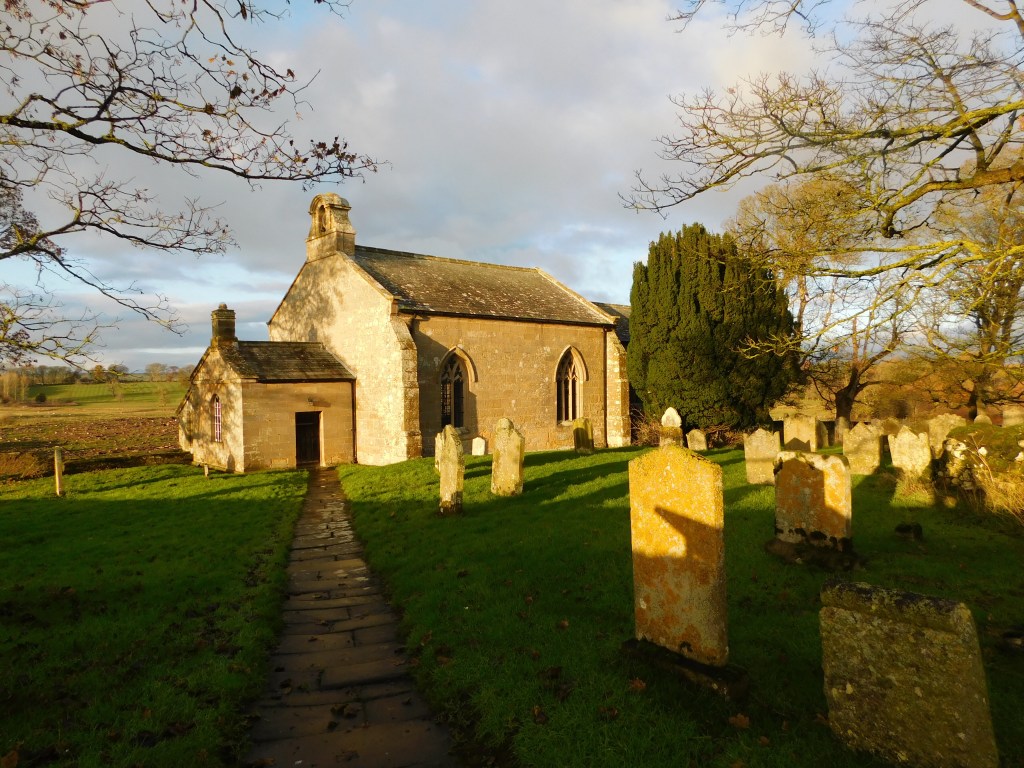
Inside I was drawn to the font. Dating from the 15th/16th century, I was stunned to discover until 1786 it was the baptismal font at the old All Saints church, Newcastle upon Tyne. Therefore not the one in which a young “Capability” Brown was inducted into the church. For me this was no disappointment – it was now far more thrilling and personal.

Image if the old All Saints church, from Sopwith’s A Historical and Descriptive Account of All Saints’ Church, in Newcastle upon Tyne’, published in 1826, out of copyright.

Completed in 1286 and initially known as All Hallows’ church, by 1786 the old All Saints church in Newcastle upon Tyne had fallen into such a state of disrepair and collapse that a meeting of parishioners in the vestry room on Easter Tuesday, 18 April voted unanimously to completely demolish it and build a new church.1
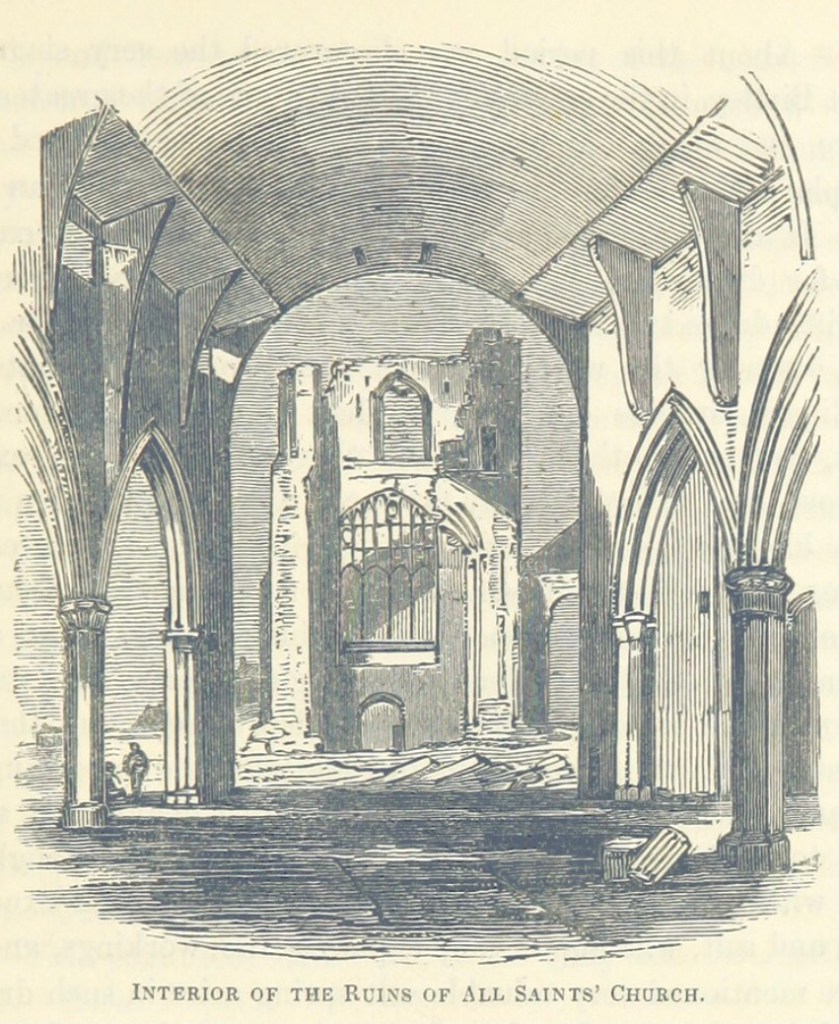
Ruined interior of the old All Saints’ Church, Newcastle upon Tyne, from
The local historian’s table book, of remarkable occurences, historical facts, traditions, legendary and descriptive ballads, etc., etc., connected with the counties of Newcastle-upon-Tyne, Northumberland and Durham, Vol II – published 1841 – out of copyright

The last service in the old church was held on 9 July 1786, and by August 1789 its total demolition was complete.2 This included disposal of all the old fixtures and fittings, even to the extent of placing an advert in the Newcastle Courant of 15 July 1786 requesting anyone entitled to any of the monuments or monumental inscriptions to immediately remove them.

The foundation stone for the new church was laid on 14 August 1786, and the building completed with the placing of the top stone of the spire on 21 October 1796. It went on to be used as a place of worship until 1959.

The new All Saints Church, Newcastle upon Tyne, from Sopwith’s A Historical and Descriptive Account of All Saints’ Church, in Newcastle upon Tyne’, published in 1826, out of copyright.

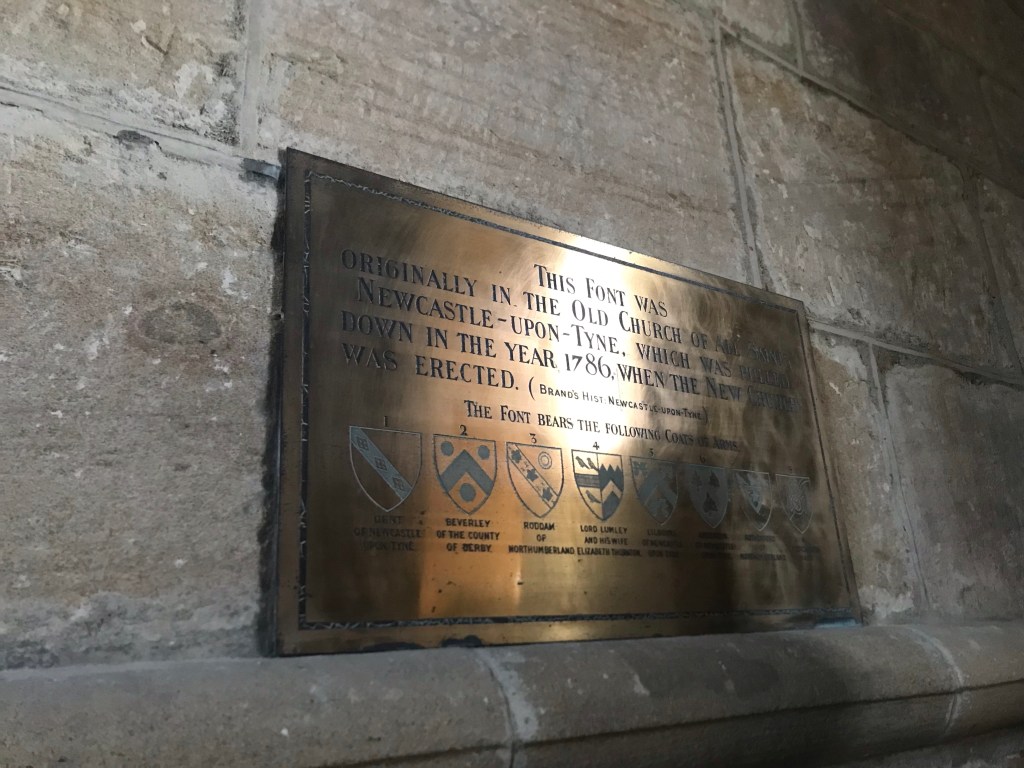
But back to my particular interest – the old All Saints church font, now at Kirkharle. I discovered it had a varied – and colourful – history. This included being hidden by stone mason Cuthbert Maxwell from Scots raiders in around 1640. It was eventually reinstated in the Newcastle upon Tyne church in 1660 following the Restoration of King Charles II.3

The font from the old Newcastle All Saints Church demolished in 1786, it is now at St Wilfrid’s Kirkharle – photo by Jane Roberts

There is a description of the font in T. Sopwith’s A Historical and Descriptive Account of All Saints’ Church, in Newcastle upon Tyne. It reads:

The font, which was of stone, was placed immediately on entering the body of the Church by the middle aisle, a situation which it generally occupied in former times, and by which was intimated the baptismal entrance of the Christian Church. It was a plain octangular pillar, the sides of which extending outward at the top, formed large cavettos,4 supporting an octagon of a larger size, with concave sides, decorated with armorial bearings…Above this octagon which contained the bason,4 a cover was formerly suspended. In the churchwardens’ accounts for 1636, mention occurs of a charge for hanging the font cover – in 1685, a bason and cover for the font cost £2, and in 1700, it was new painted and gilded. On the demolition of the Church, the stone font was given to Alderman Hugh Hornby, by whom it was placed in the garden of his house, in Pilgrim-Street, and left there when the house was sold to Mr. Clapham.6

Its worn appearance may therefore owe something to its period as a garden ornament.
So how did it come to end up in a tiny church in rural Northumberland?

In 1836 Thomas Anderson of Little Harle purchased Kirkharle from the Loraine family. His father had acquired the font three years earlier. When St Wilfrid’s was restored in 1884, Thomas’ son George placed the font in the church.6

And why did all this send shivers down my spine?

Newcastle All Saints was a church associated with my paternal ancestors. It is where my 4x great grandmother, Ann Jackson, was baptised on 22 August 1773. More details of her here.

I’d quite by chance stumbled across a religious artefact associated with my family history. I had absolutely no idea the baptismal font from her era was at Kirkharle.

This was the highlight of my holiday – made all the better for its sheer unexpectedness.


Footnotes:
1. Mackenzie, E. A Descriptive and Historical Account of the Town and County of Newcastle upon Tyne Including the Borough of Gateshead. Vol 1, 1827. Page 292-322
2. Sopwith, Thomas. A Historical and Descriptive Account of All Saints’ Church in Newcastle upon Tyne: Illustrated with Plans, Views, & Architectural Details. Newcastle: Edward Walker, 1826. Page 21
3. Bourne, Henry. The History of Newcastle upon Tyne or, the Ancient and Present State of That Town. by the Late Henry Bourne, M.A. Curate of All-Hallows in Newcastle. Newcastle upon Tyne: J White, 1736.
4. A concave moulding with a regular curved profile that is part of a circle, widely used in architecture as well as furniture, picture frames, metalwork and other decorative arts.
5. A variant spelling of basin.
6. Sopwith, Thomas, ibid. Page 40
7. Information board at St Wilfrid’s church, Kirkharle.


Other sources not directly referenced:
• “Biography: Lanelot ‘Capability’ Brown – The Gardens Trust.” Accessed November 27, 2022. https://thegardenstrust.org/wp-content/uploads/2016/11/Lancelot_Capability_Brown_biog.pdf.
• “Brown, Lancelot [Known as Capability Brown] (Bap. 1716, d. 1783), Landscape Gardener and Architect.” Oxford Dictionary of National Biography. Accessed November 27, 2022. https://www.oxforddnb.com/view/10.1093/ref:odnb/9780198614128.001.0001/odnb-9780198614128-e-3635.
• “Church of St Wilfred, Kirkwhelpington – 1370499: Historic England.” , Kirkwhelpington – 1370499 | Historic England. Accessed November 27, 2022. https://historicengland.org.uk/listing/the-list/list-entry/1370499?section=official-list-entry.
• Countryfilemag. “Kirkharle, Northumberland.” Countryfile.com. Countryfile.com, November 9, 2018. https://www.countryfile.com/go-outdoors/days-out/kirkharle-northumberland/.
• “Development of Kirkharle Landscape and Lake.” Development of Kirkharle Landscape and Lake – News | Capability Brown. Accessed November 27, 2022. https://www.capabilitybrown.org.uk/news/development-kirkharle-landscape-and-lake/.
• “Kirkharle Hall, History & Visiting: Historic Tyne & Wear Guide.” Britain Express. Accessed November 27, 2022. https://www.britainexpress.com/attractions.htm?attraction=3438.
• “Kirkharle, Northumberland – St Wilfrid.” Northernvicar’s Blog, August 23, 2019. https://www.northernvicar.co.uk/2019/08/23/kirkharle-northumberland-st-wilfrid/.
• Kelly’s Directory of Durham and Northumberland: With Coloured Maps: 1921
. London: Kelly’s Directories Ltd., 1921. Page 171.
• “Loraine Memorial Stone C.60 Yards South-West of Kirkharle Manor, Kirkwhelpington – 1155480: Historic England.” , Kirkwhelpington – 1155480 | Historic England. Accessed November 27, 2022. https://historicengland.org.uk/listing/the-list/list-entry/1155480.
• “Monument to Robert Loraine, Kirkharle: Co-Curate.” Co-curate. Accessed November 27, 2022. https://co-curate.ncl.ac.uk/resources/view/79099/.
• Richardson, Moses Aaron. The Local Historian’s Table Book: Of Remarkable Occurences, Historical Facts, Traditions, Legendary and Descriptive Ballads, &c., &c., Connected with the Counties of Newcastle-upon-Tyne, Northumberland and Durham. 2. Vol. 2. Newcastle-upon-Tyne: M.A. Richardson, 1841.

Elation and Frustration: The Reality of Family History Research

Another day, another archives visit. Off I went to the aptly named “Discovery Museum” in Newcastle which houses the Tyne and Wear Archives. Filled with anticipation and enthusiasm, I was on the trail of my one-handed gypsy 5x great grandmother Charlotte Burnett.

img_1606

Newcastle’s Discovery Museum – by Jane Roberts

As in my previous post about her, I knew she was in Newcastle in 1829. I knew the Newcastle All Saints Overseers of the Poor advertised seeking her whereabouts in February 1830. And I knew from the West Riding Quarter Sessions of April 1830 their advert bore fruit, as in indicated in Removal Orders and Child-Stealing Chimney Sweeps.

I also wanted to find any information about another linked family, that of my 4x great grandmother Ann Jackson. She married Charlotte’s son, Robert. She and her parents and siblings were from Newcastle All Saints Parish.

I decided against looking for anything about Robert Burnett and his father Stephen. It would have to wait as I needed to concentrate on one Parish.

I’d done my forward planning and had my list of records to search. So maybe this would be the next big breakthrough. But I only had three hours and my list was very long in terms of Newcastle All Saints Parish records and registers.

All Saints Church, Newcastle – by Jane Roberts

It didn’t prove long enough. My visit proved to be a mix of frustration and elation. One of those days. 

In terms of positives:

  • I took photographs on this visit, including of the previously discovered 27 May 1788 Bastardy Bond information for Ann Jackson’s illegitimate child. My photographic day pass cost £10 and I’m glad I went for the option;
  • I discovered more references in the early 1790s Vestry Minutes to Anne’s sister, Amelia. She was one of the Parish poor children undertaking work making pins in return for a small sum of money. More evidence of poor relief for the family and another occupation to explore;
  • The Apprenticeship Register had an entry on 9 February 1795 for 14 year-old Amelia Jackson. Her parents were dead. She was bound to George Thompson, a Sunderland gingerbread baker, until she was 21. So out of Parish and a new area to search. And confirmation that John and Elizabeth Jackson (my 5x great grandparents) were dead by early 1795 so a narrowing of search years; and
  • A meeting of the Vestry on 30 December 1829 noted the Removal Order from the Township of Drighlington for widow Jane Burnett (31), Ann (7), Stephen (5), Maria (4) and Jackson (1). Sadly no further details.

The negatives:

  • I didn’t have time to look at the microfilm All Saints Parish Registers so I’m still relying on my FreeReg searches;
  • Neither did I get chance to look at any overseers accounts, a big omission but I went for the quick searches first. In a way that was good. I’ve ticked off a batch of records and I have narrowed date parameters further;
  • Although I have a cut-off date for searches I still don’t know when Ann and Amelia’s parents died. Or what happened to sibling Jane; and
  • Charlotte Burnett is continuing to prove elusive.

The reality is research is not as portrayed in Who Do You Think You Are? It’s painstaking, time-consuming work. You may get lucky and find some quick-win gems, especially in the early stages of research. But it is more usually a long-game, sifting through un-indexed records with searches often gleaning little more than a negative result. Eventually puzzle pieces are slotted into place. However brick-walls remain. It’s certainly not one hour and here’s your entire family tree with lots of interesting accompanying family background information. You’re never done – there is always more to discover.

And it’s addictive. I’m already planning my next Tyne & Wear Archives visit, including looking at those Parish Registers, overseers accounts and possibly revisiting the various poor house records in the light of new information. But it may have to wait until 2017.

Sources:

  • Tyne and Wear Archives – Paupers’ Records: Newcastle All Saints Apprenticeship Register, Bastardy Bonds, Examination Books, Overseers Accounts, Select Vestry Meetings, Vestry Meetings and Removal Orders: https://twarchives.org.uk/

Removal Orders and Child Stealing Chimney Sweeps: Seeking a One-Handed Gypsy – Part 3

I’m preparing for another Tyne and Wear Archives visit so I’m reviewing my Burnett and Jackson ancestor research. Some of this research is in Part 1 and Part 2 of “Removal Orders and Child Stealing Chimney Sweeps

In these posts I wrote about how a newspaper article detailing the outcome of a Quarter Sessions case demolished some brick walls in my family history. In April 1830 Drighlington township unsuccessfully attempted to remove John Burnett’s widow, Jane, and her children to Newcastle All Saints parish. John was the brother of my 3x great grandmother.

The newspaper report provided family details which enabled me to progress back to child-stealing-accused chimney sweep Stephen Burnett and Charlotte, the woman he for some time lived in concubinage with – my 5x great grandparents.

Since writing these posts I’ve accumulated three more snippets of information, all from different sources. One of these has particular relevance for my proposed visit to Newcastle.

New Information
The first record is the administration granted to John Burnett’s widow, Jane, after he died intestate. This provides some additional pieces of background information. It states John died on 16 June 1829. Previously I only had his Drighlington burial date of 19 June 1829. The administration gives the names, abode and occupations of the two bondsmen: As yet no obvious family link, but you never know when this might be useful. I also have additional confirmation that he lived in Drighlington and that he was a collier (coalman on the administration).  Finally there is a written statement outlining the whole of his goods and chattels amounted to under £5.

The second piece of documentation is via the West Yorkshire Archive Service record set on Ancestry. The “Removal and Settlement” records show the Drighlington Churchwardens and Overseers of the Poor made a failed attempt in late 1829 to remove Jane Burnett and her children Nancy, Stephen, Maria and Jackson, to Halifax.  This is useful because it is further supporting evidence for the 27 June 1798 St John the Baptist, Halifax, baptism I traced for John. So all part of the migration pattern of the family – from Newcastle and the North East, to Cumbria and then down to Drighlington in Yorkshire via Halifax.

The third piece of information is a newspaper notice in early 1830. Thwarted by Halifax, the Drighlington poor law officials had All Saints parish in Newcastle firmly in their sights as a place to offload the potentially financially burdensome young family. On 9 December 1829 a Removal Order was issued, but Newcastle challenged it. This Order was respited pending an appeal. The January 1830 West Riding Quarter Sessions, held in Wakefield, show this appeal by the All Saints churchwardens and overseers would be heard at Easter 1830 Quarter Sessions at Pontefract. It was the report of this appeal which features in Part 1.

675px-All_Saints_Church,_Newcastle_2014 (2)

All Saints Church Newcastle – by Hewarthjb (see Sources for full details)

The overseers at All Saints now set about gathering evidence. And part of this was an appeal for the whereabouts of Charlotte Burnett. This advert appeared in the “The General Hue and Cry” column of the “Newcastle Courant” on 13 February 1830. It read:

One Pound Reward
If Charlotte Burnett be living, she will hear Something to her Advantage, by applying to Mr Salmon ___ Overseer for All Saints’ Parish, in this Town. She is upwards of 70 Years of Age[1] was born with one Hand only, and was last seen in this Neighbourhood in 1827, at which Time she was travelling with her Daughter and Children as Gipsies. It is presumed that she is known by the Name of Burnett. Any Person giving such Information as will enable Mr Salmon to find out her Place of Residence, shall receive the above Reward.
Newcastle, Feb 4 1830.”

The reward indicates the importance to the parish in locating what would be a prime witness for them.[2] From the notice I have an idea of the mobile lifestyle of Charlotte. There is confirmation of another branch of the family. There is also an indication of the hardship she faced, living with a disability for all of her life in such unforgiving times. So some more pieces in the family history jigsaw puzzle.

jigsaw-305576_1280 (2)

Jigsaw Image from Pixabay


The overseer succeeded in his search because Charlotte was traced and did appear at the appeal. The assumption that she used the name “Burnett” was correct, as was proved at the Easter Quarter Sessions. But I still do not know for sure whether she married Stephen Burnett. Neither do I know any maiden name.

The newspaper piece gives me some information to work with when I next visit to Tyne and Wear Archives – more parish record searches, including overseers accounts and vestry minutes for 1829-1831.

Sources:

  • All Saints Church, Newcastle picture from Wikimedia Commons under Creative Commons Attribution Share Alike License by Heworthjb – Own work, CC BY-SA 3.0, https://commons.wikimedia.org/w/index.php?curid=33465964Ancestry – West Yorkshire Archive Service; Calderdale, West Yorkshire, England; West Yorkshire, England, Removal and Settlement, 1627-1912 Ref OR 98
  • Ancestry – West Riding Quarter Sessions, Wakefield – January 1830
  • FindMyPast newspapers. “Newcastle Courant” – 13 February 1830
  • Measuring Worth: https://www.measuringworth.com/
  • Pixabay – Jigsaw Image
  • Prerogative Court of York – Administration for John Burnett – Jun 1829 – vol. 179, f – Borthwick Institute

[1] She was actually in her early 80s
[2] The Measuring Worth Calculator shows the 1830/2014 real price is of £1 is £79.97; labour value is £766.60 and income value is £1,429.00

Removal Orders and Child-Stealing Chimney Sweeps: How Newspapers Demolished a Brick Wall – Part 1

In my post about Bigamy in Batley I introduced my 4x great grandparents Robert Burnett and Ann Jackson. Due to Robert’s job as a tinner/brazier, the Burnett family moved frequently in the early days of their marriage. They finally settled in Drighlington in the early 1800s, presumably once Robert had earned sufficient money to establish his own business. Their first children were born in the Halifax area (1794 and 1798) and Flockton (1796). But for a while the origins of the couple remained a puzzle to me.

Robert died before the 1841 census[1]. Ann’s entry in that census indicated Yorkshire roots. She died in 1848, so there were no further clues. From death certificates it appears Robert was born in around 1771 and Ann in 1772.  I suspected Ann’s maiden name was Jackson. This theory was based on the fact that two of her sons, John and James, had children named Jackson Burnett and Ann Jackson Burnett. Their wives had no apparent link to this surname.  The only likely marriage I could find between a Robert Burnett and Ann Jackson took place on 7 January 1793 at Kendal, Westmorland[2].

After that I drew a blank. There the mystery lay for quite some time, until FindMyPast began rolling out their British Newspaper collection.  Playing about with names I was trying to find out any information about their son, Stephen Burnett, and his wife’s possible bigamous marriage. A search for him fetched the following extract from the West Riding Easter Sessions as reported in the Leeds Intelligencer of 29 April 1830:

“….She proved that when about 22 years of age, she lived some time in a slate of concubinage a man named Stephen Burnett, who was a chimney sweeper at Stockton….”

By this time Stephen, Robert and Ann’s son, had died. Neither was Durham associated with my family history research. But the name piqued my interest.

The article turned out to be a newspaper report of a case heard in Pontefract in which All Saints Parish, Newcastle upon Tyne was appealing against an order for the removal of a pauper Jane Burnett, widow of John Burnett, and her four children from Drighlington to All Saints. John Burnett, who was one of Robert and Ann’s sons, died in June 1829.

Under the complex Poor Law rules of settlement everyone “belonged” to a parish and this parish and its ratepayers were responsible for supporting them if the need arose. In larger parishes of the north the financial burden was the responsibility of the smaller township unit. This issue of settlement was a complex and contentious one, the number of inter-parish disputes and court cases a testimony to this. Generally your settlement parish was that of your father but this could be superseded by a number of other factors. For example a woman took the settlement parish of her husband on marriage. If illegitimate your settlement was the place you were born, but this changed from 1743/4 when you took the settlement parish of your mother regardless of your birthplace. There were other permutations too including being a parish ratepayer, renting a property in the parish assessed at £10 pa or more, serving an apprenticeship, or being hired to work in the parish for 12 months; but all in all the rules were a veritable minefield.

In the case of Jane Burnett and her children the Officials responsible for the Poor Law in Drighlington township were trying to prove their rightful settlement for this family was Newcastle All Saints. They were seeking to ship them off to an area of the country the family in all probability had never visited, in order to save Drighlington poor rate payers the expense of providing parish relief for them. And All Saints Newcastle similarly did not want the burden of costs falling to their ratepayers, possibly for many years to come as the children were all under ten years of age.

All Saints Church Newcastle upon Tyne - Blue Plaque All Saints Church Newcastle upon Tyne, Blue Plaque

In the course of the case Mr Maude, acting for Drighlington, called forward Ann Burnett, wife of Robert. She affirmed that her maiden settlement was Newcastle All Saints where members of her family had received frequent parish relief. Ann had also given birth to an illegitimate child in the workhouse there.

So this appeared to be the very thin grounds for the wish to send the family to this Parish: the fact that Newcastle All Saints was the Parish of John’s mother. However from Parish Registers John was born in wedlock so to my mind should, in the absence of other superseding reasons, have taken the settlement of his father Robert.

All Saints Church, Newcastle upon Tyne All Saints Church, Newcastle upon Tyne

In turn Mr Blackburn, acting for All Saints, called Charlotte Burnett the 82 year-old grandmother of the deceased. The report contains no mention of Charlotte Burnett’s maiden name, unless that too was Burnett, or her origins. She now lived in Carlisle with her daughter, Mrs McGregor.

In her testimony she stated that when she was around 22 years old she had lived for some time in a state of “concubinage” with a man named Stephen Burnett, a Stockton chimney sweep. Going one day with his apprentices to sweep chimneys in Darlington, she went into labour and gave birth to Robert[3], the father of the deceased, at a place called Long Newton.  Darlington is just over 11 miles from Stockton-on-Tees, with Long Newton a shade over four miles into the journey, so a fair trek in circa 1771 for a heavily pregnant woman. And I am baffled as to why she was making the journey in the first place; she could hardly be sweeping chimneys!

It was therefore claimed that, being born illegitimate, Robert’s place of settlement was Long Newton. And because his son John had gained no other settlement elsewhere the decision was made that he too belonged to Long Newton, as did his widow and children. The court therefore decided that Jane and her children should be removed forthwith to that Parish.

There is some doubt about whether the order was ever carried out. If it was, it only lasted for a short period. Jane Burnett remarried on 27 September 1832 at Leeds Parish Church. The Parish Register entry states that she lived in Armley Parish. The 1841 census shows she was living once more in Drighlington with her children by John, new husband Jeremiah Newell and their children.

So even though I have been unable to trace records of the case in West Yorkshire Archives, due to the contentious nature of the operation of the Poor Law in that period and the newspaper report of the ensuing court case I have a wealth of information, including names and locations, which I am in the process of following up.

From initial searches on FreeReg and a visit to Tyne and Wear Archives it appears that John Jackson, mariner, married Elizabeth Hay at All Saints on 20 April 1772. Ann was baptised on 22 August 1773; daughters Amelia and Jane appear in the church baptismal register on 4 November 1787 at the ages of six and two respectively. 1787 was during the transition period between the demolition of the old church building and the erection of a new one – the old church was last used in a service in August 1786, and the new church completed ten years later. Various Jacksons feature frequently in the return of clothes given to the poor. Sadly the poor house admission/discharge register does not cover the period for the birth Ann Jackson’s illegitimate child. However the bastardy bonds include an entry on 27 May 1788 for an Ann Jackson. Jas Atkinson, Shoemaker, appears to be the putative father and house carpenters Gilbert Dodds and Wm [Reid?] are named as those charged with paying bonds of indemnity. However further research is needed so another visit to Tyne and Wear Archives beckons.

That is not the end though. Newspaper searches have produced some further articles which potentially relate to my 5x great grandfather Stephen Burnett, father of Robert. I will return to these in Part 2.

Sources:

[1] GRO Death Certificate date 31 July 1837
[2] “England Marriages, 1538–1973 ,” database, FamilySearch (https://familysearch.org/ark:/61903/1:1:NJV1-NYQ : accessed 5 July 2015), Robert Burnett and Ann Jackson, 07 Jan 1793; citing Kendal, Westmoreland, England, reference yrs 1700-1795; FHL microfilm 97,376.
[3] Giving an estimated birth year for Robert of around 1770-1771