I was a tad disappointed when I realised WordPress wouldn’t be doing their normal review of the year. So I’m doing my own version – minus the cool graphics.
Image from Pixabay.com
First the headlines, as nicked from the previous WordPress review. The concert hall at the Sydney Opera House holds 2,700 people. This blog was viewed over 12,000 times in 2015. If it were a concert at Sydney Opera House, it would take about 4 sold-out performances for that many people to see it.
My best day: Well that would be 7 September 2016 with 360 views. My most popular day was Wednesday with 19% of views. And my most popular time is 8pm with 10% of views. This chimes with my posting pattern, as I tend to follow a Wednesday or Thursday evening routine.
How did they find you: Over 2,500 reached my site via Search Engines. Where search terms were identified, the top one was “jane roberts of batley.” Facebook clicks were responsible for over 2,200 referrals and Twitter almost 1,500.
Where did they come from: Unsurprisingly, as I’m based in England, over 7,600 were from the UK. Almost 2,000 from the USA. Australia and Canada views were around 600 each. But I had views as far afield as Hong Kong, Japan, Afghanistan, Argentina, India and Saudi Arabia.
Top posts of 2016: Other than general home page/archives and about, these were:
A German Family in WW1 England. This delved into the anti-German pork butcher riots and the impact on a Yorkshire family;
Death of a Barnbow Canary looked at the dangerous work undertaken by women in WW1 munitions factories, focusing on Annie Leonard from Batley. She died as a direct result of her work at Barnbow in 1916;
General Register Office (GRO) Index: New and Free. The exciting new index of births and deaths which gave a different set of information and search options to identify hitherto hidden ancestors; and
In a similar vein, Fabulous News for those with Irish Ancestry covered the free release of the Irish General Register Office (GRO) images of births of over 100 years ago, marriages of over 75 years ago and deaths of over 50 years ago.
A couple of my favourite posts which didn’t make the top five were my surprise discovery about my 2x great grandfather, the subject of two separate murderous assaults. And my look at how broader historical events can impact on family history, with my great grandfather’s decision to enlist in December 1914 in Happy Birthday and Farewell.
My blog started in April 2015. In those first nine months it had a smidgen over 2,900 views What is pleasing is the enduring interest in some of my early posts, which remained amongst my most popular ones in 2016. For example my family connection to the 1915 Dewsbury tram disaster, likened to Ypres. Or Shrapnel and Shelletta, where I looked at baby names and their links to war, remembrance and commemoration.
In 2016 I averaged roughly about 322 per views month. In 2016 this has grown to over 1,000 per month. My blog has developed into a mixture of personal family history stories, more general news updates, exploration of specific records and how they can be used in family history research and Batley-area focused posts. I’m also going to use my blog for my Aveyard one-name study and Healey, Batley WW1 project. Hopefully these topics and projects remain of interest, but any other suggestions would be welcome. I love reading the comments submitted and seeing the likes (well over 100 of each in 2016), as this alongside views really does help me gauge interest.
So what does 2017 hold? Well, as I said in my New Year Resolutions, I may not sustain my 2016 output as I want to focus on other in-depth projects and research. But I am committed to doing two posts a month, more if I have the time. So we’ll see how it goes.
Wishing everyone a happy, healthy and peaceful 2017.
Right, it’s time for my look ahead at the things I want to achieve in 2017. It’s a scary, but exciting, year in prospect as at the end of the month I finally quit my civil service job of 30 years. I’m still not sure if I’ve made the right decision, but I know I need to re-balance my life and put family and health first. The decision for the Department of Health to downsize, shedding a third of its staff, seemed the right time to do this.
Initially I’m going to take a bit of a break from things. I know I need to step back and recharge my batteries, take time out to relax and learn how to enjoy life again. But then I’m intending to be back with renewed vigour. I’m hoping my regained freedom will leave me more time to concentrate on family history, client work and free up time to take on volunteering roles. Although saying that, I haven’t entirely ruled out looking for a part-time job later in 2017.
In terms of personal family history goals I’ve decided to stick to just five. So here goes.
Aveyard One-Name Study: I started this in 2016, and I am taking it at a fairly relaxed pace fitting it around genealogy course work and personal research. But I do want to complete my census data collection in 2017. I also want to go through the new GRO indexes too, to identify any additional entries there, and complement my earlier birth, marriage and death civil registration data. If I do complete all this in 2017 I will be more than happy.
Healey War Memorial Project: Another thing I started in 2016. By the end of March I want to complete my data extraction from the 1918 Batley Borough Electoral Register. After a brief panic at the end of 2016, when this crucial book did a library vanishing act, the wonderful staff and volunteers at Batley Library have located it and it is now once more locked away in its rightful cabinet. It’s now full steam ahead with identifying absent military voters. Ideally as part of this I also want to check out the local papers of the time. But realistically, on my own, is this achievable? I haven’t ruled it out though. (Any volunteers to help would be very welcome). Anyway, the absent voters combined with surviving service and pensions records, provide a basis. So, once I’ve completed my absent voters list, it will leave me clear to begin researching and writing up the stories of the men.
Blog Posts: Almost by default my blog gathered pace in 2016. Unintentionally I ended up doing a post a week, with some weeks producing even greater output. The blog has developed into a mixture of family history research, general genealogy updates and Batley focused posts. Whilst I love doing it, I may not sustain the 2016 level. However I am aiming for a steady two posts per month. I will publish my 2016 blogging review in my next offering.
Palaeography Practice: This is something I find a headache (literally). However I know I need to put in more effort. I am aiming to do one transcription per week, to get and keep my eye in.
Finally a very personal piece of research: It involves investigating a family history mystery involving a brush maker, Yorkshire asylums, a will and an army officer. This is something I’ve been meaning to do since February 2016. But it is a big piece of work involving many different strands and families, including some transcription work, and I keep getting distracted. Like many others I seem to spend more time on the family history others at the expense of my own. However I want to solve the mystery in 2017 and I’m setting aside July to do it.
What may get in the way is my natural inclination to go off on genealogy tangents as new pieces of information capture my imagination, follow new record sets and do research for others. Also I’m committed to an intensive series of courses up until the end of June, which will significantly eat into my time. However I will post a mid-year update. I’m hoping committing to doing so will help my focus on these objectives, and pull me back on track if I feel they are going off the rails.
Wishing you all a happy, healthy New Year, packed full of family history fun.
16 December 1914 marked a momentous day for my family. My grandma celebrated her sixth birthday. But not any old ordinary birthday in Batley for her, spent with her mum, dad and seven year old sister Nellie. This birthday was unlike any other.
Astonishingly, I discovered this of all days was the day her 46 year-old father, my great-grandfather Patrick Cassidy, chose to enlist with the local regiment, King’s Own Yorkshire Light Infantry (KOYLI). Patrick, born in 1868 in Hagfield, County Mayo, even knocked several years off his age to ensure he would be accepted. His attestation papers show he claimed to be 35 years and 11 months.
I knew my great-grandfather had been in the Army. My grandma told a tale of a motor vehicle turning up at their Hume Street home containing someone to see her dad. The story goes that the officer inside was the one he’d acted as batman for. I had no date for this event, but given my grandma remembered it, I’d guessed in sometime after 1912.
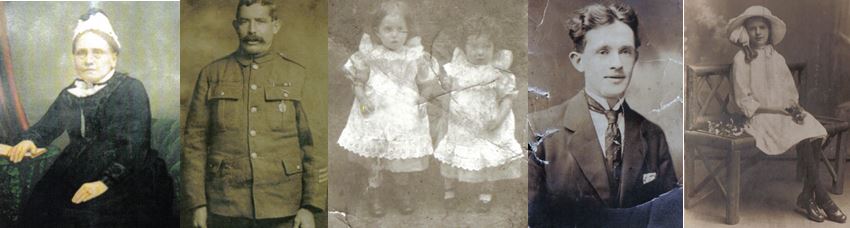
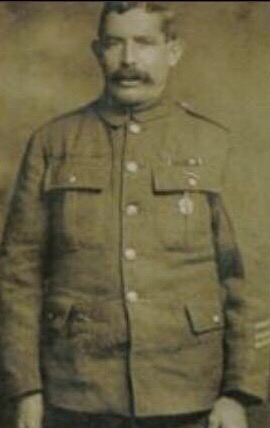
However, because of his age, I’d discounted him seeing his military service during the Great War. Combined with his age, his uniform in one of the family photos, with its three point-up chevrons on the lower left sleeve indicating 12 years good conduct, indicated pre-war service. I’d marked it as pre-1904, as he’d first turned up in Batley in January of that year. And by then he was a labourer. That was also his occupation when he married Ann Loftus in 1906. And also in the 1911 census.
Patrick Cassidy
As it happens his attestation papers backed up this earlier service theory. He confirmed to the attesting officer he had previous time-expired service with the Duke of Wellington’s Regiment (West Riding). He described it as 33rd and 76th West Riding, harking back to 1881 and the Cardwell Reforms when the Halifax depot 33rd and 76th Regiments of Foot merged.
One thing I found amusing from these papers: My grandma, who adored her father, always gave the impression of him being a tall man. According to his army forms he stood at the incredible height of…….5’ 3.5”. Just goes to show, don’t take all oral family history as gospel!
Anyway, back to the lie over his age. As an ex-soldier, by this stage of the war, the age limit was 45, not 38 as for other volunteers. So he really did go overboard with his age reduction. In fact, with his precise 35 years and 11 months, it seemed he was still working to the end of August 1914 rule change for volunteers without previous service, when the upper age limit was increased from 30 to 35. He really was determined to do his bit.
Still, I couldn’t get my head round it. Not the fact he chose to sign up. Not even the fact he lied about his age to do so. But why on earth would he do it on his young daughter’s birthday? Why not wait till a few days later? In fact, why not wait till after Christmas? Had there been some major family row that prompted it? Or had a close family member or friend, as yet unidentified by me, died whilst serving? Was my great grandfather out to avenge their death? Those were the only explanations I could come up with.
His papers offered no clues whatsoever as to why he would act in this way and leave his wife, children and labouring job in Batley to take this huge risk. Or did they?
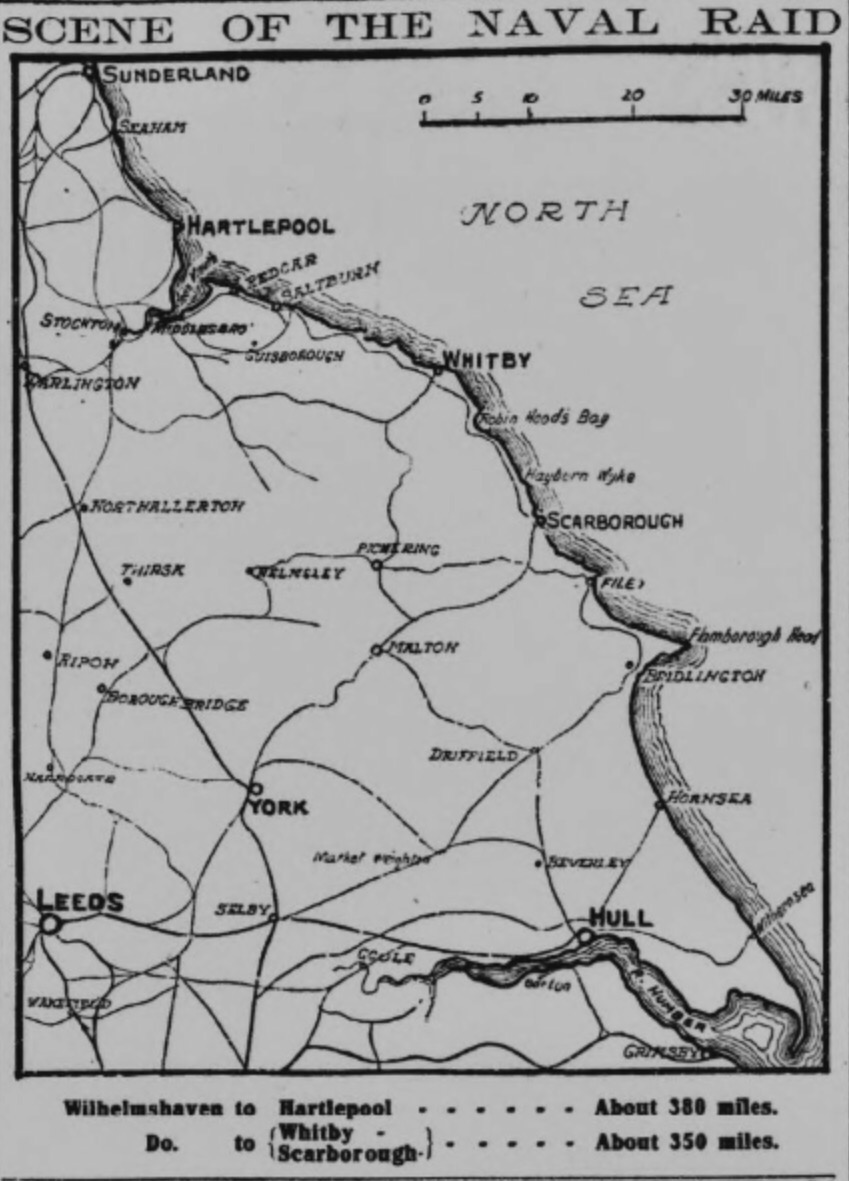
Several months later, whilst doing some general research, I realised the papers did contain the answer. The key was in the date. I’d been looking at it in narrow family terms, my grandma’s birthday. I’d not looked at any wider historical events. Besides being my grandma’s sixth birthday, Wednesday the 16 December 1914 marked the day German Imperial Navy ships Seydiltz, Moltke, Blücher, Derfflinger and Von Der Tann bombarded the east coast towns of Scarborough, Whitby and Hartlepool with a final toll of over 130 killed and almost 600 injured.
The attacks occurred from around 8am to 9.30am that morning. In the immediate aftermath, in scenes reminiscent of Belgium and France, refugees fled their homes seeking safety inland. Distressed residents from the stricken towns, some still in slippers and nightdresses, disembarked in local railway stations with tales of terror and destruction and reports of “scarcely a building left standing.” The historic landmarks of Whitby Abbey and Scarborough Castle suffered damage. Famous seaside hotels, like Scarborough’s Grand Hotel, bore shell scars.
The Grand Hotel, Scarborough
From 16 December onwards newspapers the length and breadth of the country carried the stories of this exodus, along with tales of death, injury and destruction wreaked. This from “The Yorkshire Evening Post” of 16 December reporting of arrivals in Leeds at 11 o’clock “One woman who arrived was wearing her bedroom slippers; in her arms was a two-year-old son in her nightdress and an outer garment lent by someone on the train.”
Another refugee was Mrs Knaggs, who lived in the vicinity of Scarborough’s damaged Grand Hotel. She arrived in Leeds on the 1 o’clock train into Leeds with her eight-year-old daughter and a few hastily packed groceries. She recalled meeting “…scores of women and children. All seemed unconsciously making for the railway station. Some were half dressed, and carried with them all manner of household articles. Another refugee had a child of a fortnight old in her arms, and with her was another partly-dressed girl of fourteen…..The streets of Scarborough were filled with women. These refugees were without food, money and very scantily clothed.”
Whitby resident Mrs Hogg was another Leeds arrival. Her house was struck by a shell. She recounted: “Outside shells were flying about, tearing up the pavement and damaging houses….In the fields in the outskirts of town big holes were torn in the ground and all the telegraph wires were down. People were hurrying along, some with a few belongings they had managed to get together. One man was carrying a parrot and two bird-cages. My little boy had run out of the house in his slippers. He lost his slippers on the way, and had to walk in his stocking feet.”
The German navy were dubbed the baby-killers of Scarborough, a reference to one of the victims, 14 month old John Shields Ryalls. In a letter to the Mayor of Scarborough on 20 December 1914 Winston Churchill, First Lord of the Admiralty wrote: “Whatever fears of arms the German Navy hereafter perform, the stigma of ‘Baby-Killers of Scarborough’ will brand its officers and men while sailors sail the seas.”
Baby Ryall’s picture along with another victim, 15 year-old boy scout George Harland Taylor, featured prominently in the press with inflammatory headings like “Slain by Germans” and “Killed by the Raiders.” Others included 28 year-old Miss Ada Crow, due to be married to her army fiancé, Sergeant G.R. Sturdy, on what turned out to be the day of her funeral.
John Shields Ryalls
George Harland Taylor
Some were of the opinion that the attack was the best thing that could have happened – it would give a boost to recruitment, now waning after the initial rush following the declaration of war. Battalions would be filled on the back of the attack.
By 18 December newspapers were reporting a material increase in numbers coming forward to recruiting offices, particularly in the areas affected by the bombardment. And from 18 December a new recruitment poster made its appearance:
AVENGE SCARBOROUGH Up and at ‘em now! The wholesale murder of innocent women and children demands vengeance. Men of England, the innocent victims of German brutality call upon you to avenge them. Show the German barbarians that Britain’s shores cannot be bombarded with impunity. Duty calls you now. Go to-day to the nearest recruiting depot and offer your services for your King, home, and country.
This theme was echoed in subsequent recruitment poster campaigns. This included a depiction of the ruins of 2 Wykeham Street, Scarborough where four died: Johanna Bennett (58), her son Albert Featherstone Bennett (22) a driver in the RFA, and two young boys John Christopher Ward (9 according to newspapers, although GRO entry gives his age as 10) and George James Barnes (5).
My great-grandfather didn’t wait for these rallying call to arms. He went to the recruiting office on the very day of the attack. Maybe the White Lee picric acid explosion with rumours of German sabotage only a fortnight earlier, which caused death and devastation to Heckmondwike and Batley, also played a part in his thinking. Though I can’t be 100 percent sure, it looks like he enlisted because he wanted to protect his family. The bombardment of east coast town, with the huge loss of life and the streams of refugees which followed, brought the war so much closer to home. The Yorkshire seaside resorts of Whitby and Scarborough were particularly popular local holiday destinations. In fact when war was declared only four months earlier the local Territorials, 1/4th KOYLI, were on their summer camp in Whitby. No longer was it a distant war affecting civilians – women and children – in foreign lands. It was now in Yorkshire. His family were now under threat. He couldn’t stand aside any longer.
So what became of him? The attestation papers indicated his resurrected army career with the KOYLI proved short-lived. On 15 January 1915 he was discharged as unlikely to become an efficient soldier. Unsurprising given his age. But the discharge setback did not deter him. It wasn’t the end of his military service.
By pure chance I found an entry in the “Batley Reporter and Guardian” of 27 August 1915. Private Patrick Cassidy of Hume Street appeared in Batley Borough Court charged with being absent without leave from the 3/4th battalion Duke of Wellington’s Regiment, who were stationed at Halifax. So he’d gone back to his old regiment. The Batley Borough Court records gave the offence date as 24 Aug 1915. He pleaded guilty and was remanded to await a military escort. I wonder if this has any link to the vehicle my grandma recalled?
The 3/4th Duke of Wellington’s was formed in March 1915 so it seems Patrick may have remained a civilian for as little as a couple of months after leaving the KOYLI. The battalion remained in England throughout the war, stationed at Clipstone Camp, Rugeley Camp, Bromeswell (Woodbridge) and Southend, training and supplying drafts for overseas service. I’ve traced no Medal Index Card for Patrick so it seems he remained on home shores. However he did see the war out. In the Batley Electoral Register of 1918 he is listed as being absent as a naval or military voter. Unfortunately the detailed Absent Voter List for Batley does not appear to have survived. This would potentially have confirmed his service number and regiment.
So this tale goes to show that when researching family history you need to look at wider historical events be it local, national or international. They too have an impact on the lives and decisions made by ancestors and can help you see your family history in a new light.
Sources:
Batley Borough Court Records – West Yorkshire Archives
This is another in my “Short Lives Remembered” series. In these posts I focus on often-forgotten children in family trees. Those who died all too young. The ones who never had chance to marry, have children and descendants to cherish their memory. The ones who, but for family history researchers, would be forever forgotten. This story is a direct result of the new search facilities available with the General Register Office (GRO) indexes.
I wrote about the new searchable indexes of births and deaths and the extra flexibility they provided here. As it is a new compilation it differs from other indexes because, where possible, the GRO have provided the mother’s maiden name right back to July 1837, as opposed to the September quarter of 1911. For deaths, an age is included if it is on, or is legible on, the original entry. Again this is back to their 1837 inception, as opposed to the March quarter of 1866 on other indexes.
Armed with these new search options, I am in the process of going through my family tree. For some there are obvious child-bearing gap years to focus on. The 1911 census is even more explicit in that it gives the number of children born in a marriage to a couple and provides the number surviving/dead. So the search offers a new tool to identify some of the hitherto unknown dead children if other methods have failed. More speculatively I’m going through my direct line ancestors to see if there are any other missed babies. Tedious with the two-year search parameter and having to specify the gender when searching. But rewarding nevertheless.
This is the story of my first search.
I decided to investigate my 2x great grandparents Joseph and Kezia Hill (née Clough). Joseph and Kezia married on 22 April 1869 at Tong Parish Church. Coal miner Joseph was only just 20 and Kezia 18. They both lived on Whitehall Road, Drighlington. Childhood sweethearts I assumed. In February 1871 son Albert was born, followed by John Herbert (Jack) in December 1872. Another boy, Harry, was born in around early 1874. Finally daughter Martha arrived towards the end of September 1876. Kezia died the following year. So I had a very narrow search window for this family.
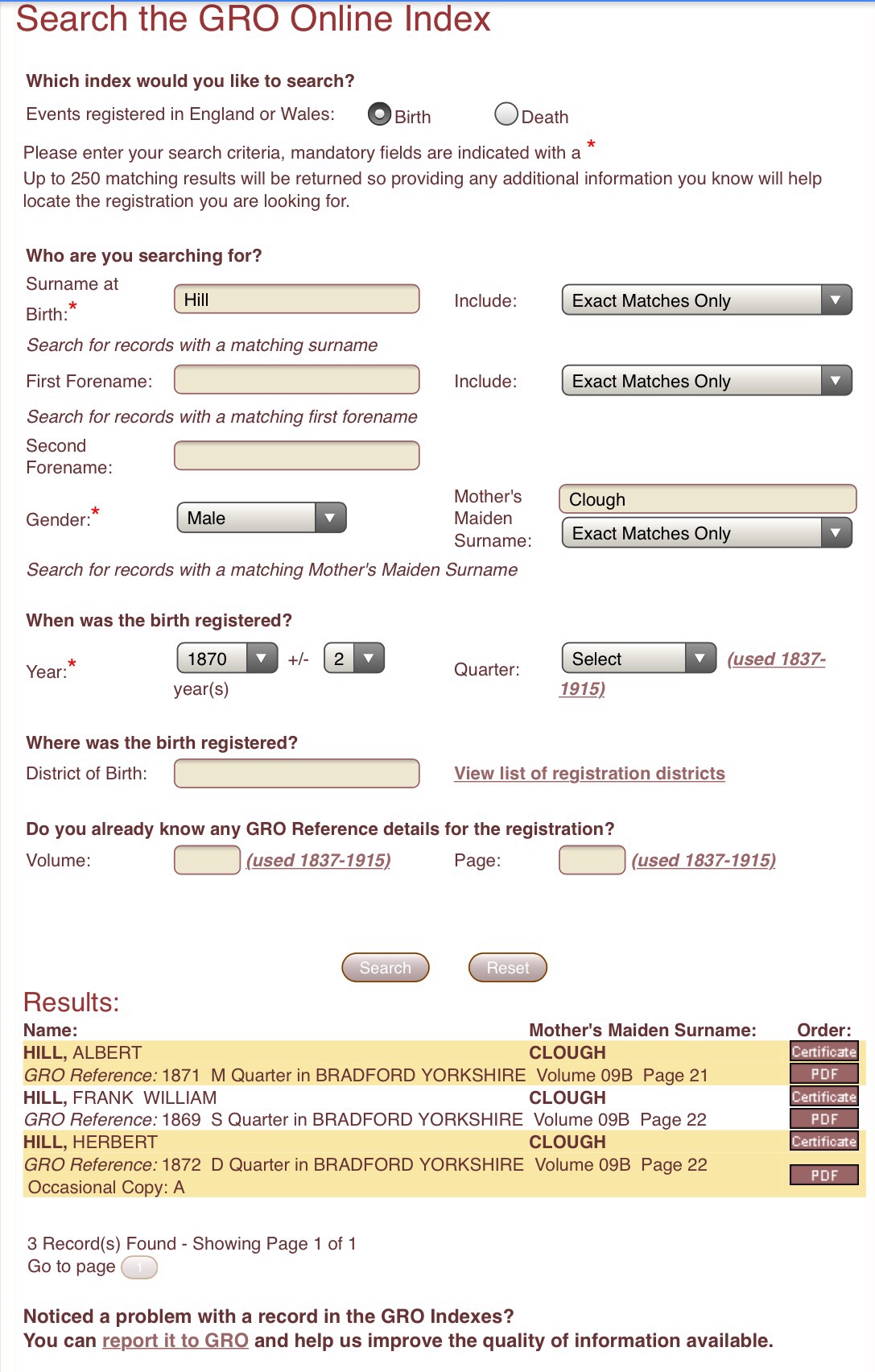
I didn’t expect much, given they’d had four children in their seven years of marriage. However the very first search produced a possible. I used 1870 +/- 2 years, males, with the surname Hill and mother’s maiden name Clough, and no phonetically similar/similar sounding variation options. It produced three hits. These are in the screenshot below.
Albert is there, as is a boy named Herbert. This is John Herbert. As I explained in my previous post, this is one of the quirks of the new search. Joseph and Kezia originally registered their son under the name Herbert, but changed their minds, went back and amended his name to John Herbert. The new indexes fail to pick up certified name changes.
There is a third boy on this list though: Frank William, whose birth was registered in the September 1869 quarter. It looked promising. The Registration District corresponded – Bradford, Yorkshire. The names were family ones – Joseph’s grandfather was called Francis; his uncle and eldest brother were named William. But it wasn’t proof positive.
In the 1871 census Joseph and Kezia with infant son Albert. No Frank. Was he living elsewhere at the time of the census, or had he died, another census “in-betweener“.
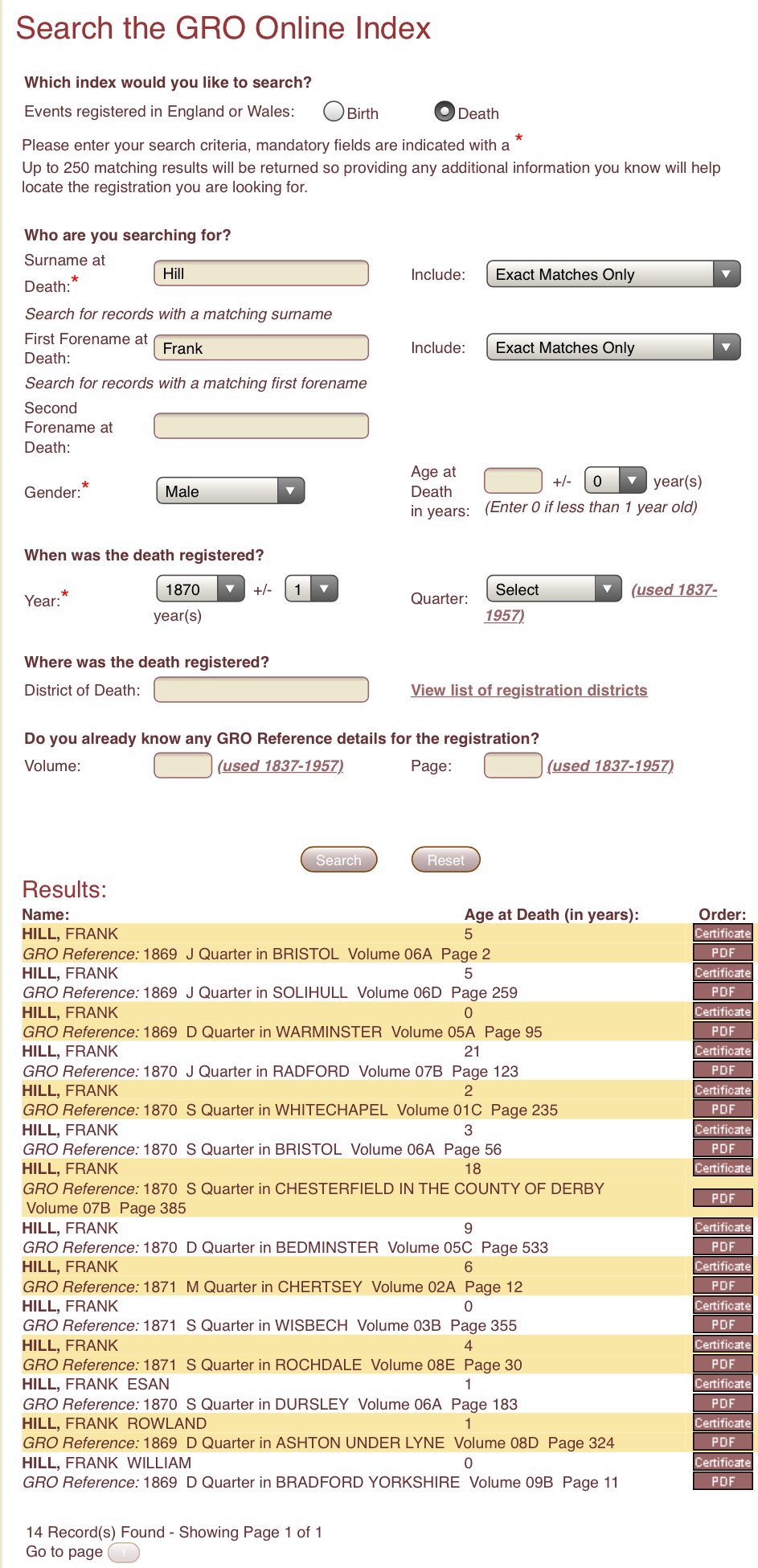
A search on the death indexes for Frank Hill with a +/- 1 year parameter resulted in 14 hits. The bottom entry looked spot on. It shows the death registration of Frank William Hill in Bradford, Yorkshire in the December quarter of 1869 – age 0. The convention is to record the age as 0 for infants under 12 months. However, be aware that despite the rhetoric, this isn’t a hard and fast rule with these new indexes – there are errors. I have instances were a child of two months at death is recorded as two years.
I decided to play it safe though and went for the birth certificate initially. I ordered it on 9 November via the trial PDF system. By 11 November it arrived, five days ahead of schedule. However I couldn’t open it. The only one of my orders I had an issue with, and it would be this one. Despite this glitch, I am feeling very positive about the new PDF system. No it’s not perfect, but it is another (cheaper) ordering option, where you don’t need a fancy all bells and whistles certified copy. It’s a straightforward process, especially for those birth and death events searchable on the new indexes. And the indexes themselves have helped me progress my family history in a way not possible with the alternative ones.
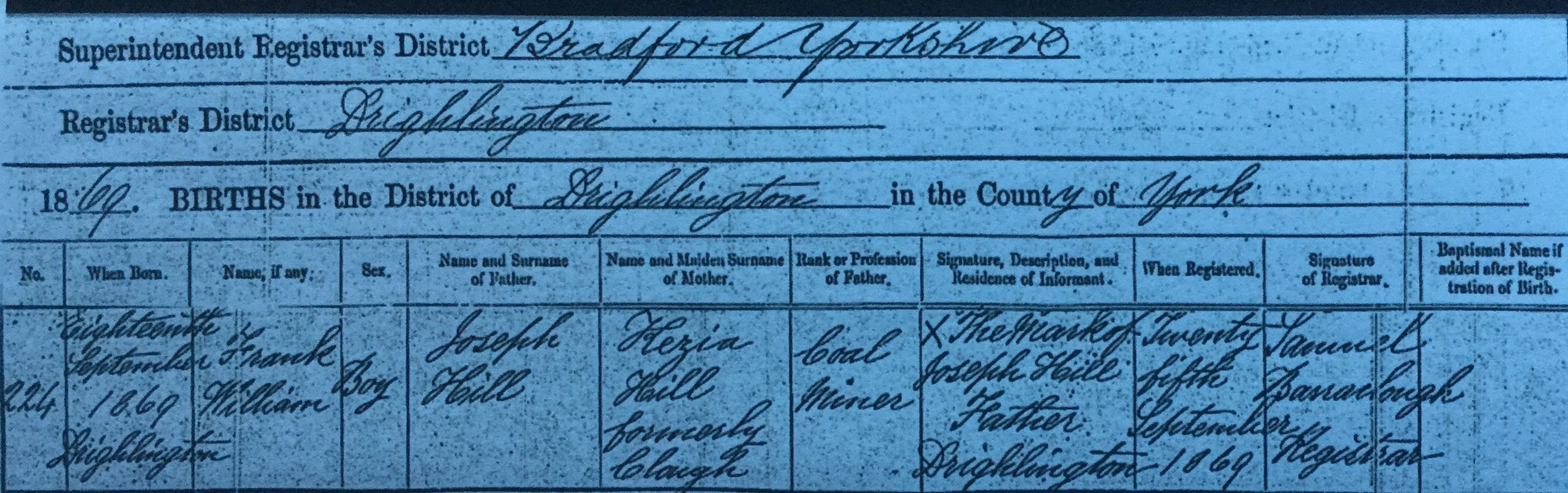
Anyway, back to Frank’s certificate. I was on tenterhooks. So near but yet so far. Then Steve Jackson stepped in, who runs the Atcherley One-Name Study. He sorted it in no time, and bingo. Frank William was indeed Joseph and Kezia’s first child.
This put a whole new spin on my family tree. For a start my great grandad was now relegated to third child. But, more importantly, Frank was born in Drighlington on 18 September 1869. This was coming up to five months after his parents married. He may therefore have been the very reason for their marriage. But sadly his life proved far shorter than those five months of his parents married life to date.
PDF Copy Birth Certificate of Frank William Hill
Joseph registered his son’s birth, making his mark. He alternated between signing and making his mark on various birth and death registrations, so it is difficult to make literacy assumptions on the basis of a one-off registration. However the sad task of registering the baby’s death fell to Sabina Hill. I suspect she is Joseph’s sister as she’s the only Sabina Hill in the family tree at this point. However I do have a slight niggle with this theory: she was only 14 years old in 1869. She too made her mark.
Frank never thrived. He must have been a constant cause of concern for his young parents. He is described on the death certificate as having anaemia since birth. He lived only three weeks, giving up his struggle in Drighlington on 9 October 1869.
His certificate also states, besides anaemia, he suffered convulsions for a few hours before his death. Convulsions was not an uncommon death certificate death cause for young children and infants in this era. Babies and infants who develop a fever as a result of an infection may fit because of their high body temperature. With the medical limitations of the period, in these circumstances the outward manifestation rather than the underlying cause was recorded.
So ended Frank’s short, but significant, life. Significant insofar as it was probably the initial impetus behind Joseph and Kezia’s marriage. And, as a result, generations later their family lives on. Including me.
I’ve not found a baptism for Frank. There won’t necessarily be one. And to date I’ve not found a parish register burial entry for him. But it’s early days, given its only a week ago since I learned of his existence thanks to the new GRO indexes. However the discovery of his brief life has added a new dimension to Joseph and Kezia’s life together. And sadly it’s another tragic one. Maybe next year I will write about them.
Others who feature in this series of “Short Lives Remembered” posts are:
It’s not even Christmas 2016, but one of my presents will be here early. After my 2016 visit to WDYTYA? Live in Birmingham, where I felt one day was far too short a visit for me, I determined that in 2017 I would spend longer at the exhibition. Tickets are now on salewith an “early bird” discount.
WDYTYA? Live 2016 – photo by Jane Roberts
So now it’s time for me to plan my visit. I’m going for a two-day option. So next to check out hotels. And based on my previous experiences I will pre-book my workshops. I’m getting old so need a seat!
Another free resource for family historians. The GRO (England & Wales) have made available online a searchable index of births and deaths, via their website. All you need to do is have a registered GRO online certificate ordering account.
This new index covers registered births from 1837-1915 and deaths from 1837-1957.
The plan was to limit the index to births over 100 years old and deaths over 50. However the GRO state that completing digitisation “would require significant investment and there are no current plans to resume this work but we continue to monitor the scope for future opportunities to complete the digitisation of all birth, death and marriage records.” So, I suspect in this climate of government austerity, the completion of the death digitisation, the year-by-year roll out, and the digitisation of marriages won’t happen anytime soon. However they will update the index if there are errors and omissions, and they do have an error report form for these to be submitted to them.
The GRO have a FAQ section on the website. This includes a guide about searching the indexes. So I won’t cover that aspect in this post. There is also a useful guide here.
So what does this GRO online index add to the indexes already out their via FreeBMD and subscription sites like FindMyPast?
Well for a start this is a brand new index and not a copy of an existing third party one from the microfiche indexes. Anyone doing family history will be familiar with the scenario – a search on two websites will not necessarily yield exactly the same results. So this provides an extra check with which to by-pass errors and find that illusive record.
Crucially, as the GRO point out, this new index contains “additional data fields to those which are already available and this will assist family historians to identify the correct record.” Other indexes, because they are taken from the microfiche indexes, only include age at death from the March quarter of 1866 onwards; and for births the mother’s maiden name only features from the September quarter of 1911. This index is different. Because it is a new compilation, where possible the GRO have provided the mother’s maiden name right back to 1837; similarly an age for deaths is also included if it is on, or is legible on, the original entry. The convention for recording the age as 0 for infants under 12 months is continued though.
As a result of this extra information I think I have narrowed the 1860s death of my 3x great grandfather to two possible certificates: Not the several of previous searches. At £9.25 a certificate this could make all the difference to me taking a gamble and ordering. Similarly the availability of the mother’s maiden name on the earlier birth entries enables pinpointing the correct entry far more straightforward. It also is a useful tool to discover hitherto unknown children of a marriage during the 1837-1911 period.
Also whereas other indexes record middle names as initials for many years, the new GRO index gives them in full. In my post about names in World War 1 I didn’t include middle names as these were not identifiable in the FreeBMD indexes for that period. The use of initials on FreeBMD is explained here.
However it is now possible to do a middle name search to a limited extent on the new GRO index irrespective of period, as the screenshot below illustrates. I did a search for a middle name of “Joffre” for 1914 +/- 2 years. With other indexes this isn’t possible, they just show the middle name by initial for these years, in this example “J”.
Although it’s not a solution to calculating a total number as you can’t search without a surname, this facility might aid the correct pinpointing of an entry.
GRO index screenshot showing 1914 +/- 2 year search for boys with surname “Smith” and middle name “Joffre”
Limitations so far for me are the:
two year search parameters, which can drag out the search process if you’re working on a longer window of uncertainty (for example an inter-census death), especially when you have to do a male and female search;
having to use the mandatory gender field when conducting a search is a tad frustrating. I keep forgetting to switch;
the 250 results limitation may be problematical for larger one-name-studies; and
not having a county-wide search functionality. It’s either everything, a volume number, which does not equate exactly to all the districts within a county (thanks to gwinowan for the tip) or a specific registration district.
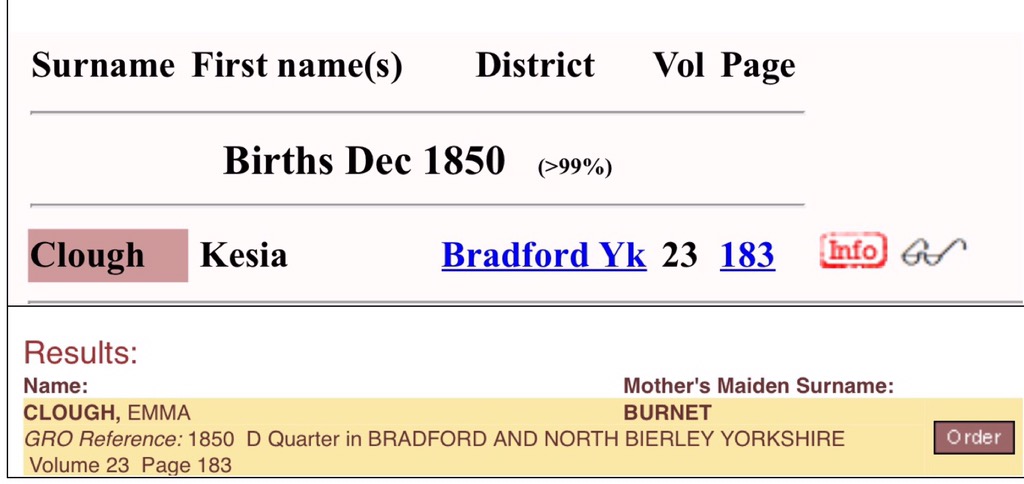
And finally one anomaly. In my post about tricky names I indicated how my 3x great grandparents changed their minds about the name they registered my 2x great grandmother under. She was originally registered as Emma Clough but, as was permissible, they subsequently amended her name to Kesia (she was known as Kezia(h), so even more spelling variants). This is shown on the original birth certificate and GRO copy. When searching on the microfiche indexes she is found under Kesia Clough. In the new GRO ones she’s down as Emma. The same applies to my great grandfather – originally registered as Herbert Hill, but amended to John Herbert. Found under John Herbert in other indexes, but Herbert in the new GRO one.
Top entry from FreeBMD showing my 2x great grandmother’s correct (amended) name; bottom entry from the new GRO indexes showing the name she was originally registered under
So be aware, the new GRO index will show the name the baby was originally registered under. This may cause confusion, especially for one-namers.
Overall though, despite its clumsiness and limitations in some ways, I’m really happy with the additional options it provides. So a thumbs up from me.
Update 1: Just read on the “Who Do You Think You Are?” Magazine FB page that, following on from these indexes, the GRO will trial the purchase of uncertified PDFs of birth certificates from 1837-1934 and death certificates from 1837-1957 at a cost of £6 each. This from 9 November 2016 lasting for three weeks, or until 45,000 PDFs have been purchased.
Update 2: GRO have launched the £6 PDF trial starting from 9 November. This from their website:
“From 9 November, we are trialling emailing PDF copies of registration records. Records will not be immediately viewable, but emailed as a PDF.
The pilot is in 3 phases, starting with our digitised records:
Births: 1837 – 1934 and 2007 on
Deaths: 1837 – 1957 and 2007 on
Marriages: 2011 on
Civil Partnerships: 2005 on
Phase 1 closes on 30 Nov, or when 45,000 PDFs have been ordered, whichever is sooner. Details of phase 2 (3 hour PDF service) and phase 3 (records not digitised) will be announced here shortly.”
Full details are in here in the GRO’s “Most Customers Want to Know” page.
I’ve ordered a couple of PDF certificates under the new system, which is all very straightforward to use. In fact it’s more user-friendly for those indexed entries, as you can place your order direct from the search result and all the relevant information (including name, District, Quarter, Volume & Page) is automatically entered. Delivery for these Phase 1 PDF’s is to a slightly longer timeframe. My expected email delivery is 16 November. I’m just hoping the 45,000 limit isn’t reached before they arrive, as if I’ve correctly identified a birth for an hitherto unknown baby of my 2x great grandparents, I also want to get the death certificate.
Update 3: Phase 1 ended on 30 November. I ended up ordering 19 PDFs in total. Six have arrived, although I do have an issue with one. It arrived in an unopenable Winmail.dat format on 11 November. The GRO finally re-sent it as a PDF on 2 December. I ordered the final 13 towards the end of the trial and delivery, due to the volume of orders, is not anticipated until early December.
Update 4: Pilot phase 2, for a within three hour delivery service for PDF copies of all birth, death, marriage and civil partnership records has ended now. However the £45 price tag was beyond my purse strings.
Phase 3 is now up and running, with a close date of 4pm on 12 April 2017, or 40,000 PDFs, whichever is the soonest. It covers PDF copies of those civil registration entries that are not held by GRO in a digital format, in other words those not included in the earlier Phase 1 £6 trial. The exact dates are:
Births: 1935-2006
Deaths: 1958-2006
Marriages: 1837-2010
These PDFs will cost £8. I may be tempted here, though it is only a £1.25 saving on the postal service – so not a massive saving.
On 1 November I began my three month notice period at work. My 30 year civil service career officially ends on 31 January 2017. I am ready for a change. When the opportunity arose and the Department of Health announced it was shedding a third of staff launching its voluntary exit scheme in the early autumn, my list of reasons for leaving far outweighed the ones for staying. True civil service policy analysis principles there. Weighing up the pluses and minuses to come to a balanced and considered opinion.
A New Family History Chapter – photo by Jane Roberts
But I do have mixed feelings. It’s a huge step after so many years. On the whole I have enjoyed my time with the civil service, to be fair some jobs far more than others. I’ve made some fantastic, lifelong friends. I’ve gained a raft of skills which will be of incredible value going forward. Above all moving from a job with a regular monthly salary into the unknown feels very scary.
But it’s an opportunity I relish. It’s a chance to have more time to concentrate on family history. A chance do the things I enjoy. A chance to do something for me. A chance to share over a decade of family research knowledge and experience. And a chance to put those skills I’ve learned to practice in a new direction. Skills, values and principles which include:
planning;
researching;
analysis;
summarising;
reporting;
seeing the bigger picture;
bringing together multiple data sources to provide a coherent picture;
writing;
time management;
independent thinking and working, yet also being able to work as part of team;
project management;
meeting deadlines;
following a set remit;
confidentiality;
honesty & integrity;
computer programme knowledge; and
providing value for money.
So going forward I will have more time to work on my own family tree and my one-name-study. I will also be able to attend more family history events. I aim to do more continuing professional development. And I will be able to take on more client work. In the coming months I will provide more details.
A sad day for those with coal mining ancestors and interests. Whilst doing some research into my many ancestors working in this industry, I attempted to access one of my favourite occupational websites, “The Coal Mining History Resource Centre” (CMHRC).
However it appears to have vanished.
Ian Winstanley compiled the information for the website. But I believe Raleys Solicitors, an old-established Barnsley law firm specialising in miners’ compensation claims, ran it. They went into administration in March 2016. Whereas client work appears to have transferred to Ison Harrison Solicitors, the website seems to have been a casualty.
Ancestry.co.uk have Ian Winstanley’s “Coal Mining Accidents and Death Index 1700-1950“, which was on the site. But CMHRC was far more than this wonderful database. Described as the UK’s largest and most comprehensive website concerning the history of coal-mining, its resources included maps, the 1842 Royal Commission reports, poems, a glossary of mining terms and a photo gallery. Unlike Ancestry, it was a free website. And to be honest I much preferred its search facility.
I would hope the loss of CMHRC is temporary and it can soon be restored in all its former glory. But in the meantime there is a bit of a work round.
In my post about an obsolete County Mayo website, I described how the Internet Archive Wayback Machine could be useful in accessing defunct websites. You can partly access CMHRC via this mechanism, but be warned you do lose much of the original site functionality.
Screenshot of CMHRC via the Wayback Machine
If searching via the Internet Archive Wayback Machine, the URL to use for CMHRC is: http://www.cmhrc.co.uk
Make sure you search for 2016 captures and earlier. It is far from perfect but it might help.
The most common occupation in my family tree is “coal miner”. Unsurprising given my paternal and maternal West Riding roots. As a result I’ve spent quite a bit of time researching the history of coal mining: the social and political aspects as well as the general occupation and its development through time.
This research could form the basis of many posts. The aspect I’m focusing on this time is the perilous nature of the work. “Poldark” brought this to mind. Different type of mining, but the death of Francis highlighted the dangers of underground work in the late 18th century and made me think once again about my coal mining forefathers. However grim I think my job is, I only have to think about my ancestors, men, women and children, who worked down the coal mine to realise how lucky I am.
Even in more recent times coal mining was a hazardous, unhealthy occupation. But in terms of my 18th and 19th century family history, these were days before today’s stringent health and safety regulations. Indeed in the early days of my ancestors the working was totally unregulated.
The cramped, damp conditions and physical exertion led to chronic muscular-skeletal problems and back pain as well as rheumatism and inflammation of the joints. Many suffered from loss of appetite, stomach pains, nausea, vomiting and liver troubles. Most colliers became asthmatic by the time they reached 30, and many had tuberculosis. And all this would have led to days off sick without income to support the family.
Then there were the accidents. No-one knows how many deaths there were in the first half of the 19th century, let alone earlier. An unreliable estimate in 1834-5 of the number of lives lost in coal mines in the previous 25 years gave the number of deaths in the West Riding as 346 and the evidence is the high proportion were children. According to the appendices of the Mines Inspectors Report’s 1850-1914 some 70,700 miners died or sustained injures in the mines of Great Britain from 1850 to 1908. However even this is not reliable, because the number of non-fatal accidents taking place between 1850-1881 is unknown. It was no-ones job to collect the information.
It is true that miners themselves took risks, failing to set timber supports, propping air doors open and working with candles when it was dangerous to do so even after the invention of the Davy lamp. But colliery officials and managers also cut corners and costs leading to dangerous conditions, for example failing to replace candles with lamps, not supplying sufficient timbers, not ensuring adequate ventilation, using defective colliery shafts which were not bricked or boarded and contained no guide rods, as well as drawing uncaged corves (the small tubs/baskets for carrying hewn coal from the pit face) direct from the pits which resulted in falls of coal and people down the shaft. It was not until 1872 that every mine manager was required to hold a certificate of competence.
Whilst explosions exacted a heavy toll and made headlines, it was the individual deaths and injuries sustained over weeks, months and years by falls of coal and roof which were responsible for most accidents, fatal or otherwise.
One of the earliest mining ancestors I’ve traced is my 6x great grandfather Joseph Womack, born in around 1738. And his is the earliest family mining fatality.
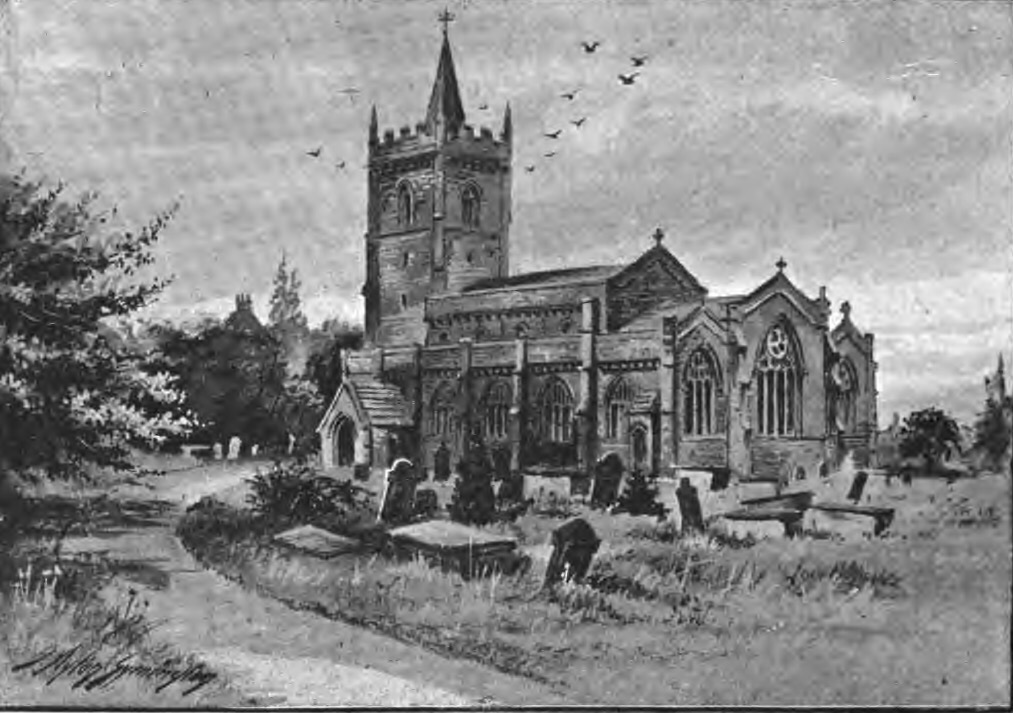
Joseph married Grace Hartley on 11 February 1760 in the parish church of St Mary’s Whitkirk. It is the oldest medieval church in Leeds and a church probably existed on the site at the time of the Domesday Book. The name “Whitkirk” or “Whitechurch” is first recorded in the 12th Century in a charter of Henry de Lacey, founder of Kirkstall Abbey, confirming the land of Newsam, Colton and the “Witechurche” to the Knights Templars. The present building dates from 1448-9 but underwent substantial restoration in 1856. So it is essentially the building in which my 6x great grandparents married.
Whitkirk Parish Church
The man known as the father of civil engineering, John Smeaton, is buried just behind the main altar. Perhaps Smeaton’s most famous work is the 3rd Eddystone Lighthouse, completed in 1759 just the year before Joseph and Grace’s marriage. His other works included the Forth & Clyde Canal, Ramsgate Harbour, Perth Bridge, over 60 mills and more than 10 steam engines.
Joseph signed the register in a wonderfully neat hand. It’s always a thrill when I see the signatures of my ancestors. And especially those who worked in manual jobs not associated with literacy.
The marriage entry indicated Joseph and Grace were both residents of the parish. The location was pinpointed to Halton with the baptism of their first child, Joseph, on 22 October 1760. This location was confirmed in each of their subsequent children’s baptismal entries. Halton was about three miles east of Leeds in Temple Newsam township with Whitkirk parish.
Another son, Richard, was baptised on 27 June 1762 followed by their first daughter Mary, my 5x great grandmother, on 12 February 1765. Four other Womack children’s baptisms are subsequently recorded – William on 21 January 1770; Henry on 24 September 1772; Thomas on 6 August 1775; and Grace on 14 February 1779. This final baptism is more detailed, giving Grace’s date of birth as 31 December 1778 and stating that her father, Joseph, worked as a collier.
The Womacks, Joseph and his sons, were a coal mining family working at the local Seacroft colliery. Joseph and his eldest sons Joseph and Richard were there one day in May 1781 when tragedy struck in the form of an explosion. The events reached papers nationally as well as locally. The coverage is typified by this paragraph in the “Leeds Intelligencer” of Tuesday 22 May 1781. According to the newspaper the explosion took place on a Thursday, which would make it 17 May. However this may be inaccurate. I will return to this later. Typically for the time no names are given.
In the era before the 1815 invention of the Davy Lamp, candles were the only form of light in the mine. But the risk of explosions with naked flames from these candles igniting methane gas was high, even in well ventilated pits. Firedamp was the name given to an inflammable gas, whose chief component was methane. This was released from the seam and roof during working. And on this fateful May day the Womack father and sons were caught in its ignition.
We turn to the Whitkirk burial register for the details of how this newspaper snippet linked to the Womacks. The register gives the following burial details on 18 May 1781:
“Joseph Womack collier slain by the firedamp at Seacroft also his son Richard Womack who was slain at the same time. The father was aged 43 the son 19 years”
Slightly later era, but illustration of a pit top after an explosion
Joseph (junior) was one of those hurt in the incident. This is shown by an entry in the same register, dated 2 June 1781: sadly another burial. It is Joseph’s. He lingered for several days before succumbing to his injuries, described as “bruises”. The entry states that his injuries were the result of the same incident in which his father and brother were killed.
Besides being emotionally devastating for the family, with the death of two members on the same day and a third receiving injuries in the same incident leading to his protracted death two weeks later, it would have been economically crippling. The three main breadwinners wiped out in a single stroke. Grace was left to bring up several children – the eldest 16 years old, the youngest just two.
Less than two years after the death of his father and brothers Thomas died, aged eight, as a result of a fever. This is a notoriously vague catch-all description for the period indicating, yet again, that in these times the precise source of illnesses were often not known but which clearly suggests some kind of infection. There are no other clues or hints. Checking the burial register for the period around Thomas’ death reveals nothing, for example an epidemic or outbreak of common illnesses in the area. He was buried on 25 April 1783 in the parish.
Surprisingly the family do not appear in the list of recipients receiving parish dole money. Neither are they mentioned in the parish churchwardens and overseers accounts or vestry minutes, but there is very little poor law related material in these specific Whitkirk documents. It is very possible that they were supported by the parish via this mechanism, but these records have not survived, or else I’ve not yet discovered them in my visit to the Leeds branch of West Yorkshire Archives.
But the two information sources, newspaper and parish register, give an indication of the devastating effect a pit explosion could have on a family at a time when fathers, brothers and sons (and prior to the 1842 Mines Act women plus girls and boys under 10) worked side by side underground.
A sad footnote to this post concerns the anonymity of those killed. In addition to Joseph senior and Richard, there were two others who lost their lives in the immediate aftermath of the explosion, as reported in the “Leeds Intelligencer” 0f 22 May. Given the date of the article, Joseph junior couldn’t have been one. Their names didn’t appear in any reports I found. I do wonder who they were though, these people who worked and died with my ancestors.
There is nothing to indicate any other Whitkirk burials of the period applied to these victims. Parishes adjoining Whitkirk were Leeds, Swillington, Rothwell and Barwick in Elmet. Leeds St Peter’s parish church provides a cause of death for all burial entries for the period. Sadly I drew a blank in this search. Likewise for Swillington St Mary’s and Holy Trinity at Rothwell. However, Barwick in Elmet All Saints register records the burial on 17 May 1781 of 33 year old Christopher Dickinson from Lowmoor. He died on 16 May 1781, “kild in Seacroft coalpitts“. So was this the same incident? If so it indicates the inaccuracy of the newspaper date which implied a 17 May accident date.
Providing the newspaper got the numbers right, the other individual remains a mystery. The only possibility so far is a cryptic and inconclusive 17 May 1781 entry in the nearby parish of Garforth St Mary’s “Thos son of Mathew Limbord colier aged 23 years” No cause of death. And really it’s not clear if it was Thomas or his father who worked as a collier.
The “UK Coal Mining Accidents and Death Index 1700-1950” doesn’t offer a solution either. This was on the now obsolete “Coal Mining History and Resource Centre” website, which I wrote about in my previous post. As indicated in that post, the index is now available on Ancestry.co.uk – but this accident is not recorded. I may never know who the fourth person was. And it makes me think how many other mining deaths are similarly lost.
In my “Fabulous News For Those With Irish Ancestry” post I could scarcely contain my excitement at the release of Irish General Register Office (GRO) birth, marriages and death register images. The site is https://www.irishgenealogy.ie
I’ve had a few days playing with my new family history toy and getting a feel for the system. These searches have focused on my primary interest area, County Mayo, and in particular the Swinford Registration District. I’ve tried a combination of search methods, including wildcards for those multiple spellings. For example I didn’t realise how many ways you could spell the seemingly simple surnames: But Loft* identifies Loftus, Loftice and Loftis; Cass* included Cassidy, Cassedy and Cassiday.
I found it interesting to note how many of my family were baptised before their registered birth date! I knew my grandpa had two birthdays, but it seems he was not unique amongst his siblings. Staggeringly this applied to seven of out of the eight children of Michael and Mary Callaghan, whose birth register images are accessible. But it also features in my Loftus line.
Glan Church, Kilkelly, County Mayo
It points to the religious importance of quick baptism to ensure eternal salvation at a time of high infant mortality; combined with the lesser imperative to officially register, with rural transport factors and employment pressures coming into play. By law, a birth had to be registered within 42 days. Fudging the birth date was a way to avoid a late registration penalty. Interestingly my grandpa carried on the “tradition” of an incorrect birth certificate date with my mum.
As with any new release on this scale there are some glitches:
The site did go down a few times and at others it was painfully slow. Hopefully these accessibility issues will improve as the traffic volume decreases;
I do get a tad frustrated at constantly proving “I am not a robot” several times within the same session. There’s a limit to how many street signs, grass vistas, milkshakes and shop fronts I must identify before curbing the urge to scream;
Not all images are online yet. Births are there from 1864 to 1915. However marriages are only available from 1882 to 1940. Deaths run from 1891 to 1965. The GRO are updating further records of Marriages dating back to 1845 and Deaths dating back to 1864, but no indication of how long this will take;
For one of my birth searches, the link was to the wrong image. I couldn’t see any way to browse adjoining pages easily. I tried in vain to overcome the issue using the advanced search options, narrowing down dates and Registration Districts. A frustrating half an hour later and I still couldn’t access it. So I know Andrew Callaghan’s 1891 birth registration is there somewhere, but the crucial image still eludes me. I have reported the issue via the feedback form, but as yet haven’t received a response;
The Advanced Search facility has issues, alluded to above. Linked to this, I do wish search guidance was clearer; and
I’ve heard anecdotal stories of false negative results, where someone who should be there isn’t identified in searches. So far this hasn’t affected me.
But the positives far outweigh these niggles:
FREE register images are instantly available with the click of a few keys;
The register pages supply the birth, marriage and death certificate details thus saving researchers €4 a certificate;
The information provided may lead to wider family. I quickly noticed that a good number of births were not registered by the parents. Far higher than I anticipated. Many entries were by people described as “present at birth”. For example a couple of my Callaghan births were registered in this manner by a Patrick Callaghan. Tantalisingly in these instances no relationship details were supplied. Possibly the baby’s grandfather or potentially an uncle, so extended family clues. However some entries do give the precise relationship details. I’ve seen sisters and grandmothers identified. So you may strike lucky;
You can include the mother’s maiden name in the advanced search option for births. And these fetch results earlier than the 1911 norm for England and Wales GRO searches. However I would not go so far as to say I to trust equating negative results to no results; and
There are entries for Northern Ireland Registration Districts. I’m not sure if these are limited to pre-1922 and how complete these are. So even if your ancestry is from the North, the records are worth checking.
In summary, despite its flaws this is a brilliant resource. It is a wonderful companion set to the free NLI Catholic parish register release of 2015. And a massive thank you to the Irish authorities for making Irish Soldiers Wills 1914-1918, the Irish 1901 and 1911 census, and other datasets, also available free of charge via the National Archives of Ireland’s genealogy page.
It is worth comparing with the “pay” attitude for similar information in England and Wales. A prime example being the £9.25 extortionate charges for similar civil registration information, with seemingly very little progress made since the 2015 Deregulation Act which was supposed to pave the way to providing this information in an uncertified, lower cost form. Or the £10 charge for a World War 1 soldier’s will in this centenary commemoration period.
5 October 2016 update:
I have now received a response from Irish Genealogy to my query on errors. They will be adding a mechanism for error reporting, but no indication of timescale.
In terms of coverage they confirmed the General Register Office are currently working on updating further records of Marriages dating back to 1845 and Deaths dating back to 1864. These will be included in future updates to the records available on the website.











 Past To Present Genealogy