Category Archives: Family History Tips

Hidden Names: Indecisive and Tricky to Downright Confusing Ancestors

I remember well my husband and I spending hours pouring over a book of baby names throughout my pregnancy trying to decide on boy/girl options for the impending arrival of our little bundle of joy. OK, not so much him as me.

We were sure of our choices for a boy – William Patrick. Less so for a girl. Alice was the early favourite, although we were not entirely convinced. That was until our daughter arrived and within minutes we did a sudden about-turn to Amelia Grace. This was way before Amelia featured in the annual top 10 lists of baby names produced, so we were not swayed (or should that be put off?) by popular opinion. Then it was down to the Registry Office to make her official, like generations of parents before.

My well-thumbed book of Babies Names

But it’s not always that straightforward. What happens if you change your mind after the official form filling? If you decide after all it wasn’t the right choice? Perhaps the parent doing the registering put down the wrong name, or an “unagreed” one.

In my recent family history I’ve a couple of examples, with unofficial solutions. My grandma registered my dad’s birth. He has a Christian and middle name. Seemingly the Christian name was my grandma’s choice – her dad’s name, Patrick. My grandad wasn’t best pleased when he found out after the deed was done. As a compromise my dad has always gone by his middle name. Something that causes endless confusion when dealing with officialdom, the only time when he’s ever referred to as Patrick. But at least we know about it so it’s not an issue – though it might be for future family historians, seeking him under his every-day name!

And there was a bit of pay-back for my grandma’s trickery. Her next son was born on St Patrick’s day – but she’d already used the name!

I also have a maternal aunt. Looking for her in the GRO indexes is problematical. My grandpa registered her under the wrong name, apparently the name of a former girlfriend. Imagine explaining that one away. Unsurprisingly she’s never used that name, although it is remarkably similar to the one she goes by .

Mind you my grandpa has a tendency to mess up birth registration. To be honest I’m surprised my nana let him do it again after the example of my aunt. But she did. The result is my mum’s birth is registered on the wrong day – something she didn’t discover till getting a copy of her certificate when leaving school, much to her embarrassment. Now, like the queen, she has two birthdays. She chooses, from year to year, which is the most convenient date to celebrate.

I suppose it’s sometimes all too easy to forget when researching your family tree that these are not one-dimensional, generational paper-trail figures. They were real people, with emotions and feelings and lives just as rich, rounded and complex as ours today. So although I shouldn’t have been, it was somewhat of a shock to find even earlier examples when I delved into my family tree and bought those all-important birth certificates. But these were examples where the families concerned actually did something about it through official channels.

Permissible but unusual, you could change to the name registered for a child providing it was done within 12 months. There is a column on the birth certificate indicating “name entered after registration” catering for this eventuality. Normal procedure was that the Minister performing the baptism provided a certificate confirming the child’s baptismal name; if unbaptised, the mother or father signed a certificate. This had to be taken to the registrar or superintendant registrar and a fee paid. So not a light undertaking given the financial and time implications, not to say knowledge in the first place that this was an option.

I’ve discovered two examples in my direct line ancestry. The first is for my 2x great grandmother Kezia(h) Clough. Born in Drighlington on 21 October 1850 she was the 6th, and youngest, daughter of William and Mary Clough (née Burnett). On 12 November 1850 Mary registered the baby’s birth, signing with her mark. Her daughter’s registered name was Emma. However, there is an entry in the name-change column. In this case it indicates the alteration to Kesia (another variation). No date as to when the amendment took place. The baptismal register at St Peter’s, Birstall, shows the child was baptised with the name Kezia on 29 December 1850. So the decision was made relatively quickly.

I’ve no idea why the change of heart. Mary did have a sister named Keziah who died in 1837. But that was over 13 years before the birth of Emma/Kezia, and Mary had two other daughters born after her sister’s death. So ample opportunity to name a daughter after her sister, without an after-registration moment of enlightenment. The reason will forever be a mystery.

Kezia Clough’s Birth Certificate

You might have observed that I’ve alluded to the fact there are variant spellings of Kezia on official documents. Sometimes the alternative Keziah is used. Something else to consider in that elusive ancestor hunt.

The other example is my great grandad Jack Hill. Coincidentally he is the son of Kezia and her husband Joseph Hill. Jack was their third son. Born on on 10 December 1872, Joseph registered him on 13 December, under the name Herbert. The amendment column shows a post-registration change of name to John Herbert. Again nothing to indicate when the change was made. Some months after birth, on 25 May 1873, he was baptised John Herbert at Birstall St Peter’s. So another bit of naming confusion thrown into the ancestral search mix – the diminutive: Jack being a diminutive of John.

Once more no clues as to why the change. Perhaps it was an afterthought nod towards Kezia’s brother John, who died in 1871. Or, the theory I’m leaning towards, is Herbert’s name was too close to the name of his older brother Albert (Bert & Bert), something hinted at in that May baptismal entry where “John Albert” is scored out and replaced by “John Herbert“.

Jack Hill’s St Peter’s Birstall Baptismal Entry

So lots of creative Christian name considerations when on the trail of ancestors:

  • Diminutives, some obvious such as Elizabeth/Lizzie/Betty and Joseph/Joe. Some less so such as John/Jack, Pauline/Polly, Sarah/Sally (yes I have those);
  • Spelling variations;
  • Christian names dropped, and possibly forgotten over time, in favour of middle names; and
  • Names being used for no obvious reason at all, other than to frustrate family history researchers. For example Cissie used instead of the registered name of Sabina (yes, that’s one of mine too).

Sources:

  • GRO birth certificates
  • Baptismal register, St Peter’s Birstall

GRO Picture Credit: 
Extract from GRO birth register entry for Kesia (Emma) Clough: Image © Crown Copyright and posted in compliance with General Register Office copyright guidance.

Family History Research Tips 

Those who follow me on social media may know I had my 15 minutes of fame this week courtesy of the local paper, “The Huddersfield Daily Examiner”. They approached me to see if they could use my story about Annie Leonard, a Barnbow munitions worker of the Great War who died as a result of work-related poisoning in July 1916. Their article is here.

The paper also wanted to do a general genealogy feature. I really didn’t know what to expect from this, or what angle they’d run with. So the interview, which lasted well over one hour, was fairly wide ranging. The resulting article included my tips for genealogists. I must admit to being caught on the hop here. It was towards the end of the interview and, not being used to this, I was feeling pretty exhausted. These were the tips I came up with off the top of my head: 

  • Work backwards using birth, marriage and death certificates.
  • The National Archives is a good starting point and includes research guides. In hindsight I’d expand on this one, saying check out some general family history “how to” books to familiarise yourself with the basics. 
  • Parish registers are invaluable for records before July 1837 civil registration.
  • If you have an unusual name it will probably be easier to research than a common one – however, whatever the surname, be aware of surname spelling variations.
  • Migration from our country or part of the country to another is a complication. Persistence is key. Think outside the box. Look at wider family and other sources including newspapers, local history and transport links. 

However, having time to consider, I’d add the following for anyone just starting out on their exciting journey of family history discovery:

  • Join a Family History Society (FHS). I’m in a few based around the locations of my ancestors. The advice and tips from this army of experts can be invaluable both for those starting out as well as those more advanced in their journey. FHS members have a wealth of local knowledge. And the regular meetings, research facilities and drop-in sessions, besides being informative, provide a social aspect to what can often be a solitary pursuit. Get involved. 
  • Be methodical and organised right from the start. Note searches, including negative ones. Record source references. Include dates and search parameters. Record your findings as soon as possible. Yes it might sound a boring chore. But it can save time in the long run. You reduce the risk of doing unnecessary repeat searches; or you can see where it might be worth doing follow-up searches, for example where providers have expanded or added new data sets. 
  • If you plan subscribing to genealogy sites, research which are the best ones for you. There is lots of genealogy subscription comparison advice on the Internet. Consider a short-term subscription to test the waters and see if a year long one is going to be worth your while. See if your local library offers free access to Ancestry or FindMyPast. GenealogyInTime Magazine has a list of the top 100 sites.  
  • Talk to older relatives and record what they can remember. This is one of my huge regrets. 
  • Don’t rely transcriptions. Shock, horror – they may contain errors! Whenever possible check sources out yourself.  

There are so many more tips. But I’ve limited myself to 10. Feel free to add any others!  

Visit Tips for Archives

My family history research is currently on hold whilst I recuperate following surgery. Whilst I rue my enforced house confinement and the temporary halt to my archives visits, I’ve set out some tips for future visits.

1200px-Coventry_History_Centre

Coventry History Centre – Wikimedia Commons Photo by Herry Lawford (see Sources)

  1. Check opening times. Archives are not 9-5 open every day of the week places. If possible pre-book your visit to ensure there is space and the facilities you require are available – there may be limited reading room places, map tables and microfilm/fiche readers. And do let the archives know if you can’t make your slot so your space can be freed up;
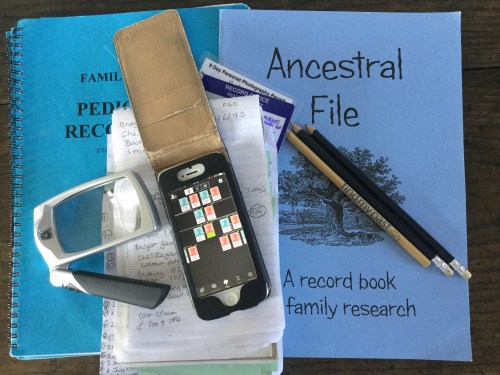
  2. Come prepared – plenty of sharpened pencils (pens not allowed), paper and a magnifier. Also your reader ticket, or appropriate signature/address identification to obtain one. Check if laptops etc are allowed; my preparation also includes checking online catalogues, which may not be the full range of holdings, and any visitor guides for particular archives advice;
  3. Don’t forget to bring your family tree/research notes. I have separate “Ancestral File” books for my maternal and paternal lines. I also have a (private) online tree available via the Ancestry app on my phone;
  4. Have a research plan. My plan includes preparing a list of documents I want to work through. I tend to focus on sources only available at the archives. An increasing number of collections are online, so for me looking at something readily available on Ancestry as a first step, for instance, may not necessarily be the best use of my time. I wouldn’t rule it out though as an online search may have produced ambiguous results;
  5. If possible order documents in advance because: a) they are not all necessarily held onsite; and b) if you have some documents ready for your arrival it saves valuable research time;
  6. Monitor the documents you have lined up throughout your visit to ensure you have a steady flow. Archives may not, for instance, bring down documents over the lunch period; or within a certain time before closing. There’s nothing worse than sitting twiddling your thumbs waiting with the only thing occupying your mind is counting wasted time! Although you could use the downtime to have a refreshment break (which may not necessarily be onsite), review your notes or revisit your research plan;
  7. If you want to take photographs consider which type of permit best suites your needs (eg day, year etc). But be aware not all documents are suitable for photographic reproduction – they may need to specialist equipment so need ordering. There may even be copyright restrictions;
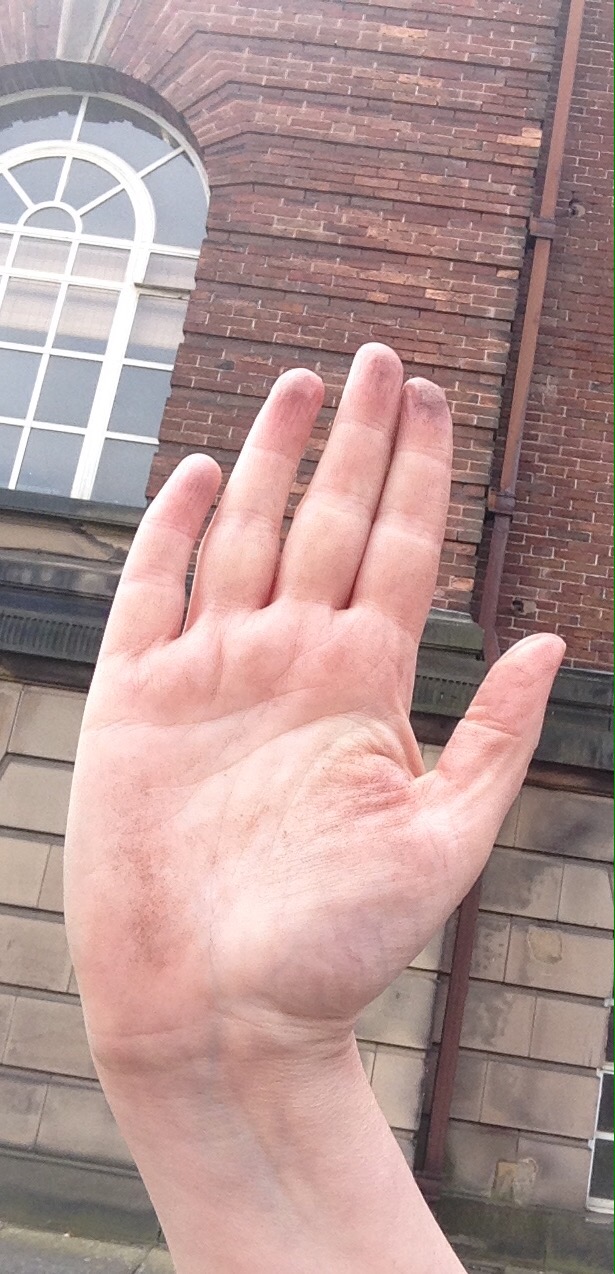
  8. Wear comfortable clothes, ones that you don’t mind getting dirty – be warned, old documents are dusty. 

    The “Archives Hands” Phenomenon

    Include a jumper/cardigan as some archives can be cold; 
  9. Check your notes and write them up as soon after your visit as possible. It’s easier to decipher “hieroglyphic” handwriting (well that’s what mine occasionally resembles) whilst it is fresh in your mind. If you’re not taking photographs read them through during your visit to make sure you’ve included key information; and
  10. Don’t be afraid to ask. Not everything is included in online catalogues. The staff have a wealth of knowledge, experience, know their collections, the geographical area and are used to dealing with all levels of expertise. Don’t go away from what might be a one-off visit thinking if only…..
Archive kit

My Archives Visit Kit – Photograph by Jane Roberts

Sources:


What a Difference a Year Can Make – Calendar Confusion

I spent last week recording data on my Family Historian software, ticking off another of my genealogy New Year Resolutions. It included a raft of 18th century parish register entries. Entering the information I was reminded of one of my early family history basic errors which I need to re-visit in my family tree file.  I recorded a swathe of entries under the wrong year.

In my first enthusiastic rush into ancestral research I totally failed to appreciate the calendar change of 1752, the amended start to the year and the implications of this. In fact in those early days I probably didn’t even know a calendar change occurred.

I couldn’t understand why some dates didn’t fit, with babies being baptised at the beginning of March 1747 to couples who married in April 1747. I thought I’d unearthed a family scandal, but there was no hint of illegitimacy in the normally brutally censorious registers.

I assumed the calendar back then was the same one in operation today, with 1 January marking the start of the year. How mistaken I was.

I subsequently discovered from around the 12th century in England the year started on 25 March, Lady Day. So, for example, the day after 24 March 1747 was 25 March 1748.

Not until 1752 did the year start on 1 January, as a result of the 1750 Calendar Act and the 1751 amended Act. Also known as Chesterfield’s Act, it brought the start of the new year into line with England’s European neighbours and ones even closer to home: Scotland adopted 1 January as the official start of the year from 1600.img_0595

It meant that in England 1751 was a short year to take account of the change. It started on 25 March and ended on 31 December.

1752 also had a reduced number of days, as this Act moved England from the Julian to the Gregorian calendar used by many European countries. It meant September 1752 was reduced to 19 days, with 2nd September being followed by 14th September. These lost 11 days were a result of a correction to an anomaly in the Julian calendar.

Chesterfield’s Calendar Act Extract

The Christian world throughout the Middle Ages used the Julian calendar. Based on a 365 day year with an extra day every fourth year it was devised to to ensure seasonal stability in an agrarian society.

But here’s the simplified scientific bit. The 365 ¼ days of the Julian calendar cycle did not accurately reflect the time taken by the earth to rotate the sun. It was too slow. Only fractionally. Less than 11 minutes annually. But it made the calendar too long. Another way of looking at it is there were too many Leap Years. However the cumulative effect of this discrepancy meant by the 16th century the year was 10 days ahead of where it should have been relative to the earth’s cycle. Significantly, apart from any agricultural seasonal impacts and the affect on navigation, for the Catholic Church there were implications for Easter.

Corrective action was needed. Enter Pope Gregory XIII who in 1582 enacted a papal bull introducing the new calendar, named the Gregorian calendar. This omitted 10 days to bring things back into line with the earth’s solar cycle. It also included a mechanism around Leap Years to account for the actual length of a year in future. From now on Leap Years only occurred in the last year of the century if their first two digits could be divided by four (ie/ only in 1600 and 2000).

Religious politics now came into play. Catholic states generally fell into line using the new calendar. Protestant countries such as Britain and Ireland and its colonies (such as the USA) resisted – they did not wish to follow any Papal edict. But gradually, given its obvious agricultural, commercial, legal and international relationship benefits (for instance by the 18th century what was 20 June in France would be 9 June in England), uptake increased.

By the time England came round to accepting that the benefits of the Gregorian calendar outweighed any religious reluctance, it was 11 days out of sync. Hence the missing 11 September days in 1752.

img_0596

But even with the 1751 Act things aren’t straightforward as far as the New Year is concerned. I’ll use some West Yorkshire parishes associated with my family history to illustrate this.

Leeds Parish Church complied with the Act and entries on 1 January displayed the New Style year of 1752. This also applied to Kirkburton All Hallows and Mirfield St Mary’s.

However it wasn’t universal. Some parishes were behind the pace.

One such example is St Peter’s Birstall. The combined baptism, marriage and burial register acknowledged the September change. An entry at the beginning of September 1752 stated:

September hath 19 days this year

Then, after a baptism entry on 2 September:

According to an Act of Parliament passed in 24th year of his Majesty’s Reign in the year of our Lord 1751 the Old Style ceases here and the new takes place and consequently the next Day which in the old account would have been the 3rd is now to be called the 14th so that all the intermediate Days from the 2nd to the 14th are omitted or rather annihilated this year and the month contains no more than 19th Days as the Title at the Head expresses”.

Birstall St Peter’s Parish Register Explanation for September 1752 Calendar Changes

No similar note mentioning the New Style calendar affected the start date of the year. This part of the Act wasn’t implemented on 1 January 1752 in Birstall. The New Year in this parish register did not start until Lady Day in March. In other words no difference.

1 January 1753 came and there was a tiny entry, a mere nod at the change. Almost imperceptibly tucked away in miniscule script. Certainly no fanfare announcement along the lines of the September change.

Birstall St Peter’s Parish Register Low-Key Entry for January 1753

Contrast that with the shouty heading marking the first post-Lady Day christening of 1753. By 1754 though they were fully towing the line.

Birstall St Peter’s Parish Register Fanfare Entry Post-Lady Day 1753

The neighbouring Parish of Batley similarly adopted the New Style from 1 January 1753 rather than 1752. The register does briefly explain the September 1752 issue, but without the pointed remarks about “annihilation” of days.

So some parishes implemented the Act with the year starting on 1 January from 1752. And from my unscientific example others didn’t adopt the change until 1 January 1753, seemingly grudgingly. Others, however, even went beyond this.

Wakefield All Saints’ register retained the Old Style up up to and including 1755, with the change only made from 1756. There may be examples of other variations if I delve deeper. And there may even be instances of it pre-January 1752, as acknowledgement of the difference did occur in documents prior to the official change.

To sum up even knowing the year change was supposed to take place on 1 January 1752, it still pays to check the register if at all possible to ensure the switch did indeed take place on the prescribed date. And accurately record the year to indicate whether the date is Old Style (O.S.) pre-calendar change or New Style (N.S.) post-change. I use a “double dating” format for those 1 January to 24 March days prior to the calendar change. So, for example, I record 23 March 1747 O.S. as  23 March 1747/48. This indicates the event took place in 1747 according to the O.S. calendar, but 1748 in the N.S.

After all that year could make a big difference to your family tree and subsequent research.

Sadly (?) I don’t think I’ll progress my family history to pre-12th century to concern myself with any calendar in use then.

Footnote:
I’m not going as far as adding in the “annihilated” 11 days to my Family Historian package à la George Washington’s Birthday though! Born on 11 February 1731 according to the then-used Julian calendar, with the adoption of the Gregorian calendar the corrected date celebrated is 22 February 1732. But that this may have happened is worth noting too.

Obsolete Mayo Family History Website: Wayback Machine to the Rescue

In a couple of my blog posts (My County Mayo Family and The National Library of Ireland Catholic Parish Registers Website and Parish Registers: Brick Wall Breakers and Mystery Creators) I’ve referred to one of my much loved, and missed, websites. It was a County Mayo baptism and marriage transcript site, EastMayo.org, launched in 2005. Mainly using LDS films, it’s aim was to provide a free facility to researchers of family history in East Mayo. It concentrated on “that area of County Mayo encompassed by the Roscommon border and the towns of Charlestown, Boholo, Swinford, Kiltimagh, Knock, Claremorris and Ballindine”.  

 The transcripts included:

  • Aghamore 1864-1883 and Knock 1869-1905 Baptisms; 
  • Aghamore Marriages 1864-1882; 
  • Claremorris Civil Registrations 1872-1875; 
  • Claremorris Marriages 1806-1890 and Baptisms 1835-1912; 
  • Kilconduff Marriages 1846-1878; 
  • Kilmovee Baptisms 1854-1910 and 1881-1913; 
  • Kilmovee Marriages; 
  • Kilmovee Marriages Out of Parish; 
  • Knock Marriages 1883-1943 

With generations of my family from the Catholic Parish of Kilmovee, this site was a Godsend. I was disappointed when it disappeared. Although in 2015 the National Library of Ireland launched its free Catholic Parish Register website plugging some of the gap, the EastMayo.org had a broader date range for its limited number of Parishes.   

And there were some extras such as the fabulous “Kilmovee Marriages Out of Parish” transcriptions. Basically, if someone married out of Parish, the priest in the Parish the marriage took place contacted the priest in the person’s baptismal Parish informing them. 

I’ve seen something similar in the Batley St Mary’s registers. These contained such letters slipped between the pages. Indeed in this Parish, the priests went so far as to annotate the person’s baptismal entry with their subsequent marriage details, whether the marriage took place in or out of Parish.  

The Kilmovee transcripts covered marriages in the first part of the 20th Century, with marriages taking place within Ireland and beyond. Although only a snapshot of around 30 years, the Batley marriages of my grandpa (John Callaghan) and his brother (Martin Callaghan) are captured in them. 

An example of the global range of these marriages is seen in the initial transcriptions. They included former Kilmovee parishioners marrying as far afield as Glasgow, Batley, Orange – New York, Stockport, Congleton, Manchester, Doncaster, Accrington, Huddersfield, Charlestown, St Helens, Jersey City – USA and Silver Falls, Canada.  

Information on these Out of Parish marriages varied, but could contain: 

  • spouse; 
  • baptismal date (a bit of creativity here – most of the dates given seem to be approximate); 
  • parental details, with sometimes the mother’s maiden name; 
  • date and place of marriage (church and location);
  • witnesses; 
  • officiating priest; 
  • age; and  
  • if the person is widowed. 

The information provided linked your ancestor to a Parish. It also enabled you to track back further, for example by looking at the baptism transcripts.  

Yes, there were acknowledged transcription difficulties, but it was a wonderful resource.  

An updated EastMayo.org site domain name still exists with links to Irish-related websites, though it is not the original site with all that wonderfully name-rich information. But all is not lost. The original, as it stood between 2006-2011, can still be accessed via the Internet Archive Wayback Machine. 

And I’ll end with another really useful County Mayo website, which can be found here. Besides current day information, including where to stay and things to do, there is information about the area’s history, geography and culture generally as well as that of individual towns and villages. There is also a message board which may be helpful for those with Mayo roots.

I Left it too Late: Batley’s Greenhill Mills Destroyed

Thank goodness no-one died, but even so I am feeling quite emotional about this. On 14 January a massive fire ripped through Greenhill Mills, Grange Road, Batley razing it to the ground.  

Apart for the sadness for those who will have lost their jobs, it was a place very much associated with an ancestor, Jesse Hill, who died in WW1: the ancestor I have spent most time researching. 

That connection has now gone, wiped out in a matter of hours. 

The firm Jesse Hill worked for, Wrigley & Parker, went into liquidation in the late 1920’s and the mill was sold. But it was still the same building. 

The mill was only down the road from me. I kept meaning to photograph it but I never got round to it. And I never made the effort to see inside, walk on the wood floors, touch the stonework. I know that sounds odd, perhaps it’s a family historian thing. 

Unlike many other places connected with my family history, because it was on my doorstop I didn’t have to make a special trip. It was there, I’d do it one day, no rush. A Victorian structure, still being used. It wasn’t like it would disappear overnight…..or so I thought.  

Following the inferno of 14 January, that’s exactly what happened.   

Not sparing the time to take that handful of photographs to record Jesse Hill’s workplace is something I now very much regret. As is never seeing the interior. It’s example of how we take for granted our local and family history.  

So a lesson learned the hard way. Don’t put off the chance to visit a family history connected location; don’t put off talking to family to record memories. Because one day you’ll wake up and realise that chance has gone. 

This is the only photo I took – too late.  

The remains of Greenhill Mills

 
Neither does Jesse Hill’s Spurr Street home exist. 

Spurr Street, Batley

Top Ten Genealogy/Family History Books by a Self-Confessed Bookworm

Tsundoku” – the Japanese word for buying books and letting them pile up unread. Yes I’m guilty of that. But I also have piles of read books because I don’t have enough bookshelf space, despite buying yet another one last year to accommodate my burgeoning genealogy and WW1 book collection. I return to these books time and time again for pleasure and my research (interchangeable, because I get enjoyment from research).   

Part of my Book Collection

 Trying to narrow it down to my top ten go-to books has been a really difficult decision because it depends on which aspect of research I’m concentrating. Some such as the handy little Gibson Guides covering topics from Militia Lists, to Hearth Tax and Probate Jurisdictions are invaluable but very specific. I wanted a broader range of topics in my selection.

So in the end I’ve gone for a mixture of general reference and more specialised books, including some tailored to my own family history interests. Here they are, in no particular order: 

  • Ancestral Trails: The Complete Guide to British Genealogy and Family History” – Mark Herber. Exactly as described in the title. It’s my definitive reference book, written in a easy-to-read style and jam-packed with information. A book I couldn’t do without.
  • The Dictionary of Genealogy” – Terrick V H FitzHugh. An alphabetical glossary of terms. A quick reference source to dip into.
  • Tracing your Ancestors in the National Archives: The Website and Beyond” – Amanda Bevan. An in-depth guide which clearly set outs and explains The National Archives series of records. It is indeed “the biggest and best guide to The National Archives”  
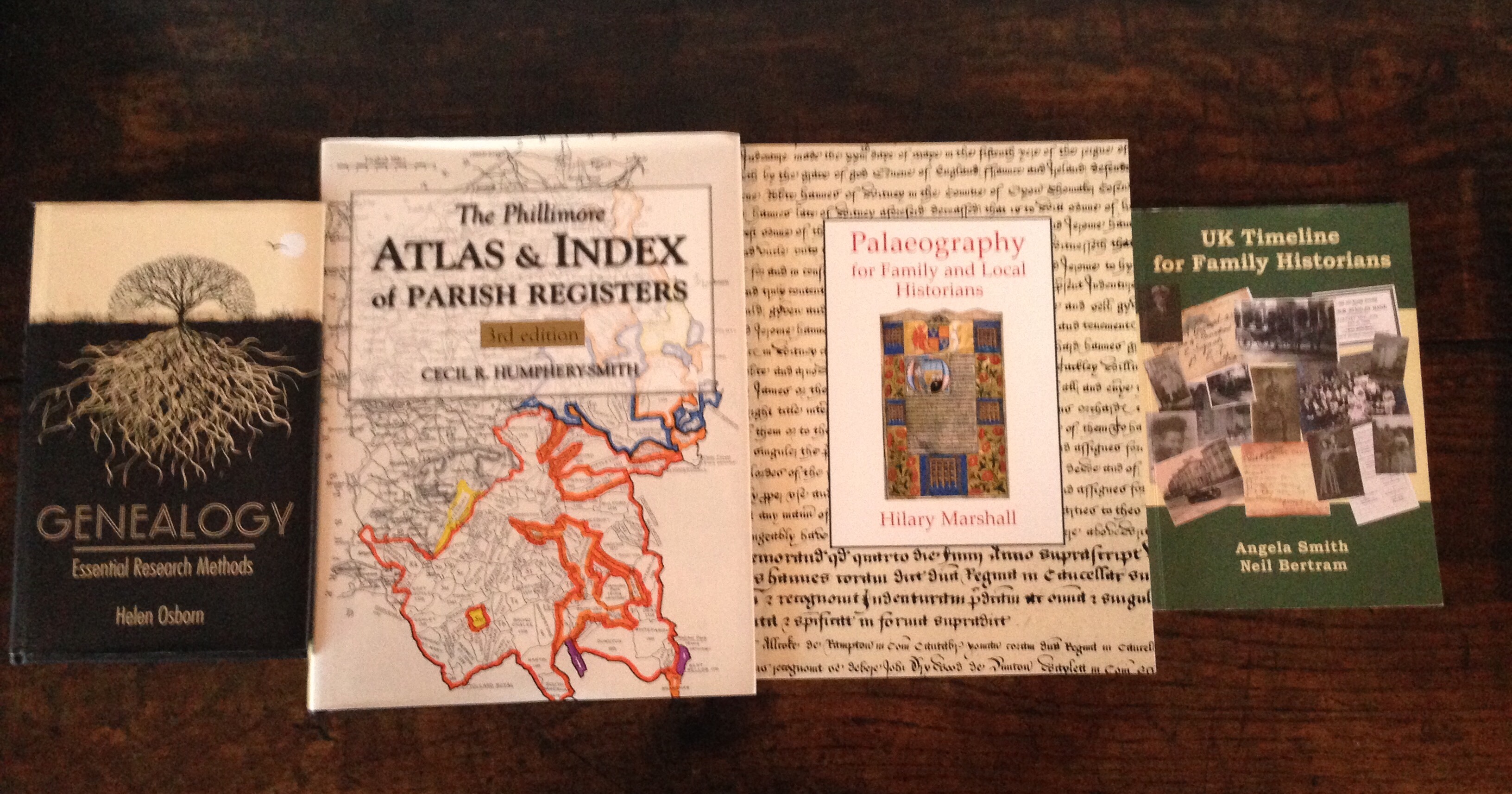
  • The Phillimore Atlas and Index of Parish Registers” – edited by Cecil R Humphrey-Smith. Although this might not be for everyone because the information is available on the Internet, I find it invaluable having everything about pre-1832 parishes at county-level in one place, juxtaposed with the topographical county map. There is a comprehensive index of the parishes complete with dates of registers. The Ecclesiastical and Peculiar Jurisdictions are also included. It covers England, Scotland and Wales. Though for those with poor eyesight, a magnifying glass to see the maps in detail is advisable!
  • UK Timeline for Family Historians” – Angela Smith & Neil Bertram. Provides a timeline for family historians setting genealogical events and resources into a wider historical context. It’s not exhaustive but it is a really useful quick, basic reference book.
  • Genealogy – Essential Research Methods” – Helen Osborn. This is a different type of book. It is a detailed, well laid out reference for problem-solving research strategies to help break down brick walls. Some excellent advice on research methodology.
  • Palaeography for Family and Local Historians” – Hilary Marshall. I think it is essential to have a book about palaeography, abbreviations and Latin to help with deciphering old handwriting and language. I have a number all of which I use to varying degrees, so it was difficult to chose one. But in the end I went for this comprehensive book. It has the standard characteristics of letters, abbreviations and a Latin vocabulary. But it also includes copies of original documents accompanied by the transcript, translation, a description and any notable features of the script. So everything in one book.  
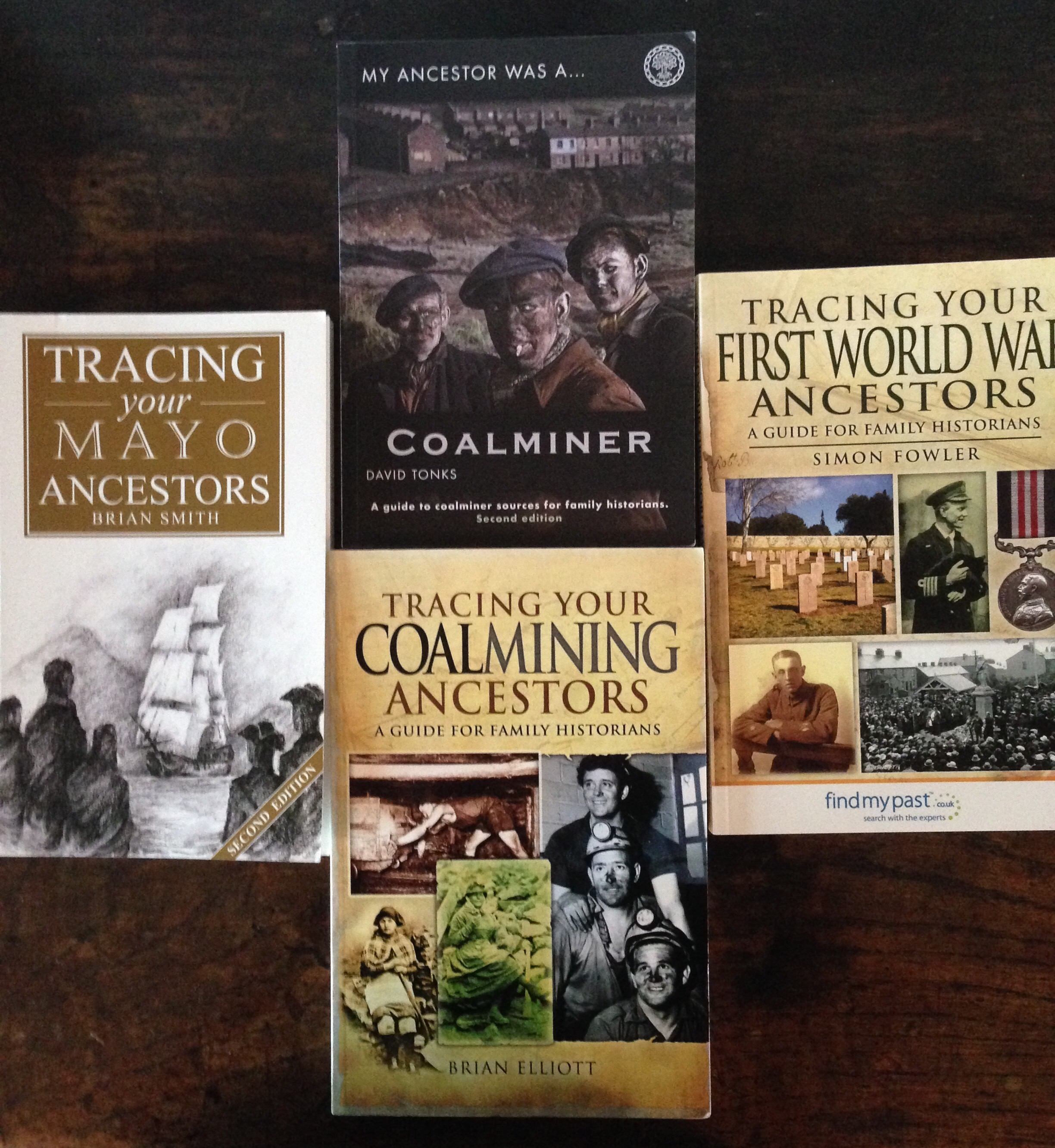
  • Tracing your Mayo Ancestors” – Brian Smith. I have a significant contingent of Irish ancestors. I agonised about which Irish ancestry book to include in my list. I was torn between this and John Grenham’s “Tracing Your Irish Ancestors” covering the whole of the country. But as, so far, all my ancestors are from County Mayo I went for a book focusing purely on the records for this County. There are other County books in this series of Flyleaf Press publications.
  • My Ancestor was a Coalminer: A Guide to Coalminer Sources for Family Historians”  – David Tonks. I love the SoG “My Ancestor was A…..” series of books, alongside Pen & Sword’s “Tracing Your Ancestor” series. My ancestors were predominantly coalminers, so for me a coal-mining family history research book is essential. I’ve included this one for the comprehensive pointer to various coal-mining sources. But I could have equally chosen Pen & Sword’s very informative and generally more detailed “Tracing Your Coalmining Ancestors: A Guide for Family Historians” by Brian Elliott (I’ve cheated though and  included this book in my final picture). However the deciding factor was my final choice, another Pen & Sword publication.
  • Tracing Your First World War Ancestors” – Simon Fowler. First World War ancestry is another one of my particular interests, having researched the 76 men on my local church War Memorial, St Mary of the Angels RC Church, Batley. I have a number of books about military research. But this is a good basic introduction covering the full range of those involved in the conflict, including women and civilians at war.  

To keep a track of my books I keep a A-Z by author index of them all. I make sure I take to any family history fairs and events so, in theory, I won’t duplicate purchases; and even if I can’t immediately spot a book on my over-crowded bookshelves, I know it’s there somewhere!

If you have tips for essential family history books please feel free to share them. It’s great to hear about key books, whether you are beginner to family history research or more experienced.

Who Do You Think You Are? Live 2016 – Workshops

I’m pushing on with my Family History New Year’s Resolutions, as described on 1 January. Today’s task has been around keeping up with the latest developments and building upon my knowledge.

I booked my ticket to “Who Do You Think You Are? Live 2016” late last year. Today I checked out the Workshop programme. Last year I failed to book these in advance. As a result the ones I wanted to attend were full. Although I was able to hang around the periphery and eavesdrop, it wasn’t quite the same as having a seat. This was my blog post based on my view of the 2015 event.

Irish Catholic Records Workshop in 2015

The programme is more or less finalised, and the workshops available to pre-book. Lots of interesting talks around a full range of topics, from Irish ancestry, copyright and War Records, to brick walls, maps and pre 1837 research. There are the inevitable workshop clashes. But I’ve deliberated and finally made my selection. These are based around a combination of my interests and areas I want to strengthen.

The full programme is here

My choices are:

  • “The Luck of the Irish” – Irish Census and Census Substitutes Might Lead You to Your Family in Ireland Prior to 1864 Registration – Grant Edward Curley (10.15)
  • Research Before 1837: Church Records on and Off Line – Else Churchill (11.15)
  • Writing Your Family History – Gill Blanchard (12.15)
  • What They Don’t Tell You About Archives – Simon Fowler (14.15)
  • Tracing a 16th and 17th Century Family Tree – Celia Heritage (15.15)
  • Copyright and Family History – Margaret Haig (16.15)


Update:
I have now received a follow up email from “WDYTYA? Live” informing me that the workshop schedule has changed since I made my booking. The “Writing Your Family History” workshop has moved to Friday’s show, so I will have to miss that one.

And “Research Before 1837” has moved to later in the day on Saturday….and it now clashes with the “Copyright and Family History” one. I’m now agonising over which one to attend. It may be that my husband will find himself attending the latter, tasked with note-taking: as a journalist, but not a family historian, it is the one he will probably get the most from.

I now have a gap at 11.15, so will probably go for Chris Baker’s  “The Fog of War: Breaking Through the Records of Soldiers of 1914-1918″, one of the talks I toyed with when making my original decision. My husband has booked for that one – so I will ask him to consider donating his place to me!

Looking at “The Education Zone” offerings which have now largely been fleshed out since my booking, Andrew Robertshaw’s “The Story of the Somme” appeals. Running between 13.50-14.10 I can probably squeeze that one in (just). But the other one I’m interested in, “Using Findmypast to Unlock Your Irish Family History“, by Brian Donovan clashes with the Archives talk.

The fact there are so many talks I’m interested in is testimony to the continued relevance of the show to family history researchers.

And the event has challenged my timetabling to the max. I only hope I haven’t gone too far with workshop overload….and I can find time to explore the various exhibitors.

I am also hoping that the surgery I’m now scheduled for will be in the week after the show. Otherwise all my planning will be in vain.


Family History 2016: My Genealogy New Year’s Resolutions

That time of the year again. Time to look at my genealogy New Year’s Resolutions. I’m not into setting myself up for failure with overly-ambitious goals. So nothing too grand. More a case of “back to basics”. Some targets are more challenging than others, but all are attainable; and I hope that re-establishing good habits will ultimately bear fruit with my family history research.

I’ve culled my Resolutions to six. Weird number I know. But when setting work-linked objectives, which is essentially what these Resolutions are, sticking to a small manageable number works best for me. It encourages focus.

So this is my 2016 line-up (or walk of shame):

Regular Data Back-Ups
I’ve so much information stored on my ageing laptop. From my Family Historian tree to genealogy coursework; from research notes to information downloads such as burial registers and directories; not to mention scanned family and location photos and the final versions of my St Mary’s War Memorial and Hill Family History book. So, on the first of each month, I’m going to commit to a regular data back-up. A boring task which is all too easy to skip, as I know only too well; and before you know it weeks can easily become months between back-ups, and the consequences of a laptop failure after such a time-lapse doesn’t bear thinking about. This objective fits neatly into the SMART acronym.

  • Specific;
  • Measurable;
  • Achievable;
  • Realistic; and
  • Time-bound

Record Keeping
I love researching. It’s the thrill of putting all the pieces of a family puzzle together. What I’m not too hot with is the day-to-day routine. Meticulously recording my searches (failures as well as finds), updating my Family Historian programme, recording sources, filing documents etc. All this is such a chore in comparison to finding that elusive relative. I do it when researching for others because it is crucial work; but over the past couple of years I seem to have I have developed a blind spot with my own family history research. I’ve a stack of documents to record and notes to sort – but I always manage to find an excuse to put it off. No more! I will get them up to date in the first quarter of the year, and from then on record and file as I go along.….something I always used to do.

Get a Grip of Subscriptions
Over the years I’ve accumulated various subscriptions including magazines, Family and Local History Societies and websites. I’m now loosing track of what I’ve got, the costs and the renewal dates. It also means I’m not making the best use of my subscriptions. So this month I’m going to make a list of them all, along with the renewal dates. Then over the course of the year I’ll monitor my usage, evaluate them and decide which ones to continue with. Hopefully by doing this I’ll also keep up to date with what is out there, make fuller use of my subscriptions and become more involved.

A Selection of my Family History Subscriptions

A Selection of my Family History Subscriptions

Keep Informed about Latest Family History Developments
I’m going to ensure I set aside some time each week to keep up to date with family history developments in an organised way. As a start I do have several “free” hours each week travelling too and from work, so I can make far better use of this “dead” time to catch up with the latest news. This will comprise a mixture of platforms including:

  • making sure I do read those family history magazine and online genealogy newsletters I subscribe to;
  • keeping up with information from genealogy websites and companies;
  • continuing to broaden my knowledge by reading genealogy/family history books (at least one a month);
  • regularly reviewing what courses, talks and webinars are out there. After participating in The National Archives 1939 webinar, I’m going to sign up for other similar learning events from a mixture of sources (a minimum of six in the year); and
  • attending at least two family history fairs during the year

Get Back to my own Family History Research
This could be the real tricky one. Particularly over the last year or so I’ve found I have spent less and less time on my own personal research and more and more time researching for others. There have also been family illness issues which have intervened. Don’t get me wrong, I love researching for others. But I really do want to make some time to return to my own roots. I never did get to do my mum’s Family History book; neither did I make any progress with my husband’s Staffordshire and Shropshire tree. There are also lots of other loose ends I want to pursue. So I will need to commit time to my own research. That means my next big project will be the Callaghan/Rhodes Family History book. I will plan the outline by autumn, and make a start on writing it towards the end of 2016. I also want to move on with my husbands tree – I’ve lots of certificates lined up to buy, but I may still delay here in the hope that the cost does come down in 2016!

DNA
In 2015 I embarked on my genetic genealogy journey. In 2016 I aim to upload my data to GEDmatch, dig deeper into the findings and respond to contacts from others within two weeks. The end goal is to generally get more from the results than I have to date. A challenge to a self-confessed technophobe!

So New Year, clean slate. It will be interesting to see if I’ve managed to stick to these when 2016 draws to a close. Hopefully putting them into the public domain is another incentive for me to succeed with them!

Right, I’m off to do my data back-up.

Family History Fair Tips for Beginners

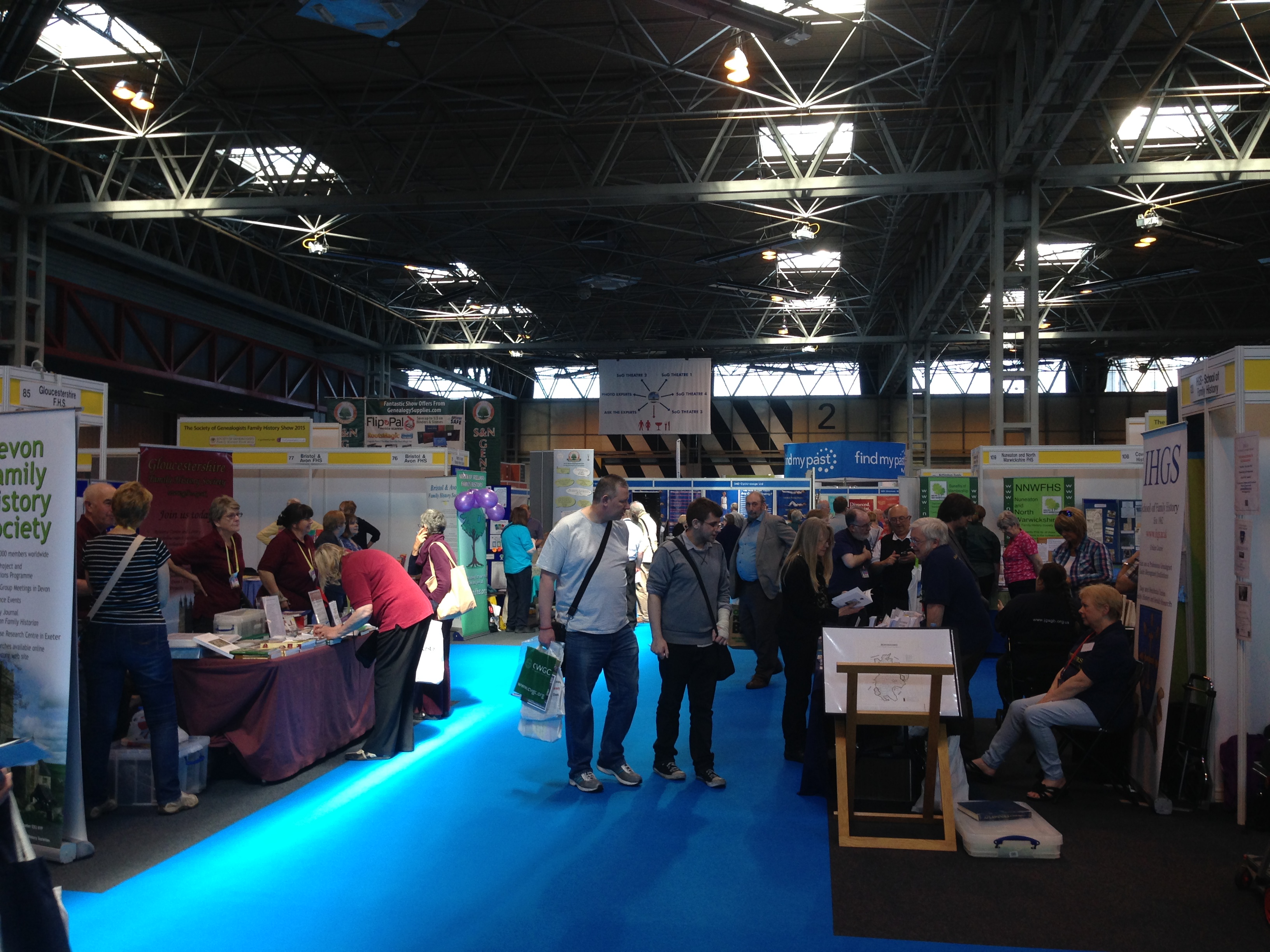
I attended “Who Do You Think You Are? Live 2015” staged this year at the NEC in Birmingham. It was my first ever visit to this annual event, although I have been to a number of local family history fairs in the past. Although it probably does not suit all, for me the new location was far more easily accessible than London, the previous venue. I had a fantastic time. It was a lovely, relaxed atmosphere. I met lots of fabulous people. And I came away with a wealth of new information and tips which hopefully will lead to the demolition of some of those family tree “brick walls”.  I also seem to have committed to researching my husband’s tree too as a result of my visit, from a geographical area outside my sphere of knowledge. So I made new contacts to facilitate that.

With lots of family history fairs and events coming up in the next few weeks such as the “Family History Fair and Lecture Day” at Pudsey on 25 April 2015 and the “Yorkshire Family History Fair” in York on 27 June 2015, I thought I would share my 10 tips for those new to going to such events. These are aimed at beginners, they are not exhaustive and some may be more applicable than others, depending on the type of event.

Tip 1: Before the event familiarise yourself with the exhibitors. For big events such as “Who Do You Think You Are? Live” and the “Yorkshire Family History Fair” the cast list can be overwhelming. I make a list of those stands and tables I definitely want to visit as, on the day, it can be all too easy to get caught up in the atmosphere and miss out someone, only realise too late when you are on your way home. I also take a map with those tables highlighted. Nevertheless the joy of these events is the opportunity to browse and see what is available. You never know what you might stumble across which may prove relevant/interesting for your research. For me this time the unexpected interest was DNA, which seems to be the latest big thing in genealogy.

Who Do You Think You Are? Live 2015

Who Do You Think You Are? Live 2015

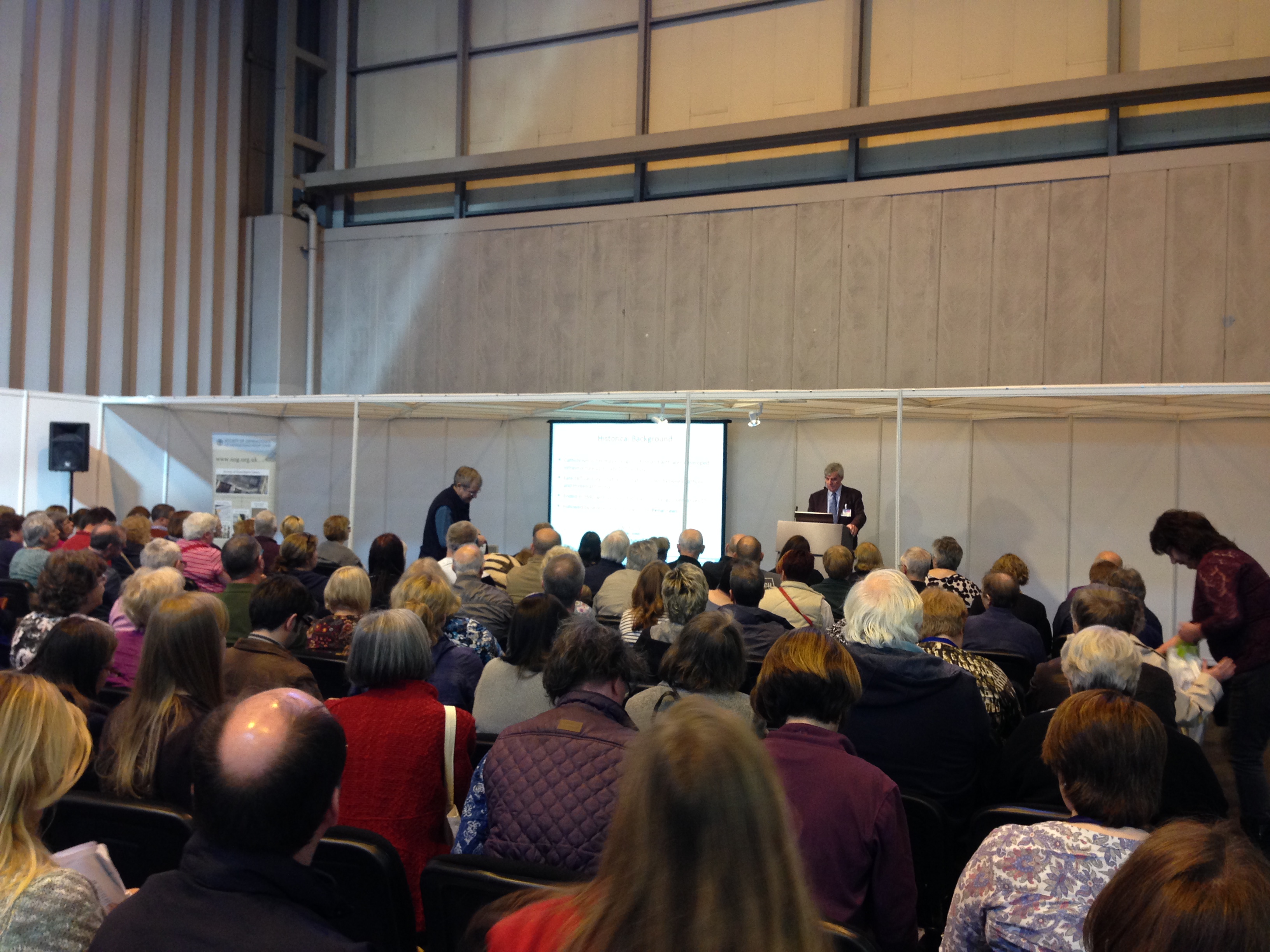
Tip 2: Make a note of the workshops you are interested in and, if possible, pre-book them. This was my failing at “Who Do You Think You Are? Live”.  When I finally got round to checking I discovered the workshops I really wanted to attend were all booked up at least the week before the event. So if you are really keen on a particular talk book it as early as possible. All was not lost for me as there was the opportunity to hover on the periphery of the unenclosed workshops. But it was not quite the same as having a seat in the designated area.

Irish Catholic Records Workshop

Irish Catholic Records Workshop

Tip 3: Take plenty of pens and a notebook. Invaluable for making notes of key workshop points as well as any general tips or contact details you pick up whilst there.

Tip 4: Take your ancestor details with you. It is all too easy on the day to forget exact dates and locations for them. I have my full tree available on a Phone App. But I make sure I have a hard paper copy too, in case reception is dodgy or my battery dies and there are no charging facilities. A number of Family History Societies have A4 printed family tree “Ancestral File” books available to purchase where you can record your research. These are perfect not only for Family History Fairs but also for record office visits.

Tip 5: Keep a list of books you own and take it with you. I have a bookcase full of genealogy reference and general interest books, so it is all too easy to forget what exactly I have on those creaking shelves.  To counteract this I also have a small pocket book listing in alphabetical author order all my books. That way when I go to one of these events and see a book I think looks interesting I can check to make sure it is not one I already own. It does take organisation and discipline in remembering to add each new purchase to the list but it can end up saving a lot of money in the long run on duplicates! This extends to Family History Society publications such as parish register indexes, MIs and even the Alan Godfrey Map Series. Make sure you know what you already own to avoid spur of the moment duplicate buys.

Tip 6: If you have hit any ancestral “brick walls” take what information you have with you. There are lots of experts on hand to help. Some of these may be drop-in sessions; others you may have to pre-book a slot. But it is well worth getting advice which may help you progress your research. I tend to take photocopies of certificates etc just in case I end up losing them. But for photographs it is always best to take the original.

Tip 7: Talk to people. It is amazing how friendly and knowledgeable everyone is and how much you can learn. It is the joy of this type of event.

Tip 8: Have a set budget. There are so many tempting things on offer at these events it can be all too easy to get carried away. Products range from books to CDs, joining societies, magazine subscriptions, software, genealogy supplies, courses and even DNA tests. I have a set budget before I go, a mixture of cash and card. I try to stick to it…..although it can be difficult!

Tip 9:  Pace yourself. It is all too tempting to rush round all day trying to cram in as much as possible, resulting in information overload, headache and exhaustion. Take time out for a coffee and a bite to eat, a chance to chat to people, re-group, evaluate what you have learned and still have left to do and importantly re-charge those batteries (and I’m not talking my phone here). The day will be an all the better experience for it.

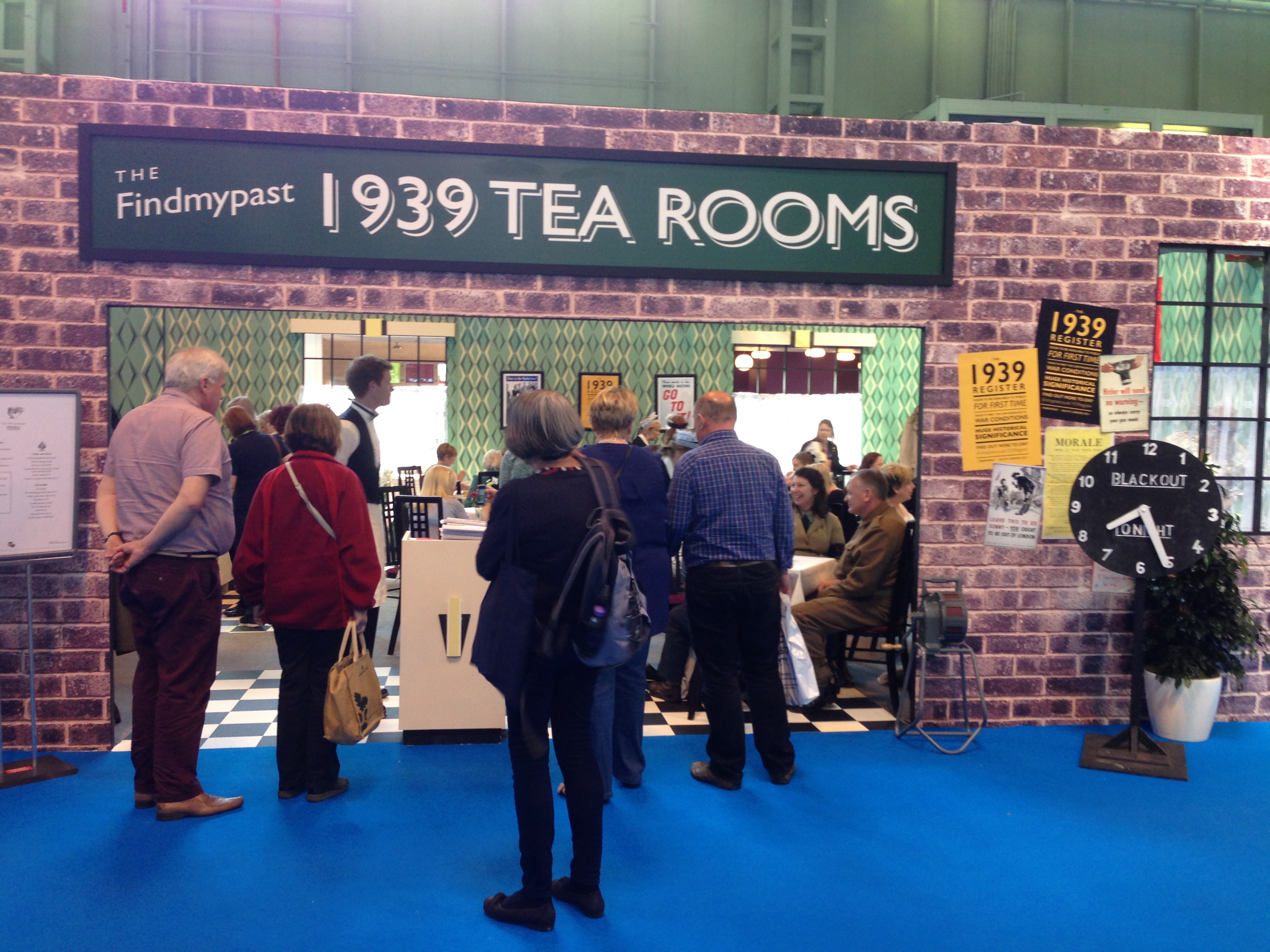
Find My Past 1939 Team Rooms

Find My Past 1939 Team Rooms

Tip 10: Finally take a lightweight bag and wear a pair of comfortable shoes – you will certainly cover some ground during the course of the day, especially at the bigger events!  And you will come away with far more leaflets, books etc than you started the day with.

I hope this is helpful to those new to Family History Fairs. Any other tips please feel free to share.

A useful events list can be found at http://geneva.weald.org.uk/

Jane