Category Archives: Family History

Child Employment in the Silk Industry 1815-1871 – Part 3

This is the third part of my look at child workers in the silk industry between 1815-1871. Earlier posts (Part 1) and (Part 2) looked at the background of the industry, numbers involved, type of work undertaken, children’s ages, their working conditions and health. In this post I will focus on the Factory Acts affecting child employment in the silk industry in this period.

How far did the Factory Acts effect the silk industry?
Although they included the silk industry, the most striking thing when examining the 1833, 1844 and 1847 Factory Acts is some of the most important clauses, dealing with hours and education, did not apply to the industry.

The first Act which included provisions concerning the silk industry was that of 1833, which resulted from the recommendations of the Parliamentary Select Committee and Royal Commission of 1833.

This Act forbade the night employment of under 18’s in a number of textile factories, including silk. Neither was the 13-18 age group to work for more than 12 hours a day or 69 a week. No child was to be employed in mills regulated by the Act until they reached the age of nine….except silk mills which could engage children regardless of age. It regulated the employment of children under 13 to nine hours a day, or 48 in a week. But in silk mills children under 13 could work 10 hours and the 48 hour rule did not apply either. The Act included overtime provisions and the circumstances in which it could be used. It also provided for one and a half hours for meals and it required children under 13 who came within the 48 hour rule to receive elementary schooling for two hours each day. It also established a minimal factory inspectorate to ensure compliance with these laws.

Children employed in silk mills were therefore only afforded limited protection by the 1833 Act, for not only was it legal to work them for 10 hours a day, but they were outside the scope of the education clauses, which were limited to those whose labour was restricted to 48 hours a week.

This Act, though firmly establishing the right for government to intervene where child employment was concerned, had a number of defects because of its novel and experimental nature. Thus Leonard Horner, one of the Inspectors of Factories established under this Act, wrote that it “has not done nearly all the good that was intended. The failures have mainly arisen from the defects in the law itself; not in the principles it lays down, but in the machinery which was constructed for the purpose of carrying the principle into operation….and after it was set into work, much of it was found to have been ill contrived, and some positively so bad that it obstructed, and to a great degree prevented, the attainment of this object.

To begin with the Act was not enforced effectively because the inspectors lacked experience in factory employment and tended to work with the employers. Other obstacles included the difficulties detecting overworking of protected persons with the 15 hour limit of the working day. Children under 13 were not specifically included in the mealtime provisions, so it was legal to employ them without a break. Above 13 they were put to work cleaning machinery during their meal breaks. Superintendents only had restricted entry to the mills, while factory owners knew when the Inspector was due so had time to put their factories in order.

The effective prosecution of the Factory Acts was not without controversy. The generally accepted view is magistrates, due to their manufacturing interests, were unwilling to convict and this encouraged factory owners to flout the law. However, an interesting theory to the contrary is put forward by A.E. Peacock in which he uses prosecution reports in Lancashire and the West Riding between 1834-55 to argue the contrary. He said: “The rates of conviction achieved would have been noteworthy in any field of legislation, but in one as new and contentious as factory working, and involving measures directed against the owners of property, they were quite remarkable.”

What effect did the 1833 Factory Act have on child employment in the silk industry?
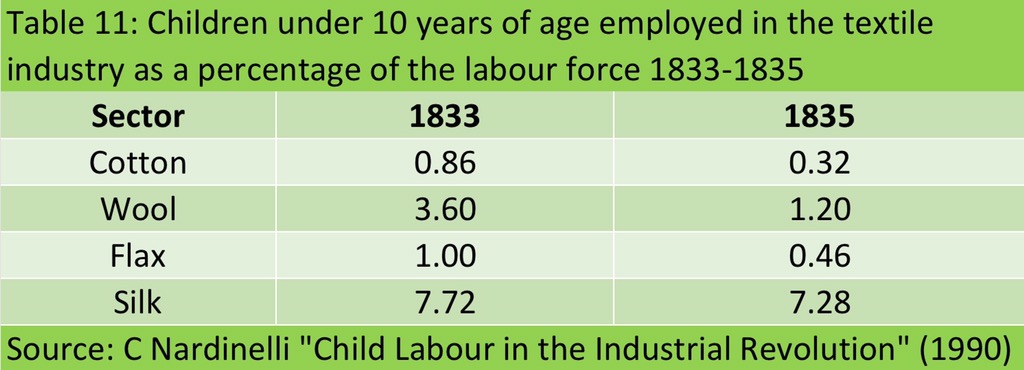
Table 10 shows although a decline of children employed in silk factories took place between 1835-1838, it was only 4.9% and this could easily be attributed to the depression in the silk industry at the time.Furthermore, while children in other factories were being dismissed as age and hours provisions came into effect, these did not apply to such an extent to the silk industry, so children remained in employment. I have used a piece of later research, Table 11, to illustrate this.The problems of enforcing the 1833 Factory Act led to the 1844 Act. This included the silk industry to a slightly greater extent than the previous Act. For, besides stricter regulations governing the recovery of lost time, and tighter provision on the subject of meals, the Act stated that silk mills were to come under the same regulations as other textile factories.

However there was a crucial step back modification. Whereas the Act limited the hours worked by children to six and a half per day, with three hours’ schooling, and set a maximum 12-hour day for young people between 13 and 18, children over the age of 11 engaged in winding and throwing raw silk were allowed to work ten hours a day. And these children were exempt from the schooling clauses which instigated the half time system. Because winding and throwing raw silk occupied the greatest number of children involved in the industry, this Act can once again be said to have had no great effect on child employment in this industry. The drop which did occur, 7.1% between 1838-1847, would potentially be accounted for the drop generally in the spun and waste silk branch.

These provisions were retained in the 1847 Factory Act, commonly known as the Ten Hours Act, and amending Acts of 1850 and 1853. These essentially dealt with the working hours of women and young persons aged 13-18 in textiles mills. The 1847 Act reduced the hours of 13-18 year olds and women to ten per day. The 1850 Act raised the hours for women and these young people to 10.5. However, nothing was done with reference to those children over the age of 11 in the silk industry as illustrated in Section 7 of the 1850 amending Act. This repeated the provision that 11 year old children engaged solely in winding and throwing raw silk could be employed in all respects as young persons, that is 10.5 hours a day, providing they had a surgical certificate to say they had completed their eleventh year. Under 11’s had to attend school under the half time system for three hours a day.

But the loopholes did cause consternation to teachers and silk spinning mill owners, as shown in the 1866. John Chadwick said those who wind hard silk “may employ children over 11 for 10.5 hours, but if we use power here for winding soft silk we could not employ them so, unless they were 13 years old.” Inspector H.W. Lord, in his report for the Royal Commission into Child Employment, agreed that this law was unfair, particularly since he believed that soft silk winding was less likely to be harmful. Whilst the Rev H.R. Sandford, Inspector of Schools for the silk dominated town of Leek remarked the children in the girls school were all infants because “there are no half timers of children attending school from any of the factories which are under the silkworks act.

So the Factory Acts only had a limited application for children in the silk industry. And their provisions did not apply at all to those employed in a domestic situation or in unregulated factories and sheds. Therefore the Factory Acts had only a limited effect on child employment and its decline in this industry. Other factors played a part, and some of these are directly linked to the rationale behind this limited legislation.

Why was legislation over child employment in the silk industry so light touch?
Because these Acts were innovative and experimental, there was a gradual evolution and extension. Not everything could be done immediately. The lace industry was another branch of the textile industry which was not included. It would have been too great a step to legislate against all child employment in one go, especially when considering the significant opposition to the limited legislation. It was not feasible, practical or prudent policy. If the Acts proved workable they could gradually be extended to cover more industries/branches.

The silk industry employed a large number of children as compared with other branches of the textile industry, as shown in Table 12 below.If this labour was removed it could have a disasterous effect on the silk industry. At the period of the first Factory Act, the silk industry was already declining and the previous year, 1832, a Select Committee had investigated the issues affecting the trade. Throughout the various investigations into child employment a constant theme was the peculiar circumstances pertaining to silk. In Lord Ashley’s Royal Commission of Inquiry into child employment, established in 1840, agreed that “these children both need and are entitled to legislative protection.” However, because of the unusual conditions in mills were silk was wound and thrown, conditions which made it imperative to employ a considerable number of young hands, they felt unable to make any recommendations other than separate treatment should be considered. Hence the fact that this industry was subject to less stringent measures than other textile industries in the subsequent Factory Acts.

So what were these peculiar circumstances? I will look at these in my final post. These peculiarities which ultimately played the more significant influence behind the decline of child employment here.

Child Employment in the Silk Industry 1815-1871 – Part 2

In the first part of my look at child workers in the silk industry between 1815-1871 I gave a brief background to this industry, looked at the numbers involved and the types of job. In this part I will cover their ages, wages, working conditions and health impacts.

Why did employers take children of this age?
First and foremost it was permissible under the Factory Acts. However there were a number of other reasons.

Factory owners believed the younger the children began to work, the better workers it made them. In 1834 J.S. Ward, who preferred to take eight year olds, but did admit to employing them as young as seven, said “children who are taught early make the best hands.

Furthermore quick, nimble fingers were needed to tie knots, a skill in which children had the advantage over adults.

They were also cheap. Factory owners, particularly in the 1830’s, exhibited a great concern for wages. In the 1820’s there had been a progressive lowering of duties on foreign silk products which caused a depression in the English silk industry. The mill owners argued that since they had been brought into competition with foreign countries with there much cheaper labour and production costs, child employment was imperative in order to keep production costs down and enable competition: young children were necessary. “A child above 12 would generally take double the time to learn as one under, and their wages would be higher whilst they were learning and getting us nothing” claimed William Upton Lester of G.M. Lester & Sons, Newcastle-Under-Lyme in the 1834 Factories Inquiry Commission supplementary report. In fact some mill owners argued a greater number of under 12s needed to be employed as a consequence. Adult wages could not be afforded.

A final reason has already been hinted at, with parental duplicity over children’s ages. In 1816-17 obliging the parents was the most common reason given for child employment. The fact that parents were prepared to lie over their children’s ages to obtain for them mill work shows this to be accurate. The parents “derived advantage from their earnings”.

Children played an important part in the family economy, making a contribution to the family finances. According to David Vincent child labourers had an awareness that their contributions could make a significant difference to the well-being of the family. This applied as much to those involved in domestic industries as to those in factories. They were to be loved and economically exploited.

What wages could a child expect to bring home?
Naturally this varied according to the child’s age, exact employment, period in time, and whether the work was conducted in a mill or domestic situation. A child who worked alongside a parent handloom weaver would not know how much he or she earned because the winding work was tied in with the parents’ earnings for the piece. A good handloom weaver could expect to earn 18s a week in the early 19th century. Generally though wages declined after 1815, and the influx of handloom weavers from the cotton industry added to the labour pool depressing wages further. For winders in a domestic situation supplying factories, payment was by the pound. Prior to 1829 they earned on average 2s per lb, but by 1831 thus decreased to 1s, with a good worker winding 2.5lbs per week.

In the factories wages varied from 1s-4s a week. Larger mills tended to pay more than smaller ones. Tables 6 & 7 illustrate wages in the mid 1820’s to 1830’s. Note the reduction in hours worked in Table 7, a result of the trade depression.

Besides helping with income, child participation in the family economy had two other functions:

  • It provided the child with a sense of identity and security; and
  • The child was nurtured and trained

These functions were only fully achievable in a domestic setting. In industry it broke down. The parent could not ensure the child was not taxed beyond his/her strength. Neither could the parent necessarily personally protect or train the child.

What were the working conditions and health effects?

Conditions in factories varied. Compared to the cotton industry, silk working did appear an healthier form of employment. According to contemporary descriptions silk manufacture “is a remarkably clean occupation, produces no dust and is best carried on in a temperature that is agreeable to the feelings.

To start with the temperature was constant at about 50 to 60 degrees Fahrenheit. Silk production required no obvious excess of heat, so the workers could ventilate the room to their own taste. According to the Factories Inquiry Commission Supplementary Report 1834 “A moderate temperature is best for silk work 50 degrees  to 60 degrees; either too hot or too cold makes the silk brittle. If it is too warm the gum flies off and the weight is lost; too cold and the thread becomes too brittle and breaks.

Punishment was a feature of work, though it varied from factory to factory. The majority imposed fines for misdeeds. Most factory owners said they did not sanction corporal punishment, though did admit to occasionally using sticks across the shoulders. But the comparatively high value of silk against other textiles did influence punishment, as waste of silk was costly. There is definite evidence of harsh treatment were waste was perceived.

The hours of work also varied from factory to factory, and during different periods of time. As we have seen from Table 7 depression meant short time. James Sharpley, of Brocklehursts, said hours varied from six upwards, depending on the fluctuations in the silk industry business.

Early in 1833 children in his factory worked about eight hours 40 minutes a day. The number of days varied too. In 1831 some factories only worked four days a week. But when demand was good excess hours were needed “since the free trade system the work is naturally very irregular, for if a little demand rises we are so afraid of competition that we work day and night to be first in the market…..which creates an over stock, and then we are not able to work above three or four days per week.” Therefore the very precarious nature of the silk industry made it difficult to compute hours.

In normal trade circumstances, children worked anything between 10 to 12 hours a day. The usual hours were from 6am to 6pm with one and a half hours for meals. Night work was rare before 1833 and after prohibited under the Factory Act. Nevertheless in smaller winding sheds “it is not unusual to work from 6am to 6pm or even 10pm.

The manufacturers claimed that the work was not laborious and the children had plenty opportunity to test. The children claimed the hours were excessive and they felt tired, even though the work was not heavy. A typical comment from a child worker, Ann Barnwell, was “Think the work hard, it tired me very much at first but it don’t now, got used to it.

It is difficult to judge the reality because both groups had an interest: the manufacturers didn’t want children to work less hours as it would increase production costs in an industry already susceptible to trade fluctuations. So it suited them to play down any impact to health brought about by hours and conditions; and child operatives would themselves be the beneficiaries shorter hours if they were deemed excessive. The issue is further complicated looking at it from the standards we employ today. But put into perspective a child of nine or ten working in the silk industry was working longer than most adults in today’s society.

Other than the inevitable fatigue, the commonly held view was that the health impacts on children of working in the silk industry were comparatively benign. Even in 1866 Assistant Commissioner H.W. Lord in the 1866 report into child employment wrote that the occupations of winding and piecing “seem to be quite harmless.

The medical inspections of the mills appear to back up this belief. John Fleet, a Macclesfield doctor described the silk-trade as an extremely healthy employment. In his letter to the 1831 letter to the Factories Inquiry Commission he went on to write “…..the temperature of the rooms is regulated according to the comfort of the parties employed in them, they are clear from dust, are I odorous and well ventilated….I find it is a popular impression, the deformity of the spine and distortion of limbs is brought on by employment in the silk business; nothing can be more erroneous than this supposition.

In a letter to the same Inquiry John Braithwaite, another Macclesfield medical man,wrote “…..of all the factories with which I am acquainted, those in the silk-trade are the least prejudicial to the people engaged in them……The children engaged in these factories, for the most part, have the appearance of health, happiness, cleanliness, and contentment;

And George Senior, on behalf of Harter’s in Manchester wrote “It is generally said that they [parents] prefer silk mills; the work is cleaner and there is no flue flying about.

adam fletcher

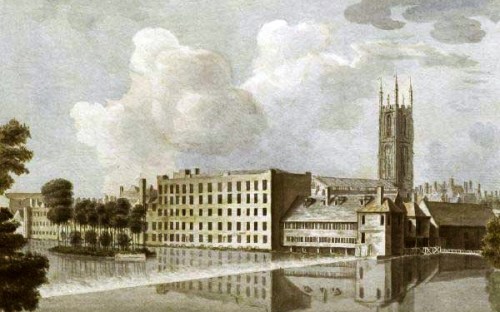
Silk Mills and Church, Derby by Moses Griffiths, 1747-1809 [Public Domain], via Wikimedia Commons

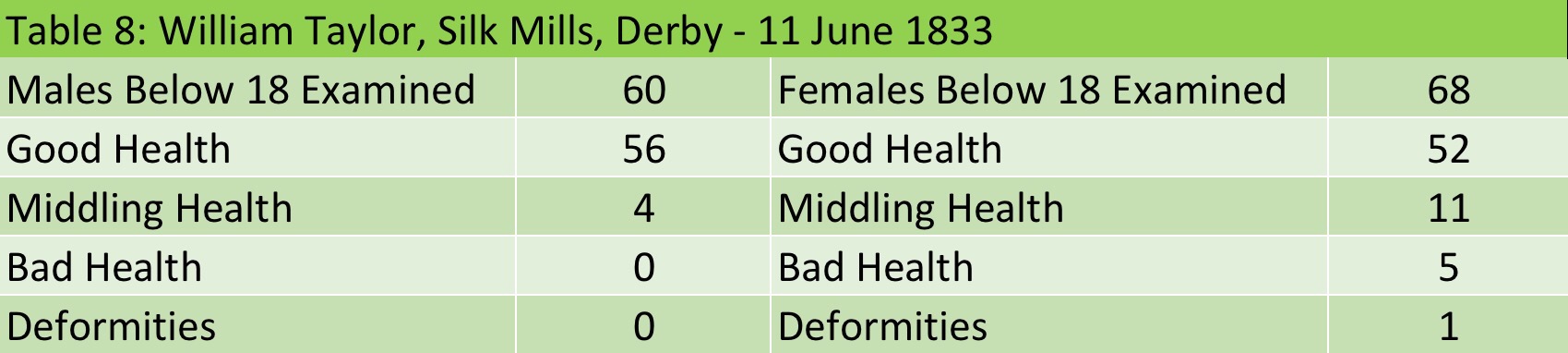
Tables 8 and 9 below chart a series of medical examinations conducted in 1833. These show overwhelmingly health in silk mills to be far better than cotton factories. Of course it is possible that these medical examinations were fixed to the extent that factory owners sent sickly children home for the day. However if this practise took place in silk mills, it would be logical to assume cotton mills did the same: yet cotton mills had a comparatively much worse record of health. It can be therefore taken that the tables provide a relatively accurate comparison of health in the two industries. But that does not mean the employment was not detrimental to health.


Condemnation of health did occur. When examined in 1832 Daniel Fraser, warping department manager at John Fisher & Co silk mill at Huddersfield was critical. He described silk mill girls in the throwing department, saying “contrasted with other children, they appear pale, their eyes are sunk, they are thinner in flesh and altogether they seem deteriorated.

It was also stated that those children not brought up in a factory system were more healthy. That’s the bottom line. The factory system, whatever branch, was fatiguing, unhealthy, dangerous and children were subjected to harsh treatment.

In my next post I will examine in more detail the Factory Acts of 1833, 1844 and 1847 and their impact on child employment in the silk industry.

Another Family History Website Bites the Dust

A sad day for those with coal mining ancestors and interests. Whilst doing some research into my many ancestors working in this industry, I attempted to access one of my favourite occupational websites, “The Coal Mining History Resource Centre” (CMHRC).

However it appears to have vanished.

Ian Winstanley compiled the information for the website. But I believe Raleys Solicitors, an old-established Barnsley law firm specialising in miners’ compensation claims, ran it. They went into administration in March 2016. Whereas client work appears to have transferred to Ison Harrison Solicitors, the website seems to have been a casualty.

Ancestry.co.uk have Ian Winstanley’s “Coal Mining Accidents and Death Index 1700-1950“, which was on the site. But CMHRC was far more than this wonderful database. Described as the UK’s largest and most comprehensive website concerning the history of coal-mining, its resources included maps, the 1842 Royal Commission reports, poems, a glossary of mining terms and a photo gallery. Unlike Ancestry, it was a free website. And to be honest I much preferred its search facility.

I would hope the loss of CMHRC is temporary and it can soon be restored in all its former glory. But in the meantime there is a bit of a work round.

In my post about an obsolete County Mayo website, I described how the Internet Archive Wayback Machine could be useful in accessing defunct websites. You can partly access CMHRC via this mechanism, but be warned you do lose much of the original site functionality.

Screenshot of CMHRC via the Wayback Machine

If searching via the Internet Archive Wayback Machine, the URL to use for CMHRC is:  http://www.cmhrc.co.uk

Make sure you search for 2016 captures and earlier. It is far from perfect but it might help.

There are also the following useful sites:

Feel free to add more to the list.

Some suggestions that I’ve since received (thanks Judy & Fergus):

Grim Times for an 18th Century Coal Mining Family 

The most common occupation in my family tree is “coal miner”. Unsurprising given my paternal and maternal West Riding roots. As a result I’ve spent quite a bit of time researching the history of coal mining: the social and political aspects as well as the general occupation and its development through time.

This research could form the basis of many posts. The aspect I’m focusing on this time is the perilous nature of the work. “Poldark” brought this to mind. Different type of mining, but the death of Francis highlighted the dangers of underground work in the late 18th century and made me think once again about my coal mining forefathers. However grim I think my job is, I only have to think about my ancestors, men, women and children, who worked down the coal mine to realise how lucky I am. 

Even in more recent times coal mining was a hazardous, unhealthy occupation. But in terms of my 18th and 19th century family history, these were days before today’s stringent health and safety regulations. Indeed in the early days of my ancestors the working was totally unregulated. 

The cramped, damp conditions and physical exertion led to chronic muscular-skeletal problems and back pain as well as rheumatism and inflammation of the joints. Many suffered from loss of appetite, stomach pains, nausea, vomiting and liver troubles. Most colliers became asthmatic by the time they reached 30, and many had tuberculosis. And all this would have led to days off sick without income to support the family. 

Then there were the accidents. No-one knows how many deaths there were in the first half of the 19th century, let alone earlier. An unreliable estimate in 1834-5 of the number of lives lost in coal mines in the previous 25 years gave the number of deaths in the West Riding as 346 and the evidence is the high proportion were children. According to the appendices of the Mines Inspectors Report’s 1850-1914 some 70,700 miners died or sustained injures in the mines of Great Britain from 1850 to 1908. However even this is not reliable, because the number of non-fatal accidents taking place between 1850-1881 is unknown. It was no-ones job to collect the information. 

It is true that miners themselves took risks, failing to set timber supports, propping air doors open and working with candles when it was dangerous to do so even after the invention of the Davy lamp. But colliery officials and managers also cut corners and costs leading to dangerous conditions, for example failing to replace candles with lamps, not supplying sufficient timbers, not ensuring adequate ventilation, using defective colliery shafts which were not bricked or boarded and contained no guide rods, as well as drawing uncaged corves (the small tubs/baskets for carrying hewn coal from the pit face) direct from the pits which resulted in falls of coal and people down the shaft. It was not until 1872 that every mine manager was required to hold a certificate of competence. 

Whilst explosions exacted a heavy toll and made headlines, it was the individual deaths and injuries sustained over weeks, months and years by falls of coal and roof which were responsible for most accidents, fatal or otherwise. 

One of the earliest mining ancestors I’ve traced is my 6x great grandfather Joseph Womack, born in around 1738. And his is the earliest family mining fatality. 

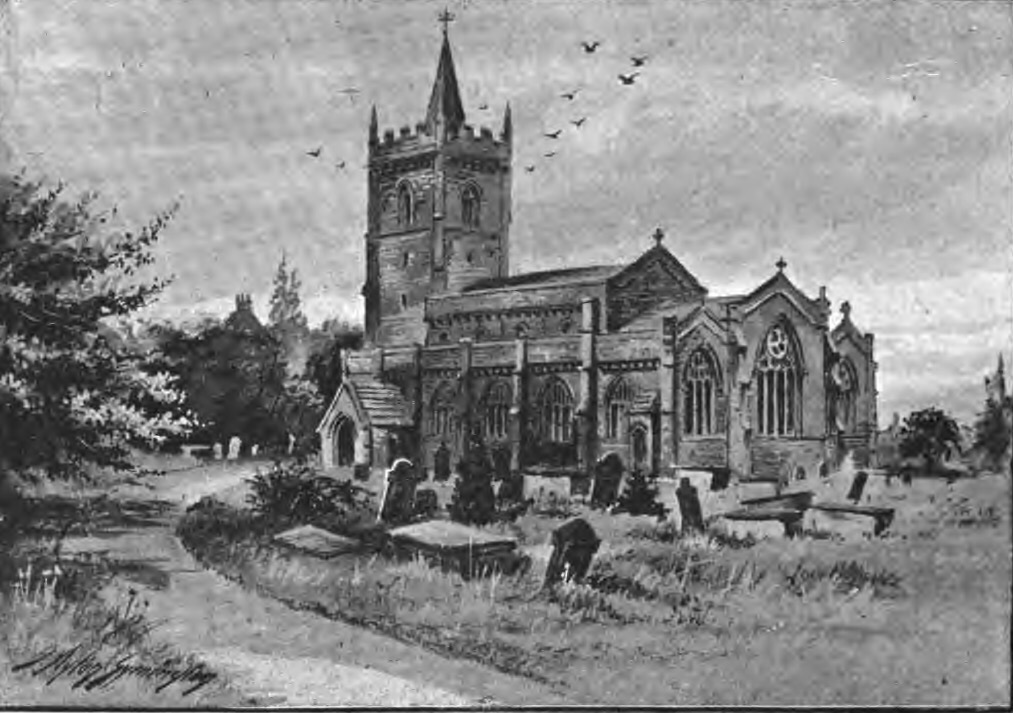
Joseph married Grace Hartley on 11 February 1760 in the parish church of St Mary’s Whitkirk. It is the oldest medieval church in Leeds and a church probably existed on the site at the time of the Domesday Book. The name “Whitkirk” or “Whitechurch” is first recorded in the 12th Century in a charter of Henry de Lacey, founder of Kirkstall Abbey, confirming the land of Newsam, Colton and the “Witechurche” to the Knights Templars. The present building dates from 1448-9 but underwent substantial restoration in 1856. So it is essentially the building in which my 6x great grandparents married. 

Whitkirk Parish Church

The man known as the father of civil engineering, John Smeaton, is buried just behind the main altar. Perhaps Smeaton’s most famous work is the 3rd Eddystone Lighthouse, completed in 1759 just the year before Joseph and Grace’s marriage. His other works included the Forth & Clyde Canal, Ramsgate Harbour, Perth Bridge, over 60 mills and more than 10 steam engines. 

Joseph signed the register in a wonderfully neat hand. It’s always a thrill when I see the signatures of my ancestors. And especially those who worked in manual jobs not associated with literacy.  

The marriage entry indicated Joseph and Grace were both residents of the parish. The location was pinpointed to Halton with the baptism of their first child, Joseph, on 22 October 1760. This location was confirmed in each of their subsequent children’s baptismal entries. Halton was about three miles east of Leeds in Temple Newsam township with Whitkirk parish. 

Another son, Richard, was baptised on 27 June 1762 followed by their first daughter Mary, my 5x great grandmother, on 12 February 1765. Four other Womack children’s baptisms are subsequently recorded – William on 21 January 1770; Henry on 24 September 1772; Thomas on 6 August 1775; and Grace on 14 February 1779. This final baptism is more detailed, giving Grace’s date of birth as 31 December 1778 and stating that her father, Joseph, worked as a collier. 

The Womacks, Joseph and his sons, were a coal mining family working at the local Seacroft colliery. Joseph and his eldest sons Joseph and Richard were there one day in May 1781 when tragedy struck in the form of an explosion. The events reached papers nationally as well as locally. The coverage is typified by this paragraph in the “Leeds Intelligencer” of Tuesday 22 May 1781. According to the newspaper the explosion took place on a Thursday, which would make it 17 May. However this may be inaccurate. I will return to this later. Typically for the time no names are given. 

In the era before the 1815 invention of the Davy Lamp, candles were the only form of light in the mine. But the risk of explosions with naked flames from these candles igniting methane gas was high, even in well ventilated pits. Firedamp was the name given to an inflammable gas, whose chief component was methane. This was released from the seam and roof during working. And on this fateful May day the Womack father and sons were caught in its ignition. 
We turn to the Whitkirk burial register for the details of how this newspaper snippet linked to the Womacks. The register gives the following burial details on 18 May 1781: 

Joseph Womack collier slain by the firedamp at Seacroft also his son Richard Womack who was slain at the same time. The father was aged 43 the son 19 years”  

Slightly later era, but illustration of a pit top after an explosion

Joseph (junior) was one of those hurt in the incident. This is shown by an entry in the same register, dated 2 June 1781: sadly another burial. It is Joseph’s. He lingered for several days before succumbing to his injuries, described as “bruises”. The entry states that his injuries were the result of the same incident in which his father and brother were killed.

Besides being emotionally devastating for the family, with the death of two members on the same day and a third receiving injuries in the same incident leading to his protracted death two weeks later, it would have been economically crippling. The three main breadwinners wiped out in a single stroke. Grace was left to bring up several children – the eldest 16 years old, the youngest just two. 

Less than two years after the death of his father and brothers Thomas died, aged eight, as a result of a fever. This is a notoriously vague catch-all description for the period indicating, yet again, that in these times the precise source of illnesses were often not known but which clearly suggests some kind of infection. There are no other clues or hints. Checking the burial register for the period around Thomas’ death reveals nothing, for example an epidemic or outbreak of common illnesses in the area. He was buried on 25 April 1783 in the parish. 

Surprisingly the family do not appear in the list of recipients receiving parish dole money. Neither are they mentioned in the parish churchwardens and overseers accounts or vestry minutes, but there is very little poor law related material in these specific Whitkirk documents. It is very possible that they were supported by the parish via this mechanism, but these records have not survived, or else I’ve not yet discovered them in my visit to the Leeds branch of West Yorkshire Archives.  

But the two information sources, newspaper and parish register, give an indication of the devastating effect a pit explosion could have on a family at a time when fathers, brothers and sons (and prior to the 1842 Mines Act women plus girls and boys under 10) worked side by side underground. 

A sad footnote to this post concerns the anonymity of those killed. In addition to Joseph senior and Richard, there were two others who lost their lives in the immediate aftermath of the explosion, as reported in the “Leeds Intelligencer” 0f 22 May. Given the date of the article, Joseph junior couldn’t have been one. Their names didn’t appear in any reports I found. I do wonder who they were though, these people who worked and died with my ancestors.

There is nothing to indicate any other Whitkirk burials of the period applied to these victims. Parishes adjoining Whitkirk were Leeds, Swillington, Rothwell and Barwick in Elmet.  Leeds St Peter’s parish church provides a cause of death for all burial entries for the period. Sadly I drew a blank in this search. Likewise for Swillington St Mary’s and Holy Trinity at Rothwell. However, Barwick in Elmet All Saints register records the burial on 17 May 1781 of 33 year old Christopher Dickinson from Lowmoor. He died on 16 May 1781, “kild in Seacroft coalpitts“. So was this the same incident? If so it indicates the inaccuracy of the newspaper date which implied a 17 May accident date. 

Providing the newspaper got the numbers right, the other individual remains a mystery. The only possibility so far is a cryptic and inconclusive 17 May 1781 entry in the nearby parish of Garforth St Mary’s “Thos son of Mathew Limbord colier aged 23 years” No cause of death. And really it’s not clear if it was Thomas or his father who worked as a collier.

The “UK Coal Mining Accidents and Death Index 1700-1950” doesn’t offer a solution either. This was on the now obsolete “Coal Mining History and Resource Centre” website, which I wrote about in my previous post. As indicated in that post, the index is now available on Ancestry.co.uk – but this accident is not recorded. I may never know who the fourth person was. And it makes me think how many other mining deaths are similarly lost.

 Sources:

  • St Mary’s Whitkirk Parish Register and records 
  • Leeds Intelligencer” 
  • National Coal Mining Museum: http://www.ncm.org.uk
  • The North of England Mining Institute of Mining and Mechanical Engineers: http://www.mininginstitute.org.uk
  • The Durham Mining Museum: http://www.dmm.org.uk
  • Voices from the Dark – Women and Children in Yorkshire Coal Mines” – Fiona Lake and Rosemary Preece 
  • “Working Conditions in Collieries around Huddersfield 1800-1870” – Alan Brooke 
  • My Ancestor was a Coalminer” – David Tonks 
  • British Coalminers in the 19th Century” – John Benson 
  • The Yorkshire Miners: A History – Volume I” – Frank Machin 
  • The history of the Yorkshire Miners 1881-1918” – Carolyn Baylies 
  • Tracing your Coalmining Ancestors” – Brian A Elliott 

“Ley Lines” of the Somme: an amazing Somme 100 experience

Do you believe in fate? Of hidden forces drawing people together? I do after my latest Great War pilgrimage.

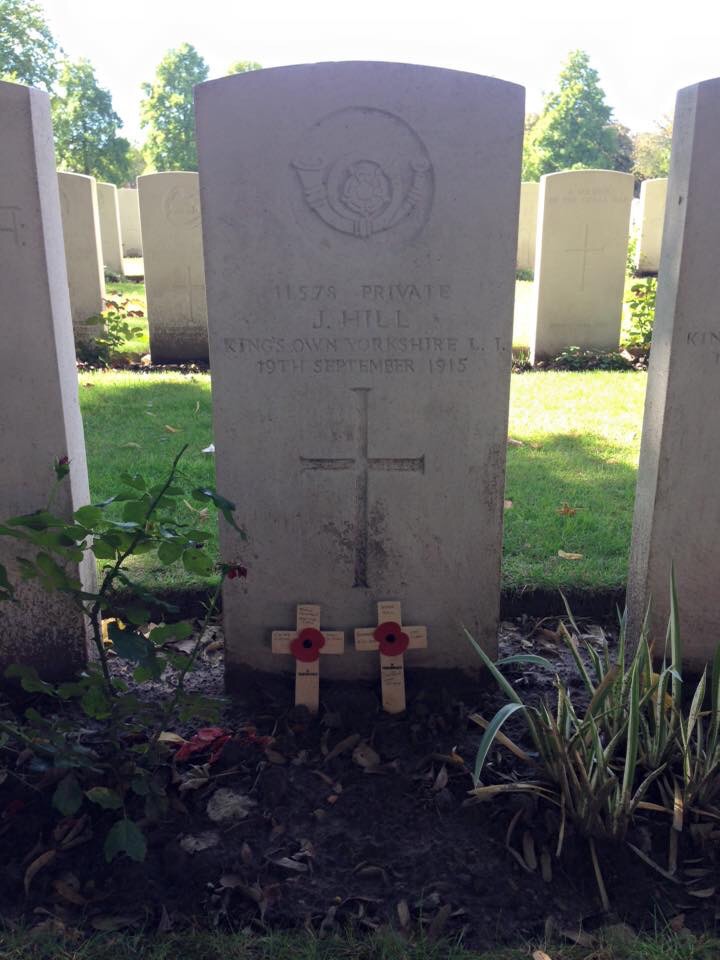
I recently went over to Belgium and France and timed the visit to coincide with two of my Hill family death anniversaries. Jesse Hill, who died on 19 September 1915 and is buried at Ypres Reservoir; and Percy Hill who died, according to soldiers’ effects records, at 2/1 South Midland Casualty Clearing Station on 30 September 1916. Percy is buried at Warloy-Baillon Community Cemetery Extension, just to the west of Albert.

Last year when visiting Jesse, on the centenary of his death, I narrowly missed meeting a relative for the first time. Two poppy crosses and the visitors book showed we’d paid our respects at Jesse’s grave within hours of each other. That was coincidence enough, but nothing in comparison to what happened this year.

Two Poppy Crosses by Jane Roberts

Chris (my husband) and I spent a few days in Ypres before driving to Avesnes Le Sec, near Cambrai, to stay with an “old” school friend for the weekend (sorry about the “old” Anne, but it applies to me too). We finished the final leg of our visit on the Somme, initially at the wonderful “No 56” b&b then at the “Royal Picardie” hotel in Albert for the last two nights. The only reason we transferred to Albert was because the b&b only had availability for three nights.

The early evening of 28 September we finished another long day of walking by stopping off at the beautiful Authuile Military Cemetery, in the village of Authuille (note the spelling difference). 

I love this tranquil cemetery with its feeling of peace and calm, and its eye-pleasingly curving layout of headstones sloping down to the river Ancre. An odd thing to say, but it’s probably my favourite cemetery. It is also the final resting place of Pte Willie Barber of the 1/4th King’s Own Yorkshire Light Infantry (KOYLI) one of the parishioners at Batley St Mary’s who I spent so much time researching.

Authuile Military Cemetery – by Jane Roberts

As we wandered down to the bottom slopes of the cemetery I noticed another visitor. This was unusual, as it was getting on and the cemetery isn’t one people normally beat a path to the door of. By the time we got to the top she had gone.

I sort of wondered if she was here to see Willie, one of those flights of fancy about impossible coincidences. I’m always a bit over-focussed on the St Mary’s men I researched. But there was nothing in the visitors book to indicate why she’d been there. That was the end of that, or so I thought. A chance to find out lost.

The following day we checked into our Albert hotel. Whilst in town sitting outside a café drinking coffee we saw the lady again. But again never spoke.

And then on 30 September, the anniversary of Percy’s death, we went down to our first breakfast in the hotel and she was there with her mum.  This time we did speak. She was over for the centenary of her great grandfather’s death, that very day. The same day as Percy Hill. 30 September.

We talked a bit more, and amazingly discovered both Percy and her ancestor, Jonathan Pearson, were in the same battalion, 1/4th KOYLI. Both died of wounds and both received their injuries during the same period of duty in the trenches near Ulster Tower in mid-September. She had followed Jonathan’s footsteps for those few final frontline days and was on her way across to Boulogne to his grave on his death anniversary, before returning home to the south of England that evening.

She had photos of Jonathan. I had some of Percy, including group photos with some of his pals. And amazingly on one of these photos was a man who looked remarkably like Jonathan. Same colouring, same features including distinctive nose and cut of hair.

We couldn’t believe it. 100 years to the exact day of their deaths we were in a hotel in Albert staring at a picture of what appears to be both men together. It was is if some unseen force had been pulling us together for the past couple of days, starting at Authuile Military Cemetery where fellow 1/4th KOYLI soldier Willie Barber is buried, finally uniting us on the centenary of their death. An incredible, earth-stopping realisation. And if the b&b had been available for the final two days of my visit I wouldn’t have even been in the Albert hotel. A week later and I still can’t believe it.

We parted promising to pass on Jonathan and Percy’s regards at their respective final resting places, around some 90 miles apart.

And so onto Warloy-Baillon. We stopped at Ulster Tower en route and found the poppy cross Jonathan’s family had laid in the area of the KOYLI trenches of mid September 1916. We saw the Pope’s Nose, the German salient with a decaying relic of a observation post/gun emplacement, which was the focus of their trench raids in that period.

We were at Percy Hill’s grave for 1.15pm, the minute is death is recorded. And there, at around 2pm, we met with David Short and his wife Pauline, the relative I so narrowly missed meeting just over a year ago at Jesse Hill’s grave. And in a final piece of symmetry David is from the north east of England, not Yorkshire, the same area from which Jonathan hailed.

How Big a Family History Addict Are You?

Time for a bit of seasonal fun. 

The scenario is familiar. You start out with a general interest in your forefathers. An idle curiosity, perhaps fuelled by TV shows such as “Who Do You Think You Are?” and “Find My Past”. A Family History Society membership here and a Family History subscription site there, and before your know it you’re hooked.

So how addicted are you? Here’s a short quiz to establish the level of your obsession.

Source: Pixabay

Question 1 
You’re making preparations for a family holiday. What is your motive?
a) A crafty nudge here; a gentle steer there. Before anyone notices you’ve influenced the destination decision with the clear intention of fitting in some ancestral home, graveyard and family location visits. These to be sprung on your unsuspecting family on visit day, couched in terms of “Ooo I’ve just realised Great Aunt Annie is buried near here” or “The mill my great grandad worked in is just up the road. I wouldn’t mind taking a look”.
b) You go ahead with planning, all family history thoughts erased. This, after all, is a family holiday and is purely about focusing on living loved ones, not dead.
c) No influencing. You tell it to them straight. There will be family history location visits, multiple graveyards, and the odd archive thrown in for good measure.
d) The destination is chosen. It’s one picked in consultation with all the family. Only then do you look to see if there are any nearby family history connections. At which point you ask the family if a brief visit is possible. And if it isn’t, you don’t sulk. You get on with enjoying time away with your nearest and dearest. 

Question 2
How many Family History Society and genealogy-related organisations are you a member of?
a) None. You’re interested, but not that serious as to want to part with money.
b) Several. You attend meetings, regularly contribute to forums and journals, volunteer to help with events and projects, and now even have the odd Committee-level post with one society. In fact your before you know it you’re devoting many hours a month to supporting an organisation.
c) Maybe one or two. Linked to the locations of the ancestors you have the greatest fascination with. But you’re not involved in activities to any great extent, other than perhaps submitting members interests or forum queries.
d) More than two. These cover a broader range of ancestral locations. You take a more active role by attending meetings or actively contributing to forums, publications and projects.

Question 3
Do you visit archives in the course of your research? Do you know your microfiche from your microfilm? Do you keep a stock of pencils at the ready?

a) A couple of times a year. But you’re not really sure what you’re looking for, and you still find it a little bit intimidating.
b) At least once a month, after making preparations and plans for your visit including sussing out in advance the documents you wish to peruse.
c) Weekly. So often that you’re on first name terms with the staff. In fact you wish they were open longer.
d) Never. Why would you need to? Everything you want is online. Pencils were left behind at school art lesson stage.

Question 4
Do you build on your family history knowledge by attending formal learning sessions, either online courses, webinars or classroom based?

Source: Pixabay


a) You’ve signed up to quite a few one-off learning sessions and webinars, but no long-term course commitments.
b) You participate in the occasional webinar or library session, but rely mainly on magazine subscriptions, a few core books and information available on the Internet.
c) No, you’re entirely self-taught and have no desire to undertake formal learning.
d) You’ve become an eternal family history student. You jump from courses to webinars. Your diary is full. You have even signed up to long-running courses, possibly with the intention of obtaining a formal qualification at the end. In fact you may even find you end up teaching courses.

Question 5
Do you have annual subscriptions to websites and magazines? (This is a tricky one as these things don’t come cheap. But it is a big indication of obsession, when you forgo money on other pleasures/essentials to fuel your family history interest).
a) No annual subscriptions. You rely on free library/society access, and free sites such as FreeBMD. You perhaps call on help from others in various forums or websites. And you may occasionally get a short-term subscription.
b) A maximum of five and you stick to this….whether you use them all or not.
c) A couple of key annual subscriptions, and you may rotate these. So one year Ancestry and “Who Do You Think You Are?” magazine; the next a switch to FindMyPast and “Your Family History” magazine.
d) You subscribe to so many of the things you’re thinking about taking a second mortgage! It started off with one, but you kept adding to them and couldn’t bear to drop any. Now it’s a skill in itself keeping up with which subscription needs renewing when.

Question 6
How many hours a week do you spend on Family History?
a) It is the way you spend most of your time. In fact everything else you do must fit around it.
b) A couple of hours a week on average.
c) Around seven to ten hours a week. You’d like to spend longer, but have to fit it around other priorities.
d) You can go for weeks on end without picking up your research.

Question 7
How many family history books do you own?

Never Too Many Books – photo by Jane Roberts

a) New bookshelves please. In fact congratulations are in order. You own your very own well-stocked family history library!
b) Around about 10. Mainly general works, but with the beginnings of a more specialised stock around key interests, be it location, occupation or period.
c) None – you borrow them from the library or consult the reference library holdings.
d) Between 10 – 50. Now specialist books are increasingly outnumbering general works. Books about apprentices, criminal ancestors, the manorial system, wills and deeds compete for shelf-space with your early introduction to family history purchases.
See the bottom of this post for the marks.

Results:
Less than 9 You are only just embarking on your family history journey. For now you’re only an occasionally dabbler. It could go either way. Who knows where you’ll be in 12 months from now? With a bit more time and effort, a few tantalising discoveries and you could easily be lured into a lifetime of pleasure. Then again, you may just get bored. You may hit a brick wall and give up. It’s been a brief, but interesting, interlude in your life. And you move onto something else.

9 to 14 You are gradually being sucked into this wonderful, alluring world full of history and mystery. Your ancestors are beginning to take shape. Bit by bit, piece by piece you are forming a picture of them. But it is not too late. You can still turn back. Though to do so will be your loss, and one which will occasionally cause you to feel the prick of wonder: what did become of the great grandparents?

15 to 20 You are well down the slippery slope to whiling away hours attempting to meet the ancestors. You’re being drawn into a world of workhouses, disease, high infant mortality, long gone occupations, religious turmoil and wars. Love, marriage, births and deaths. You’re discovering your roots. All the individuals and experiences which have lead to you. A bygone world inhabited by your flesh and blood. You want to know what happened to these people. But it’s not the be all and end all of your life.

21 to 27 It is too late. You’ve been ensnared. Yes, you do make time for other hobbies and interests. But this is your number one pastime. The thing you return to time after time. Finding out about the lives and times of your ancestors, their neighbours and their communities. Each piece of knowledge drives you on. Each mystery and gap must be solved and plugged. It may take time, but it’s time you’re willing to spend.

28 Congratulations! You are a bona fide family history addict. You live, eat, breathe and sleep family history. It is your oxygen. Your love. Your obsession. It is your reason for living. From getting up in the morning, to bedtime it is never too far away from your mind: Your family history, or that of others. You have been trapped.

Scores:
1: a3 b1 c4 d2
2: a1 b4 c2 d3
3: a2 b3 c4 d1
4: a3 b2 c1 d4
5: a1 b3 c2 d4
6: a4 b2 c3 d1
7: a4 b2 c1 d3

Sources:
Photograph of Coventry History Centre is by Herry Lawford – Flickr: Herbert History, CC BY 2.0, https://commons.wikimedia.org/w/index.php?curid=18118733

My New Toy: Irish Birth, Marriage and Death Images

In my “Fabulous News For Those With Irish Ancestry” post I could scarcely contain my excitement at the release of Irish General Register Office (GRO) birth, marriages and death register images. The site is https://www.irishgenealogy.ie

I’ve had a few days playing with my new family history toy and getting a feel for the system. These searches have focused on my primary interest area, County Mayo, and in particular the Swinford Registration District. I’ve tried a combination of search methods, including wildcards for those multiple spellings. For example I didn’t realise how many ways you could spell the seemingly simple surnames: But Loft* identifies Loftus, Loftice and Loftis; Cass* included Cassidy, Cassedy and Cassiday.

I found it interesting to note how many of my family were baptised before their registered birth date! I knew my grandpa had two birthdays, but it seems he was not unique amongst his siblings. Staggeringly this applied to seven of out of the eight children of Michael and Mary Callaghan, whose birth register images are accessible. But it also features in my Loftus line.

Glan Church, Kilkelly, County Mayo

It points to the religious importance of quick baptism to ensure eternal salvation at a time of high infant mortality; combined with the lesser imperative to officially register, with rural transport factors and employment pressures coming into play. By law, a birth had to be registered within 42 days. Fudging the birth date was a way to avoid a late registration penalty. Interestingly my grandpa carried on the “tradition” of an incorrect birth certificate date with my mum.

As with any new release on this scale there are some glitches:

  • The site did go down a few times and at others it was painfully slow. Hopefully these accessibility issues will improve as the traffic volume decreases;
  • I do get a tad frustrated at constantly proving “I am not a robot” several times within the same session. There’s a limit to how many street signs, grass vistas, milkshakes and shop fronts I must identify before curbing the urge to scream;
  • Not all images are online yet. Births are there from 1864 to 1915. However marriages are only available from 1882 to 1940. Deaths run from 1891 to 1965. The GRO are updating further records of Marriages dating back to 1845 and Deaths dating back to 1864, but no indication of how long this will take;
  • For one of my birth searches, the link was to the wrong image. I couldn’t see any way to browse adjoining pages easily. I tried in vain to overcome the issue using the advanced search options, narrowing down dates and Registration Districts. A frustrating half an hour later and I still couldn’t access it. So I know Andrew Callaghan’s 1891 birth registration is there somewhere, but the crucial image still eludes me. I have reported the issue via the feedback form, but as yet haven’t received a response;
  • The Advanced Search facility has issues, alluded to above. Linked to this, I do wish search guidance was clearer; and
  • I’ve heard anecdotal stories of false negative results, where someone who should be there isn’t identified in searches. So far this hasn’t affected me.

But the positives far outweigh these niggles:

  • FREE register images are instantly available with the click of a few keys;
  • The register pages supply the birth, marriage and death certificate details thus saving researchers €4 a certificate;
  • The information provided may lead to wider family. I quickly noticed that a good number of births were not registered by the parents. Far higher than I anticipated. Many entries were by people described as “present at birth”. For example a couple of my Callaghan births were registered in this manner by a Patrick Callaghan. Tantalisingly in these instances no relationship details were supplied. Possibly the baby’s grandfather or potentially an uncle, so extended family clues. However some entries do give the precise relationship details. I’ve seen sisters and grandmothers identified. So you may strike lucky;
  • You can include the mother’s maiden name in the advanced search option for births. And these fetch results earlier than the 1911 norm for England and Wales GRO searches. However I would not go so far as to say I to trust equating negative results to no results; and
  • There are entries for Northern Ireland Registration Districts. I’m not sure if these are limited to pre-1922 and how complete these are. So even if your ancestry is from the North, the records are worth checking.

In summary, despite its flaws this is a brilliant resource. It is a wonderful companion set to the free NLI Catholic parish register release of 2015. And a massive thank you to the Irish authorities for making Irish Soldiers Wills 1914-1918, the Irish 1901 and 1911 census, and other datasets, also available free of charge via the National Archives of Ireland’s genealogy page.

It is worth comparing with the “pay” attitude for similar information in England and Wales. A prime example being the £9.25 extortionate charges for similar civil registration information, with seemingly very little progress made since the 2015 Deregulation Act which was supposed to pave the way to providing this information in an uncertified, lower cost form. Or the £10 charge for a World War 1 soldier’s will in this centenary commemoration period.

5 October 2016 update:

I have now received a response from Irish Genealogy to my query on errors. They will be adding a mechanism for error reporting, but no indication of timescale.

In terms of coverage they confirmed the General Register Office are currently working on updating further records of Marriages dating back to 1845 and Deaths dating back to 1864. These will be included in future updates to the records available on the website.

Fabulous News For Those With Irish Ancestry

A really short blog post, but I can scarcely contain my excitement. I wanted to share my joy as soon as possible. And what fabulous news it is for those with Irish ancestry. 

The Irish Genealogy website has released the Irish General Register Office (GRO) images of births of over 100 years ago, marriages of over 75 years ago and deaths of over 50 years ago.

These aren’t just indexes, they are the actual GRO images. So mother and father details for births; cause of death information; location information; names of fathers for marriages; occupations; dates. In other words exactly what you’d get on a certificate.

And what’s even better – they’re absolutely free. So no more €4 postal applications for photocopies of Irish certificates me. And no more wasted money on speculative applications either.  

I am ecstatic. This was beyond my wildest dreams when I first heard a whisper about the launch a few days ago. 

A quick look and they’re not complete yet, but already I’m filling in some gaps. And, as they’ve been uploaded ahead of the scheduled 8 September 2016 launch date, I’ve not ruled a further tranche. 

So guess which website I’ll be on over the next few days, ploughing through my outstanding list of civil records: https://www.irishgenealogy.ie/en/

Sources:  

Which Type of Family Historian Are You?

After several years immersed in family history research, along the way I’ve also observed my fellow researchers, and I include myself here. As a result I’ve identified several breeds within this species. Some are clearly pedigrees displaying one single personality trait. Others are more of the Heinz 57 variety, displaying a cross section of characteristics to varying degrees, depending on their inherited DNA.

Which Type of Family Historian Are You?

The categories I’ve identified are by no means exhaustive. I have listed them below, along with their core characteristics.

The Gatherer: This grouping is more concerned about how far back they can go and how many individuals their tree can hold, rather than in-depth individual stories of ancestors. It’s a contest, a badge of honour. Who can get back the furthest. Who can collect the most. What their tree lacks for in substance, they more than make up for with the thousands of names and dates populating the multiple branches. So many names it makes it difficult to distinguish the wood from the trees.  

The Gatherer

The Treehopper: These individuals hop from one public tree to another culling data. The Treehopper doesn’t evaluate this data to see if it is indeed their family. And they are oblivious to errors such as children born before parents and centuries old Methusalahs. Their philosophy is “it’s on the internet so it must be true“. 

There is much cross-fertilisation amongst the Treehopper populace, so the errors become self-perpetuating. 

The Plunderer: These folk are similar to the Treehopper breed in that they cherry pick data from others. But they are far more discerning. And they are not averse to passing the research off as their own. 

The Fortune Seeker: This bounty-hunting bunch are only interested in proving their connection to rich and famous. The richer and more famous the better. Their ace would be to have a link to royalty. A dinner-table topic to dine out on forever, whilst polishing their collective tiaras. 

The Fortune Seeker

The Carnivore: This sub-species is only interested in their meaty, gory ancestors. They wallow in the deepest, darkest entrails of their family history. Ordinary lives are not worth spending time researching. These individuals thrive on the blood-lust of murderers, criminals, victims, bigamists, incest intrigues, gruesome deaths, disasters and tragedies. The grislier the better, in order to feed their passion. 

The Nurturer: Always putting others before themselves, these kindly souls spend so much time helping others in their family history quest, that their own research is sadly neglected. They make occasional efforts to tend and grow their own tree, only to succumb once more to the cries of help from others. 

Whilst they do love assisting the more juvenile researchers in their midst, their plaintive moans of despair at their lack of personal tree-time can occasionally be heard echoing in archive corridors.

The Wanderer: These are the free spirits of the family history world. Or perhaps that should read the most easily distracted? They set off on one path, but part way through their research something more interesting attracts their attention and they change direction. They then spend hours wandering down this new road, before realising they’ve been diverted. Not to worry though. They’ll get to their destination eventually, but with lots of exciting adventures along the way. 

The Wanderer

The Aestivator: This is the spring/summer version of hibernation. During the, hopefully, good weather of these seasons aestivators concentrate on other hobbies and activities. The weather is too nice to be stuck indoors, at home or in archives, researching. The only trees they tend during this period are the ones in their gardens. The only nod towards family history research may be the occasional ancestral cemetery or location visit. Essentially they have entered a phase of genealogical torpor.

They emerge from their aestivation with renewed energy and enthusiasm, ready to conduct their desk-based research during the cold, dark, wet months of late autumn/winter. 

The Night Predator: These researchers burn the midnight oil. The daylight hours are eaten up by family and work demands. Once the children are safely tucked up in bed, partners craftily diverted and work consigned till tomorrow, the Night Predators’ family history papers come out and their computers are fired up. Time looses all track. One more minute becomes one more hour. Bed is but a distant port of call. The clock chimes an inconvenient 1am. Dawn brings its own dawning realisation, “I sleep to research more effectively.” Sleep, therefore, is an unwelcome, but essential, research interruption. And so eventually the Night Predator drags them-self wearily to bed, mind whirring on finds and strategies, counting ancestors not sheep.  

The Night Predator

The Protector: This group are the guardians of their family’s history. They unearth all aspects: good, bad and indifferent. They critically analyse and evaluate their research, recording it for posterity. They delve into all aspects, and historically and locally contextualise the lives of direct line and collateral ancestors. They collect, preserve, share, treasure and protect their finds to ensure no lives are forgotten. They engender a sense of family continuity.  

However be warned, their sheer single-minded obsession and enthusiasm may occasionally be too much for living family members. They have been known to bury their heads in their hands or flee for cover at the prospect of more quizzing or yet another tale from the Protector.

The Scavenger: These phenomena pull disparate facts swiftly together in a haphazard manner with no regard for considered research or truth. If someone has the same name, well that first match they encounter must be “The One“. No matter they may be from a totally unrelated parish, sometimes hundreds of miles away, there are multiple alternatives, or there are other irregularities. 

Time, history, geography, facts and other options are minor inconveniences, swiftly ignored or dismissed. The Scavenger relies on gut instinct at best. At worst they ram the wrong shaped piece in their family history puzzle and move on.

The Specimen Collector: This category has a sole focus on direct line ancestors only, so four grandparents, eight great grandparents, 16 2x great grandparents and so on. They can really put these ancestors under their genealogical microscope or magnifying glass to probe and delve into their lives in minute detail, without the overwhelming distraction of collateral ancestors. The downside is this researcher may miss breaking down a brick wall which may come from looking at these collateral lines.

The Specimen Collector

The Hunter: These individuals love the thrill of the ancestral chase. Nothing is more satisfying than a visit to the archives or a day spent surfing family history websites. 

Their homes are filled with hastily jotted notes on the back of discarded envelopes and scattered pieces of paper. They have multiple notebooks on the go at any one time, because they misplace the one they’re working on so swiftly grab another. Finds will be properly recorded another day …..maybe. For the time being it’s all retained in the head. Occasionally an overwhelming urge to put things in order overcomes these people. But it’s a temporary blip and instinctive habits are quickly resumed. For them it’s a case of nature over nurture. 

The Hunter

The Grazer: A solid type, who munches steadily and evenly paced through their family history feast. Day by day, piece by piece. Neither obsessively or frenetically. It is a lifetime’s work, no need to rush. It’s there to be savoured, mulled over and enjoyed.

Which one(s) am I? Well that’s for me to know and you to wonder. But all theses different elements and people combine to create the wonderful discipline, interest, hobby, livelihood and obsession that is family history.  

PS – This post is prompted by a bit of end of school holiday giddiness. Any other suggestions are most welcome. 

Sources:

A Short Life Remembered: King Cholera’s Deadly Reign

This is another in my “Short Lives Remembered” series. It focuses on often-forgotten children in family trees who died all too young. The ones who never had chance to marry, have children and descendants to cherish their memory. The ones who, but for family history researchers, would be forever forgotten.

This post is about Sarah Clough. Sadly the most remarkable thing I know about her life is her death.

Sarah was the fourth child of my 3x great grandparents William and Mary Clough (née Burnett). She was born on 22 February 1833 in Adwalton Yorkshire and baptised in the parish church of St Peter’s, Birstall on 2 June 1833.

Historically, Adwalton is probably best known for its part in the English Civil War: The scene of the Battle of Adwalton Moor, when the Royalist forces of the Earl of Newcastle defeated the Parliamentarian forces of Sir Thomas Fairfax bringing Yorkshire under Royalist control.

Alongside it’s neighbour Drighlington, to where the Clough family moved, this was an otherwise historically unremarkable village, following the normal industrial revolution growth and development patterns of other West Riding villages in the 19th century.

By the time of Sarah’s birth, textile manufacture was supplanting farming and mining as principal occupations in Adwalton and Drighlington. William, her father, worked as a clothier, following the traditional occupations of the area. This was before fate stepped in and his working life took a totally different path. But that’s for another time.

Sarah only features in one census, that of 1841. She is shown living in Drighlington with her parents and three older siblings. The next record I have is her death certificate. Which brings me to a period in time when Drighlington hit the news for entirely unwelcome reasons.

Sarah died there on 10 August 1849, age 16. No occupation given, so I do not know if she followed her elder sister into a worsted spinning job in one of the area’s relatively new mills. She’s described merely as the daughter of William Clough. He registered her death the following day.

The certificate reveals she suffered one of those truly awful, and all too common, deaths of our ancestors. It indicates she died after suffering for 11 hours from “malignant cholera”.

Cause of Death Extract from Sarah Clough’s Death Certificate

So once more I venture into the depressing medical world family history researchers frequently inhabit. This time learning about cholera.

Malignant cholera was one of the names given to Asiatic cholera. This was distinct from English cholera. Adverts in 1849 stated that English cholera, which all persons more or less suffered from in summer months, was characterised by “violent looseness of the bowels, attended with sickness, and in extreme cases violent cramps”.  In other words dysentery and food poisoning, more commonly known as gastroenteritis today. If left untreated it could result in Asiatic cholera, or so some quack newspaper adverts claimed.

English Cholera Description, “Leeds Intelligencer” 25 August 1849

In fact Asiatic cholera was a different entity. Originating in India, it first reached the shores of Great Britain in the autumn of 1831, after its relentless march across Europe. It’s first victim was in Sunderland. The epidemic dissipated the following Autumn, but not before claiming the souls of some 32,000 people, roughly a 50 per cent death rate of those afflicted. In these pre-civil registration days this is only a rough estimate, with ranges fluctuating between 20,000 to 50,000+[1]

L0008118 A dead victim of cholera at Sunderland in 1832. Coloured lit

L0008118 A dead victim of cholera at Sunderland in 1832. Coloured lit Credit: Wellcome Library, London. Wellcome Images images@wellcome.ac.uk http://wellcomeimages.org A dead victim of cholera at Sunderland in 1832 by IWG. Coloured Lithograph Circa 1832 Published: – Copyrighted work available under Creative Commons Attribution only licence CC BY 4.0 http://creativecommons.org/licenses/by/4.0/

Like English cholera, Asiatic cholera also struck without warning, but it’s symptoms were more extreme. Although not the top killer in the country during the period, its high mortality rate and the speed with which it killed caused panic. Those afflicted were gripped by dramatic diarrhoea, terrible abdominal cramps and vomiting. In the most severe cases the loss of body fluids was so appalling that the victims rapidly became dehydrated, cold, withered and gaunt. Often their faces became unrecognisably shrunken and they could develop a blue-grey tinge to their skin. The swiftness with which victims succumbed is illustrated by the fact that Sarah was dead within 11 hours of the onset of her symptoms.

V0010485 A young Viennese woman, aged 23, depicted before and after

V0010485 A young Viennese woman, aged 23, depicted before and after Credit: Wellcome Library, London. Wellcome Images images@wellcome.ac.uk http://wellcomeimages.org A young Viennesen woman, aged 23, depicted before and after contracting cholera. Coloured stipple engraving. Published: – Copyrighted work available under Creative Commons Attribution only licence CC BY 4.0 http://creativecommons.org/licenses/by/4.0/

Victims died as a result of dehydration, sometimes hastened by medical ministrations which could be based on purging the body of impurities. Laxatives, such as mercury, and emetics like opium were amongst the armoury of potentially prescribed medications. Hardly the most suitable concoctions to give to patients already exhausted from sickness and diarrhoea. Other remedies touted at this time were passing steam over the patient or pouring boiling water on the patient’s stomach, brandy, bloodletting and “hot air baths”, all of which made dehydration worse. Even arsenic was prescribed.

Official advice, as well as druggists adverts, featured in the press of the day. All equally ineffective.

Official Cholera Remedy – ” Leeds Intelligencer” 23 June 1849

Fundamental to the grip the frightening disease had on the country was the lack of understanding of its causes and transmission. The prevalent theory was that the disease was caused and spread by smelly, contaminated air, otherwise known as miasma. Getting rid of foul smells, including improved sanitation, would combat the deadly menace. Attempts were made to fumigate buildings in affected communities by burning sulphur or tar. Drinking brandy or eating copious quantities of garlic were also widely believed to be a preventative measures.

L0003001 A court for King Cholera

L0003001 A court for King Cholera Credit: Wellcome Library, London. Wellcome Images images@wellcome.ac.uk http://wellcomeimages.org ‘A court for King Cholera’ is hardly an exaggeration of many dwelling places of the poor in London. 19th century Punch Published: 1852 Copyrighted work available under Creative Commons Attribution only licence CC BY 4.0 http://creativecommons.org/licenses/by/4.0/

Medical thinking had not progressed beyond this when the next deadly wave of the disease spread through Britain throughout 1848-49. The poor still lived in cramped and unhygienic conditions, sewerage was still largely inadequate and water supplies were still vulnerable to contamination: All these factors exacerbated by urbanisation. The miasma theory still held sway, promoted by the likes of social reformer Edwin Chadwick. There was no expert agreement about whether or not it was contagious, with debates on the subject aired in the press.

“The Leeds Times” 14 October 1848

However prudent advice in “The Leeds Mercury” of 29 September 1849 suggested precautions such as burning beds and clothing of the deceased and, in what looks like an early attempt funeral humour, “early (though not premature) interment“. In 1849 Dr John Snow publicly stated the disease was transmitted through water. His voice was dismissed.

In terms of fatalities this second outbreak of the disease proved to be the most serious of 19th century epidemics to hit Britain. Estimates vary between 53,000 and 62,000 lives lost[2], including that of Sarah Clough.

L0039174 Map of England showing prevalence of cholera, 1849

L0039174 Map of England showing prevalence of cholera, 1849 Credit: Wellcome Library, London. Wellcome Images images@wellcome.ac.uk http://wellcomeimages.org Map of England shaded to show the prevalence of cholera in the several districts during the epidemic of 1849. The relative degree of mortality is expressed in the darkness of the shading. The dates indicate the time at which the epidemic broke out. Printed Reproduction 1852 Report on the mortality of cholera in England, 1848-49. Great Britain. General Register Office. Published: 1852. Copyrighted work available under Creative Commons Attribution only licence CC BY 4.0 http://creativecommons.org/licenses/by/4.0/


Drighlington was particularly hard hit. Looking at the Drighlington St Paul’s burial register Sarah was just one of many of the village’s inhabitants to die in the summer of 1849.

A look at the a parish register shows 17 burials in August 1849. Of these 15 were Drighlington inhabitants, two from Adwalton. Sarah’s burial took place on 11 August 1849. Compare this with three June burials; four in July; one in September; four in October. Looking at the month of August in the years sandwiching 1849, August 1848 had four burials; whilst August 1850 shows only one. So a dramatic spike that cholera-affected month of August 1849.

The terror of the inhabitants felt is unimaginable: An illness with an incorrectly vague cause and no known cure sweeping their hometown; neighbours, friends and families being suddenly struck down; a succession of funerals held in the local church; many more suffering the distressing and debilitating effects of the illness. 

Newspapers, filled daily with cholera returns and countrywide reports, ratcheted up anxiety levels. They even remarked on the disproportionate numbers affected in Drighlington. For example, this from the “Bradford Observer” of 16 August 1849:

In our last number, we recorded a death from Asiatic cholera in Drighlington. Since then, five other cases have occurred, all of which proved fatal. Taking into consideration the size of the village and the population, this fearful malady is spreading more rapidly than in towns, where the population is so dense. The number of deaths from Asiatic cholera since the commencement a fortnight ago being seven, besides several others from English cholera”.

The “Leeds Intelligencer” of 18 August 1849 put the number of deaths at 11 and described clean-up measures to tackle the outbreak.

“Leeds Intelligencer” 18 August 1849

Put into context the 1851 population of Drighlington township was 2,740. So 11 cholera-related deaths in such a short space of time, not to mention those infected and recovering, and it’s easy to see how ravages of the illness would affect a significant proportion of the village one way or another.

Two further waves of cholera swept Britain but with decreasing death tolls – the 1853-54 outbreak claimed 20,000 souls[3]. Following this outbreak John Snow was able to prove his theory about the bacterial nature of the disease, when he isolated the source of the 1854 Soho outbreak to a contaminated Broad Street water pump.

Although full acceptance was slow, it was an important step in paving the way to laying to rest the bad air/miasma theory. This, ironically combined with the Public Health Acts and Sanitary Act resulting from the work of Chadwick, meant the disease was increasingly more effectively prevented and the 1865-66 epidemic accounted for a mere 10,000 – 14,000 deaths, depending on statistical sources.[4].

It wasn’t until 1883 that a German doctor, Robert Koch, isolated the cholera bacillus. And over 30 years more years elapsed before a vaccination became generally available in 1914.

So the short life of Sarah Clough is significant for the disease which cut it short. Just one of many thousands of people mowed down in Britain alone in what were the worldwide 19th century cholera pandemics. As a result of my research into Sarah’s death, the disease for me is now more than a name.

Others who feature in this series of “Short Lives Remembered” posts are:


Footnotes:

Sources: 

GRO Picture Credit: 

Extract from GRO death register entry for Sarah Clough: Image © Crown Copyright and posted in compliance with General Register Office copyright guidance.