No two days are ever the same for a professional genealogist, as demonstrated by a research commission I undertook this summer for Leeds-based artist Ellie Harrison, and Polite Rebellion – the company with which she works.
Polite Rebellion Artist Ellie Harrison and me at the Loose Ends Exhibition
Working to a tight deadline, my research drew together some threads of Ellie’s family history, and was a small part of the background detail to her much broader overall artistic display concept.
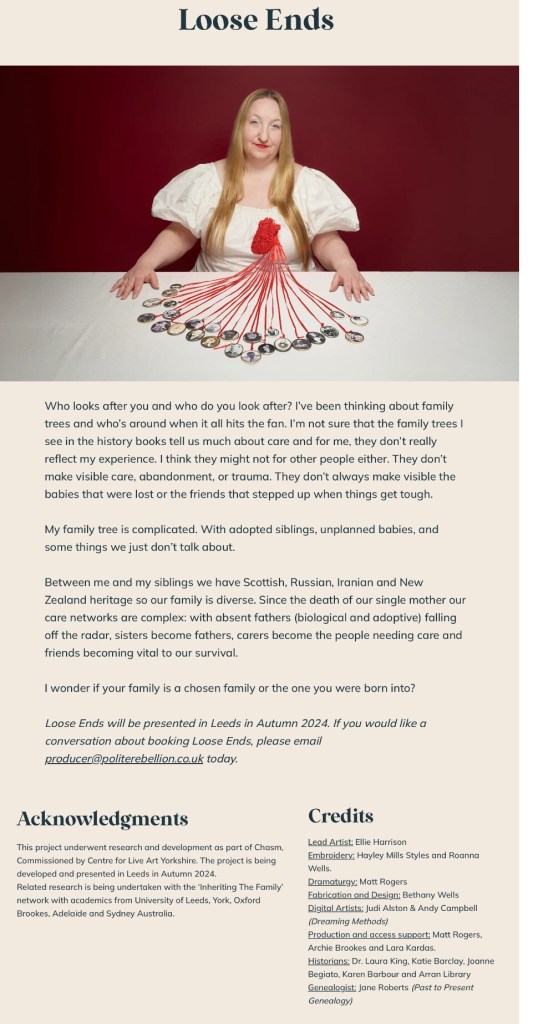
Loose Ends Credits
Ellie’s thought-provoking interactive exhibition, Loose Ends, is now currently showing in Leeds as part of November’s Compass Art Festival. This Festival brings a variety of interactive art projects into the city.
The Loose Ends exhibition space, Leeds Trinity Shopping Centre Albion Street entrance (near Boots).
I dropped by for the opening day of Loose Ends (22 November 2024).
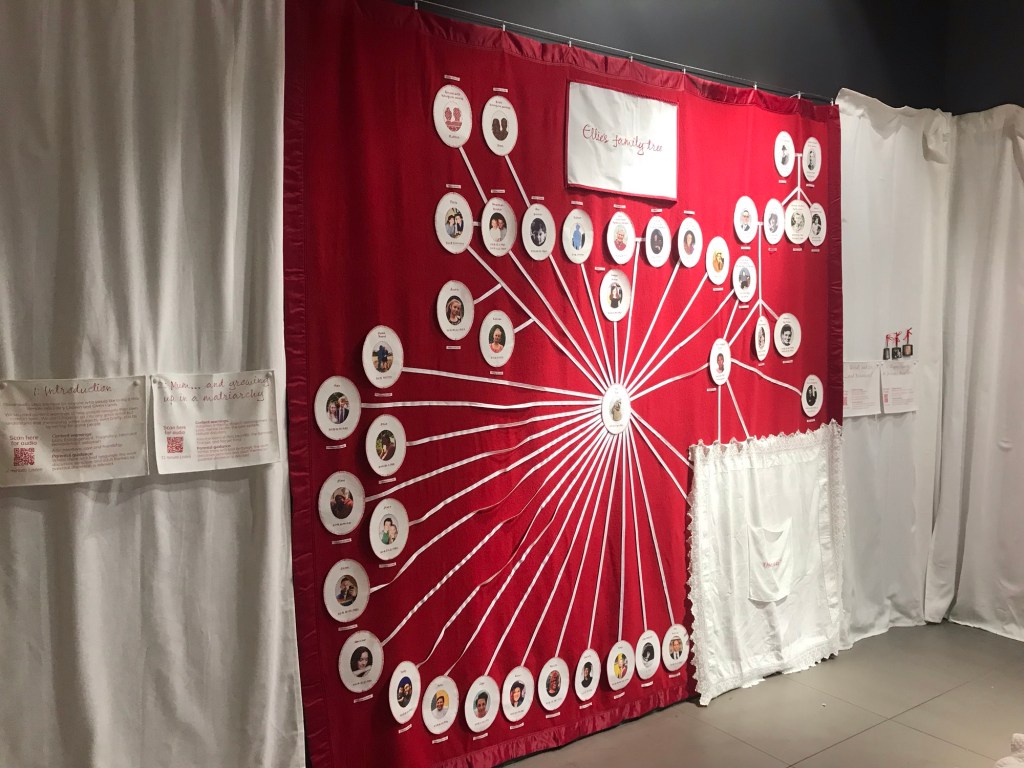
The Loose Ends component of the Festival is based in a pop-up shop in the Leeds Trinity Shopping Centre. Visually striking, this interactive and immersive experience invites you to think about your family tree in its broadest sense. It goes beyond the traditional historical concept of mother, father, siblings, grandparents, great grandparents, which in reality – as every family historian knows – is rarely so neatly packaged. It also highlights there are often unspoken topics and secrets within families.
Ellie’s family tree
It challenges you to consider what makes your family, inviting you to explore its complexities, the transient nature of some relationships weighed against more enduring ones, with this weighting not necessarily measured by blood links. You are asked to even consider the importance of wider friendship circles – a take on your FAN Club (Friends/Families, Associates and Neighbours).
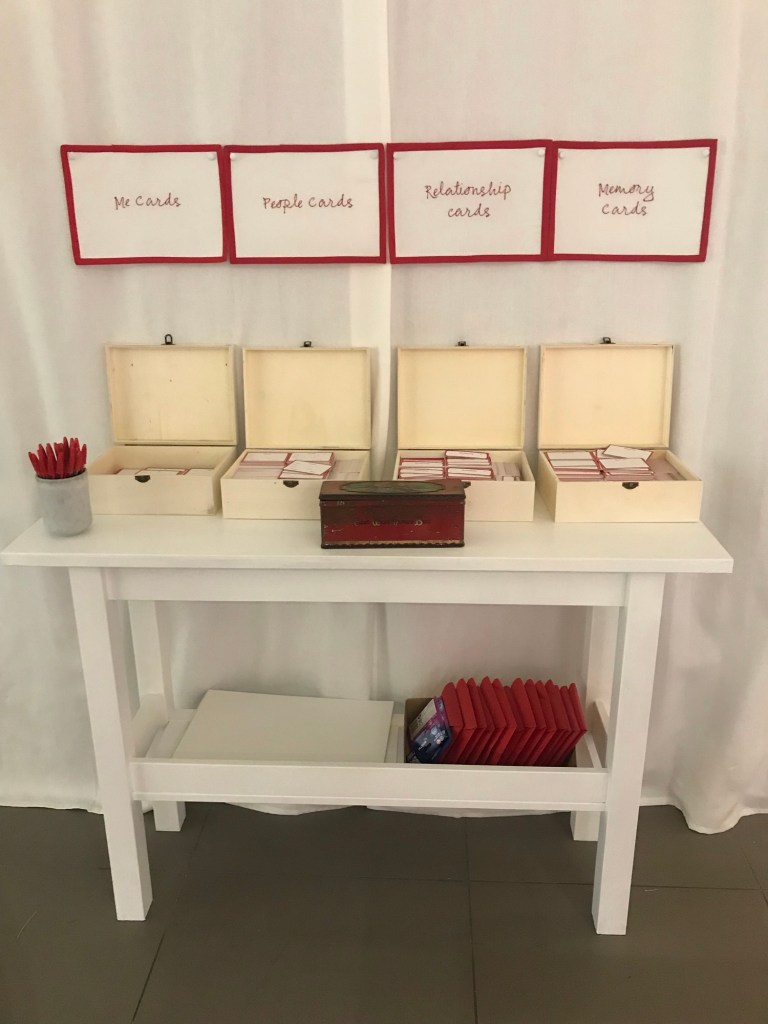
A chance to explore what makes your family tree
More details about the Loose Ends exhibition, including where to find it, can be found here.
But you need to be quick as it only runs from 22 – 24 November, and 28 – 30 November 2024.
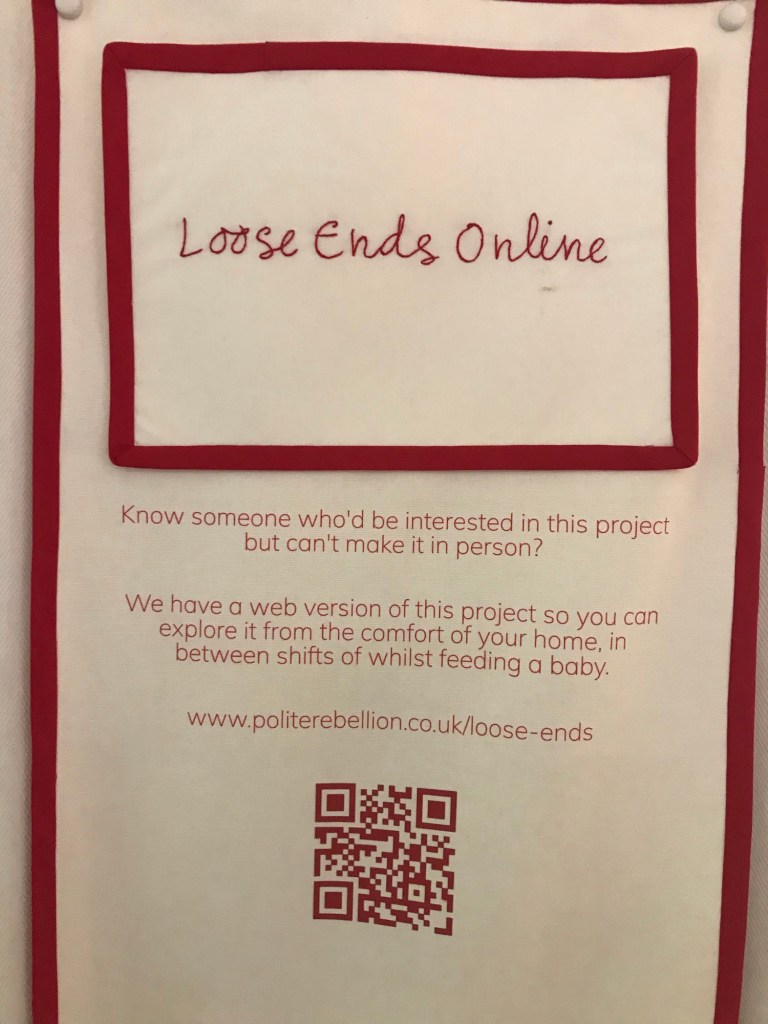
If you can’t make it, here’s the QR Code to scan and enter virtually.
Loose Ends QR Code
A huge thank you to Ellie for commissioning me to undertake her research. I loved doing it, because no two family trees are ever the same – as is demonstrated by the exhibition.
For more details about commissioning me for your research, please click here.
This is a perennial question for many people researching their family history. Whether or not to have a public family tree available online. And it is a dilemma which can arise fairly early on in the research path. Sometimes though it is not even considered, and for some the consequences of a decision to go public emerge too late.
Before I go any further I want to make it clear there’s no right or wrong answer. It really is a purely personal decision, one with which you need to be comfortable.
However, here are some considerations which I’m sharing to provoke a deeper examination of, and debate about, the implications. It’s not intended to be an exhaustive list, more a thought trigger. I’ve split them into pros and cons.
First the advantages of a public online tree.
Connecting. It goes without saying, but a public online tree allows other researchers with the same family history interests to easily find and contact you. This enables you to connect with distant cousins, compare research, potentially plug gaps and share photos.
Collaborating. Following on from this, once connections have been made this can lead to collaborative working on trees, pooling research, and the possibility to discuss findings and theories with someone who has a mutual family history connection.
Learning. Linked to the above two, connecting and collaborating can lead to improving your family history research skills.
Expanding. By having an online presence you may be able to expand your tree, pushing back lines and breaking down brick walls. All at a far quicker pace than solo research offers. Though a word of caution. Do not accept the research of others at face value. Always do your own work to check and verify.
DNA. If you have undertaken a DNA test in order to further your family history research, a linked public tree is an important corollary to that test. I realise this may not always be possible. But if it is an option, there are clear advantages. A tree is one of the first things your DNA matches will look at to identify potential links. And it does encourage contacts. Ask yourself if, amongst a plethora of DNA matches, are you more likely to initially investigate and contact the treeless or those with trees? Personally, I find one of the most frustrating things about DNA testing is to see a possible match, but for that match to have no tree.
Tree Purpose. Is your tree family history, pure and simple? Or is it something along the lines of a one-name or one-place study? The latter two may have a lesser emotional/personal attachment, and also a need for a far broader range of collaboration/connection networks than your own family tree.
Family History Community Spirit. Having an online tree may fosters for you a feeling of really contributing and sharing to further the research of others.
Legacy. You may be the only one in your family interested in family history. There may be no-one to bequeath the family history baton to, no subsequent generations willing to take on your work. You may be wondering how to ensure your research is preserved for the long-term. Putting it online is one option.
Unexpected heirlooms. Recently a story made the news about the love letters written by a soldier, killed during the First World War Battle of the Somme, to his wife. They turned up in a sewing box donated to a charity shop. An appeal was put out, and within hours searches by members of the public on an ancestry site resulted in the tracing of family descendants, which will result in the letters being reunited. More details here. This is a rare, potential unexpected bonus of having a public tree.
Turning to the disadvantages of having your tree publicly available.
Information control. Obvious really, but once your tree is out there publicly available to all, you have no control who can access it and how it is used. Be prepared for it being copied wholesale by multiple people without them even contacting you, and without them even referencing the person behind the original research. Is this something which would bother you? If it is, think of other options.
Reduced Contacts. Linked to this, your tree’s proliferation may even reduce the chances of you being contacted. Unless yours is stand-out, it may be lost amongst a forest of other similar trees. Of course though this does not reduce your opportunities to contact others.
Photos. This is a particularly sensitive subject. You may have ancestral photos linked to your tree. You may also have document images, such as civil registration certificates or probate records. Whilst you might be happy to have the basic tree information copied, you may find the copying of photographs in particular, and them popping up on scores of trees, a bridge too far. Several bridges if the photo is misattributed – great aunt Jane labelled as someone entirely different.
Copyright. This is a topic in its own right, so I’m only putting some initial thoughts out there. Your own private tree for your personal use only is one thing. But where do you stand if you link photos, copyright document images etc to a public tree for all to see, copy and share? What about your own linked notes and analysis? And is that going to create a whole new set of potential issues?
Errors. What if you include something in a public tree which you later wish to correct or amend? You may find the horse has already bolted, with your early research replicated across many other online trees.
Privacy Concerns. Whilst living relatives should not be on a public tree, something to bear in mind is how traceable ultimately you (or your family’s) details potentially may be even if the living are unnamed. It might not be the first thing you think of when constructing a public online tree, and it may only be a very minimal risk, but you should be aware of the possibilities for abuse. As an aside, while online trees hosted by genealogy providers do anonymise the living, I’ve come across trees on personal websites where details of the living have been included.
Etiquette. Essentially by openly sharing your tree you are entrusting your work to others. Do not assume all online will have the same courtesy standards regarding information sharing, use and acknowledging.
And finally, in the interest of openness, here’s how I handle the dilemma.
Well over a decade ago I did have a bad experience regarding someone copying my once online tree, including notes and other elements, and it didn’t sit right with me. However, I can see the benefits of information sharing to mutually further research. I now have a threefold tree strategy. This is:
A full tree which is on Family Historian and it is entirely private;
A private tree on a commercial website shared with a couple of trusted people – a very much pared down version of the Family Historian tree, minus any images or photographs. Only very basic information, with no source links or citations. I’ve not updated it for quite a while, but it is useful to consult when I’m out and about (family history events, archives visits etc.); and
An online publicly available skeleton tree, with basic direct line information only, linked to my DNA research. No photos. No documents. No comments. No analysis. It is there primarily for DNA purposes. That way I have a way of connecting with other DNA researchers. And I can then share selected relevant information, rather than my full tree.
I realise it does limit my opportunities for connection and collaboration because of its reduced public visibility. However, that hybrid approach is a decision I am most comfortable with. But it may not necessarily be the right one for you.
The bottom line is make sure you define your reasons for putting your tree online in advance of doing so. Ensure you know the full range of privacy settings on whatever online medium you decide to use for a family tree (if indeed you decide to go down that route). Think about what would work best for you and what you would be comfortable with. And go into it with your eyes wide open.
Postscript: Finally a big thank you for the donations already received to keep this website going.
The website has always been free to use, but it does cost me money to operate. In the current difficult economic climate I am considering if I can continue to afford to keep running it as a free resource, especially as I have to balance the research time against work commitments.
If you have enjoyed reading the various pieces, and would like to make a donation towards keeping the website up and running in its current open access format, it would be very much appreciated.
Please click here to be taken to the PayPal donation link. By making a donation you will be helping to keep the website online and freely available for all.




 Past To Present Genealogy